Showing posts with label emission nebulae. Show all posts

Sunday, March 29, 2026

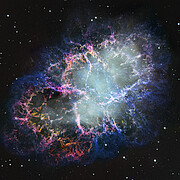
NASA’s Hubble Revisits Crab Nebula to Track 25 Years of Expansion

PR Image heic2607a
Crab Nebula (2024 Hubble image)

PR Image heic2607b
Crab Nebula (new image from 1999/2000 data)

PR Image heic2607c
Crab Nebula (2024 Hubble image, annotated)

PR Image heic2607d
Crab Nebula (new image from 1999/2000 data, annotated)


Videos

The Crab Nebula
PR Video heic2607a
The Crab Nebula
Pan Video: The Crab Nebula (2024 Hubble image)
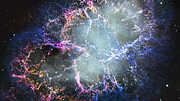
PR Video heic2607b
Pan Video: The Crab Nebula (2024 Hubble image)

Pan Video: The Crab Nebula (new Hubble image from 1999/2000 data)
PR Video heic2607c
Pan Video: The Crab Nebula (new Hubble image from 1999/2000 data)


Nearly a millennium ago, astronomers witnessed a brilliant new star blazing in the sky — a supernova so bright it was visible in daylight for weeks. Today, its expanding remnant, the Crab Nebula, continues to evolve 6,500 light-years away. First linked to historical records by Edwin Hubble, the nebula has since been studied in exquisite detail by the NASA/ESA Hubble Space Telescope, which has now revisited this ancient explosion to trace its ongoing expansion and transformation.

A quarter-century after its first observations of the full Crab Nebula, the Hubble Space Telescope has taken a fresh look at the supernova remnant. The Crab Nebula is the aftermath of SN 1054, located 6,500 light-years from Earth in the constellation Taurus.

The result is an unparalleled, detailed look at the aftermath of a supernova and how it has evolved over Hubble’s long lifetime. A paper detailing the new Hubble observation is published in The Astrophysical Journal.

The supernova remnant was discovered in the mid-18th century, and in the 1950s Edwin Hubble was among several astronomers who noted the close correlation between Chinese astronomical records of a supernova and the position of the Crab Nebula. The discovery that the heart of the Crab contained a pulsar — a rapidly rotating neutron star — that was powering the nebula’s expansion finally aligned modern observations and ancient records.

In its new image of the nebula, Hubble has captured extraordinary details of its filamentary structure, as well as the considerable outward movement of those filaments over 25 years, at a pace of 5.5 million kilometres per hour. Hubble is the only telescope with the combination of longevity and resolution capable of capturing these detailed changes.

For better comparison with the new image, Hubble’s 1999 image of the Crab was re-processed. The variation of colors in both of the Hubble images shows a combination of changes in local temperature and density of the gas as well as its chemical omposition.

The science team has noted that the filaments around the periphery of the nebula appear to have moved more compared to those in the centre and that rather than stretching out over time, they appear to have simply moved outward. This is due to the nature of the Crab as a pulsar wind nebula powered by synchrotron radiation, which is created by the interaction between the pulsar’s magnetic field and the nebula’s material. In other well-known supernova remnants, the expansion is instead driven by shockwaves from the initial explosion, eroding surrounding shells of gas that the dying star previously cast off.

The new, higher-resolution Hubble observations are also providing additional insights into the 3D structure of the Crab Nebula, which can be difficult to determine from a 2D image. Shadows of some of the filaments can be seen cast onto the haze of synchrotron radiation in the nebula’s interior. Counterintuitively, some of the brighter filaments in the latest Hubble images show no shadows, indicating they must be located on the far side of the nebula.

According to the science team, the real value of Hubble’s Crab Nebula observations is still to come. The Hubble data can be paired with recent data from other telescopes that are observing the Crab in different wavelengths of light. The NASA/ESA/CSA James Webb Space Telescope released its infrared-light observations of the Crab Nebula in 2024. Comparison of the Hubble image with other contemporary multiwavelength observations will help scientists put together a more complete picture of the supernova’s continuing aftermath, centuries after astronomers first wondered at a new little star twinkling in the sky.


More information

The Hubble Space Telescope is a project of international cooperation between ESA and NASA.

Image Credit: NASA, ESA, STScI, W. Blair (JHU). Image Processing: J. DePasquale (STScI)


Links


Contacts

Bethany Downer
ESA/Hubble Chief Science Communications Officer
Email:
Bethany.Downer@esahubble.org


Tuesday, July 12, 2022

NASA’s Webb Captures Dying Star’s Final ‘Performance’ in Fine Detail

Southern Ring Nebula (NIRCam and MIRI Images Side by Side)
Credits: Image: NASA, ESA, CSA, STScI

Release images


Some stars save the best for last.

The dimmer star at the center of this scene has been sending out rings of gas and dust for thousands of years in all directions, and NASA’s James Webb Space Telescope has revealed for the first time that this star is cloaked in dust.

Two cameras aboard Webb captured the latest image of this planetary nebula, cataloged as NGC 3132, and known informally as the Southern Ring Nebula. It is approximately 2,500 light-years away.

Webb will allow astronomers to dig into many more specifics about planetary nebulae like this one – clouds of gas and dust expelled by dying stars. Understanding which molecules are present, and where they lie throughout the shells of gas and dust will help researchers refine their knowledge of these objects.

This observation shows the Southern Ring Nebula almost face-on, but if we could rotate it to view it edge-on, its three-dimensional shape would more clearly look like two bowls placed together at the bottom, opening away from one another with a large hole at the center.

Two stars, which are locked in a tight orbit, shape the local landscape. Webb's infrared images feature new details in this complex system. The stars – and their layers of light – are prominent in the image from Webb’s Near-Infrared Camera (NIRCam) on the left, while the image from Webb’s Mid-Infrared Instrument (MIRI) on the right shows for the first time that the second star is surrounded by dust. The brighter star is in an earlier stage of its stellar evolution and will probably eject its own planetary nebula in the future.

In the meantime, the brighter star influences the nebula’s appearance. As the pair continues to orbit one another, they “stir the pot” of gas and dust, causing asymmetrical patterns.

Each shell represents an episode where the fainter star lost some of its mass. The widest shells of gas toward the outer areas of the image were ejected earlier. Those closest to the star are the most recent. Tracing these ejections allows researchers to look into the history of the system.

Observations taken with NIRCam also reveal extremely fine rays of light around the planetary nebula. Starlight from the central stars streams out where there are holes in the gas and dust – like sunlight through gaps in a cloud.

Since planetary nebulae exist for tens of thousands of years, observing the nebula is like watching a movie in exceptionally slow motion. Each shell the star puffed off gives researchers the ability to precisely measure the gas and dust that are present within it.

As the star ejects shells of material, dust and molecules form within them – changing the landscape even as the star continues to expel material. This dust will eventually enrich the areas around it, expanding into what’s known as the interstellar medium. And since it’s very long-lived, the dust may end up traveling through space for billions of years and become incorporated into a new star or planet.

In thousands of years, these delicate layers of gas and dust will dissipate into surrounding space.

The James Webb Space Telescope is the world's premier space science observatory. Webb will solve mysteries in our solar system, look beyond to distant worlds around other stars, and probe the mysterious structures and origins of our universe and our place in it. Webb is an international program led by NASA with its partners, ESA (European Space Agency) and the Canadian Space Agency.

NASA Headquarters oversees the mission for the agency’s Science Mission Directorate. NASA’s Goddard Space Flight Center in Greenbelt, Maryland, manages Webb for the agency and oversees work on the mission performed by the Space Telescope Science Institute, Northrop Grumman, and other mission partners. In addition to Goddard, several NASA centers contributed to the project, including the agency’s Johnson Space Center in Houston, Jet Propulsion Laboratory in Southern California, Marshall Space Flight Center in Huntsville, Alabama, Ames Research Center in California’s Silicon Valley, and others.

NIRCam was built by a team at the University of Arizona and Lockheed Martin’s Advanced Technology Center.

MIRI was contributed by ESA and NASA, with the instrument designed and built by a consortium of nationally funded European Institutes (The MIRI European Consortium) in partnership with JPL and the University of Arizona.

For a full array of Webb’s first images and spectra, including downloadable files, please visit: https://webbtelescope.org/news/first-images


Credits:

Release: NASA, ESA, CSA, STScI

Permissions:
Content Use Policy

Contact Us: Direct inquiries to the News Team.

Thursday, February 02, 2017

Celestial Cat Meets Cosmic Lobster

The Cat’s Paw and Lobster Nebulae

PR Image eso1705b
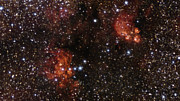
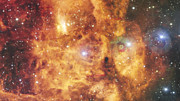
Highlights from VST image of Cat’s Paw and Lobster Nebulae

PR Image eso1705c
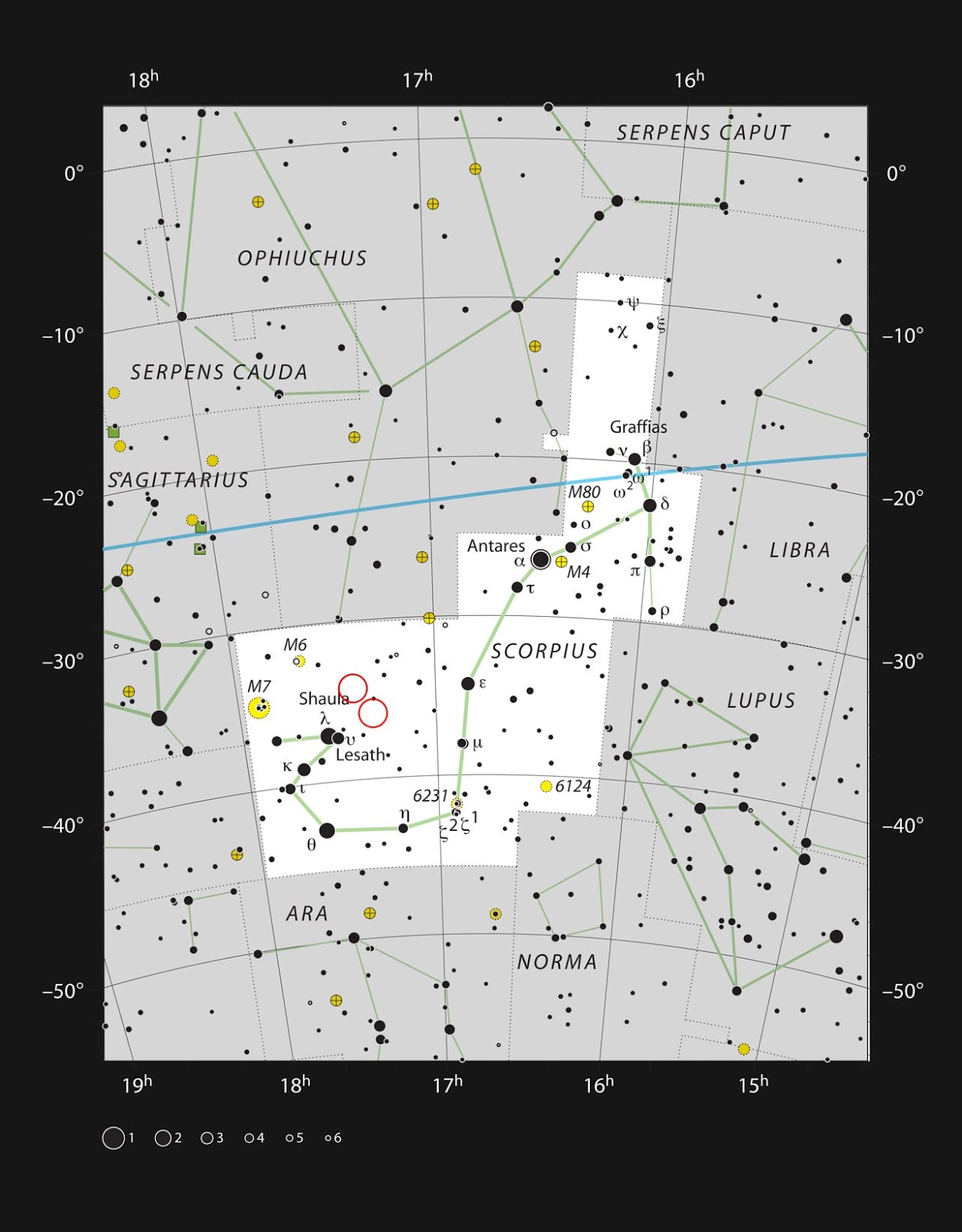
The star formation regions NGC 6334 and NGC 6357 in the constellation of Scorpius


Videos
 
ESOcast 94 Light: Celestial Cat Meets Cosmic Lobster 4K UHD

Zooming in on the Cat’s Paw and Lobster Nebulae

Panning across the Cat’s Paw and Lobster Nebulae


Astronomers have for a long time studied the glowing, cosmic clouds of gas and dust catalogued as NGC 6334 and NGC 6357, this gigantic new image from ESO’s Very Large Telescope Survey Telescope being only the most recent one. With around two billion pixels this is one of the largest images ever released by ESO. The evocative shapes of the clouds have led to their memorable names: the Cat’s Paw Nebula and the Lobster Nebula, respectively. 

NGC 6334 is located about 5500 light-years away from Earth, while NGC 6357 is more remote, at a distance of 8000 light-years. Both are in the constellation of Scorpius (The Scorpion), near the tip of its stinging tail.

The British scientist John Herschel first saw traces of the two objects, on consecutive nights in June 1837, during his three-year expedition to the Cape of Good Hope in South Africa. At the time, the limited telescopic power available to Herschel, who was observing visually, only allowed him to document the brightest “toepad” of the Cat’s Paw Nebula. It was to be many decades before the true shapes of the nebulae became apparent in photographs — and their popular names coined.

The three toepads visible to modern telescopes, as well as the claw-like regions in the nearby Lobster Nebula, are actually regions of gas — predominantly hydrogen — energised by the light of brilliant newborn stars. With masses around 10 times that of the Sun, these hot stars radiate intense ultraviolet light. When this light encounters hydrogen atoms still lingering in the stellar nursery that produced the stars, the atoms become ionised. Accordingly, the vast, cloud-like objects that glow with this light from hydrogen (and other) atoms are known as emission nebulae.

Thanks to the power of the 256-megapixel OmegaCAM camera, this new Very Large Telescope Survey Telescope (VST) image reveals tendrils of light-obscuring dust rippling throughout the two nebulae. At 49511 x 39136 pixels this is one of the largest images ever released by ESO.

OmegaCAM is a successor to ESO’s celebrated Wide Field Imager (WFI), currently installed at the MPG/ESO 2.2-metre telescope on La Silla. The WFI was used to photograph the Cat’s Paw Nebula in 2010, also in visible light but with a filter that allowed the glow of hydrogen to shine through more clearly (eso1003). Meanwhile, ESO’s Very Large Telescope has taken a deep look into the Lobster Nebula, capturing the many hot, bright stars that influence the object’s colour and shape (eso1226).

Despite the cutting-edge instruments used to observe these phenomena, the dust in these nebulae is so thick that much of their content remains hidden to us. The Cat’s Paw Nebula is one of the most active stellar nurseries in the night sky, nurturing thousands of young, hot stars whose visible light is unable to reach us. However, by observing at infrared wavelengths, telescopes such as ESO’s VISTA can peer through the dust and reveal the star formation activity within.

Viewing nebulae in different wavelengths (colours) of light gives rise to different visual comparisons on the part of human observers. When seen in longer wavelength infrared light, for example, one portion of NGC 6357 resembles a dove, and the other a skull; it has therefore acquired the additional name of the War and Peace Nebula.


More Information

ESO is the foremost intergovernmental astronomy organisation in Europe and the world’s most productive ground-based astronomical observatory by far. It is supported by 16 countries: Austria, Belgium, Brazil, the Czech Republic, Denmark, France, Finland, Germany, Italy, the Netherlands, Poland, Portugal, Spain, Sweden, Switzerland and the United Kingdom, along with the host state of Chile. ESO carries out an ambitious programme focused on the design, construction and operation of powerful ground-based observing facilities enabling astronomers to make important scientific discoveries. ESO also plays a leading role in promoting and organising cooperation in astronomical research. ESO operates three unique world-class observing sites in Chile: La Silla, Paranal and Chajnantor. At Paranal, ESO operates the Very Large Telescope, the world’s most advanced visible-light astronomical observatory and two survey telescopes. VISTA works in the infrared and is the world’s largest survey telescope and the VLT Survey Telescope is the largest telescope designed to exclusively survey the skies in visible light. ESO is a major partner in ALMA, the largest astronomical project in existence. And on Cerro Armazones, close to Paranal, ESO is building the 39-metre European Extremely Large Telescope, the E-ELT, which will become “the world’s biggest eye on the sky”.


Links


Contacts

Richard Hook
ESO Public Information Officer
Garching bei München, Germany
Tel: +49 89 3200 6655
Cell: +49 151 1537 3591
Email: rhook@eso.org


Source: ESO