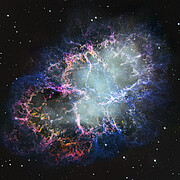
Figure 2: Artist impressions of a super-asymptotic giant branch star (left) and its core (right) made up of oxygen (O), neon (Ne), and magnesium (Mg). A super-asymptotic giant branch star is the end state of stars in a mass range of around 8-10 solar masses, whose core is pressure supported by electrons (e-). When the core becomes dense enough, neon and magnesium start to eat up electrons (so called electron-capture reactions), reducing the core pressure and inducing a core-collapse supernova explosion. (Credit: S. Wilkinson; Las Cumbres Observatory)
A worldwide team of researchers has discovered the
first convincing evidence for a new type of stellar explosion,
theorized 40 years ago by Kavli Institute for the Physics and
Mathematics Senior Scientist Ken’ichi Nomoto; the new study was
published in Nature Astronomy on June 28.
Electron-capture supernovae Nomoto theorized in
the early 1980s are thought to arise from the explosions of massive
super-asymptotic giant branch (SAGB) stars, for which there has also
been scant evidence. The new discovery sheds light on the thousand-year
mystery of the supernova from 1054AD that was seen all over the world in
the daytime, before eventually becoming the Crab Nebula.
"I am very pleased that the electron-capture
supernova has finally been discovered, which my colleagues and I
predicted to exist, and connected to the Crab Nebula, 40 years ago. I
very much appreciate the great efforts of observations that confirmed
the old theoretical predictions, which is a wonderful example of the
combination between observation and theory," said Nomoto.
Historically, there have been two main supernova
types. One is the thermonuclear supernova - the explosion of a white
dwarf star that gains matter in a binary system. These white dwarfs are
the dense cores of ash that remain after a low-mass star (one up to
about 8 times the mass of the Sun) reaches the end of its life. Another
main supernova type is a core-collapse supernova where a massive star,
one more than about 10 times the mass of the Sun, runs out of nuclear
fuel and has its iron core collapse, creating a black hole or neutron
star. The electron-capture supernovae are in between these two types of
supernovae. They push the boundary of core-collapse supernovae down to
about 8 solar masses and explode by a different mechanism.
While gravity is always trying to crush a star,
what keeps most stars from collapsing is that you can’t pack the atoms
in their cores any tighter. But in an electron-capture supernova, the
star is so massive that some of the electrons in atoms in the core get
smashed into their atomic nuclei, called an electron capture. This
causes the core of the star to buckle under its own weight and collapse,
resulting in an electron-capture supernova.
Using recently updated electron-capture rates, Nomoto and collaborators had been able to reconfirm their theoretical predictions.
Over the decades, theorists including Nomoto have
formulated predictions of what to look for in an electron-capture
supernova and their SAGB star progenitors. The stars should have a lot
of mass, lose much of it before exploding, and this mass near the dying
star should be on an unusual chemical composition. Then the
electron-capture supernova should be weak, have little radioactive
fallout, and have neutron-rich elements in the core.
The new study, led by Daichi Hiramatsu, a graduate
student at the University of California, Santa Barbara, and Las Cumbres
Observatory, and a core member of the Global Supernova Project, a
worldwide team of researchers using dozens of telescopes around and
above the globe. The team found that the supernova SN 2018zd had many
unusual characteristics, some of which were seen for the first time in a
supernova.
It helped that the supernova was relativity
nearby, only 31 million light-years away, in the galaxy NGC 2146. This
allowed the team to examine archival images taken prior to the explosion
from the Hubble Space telescope and to detect the likely progenitor
star before it exploded. The observations were consistent with another
recently identified SAGB star in the Milky Way, but inconsistent with
models of the progenitors of normal core-collapse supernovae, red
supergiants.
The study looked through all published data on
supernovae, and found that while some supernovae had a few of the
indicators predicted for electron capture supernovae, only SN 2018zd had
all six – an apparent SAGB progenitor, strong pre-supernova mass loss,
an unusual stellar chemical composition, a weak explosion, little
radioactivity, and a neutron-rich core.
The leader of the study, Daichi Hiramatsu said,
“We started by asking ‘what’s this weirdo?’ Then we examined every
aspect of SN 2018zd and realized that all of them can be explained in
the electron-capture scenario.”
The new discoveries also illuminate some mysteries
of the most famous supernova of the past. In 1054 AD a supernova
happened in the Milky Way
Galaxy, and according to Chinese and Japanese
records was so bright that it could be seen in the daytime for 23 days,
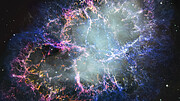
and at night nearly for two years. The resulting remnant, the Crab
Nebula, has been studied in great detail. It was previously the best
candidate for an electron-capture supernova, but this was uncertain
partly because the explosion happened nearly a thousand years ago. The
new result increases the confidence that SN 1054 was an electron-capture
supernova. It also explains why that supernova was relatively bright
compared to the models. Its luminosity was probably artificially
enhanced by the supernova ejecta colliding with material cast off by the
progenitor star as was seen in SN 2018zd.
Paper details
Journal: Nature Astronomy
Title: The electron-capture origin of supernova 2018zd
Authors:
Daichi Hiramatsu (1,2), D. Andrew Howell
(1,2), Schuyler D. Van Dyk (3), Jared A. Goldberg (2), Keiichi Maeda
(4,5), Takashi J. Moriya (6,7), Nozomu Tominaga (8, 5, 6), Ken’ichi
Nomoto (5), Griffin Hosseinzadeh (9), Iair Arcavi (10,11), Curtis
McCully (1,2), Jamison Burke (1,2), K. Azalee Bostroem (12), Stefano
Valenti (12), Yize Dong (12), Peter J. Brown (13), Jennifer E. Andrews
(14), Christopher Bilinski (14), G. Grant Williams (14,15), Paul S.
Smith (14), Nathan Smith (14), David J. Sand (14), Gagandeep S. Anand
(16,17), Chengyuan Xu (18), Alexei V. Filippenko (19,20), Melina C.
Bersten (21,22, 5), Gastón Folatelli (21,22, 5), Patrick L. Kelly (23),
Toshihide Noguchi (24) and Koichi Itagaki (25)
Author affiliations:
1. Las Cumbres Observatory, Goleta, CA, USA.
2. Department of Physics, University of California, Santa Barbara, CA, USA.
3. Caltech/Spitzer Science Center, Caltech/IPAC, Pasadena, CA, USA.
4. Department of Astronomy, Kyoto University, Kyoto, Japan.
5. Kavli Institute for the Physics and Mathematics of the Universe
(WPI), The University of Tokyo Institutes for Advanced Study, The
University of Tokyo, Kashiwa, Japan.
6. National Astronomical Observatory of Japan, National Institutes of Natural Sciences, Mitaka, Japan.
7. School of Physics and Astronomy, Faculty of Science, Monash University, Clayton, Victoria, Australia.
8. Department of Physics, Faculty of Science and Engineering, Konan University, Hyogo, Japan.
9. Center for Astrophysics ∣ Harvard & Smithsonian, Cambridge, MA, USA.
10. The School of Physics and Astronomy, Tel Aviv University, Tel Aviv, Israel.
11. CIFAR Azrieli Global Scholars program, CIFAR, Toronto, Ontario, Canada.
12. Department of Physics, University of California, Davis, CA, USA.
13. Mitchell Institute for Fundamental Physics and Astronomy, Texas A&M University, College Station, TX, USA.
14. Steward Observatory, University of Arizona, Tucson, AZ, USA.
15. MMT Observatory, Tucson, AZ, USA.
16. Infrared Processing and Analysis Center, California Institute of Technology, Pasadena, CA, USA.
17. Institute for Astronomy, University of Hawai‘i, Honolulu, HI, USA.
18. Media Arts and Technology, University of California, Santa Barbara, CA, USA.
19. Department of Astronomy, University of California, Berkeley, CA, USA.
20. Miller Institute for Basic Research in Science, University of California, Berkeley, CA, USA.
21. Instituto de Astrofísica de La Plata (IALP), CONICET, Argentina.
22. Facultad de Ciencias Astronómicas y Geofísicas, Universidad Nacional de La Plata, La Plata, Argentina.
23. School of Physics and Astronomy, University of Minnesota, Minneapolis, MN, USA.
24. Noguchi Astronomical Observatory, Katori, Japan.
25. Itagaki Astronomical Observatory, Yamagata, Japan.
DOI: https://doi.org/10.1038/s41550-021-01384-2 (Posted on June 28, 2021)
Preprint (arXiv.org page)
Paper abstract (Nature Astronomy)
Research contact
Ken’ichi Nomoto
Senior Scientist
Kavli Institute for the Physics and Mathematics of the Universe, University of Tokyo
E-mail: nomoto@astron.s.u-tokyo.ac.jp
Media contact
Motoko Kakubayashi
Press officer
Kavli Institute for the Physics and Mathematics of the Universe, The University of Tokyo
E-mail: press@ipmu.jp
TEL: 080-4056-2767
Source:Kavli Institute for the Physics and Mathematics of the Universe (Kavli IPMU)