Showing posts with label Dorado Constellation. Show all posts

Thursday, September 10, 2026

A superbubble scene

TA dense field of stars fills the image, surrounded by wispy clouds of gas and dust. Pale blue and grey nebulosity forms an intricate web across the scene, with darker clouds of dust concentrated towards the lower right. Numerous bright stars appear in shades of blue, white and orange. Credit: ESA/Hubble & NASA, D. Gouliermis.


This sprawling cosmic vista and subject of today’s ESA/Hubble Picture of the Month comes from the Large Magellanic Cloud, or LMC. The LMC is the largest of the small galaxies that orbit our Milky Way galaxy. At just 160 000 light-years away, the LMC offers a close look at highly active stellar birthsites like the nebula shown here. This nebula is named LHA 120-N44, or N44 for short, and it’s located in the constellation Dorado.

The appearance of this photogenic nebula is dominated by two features: a vast central void and a shell of dense, dusty gas. The central void is a ‘superbubble’ spanning roughly 210 by 140 light-years. The glittering stars at the centre of the void are responsible for its creation; through their powerful stellar winds and explosive supernovae, these stars have expelled much of the gas from which they were born.

When the stars of N44’s central star cluster swept away this gas, the expelled gas formed a shell around the superbubble. New stars are forming in this compressed gas shell, making N44 an interesting target for researchers studying the process of star formation. In particular, astronomers have turned to this nebula as an ideal place to time this process from start to finish. Their goal is to understand how long it takes from the collapse of cold gas clouds into dense knots to the moment nuclear fusion ignites in the heart of a newborn star.

Researchers used Hubble to survey N44 and take a census of its stars, cataloguing nearly half a million stars within the cluster as well as interlopers drifting in front of it. Of the stars surveyed, nearly 30 000 are what astronomers call pre-main-sequence stars, which have yet to begin fusing hydrogen into helium in their cores. This treasure trove of baby stars was discoverable thanks to the high sensitivity and fine spatial resolution of Hubble’s instruments that can pick out faint objects in crowded clusters.

The gas shell surrounding the superbubble is energised by ultraviolet radiation from massive stars, causing it to glow and highlighting several distinct features. Each feature within the broader N44 star-forming complex was catalogued by astronomer Karl Henize in the 1950s. One feature is a smaller bubble, catalogued as N44F, that is located near the upper-right corner of this image. N44F is an interstellar bubble blown by the intense stellar winds of a single hot and massive star. As this previously released Hubble closeup shows, the star’s furious winds and radiation have sculpted the surrounding bubble and created pillars of dusty gas.

The data used to create this image come from an observing programme (#14689; PI: Gouliermis) that aimed to probe stars in the N44 complex that have not yet begun fusing hydrogen into heavier elements in their cores. These data help to determine how long the process of star formation takes, as well as what masses newborn stars typically have. Hubble's sensitive observations of the lowest-mass stars in this region open a new window onto star formation in regions that, like the LMC or the galaxies of the early Universe, are poor in elements heavier than helium.


Links


Wednesday, August 06, 2025

A sea monster and a Tarantula

A nebula. The top-left is dense with layers of fluffy pink and greenish clouds. Long strands of green clouds stretch out from here; a faint layer of translucent blue dust combines with them to create a three-dimensional scene. A sparse network of dark dust clouds in the foreground adds reddish-black patches atop the nebula. Blue-white and orange stars, from our galaxy and beyond, are spread amongst the clouds. Credit: ESA/Hubble & NASA, C. Murray


A scene from a star-forming factory shines in this NASA/ESA Hubble Space Telescope Picture of the Week. This Hubble picture captures incredible details in the dusty clouds in a star-forming region called the Tarantula Nebula. What’s possibly the most amazing aspect of this detailed image is that this nebula isn’t even in our galaxy. Instead, it’s in the Large Magellanic Cloud, a dwarf galaxy that is located about 160 000 light-years away in the constellations Dorado and Mensa.

The Large Magellanic Cloud is the largest of the dozens of small satellite galaxies that orbit the Milky Way. The Tarantula Nebula is the largest and brightest star-forming region not just in the Large Magellanic Cloud, but in the entire group of nearby galaxies to which the Milky Way belongs.

The Tarantula Nebula is home to the most massive stars known, some of which are roughly 200 times as massive as our Sun. The scene pictured here is located away from the centre of the nebula, where there is a super star cluster called R136, but very close to a rare type of star called a Wolf–Rayet star. Wolf–Rayet stars are massive stars that have lost their outer shell of hydrogen and are extremely hot and luminous, powering dense and furious stellar winds.

This nebula is a frequent target for Hubble, whose multiwavelength capabilities are critical for capturing sculptural details in the nebula’s dusty clouds. The data used to create this image come from an observing programme called Scylla, named for a multi-headed sea monster from the Greek myth of Ulysses. The Scylla programme was designed to complement another Hubble observing programme called ULYSSES (Ultraviolet Legacy library of Young Stars as Essential Standards). ULYSSES targets massive young stars in the Small and Large Magellanic Clouds, while Scylla investigates the structures of gas and dust that surround these stars.


Tuesday, July 15, 2025

Digging up a galactic time capsule

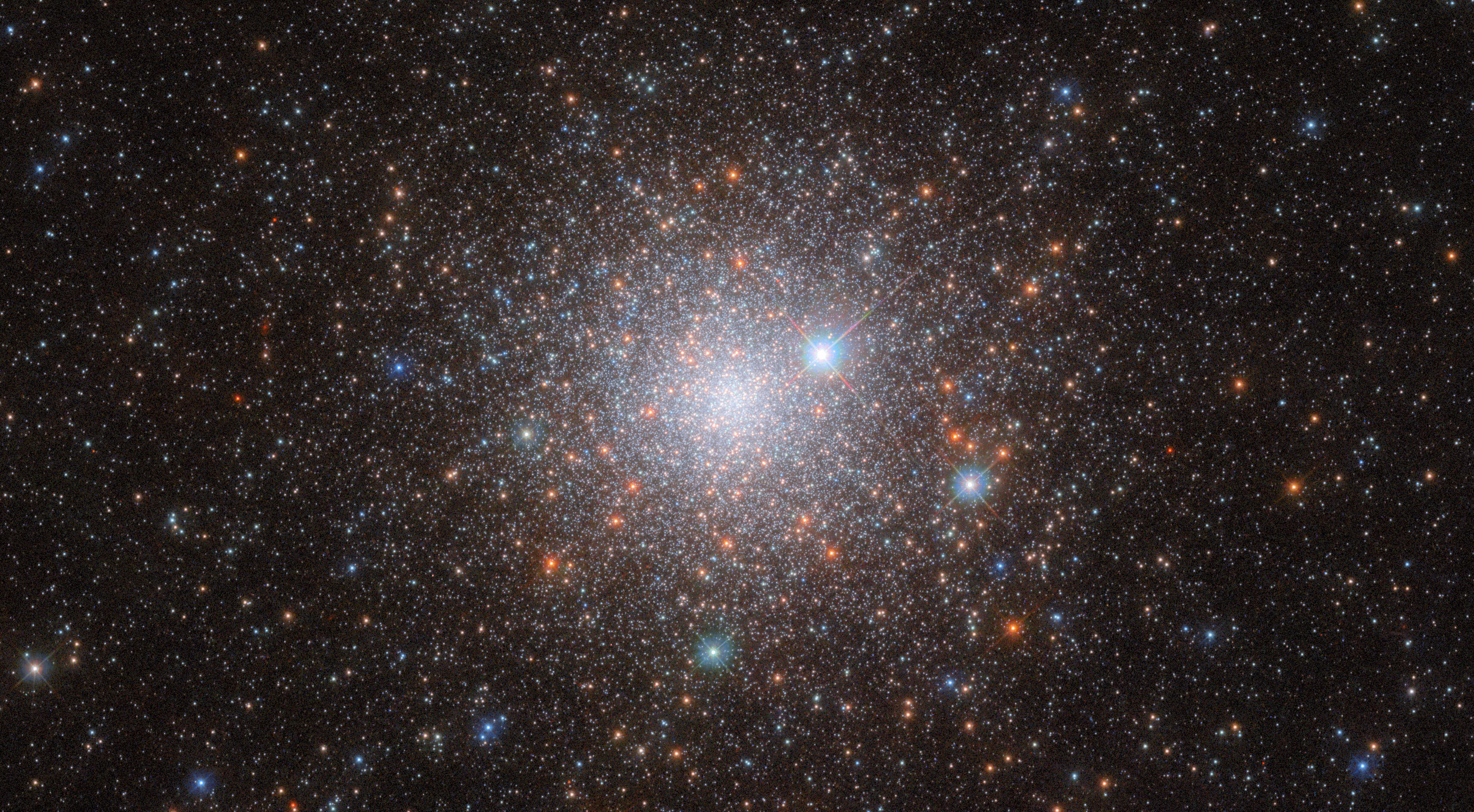
A cluster of stars in space. It’s bright in the centre, where the stars are densely packed together in the cluster’s core, and grows dimmer and more diffuse out to the edges, as the stars give way to the dark background of space. A few orange stars are spread across the cluster, but most are pale, bluish-white points of light. Three large stars with cross-shaped spikes around them lie between us and the cluster. Credit: ESA/Hubble & NASA, M. Monelli Acknowledgement: M. H. Özsaraç

For this ESA/Hubble Picture of the Week, we gaze upon the field of stars that is NGC 1786. This object is a globular cluster in the Large Magellanic Cloud (LMC), a small satellite galaxy of the Milky Way Galaxy that is approximately 160 000 light-years away from Earth. NGC 1786 itself is in the constellation Dorado. It was discovered in the year 1835 by John Herschel.

The data for this image comes from an observing programme comparing old globular clusters in nearby dwarf galaxies — the LMC, the Small Magellanic Cloud and the Fornax dwarf spheroidal galaxy — to the globular clusters in the Milky Way galaxy. Our galaxy contains over 150 of these old, spherical collections of tightly-bound stars, which have been studied in depth — especially with Hubble Space Telescope images like this one, which show them in previously-unattainable detail. Being very stable and long-lived, they act as galactic time capsules, preserving stars from the earliest stages of a galaxy’s formation.

Astronomers once thought that the stars in a globular cluster all formed together at about the same time, but study of the old globular clusters in our galaxy has uncovered multiple populations of stars with different ages. In order to use globular clusters as historical markers, we must understand how they form and where these stars of varying ages come from. This observing programme examined old globular clusters like NGC 1786 in these external galaxies to see if they, too, contain multiple populations of stars. This research can tell us more not only about how the LMC was originally formed, but the Milky Way Galaxy, too.


Tuesday, February 11, 2025

Cosmic cloudscape

A portion of a nebula, made of variously-coloured layers of dust clouds. One upper layer is dark reddish dust which is dense and obscures light, in places so dense that it appears black. A middle layer is pale clouds that are thick like curling wisps of smoke. They form a broad bow across the centre of the image. Many small, bright stars lie throughout the nebula, coloured blue, purple or red depending on depth. Credit: ESA/Hubble & NASA, C. Murray

The Universe is a dusty place, as this NASA/ESA Hubble Space Telescope Picture of the Week shows. Featured in this image are swirling clouds of gas and dust near the Tarantula Nebula in the Large Magellanic Cloud. About 160 000 light-years away in the constellations Dorado and Mensa, the Large Magellanic Cloud is one of the nearest galaxies to the Milky Way. The Tarantula Nebula is the most productive star-forming region in the nearby Universe, home to the most massive stars known.

The colourful gas clouds of this nebula are crossed by wispy tendrils and dark clumps of dust. This dust is different from ordinary household dust, which can be made of bits of soil, skin cells, hair and even plastic. Cosmic dust tends to be made of carbon or of molecules called silicates, which contain silicon and oxygen. The data used to create this image were collected as part of an observing programme that aims to characterise the properties of cosmic dust in the Large Magellanic Cloud and other nearby galaxies.

Dust plays several important roles in the Universe. Even though individual dust grains are incredibly tiny, far smaller than the width of a single human hair, dust grains in discs around young stars clump together to form larger grains and eventually planets. Dust also helps cool clouds of gas so that they can condense into new stars. Dust even plays a role in making new molecules in interstellar space, providing a venue for individual atoms to find each other and bond together in the vastness of space.


Friday, January 24, 2025

A Tarantula’s outskirts

A section of a nebula, made up of layers of coloured clouds of gas, of varying thickness. In the background are bluish, translucent and wispy clouds; on top of these are stretches of redder and darker, clumpy dust, mostly along the bottom and right. In the bottom left corner are some dense bars of dust that block light and appear black. Small stars are scattered across the nebula. Credit: ESA/Hubble

Today’s NASA/ESA Hubble Space Telescope Picture of the Week features a dusty yet sparkling scene from one of the Milky Way’s satellite galaxies, the Large Magellanic Cloud. The Large Magellanic Cloud is a dwarf galaxy situated about 160 000 light-years away in the constellations Dorado and Mensa.

Despite being only 10–20% as massive as the Milky Way galaxy, the Large Magellanic Cloud contains some of the most impressive star-forming regions in the nearby Universe. The scene pictured here is on the outskirts of the Tarantula Nebula, the largest and most productive star-forming region in the local Universe. At its center, the Tarantula Nebula hosts the most massive stars known, which weigh in at roughly 200 times the mass of the Sun.

The section of the nebula shown here features serene blue gas, brownish-orange dust patches and a sprinkling of multicoloured stars. The stars within and behind the dust clouds appear redder than those that are not obscured by dust. Dust absorbs and scatters blue light more than red light, allowing more of the red light to reach our telescopes and making the stars appear redder than they are. This image incorporates ultraviolet and infrared light as well as visible light. Using Hubble observations of dusty nebulae in the Large Magellanic Cloud and other galaxies, researchers will study these distant dust grains, helping to understand the role that cosmic dust plays in the formation of new stars and planets.


Friday, September 13, 2024

Astronomers track bubbles on star’s surface in most detailed video yet

PR Image eso2412a
Detailed images of the surface of the star R Doradus

PR Image eso2412b
Detailed images of the surface of the star R Doradus (no annotations)

PR Image eso2412c
The star R Doradus in the constellation Dorado

PR Image eso2412d
Wide-field view of the region of the sky around the R Doradus star


Videos

Most detailed video yet of bubbles on a star’s surface
PR Video eso2412a
Most detailed video yet of bubbles on a star’s surface

Zooming in on the R Doradus star
PR Video eso2412b
Zooming in on the R Doradus star

Stellar bubbles captured by ALMA | ESO News
PR Video eso2412c
Stellar bubbles captured by ALMA | ESO News


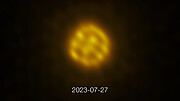
For the first time, astronomers have captured images of a star other than the Sun in enough detail to track the motion of bubbling gas on its surface. The images of the star, R Doradus, were obtained with the Atacama Large Millimeter/submillimeter Array (ALMA), a telescope co-owned by the European Southern Observatory (ESO), in July and August 2023. They show giant, hot bubbles of gas, 75 times the size of the Sun, appearing on the surface and sinking back into the star’s interior faster than expected.

“This is the first time the bubbling surface of a real star can be shown in such a way,“ [1] says Wouter Vlemmings, a professor at Chalmers University of Technology, Sweden, and lead author of the study published today in Nature. “We had never expected the data to be of such high quality that we could see so many details of the convection on the stellar surface.”

Stars produce energy in their cores through nuclear fusion. This energy can be carried out towards the star’s surface in huge, hot bubbles of gas, which then cool down and sink — like a lava lamp. This mixing motion, known as convection, distributes the heavy elements formed in the core, such as carbon and nitrogen, throughout the star. It is also thought to be responsible for the stellar winds that carry these elements out into the cosmos to build new stars and planets.

Convection motions had never been tracked in detail in stars other than the Sun, until now. By using ALMA, the team were able to obtain high-resolution images of the surface of R Doradus over the course of a month. R Doradus is a red giant star, with a diameter roughly 350 times that of the Sun, located about 180 light-years away from Earth in the constellation Dorado. Its large size and proximity to Earth make it an ideal target for detailed observations. Furthermore, its mass is similar to that of the Sun, meaning R Doradus is likely fairly similar to how our Sun will look like in five billion years, once it becomes a red giant.

“Convection creates the beautiful granular structure seen on the surface of our Sun, but it is hard to see on other stars,” adds Theo Khouri, a researcher at Chalmers who is a co-author of the study. “With ALMA, we have now been able to not only directly see convective granules  — with a size 75 times the size of our Sun! — but also measure how fast they move for the first time.”

The granules of R Doradus appear to move on a one-month cycle, which is faster than scientists expected based on how convection works in the Sun. “We don’t yet know what is the reason for the difference. It seems that convection changes as a star gets older in ways that we don't yet understand,” says Vlemmings. Observations like those now made of R Doradus are helping us to understand how stars like the Sun behave, even when they grow as cool, big and bubbly as R Doradus is.

“It is spectacular that we can now directly image the details on the surface of stars so far away, and observe physics that until now was mostly only observable in our Sun,” concludes Behzad Bojnodi Arbab, a PhD student at Chalmers who was also involved in the study.

Source: ESO/News


Notes

[1] Convection bubbles have been previously observed in detail on the surface of stars, including with the PIONIER instrument on ESO's Very Large Telescope Interferometer. But the new ALMA observations track the motion of the bubbles in a way that was not possible before.


More information

This research was presented in a paper entitled “One month convection timescale on the surface of a giant evolved star” to appear in Nature (doi:10.1038/s41586-024-07836-9).

The team is composed of W. Vlemmings (Chalmers University of Technology, Sweden [Chalmers]), T. Khouri (Chalmers), B. Bojnordi (Chalmers), E. De Beck (Chalmers), and M. Maercker (Chalmers).

The Atacama Large Millimeter/submillimeter Array (ALMA), an international astronomy facility, is a partnership of ESO, the U.S. National Science Foundation (NSF) and the National Institutes of Natural Sciences (NINS) of Japan in cooperation with the Republic of Chile. ALMA is funded by ESO on behalf of its Member States, by NSF in cooperation with the National Research Council of Canada (NRC) and the National Science and Technology Council (NSTC) in Taiwan and by NINS in cooperation with the Academia Sinica (AS) in Taiwan and the Korea Astronomy and Space Science Institute (KASI). ALMA construction and operations are led by ESO on behalf of its Member States; by the National Radio Astronomy Observatory (NRAO), managed by Associated Universities, Inc. (AUI), on behalf of North America; and by the National Astronomical Observatory of Japan (NAOJ) on behalf of East Asia. The Joint ALMA Observatory (JAO) provides the unified leadership and management of the construction, commissioning and operation of ALMA.

The European Southern Observatory (ESO) enables scientists worldwide to discover the secrets of the Universe for the benefit of all. We design, build and operate world-class observatories on the ground — which astronomers use to tackle exciting questions and spread the fascination of astronomy — and promote international collaboration for astronomy. Established as an intergovernmental organisation in 1962, today ESO is supported by 16 Member States (Austria, Belgium, Czechia, Denmark, France, Finland, Germany, Ireland, Italy, the Netherlands, Poland, Portugal, Spain, Sweden, Switzerland and the United Kingdom), along with the host state of Chile and with Australia as a Strategic Partner. ESO’s headquarters and its visitor centre and planetarium, the ESO Supernova, are located close to Munich in Germany, while the Chilean Atacama Desert, a marvellous place with unique conditions to observe the sky, hosts our telescopes. ESO operates three observing sites: La Silla, Paranal and Chajnantor. At Paranal, ESO operates the Very Large Telescope and its Very Large Telescope Interferometer, as well as survey telescopes such as VISTA. Also at Paranal ESO will host and operate the Cherenkov Telescope Array South, the world’s largest and most sensitive gamma-ray observatory. Together with international partners, ESO operates ALMA on Chajnantor, a facility that observes the skies in the millimetre and submillimetre range. At Cerro Armazones, near Paranal, we are building “the world’s biggest eye on the sky” — ESO’s Extremely Large Telescope. From our offices in Santiago, Chile we support our operations in the country and engage with Chilean partners and society.


Links


Contacts

Wouter Vlemmings
Chalmers University of Technology
Gothenburg, Sweden
Tel: +46 31 772 63 54
Email:
wouter.vlemmings@chalmers.se

Theo Kouri
Chalmers University of Technology
Gothenburg, Sweden
Tel: +46 31 772 6022
Email:
theo.khouri@chalmers.se

Behzad Bojnodi Arbab
Chalmers University of Technology
Gothenburg, Sweden
Email:
bojnordi@chalmers.se

Bárbara Ferreira
ESO Media Manager
Garching bei München, Germany
Tel: +49 89 3200 6670
Cell: +49 151 241 664 00
Email:
press@eso.org