Showing posts with label distant galaxies. Show all posts

Tuesday, August 04, 2026

NSF–DOE Rubin Observatory Opens Deep Window on Famous Cosmic Field

PR Image noirlab2618a
Rubin Looks Deep Into a Famous Cosmic Field

PR Image noirlab2618b
Rubin Looks Deep Into a Famous Cosmic Field (selected excerpts)

PR Image noirlab2618c
Footprints on COSMOS


Videos

Zoom on Rubin Observatory’s Image of the COSMOS Field
PR Video noirlab2618a
Zoom on Rubin Observatory’s Image of the COSMOS Field
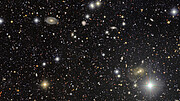
Pan on Rubin Observatory’s Image of the COSMOS Field
PR Video noirlab2618b
Pan on Rubin Observatory’s Image of the COSMOS Field


A new NSF–DOE Vera C. Rubin Observatory image featuring hundreds of thousands of distant galaxies in and around the COSMOS field marks the Observatory’s first LSST Camera image and catalog release for science

A new image from NSF–DOE Vera C. Rubin Observatory offers a spectacularly deep view into a famous region of sky known as the COSMOS field. Located in the constellation Sextans, COSMOS is one of the most observed patches of the Universe — and Rubin’s new image adds a powerful new view of this well-known cosmic landmark.

Packed into this single image from Rubin Observatory are many different kinds of galaxies: spirals with delicate arms, smooth elliptical galaxies, distorted merging galaxies, and faint red galaxies from the distant Universe. Only a relatively small number of bright stars from our own Milky Way appear in the foreground, leaving an unusually clear view of galaxies stretching far into the distance.

Rubin Observatory is jointly funded by the U.S. National Science Foundation (NSF) and the U.S. Department of Energy's Office of Science (DOE/SC).

This image was captured with Rubin’s 3.2-gigapixel LSST Camera — the largest digital camera in the world, mounted on the 8.4-meter Simonyi Survey Telescope. It features the well-known and well-studied region of sky known as the COSMOS field. It was created by stacking hundreds of individual observations and contains more than half a million galaxies and more than 50,000 stars.

The COSMOS field is especially valuable to astronomers because it looks away from the crowded plane of our Milky Way. With fewer nearby stars and clouds of dust blocking the view, telescopes can see enormous numbers of distant galaxies, many so far away that their light has traveled for billions of years before reaching Earth. Looking deeper into space also means looking farther back in time, allowing scientists to study galaxies at many different stages in the history of the Universe.

Astronomers have studied COSMOS for more than two decades. Beginning with observations by the Hubble Space Telescope in 2003, researchers around the world have pointed many of the world’s leading telescopes at this same area, observing it in wavelengths ranging from radio waves to X-rays. Because the field has been observed so extensively, it serves as an important reference point for testing new data, comparing measurements, and combining information from many observatories.

Rubin now brings something new to this familiar field: a combination of depth, wide-field coverage, and repeated observations. By imaging COSMOS again and again with the LSST Camera, Rubin will complement earlier observations and add a dynamic view of the field. This perspective will help astronomers study not only what distant galaxies look like, but also how the sky changes over time.

Because of its scientific value, the COSMOS field is among the regions that will be observed more frequently than most areas included in the Legacy Survey of Space and Time (LSST) — Rubin’s ten-year survey aimed at creating the most comprehensive, cinematic record of the Universe in history. With added observations, Rubin will create an even deeper view, revealing fainter galaxies and finer details than can be seen in this first image.

This image is being released today to mark the occasion of Rubin’s Early Data Preview 2, or EDP2 — the first phase of Rubin’s Data Preview 2 release. EDP2 is Rubin’s first data preview based on observations from the LSST Camera [1]. It combines Rubin’s science validation observations collected between April 2025 and January 2026. It provides the Rubin science community with a deep co-added (stacked) image covering 3000 square degrees of night sky, which is around one-sixth of the entire visible Southern Hemisphere sky.

“The COSMOS deep image is just the beginning for Rubin in this region. Repeated visits to the field over the next few years will demonstrate the power of our survey design for discovery by providing our science community with a huge number of transient and variable objects like supernovae and other explosive transients for follow-up and detailed study,” says Bob Blum, Director of Rubin Observatory at NSF NOIRLab.

While EDP2 is not a release of data from the full LSST, which has only recently begun, it is a scientifically valuable data release in and of itself. The data preview gives scientists a rich look at the Southern Hemisphere sky, while allowing the Rubin science community to test tools, validate data products, and prepare for the decade-long survey ahead. Notably, EDP2 includes the COSMOS field, as well as the region of sky captured in Rubin’s Ocean of Stars image, which was released to celebrate the beginning of the LSST.

“The COSMOS field is a very important one for LSST science,” says Phil Marshall, Deputy Director of Rubin Observatory at SLAC. “Its wealth of prior observations, and its repeated targeting both during commissioning and as one of the LSST’s deep fields, will make it very valuable as a testing ground for scientists as they get ready to take on the survey data.”

With this new view of COSMOS, Rubin offers an early glimpse of the science to come: an extraordinarily deep and wide view of the Universe, revealing both the vast population of distant galaxies and the changing sky above Earth. Visit the Rubin Skyviewer app to explore this field in more detail.

Bob Blum adds: “As we celebrate the start of science with Rubin Observatory, our thoughts are with our staff and the community of Chile impacted by the recent devastating storms in the region of Coquimbo and beyond. Our priority is to ensure the well-being of our staff in the region and support the community where we live and work. This image marking the start of LSST science is dedicated to the people of the region of Coquimbo and is a small token of our gratitude for their decades of support for astronomy and the AURA Observatories in Chile.”

The second phase of EDP2, expected in the October–December 2026 timeframe, will add products derived from individual images. This includes the processed visit images from individual observations, difference images that show only detected changes, and the template images, which are compared to the individual visit images to produce the difference images

Access to EDP2 is available right now to researchers in the U.S. and Chile, as well as authorized international Rubin data-rights holders. In keeping with Rubin Observatory’s data-access policy, the data products will be made openly available to the public after a two-year proprietary period.


Notes

[1] Rubin’s Data Preview 1 (DP1), released in June 2025, contained observations from October–December 2024 taken with the LSST Commissioning Camera — a much smaller version of the LSST Camera that was used to conduct test campaigns.


More information

NSF–DOE Vera C. Rubin Observatory, funded by the U.S. National Science Foundation and the U.S. Department of Energy’s Office of Science, is a groundbreaking new astronomy and astrophysics observatory on Cerro Pachón in Chile. It is named after astronomer Vera Rubin, who provided the first convincing evidence for the existence of dark matter. Using the largest camera ever built, Rubin will repeatedly scan the sky for 10 years to create an ultra-wide, ultra-high-definition, time-lapse record of our Universe.

NSF–DOE Vera C. Rubin Observatory is a joint initiative of the U.S. National Science Foundation (NSF) and the U.S. Department of Energy’s Office of Science (DOE/SC). Its primary mission is to carry out the Legacy Survey of Space and Time, providing an unprecedented data set for scientific research supported by both agencies. Rubin is operated jointly by NSF NOIRLab and SLAC National Accelerator Laboratory. NSF NOIRLab is managed by the Association of Universities for Research in Astronomy (AURA) and SLAC is operated by Stanford University for the DOE. France provides key support to the construction and operations of Rubin Observatory through contributions from CNRS/IN2P3. The Science and Technology Facilities Council supports the wide range of UK contributions to Rubin operations provided through the LSST:UK Science Centre programme. Rubin Observatory is privileged to conduct research in Chile and gratefully acknowledges additional contributions from more than 40 international organizations and teams.

The U.S. National Science Foundation (NSF) is an independent federal agency created by Congress in 1950 to promote the progress of science. NSF supports basic research and people to create knowledge that transforms the future.

The DOE’s Office of Science is the single largest supporter of basic research in the physical sciences in the United States and is working to address some of the most pressing challenges of our time.

NSF NOIRLab, the U.S. National Science Foundation center for ground-based optical-infrared astronomy, operates the International Gemini Observatory (a facility of NSF, NRC–Canada, ANID–Chile, MCTIC–Brazil, MINCyT–Argentina, and KASI–Republic of Korea), NSF Kitt Peak National Observatory (KPNO), NSF Cerro Tololo Inter-American Observatory (CTIO), the Community Science and Data Center (CSDC), and NSF–DOE Vera C. Rubin Observatory (in cooperation with DOE’s SLAC National Accelerator Laboratory). It is managed by the Association of Universities for Research in Astronomy (AURA) under a cooperative agreement with NSF and is headquartered in Tucson, Arizona.

The scientific community is honored to have the opportunity to conduct astronomical research on I’oligam Du’ag (Kitt Peak) in Arizona, on Maunakea in Hawai‘i, and on Cerro Tololo and Cerro Pachón in Chile. We recognize and acknowledge the very significant cultural role and reverence of I’oligam Du’ag to the Tohono O’odham Nation, and Maunakea to the Kanaka Maoli (Native Hawaiians) community.

SLAC National Accelerator Laboratory explores how the Universe works at the biggest, smallest and fastest scales and invents powerful tools used by researchers around the globe. As world leaders in ultrafast science and bold explorers of the physics of the Universe, we forge new ground in understanding our origins and building a healthier and more sustainable future. Our discovery and innovation help develop new materials and chemical processes and open unprecedented views of the cosmos and life’s most delicate machinery. Building on more than 60 years of visionary research, we help shape the future by advancing areas such as quantum technology, scientific computing and the development of next-generation accelerators. SLAC is operated by Stanford University for the U.S. Department of Energy’s Office of Science.

Forty-three international teams outside the U.S. and Chile are contributing to Rubin Observatory and LSST Science through the In-kind Program, in exchange for LSST data rights. These contributions are recognized in the International Data Rights Holder list, which includes all individuals nominated by their respective international programs.


Links


Contacts:

Bob Blum
Director for Operations
NSF–DOE Vera C. Rubin Observatory/NSF NOIRLab
Email:
bob.blum@noirlab.edu

Phil Marshall
Deputy Director of Operations
SLAC National Accelerator Laboratory
Email:
pjm@slac.stanford.edu

Josie Fenske
Public Information Officer
NSF NOIRLab
Email:
josie.fenske@noirlab.edu

Manuel Gnida
Head of External Communications
SLAC National Accelerator Laboratory
Email:
mgnida@slac.stanford.edu


Monday, May 04, 2026

Radiative Transfer Shapes Hydrogen Lines in Little Red Dots

Schematic illustration of resonance scattering in a hydrogen atom. Interactions with electrons in the ground state (1s–2p) are called Lyman-α (green), whereas excited electrons on n=2 contribute to the Balmer series (Hα and Hβ, red and blue). The next higher excitation level is then called the Paschen series (yellow). © MPA

Due to distinctive features in the spectra of the 'Little Red Dots', a new class of objects spotted by the James Webb Space Telescope, it was thought that these were distant galaxies with massive black holes at their centres. However, new research suggests that the light from these galaxies is shaped not only by the motion of gas near the central black hole, but also by the effects of radiation. MPA scientists have modelled three key processes – resonance, Raman, and Thomson scattering – and found that these, acting together, can explain the formation of hydrogen emission lines in the Little Red Dots.

Little Red Dots (LRDs) are among the most surprising discoveries of the James Webb Space Telescope. These compact, reddish sources appear in the early universe, within the first billion years of cosmic history, and exhibit unusual hydrogen spectra. Their light shows broad hydrogen emission lines, Balmer absorption features, and a pronounced break between ultraviolet and optical wavelengths. At first glance, these properties seem to point to active galactic nuclei, where broad hydrogen lines are typically interpreted as signatures of rapidly moving gas surrounding a supermassive black hole.

Yet this interpretation creates a major puzzle. If the widths of these hydrogen lines are directly interpreted as tracers of gas motion around a black hole, many Little Red Dots appear to host black holes that are unexpectedly massive compared to their young host galaxies. Such enormous black holes would challenge current ideas of how quickly black holes and galaxies could have formed and grown in the early universe. This tension raises an important question: do these spectral features truly provide a direct measure of black hole mass, or are they significantly shaped by the dense environments through which the radiation propagates?

This work explores a new possibility. Rather than assuming that hydrogen line widths primarily trace gas dynamics near a black hole, it investigates how radiative transfer through dense surrounding gas can fundamentally alter the observed spectrum. The presence of Balmer absorption and strong spectral breaks already hints that light in these systems may undergo substantial scattering and reprocessing. If so, some of the broad and complex hydrogen features in Little Red Dots may arise not only from fast-moving gas, but also from the way photons interact with thick, hydrogen-rich environments before escaping.

Understanding how radiative transfer shapes these spectral signatures therefore offers more than an alternative explanation for broad lines: it provides a new tool for probing the physical conditions, structure, and nature of Little Red Dots themselves, revealing how gas, radiation, and black hole growth interact in some of the earliest galaxies. Our focus is on three key processes:
  1. Resonance scattering, where photons interact with hydrogen atoms in the excited n=2 state.
  2. Raman scattering, where ultraviolet photons are converted into optical emission through inelastic scattering by atomic hydrogen.
  3. Thomson scattering, where photons scatter off free electrons. Each process contributes differently to the observed spectral features.
Resonance scattering: shaping line profiles and ratios

Resonance scattering plays a crucial role when hydrogen atoms populate the n=2 or Balmer state, as indicated by Balmer absorption features and strong Balmer breaks. In this regime, Balmer photons can undergo multiple scatterings before escaping, which significantly modifies the emerging line profiles. These repeated interactions can produce asymmetric line shapes, particularly in the presence of gas motions such as outflows.

Notably, the radiative transfer of Hα and Hβ differs due to the atomic structure of hydrogen. While Hα photons predominantly remain in the same transition, Hβ photons can be converted into other lines, such as Paschen-α and Hα, through cascades involving the n=3 state. Consequently, Hβ photons are efficiently depleted in optically thick gas, while more Hα photons are produced. This leads to enhanced Hα emission and naturally increases the Hα/Hβ flux ratio beyond its intrinsic value.


Left: schematic illustration of Raman scattering of far-ultraviolet photons and the energy levels involved in neutral hydrogen. An UV photon excites the atom near the n=3 or n=4 state (green). If the electron drops down again to the ground state, it emits a Rayleigh photon (blue). If it drops down to an intermediate energy level, it emits a Raman photon (yellow or red). Right: The width of the emission line around Hα and Hβ depends on the column density (coloured lines), with the Hα wings being approximately three times broader than the Hβ wings for the same column density.© MPA

Raman scattering: generating broad wings

Raman scattering introduces a distinct spectral signature. Ultraviolet (UV) photons near the hydrogen Lyman series can be inelastically scattered by neutral hydrogen into optical wavelengths, producing broad wings around emission lines and showing systematic differences between certain hydrogen transitions. In particular, Raman scattering predicts that the wings of Hα should be significantly broader than those of Hβ.

Although broad emission lines are a defining feature of the Little Red Dots, such strong differences between lines are not always observed. This suggests that, although Raman scattering may contribute to the observed spectra, it is unlikely to be the dominant origin of the broad emission features. than those of Hβ.
Thomson-scattered line profiles for different electron temperatures. The line width increases with electron temperature.
© MPA

Thomson scattering: similar broad wings in hydrogen emission lines

Among the processes considered, Thomson scattering by free electrons provides a particularly compelling explanation for the broad components observed. Since electrons move thermally, the scattering introduces a symmetric broadening that depends on the electron temperature rather than on the motion of the bulk gas. Under typical conditions, this naturally produces line widths of around 1000 km/s, which is consistent with observations of the Little Red Dots. than those of Hβ.

The resulting profiles often exhibit exponential wings — a distinctive feature of electron scattering that has also been identified in other astrophysical environments. Importantly, this mechanism affects all emission lines in a similar way, which is consistent with the observed spectra. than those of Hβ.

Simulated spectra of the Hα, Hβ and Paα lines (red, blue and yellow) in a model combining an inner ionised region producing Thomson scattering (green) and an outer neutral region producing resonance scattering (grey). The resulting profiles illustrate how multiple scattering processes shape the observed line features together. © MPA

Implications for interpreting the Little Red Dots

The combined effects of resonance, Raman and Thomson scattering demonstrate that the Little Red Dots' diverse spectral features can naturally arise from radiative transfer in dense gas. Broad wings, absorption features and differences between hydrogen lines do not necessarily require extreme gas velocities or a classical broad-line region.

This has important consequences. If line widths are interpreted purely as indicators of gas motion, the mass of black holes may be significantly overestimated. Instead, the spectra of Little Red Dots encode the physical properties of their surrounding gas, such as density, temperature and ionisation state, through radiative processes.

These results provide a new framework for interpreting the spectra of Little Red Dots and similar systems in the early universe, offering a new perspective on early galaxy evolution. Rather than being straightforward indicators of black hole dynamics, hydrogen emission lines can reflect the complex interplay between radiation and dense gas.

Understanding this interplay is essential for correctly inferring the physical properties of galaxies and black holes at high redshifts and for developing a consistent model of their co-evolution during the first billion years of cosmic history. Current work focuses on analysing observed line profiles and using these models to decode the physical conditions imprinted in their shapes.

Source:


Contact:

Dr. Seok-Jun Chang
Chang, Seok-Jun
Postdoc
2245

sjchang@mpa-garching.mpg.de


Original Publication

Chang, Seok-Jun; Gronke, Max; Matthee, Jorryt; Mason, Charlotte
Impact of resonance, Raman, and Thomson scattering on hydrogen line formation in Little Red Dots
MNRAS, 545, 4, id.staf2131, 21 pp


Source | DOI


Tuesday, March 10, 2026

Two observatories, one cosmic eye

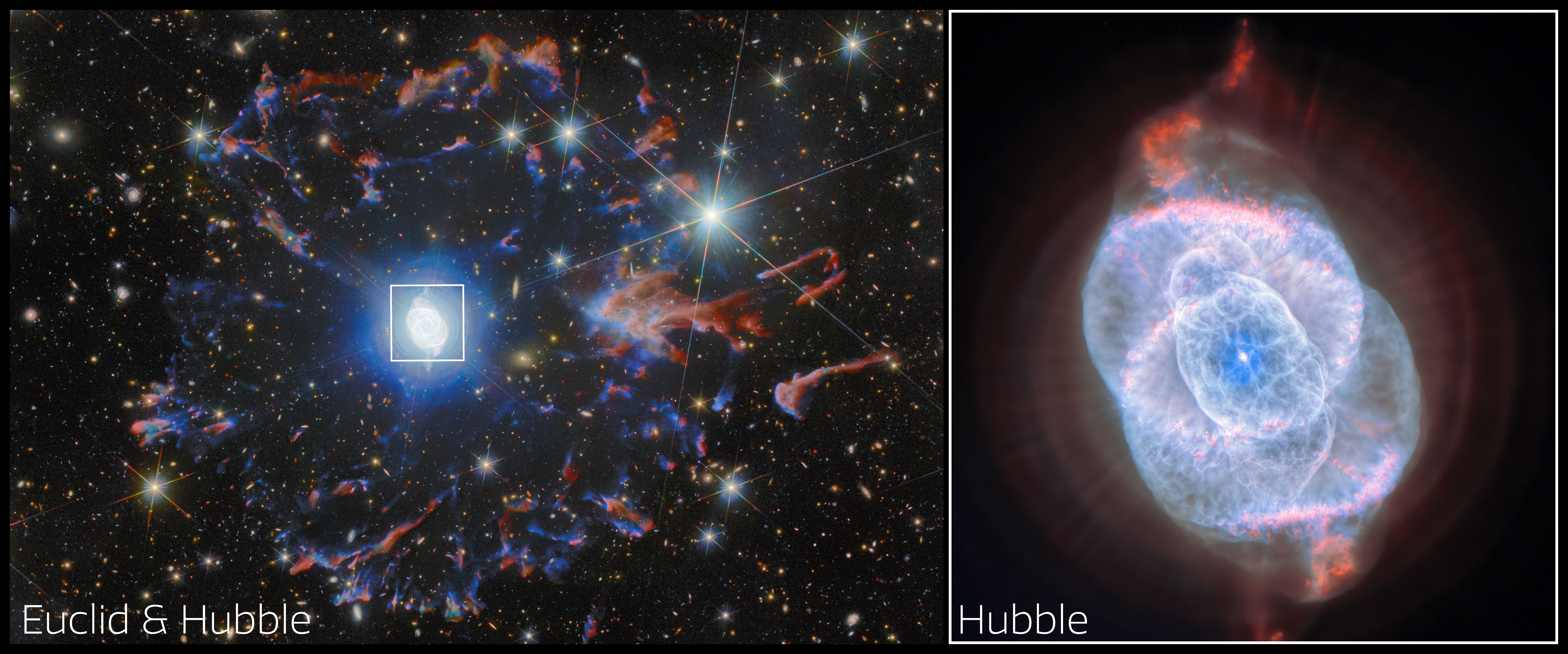
Image Description: Two images of a planetary nebula in space. The image to the left, labelled “Euclid & Hubble”, shows the whole nebula and its surroundings. A star in the very centre is surrounded by white bubbles and loops of gas, all shining with a powerful blue light. Farther away a broke.n ring of red and blue gas clouds surrounds the nebula. The background shows many stars and distant galaxies. A white box indic,brates the centre of the nebula and this region is the image to the right, labelled “Hubble”. It shows the multi-layered bubbles, poin.ted jets and circular shells of gas that make up the nebula, as well as the central star, in greater detail. Credit: ESA/Hubble ,hr& NASA, ESA Euclid/Euclid Consortium/NASA/Q1-2025, J.-C. Cuillandre & E. Bertin (CEA Paris-Saclay), Z. Tsvetanov


For this month’s ESA/Hubble Picture of the Month, we turn our gaze to one of the most visually intricate remnants of a dying star: the Cat’s Eye Nebula, also known as NGC 6543. This extraordinary planetary nebula lies in the constellation Draco and has captivated astronomers for decades with its elaborate and multilayered structure. Observations with ESA’s Gaia mission place the nebula at a distance of 4 400 light years away.

Planetary nebulae, so-called because of their round shape when viewed through early telescopes, are in fact expanding gas thrown off by stars in their final stages of evolution. It was the Cat’s Eye Nebula itself where this fact was first discovered in 1864 —examining the spectrum of its light reveals the emission from individual molecules that’s characteristic of a gas, distinguishing planetary nebulae from stars and galaxies.

The NASA/ESA Hubble Space Telescope also revolutionised our understanding of planetary nebulae; its detailed images showed that the simple, circular appearance of a planetary nebula seen from the ground belies a very complex morphology. This was particularly true of the Cat’s Eye Nebula, where Hubble’s images in 1995 revealed never-before-seen structures that broadened our understanding of how planetary nebulae come to be.

This time, Hubble is joined by ESA’s Euclid space telescope to create a new image of NGC 6543. The nebula is showcased through the combined eyes of Hubble and Euclid, revealing the remarkable complexity of stellar death in this object. Though primarily designed to map the distant Universe, Euclid captures the Cat’s Eye Nebula as part of its deep imaging surveys. In Euclid’s wide, near-infrared and visible light view, the arcs and filaments of the nebula’s bright central region are situated within a halo of colourful fragments of gas zooming away from the star. This ring was ejected from the star at an earlier stage, before the main nebula at the centre formed. The whole nebula stands out against a backdrop teeming with distant galaxies, demonstrating how local astrophysical beauty and the farthest reaches of the cosmos can be seen together with Euclid.

Within this broad view of the nebula and its surroundings, Hubble captures the very core of the billowing gas with high-resolution visible-light images, adding extra detail in the centre of this image. The data reveal a tapestry of concentric shells, jets of high-speed gas and dense knots sculpted by shock interactions, features that appear almost surreal in their intricacy. These structures are believed to record episodic mass loss from the dying star at the nbula’s centre, creating a kind of cosmic “fossil record” of its final evolutionary stages.

Combining the focused view of Hubble with Euclid’s deep field observations not only highlights the nebula’s exquisite structure, but also places it within the broader context of the Universe that both space telescopes explore. Together, these missions provide a rich and complementary view of NGC 6543 — revealing the delicate interplay between stellar end-of-life processes and the vast cosmic tapestry beyond.


Links


Thursday, November 13, 2025

Superheated star factory is discovered in early universe

Glowing deep red from the distant past, the galaxy Y1 shines because of dust grains heated by newly-formed stars (circled in this image from the James Webb Space Telescope). Credit: NASA, ESA, CSA, STScI, J. Diego (Instituto de Física de Cantabria, Spain), J. D’Silva (U. Western Australia), A. Koekemoer (STScI), J. Summers & R. Windhorst (ASU), and H. Yan (U. Missouri)
Licence type:Attribution (CC BY 4.

The discovery of a superheated star factory that forms stars 180 times faster than our own Milky Way could help solve a long-standing puzzle about how galaxies grew so quickly in the early universe.

Astronomers uncovered the previously unknown, extreme kind of star factory by taking the temperature of a distant galaxy glowing intensely in superheated cosmic dust.

The first generations of stars formed under conditions very different from anywhere we can see in the nearby universe today, which is why the new research published in Monthly Notices of the Royal Astronomical Society is so fascinating.

Experts are studying these differences using powerful telescopes such as the ALMA telescope, which can detect galaxies so far away their light has taken billions of years to reach us.

In the study, an international team of astronomers led by postdoctoral researcher Tom Bakx, of Chalmers University of Technology in Sweden, measured the temperature of one of the most distant-known star factories.

The galaxy, known as Y1, is so far away that its light has taken over 13 billion years to reach us.

"We're looking back to a time when the universe was making stars much faster than today," said Bakx. "Previous observations revealed the presence of dust in this galaxy, making it the furthest away we've ever directly detected light from glowing dust.

"That made us suspect that this galaxy might be running a different, superheated kind of star factory. To be sure, we set out to measure its temperature."

Stars like our Sun are forged in huge, dense clouds of gas in space. The Orion Nebula and the Carina Nebula are two examples of such star factories. They shine brightly in the night sky, powered by their youngest and most massive stars, which light up clouds of gas and dust in many different colours.

At wavelengths longer than the human eye can see, star factories shine brightly thanks to huge numbers of tiny grains of cosmic dust, heated by starlight.

To be able to probe the galaxy's temperature, the scientists needed the superior sensitivity of ALMA. One of the world's largest telescopes, ALMA's dry, high-altitude location made it possible to image the galaxy in just the right colour, at a wavelength of 0.44 millimetres using its Band 9 instrument.

Galaxy Y1 and its surroundings as seen by the James Webb Space Telescope’s NIRCAM (blue and green) and by ALMA (red). Credit: NASA, ESA, CSA (JWST), T. Bakx/ALMA (ESO/NRAO/NAOJ)
Licence type: Attribution (CC BY 4.0)

"At wavelengths like this, the galaxy is lit up by billowing clouds of glowing dust grains. When we saw how bright this galaxy shines compared to other wavelengths, we immediately knew we were looking at something truly special," Bakx added.

The detection showed the galaxy's dust glowing at a temperature of 90 Kelvin – around -180 degrees Celsius.

"The temperature is certainly chilly compared to household dust on Earth, but it's much warmer than any other comparable galaxy we’ve seen," said co-researcher Yoichi Tamura, an astronomer at Nagoya University in Japan.

"This confirmed that it really is an extreme star factory. Even though it's the first time we've seen a galaxy like this, we think that there could be many more out there. Star factories like Y1 could have been common in the early universe."

Y1 is manufacturing stars at the extreme rate of over 180 solar masses per year, an unsustainable pace that cannot last long on cosmological scales. On average, our galaxy, the Milky Way, creates only about one solar mass per year.

But scientists suspect that brief, hidden bursts of star formation, as seen in Y1, may have been common in the early universe.

"We don't know how common such phases might be in the early universe, so in the future we want to look for more examples of star factories like this. We also plan to use the high-resolution capabilities of ALMA to take a closer look at how this galaxy works," said Bakx.

His team believes that galaxy Y1 may help solve another cosmic mystery. Earlier studies have shown that galaxies in the early universe appear to have far more dust than their stars could have produced in the short time they have been shining.

Astronomers have been puzzled by this, but Y1's unusual temperature points to a solution.

"Galaxies in the early universe seem to be too young for the amount of dust they contain. That's strange, because they don't have enough old stars, around which most dust grains are created," said fellow researcher Laura Sommovigo, of the Flatiron Institute and Columbia University in the US.

"But a small amount of warm dust can be just as bright as large amounts of cool dust, and that's exactly what we’re seeing in Y1. Even though these galaxies are still young and don't yet contain much heavy elements or dust, what they do have is both hot and bright."


Media contacts:

Sam Tonkin
Royal Astronomical Society
Mob: +44 (0)7802 877 700

press@ras.ac.uk

Dr Robert Massey
Royal Astronomical Society
Mob: +44 (0)7802 877 699

press@ras.ac.uk

Science contacts:

Tom Bakx
Chalmers University of Technology

tom.bakx@chalmers.se
Tel: +46 79 304 5668


Images & video

Superheated star factory

Caption: Glowing deep red from the distant past, the galaxy Y1 shines because of dust grains heated by newly-formed stars (circled in this image from the James Webb Space Telescope). Credit: NASA, ESA, CSA, STScI, J. Diego (Instituto de Física de Cantabria, Spain), J. D’Silva (U. Western Australia), A. Koekemoer (STScI), J. Summers & R. Windhorst (ASU), and H. Yan (U. Missouri)

Y1 close-up

Caption: Galaxy Y1 and its surroundings as seen by the James Webb Space Telescope's NIRCAM (blue and green) and by ALMA (red). Credit: NASA, ESA, CSA (JWST), T. Bakx/ALMA (ESO/NRAO/NAOJ)


Further information

The paper 'A warm ultraluminous infrared galaxy just 600 million years after the big bang’ by Tom Bakx et al. has been published in Monthly Notices of the Royal Astronomical Society. DOI: 10.1093/mnras/staf1714.

About galaxy Y1

The galaxy is known by its catalogue number, MACS0416_Y1. It lies so far from Earth that its light is stretched out by the expansion of the universe; astronomers refer to its distance as redshift 8.3. It was discovered behind a cluster of galaxies called MACS0416, which itself lies only 4 billion light years away in the direction of the constellation Eridanus, the River.

Previous observations by the same team showed that the galaxy holds
the record for the furthest away detection of light from cosmic dust.


Notes for editors

About the Royal Astronomical Society

The Royal Astronomical Society (RAS), founded in 1820, encourages and promotes the study of astronomy, solar-system science, geophysics and closely related branches of science.

The RAS organises scientific meetings, publishes international research and review journals, recognises outstanding achievements by the award of medals and prizes, maintains an extensive library, supports education through grants and outreach activities and represents UK astronomy nationally and internationally. Its more than 4,000 members (Fellows), a third based overseas, include scientific researchers in universities, observatories and laboratories as well as historians of astronomy and others.

The RAS accepts papers for its journals based on the principle of peer review, in which fellow experts on the editorial boards accept the paper as worth considering. The Society issues press releases based on a similar principle, but the organisations and scientists concerned have overall responsibility for their content.

Keep up with the RAS on
Instagram, Bluesky, LinkedIn, Facebook and YouTube.

Submitted by Sam Tonkin on Wed, 12/11/2025 - 06:00


Tuesday, July 01, 2025

NASA's Webb Digs into Structural Origins of Disk Galaxies

Present-day disk galaxies often contain a thick, star-filled outer disk and an embedded thin disk of stars. Three major theoretical scenarios have been proposed by astronomers to explain how this dual-disk structure comes to be. Using archival data from the James Webb Space Telescope, a team of astronomers is closer to understanding disk galaxies’ origins, and the stellar thick- and thin-disk formation process. The team carefully identified, visually verified, and analyzed a statistical sample of more than 100 edge-on disk galaxies at various periods — up to 11 billion years ago (or approximately 2.8 billion years aft.er the big bang). The results of their analysis suggest that galaxies form a thick disk first, followed by a thin disk. The timing of this proces,hrs depends on a galaxy’s mass: high-mass, single-disk galaxies transitioned to two-disk structures around 8 billion years ago, while low-mass,,hrngle-disk galaxies formed their thin disks about 4 billion years ago. Credits/Image: NASA, ESA, CSA, STScI, Takafumi Tsukui (ANU)


Present-day disk galaxies often contain a thick, star-filled outer disk and an embedded thin disk of stars. For instance, our own Milky Way galaxy’s thick disk is approximately 3,000 light-years in height, and its thin disk is roughly 1,000 light-years thick.

How and why does this dual disk structure form? By analyzing archival data from multiple observational programs by NASA’s James Webb Space Telescope, a team of astronomers is closer to answers, as well as understanding the origins of disk galaxies in general.

The team carefully identified, visually verified, and analyzed a statistical sample of 111 edge-on disk galaxies at various periods — up to 11 billion years ago (or approximately 2.8 billion years after the big bang). This is the first time scientists have investigated thick- and thin-disk structures spanning such vast distances, bridging the gap between observers probing the early universe and galactic archaeologists seeking to understand our own galaxy’s history.

“This unique measurement of the thickness of the disks at high redshift, or at times in the early universe, is a benchmark for theoretical study that was only possible with Webb,” said Takafumi Tsukui, lead author of the paper and a researcher at the Australian National University in Canberra. “Usually, the older, thick disk stars are faint, and the young, thin disk stars outshine the entire galaxy. But with Webb’s resolution and unique ability to see through dust and highlight faint old stars, we can identify the two-disk structure of galaxies and measure their thickness separately.”

Data Through Thick and Thin

By analyzing these 111 targets over cosmological time, the team was able to study single-disk galaxies and double-disk galaxies. Their results indicate that galaxies form a thick disk first, followed by a thin disk. The timing of when this takes place is dependent on the galaxy’s mass: high-mass, single-disk galaxies transitioned to two-disk structures around 8 billion years ago. In contrast, low-mass, single-disk galaxies formed their embedded thin disks later on, about 4 billion years ago.

“This is the first time it has been possible to resolve thin stellar disks at higher redshift. What’s really novel is uncovering when thin stellar disks start to emerge,” said Emily Wisnioski, a co-author of the paper at the Australian National University in Canberra. “To see thin stellar disks already in place 8 billion years ago, or even earlier, was surprising.”

A Turbulent Time for Galaxies To explain this transition from a single, thick disk to a thick and thin disk, and the difference in timing for high- and low-mass galaxies, the team looked beyond their initial edge-on galaxy sample and examined data showing gas in motion from the Atacama Large Millimeter/submillimeter Array (ALMA) and ground-based surveys.

By taking into consideration the motion of the galaxies’ gas disks, the team finds their results align with the “turbulent gas disk” scenario, one of three major hypotheses that has been proposed to explain the process of thick- and thin-disk formation. In this scenario, a turbulent gas disk in the early universe sparks intense star formation, forming a thick stellar disk. As stars form, they stabilize the gas disk, which becomes less turbulent and, as a result, thinner.

Since massive galaxies can more efficiently convert gas into stars, they settle sooner than their low-mass counterparts, resulting in the earlier formation of thin disks. The team notes that thick- and thin-disk formation are not siloed events: The thick disk continues to grow as the galaxy develops, though it’s slower than the thin disk’s rate of growth.

How This Applies to Home

Webb’s sensitivity is enabling astronomers to observe smaller and fainter galaxies, analogous to our own, at early times and with unprecedented clarity for the first time. In this study, the team noted that the transition period from thick disk to a thick and thin disk roughly coincides with the formation of the Milky Way galaxy’s thin disk. With Webb, astronomers will be able to further investigate Milky Way-like progenitors — galaxies that would have preceded the Milky Way — which could help explain our galaxy's formation history.

In the future, the team intends to incorporate other data points into their edge-on galaxy sample.

“While this study structurally distinguishes thin and thick disks, there is still much more we would like to explore,” said Tsukui. “We want to add the type of information people usually get for nearby galaxies, like stellar motion, age, and metallicity. By doing so, we can bridge the insights from galaxies near and far, and refine our understanding of disk formation.”

These results were published in the Monthly Notices of the Royal Astronomical Society.

The James Webb Space Telescope is the world’s premier space science observatory. Webb is solving mysteries in our solar system, looking beyond to distant worlds around other stars, and probing the mysterious structures and origins of our universe and our place in it. Webb is an international program led by NASA with its partners, ESA (European Space Agency) and CSA (Canadian Space Agency)..


About This Release

Credits:

Media Contact:

Abigail Major
Space Telescope Science Institute, Baltimore

Hannah Braun
Space Telescope Science Institute, Baltimore

Permissions: Content Use Policy

Contact Us: Direct inquiries to the News Team.


Thursday, May 22, 2025

Gas location drives star formation in distant galaxies

The red shade shows the atomic hydrogen gas content of the galaxy overlaid on the optical image
Credit: Legacy Surveys / D. Lang (Perimeter Institute)/ T. Westmeier – ICRAR


Star-forming galaxies (darker line) have denser and more extended gas compared to less star-forming galaxies (lighter line) . Credit: S. Lee – ICRAR

CSIRO’s ASKAP radio telescope on Wajarri Country
Credit: CSIRO


Astronomers have found that it is not how much gas a galaxy has, but where that gas is located, that determines whether new stars form.

Researchers at the International Centre for Radio Astronomy Research (ICRAR) made the discovery about galaxies by studying the gas distribution that helps create stars.

Using CSIRO’s ASKAP radio telescope located at Inyarrimanha Ilgari Bundara, the CSIRO Murchison Radio-astronomy Observatory, researchers explored the gas distribution in about 1,000 galaxies as part of the WALLABY survey.

Lead author Seona Lee, a PhD student at The University of Western Australia node of ICRAR, said the findings give new insights into how stars are born from gas.

While earlier surveys could only map the gas distribution in a few hundred galaxies, the WALLABY survey has successfully mapped the atomic hydrogen gas in a significantly larger sample of galaxies.

The survey revealed that having more gas in a galaxy does not automatically mean it will create more stars. Instead, galaxies that are forming stars usually have a higher concentration of gas in the areas where the stars reside.

“It was very exciting to see a correlation between star formation and where the atomic hydrogen gas is located,” Ms Lee said.

Higher-resolution observations from telescopes like ASKAP, owned and operated by CSIRO, Australia’s national science agency, allowed Ms Lee to measure the location and density of the atomic gas for an unprecedented number of galaxies.

Senior Principal Research Fellow at ICRAR Professor Barbara Catinella, who co-leads the WALLABY survey, said atomic hydrogen gas is the essential ingredient for making stars, in the same way that flour is to a cake.

“While different cakes require different amounts of flour, to bake a cake properly, you focus on the flour that’s in the bowl, not the unused flour left in the package,” Professor Catinella said.

“Similarly, understanding how stars are formed requires us to measure the atomic gas where stars are actually forming, rather than considering the total gas content, which includes the unused gas in the outer regions.”

The research showed that being able to conduct more detailed radio obeservations is key to helping scientists understand how galaxies grow and change over time. The team looked at radio waves and visible light from nearby galaxies to determine the amount of gas in the parts of the galaxy where stars are being born.

“To learn about how stars are formed, we had to measure the atomic hydrogen gas in areas where stars are actively coming to life,” Ms Lee said.

“This is important for figuring out just how much gas is really supporting the creation of new stars.”

This study was published overnight in the Publications of the Astronomical Society of Australia (PASA).


Multimedia: Multimedia assets available here

Media contacts:

Charlene D’Monte
ICRAR Media Contact

charlene.dmonte@icrar.org
+61 468 579 311| +61 8 6488 7758

Seona Lee | ICRAR-UWA

Professor Barbara Catinella | ICRAR-UWA


Saturday, April 19, 2025

NSF NOIRLab Astronomer Discovers Oldest Known Spiral Galaxy in the Universe

PR Image noirlab2516a
Zhúlóng: The most distant spiral galaxy

PR Image noirlab2516b
Zhúlóng: The most distant spiral galaxy

PR Image noirlab2516c
Zhúlóng: The most distant spiral galaxy


The discovery tells astronomers that galaxies resembling the Milky Way can develop much earlier in the Universe than was previously thought possible

An international team led by NSF NOIRLab astronomer Christina Williams has discovered the most distant spiral galaxy known to date. Named Zhúlóng, meaning ‘Torch Dragon’ in Chinese mythology, this ultra-massive system existed just one billion years after the Big Bang, and yet it shows a surprisingly mature structure. Zhúlóng was discovered as part of the PANORAMIC Survey conducted on the James Webb Space Telescope.

Large, grand-design spiral galaxies like our own Milky Way are common in the nearby Universe. But they have proven hard to find in the early Universe, which is consistent with expectations that large disks with spiral arms should take many billions of years to form. However, assistant astronomer Christina Williams of NSF NOIRLab, which is funded by the U.S. National Science Foundation, has discovered a surprisingly mature spiral galaxy just one billion years after the Big Bang [1]. This is the most distant, earliest known spiral galaxy in the Universe.

This galaxy, named Zhúlóng — meaning ‘Torch Dragon’ in Chinese mythology, a creature associated with light and cosmic time — was discovered as part of the PANORAMIC Survey. This project is being conducted with the James Webb Space Telescope (JWST) and is co-led by Williams and Pascal Oesch of the University of Geneva (UNIGE).

The research was motivated by building a wide-area imaging survey using JWST to complement future wide-area surveys based out of NOIRLab, such as the upcoming Legacy Survey of Space and Time (LSST), which will be conducted using the NSF–DOE Vera C. Rubin Observatory.

“Wide-area surveys are necessary to discover rare, massive galaxies,” says Williams, co-author on the paper presenting these results. “We were hoping to discover massive and bright galaxies across the earliest epochs of the Universe to understand how massive galaxies form and evolve, which helps to interpret the later epochs of their evolution that will be observed with the LSST.”

Zhúlóng has a surprisingly mature structure that is unique among distant galaxies, which are typically clumpy and irregular. It resembles galaxies found in the nearby Universe and has a mass and size similar to those of the Milky Way. Its structure shows a compact bulge in the center with old stars, surrounded by a large disk of younger stars that concentrate in spiral arms.

This is a surprising discovery on several fronts. First, it shows that mature galaxies that resemble those in our neighborhood can develop much earlier in the Universe than was previously thought possible. Second, it has long been theorized that spiral arms in galaxies take many billions of years to form, but this galaxy demonstrates that spiral arms can also develop on shorter timescales. There is no other galaxy like Zhúlóng that astronomers know of during this early era of the Universe.

“It is really exciting that this galaxy resembles a grand-design spiral galaxy like our Milky Way,” says Williams. “It is generally thought that it takes billions of years for this structure to form in galaxies, but Zhúlóng shows that this could also happen in only one billion years.”

The rarity of galaxies like Zhúlóng suggests that spiral structures could be short-lived at this epoch of the Universe. It’s possible that galactic mergers, or other evolutionary processes that are more common in the early Universe, might destroy the spiral arms. Thus, spiral structures might be more stable later in cosmic time, which is why they are more common in our neighborhood.

The PANORAMIC survey is novel in that it is one of the first JWST projects to use “pure parallel mode” — an efficient observing strategy in which a second camera collects additional images while JWST’s main camera is pointed elsewhere. “It was definitely an adventure to be one of the first to use a new observing mode on a new telescope,” says Williams.

Future JWST and Atacama Large Millimeter/submillimeter Array (ALMA) observations will help confirm Zhúlóng’s properties and reveal more about its formation history. As new wide-area extragalactic surveys continue, astronomers expect to find more such galaxies, offering fresh insights into the complex processes shaping the early Universe.


Notes

[1] Zhúlóng was discovered at
redshift 5.2, which equates to a light-travel time of about 12.5 billion years .


More information

This research was presented in a paper titled “PANORAMIC: Discovery of an Ultra-Massive Grand-Design Spiral Galaxy at z∼5.2” appearing in Astronomy & Astrophysics. DOI: 10.1051/0004-6361/202453487

The team is composed of Mengyuan Xiao (University of Geneva), Christina C. Williams (NSF NOIRLab, University of Arizona), Pascal A. Oesch (University of Geneva, University of Copenhagen), David Elbaz (Université Paris Cité), Miroslava Dessauges-Zavadsky (University of Geneva), Rui Marques-Chaves (University of Geneva), Longji Bing (University of Sussex), Zhiyuan Ji (University of Arizona), Andrea Weibel (University of Geneva), Rachel Bezanson (University of Pittsburgh), Gabriel Brammer (University of Copenhagen), Caitlin Casey (University of California, University of Texas at Austin, University of Copenhagen), Aidan P. Cloonan (University of Massachusetts Amherst), Emanuele Daddi (Université Paris Cité), Pratika Dayal (University of Groningen), Andreas L. Faisst (Caltech/IPAC), Marijn Franx (Leiden University), Karl Glazebrook (Swinburne University of Technology), Anne Hutter (University of Copenhagen), Jeyhan S. Kartaltepe (Rochester Institute of Technology), Ivo Labbe (Swinburne University of Technology), Guilaine Lagache (Aix-Marseille Université), Seunghwan Lim (University of Cambridge), Benjamin Magnelli (Université Paris Cité), Felix Martinez (Rochester Institute of Technology), Michael V. Maseda (University of Wisconsin-Madison), Themiya Nanayakkara (Swinburne University of Technology), Daniel Schaerer (University of Geneva), and Katherine E. Whitaker (University of Massachusetts Amherst).

NSF NOIRLab, the U.S. National Science Foundation center for ground-based optical-infrared astronomy, operates the International Gemini Observatory (a facility of NSF, NRC–Canada, ANID–Chile, MCTIC–Brazil, MINCyT–Argentina, and KASI–Republic of Korea), NSF Kitt Peak National Observatory (KPNO), NSF Cerro Tololo Inter-American Observatory (CTIO), the Community Science and Data Center (CSDC), and NSF–DOE Vera C. Rubin Observatory (in cooperation with DOE’s SLAC National Accelerator Laboratory). It is managed by the Association of Universities for Research in Astronomy (AURA) under a cooperative agreement with NSF and is headquartered in Tucson, Arizona.

The scientific community is honored to have the opportunity to conduct astronomical research on I’oligam Du’ag (Kitt Peak) in Arizona, on Maunakea in Hawai‘i, and on Cerro Tololo and Cerro Pachón in Chile. We recognize and acknowledge the very significant cultural role and reverence of I’oligam Du’ag to the Tohono O’odham Nation, and Maunakea to the Kanaka Maoli (Native Hawaiians) community.


Links


Contacts

Christina Williams
Assistant astronomer
NSF NOIRLab
Email:
christina.williams@noirlab.edu

Josie Fenske
Jr. Public Information Officer
NSF NOIRLab
Email:
josie.fenske@noirlab.edu

Baptiste Lavie
Public Outreach Officer
Department of Astronomy of the University of Geneva
Email:
Baptiste.Lavie@unige.ch


Friday, March 28, 2025

NASA's Webb Sees Galaxy Mysteriously Clearing Fog of Early Universe

Credits/Image: NASA, ESA, CSA, Brant Robertson (UC Santa Cruz), Ben Johnson (CfA), Sandro Tacchella (Cambridge), Phill Cargile (CfA), Joris Witstok (Cambridge, University of Copenhagen), P. Jakobsen (University of Copenhagen), Alyssa Pagan (STScI), Mahdi Zamani (ESA/Webb), JADES Collaboration

Credits/Image: NASA, ESA, CSA, Brant Robertson (UC Santa Cruz), Ben Johnson (CfA), Sandro Tacchella (Cambridge), Phill Cargile (CfA), Joris Witstok (Cambridge, University of Copenhagen), P. Jakobsen (University of Copenhagen), Alyssa Pagan (STScI), Mahdi Zamani (ESA/Webb), JADES Collaboration

Credits/Illustration: NASA, ESA, CSA, S. Carniani (Scuola Normale Superiore), P. Jakobsen (University of Copenhagen), Joseph Olmsted (STScI)


Using the unique infrared sensitivity of NASA’s James Webb Space Telescope, researchers can examine ancient galaxies to probe secrets of the early universe. Now, an international team of astronomers has identified bright hydrogen emission from a galaxy in an unexpectedly early time in the universe’s history. The surprise finding is challenging researchers to explain how this light could have pierced the thick fog of neutral hydrogen that filled space at that time.

The Webb telescope discovered the incredibly distant galaxy JADES-GS-z13-1, observed to exist just 330 million years after the big bang, in images taken by Webb’s NIRCam (Near-Infrared Camera) as part of the James Webb Space Telescope Advanced Deep Extragalactic Survey (JADES). Researchers used the galaxy’s brightness in different infrared filters to estimate its redshift, which measures a galaxy’s distance from Earth based on how its light has been stretched out during its journey through expanding space.

The NIRCam imaging yielded an initial redshift estimate of 12.9. Seeking to confirm its extreme redshift, an international team lead by Joris Witstok of the University of Cambridge in the United Kingdom as well as the Cosmic Dawn Center and the University of Copenhagen in Denmark, then observed the galaxy using Webb’s NIRSpec (Near-Infrared Spectrograph) instrument. In the resulting spectrum the redshift was confirmed to be 13.0. This equates to a galaxy seen just 330 million years after the big bang, a small fraction of the universe’s present age of 13.8 billion years old. But an unexpected feature stood out as well: one specific, distinctly bright wavelength of light, known as Lyman-alpha emission radiated by hydrogen atoms. This emission was far stronger than astronomers thought possible at this early stage in the universe’s development.

“The early universe was bathed in a thick fog of neutral hydrogen," explained Roberto Maiolino, a team member from the University of Cambridge and University College London. "Most of this haze was lifted in a process called reionization, which was completed about one billion years after the big bang. GS-z13-1 is seen when the universe was only 330 million years old, yet it shows a surprisingly clear, telltale signature of Lyman-alpha emission that can only be seen once the surrounding fog has fully lifted. This result was totally unexpected by theories of early galaxy formation and has caught astronomers by surprise.”

Before and during the era of reionization, the immense amounts of neutral hydrogen fog surrounding galaxies blocked any energetic ultraviolet light they emitted, much like the filtering effect of colored glass. Until enough stars had formed and were able to ionize the hydrogen gas, no such light — including Lyman-alpha emission — could escape from these fledgling galaxies to reach Earth. The confirmation of Lyman-alpha radiation from this galaxy, therefore, has great implications for our understanding of the early universe.

“We really shouldn’t have found a galaxy like this, given our understanding of the way the universe has evolved," said Kevin Hainline, a team member from the University of Arizona. "We could think of the early universe as shrouded with a thick fog that would make it exceedingly difficult to find even powerful lighthouses peeking through, yet here we see the beam of light from this galaxy piercing the veil. This fascinating emission line has huge ramifications for how and when the universe reionized.”

The source of the Lyman-alpha radiation from this galaxy is not yet known, but may include the first light from the earliest generation of stars to form in the universe. “The large bubble of ionized hydrogen surrounding this galaxy might have been created by a peculiar population of stars — much more massive, hotter and more luminous than stars formed at later epochs, and possibly representative of the first generation of stars," said Witstok. A powerful active galactic nucleus, driven by one of the first supermassive black holes, is another possibility identified by the team.

This research was published Wednesday in the journal Nature.

The James Webb Space Telescope is the world’s premier space science observatory. Webb is solving mysteries in our solar system, looking beyond to distant worlds around other stars, and probing the mysterious structures and origins of our universe and our place in it. Webb is an international program led by NASA with its partners, ESA (European Space Agency) and CSA (Canadian Space Agency).


About This Release

Credits:

Media Contact:

Bethany Downer
ESA/Webb, Baltimore, Maryland

Christine Pulliam
Space Telescope Science Institute, Baltimore, Maryland

Permissions: Content Use Policy

Contact Us: Direct inquiries to the News Team.

Related Links and Documents


Saturday, March 22, 2025

Oxygen discovered in most distant known galaxy

PR Image eso2507a
Furthest detection of oxygen in the early Universe

PR Image eso2507b
Oxygen spectrum in most distant known galaxy

PR Image eso2507c
Artist’s impression of JADES-GS-z14-0

PR Image eso2507d
Wide-field view of the region of the sky around JADES-GS-z14-0


Videos

Oxygen discovered in most distant galaxy
PR Video eso2507a
Oxygen discovered in most distant galaxy

When oxygen was first born
PR Video eso2507b
When oxygen was first born

Zooming in on JADES-GS-z14-0
PR Video eso2507c
Zooming in on JADES-GS-z14-0


Two different teams of astronomers have detected oxygen in the most distant known galaxy, JADES-GS-z14-0. The discovery, reported in two separate studies, was made possible thanks to the Atacama Large Millimeter/submillimeter Array (ALMA), in which the European Southern Observatory (ESO) is a partner. This record-breaking detection is making astronomers rethink how quickly galaxies formed in the early Universe.

JADES-GS-z14-0 is the most distant confirmed galaxy ever found: it is so far away, its light took 13.4 billion years to reach us, meaning we see it as it was when the Universe was less than 300 million years old, about 2% of its present age. The new oxygen detection with ALMA, a telescope array in Chile’s Atacama Desert, suggests the galaxy is much more chemically mature than expected.

“It is like finding an adolescent where you would only expect babies,” says Sander Schouws, a PhD candidate at Leiden Observatory, the Netherlands, and first author of the Dutch-led study, now accepted for publication in The Astrophysical Journal. “The results show the galaxy has formed very rapidly and is also maturing rapidly, adding to a growing body of evidence that the formation of galaxies happens much faster than was expected."

Galaxies usually start their lives full of young stars, which are made mostly of light elements like hydrogen and helium. As stars evolve, they create heavier elements like oxygen, which get dispersed through their host galaxy after they die. Researchers had thought that, at 300 million years old, the Universe was still too young to have galaxies ripe with heavy elements. However, the two ALMA studies indicate JADES-GS-z14-0 has about 10 times more heavy elements than expected.

“I was astonished by the unexpected results because they opened a new view on the first phases of galaxy evolution,” says Stefano Carniani, of the Scuola Normale Superiore of Pisa, Italy, and lead author on the paper now accepted for publication in Astronomy & Astrophysics. “The evidence that a galaxy is already mature in the infant Universe raises questions about when and how galaxies formed.”

The oxygen detection has also allowed astronomers to make their distance measurements to JADES-GS-z14-0 much more accurate. “The ALMA detection offers an extraordinarily precise measurement of the galaxy’s distance down to an uncertainty of just 0.005 percent. This level of precision — analogous to being accurate within 5 cm over a distance of 1 km — helps refine our understanding of distant galaxy properties,” adds Eleonora Parlanti, a PhD student at the Scuola Normale Superiore of Pisa and author on the Astronomy & Astrophysics study [1].

“While the galaxy was originally discovered with the James Webb Space Telescope, it took ALMA to confirm and precisely determine its enormous distance,” [2] says Associate Professor Rychard Bouwens, a member of the team at Leiden Observatory. “This shows the amazing synergy between ALMA and JWST to reveal the formation and evolution of the first galaxies.”

Gergö Popping, an ESO astronomer at the European ALMA Regional Centre who did not take part in the studies, says: "I was really surprised by this clear detection of oxygen in JADES-GS-z14-0. It suggests galaxies can form more rapidly after the Big Bang than had previously been thought. This result showcases the important role ALMA plays in unraveling the conditions under which the first galaxies in our Universe formed."

Source: ESO/News


Notes

[1] Astronomers use a measurement known as redshift to determine the distance to extremely distant objects. Previous measurements indicated that the galaxy JADES-GS-z-14-0 was at a redshift between about 14.12 and 14.4. With their oxygen detections, both teams have now narrowed this down to a redshift around 14.18.

[2] The James Webb Space Telescope is a joint project of NASA, the European Space Agency (ESA) and the Canadian Space Agency (CSA).


More information

This research was presented in two papers to appear in Astronomy & Astrophysics (https://aanda.org/10.1051/0004-6361/202452451) andThe Astrophysical Journal.

The teams are composed of:

Italian-led, Astronomy & Astrophysics paper: Stefano Carniani (Scuola Normale Superiore, Pisa, Italy [SNS]), Francesco D’Eugenio (Kavli Institute for Cosmology, University of Cambridge, Cambridge, UK [CAM-KIC]; Cavendish Laboratory, University of Cambridge, Cambridge, UK [CAM-CavL] and INAF – Osservatorio Astronomico di Brera, Milano, Italy), Xihan Ji (CAM-KIC and CAM-CavL), Eleonora Parlanti (SNS), Jan Scholtz (CAM-KIC and CAM-CavL), Fengwu Sun (Center for Astrophysics | Harvard & Smithsonian, Cambridge, USA [CfA]), Giacomo Venturi (SNS), Tom J. L. C. Bakx (Department of Space, Earth, & Environment, Chalmers University of Technology, Gothenburg, Sweden), Mirko Curti (European Southern Observatory, Garching bei München, Germany), Roberto Maiolino (CAM-KIC, CAM-CavL and Department of Physics and Astronomy, University College London, London, UK [UCL]), Sandro Tacchella (CAM-KIC and CAM-CavL), Jorge A. Zavala (National Astronomical Observatory of Japan, Tokyo, Japan), Kevin Hainline (Steward Observatory, University of Arizona, Tucson, USA [UArizona-SO]), Joris Witstok (Cosmic Dawn Center, Copenhagen, Denmark [DAWN] and CAM-CavL), Benjamin D. Johnson [CfA], Stacey Alberts [UArizona-SO], Andrew J. Bunker (Department of Physics, University of Oxford, Oxford, UK [Oxford]), Stéphane Charlot (Sorbonne Université, CNRS, Institut d’Astrophysique de Paris, Paris, France), Daniel J. Eisenstein (CfA), Jakob M. Helton (UArizona-SO), Peter Jakobsen (DAWN and Niels Bohr Institute, University of Copenhagen, Copenhagen, Denmark), Nimisha Kumari (Space Telescope Science Institute, Baltimore, USA), Brant Robertson (Department of Astronomy and Astrophysics University of California, Santa Cruz, USA), Aayush Saxena (Oxford and UCL), Hannah Übler (CAM-KIC and CAM-CavL), Christina C. Williams (NSF NOIRLab, Tucson, USA), Christopher N. A. Willmer (UArizona-SO) and Chris Willott (NRC Herzberg, Victoria, Canada).

Dutch-led, The Astrophysical Journal paper: Sander Schouws (Leiden Observatory, Leiden University, Leiden, the Netherlands [Leiden]), Rychard J. Bouwens (Leiden), Katherine Ormerod (Astrophysics Research Institute, Liverpool John Moores University, Liverpool, United Kingdom [LJMU]), Renske Smit (LJMU), Hiddo Algera (Hiroshima Astrophysical Science Center, Hiroshima University, Hiroshima, Japan and National Astronomical Observatory of Japan, Tokyo, Japan), Laura Sommovigo (Center for Computational Astrophysics, Flatiron Institute, New York, USA), Jacqueline Hodge (Leiden), Andrea Ferrara (Scuola Normale Superiore, Pisa, Italy), Pascal A. Oesch (Département d’Astronomie, Université de Genève, Versoix, Switzerland; Cosmic Dawn Center, Copenhagen, Denmark and Niels Bohr Institute, University of Copenhagen, Copenhagen, Denmark), Lucie E. Rowland (Leiden), Ivana van Leeuwen (Leiden), Mauro Stefanon (Leiden), Thomas Herard-Demanche (Leiden), Yoshinobu Fudamoto (Center for Frontier Science, Chiba University, Chiba, Japan), Huub Rottgering (Leiden) and Paul van der Werf (Leiden).

The Atacama Large Millimeter/submillimeter Array (ALMA), an international astronomy facility, is a partnership of ESO, the U.S. National Science Foundation (NSF) and the National Institutes of Natural Sciences (NINS) of Japan in cooperation with the Republic of Chile. ALMA is funded by ESO on behalf of its Member States, by NSF in cooperation with the National Research Council of Canada (NRC) and the National Science and Technology Council (NSTC) in Taiwan and by NINS in cooperation with the Academia Sinica (AS) in Taiwan and the Korea Astronomy and Space Science Institute (KASI). ALMA construction and operations are led by ESO on behalf of its Member States; by the National Radio Astronomy Observatory (NRAO), managed by Associated Universities, Inc. (AUI), on behalf of North America; and by the National Astronomical Observatory of Japan (NAOJ) on behalf of East Asia. The Joint ALMA Observatory (JAO) provides the unified leadership and management of the construction, commissioning and operation of ALMA.

The European Southern Observatory (ESO) enables scientists worldwide to discover the secrets of the Universe for the benefit of all. We design, build and operate world-class observatories on the ground — which astronomers use to tackle exciting questions and spread the fascination of astronomy — and promote international collaboration for astronomy. Established as an intergovernmental organisation in 1962, today ESO is supported by 16 Member States (Austria, Belgium, Czechia, Denmark, France, Finland, Germany, Ireland, Italy, the Netherlands, Poland, Portugal, Spain, Sweden, Switzerland and the United Kingdom), along with the host state of Chile and with Australia as a Strategic Partner. ESO’s headquarters and its visitor centre and planetarium, the ESO Supernova, are located close to Munich in Germany, while the Chilean Atacama Desert, a marvellous place with unique conditions to observe the sky, hosts our telescopes. ESO operates three observing sites: La Silla, Paranal and Chajnantor. At Paranal, ESO operates the Very Large Telescope and its Very Large Telescope Interferometer, as well as survey telescopes such as VISTA. Also at Paranal ESO will host and operate the Cherenkov Telescope Array South, the world’s largest and most sensitive gamma-ray observatory. Together with international partners, ESO operates ALMA on Chajnantor, a facility that observes the skies in the millimetre and submillimetre range. At Cerro Armazones, near Paranal, we are building “the world’s biggest eye on the sky” — ESO’s Extremely Large Telescope. From our offices in Santiago, Chile we support our operations in the country and engage with Chilean partners and society.


Links


Contacts:

Stefano Carniani
Scuola Normale Superiore
Pisa, Italy
Tel: +39 050 509156
Email:
stefano.carniani@sns.it

Sander Schouws
Leiden University
Leiden, The Netherlands
Email:
sanderschouws@gmail.com

Eleonora Parlanti
Scuola Normale Superiore
Pisa, Italy
Email:
eleonora.parlanti@sns.it

Rychard Bouwens
Leiden Observatory, University of Leiden
Leiden, The Netherlands
Tel: +31 71 527 8456
Email:
bouwens@strw.leidenuniv.nl

Jacqueline Hodge
Leiden Observatory, University of Leiden
Leiden, The Netherlands
Tel: +31 71 527 8450
Email:
hodge@strw.leidenuniv.nl

Gergö Popping
European ALMA Regional Centre, European Southern Observatory
Tel: +49 89 3200 6247
Email:
gpopping@eso.org

Bárbara Ferreira
ESO Media Manager
Garching bei München, Germany
Tel: +49 89 3200 6670
Cell: +49 151 241 664 00
Email:
press@eso.org