Showing posts with label Globular clusters (GCs). Show all posts

Friday, November 06, 2026

Lessons from a stellar instructor

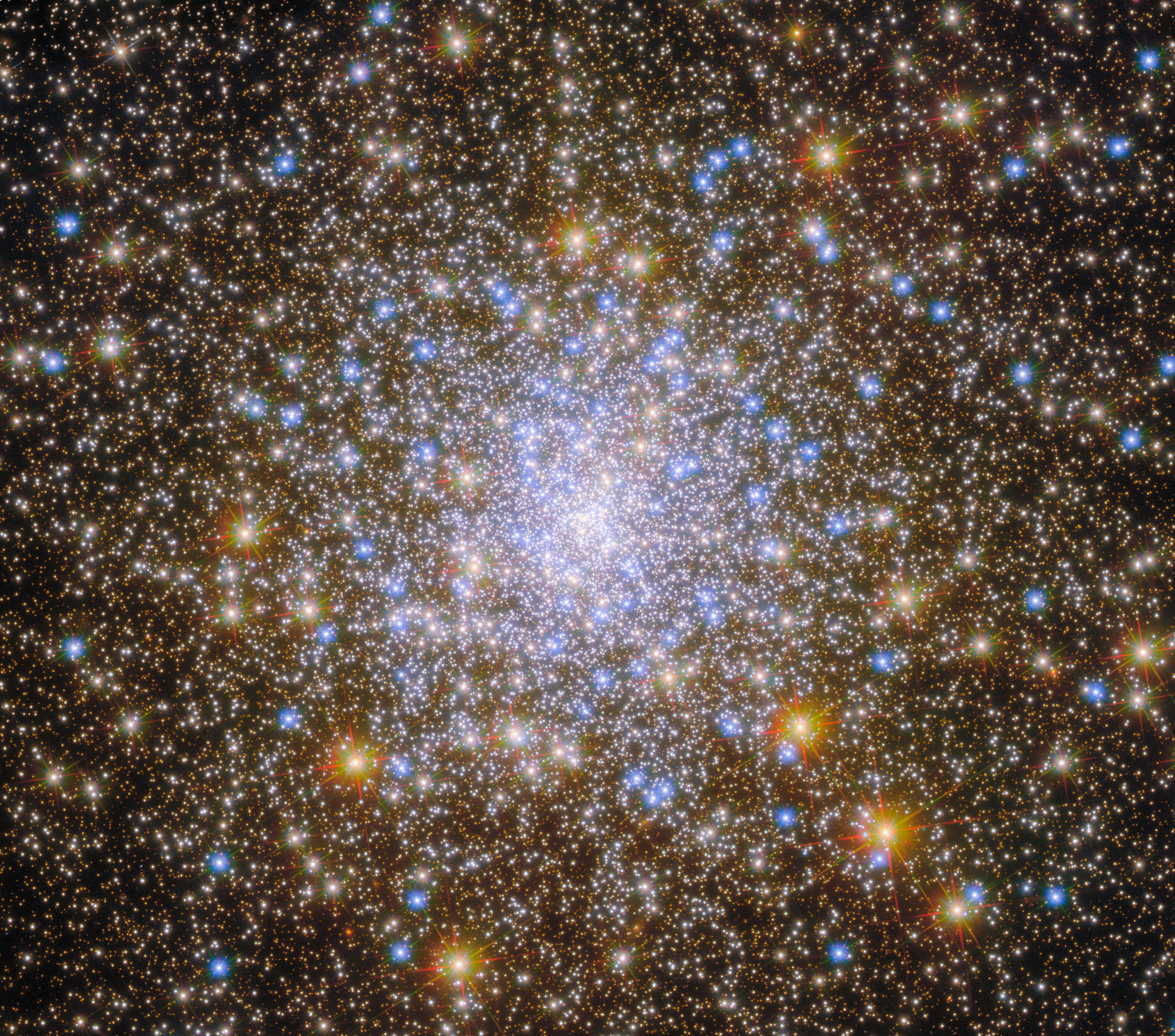
A star cluster seen up close, filling the view with thousands of stars. They are clearly divided between blue ones, which are scattered around the outskirts of the image but more towards the centre and are the majority in the bright core of the cluster, and yellow stars, which are present in the core but make up most of the cluster outside of that. A few orange stars are closer to us and appear noticeably larger.


Today’s ESA/Hubble Picture of the Month gives us a lesson in galactic history. This sparkling collection of stars is named Messier 30 (M30) after Charles Messier, the French astronomer who catalogued M30 and other diffuse objects that might be mistaken for comets. M30 lies about 27 500 light-years away in the constellation Capricornus.

M30 is a globular cluster: a roughly spherical star cluster containing anywhere from tens of thousands to millions of stars. These clusters generally reside on the outskirts of galaxies, orbiting within a vast, diffuse region called the halo like a swarm of moths around a lightbulb. Our Milky Way galaxy has at least 150 globular clusters, the nearest of which is about 6000 light-years away. These clusters are impressively ancient: astronomers have estimated their ages at 11.5 to 13.5 billion years, making certain globular clusters nearly as old as the Universe itself.

Globular clusters have long played an important role in helping us learn about our galaxy. More than a century ago, astronomer Harlow Shapley used observations of a particular type of variable star to measure the locations of and distances to dozens of globular clusters within our galaxy. This work showed that the Sun is not in the centre of our galaxy, and that the galactic centre lies instead toward the constellation Sagittarius. (His distance measurements were incorrect, however, and he concluded that our galaxy is about twice as large as it really is.)

Today, astronomers continue to learn about our galaxy by observing globular clusters. Because globular clusters are so ancient, they can give us clues about how our galaxy was assembled long ago. Globular clusters that formed within our galaxy can act as time capsules, preserving the original chemistry of our young galaxy.

However, it’s possible that not all globular clusters that orbit within our galaxy today formed there. Researchers have discovered that M30 and many other globular clusters orbit in the direction opposite from the way our galaxy spins. This may mean that these clusters did not form within our galaxy at all, but may instead have been captured by the Milky Way galaxy in the distant past!

Hubble has observed M30 multiple times, A previously released image of M30 featured data from Hubble’s Advanced Camera for Surveys. These data came from an observing programme (#10775; PI: Sarajedini) that surveyed dozens of Milky Way globular clusters, observing red and near-infrared light that revealed stars down to just 20% of the mass of the Sun. A more recent programme (#13297; PI: Piotto) returned to M30 and other globular clusters in our galaxy, this time observing the clusters with Hubble’s Wide Field Camera 3 and using three filters that captured bluer light. This programme collected data that was critical for studying exotic objects like blue straggler stars as well as for investigating the multiple populations of stars that can inhabit a single globular cluster.

Most recently, Hubble viewed many of these globular clusters once more, aiming to detect how the stars in these clusters had moved over 15 years. This programme (#16298, PI: Libralato) allowed astronomers to study how different populations of stars in globular clusters move — a feat only possible due to Hubble’s longevity and ability to discern fantastically small details in distant objects.


Monday, October 19, 2026

Catching the Culprit Behind Globular Clusters’ Disappearing Binaries

The formation of young binary protostars.
Credit:
ALMA (ESO / NAOJ / NRAO), F. O. Alves et al.; CC BY 4.0

Roughly one-third of stars in the Milky Way are in binary or multiple systems, but only ~1–10% of stars in globular clusters have a companion. Did globular clusters start with fewer binaries than the solar neighborhood, or have they since been wiped out?

Map of the semi-major axis–primary mass parameter space for binary systems. Solid lines show the boundary between hard (below the line) and soft (above the line) binaries for a variety of models. Models A–K span a variety of cluster masses and virial radii (a proxy for cluster density). Credit: O’Connor et al. 2026

Survival of the Tightest

Globular clusters (GCs) are dense, ancient, gravitationally bound groups of stars. A team led by Christopher O’Connor at Northwestern University explored whether the lack of binary systems could be the result of some process unique to GCs. First, the team developed an analytical formalism to understand how binaries in a GC evolve depending on the binary stars’ masses, distance from each other, and interactions with other stars in the cluster.

It turns out that the fate of a binary system depends on whether it is dynamically “hard” or “soft.” Hard binaries are generally tightly bound, and they tend to get “harder” from stellar flybys, which are common in a crowded cluster environment. Soft binaries are the opposite — they have much shorter lifetimes since encounters with other stars tend to loosen them. The team found that, assuming GCs have the same initial distribution of binaries as the solar neighborhood, the dissolution of soft binaries is sufficient to explain the present-day scarcity of binaries in GCs.

Burning Away the Binaries

What actually tears the soft binaries apart? The answer is a process called “black hole burning.” As some of the most massive objects in a globular cluster, black holes in binary systems can transfer energy when they interact with passing stars. This influx of energy can excite soft binaries to the point of dissolution, the study shows.

Black hole burning can also prevent core collapse in GCs. Left to itself, a cluster’s core gradually loses energy to its outskirts, causing the core to grow hotter and denser with stars. This leads to more dynamical interactions between stars that can then get flung from the core or enter new tight binaries. Black hole burning pumps energy back into the core and prevents this from happening.

The total number of black holes in a cluster (top) and the binary fraction (bottom) as a function of time for three different cluster models. In the densest cluster (blue), binary dissolution starts early on, mainly driven by stellar collisions. For the other two models, binary dissolution mainly occurs after the number of black holes reaches its peak and black hole burning commences. Adapted from O’Connor et al. 2026

Putting the Theory to the Test

To validate their analytical results, the team performed N-body simulations of GC dynamics with the Cluster Monte Carlo code. They found that, in moderate-to-low-density clusters, the decline of binary systems is powered mainly by black hole burning. In more compact clusters, however, stellar collisions also play an important role in the dissolution of binary systems, and at earlier times than the onset of black hole burning.

In general, the final binary fractions of the simulated clusters agree with those predicted by the team’s analytical formalism. This further supports the theory that there is a universal initial binary distribution between galactic GCs and our solar neighborhood. Constraining this distribution is pivotal for refining dynamical models of GCs.

In short, GCs and the solar neighborhood likely started with the same amount of binary systems, and interstellar dynamics handled the rest.

Citation

“A Common Origin for Binary Fractions in the Field and in Dense Clusters,” Christopher E. O’Connor et al 2026 ApJ 1009 L80. doi:10.3847/1538-4357/aea078


Tuesday, July 15, 2025

Digging up a galactic time capsule

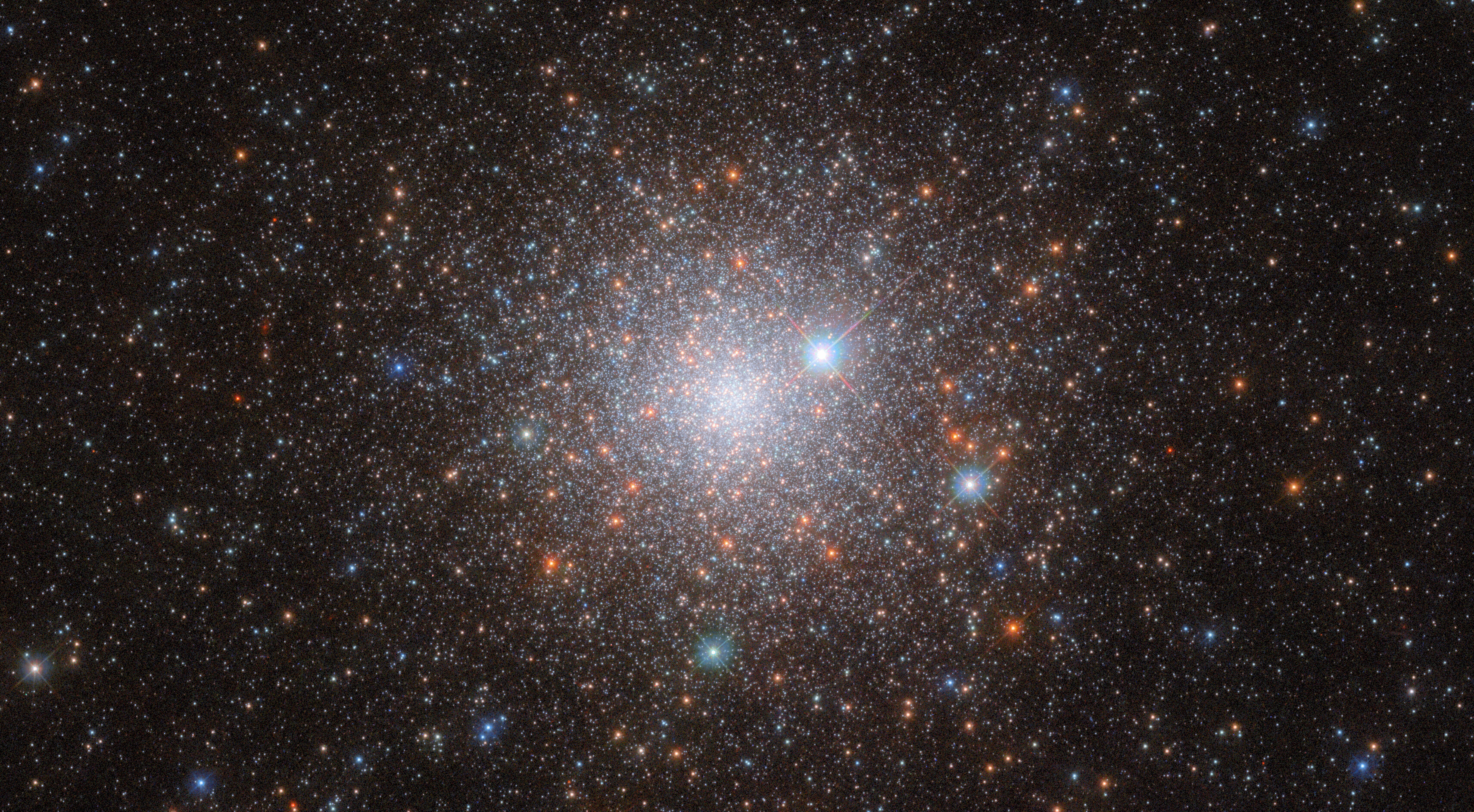
A cluster of stars in space. It’s bright in the centre, where the stars are densely packed together in the cluster’s core, and grows dimmer and more diffuse out to the edges, as the stars give way to the dark background of space. A few orange stars are spread across the cluster, but most are pale, bluish-white points of light. Three large stars with cross-shaped spikes around them lie between us and the cluster. Credit: ESA/Hubble & NASA, M. Monelli Acknowledgement: M. H. Özsaraç

For this ESA/Hubble Picture of the Week, we gaze upon the field of stars that is NGC 1786. This object is a globular cluster in the Large Magellanic Cloud (LMC), a small satellite galaxy of the Milky Way Galaxy that is approximately 160 000 light-years away from Earth. NGC 1786 itself is in the constellation Dorado. It was discovered in the year 1835 by John Herschel.

The data for this image comes from an observing programme comparing old globular clusters in nearby dwarf galaxies — the LMC, the Small Magellanic Cloud and the Fornax dwarf spheroidal galaxy — to the globular clusters in the Milky Way galaxy. Our galaxy contains over 150 of these old, spherical collections of tightly-bound stars, which have been studied in depth — especially with Hubble Space Telescope images like this one, which show them in previously-unattainable detail. Being very stable and long-lived, they act as galactic time capsules, preserving stars from the earliest stages of a galaxy’s formation.

Astronomers once thought that the stars in a globular cluster all formed together at about the same time, but study of the old globular clusters in our galaxy has uncovered multiple populations of stars with different ages. In order to use globular clusters as historical markers, we must understand how they form and where these stars of varying ages come from. This observing programme examined old globular clusters like NGC 1786 in these external galaxies to see if they, too, contain multiple populations of stars. This research can tell us more not only about how the LMC was originally formed, but the Milky Way Galaxy, too.


Friday, June 28, 2024

Channelling light from starbursts

An oval-shaped galaxy, made up of many point-like stars. It is softly lit from the centre, brightest and slightly blue at the very centre and fading to darkness at the edges. Surrounding the galaxy’s core are reddish clouds of gas and dust, most around or behind the core, but a few wisps are in front of it and block some light. Some faraway galaxies and two foreground stars can be seen around the galaxyCredit: ESA/Hubble & NASA, A. Zezas, D. Calzetti

The focus of this week’s Hubble Picture of the Week is the blue compact dwarf galaxy NGC 5253, located in the constellation Centaurus around 11 million light-years from Earth. This new image combines data taken with Hubble’s Advanced Camera for Surveys (ACS), using its Wide Field Channel, and with the older Wide Field and Planetary Camera 2 (WFPC2). As a bonus for this Picture of the Week, there is also a second new image made using data from the High Resolution Channel (HRC) of ACS, a sub-instrument only operational for a few years that was optimised for detailed studies of environments dense with stars.

What has interested astronomers so much about this galaxy that three of Hubble’s instruments were used to study it in depth over ten years? It turns out to lie at the focus of a few areas of research where Hubble’s capabilities are essential. Dwarf galaxies are considered important for understanding the evolution of both stars and galaxies through time, since they resemble ancient, distant galaxies. NGC 5253 is called both a 'starburst galaxy' and a 'blue compact dwarf': these names mean it is forming clusters of bright, massive stars at an exceptional rate. This Hubble image clearly shows the dense nebula which is being consumed to birth these stars, and which makes NGC 5253 a laboratory in which to investigate stellar composition, star formation and star clusters, all at once.

A tremendously high rate of star formation is a recipe for star clusters, but NGC 5253 goes beyond that: in a small region of the core, the star formation is so intense that the galaxy contains no fewer than three 'super star clusters' (SSCs). SSCs are very bright, populous and massive open clusters which are believed to evolve into globular clusters. Globular clusters themselves offer unique insights into how stars form and evolve, but their origins are poorly understood. Astronomers were therefore eager to make use of the HRC sub-instrument, with its superb resolution, to home in on these small, very dense clusters of stars.

Links


Wednesday, June 05, 2024

Simulations Yield New Intermediate Mass Black Holes Recipe

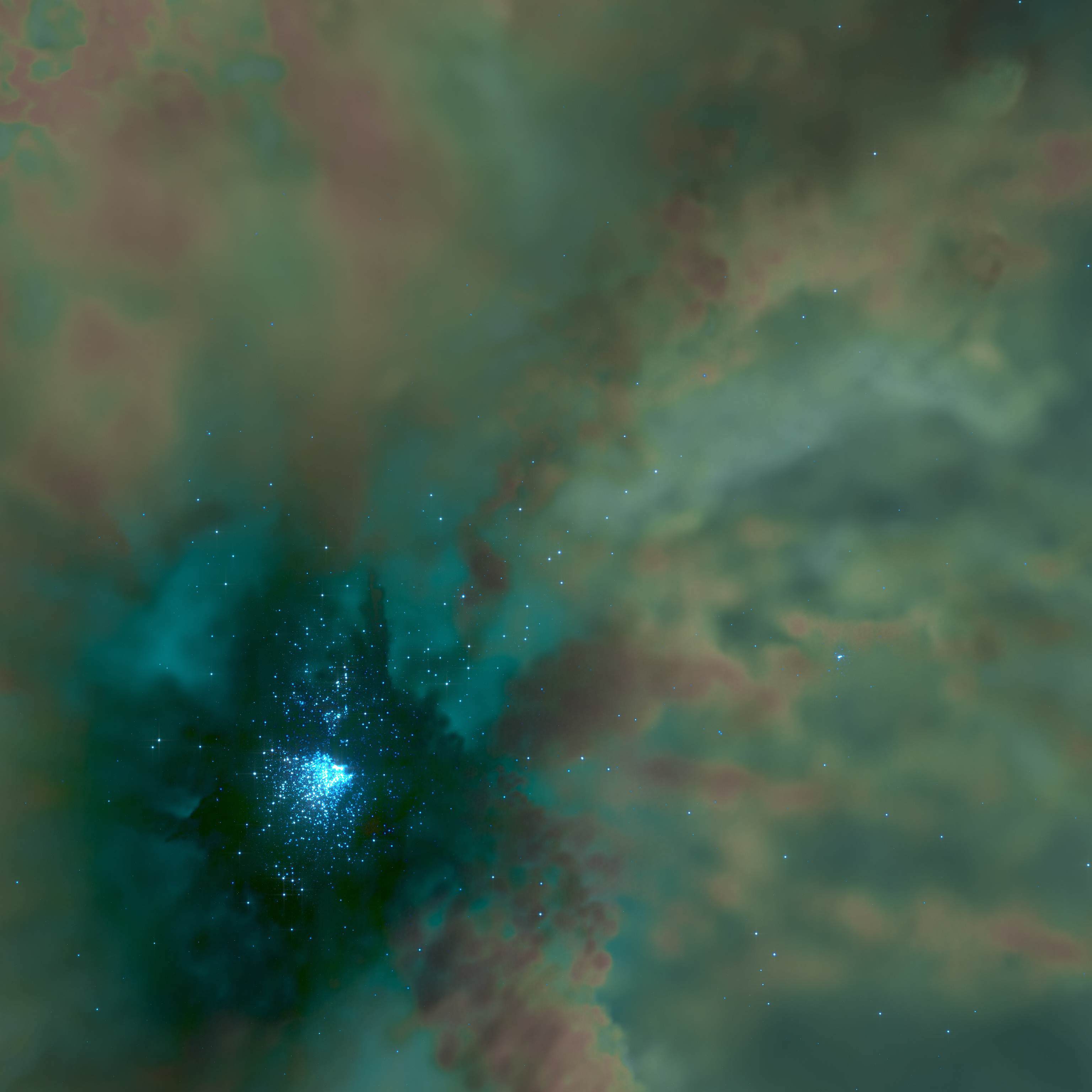
Simulation of globular cluster formation. Individual blue-white stars can be seen. The “cloud” around them is interstellar gas. The gas color gradation shows cooler (dark) and warmer (bright) regions. Credit: Michiko Fujii and Takaaki Takeda. 2024 Download image (3.7MB)

The first star-by-star simulations of globular cluster formation show that massive star collisions can start a runaway process resulting in the formation of intermediate-mass black holes. These results can help explain the origins of this rare type of black holes.

Known black holes generally fall into two categories; low mass black holes with dozens of times the mass of the Sun and high mass black holes with masses more than tens-of-thousands of times that of the Sun. However, black holes with masses in between those two are rarely found, and are considered a major mystery in the evolution of black holes.

One possible place to look for intermediate-mass black holes is in globular clusters, self-contained globs of stars in the halo around the Milky Way Galaxy. One of the hypotheses for the formation of black holes in globular clusters is a “runaway collision” of stars in forming star clusters embedded in their parental molecular clouds. To confirm this theory, however, simulations that reproduce the motion of individual stars inside molecular clouds are needed, but have not been possible due to problems with computational techniques and computer capabilities. Previous simulations of globular cluster evolution have reduced computing costs by bundling stars into groups to track their motion. But these simulations could not reproduce runaway collisions.

A team led by Michiko S. Fujii at The University of Tokyo tested a new recipe for intermediate black holes using the world’s most powerful supercomputer dedicated to astronomy, ATERUI II at the National Astronomical Observatory of Japan. Their new simulation code and the performance of ATERUI II have enabled the world’s first simulation of the formation of individual stars in globular clusters, accurately reproducing the motion of more than one million stars in the interstellar gas, including their collisions and mergers, without eating up unrealistic amounts of computing time.

The results of the simulation show that runaway collisions of stars occur in the cluster during its formation, eventually forming a massive star with a mass about 10,000 times that of the Sun. Calculations based on stellar evolution theory predict that the massive star would become an intermediate-mass black hole with a mass three to four thousand times that of the Sun. This result provides strong theoretical support for the existence of intermediate-mass black holes in globular clusters.


Detailed Article(s)

Medium and mighty: intermediate-mass black holes can survive in globular clusters

The University of Tokyo


Release Information

Researcher(s) Involved in this Release:


Michiko S. Fujii (Department of Astronomy, Graduate School of Science, The University of Tokyo)
Ataru Tanikawa (Center for Information Science, Fukui Prefectural University)
Yutaka Hirai (Astronomical Institute, Tohoku University)
Takayuki Saitoh (Department of Planetology, Graduate School of Science, Kobe University)


Coordinated Release Organization(s):

The University of Tokyo
Fukui Prefectural University
Tohoku University
Kobe University
National Astronomical Observatory of Japan


Paper(s):

Michiko S. Fujii et al. “Simulations predict intermediate-mass black hole formation in globular clusters”, in Science, DOI: 10.1126/science.adi4211

Wednesday, January 03, 2024

Globular cluster VVV CL002 is falling down to the galactic center, study finds


Orbit computed for VVV CL002 (black line), overlaid on the probability densities of orbits projected on the galactic plane (left) and height above the plane z versus galactocentric radius (right). Lighter colors indicate more probable regions of space, that are more frequently sampled by the simulated orbits. Credit: arXiv (2023). DOI: 10.48550/arxiv.2312.16028

Using the Magellan Clay telescope in Chile, astronomers have performed high-resolution spectroscopic observations of a galactic globular cluster known as VVV CL002. They found that the cluster is falling down to the Milky Way's center. The discovery was reported in a research paper published December 26 on the pre-print server arXiv.

Globular clusters (GCs) are collections of tightly bound stars orbiting galaxies. Astronomers perceive them as natural laboratories enabling studies on the evolution of stars and galaxies. In particular, globular clusters could help researchers to better understand the formation history and evolution of early-type galaxies, as the origin of GCs seems to be closely linked to periods of intense star formation.

Located some 23,800 light years away, VVV CL002 is a relatively low-luminosity GC discovered in 2011 with the VISTA Variables in the Via Lactea (VVV) survey. With a galactocentric distance of approximately 1,300 light years, VVV CL002 is assumed to be closest GC to the center of the Milky Way.

Recently, a team of led by Dante Minniti of the Andrés Bello Catholic University in Santiago, Chile, decided to conduct near-infrared high-resolution spectroscopy of VVV CL002 in order to find out how the cluster is surviving so close to the without being tidally disrupted. For this purpose, they employed the Warm INfrared Echelle spectrograph to Realize Extreme Dispersion and (WINERED) at the Magellan Clay telescope.

The observations found that VVV CL002 has a retrograde orbital configuration of relatively high eccentricity of 0.69, with perigalactocentric and apogalactocentric distances of 619 and 3,400 , respectively, well inside the bulge. It turned out that the orbit of VVV CL002 is tighter than the orbits of all other known GCs.

The study delivered important insights into the chemical composition of VVV CL002. It was found that the has a metallicity at a level of -0.54 and showcases high alpha-element abundance. This indicates that VVV CL002 is an old GC that formed together with other clusters.

Therefore, according to the authors of the paper, VVV CL002 was formed outside the central region of the Milky Way but is now falling down to the galactic center.

"This brings us to a scenario where VVV CL002 was formed at a relatively large stellar birth radius and started to fall towards the center recently. It is probably doomed to continue spiraling into the inner parsecs and be destroyed in the not-so-distant future," the researchers explained.

The astronomers underlined that further high-resolution observations of VVV CL002 could be essential in order to better understand the survival and migration mechanisms of galactic .

By Tomasz Nowakowski (Phys.org)

Source: Phys.org


More information: D. Minniti et al, The globular cluster VVV CL002 falling down to the hazardous Galactic centre, arXiv (2023). DOI: 10.48550/arxiv.2312.16028

Journal information: arXiv