Showing posts with label barred spiral galaxy. Show all posts

Saturday, May 16, 2026

A beacon of light in swirls of dust

A spiral galaxy shown in mid-infrared light. The image is dominated by an extremely bright glow from the galaxy’s nucleus. Six large and two smaller rays of light emit from the centre, which are diffraction spikes created by the telescope’s optics. The galaxy’s spiral arms are visible by two lines of glowing orange bubbles which whirl out into the disc. Swirling blue clouds of dust make up the rest of the galaxy. Credit:ESA/Webb, NASA & CSA, A. Leroy


This latest Picture of the Month from the NASA/ESA/CSA James Webb Space Telescope features Messier 77 (M77), a barred spiral galaxy famous and appreciated among astronomers for its combination of relative proximity and spectacular features to study. It is located 45 million light-years away in the constellation Cetus (The Whale). This new image from Webb’s Mid-Infrared Instrument (MIRI) highlights its swirling spiral arms, the dust in its disc and its piercingly bright core like never before.

At the heart of M77 is a compact region filled with hot gas that handily outshines the rest of the galaxy put together, even overcoming the light-gathering capacity of Webb’s cameras. This is an active galactic nucleus (AGN), and it’s powered by M77’s central supermassive black hole, which is eight million times as massive as our Sun. Gas in the galaxy’s central regions is pulled by the strong gravity into a tight and rapid orbit around the black hole, where it crashes together and heats up, releasing tremendous amounts of radiation.

The bright orange lines appearing to radiate out from the centre of M77 are not actually a feature of the galaxy: they are a type of distortion that arises from the optical design of the telescope. Called diffraction spikes, they are created because the intense light from the unresolved AGN is bent (“diffracted”) very slightly at the edges of Webb’s hexagonal mirror panels and around one of the struts that hold up its secondary mirror. This distinctive six-plus-two-pointed pattern is the same for any image taken by Webb. For diffraction spikes to appear, the light source has to be very bright and very concentrated, so they’re most often seen on stars. But in some galaxies, as here, the nucleus is bright and compact enough to make diffraction spikes appear as well.

M77 is not just known for its easily visible AGN, but also as a prolific star-forming galaxy. The near-infrared image of M77 reveals a bar spanning across the central region, which doesn’t appear in visible-light images of the galaxy. The bar is enclosed by a bright ring, called a starburst ring, formed by the inner ends of M77’s two spiral arms. Starburst regions in galaxies are typified by extremely high star-formation rates. This ring is more than 6 000 light-years across and displays intense and widespread starbursts, visible in this image by the densely concentrated orange bubbles all around the ring. Since M77 is relatively close to Earth, this starburst ring is a very well-studied example of the phenomenon.

As an active spiral galaxy, M77’s disc is filled with gas and dust which is both a product of and fuel for future star formation. Webb’s MIRI fills out our view of the galaxy with the glow of interstellar dust grains emitted at longer wavelengths, shown here in blue. The dust forms a huge vortex of smoky, swirling filaments with cavities in between. The glowing orange bubbles carved out by newly formed star clusters are also prominently visible out along the galaxy’s arms.

Beyond Webb’s quite focused view, M77’s arms join into a faint extended ring of hydrogen gas thousands of light-years wide, where yet more star formation is taking place. Vast, tenuous filaments of hydrogen gas stretch across this ring and out into intergalactic space, forming an outermost layer around the galaxy. For the tentacle-like appearance of these filaments, M77 is also named the Squid Galaxy.

The data used to create this image are from an observing programme (#3707) that surveyed massive, nearby, star-forming galaxies to create a rich dataset useful for many scientific investigations. As can be seen here, the stunning resolution of Webb’s instruments reveals star clusters and rich reservoirs of gas, which can be used to explore the cycle of star formation, life and death in these and other galaxies.


Links


Saturday, April 04, 2026

Where spiral arms and star formation meet

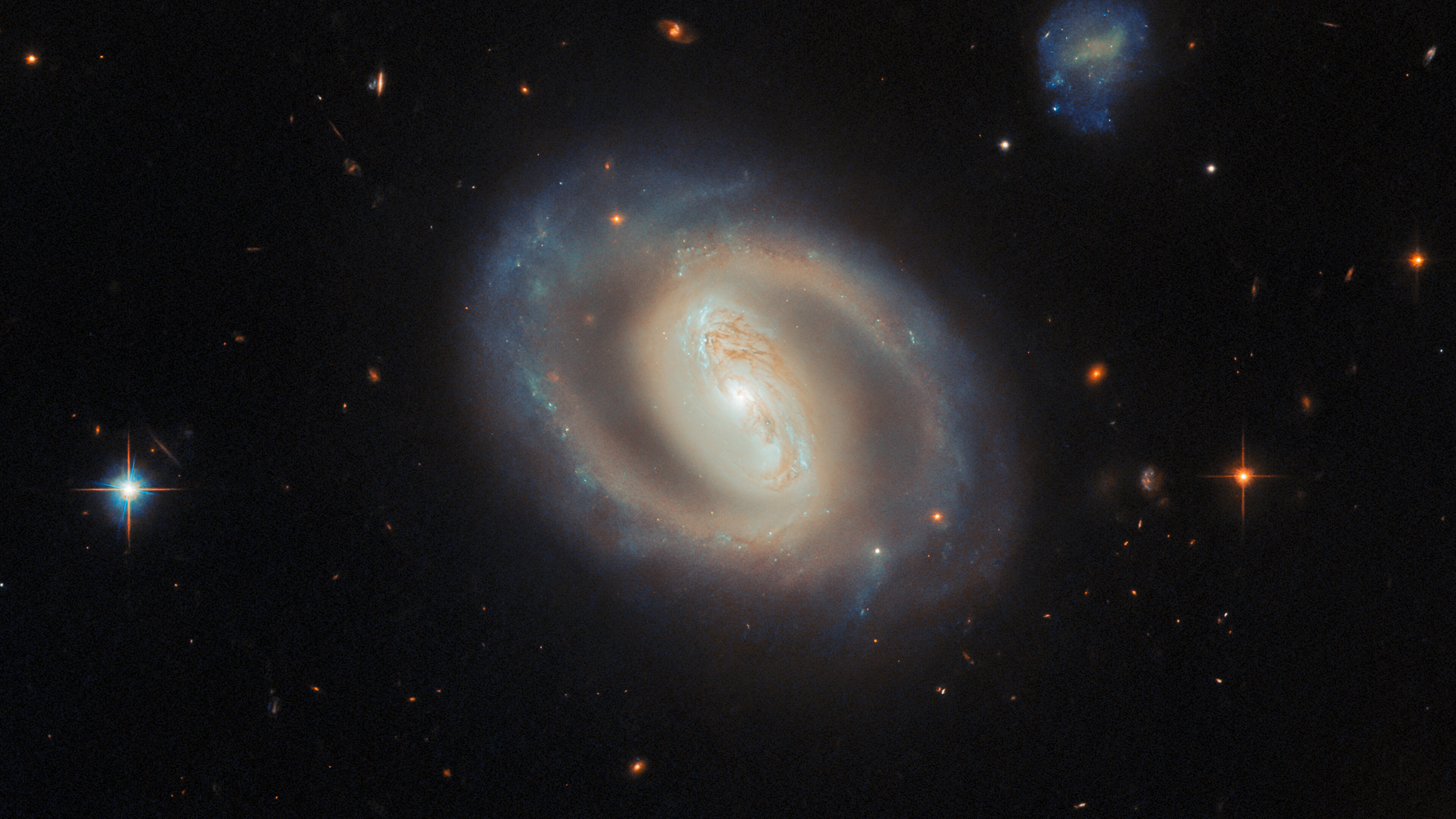
A face-on view of the barred spiral galaxy IC 486, showing a bright, elongated central bar and softly curving, ring-like spiral arms with subtle blue star-forming regions and dark dust lanes, set against a black background dotted with distant galaxies and a few foreground stars.


A luminous swirl set against the deep black of space, the barred spiral galaxy IC 486 glows with a soft, ethereal light in this new ESA/Hubble Picture of the Month image.

IC 486 lies right on the edge of the constellation Gemini (the Twins), around 380 million light-years from Earth. Classified as a barred spiral galaxy, it features a bright central bar-shaped structure from which its spiral arms unfurl, wrapping around the core in a smooth, almost ring-like pattern.

Hubble’s keen eye reveals subtle variations in colour across the galaxy. The pale, luminous centre is dominated by older stars, while faint bluish regions in the surrounding disc trace pockets of more recent star formation. Wisps of dust thread through the galaxy’s structure, gently obscuring light and tracing regions of increased molecular gas where new stars are likely to form.

At the galaxy’s centre a noticeable white glow outshines the starlight around it. This is light given off by IC 486’s active galactic nucleus (AGN), powered by a supermassive black hole more than 100 million times the mass of the Sun. Every sufficiently large galaxy hosts a supermassive black hole at its centre, but some of these black holes are particularly ravenous, marshalling vast amounts of gas and dust into swirling accretion discs from which they feed. The intense heat generated by the orbiting disc of material generates intense radiation up to and including X-rays, which can outshine the entire rest of the galaxy. In these cases, the galaxy is known as an active galaxy, with an AGN at its centre.

The data used to make this image comes from two separate observing programmes — #17310 (PI: M. J. Koss) and #15444 (PI: A. J. Barth) — with similar aims: to survey nearby active galaxies like IC 486 and record detailed, high-quality images of their central black holes and the stars near the core of the galaxy. By combining Hubble’s sharp imaging with large comprehensive samples, these programmes are enabling detailed comparisons of how stars, gas, dust, and black holes interact in galaxy centres.

A key goal of this work is to understand how galaxies grow by linking their large-scale structures, such as bars and spiral arms, to activity in their nuclei. To achieve this, the research teams are leveraging both expert classifications and citizen science through Galaxy Zoo, with datasets that will ultimately be released to the public. In parallel, the same images are being used to test how well large language models and other machine learning techniques can reproduce or extend human classifications, offering a new way to scale galaxy morphology studies to the largest surveys that are currently being performed with the Euclid telescope.

Beyond IC 486 itself, the image is peppered with distant background galaxies and foreground stars. Some stars appear with characteristic diffraction spikes, while the more diffuse, reddish smudges are far more distant galaxies scattered across the cosmos.

Though it may appear calm and orderly, IC 486 is a dynamic system shaped by gravity and stellar evolution. Over millions of years, its structure will continue to evolve as stars are born, age, and fade, contributing to the ongoing story of galactic life in the Universe.


Links


Sunday, March 08, 2026

Intermediate Spiral Galaxy NGC 941


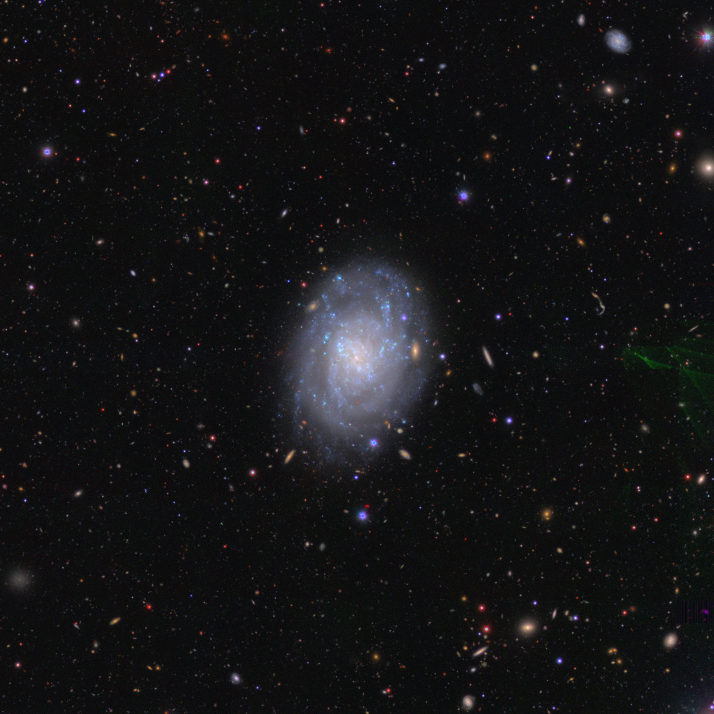
NGC 941 is located approximately 55 million light-years away in the constellation Cetus. This faint galaxy is classified as an intermediate spiral, exhibiting characteristics between a barred spiral with a central bar and an unbarred spiral. Overall, NGC 941 has a bluish appearance, and the presence of dust lanes in its central region indicates ongoing star formation. The small orange galaxies visible around it are actually much more distant background galaxies, seen through NGC 941 due to its low surface brightness. Credit: NAOJ; Image provided by Masayuki Tanaka


Friday, November 28, 2025

Barred Spiral Galaxy IC 1010

IC 1010

Detail:
Low Res. (149 KB) / Mid. Res. (1.0 MB) / High Res. (8.2 MB)
Credit: NAOJ; Image provided by Masayuki Tanak
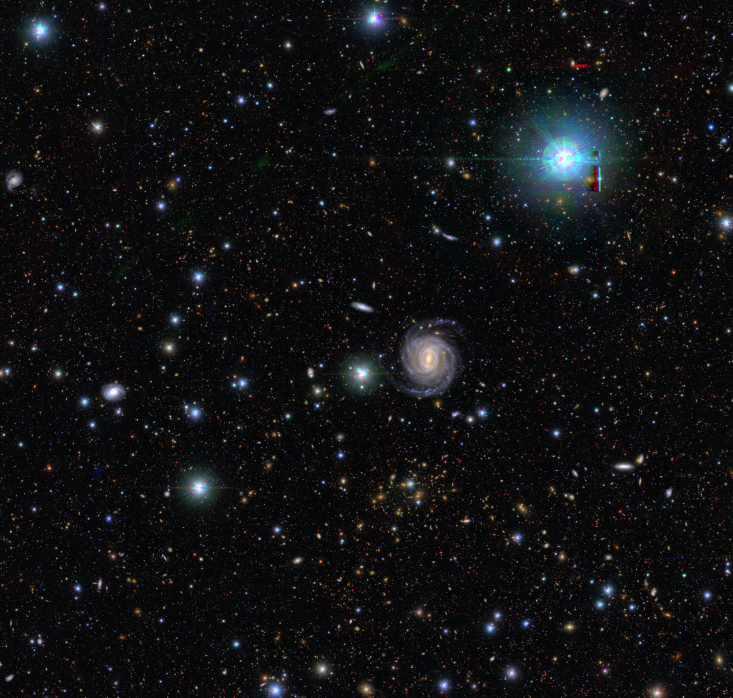
In the constellation of Virgo, about 360 million light-years away, IC 1010 appears to stand alone in the vast Universe, positioned at the center-right of the image. This galaxy is classified as a barred spiral galaxy, characterized by its spiral structure and a prominent central bar-like feature.

The image shows no other prominent galaxies surrounding IC 1010. Many spiral galaxies are known to exist in isolation like this one. In contrast, elliptical galaxies are frequently found in regions with a gathering of other galaxies, such as galaxy clusters. This difference in distribution indicates that the environment surrounding a galaxy has a significant influence on its formation.

Distance from Earth: 360 million light-years
Instrument: Hyper Suprime-Cam (HSC)


Wednesday, May 28, 2025

A Fierce Storm in a Giant-Barred Spiral Galaxy 11 Billion Years Ago

Left: Near-infrared image captured by the James Webb Space Telescope. The two galaxies at the bottom are the foreground objects. Right: Molecular gas distribution observed by ALMA. Gas accumulates at the leading side of the rotating bar structure and falls toward the center. (credit: NASA, ALMA(ESO/NAOJ/NRAO), Huang et al.).

Left: Near-infrared image of a nearby galaxy, VV114, and the background monster barred spiral galaxy J0107a at z=2.433 captured by the James Webb Space Telescope (credit: NASA). Right: Stellar and molecular gas distribution of J0107a (credit: NASA, ALMA(ESO/NAOJ/NRAO), Huang et al.).


In the early universe, more than 10 billion years ago, numerous monster galaxies formed stars at a rate over 100 times faster than the Milky Way. Although a few galaxies undergo star formation at a similar pace even in the present-day universe, almost all of them collide or merge with other galaxies. Based on this, scientists assumed that such intense bursts of star formation in monster galaxies are also caused by substantial gas influx at their centers because of galaxy collisions or mergers, and that they evolve into giant elliptical galaxies once the gas is depleted.

Monster galaxies are far from Earth and obscured by massive amounts of dust generated by intense star formation, making them difficult to observe at optical wavelengths. Until recently, their shape and the physical process that drives such bursts of star formation remained largely unknown. However, recent infrared imaging observations with the James Webb Space Telescope have uncovered dust-veiled monster galaxies, revealing the existence of many monster galaxies with a remarkable disk structure. This prompted a new question: Why are monster galaxies that appear to be ordinary disk galaxies experiencing such intense bursts of star formation?

A research team led by Shuo Huang targeted a monster galaxy with a barred spiral structure in the Universe 11.1 billion years ago. The J0107a galaxy, located at a redshift of z=2.467, was serendipitously found in 2014, while the nearby merging galaxy VV114 was observed. The James Webb Space Telescope’s near-infrared images of VV114, released in 2023, revealed that J0107a is an exceptionally massive example of a monster galaxy, with a mass more than ten times that of the Milky Way Galaxy and a star formation rate approximately 300 times that of the Milky Way. Even more surprisingly, J0107a has a perfect barred spiral structure, one of the largest and most distinct of any galaxy in this cosmic epoch. The shape looks more like modern barred spiral galaxies than any previously observed monster galaxies. While more information on gas kinematics is needed to explore the factors behind J0107a's intense star formation, spectroscopic observations of a dust-covered galaxy are incredibly challenging, even with the James Webb Space Telescope.

The research team then used ALMA to observe the emission lines of carbon monoxide and neutral carbon atoms and discovered that J0107a closely resembles modern barred spiral galaxies, such as the Milky Way, in terms of the shape of its bar structure as well as the distribution and movement of the associated gas. On the other hand, the team also found that while the proportion of gas in the bar structure of a modern galaxy is less than 10% of the total mass, that of J0107a is very high at around 50%. The data shows that J0107a's bar structure, which consists of stars and gas with a mass far greater than that of modern galaxies, stirs up the disk, creating a gas flow at a speed of several hundred kilometers per second over a radius of 20,000 light-years around the center of the galaxy, which is equivalent to the distance from the center of the Milky Way to the Solar System. Some of this gas falls into the galaxy's center, resulting in intense star formation. No previous theoretical studies of galaxy formation predicted the existence of a monster galaxy with such a bar structure.

This is the first successful direct observation of a burst of star formation induced by gas inflow from a bar structure in the early universe. The conventional theories of monster galaxy formation and evolution assumed that intense star formation occurs due to galactic collisions and mergers or gravitational instability in their disks, turning them into elliptical galaxies over hundreds of millions of years. Meanwhile, J0107a is assumed to have developed a shape resembling a modern barred spiral galaxy while retaining the extreme physical properties of a monster galaxy over hundreds of millions of years in the early universe, just 2.6 billion years after the Big Bang. The detailed data on gas distribution and kinematics obtained from this observation will provide essential clues to the origin of monster galaxies and inform research into the formation and evolution of bar structures in other galaxies, as we are witnessing the bar structure formation process in the early universe.

Shuo Huang, the research team's leader, says, "The substantial amount of gas required for the growth of giant galaxies is supplied by galactic mergers or inflows from the cosmic web. While no sign of a galactic merger exists, a large gas disk has been detected around J0107a. This gas disk has a diameter of approximately 120,000 light years, which is twice the diameter of the galaxy's main body, visible as stars, and its motion roughly follows that of the galaxy itself. Based on this, we assume it was created from a large amount of gas spiraling toward the galaxy from the cosmic web1. This is a new picture of a monster galaxy, in which a disk galaxy is formed from a cosmic-scale gas flow, followed by the emergence of a bar structure during the galactic evolution, leading to rapid galactic-scale gas flows and bursts of star formation. We will continue our observational studies with ALMA to investigate this further."

Science Paper


Notes

1. These gas flows are theoretically predicted and called "cold streams."


Additional Information

This research was published in Nature on May 21, 2025, by Shuo Huang et al., "Large gas inflow driven by a matured galactic bar in the early Universe" (DOI: 10.1038/s41586-025-08914-2).

Grants-in-Aid support this research from the Japan Society for the Promotion of Science (KAKENHI: Nos. JP22H04939, JP23K20035, JP24H00004) and the ALMA Joint Scientific Research Program (No. 2024-26A).

The National Astronomical Observatory of Japan (NAOJ), an ALMA partner on behalf of East Asia, published the
original press release.

The Atacama Large Millimeter/submillimeter Array (ALMA), an international astronomy facility, is a partnership of the European Southern Observatory (ESO), the U.S. National Science Foundation (NSF), and the National Institutes of Natural Sciences (NINS) of Japan in cooperation with the Republic of Chile. ALMA is funded by ESO on behalf of its Member States, by NSF in cooperation with the National Research Council of Canada (NRC) and the National Science and Technology Council (NSTC) in Taiwan, and by NINS in cooperation with the Academia Sinica (AS) in Taiwan and the Korea Astronomy and Space Science Institute (KASI).

ALMA construction and operations are led by ESO on behalf of its Member States; by the National Radio Astronomy Observatory (NRAO), managed by Associated Universities, Inc. (AUI), on behalf of North America; and by the National Astronomical Observatory of Japan (NAOJ) on behalf of East Asia. The Joint ALMA Observatory (JAO) provides the unified leadership and management of ALMA's construction, commissioning, and operation.


Thursday, April 24, 2025

Eye on Infinity: NASA Celebrates Hubble’s 35th Year in Orbit

A selection of photogenic space targets to celebrate the 35th anniversary of NASA's Hubble Space Telescope. Upper left: Mars. Upper right: planetary nebula NGC 2899. Lower left: a small portion of the Rosette Nebula. Lower right: barred spiral galaxy NGC 5 planetary nebula335. Image: NASA, ESA, STScI; Image Processing: Joseph DePasquale (STScI), Alyssa Pagan (STScI)


In celebration of the Hubble Space Telescope’s 35 years in Earth orbit, NASA is releasing an assortment of compelling images recently taken by Hubble, stretching from the planet Mars to star-forming regions, and a neighboring galaxy.

After more than three decades of perusing the universe, Hubble remains a household name — the most well-recognized and scientifically productive telescope in history. The Hubble mission is a glowing success story of America’s technological prowess, unyielding scientific curiosity, and a reiteration of our nation’s pioneering spirit.

“Hubble opened a new window to the universe when it launched 35 years ago. Its stunning imagery inspired people across the globe, and the data behind those images revealed surprises about everything from early galaxies to planets in our own solar system,” said Shawn Domagal-Goldman, acting director of the Astrophysics Division at NASA Headquarters in Washington. “The fact that it is still operating today is a testament to the value of our flagship observatories, and provides critical lessons for the Habitable Worlds Observatory, which we plan to be serviceable in the spirit of Hubble.”

Perched above Earth’s blurry atmosphere, Hubble’s crystal-clear views have been nothing less than transformative for the public’s perception of the cosmos. Through its evocative imagery, Hubble has made astronomy very relevant, engaging, and accessible for people of all ages. Hubble snapshots can portray the universe as awesome, mysterious, and beautiful — and at the same time chaotic, overwhelming, and foreboding.

A selection of photogenic space targets to celebrate the 35th anniversary of NASA's Hubble Space Telescope. Upper left: Mars. Upper right: planetary nebula NGC 2899. Lower left: a small portion of the Rosette Nebula. Lower right: barred spiral galaxy NGC 5335. Image: NASA, ESA, STScI; Image Processing: Joseph DePasquale (STScI), Alyssa Pagan (STScI)

The 24,000-pound observatory was tucked away inside the space shuttle Discovery’s cargo bay and lofted into low Earth orbit on April 24, 1990. As the shuttle Discovery thundered skyward, the NASA commentator described Hubble as a “new window on the universe.” The telescope turned out to be exactly as promised, and more.

More scientific papers than ever are based on Hubble data, thanks to the dedication, perseverance, and skills of engineers, scientists, and mission operators. Astronauts chased and rendezvoused with Hubble on five servicing missions in which they upgraded Hubble’s cameras, computers, and other support systems. The servicing missions took place from 1993 to 2009.

The telescope’s mission got off to a shaky start in 1990 when an unexpected flaw was found in the observatory’s nearly eight-foot diameter primary mirror. Astronauts gallantly came to the rescue on the first shuttle servicing mission in December 1993 to improve Hubble’s sharpness with corrective optics.

To date, Hubble has made nearly 1.7 million observations, looking at approximately 55,000 astronomical targets. Hubble discoveries have resulted in over 22,000 papers and over 1.3 million citations as of February 2025. All the data collected by Hubble is archived and currently adds up to over 400 terabytes, representing the biggest dataset for a NASA astrophysics mission besides the James Webb Space Telescope.

Hubble’s long operational life has allowed astronomers to return to the same cosmic scenes multiple times to observe changes that happened during more than three decades: seasonal variability on the planets in our solar system, black hole jets travelling at nearly the speed of light, stellar convulsions, asteroid collisions, expanding supernova bubbles, and much more.

Hubble’s Senior Project Scientist, Dr. Jennifer Wiseman, takes you on a tour of all four Hubble 35th anniversary images. Credit: NASA's Goddard Space Flight Center; Lead Producer: Paul Morris; Narrator: Dr. Jennifer Wiseman

Before 1990, powerful optical telescopes on Earth could see only halfway across the cosmos. Estimates for the age of the universe disagreed by a big margin. Supermassive black holes were only suspected to be the powerhouses behind a rare zoo of energetic phenomena. Not a single planet had been seen around another star.

Among its long list of breakthroughs: Hubble’s deep field images unveiled myriad galaxies dating back to the early universe. The telescope also allowed scientists to precisely measure the universe’s expansion, find that supermassive black holes are common among galaxies, and make the first measurement of the atmospheres of exoplanets. Hubble also contributed to the discovery of dark energy, the mysterious phenomenon accelerating the expansion of universe, leading to the 2011 Nobel Prize in Physics. 

The relentless pace of Hubble’s trailblazing discoveries kick-started a new generation of space telescopes for the 21st century. Hubble provided the first observational evidence that there were myriad distant galaxies for Webb to pursue in infrared wavelengths that reach even farther beyond Hubble’s gaze. Now, Hubble and Webb are often being used in complement to study everything from exoplanets to galaxy evolution.

Hubble’s planned successor, the Habitable Worlds Observatory, will have a significantly larger mirror than Hubble’s to study the universe in visible and ultraviolet light. It will be significantly sharper than Hubble and up to 100 times more sensitive to starlight. The Habitable Worlds Observatory will advance science across all of astrophysics, as Hubble has done for over three decades. A major goal of the future mission is to identify terrestrial planets around neighboring stars that might be habitable.

The Hubble Space Telescope continues to make ground-breaking discoveries that shape our fundamental understanding of the universe. Hubble is a project of international cooperation between NASA and ESA (European Space Agency). NASA’s Goddard Space Flight Center in Greenbelt, Maryland, manages the telescope and mission operations. Lockheed Martin Space, based in Denver, also supports mission operations at Goddard. The Space Telescope Science Institute in Baltimore, which is operated by the Association of Universities for Research in Astronomy, conducts Hubble science operations for NASA.


Tuesday, June 04, 2024

A broad and narrow galactic view

A spiral galaxy seen face-on, so that its many arms and its glowing, bar-shaped core can be easily seen. The arms are filled with bluish patches of older stars, pink patches where new stars are forming, and dark threads of dust. A few bright stars with cross-shaped diffraction spikes lie in the foreground. Credit: ESA/Hubble & NASA, D. Thilker

This Picture of the Week features the barred spiral galaxy NGC 3059, which lies about 57 million light-years from Earth. The data used to compose this image were collected by Hubble in May 2024, as part of an observing programme that studied a number of galaxies. All the observations were made using the same range of filters: partially transparent materials that allow only very specific wavelengths of light to pass through.

Filters are used extensively in observational astronomy, and can be calibrated to allow either extremely narrow or somewhat broader ranges of light through. Narrow-band filters are invaluable from a scientific perspective because certain light wavelengths are associated with specific physical and chemical processes. For example, under particular conditions, hydrogen atoms are known to emit red light with wavelength value of 656.46 nanometres. Red light at this wavelength is known as H-alpha emission, or the ‘H-alpha line’. It is very useful to astronomers because its presence acts as an indicator of certain physical processes and conditions; it is often a tell-tale sign of new stars being formed, for example.

Thus, narrow-band filters calibrated to allow H-alpha emission through can be used to identify regions of space where stars are forming.

Such a filter was used for this image, the narrow-band filter called F657N or the H-alpha filter. The F stands for filter, and the N stands for narrow. The numerical value refers to the peak wavelength (in nanometres) that the filter lets through. The eagle-eyed amongst you may have noticed that 657 is very close to the 656.46 H-alpha line’s wavelength. Data collected using five other filters contributed to this image as well, all of which were wide-band filters; meaning that they allow a wider range of light wavelengths through. This is less useful for identifying extremely specific lines (such as the H-alpha line) but still enables astronomers to explore relatively specific parts of the electromagnetic spectrum. In addition, collectively the information from multiple filters can be used to make beautiful images such as this one.


Thursday, July 27, 2023

Dark Energy Camera Captures Galaxies in Lopsided Tug of War, a Prelude to Merger

PR Image noirlab2321a
Dark Energy Camera Captures Galaxies in Lopsided Tug of War, a Prelude to Merger


Haley’s Coronet and dwarf galaxy companion feel each other’s gravitational forces as they begin to coalesce

The spiral galaxy NGC 1532, also known as Haley’s Coronet, is caught in a lopsided tug of war with its smaller neighbor, the dwarf galaxy NGC 1531. The image — taken by the US Department of Energy’s (DOE) Dark Energy Camera mounted on the National Science Foundation’s (NSF) Víctor M. Blanco 4-meter Telescope at Cerro Tololo Inter-American Observatory in Chile, a Program of NSF’s NOIRLab — captures the mutual gravitational influences of a massive- and dwarf-galaxy merger.

Galaxies grow and evolve over billions of years by absorbing nearby companions and merging with other galaxies. The early stages of this galactic growth process are showcased in a new image taken with the US Department of Energy’s (DOE) Dark Energy Camera (DECam) mounted on the National Science Foundation’s (NSF) Víctor M. Blanco 4-meter Telescope at Cerro Tololo Inter-American Observatory (CTIO), a Program of NSF’s NOIRLab.

The massive barred spiral galaxy NGC 1532, also known as Haley’s Coronet, is located about 55 million light-years away in the direction of the southern constellation Eridanus (the river). Its sweeping spiral arms are seen edge-on from Earth, with the nearer arm dipping downward and the receding arm lurching upward as it tugs upon its smaller, dwarf companion galaxy NGC 1531. These gravitationally bound galaxies will eventually become one, as NGC 1532 completely consumes its smaller companion.

Despite its small stature, however, the dwarf galaxy has also been exerting a noticeable gravitational influence on its larger companion, distorting one of its spiral arms, which can be seen rising above the galactic plane. Additionally, plumes of gas and dust can be seen between the two galaxies, like a bridge of stellar matter held in place by the competing tidal forces. This interaction has also triggered bursts of star formation within both galaxies.

This lopsided cosmic tug of war is a snapshot of how large galaxies grow and evolve by devouring smaller galaxies, absorbing their stars and star-forming material. A similar process has happened in the Milky Way, possibly six times in the past, leaving vast streams of stars and other signs in the halo of the Milky Way.

The process of absorbing a smaller companion galaxy is starkly different from the cataclysmic merger of two spiral galaxies of comparable size. In the latter case, two massive galaxies collide to form an entirely distinct galaxy with its own shape and characteristics. This type of galactic merger will happen to the Milky Way when it merges with the Andromeda Galaxy four billion years from now.

DECam, with its unparalleled wide-field imaging capabilities, gives astronomers highly detailed views of these large-scale galactic interactions. It also has the remarkable sensitivity, with the help of the 4-meter Blanco telescope, needed to detect faint objects in our Solar System and to trace the influence of dark matter on galaxies across the visible Universe. Currently, DECam is used for programs covering a wide range of science.


More Information

NSF’s NOIRLab (National Optical-Infrared Astronomy Research Laboratory), the US center for ground-based optical-infrared astronomy, operates the international Gemini Observatory (a facility of NSF, NRC–Canada, ANID–Chile, MCTIC–Brazil, MINCyT–Argentina, and KASI–Republic of Korea), Kitt Peak National Observatory (KPNO), Cerro Tololo Inter-American Observatory (CTIO), the Community Science and Data Center (CSDC), and Vera C. Rubin Observatory (in cooperation with DOE’s SLAC National Accelerator Laboratory). It is managed by the Association of Universities for Research in Astronomy (AURA) under a cooperative agreement with NSF and is headquartered in Tucson, Arizona. The astronomical community is honored to have the opportunity to conduct astronomical research on Iolkam Du’ag (Kitt Peak) in Arizona, on Maunakea in Hawai‘i, and on Cerro Tololo and Cerro Pachón in Chile. We recognize and acknowledge the very significant cultural role and reverence that these sites have to the Tohono O'odham Nation, to the Native Hawaiian community, and to the local communities in Chile, respectively.


Links


Contacts:

Charles Blue
NSF’s NOIRLab
Tel: +1 202-236-6324
Email:
charles.blue@noirlab.edu

Josie Fenske
NSF's NIORLab
Email:
josie.fenske@noirlab.edu

Tuesday, May 10, 2022

Galactic Ballet Captured from NSF’s NOIRLab in Chile

PR Image noirlab2210a
The interacting galaxy pair NGC 1512 and NGC 1510

PR Image noirlab2210b
Wider crop of the NGC 1512 image

Wider crop of the NGC 1512 image


Videos

Cosmoview Episode 44: Galactic Ballet Captured from NSF’s NOIRLab in Chile
Cosmoview Episode 44: Galactic Ballet Captured from NSF’s NOIRLab in Chile 
 
Zooming into NGC 1512
Zooming into NGC 1512 
 
CosmoView Episodio 44: Tololo captura un ballet galáctico a 60 millones de años luz de la Tierra


DOE-funded Dark Energy Camera captures a pair of galaxies performing a gravitational duet


The interacting galaxy pair NGC 1512 and NGC 1510 take center stage in this image from the US Department of Energy-fabricated Dark Energy Camera, a state-of-the-art wide-field imager on the Víctor M. Blanco 4-meter Telescope at Cerro Tololo Inter-American Observatory, a Program of NSF’s NOIRLab. NGC 1512 has been in the process of merging with its smaller galactic neighbor for 400 million years, and this drawn-out interaction has ignited waves of star formation.

The barred spiral galaxy NGC 1512 (left) and its diminutive neighbor NGC 1510 were captured in this observation from the Víctor M. Blanco 4-meter Telescope. As well as revealing the intricate internal structure of NGC 1512, this image shows the wispy outer tendrils of the galaxy stretching out and appearing to envelop its tiny companion. The starry stream of light that connects the two galaxies is evidence of the gravitational interaction between them — a stately and graceful liaison that has been going on for 400 million years. NGC 1512 and NGC 1510’s gravitational interaction has affected the rate of star formation in both galaxies as well as distorting their shapes. Eventually, NGC 1512 and NGC 1510 will merge into one larger galaxy — a drawn-out example of galactic evolution.

These interacting galaxies lie in the direction of the constellation of Horologium in the southern celestial hemisphere and are around 60 million light-years from Earth. The wide field of view of this observation shows not only the intertwined galaxies, but also their star-studded surroundings. The frame is populated with bright foreground stars within the Milky Way and is set against a backdrop of even more distant galaxies.

The image was taken with one of the highest-performance wide-field imaging instruments in the world, the Dark Energy Camera (DECam). This instrument is perched atop the Víctor M. Blanco 4-meter Telescope and its vantage point allows it to collect starlight reflected by the telescope’s 4-meter-wide (13-foot-wide) mirror, a massive, aluminum-coated and precisely shaped piece of glass roughly the weight of a semi truck. After passing through the optical innards of DECam — including a corrective lens nearly a meter (3.3 feet) across — starlight is captured by a grid of 62 charge-coupled devices (CCDs). These CCDs are similar to the sensors found in ordinary digital cameras but are far more sensitive, and allow the instrument to create detailed images of faint astronomical objects such as NGC 1512 and NGC 1510.

Large astronomical instruments such as DECam are custom-built masterpieces of optical engineering, requiring enormous effort from astronomers, engineers, and technicians before the first images can be captured. Funded by the US Department of Energy (DOE) with contributions from international partners, DECam was built and tested at DOE’s Fermilab, where scientists and engineers built a “telescope simulator” — a replica of the upper segments of the Víctor M. Blanco 4-meter Telescope — that allowed them to thoroughly test DECam before shipping it to Cerro Tololo in Chile.

DECam was created to conduct the Dark Energy Survey (DES), a six-year observing campaign (from 2013 to 2019) involving over 400 scientists from 25 institutions in seven countries. This international collaborative effort set out to map hundreds of millions of galaxies, detect thousands of supernovae, and discover delicate patterns of cosmic structure — all to provide much-needed details of the mysterious dark energy that is accelerating the expansion of the Universe. Today DECam is still used for programs by scientists from around the world continuing its legacy of cutting-edge science.


More Information

NSF’s NOIRLab (National Optical-Infrared Astronomy Research Laboratory), the US center for ground-based optical-infrared astronomy, operates the international Gemini Observatory (a facility of NSF, NRC–Canada, ANID–Chile, MCTIC–Brazil, MINCyT–Argentina, and KASI–Republic of Korea), Kitt Peak National Observatory (KPNO), Cerro Tololo Inter-American Observatory (CTIO), the Community Science and Data Center (CSDC), and Vera C. Rubin Observatory (operated in cooperation with the Department of Energy’s SLAC National Accelerator Laboratory). It is managed by the Association of Universities for Research in Astronomy (AURA) under a cooperative agreement with NSF and is headquartered in Tucson, Arizona. The astronomical community is honored to have the opportunity to conduct astronomical research on Iolkam Du’ag (Kitt Peak) in Arizona, on Maunakea in Hawai‘i, and on Cerro Tololo and Cerro Pachón in Chile. We recognize and acknowledge the very significant cultural role and reverence that these sites have to the Tohono O'odham Nation, to the Native Hawaiian community, and to the local communities in Chile, respectively.


Links


Contact:

Amanda Kocz
Communications Manager
NSF’s NOIRLab
Tel: +1 520 318 8591
Email:
amanda.kocz@noirlab.edu

Source: NoirLab/News


Wednesday, December 01, 2021

SOFIA Confirms a Spiral Galaxy's Invisible, Opposing Arms


Hubble Space Telescope image of NGC 7479 created from observations at visible and near-infrared wavelengths with 20 cm radio continuum contours in yellow. The boxes highlight the ends of the lower and upper counter-arms; expanded versions of these regions are shown in the left and right panels where the circles depict the aperture of SOFIA’s FIFI-LS instrument. Credit: ESA/Hubble & NASA

Columbia, MD—November 29, 2021. NGC 7479, also known as Caldwell 44, is a barred spiral galaxy, with a bar-shaped center filled with stars (as is characteristic of a majority of spiral galaxies), and S- shaped arms. However, looking at features of NGC 7479 that are hidden from the naked eye reveals another pair of arms bending in an opposite direction to the visible galaxy. The Stratospheric Observatory for Infrared Astronomy (SOFIA) observed ionized carbon emissions to help confirm these counter-arms. The results were published in The Astrophysical Journal.

Radio wavelength emissions from these small, so-called “counter-arms” have been observed before, but with the help of SOFIA – along with observations by ALMA and archival data from a number of other observatories – their presence has now been confirmed by X-ray, ionized carbon, and carbon monoxide emissions as well. SOFIA’s new observations of the counter-arms can help reveal their origin.

Universities Space Research Association's Dario Fadda, the lead author of the paper, noted,“The really important thing in this galaxy are the two little counter-arms that go in the opposite direction of the optical arms that are seen in radio, but nobody had seen them in the X-ray. Seeing them in X-ray is important because it shows there’s energy coming out of the nucleus, something that comes out in jets that originate in the nucleus.”

The fact that these jets originate at the galaxy’s center implies the galaxy harbors an active nucleus – a supermassive black hole.

As the jet approaches the dense molecular clouds along the bar, some of its momentum is absorbed by the clouds, causing the jet to bend in the direction opposite to the rotation of the galaxy. This process is responsible for the orientation of the counter-arms.

By comparing the X-ray emissions of the jet to the ratio of ionized carbon and carbon dioxide emissions from the same area – both of which are considered indicators of star formation – the researchers discovered an anomaly. Certain hotspots within the counter-arms have too much ionized carbon, meaning the X-ray emission cannot entirely be explained by star formation.

“We knew about these counter-arms and tried to observe with SOFIA if ionized carbon is actually produced by star formation, or if there’s some extra component that can come from the energy injected by the active galactic nucleus,” said Fadda.

This calls into question the relationship between ionized carbon and star formation, and can have implications on the study of galaxies that are more distant than NGC 7479.

“This is where SOFIA becomes uniquely useful: Studying these cases of galaxies close to us to have an idea of what to encounter when we go to higher redshift to study galaxies and the farther universe,” Fadda said.NGC 7479

SOFIA’s role in these observations pushes the limits of its capabilities. Primarily suited for studying objects fairly close to our home galaxy, SOFIA’s spatial and spectral resolution were just enough to distinguish ionized carbon in NGC 7479’s region of interest. Specifically, SOFIA’s Far Infrared Field-Imaging Line Spectrometer (FIFI-LS) was used to map the ionized carbon in the area.


About USRA

Founded in 1969, under the auspices of the National Academy of Sciences at the request of the U.S. Government, the Universities Space Research Association (USRA), is a nonprofit corporation chartered to advance space-related science, technology and engineering. USRA operates scientific institutes and facilities, and conducts other major research and educational programs. USRA engages the university community and employs in-house scientific leadership, innovative research and development, and project management expertise. More information about USRA is available at www.usra.edu

About SOFIA

SOFIA is a joint project of NASA and the German Space Agency at DLR. DLR provides the telescope, scheduled aircraft maintenance, and other support for the mission. NASA’s Ames Research Center in California’s Silicon Valley manages the SOFIA program, science, and mission operations in cooperation with the Universities Space Research Association, headquartered in Columbia, Maryland, and the German SOFIA Institute at the University of Stuttgart. The aircraft is maintained and operated by NASA’s Armstrong Flight Research Center Building 703, in Palmdale, California.


Contact:

Suraiya Farukhi, Ph.D.
Director, External Communications

sfarukhi@usra.edu
443-812-6945