Showing posts with label planetesimals. Show all posts

Wednesday, February 25, 2026

Why some objects in space look like snowmen

This image was taken by NASA's New Horizons spacecraft on 1 January 2019 during a flyby of Kuiper belt object 2014 MU69, known as Arrokoth. It is the clearest view yet of this remarkable, ancient object in the far reaches of the solar system – and the first small "KBO" ever explored by a spacecraft. Credit: NASA 
Licence type: Attribution (CC BY 4.0)

Astronomers have long debated why so many icy objects in the outer solar system look like snowmen.

Now, thanks to a new computer simulation in a research paper published in Monthly Notices of the Royal Astronomical Society, Michigan State University (MSU) researchers have evidence of the surprisingly simple process that could be responsible for their creation.

Far beyond the violent, chaotic asteroid belt between Mars and Jupiter lies what is known as the Kuiper belt. There, past Neptune, are icy, untouched building blocks from the dawn of the solar system, known as planetesimals.

bout one in 10 of these objects are contact binaries, planetesimals that are shaped like two connected spheres – much like a snowman – including the most distant and most primitive object ever explored by a spacecraft, the ultra-red, 4 billion-year-old body known as Arrokoth, which was discovered in 2014 by NASA’s New Horizons spacecraft.

But just how objects such as Arrokoth came to be has long been a mystery.

Jackson Barnes, an MSU graduate student, has created the first simulation that reproduces the two-lobed shape naturally with gravitational collapse.

Earlier computational models treated colliding objects as fluid blobs that merged into spheres, making it impossible to form these unique shapes.

But with the help of MSU’s Institute for Cyber-Enabled Research (ICER) and its high-performance computing cluster, Barnes says his simulations produce a more realistic environment that allows objects to retain their strength and rest against one another.

Other formation theories involve special events or exotic phenomena that, while possible, aren’t likely to happen on a regular basis.

“If we think 10 per cent of planetesimal objects are contact binaries, the process that forms them can’t be rare,” said Earth and Environmental Science Professor Seth Jacobson, senior author on the paper. “Gravitational collapse fits nicely with what we’ve observed.”


Contact binaries were first imaged up close by the New Horizons spacecraft in January 2019. These images prompted scientists to take another look at other objects in the Kuiper belt, and it turned out that contact binaries accounted for about one in 10 of all planetesimals.

These distant objects float mostly undisturbed and safe from collisions in the sparsely populated Kuiper belt.

In the early days of the Milky Way, the galaxy was a disc of dust and gas. Remnants of the galaxy’s formation are found in the Kuiper belt, including dwarf planets such as Pluto, comets and planetesimals.

Planetesimals are the first large planetary objects to form from the disc of dust and pebbles. Much like individual snowflakes that are packed into a snowball, these first planetesimals are aggregates of pebble-sized objects pulled together by gravity from a cloud of tiny materials.

Occasionally as the cloud rotates, it falls inward on itself, ripping the object apart and forming two separate planetesimals that orbit one another.

Astronomers observe many binary planetesimals in the Kuiper belt. In Barnes’ simulation, the orbits of these objects spiral inward until the two gently make contact and fuse together while still maintaining their round shapes.

How do these two objects stay together throughout the history of the solar system? Barnes explains they’re simply unlikely to crash into another object. Without a collision, there’s nothing to break them apart. Most binaries aren’t even pocked with craters.

Scientists long suspected that gravitational collapse was responsible for forming these objects, but they couldn’t fully test the idea. Barnes’ model is the first to include the physics needed to reproduce contact binaries.

“We’re able to test this hypothesis for the first time in a legitimate way,” Barnes said. “That’s what’s so exciting about this paper.”

Barnes expects his model will help scientists understand binary systems of three or more objects. The team is also working to create a new simulation that better models the collapse process.


Media contacts:

Sam Tonkin
Royal Astronomical Society
Mob: +44 (0)7802 877 700

press@ras.ac.uk

Science contacts:

Jackson Barnes
Michigan State University

barne383@msu.edu

Professor Seth Jacobson
Michigan State University

seth@msu.edu


Images & captions

Arrokoth

Caption: This image was taken by NASA's New Horizons spacecraft on 1 January 2019 during a flyby of Kuiper belt object 2014 MU69, known as Arrokoth. It is the clearest view yet of this remarkable, ancient object in the far reaches of the solar system – and the first small "KBO" ever explored by a spacecraft. Credit: NASA


Further information

The paper 'Direct contact binary planetesimal formation from gravitational collapse' by J. Barnes et al. has been published in Monthly Notices of the Royal Astronomical Society. DOI: 10.1093/mnras/stag002.


Notes for editors

About the Royal Astronomical Society

The Royal Astronomical Society (RAS), founded in 1820, encourages and promotes the study of astronomy, solar-system science, geophysics and closely related branches of science.

The RAS organises scientific meetings, publishes international research and review journals, recognises outstanding achievements by the award of medals and prizes, maintains an extensive library, supports education through grants and outreach activities and represents UK astronomy nationally and internationally. Its more than 4,000 members (Fellows), a third based overseas, include scientific researchers in universities, observatories and laboratories as well as historians of astronomy and others.

The RAS accepts papers for its journals based on the principle of peer review, in which fellow experts on the editorial boards accept the paper as worth considering. The Society issues press releases based on a similar principle, but the organisations and scientists concerned have overall responsibility for their content.

Keep up with the RAS on Instagram, Bluesky, LinkedIn, Facebook and YouTube.

Download the RAS Supermassive podcast

Submitted by Sam Tonkin on Thu, 19/02/2026 - 19:00


Tuesday, December 30, 2025

Hubble sees asteroids colliding at nearby star for first time

PR Image heic2512a
Fomalhaut cs1 and cs2 (annotated)

PR Image heic2512b
Fomalhaut cs1 and cs2 (clean image)

PR Image heic2512c
Fomalhaut cs2 (artist’s concept)


Videos

Fomalhaut cs2 (artist’s concept animation)
PR Video heic2512a
Fomalhaut cs2 (artist’s concept animation)

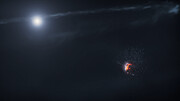
Space Sparks episode 21: Hubble sees asteroids colliding at nearby star for first time
PR Video heic2512b
Space Sparks episode 21: Hubble sees asteroids colliding at nearby star for first time


In a historical milestone, catastrophic collisions in a nearby planetary system were witnessed for the first time by astronomers using the NASA/ESA Hubble Space Telescope. As they observed the bright star Fomalhaut, the scientists saw the impact of massive objects around the star. The Fomalhaut system appears to be in a dynamical upheaval, similar to what our solar system experienced in its first few hundred million years after formation.

“This is certainly the first time I’ve ever seen a point of light appear out of nowhere in an exoplanetary system,” said principal investigator Paul Kalas of the University of California, Berkeley. “It’s absent in all of our previous Hubble images, which means that we just witnessed a violent collision between two massive objects and a huge debris cloud unlike anything in our own solar system today. Amazing!"

Just 25 light-years from Earth, Fomalhaut is one of the brightest stars in the night sky. Located in the constellation Piscis Austrinus, also known as the Southern Fish, it is more massive and brighter than the Sun and is encircled by several belts of dusty debris.

In 2008, scientists used Hubble to discover a candidate planet around Fomalhaut, making it the first stellar system with a possible planet found using visible light. That object, called Fomalhaut b, now appears to be a dust cloud masquerading as a planet – the result of colliding planetesimals. While searching for Fomalhaut b in recent Hubble observations, scientists were surprised to find a second point of light at a similar location around the star. They call this object “circumstellar source 2” or “cs2” while the first object is now known as “cs1.”

Tackling mysteries of colliding planetesimals

Why astronomers are seeing both of these debris clouds so physically close to each other is a mystery. If the collisions between asteroids and planetesimals were random, cs1 and cs2 should appear by chance at unrelated locations. Yet, they are positioned intriguingly near each other along the inner portion of Fomalhaut’s outer debris disk.

Another mystery is why scientists have witnessed these two events within such a short timeframe. “Previous theory suggested that there should be one collision every 100,000 years, or longer. Here, in 20 years, we've seen two,” explained Kalas. “If you had a movie of the last 3,000 years, and it was sped up so that every year was a fraction of a second, imagine how many flashes you'd see over that time. Fomalhaut’s planetary system would be sparkling with these collisions.”

Collisions are fundamental to the evolution of planetary systems, but they are rare and difficult to study.

“The exciting aspect of this observation is that it allows researchers to estimate both the size of the colliding bodies and how many of them there are in the disk, information which is almost impossible to get by any other means,” said co-author Mark Wyatt at the University of Cambridge in England. “Our estimates put the planetesimals that were destroyed to create cs1 and cs2 at just 30 kilometres in size, and we infer that there are 300 million such objects orbiting in the Fomalhaut system.”

“The system is a natural laboratory to probe how planetesimals behave when undergoing collisions, which in turn tells us about what they are made of and how they formed,” explained Wyatt.

Cautionary tale

The transient nature of Fomalhaut cs1 and cs2 poses challenges for future space missions aiming to directly image exoplanets. Such telescopes may mistake dust clouds like cs1 and cs2 for actual planets.

“Fomalhaut cs2 looks exactly like an extrasolar planet reflecting starlight,” said Kalas. “What we learned from studying cs1 is that a large dust cloud can masquerade as a planet for many years. This is a cautionary note for future missions that aim to detect extrasolar planets in reflected light."

Looking to the future

Kalas and his team have been granted Hubble time to monitor cs2 over the next three years. They want to see how it evolves -- does it fade, or does it get brighter? Being closer to the dust belt than cs1, the expanding cs2 cloud is more likely to start encountering other material in the belt. This could lead to a sudden avalanche of more dust in the system, which could cause the whole surrounding area to get brighter.

“We will be tracing cs2 for any changes in its shape, brightness, and orbit over time,” said Kalas, “It’s possible that cs2 will start becoming more oval or cometary in shape as the dust grains are pushed outward by the pressure of starlight.” The team also will use the NIRCam (Near-Infrared Camera) instrument on the NASA/ESA/CSA James Webb Space Telescope to observe cs2. Webb’s NIRCam has the ability to provide color information that can reveal the size of the cloud’s dust grains and their composition. It can even determine if the cloud contains water ice.

Hubble and Webb are the only observatories capable of this kind of imaging. While Hubble primarily sees in visible wavelengths, Webb could view cs2 in the infrared. These different, complementary wavelengths are needed to provide a broad multi-spectral investigation and a more complete picture of the mysterious Fomalhaut system and its rapid evolution.

This research appears today in the December 18 issue of Science.


More information

The Hubble Space Telescope is a project of international cooperation between ESA and NASA.

Image Credit: NASA, ESA, P. Kalas (UC Berkeley), J. DePasquale (STScI)


Links


Contacts:

Bethany Downer
ESA/Hubble Chief Science Communications Officer
Email:
Bethany.Downer@esahubble.org


Friday, July 18, 2025

For the first time, astronomers witness the dawn of a new solar system

PR Image eso2512a
ALMA image of HOPS-315, a still-forming planetary system

PR Image eso2512b
Formation of silicates around the baby star HOPS-315

PR Image eso2512c
Jets of silicon monoxide in the baby star HOPS-315

PR Image eso2512d
The baby star HOPS-315 in the constellation Orion


Videos

Witnessing the dawn of a new solar system | Chasing Starlight
PR Video eso2512a
Witnessing the dawn of a new solar system | Chasing Starlight

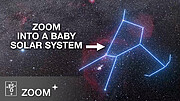
Zoom into the baby star HOPS-315
PR Video eso2512b
Zoom into the baby star HOPS-315

Animation of the formation of minerals around the baby star HOPS-315
PR Video eso2512c
Animation of the formation of minerals around the baby star HOPS-315


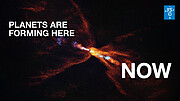
International researchers have, for the first time, pinpointed the moment when planets began to form around a star beyond the Sun. Using the ALMA telescope, in which the European Southern Observatory (ESO) is a partner, and the James Webb Space Telescope, they have observed the creation of the first specks of planet-forming material — hot minerals just beginning to solidify. This finding marks the first time a planetary system has been identified at such an early stage in its formation and opens a window to the past of our own Solar System.

"For the first time, we have identified the earliest moment when planet formation is initiated around a star other than our Sun,” says Melissa McClure, a professor at Leiden University in the Netherlands and lead author of the new study, published today in Nature.

Co-author Merel van ‘t Hoff, a professor at Purdue University, USA, compares their findings to "a picture of the baby Solar System", saying that “we're seeing a system that looks like what our Solar System looked like when it was just beginning to form.”

This newborn planetary system is emerging around HOPS-315, a ‘proto’ or baby star that sits some 1300 light-years away from us and is an analogue of the nascent Sun. Around such baby stars, astronomers often see discs of gas and dust known as ‘protoplanetary discs’, which are the birthplaces of new planets. While astronomers have previously seen young discs that contain newborn, massive, Jupiter-like planets, McClure says, “we've always known that the first solid parts of planets, or ‘planetesimals’, must form further back in time, at earlier stages.”

In our Solar System, the very first solid material to condense near Earth’s present location around the Sun is found trapped within ancient meteorites. Astronomers age-date these primordial rocks to determine when the clock started on our Solar System’s formation. Such meteorites are packed full of crystalline minerals that contain silicon monoxide (SiO) and can condense at the extremely high temperatures present in young planetary discs. Over time, these newly condensed solids bind together, sowing the seeds for planet formation as they gain both size and mass. The first kilometre-sized planetesimals in the Solar System, which grew to become planets such as Earth or Jupiter’s core, formed just after the condensation of these crystalline minerals.

With their new discovery, astronomers have found evidence of these hot minerals beginning to condense in the disc around HOPS-315. Their results show that SiO is present around the baby star in its gaseous state, as well as within these crystalline minerals, suggesting it is only just beginning to solidify. "This process has never been seen before in a protoplanetary disc — or anywhere outside our Solar System," says co-author Edwin Bergin, a professor at the University of Michigan, USA.

These minerals were first identified using the James Webb Space Telescope, a joint project of the US, European and Canadian space agencies. To find out where exactly the signals were coming from, the team observed the system with ALMA, the Atacama Large Millimeter/submillimeter Array, which is operated by ESO together with international partners in Chile’s Atacama Desert.

With these data, the team determined that the chemical signals were coming from a small region of the disc around the star equivalent to the orbit of the asteroid belt around the Sun. “We're really seeing these minerals at the same location in this extrasolar system as where we see them in asteroids in the Solar System,“ says co-author Logan Francis, a postdoctoral researcher at Leiden University.

Because of this, the disc of HOPS-315 provides a wonderful analogue for studying our own cosmic history. As van ‘t Hoff says, “this system is one of the best that we know to actually probe some of the processes that happened in our Solar System." It also provides astronomers with a new opportunity to study early planet formation, by standing in as a substitute for newborn solar systems across the galaxy.

ESO astronomer and European ALMA Programme Manager Elizabeth Humphreys, who did not take part in the study, says: “I was really impressed by this study, which reveals a very early stage of planet formation. It suggests that HOPS-315 can be used to understand how our own Solar System formed. This result highlights the combined strength of JWST and ALMA for exploring protoplanetary discs.”

Source: ESO/News


More information

This research was presented in the paper “Refractory solid condensation detected in an embedded protoplanetary disk” (doi:10.1038/s41586-025-09163-z) to appear in Nature.

The team is composed of M. K. McClure (Leiden Observatory, Leiden University, The Netherlands [Leiden]), M. van ’t Hoff (Department of Astronomy, The University of Michigan, Michigan, USA [Michigan] and Purdue University, Department of Physics and Astronomy, Indiana, USA), L. Francis (Leiden), Edwin Bergin (Michigan), W.R. M. Rocha (Leiden), J. A. Sturm (Leiden), D. Harsono (Institute of Astronomy, Department of Physics, National Tsing Hua University, Taiwan), E. F. van Dishoeck (Leiden), J. H. Black (Chalmers University of Technology, Department of Space, Earth and Environment, Onsala Space Observatory, Sweden), J. A. Noble (Physique des Interactions Ioniques et Moléculaires, CNRS, Aix Marseille Université, France), D. Qasim (Southwest Research Institute, Texas, USA), E. Dartois (Institut des Sciences Moléculaires d’Orsay, CNRS, Université Paris-Saclay, France.)

The Atacama Large Millimeter/submillimeter Array (ALMA), an international astronomy facility, is a partnership of ESO, the U.S. National Science Foundation (NSF) and the National Institutes of Natural Sciences (NINS) of Japan in cooperation with the Republic of Chile. ALMA is funded by ESO on behalf of its Member States, by NSF in cooperation with the National Research Council of Canada (NRC) and the National Science and Technology Council (NSTC) in Taiwan and by NINS in cooperation with the Academia Sinica (AS) in Taiwan and the Korea Astronomy and Space Science Institute (KASI). ALMA construction and operations are led by ESO on behalf of its Member States; by the National Radio Astronomy Observatory (NRAO), managed by Associated Universities, Inc. (AUI), on behalf of North America; and by the National Astronomical Observatory of Japan (NAOJ) on behalf of East Asia. The Joint ALMA Observatory (JAO) provides the unified leadership and management of the construction, commissioning and operation of ALMA.

The European Southern Observatory (ESO) enables scientists worldwide to discover the secrets of the Universe for the benefit of all. We design, build and operate world-class observatories on the ground — which astronomers use to tackle exciting questions and spread the fascination of astronomy — and promote international collaboration for astronomy. Established as an intergovernmental organisation in 1962, today ESO is supported by 16 Member States (Austria, Belgium, Czechia, Denmark, France, Finland, Germany, Ireland, Italy, the Netherlands, Poland, Portugal, Spain, Sweden, Switzerland and the United Kingdom), along with the host state of Chile and with Australia as a Strategic Partner. ESO’s headquarters and its visitor centre and planetarium, the ESO Supernova, are located close to Munich in Germany, while the Chilean Atacama Desert, a marvellous place with unique conditions to observe the sky, hosts our telescopes. ESO operates three observing sites: La Silla, Paranal and Chajnantor. At Paranal, ESO operates the Very Large Telescope and its Very Large Telescope Interferometer, as well as survey telescopes such as VISTA. Also at Paranal ESO will host and operate the Cherenkov Telescope Array South, the world’s largest and most sensitive gamma-ray observatory. Together with international partners, ESO operates ALMA on Chajnantor, a facility that observes the skies in the millimetre and submillimetre range. At Cerro Armazones, near Paranal, we are building “the world’s biggest eye on the sky” — ESO’s Extremely Large Telescope. From our offices in Santiago, Chile we support our operations in the country and engage with Chilean partners and society.


Links


Contacts

Melissa McClure
Leiden Observatory, Leiden University
Leiden, The Netherlands
Cell: on request
Email:
mcclure@strw.leidenuniv.nl

Merel van ‘t Hoff
Department of Physics and Astronomy, Purdue University
West Lafayette, Indiana, United States
Tel: +1-734-882-0270
Email:
vanthoff@purdue.edu

Logan Francis
Leiden Observatory, Leiden University
Leiden, The Netherlands
Tel: +31 71 527 2727
Email:
francis@strw.leidenuniv.nl

Edwin Bergin
Department of Astronomy, University of Michigan
Ann Arbor, Michigan, United States
Tel: +1 734 764 3441
Email:
ebergin@umich.edu

Elizabeth Humphreys
European Southern Observatory
Garching bei München, Germany
Tel: +49 89 3200 6541
Email:
ehumphre@eso.org

Bárbara Ferreira
ESO Media Manager
Garching bei München, Germany
Tel: +49 89 3200 6670
Cell: +49 151 241 664 00
Email:
press@eso.org


Thursday, May 15, 2025

Another First: NASA Webb Identifies Frozen Water in Young Star System

For the first time, researchers confirmed the presence of crystalline water ice in a dusty debris disk that orbits a Sun-like star, using NASA’s James Webb Space Telescope. All the frozen water detected by Webb is paired with fine dust particles throughout the disk. The majority of the water ice observed is found where it’s coldest and farthest from the star. The closer to the star the researchers looked, the less water ice they found. Credits/Artwork: NASA, ESA, CSA, STScI, Ralf Crawford (STScI)


Is frozen water scattered in systems around other stars? Astronomers have long expected it is, partially based on previous detections of its gaseous form, water vapor, and its presence in our own solar system.

Now there is definitive evidence: Researchers confirmed the presence of crystalline water ice in a dusty debris disk that orbits a Sun-like star 155 light-years away using detailed data known as spectra from NASA’s James Webb Space Telescope. (The term water ice specifies its makeup, since many other frozen molecules are also observed in space, such as carbon dioxide ice, or “dry ice.”) In 2008, data from NASA’s retired Spitzer Space Telescope hinted at the possibility of frozen water in this system.

“Webb unambiguously detected not just water ice, but crystalline water ice, which is also found in locations like Saturn’s rings and icy bodies in our solar system’s Kuiper Belt,” said Chen Xie, the lead author of the new paper and an assistant research scientist at Johns Hopkins University in Baltimore, Maryland.

All the frozen water Webb detected is paired with fine dust particles throughout the disk — like itsy-bitsy “dirty snowballs.” The results published Wednesday in the journal Nature.

Astronomers have been waiting for this definitive data for decades. “When I was a graduate student 25 years ago, my advisor told me there should be ice in debris disks, but prior to Webb, we didn’t have instruments sensitive enough to make these observations,” said Christine Chen, a co-author and associate astronomer at the Space Telescope Science Institute in Baltimore. “What’s most striking is that this data looks similar to the telescope’s other recent observations of Kuiper Belt objects in our own solar system.”

Water ice is a vital ingredient in disks around young stars — it heavily influences the formation of giant planets and may also be delivered by small bodies like comets and asteroids to fully formed rocky planets. Now that researchers have detected water ice with Webb, they have opened the door for all researchers to study how these processes play out in new ways in many other planetary systems.

Rocks, Dust, Ice Rushing Around

The star, cataloged HD 181327, is significantly younger than our Sun. It’s estimated to be 23 million years old, compared to the Sun’s more mature 4.6 billion years. The star is slightly more massive than the Sun, and it’s hotter, which led to the formation of a slightly larger system around it.

Webb’s observations confirm a significant gap between the star and its debris disk — a wide area that is free of dust. Farther out, its debris disk is similar to our solar system’s Kuiper Belt, where dwarf planets, comets, and other bits of ice and rock are found (and sometimes collide with one another). Billions of years ago, our Kuiper Belt was likely similar to this star’s debris disk.

“HD 181327 is a very active system,” Chen said. “There are regular, ongoing collisions in its debris disk. When those icy bodies collide, they release tiny particles of dusty water ice that are perfectly sized for Webb to detect.”

Frozen Water — Almost Everywhere

Water ice isn’t spread evenly throughout this system. The majority is found where it’s coldest and farthest from the star. “The outer area of the debris disk consists of over 20% water ice,” Xie said.

The closer in the researchers looked, the less water ice they found. Toward the middle of the debris disk, Webb detected about 8% water ice. Here, it’s likely that frozen water particles are produced slightly faster than they are destroyed. In the area of the debris disk closest to the star, Webb detected almost none. It’s likely that the star’s ultraviolet light vaporizes the closest specks of water ice. It’s also possible that rocks known as planetesimals have “locked up” frozen water in their interiors, which Webb can’t detect.

This team and many more researchers will continue to search for — and study — water ice in debris disks and actively forming planetary systems throughout our Milky Way galaxy. “The presence of water ice helps facilitate planet formation,” Xie said. “Icy materials may also ultimately be ‘delivered’ to terrestrial planets that may form over a couple hundred million years in systems like this.”

The researchers observed HD 181327 with Webb’s NIRSpec (Near-Infrared Spectrograph), which is super-sensitive to extremely faint dust particles that can only be detected from space.

The James Webb Space Telescope is the world’s premier space science observatory. Webb is solving mysteries in our solar system, looking beyond to distant worlds around other stars, and probing the mysterious structures and origins of our universe and our place in it. Webb is an international program led by NASA with its partners, ESA (European Space Agency) and CSA (Canadian Space Agency).

To learn more about Webb, visit: https://science.nasa.gov/webb


About This Release

Credits:

Media Contact Claire Blome
Space Telescope Science Institute, Baltimore

Christine Pulliam
Space Telescope Science Institute, Baltimore

Permissions: Content Use Policy

Contact Us: Direct inquiries to the News Team.

Related Links and Documents


Thursday, July 19, 2018

Chandra May Have First Evidence of a Young Star Devouring a Planet

RW Aur A
Credit: Illustration: NASA/CXC/M.Weiss; X-ray spectrum: NASA/CXC/MIT/H.M.Günther 


This artist's illustration depicts the destruction of a young planet or planets, which scientists may have witnessed for the first time using data from NASA's Chandra X-ray Observatory, as described in our latest press release. If this discovery is confirmed, it would give insight into the processes affecting the survival of infant planets.

RW Aur A is a star about 450 light years from Earth, making it relatively nearby. Since the 1930s, astronomers have studied RW Aur A and been curious about why the optical light from this star changes over time. In recent years, scientists have observed that this variability has increased, with the star dimming even more and for longer periods of time.

To investigate this mystery, a team of astronomers used Chandra to get information in the X-ray band of the electromagnetic spectrum. X-rays are generally emitted by more energetic and hotter phenomena than their optical light counterparts and can reveal information about different elements, including iron.

The Chandra data suggest that the most recent dimming event from RW Aur A was caused by the collision of two "planetesimals" (that is, infant planetary bodies still in the process of formation), including at least one object large enough to be a planet.

Because the X-rays come from the hot outer atmosphere of the star, changes in the X-ray spectrum — the intensity of X-rays measured at different energies — over these three observations were used to probe the density and composition of the absorbing material around the star.

The team found that the dips in both optical and X-ray light are caused by dense gas obscuring the star's light. Also, a Chandra observation in 2017 showed strong emission from iron atoms, indicating that the disk contained at least 10 times more iron than in the 2013 observation during a bright period.

The Chandra spectra from the 2013 and 2017 observations are shown in an inset in the graphic. The sharp peak on the right side of the 2017 spectrum is a signature of a large amount of iron.

The researchers propose the excess iron was created when the two planetesimals collided. If one or both planetary bodies are made partly of iron, their smash-up could release a large amount of iron into the star's disk and temporarily obscure its light as the material falls into the star.

A paper describing these results led by Hans Moritz Guenther (MIT's Kavli Institute for Astrophysics) appears in the most recent issue of The Astrophysical Journal and is available online.

The other authors on the paper are Til Birnstiel (Ludwig-Maximillians-University Munich), David Huenemoerder (MIT), David Principe (MIT), Christian Schneider (Hamburger Sternwarte), Scott Wolk (Harvard-Smithsonian Center for Astrophysics), Franky Dubois (Astrolab IRIS), Ludwig Logiie (Astrolab IRIS), Steve Rau (Astrolab IRIS), and Siegfried Vanaverbeke (Astrolab IRIS).

NASA's Marshall Space Flight Center in Huntsville, Alabama, manages the Chandra program for NASA's Science Mission Directorate in Washington. The Smithsonian Astrophysical Observatory in Cambridge, Massachusetts, controls Chandra's science and flight operations.


Fast Facts for RW Aur A:

Category: Normal Stars & Star Clusters, Neutron Stars/X-ray Binaries
Coordinates (J2000): RA 05h 07m 49.5s | Dec 30° 24´ 05.1"
Constellation: Aurigae
Observation Date: 4 pointings from Jan 2013-Jan 2017
Observation Time: 75 hours 33 minutes (3 days 2 hours 33 minutes)
Obs. ID: 14539, 17644, 17764, 19980
Instrument: ACIS
References: Günther, H.M. et al, 2018, AJ. (accepted)
Distance Estimate: About 450 light years


Monday, November 03, 2014

VLTI Detects Exozodiacal Light

Artist’s impression of bright exozodiacal light
 
Zodiacal light seen from Paranal
 
Zodiacal Light over La Silla


*********************

Videos


Artist’s impression of bright exozodiacal light


New challenge for direct imaging of exo-Earths


By using the full power of the Very Large Telescope Interferometer an international team of astronomers has discovered exozodiacal light close to the habitable zones around nine nearby stars. This light is starlight reflected from dust created as the result of collisions between asteroids, and the evaporation of comets. The presence of such large amounts of dust in the inner regions around some stars may pose an obstacle to the direct imaging of Earth-like planets in the future.

Using the Very Large Telescope Interferometer (VLTI) in near-infrared light [1], the team of astronomers observed 92 nearby stars to probe exozodiacal light from hot dust close to their habitable zones and combined the new data with earlier observations [2]. Bright exozodiacal light, created by the glowing grains of hot exozodiacal dust, or the reflection of starlight off these grains, was observed around nine of the targeted stars. 

From dark clear sites on Earth, zodiacal light looks like a faint diffuse white glow seen in the night sky after the end of twilight, or before dawn. It is created by sunlight reflected off tiny particles and appears to extend up from the vicinity of the Sun. This reflected light is not just observed from Earth but can be observed from everywhere in the Solar System. 

The glow being observed in this new study is a much more extreme version of the same phenomenon. While this exozodiacal light — zodiacal light around other star systems — had been previously detected, this is the first large systematic study of this phenomenon around nearby stars. 

In contrast to earlier observations the team did not observe dust that will later form into planets, but dust created in collisions between small planets of a few kilometres in size — objects called planetesimals that are similar to the asteroids and comets of the Solar System. Dust of this kind is also the origin of the zodiacal light in the Solar System.

“If we want to study the evolution of Earth-like planets close to the habitable zone, we need to observe the zodiacal dust in this region around other stars,” said Steve Ertel, lead author of the paper, from ESO and the University of Grenoble in France. “Detecting and characterising this kind of dust around other stars is a way to study the architecture and evolution of planetary systems.”

Detecting faint dust close to the dazzling central star requires high resolution observations with high contrast. Interferometry — combining light collected at the exact same time at several different telescopes — performed in infrared light is, so far, the only technique that allows this kind of system to be discovered and studied. 

By using the power of the VLTI and pushing the instrument to its limits in terms of accuracy and efficiency, the team was able to reach a performance level about ten times better than other available instruments in the world.

For each of the stars the team used the 1.8-metre Auxiliary Telescopes to feed light to the VLTI. Where strong exozodiacal light was present they were able to fully resolve the extended discs of dust, and separate their faint glow from the dominant light of the star [3]. 

By analysing the properties of the stars surrounded by a disc of exozodiacal dust, the team found that most of the dust was detected around older stars. This result was very surprising and raises some questions for our understanding of planetary systems. Any known dust production caused by collisions of planetesimals should diminish over time, as the number of planetesimals is reduced as they are destroyed.

The sample of observed objects also included 14 stars for which the detection of exoplanets has been reported. All of these planets are in the same region of the system as the dust in the systems showing exozodiacal light. The presence of exozodiacal light in systems with planets may create a problem for further astronomical studies of exoplanets.

Exozodiacal dust emission, even at low levels, makes it significantly harder to detect Earth-like planets with direct imaging. The exozodiacal light detected in this survey is a factor of 1000 times brighter than the zodiacal light seen around the Sun. The number of stars containing zodiacal light at the level of the Solar System is most likely much higher than the numbers found in the survey. These observations are therefore only a first step towards more detailed studies of exozodiacal light.

“The high detection rate found at this bright level suggests that there must be a significant number of systems containing fainter dust, undetectable in our survey, but still much brighter than the Solar System’s zodiacal dust,” explains Olivier Absil, co-author of the paper, from the University of Liège. “The presence of such dust in so many systems could therefore become an obstacle for future observations, which aim to make direct images of Earth-like exoplanets.”


Notes


[1] The team used the VLTI visitor instrument PIONIER, which is able to interferometrically connect all four Auxiliary Telescopes or all four Unit Telescopes of the VLT at the Paranal Observatory. This led to not only extremely high resolution of the targets but also allowed for a high observing efficiency. 

[2] Previous observations were made with the CHARA array — an optical astronomical interferometer operated by the Center for High Angular Resolution Astronomy (CHARA) of the Georgia State University, and its fibred beam combiner FLUOR.  

[3] As a by-product, these observations have also led to the discovery of new, unexpected stellar companions orbiting around some of the most massive stars in the sample. "These new companions suggest that we should revise our current understanding of how many of this type of star are actually double," says Lindsay Marion, lead author of an additional paper dedicated to this complementary work using the same data.


More information


This research was presented in a paper “A near-infrared interferometric survey of debris-disc stars. IV. An unbiased sample of 92 southern stars observed in H-band with VLTI/PIONIER”, by S. Ertel et al., to appear in the journal Astronomy & Astrophysics. The complementary paper on companion stars found in the survey is "Searching for faint companions with VLTI/PIONIER. II. 92 main sequence stars from the Exozodi survey", by L. Marion et al., in the same edition of the journal.

The team is composed of S. Ertel (Université Grenoble Alpes, France; ESO, Chile), O. Absil (University of Liège, Belgium), D. Defrère (University of Arizona, USA), J.-B. Le Bouquin (Université Grenoble Alpes), J.-C. Augereau (Université Grenoble Alpes), L. Marion (University of Liège), N. Blind (Max-Planck Institute for Extraterrestrial Physics, Garching, Germany), A. Bonsor (University of Bristol, United Kingdom), G. Bryden (California Institute of Technology, Pasadena, USA), J. Lebreton (California Institute of Technology), and J. Milli (Université Grenoble Alpes)

ESO is the foremost intergovernmental astronomy organisation in Europe and the world’s most productive ground-based astronomical observatory by far. It is supported by 15 countries: Austria, Belgium, Brazil, the Czech Republic, Denmark, France, Finland, Germany, Italy, the Netherlands, Portugal, Spain, Sweden, Switzerland and the United Kingdom. ESO carries out an ambitious programme focused on the design, construction and operation of powerful ground-based observing facilities enabling astronomers to make important scientific discoveries. ESO also plays a leading role in promoting and organising cooperation in astronomical research. ESO operates three unique world-class observing sites in Chile: La Silla, Paranal and Chajnantor. At Paranal, ESO operates the Very Large Telescope, the world’s most advanced visible-light astronomical observatory and two survey telescopes. VISTA works in the infrared and is the world’s largest survey telescope and the VLT Survey Telescope is the largest telescope designed to exclusively survey the skies in visible light. ESO is the European partner of a revolutionary astronomical telescope ALMA, the largest astronomical project in existence. ESO is currently planning the 39-metre European Extremely Large optical/near-infrared Telescope, the E-ELT, which will become “the world’s biggest eye on the sky”.


Links


Contacts


Steve Ertel
European Southern Observatory
Santiago, Chile
Email: sertel@eso.org

Lindsay Marion
University of Liège
Liège, Belgium
Tel: +32 4 366 97 58
Cell: +32 472 347 742
Email: lindsay.marion@ulg.ac.be

Jean-Charles Augereau
Institut de Planétologie et d'Astrophysique de Grenoble (IPAG)
Grenoble, France
Tel: +33 (0)4 76 51 47 86
Email:
Jean-Charles.Augereau@obs.ujf-grenoble.fr


Richard Hook
ESO education and Public Outreach Department
Garching bei München, Germany
Tel: +49 89 3200 6655
Cell: +49 151 1537 3591
Email: rhook@eso.org

Source: ESO