Showing posts with label Messier 30. Show all posts

Friday, November 06, 2026

Lessons from a stellar instructor

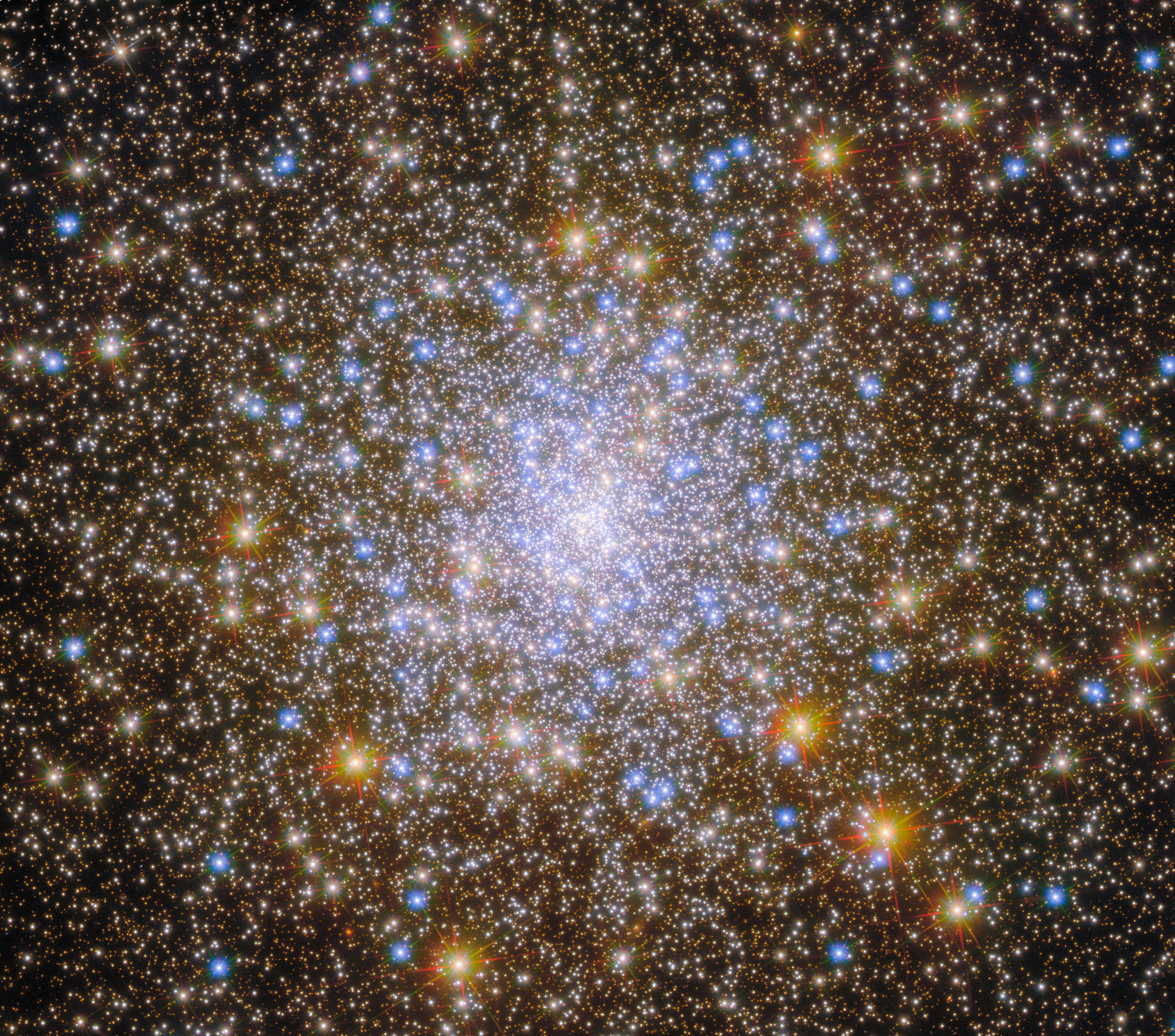
A star cluster seen up close, filling the view with thousands of stars. They are clearly divided between blue ones, which are scattered around the outskirts of the image but more towards the centre and are the majority in the bright core of the cluster, and yellow stars, which are present in the core but make up most of the cluster outside of that. A few orange stars are closer to us and appear noticeably larger.


Today’s ESA/Hubble Picture of the Month gives us a lesson in galactic history. This sparkling collection of stars is named Messier 30 (M30) after Charles Messier, the French astronomer who catalogued M30 and other diffuse objects that might be mistaken for comets. M30 lies about 27 500 light-years away in the constellation Capricornus.

M30 is a globular cluster: a roughly spherical star cluster containing anywhere from tens of thousands to millions of stars. These clusters generally reside on the outskirts of galaxies, orbiting within a vast, diffuse region called the halo like a swarm of moths around a lightbulb. Our Milky Way galaxy has at least 150 globular clusters, the nearest of which is about 6000 light-years away. These clusters are impressively ancient: astronomers have estimated their ages at 11.5 to 13.5 billion years, making certain globular clusters nearly as old as the Universe itself.

Globular clusters have long played an important role in helping us learn about our galaxy. More than a century ago, astronomer Harlow Shapley used observations of a particular type of variable star to measure the locations of and distances to dozens of globular clusters within our galaxy. This work showed that the Sun is not in the centre of our galaxy, and that the galactic centre lies instead toward the constellation Sagittarius. (His distance measurements were incorrect, however, and he concluded that our galaxy is about twice as large as it really is.)

Today, astronomers continue to learn about our galaxy by observing globular clusters. Because globular clusters are so ancient, they can give us clues about how our galaxy was assembled long ago. Globular clusters that formed within our galaxy can act as time capsules, preserving the original chemistry of our young galaxy.

However, it’s possible that not all globular clusters that orbit within our galaxy today formed there. Researchers have discovered that M30 and many other globular clusters orbit in the direction opposite from the way our galaxy spins. This may mean that these clusters did not form within our galaxy at all, but may instead have been captured by the Milky Way galaxy in the distant past!

Hubble has observed M30 multiple times, A previously released image of M30 featured data from Hubble’s Advanced Camera for Surveys. These data came from an observing programme (#10775; PI: Sarajedini) that surveyed dozens of Milky Way globular clusters, observing red and near-infrared light that revealed stars down to just 20% of the mass of the Sun. A more recent programme (#13297; PI: Piotto) returned to M30 and other globular clusters in our galaxy, this time observing the clusters with Hubble’s Wide Field Camera 3 and using three filters that captured bluer light. This programme collected data that was critical for studying exotic objects like blue straggler stars as well as for investigating the multiple populations of stars that can inhabit a single globular cluster.

Most recently, Hubble viewed many of these globular clusters once more, aiming to detect how the stars in these clusters had moved over 15 years. This programme (#16298, PI: Libralato) allowed astronomers to study how different populations of stars in globular clusters move — a feat only possible due to Hubble’s longevity and ability to discern fantastically small details in distant objects.


Wednesday, December 23, 2009

Vampires and collisions rejuvenate stars

Image credit: NASA, ESA and Francesco Ferraro (University of Bologna)
Videos: Video 1 - Video 2

Using the NASA/ESA Hubble Space Telescope, astronomers have uncovered two distinct kinds of "rejuvenated" stars in the globular cluster Messier 30. A new study shows that both stellar collisions and a process sometimes called vampirism are behind this cosmic "face lift". The scientists also uncover evidence that both sorts of blue stragglers were produced during a critical dynamical event (known as "core collapse") that occurred in Messier 30 a few billion years ago.

Stars in globular clusters [1] are generally extremely old, with ages of 12-13 billion years. However, a small fraction of them appear to be significantly younger than the average population and, because they seem to have been left behind by the stars that followed the normal path of stellar evolution and became red giants, have been dubbed blue stragglers [2]. Blue stragglers appear to regress from "old age" back to a hotter and brighter "youth", gaining a new lease on life in the process. A team of astronomers used Hubble to study the blue straggler star content in Messier 30, which formed 13 billion years ago and was discovered in 1764 by Charles Messier. Located about 28 000 light-years away from Earth, this globular cluster — a swarm of several hundred thousand stars — is about 90 light-years across.

Although blue stragglers have been known since the early 1950s, their formation process is still an unsolved puzzle in astrophysics. "It’s like seeing a few kids in the group picture of a rest-home for retired people. It is natural to wonder why they are there," says Francesco Ferraro from the University of Bologna in Italy, lead author of the study that will be published this week in Nature [3]. Researchers have been studying these stars for many years and knew that blue stragglers are indeed old. They were thought to have arisen in a tight binary system [4]. In such a pair, the less massive star acts as a "vampire", siphoning fresh hydrogen from its more massive companion star. The new fuel supply allows the smaller star to heat up, growing bluer and hotter — behaving like a star at an earlier stage in its evolution.

The new study shows that some of the blue stragglers have instead been rejuvenated by a sort of "cosmic facelift", courtesy of cosmic collisions. These stellar encounters are nearly head-on collisions in which the stars might actually merge, mixing their nuclear fuel and re-stoking the fires of nuclear fusion. Merged stars and binary systems would both be about twice the typical mass of individual stars in the cluster.

"Our observations demonstrate that blue stragglers formed by collisions have slightly different properties from those formed by vampirism. This provides a direct demonstration that the two formation scenarios are valid and that they are both operating simultaneously in this cluster," says team member Giacomo Beccari from ESA.
Using data from the now-retired Wide Field Planetary Camera 2 (WFPC2) aboard Hubble, astronomers found that these "straggling" stars are much more concentrated towards the centre of the cluster than the average star. "This indicates that blue stragglers are more massive than the average star in this cluster," says Ferraro. "More massive stars tend to sink deep into the cluster the way a billiard ball would sink in a bucket of honey."

The central regions of high density globular clusters are crowded neighbourhoods where interactions between stars are nearly inevitable. Researchers conjecture that one or two billion years ago, Messier 30 underwent a major "core collapse" that started to throw stars towards the centre of the cluster, leading to a rapid increase in the density of stars. This event significantly increased the number of collisions among stars, and favoured the formation of one of the families of blue stragglers. On the other hand, the increase of stellar crowding due to the collapse of the core also perturbed the twin systems, encouraging the vampirism phenomenon and thus forming the other family of blue stragglers. "Almost ten percent of galactic globular clusters have experienced core collapse, but this is the first time that we see the effect of the core collapse imprinted on a stellar population," says Barbara Lanzoni, University of Bologna.

"The two distinct populations of blue stragglers discovered in Messier 30 are the relics of the collapse of the core that occurred two billion years ago. In a broad context our discovery is direct evidence of the impact of star cluster dynamics on stellar evolution. We should now try to see if other globular clusters present this double population of blue stragglers," concludes Ferraro.

Notes for editors:

[1] Globular clusters are dense agglomerations of several hundred thousand stars. Present among the earliest inhabitants of our Milky Way, they formed in the vast halo of our galaxy before it flattened to form a pancake-shaped spiral disc. Star formation essentially stopped in globular clusters 13 billion years ago, so astronomers expect to find only old stars and they use globular cluster ages as a benchmark for estimating the age of the Universe.

[2] In 1953, astronomer Allan Sandage found a puzzling new population of stars that seemed to go against the rules of stellar evolution in globular clusters. Sandage detected hot young blue stars in the globular cluster Messier 3, and subsequently in other globular clusters. He dubbed them stragglers because they looked like they were trailing or left behind by other blue stars in the cluster that had long ago evolved to the red giant stage.

[3] This research was presented in a paper that appears in the 24 December 2009 issue of Nature, “Two distinct sequences of blue straggler stars in the globular cluster M30”, by F. R. Ferraro et al.

[4] In 1964 astronomers Fred Hoyle and W.H. McCrea independently suggested that blue stragglers result when two stars capture each other and form a tight binary system.

Links:


Contacts:

Francesco Ferraro
Astronomy Department
University of Bologna
Tel: +39-051-20-95-774

Colleen Sharkey
Hubble/ESA, Garching, Germany
Tel: +49-89-3200-6306
Cell: +49-015115373591