Friday, September 13, 2024

Astronomers track bubbles on star’s surface in most detailed video yet

PR Image eso2412a
Detailed images of the surface of the star R Doradus

PR Image eso2412b
Detailed images of the surface of the star R Doradus (no annotations)

PR Image eso2412c
The star R Doradus in the constellation Dorado

PR Image eso2412d
Wide-field view of the region of the sky around the R Doradus star


Videos
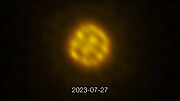
Most detailed video yet of bubbles on a star’s surface
PR Video eso2412a
Most detailed video yet of bubbles on a star’s surface

Zooming in on the R Doradus star
PR Video eso2412b
Zooming in on the R Doradus star

Stellar bubbles captured by ALMA | ESO News
PR Video eso2412c
Stellar bubbles captured by ALMA | ESO News


For the first time, astronomers have captured images of a star other than the Sun in enough detail to track the motion of bubbling gas on its surface. The images of the star, R Doradus, were obtained with the Atacama Large Millimeter/submillimeter Array (ALMA), a telescope co-owned by the European Southern Observatory (ESO), in July and August 2023. They show giant, hot bubbles of gas, 75 times the size of the Sun, appearing on the surface and sinking back into the star’s interior faster than expected.

“This is the first time the bubbling surface of a real star can be shown in such a way,“ [1] says Wouter Vlemmings, a professor at Chalmers University of Technology, Sweden, and lead author of the study published today in Nature. “We had never expected the data to be of such high quality that we could see so many details of the convection on the stellar surface.”

Stars produce energy in their cores through nuclear fusion. This energy can be carried out towards the star’s surface in huge, hot bubbles of gas, which then cool down and sink — like a lava lamp. This mixing motion, known as convection, distributes the heavy elements formed in the core, such as carbon and nitrogen, throughout the star. It is also thought to be responsible for the stellar winds that carry these elements out into the cosmos to build new stars and planets.

Convection motions had never been tracked in detail in stars other than the Sun, until now. By using ALMA, the team were able to obtain high-resolution images of the surface of R Doradus over the course of a month. R Doradus is a red giant star, with a diameter roughly 350 times that of the Sun, located about 180 light-years away from Earth in the constellation Dorado. Its large size and proximity to Earth make it an ideal target for detailed observations. Furthermore, its mass is similar to that of the Sun, meaning R Doradus is likely fairly similar to how our Sun will look like in five billion years, once it becomes a red giant.

“Convection creates the beautiful granular structure seen on the surface of our Sun, but it is hard to see on other stars,” adds Theo Khouri, a researcher at Chalmers who is a co-author of the study. “With ALMA, we have now been able to not only directly see convective granules  — with a size 75 times the size of our Sun! — but also measure how fast they move for the first time.”

The granules of R Doradus appear to move on a one-month cycle, which is faster than scientists expected based on how convection works in the Sun. “We don’t yet know what is the reason for the difference. It seems that convection changes as a star gets older in ways that we don't yet understand,” says Vlemmings. Observations like those now made of R Doradus are helping us to understand how stars like the Sun behave, even when they grow as cool, big and bubbly as R Doradus is.

“It is spectacular that we can now directly image the details on the surface of stars so far away, and observe physics that until now was mostly only observable in our Sun,” concludes Behzad Bojnodi Arbab, a PhD student at Chalmers who was also involved in the study.

Source: ESO/News


Notes

[1] Convection bubbles have been previously observed in detail on the surface of stars, including with the PIONIER instrument on ESO's Very Large Telescope Interferometer. But the new ALMA observations track the motion of the bubbles in a way that was not possible before.


More information

This research was presented in a paper entitled “One month convection timescale on the surface of a giant evolved star” to appear in Nature (doi:10.1038/s41586-024-07836-9).

The team is composed of W. Vlemmings (Chalmers University of Technology, Sweden [Chalmers]), T. Khouri (Chalmers), B. Bojnordi (Chalmers), E. De Beck (Chalmers), and M. Maercker (Chalmers).

The Atacama Large Millimeter/submillimeter Array (ALMA), an international astronomy facility, is a partnership of ESO, the U.S. National Science Foundation (NSF) and the National Institutes of Natural Sciences (NINS) of Japan in cooperation with the Republic of Chile. ALMA is funded by ESO on behalf of its Member States, by NSF in cooperation with the National Research Council of Canada (NRC) and the National Science and Technology Council (NSTC) in Taiwan and by NINS in cooperation with the Academia Sinica (AS) in Taiwan and the Korea Astronomy and Space Science Institute (KASI). ALMA construction and operations are led by ESO on behalf of its Member States; by the National Radio Astronomy Observatory (NRAO), managed by Associated Universities, Inc. (AUI), on behalf of North America; and by the National Astronomical Observatory of Japan (NAOJ) on behalf of East Asia. The Joint ALMA Observatory (JAO) provides the unified leadership and management of the construction, commissioning and operation of ALMA.

The European Southern Observatory (ESO) enables scientists worldwide to discover the secrets of the Universe for the benefit of all. We design, build and operate world-class observatories on the ground — which astronomers use to tackle exciting questions and spread the fascination of astronomy — and promote international collaboration for astronomy. Established as an intergovernmental organisation in 1962, today ESO is supported by 16 Member States (Austria, Belgium, Czechia, Denmark, France, Finland, Germany, Ireland, Italy, the Netherlands, Poland, Portugal, Spain, Sweden, Switzerland and the United Kingdom), along with the host state of Chile and with Australia as a Strategic Partner. ESO’s headquarters and its visitor centre and planetarium, the ESO Supernova, are located close to Munich in Germany, while the Chilean Atacama Desert, a marvellous place with unique conditions to observe the sky, hosts our telescopes. ESO operates three observing sites: La Silla, Paranal and Chajnantor. At Paranal, ESO operates the Very Large Telescope and its Very Large Telescope Interferometer, as well as survey telescopes such as VISTA. Also at Paranal ESO will host and operate the Cherenkov Telescope Array South, the world’s largest and most sensitive gamma-ray observatory. Together with international partners, ESO operates ALMA on Chajnantor, a facility that observes the skies in the millimetre and submillimetre range. At Cerro Armazones, near Paranal, we are building “the world’s biggest eye on the sky” — ESO’s Extremely Large Telescope. From our offices in Santiago, Chile we support our operations in the country and engage with Chilean partners and society.


Links


Contacts

Wouter Vlemmings
Chalmers University of Technology
Gothenburg, Sweden
Tel: +46 31 772 63 54
Email:
wouter.vlemmings@chalmers.se

Theo Kouri
Chalmers University of Technology
Gothenburg, Sweden
Tel: +46 31 772 6022
Email:
theo.khouri@chalmers.se

Behzad Bojnodi Arbab
Chalmers University of Technology
Gothenburg, Sweden
Email:
bojnordi@chalmers.se

Bárbara Ferreira
ESO Media Manager
Garching bei München, Germany
Tel: +49 89 3200 6670
Cell: +49 151 241 664 00
Email:
press@eso.org


Thursday, September 12, 2024

Solution to a cosmic mystery—the eccentric orbits of trans-Neptunian objects

Simulation snapshots of model A1.
Credit: Nature Astronomy (2024).
DOI: 10.1038/s41550-024-02349-x


New evidence suggests that billions of years ago, a star may have passed very close to our solar system. As a result, thousands of smaller celestial bodies in the outer solar system outside Neptune's orbit were deflected into highly inclined trajectories around the sun. It is possible that some of them were captured by the planets Jupiter and Saturn as moons.

These findings come from a team of astrophysicists from Forschungszentrum Jülich and Leiden University in the Netherlands. They were published in two studies in the journals Nature Astronomy and The Astrophysical Journal Letters.

When we think of our solar system, we usually assume that it ends at the outermost known planet, Neptune. "However, several thousand celestial bodies are known to move beyond the orbit of Neptune," explains Susanne Pfalzner, astrophysicist at Forschungszentrum Jülich.

It is even suspected that there are tens of thousands of objects with a diameter of more than 100 kilometers. "Surprisingly, many of these so-called trans-Neptunian objects move on eccentric orbits that are inclined relative to the common orbital plane of the planets in the solar system."

Together with her Jülich colleague Amith Govind and Simon Portegies Zwart from Leiden University, Susanne Pfalzner has used more than 3,000 computer simulations to investigate a possible cause of the unusual orbits: could another star have caused the strange orbits of trans-Neptunian objects?

The three astrophysicists found that a distinctive, close flyby of another star can explain the inclined and eccentric orbits of the known trans-Neptunian celestial bodies. "Even the orbits of very distant objects can be deduced, such as that of the dwarf planet Sedna in the outermost reaches of the solar system, which was discovered in 2003.

"And also objects that move in orbits almost perpendicular to the planetary orbits," says Susanne Pfalzner. Such a flyby can even explain the orbits of 2008 KV42 and 2011 KT19—the two celestial bodies that move in the opposite direction to the planets.

Saturn's moon Phoebe is a prime example of the unusual properties of irregular moons. Like many others, it orbits Saturn in the opposite direction. Credit: NASA / JPL

"The best match for today's outer solar system that we found with our simulations is a star that was slightly lighter than our sun—about 0.8 solar masses," explains Pfalzner's colleague Amith Govind. "This star flew past our sun at a distance of around 16.5 billion kilometers. That's about 110 times the distance between Earth and the sun, a little less than four times the distance of the outermost planet Neptune."

However, the scientists' most surprising realization was that the flyby of an alien star billions of years ago could also provide a natural explanation for phenomena closer to home. Susanne Pfalzner and her colleagues found that in their simulations, some trans-Neptunian objects were hurled into our solar system—into the region of the outer giant planets Jupiter, Saturn, Uranus and Neptune.

"Some of these objects could have been captured by the giant planets as moons," says Simon Portegies Zwart from Leiden University. "This would explain why the outer planets of our solar system have two different types of moons."

In contrast to the regular moons, which orbit close to the planet on circular orbits, the irregular moons orbit the planet at a greater distance on inclined, elongated orbits. Until now, there was no explanation for this phenomenon.

"The beauty of this model lies in its simplicity," says Pfalzner. "It answers several open questions about our solar system with just a single cause."

Source: Phys.org


More information: Susanne Pfalzner et al, Trajectory of the stellar flyby that shaped the outer Solar System, Nature Astronomy (2024). DOI: 10.1038/s41550-024-02349-x

Susanne Pfalzner et al, Irregular Moons Possibly Injected from the Outer Solar System by a Stellar Flyby, The Astrophysical Journal Letters (2024). DOI: 10.3847/2041-8213/ad63a6

Journal information: Astrophysical Journal Letters , Nature Astronomy

Provided By Forschungszentrum Juelich


Explore further


Wednesday, September 11, 2024

Complex Composition: The Origins of J1010+2358

A massive young star IRS 4 heats and warps the nebula Sharpless 2-106
Credit:
NASA, ESA, and the Hubble Heritage Team (STScI/AURA)

Once thought to be a pure descendant of one the universe’s first stars, new research on star J1010+2358 uncovers a more complex history.

The First Stars and Their Violent Ends

During the universe’s debut into star formation, only hydrogen, helium, and some lithium existed. Without metals (i.e., elements heavier than helium) to efficiently cool the gas, the first generation of stars, called Population III stars, likely formed with much higher masses than any subsequent generation. Based on theoretical modeling, Pop III stars may have had masses hundreds of times the mass of the Sun; however, their true mass distribution is still under investigation.

Some of the most massive Pop III stars likely ended their lives in pair-instability supernovae (PISNe), a type of supernova so energetic and violent it completely rips the star apart, leaving behind no stellar remnant. Metals that formed inside these stars and within their explosions are released into the interstellar medium, creating a newly enriched cosmic soup that fuels the next generation of star formation. Finding stars born out of PISN material, and particularly descendants whose chemical signatures trace back to a single Pop III star, is no simple task, but this detection would provide powerful information about the first stars in the universe.

Measured chemical abundance pattern of J1010+2358 (red stars). Multiple model predictions are overlaid; the dashed gray line shows a 100% 260-solar-mass PISN contribution, indicating an ill fit to the data. Credit: Skúladóttir et al. 2024

Likely Origins of J1010+2358

How, then, did J1010+2358 obtain its interesting chemical composition? Through applying theoretical models for various progenitor combinations, Skúladóttir’s team found a best fit where the star’s metals come from a combination of a 13-solar-mass second-generation star that underwent a core-collapse supernova and a 39-solar-mass Pop III core-collapse supernova. They considered multiple scenarios with the star obtaining some of its metals from a 260-solar-mass PISN, but all plausible fits have PISN contributions too low to further characterize the mass distribution of first-generation stars.

Measuring Chemical Abundances

With a low metallicity and unique chemical abundance pattern, the star J1010+2358 was initially suggested to have been formed from the gaseous remains of a single 260-solar-mass Pop III star. However, more recent analysis suggests that the star’s origins are more ambiguous, perhaps obtaining only 10% of its metals from such a PISN.

To more confidently determine J1010+2358’s ancestry, a team led by Ása Skúladóttir (University of Florence) used the Ultraviolet and Visible Echelle Spectrograph on the European Southern Observatory’s 8.2-meter Very Large Telescope to derive a more detailed abundance pattern of the star. They found the carbon and aluminum abundances to be significantly higher than predicted for pure PISN descendants. The team also remeasured a number of other elements, and the results further signal that J1010+2358 is not a descendant of a single, massive Pop III star as previously claimed.

Quality of fit results for J1010+2358 containing two progenitors, with one being a PISN of a given mass and fraction of metal contribution and the other being a 13-solar-mass second-generation star that underwent a core-collapse supernova. Values 2 and below are best quality fits and most plausible progenitor scenarios. Click to enlarge. Credit: Skúladóttir et al. 2024

Likely Origins of J1010+2358

How, then, did J1010+2358 obtain its interesting chemical composition? Through applying theoretical models for various progenitor combinations, Skúladóttir’s team found a best fit where the star’s metals come from a combination of a 13-solar-mass second-generation star that underwent a core-collapse supernova and a 39-solar-mass Pop III core-collapse supernova. They considered multiple scenarios with the star obtaining some of its metals from a 260-solar-mass PISN, but all plausible fits have PISN contributions too low to further characterize the mass distribution of first-generation stars.

Stars have complex histories stored within their chemical DNA, and the difficulty of identifying a star with a single first-generation predecessor underscores the importance of careful chemical abundance analyses. Although J1010+2358 is likely not a true PISN descendant, the lessons learned through this star will be critical in the quest to uncover the properties of the universe’s first stars, and upcoming high-resolution spectroscopic surveys may reveal more promising candidates in the near future.

By Lexi Gault


Citation

“On the Pair-instability Supernova Origin of J1010+2358,” Ása Skúladóttir et al 2024 ApJL 968 L23.
doi:10.3847/2041-8213/ad4b1a


Editor’s Note: Lexi Gault is a fourth-year graduate student at Indiana University who was recently selected as the 2024–2025 AAS Media Fellow. We’re excited to welcome Lexi to the team and look forward to featuring her writing on AAS Nova regularly!


Tuesday, September 10, 2024

Cloudy with a chance of explosions

A spiral galaxy, seen up close and face-on. It is coloured yellow and glowing brightly at the oval-shaped centre, showing older and cooler stars, and it becomes bluer out to the edge of the disc where the stars are younger and hotter. It has a number of somewhat patchy spiral arms curling around, with sparkling areas where stars form. The black background can just be seen at the corners. Credit: ESA/Hubble & NASA, C. Kilpatrick

The subject of this Hubble Picture of the Week is a spiral galaxy in the constellation Virgo named NGC 5668. It is relatively near to us at 90 million light-years from Earth and quite accessible for astronomers to study with both space- and ground-based telescopes. At first blush, it doesn’t seem like a remarkable galaxy. It is around 90 000 light-years across, similar in size and mass to our own Milky Way galaxy, and its orientation nearly face-on to us shows open spiral arms made of cloudy, irregular patches.

One noticeable difference between the Milky Way galaxy and NGC 5668 is that this galaxy is forming new stars 60% more quickly. This fact belies a galaxy with churning clouds and flows of gas, inclement weather that forms excellent conditions for the formation of new stars! Two main drivers of star formation have been identified by astronomers. Firstly, this high-quality Hubble snapshot reveals a bar at the centre; it might look more like a slight oval shape than a real bar, but it appears to have impacted the galaxy’s star formation rate, as central bars do in many spiral galaxies. Secondly, high-velocity clouds of hydrogen gas have been tracked moving vertically between the disc of the galaxy and the spherical, faint halo which surrounds it. These can be produced by the strong stellar winds of hot, massive stars, and they contribute gas to new star-forming regions.

The enhanced star formation rate in NGC 5668 comes with a corresponding abundance of supernova explosions. Three have been spotted in the galaxy, in 1952, 1954 and 2004. In this image, Hubble was used to examine the surroundings of the Type II SN 2004G, seeking to study the kinds of stars that end their lives as this kind of supernova.


Monday, September 09, 2024

Dancing Galaxies Make a Monster at the Cosmic Dawn

The interacting galaxies observed by the ALMA radio telescope at the Cosmic Dawn. This image shows the distribution of ionized carbon gas, which reflects the overall distribution and motion of interstellar matter. It is clearly visible that the two galaxies are interacting, and are connected by a structure between them. The two crosses in the image indicate the positions of the low-luminosity quasars discovered by the Subaru Telescope. Credit: T.Izumi et al.

An artist’s impression of the interacting galaxies is based on the current observation results. The illustration depicts how the interaction between the galaxies gradually triggers star formation activity and the growth of the supermassive black holes at their centers. Credit: T.Izumi et al.

Credit: T.Izumi et al.


Using the combined power of the Subaru Telescope and the ALMA radio telescope, astronomers have discovered a system where two distant galaxies, located 12.8 billion light-years away, are in the process of merging. These galaxies, hosting faint quasars at their centers, could be the ancestors of the brightest and most massive quasars in the early Universe, shedding light on the mysterious processes that trigger the explosive growth of supermassive black holes.

Astronomical observations to date have discovered several supermassive black holes with masses exceeding a billion times that of the Sun in the early Universe when it was less than a billion years old. These objects, known as high-luminosity quasars, shine brighter than an entire galaxy when they consume vast amounts of interstellar matter. Galaxies hosting these quasars often experience a burst of star formation, producing hundreds to thousands of times the mass of our Sun in new stars every year. What triggers and sustains such rapid growth of supermassive black holes and starburst activity?

A leading hypothesis is the mergers of gas-rich galaxies. Scientists think that when gas-rich galaxies merge, some of the gas gets compressed to form a large number of stars, while some of it flows into the galaxy's center, fueling the growth of the central black hole. To better understand galaxy/black hole formation in the early Universe, we need detailed investigations of the probable ancestors of high-luminosity quasars: galaxies and black holes in the pre-merger stage. However, research on such ancestors has long been stagnant because they are not yet bright, high-luminosity quasars (before merging), making them extraordinarily faint and difficult to detect.

To overcome this challenge, a research team led by Associate Professor Yoshiki Matsuoka of Ehime University analyzed large-scale survey data taken with the Subaru Telescope's Hyper Suprime-Cam, which boasts a vast field of view. Utilizing the Subaru Telescope's high light-gathering power, this survey is significantly more sensitive than other large-scale surveys, enabling astronomers to detect fainter objects. As a result, the team discovered a system with two very faint quasars (about 10 to 100 times fainter than high-luminosity quasars of the same era) side by side.

Located approximately 12.8 billion light-years away, corresponding to the "Cosmic Dawn" era when the Universe was only 900 million years old, this is the most distant record of such "pair quasars." Due to their faintness, scientists thought these objects were in the pre-merger stage before the rapid growth of the supermassive black holes. However, observations with the Subaru Telescope could only provide information about the central supermassive black holes, leaving unanswered whether the host galaxies were destined to merge and eventually grow into high-luminosity quasars.

As a next step, a research team led by Associate Professor Takuma Izumi of the National Astronomical Observatory of Japan conducted observations of the host galaxies of these pair quasars using the ALMA radio telescope. The results obtained during Director's Discretionary Time were astonishing. The distribution of interstellar matter observed (two host galaxies and the structure bridging them: Figure 1) and the nature of their motion indicated that these galaxies were interacting. They are undoubtedly on the path to merging into a single galaxy shortly. Furthermore, calculations from the observational data revealed that the total gas mass in these galaxies (around 100 billion times the mass of the Sun) is comparable to or even more significant than the gas masses of the host galaxies of most high-luminosity quasars, whose nuclei are extraordinarily bright. With this tremendous amount of material, post-merger explosive star formation and fueling of the supermassive black holes should be easily triggered and sustained. Therefore, these findings represent a significant achievement in identifying the ancestors of high-luminosity quasars—the brightest celestial objects in the early Universe—and starburst galaxies from multiple perspectives, including galaxy structure, motion, and the amount of interstellar matter.

Commenting on this discovery, Associate Professor Takuma Izumi, who led the research, expresses his excitement: "When we first observed the interaction between these two galaxies, it was like watching a dance, with the black holes at their centers having started their growth. It was truly beautiful." He also looked forward to future research, saying, "With the combined power of the Subaru Telescope and ALMA, we have begun to unveil the nature of the central engines (supermassive black holes), as well as the gas in the host galaxies. However, the properties of the stars in the host galaxies remain unknown. Using the James Webb Space Telescope, which is currently operational, we could learn about the stellar properties of these objects. As these are the long-sought ancestors of high-luminosity quasars, which should serve as a precious cosmic laboratory, I hope to deepen our understanding of their nature and evolution through various observations in the future."


Additional Information

Izumi et al. "Merging Gas-rich Galaxies that Harbor Low-luminosity Twin Quasars at z = 6.05: A Promising Progenitor of the Most Luminous Quasars" in The Astrophysical Journal, DOI: 10.3847/1538-4357/ad57c6.

The Atacama Large Millimeter/submillimeter Array (ALMA), an international astronomy facility, is a partnership of the European Southern Observatory (ESO), the U.S. National Science Foundation (NSF) and the National Institutes of Natural Sciences (NINS) of Japan in cooperation with the Republic of Chile. ALMA is funded by ESO on behalf of its Member States, by NSF in cooperation with the National Research Council of Canada (NRC) and the National Science and Technology Council (NSTC) in Taiwan and by NINS in cooperation with the Academia Sinica (AS) in Taiwan and the Korea Astronomy and Space Science Institute (KASI).

ALMA construction and operations are led by ESO on behalf of its Member States; by the National Radio Astronomy Observatory (NRAO), managed by Associated Universities, Inc. (AUI), on behalf of North America; and by the National Astronomical Observatory of Japan (NAOJ) on behalf of East Asia. The Joint ALMA Observatory (JAO) provides the unified leadership and management of ALMA's construction, commissioning, and operation.


Contacts:

Nicolás Lira
Education and Public Outreach Coordinator
Joint ALMA Observatory, Santiago - Chile
Phone: +56 2 2467 6519
Cel: +56 9 9445 7726
Email:
nicolas.lira@alma.cl

Yuichi Matsuda
ALMA EA-ARC Staff Member
NAOJ
Email:
yuichi.matsuda@nao.ac.jp

Juan Carlos Muñoz Mateos
ESO Media Officer
Garching bei München, Germany
Phone: +49 89 3200 6176
Email:
press@eso.org

Jill Malusky
Public Information Officer
NRAO
Phone: +1 304-456-2236
Email:
jmalusky@nrao.edu


Sunday, September 08, 2024

ALMA Detects Hallmark “Wiggle” of Gravitational Instability in Planet-Forming Disk

ALMA images reveal vast spiral arms in the AB Aurigae circumstellar disk (three rightmost panels), and counterparts observed with VLT/SPHERE (leftmost panel). Astronomers processed the ALMA images to uncover the variations in brightness, temperature, and velocity of the gas. Credit: ALMA (ESO/NAOJ/NSF NRAO), VLT/SPHERE (ESO), Speedie et al. Hi-Res File

Interferometry of stunning spiral arms around young star reveals gravity’s hand in planet formation

Traditionally, planet formation has been described as a “bottom-up” process, as dust grains gradually collect into bigger conglomerations over tens of millions of years: from microns, to centimeters, to meters, to kilometers. Alternatively, another theory proposes that planets can form rapidly by a “top-down” process, where circumstellar disk material in spiral arms fragments due to gravitational instability.

In a powerful match-up of technique, instrumentation, and target, an international team of astronomers led by Jessica Speedie, Department of Physics & Astronomy PhD candidate at the University of Victoria (Canada), observed the well-characterized protoplanetary disk around AB Aurigae and found observational evidence that matches the alternative “top-down” theoretical sequence of planet formation.

The U.S. National Science Foundation National Radio Astronomy Observatory (NSF NRAO) and the Atacama Large Millimeter/submillimeter Array (ALMA), in which NRAO is a partner, were crucial to the team’s success. “ALMA’s sensitivity and high velocity resolution enabled us to probe the gas deep within the disk and measure its motion precisely. It was the only tool for the job,” Speedie says.

Astronomers have already spotted several developing protoplanets currently forming in AB Aurigae’s disk region, including one that is nine times more massive than Jupiter. They appear as clumps nestled within a clear structure of spiral arms rotating counterclockwise around the star. The star itself, AB Aurigae, has a mass of approximately 2.4 times that of our Sun, and is roughly 4 million years old. The star’s age implies a conundrum: if the “bottom-up” process has not had time to take place, then by what mechanism are the protoplanets forming?

ALMA observations of 13CO molecular emission reveal vast spiral arms and global velocity perturbations in the planet-forming disk around AB Aurigae. Credit: ALMA (ESO/NAOJ/NSF NRAO), VLT/SPHERE (ESO), Speedie et al.

Speedie, her PhD advisor Ruobing Dong, and their team set out to use ALMA to study how the gas in the system’s vast spiral arms is moving. “Disks that are gravitationally unstable should have distinctive ‘wiggles’ in their velocity field, unlike disks that are stable,’’ says Dr. Cassandra Hall, Assistant Professor of Computational Astrophysics at the University of Georgia and co-author on the research. “Back in 2020, we performed some of the most advanced simulations in the world to predict the existence of this hallmark signature of gravitational instability,” Hall said of the research she led four years ago. “It was clear, it was testable, and it was a bit scary – if we didn’t find it, then something had to be very, very wrong with our understanding of these disks.”

Using the ALMA radio interferometer (12-meter array), Speedie mapped the velocity of 13CO and C18O gases within these vast spiral arms around AB Aurigae and found clear evidence of the predicted “wiggles.” Cristiano Longarini, postdoctoral associate at the University of Cambridge and co-author on the research explains, “Spiral arms form in the disk when the disk-to-star mass ratio is sufficiently high. Within those arms, changes in density lead to changes in gravity, which in turn lead to variations in the velocities of gas in the local area around and within the arms. We see these variations in the velocity as wiggles.” The magnitude of these velocity wiggles, Longarini confirmed, can be used to infer the mass ratio between the host star and its surrounding disk material.

“Our detection of gravitational instability in the disk around AB Aurigae is a direct observational confirmation of this ‘top-down’ pathway to planet formation,” Speedie summarizes.

Animation of an ALMA data cube clearly showing how astronomers detect the velocity wiggle in a cut through the cube
Credit: ALMA (ESO/NAOJ/NSF NRAO), J. Speedie.

Similar to how an MRI generates images of the brain in “slices,” ALMA interferometry measurements yielded a three-dimensional rectangular “data cube” that mapped gas velocity and position along the line of sight within the protoplanetary disk. By parsing strategically oriented cuts through the data cube, Speedie and her team were able to conclusively identify the telltale velocity wiggle indicating gravitational instability.

“We worked with one of the deepest ALMA observations taken with such high velocity resolution toward a single protoplanetary disk to date,” Speedie says. “The ALMA data provides a clear diagnosis of gravitational instability in action. There is no other mechanism we know of that can create the global architecture of spiral structure and velocity patterns that we observe.”

Adds Speedie in reference to Hall’s predictions, “This is a classic science story of, ‘we predicted it, and then we found it’. The Hall-mark of gravitational instability.” Her use of ALMA won’t end with this research — as part of the NSF NRAO ALMA ambassador program, she is training alongside other postdocs and early career astronomers to share ALMA’s resources and capabilities with the wider astronomy community.

This research was published in the journal Nature.


About NRAO

The National Radio Astronomy Observatory (NRAO) is a facility of the U.S. National Science Foundation, operated under cooperative agreement by Associated Universities, Inc.

About ALMA

The Atacama Large Millimeter/submillimeter Array (ALMA), an international astronomy facility, is a partnership of ESO, the U.S. National Science Foundation (NSF) and the National Institutes of Natural Sciences (NINS) of Japan in cooperation with the Republic of Chile. ALMA is funded by ESO on behalf of its Member States, by NSF in cooperation with the National Research Council of Canada (NRC) and the National Science and Technology Council (NSTC) in Taiwan and by NINS in cooperation with the Academia Sinica (AS) in Taiwan and the Korea Astronomy and Space Science Institute (KASI).

ALMA construction and operations are led by ESO on behalf of its Member States; by the National Radio Astronomy Observatory (NRAO), managed by Associated Universities, Inc. (AUI), on behalf of North America; and by the National Astronomical Observatory of Japan (NAOJ) on behalf of East Asia. The Joint ALMA Observatory (JAO) provides the unified leadership and management of the construction, commissioning and operation of ALMA.


Saturday, September 07, 2024

NASA's Hubble, MAVEN Help Solve the Mystery of Mars' Escaping Water

These are far-ultraviolet Hubble images of Mars near its farthest point from the Sun, called aphelion, on December 31, 2017 (top), and near its closest approach to the Sun, called perihelion, on December 19, 2016 (bottom). The atmosphere is clearly brighter and more extended when Mars is close to the Sun.

Reflected sunlight from Mars at these wavelengths shows scattering by atmospheric molecules and haze, while the polar ice caps and some surface features are also visible. Hubble and MAVEN showed that Martian atmospheric conditions change very quickly. When Mars is close to the Sun, water molecules rise very rapidly through the atmosphere, breaking apart and releasing atoms at high altitudes. Credits: Science: NASA, ESA, STScI, John T. Clarke (Boston University) - Image Processing: Joseph DePasquale (STScI)


Mars was once a very wet planet as is evident in its surface geological features. Scientists know that over the last 3 billion years, at least some water went deep underground, but what happened to the rest? Now, NASA's Hubble Space Telescope and MAVEN (Mars Atmosphere and Volatile Evolution) mission are helping unlock that mystery.

"There are only two places water can go. It can freeze into the ground, or the water molecule can break into atoms, and the atoms can escape from the top of the atmosphere into space," explained study leader John Clarke of the Center for Space Physics at Boston University in Massachusetts. "To understand how much water there was and what happened to it, we need to understand how the atoms escape into space."

Clarke and his team combined data from Hubble and MAVEN to measure the number and current escape rate of the hydrogen atoms escaping into space. This information allowed them to extrapolate the escape rate backwards through time to understand the history of water on the Red Planet.

Escaping Hydrogen and "Heavy Hydrogen"

Water molecules in the Martian atmosphere are broken apart by sunlight into hydrogen and oxygen atoms. Specifically, the team measured hydrogen and deuterium, which is a hydrogen atom with a neutron in its nucleus. This neutron gives deuterium twice the mass of hydrogen. Because its mass is higher, deuterium escapes into space much more slowly than regular hydrogen.

Over time, as more hydrogen was lost than deuterium, the ratio of deuterium to hydrogen built up in the atmosphere. Measuring the ratio today gives scientists a clue to how much water was present during the warm, wet period on Mars. By studying how these atoms currently escape, they can understand the processes that determined the escape rates over the last four billion years and thereby extrapolate back in time.

Although most of the study's data comes from the MAVEN spacecraft, MAVEN is not sensitive enough to see the deuterium emission at all times of the Martian year. Unlike the Earth, Mars swings far from the Sun in its elliptical orbit during the long Martian winter, and the deuterium emissions become faint. Clarke and his team needed the Hubble data to "fill in the blanks" and complete an annual cycle for three Martian years (each of which is 687 Earth days). Hubble also provided additional data going back to 1991 – prior to MAVEN's arrival at Mars in 2014.

The combination of data between these missions provided the first holistic view of hydrogen atoms escaping Mars into space.

A Dynamic and Turbulent Martian Atmosphere

"In recent years scientists have found that Mars has an annual cycle that is much more dynamic than people expected 10 or 15 years ago," explained Clarke. "The whole atmosphere is very turbulent, heating up and cooling down on short timescales, even down to hours. The atmosphere expands and contracts as the brightness of the Sun at Mars varies by 40 percent over the course of a Martian year."

The team discovered that the escape rates of hydrogen and deuterium change rapidly when Mars is close to the Sun. In the classical picture that scientists previously had, these atoms were thought to slowly diffuse upward through the atmosphere to a height where they could escape.

But that picture no longer accurately reflects the whole story, because now scientists know that atmospheric conditions change very quickly. When Mars is close to the Sun, the water molecules, which are the source of the hydrogen and deuterium, rise through the atmosphere very rapidly releasing atoms at high altitudes.

The second finding is that the changes in hydrogen and deuterium are so rapid that the atomic escape needs added energy to explain them. At the temperature of the upper atmosphere only a small fraction of the atoms have enough speed to escape the gravity of Mars. Faster (super-thermal) atoms are produced when something gives the atom a kick of extra energy. These events include collisions from solar wind protons entering the atmosphere or sunlight that drives chemical reactions in the upper atmosphere.

Serving as a Proxy

Studying the history of water on Mars is fundamental not only to understanding planets in our own solar system but also the evolution of Earth-size planets around other stars. Astronomers are finding more and more of these planets, but they’re difficult to study in detail. Mars, Earth and Venus all sit in or near our solar system's habitable zone, the region around a star where liquid water could pool on a rocky planet; yet all three planets have dramatically different present-day conditions. Along with its sister planets, Mars can help scientists grasp the nature of far-flung worlds across our galaxy.

These results appear in the July 26 edition of Science Advances, published by the American Association for the Advancement of Science.

About the Missions

The Hubble Space Telescope has been operating for over three decades and continues to make ground-breaking discoveries that shape our fundamental understanding of the universe. Hubble is a project of international cooperation between NASA and ESA (European Space Agency). NASA’s Goddard Space Flight Center in Greenbelt, Maryland, manages the telescope and mission operations. Lockheed Martin Space, based in Denver, Colorado, also supports mission operations at Goddard. The Space Telescope Science Institute (STScI) in Baltimore, Maryland, which is operated by the Association of Universities for Research in Astronomy, conducts Hubble science operations for NASA.

MAVEN’s principal investigator is based at the Laboratory for Atmospheric and Space Physics (LASP) at the University of Colorado Boulder. LASP is also responsible for managing science operations and public outreach and communications. NASA’s Goddard Space Flight Center in Greenbelt, Maryland, manages the MAVEN mission. Lockheed Martin Space built the spacecraft and is responsible for MAVEN mission operations at Goddard. NASA’s Jet Propulsion Laboratory in Southern California provides navigation and Deep Space Network support. The MAVEN team is preparing to celebrate the spacecraft’s 10th year at Mars in September 2024
.


About This Release

Credits:

Media Contact:

Ann Jenkins
Space Telescope Science Institute, Baltimore, Maryland

Ray Villard
Space Telescope Science Institute, Baltimore, Maryland

Science Contact:

John T. Clarke
Boston University, Boston, Massachusetts

Permissions: Content Use Policy

Contact Us: Direct inquiries to the News Team.

Related Links and Documents


Friday, September 06, 2024

Can We Please Have the Black Hole Origin Story?

Illustration of a black hole in a galaxy. The jury's still out on how the first black holes in the universe came to be: through dying stars or the direct collapse of gas clouds? Credit: NASA, ESA, and D. Coe, J. Anderson, and R. van der Marel (STScI)

Authors: R. Scott Barrows et al.
First Author’s Institution: University of Colorado Boulder
Status: Published in ApJ

Who doesn’t love a good origin story? How did your favorite superheroes and supervillains become one in the first place? Sometimes, it may boil down to a single instant, like that fateful night when Bruce Wayne and his parents took a turn down a dark alley. Occasionally, they evolve slowly, through several internal battles, to emerge as the greatest supervillain in the Galactic Empire. Regardless of how they became some of the most powerful characters in the fictional (or real) universe, there is no question that origin stories help us understand them better.

Our very universe has (super) entities whose origin story is shrouded in mystery. These are the supermassive black holes, which are powerful objects that occupy the centers of nearly every galaxy in the universe. These black holes are believed to have been around for billions of years (some were even formed when the universe was very young) and are some of the most massive and luminous objects in the universe. However, we still don’t understand how the first black holes formed. The enthusiastic astronomy community has been hard at work trying to come up with an origin story. Some astronomers believe that the first black holes formed when the first stars in the universe died, while others believe they formed when dense gas in the early universe directly collapsed into black holes without forming stars first.

So, how can we determine the true origin story of the black hole? We look for clues in the universe that we see through our telescopes. One way is by looking at the masses of certain black holes called intermediate-mass black holes. These are believed to be relics of early black holes that have survived relatively unscathed to our present universe. If most of these black holes have low masses (102 – 104 solar masses), they were likely to have formed from the collapse of early stars. If they instead have masses around 104– 105 solar masses, then they were formed from the collapse of dense gas. This difference in mass is a likely consequence of the conditions involved in the collapse scenario.

It is challenging to detect intermediate-mass black holes in the first place, let alone measure their masses. The authors of today’s article set out to achieve this mighty task! They first identify a sample of hyper-luminous X-ray sources. As the name suggests, these are highly luminous X-ray sources, and they are detected at off-center locations in a galaxy. This characteristic makes it likely that they are linked to intermediate-mass black holes. Intermediate-mass black holes are more likely to wander and can be found in different parts of a galaxy, as opposed to supermassive black holes, which are always found at the centers of galaxies. The authors then use the Hubble Space Telescope to look at these hyper-luminous X-ray sources and their surroundings to understand them better. Let’s see the clues the authors gather to formulate their theory of the formation mechanism of black holes.

Figure 1: The Sloan Digital Sky Survey images (left) and Hubble images of the hyper-luminous X-ray source candidates (highlighted by the magenta pointers). Each candidate lies outside/on the edge of a larger galaxy in the center of each Hubble image. Adapted from Barrows et al. 2024

Clue No. 1: Violent Disruptions Found at the Scene of the Crime!

The authors find that the strongest X-ray sources are associated with systems showing signs of mergers between galaxies. The hyper-luminous X-ray sources do not reside in a definite galaxy (Figure 1) but rather in a compact source that more closely resembles the core or center of a galaxy. The authors also measure the masses of the objects that host the X-ray sources using spectral energy distributions and the flux measured by Hubble. They find that nearly all the masses of the objects are larger than typical globular clusters and, thus, they are more likely to be the leftovers of dwarf galaxies that have merged or are merging with the more massive galaxy.

Figure 2: The total fraction of black hole masses (determined from scaling relations) in hyper-luminous X-ray sources, added over the sum of each contribution from black holes at different mass ranges. The data has been corrected to be mass-complete, which determines how many sources are present in a field based on the number of sources detected. Credit: Barrows et al. 2024

Clue No. 2: What Are the Masses of Those Black Holes?

The authors then use several scaling relations and different Eddington ratios (which give a sense of how quickly the black hole is accreting based on its luminosity) to determine the mass of the black hole. Looking at the lowest-mass black holes (as they are more similar to the early seed black holes) (Figure 2), they conclude that 28% of their samples agree with the direct collapse scenario (which forms more-massive black holes) and 21% with the formation in dense stellar clusters (which forms less-massive black holes).

The Plot Thickens!

Looking at the larger masses of the intermediate-mass black holes, it is tempting to conclude that we have narrowed the origin story of black holes to the direct collapse scenario. However, since most of the hyper-luminous X-ray sources are found in galaxies closely associated with merger events, the authors argue that the gas falling into the black hole during the galaxy merger could have triggered the increase in the size of the black hole seeds from their original mass. They determine that the low-mass X-ray sources all have larger X-ray luminosities than expected from their host stellar masses. This could hint that accretion likely increases the size of the black hole, which leads to enhanced luminosity. The original black hole seeds were thus likely much smaller, suggesting they were formed from stars.

Well, that was full of twists and turns! This article has added some evidence favoring the stellar collapse formation mechanism. With more data and further analysis, we will one day end up with convincing numbers to help us determine how the first black holes in the universe formed. And hey! If I could sit through all of those 7 hours and 1 minute to find out how Anakin Skywalker became Darth Vader, I think I would be fine waiting a couple more years (hopefully!) to uncover the origin story of these mighty black holes!

Original astrobite edited by Storm Colloms


About the author, Archana Aravindan:

I am a PhD candidate at the University of California, Riverside, where I study black hole activity in small galaxies. When I am not looking through some incredible telescopes, you can usually find me reading, thinking about policy, or learning a cool language!


Editor’s Note: Astrobites is a graduate-student-run organization that digests astrophysical literature for undergraduate students. As part of the partnership between the AAS and astrobites, we occasionally repost astrobites content here at AAS Nova. We hope you enjoy this post from astrobites; the original can be viewed at astrobites.org.


Thursday, September 05, 2024

NASA's Webb Reveals Distorted Galaxy Forming Cosmic Question Mark

The galaxy cluster MACS-J0417.5-1154 is so massive it is warping the fabric of space-time and distorting the appearance of galaxies behind it, an effect known as gravitational lensing. This natural phenomenon magnifies distant galaxies and can also make them appear in an image multiple times, as NASA’s James Webb Space Telescope saw here. Two distant, interacting galaxies — a face-on spiral and a dusty red galaxy seen from the side — appear multiple times, tracing a familiar shape across the sky. Active star formation, and the face-on galaxy’s remarkably intact spiral shape, indicate that these galaxies’ interaction is just beginning. Credits: Image: NASA, ESA, CSA, STScI, Vicente Estrada-Carpenter (Saint Mary's University)
See a side-by-side comparison of how the Hubble Space Telescope and Webb each viewed this same region of space:
https://webbtelescope.org/contents/media/images/2024/128/01J6CXQZWPPN3NHPJQYY4WZG1R.

A cosmic question mark appears amid a powerful gravitational lens in the James Webb Space Telescope’s wide-field view of the galaxy cluster MACS-J0417.5-1154. Gravitational lensing occurs when something is so massive, like this galaxy cluster, that it warps the fabric of space-time itself, creating a natural funhouse-mirror effect that also magnifies galaxies behind it.

The rarely seen type of lensing captured here, which astronomers term hyperbolic umbilic, created five repeated images of one galaxy pair. The red, elongated member of this pair traces the familiar shape of a question mark across the sky due to the distortion, with another unrelated galaxy happening to be in just the right space-time to appear like the question mark’s dot – especially for humans who love to recognize familiar shapes and patterns. Credits: Image: NASA, ESA, CSA, STScI, Vicente Estrada-Carpenter (Saint Mary's University)

See more detail in the question mark galaxy here and see the repeated images of the galaxies labeled here.

NASA’s Hubble Space Telescope has also observed the galaxy cluster MACS-J0417.5-1154, but the dusty red galaxy that appears multiple times to form a question mark shape is much more prominent in the Webb image. The infrared light that Webb detects is better able to pass through the cosmic dust of its home galaxy to reach the telescope. Astronomers used Hubble’s ultraviolet observations to help determine where star formation is happening in both the red galaxy and its close companion, a face-on spiral galaxy. Credits: Image: NASA, ESA, CSA, STScI, Vicente Estrada-Carpenter (Saint Mary's University)


It’s 7 billion years ago, and the universe’s heyday of star formation is beginning to slow. What might our Milky Way galaxy have looked like at that time? Astronomers using NASA’s James Webb Space Telescope have found clues in the form of a cosmic question mark, the result of a rare alignment across light-years of space.

We know of only three or four occurrences of similar gravitational lens configurations in the observable universe, which makes this find exciting, as it demonstrates the power of Webb and suggests maybe now we will find more of these,” said astronomer Guillaume Desprez of Saint Mary’s University in Halifax, Nova Scotia, a member of the team presenting the Webb results.

While this region has been observed previously with NASA’s Hubble Space Telescope, the dusty red galaxy that forms the intriguing question-mark shape only came into view with Webb. This is a result of the wavelengths of light that Hubble detects getting trapped in cosmic dust, while longer wavelengths of infrared light are able to pass through and be detected by Webb’s instruments.

Astronomers used both telescopes to observe the galaxy cluster MACS-J0417.5-1154, which acts like a magnifying glass because the cluster is so massive it warps the fabric of space-time. This allows astronomers to see enhanced detail in much more distant galaxies behind the cluster. However, the same gravitational effects that magnify the galaxies also cause distortion, resulting in galaxies that appear smeared across the sky in arcs and even appear multiple times. These optical illusions in space are called gravitational lensing.

The red galaxy revealed by Webb, along with a spiral galaxy it is interacting with that was previously detected by Hubble, are being magnified and distorted in an unusual way, which requires a particular, rare alignment between the distant galaxies, the lens, and the observer — something astronomers call a hyperbolic umbilic gravitational lens. This accounts for the five images of the galaxy pair seen in Webb’s image, four of which trace the top of the question mark. The dot of the question mark is an unrelated galaxy that happens to be in the right place and space-time, from our perspective.

In addition to producing a case study of the Webb NIRISS (Near-Infrared Imager and Slitless Spectrograph) instrument’s ability to detect star formation locations within a galaxy billions of light-years away, the research team also couldn’t resist highlighting the question mark shape. “This is just cool looking. Amazing images like this are why I got into astronomy when I was young,” said astronomer Marcin Sawicki of Saint Mary’s University, one of the lead researchers on the team. “Knowing when, where, and how star formation occurs within galaxies is crucial to understanding how galaxies have evolved over the history of the universe,” said astronomer Vicente Estrada-Carpenter of Saint Mary’s University, who used both Hubble’s ultraviolet and Webb’s infrared data to show where new stars are forming in the galaxies. The results show that star formation is widespread in both. The spectral data also confirmed that the newfound dusty galaxy is located at the same distance as the face-on spiral galaxy, and they are likely beginning to interact.

“Both galaxies in the Question Mark Pair show active star formation in several compact regions, likely a result of gas from the two galaxies colliding,” said Estrada-Carpenter. “However, neither galaxy’s shape appears too disrupted, so we are probably seeing the beginning of their interaction with each other.”

“These galaxies, seen billions of years ago when star formation was at its peak, are similar to the mass that the Milky Way galaxy would have been at that time. Webb is allowing us to study what the teenage years of our own galaxy would have been like,” said Sawicki.

The Webb images and spectra in this research came from the Canadian NIRISS Unbiased Cluster Survey (CANUCS). The research paper is published in the Monthly Notices of the Royal Astronomical Society.

The James Webb Space Telescope is the world’s premier space science observatory. Webb is solving mysteries in our solar system, looking beyond to distant worlds around other stars, and probing the mysterious structures and origins of our universe and our place in it. Webb is an international program led by NASA with its partners, ESA (European Space Agency) and CSA (Canadian Space Agency).


About This Release

Credits:

Media Contact:

Leah Ramsay
Space Telescope Science Institute, Baltimore, Maryland

Christine Pulliam
Space Telescope Science Institute, Baltimore, Maryland

Permissions: Content Use Policy

Contact Us: Direct inquiries to the News Team.

Related Links and Documents


Wednesday, September 04, 2024

Power across the spectrum

A spiral galaxy is situated right of centre. It has a white, brightly-shining core, a glowing disc which is thick with swirling patterns of dark dust, and a faint halo around the disc. It is on a black background with some small, distant galaxies and some foreground stars around it. Six stars along the left side appear particularly large and bright, with two opposing sets of spikes surrounding each one. Credit: ESA/Hubble & NASA, M. Koss, A, Barth

The Hubble Space Telescope has a lot to show in this week’s Picture of the Week. Its view here is studded with stars, many of which appear particularly large and bright thanks to their nearby locations in our own galaxy, and which feature the characteristic diffraction patterns caused by Hubble’s optics. Much further away — around 240 million light-years distant, in fact, in the southern constellation Telescopium — is the spiral galaxy IC 4709. Its swirling disc filled with stars and dust bands is beautifully captured, as is the faint halo surrounding it. The compact region at its core might be the most remarkable sight, however: this is an active galactic nucleus (AGN).

If IC 4709’s core were just filled with stars, it would not be nearly so bright. Instead it hosts a gargantuan black hole, 65 million times the mass of our Sun. A disc of gas spirals around and eventually into this black hole, with the gas crashing together and heating up as it spins. It reaches such high temperatures that it emits vast quantities of electromagnetic radiation, from infrared to visible to ultraviolet light and beyond — in this case including X-rays. The AGN in IC 4709 is obscured by a lane of dark dust, just visible at the centre of the galaxy in this image, which blocks any optical emission from the nucleus itself. Hubble’s spectacular resolution, however, gives astronomers a detailed view of the interaction between the quite small AGN and its host galaxy. This is essential to understanding supermassive black holes in galaxies much more distant than IC 4709, where resolving such fine details is not possible.

This image incorporates data from two Hubble surveys of nearby AGNs that were identified by the Swift X-ray/UV telescope, as does the image from last week. Swift will collect new data on these galaxies — with an X-ray telescope, it’s possible to directly see the X-rays from IC 4709’s AGN breaking through the obscuring dust. ESA’s Euclid telescope — currently surveying the dark Universe in optical and infrared light — will also image IC 4709 and other local AGNs. The complementary use of space telescopes across the electromagnetic spectrum is key to fully researching black holes and their impact on their host galaxies.


Tuesday, September 03, 2024

Observatory reveals key evidence of cosmic ray acceleration limit in W51 for first time

(a)The UHE gamma-ray emission is clearly observed from the W51 complex, which hosts the supernova remnant W51C and star forming region W51B. (b) The "bending" feature around tens TeV indicates the cosmic-ray acceleration limit in the W51 complex at around 400TeV. Credit: Science China Press


The Large High Altitude Air Shower Observatory (LHAASO) officially released the precise measurements of high-energy gamma radiation from the W51 complex, confirming it as a cosmic-ray accelerator boosting particles up to so-called ultra-high energies (UHE, above 1014 electronvolts). The results also provide key evidence about the cosmic-ray acceleration limit in this complex.

The findings, titled "Evidence for particle acceleration approaching PeV energies in the W51 complex," were recently published online in Science Bulletin. The research was conducted by the LHAASO International Collaboration, led by the Institute of High Energy Physics, Chinese Academy of Sciences.

The W51 complex is one of the largest and the most active stellar factories in the Milky Way and one of the few regions confirmed to host GeV energy cosmic-ray accelerators. It plays a crucial role in unraveling the century-old mystery of the origin of cosmic rays.

Researchers utilized data from the LHAASO experiment to, for the first time, extend the measurements of the energy spectrum of gamma-rays from this region to the UHE range. They clearly observed a bending structure in the gamma-ray spectrum at tens of TeV, indicating the acceleration limit of cosmic rays in this region.

The energy spectrum measured by LHAASO can be smoothly connected with that which was measured by the Fermi-LAT collaboration at lower energies. Spanning six orders of magnitude of gamma-ray energy, the spectrum provides important evidence that the radiation originates from collisions between cosmic rays and molecular clouds. It also indicates that the W51 complex has a cosmic-ray acceleration limit of around 400 TeV.

"The supernova remnant W51C, located in the W51 complex, is the most plausible cosmic-ray accelerator responsible for the wideband gamma-ray emission," Prof. Li Zhe said, one of the co-corresponding authors.

LHAASO is a national major science and technology infrastructure located on Haizi Mountain at an altitude of 4,410 meters in Daocheng, Sichuan province, China. It consists of an array of 5,216 electromagnetic particle detectors and 1,188 muon detectors distributed over 1 km2, a water Cherenkov detector array covering 78,000 m2 and an array of 18 wide-field-of-view Cherenkov telescopes.

LHAASO was completed and began high-quality stable operation in July 2021. It is the most sensitive UHE gamma-ray detection device in the world, characterized by the large field of view and all-weather capability.

by Science China Press


More information: Zhen Cao et al, Evidence for particle acceleration approaching PeV energies in the W51 complex, Science Bulletin (2024). DOI: 10.1016/j.scib.2024.07.017


Explore further


Monday, September 02, 2024

Smithsonian Scientists Help Uncover How the Solar Wind Gets its Energy

Credits: Image background: NASA Goddard/CIL/Adriana Manrique Gutierrez, Spacecraft images: NASA/ESA

A team from SAO has helped a decades-long mystery surrounding the solar wind that helps us understand how the Sun affects its environment and, ultimately, the Earth.

Since the 1960s, astronomers have wondered how the Sun's supersonic "solar wind," a stream of energetic particles that flows out into the Solar System, continues to receive energy once it leaves the Sun. Now, thanks to a lucky line up of two spacecraft currently in space studying the Sun, they may have discovered the answer.

A paper in the journal Science, led by researchers at the Smithsonian Astrophysical Observatory (SAO) that is part of Center for Astrophysics | Harvard & Smithsonian (CfA), provides conclusive evidence that the fastest solar winds are powered by magnetic "switchbacks," or large kinks in the magnetic field, near the Sun.

"Our study addresses a huge open question about how the solar wind is energized and helps us understand how the Sun affects its environment and, ultimately, the Earth," said Yeimy Rivera of the CfA who co-led the study. "If this process happens in our local star, it’s highly likely that this powers winds from other stars across the Milky Way galaxy and beyond and could have implications for the habitability of exoplanets."

Previously, NASA's Parker Solar Probe found that these switchbacks were common throughout the solar wind. When Parker became the first craft to enter the Sun's magnetic atmosphere in 2021, scientists observed that switchbacks become more distinct and more powerful as Parker approached the atmosphere's outer edge. Up to now, however, scientists lacked experimental evidence that this interesting phenomenon actually deposits enough energy to be important in the solar wind.

"About three years ago, I was giving a talk about how fascinating these waves are," said co-author Mike Stevens, also at the CfA . 'At the end, an astronomy professor stood up and said 'that's neat, but do they actually matter?'"

To answer this, the team of scientists had to use two different spacecraft: Parker is built to fly through the Sun's atmosphere, or "corona." Scientists and engineers at the Smithsonian Astrophysical Observatory (SAO), which is part of the CfA, partially built one of the key instruments aboard Parker. Meanwhile, ESA's Solar Orbiter mission is also on an orbit that takes it relatively nearby to the Sun with complementary instruments onboard that measure the solar wind at larger distances.

This discovery was made possible because of a coincidental alignment in February 2022 that let both the Parker Solar Probe and Solar Orbiter measure the same solar wind stream within two days of each other. Solar Orbiter was almost halfway to the Sun while Parker was skirting the edge of the Sun's magnetic atmosphere.

"We didn't initially realize that Parker and Solar Orbiter were measuring the same thing at all. Parker saw this slower plasma near the Sun that was full of switchback waves, and then Solar Orbiter recorded a fast stream which had received heat and with very little wave activity," said Samuel Badman of the CfA, the other co-lead of the study. "When we connected the two, that was a real eureka moment."

Scientists have long known that energy is moved throughout the Sun‘s corona and the solar wind, at least in part, through what are known as "Alfven waves.” These waves that transport energy through a plasma, the superheated state of matter that makes up much of the Sun.

However, how much the Alfven waves evolve and interact with the solar wind between the Sun and Earth couldn't be measured until these two missions were sent closer to the Sun than ever before together. Now, scientists can directly determine how much energy is stored in the magnetic and velocity fluctuations of these waves near the corona and how much less energy is carried by the waves further from the Sun.

The new research shows that the Alfven waves in the form of switchbacks provide enough energy to account for the heating and acceleration documented in the faster stream of the solar wind as it flows away from the Sun. The knowledge is a crucial piece of the puzzle that will help scientists better forecast solar activity between the Sun and Earth as well as understanding how Sun-like stars and stellar winds operate everywhere.

"It took over half a century to confirm that Alfvenic wave acceleration and heating are important processes, and they happen in approximately the way we think they do," said John Belcher, emeritus professor from the Massachusetts Institute of Technology who was not involved in this study. “This will be a classic paper and it helps fulfill one of the main goals of the Parker Solar Probe."

The paper describing these results, co-led by Dr. Rivera and Dr. Badman, appears in the August 30, 2024 issue of the journal Science and is available at http://www.science.org/doi/10.1126/science.adk6953


About the Center for Astrophysics | Harvard & Smithsonian

The Center for Astrophysics | Harvard & Smithsonian is a collaboration between Harvard and the Smithsonian designed to ask—and ultimately answer—humanity's greatest unresolved questions about the nature of the universe. The Center for Astrophysics is headquartered in Cambridge, MA, with research facilities across the U.S. and around the world.


Media Contact:

Megan Watzke
Interim CfA Public Affairs Officer
Center for Astrophysics | Harvard & Smithsonian
617-496-7998

mwatzke@cfa.harvard.edu