Showing posts with label Quasar. Show all posts

Wednesday, July 22, 2026

A Wave of Ancient Quasars from the Dawn of the Universe

15 of the 31 quasars discovered, the small dots at the center of each tile, with their names and redshift (z). Credit: ESA/Euclid/Euclid Consortium/NASA, image processing by the Euclid Science Ground Segment and Antoine Basset (CNES).


Keck Observatory and ESA’s Euclid mission double the known population, including the two most distant quasars ever found

Maunakea, Hawaiʻi – Astronomers using the W. M. Keck Observatory on Maunakea, Hawaiʻi Island, have confirmed two-thirds (21 of 31) of the most ancient quasars from the Euclid mission, including two of the most distant ever observed.

Quasars represent a brief phase in a galaxy’s life during which large amounts of material spiral into the central supermassive black hole, releasing enormous amounts of energy. In this phase, the galaxy’s nucleus can become one of the brightest persistent sources in the Universe.

Astronomers have been hunting for the Universe’s earliest quasars for decades. These celestial archives reveal conditions in the earliest days of the cosmos, including how the first supermassive black holes and galaxies took shape. But accessing them isn’t easy. Quasars from this era are difficult to find: they are elusive, as few galaxies had time to grow large enough, and their light has traveled for more than 13 billion years to reach us, arriving faint and stretched into infrared wavelengths, where it can resemble nearby cool stars.

“We see these quasars as they were during the Universe’s infancy,” says Daming Yang, lead author of the study and graduate student at Leiden University in the Netherlands. “By finding and studying them, we can better understand how these enormous systems formed and grew so quickly – one of the greatest mysteries in astrophysics.”

The study, led by an international team in the Euclid consortium, is published in today’s issue of Astronomy & Astrophysics.

Confirming Ancient Quasars

The 31 quasars reported here were selected from ESA’s Euclid Wide Survey, which will cover more than one-third of the total sky once complete. While the Euclid mission identified promising candidates, confirming them required follow-up spectroscopy from ground-based observatories.

To confirm these quasars spanning redshifts from 6.5 and beyond, the team used three instruments at Keck Observatory, covering a broad wavelength range: the Multi-Object Spectrograph for Infrared Exploration (MOSFIRE), the Low Resolution Imaging Spectrometer (LRIS), and the Keck Cosmic Web Imager (KCWI). With these instruments, the team analyzed the light from more than 100 candidates in the northern sky, searching each one for a telltale signature: a sharp drop in brightness known as the Lyman-alpha break. This cutoff is imprinted by hydrogen gas that pervaded the early universe, which absorbed the quasar’s light at specific wavelengths before it could reach us. The precise location of that drop confirms the object as a genuine quasar and pins down its distance.

The challenge is that these quasars appear incredibly faint due to their extreme distances, so detecting this signal requires the combination of highly sensitive instruments and the light-gathering capability of the world’s largest ground-based telescopes, such as Keck Observatory.

An elusive and distant population

Before Euclid, astronomers had identified only a handful of quasars at redshift 7 or higher after decades of searching — a measure of distance tied to how light stretches as the universe expands — corresponding to the first 770 million years after the Big Bang. Finding more and pushing further into the early universe is extraordinarily challenging for several reasons: so early in cosmic history, very few galaxies had grown large enough to power them; those that existed are so far away that their light has been travelling for over 13 billion years, arriving incredibly dim; and over that vast journey, the light has been stretched into infrared wavelengths, invisible to traditional optical telescopes.

The mission has already uncovered 12 new quasars above redshift 7, more than doubling the known population. For the first time, astronomers have a large enough sample to study these ancient quasars not as individual curiosities but as a population, building the first statistical picture of how supermassive black holes formed and grew in the Universe’s earliest epochs.

The two most ancient of the batch, EUCL J172902.75+641018.1 and EUCL J125308.55+705432.3, have redshifts of 7.77 and 7.69, respectively, setting a new record for the most ancient quasars ever found. Both lie more than 13 billion light-years away and emerged during the Universe’s first 670 million years.

Building a quasar chronicle

A multi-wavelength follow-up study of all high redshift quasars is currently underway. Using a collection of ground and space-based telescopes the team is constructing a quasar chronicle that will trace how supermassive black holes and their host galaxies evolved over the first billion years of cosmic history, and how reionization unfolded.

“We have a real sample at such high redshift for the first time, and we can finally start answering the questions that were unanswerable before,” said Yang.

“Every one of these 31 quasars is a new sightline into the early Universe, and the follow up science is just beginning” added Joseph Hennawi, co-author and professor at the University of California, Santa Barbara.

As the ESA Euclid space telescope continues to scan new sky, the probability of finding the first quasars beyond redshift 8 increases. A redshift 8 quasar would be shining when the Universe was less than about 630 million years old and would also place the strongest direct constraints yet on how early supermassive black holes could have formed and grown.

A Wave of Ancient Quasars Discovered from the Dawn of the Universe
Artist’s animation depicting a wave of ancient quasars discovered from the dawn of the universe.
Credit: W. M. Keck Observatory / Adam Makarenko. Image of Keck Observatory by Andrew Hara.


Tuesday, July 14, 2026

Probing the host galaxy of one of the most distant quasars

Artist's impression of the early quasar with its starforming host galaxy.
© T. Müller, HdA/MPIA


To the point:
  • Super-effective distant quasar hunter: the ESA space telescope Euclid has found a treasure trove of early quasars, including two at record-breaking distances, and is poised to find many more.

  • First look at ordinary early quasars: This is the first time astronomers can examine very early quasars that are ordinary, instead of seeing only the very brightest quasars.

  • A massive, star-forming host galaxy: Follow-up on the galaxy hosting one of those ordinary quasars reveals a massive galaxy forming many stars – a new piece for the puzzle of galaxy formation.


ESA’s space telescope Euclid has opened up a new chapter in the study of early galaxies. New research by Silvia Belladitta (Max Planck Institute for Astronomy, MPIA) and colleagues has followed up on one of the Euclid discoveries to uncover key properties of the host galaxy of one of the earliest supermassive black holes known in the universe.

Bright objects with a dark center

Active galactic nuclei known as quasars are responsible for some of the brightest celestial objects we see in the sky. The “engine” behind that enormous luminosity is matter falling onto a central supermassive black hole – a black hole with masses of millions, billions or an even greater number of solar masses. Such supermassive black holes are found in all but the smallest galaxies. Energy from the 'central engine' influences star formation in a galaxy (in particular the most massive galaxies): by either heating or compressing the gas that is the raw material for new stars, limiting star formation in the first case, enhancing it in the second.

How the first galaxies and their central black holes emerged is a highly active area of research. Finding the earliest quasars and examining their properties and the properties of their host galaxies is an important piece of the puzzle. But targeting the earliest quasars is challenging. Objects that we see as they were in the early universe are necessarily very far away. When light reaching our telescopes today shows us a quasar as it was 13.4 billion years ago, that is because the light needed 13.4 billion years to travel from its source to our telescopes.

Searching for “ordinary” quasars

At such great distances, even intrinsically bright objects like quasars appear rather dim. Easiest to observe are particularly bright specimens – but those, being exceptionally bright, are unlikely to be representative of their more normal siblings. When it comes to the population of quasars, we had so far seen only the tip of the iceberg. This is changing: Euclid’s combination of sensitivity and the ability to scan large areas of the sky at once makes it an ideal search machine for quasars in the early universe. Follow-up observations with ground-based telescopes confirm Euclid’s remarkable quasar-finding power.

Eduardo Bañados, group leader at MPIA and co-lead of the Euclid Quasar Work Package from 2022 to 2025, says: “Seeing Euclid deliver on its potential is immensely satisfying. But more than that, it marks a genuine shift: For the first time, we can study the typical early-universe quasar, not just exceptional outliers. We now have a real window onto how the bulk of the first black holes grew — and how they shaped the galaxies around them."

After only 1.5 years of data-taking, Euclid has more than doubled the number of known early quasars, from nine to 21 (“redshift z>7 quasars”, seen as they were less than 800 million years after the Big Bang). In fact, within a few months, Euclid broke the quasar redshift record not once, but twice!

Probing an extremely distant host galaxy

One refreshingly ordinary early quasar is the one that Belladitta and her team examined more closely. The quasar has the designation EUCL J125308.55+705432.3 (in the usual astronomy fashion, less a name than a detailed sky position). Light we receive today from this quasar was emitted 13 billion years ago, a mere 800 million years after the Big Bang (“z=7.7”). Its UV light amounts to only about 15% the brightness of previous redshift record-holding quasars.

For their follow-up, the astronomers used the NOEMA (NOrthern Extended Millimeter Array) observatory on the Plateau de Bure in the French Alps. NOEMA’s twelve 15-m-antennas act in concert like a single, much larger telescope. The astronomers observed submillimeter light at two carefully chosen wavelengths, each of which traces a different property of the quasar’s host galaxy.

Star formation and dust content

The first type of light is what astronomers call the [CII] line. This kind of light is produced in clouds of molecular gas where new stars are being born. The brightness of this line therefore indicates a galaxy’s star formation rate. The light also allows for a mass estimate: If you have ever heard the way that an emergency vehicle’s siren sound changes as the vehicle passes by, you know how motion influences the wavelength of waves. Applying the same principle in reverse, the way that the [CII] line is shaped allows astronomers to reconstruct the motion of gas in the quasar’s host galaxy, which in turn yields an estimate of its total mass.

The second type of light is thermal radiation from the cold dust in a galaxy. The intensity of this light reveals how much dust is present. The amount of dust is typically associated with the amount of molecular hydrogen, the raw material for star formation – of which this quasar appears to have a lot!

Reconstructing the galaxy’s star-formation rate

Taken together, Belladitta and her colleagues were able to reconstruct key properties of the galaxy that is hosting the quasar. The galaxy is forming stars at a rate of more than 250 solar masses per year – an impressive amount compared to the one solar mass per year of our own Milky Way, but not unexpected given previous finds for less distant quasars. The galaxy’s mass is estimated at around ten billion solar masses, a factor ten less than our own Milky Way. This is consistent with early galaxies that still have a lot of growth ahead of them.

"We found a galaxy that has all the ingredients to build a giant system: it is as massive as the hosts of the brightest early quasars and contains a huge reservoir of molecular gas to fuel intense star formation,” says Silvia Belladitta, a postdoctoral researcher at MPIA. Belladitta, who is the lead author of the study and the new co-leader of the Euclid Quasar Work Package, adds: “This raises an intriguing possibility. UV-faint quasars like EUCL J125308.55+705432.3 may be in a different evolutionary phase than their brighter cousins. Either the black hole is growing more slowly than in the brightest quasars, or else much of its activity is hidden behind thick clouds of dust. Distinguishing between these possibilities will be an exciting challenge for future observations.”

Future plans

For the big picture of galaxy evolution, these are incremental results. But they are pioneering achievements nonetheless, and they point the way forward: with the full 6-year Euclid survey expected to uncover hundreds of additional early quasars of this kind, and with follow-up observations like those of Belladitta and her colleagues providing an ever-larger set of information about star formation rates and galaxy masses, astronomy is steadily building a picture of the earliest galaxies and supermassive black holes in the universe. This will bring the story of the origin of galaxies, and of ourselves, into ever sharper focus.

Background information

The results described here have been published as Belladitta et al. “Euclid: A UV-faint quasar in a highly luminous star-forming host galaxy at z≈7.7” in the journal Astronomy & Astrophysics, doi: 10.1051/0004-6361/202659319. The Euclid quasar search results have been published as D. Yang et al., “Euclid: Discovery of 31 new quasars at 6.6 < z < 7.8” in the journal Astronomy & Astrophysics, doi: 10.1051/0004-6361/202658883.

The MPIA scientists involved are Silvia Belladitta, Eduardo Banados, Fabian Walter, Knud Jahnke, Sarah Bosman, Julien Wolf, and Mischa Schirmer, in collaboration with Roberto Decarli (INAF Observatory, Bologna), Daming Yang (Leiden Observatory), Francesco Guarneri (University of Hamburg) and the rest of the EuclidCollaboration.

Euclid is ESA's mission to characterize Dark Energy and Dark Matter across cosmic time. Launched in 2023, Euclid will survey a third of the sky, recording images for two billion galaxies and precise distances of 50 million galaxies. Euclid's first major data release DR1 will provide data to the world for almost 2000 square degrees in November 2026. The Max-Planck-Institute for Astronomy (MPIA) is a founding member of the Euclid Consortium, a group of now more than 150 institutions across Europe, Canada, Japan, and the USA. During its construction MPIA has contributed hardware for the near-infrared instrument onboard Euclid. Now MPIA scientists are involved in its operation in orbit and are leading Euclid's overall calibration work.


Contacts:

Dr. Markus Pössel
Head of press relations and outreach
Tel:
+49 6221 528-261
Email: pr@mpia.de
Max Planck Institute for Astronomy, Heidelberg

Dr. Silvia Belladitta
Tel:
+49 6221 528-102
Email: belladitta@mpia.de
Max Planck Institute for Astronomy, Heidelberg


Original publication

Silvia Belladitta et al.
Euclid: A UV-faint quasar in a highly luminous star-forming host galaxy at z≈7.7
Astronomy & Astrophysics (2026)


DOI

Daming Yang (Leiden Observatory) et al.
Euclid: Discovery of 31 new quasars at 6.6 < z < 7.8
Astronomy & Astrophysics (2026)


DOI


Saturday, June 13, 2026

Galaxy Roasts Clouds, Makes "BBQ Sauce"

Figure: Schematic illustration of an evolutionary scenario connecting LRDs (left), BBQSORS (center), and ordinary QSOs (right). In LRDs, a supermassive black hole is thought to be surrounded by thick gas clouds. In BBQSORS, the surrounding clouds are being roasted off, and the region around the black hole may be partially emerging into view. In a QSO, the region around the black hole is visible. (Credit: Illustration generated by ChatGPT [OpenAI]; edited by Kohei Ichikawa)


Galaxies in the early Universe which shine brightly due to gas falling into a supermassive blackhole at the galaxy center were originally regarded as puzzling Quazi-Stellar Objects, abbreviated as QSO. Even though we now know that they are not stars, but entire galaxies, the abbreviation QSO, now pronounced as "quasar," is still used. QSOs are some of the brightest objects in the Universe, but the recipe nature uses to create them has remained a secret.

Now, thanks to data from the new wide-field multi-object spectrograph, ʻŌnohiʻula PFS, on the Subaru Telescope, astronomers think that they have discovered the special sauce needed to understand the secret recipe. The data comes from observations of an object known as "BBQSORS," which is an abbreviation for "Blackbody QSO and Radio Source," and is pronounced "barbecue sauce."

As the name implies, BBQSORS seems to be a QSO, but has some idiosyncrasies. It was originally identified as a radio-bright QSO candidate. Follow-up observations to determine the true nature of the candidate were conducted as part of ʻŌnohiʻula PFS’s filler observations program. Under this program, astronomers can request observations of an object when ʻŌnohiʻula PFS is scheduled to observe other targets in the same area of the sky. This filler observation program allows astronomers to make simultaneous observations, which use the instrument more efficiently without detracting from the main observations. The PFS observations revealed that BBQSORS shows the characteristic of high-speed gas around a black hole, but, unlike ordinary QSOs, also has features similar to black body emission from gas at around 10,000 degrees.

A research team including researchers from the Japanese institutions Tohoku University, Ehime University, and Ritsumeikan University analyzed data for BBQSORS from other observations and found that it has properties similar to those of a class of objects called "Little Red Dots" (LRDs). Researchers think that in LRDs, a growing supermassive black hole may be obscured by very dense clouds of gas which absorb the intense light from the center and re-emit it at different wavelengths. From this early "cloudy stage," LRDs are thought to change into QSOs.

BBQSORS seems to be shrouded in gas clouds, similar to LRDs, but the gas may be hotter than that surrounding LRDs. In other words, BBQSORS may be roasting off its surrounding clouds in the process of cooking up a QSR. If this interpretation is correct, BBQSORS is a valuable candidate object capturing the transition from a thick-gas-enshrouded stage to an ordinary quasar.

This research result was published on June 3, 2026, in The Astrophysical Journal Letters (Zhong, Chen, Ichikawa et al., "Blackbody Quasar and Radio Source (BBQSORS): A Candidate of Transitional Little Red Dots with a T ~ 104 K Blackbody Spectrum").

This research was supported by JSPS KAKENHI (Grant No. 25K01043), JST FOREST Program (JPMJFR2466), and the Inamori Foundation Research Grant.


Relevant Links


About the Subaru Telescope

The Subaru Telescope is a large optical-infrared telescope operated by the National Astronomical Observatory of Japan, National Institutes of Natural Sciences with the support of the MEXT Project to Promote Large Scientific Frontiers. We are honored and grateful for the opportunity of observing the Universe from Maunakea, which has cultural, historical, and natural significance in Hawai`i.


Sunday, May 17, 2026

Astronomers Directly Detect How Turbulence Between Stars Distorts Light

Radio light from quasar TXS 2005+403 travels roughly 10 billion light-years to reach Earth, traversing the Cygnus region, one of the most turbulent and scattering environments in the Milky Way Galaxy. On the left, this artist's conception shows the quasar as it truly appears, with a bright accretion disk and jets blasting into the galaxy like a beacon through the darkness. On the right, we see how turbulent gas distorts scientists' view of the quasar in much the same way heat haze from a fire warps our view of the objects behind it. In a new study led by astronomers from the Center for Astrophysics | Harvard & Smithsonian (CfA), scientists have for the first time directly detected how interstellar turbulence distorts light from a distant quasar, revealing the structure of that turbulence. Credit: Melissa Weiss/CfA


Using a distant quasar as a beacon, researchers identified the tiny, turbulence-driven ripples imprinted on the quasar’s radio signal as it passed through a particularly chaotic region of the Milky Way.

Cambridge, MA (May 13, 2026) — Astronomers led by the Center for Astrophysics | Harvard & Smithsonian (CfA) have made the first direct detection of turbulence distorting light in the interstellar medium. The findings will help scientists achieve clearer imaging of the supermassive black hole at the center of the Milky Way Galaxy.

The article was published today in The Astrophysical Journal Letters.

The space between stars in our galaxy, known as the interstellar medium, is churning with clouds of ionized gas and electrons. When waves of radio light from distant objects pass through this turbulent material, they are bent and distorted in the same way heat haze rising above a fire distorts our view of everything behind it.

That distortion has long allowed astronomers to infer that the turbulence exists, but understanding its structure has remained out of reach until now.

To measure the turbulence, astronomers set their sights on quasar TXS 2005+403, a bright radio source powered by a supermassive black hole that is located roughly 10 billion light-years away from Earth in the constellation Cygnus. As radio light from the quasar travels toward Earth, it passes through the Cygnus region of the galaxy, one of the most turbulent and strongly scattering environments in the Milky Way, causing the radio waves to be deflected and distorted.

“Most of what we see in the radio data isn’t coming from the quasar itself, it’s coming from the scattering caused by the turbulence in this region of the Milky Way,” said Alexander Plavin, an astronomer at the CfA’s Black Hole Initiative and lead author of the new paper.

“That scattering and the distortions that come with it are what allows us to study the turbulence and better understand and infer its structure.”

To get a better look at the effects of turbulence on light from the quasar, scientists analyzed nearly a decade of archival observations from the U.S. National Science Foundation’s Very Long Baseline Array (NSF VLBA). Operated by NSF’s National Radio Astronomy Observatory (NSF NRAO), the NSF VLBA is a network of ten radio telescopes spread across the country.

Scientists expected that when radio light from TXS 2005+403 passed though the Milky Way, it would spread out into a smooth blur and fade away. Instead, they found persistent, distinct patterns, producing structured, patchy distortions in the light that could only have come from turbulence. “The most distant pairs of telescopes should not have seen the quasar image, but to our surprise, they clearly detected its signal, or faint glow,” Plavin said. “It can’t be explained by simple blurring or by the quasar itself, and it behaves the way turbulence is expected to, which is how we know we’re seeing the effects of interstellar turbulence.”

Plavin added that the scattering properties along this line of sight through the galaxy remain persistent over time.

The findings have significant implications for future astronomical research. The turbulence detected here exists at scales roughly the size of our solar system. Understanding it helps explain how energy moves through the galaxy and how gas behaves before collapsing to form new stars.

The findings may also directly inform efforts to sharpen images of black holes. The Event Horizon Telescope's images of Sagittarius A*, the supermassive black hole at the center of the Milky Way, are degraded by this same interstellar scattering. Studying how turbulence scatters radio light over time and different frequencies provides a path toward removing its effects from those images.

The team has begun a follow-up observing campaign with the NSF VLBA running through 2026, with an aim to measure the specific properties of the screen created by this turbulence and track how it changes as the gas moves relative to Earth.


About the Center for Astrophysics | Harvard & Smithsonian

The Center for Astrophysics | Harvard & Smithsonian is a collaboration between Harvard and the Smithsonian designed to ask, and ultimately answer, humanity's greatest unresolved questions about the nature of the universe. The CfA is headquartered in Cambridge, MA, with research facilities across the U.S. and around the world.


Sunday, February 08, 2026

The Winner of the Cosmic Speed-Eating Contest

Artist's impression of a luminous quasar surrounded by a swirling accretion disk.
Credit:
ESA/Hubble, NASA, M. Kornmesser; CC BY 4.0

Title: X-Ray Investigation of Possible Super-Eddington Accretion in a Radio-Loud Quasar at z = 6.13
Authors: Luca Ighina et al.
First Author’s Institution: Harvard–Smithsonian Center for Astrophysics and Italian National Institute for Astrophysics
Status: Published in ApJL

Quasars are some of the most extreme objects in the entire universe. Despite being as far as tens of billions of light-years away, they nonetheless can appear as bright as some stars in our own Milky Way. To put their brightness in perspective, one just has to consider the Sun. Compared to puny human scales, our star is a truly gargantuan object. It’s a fully functional fusion reactor, churning hydrogen into helium in its core and outputting an unfathomable amount of energy in the process. This glowing furnace is so bright that it can cook us with the heat of an oven during the day, even at a distance of more than 90 million miles (about 8 light-minutes). That distance dramatically dilutes the radiation of the Sun by the time it reaches us, as we only receive a small sliver of its total output, and yet we can still feel its heat pounding down on us when we stand beneath a clear summer sky.

However, if one were to move the Sun about 30 light-years away, it would appear completely unremarkable. You’d need to be under relatively dark skies to even spot it! The vastness of space would simply crush the output of our solar engine; however, if you place a luminous quasar at that same 30 light-year distance, its searing radiation would seem to effortlessly cross the cosmic gulf looming between the stars, scorching us relentlessly with the same heat as the Sun does today. The power of a quasar simply puts our star to shame.

Still, even quasars have limits. The source of power for these objects is a supermassive black hole. The supermassive black hole that lives at the center of our Milky Way is currently dormant. However, many supermassive black holes (especially in the early universe) actively gulp down matter, releasing tremendous energy that escapes in the form of radiation across the electromagnetic spectrum. The escaping photons bump into particles on their way out, exerting an outward pressure. If enough light is unleashed by the quasar, this pressure will actually balance against the pull of gravity, cutting off the food supply for the black hole. This negative feedback loop means that a given quasar has an upper limit to its brightness, called the Eddington luminosity, and to the speed at which it accretes matter, called the Eddington rate. The authors of today’s bite examine a particularly misbehaved quasar that seems to violate even these extreme limits.

It’s a Bird! It’s a Plane! It’s a Jet?

The authors observed the quasar RACS J032021.44−352104.1 (RACS J0320−35 for short) with several radio observatories, including the Giant Metrewave Radio Telescope, the Australia Telescope Compact Array, and the Australian Large Baseline Array. Combining this data with publicly available observations, they find that the source is “radio-loud,” or bright at very long wavelengths. Typically, this kind of emission is expected to be generated by powerful jets that are ejected from the poles of a quasar. For example, the authors compare this radio-loud quasar to similar sources, which show significant variability in the X-ray part of the spectrum. This is a tell-tale sign that the X-ray emission is also generated by these jets (which might come out in fits and spurts and thus cause fluctuations in brightness over time).

However, when the authors examine X-ray data of RACS J0320−35 taken by the Chandra X-ray Observatory, they find surprising results. The quasar is extremely luminous in X-rays, making it one of the brightest in the early universe. But despite the fact that it pumps out a huge number of these energetic photons, it seems to preferentially emit only the lower-energy band of X-rays and completely lacks the highest-energy emission that characterizes similar sources. In technical terms, the X-ray spectrum of RACS J0320−35 is incredibly “soft.” Moreover, this X-ray emission seems to be constant on the timescale of months, though further observations will be required to test if it varies on longer timescales. Still, the softness of the spectrum and weak variability of this system mean that its X-ray emission is unlikely to be produced by a jet.

The authors carefully consider a particular variety of jet — one that is sharply angled towards us. Since quasar jets often travel at incredible speeds, the special theory of relativity kicks in and causes strange behaviors. In particular, an effect called relativistic beaming can cause a source to appear much brighter if traveling towards the observer at extremely high speeds. However, they find that although relativistic beaming can explain the mysterious X-ray properties of RACS J0320−35, such a scenario is incompatible with its observed radio emission. Moreover, a lack of gamma-ray emission and weak variability are further pieces of evidence against the jet origin of the X-ray emission.

Figure 1: A plot showing the observed energy spectrum of RACS J0320−35 and the theoretical spectra predicted by several models. In particular, the green circles (visible light and ultraviolet (UV) emission), blue diamonds (X-ray emission), and red squares (radio emission) representthe real observations. The shaded pink region represents the predictions of a model that simulates a black hole spinning very slowly and accreting at super-Eddington rates. The model seems to match the observed X-ray and visible/UV emission excellently. However, explaining the observed radio emission might require conditions that violate the assumptions behind this scenario. Adapted from Ighina et al. 2025.

Limits Are Meant to Be Broken

The article presents one more fascinating possibility for the origin of the X-rays in this source. Some theoretical work and simulations show that if a black hole breaks the Eddington limit and starts accreting matter at “super-Eddington rates,” the X-ray spectrum that results can be incredibly soft. The authors find excellent agreement between the observations and the predictions from a particular model that simulates a very slowly spinning black hole (see Figure 1). This scenario seems to be a promising explanation for the X-ray emission in RACS J0320−35, which is extremely exciting for several reasons.

Many astronomers are considering super-Eddington accretion to explain the masses of early quasars and their fainter counterparts, called active galactic nuclei. Because supermassive black holes are supposed to have a cap on their accretion rate (the Eddington limit), the earliest black holes in the universe should only have been able to reach large sizes after sufficient time had passed. Astonishingly, observations from JWST are finding massive active galactic nuclei everywhere in the early universe, which seems to violate this — these black holes appear astonishingly massive despite existing for only a fraction of the universe’s current age. However, if early black holes could grow faster than expected by undergoing super-Eddington accretion, this tension might be resolved.

Despite the promising initial results of this model, there are a few caveats to the results presented in today’s article. For example, the radio jets observed from this source require a rapidly spinning black hole, which conflicts with the model assumptions. The authors note that a radio jet can be very far from a black hole, tracing its past activity. In fact, this jet may have actually spun down the central supermassive black hole by extracting energy from it, a fascinating possibility that will require both further observations and simulations to explore. Today’s bite shines a brilliant light on this possibility by analyzing RACS J0320−35, a fascinating quasar in the early universe and a stunning example that cosmic limits are meant to be broken.

Original astrobite edited by Veronika Dornan


About the author, Ansh Gupta:

I’m an astronomy graduate student at the University of Texas at Austin working with Steven Finkelstein. I use data from JWST to study the formation and growth of the first galaxies and black holes in the universe. In my spare time, I enjoy playing piano, reading, and making YouTube videos.


Editor’s Note: Astrobites is a graduate-student-run organization that digests astrophysical literature for undergraduate students. As part of the partnership between the AAS and astrobites, we occasionally repost astrobites content here at AAS Nova. We hope you enjoy this post from astrobites; the original can be viewed at astrobites.org.


Sunday, September 28, 2025

A look deep into the early universe: First infrared interferometry of a quasar at redshift 4

This artist’s illustration shows a rapidly feeding black hole that is emitting powerful gas outflows.
Credit: NOIRLab/NSF/AURA/J. da Silva/M. Zamani

Using cutting-edge technology on the Very Large Telescope in Chile, the GRAVITY+ team managed to peer deep into the most luminous quasar known: a galaxy more than 12 billion light-years away. The astronomers were able to resolve its inner structure and more accurately determine the mass of its central black hole, which is much less than expected with the usual relations. In addition, they also found a prominent outflow, rather than most of gas rotating around the black hole. This shows that astronomers can now use GRAVITY+ to study active galaxies in the same epochs as JWST.

This pioneering observation, the first of its kind at such a high redshift, was made possible by the new Adaptive Optics (AO) systems recently installed at the Very Large Telescope Interferometer (VLTI). Developed by the Max Planck Institute for Extraterrestrial Physics (MPE) and the GRAVITY+ consortium, the AO upgrade significantly improves the correction of atmospheric blurring – adapting technology previously implemented in the ERIS instrument – to allow for deeper, more sensitive observations of the distant Universe.

The target of the observation is the most luminous known quasar (QSO) at redshift 4 – more than 12 billion light-years away and well before the era known as “cosmic noon.” The quasar studied here is an extreme object whose discovery was only reported by a team of Australian astronomers in 2024. Using the GRAVITY+ instrument, the team now resolved its “broad line region” (BLR) – the area of gas swirling around the supermassive black hole at the galaxy’s center – giving them a direct view into how material is moving under the black hole’s gravitational pull. Combining these data with a spectrum from the ERIS instrument, the team simultaneously analyzed the H-beta and H-gamma emission lines, yielding a robust and detailed kinematic model of the gas dynamics in this region.

The best-fit model of the broad-line region overlaid with a schematic explaining the geometry. We see the BLR of the galaxy edge-on. The blue part is the prominent outflow directed towards us; the red part is the reverse outflow, which is almost completely hidden from sight. Credit: MPE, GRAVITY+

A Powerful Outflow

In a second surprising result, the team found that 80% of the gas in the BLR is not rotating around the central black hole, but is being blown outwards at speeds of up to 10,000 km/s. “This is the most prominent outflow we’ve seen, and rather than studying the gas on larger scales after it has interacted with the gas in the host galaxy, these data have enabled us to resolve its launching site,” explains Taro Shimizu, who led the observations and participated in the analysis. These outflows are thought to play a crucial role in regulating galaxy growth and black hole accretion, so resolving them at their launching point is a major step forward in understanding galaxy evolution.

These results were achieved in collaboration with the new Max Planck Partner Group in Beijing led by Jinyi Shangguan, and they demonstrate that infrared interferometry can now reach into the same epoch as JWST, offering complementary insights with far higher spatial resolution.


Contact:

Richard Davies
scientis
Tel:
+49 89 30000-3298
Fax: +49 89 30000-3390

davies@mpe.mpg.de

Taro Shimizu
scientist
Tel:
+49 89 30000-3392
Fax: +49 89 30000-3569
shimizu@mpe.mpg.de


Original publication

GRAVITY+ Collaboration
Spatially resolved broad line region in a quasar at z=4 – Dynamical black hole mass and prominent outflow
Submitted to A&A


Source


More Information


Weighing a Black Hole in the early universe

January 29, 2024

With the upgraded GRAVITY-instrument at the ESO VLTI, a team of astronomers led by the Max Planck Institute for Extraterrestrial Physics has determined the mass of a Black Hole in a galaxy only 2 billion years after the Big Bang. With 300 million solar masses, the black hole is actually under-massive compared to the mass of its host galaxy, indicating that at least for some systems there might be a delay between the growth of the galaxy and its central black hole. more


Sharper infrared eyes for the VLT: ERIS sees first light


November 23, 2022

The Enhanced Resolution Imager and Spectrograph (ERIS), a science instrument which was built by a consortium under the leadership of the Max Planck Institute for Extraterrestrial Physics, has successfully completed its first test observations. One of them exposed the heart of the galaxy NGC 1097 in mesmerising detail.  more


Wednesday, September 24, 2025

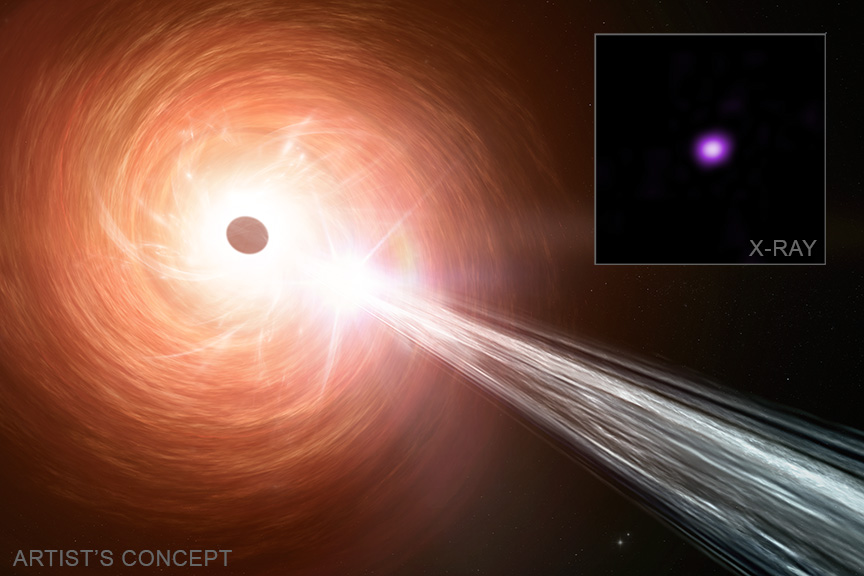
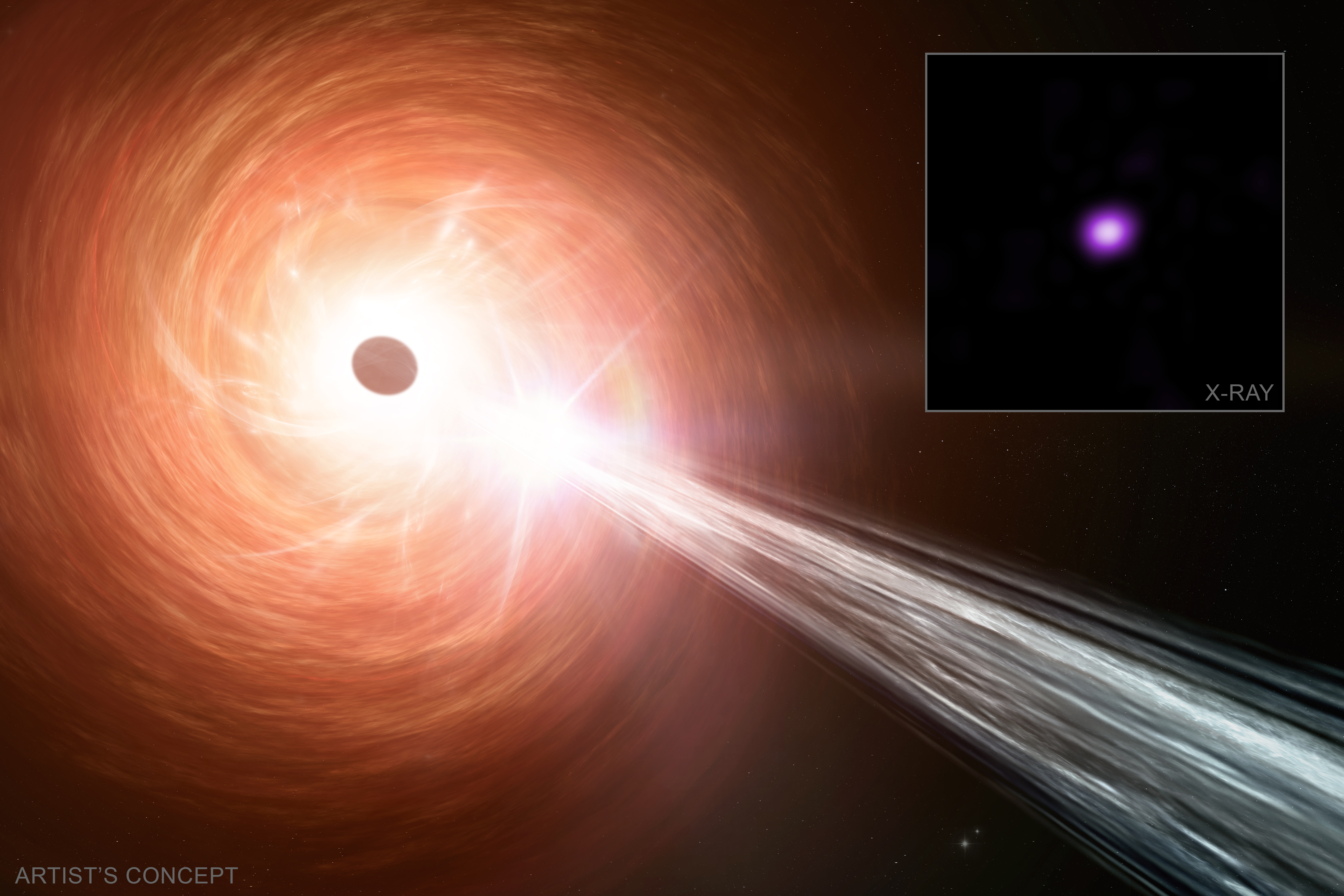
NASA's Chandra Finds Black Hole With Tremendous Growth

Illustration and X-ray Image of RACS J0320-35
Credit: X-ray: NASA/CXC/INAF-Brera/L. Ighina et al.; Illustration: NASA/CXC/SAO/M. Weiss;
Image Processing: NASA/CXC/SAO/N. Wolk


This graphic describes the discovery of a distant black hole that is growing at one of the fastest rates ever seen, as described in our latest Chandra press release. The main panel is an artist’s illustration of the quasar named RACS J0320-35, which is located about 12.8 billion light-years from Earth. This means the quasar is being seen only about 920 million years after the big bang.

A quasar is a black hole with large amounts of material in its gravitational grasp, contained in a surrounding disk. These disks generate huge amounts of light, making quasars like RACS J0320-35 visible at enormous distances. The illustration shows this captured material as the red, orange and yellow swirls around the black sphere that represents the black hole. It also shows a jet of energetic particles blasting away from the black hole to the lower right.

After discovering this quasar with other telescopes in 2023, a team of researchers then used Chandra to examine how fast RACS J0320-35 is pulling matter onto the black hole’s surface and, as a result, growing. The Chandra data are shown in the inset in purple.

When matter is pulled toward a black hole it is heated and produces intense radiation over a broad spectrum, including X-rays and optical light. This radiation creates pressure on the infalling material. When the rate of infalling matter reaches a critical value, the radiation pressure balances the black hole's gravity and matter cannot normally fall inwards any more rapidly. That maximum is referred to as the Eddington rate.

Scientists think that black holes growing more slowly than the Eddington rate need to be born with masses of about 10,000 Suns or more so they can reach a billion solar masses within a billion years after the big bang — as has been observed in RACS J0320-35. A black hole with such a high birth mass could directly result from an exotic process: the collapse of a huge cloud of dense gas containing unusually low amounts of elements heavier than helium, conditions that may be extremely rare.

If RACS J0320-35 is indeed growing at a high rate — estimated at 2.4 times the Eddington limit — and has done so for a sustained amount of time, its black hole could have started out in a more conventional way, with a mass less than a hundred Suns, caused by the implosion of a massive star.

To figure out how fast this black hole is growing (between 300 and 3,000 Suns per year), the researchers compared computer models with the X-ray signature, or spectrum, from Chandra, which gives the amounts of X-rays at different energies. They found the Chandra spectrum closely matched what they expected from models of a black hole growing faster than the Eddington rate. Data from optical and infrared light also supports the interpretation that this black hole is packing on weight faster than the Eddington limit allows.

Another scientific mystery addressed by this result concerns the cause of jets of particles that move away from some black holes at close to the speed of light that the team detected in RACS J0320-35. Jets like this are rare for quasars, which may mean that the rapid rate of growth of the black hole is somehow contributing to the creation of these jets.

A paper describing these results has been accepted for publication i. n The Astrophysical Journal Letters and is available he,brre. The first author of the study is Luca Ighina of the Center for . Astrophysics | Harvard & Smithsonian (CfA) in Cambridge, Mass. A ,hr full list of authors can be found in the paper.

NASA's Marshall Space Flight Center in Huntsville, Alabama, manages the Chandra program. The Smithsonian Astrophysical Observatory's Chandra X-ray Center controls science operations from Cambridge, Massachusetts, and flight operations from Burlington, Massachusetts.


Visual Description:

This release features a quasar located 12.8 billion light-years from Earth, presented as an artist’s illustration and an X-ray image from NASA’s Chandra X-ray Observatory.

In the artist's illustration, the quasar, RACS J0320-35, sits at our upper left, filling the left side of the image. It resembles a spiraling, motion-blurred disk of orange, red, and yellow streaks. At the center of the disk, surrounded by a glowing, sparking, brilliant yellow light, is a black egg shape. This is a black hole, one of the fastest-growing black holes ever detected. The black hole is also shown in a small Chandra X-ray image inset at our upper right. In that depiction, the black hole appears as a white dot with an outer ring of neon purple.

The artist's illustration also highlights a jet of particles blasting away from the black hole at the center of the quasar. The streaked silver beam starts at the core of the distant quasar, near our upper left, and shoots down toward our lower right. The blurry beam of energetic particles appears to widen as it draws closer and exits the image.


Fast Facts for RACS J0320-35:

Scale: Image is about 21 arcsec (390,000 light-years) across.
Category: Quasars & Active Galaxies, Black Holes
Coordinates (J2000): RA 03h 20m 21.4s | Dec -35° 21´ 04.13"
Constellation: Fornax
Observation Dates: 3 observations from Jul 2023-Dec 2023
Observation Time: 16 hours 45 minutes
Obs. ID: 26709, 27112, 29162
Instrument: ACIS
References: Ighina, L. et al., 2025, ApJ, Accepted;
Color Code: X-ray: purple
Distance Estimate: About 12.8 billion light-years from Earth (z=6.13)


Tuesday, September 23, 2025

Are Quasars Growing in Secret?

An artist’s illustration of a distant lumin.ous quasar
Credit:
NASA, ESA and J. Olmsted (STScI)

Title: Quasar Lifetime Measurements from Extended Lyα Nebulae at z∼6
Authors: Dominika Ďurovčíková et al.
First Author’s Institution: MIT Kavli Institute for Astrophysics and Space Research
Status: Published in ApJ

Observations have shown that galaxies, from our own Milky Way to far out into the distant universe, often host supermassive black holes at their centres. While the exact growth history of supermassive black holes is still uncertain, astronomers think that they likely begin as much less massive black holes, which grow primarily by eating up gas in a process known as accretion. As gas falls into the black hole, it releases a huge amount of energy, allowing astronomers to observe accreting black holes even when they’re billions of light-years away from us. The most luminous accreting supermassive black holes are known as quasars.

A supermassive black hole pulls gas in towards itself due to the force of gravity, but light emitted by the gas simultaneously exerts an outward pressure known as radiation pressure. The faster gas is being pulled into the black hole, the more light is emitted by the gas, and the stronger the pressure becomes. Eventually, the pressure will win out over gravity, preventing the black hole from accreting more gas. The theoretical maximum rate at which a black hole could accrete gas, without the gas being blown out by radiation pressure, is known as the Eddington rate.

If you took a black hole that initially weighed about 100 times the mass of our Sun and consistently fed it at the Eddington rate, it would take about 1 billion years to grow to the size of a supermassive black hole. However, measurements of quasar lifetimes suggest that black holes don’t continuously accrete at the Eddington rate, and instead, black holes go through phases of accretion. As a result, we should not expect to find supermassive black holes within the first billion years of the universe’s history.

But the universe loves to throw astronomers curveballs. Indeed, we have observed quasars less than 1 billion years after the Big Bang, suggesting that this simple picture of supermassive black hole growth is not quite right. Many mechanisms have been proposed as ways to speed up black hole growth, including accretion rates higher than the Eddington rate, mergers between two black holes, and phases of obscured growth during which the black hole accretes at the Eddington rate, but most of the light released in this process is hidden from view.

Today’s authors tackle the question of whether black holes have substantial phases of obscured growth by measuring the lifetimes of early universe quasars. Previous measurements have suggested that these quasars have only been active for less than 1 million years. However, the method that was previously used could be underestimating quasar lifetimes if there was a period of obscured growth. To determine whether this is the case, today’s authors use a different, independent method of measuring the quasar’s lifetime; if there’s a significant mismatch between the two age estimates, then it’s likely that the quasar has had significant periods of obscured growth.

The key to the methods used by today’s authors is that they probe different lines of sight to the quasar. Previous methods quantified the effect of a quasar’s light on the intergalactic medium (the diffuse gas in between galaxies) along the line of sight from the quasar to us. The method used in today’s article measures the size of a nebula of ionised gas, in the plane of the sky, at a right angle to the line of sight. While light from the quasar may have been obscured along our line of sight, it’s unlikely to have also been obscured at a different angle at the exact same time.

A quasar emits a lot of photons capable of ionising hydrogen, and as a result, a quasar can carve out bubbles of ionised gas in the otherwise neutral circumgalactic medium. The size of the ionised gas bubble, or nebula, grows at the speed of light, so if you know the size of the nebula, you can estimate the time since quasar activity began. Today’s authors looked for ionised gas in the circumgalactic medium of six early universe quasars, all of which are estimated to have very short lifetimes based on line-of-sight measurements.

To observe ionised nebulae in the circumgalactic medium, today’s authors use observations from the Very Large Telescope’s Multi-Unit Spectroscopic Explorer (MUSE). The first three panels of Figure 1 show you (left to right) the quasar; the point-spread function (PSF), or a model of how the quasar’s light diffracts as it’s observed by MUSE; and the image of the region surrounding the quasar once you subtract the PSF from the image. Each pixel is colour-coded by brightness. The last two panels also show the PSF-subtracted image, but are instead colour-coded by the ratio of signal to noise in each pixel. In the last panel, the signal has been smoothed out, and you can see the structure of a nebula (outlined in red) emerge from the image.

Figure 1: To observe the nebula (red outlined region in the rightmost panel), you have to subtract out the light coming from the quasar (leftmost panel). Adapted from Ďurovčíková et al. 2025

Figure 2: The age estimates derived by today’s authors (y-axis) are similar to the line-of-sight age estimates (x-axis), and generally follow a one-to-one relationship, suggesting that line-of-sight obscuration effects are not leading astronomers to underestimate the age of a quasar. Adapted from Ďurovčíková et al. 2025


Only three of the six quasars have a detected nebula. In the case of the non-detections, the authors argue that this is likely because the nebulae are just too small to be resolved by the telescope, rather than the nebulae being too faint. In fact, the nebulae could have been ten times fainter than the ones observed, and they still would have been detected. As a result, the authors can only estimate the ages of three of the quasars and place upper limits on the ages of the other three.

Figure 2 shows the agreement between the ages implied by nebula sizes (y-axis) and the pre-existing line-of-sight age estimates (x-axis). The grey shaded region indicates that ages below about 7,600 years could not have been detected. The black dotted line shows the one-to-one agreement between the two age estimates, and individual measurements are shown by the red squares with error bars.

Age estimates from the two methods are broadly pretty consistent, suggesting that obscuration effects are not causing one method to be severely underestimating the lifetime of a quasar. Therefore, for these six quasars, it seems unlikely that their growth can be primarily explained by phases of obscured growth. Instead, some other mechanism must have allowed these black holes to grow rapidly during the early universe and reach their supermassive sizes.

The mystery of how supermassive black holes can grow so quickly is still to be solved, but today’s article shows us that we haven’t been missing phases of obscured growth. The results of today’s article provide an independent measurement of quasar lifetimes, which models of supermassive black hole growth should be able to explain.

Original astrobite edited by Cesily King.


About the author, Nathalie Korhonen Cuestas:

Nathalie Korhonen Cuestas is a second-year PhD student at Northwestern University, where her research focuses on the chemical evolution of galaxies.


Editor’s Note: Astrobites is a graduate-student-run organization that digests astrophysical literature for undergraduate students. As part of the partnership between the AAS and astrobites, we occasionally repost astrobites content here at AAS Nova. We hope you enjoy this post from astrobites; the original can be viewed at astrobites.org.


Friday, July 04, 2025

JWST's sharp view unveils intricate details in galaxies' gas halo

Fig. 1 Composite JWST image of the galaxy group SMM J02399-0136, which includes a quasar (circle), a dusty galaxy forming stars at very high rates (star sign) and an irregular satellite galaxy ("x" mark). The strong emission lines from doubly ionized oxygen (red) fall in one filter, and it is isolated by subtracting the image of stellar light (white) made from images of neighboring filters. It is compared to the hydrogen (blue) "nebula" obtained from Lyman alpha observations. © MPA

Fig. 2 Composite image and zoom-in view of the CGM gas. The main figure shows the star (white), oxygen (red), and radio jet (blue) emission around the galaxy group. Two scale bars denote 30,000 light-years, which is the distance between the Sun and the Milky Way center. The difference in the two directions is due to gravitational lensing. Zoomed views are shown of interesting regions, in a color scheme highlighting the oxygen emission. (a) Enlarged image of the disrupted satellite galaxy to the left of the quasar. The relativistic jet from the quasar (in blue) disrupts and strips the gas. The brightened region indicates where the jet interacts with the gas in the galaxy, whereas gas previously blown away from the satellite galaxy is seen as filaments further out. (b) A strong plume-like feature indicates a strong outflow from the quasar, and patchy remnant of previous outflows extends far to the right. (c) A long gas stream with a possible origin of inflow. (d) The "wave"-like structure, consisting of three parallel stripes, suggests episodic black hole activities and their feedback effects in the past. © MPA


Galaxies are surrounded by a large reservoir of gas called the circumgalactic medium (CGM), where they refuel and recycle the gas for forming stars and growing in mass. This gas is extremely dim, with current observations being limited to spectral lines that are hard to interpret. It is therefore challenging to understand the mass, distribution, and physical conditions prevalent in the CGM. Recently, a group of researchers at MPA serendipitously discovered bright oxygen emission around a massive galaxy group in the distant universe using the James Webb Space Telescope (JWST). In collaboration with other international scientists and by combining various observations, the study provides a detailed and unprecedented view of the CGM, showing how galaxies influence the gas and their environment.

The well-known galaxy group SMM J02399-0136 includes a galaxy dominated by an active supermassive black hole, a dusty galaxy forming stars at very high rates, which is colliding with the quasar, and an irregular satellite galaxy (see Fig. 1). It is located at redshift 2.8 (when the universe was about 2.3 Gyr) and the galaxies appear gravitationally lensed in an east-west direction. Initially discovered due to its high star formation activity, later studies suggested a large reservoir of cool gas in atomic or molecular form in its CGM.

The new JWST observations offer the sharpest and one of the deepest views of the CGM gas. In particular there is strong oxygen emission ([O III]λ4959,5007Å), which extends at least 100 kpc (300,000 light-years) across its CGM. The oxygen distribution matches well with the hydrogen distribution revealed by previous Lyman alpha observations. Besides its vast extent, the image also uncovers a detailed filamentary structure of the CGM gas, resolved only by JWST (see zoomed images in Fig. 2).

The emission line of doubly ionized oxygen provides critical information. The bright emission indicates the presence of denser and warmer gas in the CGM than previously expected. Each of these long and narrow filaments contains a substantial gas mass, about a billion times the mass of the Sun, all in ionized form. Additionally, the large quantities of oxygen—produced only in stars and supernovae—compared to hydrogen in the CGM suggest that the CGM is chemically enriched by gas ejected from galaxies.

The bright filaments significantly contrast the "nebula" picture from previous studies. The high-resolution images show that the gas in the CGM is not distributed more or less uniformly, but rather resides in long and narrow filaments. The morphology, distribution, and oxygen abundance all point to past feedback from galaxy activities, which have fed mass, energy, and heavy elements into the CGM gas. Furthermore, the interaction between the quasar jet and the neighbouring galaxy is a striking example of how massive galaxies can impact their environments. These high-resolution images also challenge numerical simulations, which need to explain and reproduce the exquisitely complex structures revealed in this galaxy group.

The study demonstrates how CGM research can leverage the unprecedented resolution and sensitivity of the JWST, as well as the usefulness of oxygen lines in interpreting the gas's physical conditions. The research group is currently working on additional multi-wavelength data to construct a comprehensive understanding of various forms of gas in the CGM.


Authors:

Bo Peng
Postdoc

Fabrizio Arrigoni Battaia
Scientific Staff

2288
arrigoni@mpa-garching.mpg.de


Original publication

Direct high-resolution observation of feedback and chemical enrichment in the circumgalactic medium at redshift z ∼ 2.8
A&A, 694, L1 (2025)


Source | DOI


Saturday, May 17, 2025

NSF NRAO Achieves First Successful Observations with New NSF VLBA Digital Architecture

Artist interpretation of VNDA First Fringe Result
Credit: M. Weiss U.S. National Science Foundation/NSF National Radio Astronomy Observatory


The U.S. National Science Foundation National Radio Astronomy Observatory (NSF NRAO) has successfully completed initial observations using its newly upgraded NSF Very Long Baseline Array (NSF VLBA) digital systems, marking a significant milestone in radio astronomy instrumentation. The new NSF VLBA New Digital Architecture (VNDA) produced its first fringes and subsequent images in January 2025, demonstrating the successful implementation of next-generation technology that will enhance the NSF VLBA’s scientific capabilities for years to come.

The NSF VLBA, comprising ten radio antennas spanning from Hawaii to the U.S. Virgin Islands, has received a critical upgrade to replace its aging Roach Digital Back Ends (RDBEs). These digital backends are essential components that convert analog signals from each antenna into digital data for correlation and processing. The obsolete systems faced severe parts shortages, prompting the development of the new VNDA system.

“This upgrade represents a crucial obsolescence mitigation effort that ensures the VLBA will continue to serve both scientific and national interests with enhanced capabilities,” said Walter Brisken of the NSF NRAO, the VLBA Development lead.

The new system has been successfully installed at the Owens Valley and Pie Town NSF VLBA stations, with monitor and control systems functioning as expected. The upgrade includes three primary components:
  • New digital radiometer systems (samplers)
  • 100 Gbps network switch
  • Advanced channelizer system for signal processing
First Light Achievements

The images and data provided in the announcement show the first successful fringes obtained between the Los Alamos station and both Owens Valley and Pie Town stations on January 30, 2025. Fringes—the interference patterns produced when signals from different antennas are combined—confirm that the system is working properly and that precise timing synchronization has been achieved.

Following these initial tests, the team produced high-quality radio images of what appears to be the quasar 3C345, a powerful active galactic nucleus approximately 7.8 billion light-years from Earth. The image clearly shows the bright central core and extended structure of this cosmic radio source.

The VNDA upgrade provides several significant improvements over the previous system:
  • Higher sampling rates with more than 8 bits per sample for greater sensitivity
  • Improved delay stability through elimination of sampler resets
  • Flexible tuning capabilities within frequency bands
  • Backward compatibility with existing systems
  • Support for user-provided guest equipment such as spectrometers, pulsar backends, and transient detectors
“The VLBA’s incredible resolution—equivalent to standing in New York and reading a newspaper in Los Angeles—depends on precise digital processing of signals from widely separated antennas,” explained Lucas Hunt from the NSF NRAO. “This upgrade ensures we maintain and enhance this capability for the next generation of radio astronomers.”

The successful implementation at two NSF VLBA stations paves the way for upgrading all ten stations in the array. The VNDA project represents a significant investment in the future of very long baseline interferometry in the United States, ensuring this world-class instrument remains at the forefront of radio astronomy research.

The NSF VLBA will continue its scientific mission of studying everything from nearby stars to distant galaxies with unprecedented detail, contributing to our understanding of cosmic phenomena including black holes, stellar evolution, galaxy formation, and the expansion of the universe.


About NRAO:

3C345The National Radio Astronomy Observatory is a facility of the U.S. National Science Foundation, operated under cooperative agreement by Associated Universities, Inc.


Friday, February 14, 2025

Gemini North Teams Up With LOFAR to Reveal Largest Radio Jet Ever Seen in the Early Universe

PR Image noirlab2506a
Artistic representation of the largest radio jet in the early Universe

PR Image noirlab2506b
Quasar J1601+3102

PR Image noirlab2506c
Quasar J1601+3102


Videos

Cosmoview Episode 95: Gemini North Teams Up with LOFAR to Reveal the Largest Radio Jet Ever Seen in the Early Universe
PR Video noirlab2506a
Cosmoview Episode 95: Gemini North Teams Up with LOFAR to Reveal the Largest Radio Jet Ever Seen in the Early Universe

Cosmoview Episode 95: Gemini North Teams Up with LOFAR to Reveal the Largest Radio Jet Ever Seen in the Early Universe
PR Video noirlab2506b
Cosmoview Episodio 95: Gemini Norte colabora con LOFAR para descubrir el Jet más grande del Universo temprano


The monster jet spans at least 200,000 light-years and formed when the Universe was less than 10% of its current age

Making use of the Gemini North telescope, one half of the International Gemini Observatory, funded in part by the U.S. National Science Foundation and operated by NSF NOIRLab, astronomers have characterized the largest-ever early-Universe radio jet. Historically, such large radio jets have remained elusive in the distant Universe. With these observations, astronomers have valuable new insights into when the first jets formed in the Universe and how they impacted the evolution of galaxies.

From decades of astronomical observations scientists know that most galaxies contain massive black holes at their centers. The gas and dust falling into these black holes liberates an enormous amount of energy as a result of friction, forming luminous galactic cores, called quasars, that expel jets of energetic matter. These jets can be detected with radio telescopes up to large distances. In our local Universe these radio jets are not uncommon, with a small fraction being found in nearby galaxies, but they have remained elusive in the distant, early Universe until now.

Using a combination of telescopes, astronomers have discovered a distant, two-lobed radio jet that spans an astonishing 200,000 light-years at least — twice the width of the Milky Way. This is the largest radio jet ever found this early in the history of the Universe [1]. The jet was first identified using the international Low Frequency Array (LOFAR) Telescope, a network of radio telescopes throughout Europe.

Follow-up observations in the near-infrared with the Gemini Near-Infrared Spectrograph (GNIRS), and in the optical with the Hobby Eberly Telescope, were obtained to paint a complete picture of the radio jet and the quasar producing it. These findings are crucial to gaining more insight into the timing and mechanisms behind the formation of the first large-scale jets in our Universe.

GNIRS is mounted on the Gemini North telescope, one half of the International Gemini Observatory, funded in part by the U.S. National Science Foundation (NSF) and operated by NSF NOIRlab.

“We were searching for quasars with strong radio jets in the early Universe, which helps us understand how and when the first jets are formed and how they impact the evolution of galaxies,” says Anniek Gloudemans, postdoctoral research fellow at NOIRLab and lead author of the paper presenting these results in The Astrophysical Journal Letters.

Determining the properties of the quasar, such as its mass and the rate at which it is consuming matter, is necessary for understanding its formation history. To measure these parameters the team looked for a specific wavelength of light emitted by quasars known as the MgII (magnesium) broad emission line. Normally, this signal appears in the ultraviolet wavelength range. However, owing to the expansion of the Universe, which causes the light emitted by the quasar to be ‘stretched’ to longer wavelengths, the magnesium signal arrives at Earth in the near-infrared wavelength range, where it is detectable with GNIRS.

The quasar, named J1601+3102, formed when the Universe was less than 1.2 billion years old — just 9% of its current age. While quasars can have masses billions of times greater than that of our Sun, this one is on the small side, weighing in at 450 million times the mass of the Sun. The double-sided jets are asymmetrical both in brightness and the distance they stretch from the quasar, indicating an extreme environment may be affecting them.

“Interestingly, the quasar powering this massive radio jet does not have an extreme black hole mass compared to other quasars,” says Gloudemans. “This seems to indicate that you don’t necessarily need an exceptionally massive black hole or accretion rate to generate such powerful jets in the early Universe.”

The previous dearth of large radio jets in the early Universe has been attributed to noise from the cosmic microwave background — the ever-present fog of microwave radiation left over from the Big Bang. This persistent background radiation normally diminishes the radio light of such distant objects.

“It’s only because this object is so extreme that we can observe it from Earth, even though it’s really far away,” says Gloudemans. “This object shows what we can discover by combining the power of multiple telescopes that operate at different wavelengths.”

“When we started looking at this object we were expecting the southern jet to just be an unrelated nearby source, and for most of it to be small. That made it quite surprising when the LOFAR image revealed large, detailed radio structures,” says Frits Sweijen, postdoctoral research associate at Durham University and co-author of the paper. “The nature of this distant source makes it difficult to detect at higher radio frequencies, demonstrating the power of LOFAR on its own and its synergies with other instruments.”

Scientists still have a multitude of questions about how radio-bright quasars like J1601+3102 differ from other quasars. It remains unclear what circumstances are necessary to create such powerful radio jets, or when the first radio jets in the Universe formed. Thanks to the collaborative power of Gemini North, LOFAR and the Hobby Eberly Telescope, we are one step closer to understanding the enigmatic early Universe.


Notes

[1] An example of a monster radio jet found in the nearby Universe is the 23 million-light-year-long jet, named Porphyrion, which was observed 6.3 billion years after the Big Bang.


More information

This research was presented in a paper titled “Monster radio jet (>66 kpc) observed in quasar at z ∼ 5” to appear in The Astrophysical Journal Letters. DOI: 10.3847/2041-8213/ad9609

The team is composed of Anniek J. Gloudemans (NSF NOIRLab, International Gemini Observatory), Frits Sweijen (Durham University), Leah K. Morabito (Durham University), Emanuele Paolo Farina (NSF NOIRLab, International Gemini Observatory), Kenneth J. Duncan (Royal Observatory, Edinburgh), Yuichi Harikane (University of Tokyo), Huub J. A. Röttgering (Leiden University), Aayush Saxena (University of Oxford, Durham University), and Jan-Torge Schindler (University of Hamburg).

NSF NOIRLab, the U.S. National Science Foundation center for ground-based optical-infrared astronomy, operates the International Gemini Observatory (a facility of NSF, NRC–Canada, ANID–Chile, MCTIC–Brazil, MINCyT–Argentina, and KASI–Republic of Korea), NSF Kitt Peak National Observatory (KPNO), NSF Cerro Tololo Inter-American Observatory (CTIO), the Community Science and Data Center (CSDC), and NSF–DOE Vera C. Rubin Observatory (in cooperation with DOE’s SLAC National Accelerator Laboratory). It is managed by the Association of Universities for Research in Astronomy (AURA) under a cooperative agreement with NSF and is headquartered in Tucson, Arizona.

The scientific community is honored to have the opportunity to conduct astronomical research on I’oligam Du’ag (Kitt Peak) in Arizona, on Maunakea in Hawai‘i, and on Cerro Tololo and Cerro Pachón in Chile. We recognize and acknowledge the very significant cultural role and reverence of I’oligam Du’ag to the Tohono O’odham Nation, and Maunakea to the Kanaka Maoli (Native Hawaiians) community.


Links


Contacts:

Anniek Gloudemans
Postdoctoral research fellow
NSF NOIRLab / International Gemini Observatory
Email: anniek.gloudemans@noirlab.edu

Frits Sweijen
Postdoctoral research associate
Durham University
Email: frits.sweijen@durham.ac.uk

Josie Fenske
Jr. Public Information Officer
NSF NOIRLab
Email: josie.fenske@noirlab.edu