Showing posts with label trans-Neptunian objects (TNOs). Show all posts

Wednesday, May 06, 2026

Outer Solar System Object Has an Atmosphere But Shouldn’t

Artist’s conception of this research showing an imagined time sequence as a star passes behind a TNO with an atmosphere. Credit: NAOJ. Image (961KB)


A team of professional and amateur Japanese astronomers foundidence for a thin atmosphere around a small body in the outer Solarystem. The object is so small that it should not have a sustainableatmosphere, raising questions about when and how the atmosphere formd. Future observations to better characterize the atmosphere will help solve these mysteries.

In the cold reaches of the outer Solar System lie thousands of small objects known as trans-Neptunian objects (TNOs) because they lie outside the orbit of Neptune. A thin atmosphere has been observed around Pluto, the most famous TNO, but studies of other TNOs have yielded negative results. Most TNOs are so cold, and their surface gravity so weak, that they are not expected to retain atmospheres.

But astronomers like to expect the unexpected, so they took advantage of a lucky “natural experiment” to look for an atmosphere around a TNO known as (612533) 2002 XV93. This object, abbreviated as 2002 XV93, has a diameter of approximately 500 km. For reference, Pluto’s diameter is 2,377 km. The orbit of 2002 XV93 is such that, as seen from Japan, it passed directly in front of a star on January 10, 2024. As the star disappears behind 2002 XV93, it might gradually fade, indicating that the light is being attenuated as it passes through a thin atmosphere; or it might suddenly wink out as it slips behind the solid surface of the TNO.

A team of professional and amateur astronomers, led by Ko Arimatsu at NAOJ Ishigakijima Astronomical Observatory, observed the star as 2002 XV93 passed in front of it from multiple sites in Japan. The obtained data are consistent with attenuation by an atmosphere.

Calculations show that the atmosphere found around 2002 XV93 is expected to last less than 1000 years unless it is replenished. So it must have been created or replenished recently. Observations by the James Webb Space Telescope show no signs of frozen gases on the surface of 2002 XV93 that might sublimate to form an atmosphere. One possibility is that some event brought frozen or liquid gases from deep inside the TNO to the surface. Another possibility is that a comet crashed into 2002 XV93, releasing gas that formed a temporary atmosphere. Further observations are needed to distinguish between these two scenarios.

Conceptual video for Arimatsu et al. (2026)
Conceptual video showing how the light from a star changes when it passes behind an object with an atmosphere.
Credit: NAOJ


Release Information

Researcher(s) Involved in this Release

Ko Arimatsu (Ishigakijima Astronomical Observatory, National Astronomical Observatory of Japan)

Jun-ichi Watanabe (Kyoto Sangyo University)

Coordinated Release Organization(s)

National Astronomical Observatory of Japan, NINS

Faculty of Science, The University of Tokyo

Kyoto University

Kyoto Sangyo University

Paper(s)

Ko Arimatsu et al. “Detection of an atmosphere on a trans-Neptunian object beyond Pluto”, in Nature Astronomy, DOI:
10.1038/s41550-026-02846-1


Tuesday, April 07, 2026

Rubin Observatory Early Data from NSF–DOE Vera C. Rubin Observatory Reveals Over 11,000 New Asteroids

PR Image noirlab2608a
3D rendering of asteroids discovered by NSF–DOE Rubin Observatory

PR Image noirlab2608b
Asteroids discovered by NSF–DOE Rubin Observatory infographic

PR Image noirlab2608c
3D rendering of trans-Neptunian objects discovered by NSF–DOE Rubin Observatory

PR Image noirlab2608d
Distribution of new asteroids discovered by NSF–DOE Rubin Observatory

PR Image noirlab2608e
3D model of asteroids discovered by NSF–DOE Rubin Observatory (polar view)


Videos

3D animation of asteroids discovered by NSF–DOE Rubin Observatory (close)
PR Video noirlab2608a
3D animation of asteroids discovered by NSF–DOE Rubin Observatory (close)

3D animation of asteroids discovered by NSF–DOE Rubin Observatory
PR Video noirlab2608b
3D animation of asteroids discovered by NSF–DOE Rubin Observatory


Rubin’s largest asteroid haul yet, gathered before the Legacy Survey of Space and Time even begins, is just the “tip of the iceberg”

Scientists at NSF–DOE Vera C. Rubin Observatory, jointly funded by the U.S. National Science Foundation and the U.S. Department of Energy's Office of Science, have submitted an unprecedented set of asteroid detections to the IAU Minor Planet Center, including hundreds of distant worlds beyond Neptune and 33 previously unknown near-Earth asteroids.

Using preliminary data from NSF–DOE Vera C. Rubin Observatory, scientists have discovered over 11,000 new asteroids [1]. The data were confirmed by the International Astronomical Union’s Minor Planet Center (MPC), making this the largest single batch of asteroid discoveries submitted in the past year. The discoveries were made using data from Rubin’s early optimization surveys and offer a powerful preview of the observatory’s transformative impact on Solar System science.

Rubin Observatory is a joint program of NSF NOIRLab and DOE’s SLAC National Accelerator Laboratory, who cooperatively operate Rubin. NOIRLab is managed by the Association of Universities for Research in Astronomy (AURA).

The submission to MPC comprises approximately one million observations, taken over the span of a month and a half, of over 11,000 new asteroids and more than 80,000 already known asteroids, including some that had previously been observed but were later “lost” because their orbits were too uncertain to predict their future locations. You can interact with all of Rubin’s asteroid discoveries in the Rubin Orbitviewer, which uses real data to provide an intuitive way to explore the structure of our cosmic backyard in three dimensions and in real time. Also, visit the Rubin Asteroid Discoveries Dashboard to learn about the new objects Rubin has uncovered.

“This first large submission after Rubin First Look is just the tip of the iceberg and shows that the observatory is ready,” says Mario Juric, faculty at the University of Washington and Rubin Solar System Lead Scientist. “What used to take years or decades to discover, Rubin will unearth in months. We are beginning to deliver on Rubin’s promise to fundamentally reshape our inventory of the Solar System and open the door to discoveries we haven’t yet imagined.”

Among the newly identified objects are 33 previously unknown near-Earth objects (NEOs), which are small asteroids and comets whose closest approach to the Sun is less than 1.3 times the distance between Earth and the Sun. None of the newly discovered NEOs pose a threat to Earth, and the largest is about 500 meters wide. Objects larger than 140 meters are closely tracked as they could cause significant regional damage if they impact, yet scientists estimate that only about 40% of these mid-sized NEOs have been identified so far.

Once operating fully in survey mode, Rubin is expected to reveal an additional nearly 90,000 new NEOs, some of which may be potentially hazardous, and to nearly double the number of known NEOs larger than 140 meters to around 70%. By enabling early detection and continuous monitoring of these objects, Rubin will be a powerful tool for planetary defense.

The dataset also contains roughly 380 trans-Neptunian objects (TNOs) — icy bodies orbiting beyond Neptune. Two of the newly discovered TNOs — provisionally named 2025 LS2 and 2025 MX348 — have been found to be on extremely large and elongated, or stretched out, orbits. At their most distant points, these two objects reach roughly 1000 times farther away from the Sun than the Earth is, placing them among the 30 most distant minor planets known.

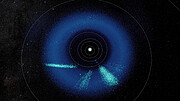
This animation shows the inner Solar System populated with known asteroids in dark blue and asteroids discovered by Rubin in light teal. Read morehere. Credit: NSF–DOE Vera C. Rubin Observatory/NOIRLab/SLAC/AURA/R. Proctor. Star map: NASA/Goddard Space Flight Center Scientific Visualization Studio. Gaia DR2: ESA/Gaia/DPAC. Image Processing: M. Zamani (NSF NOIRLab)

The discoveries were enabled by Rubin Observatory’s unique combination of a large mirror, the world’s most powerful astronomical digital camera, and highly sophisticated, software-driven pipelines designed to detect faint, fast-moving objects against a crowded sky. Rubin can survey the southern sky at roughly six times the sensitivity of most current asteroid searches, allowing it to detect smaller and more distant objects than ever before. These capabilities will allow Rubin to build the most detailed census of our Solar System ever, and all of the discoveries will help scientists work out the story of the Solar System’s history.

“Rubin’s unique observing cadence required a whole new software architecture for asteroid discovery,” says Ari Heinze, University of Washington, who, together with Jacob Kurlander, a graduate student at the University of Washington, built the software that detected them. “We built it, and it works. Even with just early, engineering-quality data, Rubin discovered 11,000 asteroids and measured more precise orbits for tens of thousands more. It seems pretty clear this observatory will revolutionize our knowledge of the asteroid belt.”

Particularly striking is the rapid growth of the TNO population. The 380 candidates discovered by Rubin in less than two months add to the 5000 discovered over the past three decades. As with less distant asteroids, finding the TNOs depended critically on developing new sophisticated algorithms.

“Searching for a TNO is like searching for a needle in a field of haystacks — out of millions of flickering sources in the sky, teaching a computer to sift through billions of combinations and identify those that are likely to be distant worlds in our Solar System required novel algorithmic approaches,” says Matthew Holman, a Senior Astrophysicist at the Center for Astrophysics | Harvard & Smithsonian and former Director of the Minor Planet Center, who spearheaded the work on the TNO discovery pipeline.

“Objects like these offer a tantalizing probe of the Solar System’s outermost reaches, from telling us how the planets moved early on in the Solar System’s history, to whether a hitherto undiscovered 9th large planet may still be out there,” says Kevin Napier, a research scientist at the Harvard-Smithsonian Center for Astrophysics who, with Holman, developed the algorithms to detect distant Solar System objects with Rubin data.

The MPC's verification of this large group of discoveries enables the entire global community to access the data, refine orbits, and begin analysis immediately. And these ~11,000 asteroids are just the start. Once the decade-long Legacy Survey of Space and Time (LSST) begins later this year, scientists expect Rubin to discover this many asteroids every two to three nights during the early years of the survey. This will ultimately triple the number of known asteroids and increase the number of known TNOs by nearly an order of magnitude.


Notes

[1] The new asteroid discoveries reported here are in addition to the ~1500 asteroid discoveries announced as part of Rubin First Look. When originally announced, 2104 of the asteroids were registered as new. Since then, 600 of the asteroids have been connected to earlier observations by the IAU Minor Planet Center, and hence reclassified as “recovered asteroids” and not discoveries.


More information

This research is available at the Rubin Asteroid Discoveries Dashboard.

The team is composed (in alphabetical order) of P. H. Bernardinelli (UW and USP, Brazil), S. Eggl (UIUC), A. Heinze (UW), M. Holman (CfA), M. Juric (UW), J. Kurlander (UW), J. Moeyens (B612 Asteroid Institute), K. Napier (CfA), and E. Nourbakhsh (Princeton).

NSF–DOE Vera C. Rubin Observatory, funded by the U.S. National Science Foundation and the U.S. Department of Energy’s Office of Science, is a groundbreaking new astronomy and astrophysics observatory on Cerro Pachón in Chile. It is named after astronomer Vera Rubin, who provided the first convincing evidence for the existence of dark matter. Using the largest camera ever built, Rubin will repeatedly scan the sky for 10 years to create an ultra-wide, ultra-high-definition, time-lapse record of our Universe.

NSF–DOE Vera C. Rubin Observatory is a joint initiative of the U.S. National Science Foundation (NSF) and the U.S. Department of Energy’s Office of Science (DOE/SC). Its primary mission is to carry out the Legacy Survey of Space and Time, providing an unprecedented data set for scientific research supported by both agencies. Rubin is operated jointly by NSF NOIRLab and SLAC National Accelerator Laboratory. NSF NOIRLab is managed by the Association of Universities for Research in Astronomy (AURA) and SLAC is operated by Stanford University for the DOE. France provides key support to the construction and operations of Rubin Observatory through contributions from CNRS/IN2P3. Rubin Observatory is privileged to conduct research in Chile and gratefully acknowledges additional contributions from more than 40 international organizations and teams.

The U.S. National Science Foundation (NSF) is an independent federal agency created by Congress in 1950 to promote the progress of science. NSF supports basic research and people to create knowledge that transforms the future

The DOE’s Office of Science is the single largest supporter of basic research in the physical sciences in the United States and is working to address some of the most pressing challenges of our time.

NSF NOIRLab, the U.S. National Science Foundation center for ground-based optical-infrared astronomy, operates the International Gemini Observatory (a facility of NSF, NRC–Canada, ANID–Chile, MCTIC–Brazil, MINCyT–Argentina, and KASI–Republic of Korea), NSF Kitt Peak National Observatory (KPNO), NSF Cerro Tololo Inter-American Observatory (CTIO), the Community Science and Data Center (CSDC), and NSF–DOE Vera C. Rubin Observatory (in cooperation with DOE’s SLAC National Accelerator Laboratory). It is managed by the Association of Universities for Research in Astronomy (AURA) under a cooperative agreement with NSF and is headquartered in Tucson, Arizona.

The scientific community is honored to have the opportunity to conduct astronomical research on I’oligam Du’ag (Kitt Peak) in Arizona, on Maunakea in Hawai‘i, and on Cerro Tololo and Cerro Pachón in Chile. We recognize and acknowledge the very significant cultural role and reverence of I’oligam Du’ag (Kitt Peak) to the Tohono O’odham Nation, and Maunakea to the Kanaka Maoli (Native Hawaiians) community.

SLAC National Accelerator Laboratory explores how the Universe works at the biggest, smallest and fastest scales and invents powerful tools used by researchers around the globe. As world leaders in ultrafast science and bold explorers of the physics of the Universe, we forge new ground in understanding our origins and building a healthier and more sustainable future. Our discovery and innovation help develop new materials and chemical processes and open unprecedented views of the cosmos and life’s most delicate machinery. Building on more than 60 years of visionary research, we help shape the future by advancing areas such as quantum technology, scientific computing and the development of next-generation accelerators. SLAC is operated by Stanford University for the U.S. Department of Energy’s Office of Science.


Links


Contacts:

Mario Juric
Rubin Solar System Lead Scientist
University of Washington
Email:
mjuric@uw.edu

Josie Fenske
Public Information Officer
NSF NOIRLab
Email:
josie.fenske@noirlab.edu


Monday, November 17, 2025

The Sun Left Home in a Hurry

An open star cluster named NGC 2002, as viewed by the Hubble Space Telescope. The Sun may have been born in a similar cluster. Credit:
NASA, ESA and G. Gilmore (University of Cambridge); Processing: Gladys Kober (NASA/Catholic University of America)

By simulating how the orbits of distant solar system objects were altered by close encounters with other stars early in the Sun’s life, astronomers have placed tight constraints on how long our home star stuck around its siblings after birth.

The Hubble Space Telescope’s view of a collection of young stars still embedded within their natal nebula. Credit:
NASA, ESA, G. Duchene (Universite de Grenoble I); Image Processing: Gladys Kober (NASA/Catholic University of America)

Born in Batches

Though our Sun currently travels on a solitary trajectory through the galaxy, its earliest childhood was not spent so lonely. Instead, the Sun was likely born as part of a litter of many other stars all collapsing out of the same cloud of precursor gas and dust. As a consequence, its early adolescence was spent in the company of dozens of other young stars, all zipping along on their own paths, destined to drift apart but initially packed close together.

Despite their kinship, these young stars were not kind to one another when they passed nearby. When two stars grow close, the intense gravity of the encounter can severely disrupt their proto-planetary systems, scattering the objects orbiting farthest from their stars and potentially even ejecting some objects altogether. These early years likely left scars on the edges of our solar system that persist even today, billions of years after the early tussles.

Recent research led by Amir Siraj, Princeton University, leverages these scars or their apparent absence to ask the question: given the structure we observe in the outer solar system today, what limits can we place on the number of stars born near the Sun and the amount of time the Sun spent in its birth cluster?

An illustration of the orbits for some of the distant sednoids considered in this study.
Credit: NAOJ

Distance is Power

Several authors have asked this question over the past several decades, but Siraj and collaborators added a new twist: instead of studying either the giant planets or the cold classical Kuiper Belt, they instead focused exclusively on the “distant sednoids.” This rarefied collection of only nine known objects includes only the most distant minor planets in our solar system: the sednoids never come within 40 au of the Sun, and they spend much of their orbits beyond 400 au. Interestingly, however, all of them orbit on planes that are fairly aligned with that of the planets, and none ever strays farther than 20° from the ecliptic.

Through a suite of numerical simulations, Siraj and collaborators demonstrate that this relatively tight distribution of inclinations implies that the Sun couldn’t have been too roughed up on its way out of the cluster. By simulating many different close flybys and their influence on the distant sednoids, the researchers constrained the product of the number of stars in the Sun’s birth cluster and the time the Sun spent there to be less than or equal to 5 billion years per cubic parsec. Assuming a typical cluster density of 100 stars per cubic parsec, this suggests that the Sun cleared out of the densest and most dangerous part of the cluster within just 50 million years.

The authors stress that this conclusion leans on the assumption that the distant sednoids arrived on their extreme orbits essentially immediately, though in fact astronomers aren’t sure exactly how and when these objects ended up on the outskirts of the solar system. If the sednoids were in fact implanted onto their orbits early on, this limit on how long it took the Sun to leave its siblings is by far the strongest to date. With the Vera C. Rubin Observatory poised to discover thousands of new distant solar system objects, it’s likely that the bound will grow even more stringent in the next few years.

By Ben Cassese

Citation

“Limits on Stellar Flybys in the Solar Birth Cluster,” Amir Siraj et al 2025 ApJL 993 L4. doi:10.3847/2041-8213/ae1025


Sunday, July 20, 2025

Astronomers Discover Rare Distant Object in Sync with Neptune

A team of astronomers led by the Center for Astrophysics | Harvard & Smithsonian has discovered a rare object far beyond Neptune, from a class known as trans-Neptunian objects, that is moving in rhythm with the giant planet. This image shows the orbits of all of the objects discovered in the Outer Solar System Origins Survey. The orbit of 2020 VN40 is the thickest one, tilted up and to the left from the orbits of most of the objects. The orbits of the giant planets Jupiter, Saturn, Uranus, and Neptune are the white circles. Credit: Rosemary Pike, CfA


This object, called 2020 VN40, is the first confirmed body that orbits the sun once for every ten orbits Neptune completes.

Cambridge, MA — A team of astronomers led by the Center for Astrophysics | Harvard & Smithsonian has discovered a rare object far beyond Neptune, from a class known as trans-Neptunian objects, that is moving in rhythm with the giant planet. This object, called 2020 VN40, is the first confirmed body that orbits the sun once for every ten orbits Neptune completes.

This discovery helps scientists understand how objects in the outer solar system behave and how they got there. It supports the idea that many distant objects are temporarily "caught" in Neptune’s gravity as they drift through space.

"This is a big step in understanding the outer solar system," said Rosemary Pike, lead researcher from the Center for Astrophysics | Harvard & Smithsonian. "It shows that even very distant regions influenced by Neptune can contain objects, and it gives us new clues about how the solar system evolved."

The finding was published this month in The Planetary Science Journal, a publication of the American Astronomical Society.

The discovery was made by the Large inclination Distant Objects (LiDO) survey, which searched for unusual objects in the outer solar system. This survey used the Canada-France-Hawaii Telescope for the main survey operations, and Gemini Observatory and Magellan Baade for additional observations.

The survey was designed to search for bodies with orbits that extend far above and below the plane of the Earth's orbit around the sun, part of the outer solar system that hasn’t been well-studied.

"It has been fascinating to learn how many small bodies in the solar system exist on these very large, very tilted orbits," said Dr. Samantha Lawler (University of Regina), a core member of the LiDO team. The object’s average distance is about 140 times farther from the sun than Earth and follows a very tilted path around the solar system.

What makes 2020 VN40 even more interesting is how it moves compared to Neptune. Most objects with a simple ratio of the duration of their orbit compared to the duration of Neptune's orbit always come closest to the sun when Neptune is far away. In contrast, 2020 VN40 comes closest to the sun when Neptune is very close by, if you look at their positions from above the solar system. The tilt of 2020 VN40's orbit means that the objects are not actually close, because 2020 VN40 is actually far below the solar system- they only appear close when flattened onto a map. All other known resonant trans-Neptunian objects orbit such that they avoid this alignment at their closest approach to the sun, even in the flattened view.

"This new motion is like finding a hidden rhythm in a song we thought we knew," said Ruth Murray-Clay (University of California Santa Cruz), co-author of the study. "It could change how we think about the way distant objects move."

These findings suggest that highly tilted orbits can lead to new and unexpected types of motion. The LiDO survey has already found over 140 distant objects, and more discoveries are expected from future surveys. With telescopes like the Vera C. Rubin Observatory, scientists hope to find many more objects like 2020 VN40.

"This is just the beginning," said Kathryn Volk of the Planetary Science Institute. "We’re opening a new window into the solar system’s past."

Source: Harvard-Smithsonian Center for Astrophysics (CfA)


Resources

The Gemini North telescope is one half of the International Gemini Observatory, which is funded in part by the U.S. National Science Foundation and operated by NSF NOIRLab.

DOI: 10.3847/PSJ/addd22


https://iopscience.iop.org/article/10.3847/PSJ/addd22


About the Center for Astrophysics | Harvard & Smithsonian


The Center for Astrophysics | Harvard & Smithsonian is a collaboration between Harvard and the Smithsonian designed to ask—and ultimately answer—humanity's greatest unresolved questions about the nature of the universe. The Center for Astrophysics is headquartered in Cambridge, MA, with research facilities across the U.S. and around the world.


Media Contact:

Christine Buckley
Director of Communications
Center for Astrophysics | Harvard & Smithsonian

christine.buckley@cfa.harvard.edu


Thursday, September 12, 2024

Solution to a cosmic mystery—the eccentric orbits of trans-Neptunian objects

Simulation snapshots of model A1.
Credit: Nature Astronomy (2024).
DOI: 10.1038/s41550-024-02349-x


New evidence suggests that billions of years ago, a star may have passed very close to our solar system. As a result, thousands of smaller celestial bodies in the outer solar system outside Neptune's orbit were deflected into highly inclined trajectories around the sun. It is possible that some of them were captured by the planets Jupiter and Saturn as moons.

These findings come from a team of astrophysicists from Forschungszentrum Jülich and Leiden University in the Netherlands. They were published in two studies in the journals Nature Astronomy and The Astrophysical Journal Letters.

When we think of our solar system, we usually assume that it ends at the outermost known planet, Neptune. "However, several thousand celestial bodies are known to move beyond the orbit of Neptune," explains Susanne Pfalzner, astrophysicist at Forschungszentrum Jülich.

It is even suspected that there are tens of thousands of objects with a diameter of more than 100 kilometers. "Surprisingly, many of these so-called trans-Neptunian objects move on eccentric orbits that are inclined relative to the common orbital plane of the planets in the solar system."

Together with her Jülich colleague Amith Govind and Simon Portegies Zwart from Leiden University, Susanne Pfalzner has used more than 3,000 computer simulations to investigate a possible cause of the unusual orbits: could another star have caused the strange orbits of trans-Neptunian objects?

The three astrophysicists found that a distinctive, close flyby of another star can explain the inclined and eccentric orbits of the known trans-Neptunian celestial bodies. "Even the orbits of very distant objects can be deduced, such as that of the dwarf planet Sedna in the outermost reaches of the solar system, which was discovered in 2003.

"And also objects that move in orbits almost perpendicular to the planetary orbits," says Susanne Pfalzner. Such a flyby can even explain the orbits of 2008 KV42 and 2011 KT19—the two celestial bodies that move in the opposite direction to the planets.

Saturn's moon Phoebe is a prime example of the unusual properties of irregular moons. Like many others, it orbits Saturn in the opposite direction. Credit: NASA / JPL

"The best match for today's outer solar system that we found with our simulations is a star that was slightly lighter than our sun—about 0.8 solar masses," explains Pfalzner's colleague Amith Govind. "This star flew past our sun at a distance of around 16.5 billion kilometers. That's about 110 times the distance between Earth and the sun, a little less than four times the distance of the outermost planet Neptune."

However, the scientists' most surprising realization was that the flyby of an alien star billions of years ago could also provide a natural explanation for phenomena closer to home. Susanne Pfalzner and her colleagues found that in their simulations, some trans-Neptunian objects were hurled into our solar system—into the region of the outer giant planets Jupiter, Saturn, Uranus and Neptune.

"Some of these objects could have been captured by the giant planets as moons," says Simon Portegies Zwart from Leiden University. "This would explain why the outer planets of our solar system have two different types of moons."

In contrast to the regular moons, which orbit close to the planet on circular orbits, the irregular moons orbit the planet at a greater distance on inclined, elongated orbits. Until now, there was no explanation for this phenomenon.

"The beauty of this model lies in its simplicity," says Pfalzner. "It answers several open questions about our solar system with just a single cause."

Source: Phys.org


More information: Susanne Pfalzner et al, Trajectory of the stellar flyby that shaped the outer Solar System, Nature Astronomy (2024). DOI: 10.1038/s41550-024-02349-x

Susanne Pfalzner et al, Irregular Moons Possibly Injected from the Outer Solar System by a Stellar Flyby, The Astrophysical Journal Letters (2024). DOI: 10.3847/2041-8213/ad63a6

Journal information: Astrophysical Journal Letters , Nature Astronomy

Provided By Forschungszentrum Juelich


Explore further


Thursday, December 27, 2018

Outer Solar System Object has Astronomers Seeing Double

Gemini South DSSI image of star pair occulted by Orcus’ satellite Vanth. Image reveals bright primary star in the center of the image and a companion at upper right (approximately 2:00 position). The other “star” at lower left (8:00 position) is an artifact of processing. This image consists of 1000 seconds of data subtracted to remove atmospheric distortions to reveal the close binary pair responsible for the Vanth double occultation.

Extremely high-resolution speckle observations by Gemini South deliver critical details on a star (or stars) lying in the apparent path of remnants from the early formation of our Solar System.

In early March of 2017 the outer Solar System object Orcus, and its one known satellite Vanth, were on an apparent collision course with a star – at least that’s the way it appeared from our perspective on Earth. Original calculations showed that Orcus would pass in front of a relatively bright star and temporarily block the star’s light. However, later refinements to the calculations revealed that the shadow of Vanth would trace a path across the Earth’s surface.

These events, known as occultations, are only visible from a thin swath on Earth’s surface and calculations have small uncertainties due to observations of the orbits and estimates of the objects’ size. But even with these uncertainties, what happened surprised astronomers.

Because of these uncertainties observations were conducted by five telescopes distributed geographically to be sure to catch the event. While neither of the Gemini telescopes were scheduled to observe the occultation, Gemini was called into action when the coordinated observations detected two separate, non-simultaneous occultations by widely separated telescopes. The detections were made by the NASA Infrared Telescope Facility on Maunakea, and the Las Cumbres 1-meter telescope at the McDonald Observatory in Texas.

Based on the observations, and earlier Hubble Space Telescope observations, the team ruled out the possibility of another yet-undiscovered satellite. The separation of the events also precluded Vanth or Orcus from being responsible for both occultations.

Following the recommendation of an external reviewer of the submitted paper on the work, team member Amanda Bosh of the Massachusetts Institute of Technology asked for Fast Turnaround time on the Gemini South telescope in Chile. These observations would scrutinize the star in extremely high resolution and look for a yet unseen companion which could explain the double occultation. A visiting instrument, called the Differential Speckle Survey Instrument (DSSI), would be used due to its powerful ability to resolve stars in exquisite detail.

DSSI uses a technique called “speckle imaging,” which takes thousands of very quick exposures that can capture fine details, including artifacts due to atmospheric blurring. By averaging out the effects of the ever-changing atmospheric turbulence, what remains is an ultra-sharp image of the stars in the field. When this technique was applied to the target star for this occultation, the result was clear: the star was a double and separated by only 250 milliarcseconds from each other (comparable to separating two automobile headlamps from approximately 600 miles, or 1,000 kilometers, away). Furthermore, the alignment of the star pair fit the paths of the occultations, proving that Vanth was observed to occult the two different stars from the two different sites. Mystery solved!

“Without the high-resolution data provided by Gemini, we would not have been able to accurately determine which body occulted which star(s). Speckle imaging is a powerful technique, and it ensured correct interpretation of these stellar occultation data,” said Amanda Sickafoose, lead author on the published results.

Stellar occultations provide an extremely reliable way to determine the sizes of distant Solar System objects so these observations were critical in refining the size of Vanth. Amanda Sickafoose adds, “Occultations are extremely sensitive to atmospheres and our results place a limit of a few microbars for any possible global atmosphere on Vanth.” From other observations astronomers also estimate that Orcus has a diameter of about 900 kilometers and the new occultation measurements from this work show that Vanth’s diameter is about 450 kilometers which is almost double the previously estimated size. The pair are known as trans-Neptunian objects (TNOs) which are thought to be remnants from the formation of our Solar System. Orcus and Vanth orbit in the outer Solar System in resonance with Neptune and in an orbit similar to Pluto in distance from the Sun, but in a position about 180 degrees from Pluto relative to the Sun. “This is why the Orcus system is sometimes described as an ‘anti-Pluto’,” said Sickafoose.

DSSI has visited both Gemini telescopes several times, thanks to the instrument’s Principal Investigator (PI) Elliott Horch of Southern Connecticut State University. Based on the instrument’s success, two updated versions of DSSI are slated for Gemini, one on Gemini North (called ‘Alopeke, Hawaiian for fox, which is already in use), and at Gemini South (called Zorro, Spanish for fox, which is slated for installation in early 2019). Steve Howell of NASA’s Ames Research Center serves as PI for both of these new instruments.

The paper describing these observations was led by Amanda A. Sickafoose of the South African Astronomical Observatory and the Massachusetts Institute of Technology. The paper has been published in Icarus and the preprint is available at: https://arxiv.org/abs/1810.08977.


Wednesday, June 11, 2014

Herschel’s population of trans-Neptunian objects

Herschel’s population of trans-Neptunian objects
Copyright: ESA/Herschel/PACS/SPIRE; acknowledgements: M. Rengel and P. Lacerda (Max-Plack-Institute für Sonnensystemforschung, Germany), T. Müller (Max-Planck-Institut für extraterrestrische Physik) and the Herschel “TNOs are Cool” Team. JPG - PNG

ESA’s Herschel space observatory has observed 132 of the known 1400 cold worlds that inhabit a region of the Solar System beyond the orbit of Neptune, some 4.5–7.5 billion km from the Sun.

These ‘trans-Neptunian objects’, or TNOs, include worlds such as Pluto, Eris, Haumea and Makemake, and make up a vast population of such objects thought to occupy these far-flung reaches of the Solar System.

TNOs are particularly cold, at around –230ºC, but these low temperatures lend themselves to observations by Herschel, which observes at far-infrared to sub-millimetre wavelengths. Indeed, the space observatory observed the thermal emission from 132 such objects during its nearly four-year lifetime.

These measurements provided their sizes and albedos (the fraction of visible light reflected from the surface), properties that are not otherwise easily accessible. The graphic presented here shows a sample of the population of TNOs observed with Herschel, arranged to showcase these properties.

What is most striking is their diversity. They range from just below 50 km to almost 2400 km in diameter; Pluto and Eris are the largest. Two worlds have distinctly elongated shapes: Haumea (seen in white) and Varuna (brown). Some even host their own moons (not shown).

The albedo measurement implies a variety of surface compositions: low albedo (brown) is an indication of dark surface materials, such as organic material, while higher albedo (white) suggests pure ices.

TNOs are thought to be some of the most primitive remnants of the planet-forming era. Thus the results of the Herschel “TNOs are cool: A survey of the trans-Neptunian region” open key time programme are being used to test different models of Solar System formation and evolution.

Source: ESA