Showing posts with label globular cluster. Show all posts

Thursday, October 23, 2025

4MOST Begins its Journey of Cosmic Discovery

The sky around the Sculptor Galaxy NGC 253 and the globular cluster NGC 288 was the target of the first observations with 4MOST. The blue frame shows the boundary of 4MOST's field of view. Each circle symbolises one of the more than 2400 fibres. The embedded images show the spectrum of a star (right) and the spectrum of a globular cluster in the Sculptor Galaxy (left). © AIP/R. de Jong, Centre de Recherche Astrophysique de Lyon/J.-K. Krogager, Background: Harshwardhan Pathak/Telescope Live

ESO’s astronomical facilities in Chile are hives of activity — or oases! — in the otherwise barren and arid landscape of the Atacama Desert. This hostile and hard-to-reach location may seem like an odd choice for construction, but the Atacama is one of the best sites in the world for astronomy. It has practically no cloud cover, a distinct lack of light pollution, and is the driest non-polar location in the world, receiving under two centimetres of rainfall every year! Chile has hosted ESO’s telescopes since the 1960s, in observatories based at La Silla, Paranal, and Chajnantor Plateau. Shown here is the Visible and Infrared Survey Telescope for Astronomy (VISTA), situated at the Paranal Observatory. Perched atop a mountain adjacent to Cerro Paranal, the home of the flagship Very Large Telescope (VLT), VISTA is the largest telescope in the world designed to survey the sky in near-infrared light (just beyond that visible to humans). The spectacular sights of the cosmos — including the notable streak of our home galaxy, the Milky Way, stretching across the top of the frame here — are more than enough to keep VISTA and its telescopic siblings busy. © ESO/B. Tafreshi (twanight.org)

 
The components of the 4MOST instrument at the VISTA telescope.
© 4MOST Consortium

© AIP/R. de Jong, AIP/K. Riebe, AIP/A. Saviauk, CRAL/J.-K. Krogager
Video MP4 (235 mb)


First light marks the start of an ambitious mission to decode the physical and chemical fingerprints of thousands of celestial objects at once.

On October 18, the 4-metre Multi-Object Spectroscopic Telescope (4MOST) facility, installed on the VISTA telescope at the European Southern Observatory’s (ESO) Paranal Observatory in Chile, obtained its first light. This milestone is a crucial step in the life of any telescope marking the moment the instrument is deemed ready to begin its scientific journey. 4MOST does not simply take images of the sky; it records spectra, capturing the light of each object in every individual colour. With this capability, it can unravel the light of 2,400 celestial objects simultaneously into 18,000 colour components, allowing astronomers to study their detailed chemical composition and physical properties. And scientists from the Max Planck Institute for Extraterrestrial Physics (MPE) play a key role in this project.

MPE was part of the 4MOST Consortium since the very beginning, and contributed both resources towards the construction of the spectrographs as well as leadership in the development of the Operations System, the complex software system that ensures efficient planning and execution of the 4MOST observations. The planning of observations is done remotely from MPE. The main scientific focus for MPE scientists is the ability of 4MOST to provide spectra and distance measurements (redshifts) for millions of X-ray sources detected by the eROSITA all-sky survey.

Andrea Merloni, PI of one of the 4MOST surveys devoted to the study of growing Supermassive Black Holes, and Local Project Manager of the Operations System team at MPE, remarks: “With the start of 4MOST Operations, a long-term vision of our team gets a step closer to reality. Finally, we will be able to connect the X-ray emission from supermassive black holes and clusters of galaxies detected by eROSITA with the three-dimensional distribution of the Large-Scale Structure, probed by the 4MOST spectroscopic measurements. The combination of these datasets will have a long-lasting legacy impact on extra-galactic astrophysics and Cosmology.”

Jake Laas, who has been involved in the development of the Operations System software over the last five years, adds: “It’s exciting that all the hard work we’ve put in toward automating such a complex survey will soon be put to the true test. The operational concepts which have been designed and implemented for 4MOST as a joint effort between the Consortium and ESO resulted in many unique solutions.”

The 4MOST science team consists of more than 700 investigators from universities and research institutes around the world. The Leibniz-Institut für Astrophysik Potsdam (AIP) is the lead institute of the 4MOST Consortium that has built and will scientifically operate the facility. Next to overall management, AIP has been involved in many aspects of the facility, like its wide field camera with six lenses that are up to 90 cm in diameter, its guiding and focussing system, and its fibre system that contain more than 2500 glass fibres, each with a diameter of a human hair. AIP is also strongly involved in determining 4MOST’s operations scheme, including observing planning and data archiving.

The Principal Investigator for 4MOST, Roelof de Jong from the AIP, remarks: “It is incredible to see the first spectra from our new instrument. The data looks fantastic from the start and bodes well for all the different science projects we want to execute. That we can catch the light that has travelled sometimes for billions of light years into a glass fibre the size of a hair is mindboggling.”

4MOST_First-Observation

From ESO's VISTA telescope in Chile to the First Light sky region. Here, 4MOST used its 2400 fibres to capture the light of many different objects for further spectral analysis, including the centre of the Sculptor Galaxy, stars in the globular cluster NGC288 and the active core of a distant galaxy.

Once fully operational, 4MOST will investigate the formation and evolution processes of stars and planets, the Milky Way and other galaxies, black holes and other exotic objects, and of the Universe as a whole. By analysing the detailed rainbow-like colours of thousands of objects every 10–20 minutes, 4MOST will build a catalogue of distances, temperatures, chemical compositions, velocities and many more physical parameters of tens of millions of objects spread across the entire Southern sky.

The First Light observations exemplify the unique capabilities of 4MOST: its ability to observe a very large field of view and its capability to investigate a large number of very different objects and science cases simultaneously in great detail. One of the objects dominating the First Light observation of 4MOST is the elongated galaxy NGC253, also called the Sculptor or Silver Coin galaxy, which was discovered by Caroline Herschel in 1783 and is at a distance of about 11.5 million lightyears.

The other large object seen in the field is the Globular Cluster NGC288, a very dense group of about 100,000 very old stars in the outskirts of the Milky Way. It formed about 13.5 billion years ago in the very earliest phases of the formation of the Milky Way. Its stars contain very small amounts of most chemical elements heavier than hydrogen and helium, reflecting it’s pristine composition.


About 4MOST

4MOST is the largest multi-object spectroscopic survey facility in the southern hemisphere and is unique in its combination of large field of view, number of simultaneous observed objects, and number of spectral colours simultaneously registered. Development started in 2010 and the facility has been designed to operate for at least the next 15 years.

The 4MOST Consortium

The 4MOST facility is designed, built, and scientifically operated by a Consortium of 30 universities and research institutes in Europe and Australia under leadership of the Leibniz Institute for Astrophysics Potsdam (AIP). The main institutes involved in building and operating of the facility are:


  • Leibniz Institute for Astrophysics Potsdam (AIP): consortium lead, telescope corrector and guiding system, metrology, control software, fibre system, and archive system,

  • Macquarie University / Australian Astronomical Optics (AAO): fibre positioner,

  • Centre de Recherche Astrophysique de Lyon (CRAL): low-resolution spectrographs,

  • European Southern Observatory (ESO): detector systems

  • Max Planck Institute for Astronomy (MPIA): instrument control hardware

  • Max Planck Institute for Extraterrestrial Physics (MPE): observation planning and remote operations,

  • Nederlandse Onderzoekschool Voor Astronomie (NOVA): calibration system,

  • University of Cambridge, Institute of Astronomy (IoA): data management,

  • Universität Hamburg (UHH), Hamburger Sternwarte: archive and user management,

  • Universität Heidelberg, Zentrum für Astronomie (ZAH): high-resolution spectrograph and instrument control software.


Contacts:

Dr. Andrea Merloni
Senior Scientist Highenergy Group; PI eROSITA
Tel:
+49 89 30000-3893
Email: am@mpe.mpg.de
Max Planck Institute for Extraterrestrial Physics

Dr. Jake Laas
Tel:
+49 89 30000-3812
Email: jclaas@mpe.mpg.de
Max Planck Institute for Extraterrestrial Physics


Further Information:

4MOST Project website

4MOST to follow up on eROSITA sources

On 6 March, a series of White Papers was published to introduce the 4MOST survey program to the scientific community. The 4-metre Multi-Object Spectroscopic Telescope 4MOST will be the largest spectroscopic survey facility of its kind in the Southern hemisphere and will address today’s most pressing astronomical questions in the fields of Galactic archaeology, high-energy astrophysics, galaxy evolu­tion and cosmology, starting its public survey program in 2022. MPE has contributed two of the White Papers with the aim of using 4MOST to the followup of eROSITA sources in two major surveys dedicated to Active Galactic Nuclei and Clusters of Galaxies, respectively.

more

The X-ray sky opens to the world

January 31, 2024

First eROSITA sky-survey data release makes public the largest ever catalogue of high-energy cosmic sources 
 
 
  eROSITA relaxes cosmological tension

February 14, 2024

Results from the first X-ray sky survey resolve the previous inconsistency between competing measurements of the structure of the Universe


more

Unveiling the 'Ghost' Baryonic Matter

November 19, 2024

A team of scientists from the Max Planck Institute for Extraterrestrial Physics (MPE) has shed light on one of the most elusive components of the universe: the warm-hot intergalactic medium (WHIM).


more

Cosmic dance of the ‘Space Clover’

April 30, 2024

A group led by MPE has, for the first time, detected X-ray gas at the location of the cloverleaf ORC, an odd radio circle (ORC). The origin of ORCs is unknown; in the case of the cloverleaf ORC, the combined data from different wavelengths indicate that the emission is due to a merger of two small galaxy groups.

more


Tuesday, April 22, 2025

A glittering cluster shines again

A cluster of many thousands of bright stars. In the centre most of the stars are blue, while this centre is surrounded by a thick shell of yellower stars, seen in differing sizes according to their position in the spherical star cluster. They spread out beyond the edges of the image, becoming smaller and more sparse only at the corners. A distant spiral galaxy is also visible in the very corner. Credit: ESA/Hubble & NASA, A. Sarajedini, G. Piotto, M. Libralato

As part of ESA/Hubble’s 35th anniversary celebrations, a new image series has been shared throughout April to revisit stunning Hubble targets that were previously released. New images of NGC 346, the Sombrero Galaxy, and the Eagle Nebula have already been published. Now, ESA/Hubble is revisiting the star cluster Messier 72 (M72) with new data and image processing techniques.

M72 is a particularly special target because it was the first image ever published in the ESA/Hubble Picture of the Week series, on 22 April 2010. For fifteen years, the ESA/Hubble team has been publishing a new Hubble image every Monday for everyone to enjoy. This has resulted in nearly 800 images being added to the vast Hubble image archive over the years.

M72 is a collection of stars, formally known as a globular cluster, located in the constellation Aquarius roughly 50 000 light years from Earth. The intense gravitational attraction between the closely packed stars gives globular clusters their regular, spherical shape. Roughly 150 clusters such as this have been discovered in the Milky Way galaxy.

The striking variety in the colour of the stars in this image of M72, particularly compared to the original image, results from adding ultraviolet observations to the previous visible-light data. The colours indicate groups of different types of stars. Blue stars are those in the cluster that were originally more massive, and have now reached hotter temperatures after burning through much of their hydrogen fuel; the bright red objects are lower-mass stars that have now become red giants. Studying these different groups help astronomers to understand how globular clusters, and the galaxies they were born in, initially formed.

Pierre Méchain, a French astronomer and colleague of Charles Messier, discovered M72 in 1780. It was the first of five star clusters that Méchain would discover while assisting Messier. It was recorded as the 72nd entry in Messier’s famous collection of astronomical objects, and the object is also one of the most remote clusters in the catalogue.

The ESA/Hubble science outreach team invites members of the public as well as all scientists who have had (or will have) approved Hubble observing time to contact us if you feel you have aesthetically appealing yet visually informative image data that could be featured in this series!


Sunday, January 19, 2025

ALMA and JWST Explored a 13.4 Billion-Year-Old Galaxy


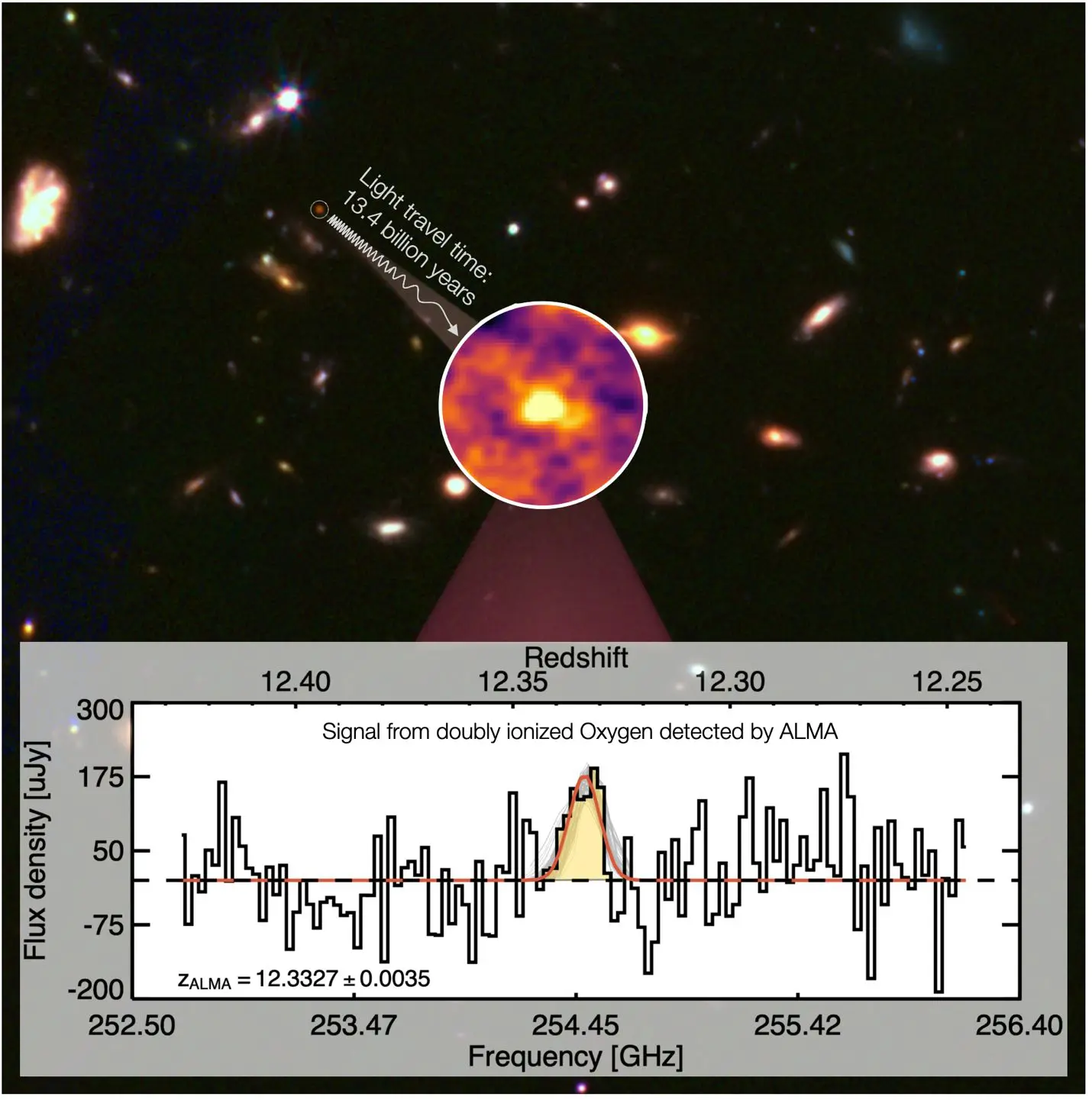
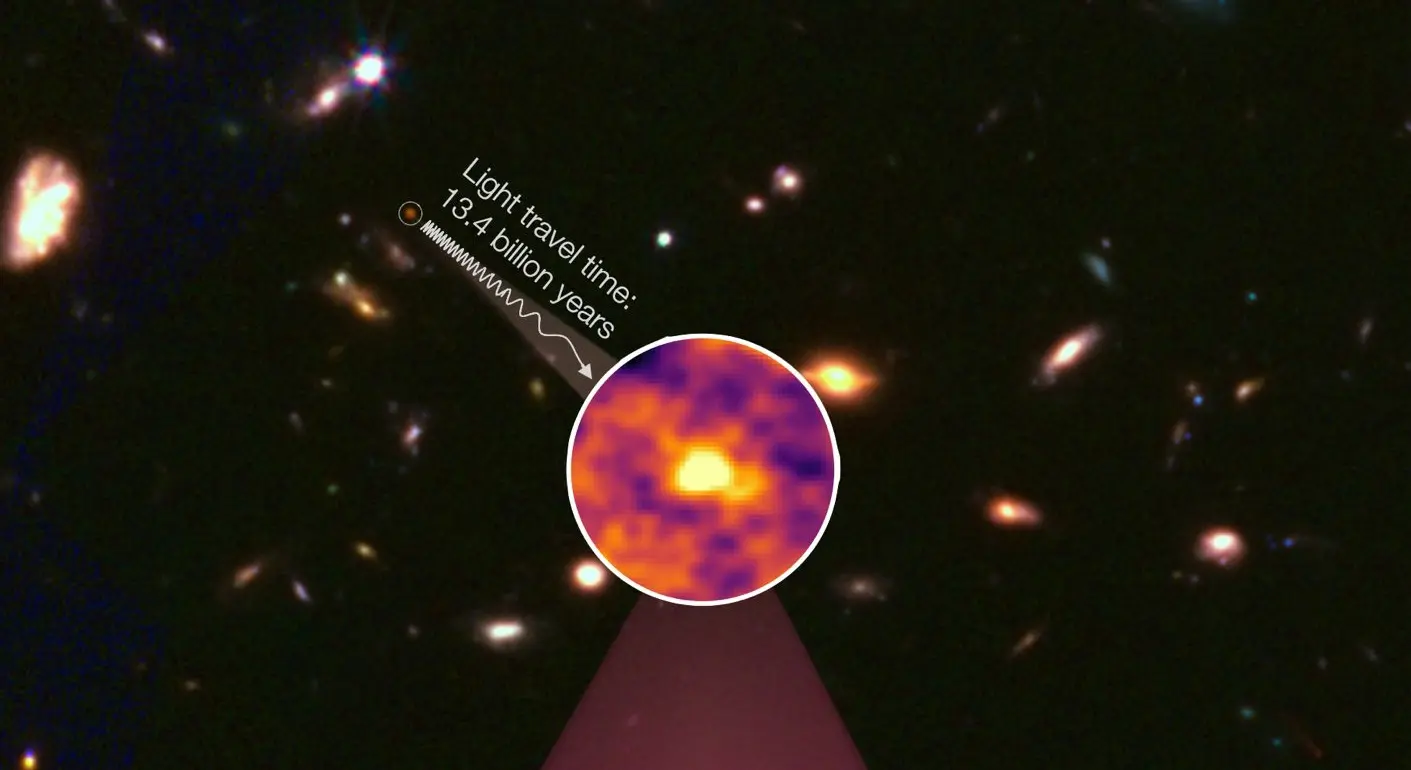
The JWST image of the Abell 2744 field is shown in the background, highlighting the galaxy GHZ2 – the target of this study. On top of this, the ALMA detection of the [OIII] 88µm line is shown in the center (moment-0 map) and the corresponding extracted spectrum is included in the bottom part. The signal from ionized Oxygen is highlighted in yellow. Credit: J. Zavala et al. Original Image
Fig1 and Fig.2


“We pointed the more than forty 12-m antennas of the Atacama Large Millimeter/submillimeter Array (ALMA) and the 6.5-m James Webb Space Telescope (JWST) for several hours at a sky position that would appear empty to the naked human eye, aiming to catch a signal from one of most distant astronomical objects known to date,” says Jorge Zavala, an astronomer at the East Asian ALMA Regional Center at the National Astronomical Observatory of Japan. “And successfully detected the emission from excited atoms of different elements such as Hydrogen and Oxygen from an epoch never reached before,” he adds. This is the first time such emissions have been detected for distant galaxies more than 13 billion light-years away.

The start of this study goes back to the first extragalactic T observations made by JWST in 2022, from which astronomers identified a surprisingly large number of bright far-away galaxy candidates, including the target of these observations: the galaxy GHZ2 (also known as GLASS-z12).

Confirming and characterizing the physical properties of this unexpected population of bright distant objects is crucial to test our current theories of galaxy formation and evolution and understand the earliest phases of galaxies’ assembly history. However, insight into their internal physics requires detailed and sensitive astronomical observations and, particularly, spectroscopy – a technique that allows astronomers to identify specific features that can be unambiguously linked to specific atomic elements, molecules, or more complex compounds. But these observations have proven challenging for these galaxies – not surprisingly, given that they are the most distant astronomical objects ever detected.

The exquisite observations reported in these works have allowed us to gain some of the first insights into the nature of these primeval galaxies. The ALMA detection of the [OIII] 88μm transition from doubly ionized Oxygen places this galaxy at a redshift of z=12.333, approximately 400 million years after the Big Bang, when the cosmos was only 3% of its current age! This corresponds to a light travel time of 13.4 billion years – a record-breaking detection. Indeed, this is the first astronomical object detected by ALMA at z>10 and the most distant galaxy with multiple line detections across the electromagnetic spectrum to date. The availability of this dataset, in combination with the JWST observations taken with the NIRSpec and MIRI instruments, allowed for an unparalleled characterization of this object.

The team discovered that this galaxy is experiencing extreme bursts of star formation under unique conditions that differ from those of the broader population of star-forming galaxies studied over the past decades. The inferred metallicity (relative abundance of elements heavier than hydrogen) is significantly lower compared to most galaxies studies to date – an expected result given the early Universe age at the time – although it has already reached a tenth of the Solar abundance. Similarly, it has a young stellar population that might partially explain its high luminosity due to the presence of short-lived, massive, and hot stars, usually absent in more evolved galaxies.

The total mass of this galaxy of a few hundred million times the mass of the Sun, nicely constrained by the ALMA data, is encapsulated into a surprisingly small region of around (or less than) 100 pc, indicating a high stellar density like that in Globular Clusters – massive, gravitationally bound associations of ancient stars found in our galaxy and others. There are numerous similarities with this enigmatic population of objects, including low metallicity, chemical abundance anomalies, high star-formation rate surface density, and high stellar mass surface density, among others. Objects like GHZ2 could, therefore, help to explain the intriguing origin of globular clusters, whose formation has remained a mystery for many decades.

“This study is a crown on the multi-year endeavor to understand galaxies in the early Universe,” explains Tom Bakx, a researcher at Chalmers University in Sweden who previously worked at Nagoya University. These observations pave the way for future investigations of primordial objects to reveal the earliest phases of galaxy formation. “The analysis of multiple emission lines enabled several key tests of galaxy properties and demonstrates the excellent capabilities of ALMA through an exciting, powerful synergy with other telescopes like the JWST,” concluded Bakx.


Additional Information

The results of the observations are published in the following scientific papers:
The original press release was published by the National Astronomical Observatory of Japan (NAOJ), an ALMA partner on behalf of East Asia.

The Atacama Large Millimeter/submillimeter Array (ALMA), an international astronomy facility, is a partnership of the European Organization for Astronomical Research in the Southern Hemisphere (ESO), the U.S. National Science Foundation (NSF) and the National Institutes of Natural Sciences (NINS) of Japan in cooperation with the Republic of Chile. ALMA is funded by ESO on behalf of its Member States, by NSF in cooperation with the National Research Council of Canada (NRC) and the National Science and Technology Council (NSTC) in Taiwan, and by NINS in cooperation with the Academia Sinica (AS) in Taiwan and the Korea Astronomy and Space Science Institute (KASI).

ALMA construction and operations are led by ESO on behalf of its Member States; by the National Radio Astronomy Observatory (NRAO), managed by Associated Universities, Inc. (AUI), on behalf of North America; and by the National Astronomical Observatory of Japan (NAOJ) on behalf of East Asia. The Joint ALMA Observatory (JAO) provides the unified leadership and management of the construction, commissioning, and operation of ALMA.


Contacts:

Nicolás Lira
Education and Public Outreach Coordinator
Joint ALMA Observatory, Santiago - Chile
Phone:
+56 2 2467 6519
Cel: +56 9 9445 7726
Email: nicolas.lira@alma.cl

Yuichi Matsuda
ALMA EA-ARC Staff Member
NAOJ
Email:
yuichi.matsuda@nao.ac.jp

Jill Malusky
Public Information Officer
NRAO
Phone:
+1 304-456-2236
Email: jmalusky@nrao.edu

Bárbara Ferreira
ESO Media Manager
Garching bei München, Germany
Phone:
+49 89 3200 6670
Email: press@eso.org


Friday, September 06, 2024

Can We Please Have the Black Hole Origin Story?

Illustration of a black hole in a galaxy. The jury's still out on how the first black holes in the universe came to be: through dying stars or the direct collapse of gas clouds? Credit: NASA, ESA, and D. Coe, J. Anderson, and R. van der Marel (STScI)

Authors: R. Scott Barrows et al.
First Author’s Institution: University of Colorado Boulder
Status: Published in ApJ

Who doesn’t love a good origin story? How did your favorite superheroes and supervillains become one in the first place? Sometimes, it may boil down to a single instant, like that fateful night when Bruce Wayne and his parents took a turn down a dark alley. Occasionally, they evolve slowly, through several internal battles, to emerge as the greatest supervillain in the Galactic Empire. Regardless of how they became some of the most powerful characters in the fictional (or real) universe, there is no question that origin stories help us understand them better.

Our very universe has (super) entities whose origin story is shrouded in mystery. These are the supermassive black holes, which are powerful objects that occupy the centers of nearly every galaxy in the universe. These black holes are believed to have been around for billions of years (some were even formed when the universe was very young) and are some of the most massive and luminous objects in the universe. However, we still don’t understand how the first black holes formed. The enthusiastic astronomy community has been hard at work trying to come up with an origin story. Some astronomers believe that the first black holes formed when the first stars in the universe died, while others believe they formed when dense gas in the early universe directly collapsed into black holes without forming stars first.

So, how can we determine the true origin story of the black hole? We look for clues in the universe that we see through our telescopes. One way is by looking at the masses of certain black holes called intermediate-mass black holes. These are believed to be relics of early black holes that have survived relatively unscathed to our present universe. If most of these black holes have low masses (102 – 104 solar masses), they were likely to have formed from the collapse of early stars. If they instead have masses around 104– 105 solar masses, then they were formed from the collapse of dense gas. This difference in mass is a likely consequence of the conditions involved in the collapse scenario.

It is challenging to detect intermediate-mass black holes in the first place, let alone measure their masses. The authors of today’s article set out to achieve this mighty task! They first identify a sample of hyper-luminous X-ray sources. As the name suggests, these are highly luminous X-ray sources, and they are detected at off-center locations in a galaxy. This characteristic makes it likely that they are linked to intermediate-mass black holes. Intermediate-mass black holes are more likely to wander and can be found in different parts of a galaxy, as opposed to supermassive black holes, which are always found at the centers of galaxies. The authors then use the Hubble Space Telescope to look at these hyper-luminous X-ray sources and their surroundings to understand them better. Let’s see the clues the authors gather to formulate their theory of the formation mechanism of black holes.

Figure 1: The Sloan Digital Sky Survey images (left) and Hubble images of the hyper-luminous X-ray source candidates (highlighted by the magenta pointers). Each candidate lies outside/on the edge of a larger galaxy in the center of each Hubble image. Adapted from Barrows et al. 2024

Clue No. 1: Violent Disruptions Found at the Scene of the Crime!

The authors find that the strongest X-ray sources are associated with systems showing signs of mergers between galaxies. The hyper-luminous X-ray sources do not reside in a definite galaxy (Figure 1) but rather in a compact source that more closely resembles the core or center of a galaxy. The authors also measure the masses of the objects that host the X-ray sources using spectral energy distributions and the flux measured by Hubble. They find that nearly all the masses of the objects are larger than typical globular clusters and, thus, they are more likely to be the leftovers of dwarf galaxies that have merged or are merging with the more massive galaxy.

Figure 2: The total fraction of black hole masses (determined from scaling relations) in hyper-luminous X-ray sources, added over the sum of each contribution from black holes at different mass ranges. The data has been corrected to be mass-complete, which determines how many sources are present in a field based on the number of sources detected. Credit: Barrows et al. 2024

Clue No. 2: What Are the Masses of Those Black Holes?

The authors then use several scaling relations and different Eddington ratios (which give a sense of how quickly the black hole is accreting based on its luminosity) to determine the mass of the black hole. Looking at the lowest-mass black holes (as they are more similar to the early seed black holes) (Figure 2), they conclude that 28% of their samples agree with the direct collapse scenario (which forms more-massive black holes) and 21% with the formation in dense stellar clusters (which forms less-massive black holes).

The Plot Thickens!

Looking at the larger masses of the intermediate-mass black holes, it is tempting to conclude that we have narrowed the origin story of black holes to the direct collapse scenario. However, since most of the hyper-luminous X-ray sources are found in galaxies closely associated with merger events, the authors argue that the gas falling into the black hole during the galaxy merger could have triggered the increase in the size of the black hole seeds from their original mass. They determine that the low-mass X-ray sources all have larger X-ray luminosities than expected from their host stellar masses. This could hint that accretion likely increases the size of the black hole, which leads to enhanced luminosity. The original black hole seeds were thus likely much smaller, suggesting they were formed from stars.

Well, that was full of twists and turns! This article has added some evidence favoring the stellar collapse formation mechanism. With more data and further analysis, we will one day end up with convincing numbers to help us determine how the first black holes in the universe formed. And hey! If I could sit through all of those 7 hours and 1 minute to find out how Anakin Skywalker became Darth Vader, I think I would be fine waiting a couple more years (hopefully!) to uncover the origin story of these mighty black holes!

Original astrobite edited by Storm Colloms


About the author, Archana Aravindan:

I am a PhD candidate at the University of California, Riverside, where I study black hole activity in small galaxies. When I am not looking through some incredible telescopes, you can usually find me reading, thinking about policy, or learning a cool language!


Editor’s Note: Astrobites is a graduate-student-run organization that digests astrophysical literature for undergraduate students. As part of the partnership between the AAS and astrobites, we occasionally repost astrobites content here at AAS Nova. We hope you enjoy this post from astrobites; the original can be viewed at astrobites.org.


Tuesday, June 11, 2024

An ancient witness

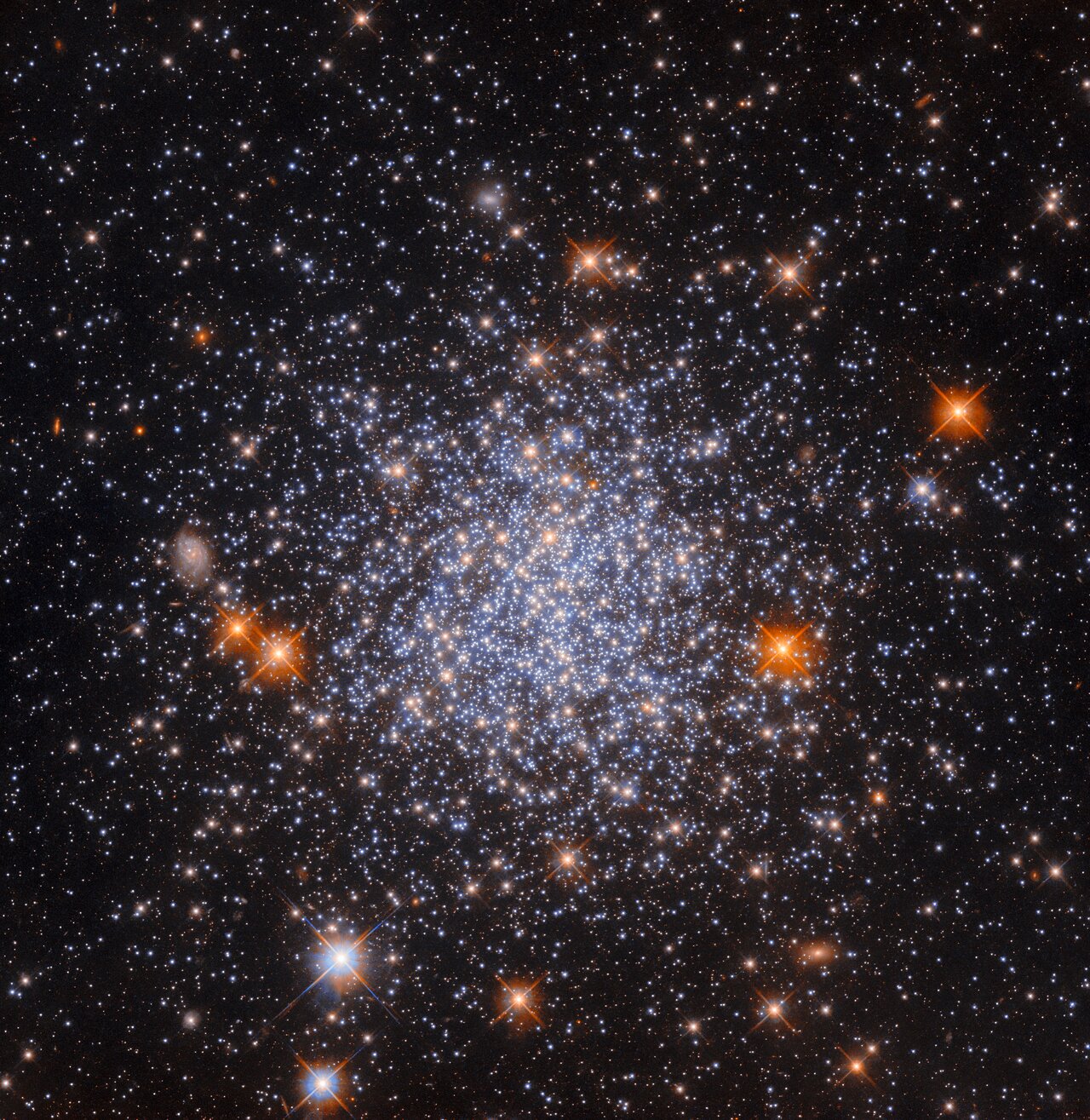
A globular cluster, appearing as a highly dense and numerous collection of shining stars. Some appear a bit larger and brighter than others, with the brightest having cross-shaped spikes around them. They are scattered mostly uniformly, but in the centre they crowd together more and more densely, and merge into a strong glow at the cluster’s core.Credit: ESA/Hubble & NASA, F. Niederhofer, L. Girardi

The globular cluster NGC 2005, featured in this Hubble Picture of the Week, is not unusual in and of itself; but it is a peculiarity in relation to its surroundings. NGC 2005 is located about 750 light-years from the heart of the Large Magellanic Cloud (LMC), which is the Milky Way’s largest satellite galaxy and which itself lies about 162 000 light-years from Earth. Globular clusters are densely-packed clusters that can constitute tens of thousands or millions of stars. Their density means that they are tightly gravitationally bound and are therefore very stable. This stability contributes to their longevity: globular clusters can be billions of years old, and as such often comprise very old stars. Thus, studying globular clusters in space can be a little like studying fossils on Earth: where fossils give insights into the characteristics of ancient plants and animals, globular clusters illuminate the characteristics of ancient stars.

Current theories of galaxy evolution predict that galaxies merge with one another. It is widely thought that the relatively large galaxies that we observe in the modern Universe were formed via the merging of smaller galaxies. If this is correct, then astronomers would expect to see evidence that the most ancient stars in nearby galaxies originated in different galactic environments. As globular clusters are known to contain ancient stars, and because of their stability, they are an excellent laboratory to test this hypothesis.

NGC 2005 is such a globular cluster, and its very existence has provided evidence to support the theory of galaxy evolution via mergers. Indeed, the stars in NGC 2005 have a chemical composition that is distinct from the stars in the LMC around it. This suggests that the LMC underwent a merger with another galaxy somewhere in its history. That other galaxy has long-since merged and otherwise dispersed, but NGC 2005 remains behind as an ancient witness to the long-past merger.


Wednesday, March 27, 2024

No zoom

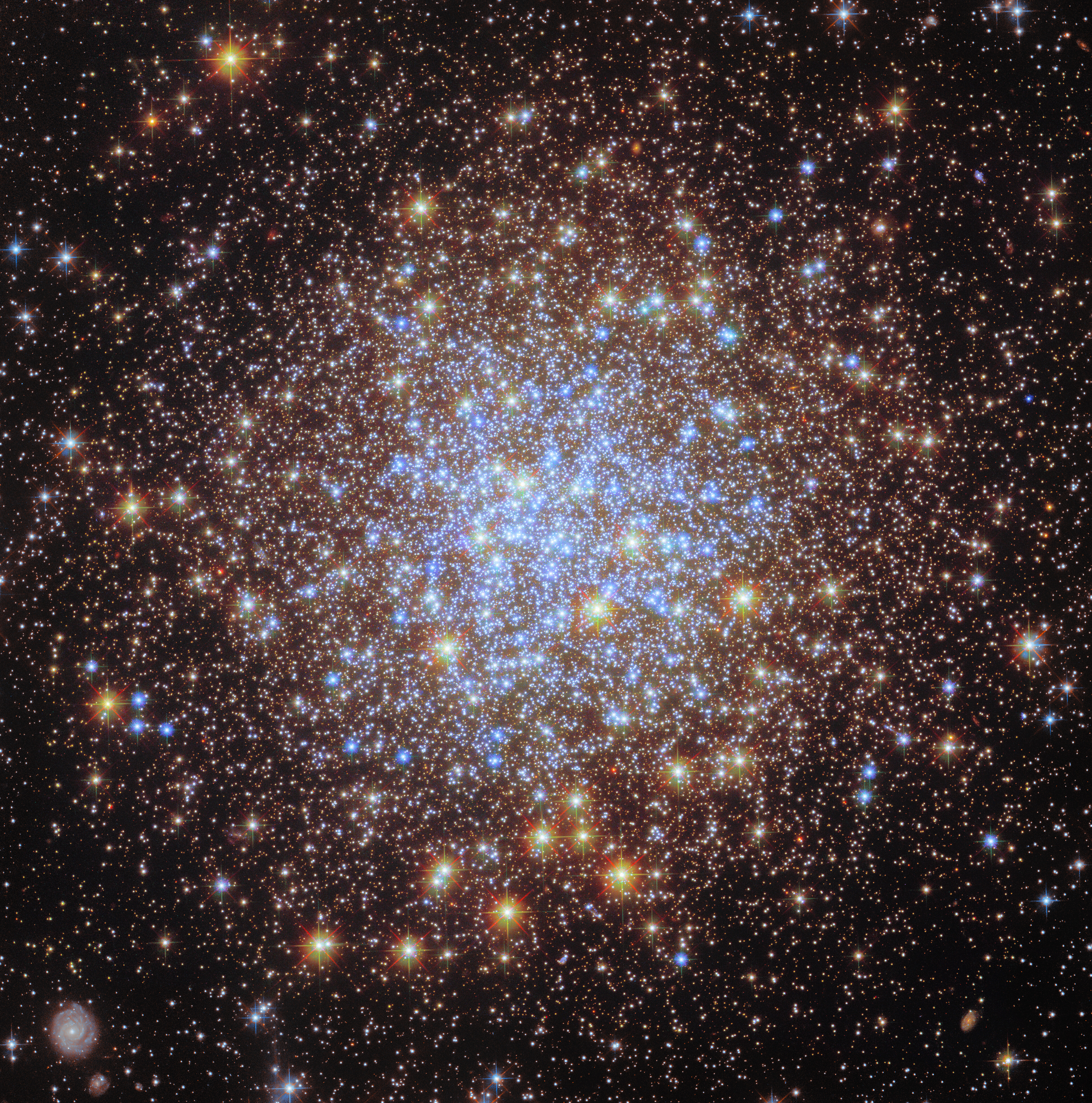
A spherical collection of stars, which fills the whole view. The stars merge into a bright, bluish core in the centre, and form a sparse band around that out to the edges of the image. A few stars lie in front of the cluster, with visible diffraction spikes. The background is dark black. Credit: ESA/Hubble & NASA, L. Girardi, F. Niederhofer


This image shows a globular cluster known as NGC 1651. Like the object in another recent Picture of the Week, it is located about 162 000 light-years away in the largest and brightest of the Milky Way’s satellite galaxies, the Large Magellanic Cloud (LMC). A notable feature of this image is that the globular cluster almost fills the entire image, even though globular clusters are only about 10 to 300 light-years in diameter (NGC 1651 has a diameter of roughly 120 light-years). In contrast, there are numerous Hubble Pictures of the Week that feature entire galaxies — which can be tens or hundreds of millions of light-years in diameter — that also more or less fill the whole image.

A common misconception is that Hubble and other large telescopes manage to observe wildly differently sized celestial objects by zooming in on them, as one would with a specialised camera here on Earth. However, whilst small telescopes might have the option to zoom in and out to a certain extent, large telescopes do not. Each telescope’s instrument has a fixed ‘field of view’ (the size of the region of sky that it can observe in a single observation). For example, the ultraviolet/visible light channel of Hubble’s Wide Field Camera 3 (WFC3), the channel and instrument that were used to collect the data used in this image, has a field of view roughly one twelfth the diameter of the Moon as seen from Earth. Whenever WFC3 makes an observation, that is the size of the region of sky that it can observe.

The reason that Hubble can observe objects of such wildly different sizes is two-fold. Firstly, the distance to an object will determine how big it appears to be from Earth, so entire galaxies that are relatively far away might take up the same amount of space in the sky as a globular cluster like NGC 1651 that is relatively close by. In fact, there's a distant spiral galaxy lurking in this image, directly left of the cluster — though undoubtedly much larger than this star cluster, it appears small enough here to blend in with foreground stars! Secondly, multiple images spanning different parts of the sky can be mosaiced together to create single images of objects that are too big for Hubble’s field of view. This is a very complex task and is not typically done for Pictures of the Week, but it has been done for some of Hubble’s most iconic images.


Friday, February 02, 2024

Astronomers produce most detailed sensitive image ever of ancient star cluster

The team identified a new radio source (white square) in the centre of the cluster (red circle)
Credit: Paduano et al.

The discovery was made using CSIRO’s Australia Telescope Compact Array.
Credit: Alex Cherney/CSIRO

The dense ball of stars that makes up globular cluster 47 Tucanae.
Credits: NASA, ESA, and the Hubble Heritage (STScI/AURA)-ESA/Hubble Collaboration


A global team of astronomers have created the most sensitive radio image ever of a globular cluster, an ancient ball of tightly-packed stars.

The image is of the second brightest globular cluster in the night sky—known as 47 Tucanae—and was produced by a team led by the Curtin University node of the International Centre for Radio Astronomy Research (ICRAR) in Western Australia.

The scientists also detected a previously undiscovered radio signal from the centre of the cluster.

The research was published overnight in The Astrophysical Journal.

Astronomer Dr Arash Bahramian, from ICRAR’s Curtin University node, says star clusters are an ancient relic of the early Universe.

“Globular clusters are very old, giant balls of stars that we see around the Milky Way,” he said. “They’re incredibly dense, with tens of thousands to millions of stars packed together in a sphere.

“Our image is of 47 Tucanae, one of the most massive globular clusters in the galaxy. It has over a million stars and a very bright, very dense core.”

Dr Bahramian said the ultra-sensitive image was created from more than 450 hours of observations on CSIRO’s Australia Telescope Compact Array (ATCA), on Gomeroi Country.

It is the deepest, most sensitive radio image ever compiled by any Australian radio telescope.

Dr Bahramian said 47 Tucanae can be seen with the naked eye, and was first catalogued in the 1700s.

But he said imaging it in such great detail allowed astronomers to discover an incredibly faint radio signal at the centre of the cluster that had not been detected before.

Lead author Dr Alessandro Paduano, from ICRAR’s Curtin University node, said the detection of the signal was an exciting discovery and could be attributed to one of two possibilities.

“The first is that 47 Tucanae could contain a black hole with a mass somewhere between the supermassive black holes found in the centres of galaxies and the stellar black holes created by collapsed stars.” he said.

“While intermediate-mass black holes are thought to exist in globular clusters, there hasn’t been a clear detection of one yet.

“If this signal turns out to be a black hole, it would be a highly-significant discovery and the first ever radio detection of one inside a cluster.”

The second possible source of the signal is a pulsar—a rotating neutron star that emits radio waves.

“A pulsar this close to a cluster centre is also a scientifically interesting discovery, as it could be used to search for a central black hole that is yet to be detected.” Dr Paduano said.

Co-author Dr Tim Galvin, a research scientist with CSIRO, said the project once again demonstrated the ongoing importance of ATCA.

“This project has stretched our software to its limits, in terms of both data management and processing, and it has been really exciting to see the wealth of science that these techniques have enabled.”

“Alessandro’s research represents a culmination of years of research and technological advancements, and ATCA’s ultra-deep image of 47 Tucanae represents just the beginning of the discoveries that are yet to come.”

The ultra-sensitive image produced is what researchers can expect from the SKA radio telescopes, currently being built in Australia and South Africa by the SKA Observatory (SKAO).

Once complete, the SKA telescopes will be the two largest radio telescope arrays in the world, transforming our understanding of the Universe and tackling some of the most fundamental scientific questions of our time.

Dr Bahramian said researchers are continually finding new and innovative ways to get the best out of the radio telescopes they use.

“We managed to achieve close to SKA-quality science with the current generation of radio telescopes, combining hundreds of hours of observations to reveal the faintest details.” he said.

“It gives us a glimpse of the exciting capabilities the next generation of radio telescopes will achieve when they come online.”

The technique used for the ultra-sensitive image could help future radio telescopes, such as the SKA, to detect some of the faintest objects in the Universe.

Multimedia

A short, narrated animation is available from
vimeo.com/icrar/47tuc


Tuesday, December 05, 2023

Cluster in the Cloud

This striking image shows the densely packed globular cluster known as NGC 2210, which is situated in the Large Magellanic Cloud (LMC). The LMC lies about 157 000 light-years from Earth, and is a so-called satellite galaxy of the Milky Way, meaning that the two galaxies are gravitationally bound. Globular clusters are very stable, tightly bound clusters of thousands or even millions of stars. Their stability means that they can last a long time, and therefore globular clusters are often studied in order to investigate potentially very old stellar populations.

In fact, 2017 research that made use of some of the data that were also used to build this image revealed that a sample of LMC globular clusters were incredibly close in age to some of the oldest stellar clusters found in the Milky Way’s halo. They found that NGC 2210 specifically probably clocks in at around 11.6 billion years of age. Even though this is only a couple of billion years younger than the Universe itself, it made NGC 2210 by far the youngest globular cluster in their sample. All other LMC globular clusters studied in the same work were found to be even older, with four of them over 13 billion years old. This is interesting, because it tells astronomers that the oldest globular clusters in the LMC formed contemporaneously with the oldest clusters in the Milky Way, even though the two galaxies formed independently.

As well as being a source of interesting research, this old-but-relatively-young cluster is also extremely beautiful, with its highly concentrated population of stars. The night sky would look very different from the perspective of an inhabitant of a planet orbiting one of the stars in a globular cluster’s centre: the sky would appear to be stuffed full of stars, in a stellar environment that is thousands of times more crowded than our own.

Links


Thursday, August 03, 2023

NGC 6652

A dense spherical cluster of stars. The stars merge into a bright core in the centre, and spread out to the edges gradually, giving way to an empty, dark background. Most of the stars are small points of light. A few stars with cross-shaped diffraction spikes appear larger, and stand out in front. Credit: ESA/Hubble & NASA, A. Sarajedini, G. Piotto

The glittering, glitzy contents of the globular cluster NGC 6652 sparkle in this star-studded image from the NASA/ESA Hubble Space Telescope. The core of the cluster is suffused with the pale blue light of countless stars, and a handful of particularly bright foreground stars are adorned with criss-crossing diffraction spikes. NGC 6652 lies in our own Milky Way galaxy in the constellation Sagittarius, just under 30 000 light-years from Earth and only 6500 light-years from the Galactic centre.

Globular clusters are stable, tightly gravitationally bound clusters containing anywhere between tens of thousands and millions of stars. The intense gravitational attraction between the closely packed stars in globular clusters is what gives these star-studded objects their regular, spherical shape.

This image combines data from two of Hubble’s third-generation instruments; the Advanced Camera for Surveys and Wide Field Camera 3. As well as two instruments, this image draws on two different observing programmes from two different teams of astronomers. The first team set out to survey globular clusters in the Milky Way galaxy in the hope of shedding light on topics ranging from the ages of these objects to the gravitational potential of the galaxy as a whole. The second team of astronomers used a trio of exquisitely sensitive filters in Hubble’s Wide Field Camera 3 to disentangle the proportions of carbon, nitrogen, and oxygen in globular clusters such as NGC 6652.


Friday, May 19, 2023

Scrutinising a star-studded cluster

NGC 6325
The dense cluster of bright stars. The core of the cluster is to the left and has a distinct group of blue stars. Surrounding the core are a multitude of stars in warmer colours. These stars are very numerous near the core and become more and more sparse, and more small and distant, out to the sides of the image. A few larger stars also stand in the foreground near the edges of the image. Credit: ESA/Hubble & NASA, E. Noyola, R. Cohen. Hi-res image

The densely packed globular cluster NGC 6325 glistens in this image from the NASA/ESA Hubble Space Telescope. This concentrated group of stars lies around 26 000 light years from Earth in the constellation Ophiuchus.

Globular clusters like NGC 6325 are tightly bound collections of stars with anywhere from tens of thousands to millions of members. They can be found in all types of galaxies, and act as natural laboratories for astronomers studying star formation. This is because the constituent stars of globular clusters tend to form at roughly the same time and with similar initial composition, meaning that astronomers can use them to fine-tune their theories of how stars evolve.

Astronomers inspected this particular cluster not to understand star formation, but to search for a hidden monster. Though it might look peaceful, astronomers suspect this cluster could contain an intermediate-mass black hole that is subtly affecting the motion of surrounding stars. Previous research found that the distribution of stars in some highly concentrated globular clusters — those with stars packed relatively tightly together — was slightly different from what astronomers expected.

This discrepancy suggested that at least some of these densely packed globular clusters — including perhaps NGC 6325 — could have a black hole lurking at the centre. To explore this hypothesis further, astronomers turned to Hubble’s Wide Field Camera 3 to observe a larger sample of densely populated globular clusters, which included this star-studded image of NGC 6325. Additional data from Hubble’s Advanced Camera for Surveys were also incorporated into this image.


Monday, March 20, 2023

Messier 55

This image shows just a portion of M55, the cluster as a whole appears spherical because the stars’ intense gravitational attraction pulls them together. Hubble’s clear view above Earth’s atmosphere resolves individual stars in this cluster. Ground-based telescopes can also resolve individual stars in M55, but fewer stars are visible.  Credits: NASA, ESA, A. Sarajedini (Florida Atlantic University), and M. Libralato (STScI, ESA, JWST); Image Processing: Gladys Kober

Even the great observer Charles Messier had trouble seeing this globular cluster when building his Catalog of Nebulae and Star Clusters. It was originally spotted in 1752 by a French astronomer in what is now South Africa, but it took until 1778 for Messier to catalog it.

This is because, while Messier 55 is large and reasonably bright, it is lacking a dense core and many of its stars are quite faint, making it hard to observe in non-optimal conditions.

For northern observers M55 sits low in the sky, so the view is hampered by a thicker layer of atmosphere, as well as water vapor and light pollution. This hindered Messier’s view from his Paris observatory. When he cataloged it, Messier noted that “its light is even and does not appear to contain any star.”

Though this image shows just a portion of M55, the cluster as a whole appears spherical because the stars’ intense gravitational attraction pulls them together. Hubble’s clear view above Earth’s atmosphere resolves individual stars in this cluster. Ground-based telescopes can also resolve individual stars in M55, but fewer stars are visible.

Even in skies with low light pollution, viewed through binoculars, the cluster will only appear as a round hazy patch. Small telescopes can begin to resolve individual stars in M55, while larger aperture telescopes will pick out low magnitude stars easily. The star cluster is found in the southern part of the constellation Sagittarius and is easiest to spot in August.

The globular cluster is about 20,000 light-years away and has a diameter of about 100 light-years. It contains an estimated 100,000 stars with 55 variable stars whose brightness changes.


The smaller, ground-based image (lower left) taken by the Digital Sky Survey illustrates the area of Messier 55 that Hubble observed.Credits: NASA, ESA, A. Sarajedini (Florida Atlantic University), M. Libralato (STScI, ESA, JWST), and Digital Sky Survey; Image Processing: Gladys Kober
 
This star chart for M55 represents the view from mid-northern latitudes for the given month and time.
Credits: Image courtesy of Stellarium
Editor: Andrea Gianopoulos

Source: NASA/Hubble


Thursday, March 16, 2023

Update on JWST Observations of Galaxy Cluster SMACS 0723


The first image from JWST, a portion of which is shown here, offers a detailed view of the galaxy cluster SMACS 0723. Credit: NASA, ESA, CSA, and STScI

In the months since the release of the first JWST image of the galaxy cluster SMACS J0723.3–7327 (SMACS 0723), astronomers have studied the image from every possible angle. Today’s post takes a look at five research articles that have advanced our understanding of galaxies within the cluster and beyond.


Top: Mass distribution derived by Mahler and collaborators. The magenta lines are mass contours and the white lines are X-ray surface brightness contours. Bottom: Mass distribution derived by Pascale and collaborators. The black lines show the surface mass density distribution. Note that there is a difference in scale and orientation between the two maps. Credit: Adapted from Mahler et al. 2023; Pascale et al. 2022


How to Weigh a Cluster

SMACS 0723 is a galaxy cluster located four billion light-years away. It gets its name from the Southern MAssive Cluster Survey (SMACS), in which the Hubble Space Telescope observed 124 galaxy clusters that are bright at X-ray wavelengths. In addition to the galaxies bound to the cluster, observations of SMACS 0723 contain images of galaxies far more distant. This is because SMACS 0723 is so massive that it warps spacetime, causing photons from galaxies billions of light-years away to curve around the foreground galaxies and into our field of view. As a result, we see stretched-out, wiggly, or multiple images of distant galaxies.
 
Researchers can use these wiggly galaxies to reconstruct a map of SMACS 0723’s mass distribution. Understanding how a cluster’s mass is distributed is important because it can tell us about the underlying distribution of dark matter within the cluster and how the cluster has evolved over time. As is often the case when exciting new data are released, several teams worked in parallel to map SMACS 0723’s mass distribution using different techniques. Two articles published in AAS journals detail efforts by teams led by Massimo Pascale (University of California, Berkeley) and Guillaume Mahler (Durham University) to use JWST’s superior capabilities to improve upon the existing mass map based on Hubble data.

In previous observations of the cluster, astronomers picked out five lensed background galaxies, but JWST’s impressive capabilities allowed the teams to pick out many more; at 6.5 meters in diameter, JWST is already a massive space telescope, but as Pascale and coauthors noted, pointing it toward a galaxy cluster that bends the light from more distant sources effectively creates a telescope with a diameter of 20–30 meters!

Pascale’s and Mahler’s teams used different computer algorithms to analyze the lensed galaxies newly identified in the JWST images, and both teams achieved a large increase in the precision of their mass maps compared to those based on Hubble data. Both teams’ maps show evidence of a past disturbance in the galaxy cluster, such as gravitational interactions or mergers between galaxies.


Metallicity versus stellar mass for galaxies in the local universe (light blue circles) and at high redshift. Values from this work are shown with stars, while other researchers’ results are shown with triangles, diamonds, pentagons, and squares. Credit: Arellano-Córdova et al. 2022

A Trio of Distant Galaxies

Karla Arellano-Córdova (The University of Texas at Austin) and collaborators took advantage of SMACS 0723’s lensing ability to study three galaxies with redshift, z, between 7.6 and 8.5, corresponding to when the universe was about 600–700 million years old. Using JWST’s Near-Infrared Spectrograph (NIRSpec), the team identified emission lines in the spectra of these distant galaxies. By measuring the strength of several prominent emission lines and the ratios of their strengths relative to one another, Arellano-Córdova’s team determined the properties of the gas in each galaxy, including the abundance of elements like carbon, oxygen, neon, and potentially iron. Notably, the team measured the neon-to-oxygen abundance ratio for a galaxy at z > 7 for the first time, and they obtained the most distant carbon-to-oxygen ratio measurement ever.
 
By comparing the chemical abundances for the three high-redshift galaxies to those of nearby galaxies, the team gained a sense of how each element’s abundance has changed over time, which can inform us about how galactic stellar populations evolved early in the universe. While some of the abundances followed expected trends, others showed behavior that will require further inspection; a tentative detection of emission lines from iron atoms suggests that these galaxies might be rich in iron compared to oxygen, which the authors propose could be due to gaseous outflows. The authors emphasized that this is just the beginning of what JWST will accomplish in terms of investigating the chemical makeup of galaxies in the first billion years of the universe — we’ve cracked open a window into that time period, and future studies should open it wider still.

Location of the star clusters studied in this work within the larger SMACS 0723 field.
Credit: Faisst et al. 2022

Galaxy Cluster Globular Clusters

Myung Gyoon Lee (Seoul National University) and collaborators also went globular cluster–hunting in the SMACS 0723 images, using an algorithm to identify and characterize point sources throughout the galaxy cluster. By grouping point sources based on their color and brightness, the team identified those that are most likely to be globular clusters associated with the SMACS 0723 galaxy cluster.

Many of the sources appear to be linked to the brightest galaxy in the cluster, which lies near the cluster center. These star clusters are most concentrated near the bright central galaxy and become more scattered farther out, and similar concentrations are seen around other bright galaxies within the cluster.

In addition to tracing the distribution of galaxies in SMACS 0723, the candidate globular clusters also follow some of the intracluster structures, such as the distribution of diffuse intracluster light. This faint emission comes from stars that have been ejected from their home galaxy due to gravitational interactions between galaxies in the cluster. The team also compared the star cluster distribution to the dark matter distribution determined in other research articles, finding considerable similarities between the two distributions. These findings suggest that star clusters can be used to trace dark matter within galaxy clusters.

Citation

“Unscrambling the Lensed Galaxies in JWST Images behind SMACS 0723,” Massimo Pascale et al 2022 ApJL 938 L6. doi:10.3847/2041-8213/ac9316

 By


Monday, January 02, 2023

Stargazing in NGC 6355

A dense collection of stars covers the view. Towards the centre the stars become even more dense in a circular region, and also more blue. Around the edges there are some redder foreground stars, and many small stars in the background. Credit: ESA/Hubble & NASA, E. Noyola, R. Cohen

The scattered stars of the globular cluster NGC 6355 are strewn across this image from the NASA/ESA Hubble Space Telescope. This globular cluster lies less than 50,000 light-years from Earth in the Ophiuchus constellation. NGC 6355 is a galactic globular cluster that resides in our Milky Way galaxy's inner regions.

Globular clusters are stable, tightly bound clusters of tens of thousands to millions of stars, and can be found in all types of galaxies. Their dense populations of stars and mutual gravitational attraction give these clusters a roughly spherical shape, with a bright concentration of stars surrounded by an increasingly sparse sprinkling of stars. The dense, bright core of NGC 6355 was picked out in crystal-clear detail by Hubble in this image, and is the crowded area of stars towards the centre of this image.

With its vantage point above the distortions of the atmosphere, Hubble has revolutionised the study of globular clusters. It is almost impossible to distinguish the stars in globular clusters from one another with ground-based telescopes, but astronomers have been able to use Hubble to study the constituent stars of globular clusters in detail. This Hubble image of NGC 6355 contains data from both the Advanced Camera for Surveys and Wide Field Camera 3.


Tuesday, October 11, 2022

Terzan 1, Take 2

Terzan 1
Credit: ESA/Hubble & NASA, R. Cohen

Terzan 1 is a globular cluster that lies about 22,000 light-years from Earth in the constellation Scorpius. It is one of 11 globular clusters that were discovered by the Turkish-Armenian astronomer Agop Terzan between 1966 and 1971 when he was working in France, based mostly at Lyon Observatory.

Somewhat confusingly, the 11 Terzan globular clusters are numbered from Terzan 1 to Terzan 12. This is due to an error made by Terzan in 1971, when he rediscovered Terzan 5 — a cluster he had already discovered and reported back in 1968 — and named it Terzan 11. He published its discovery alongside those of Terzan 9, 10 and 12. He quickly realised his mistake, and attempted to have Terzan 12 renamed as Terzan 11. Unfortunately, he did not make it clear that Terzan 5 and Terzan 11 were one and the same, although another astronomer, Ivan Robert King, did publish a note to try and clear up the confusion. Nowadays, most papers recognise the original Terzan 5 and Terzan 12, and accept the oddity that there is no Terzan 11. There have, however, been instances of confusion in the scientific literature over the past few decades.

Terzan 1 is not a new target for Hubble — an image of the cluster was released back in 2015, taken by Hubble’s Wide Field Planetary Camera 2 (WFPC2). That instrument was replaced by the Wide Field Camera 3 (WFC3) during the 2009 Hubble servicing mission. WFC3 has both superior resolving power and a wider field of view than WFPC2, and the improvement is obvious in this fantastically detailed image.

Source: ESA/Hubble/potw


Monday, August 15, 2022

Hubble Spies a Scintillating Globular Cluster

NGC 6540
Credit: ESA/Hubble & NASA, R. Cohen

This scintillating image showcases the globular cluster NGC 6540 in the constellation Sagittarius, which was captured by the NASA/ESA Hubble Space Telescope’s Wide Field Camera 3 and Advanced Camera for Surveys. These two instruments have slightly different fields of view — which determines how large an area of sky each instrument captures. This composite image shows the star-studded area of sky that was captured in both instruments’ field of view.

NGC 6540 is a globular cluster, a stable, tightly bound multitude of stars. The populations of these clusters can range from tens of thousands to millions of stars, all of which are trapped in a closely-packed group by their mutual gravitational attraction.

The brightest stars in this image are adorned with prominent cross-shaped patterns of light known as diffraction spikes. These astronomical embellishments are a type of imaging artefact, meaning that they are caused by the structure of Hubble rather than the stars themselves. The path taken by the starlight as it enters the telescope is slightly disturbed by its internal structure, causing bright objects to be surrounded by spikes of light.

Hubble peered into the heart of NGC 6540 to help astronomers measure the ages, shapes, and structures of globular clusters towards the centre of the Milky Way. The gas and dust shrouding the centre of our galaxy block some of the light from these clusters, as well as subtly changing the colours of their stars. Globular clusters contain insights into the earliest history of the Milky Way, and so studying them can help astronomers understand how our galaxy has evolved.

Link

Source: ESA/Hubble/potw