Showing posts with label gravitational lensing. Show all posts

Monday, September 21, 2026

STScI Scientists Part of Collaboration Receiving 2027 Berkeley Prize

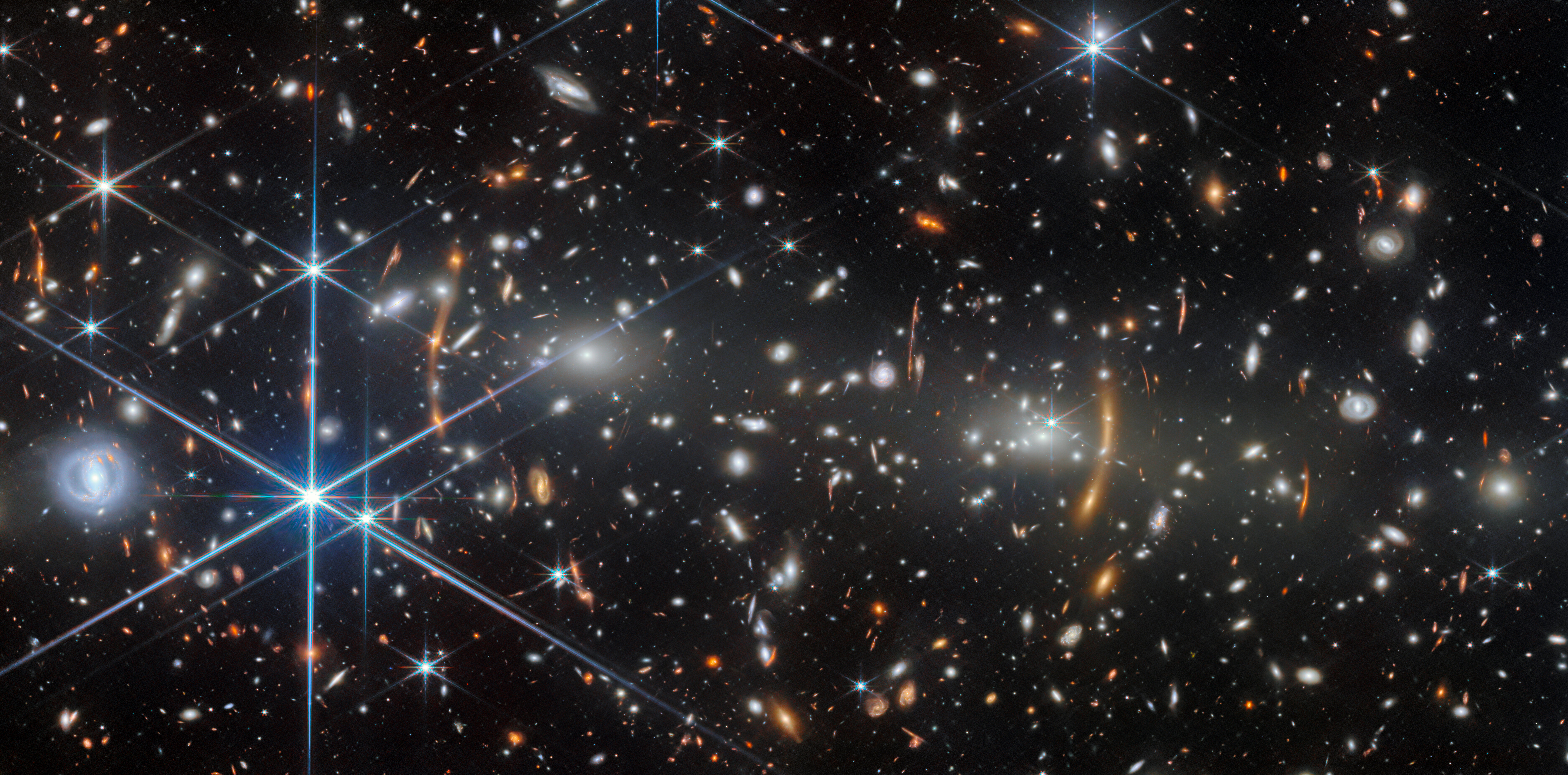
Astronomers estimate 50,000 sources of near-infrared light are represented in this image from NASA’s James Webb Space Telescope. Their light has travelled through varying distances to reach the telescope’s detectors, representing the vastness of space in a single image. A foreground star in our own galaxy, to the right of the image center, displays Webb’s distinctive diffraction spikes. Bright white sources surrounded by a hazy glow are the galaxies of Pandora’s Cluster, a conglomeration of already-massive clusters of galaxies coming together to form a megacluster. The concentration of mass is so great that the fabric of spacetime is warped by gravity, creating an effect that makes the region of special interest to astronomers: a natural, super-magnifying glass called a “gravitational lens” that they can use to see very distant sources of light beyond the cluster that would otherwise be undetectable, even to Webb.

These lensed sources appear red in the image, and often as elongated arcs distorted by the gravitational lens. Many of these are galaxies from the early universe, with their contents magnified and stretched out for astronomers to study. Other red sources in the image have yet to be confirmed by follow-up observations with Webb’s Near-Infrared Spectrograph (NIRSpec) instrument to determine their true nature. One intriguing example is an extremely compact source that appears as a tiny red dot, despite the magnifying effect of the gravitational lens. One possibility is that the dot is a supermassive black hole in the early universe. NIRSpec data will provide both distance measurements and compositional details of selected sources, providing a wealth of previously-inaccessible information about the universe and how it has evolved over time. This image was taken as part of the
UNCOVER Cycle 1 Treasury program. Image Processing: Alyssa Pagan (STScI)


Scientists from the Space Telescope Science Institute (STScI) are members of the collaboration that has been awarded the 2027 Lancelot M. Berkeley–New York Community Trust Prize for Meritorious Work in Astronomy as part of their work with the UNCOVER project. The Berkeley prize is awarded annually for highly meritorious work in advancing the science of astronomy during the previous year.

According to the prize citation, the UNCOVER collaboration is being honored with the 2027 Berkeley prize for “combining the power of telescopes and gravitational lenses to reveal the contents of the distant universe. Through spectroscopic studies, the team has discovered galaxies at cosmic dawn, including large populations of luminous galaxies and supermassive black holes in the early universe.”

UNCOVER is a Cycle 1 Treasury program on NASA’s James Webb Space Telescope. UNCOVER — which stands for Ultradeep NIRSpec and NIRCam Observations before the Epoch of Reionization — conducted ultradeep imaging and spectroscopy of and around Abell 2744, a massive group of galaxies also known as “Pandora's Cluster.” The large mass of this cluster causes it to act as a powerful magnifying glass, bending the light from faraway background galaxies in a phenomenon known as gravitational lensing.

The primary science goals of the UNCOVER program are to constrain the physical properties of the first galaxies that formed in the universe; to explore how and when galaxies irradiated their environment and reionized the surrounding neutral gas; to discover dust-obscured galaxies out to a high redshift to probe star formation early in the universe; and to build a fuller picture of star formation quenching in galaxies over cosmic time.

Awarded annually since 2011 by the American Astronomical Society (AAS) and supported by a grant from The New York Community Trust, the Berkeley prize includes a monetary award and an invitation to give the closing plenary lecture at the AAS winter meeting. The 249th AAS meeting will be held in Salt Lake City, Utah, from 10 to 14 January 2027.

Each year the three AAS Vice Presidents, in consultation with the Editor in Chief of the AAS journals, select the Berkeley prize winner for meritorious research published within the preceding 12 months. This year’s prize recognizes the UNCOVER team for three recent articles published in The Astrophysical Journal. The first and the second present an overview of the UNCOVER project, summarize its science goals, and characterize the initial imaging and final spectroscopy from the project. The third introduces a key result from the project: evidence that the population of faint, compact “little red dots” seen by JWST in the early universe is dominated by reddened, actively accreting black holes rather than simply dusty star-forming galaxies. The team showed that these reddened active galactic nuclei are far more numerous at high redshifts than previously recognized.

The UNCOVER team consists of more than 50 people located across the globe co-led by Sedona Price at STScI, and including STScI astronomers Dan Coe and Susan Kassin, along with Camilla Pacifici, formerly at STScI. The Berkeley prize will be accepted on behalf of the collaboration by Ivo Labbé (Swinburne University of Technology) who, along with Rachel Bezanson, is the co-principal investigator of UNCOVER.

The Space Telescope Science Institute is expanding the frontiers of space astronomy by hosting the science operations center of the Hubble Space Telescope, the science and mission operations centers for the James Webb Space Telescope, and the science operations center for the Nancy Grace Roman Space Telescope. STScI also houses the Barbara A. Mikulski Archive for Space Telescopes (MAST) which is a NASA-funded project to support and provide to the astronomical community a variety of astronomical data archives, and is the data repository for the Hubble, Webb, Roman, Kepler, K2, TESS missions and more. STScI is operated by the Association of Universities for Research in Astronomy in Washington, D.C.


About This Release

Credits:

Media Contact

Christine Pulliam
Space Telescope Science Institute, Baltimore

Susanna Kohler
American Astronomical Society, Washington

Permissions:
Content Use Policy

Contact Us: Direct inquiries to the News Team.

Related Links and Documents

American Astronomical Society Press Release


Monday, July 13, 2026

A cosmic construction project

A galaxy cluster in deep space. It is filled with elliptical galaxies: small, bright white glowing ovals. The two largest elliptical galaxies, left and right of center, are bright cores that radiate light. Unrelated, distant galaxies are scattered around as red smudges and dots.Many of these are stretched out into red arcs and lines by the galaxy cluster’s strong gravity, creating multiple images in places. Numerous spiral galaxies and bright stars appear in the foreground. Credit: ESA/Webb, NASA & CSA, S. Fujimoto


In today’s Picture of the Month from the NASA/ESA/CSA James Webb Space Telescope we are taken on a visit to a building site of significant scale. The project is a galaxy cluster named MACS J0553.4-3342, located in the constellation Columba (the Dove).

MACS J0553.4-3342 is situated at a redshift of 0.412. Redshift is a measure of how much the cluster’s light has been stretched by the expansion of the Universe over the course of its long journey to Webb’s mirrors; this unassuming number tells us that we are seeing MACS J0553.4-3342 as it was 4.4 billion years in the past. But for a galaxy cluster, this is relatively young. In fact, observations with the NASA/ESA Hubble Space Telescope and other telescopes show a cluster still in the process of being built.

MACS J0553.4-3342 is composed of two sub-clusters — roughly equal in mass — that are actively merging. The two subclusters have already slammed through each other and travelled over one million light-years apart, but they will eventually come back together again and again until they finally merge. The construction process is messy, and MACS J0553.4-3342 is filled with extremely hot gas that radiates powerful X-rays. Each subcluster is anchored on an immensely bright and massive elliptical galaxy, which are easily identifiable as the two brightest points in the centre of this scene with the largest glowing halos around them. The many smaller white elliptical galaxies are bound to one of the two subclusters by gravity, and will be incorporated into the final galaxy cluster. This image also features many foreground galaxies — spirals and dusty discs that are unrelated to MACS J0553.4-3342 — and prominent bright stars in our own Milky Way galaxy.

Even mid-way through its construction, the titanic clumps of matter swirling around in this galaxy cluster have built a device that is already very useful for us here on Earth: a gravitational lens. The extreme and concentrated mass in MACS J0553.4-3342 curves light with its gravity, similar to how a glass lens bends and focuses light. In this image you can see prominent orange, stretched-out arcs alongside each of the subclusters. These arcs are images of distant background galaxies, whose light has been warped by the galaxy cluster’s gravitational pull. The arc on the left side, three bright spots joined together, is actually three images of a single background galaxy! A forest of smaller arcs and lines are scattered across the image too; such a fantastic view appears in few other places in the Universe.

Look in the right spot, however, and this galaxy cluster turns from a distorting funhouse mirror into a precision scientific device. The gravitational lensing focuses light, magnifying objects and enhancing their brightness so if they lie in exactly the right place, background galaxies and even individual stars that would have been far too faint and distant to spot will be made visible. By carefully mapping out the mass of the cluster, researchers can reconstruct where and how strongly it distorts light from our point of view, then search for serendipitously-magnified distant objects to study. The arcs we can see in MACS J0553.4-3342 already show a few galaxies from less than a billion years after the Big Bang.

This image, taken with Webb’s Near-Infrared Camera (NIRCam), stems from a survey programme named VENUS (#6882). Astronomers aimed to create a collection of deep, high-quality images of massive galaxy clusters like MACS J0553.4-3342 across a wide range of infrared wavelengths, greatly expanding the area covered by Webb’s sensitive instruments. Researchers can then scour the clusters for distant and faint objects that have been brightened through gravitational lensing, from young galaxies and low-mass black holes to supernova explosions and individual stars. Gravitational lensing has been key to many of Webb’s most dramatic discoveries in recent years, and having many more examples of it allows us to systematically study the distant past and the evolutionary stages of the galaxies, stars and black holes we see today.


Links


Thursday, June 25, 2026

Tracing a Neutrino Ghost to Distant “Shadow Blaster” Galaxy

PR Image noirlab2615a
Composite of Gemini North and ALMA images of "Shadow Blaster"

PR Image noirlab2615b
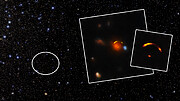
Gemini North image of the field around "Shadow Blaster"

PR Image noirlab2615c
Gemini North and ALMA image of "Shadow Blaster"

PR Image noirlab2615d
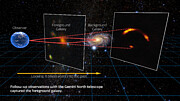
Gravitational lensing infographic

PR Image noirlab2615e
ALMA image of "Shadow Blaster"

PR Image noirlab2615f
James Clerk Maxwell Telescope

PR Image noirlab2615g
The Submillimeter Array


Videos

Gravitational lensing animation
PR Video noirlab2615a
Gravitational lensing animation

Gravitational lensing animation (Spanish)
PR Video noirlab2615b
Gravitational lensing animation (Spanish)

Zooming into “Shadow Blaster” galaxy
PR Video noirlab2615d
Zooming into “Shadow Blaster” galaxy


Gemini North telescope on Maunakea helps uncover strongest evidence yet that distant star-forming galaxies contribute to the production of one of the Universe’s most mysterious ghost particles

A team of astronomers has identified a remarkably bright, gravitationally-lensed, star-forming galaxy as the likely source of the high-energy neutrino event IC 210922A, detected by the IceCube Neutrino Observatory in 2021. The galaxy, nicknamed “Shadow Blaster,” is located about 11 billion light-years away, providing the most concrete observational evidence yet that populations of distant star-forming galaxies play a significant role in producing high-energy cosmic neutrinos.

Neutrinos are one of the fundamental particles of the Universe. They live a ghostly existence with no electric charge, very little mass, and extremely few interactions with matter. They are also the most abundant particles with mass in the Universe, and can be created through a variety of processes, such as the decay of heavy particles, nuclear reactions in the Sun, and the explosions of stars.

Instruments on Earth have detected high-energy neutrinos arriving from space since the 1960s, and identifying their origin has been a long-standing challenge in astronomy. While scientists have identified a small number of nearby neutrino sources [1], they cannot account for the total amount of neutrinos our instruments measure arriving from across the Universe, referred to as the cosmic neutrino background. Astronomers, therefore, suspect that other major source populations exist but remain hidden.

In a study published today in Nature Astronomy, a team led by Yuji Urata of MITOS Science Co., LTD. in Taiwan presents the analysis of a new neutrino source candidate — an extremely bright galaxy, JCMT0402−0424, nicknamed “Shadow Blaster.” This galaxy is located about 11 billion light-years away, has trillions of times the luminosity of the Sun in the infrared, and may provide the long-sought link between high-energy neutrino production and distant star-forming galaxies.

The discovery was made in part using observations from the International Gemini Observatory, partly funded by the U.S. National Science Foundation (NSF) and operated by NSF NOIRLab. The study also utilized observations from the James Clerk Maxwell Telescope (JCMT), operated by the East Asian Observatory, and the Submillimeter Array (SMA), a joint operation between the Center for Astrophysics | Harvard & Smithsonian and the Academia Sinica Institute of Astronomy and Astrophysics. All three of these telescopes are located on the summit of Maunakea in Hawai‘i.

In 2021, the NSF IceCube Neutrino Observatory in Antarctica alerted the scientific community to a high-energy neutrino event, dubbed IC 210922A, coming from a region of space in the direction of the constellation Eridanus. This alert triggered rapid follow-up observations across the electromagnetic spectrum to search for a counterpart signal that, if detected, could help identify the neutrino’s source.

Multiple teams of scientists conducted follow-up observations using a variety of telescopes and instruments. However, they all reported no convincing gamma-ray, X-ray, or optical counterpart, nor any gamma-ray burst, supernova, or tidal disruption event that could be associated with the alert [2].

Then, a couple of days after the initial alert, Urata and his team initiated observations with JCMT and SMA and discovered Shadow Blaster, whose location and brightness made it a promising candidate for the source of the signal. To investigate this galaxy further, the team organized follow-up observations with the Atacama Large Millimeter/submillimeter Array (ALMA), managed for North America by the NSF National Radio Astronomy Observatory, and they discovered that Shadow Blaster is located behind a strong gravitational lens[3].

Thanks to this lensing effect, the team would be able to study the internal structure of Shadow Blaster, which would otherwise be too distant and too faint to resolve in such detail. However, to use the lensing effect correctly and to understand how much the lens amplified the neutrino signal, they first needed to know the distance, nature, and mass distribution of the foreground galaxy. To decipher these details, they used two powerful instruments on Gemini North: the Gemini Multi-Object Spectrograph (GMOS) and the Gemini Near-InfraRed Spectrograph (GNIRS).

“The combined GMOS and GNIRS data helped us measure the distance to the lensing galaxy and determine that it is a massive elliptical galaxy. This information was crucial for estimating the lens mass distribution and constructing a model of the gravitational lens,” says Urata.

Combining the lens model with the ALMA imaging data revealed that the central region of Shadow Blaster contains an extremely compact core that is densely packed with gas and dust and forming new stars at an intense rate. Theoretical models predict that such an extreme environment can act as a natural particle accelerator, where energetic particles repeatedly collide with gas and produce neutrinos. Additionally, Shadow Blaster does not display any characteristics of possessing an active black hole. This strongly suggests that high-energy neutrinos can be produced not only by spectacular black-hole jets as scientists have observed in nearby galaxies, but also by the intense, densely packed star formation that is common in very distant galaxies.

“This breakthrough shows how particle detectors and telescopes become far more impactful when they work together, opening a powerful 'multi-messenger' window on the Universe,” says Martin Still, Program Director, NSF Office of Research Infrastructure. “By combining signals from particles and light, scientists can explore distant cosmic environments and events in unprecedented detail — revealing phenomena that were once only theoretical.”sts have observed in nearby galaxies, but also by the intense, densely packed star formation that is common in very distant galaxies.

Around 10 billion years ago, the Universe was populated with galaxies like Shadow Blaster that were actively forming stars. During this epoch, galaxies were theoretically producing large numbers of cosmic rays, which are high-energy streams of particles that can generate neutrinos. Yet obtaining observational evidence that links an individual neutrino event to such a distant galaxy has been extremely difficult since these galaxies are very far away and often deeply hidden behind thick layers of dust. Shadow Blaster's serendipitous location behind a gravitational lens makes finding this observational evidence much easier.

“Shadow Blaster possesses the kind of dense, gas-rich environment that theoretical models have long suggested could efficiently produce high-energy neutrinos,” says Urata. Combined with the absence of any more compelling counterpart despite extensive follow-up searches, Shadow Blaster is the most plausible candidate for the source of  IC 210922A. “If confirmed, Shadow Blaster would be the first-ever individual dusty star-forming galaxy directly linked to a high-energy neutrino event.”

Compact star-forming galaxies like Shadow Blaster may be numerous throughout the Universe. As a population, they may therefore contribute a significant fraction of the high-energy neutrino background that fills the cosmos. “Our analysis suggests that this population could contribute up to roughly 20% of the observed diffuse neutrino background measured by IceCube,” says Urata.


Notes

[1] Astrophysical neutrino sources, or candidate source associations, that have been identified include the Sun and Supernova 1987A at lower energies, and, at high energies, the blazar TXS 0506+056, the active galaxy Messier 77, the active galaxy PKS 1424+240, and diffuse emission from the plane of the Milky Way. Candidate high-energy associations have also been reported with tidal disruption events such as AT2019dsg and AT2019fdr.

[2] Facilities used for follow-up observations: NASA's Fermi Gamma-ray Space Telescope, ANTARES neutrino telescope, NASA's Neil Gehrels Swift Observatory, Zwicky Transient Facility, High-Altitude Water Cherenkov Observatory, and the Department of Energy-funded DESI Transients Survey. In particular, DESI “spare fibers” — fibers that can’t be matched to targets from the main DESI program on a given pointing — obtained spectra for 249 galaxies within the IceCube localization region.

[3] Gravitational lensing occurs when a very massive foreground galaxy bends spacetime, acting as a cosmic magnifying glass that enlarges and distorts the image of a more distant galaxy behind it. In this case, the gravitational lens amplified the brightness of Shadow Blaster from 2.7 trillion to 33 trillion times the luminosity of the Sun in infrared light.


More information

This research is presented in a paper titled “Compact dusty starbursts at cosmic noon linked to high-energy neutrinos,” appearing in Nature Astronomy. DOI: 10.1038/s41550-026-02884-9.

The team is composed of Y. Urata (MITOS Science Co., LTD/National Central University, Taiwan), K. Huang (Chung Yuan Christian University, Taiwan), B. Hatsukade (National Astronomical Observatory of Japan/The Graduate University for Advanced Studies/The University of Tokyo, Japan), M. Kasliwal (California Institute of Technology, USA), S. S. Kimura (Tohoku University, Japan), Y. Matsuda (National Astronomical Observatory of Japan/Ministry of Education, Culture, Sports, Science and Technology, Japan), Y. Miyamoto (Fukui University of Technology, Japan), H. Nagai (National Astronomical Observatory of Japan/The Graduate University for Advanced Studies, Japan), K. Nakanishi (National Astronomical Observatory of Japan/The Graduate University for Advanced Studies, Japan), and R. Stein (University of Maryland/NASA Goddard Space Flight Center, USA).

NSF NOIRLab, the U.S. National Science Foundation center for ground-based optical-infrared astronomy, operates the International Gemini Observatory (a facility of NSF, NRC–Canada, ANID–Chile, MCTIC–Brazil, MINCyT–Argentina, and KASI–Republic of Korea), NSF Kitt Peak National Observatory (KPNO), NSF Cerro Tololo Inter-American Observatory (CTIO), the Community Science and Data Center (CSDC), and NSF–DOE Vera C. Rubin Observatory (in cooperation with DOE’s SLAC National Accelerator Laboratory). It is managed by the Association of Universities for Research in Astronomy (AURA) under a cooperative agreement with NSF and is headquartered in Tucson, Arizona.

The scientific community is honored to have the opportunity to conduct astronomical research on I’oligam Du’ag (Kitt Peak) in Arizona, on Maunakea in Hawai‘i, and on Cerro Tololo and Cerro Pachón in Chile. We recognize and acknowledge the very significant cultural role and reverence of I’oligam Du’ag to the Tohono O’odham Nation, and Maunakea to the Kanaka Maoli (Native Hawaiians) community. The James Clerk Maxwell Telescope is operated by the East Asian Observatory, which is funded by the Academia Sinica Institute of Astronomy and Astrophysics (ASIAA, Taiwan), the National Astronomical Research Institute of Thailand (NARIT), the Science and Technology Facilities Council (STFC, United Kingdom), and other partners.


Links


Contacts:

Yuji Urata
MITOS Science Co., Ltd
National Central University
Email:
yjurata@gmail.com

Josie Fenske
Public Information Officer
NSF NOIRLab
Email:
josie.fenske@noirlab.edu


Tuesday, June 16, 2026

NASA Webb Finds Strongest Evidence Yet for ‘Black Hole Stars’

While the primary purpose of NASA’s James Webb Space Telescope’s observations of galaxy cluster Abell S1063 was to look for a certain population of stars, scientists obtained a detailed spectrum of GLIMPSE-17775 from the dataset. This little red dot is located behind Abell S1063. Credit Image: NASA, ESA, CSA, Vasily Kokorev (UT Austin); Image Processing: Alyssa Pagan (STScI)

NASA’s James Webb Space Telescope captured the deepest spectrum to date of a little red dot. More than 40 spectral lines have been discerned from the data, many of which independently support the theory that GLIMPSE-17775 is a black hole enshrouded by a hot, dense gas cocoon. Credit Illustration: NASA, ESA, CSA, Vasily Kokorev (UT Austin); Designer: Leah Hustak (STScI)


The complex puzzle known as little red dots has become more complete since their initial discovery by NASA’s James Webb Space Telescope in 2022. Now a particular little red dot’s spectrum is helping connect many of the pieces.

A team of astronomers led by Vasily Kokorev at the University of Texas at Austin identified the lucky dot in question: GLIMPSE-17775. By carefully analyzing the dot’s spectrum captured by Webb — the deepest spectrum to date of a little red dot — the research team has identified multiple lines of evidence, all of which support the interpretation that GLIMPSE-17775 is a supermassive black hole enveloped in a dense cocoon of partially ionized gas, a model referred to as the BH* (black hole star) scenario. A paper describing the results was published today in The Astrophysical Journal.

“I think part of the scientific community is converging on a singular picture — that little red dots can be explained by black hole star models. But none of the previous little red dots have all of the pieces of evidence in the same place,” said Kokorev, lead author of the study. “With GLIMPSE-17775 we can test these models because of how deep and amazing this source’s spectrum is.”

Connecting puzzle pieces

Soon after Webb first began science operations, it discovered a new, mysterious type of object in the very early universe – abundant red objects that emerged about 600 million years after the big bang. Scientists have explored multiple explanations for these little red dots, including the black hole star scenario.

A set of fortunate circumstances brought about this new, elaborate spectrum of a little red dot. The little red dot that would come to be known as GLIMPSE-17775 was fortunately included in Webb’s imaging and spectroscopy efforts for a project that sought to look for Population III stars and faint galaxies in galaxy cluster Abell S1063. This little red dot is more distant than the galaxy cluster and magnified by gravitational lensing. (GLIMPSE-17775 has a cosmological redshift of 3.5, meaning it existed about 1.8 billion years after the big bang.)

While Webb provided a 30-hour spectrum of the little red dot, the effect of gravitational lensing made it equivalent to 80 hours of telescope time. This combination of Webb’s infrared sensitivity and nature’s own “magnifying glass” amplified the amount of detail that could be gleaned from GLIMPSE-17775. The result was more than 40 spectral lines from this small, red source, which is the most detailed little red dot spectrum to date.

“When we saw the spectrum for the first time, it was like having all the pieces of a puzzle scattered on the floor,” said Kokorev. “We picked up each piece of the puzzle, measured the lines, and started combining the different pieces into a mosaic. Maybe a few pieces looked like nothing at first, but then a couple of them came together, and we realized that there was something there.”

The spectroscopic data collected by Webb contains multiple lines of evidence that support the interpretation that little red dot GLIMPSE-17775 is a black hole star: a rapidly accreting, or growing, black hole enveloped in a dense gas cocoon, which is reprocessing the light emitted from near the black hole and producing the features seen in the spectrum.

Lines of evidence

Among the 40-plus lines that the team detected in GLIMPSE-17775’s spectrum were various independent indicators that all align with the BH* scenario. For example, the team found that many of the spectral lines, such as hydrogen, oxygen, and helium, do not fit a simple model of a rotating gas cloud. Instead, the best fit model includes a broadening effect known as electron scattering, a telltale sign that a dense, layered gas cocoon is enshrouding this source.

The strength and ratios of certain lines to each other, most notably the 16 iron lines that compose what the team has dubbed an “iron forest” and certain oxygen lines, require a high-energy source to produce them, like a rapidly accreting black hole. Additionally, astronomers noted the fluorescence and absorption of helium in the spectrum, both of which individually suggest that there is a dense medium enveloping a powerful source.

The BH* scenario not only fits GLIMPSE-17775; it also accounts for why most little red dots are faint in X-rays, since any such emission is likely absorbed by the dense gas cocoon.

One missing element of the GLIMPSE-17775 puzzle piece is the part of the spectrum that would reveal what’s known as a Balmer break, or a strong dip in the emitted light that’s a signature characteristic of little red dots. To build a more comprehensive understanding of this little red dot, the team incorporated ancillary data from two observing programs that used NASA’s Hubble Space Telescope: the Frontier Fields and BUFFALO (Beyond Ultra-deep Frontier Fields And Legacy Observations) programs.

The Webb and Hubble data together help explain why the Balmer break is weaker than what typically is found in other little red dots: A giant host galaxy is surrounding GLIMPSE-17775. Although a little red dot’s host galaxy is not something that has been usually seen at such scale before, it isn’t inconsistent with the dense gas cocoon model. The black hole star model of little red dots attributes excess blue light to stars in the host galaxy.

When Webb first discovered little red dots, some researchers thought these objects had “broken cosmology,” unsure how galaxies could have grown so big so quickly in the early universe to account for all this light coming from their stars. However, the team believes the GLIMPSE-17775 puzzle piece fits nicely in the existing framework of the universe’s evolutionary history, because black hole masses don’t need to be as high in order to explain the broad emission lines.

“Everything fits, nothing is broken, and I think that makes the puzzle that is our universe even better,” said Kokorev. “Looking ahead, I’m eager to dive deeper and learn about what is powering the central engines of little red dots. While we think it’s a black hole, there are some other interesting theories being proposed, which is exciting. Maybe in a year or two, we’ll have the final answer to what powers these sources.”

The James Webb Space Telescope is the world’s premier space science observatory. Webb is solving mysteries in our solar system, looking beyond to distant worlds around other stars, and probing the mysterious structures and origins of our universe and our place in it. Webb is an international program led by NASA with its partners, ESA (European Space Agency) and CSA (Canadian Space Agency).


Details:

Last Updated: Jun 10, 2026

Location:
NASA Goddard Space Flight Center

Contact Media:

Laura Betz
NASA’s Goddard Space Flight Center
Greenbelt, Maryland

laura.e.betz@nasa.gov

Abigail Major
Space Telescope Science Institute
Baltimore, Maryland


Christine Pulliam
Space Telescope Science Institute
Baltimore, Maryland


Tuesday, May 12, 2026

Hubble Survey Sets Up Roman’s Future Look Near Milky Way’s Center


About this image: This near-infrared image from the ground-based VISTA VVV Survey shows the galactic bulge near Sagittarius A* (pronounced “A star”), the black hole at the Milky Way’s center. The region, outlined in white, shows five stacked fields of view from NASA’s Nancy Grace Roman Space Telescope that will be observed as part of its Galactic Bulge Time-Domain Survey, one of its three core community surveys. (Roman will also observe a sixth field at the galactic center that is not shown here.) Prior to Roman’s launch, a team of researchers sought to use Hubble to capture the same regions in preparation for potential microlensing events.

These events cause the light from a more distant object to warp as a mass precisely aligns in front of that object. These masses, therefore, act like lenses, bending the light from objects behind them like background stars. In this case, the glow from the densely packed stars within the galactic bulge would be the distant light source. Having these Hubble observations allows us to capture the moments before these microlensing events happen, providing astronomers a way to clearly characterize objects (stars, planets, and even stellar-mass black holes) that cause microlensing by passing in front of stars within the galactic bulge.

The colored lines representing the Hubble survey area are stylized and represent a large number of individual pointings.

Credits Image: NASA, Alyssa Pagan (STScI) - Acknowledgment: VISTA, Dante Minniti (UNAB), Ignacio Toledo (ALMA), Martin Kornmesser (ESO) //imag

A follow-up observation by NASA’s Hubble Space Telescope shows a field containing a microlensing event that was captured by the Optical Gravitational Lensing Experiment (OGLE) in 2013. This provides an example of how a Hubble image could be used to analyze future microlensing events spotted by NASA’s Nancy Grace Roman Space Telescope.

In gravitational microlensing, the gravity of a foreground object acts as a lens, magnifying and distorting the light of a background star when the two objects align in the sky. Credits Image: NASA, ESA, Sean Terry (UMD), Jay Anderson (STScI) - Image Processing: Alyssa Pagan (STScI)

This graphic illustrates a microlensing event, which occurs when the light from a distant object warps as a mass, such as a star (depicted here) or a stellar-mass black hole, precisely aligns in front of that object. In this image, a red, foreground star intervenes between the telescope, acting as the “lens,” bending, and magnifying the light of the yellow background star. Unlike some gravitational lensing events, which occur at the scale of galaxies or galaxy clusters, microlensing events occur on a much smaller scale, such as that of individual stars. The lensing effect is, therefore, much smaller.

This image also provides a representation of what the background star would look like to a telescope in a microlensing event. Because of the curvature of space around the background star (represented by the white arrows that curve around it in the image), the background star appears to increase in brightness as the event begins before decreasing in apparent brightness as it falls out of alignment. The graph at bottom plots the apparent brightness of the background star over time. Credits Illustration: NASA, STScI, Joyce Kang (STScI)

This video shows a zoom into the Milky Way’s galactic bulge near the galactic center. As it zooms in, the view changes from the near-infrared 2MASS survey to the VISTA VVV survey (both ground-based). At the conclusion of the zoom, part of the region of the galactic bulge that will be surveyed by Roman’s Galactic Bulge Time-Domain Survey is highlighted with five stacked fields of view. (Roman will also observe a sixth field at the galactic center that is not shown here.)

Prior to Roman’s launch, a team of researchers are using NASA’s Hubble Space Telescope to observe the same regions to enable better analysis of microlensing events detected by Roman. The colored lines representing the Hubble survey area are stylized and represent a large number of individual pointings. The video also labels Sagittarius A* (pronounced “A star”), the black hole at the Milky Way’s center. Credits Video: NASA, Alyssa Pagan (STScI) - Acknowledgment: VISTA, Caltech, Caltech/IPAC, Sean Terry (UMD), Jay Anderson (STScI), Dante Minniti (UNAB), Ignacio Toledo (ALMA), Martin Kornmesser (ESO), 2MASS


The Milky Way’s galactic bulge, the bulbous region that surrounds the galactic center, contains a dense collection of stars, planets, and other free-floating objects. This region has been studied for decades with numerous ground-based and space-based telescopes, including NASA’s Hubble and James Webb space telescopes. Soon, NASA’s Nancy Grace Roman Space Telescope will be the first to make studying the galactic bulge a part of its core science objectives, building on the data collected from all observatories before it. Roman’s field of view will cover more area at a far faster cadence than previous space telescopes, allowing it to survey millions of stars and find thousands of new exoplanets.

To support Roman in characterizing numerous stars and planets, astronomers sought to use Hubble to observe many of the same areas of the galactic bulge that Roman will observe in its core Galactic Bulge Time-Domain Survey. By comparing Hubble data taken months or years earlier to new Roman data, astronomers will be better able to interpret Roman’s forthcoming observations. The Roman telescope team is targeting as soon as early September 2026 for launch.

“A top priority of our Hubble survey is to cover as much sky area as possible,” said Sean Terry, project lead and assistant research scientist from the University of Maryland, College Park and NASA’s Goddard Space Flight Center in Greenbelt.

A paper about the team’s work published May 11, 2026 in the Astrophysical Journal.

‘Small’ lenses, large discoveries

Many planetary systems within the Milky Way evolve much like our solar system did, beginning with the collapse of a cosmic gas cloud, the growth of a star, and the formation of surrounding planets. However, in some systems, different events can result in a planet being ejected from the system where it formed. Hundreds of these “rogue planets” will be detected by Roman’s Galactic Bulge Time-Domain Survey, in addition to previously unseen, isolated neutron stars, and even black holes with masses similar to our Sun.

This survey consists of six 72-day observing seasons during which Roman will take a snapshot every 12 minutes of a large portion of the bulge (approximately 1.7 square degrees of the region, or the area of 8.5 full moons). While it will detect a variety of targets, the survey is optimized to look for a specific type of event known as microlensing.

Microlensing events, a type of gravitational lensing event, occur when the light from a more distant object is warped by the mass of a closer object along the line of sight. These events occur on a much smaller scale than larger lensing events (on the order of individual stars instead of galaxies or galaxy clusters) and allow us to search for exoplanets between us and the densely packed stars within the galactic bulge.

“The great thing about microlensing is that we’ll be able to do a complete census of objects as small as Mars that are moving between us and these fields in the bulge, no matter what it is,” said co-author Jay Anderson of the Space Telescope Science Institute in Baltimore.

For Roman, from Hubble

When a telescope observes a lensing object, such as a bright star, aligning with a star in the galactic bulge, it can be difficult for astronomers to decipher which of the two the starlight comes from. Therefore, timing is a key consideration. If astronomers can identify light sources separately before a microlensing event occurs, it becomes far easier to disentangle them.

To collect this pre-Roman data, astronomers used the Hubble Space Telescope to conduct a large-scale survey, which began in the spring of 2025, covering much of the same area that Roman will observe in the Galactic Bulge Time-Domain Survey. The size of this program is even larger than two previous surveys (each around 0.5 square degrees) that led to Hubble’s largest mosaic, that of our neighboring Andromeda galaxy, which took over 10 years to assemble.

“The main goal of these observations is to be able to identify objects that participate in lensing events during the Roman survey, catching them before they undergo the lensing event,” said Anderson. “When, in a couple of years, an event happens during Roman's long stare at the field, we can go back and say, ‘This was a red star, this was a blue star, and the event happened when the red star went in front of the blue star.’”

The data from Hubble also will help shape the analysis of the lensing objects themselves. The microlensing event itself measures only a ratio of the masses of a host star and its planet. With data from stars before or after their microlensing events, however, scientists would be able to measure the stars’ individual masses, echoing the way Hubble previously determined the mass of a star and its planet in the Milky Way. This method turns a more opaque measurement of the relationship between a star and its planet into one far more certain.

“Instead of estimating a mass ratio of a planet that's orbiting a star, we can say that we're confident it's a Saturn-mass planet orbiting a star that's 0.8 solar masses, for example,” Terry said. “So with the help of precursor imaging from Hubble you can hope to get direct measurements of the masses as opposed to indirect mass ratios.”

Next leap in magnitude

While exoplanet discovery is a large part of Roman’s Galactic Bulge Time-Domain Survey, observing such a large area with Hubble also can help identify areas of extinction, dense pockets of dust and gas that absorb or scatter light, allowing us to create maps detailing where we can see stars and where we can’t.

Hubble’s survey also has provided the crucial beginning of a brand-new catalog of stars, which will help astronomers characterize the host stars of exoplanets discovered by Roman. The research team predicts Roman will add to Hubble’s star catalog by an order of magnitude.

“This Hubble survey will build a catalog of 20 to 30 million point sources,” said Terry. “But, by the end of the Galactic Bulge Time-Domain Survey, Roman may measure about 200 to 300 million, and it will produce, essentially, some of the deepest images ever taken of any part of the sky.”

The data from the most recent Hubble survey is available in the Mikulski Archive for Space Telescopes.

The Hubble Space Telescope has been operating for over three decades and continues to make ground-breaking discoveries that shape our fundamental understanding of the universe. Hubble is a project of international cooperation between NASA and ESA (European Space Agency). NASA Goddard manages the telescope and mission operations. Lockheed Martin Space, based in Denver, also supports mission operations at Goddard. The Space Telescope Science Institute in Baltimore, which is operated by the Association of Universities for Research in Astronomy, conducts Hubble science operations for NASA.

The Nancy Grace Roman Space Telescope is managed at NASA Goddard with participation by NASA's Jet Propulsion Laboratory in Southern California; Caltech/IPAC in Pasadena, California; the Space Telescope Science Institute; and a science team comprising scientists from various research institutions. The primary industrial partners are BAE Systems, Inc. in Boulder, Colorado; L3Harris Technologies in Melbourne, Florida; and Teledyne Scientific & Imaging in Thousand Oaks, California.


About This Release

Credits

Media Contact:

Matthew Brown
Space Telescope Science Institute, Baltimore

Christine Pulliam
Space Telescope Science Institute, Baltimore

Permissions:
Content Use Policy

Related Links and Documents


Thursday, April 23, 2026

Euclid Space Warps: help spot galaxies bending spacetime

A collage of fourteen by eight squares containing examples of gravitational lenses. Each example typically comprises a bright centre with smears of stacredirs in an arc or multiple arcs around it as a result of light travelling towards Euclid from distant galaxies being bent and distorted by normal and dark matter in the foreground. In some rare cases the smearing is in a complete ring, crea,brting a so-called Einstein Ring. Credit: ESA/Euclid/Euclid Consortium/NASA, image processing by M. Walmsley, M. Huertas-Company, J.-C. Cuillandre.Hi-res JPG
Licence: CC BY-SA 3.0 IGO or ESA Standard Licence (content can be used under either licence)

Against a dark blue background, this infographic contains a paragraph of text in the top left corner, the logo of ESA in the top right corner and a succession of graphics in the bottom half of the image. The text paragraph explains the principle behind Einstein rings, and it can be read in the image caption. The graphics below it illustrate this astrophysical phenomenon, and by looking at them from left to right we can understand the process of how Einstein rings are formed.

The left-most element in the bottom half of the image is a graphic representation of a galaxy, labelled ‘distant galaxy’. To the right of it, another galaxy is shown, labelled ‘Foreground galaxy acting as a magnifying lens’. The third illustration, to the right of the previous one, shows ESA’s Euclid space telescope and is labelled ‘Telescope’. The ‘distant galaxy’ and the ‘Telescope’ are connected by two lines that form an elongated diamond-shape around the ‘Foreground galaxy’. This line is labelled ‘Gravity bends the light rays of the distant galaxy’. The fourth and last illustration in the line shows a ring of light around a central disk and is labelled ‘What the telescope sees’. Credit: ESA.
Hi-res JPG
Licence: CC BY-SA 3.0 IGO or ESA Standard Licence (content can be used under either licence)


In brief

With the launch of Space Warps, a new citizen science project on the Zooniverse platform, you can now join in the search to find rare and elusive strong gravitational lenses in never-before-seen images captured by the European Space Agency’s Euclid space telescope. The project aims at shining a light on dark matter in galaxies and providing clues about mysterious dark energy.

In-depth

Warps in spacetime do not only show up in science fiction movies like Interstellar. In real life, we can see the warping effect that gravity has on spacetime in the form of gravitational lensing.

The enormous gravity of a massive object – such as a galaxy or cluster of galaxies – distorts the shape of spacetime and can bend the light rays coming from a distant galaxy behind. By warping spacetime, the foreground galaxy acts like a magnifying glass.

Light from the background object that would be obscured doesn’t travel in a straight line anymore. Instead, it curves around the intervening mass, often producing multiple images, stretched arcs, or even a complete ring known as ‘Einstein ring’, like the one recently discovered by Euclid.

Strong gravitational lenses offer a striking demonstration of Einstein’s theory of general relativity, showing that matter in the Universe can act as a natural telescope, bringing distant objects into sight.

ESA’s Euclid telescope is revolutionising the studies of strong gravitational lensing by providing very sensitive imaging over large swaths of the sky in unprecedented detail. This is exactly what is needed to identify rare gravitational lenses.

In March 2025, 500 galaxy-galaxy strong lenses were found nestled in just the first 0.04% of Euclid data, most of them previously unknown. This pioneering catalogue was created thanks to the combined effort from citizen scientists, artificial intelligence (AI) and researchers.

Early glimpse of new Euclid images

As Euclid continues its survey, sending around 100 GB of data back to Earth every day, ESA and the Euclid Consortium once again need help from citizen scientists to identify strong gravitational lenses in a large data set.

For this, the Space Warps team has launched a citizen science project based on new Euclid images, which will be part of the future Euclid Data Release 1. While this data is not public yet, by participating in this new citizen science project you can get an early glimpse of these new images of galaxies captured by the telescope.

For this project, you will be inspecting new high quality imaging data from Euclid in which many previously unknown strong lenses are hiding. About 300 000 images pre-selected by AI algorithms will be shown, which are fine-tuned with the results from the initial citizen-science Euclid strong lens search. These are the highest ranked candidates from a whopping 72 million galaxies from DR1 that were classified by the AI algorithms. Scientists expect that this exquisite high-quality data will reveal more than 10 000 new lenses.

What can we learn from strong lenses.

The Euclid mission explores how the Universe has expanded and how its structure has changed through cosmic history using mainly two methods: weak lensing and baryonic acoustic oscillations. From this, scientists can learn more about the role of gravity and the nature of dark matter and dark energy.

Strong gravitational lenses can also provide insights into these central questions. For example, strong lensing features can ‘weigh’ individual galaxies and clusters of galaxies. This reveals the total matter (whether dark or light) and traces the distribution of dark matter. By studying strong lenses across cosmic time, scientists can trace the expansion of the Universe and its apparent acceleration. This will provide additional insight into the role of dark energy..

“We’ve already seen the success of combining AI with visual inspection by citizen volunteers and scientists on Space Warps, efficiently finding hundreds of high‑probability lens candidates in an initial small Euclid search in 2024”, explains Aprajita Verma, Space Warps’ co-founder and project lead at the University of Oxford, UK..

“In this brand new DR1 data, 30 times larger than the initial search and together with our improved AI algorithms, we are expecting to find more than 10 000 high quality lens candidates. This is more than four times the number of lenses than we have been able to find since the first gravitational lens was discovered nearly 50 years ago.”.

This step-change is possible thanks to Euclid. The mission can map large areas of the sky with unique sharpness, an ideal combination for finding rare objects like strong gravitational lenses..

“We can’t wait to see what we will find within this unprecedented dataset. Join us on Space Warps to take part in this exciting search!” concludes Aprajita.

Euclid: ESA’s mission into the unknown
Access the video


About Euclid

Euclid was launched in July 2023 and started its routine science observations on 14 February 2024. The goal of the mission is to reveal the hidden influence of dark matter and dark energy on the visible Universe. Over a period of six years, Euclid will observe the shapes, distances and motions of billions of galaxies out to 10 billion light-years. Euclid is a European mission, built and operated by ESA, with contributions from NASA. The Euclid Consortium – consisting of more than 2000 scientist from 300 institutes in 15 European countries, the USA, Canada, and Japan – is responsible for providing the scientific instruments and scientific data analysis. ESA selected Thales Alenia Space as prime contractor for the construction of the satellite and its service module, with Airbus Defence and Space chosen to develop the payload module, including the telescope. NASA provided the detectors of the Near-Infrared Spectrometer and Photometer, NISP. Euclid is a medium-class mission in ESA’s Cosmic Vision Programme.


Friday, March 06, 2026

Core Survey by NASA’s Roman Mission Will Unveil Universe’s Dark Side

This infographic describes the High-Latitude Wide-Area Survey that will be conducted by NASA’s Nancy Grace Roman Space Telescope. This observation program will cover more than 5,000 square degrees (about 12 percent of the sky) in just under a year and a half. Scientists will use the survey to analyze hundreds of millions of galaxies scattered across the cosmos that reveal clues about the universe’s shadowy underpinnings — dark matter and dark energy — as well as a wealth of other science topics. Credit: NASA’s Goddard Space Flight Center

This simulation shows the type of science astronomers will be able to do with future observations from NASA’s Nancy Grace Roman Space Telescope. The sequence demonstrates how the gravity of intervening galaxy clusters and dark matter can distort the light from farther objects, warping their appearance. More intervening material creates stronger distortions. By analyzing these features, astronomers can study elusive dark matter, which can only be measured indirectly through its gravitational effects on visible matter. As a bonus, the distortion acts like a telescope, enabling observations of extremely distant galaxies. Simulations like this one help astronomers understand what Roman’s future observations could tell us about the universe, and provide useful data to validate data analysis techniques. Caltech/IPAC/R. Hurt

This animation illustrates how small particles (in this case, sand) behave when exposed to different sound frequencies. In the very early universe, a cosmic “hum” created ripples in the primordial soup that filled space. Since the ripples were places where more matter was collected, like the rings of sand shown here, slightly more galaxies formed along them than elsewhere. As the universe expanded over billions of years, so did these structures. By comparing their size during different cosmic epochs, astronomers can trace the universe’s expansion. Nigel Stanford (used with permission)


The broadest planned survey by NASA’s upcoming Nancy Grace Roman Space Telescope will reveal hundreds of millions of galaxies scattered across the cosmos. After Roman launches as soon as this fall, scientists will use these sparkly beacons to study the universe’s shadowy underpinnings: dark matter and dark energy.

“We set out to build the ultimate wide-area infrared survey, and I think we accomplished that,” said Ryan Hickox, a professor at Dartmouth College in Hanover, New Hampshire, and co-chair of the committee that shaped the survey’s design. “We’ll use Roman’s enormous, deep 3D images to explore the fundamental nature of the universe, including its dark side.”

Roman’s High-Latitude Wide-Area Survey is one of the mission’s three core observation programs. It will cover more than 5,000 square degrees (about 12 percent of the sky) in just under a year and a half. Roman will look far from the dusty plane of our Milky Way galaxy (that’s what the “high-latitude” part of the survey name means), looking up and out of the galaxy rather than through it to get the clearest view of the distant cosmos.

“This survey is going to be a spectacular map of the cosmos, the first time we have Hubble-quality imaging over a large area of the sky,” said David Weinberg, an astronomy professor at Ohio State University in Columbus, who played a major role in devising the survey. “Even a single pointing with Roman needs a whole wall of 4K televisions to display at full resolution. Displaying the whole high-latitude survey at once would take half a million 4K TVs, enough to cover 200 football fields or the cliff face of El Capitan.”

The survey will combine the powers of imaging and spectroscopy to unveil a goldmine of galaxies strewn across cosmic time. Astronomers will use the survey’s data to explore invisible dark matter, detectable only via its gravitational effects on other objects, and the nature of dark energy — a pressure that seems to be speeding up the universe’s expansion.

“Cosmic acceleration is the biggest mystery in cosmology and maybe in all of physics,” Weinberg said. “Somehow, when we get to scales of billions of light years, gravity pushes rather than pulls. The Roman wide area survey will provide critical new clues to help us solve this mystery, because it allows us to measure the history of cosmic structure and the early expansion rate much more accurately than we can today.”

Weighing shadows

Anything that has mass warps space-time, the underlying fabric of the universe. Extremely massive things like clusters of galaxies warp space-time so much that they distort the appearance of background objects — a phenomenon called gravitational lensing.

“It’s like looking through a cosmic funhouse mirror,” Hickox said. “It can smear or duplicate distant galaxies, or if the alignment is just right, it can magnify them like a natural telescope.”

Roman’s view will be large and sharp enough to study this lensing effect on a small scale to see how clumps of dark matter warp the appearance of distant galaxies. Astronomers will create a detailed map of the large-scale distribution of matter — both seen and unseen — throughout the universe and fill in more of the gaps in our understanding of dark matter. Studying how structures grow over time will also help astronomers explore dark energy’s strength at various cosmic stages.

“The data analysis standards required to measure weak gravitational lensing are such that the astronomy community as a whole will benefit from very high-quality data over the full survey area, which will undoubtedly lead to unexpected discoveries,” said Olivier Doré, a senior research scientist at NASA’s Jet Propulsion Laboratory in Southern California, who leads a team focused on Roman imaging cosmology with the High-Latitude Wide-Area Survey. “This survey will accomplish much more than just revealing dark energy!” While NASA’s Hubble and James Webb space telescopes both also study gravitational lensing, the breakthrough with Roman is its large field of view.

“Weak lensing distorts galaxy shapes too subtly to see in any single galaxy — it’s invisible until you do a statistical analysis,” Hickox said. “Roman will see more than a billion galaxies in this survey, and we estimate about 600 million of them will be detailed enough for Roman to study these effects. So Roman will trace the growth of structure in the universe in 3D from shortly after the big bang to today, mapping dark matter more precisely than we’ve ever done before.”

Sounding out dark energy

Roman’s wide-area survey will also gather spectra from around 20 million galaxies. Analyzing spectra helps show how the universe expanded during different cosmic eras because when an object recedes, all of the light waves we receive from it are stretched out and shifted toward redder wavelengths — a phenomenon called redshift.

By determining how quickly galaxies are receding from us, carried by the relentless expansion of space, astronomers can find out how far away they are — the more a galaxy’s spectrum is redshifted, the farther away it is. Astronomers will use this phenomenon to make a 3D map of all the galaxies measured within the survey area out to about 11.5 billion light-years away.

That will reveal frozen echoes of ancient sound waves that once rippled through the primordial cosmic sea. For most of the universe’s first half-million years, the cosmos was a dense, almost uniform sea of plasma (charged particles).

Rare, tiny clumps attracted more matter toward themselves gravitationally. But it was too hot for the material to stick together, so it rebounded. This push and pull created waves of pressure—sound — that propagated through the plasma.

Over time, the universe cooled and the waves ceased, essentially freezing the ripples (called baryon acoustic oscillations) in place. Since the ripples were places where more matter was collected, slightly more galaxies formed along them than elsewhere. As the universe expanded over billions of years, so did these structures.

These rings act like a ruler for the universe. Today, they are about 500 million light-years wide. Roman will precisely measure their size across cosmic time, revealing how dark energy may have evolved.

Recent results from other telescopes hint that dark energy may be shifting in strength over cosmic time. “Roman will be able to make high precision tests that should tell us whether these hints are real deviations from our current standard model or not,” said Risa Wechsler, director of Stanford University’s KIPAC (Kavli Institute for Particle Astrophysics and Cosmology) in California and co-chair of the committee that shaped the survey’s design. “Roman’s imaging survey combined with its redshift survey give us new information about the evolution of the universe — both how it expands and how structures grow with time — that will help us understand what dark energy and gravity are doing at unprecedented precision.”

Altogether, Roman will help us understand the effects of dark energy 10 times more precisely than current measurements, helping discern between the leading theories that attempt to explain why the expansion of the universe is speeding up.

Because of the way Roman will survey the universe, it will reveal everything from small, rocky objects in our outer solar system and individual stars in nearby galaxies to galaxy mergers and black holes at the cosmic frontier over 13 billion years ago.

“Roman is exciting because it covers such a wide area with the image quality only available in space,” Wechsler said. “This enables a broad range of science, from things we can anticipate studying to discoveries that we haven’t thought of yet.”

The Nancy Grace Roman Space Telescope is managed at NASA’s Goddard Space Flight Center in Greenbelt, Maryland, with participation by NASA’s Jet Propulsion Laboratory in Southern California; Caltech/IPAC in Pasadena, California; the Space Telescope Science Institute in Baltimore; and a science team comprising scientists from various research institutions. The primary industrial partners are BAE Systems Inc. in Boulder, Colorado; L3Harris Technologies in Rochester, New York; and Teledyne Scientific & Imaging in Thousand Oaks, California.


By Ashley Balzer
NASA’s Goddard Space Flight Center, Greenbelt, Md.

Media contact:

Claire Andreoli
NASA’s Goddard Space Flight Center , Greenbelt, Md
301-286-1940


Wednesday, February 18, 2026

New method could reveal hidden supermassive black hole binaries

Artistic impression of gravitationally lensed starlight (orange) by a supermassive black hole binary. The Einstein ring is shown in blue.Credit: Physics simulation enhanced using AI


To the point:

  • New method: Researchers at Oxford University and the Max Planck Institute for Gravitational Physics (Albert Einstein Institute) in the Potsdam Science Park propose a new way to detect supermassive black hole binaries using gravitational lensing.

  • Gravitational lensing: Black holes act as natural telescopes, bending light with their gravity. This magnification creates bright images of stars from the same galaxy that lie behind the supermassive black hole binary.

  • Detectable signals: As the binary orbits, it produces repeating flashes of lensed starlight. Current and upcoming wide-field surveys may detect these bursts in the future. These bursts can provide information about the black holes’ properties and enabling entirely new studies.


Bright flashes of lensed starlight guide the way

New method

Tightly bound supermassive black hole binaries form naturally when galaxies merge, but only widely separated systems have confidently been observed to date. In a paper published today in Physical Review Letters, the researchers suggest hunting down the hidden systems by searching for repeating flashes of light from individual stars lying behind the black holes as they are temporarily magnified by gravitational lensing as the binary orbits.

Supermassive black holes reside at the centers of most galaxies. When two galaxies collide and merge, their central black holes eventually form a bound pair, known as a supermassive black hole binary. These systems play a crucial role in galaxy evolution and are among the most powerful sources of gravitational waves in the Universe. While future space-based gravitational-wave observatories like LISA will be able to probe such binaries directly, researchers are now showing that they may already be detectable using existing and upcoming electromagnetic surveys.

Gravitational lensing

“Supermassive black holes act as natural telescopes,” says Miguel Zumalacárregui from the Max Planck Institute for Gravitational Physics. “Because of their enormous mass and compact size, they strongly bend passing light. Starlight from the same host galaxy can be focused into extraordinarily bright images, a phenomenon known as gravitational lensing.”

For a single supermassive black hole, extremely strong lensing occurs only when a star lies almost exactly along the line of sight. In contrast, a supermassive black hole binary acts as a pair of lenses. This produces a diamond-shaped structure, known as a caustic curve, along which stars can experience dramatic magnification.

“The chances of starlight being hugely amplified increase enormously for a binary compared to a single black hole,” explains Bence Kocsis from the University of Oxford’s Department of Physics and a co-author of the study.

A further key difference is that black hole binaries are not static. While the pair orbits under gravity the system slowly loses energy by emitting gravitational waves. As a result, the binary separation shrinks over time and the orbit gradually speeds up.

“As the binary moves, the caustic curve rotates and changes shape, sweeping across a large volume of stars behind it. If a bright star lies within this region, it can produce an extraordinarily bright flash each time the caustic passes over it,” says Hanxi Wang, a PhD student in Kocsis’ group who led the study “This leads to repeating bursts of starlight, which provide a clear and distinctive signature of a supermassive black hole binary.”

Valuable information from detectable signals

The researchers show that the timing and brightness of these bursts encode valuable information about the black hole binary. As the binary inspirals, gravitational-wave emission subtly alters the caustic structure, imprinting a characteristic modulation in both the frequency and peak brightness of the flashes. By measuring these patterns, astronomers could infer key properties of the underlying black hole binary, including its masses and orbital evolution.

With powerful wide-field surveys coming online such as the Vera C. Rubin Observatory and the Nancy Grace Roman Space Telescope, researchers are optimistic that such repeating lensing bursts could be observed in the coming years.

“The prospect of identifying inspiraling supermassive black hole binaries years before future space-based gravitational wave detectors come online is extremely exciting,” concludes Kocsis. “It opens the door to true multi-messenger studies of black holes, allowing us to test gravity and black hole physics in entirely new ways.”


Media contact:

Dr. Elke Müller
Press Officer AEI Potsdam, Scientific Coordinator
Tel:
+49 331 567-7303
Email: elke.mueller@aei.mpg.de

Science contact:

Dr. Miguel Zumalacarregui
Group; Leader
Tel:
+49 331 567-7322
Fax: +49 331 567-7298
Email: miguel.zumalacarregui@aei.mpg.de


Publication

Wang, H.; Zumalacarregui, M.; Kocsis, B.
Black holes as telescopes: Discovering supermassive binaries through quasi-periodic lensed starlight. Physical Review Letters 136, 061403 (2026)


MPG.PuRe - pre-print - publisher-version