Showing posts with label intermediate-mass black holes (IMBHs). Show all posts

Friday, October 03, 2025

Nuclear star clusters boost the growth of intermediate mass black holes

The low-mass galaxy NGC 300 (left) hosts a compact nuclear star cluster at its centre that can be resolved using an image from the Hubble Space Telescope (middle). A similar nuclear star cluster is included in the simulations (right). Credit: left: Adam Block/Mount Lemmon SkyCenter/University of Arizona; middle: Carson et al. (2015); right: MPA/Partmann et al. (2025).

Growth of IMBHs of different initial mass in the center of a simulated galaxy. Solid lines show growth without a nuclear star cluster, while dashed lines show growth with one. Low-mass black holes (red, blue and orange lines) only grow when embedded in a nuclear star cluster, whereas more massive black holes, which are comparable in mass to the nuclear star cluster itself, show little additional growth (green line). The nuclear star cluster contains 500,000 solar masses of stars, representing a few percent of the galaxy’s total stellar mass. Credit: MPA/Partmann


Black holes with masses between the stellar and supermassive regime are among the most elusive objects in the Universe. These intermediate-mass black holes are believed to reside in many dwarf galaxies. Using new, high-resolution supercomputer simulations, MPA scientists discovered that nuclear star clusters — compact, massive clusters of stars at the centres of galaxies — may be key to enabling these black holes to grow, thus shedding light on the origins of supermassive black holes.

All massive galaxies, including our own Milky Way, contain supermassive black holes at their centres, with masses ranging from millions to billions of solar masses. However, the formation and growth of these giants remains a mystery. Low-mass galaxies may hold the answer: some of them contain these elusive intermediate-mass black holes (IMBHs), which have masses ranging from hundreds to hundreds of thousands of times that of the Sun. These are more massive than stellar black holes, but have never reached the supermassive stage. IMBHs exert influence only in a tiny region around them. This makes it difficult for them to capture gas and stars, affect their host galaxies, or even be detected in the first place.

Many low-mass galaxies host nuclear star clusters: extremely dense systems of stars spanning only a few light years, yet containing a few percent of the entire galaxy’s stellar mass. Nuclear star clusters form an extremely compact and deep potential well at the centre of the galaxy. Recent observations suggest a strong correlation between nuclear star clusters and the existence of IMBHs at their centres. The nuclear star clusters in low-mass galaxies tend to be more massive than their IMBHs, and may play a crucial role in the evolution of galactic centres. The MPA team set out to study how such an environment affects IMBH growth.

Simulating black hole growth is complex as it requires tracking how interstellar gas flows from galactic scales down to the tiny sphere of influence of the black hole. The team of researchers used high-resolution simulations that resolve the black hole's sphere of influence and capture many relevant physical processes in the interstellar gas. The simulations also follow millions of individual stars, including the radiation they emit and the supernovae of the most massive ones. By heating and stirring the gas, these processes strongly influence whether black holes can feed and grow.

The team tested low-mass galaxies with IMBHs of different initial masses. They found that light IMBHs (those below 10,000 solar masses) are barely able to capture gas and grow unless a nuclear star cluster is present. If the IMBH is embedded in a cluster, its additional gravitational potential enables rapid gas accretion and swift black hole growth. More massive IMBHs accrete efficiently even without a nuclear star cluster, but the additional growth is small compared to their initial mass. This demonstrates that nuclear star clusters are particularly significant for the smallest black holes, where the cluster's mass far exceeds that of the black hole itselfas is typical in low-mass galaxies.

Even with a nuclear star cluster, growth can be easily disrupted by stellar feedback. Some of the gas captured by the nuclear star cluster forms stars, including massive stars. When these massive stars end their lives as supernovae, they can expel gas from the galaxy’s centre, temporarily starving the black hole. Consequently, IMBHs undergo cycles of activity and quiet phases. This means that many are likely to be missed in current surveys, which typically detect only actively feeding black holes through the radiation produced by the accretion process.

The study shows that nuclear star clusters are essential for the growth of intermediate-mass black holes in low-mass galaxies, which would otherwise remain stagnant. This is particularly exciting because many theories suggest that the first black hole seeds in the early Universe formed through stellar collisions inside such clusters. Therefore, the new results point not only to nuclear star clusters as the birthplace of intermediate-mass black holes, but also as the sites where they grow most efficiently.

Interstellar gas (top left) is stirred by radiation and supernova explosions from massive stars, creating hot, low-density regions (top middle). Occasionally, the IMBH captures gas (bottom left), fuelling growth and star formation in the galactic centre. In the IMBH’s immediate surroundings (bottom middle and right), supernovae clear gas from the galaxy’s core, temporarily stopping black hole feeding. Once most massive stars have exploded, new gas can be captured by the black hole. Stars with masses greater than 8 solar masses (and their potential massive remnants) are depicted as red, orange, and yellow star symbols, with colour indicating increasing mass.


Author:

Christian Partmann

partmann@mpa-Garching.mgp.de

Thorsten Naab
Scientific Staff
tnaab@mpa-garching.mpg.de

Original publication

Christian Partmann, Thorsten Naab, Natalia Lahén, Antti Rantala, Michaela Hirschmann, Jessica M Hislop, Jonathan Petersson, Peter H Johansson
The importance of nuclear star clusters for massive black hole growth and nuclear star formation in simulated low-mass galaxies
Monthly Notices of the Royal Astronomical Society, Volume 537, Issue 2, February 2025, Pages 956–977

Source


Friday, September 06, 2024

Can We Please Have the Black Hole Origin Story?

Illustration of a black hole in a galaxy. The jury's still out on how the first black holes in the universe came to be: through dying stars or the direct collapse of gas clouds? Credit: NASA, ESA, and D. Coe, J. Anderson, and R. van der Marel (STScI)

Authors: R. Scott Barrows et al.
First Author’s Institution: University of Colorado Boulder
Status: Published in ApJ

Who doesn’t love a good origin story? How did your favorite superheroes and supervillains become one in the first place? Sometimes, it may boil down to a single instant, like that fateful night when Bruce Wayne and his parents took a turn down a dark alley. Occasionally, they evolve slowly, through several internal battles, to emerge as the greatest supervillain in the Galactic Empire. Regardless of how they became some of the most powerful characters in the fictional (or real) universe, there is no question that origin stories help us understand them better.

Our very universe has (super) entities whose origin story is shrouded in mystery. These are the supermassive black holes, which are powerful objects that occupy the centers of nearly every galaxy in the universe. These black holes are believed to have been around for billions of years (some were even formed when the universe was very young) and are some of the most massive and luminous objects in the universe. However, we still don’t understand how the first black holes formed. The enthusiastic astronomy community has been hard at work trying to come up with an origin story. Some astronomers believe that the first black holes formed when the first stars in the universe died, while others believe they formed when dense gas in the early universe directly collapsed into black holes without forming stars first.

So, how can we determine the true origin story of the black hole? We look for clues in the universe that we see through our telescopes. One way is by looking at the masses of certain black holes called intermediate-mass black holes. These are believed to be relics of early black holes that have survived relatively unscathed to our present universe. If most of these black holes have low masses (102 – 104 solar masses), they were likely to have formed from the collapse of early stars. If they instead have masses around 104– 105 solar masses, then they were formed from the collapse of dense gas. This difference in mass is a likely consequence of the conditions involved in the collapse scenario.

It is challenging to detect intermediate-mass black holes in the first place, let alone measure their masses. The authors of today’s article set out to achieve this mighty task! They first identify a sample of hyper-luminous X-ray sources. As the name suggests, these are highly luminous X-ray sources, and they are detected at off-center locations in a galaxy. This characteristic makes it likely that they are linked to intermediate-mass black holes. Intermediate-mass black holes are more likely to wander and can be found in different parts of a galaxy, as opposed to supermassive black holes, which are always found at the centers of galaxies. The authors then use the Hubble Space Telescope to look at these hyper-luminous X-ray sources and their surroundings to understand them better. Let’s see the clues the authors gather to formulate their theory of the formation mechanism of black holes.

Figure 1: The Sloan Digital Sky Survey images (left) and Hubble images of the hyper-luminous X-ray source candidates (highlighted by the magenta pointers). Each candidate lies outside/on the edge of a larger galaxy in the center of each Hubble image. Adapted from Barrows et al. 2024

Clue No. 1: Violent Disruptions Found at the Scene of the Crime!

The authors find that the strongest X-ray sources are associated with systems showing signs of mergers between galaxies. The hyper-luminous X-ray sources do not reside in a definite galaxy (Figure 1) but rather in a compact source that more closely resembles the core or center of a galaxy. The authors also measure the masses of the objects that host the X-ray sources using spectral energy distributions and the flux measured by Hubble. They find that nearly all the masses of the objects are larger than typical globular clusters and, thus, they are more likely to be the leftovers of dwarf galaxies that have merged or are merging with the more massive galaxy.

Figure 2: The total fraction of black hole masses (determined from scaling relations) in hyper-luminous X-ray sources, added over the sum of each contribution from black holes at different mass ranges. The data has been corrected to be mass-complete, which determines how many sources are present in a field based on the number of sources detected. Credit: Barrows et al. 2024

Clue No. 2: What Are the Masses of Those Black Holes?

The authors then use several scaling relations and different Eddington ratios (which give a sense of how quickly the black hole is accreting based on its luminosity) to determine the mass of the black hole. Looking at the lowest-mass black holes (as they are more similar to the early seed black holes) (Figure 2), they conclude that 28% of their samples agree with the direct collapse scenario (which forms more-massive black holes) and 21% with the formation in dense stellar clusters (which forms less-massive black holes).

The Plot Thickens!

Looking at the larger masses of the intermediate-mass black holes, it is tempting to conclude that we have narrowed the origin story of black holes to the direct collapse scenario. However, since most of the hyper-luminous X-ray sources are found in galaxies closely associated with merger events, the authors argue that the gas falling into the black hole during the galaxy merger could have triggered the increase in the size of the black hole seeds from their original mass. They determine that the low-mass X-ray sources all have larger X-ray luminosities than expected from their host stellar masses. This could hint that accretion likely increases the size of the black hole, which leads to enhanced luminosity. The original black hole seeds were thus likely much smaller, suggesting they were formed from stars.

Well, that was full of twists and turns! This article has added some evidence favoring the stellar collapse formation mechanism. With more data and further analysis, we will one day end up with convincing numbers to help us determine how the first black holes in the universe formed. And hey! If I could sit through all of those 7 hours and 1 minute to find out how Anakin Skywalker became Darth Vader, I think I would be fine waiting a couple more years (hopefully!) to uncover the origin story of these mighty black holes!

Original astrobite edited by Storm Colloms


About the author, Archana Aravindan:

I am a PhD candidate at the University of California, Riverside, where I study black hole activity in small galaxies. When I am not looking through some incredible telescopes, you can usually find me reading, thinking about policy, or learning a cool language!


Editor’s Note: Astrobites is a graduate-student-run organization that digests astrophysical literature for undergraduate students. As part of the partnership between the AAS and astrobites, we occasionally repost astrobites content here at AAS Nova. We hope you enjoy this post from astrobites; the original can be viewed at astrobites.org.


Wednesday, June 05, 2024

Simulations Yield New Intermediate Mass Black Holes Recipe

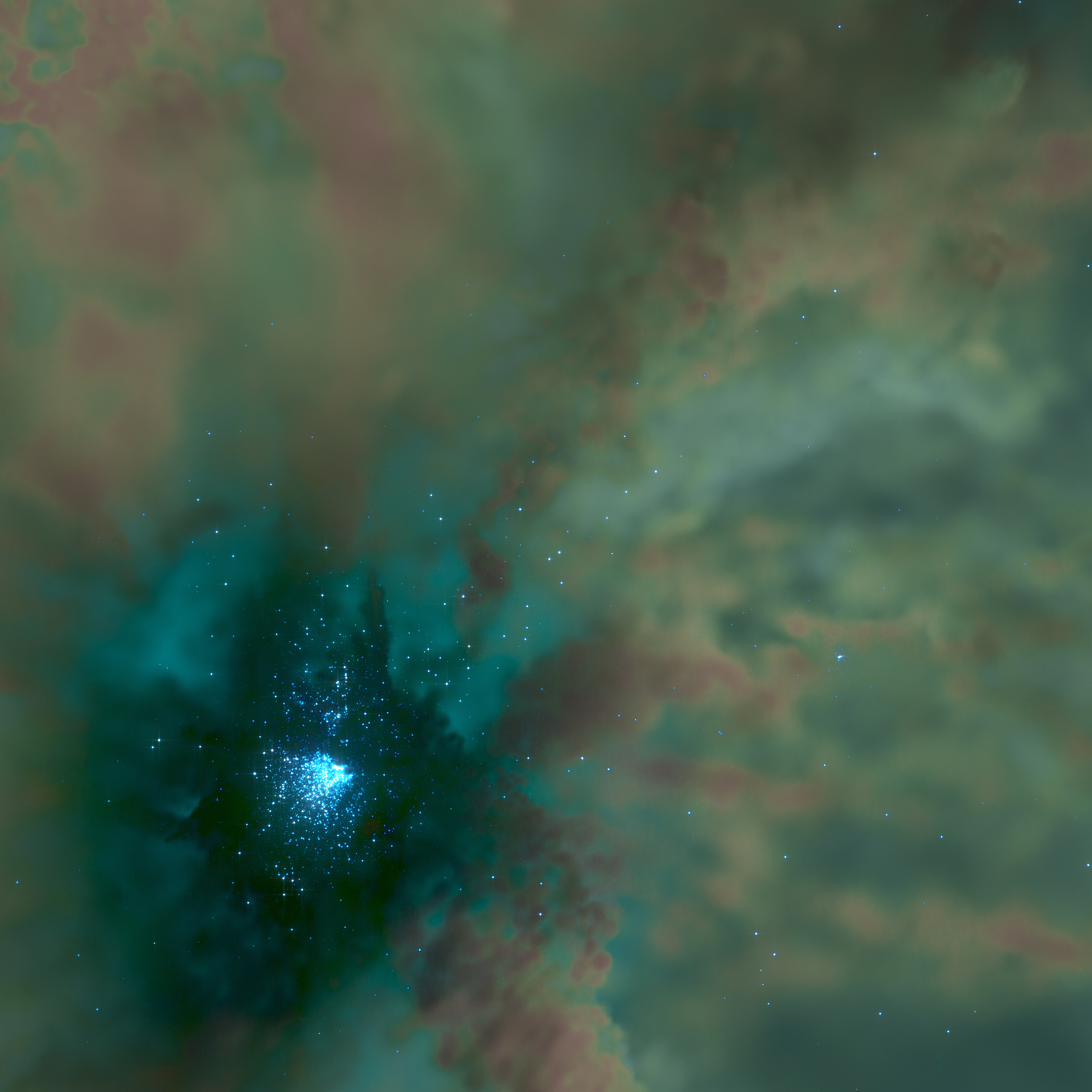
Simulation of globular cluster formation. Individual blue-white stars can be seen. The “cloud” around them is interstellar gas. The gas color gradation shows cooler (dark) and warmer (bright) regions. Credit: Michiko Fujii and Takaaki Takeda. 2024 Download image (3.7MB)

The first star-by-star simulations of globular cluster formation show that massive star collisions can start a runaway process resulting in the formation of intermediate-mass black holes. These results can help explain the origins of this rare type of black holes.

Known black holes generally fall into two categories; low mass black holes with dozens of times the mass of the Sun and high mass black holes with masses more than tens-of-thousands of times that of the Sun. However, black holes with masses in between those two are rarely found, and are considered a major mystery in the evolution of black holes.

One possible place to look for intermediate-mass black holes is in globular clusters, self-contained globs of stars in the halo around the Milky Way Galaxy. One of the hypotheses for the formation of black holes in globular clusters is a “runaway collision” of stars in forming star clusters embedded in their parental molecular clouds. To confirm this theory, however, simulations that reproduce the motion of individual stars inside molecular clouds are needed, but have not been possible due to problems with computational techniques and computer capabilities. Previous simulations of globular cluster evolution have reduced computing costs by bundling stars into groups to track their motion. But these simulations could not reproduce runaway collisions.

A team led by Michiko S. Fujii at The University of Tokyo tested a new recipe for intermediate black holes using the world’s most powerful supercomputer dedicated to astronomy, ATERUI II at the National Astronomical Observatory of Japan. Their new simulation code and the performance of ATERUI II have enabled the world’s first simulation of the formation of individual stars in globular clusters, accurately reproducing the motion of more than one million stars in the interstellar gas, including their collisions and mergers, without eating up unrealistic amounts of computing time.

The results of the simulation show that runaway collisions of stars occur in the cluster during its formation, eventually forming a massive star with a mass about 10,000 times that of the Sun. Calculations based on stellar evolution theory predict that the massive star would become an intermediate-mass black hole with a mass three to four thousand times that of the Sun. This result provides strong theoretical support for the existence of intermediate-mass black holes in globular clusters.


Detailed Article(s)

Medium and mighty: intermediate-mass black holes can survive in globular clusters

The University of Tokyo


Release Information

Researcher(s) Involved in this Release:


Michiko S. Fujii (Department of Astronomy, Graduate School of Science, The University of Tokyo)
Ataru Tanikawa (Center for Information Science, Fukui Prefectural University)
Yutaka Hirai (Astronomical Institute, Tohoku University)
Takayuki Saitoh (Department of Planetology, Graduate School of Science, Kobe University)


Coordinated Release Organization(s):

The University of Tokyo
Fukui Prefectural University
Tohoku University
Kobe University
National Astronomical Observatory of Japan


Paper(s):

Michiko S. Fujii et al. “Simulations predict intermediate-mass black hole formation in globular clusters”, in Science, DOI: 10.1126/science.adi4211

Saturday, July 22, 2023

When White Dwarf Is on the Menu By Ben Cassese


Not everything astronomers observe has firmly supported explanations. Recently, however, advanced simulations have supported the hypothesis that certain flashes are the sign of a white dwarf in trouble.


A snapshot of a hydrodynamical simulation. The white dwarf core is shown in the inset; the long, spiraled streamer of gas represents material that has already been tidally stripped. Credit: Chen et al. 2023


Intermediate Mass, Extreme Danger

Intermediate mass black holes, though several thousand times smaller than their supermassive cousins, share many of the same egotistical personality traits. The more famous gargantuans tend to make themselves the center of attention by living in the middle of large galaxies and surrounding themselves with a dense core of stellar sycophants. Intermediate mass black holes similarly enjoy the spotlight, but on a smaller scale: they inhabit the centers of dwarf galaxies, or even smaller stellar clusters, but also surround themselves with many tightly-packed stars.

As a result of this dense environment, every now and then a star will get gravitationally bumped by its neighbors onto a trajectory that will carry it too close to the central black hole. Once within a certain distance, the star is doomed: as punishment for crossing an unseen barrier, the black hole will stretch the star into a long string of gas, which it will then consume. An even grislier fate awaits hardy white dwarf stars bumped onto very special trajectories that only graze this minimum distance. These stars will continue to circle the black hole on elongated, eccentric orbits, but each time they reach their closest distance, their outermost material will be peeled off and stripped away. Instead of destroying them quickly, the black hole will extend their suffering, slowly consuming them layer by layer, all the while burping out X-rays with each snack.
 

The rate at which a white dwarf loses mass to the black hole. Over time, tidal stripping becomes more and more effective, until a certain point at which the white dwarf cannot maintain its structural integrity and is completely disrupted. Credit: Chen et al. 2023


A Simulated Feast

That’s the story, anyway. Although astronomers have guessed that some strange X-ray flashes and quasi-repeating flares are the signs of the drawn-out ends to white dwarfs, they’ve never been sure since the process has mostly been studied only with analytic approximations. To more confidently attribute these strange observations to the slow deaths of white dwarfs near intermediate mass black holes, a team led by Jin-Hong Chen (Sun Yat-sen University) completed detailed hydrodynamical simulations that more accurately mimic the gruesome process.

The team found that yes, if intermediate mass black holes really were feasting on unsuspecting white dwarfs, they would periodically emit bright bursts of X-rays that we could detect with specialized space-based telescopes. Equally exciting, the team also found that if the dance of death were close enough to Earth (within about 100 million light-years, “nearby” by cosmic standards), next-generation gravitational wave detectors could also likely record the inspiral.

Though the instruments needed to record such a signal are still several years away, these accurate simulations of white dwarf tidal stripping will help future astronomers make sense of the strange, somewhat frightening processes that make things flash in the night.

By Ben Cassese


Citation

“Tidal Stripping of a White Dwarf by an Intermediate-mass Black Hole,” Jin-Hong Chen et al 2023 ApJ 947 32. doi:10.3847/1538-4357/acbfb6


Friday, April 22, 2022

Black Holes Raze Thousands of Stars to Fuel Growth

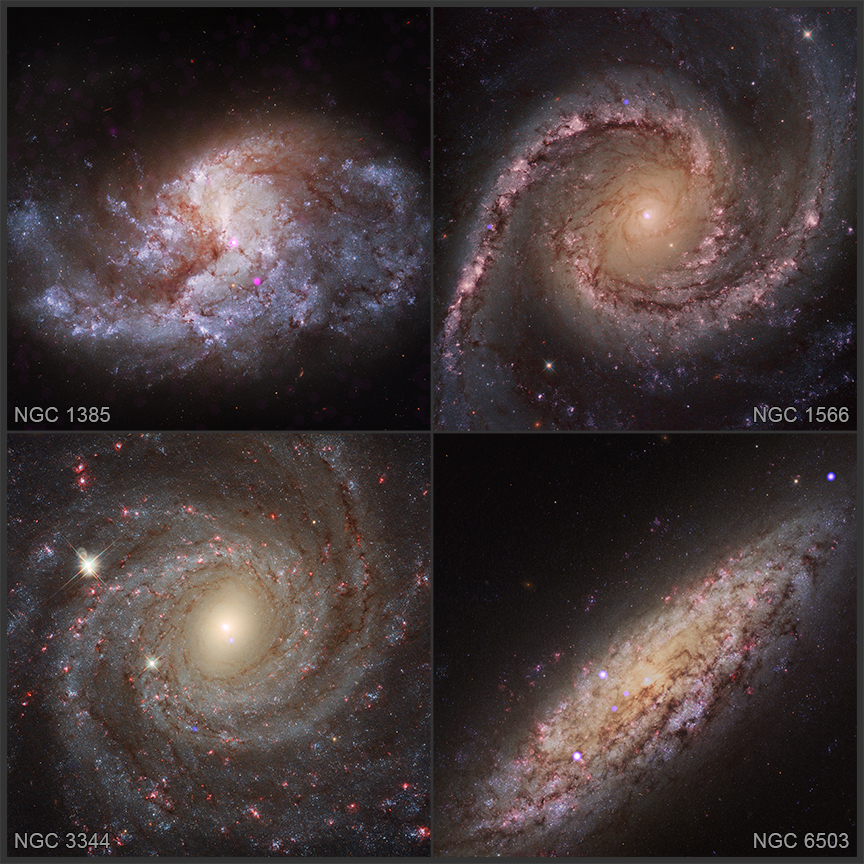
NGC 1385 - NGC 1566 - NGC 3344 - NGC 6503
Credit: X-ray: NASA/CXC/Washington State Univ./V. Baldassare et al.; Optical: NASA/ESA/STScI


JPEG (849.3 kb) - Large JPEG (42.2 MB)- Tiff (107.8 MB)- More Images

Tour: Chandra Archive Collection-More Animations


A new survey of over 100 galaxies by NASA's Chandra X-ray Observatory has uncovered signs that black holes are demolishing thousands of stars in a quest to pack on weight. The four galaxies shown in this graphic are among 29 galaxies in the sample that showed evidence for growing black holes near their centers. X-rays from Chandra (blue) have been overlaid on optical images from NASA's Hubble Space Telescope of the galaxies NGC 1385, NGC 1566, NGC 3344, and NGC 6503. The boxes that appear in the roll-over outline the location of the burgeoning black holes.

These new results suggest a somewhat violent path for at least some of these black holes to reach their present size — stellar destruction on a scale that has rarely if ever been seen before.

Astronomers have made detailed studies of two distinct classes of black holes. The smaller variety are "stellar-mass" black holes that typically weigh 5 to 30 times the mass of the Sun. On the other end of the spectrum are the supermassive black holes that live in the middle of most large galaxies, which weigh millions or even billions of solar masses. In recent years, there has also been evidence that an in-between class called "intermediate-mass black holes" (IMBHs) exists. The new study with Chandra could explain how such IMBHs are made through the runaway growth of stellar-mass black holes.

One key to making IMBHs may be their environment. This latest research looked at very dense clusters of stars in the centers of galaxies. With stars in such close proximity, many stars will pass within the gravitational pull of black holes in the centers of the clusters. Theoretical work by the team implies that if the density of stars in a cluster — the number packed into a given volume — is above a threshold value, a stellar-mass black hole at the center of the cluster will undergo rapid growth as it pulls in, shreds and ingests the abundant neighboring stars in close proximity.

Of the clusters in the new Chandra study, the ones with density above this threshold had about twice as many growing black holes as the ones below the density threshold. The density threshold depends also on how quickly the stars in the clusters are moving.

The process suggested by the latest Chandra study can occur at any time in the universe's history, implying that intermediate-mass black holes can form billions of years after the Big Bang, right up to the present day.

A paper describing these results was accepted and appears in The Astrophysical Journal. It is also available online. The authors of the study are Vivienne Baldassare (Washington State University), Nicolas C. Stone (Hebrew University in Jerusalem, Israel), Adi Foord (Stanford University), Elena Gallo (University of Michigan), and Jeremiah Ostriker (Princeton University).

NASA's Marshall Space Flight Center manages the Chandra program. The Smithsonian Astrophysical Observatory's Chandra X-ray Center controls science operations from Cambridge, Massachusetts, and flight operations from Burlington, Massachusetts.


Fast Facts for NGC 1385:

Credit: X-ray: NASA/CXC/Washington State Univ./V. Baldassare et al.; Optical: NASA/ESA/STScI
Scale: Image is about 2.68 arcmin (33,400 light years) across
Category: Black Holes, Normal Galaxies & Starburst Galaxies
Coordinates (J2000): RA 3h 37m 28.33s | -24° 30' 3.22"
Constellation:
Fornax
Observation Dates: Dec 6, 2018
Observation Time: 1 hour 24 minutes
Obs. IDs: 21473
Instrument:
ACIS
Color Code: X-ray: blue; Optical: red, green, and blue
Distance Estimate: About 43 million light years


Fast Facts for NGC 1566:

Credit: X-ray: NASA/CXC/Washington State Univ./V. Baldassare et al.; Optical: NASA/ESA/STScI
Scale: Image is about 2.77 arcmin (25,700 million light years) across
Category: Black Holes, Normal Galaxies & Starburst Galaxies
Coordinates (J2000): RA 4h 20m 0.27s | Dec -54° 56' 12.02"
Constellation:
Dorado
Observation Dates: Dec 3, 2018
Observation Time: 51 minutes
Obs. IDs: 21478
Instrument:
ACIS
Color Code: X-ray: blue; Optical: red, green, and blue
Distance Estimate: About 32 million light years


Fast Facts for NGC 3344:

Credit: X-ray: NASA/CXC/Washington State Univ./V. Baldassare et al.; Optical: NASA/ESA/STScI
Scale: Image is about 2.58 arcmin (46,400 light years) across
Category: Black Holes, Normal Galaxies & Starburst Galaxies
Coordinates (J2000): RA 10h 43m 31.08s | Dec +24° 55" 14.25'
Constellation: Leo Minor
Observation Dates: 2 observations, Jan 25, 2006 & Jan 21, 2013
Observation Time: 13 hours 40 minutes
Obs. IDs: 7087, 15387
Instrument:
ACIS
Color Code: X-ray: blue; Optical: red, green, and blue
Distance Estimate: About 62 million light years


Fast Facts for NGC 6503:

Credit: X-ray: NASA/CXC/Washington State Univ./V. Baldassare et al.; Optical: NASA/ESA/STScI
Scale: Image is about 2.68 arcmin (13,700 light years) across
Category: Black Holes, Normal Galaxies & Starburst Galaxies
Coordinates (J2000): RA 17h 49m 23.4s | Dec +70° 8' 51.12"
Constellation:
Draco
Observation Dates: 2 observations, Mar 23, 2000 & Oct 27, 2000
Observation Time: 4 hours 14 minutes
Obs. IDs: 872, 1640
Instrument:
ACIS
Color Code: X-ray: blue; Optical: red, green, and blue
Distance Estimate: About 18 million light years


Wednesday, April 01, 2020

Hubble Finds Best Evidence for Elusive Mid-Size Black Hole

Intermediate-Mass Black Hole with Torn-Apart Star (Artist’s Impression)

Black Hole in a Star Cluster (Artist's Impression)

Hubble Observation of Intermediate-Mass Black Hole

Ground-Based View of J2150−0551 Region


Videos

A rare and exotic intermediate-mass black hole (artist’s impression)


New data from the NASA/ESA Hubble Space Telescope have provided the strongest evidence yet for mid-sized black holes in the Universe. Hubble confirms that this “intermediate-mass” black hole dwells inside a dense star cluster.

Intermediate-mass black holes (IMBHs) are a long-sought “missing link” in black hole evolution. There have been a few other IMBH candidates found to date. They are smaller than the supermassive black holes that lie at the cores of large galaxies, but larger than stellar-mass black holes formed by the collapse of massive stars. This new black hole is over 50 000 times the mass of our Sun.

> IMBHs are hard to find. “Intermediate-mass black holes are very elusive objects, and so it is critical to carefully consider and rule out alternative explanations for each candidate. That is what Hubble has allowed us to do for our candidate,” said Dacheng Lin of the University of New Hampshire, principal investigator of the study1.

Lin and his team used Hubble to follow up on leads from NASA’s Chandra X-ray Observatory and the European Space Agency’s X-ray Multi-Mirror Mission (XMM-Newton), which carries three high-throughput X-ray telescopes and an optical monitor to make long uninterrupted exposures providing highly sensitive observations.

“Adding further X-ray observations allowed us to understand the total energy output,” said team member Natalie Webb of the Université de Toulouse in France. “This helps us to understand the type of star that was disrupted by the black hole.”

"In 2006 these high-energy satellites detected a powerful flare of X-rays, but it was not clear if they originated from inside or outside of our galaxy. Researchers attributed it to a star being torn apart after coming too close to a gravitationally powerful compact object, like a black hole.

Surprisingly, the X-ray source, named 3XMM J215022.4−055108, was not located in the centre of a galaxy, where massive black holes normally reside. This raised hopes that an IMBH was the culprit, but first another possible source of the X-ray flare had to be ruled out: a neutron star in our own Milky Way galaxy, cooling off after being heated to a very high temperature. Neutron stars are the extremely dense remnants of an exploded star.

Hubble was pointed at the X-ray source to resolve its precise location. Deep, high-resolution imaging confirmed that the X-rays emanated not from an isolated source in our galaxy, but instead in a distant, dense star cluster on the outskirts of another galaxy — just the sort of place astronomers expected to find evidence for an IMBH. Previous Hubble research has shown that the more massive the galaxy, the more massive its black hole. Therefore, this new result suggests that the star cluster that is home to 3XMM J215022.4−055108 may be the stripped-down core of a lower-mass dwarf galaxy that has been gravitationally and tidally disrupted by its close interactions with its current larger galaxy host.

IMBHs have been particularly difficult to find because they are smaller and less active than supermassive black holes; they do not have readily available sources of fuel, nor do they have a gravitational pull that is strong enough for them to be constantly drawing in stars and other cosmic material and producing the tell-tale X-ray glow. Astronomers therefore have to catch an IMBH red-handed in the relatively rare act of gobbling up a star. Lin and his colleagues combed through the XMM-Newton data archive, searching hundreds of thousands of sources to find strong evidence for this one IMBH candidate. Once found, the X-ray glow from the shredded star allowed astronomers to estimate the black hole’s mass.

Confirming one IMBH opens the door to the possibility that many more lurk undetected in the dark, waiting to be given away by a star passing too close. Lin plans to continue this meticulous detective work, using the methods his team has proved successful.

“Studying the origin and evolution of the intermediate mass black holes will finally give an answer as to how the supermassive black holes that we find in the centres of massive galaxies came to exist,” added Webb.

Black holes are one of the most extreme environments humans are aware of, and so they are a testing ground for the laws of physics and our understanding of how the Universe works. Does a supermassive black hole grow from an IMBH? How do IMBHs themselves form? Are dense star clusters their favoured home? With a confident conclusion to one mystery, Lin and other black hole astronomers find they have many more exciting questions to pursue.


Notes

[1] The results are published in the Astrophysical Journal Letters and were a result of the HST Program GO-15441


More information

The Hubble Space Telescope is a project of international cooperation between ESA and NASA.

The international team of astronomers in this study consists of D. Lin, J. Strader, A. J. Romanowski, J. A. Irwin, O. Godet, D. Barret, N. A. Webb, J. Homan, and R. A. Remillard.

Image credit: ESA/Hubble, M. Kornmesser


Links


Contact

Dacheng Lin
University of New Hampshire
Durham, New Hampshire, USA
Email: dacheng.lin@unh.edu

Bethany Downer
ESA/Hubble, Public Information Officer
Garching, Germany
Email: bethany.downer@partner.eso.org


Thursday, September 06, 2018

AM 0644-741: Cosmic Collision Forges Galactic One Ring -- in X-rays

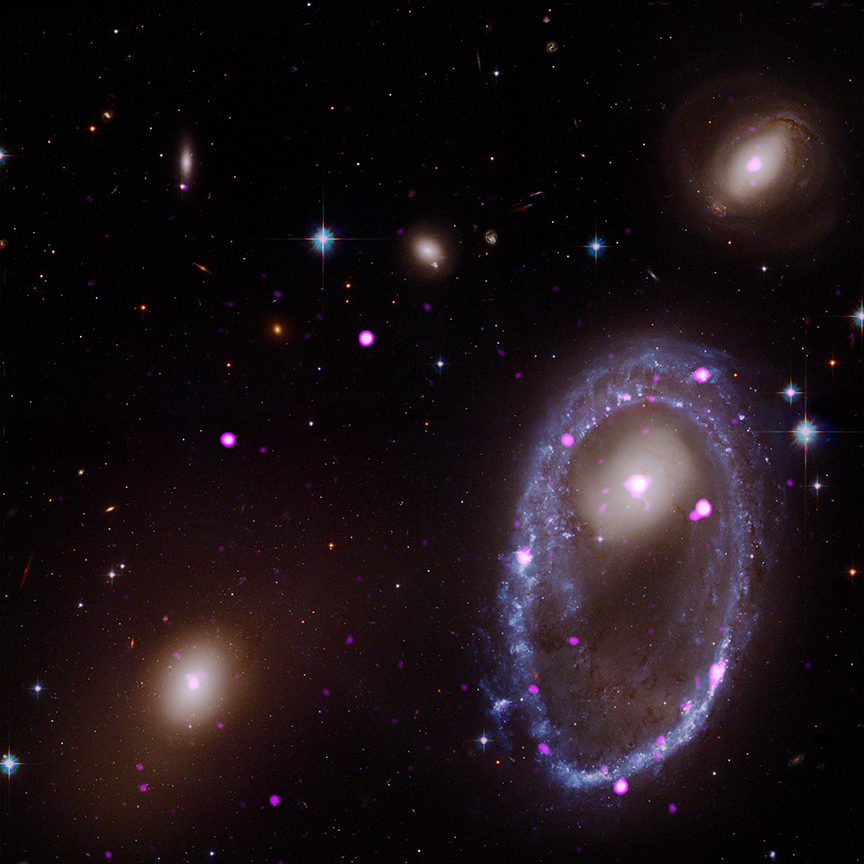
 AM 0644-741
Credit X-ray: NASA/CXC/INAF/A. Wolter et al; Optical: NASA/STScI


Astronomers have used NASA's Chandra X-ray Observatory to discover a ring of black holes or neutron stars in a galaxy 300 million light years from Earth.

This ring, while not wielding power over Middle Earth, may help scientists better understand what happens when galaxies smash into one another in catastrophic impacts.

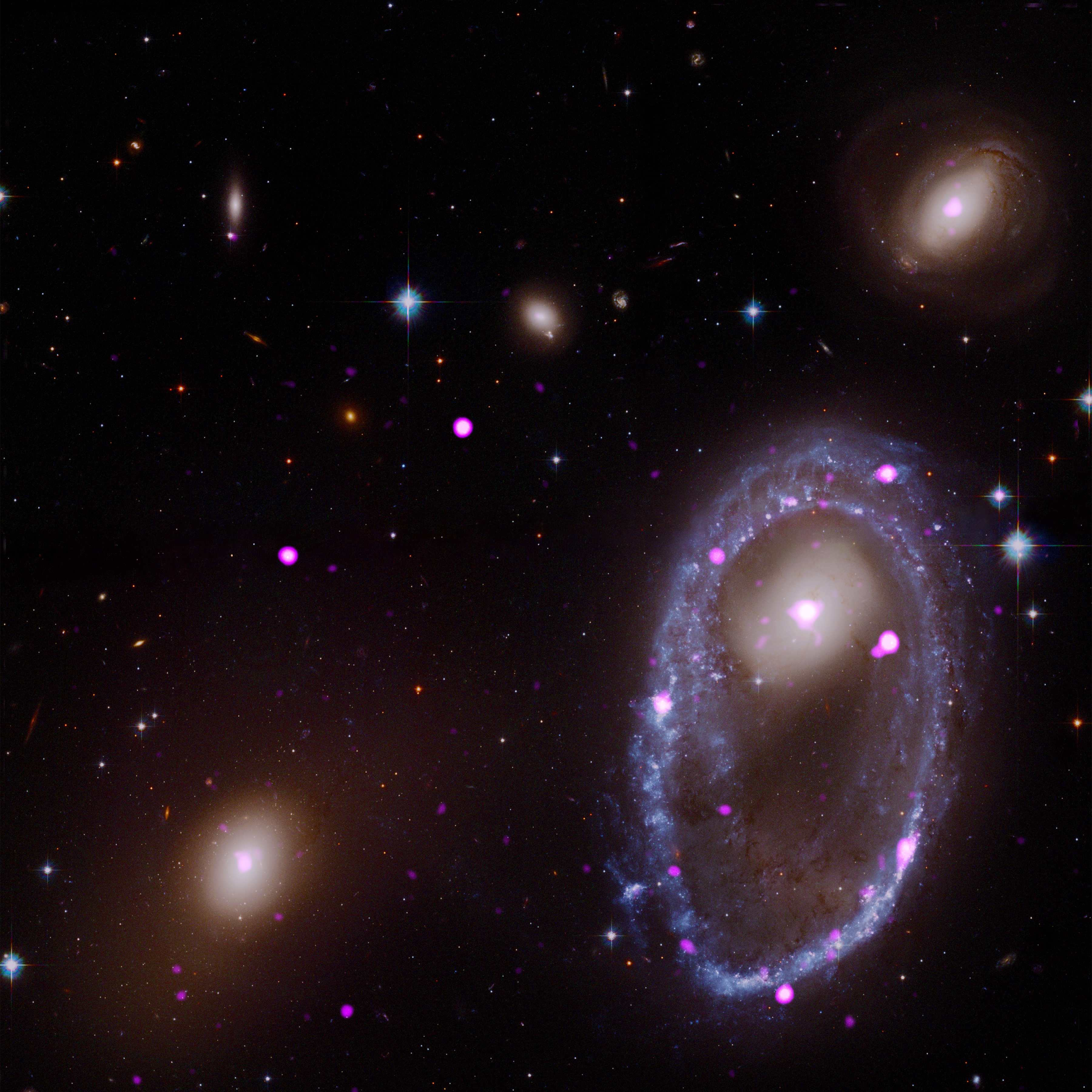
In this new composite image of the galaxy AM 0644-741 (AM 0644 for short), X-rays from Chandra (purple) have been combined with optical data from NASA's Hubble Space Telescope (red, green, and blue). The Chandra data reveal the presence of very bright X-ray sources, most likely binary systems powered by either a stellar-mass black hole or neutron star, in a remarkable ring. The results are reported in a new paper led by Anna Wolter from INAF-Osservatorio Astronomico di Brera in Milano, Italy.

Where did the ring of black holes or neutron stars in AM 0644 come from? Astronomers think that it was created when one galaxy was pulled into another galaxy by the force of gravity. The first galaxy generated ripples in the gas of the second galaxy, AM 0644, located in the lower right. These ripples then produced an expanding ring of gas in AM 0644 that triggered the birth of new stars. The first galaxy is possibly the one located in the lower left of the image.

The most massive of these fledgling stars will lead short lives — in cosmic terms — of millions of years. After that, their nuclear fuel is spent and the stars explode as supernovas leaving behind either black holes with masses typically between about five to twenty times that of the Sun, or neutron stars with a mass approximately equal to that of the Sun.

Some of these black holes or neutron stars have close companion stars, and siphon gas from their stellar partner. This gas falls towards the black hole or neutron star, forming a spinning disk like water circling a drain, and becomes heated by friction. This superheated gas produces large amounts of X-rays that Chandra can detect.

While a ring of black holes or neutron stars is intriguing in itself, there is more to the story of AM 0644. All of the X-ray sources detected in the ring of AM 0644 are bright enough to be classified as ultraluminous X-ray sources (ULXs). This is a class of objects that produce hundreds to thousands of times more X-rays than most "normal" binary systems in which a companion star is in orbit around a neutron star or black hole. Until recently most astronomers thought that ULXs generally contained stellar-mass black holes, with the possible presence in some cases of intermediate-mass black holes (IMBHs) that contain over a hundred times the mass of the Sun. However, this thinking was overturned when a few ULXs in other galaxies, including M82 and M51, were found to contain neutron stars.

Several other explanations besides IMBHs have been suggested for the intense X-ray emission of ULXs. They include unusually rapid growth of the black hole or neutron star, or geometrical effects arising from the funneling of infalling material along magnetic field lines. 

The identity of the individual ULXs in AM 0644 is currently unknown. They may be a mixture of black holes and neutron stars, and it is also possible that they are all black holes or all neutron stars.

Not all of the X-ray sources in the image are located in the ring of AM 0644. One of the sources is a rapidly growing black hole that's located well behind the galaxy at a distance of 9.1 billion light years from Earth. Another intriguing source detected by Chandra is a growing supermassive black hole located at the center of the galaxy. In the new study, the researchers also used Chandra observations to study six other ring galaxies in addition to AM 0644. A total of 63 sources were detected in the seven galaxies, and 50 of them are ULXs. The authors see a larger average number of ULXs per galaxy in these ring galaxies than in other types of galaxies. Ring galaxies have stimulated the interest of astronomers because they are ideal testbeds for examining models of how double stars form, and understanding the origin of ULXs.

The paper describing the study of AM 0644 and its sister ring galaxies appeared in the August 10, 2018 issue of the Astrophysical Journal and is available online. The co-authors of the paper are Antonella Fruscione from the Harvard-Smithsonian Center for Astrophysics in Cambridge, Mass., and Michela Mapelli from INAF-Osservatorio Astronomico di Padova in Padova, Italy.

NASA's Marshall Space Flight Center in Huntsville, Alabama, manages the Chandra program for NASA's Science Mission Directorate in Washington. The Smithsonian Astrophysical Observatory in Cambridge, Massachusetts, controls Chandra's science and flight operations.


Fast Facts for AM 0644-741:

Scale: Image is about 3.25 arcmin (280,000 light years) across
Category: Normal Galaxies & Starburst Galaxies, Black Holes
Coordinates (J2000): RA 06h 43m 06.1s | Dec -74° 13´ 35
Constellation: Volans
Observation Date: November 17, 2003
Observation Time: 10 hours
Obs. ID: 3969
Instrument: ACIS
References: Wolter, A. et al, 2018, ApJ, 863,43; arXiv:1806.02746
Color Code: X-ray: purple; Optical: red, green, blue
Distance Estimate: About 300 million light years


Sunday, August 05, 2018

Finding the Happy Medium of Black Holes

Black Hole Ilustration
Credit: X-ray: NASA/CXC/ICE/M.Mezcua et al.; 
Infrared: NASA/JPL-Caltech; 
Illustration: NASA/CXC/A.Hobart


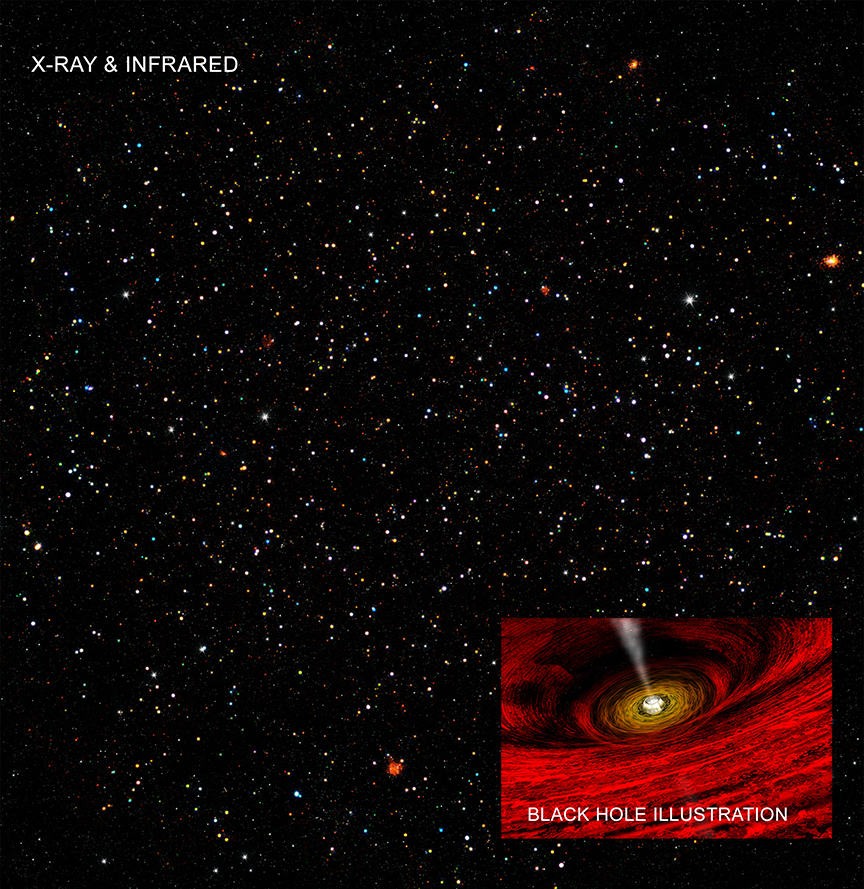
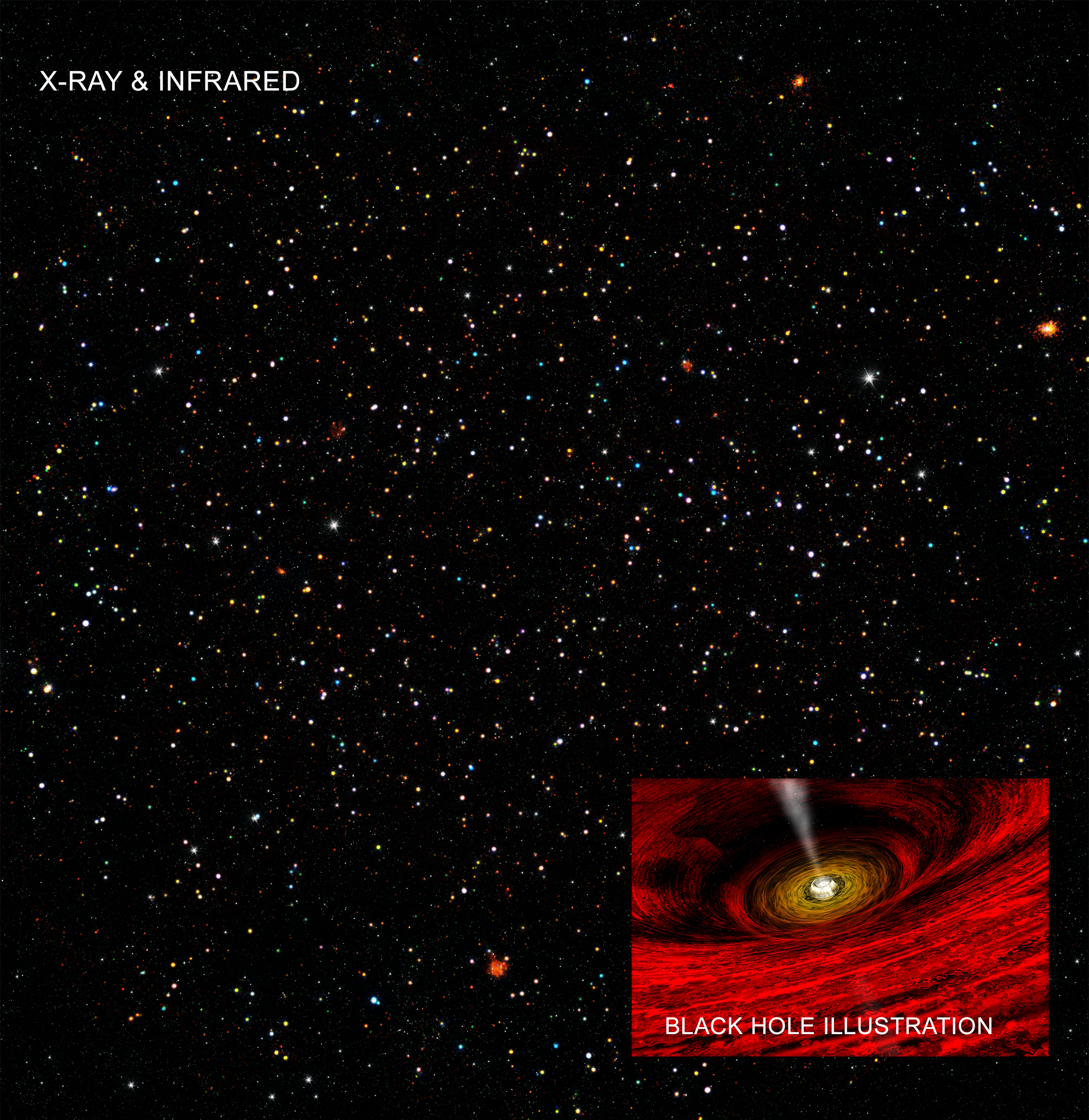
This image shows data from a massive observing campaign that includes NASA's Chandra X-ray Observatory. These Chandra data have provided strong evidence for the existence of so-called intermediate-mass black holes (IMBHs). Combined with a separate study also using Chandra data, these results may allow astronomers to better understand how the very largest black holes in the early Universe formed, as described in our latest press release.

The COSMOS ("cosmic evolution survey") Legacy Survey has assembled data from some of the world's most powerful telescopes spanning the electromagnetic spectrum. This image contains Chandra data from this survey, equivalent to about 4.6 million seconds of observing time. The colors in this image represent different levels of X-ray energy detected by Chandra. Here the lowest-energy X-rays are red, the medium band is green, and the highest-energy X-rays observed by Chandra are blue. Most of the colored dots in this image are black holes. Data from the Spitzer Space Telescope are shown in grey. The inset shows an artist's impression of a growing black hole in the center of a galaxy. A disk of material surrounding the black hole and a jet of outflowing material are also depicted.

Two new separate studies using the Chandra COSMOS-Legacy survey data and other Chandra data have independently collected samples of IMBHs, an elusive category of black holes in between stellar mass black holes and the supermassive black holes found in the central regions of massive galaxies.

One team of researchers identified 40 growing black holes in dwarf galaxies. Twelve of them are located at distances more than five billion light years from Earth and the most distant is 10.9 billion light years away, the most distant growing black hole in a dwarf galaxy ever seen. Most of these sources are likely IMBHs with masses that are about 10,000 to 100,000 times that of the Sun.

A second team found a separate, important sample of possible IMBHs in galaxies that are closer to Earth. In this sample, the most distant IMBH candidate is about 2.8 billion light years from Earth and about 90% of the IMBH candidates they discovered are no more than 1.3 billion light years away.

They detected 305 galaxies in their survey with black hole masses less than 300,000 solar masses. Observations with Chandra and with ESA's XMM-Newton of a small part of this sample show that about half of the 305 IMBH candidates are likely to be valid IMBHs. The masses for the ten sources detected with X-ray observations were determined to be between 40,000 and 300,000 times the mass of the Sun.

IMBHs may be able to explain how the very biggest black holes, the supermassive ones, were able to form so quickly after the Big Bang. One leading explanation is that supermassive black holes grow over time from smaller black holes "seeds" containing about a hundred times the Sun's mass. Some of these seeds should merge to form IMBHs. Another explanation is that they form very quickly from the collapse of a giant cloud of gas with a mass equal to hundreds of thousands of times that of the Sun. There is yet to be a consensus among astronomers on the role IMBHs may play.

A paper describing the COSMOS-Legacy result by Mar Mezcua (Institute for Space Sciences, Spain) and colleagues was published in the August issue of the Monthly Notices of the Royal Astronomical Society and is available online. The paper by Igor Chilingarian (Harvard-Smithsonian Center for Astrophysics) on the closer IMBH sample is being published in the August 10th issue of The Astrophysical Journal and is available online.

NASA's Marshall Space Flight Center in Huntsville, Alabama, manages the Chandra program for NASA's Science Mission Directorate in Washington. The Smithsonian Astrophysical Observatory in Cambridge, Massachusetts, controls Chandra's science and flight operations.


Fast Facts for COSMOS Legacy Survey:

Category: Black Holes, Cosmology/Deep Fields/X-ray Background
Constellation: Sextans
Observation Date: 68 pointings between Nov 2012 and March 2014
Observation Time: 1277 hours (53 days 5 hours)
Obs. ID: 15207-15262, 15590, 15591, 15598, 15600, 15604-15606, 15649, 15653, 15655, 16544, 16562
Instrument: ACIS
References: Mezcua, M. et al., 2018, MNRAS, 478, 2576; arXiv:1802.01567; [Non-COSMOS study: Chilingarian, I. et al., 2018, ApJ, 873, 1; arXiv:1805.01467]
Distance Estimate: About 410 million to 11.0 billion light years