Thursday, February 22, 2024

Cosmic Dark Matter Web Detected in Coma Cluster


Figure 1: Dark matter in the Coma Cluster region. The distribution of dark matter calculated based on this research (dark green cloud) is overlayed on an image of the Coma Cluster and more distant background galaxies taken by the Subaru Telescope. Strands of dark matter can be seen extending millions of light years. Credit: HyeongHan et al.

The Subaru Telescope has spotted the terminal ends of dark matter filaments in the Coma Cluster stretching across millions of light years. This is the first time that strands of the cosmic web spanning the entire Universe have been directly detected. This provides new evidence to test theories about the evolution of the Universe.

In the Solar System we are used to seeing matter gathered into round objects like planets, moons, and the Sun. But dark matter, which accounts for most of the mass in the Universe, is believed to exist as a web of long thin strands. But like a spider web, these strands can be hard to see, so astronomers have typically drawn conclusions based on observations of galaxies and gas stuck in the web. This is similar to how if you see a dead leaf that appears to hang in midair, you know there is a spider web that you cannot see.

A team of researchers from Yonsei University used the Subaru Telescope to look for direct signs of dark matter filaments in the Coma Cluster, located 321 million light-years away in the direction of the constellation Coma Berenices. The Coma Cluster is one of the largest and closest galaxy clusters, making it a good place to look for faint signs of dark matter. Ironically, because it is so close, it also appears large, making it difficult to observe the entire cluster. The Subaru Telescope offers the right combination of high sensitivity, high resolution, and wide field of view, to make these observations possible. Through robust data analysis, the team identified the terminal segments of the invisible dark matter filaments attached to the Coma Cluster. This is the first time these strands have been confirmed directly, giving new evidence for the idea that dark matter webs stretch across the Universe.

These results appeared as HyeongHan et al. "Weak-lensing detection of intracluster filaments in the Coma cluster" in Nature Astronomy on January 5, 2024.

This research is based on data collected at Subaru Telescope and obtained from SMOKA, which is operated by the Astronomy Data Center, National Astronomical Observatory of Japan.


Relevant Links


About the Subaru Telescope

The Subaru Telescope is a large optical-infrared telescope operated by the National Astronomical Observatory of Japan, National Institutes of Natural Sciences with the support of the MEXT Project to Promote Large Scientific Frontiers. We are honored and grateful for the opportunity of observing the Universe from Maunakea, which has cultural, historical, and natural significance in Hawai`i.


Wednesday, February 21, 2024

Brightest and fastest-growing: astronomers identify record-breaking quasar

PR Image eso2402a
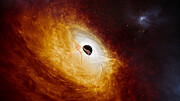
Artist’s impression of the record-breaking quasar J0529-4351

PR Image eso2402b
Wide-field of the region around the quasar J0529-4351


Videos

Astronomers identify record-breaking quasar | ESOcast Light  
PR Video eso2402a
Astronomers identify record-breaking quasar | ESOcast Light

Artist’s impression of the record-breaking quasar J0529-4351  
PR Video eso2402b
Artist’s impression of the record-breaking quasar J0529-4351

Zooming in on the record-breaking quasar J0529-4351  
PR Video eso2402c
Zooming in on the record-breaking quasar J0529-4351


Using the European Southern Observatory’s (ESO) Very Large Telescope (VLT), astronomers have characterised a bright quasar, finding it to be not only the brightest of its kind, but also the most luminous object ever observed. Quasars are the bright cores of distant galaxies and they are powered by supermassive black holes. The black hole in this record-breaking quasar is growing in mass by the equivalent of one Sun per day, making it the fastest-growing black hole to date.

The black holes powering quasars collect matter from their surroundings in a process so energetic that it emits vast amounts of light. So much so that quasars are some of the brightest objects in our sky, meaning even distant ones are visible from Earth. As a general rule, the most luminous quasars indicate the fastest-growing supermassive black holes.

“We have discovered the fastest-growing black hole known to date. It has a mass of 17 billion Suns, and eats just over a Sun per day. This makes it the most luminous object in the known Universe,” says Christian Wolf, an astronomer at the Australian National University (ANU) and lead author of the study published today in Nature Astronomy. The quasar, called J0529-4351, is so far away from Earth that its light took over 12 billion years to reach us.

The matter being pulled in toward this black hole, in the form of a disc, emits so much energy that J0529-4351 is over 500 trillion times more luminous than the Sun [1]. “All this light comes from a hot accretion disc that measures seven light-years in diameter — this must be the largest accretion disc in the Universe," says ANU PhD student and co-author Samuel Lai. Seven light-years is about 15 000 times the distance from the Sun to the orbit of Neptune.

And, remarkably, this record-breaking quasar was hiding in plain sight. “It is a surprise that it has remained unknown until today, when we already know about a million less impressive quasars. It has literally been staring us in the face until now,” says co-author Christopher Onken, an astronomer at ANU. He added that this object showed up in images from the ESO Schmidt Southern Sky Survey dating back to 1980, but it was not recognised as a quasar until decades later.

Finding quasars requires precise observational data from large areas of the sky. The resulting datasets are so large, researchers often use machine-learning models to analyse them and tell quasars apart from other celestial objects. However, these models are trained on existing data, which limits the potential candidates to objects similar to those already known. If a new quasar is more luminous than any other previously observed, the programme might reject it and classify it instead as a star not too distant from Earth.

An automated analysis of data from the European Space Agency’s Gaia satellite passed over J0529-4351 for being too bright to be a quasar, suggesting it to be a star instead. The researchers identified it as a distant quasar last year using observations from the ANU 2.3-metre telescope at the Siding Spring Observatory in Australia. Discovering that it was the most luminous quasar ever observed, however, required a larger telescope and measurements from a more precise instrument. The X-shooter spectrograph on ESO’s VLT in the Chilean Atacama Desert provided the crucial data.

The fastest-growing black hole ever observed will also be a perfect target for the GRAVITY+ upgrade on ESO’s VLT Interferometer (VLTI), which is designed to accurately measure the mass of black holes, including those far away from Earth. Additionally, ESO’s Extremely Large Telescope (ELT), a 39-metre telescope under construction in the Chilean Atacama Desert, will make identifying and characterising such elusive objects even more feasible.

Finding and studying distant supermassive black holes could shed light on some of the mysteries of the early Universe, including how they and their host galaxies formed and evolved. But that’s not the only reason why Wolf searches for them. “Personally, I simply like the chase,” he says. “For a few minutes a day, I get to feel like a child again, playing treasure hunt, and now I bring everything to the table that I have learned since.”

Source: ESO/News


Notes

[1] A few years ago, NASA and the European Space Agency reported that the Hubble Space Telescope had discovered a quasar, J043947.08+163415.7, as bright as 600 trillion Suns. However, that quasar’s brightness was magnified by a ‘lensing’ galaxy, located between us and the distant quasar. The actual luminosity of J043947.08+163415.7 is estimated to be equivalent to about 11 trillion Suns (1 trillion is a million million: 1 000 000 000 000 or 1012).


More information

This research was presented in a paper titled “The accretion of a solar mass per day by a 17-billion solar mass black hole” to appear in Nature Astronomy (doi:10.1038/s41550-024-02195-x).

The team is composed of Christian Wolf (Research School of Astronomy and Astrophysics, Australian National University, Australia [ANU] and Centre for Gravitational Astrophysics, Australian National University, Australia [CGA]), Samuel Lai (ANU), Christopher A. Onken (ANU), Neelesh Amrutha (ANU), Fuyan Bian (European Southern Observatory, Chile), Wei Jeat Hon (School of Physics, University of Melbourne, Australia [Melbourne]), Patrick Tisserand (Sorbonne Universités, CNRS, UMR 7095, Institut d’Astrophysique de Paris, France), and Rachel L. Webster (Melbourne).

The European Southern Observatory (ESO) enables scientists worldwide to discover the secrets of the Universe for the benefit of all. We design, build and operate world-class observatories on the ground — which astronomers use to tackle exciting questions and spread the fascination of astronomy — and promote international collaboration for astronomy. Established as an intergovernmental organisation in 1962, today ESO is supported by 16 Member States (Austria, Belgium, the Czech Republic, Denmark, France, Finland, Germany, Ireland, Italy, the Netherlands, Poland, Portugal, Spain, Sweden, Switzerland and the United Kingdom), along with the host state of Chile and with Australia as a Strategic Partner. ESO’s headquarters and its visitor centre and planetarium, the ESO Supernova, are located close to Munich in Germany, while the Chilean Atacama Desert, a marvellous place with unique conditions to observe the sky, hosts our telescopes. ESO operates three observing sites: La Silla, Paranal and Chajnantor. At Paranal, ESO operates the Very Large Telescope and its Very Large Telescope Interferometer, as well as survey telescopes such as VISTA. Also at Paranal ESO will host and operate the Cherenkov Telescope Array South, the world’s largest and most sensitive gamma-ray observatory. Together with international partners, ESO operates ALMA on Chajnantor, a facility that observes the skies in the millimetre and submillimetre range. At Cerro Armazones, near Paranal, we are building “the world’s biggest eye on the sky” — ESO’s Extremely Large Telescope. From our offices in Santiago, Chile we support our operations in the country and engage with Chilean partners and society.


Links


Contacts

Christian Wolf
Australian National University
Canberra, Australia
Tel: +61(02)-61256373
Cell: +61(0)415330371
Email:
christian.wolf@anu.edu.au

Samuel Lai
Australian National University
Canberra, Australia
Cell: +61 (0) 493418898
Email:
samuel.lai@anu.edu.au

Christopher Onken
Australian National University
Canberra, Australia
Tel: +61(0) 26125 8039
Email:
christopher.onken@anu.edu.au

Rachel L. Webster (study co-author)
University of Melbourne
Melbourne, Australia
Cell: +61(0) 425863209
Email:
r.webster@unimelb.edu.au

Bárbara Ferreira
ESO Media Manager
Garching bei München, Germany
Tel: +49 89 3200 6670
Cell: +49 151 241 664 00
Email:
press@eso.org


Tuesday, February 20, 2024

A high amount of ram

A dwarf spiral galaxy. The centre is not particularly bright and is covered by some dust, while the outer disc and halo wrap around as if swirling water. Across the face of the galaxy, an arc of brightly glowing spots marks areas where new stars are being formed. The galaxy is surrounded by tiny, distant galaxies on a dark background. Credit: ESA/Hubble & NASA, M. Sun

This image features IC 3476, a dwarf galaxy that lies about 54 million light-years from Earth in the constellation Coma Berenices. Whilst this image does not look very dramatic — if we were to anthropomorphise the galaxy, we might say it looks almost serene — the actual physical events taking place in IC 3476 are highly energetic. In fact, the little galaxy is undergoing a process known as ram pressure stripping, which is driving unusually high levels of star formation within regions of the galaxy itself.

We tend to associate the letters ‘ram’ with the acronym RAM, which refers to Random Access Memory in computing. However, ram pressure has a totally distinct definition in physics: it is the pressure exerted on a body when it moves through some form of fluid, due to the overall resistance of the fluid. In the case of entire galaxies experiencing ram pressure, the galaxies are the ‘bodies’ and the intergalactic or intracluster medium (the dust and gas that permeates the space between galaxies, and for the latter the spaces between galaxies in clusters) is the ‘fluid’.

Ram pressure stripping occurs when the ram pressure results in gas being stripped from the galaxy. This stripping away of gas can lead to a reduction in the level of star formation, or even its complete cessation, as gas is absolutely key to the formation of stars. However, the ram pressure can also cause other parts of the galaxy to be compressed, which can actually boost star formation. This is what seems to be taking place in IC 3476: there seems to be absolutely no star formation going on at the edge of the galaxy bearing the brunt of the ram pressure stripping, but then star formation rates within deeper regions of the galaxy seem to be markedly above the average.


Monday, February 19, 2024

What fuels the powerful engine of neutron star mergers?


Around sixty milliseconds after the merger, the simulation shows the jet emitted from the poles of the magnetar (up and down in this still image). The left panel shows the neutron richness of the ejected material. Blue denotes neutron-rich matter, and red denotes matter that contains neutrons and protons in roughly equal proportions. The middle panel shows surfaces of constant rest mass density. The purple curves indicate magnetic field lines. The right panel shows surfaces of constant magnetic field strength. The scale bar shows a length of 500 kilometers. Credit: Kota Hayashi (Max Planck Institute for Gravitational Physics

New computer simulation reveals the dynamo that generates large-scale magnetic fields in merging neutron stars

Merging and colliding neutron stars produce powerful kilonova explosions and gamma-ray bursts. Scientists have long suspected that a large and ultra-strong magnetic field is the engine behind these high-energy phenomena. However, the process that generates this magnetic field has been a mystery until now. Researchers at the Max Planck Institute for Gravitational Physics and at the universities in Kyoto and Toho have revealed the underlying mechanism by performing a super-high resolution computer simulation taking into account all fundamental physics. The researchers showed that ultra-strongly magnetized neutron stars, also known as magnetars, cause very bright kilonova explosions. Telescopic observations could test this prediction in the future.

Neutron stars are compact remnants of supernova explosions and consist of extremely dense matter. They are about 20 kilometers across and have up to twice the mass of our Sun, or almost 700,000 times the mass of our Earth. On August 17, 2017, astronomers observed for the first time gravitational waves, light, and gamma rays from the merger of two neutron stars. This event marked the beginning of a new kind of multi-messenger astronomy, combining gravitational-wave and electromagnetic observations.

Observations of the gravitational waves and the gamma-ray burst emitted during the merger revealed that binary neutron star mergers are the origin of at least a part of short-hard gamma-ray bursts and the heavy elements. “Only by performing a numerical simulation that takes into account all the fundamental physical effects in binary neutron star mergers will we fully understand the complete process and its underlying mechanisms,” explains Masaru Shibata, director of the Computational Relativistic Astrophysics department at the Max Planck Institute for Gravitational Physics in Potsdam. “That’s why we ran a merger simulation that took into account all the implications of Einstein’s theory of relativity and all other fundamental physics, with a spatial resolution more than ten times higher than any previous simulation, and the highest ever.”

What fuels the powerful engine of neutron star mergers?
New computer simulation reveals the dynamo that generates large-scale magnetic fields in merging neutron stars
© Kota Hayashi (Max Planck Institute for Gravitational Physics)
https://www.youtube.com/watch?v=x6qb_kt41Gs

As in the Sun so in the neutron star

High-energy phenomena associated with neutron-star mergers such as kilonova explosions and gamma-ray bursts are most likely driven by magnetohydrodynamics—the interplay between magnetic fields and fluids. This implies that a binary neutron star merger remnant must generate a strong, large-scale magnetic field via a dynamo mechanism.

“For the first time, we could pin down the physical mechanism that generates a large-scale magnetic field from smaller ones in binary neutron star mergers,” says Kenta Kiuchi, group leader in the Computational Relativistic Astrophysics department. “Part of this mechanism is the same that drives our Sun’s magnetic field. In a neutron star merger, the large-scale magnetic field emerges because of instabilities and vortices at the surface where the two neutron stars slam into one another.”

There are two phases of magnetic field amplifications: In a first phase, the Kelvin-Helmholtz instability rapidly amplifies the energy in the magnetic field by a factor of several thousand within a few milliseconds after the merger. “However, this amplified magnetic field still is a small-scale field,” explains Alexis Raboul-Salze, postdoctoral researcher in the Computational Relativistic Astrophysics department. “But after a few milliseconds, there is a second phase of magnetic field amplification due to another instability, the magnetorotational instability. This instability further amplifies the small-scale field and acts as a dynamo on the large-scale field – the same mechanism as in the Sun.”

The resulting highly magnetized massive neutron star born in the collision is hypothetically proposed as a magnetar. About 40 milliseconds after the merger the magnetic fields drives a strong particle wind at relativistic speeds from the poles of the magnetar. This wind forms a jet, which is related to the observed high-energy phenomena. The research group shows that this hypothesis is feasible for the first time.

“Our simulation suggests that the magnetar engine generates very bright kilonova explosions. We can test our prediction by multi-messenger observations in the near future,” concludes Masaru Shibata.


Media contact:

Dr. Elke Müller
Press Officer AEI
Potsdam, Scientific Coordinator
tel:+49 331 567-7303
tel:+49 331 567-7298

elke.mueller@aei.mpg.de

Scientific contacts:

Prof. Masaru Shibata
Director
tel:+49 331 567-7222
tel:+49 331 567-7298

masaru.shibata@aei.mpg.de

Dr. Kenta Kiuchi
Group Leader
tel:+49 331 567-7320

kenta.kiuchi@aei.mpg.de

Dr. Alexis Reboul-Salze
Junior Scientist/Postdoc
tel:+49 331 567-7234

alexis.reboul-salze@aei.mpg.de


Publication:

Kenta Kiuchi, Alexis Reboul-Salze, Masaru Shibata, Yuichiro Sekiguchi
A large-scale magnetic field produced by a solar-like dynamo in binary neutron star mergers
Nature Astronomy (2024)


Source | DOI


Sunday, February 18, 2024

JWST Photographs Possible Giant Planets Around White Dwarfs

Illustration of a cloudy exoplanet and a disk of debris orbiting a white dwarf star
Credit: NASA/JPL-Caltech


JWST has directly imaged what appear to be two giant exoplanets in orbit around white dwarf stars. This discovery has important implications for the fate of giant planets in our solar system as the Sun evolves into a red giant and eventually becomes a white dwarf.


A planetary nebula appears briefly during the life cycle of most stars, including those like the Sun. Planetary nebulae tend to appear round or elliptical, but they can have dramatically varied shapes, like NGC 5189 shown here. Credit: NASA, ESA, and the Hubble Heritage Team (STScI/AURA)

The Fate of Most Stars

While brilliant supernova explosions demand our attention when they burst onto the scene, the vast majority of stars will end their lives more quietly, lofting their outer layers into space and forming a glowing planetary nebula that surrounds the star’s exposed core. The core, now a white dwarf containing roughly the mass of the Sun in a sphere roughly the size of Earth, starts out extremely hot and cools slowly over billions of years.

As stars evolve from main-sequence stars to red giants to white dwarfs, it’s clear that close-in planets will meet a fiery fate: as a red giant, the Sun will swell to more than 200 times its current radius, engulfing Mercury, Venus, and possibly Earth. But exactly how the transition affects planets watching things unfold from a distance isn’t yet clear. To learn more, we’ll need to study planets that survived the transformation, and recent observations with JWST may have revealed two planets that fit the bill.

The two white dwarfs and their candidate planets. The object in the upper-left corner of the top row of images is a galaxy.
Credit: Mullally et al. 2024

Investigating Metal-Polluted White Dwarfs

Only a handful of planetary-mass objects have been discovered around white dwarfs, but many more are thought to exist; 25–50% of seemingly solo white dwarfs show metals in their spectra, which suggests that they’re collecting cast-off material from unseen planets or asteroids. If giant planets are common around these “metal-polluted” white dwarfs, it would suggest that 1) these planets are able to survive their home star’s red giant phase, and 2) they play a role in gravitationally nudging material toward the white dwarf.

Susan Mullally (Space Telescope Science Institute) and collaborators pointed JWST at four white dwarfs that may harbor planets. These white dwarfs have been shown to contain metals in their atmospheres and are young enough or close enough that their planets would be relatively bright. Even before carefully removing the white dwarfs’ light from the images, Mullally’s team spotted what they were looking for — a possible giant planet around two of the four white dwarfs.


A comparison of the ages and orbital separations of the two new planet candidates (red triangles), the four giant planets in our solar system (blue stars), and objects with masses less than 12 Jupiter masses discovered previously through direct imaging (black circles). Click to enlarge. Credit: Mullally et al. 2024

Potential Planets on Outlying Orbits

The observations show a reddish object near two of the white dwarfs. If these objects are indeed planets and the same ages as their host white dwarfs (5.3 and 1.6 billion years old), they likely have masses of 1–7 and 1–2 Jupiter masses, respectively. They’re currently orbiting at estimated distances of 11.47 and 34.62 astronomical units (au), which correspond to orbital distances of 5.3 au and 9.7 au when their host stars were on the main sequence — similar to the present-day orbital distances of Jupiter and Saturn.

While the objects appear to be associated with the white dwarfs, it’s not impossible for them to instead be small photobombing objects within our solar system or distant, reddish galaxies meandering in the background. The authors pin the likelihood of their detections being a false positive at 1 in 3,000.

If future JWST observations show that these white dwarfs and their candidate planetary companions march across the sky in step, it will mark the first direct imaging detection of planets similar to the giant planets in our solar system in age, mass, and orbital distance. More than that, it will provide evidence that widely separated planets survive their host stars ballooning into red giants, and that giant planets around white dwarfs are common and help their hosts accrete metal-rich material.

Citation

“JWST Directly Images Giant Planet Candidates Around Two Metal-Polluted White Dwarf Stars,” Susan E. Mullally et al 2024 ApJL 962 L32. doi:10.3847/2041-8213/ad2348

Saturday, February 17, 2024

Colouring what human eyes can’t see

A nebula with stars. The centre of the image from top-left to bottom-right glows brightly with light from where new stars are being formed, and is partially covered by dark dust. Coloured layers of gas and dust billow out across the rest of the image. The nebula is speckled with foreground stars with large diffraction spikes. Credit: ESA/Hubble & NASA, R. Fedriani, J. Tan

If the Hubble Picture of the Week from two weeks ago was somewhat dim and subtle in appearance, then this week’s image is a veritable riot of colour and activity! It features a relatively close-by star-forming region known as IRAS 16562-3959 that lies within the Milky Way in the constellation Scorpius, about 5900 light-years from Earth.

This image was compiled using observations from Hubble’s Wide Field Camera 3 (WFC 3). The detailed nuances of colour are possible because of the four separate filters that were used to collect the data. Filters are thin slivers of highly specialised material that only allow very specific wavelengths of light through. They can be slid in front of the part of the telescope that is sensitive to light, letting astronomers control which wavelengths of light the telescope collects with each observation. This is useful not only for specific scientific research, but also for the creation of images like this one.

Raw telescope observations are always monochrome, regardless of which filter was used. However, specially trained artists and image specialists can select colours that match the wavelength range covered by individual filters. Or, in the case where a direct match is not possible — such as for the data used in this image, which are all in the infrared regime, which human eyes are not sensitive to — the artist can select a colour that sensibly represents what is taking place. For example, they might assign bluer colours to shorter wavelengths and redder colours to longer wavelengths, as is the case in the visible light range. Then, data from multiple filters can be combined to build up a multi-colour image, that both looks beautiful and has scientific meaning.

At the centre of the image, IRAS 16562-3959 is thought to host a massive star — about 30 times the mass of our Sun — that is still in the process of forming. At the near-infrared wavelengths to which Hubble is sensitive, the central region appears dark because there is so much obscuring dust in the way. However near-infrared light leaks out mainly on two sides — upper left and lower right — where a powerful jet from the massive protostar has cleared away the dust. Multi-wavelength images including this incredible Hubble scene will help us gain a better understanding of how the most massive, brightest stars in our galaxy are born.


Friday, February 16, 2024

Extreme Eruption on Young Sun-like Star Signals Savage Environment for Developing Exoplanets


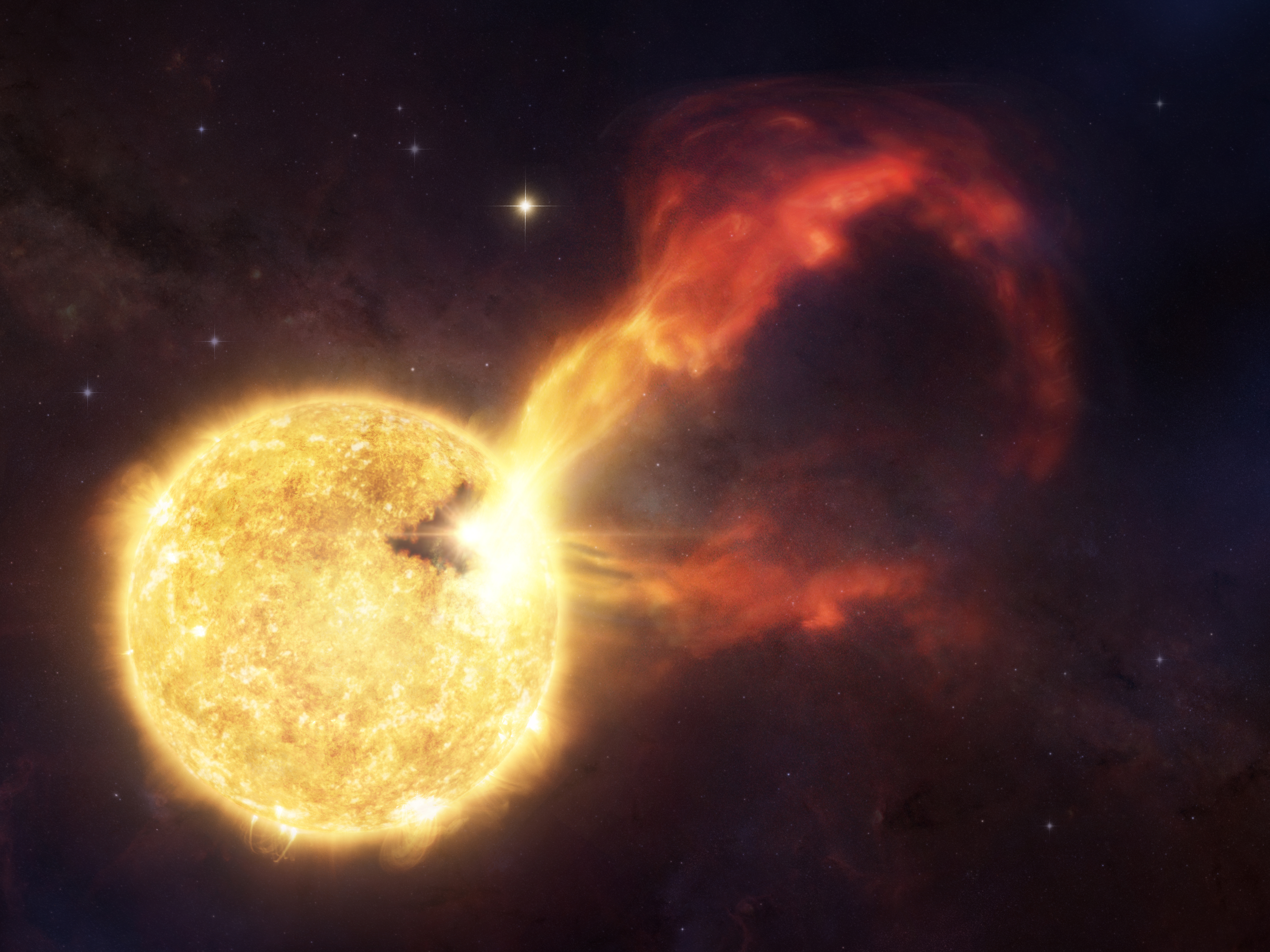
An artistic representation of a flare from HD 283572, a young nearby star. During quiescent (or quiet) periods, HD 283572 cannot be detected with the Submillimeter Array (SMA). However, on January 17 2022, an extreme flare event occurred, just when the SMA happened to be observing HD 283572. The SMA detected the rare, millimeter--wavelength part of this event, which could have produced a flaring loop that spanned a size larger than the entire star, with an energy output of over 1,000,000-times that of the millimeter flares produced by the Sun's nearest stellar neighbors. Credit: CfA/Melissa Weiss. .High Resolution Image


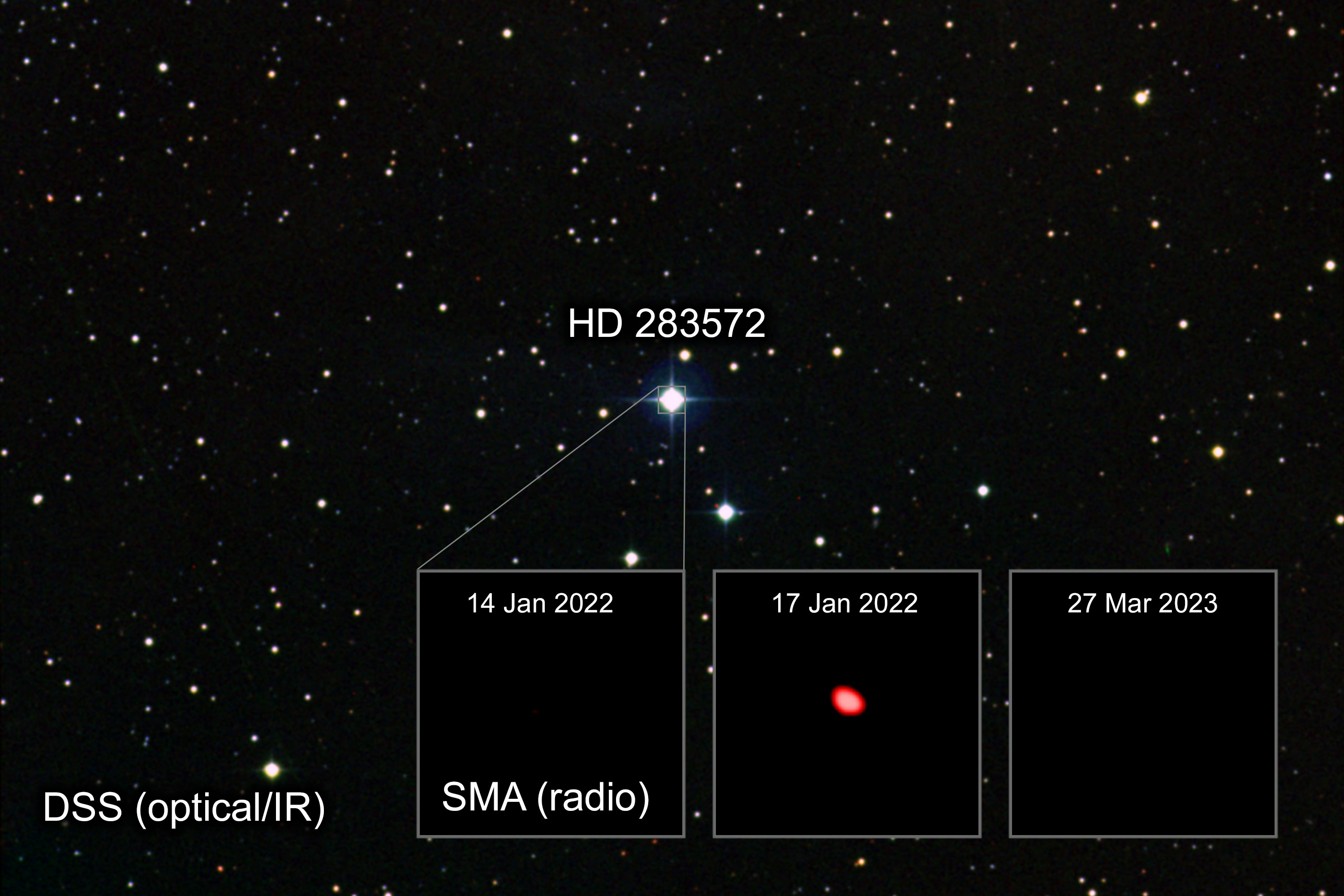
Labeled version - Images of the young star HD 283572 and its surrounding field. The large image shows optical and infrared data from the Digitized Sky Survey (DSS), and HD 283572 is the bright star near the middle of the image, highlighted by a square. The insets show Submillimeter Array (SMA) images centered on HD 283572 taken on January 14th and 17th, 2022 and March 27th, 2023. The red source in the middle panel shows the flare witnessed on January 17th. The star was not detected by the SMA on the other two days, nor in five other SMA observations not shown here. The DSS image is 20 arcminutes across (2.3 light-years at HD 283572's distance of 400 light-years) and the SMA images are 24 arcseconds across. Credit: CfA/J. B. Lovell et al. Low Resolution Image


Astronomers have detected an extreme eruption from a young star that became more than a hundred times brighter in only a few hours. This discovery offers new insight into how young Sun-like stars behave early in their lives, and their impact on the development of any of their newborn planets.

Researchers at the Smithsonian Astrophysical Observatory (SAO), part of the Center for Astrophysics | Harvard & Smithsonian (CfA), led this discovery using Submillimeter Array (SMA) observations of HD 283572, a star 40 per cent more massive than the Sun located about 400 light-years away. The SMA is an array of telescopes on Mauna Kea in Hawaii that is specifically designed to detect millimeter-wave light.

At less than 3 million years old, HD 283572 is over a thousand times younger than the Sun, at the age when Earth-like planets begin to form around stars. A team led by Dr. Joshua Bennett Lovell, an SAO astronomer and SMA Fellow at CfA, was using the SMA to search for the dusty material produced in the formation of young planets that have a faint but detectable glow at millimeter, or radio, wavelengths. However, they found something altogether different.

"We were surprised to see an extraordinarily bright flare from an ordinary young star," said Lovell. "Flares at these wavelengths are rare, and we had not anticipated seeing anything but the faint glow of planet-forming dust."

Stellar flares can increase a star's brightness by factors of tens or hundreds at different wavelengths of light. As stars rotate, their magnetic fields can wind up and develop regions of increased magnetic energy. Like a spring wound too tight, this stored magnetic energy eventually must be released. In the case of stars, this produces intense accelerations of its charged particles, which blast through their surfaces.

A challenge for observing such flares is that it is never precisely clear when a star might flare next, and catching them can be particularly challenging at millimeter wavelengths.

"HD 283572 appeared dormant for months before we caught its eruption," said Lovell. "Every time we pointed the SMA back at the star after this flare, we saw nothing. Our findings confirm that these flare events are rare at millimeter wavelengths, but that these can be extremely powerful for stars at this young age."

The team measured the energy of HD 283572's flare and found that over a 9-hour period it released roughly a million times more energy than any millimeter flares seen on the Sun’s closest stellar neighbors. This ranks amongst the most powerful such flares reported.

This was an immense event, equivalent to expending Earth’s entire nuclear arsenal in about a millisecond, over and over again, for nearly half a day!" said SAO researcher Dr Garrett Keating, second author on the study and SMA Project Scientist. "If we account for the wavelengths of the star's light that the SMA did not observe, we expect it could have even been many times more energetic."

With only one flare detected, however, it remains unclear exactly what triggered the event.

"It's a real puzzle and there are a range of mechanisms that could be at play. Interactions with unseen companion stars or planets, or periodic starspot activity are two possibilities, but what remains beyond doubt is how powerful an event this was," said Keating. "Any potential planets developing in this system would have been hammered by the intense power of this flare. I wouldn’t want to grow up there!"

The young age of the star and its Sun-like nature provides important clues about the typical environments that any young, developing planets such as the Earth may experience. Powerful flares can limit the growth of planet atmospheres or severely damage atmospheres that have already developed.

Further observations are ongoing to understand how frequently HD 283572 undergoes flaring activity, and whether flares around this type of young star inhibit the growth of planetary atmospheres.

We're running a new SMA campaign right now to study young stars similar to HD283572. How often do they flare, and what are their typical properties? By combining SMA data with longer wavelength observations, we are also able to probe the physics of flares and their emission mechanisms. I have worked on that using archival data from the Very Large Array," said Ramisa Akther Rahman, an undergraduate Senior from the College of William and Mary, who was a 2023 summer intern with Dr Lovell in the SAO's Research Experience for Undergraduates program.

The results have been accepted for publication in The Astrophysical Journal Letters (ApJL) and the paper is available at https://arxiv.org/abs/2402.01833. The other co-authors of the paper are David Wilner, Sean Andrews, and Ramprasad Rao, all from CfA, Meredith MacGregor from Johns Hopkins University in Baltimore, Maryland and Jonathan Williams from the University of Hawai'i at Manoa in Honolulu, Hawaii.

The SMA is jointly operated by SAO and the Academia Sinica Institute of Astronomy & Astrophysics (ASIAA) of Taiwan.


About the Center for Astrophysics | Harvard & Smithsonian

The Center for Astrophysics | Harvard & Smithsonian is a collaboration between Harvard and the Smithsonian designed to ask—and ultimately answer—humanity's greatest unresolved questions about the nature of the universe. The Center for Astrophysics is headquartered in Cambridge, MA, with research facilities across the U.S. and around the world.


Media Contact:

Peter Edmonds
Interim CfA Public Affairs Officer
Center for Astrophysics | Harvard & Smithsonian
+1 617-571-7279

Thursday, February 15, 2024

Sagittarius A*: Telescopes Show the Milky Way's Black Hole is Ready for a Kick

Illustration of Sagittarius A*
Credit: NASA/CXC/M.Weiss


This artist’s illustration depicts the findings of a new study about the supermassive black hole at the center of our galaxy called Sagittarius A* (abbreviated as Sgr A*). As reported in our latest press release, this result found that Sgr A* is spinning so quickly that it is warping spacetime — that is, time and the three dimensions of space — so that it can look more like an American football.

These results were made with NASA’s Chandra X-ray Observatory and the NSF’s Karl G. Jansky Very Large Array (VLA). A team of researchers applied a new method that uses X-ray and radio data to determine how quickly Sgr A* is spinning based on how material is flowing towards and away from the black hole. They found Sgr A* is spinning with an angular velocity that is about 60% of the maximum possible value, and with an angular momentum of about 90% of the maximum possible value.

Black holes have two fundamental properties: their mass (how much they weigh) and their spin (how quickly they rotate). Determining either of these two values tells scientists a great deal about any black hole and how it behaves. In the past, astronomers made several other estimates of Sgr A*’s rotation speed using different techniques, with results ranging from Sgr A* not spinning at all to it spinning at almost the maximum rate.

The new study suggests that Sgr A* is, in fact, spinning very rapidly, which causes the spacetime around it to be squashed down. The illustration shows a cross-section of Sgr A* and material swirling around it in a disk. The black sphere in the center represents the so-called event horizon of the black hole, the point of no return from which nothing, not even light, can escape.

Looking at the spinning black hole from the side, as depicted in this illustration, the surrounding spacetime is shaped like an American football. The faster the spin the flatter the football.

The yellow-orange material to either side represents gas swirling around Sgr A*. This material inevitably plunges towards the black hole and crosses the event horizon once it falls inside the football shape. The area inside the football shape but outside the event horizon is therefore depicted as a cavity. The blue blobs show jets firing away from the poles of the spinning black hole. Looking down on the black hole from the top, along the barrel of the jet, spacetime is a circular shape.

A black hole’s spin can act as an important source of energy. Spinning supermassive black holes produce collimated outflows such as jets when their spin energy is extracted, which requires that there is at least some matter in the vicinity of the black hole. Because of limited fuel around Sgr A*, this black hole has been relatively quiet in recent millennia with relatively weak jets. This work, however, shows that this could change if the amount of material in the vicinity of Sgr A* increases.

Chandra X-ray image of Sagittarius A* and the surrounding region
Credit: NASA/CXC/Univ. of Wisconsin/Y.Bai, et al.

To determine the spin of Sgr A*, the authors used an empirically based technique referred to as the “outflow method” that details the relationship between the spin of the black hole and its mass, the properties of the matter near the black hole, and the outflow properties. The collimated outflow produces the radio waves, while the disk of gas surrounding the black hole is responsible for the X-ray emission. Using this method, the researchers combined data from Chandra and the VLA with an independent estimate of the black hole’s mass from other telescopes to constrain the black hole’s spin.
The paper describing these results led by Ruth Daly (Penn State University) is published in the January 2024 issue of the Monthly Notices of the Royal Astronomical Society and appears online at https://ui.adsabs.harvard.edu/abs/2024MNRAS.527..428D/abstract.

The other authors are Biny Sebastian (University of Manitoba, Canada), Megan Donahue (Michigan State University), Christopher O’Dea (University of Manitoba), Daryl Haggard (McGill University) and Anan Lu (McGill University).

NASA's Marshall Space Flight Center manages the Chandra program. The Smithsonian Astrophysical Observatory's Chandra X-ray Center controls science operations from Cambridge, Massachusetts, and flight operations from Burlington, Massachusetts.


Visual Description:

TThis artist's illustration shows a cross-section of Sagittarius A*, pronounced as "SAJ-ee-TARE-ee-us A-star", the supermassive black hole near the center of our Milky Way galaxy.

In the middle of the image, the spinning, circular black hole is presented from the side in black. The swirling gas that surrounds Sagittarius A* is presented in white and yellow on either side of the black hole, within a rectangular-shaped dotted line, indicating the representation is a cross-section view. The shape of the spacetime surrounding Sgr A*, seen as the inner edge of the white and yellow gas on either side of the black hole, has been squashed down. The spacetime around Sgr A* thus resembles the shape of an American football. The background of the image contains a multitude of faint stars, peeking out from within brooding, dark red, indistinct clouds.


Fast Facts for Sagittarius A*:

Category: Black Holes, Milky Way Galaxy
Coordinates (J2000): RA 17h 45m 40.125s | Dec -29° 00´ 28.24"
Constellation: Sagittarius
Instrument: ACIS
Also Known As: Galactic Center
References: Daly, R. et al., 2024, MNRAS 527, 428–436. arXiv:2310.12108
Distance Estimate: About 26,000 light-years


Wednesday, February 14, 2024

What happens when a star approaches a black hole?


Simulations of stars being disrupted by black holes. From left to right the distance of closest approach increases (resulting in full disruption to almost no disruption). The top row shows 0.5 solar mass stars, while the three bottom rows show three ages of 1 solar mass stars. The black holes are of 10 solar masses. © MPA

In dense stellar environments, interactions between stars and stellar-mass black holes should occur frequently. Through hydrodynamical simulations, researchers at MPA have explored how stars are disrupted in such encounters, varying key parameters such as stellar and black hole masses, stellar age, and approach distance. The study quantifies the impact of these initial parameters on stellar remnants' masses, spins, and trajectories, offering insights into cluster dynamics and providing best-fit formulae for post-disruption parameters.

The centers of globular and nuclear star clusters are the densest stellar environments in the Universe. Due to this high density, one can expect numerous gravitational encounters between stellar objects, including black holes with masses of about 10-100 solar masses. A particularly close approach of a star towards a stellar-mass black hole can result in the distortion or disruption of the star due to the intense tidal force around the black hole. Such a phenomenon is called a ‘micro tidal disruption event’ or μTDE. The prefix ‘micro’ distinguishes it from the more widely studied TDE involving a supermassive black hole (i.e. with a mass greater than a million times the Sun). The TDEs that are due to supermassive black holes have garnered significant interest as transients at optical, UV, and X-ray wavelengths, with more than 100 confirmed observations. Although there have been no confirmed observations of μTDEs as of 2023, future large-scale transient surveys like LSST hold promise.

Detailed studies of μTDEs are crucial for understanding the gravitational dynamics of dense star clusters and the growth of black holes in these clusters. The trajectory of a star undergoing a partial disruption is altered due to mass loss (A full disruption leads to the destruction of the star). Approximately half of the mass lost from the star becomes unbound while the other half stays close to the black hole. This material eventually accretes onto the black hole resulting in the growth of its mass. Therefore, N-body and other simulations need to take these disruptions into account to properly model the long-term dynamics of a star cluster, especially its central dense region. This accuracy can be attained through detailed hydrodynamics simulations of star - black hole encounters.

In this work, we simulated a suite of 58 hydrodynamical partial μTDEs using the 3D moving-mesh code AREPO. Unlike previous studies on μTDEs, we employed realistic stellar models generated through the stellar evolution code MESA. We varied the masses of both the star (0.5 and 1 solar masses) and the black hole (10 and 40 Solar masses), the age of the star (zero-age, middle-age, and terminal-age main sequence), and the distance of closest approach between the two. Our results then ranged from almost no mass loss to full disruption of the star.

Assuming an initially non-rotating star and a parabolic encounter between the star and the black hole, our primary aim was to quantify how the masses, spins, and trajectories of the stellar remnants depend on these initial parameters.

The partial disruption of a star by a black hole
This sequence shows a simulation of how a Sun-like star is disrupted by a black hole of 10 solar masses. The star approaches the black hole on a parabolic orbit, with a closest approach distance of approximately the star’s radius. The star spins up due to the torque from the black hole, and around 5% of the star’s mass is lost to the tidal streams, half of which becomes bound to the black hole.

We found that the amount of mass lost from a star decreases roughly exponentially with increasing distance of closest approach; i.e. the farther away a star passes the black hole, the less matter it loses. The stellar age also plays a role – main-sequence stars of different ages disrupt differently even when all the other initial parameters are the same. The more evolved a main-sequence star is, the higher its central density as it contains more core helium from hydrogen burning. It is therefore much harder to fully disrupt an older main-sequence star compared to a younger one. In addition, the stellar remnant is spun up due to torque from the black hole. A closer approach results in a higher torque, which translates to a higher angular momentum gained by the stellar remnant.

Finally, the initial parabolic trajectory of the star changes due to the combined effects of stellar tides, asymmetric mass loss, spin-up of the remnant, and ejecta energy. In accordance with previous studies, the remnant can either be bound to the black hole (eccentric orbit) or escape from it (hyperbolic orbit). In the former case, the remnant would then undergo repeated disruptions until it is completely ripped apart. In general, the remnant becomes unbound when the star loses a significant fraction of mass in the disruption and the star-black hole mass ratio is skewed, i.e., the black hole is much heavier than the star.

The results from our suite of simulations are available in the form of best-fit formulae for the post-disruption parameters. These can be incorporated into cluster simulation codes to better model elusive star-black hole encounters.


Contact:

Vynatheya, Pavan
PhD student
tel: 2262

pavanvyn@mpa-garching.mpg.de

Original publication

Vynatheya, P.; Ryu, T.; Pakmor, R.; de Mink, S. E; Perets, H. B. Simulating the tidal disruption of stars by stellar-mass black holes using moving-mesh hydrodynamics
submitted to A&A


Source


Tuesday, February 13, 2024

NASA's Hubble Traces 'String of Pearls' Star Clusters in Galaxy Collisions


Galaxy AM 1054-325 has been distorted into an S-shape from a normal pancake-like spiral shape by the gravitational pull of a neighboring galaxy, seen in this Hubble Space Telescope image. A consequence of this is that newborn clusters of stars form along a stretched-out tidal tail for thousands of light-years, resembling a string of pearls. They form when knots of gas gravitationally collapse to create about 1 million newborn stars per cluster. Credits: Image; NASA, ESA, STScI, Jayanne English (University of Manitoba)


Contrary to what you might think, galaxy collisions do not destroy stars. In fact, the rough-and-tumble dynamics trigger new generations of stars, and presumably accompanying planets.

Now NASA's Hubble Space Telescope has homed in on 12 interacting galaxies that have long, tadpole-like tidal tails of gas, dust, and a plethora of stars. Hubble's exquisite sharpness and sensitivity to ultraviolet light have uncovered 425 clusters of newborn stars along these tails, looking like strings of holiday lights. Each cluster contains as many as 1 million blue, newborn stars.

Clusters in tidal tails have been known about for decades. When galaxies interact, gravitational tidal forces pull out long streamers of gas and dust. Two popular examples are the Antennae and Mice galaxies with their long, narrow, finger-like projections.

A team of astronomers used a combination of new observations and archival data to get ages and masses of tidal tail star clusters. They found that these clusters are very young — only 10 million years old. And they seem to be forming at the same rate along tails stretching for thousands of light-years.

"It's a surprise to see lots of the young objects in the tails. It tells us a lot about cluster formation efficiency," said lead author Michael Rodruck of Randolph-Macon College in Ashland, Virginia. "With tidal tails, you will build up new generations of stars that otherwise might not have existed."

The tails look like they are taking a galaxy's spiral arm and stretching it out into space. The exterior part of the arm gets pulled like taffy from the gravitational tug-of-war between a pair of interacting galaxies.

Before the mergers, the galaxies were rich in dusty clouds of molecular hydrogen that simply may have remained inert. But the clouds got jostled and bumped into each other during the encounters. This compressed the hydrogen to the point where it precipitated a firestorm of star birth.

The fate of these strung-out star clusters is uncertain. They may stay gravitationally intact and evolve into globular star clusters — like those that orbit outside the plane of our Milky Way galaxy. Or they may disperse to form a halo of stars around their host galaxy, or get cast off to become wandering intergalactic stars.

This string-of-pearls star formation may have been more common in the early universe when galaxies collided with each other more frequently. These nearby galaxies observed by Hubble are a proxy for what happened long ago, and therefore are laboratories for looking into the distant past.

The Hubble Space Telescope is a project of international cooperation between NASA and ESA. NASA's Goddard Space Flight Center in Greenbelt, Maryland, manages the telescope. The Space Telescope Science Institute (STScI) in Baltimore, Maryland, conducts Hubble and Webb science operations. STScI is operated for NASA by the Association of Universities for Research in Astronomy, in Washington, D.C.


About This Release

Credits:

Media Contact:

Ray Villard
Space Telescope Science Institute, Baltimore, Maryland

Science Contact:

Michael Rodruck
Randolph-Macon College, Ashland, Virginia

Permissions: Content Use Policy

Contact Us: Direct inquiries to the News Team.

Related Links and Documents


Monday, February 12, 2024

NASA's Roman to Use Rare Events to Calculate Expansion Rate of Universe


Supernova Refsdal (Hubble image)
Credits: Image: NASA, ESA, Steve A. Rodney (JHU), Tommaso Treu (UCLA), Patrick Kelly (UC Berkeley), Jennifer Lotz (STScI), Marc Postman (STScI), Zolt G. Levay (STScI), FrontierSN Team, GLASS Team, HFF Team (STScI), CLASH Team

Distant Supernova Multiply Imaged by Foreground Cluster
Illustration: NASA, ESA, Ann Feild (STScI), Joseph DePasquale (STScI)
Science: NASA, ESA, Steve A. Rodney (JHU), Tommaso Treu (UCLA), Patrick Kelly (UC Berkeley), Jennifer Lotz (STScI), Marc Postman (STScI), Zolt G. Levay (STScI), FrontierSN Team, GLASS Team, HFF Team (STScI), CLASH Team


Astronomers investigating one of the most pressing mysteries of the cosmos – the rate at which the universe is expanding – are readying themselves to study this puzzle in a new way using NASA’s Nancy Grace Roman Space Telescope. Once it launches by May 2027, astronomers will mine Roman’s wide swaths of images for gravitationally lensed supernovae, which can be used to measure the expansion rate of the universe.

There are multiple independent ways astronomers can measure the present expansion rate of the universe, known as the Hubble constant . Different techniques have yielded different values, referred to as the Hubble tension . Much of Roman’s cosmological investigations will be into elusive dark energy, which affects how the universe is expanding over time. One primary tool for these investigations is a fairly traditional method, which compares the intrinsic brightness of objects like type Ia supernovae to their perceived brightness to determine distances. Alternatively, astronomers could use Roman to examine gravitationally lensed supernovae. This method of exploring the Hubble constant is unique from traditional methods because it’s based on geometric methods, and not brightness.

“Roman is the ideal tool to let the study of gravitationally lensed supernovae take off,” said Lou Strolger of the Space Telescope Science Institute (STScI) in Baltimore, co-lead of the team preparing for Roman’s study of these objects. “They are rare, and very hard to find. We have had to get lucky in detecting a few of them early enough. Roman’s extensive field of view and repeated imaging in high resolution will help those chances.”

Using various observatories like NASA’s Hubble Space Telescope and James Webb Space Telescope, astronomers have discovered just eight gravitationally lensed supernovae in the universe. However, only two of those eight have been viable candidates to measure the Hubble constant due to the type of supernovae they are and the duration of their time-delayed imaging.

Gravitational lensing occurs when the light from an object like a stellar explosion, on its way to Earth, passes through a galaxy or galaxy cluster and gets deflected by the immense gravitational field. The light splits along different paths and forms multiple images of the supernova on the sky as we see it. Depending on the differences between the paths, the supernova images appear delayed by hours to months, or even years. Precisely measuring this difference in arrival times between the multiple images leads to a combination of distances that constrain the Hubble constant.

“Probing these distances in a fundamentally different way than more common methods, with the same observatory in this case, can help shed light on why various measurement techniques have yielded different results,” added Justin Pierel of STScI, Strolger’s co-lead on the program.

Finding the Needle in the Haystack

Roman's extensive surveys will be able to map the universe much faster than Hubble can, with the telescope “seeing” more than 100 times the area of Hubble in a single image.

“Rather than gathering several pictures of trees, this new telescope will allow us to see the entire forest in a single snapshot,” Pierel explained.

In particular, the High Latitude Time Domain Survey will observe the same area of sky repeatedly, which will allow astronomers to study targets that change over time. This means there will be an extraordinary amount of data – over 5 billion pixels each time – to sift through in order to find these very rare events.

A team led by Strolger and Pierel at STScI is laying the groundwork for finding gravitationally lensed supernovae in Roman data through a project funded by NASA’s Research Opportunities in Space and Earth Science (ROSES) Nancy Grace Roman Space Telescope Research and Support Participation Opportunities program.

“Because these are rare, leveraging the full potential of gravitationally lensed supernovae depends on a high level of preparation,” said Pierel. “We want to make all the tools for finding these supernovae ready upfront so we don’t waste any time sifting through terabytes of data when it arrives.”

The project will be carried out by a team of researchers from various NASA centers and universities around the country.

The preparation will occur in several stages. The team will create data reduction pipelines designed to automatically detect gravitationally lensed supernovae in Roman imaging. To train those pipelines, the researchers will also create simulated imaging: 50,000 simulated lenses are needed, and there are only 10,000 actual lenses currently known.

The data reduction pipelines created by Strolger and Pierel’s team will complement pipelines being created to study dark energy with Type Ia supernovae.

“Roman is truly the first opportunity to create a gold-standard sample of gravitationally lensed supernovae,” concluded Strolger. “All our preparations now will produce all the components needed to ensure we can effectively leverage the enormous potential for cosmology.”

The Nancy Grace Roman Space Telescope is managed at NASA’s Goddard Space Flight Center in Greenbelt, Maryland, with participation by NASA's Jet Propulsion Laboratory and Caltech/IPAC in Southern California, the Space Telescope Science Institute in Baltimore, and a science team comprising scientists from various research institutions. The primary industrial partners are Ball Aerospace and Technologies Corporation in Boulder, Colorado; L3Harris Technologies in Melbourne, Florida; and Teledyne Scientific & Imaging in Thousand Oaks, California.


About This Release

Credits:

Media Contact:

Hannah Braun
Space Telescope Science Institute, Baltimore, Maryland

Christine Pulliam
Space Telescope Science Institute, Baltimore, Maryland

Permissions: Content Use Policy

Related Links and Documents


Sunday, February 11, 2024

New research finds that young planets are flattened structures rather than spherical

Simulated young planet as viewed from the top (left) and from the side (right)
Credit: arXiv (2024). DOI: 10.48550/arxiv.2402.01432


Astrophysicists from the University of Central Lancashire (UCLan) have found that planets have flattened shapes like smarties just after they form rather than being spherical as previously thought.

The research, accepted for publication in Astronomy & Astrophysics Letters, shows that protoplanets, which are very young planets recently formed around stars, are flattened structures called oblate spheroids. The paper can currently be accessed on the arXiv preprint server.

The team, from UCLan's Jeremiah Horrocks Institute for Mathematics, Physics and Astronomy, used computer simulations to model the formation of planets according to the theory of disk-instability, which suggests that protoplanets form in short timescales from the breaking up of large rotating disks of dense gas orbiting around young stars.

The team, from UCLan's Jeremiah Horrocks Institute for Mathematics, Physics and Astronomy, used computer simulations to model the formation of planets according to the theory of disk-instability, which suggests that protoplanets form in short timescales from the breaking up of large rotating disks of dense gas orbiting around young stars.

Taking this approach, the team determined planet properties, compared them with observations and examined the formation mechanism of gas giant planets. They focused on investigating the shapes of young planets and on how these planets may grow to become large gas giant planets, even larger than Jupiter. They also examined the properties of planets forming in a variety of physical conditions, such as ambient temperature and gas density.

Dr. Adam Fenton, a recently graduated Ph.D. student, led the research. He said, "Many exoplanets, which are planets that orbit stars in other solar systems outside of our own, have been discovered in the last three decades. Despite observing many thousands of them, how they form remains unexplained.

"It is believed that they either form through 'core accretion,' which is a gradual growth of dust particles that stick together to form progressively larger and larger objects on long timescales, or directly by the breaking up of large rotating protostellar disks around young stars in short timescales, which is what we call the theory of disk-instability.

"This theory is appealing due to the fact that large planets can form very quickly at large distances from their host star, explaining some exoplanet observations.

"It was an extremely demanding computational project requiring half a million CPU hours on the UK's DiRAC High Performance Computing Facility. But the results were amazing and worth the effort."

Computer simulation of planets forming in a protostellar disc
Credit: arXiv (2024). DOI: 10.48550/arxiv.2402.01432

Dr. Dimitris Stamatellos, Reader in Astrophysics at UCLan and co-investigator, said, "We have been studying planet formation for a long time but never before had we thought to check the shape of the planets as they form in the simulations. We had always assumed that they were spherical.

"We were very surprised that they turned out to be oblate spheroids, pretty similar to smarties."

Observational confirmation of the flattened shape of young planets may answer the critical question about how planets form, pointing towards the currently less-favored disk-instability model rather than the standard planet formation theory of core accretion.

The researchers also discovered that new planets grow as material falls onto them, predominately from their poles rather than their equators.

These findings have important implications for observations of young planets as they suggest that the way planets appear through a telescope depends on the viewing angle. Such observations of young planets are important in order to understand the planet formation mechanism.

The researchers are following up this discovery with improved computational models to examine how the shape of these planets is affected by the environment in which they form, and to determine their chemical composition to compare with future observations from the James Webb Space Telescope (JWST).

Observations of young planets have become possible in the last few years with observing facilities such as the Atacama Large Millimeter Array (ALMA) and the Very Large Telescope (VLT)

Provided by Astronomy & Astrophysics

Source: PHys.org


More information: Adam Fenton et al, The 3D structure of disc-instability protoplanets, arXiv (2024).
DOI: 10.48550/arxiv.2402.01432


Saturday, February 10, 2024

How Close Is Too Close to a Kilonova?


The image above shows the radiation and particles generated by a kilonova, the explosion produced when the remnants of two massive stars collide. Kilonovae made headlines in 2017, when scientists observed gravitational waves and a kilonova from colliding neutron stars for the first time. Recently, a research team led by Haille Perkins (University of Illinois Urbana-Champaign) used information gleaned from the 2017 event to estimate the threat posed by a kilonova’s X-rays, gamma rays, and cosmic rays. Fortunately for us, a kilonova would have to be quite close for life on Earth to be endangered by its X-rays or gamma rays — within about 3 light-years for X-rays or 13 light-years for gamma rays. Even after the initial glow of the collision fades, though, there’s still danger: high-energy charged particles called cosmic rays pose a threat years after the dangerous radiation has passed, and a kilonova’s cosmic rays can be lethal out to 36 light-years away. Luckily, kilonovae are extremely rare, and the danger to life on Earth is minimal. As researchers observe more kilonovae and improve their models, we’ll be able to refine our understanding of how close is too close when it comes to kilonovae, the threat they pose to Earth, and the role they play in determining where in the universe life can form and flourish.

Citation

“Could a Kilonova Kill: A Threat Assessment,” Haille M. L. Perkins et al 2024 ApJ 961 170.

doi:10.3847/1538-4357/ad12b7

By Kerry Hensley