Showing posts with label supermassive black holes. Show all posts

Sunday, June 14, 2026

What Powers the X-ray Emission from Distant Supermassive Black Holes?

An artist’s concept of a supermassive black hole surrounded by a swirling disk of material falling into it. The purpish ball of light above the black hole, a feature called the corona, contains highly energetic particles that generate X-ray light. Credit: NASA/JPL-Caltech/R. Hurt (IPAC).
Download Image


Supermassive black holes don't give off any light themselves, but at those times in their existence when they are actively accreting material, they are encircled by a disk of hot, glowing material. The gravity of a black hole pulls swirling gas in, heating that material and causing it to shine at energies ranging from the ultraviolet to X-rays depending on the mass of the black hole. Another major source of radiation near a black hole is the so-called “corona”. Coronae are made up of highly energetic particles that generate X-ray light, though details about their geometry, location, appearance, and how they form remain uncertain and are driving questions for X-ray astrophysicists. In the artist’s concept shown here, the corona is envisioned as a hot spot of energetic plasma above (and below) the black hole, though other models suggest the corona is a hot atmosphere to the inner accretion disk.

In a new study submitted to the Astrophysical Journal, an international team led by Dr. Xiurui Zhao of the California Institute of Technology systematically studied the X-ray coronae in some of the most distant and luminous accreting supermassive black holes ever observed. These coronae, composed of ultra-hot electrons, produce high-energy X-rays by boosting lower-energy light emitted by the accretion disk. The expansion of the universe then shifts these high-energy emitted photons to lower observed energies, similar to the Doppler shift we hear as an ambulance or police car speeds away from us and the tone of the siren shifts to lower notes. By targeting luminous accreting supermassive black holes in the distant universe, known as quasars, the team leveraged this cosmological shift to bring key spectral features into NuSTAR’s energy range. This enabled direct measurements of the coronal properties which had been out of reach of previous X-ray satellites.

By combining NuSTAR observations with observations by the European Space Agency-led XMM-Newton satellite, which is sensitive to lower energy X-rays, the team constructed the most comprehensive view to date of coronae in active galaxies across cosmic time. The results provide new constraints on how energy is dissipated and radiated near supermassive black holes, offering critical tests for state-of-the-art theoretical models and simulations.

The study reveals that coronae in these powerful, distant quasars are significantly cooler than those found in the nearby universe, where quasars are typically less luminous. This result suggests that the most luminous black holes operate in a fundamentally different physical regime. The findings also indicate that these distant coronae are denser and more efficiently cooled, likely due to intense radiation fields near rapidly accreting black holes. Together, these results challenge standard models of black hole coronae and point toward a more complex interplay between heating, cooling, and particle acceleration in these extreme environments.

In a related study to be presented at the 248th meeting of the American Astronomical Society later this month, Dr. Zhao and collaborators report on dramatic X-ray variability detected in the corona of the galaxy Mrk 509. Mrk 509 is a relatively nearby galaxy, just shy of 500 million light years away, that hosts an actively accreting supermassive black hole. This new work, relying on observations from the NuSTAR satellite, finds very strong variations in the temperature of the corona, at a level not previously found from either Mrk 509 or similar sources. Both the distant quasar survey and this detailed study of the nearby galaxy Mrk 509 have important implications for understanding the physical processes occurring very close to supermassive black holes.


Friday, January 17, 2025

Newfound Galaxy Class May Indicate Early Black Hole Growth, Webb Finds

Little Red Dots (NIRCam Image)
Credits/Image: NASA, ESA, CSA, STScI, Dale Kocevski (Colby College)


In December 2022, less than six months after commencing science operations, NASA’s James Webb Space Telescope revealed something never seen before: numerous red objects that appear small on the sky, which scientists soon called “little red dots” (LRDs). Though these dots are quite abundant, researchers are perplexed by their nature, the reason for their unique colors, and what they convey about the early universe.

A team of astronomers recently compiled one of the largest samples of LRDs to date, nearly all of which existed during the first 1.5 billion years after the big bang. They found that a large fraction of the LRDs in their sample showed signs of containing growing supermassive black holes.

“We’re confounded by this new population of objects that Webb has found. We don’t see analogs of them at lower redshifts, which is why we haven’t seen them prior to Webb,” said Dale Kocevski of Colby College in Waterville, Maine, and lead author of the study. “There's a substantial amount of work being done to try to determine the nature of these little red dots and whether their light is dominated by accreting black holes.”

A Potential Peek Into Early Black Hole Growth

A significant contributing factor to the team’s large sample size of LRDs was their use of publicly available Webb data. To start, the team searched for these red sources in the Cosmic Evolution Early Release Science (CEERS) survey before widening their scope to other extragalactic legacy fields, including the JWST Advanced Deep Extragalactic Survey (JADES) and the Next Generation Deep Extragalactic Exploratory Public (NGDEEP) survey.

The methodology used to identify these objects also differed from previous studies, resulting in the census spanning a wide redshift range. The distribution they discovered is intriguing: LRDs emerge in large numbers around 600 million years after the big bang and undergo a rapid decline in quantity around 1.5 billion years after the big bang.

The team looked toward the Red Unknowns: Bright Infrared Extragalactic Survey (RUBIES) for spectroscopic data on some of the LRDs in their sample. They found that about 70 percent of the targets showed evidence for gas rapidly orbiting 2 million miles per hour (1,000 kilometers per second) – a sign of an accretion disk around a supermassive black hole. This suggests that many LRDs are accreting black holes, also known as active galactic nuclei (AGN).

“The most exciting thing for me is the redshift distributions. These really red, high-redshift sources basically stop existing at a certain point after the big bang,” said Steven Finkelstein, a co-author of the study at the University of Texas at Austin. “If they are growing black holes, and we think at least 70 percent of them are, this hints at an era of obscured black hole growth in the early universe.”

Contrary to Headlines, Cosmology Isn’t Broken

When LRDs were first discovered, some suggested that cosmology was “broken.” If all of the light coming from these objects was from stars, it implied that some galaxies had grown so big, so fast, that theories could not account for them.

The team’s research supports the argument that much of the light coming from these objects is from accreting black holes and not from stars. Fewer stars means smaller, more lightweight galaxies that can be understood by existing theories.

“This is how you solve the universe-breaking problem,” said Anthony Taylor, a co-author of the study at the University of Texas at Austin.

Curiouser and Curiouser

There is still a lot up for debate as LRDs seem to evoke even more questions. For example, it is still an open question as to why LRDs do not appear at lower redshifts. One possible answer is inside-out growth: As star formation within a galaxy expands outward from the nucleus, less gas is being deposited by supernovas near the accreting black hole, and it becomes less obscured. In this case, the black hole sheds its gas cocoon, becomes bluer and less red, and loses its LRD status.

Additionally, LRDs are not bright in X-ray light, which contrasts with most black holes at lower redshifts. However, astronomers know that at certain gas densities, X-ray photons can become trapped, reducing the amount of X-ray emission. Therefore, this quality of LRDs could support the theory that these are heavily obscured black holes.

The team is taking multiple approaches to understand the nature of LRDs, including examining the mid-infrared properties of their sample, and looking broadly for accreting black holes to see how many fit LRD criteria. Obtaining deeper spectroscopy and select follow-up observations will also be beneficial for solving this currently “open case” about LRDs.

“There’s always two or more potential ways to explain the confounding properties of little red dots,” said Kocevski. “It’s a continuous exchange between models and observations, finding a balance between what aligns well between the two and what conflicts.”

These results were presented in a press conference at the 245th meeting of the American Astronomical Society in National Harbor, Maryland, and have been accepted for publication in The Astrophysical Journal.

The James Webb Space Telescope is the world’s premier space science observatory. Webb is solving mysteries in our solar system, looking beyond to distant worlds around other stars, and probing the mysterious structures and origins of our universe and our place in it. Webb is an international program led by NASA with its partners, ESA (European Space Agency) and CSA (Canadian Space Agency).


About This Release

Credits:

Media Contact:

Abigail Major
Space Telescope Science Institute, Baltimore, Maryland

Christine Pulliam
Space Telescope Science Institute, Baltimore, Maryland

Science: Dale Kocevski (Colby College)

Permissions: Content Use Policy

Contact Us: Direct inquiries to the News Team.


Thursday, January 16, 2025

Hubble Reveals Surprising Spiral Shape of Galaxy Hosting Young Jet

Spiral Quasar-host Galaxy J0742+2704
Credits/Science: NASA, ESA, Kristina Nyland (U.S. Naval Research Laboratory)
Image Processing: Joseph DePasquale (STScI)

Compass Image of J0742+2704
Credits/Science: NASA, ESA, Kristina Nyland (U.S. Naval Research Laboratory)
Image Processing: Joseph DePasquale (STScI)


The night sky has always played a crucial role in navigation, from early ocean crossings to modern GPS. Besides stars, the United States Navy uses quasars as beacons. Quasars are distant galaxies with supermassive black holes, surrounded by brilliantly hot disks of swirling gas that can blast off jets of material. Following up on the groundbreaking 2020 discovery of newborn jets in a number of quasars, aspiring naval officer Olivia Achenbach of the United States Naval Academy has used NASA’s Hubble Space Telescope to reveal surprising properties of one of them, quasar J0742+2704.

"The biggest surprise was seeing the distinct spiral shape in the Hubble Space Telescope images. At first I was worried I had made an error," said Achenbach, who made the discovery during the course of a four-week internship.

“We typically see quasars as older galaxies that have grown very massive, along with their central black holes, after going through messy mergers and have come out with an elliptical shape,” said astronomer Kristina Nyland of the Naval Research Laboratory, Achenbach’s adviser on the research.

"It's extremely rare and exciting to find a quasar-hosting galaxy with spiral arms and a black hole that is more than 400 million times the mass of the Sun — which is pretty big — plus young jets that weren't detectable 20 years ago," Nyland said.

The unusual quasar takes its place amid an active debate in the astronomy community over what triggers quasar jets, which can be significant in the evolution of galaxies, as the jets can suppress star formation. Some astronomers suspect that quasar jets are triggered by major galaxy mergers, as the material from two or more galaxies mashes together, and heated gas is funneled toward merged black holes. Spiral galaxy quasars like J0742+2704, however, suggest that there may be other pathways for jet formation.

While J0742+2704 has maintained its spiral shape, the Hubble image does show intriguing signs of its potential interaction with other galaxies. One of its arms shows distortion, possibly a tidal tail.

"Clearly there is something interesting going on. While the quasar has not experienced a major disruptive merger, it may be interacting with another galaxy, which is gravitationally tugging at its spiral arm," said Nyland.

Another galaxy that appears nearby in the Hubble image (though its location still needs to be spectroscopically confirmed) has a ring structure. This rare shape can occur after a galaxy interaction in which a smaller galaxy punches through the center of a spiral galaxy. "The ring galaxy near the quasar host galaxy could be an intriguing clue as to what is happening in this system. We may be witnessing the aftermath of the interaction that triggered this young quasar jet," said Nyland.

Both Achenbach and Nyland emphasize that this intriguing discovery is really a new starting point, and there will be additional multi-wavelength analysis of J0742+2704 with data from NASA's Chandra X-ray Observatory and the Atacama Large Millimeter/submillimeter Array (ALMA) in Chile. It's also a case for keeping our eyes on the skies, said Achenbach.

"If we looked at this galaxy 20 years, or maybe even a decade ago, we would have seen a fairly average quasar and never known it would eventually be home to newborn jets," said Achenbach. "It goes to show that if you keep searching, you can find something remarkable that you never expected, and it can send you in a whole new direction of discovery."

These results are being presented at the 245th meeting of the American Astronomical Society in Washington, D.C.

The Hubble Space Telescope has been operating for over three decades and continues to make ground-breaking discoveries that shape our fundamental understanding of the universe. Hubble is a project of international cooperation between NASA and ESA (European Space Agency). NASA's Goddard Space Flight Center in Greenbelt, Maryland, manages the telescope and mission operations. Lockheed Martin Space, based in Denver, also supports mission operations at Goddard. The Space Telescope Science Institute in Baltimore, which is operated by the Association of Universities for Research in Astronomy, conducts Hubble science operations for NASA.


About This Release

Credits:

Media Contact:

Leah Ramsay
Space Telescope Science Institute, Baltimore, Maryland

Ray Villard
Space Telescope Science Institute, Baltimore, Maryland

Permissions: Content Use Policy

Contact Us: Direct inquiries to the News Team.

Related Links and Documents


Thursday, January 02, 2025

Towards direct observation of large samples of intergalactic filaments in the early universe

One quasar of the sample embedded into extended Lyman alpha emission (cyan), which reaches the edge of the circumgalactic medium of its host galaxy. The uncovered filamentary structure is stretched in the direction of the second quasar of the pair (not shown). Multiple further sources are visible in this field, which are not physically associated with the quasar pair; these lie between Earth and the observed quasar. © MPA

This plot shows the alignment of the Lyman alpha nebulae with the quasar pair direction. An angle of zero degrees corresponds to perfect alignment. In the sample studied, all large nebulae (extending into the circumgalactic medium by more than 200,000 light years) trace the quasar pair direction. This trend is not driven by the quasar luminosity (colour of the points) or the distance between the quasar pairs (size of the dots). This shows that the Lyman alpha nebulae indeed trace the cosmic web filaments. © MPA


The distribution of matter in the universe is predicted by supercomputer simulations to occur in a network of filaments, known as the "cosmic web", where galaxies form and evolve. The vast majority of this intricate structure is in the form of diffuse hydrogen gas, so rarefied that it is extremely challenging to observe it directly. A collaboration led by MPA researchers has targeted the active supermassive black holes of galaxy pairs at close separations to reveal the connecting filamentary structures of the cosmic web in the early universe. The results are promising and unveil evidence for such structures stretching between the observed pairs, ultimately providing excellent targets for future ultra-deep observations.

Galaxies are embedded in large reservoirs of gas bound to them by gravity, the so-called 'circumgalactic medium'. Like all gas in the universe, it mainly consists of hydrogen and helium with traces of other elements that are produced in stars and ejected from the galaxy disks in bubbles of hot gas or fast winds expanding into the circumgalactic medium. In turn, cool gas is funneled back into the galaxy in streams and can form new stars or feed the supermassive black hole at the galactic centre. Galaxies are not hermits though: large filamentary gas structures connect galaxies to their neighbours. This overall skeleton is called 'cosmic web' (see Monthly Highlight of June 2024), and galaxies can accrete additional material from its filaments to rejuvenate and grow. While simulations have explored this process very well, observational evidence of the filamentary cosmic web is sparse and mainly indirect, e.g. inferred from the observed position of galaxies in the local universe or by how the cosmic web absorbs light from bright background sources.

The areas where multiple filaments of the cosmic web intersect are called 'nodes', typically inhabited by the most massive galaxies. In the early universe, 11.5 billion years ago, these massive galaxies are commonly pinpointed by quasars – a brief phase in these galaxies’ life cycle, when matter falling onto their central supermassive black holes powers exceptionally luminous events that easily outshine all stars in their host galaxy. Therefore quasars can act as powerful natural 'cosmic flashlights': Their radiation can reach far into the circumgalactic medium and the surrounding cosmic web, lighting up the hydrogen gas at a specific ultraviolet colour, the Lyman alpha wavelength.

Researchers from MPA have now observed a sample of quasar pairs, i.e. two massive active galaxies in direct vicinity to each other, to unveil the Lyman alpha emission in their circumgalactic medium and in-between the galaxies (commonly referred to as 'Lyman alpha nebulae'). Extended emission is detected in most targeted systems (see example in Fig. 1) and the emission is preferentially aligned with the pair direction (see Fig. 2). These results are in line with expectations, if a cosmic web filament connects the two quasars and cool gas gets funneled directly from the filament through the circumgalactic medium down to the galactic disk.

Compared to other massive galaxies at this epoch, quasar pairs are embedded in smaller reservoirs of cool gas. Their circumgalactic medium actually resembles that of galaxies at a cosmic time one billion years later. Such an accelerated evolution might be caused by the rich environment inhabited by quasar pairs and/or by highly energetic processes connected to the accreting supermassive black holes, which could heat up the gas surrounding the galaxy and counteract the gas accretion.

This sample of quasar pair observations is the largest to date and represents the best collection of promising targets for directly studying the emission of the cosmic web in the early universe with future ultra-deep observations. More and more observations of the intricate web of cosmic filaments will become available in the near future.


Author:

Eileen Herwig
PhD student
tel:2344

eherwig@mpa-garching.mpg.de

Original publication

Eileen Herwig
Arrigoni Battaia, Fabrizio;
González Lobos, Jay; et al.

QSO MUSEUM: II. Search for extended Lyα emission around eight z ∼ 3 quasar pairs
A&A, 691, A210 (2024)

Source | DOI


Wednesday, October 23, 2024

Astronomers detect ancient lonely quasars with murky origins

This image, taken by NASA’s James Webb Space Telescope, shows an ancient quasar (circled in red) with fewer than expected neighboring galaxies (bright blobs), challenging physicists’ understanding of how the first quasars and supermassive black holes formed. Credit: Christina Eilers/EIGER team


The quasars appear to have few cosmic neighbors, raising questions about how they first emerged more than 13 billion years ago

A quasar is the extremely bright core of a galaxy that hosts an active supermassive black hole at its center. As the black hole draws in surrounding gas and dust, it blasts out an enormous amount of energy, making quasars some of the brightest objects in the universe. Quasars have been observed as early as a few hundred million years after the Big Bang, and it’s been a mystery as to how these objects could have grown so bright and massive in such a short amount of cosmic time..

Scientists have proposed that the earliest quasars sprang from overly dense regions of primordial matter, which would also have produced many smaller galaxies in the quasars’ environment. But in a new MIT-led study, astronomers observed some ancient quasars that appear to be surprisingly alone in the early universe.

The astronomers used NASA’s James Webb Space Telescope (JWST) to peer back in time, more than 13 billion years, to study the cosmic surroundings of five known ancient quasars. They found a surprising variety in their neighborhoods, or “quasar fields.” While some quasars reside in very crowded fields with more than 50 neighboring galaxies, as all models predict, the remaining quasars appear to drift in voids, with only a few stray galaxies in their vicinity.

These lonely quasars are challenging physicists’ understanding of how such luminous objects could have formed so early on in the universe, without a significant source of surrounding matter to fuel their black hole growth.

“Contrary to previous belief, we find on average, these quasars are not necessarily in those highest-density regions of the early universe. Some of them seem to be sitting in the middle of nowhere,” says Anna-Christina Eilers, assistant professor of physics at MIT. “It’s difficult to explain how these quasars could have grown so big if they appear to have nothing to feed from.”

There is a possibility that these quasars may not be as solitary as they appear, but are instead surrounded by galaxies that are heavily shrouded in dust and therefore hidden from view. Eilers and her colleagues hope to tune their observations to try and see through any such cosmic dust, in order to understand how quasars grew so big, so fast, in the early universe.

Eilers and her colleagues report their findings in a paper appearing today in the Astrophysical Journal. The MIT co-authors include postdocs Rohan Naidu and Minghao Yue; Robert Simcoe, the Francis Friedman Professor of Physics and director of MIT’s Kavli Institute for Astrophysics and Space Research; and collaborators from institutions including Leiden University, the University of California at Santa Barbara, ETH Zurich, and elsewhere.

Galactic neighbors

The five newly observed quasars are among the oldest quasars observed to date. More than 13 billion years old, the objects are thought to have formed between 600 to 700 million years after the Big Bang. The supermassive black holes powering the quasars are a billion times more massive than the sun, and more than a trillion times brighter. Due to their extreme luminosity, the light from each quasar is able to travel over the age of the universe, far enough to reach JWST’s highly sensitive detectors today.

“It’s just phenomenal that we now have a telescope that can capture light from 13 billion years ago in so much detail,” Eilers says. “For the first time, JWST enabled us to look at the environment of these quasars, where they grew up, and what their neighborhood was like.”

The team analyzed images of the five ancient quasars taken by JWST between August 2022 and June 2023. The observations of each quasar comprised multiple “mosaic” images, or partial views of the quasar’s field, which the team effectively stitched together to produce a complete picture of each quasar’s surrounding neighborhood.

The telescope also took measurements of light in multiple wavelengths across each quasar’s field, which the team then processed to determine whether a given object in the field was light from a neighboring galaxy, and how far a galaxy is from the much more luminous central quasar.

“We found that the only difference between these five quasars is that their environments look so different,” Eilers says. “For instance, one quasar has almost 50 galaxies around it, while another has just two. And both quasars are within the same size, volume, brightness, and time of the universe. That was really surprising to see.”

Growth spurts

The disparity in quasar fields introduces a kink in the standard picture of black hole growth and galaxy formation. According to physicists’ best understanding of how the first objects in the universe emerged, a cosmic web of dark matter should have set the course. Dark matter is an as-yet unknown form of matter that has no other interactions with its surroundings other than through gravity.

Shortly after the Big Bang, the early universe is thought to have formed filaments of dark matter that acted as a sort of gravitational road, attracting gas and dust along its tendrils. In overly dense regions of this web, matter would have accumulated to form more massive objects. And the brightest, most massive early objects, such as quasars, would have formed in the web’s highest-density regions, which would have also churned out many more, smaller galaxies.

“The cosmic web of dark matter is a solid prediction of our cosmological model of the Universe, and it can be described in detail using numerical simulations,” says co-author Elia Pizzati, a graduate student at Leiden University. “By comparing our observations to these simulations, we can determine where in the cosmic web quasars are located.”

Scientists estimate that quasars would have had to grow continuously with very high accretion rates in order to reach the extreme mass and luminosities at the times that astronomers have observed them, fewer than 1 billion years after the Big Bang.

“The main question we’re trying to answer is, how do these billion-solar-mass black holes form at a time when the universe is still really, really young? It’s still in its infancy,” Eilers says.

The team’s findings may raise more questions than answers. The “lonely” quasars appear to live in relatively empty regions of space. If physicists’ cosmological models are correct, these barren regions signify very little dark matter, or starting material for brewing up stars and galaxies. How, then, did extremely bright and massive quasars come to be?

“Our results show that there’s still a significant piece of the puzzle missing of how these supermassive black holes grow,” Eilers says. “If there’s not enough material around for some quasars to be able to grow continuously, that means there must be some other way that they can grow, that we have yet to figure out.”

This research was supported, in part, by the European Research Council.

By Jennifer Chu | MIT News


Tuesday, October 01, 2024

NASA's Hubble Finds that a Black Hole Beam Promotes Stellar Eruptions

This is an artist's concept looking down into the core of the giant elliptical galaxy M87. A supermassive black hole ejects a 3,000-light-year-long jet of plasma, traveling at nearly the speed of light. In the foreground, to the right is a binary star system. The system is far from the black hole, but in the vicinity of the jet. In the system an aging, swelled-up, normal star spills hydrogen onto a burned-out white dwarf companion star. As the hydrogen accumulates on the surface of the dwarf, it reaches a tipping point where it explodes like a hydrogen bomb. Novae frequently pop-off throughout the giant galaxy of 1 trillion stars, but those near the jet seem to explode more frequently. So far, it's anybody's guess why black hole jets enhance the rate of nova eruptions. Credits: Artwork: NASA, ESA, Joseph Olmsted (STScI) 

A Hubble Space Telescope image of the giant galaxy M87 shows a 3,000-light-year-long jet of plasma blasting from the galaxy's 6.5-billion-solar-mass central black hole. The blowtorch-like jet seems to cause stars to erupt along its trajectory. These novae are not caught inside the jet, but are apparently in a dangerous neighborhood nearby. During a recent 9-month survey, astronomers using Hubble found twice as many of these novae going off near the jet as elsewhere in the galaxy. The galaxy is the home of several trillion stars and thousands of star-like globular star clusters. Credits: Science: NASA, ESA, STScI, Alec Lessing (Stanford University), Mike Shara (AMNH) Acknowledgment: Edward Baltz (Stanford University) - Image Processing: Joseph DePasquale (STScI)


In a surprise finding, astronomers using NASA's Hubble Space Telescope have discovered that the blowtorch-like jet from a supermassive black hole at the core of a huge galaxy seems to cause stars to erupt along its trajectory. The stars, called novae, are not caught inside the jet, but apparently in a dangerous neighborhood nearby.

The finding is confounding researchers searching for an explanation. "We don't know what's going on, but it's just a very exciting finding," said Alec Lessing of Stanford University, lead author of the paper accepted for publication in The Astrophysical Journal. "This means there's something missing from our understanding of how black hole jets interact with their surroundings."

A nova erupts in a double-star system where an aging, swelled-up, normal star spills hydrogen onto a burned-out white dwarf companion star. When the dwarf has tanked up a mile-deep surface layer of hydrogen that layer explodes like a giant nuclear bomb. The white dwarf isn't destroyed by the nova eruption, which ejects its surface layer and then goes back to siphoning fuel from its companion, and the nova-outburst cycle starts over again.

Hubble found twice as many novae going off near the jet as elsewhere in the giant galaxy during the surveyed time period. The jet is launched by a 6.5-billion-solar-mass central black hole surrounded by a disk of swirling matter. The black hole, engorged with infalling matter, launches a 3,000-light-year-long jet of plasma blazing through space at nearly the speed of light. Anything caught in the energetic beam would be sizzled. But being near its blistering outflow is apparently also risky, according to the new Hubble findings.

The finding of twice as many novae near the jet implies that there are twice as many nova-forming double-star systems near the jet or that these systems erupt twice as often as similar systems elsewhere in the galaxy.

"There's something that the jet is doing to the star systems that wander into the surrounding neighborhood. Maybe the jet somehow snowplows hydrogen fuel onto the white dwarfs, causing them to erupt more frequently," said Lessing. "But it's not clear that it's a physical pushing. It could be the effect of the pressure of the light emanating from the jet. When you deliver hydrogen faster, you get eruptions faster. Something might be doubling the mass transfer rate onto the white dwarfs near the jet." Another idea the researchers considered is that the jet is heating the dwarf's companion star, causing it to overflow further and dump more hydrogen onto the dwarf. However, the researchers calculated that this heating is not nearly large enough to have this effect.

"We're not the first people who've said that it looks like there's more activity going on around the M87 jet," said co-investigator Michael Shara of the American Museum of Natural History in New York City. "But Hubble has shown this enhanced activity with far more examples and statistical significance than we ever had before."

Shortly after Hubble's launch in 1990, astronomers used its first-generation Faint Object Camera (FOC) to peer into the center of M87 where the monster black hole lurks. They noted that unusual things were happening around the black hole. Almost every time Hubble looked, astronomers saw bluish "transient events" that could be evidence for novae popping off like camera flashes from nearby paparazzi. But the FOC's view was so narrow that Hubble astronomers couldn't look away from the jet to compare with the near-jet region. For over two decades, the results remained mysteriously tantalizing.

Compelling evidence for the jet's influence on the stars of the host galaxy was collected over a nine-month interval of Hubble observing with newer, wider-view cameras to count the erupting novae. This was a challenge for the telescope's observing schedule because it required revisiting M87 precisely every five days for another snapshot. Adding up all of the M87 images led to the deepest images of M87 that have ever been taken.

Hubble found 94 novae in the one-third of M87 that its camera can encompass. "The jet was not the only thing that we were looking at — we were looking at the entire inner galaxy. Once you plotted all known novae on top of M87 you didn't need statistics to convince yourself that there is an excess of novae along the jet. This is not rocket science. We made the discovery simply by looking at the images. And while we were really surprised, our statistical analyses of the data confirmed what we clearly saw," said Shara.

This accomplishment is entirely due to Hubble's unique capabilities. Ground-based telescope images do not have the clarity to see novae deep inside M87. They cannot resolve stars or stellar eruptions close to the galaxy's core because the black hole's surroundings are far too bright. Only Hubble can detect novae against the bright M87 background.

Novae are remarkably common in the universe. One nova erupts somewhere in M87 every day. But since there are at least 100 billion galaxies throughout the visible universe, around 1 million novae erupt every second somewhere out there.

The Hubble Space Telescope has been operating for over three decades and continues to make ground-breaking discoveries that shape our fundamental understanding of the universe. Hubble is a project of international cooperation between NASA and ESA (European Space Agency). NASA's Goddard Space Flight Center in Greenbelt, Maryland, manages the telescope and mission operations. Lockheed Martin Space, based in Denver, Colorado, also supports mission operations at Goddard. The Space Telescope Science Institute in Baltimore, Maryland, which is operated by the Association of Universities for Research in Astronomy, conducts Hubble science operations for NASA.


About This Release

Credits:

Media Contact:

Ray Villard Space Telescope Science Institute, Baltimore, Maryland

Science Contact:

Alec Lessing
Stanford University, Stanford, California

Michael Shara
American Museum of Natural History, New York, New York

Permissions:
Content Use Policy

Contact Us: Direct inquiries to the News Team.

Related Links and Documents


Monday, September 30, 2024

DECam Confirms that Early-Universe Quasar Neighborhoods are Indeed Cluttered

PR Image noirlab2422a
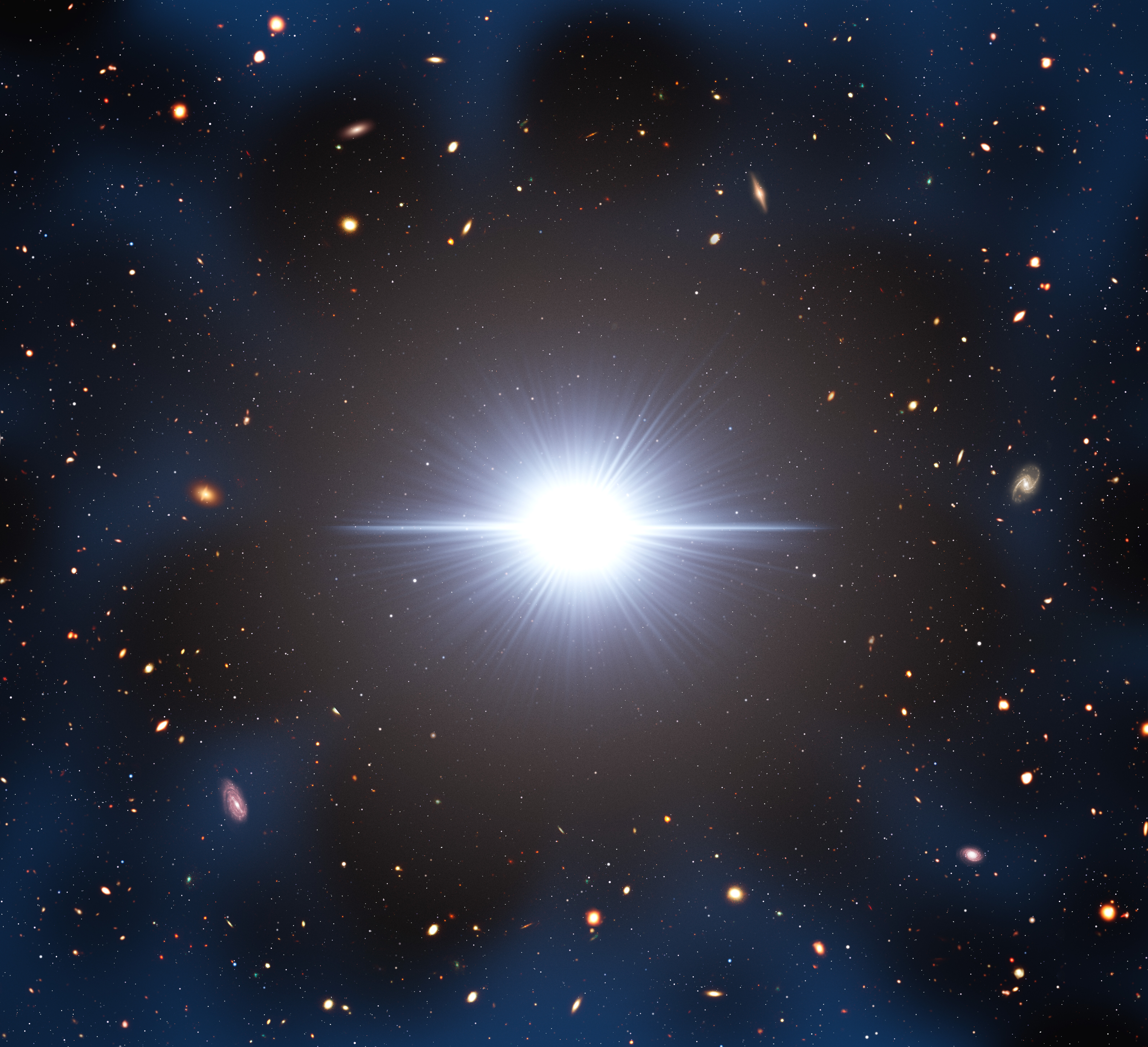
Artist Illustration of Early-Universe Quasar Cosmic Neighborhood


Videos

Cosmoview Episode 86: DECam Confirms that Early-Universe Quasar Neighborhoods are Indeed Cluttered
PR Video noirlab2422a
Cosmoview Episode 86: DECam Confirms that Early-Universe Quasar Neighborhoods are Indeed Cluttered

Cosmoview Episodio 86: DECam confirma que los vecindarios de los cuásares del Universo primitivo están realmente abarrotados


New finding with the expansive Dark Energy Camera offers a clear explanation to quasar ‘urban density’-conundrum

Observations using the Dark Energy Camera (DECam) confirm astronomers’ expectation that early-Universe quasars formed in regions of space densely populated with companion galaxies. DECam’s exceptionally wide field of view and special filters played a crucial role in reaching this conclusion, and the observations reveal why previous studies seeking to characterize the density of early-Universe quasar neighborhoods have yielded conflicting results.

Quasars are the most luminous objects in the Universe and are powered by material accreting onto supermassive black holes at the centers of galaxies. Studies have shown that early-Universe quasars have black holes so massive that they must have been swallowing gas at very high rates, leading most astronomers to believe that these quasars formed in some of the densest environments in the Universe where gas was most available. However, observational measurements seeking to confirm this conclusion have thus far yielded conflicting results. Now, a new study using the Dark Energy Camera (DECam) points the way to both an explanation for these disparate observations and also a logical framework to connect observation with theory.

DECam was fabricated by the Department of Energy and is mounted on the U.S. National Science Foundation Víctor M. Blanco 4-meter Telescope at Cerro Tololo Inter-American Observatory in Chile, a Program of NSF NOIRLab.

The study was led by Trystan Lambert, who completed this work as a PhD student at Diego Portales University’s Institute of Astrophysical Studies in Chile [1] and is now a postdoc at the University of Western Australia node at the International Centre for Radio Astronomy Research (ICRAR). Utilizing DECam’s massive field of view, the team conducted the largest on-sky area search ever around an early-Universe quasar in an effort to measure the density of its environment by counting the number of surrounding companion galaxies.

For their investigation, the team needed a quasar with a well-defined distance. Luckily, quasar VIK 2348–3054 has a known distance, determined by previous observations with the Atacama Large Millimeter/submillimeter Array (ALMA), and DECam’s three-square-degree field of view provided an expansive look at its cosmic neighborhood. Serendipitously, DECam is also equipped with a narrowband filter perfectly matched for detecting its companion galaxies. “This quasar study really was the perfect storm,” says Lambert. “We had a quasar with a well-known distance, and DECam on the Blanco telescope offered the massive field of view and exact filter that we needed.”

DECam’s specialized filter allowed the team to count the number of companion galaxies around the quasar by detecting a very specific type of light they emit, known as Lyman-alpha radiation. Lyman alpha radiation is a specific energy signature of hydrogen, produced when it is ionized and then recombined during the process of star formation. Lyman-alpha emitters are typically younger, smaller galaxies, and their Lyman-alpha emission can be used as a way to reliably measure their distances. Distance measurements for multiple Lyman-alpha emitters can then be used to construct a 3D map of a quasar’s neighborhood.

After systematically mapping the region of space around quasar VIK J2348-3054, Lambert and his team found 38 companion galaxies in the wider environment around the quasar — out to a distance of 60 million light-years — which is consistent with what is expected for quasars residing in dense regions. However, they were surprised to find that within 15 million light-years of the quasar, there were no companions at all.

This finding illuminates the reality of past studies aimed at classifying early-Universe quasar environments and proposes a possible explanation for why they have turned out conflicting results. No other survey of this kind has used a search area as large as the one provided by DECam, so to smaller-area searches a quasar’s environment can appear deceptively empty.

“DECam’s extremely wide view is necessary for studying quasar neighborhoods thoroughly. You really have to open up to a larger area,” says Lambert. “This suggests a reasonable explanation as to why previous observations are in conflict with one another.”

The team also suggests an explanation for the lack of companion galaxies in the immediate vicinity of the quasar. They postulate that the intensity of the radiation from the quasar may be large enough to affect, or potentially stop, the formation of stars in these galaxies, making them invisible to our observations.

“Some quasars are not quiet neighbors,” says Lambert. “Stars in galaxies form from gas that is cold enough to collapse under its own gravity. Luminous quasars can potentially be so bright as to illuminate this gas in nearby galaxies and heat it up, preventing this collapse.”

Lambert’s team is currently following up with additional observations to obtain spectra and confirm star formation suppression. They also plan to observe other quasars to build a more robust sample size.

“These findings show the value of the National Science Foundation’s productive partnership with the Department of Energy,” says Chris Davis, NSF program director for NSF NOIRLab. “We expect that productivity will be amplified enormously with the upcoming NSF–DOE Vera C. Rubin Observatory, a next-generation facility that will reveal even more about the early Universe and these remarkable objects.”


Notes

[1] This study was made possible through a collaboration between researchers at Diego Portales University and the Max Planck Institute of Astronomy. A portion of this work was funded through a grant by Chile’s National Research and Development Agency (ANID) for collaborations with the Max Planck Institutes.


More information

This research was presented in a paper entitled “A lack of LAEs within 5 Mpc of a luminous quasar in an overdensity at z=6.9: potential evidence of quasar negative feedback at protocluster scales” to appear in Astronomy & Astrophysics. DOI: 10.1051/0004-6361/202449566

The team is composed of Trystan S. Lambert (Universidad Diego Portales, Chile/University of Western Australia, Australia), R.J. Assef (Universidad Diego Portales, Chile), C. Mazzucchelli (Universidad Diego Portales, Chile), E. Bañados (Max Planck Institute of Astronomy, Germany), M. Aravena (Universidad Diego Portales, Chile), F. Barrientos (Pontificia Universidad Católica de Chile, Chile), J. González-López (Las Campanas Observatory, Chile/Universidad Diego Portales, Chile), W. Hu (George P. and Cynthia Woods Mitchell Institute for Fundamental Physics and Astronomy, Texas A&M University, USA), L. Infante (Pontificia Universidad Católica de Chile, Chile), S. Malhotra (NASA Goddard Space Flight Center, USA), C. Moya-Sierralta (Pontificia Universidad Católica de Chile, Chile), J. Rhoads (NASA Goddard Space Flight Center, USA), F. Valdes (NSF NOIRLab), J. Wang (University of Science and Technology of China, People’s Republic of China), I.G.B. Wold (Center for Research and Exploration in Space Science and Technology, NASA Goddard Space Flight Center, USA/Catholic University of America, USA), and Z. Zheng (Shanghai Astronomical Observatory, People’s Republic of China).

NSF NOIRLab (U.S. National Science Foundation National Optical-Infrared Astronomy Research Laboratory), the U.S. center for ground-based optical-infrared astronomy, operates the International Gemini Observatory (a facility of NSF, NRC–Canada, ANID–Chile, MCTIC–Brazil, MINCyT–Argentina, and KASI–Republic of Korea), Kitt Peak National Observatory (KPNO), Cerro Tololo Inter-American Observatory (CTIO), the Community Science and Data Center (CSDC), and Vera C. Rubin Observatory (operated in cooperation with the Department of Energy’s SLAC National Accelerator Laboratory). It is managed by the Association of Universities for Research in Astronomy (AURA) under a cooperative agreement with NSF and is headquartered in Tucson, Arizona. The astronomical community is honored to have the opportunity to conduct astronomical research on I’oligam Du’ag (Kitt Peak) in Arizona, on Maunakea in Hawai‘i, and on Cerro Tololo and Cerro Pachón in Chile. We recognize and acknowledge the very significant cultural role and reverence that these sites have to the Tohono O’odham Nation, to the Native Hawaiian community, and to the local communities in Chile, respectively.


Links


Contacts

Trystan Lambert
Postdoc Scholar
University of Western Australia
Email:
trystanscottlambert@gmail.com

Josie Fenske
Jr. Public Information Officer
NSF NOIRLab
Email:
josie.fenske@noirlab.edu


Friday, September 20, 2024

NASA's Hubble Finds More Black Holes than Expected in the Early Universe


This is a new image of the Hubble Ultra Deep Field. The first deep imaging of the field was done with Hubble in 2004. The same survey field was observed again by Hubble several years later, and was then reimaged in 2023. By comparing Hubble Wide Field Camera 3 near-infrared exposures taken in 2009, 2012, and 2023, astronomers found evidence for flickering supermassive black holes in the hearts of early galaxies. One example is seen as a bright object in the inset. Some supermassive black holes do not swallow surrounding material constantly, but in fits and bursts, making their brightness flicker. This can be detected by comparing Hubble Ultra Deep Field frames taken at different epochs. The survey found more black holes than predicted. Credits: Science: NASA, ESA, Matthew Hayes (Stockholm University), Acknowledgment: Steven V.W. Beckwith (UC Berkeley), Garth Illingworth (UC Santa Cruz), Richard Ellis (UCL), Image Processing: Joseph DePasquale (STScI)


With the help of NASA's Hubble Space Telescope, an international team of researchers led by scientists in the Department of Astronomy at Stockholm University has found more black holes in the early universe than has previously been reported. The new result can help scientists understand how supermassive black holes were created.

Currently, scientists do not have a complete picture of how the first black holes formed not long after the big bang. It is known that supermassive black holes, that can weigh more than a billion suns, exist at the center of several galaxies less than a billion years after the big bang.

"Many of these objects seem to be more massive than we originally thought they could be at such early times — either they formed very massive or they grew extremely quickly," said Alice Young, a PhD student from Stockholm University and co-author of the study published in The Astrophysical Journal Letters.

Black holes play an important role in the lifecycle of all galaxies, but there are major uncertainties in our understanding of how galaxies evolve. In order to gain a complete picture of the link between galaxy and black hole evolution, the researchers used Hubble to survey how many black holes exist among a population of faint galaxies when the universe was just a few percent of its current age.

Initial observations of the survey region were re-photographed by Hubble after several years. This allowed the team to measure variations in the brightness of galaxies. These variations are a telltale sign of black holes. The team identified more black holes than previously found by other methods.

The new observational results suggest that some black holes likely formed by the collapse of massive, pristine stars during the first billion years of cosmic time. These types of stars can only exist at very early times in the universe, because later-generation stars are polluted by the remnants of stars that have already lived and died. Other alternatives for black hole formation include collapsing gas clouds, mergers of stars in massive clusters, and "primordial" black holes that formed (by physically speculative mechanisms) in the first few seconds after the big bang. With this new information about black hole formation, more accurate models of galaxy formation can be constructed.

"The formation mechanism of early black holes is an important part of the puzzle of galaxy evolution," said Matthew Hayes from the Department of Astronomy at Stockholm University and lead author of the study. "Together with models for how black holes grow, galaxy evolution calculations can now be placed on a more physically motivated footing, with an accurate scheme for how black holes came into existence from collapsing massive stars."

Astronomers are also making observations with NASA's James Webb Space Telescope to search for galactic black holes that formed soon after the big bang, to understand how massive they were and where they were located.

The Hubble Space Telescope has been operating for over three decades and continues to make ground-breaking discoveries that shape our fundamental understanding of the universe. Hubble is a project of international cooperation between NASA and ESA (European Space Agency). NASA's Goddard Space Flight Center in Greenbelt, Maryland, manages the telescope and mission operations. Lockheed Martin Space, based in Denver, Colorado, also supports mission operations at Goddard. The Space Telescope Science Institute in Baltimore, Maryland, which is operated by the Association of Universities for Research in Astronomy, conducts Hubble science operations for NASA.


About This Release

Credits:

Media Contact:

Ray Villard
Space Telescope Science Institute, Baltimore, Maryland

Science Contact:

Matthew Hayes
Stockholm University, Stockholm, Sweden

Permissions: Content Use Policy

Contact Us: Direct inquiries to the News Team.

Related Links and Documents


Friday, July 12, 2024

NASA's Hubble Finds Strong Evidence for Intermediate-Mass Black Hole in Omega Centauri

Omega Centauri
Credits: Image: ESA/Hubble, NASA, Maximilian Häberle (MPIA)

IMBH Candidate in Omega Centauri
Credits: Image: ESA/Hubble, NASA, Maximilian Häberle (MPIA)

Omega Centauri (cropped)
Credits: Image: ESA/Hubble, NASA, Maximilian Häberle (MPIA)


Most known black holes are either extremely massive, like the supermassive black holes that lie at the cores of large galaxies, or relatively lightweight, with a mass of under 100 times that of the Sun. Intermediate-mass black holes (IMBHs) are scarce, however, and are considered rare "missing links" in black hole evolution.

Now, an international team of astronomers has used more than 500 images from NASA's Hubble Space Telescope — spanning two decades of observations — to search for evidence of an intermediate-mass black hole by following the motion of seven fast-moving stars in the innermost region of the globular star cluster Omega Centauri.

These stars provide new compelling evidence for the presence of the gravitational pull from an intermediate-mass black hole tugging on them. Only a few other IMBH candidates have been found to date.

Omega Centauri consists of roughly 10 million stars that are gravitationally bound. The cluster is about 10 times as massive as other big globular clusters — almost as massive as a small galaxy.

Among the many questions scientists want to answer: Are there any IMBHs, and if so, how common are they? Does a supermassive black hole grow from an IMBH? How do IMBHs themselves form? Are dense star clusters their favored home?

The astronomers have now created an enormous catalog for the motions of these stars, measuring the velocities for 1.4 million stars gleaned from the Hubble images of the cluster. Most of these observations were intended to calibrate Hubble's instruments rather than for scientific use, but they turned out to be an ideal database for the team's research efforts.

"We discovered seven stars that should not be there," explained Maximilian Häberle of the Max Planck Institute for Astronomy in Germany, who led this investigation. "They are moving so fast that they would escape the cluster and never come back. The most likely explanation is that a very massive object is gravitationally pulling on these stars and keeping them close to the center. The only object that can be so massive is a black hole, with a mass at least 8,200 times that of our sun."

Several studies have suggested the presence of an IMBH in Omega Centauri. However, other studies proposed the mass could be contributed by a central cluster of stellar-mass black holes, and had suggested the lack of fast-moving stars above the necessary escape velocity made an IMBH less likely in comparison.

"This discovery is the most direct evidence so far of an IMBH in Omega Centauri," added team lead Nadine Neumayer of the Max Planck Institute for Astronomy in Germany, who initiated the study, together with Anil Seth from the University of Utah, Salt Lake City. "This is exciting because there are only very few other black holes known with a similar mass. The black hole in Omega Centauri may be the best example of an IMBH in our cosmic neighborhood."

If confirmed, at a distance of 17,700 light-years the candidate black hole resides closer to Earth than the 4.3-million-solar-mass black hole in the center of the Milky Way, located 26,000 light-years away.

Omega Centauri is visible from Earth with the naked eye and is one of the favorite celestial objects for stargazers living in the southern hemisphere. Located just above the plane of the Milky Way, the cluster appears almost as large as the full Moon when seen from a dark rural area. It was first listed in Ptolemy’s catalog nearly 2,000 years ago as a single star. Edmond Halley reported it as a nebula in 1677. In the 1830s the English astronomer John Herschel was the first to recognize it as a globular cluster.

The discovery paper led by Häberle et al. is published online today in the journal Nature.

The Hubble Space Telescope has been operating for over three decades and continues to make ground-breaking discoveries that shape our fundamental understanding of the universe. Hubble is a project of international cooperation between NASA and ESA (European Space Agency). NASA's Goddard Space Flight Center in Greenbelt, Maryland, manages the telescope and mission operations. Lockheed Martin Space, based in Denver, Colorado, also supports mission operations at Goddard. The Space Telescope Science Institute in Baltimore, Maryland, which is operated by the Association of Universities for Research in Astronomy, conducts Hubble science operations for NASA.


About This Release

Credits:

Media Contact:

Ray Villard
Space Telescope Science Institute, Baltimore, Maryland

Bethany Downer
ESA/Hubble.org

Science Contact:

Maximilian Häberle
Max Planck Institute for Astronomy, Heidelberg, Germany

Permissions: Content Use Policy

Contact Us: Direct inquiries to the News Team.

Related Links and Documents


Saturday, July 06, 2024

Cosmic Simulation Reveals How Black Holes Grow and Evolve

This still from the simulation shows a supermassive black hole, or quasar, surrounded by a swirling disk of material called an accretion disk. Credit: Caltech/Phil Hopkins group

An earlier still from the simulation shows a tangle of merging galaxies.
Credit: Caltech/Phil Hopkins group

The new simulation flies into a tangle of merging galaxies, ultimately zooming into an active supermassive black hole, or quasar, surrounded by a swirling disk of material called an accretion disk. A filamentary stream of gas has been wound up into the disk, funneling gas in at a rate sufficient to fuel the brightest known quasars in the universe. Near the end of the simulation, magnetic fields rip away the angular momentum from the rotating disk, which allows material to spiral in further and further until it reaches the event horizon of the black hole, where it can't escape. During this simulation, which represents one moment in time, the scale zooms in by a factor of a billion. The colors show the density of the gas, with brighter colors representing higher densities. Credit: Caltech/Phil Hopkins group


A team of astrophysicists led by Caltech has managed for the first time to simulate the journey of primordial gas dating from the early universe to the stage at which it becomes swept up in a disk of material fueling a single supermassive black hole. The new computer simulation upends ideas about such disks that astronomers have held since the 1970s and paves the way for new discoveries about how black holes and galaxies grow and evolve.

"Our new simulation marks the culmination of several years of work from two large collaborations started here at Caltech," says Phil Hopkins, the Ira S. Bowen Professor of Theoretical Astrophysics.

The first collaboration, nicknamed FIRE (Feedback in Realistic Environments), has focused on the larger scales in the universe, studying questions such as how galaxies form and what happens when galaxies collide. The other, dubbed STARFORGE, was designed to examine much smaller scales, including how stars form in individual clouds of gas. "But there was this big gap between the two," Hopkins explains. "Now, for the first time, we have bridged that gap." To do that, the researchers had to build a simulation with a resolution that is more than 1,000 times greater than the previous best in the field.

To the team's surprise, as reported in The Open Journal of Astrophysics, the simulation revealed that magnetic fields play a much larger role than previously believed in forming and shaping the huge disks of material that swirl around and feed the supermassive black holes. "Our theories told us the disks should be flat like crepes," Hopkins says. "But we knew this wasn't right because astronomical observations reveal that the disks are actually fluffy—more like an angel cake. Our simulation helped us understand that magnetic fields are propping up the disk material, making it fluffier."


Visualizing the Activity Around Supermassive Black Holes Using "Super Zoom-Ins"

In the new simulation, the researchers performed what they call a "super zoom-in" on a single supermassive black hole, a monstrous object that lies at the heart of many galaxies, including our own Milky Way. These ravenous, mysterious bodies contain anywhere from thousands to billions of times the mass of the Sun, and thus exert a huge effect on anything that comes near.

Astronomers have known for decades that as gas and dust are pulled in by the tremendous gravity of these black holes, they are not immediately sucked in. Instead, the material first forms a rapidly swirling disk called an accretion disk. And as the material is just about to fall in, it radiates a huge amount of energy, shining with a brilliance unmatched by just about anything in the universe. But much is still not known about these active supermassive black holes, called quasars, and how the disks that feed them form and behave.

While disks around supermassive black holes have been imaged previously—the Event Horizon Telescope imaged disks circling black holes at the heart of our own galaxy in 2022 and Messier 87 in 2019—these disks are much closer and more tame than the ones that churn around quasars. To visualize what happens around these more active and distant black holes, astrophysicists turn to supercomputer simulations. They feed information about the physics at work in these galactic settings—everything from the basic equations that govern gravity to how to treat dark matter and stars—into thousands of computing processors that work in parallel. This input includes many algorithms, or series of instructions, for the computers to follow to recreate complicated phenomena. So, for example, the computers know that once gas becomes dense enough, a star forms. But the process is not that straightforward.

"If you just say gravity pulls everything down and then eventually the gas forms a star and stars just build up, you'll get everything wildly wrong," Hopkins explains. After all, stars do many things that affect their surroundings. They shine radiation that can heat up or push surrounding gas. They blow winds like the solar wind created by our own Sun, which can sweep up material. They explode as supernovae, sometimes launching material clear out of galaxies or changing the chemistry of their surroundings. So, the computers must know all the ins and outs of this "stellar feedback" as well, as it regulates how many stars a galaxy can actually form.

Building a Simulation that Spans Multiple Scales

But at these larger scales, the set of physics that are most important to include and what approximations can be made differ from those at smaller scales. For example, on the galactic scale, the complicated details of how atoms and molecules behave are extremely important and must be built into any simulation. However, scientists agree that when simulations focus on the more immediate area around a black hole, molecular chemistry can be mostly ignored because the gas there is too hot for atoms and molecules to exist. Instead, what is exists there is hot ionized plasma.

Creating a simulation that could cover all the relevant scales down to the level of a single accretion disk around a supermassive black hole was a huge computational challenge—one that also required a code that could handle all the physics. "There were some codes that had the physics that you needed to do the small-scale part of the problem and some codes that had the physics that you needed to do the larger, cosmological part of the problem, but nothing that had both," Hopkins says.

The Caltech-led team used a code they call GIZMO for both the large- and small-scale simulation projects. Importantly, they built the FIRE project so that all the physics they added to it could work with the STARFORGE project, and vice versa. "We built it in a very modular way, so that you could flip on and off any of the pieces of physics that you wanted for a given problem, but they were all cross compatible," Hopkins says.

This allowed the scientists in the latest work to simulate a black hole that is about 10 million times the mass of our Sun, beginning in the early universe. The simulation then zooms in on that black hole at a moment when a giant stream of material is torn off a cloud of star-forming gas and begins to swirl around the supermassive black hole. The simulation can continue zooming in, resolving a finer area at each step as it follows the gas on its way toward the hole.

Surprisingly Fluffy, Magnetic Disks

"In our simulation, we see this accretion disk form around the black hole," Hopkins says. "We would have been very excited if we had just seen that accretion disk, but what was very surprising was that the simulated disk doesn't look like what we've thought for decades it should look like." In two seminal papers from the 1970s that described the accretion disks fueling supermassive black holes, scientists assumed that thermal pressure—the change in pressure caused by the changing temperature of the gas in the disks—played the dominant role in preventing such disks from collapsing under the tremendous gravity they experience close to the black hole. They acknowledged that magnetic fields might play a minor role in helping to shore up the disks. In contrast, the new simulation found that the pressure from the magnetic fields of such disks was actually 10,000 times greater than the pressure from the heat of the gas.

"So, the disks are almost completely controlled by the magnetic fields," Hopkins says. "The magnetic fields serve many functions, one of which is to prop up the disks and make the material puffy."

This realization changes a host of predictions scientists can make about such accretion disks, such as their mass, how dense and thick they should be, how fast material should be able to move from them into a black hole, and even their geometry (such as whether the disks can be lopsided).

Looking forward, Hopkins hopes this new ability to bridge the gap in scales for cosmological simulations will open many new avenues of research. For example, what happens in detail when two galaxies merge? What types of stars form in the dense regions of galaxies where conditions are unlike those in our Sun's neighborhood? What might the first generation of stars in the universe have looked like? "There's just so much to do," he says.

The new simulation is detailed in a paper entitled "FORGE'd in FIRE: Resolving the End of Star Formation and Structure of AGN Accretion Disks from Cosmological Initial Conditions," which appears in The Open Journal of Astrophysics. Additional authors on the paper include Michael Grudic (PhD '19) of Carnegie Observatories, Kung-Yi Su (PhD '19) of Harvard University, Sarah Wellons of Wesleyan University, Daniel Angles-Alcazar of the University of Connecticut and the Flatiron Institute, Ulrich Steinwandel of the Flatiron Institute, David Guszeinov (PhD '18) of the University of Texas at Austin, Norman Murray (BS '79) of the University of Toronto, Claude-Andre Faucher-Giguere of Northwestern University, Eliot Quatert of Princeton University, and Dusan Keres of UC San Diego. Hopkins's work was supported by funding from the National Science Foundation and NASA.

Written by Kimm Fesenmaier

Source: Caltech/News


Contact:

Whitney Clavin
(626) 395‑1944

wclavin@caltech.edu