Showing posts with label kilonova. Show all posts

Saturday, December 27, 2025

“Superkilonova” A Star So Nice, It Explodes Twice

Artist interpretation depicts a hypothesized event known as a superkilonova. Initially, a massive star explodes in a supernova, which generates elements like carbon and iron (left). In the aftermath, two neutron stars are born, at least one of which is believed to be less massive than our Sun (middle). The neutron stars spiral together, sending gravitational waves rippling through the cosmos, before merging in a dramatic kilonova (right). Kilonovae seed the universe with the heaviest elements, such as gold at platinum, which glow in red light as depicted in the animation. Credit: Caltech/K. Miller and R. Hurt (IPAC)


Potential first-of-a-kind may have produced gravitational waves and light

Maunakea, Hawaiʻi – A team of astronomers using a variety of telescopes, including the W. M. Keck Observatory on Maunakea, Hawaiʻi Island, have discovered a possible “Superkilonova” that exploded not once but twice, evidence that this oddball event may be a first-of-a-kind superkilonova, or a kilonova spurred by a supernova. Such an event has been hypothesized but never seen.

When the most massive stars reach the ends of their lives, they blow up in spectacular supernova explosions, which seed the universe with heavier elements such as carbon and iron. Another type of explosion—the kilonova—occurs when a pair of dense, dead stars called neutron stars smash together, forging even heavier elements, such as gold and uranium. The heavy elements created by both of these explosions are among the basic building blocks of stars and planets.

So far, only one kilonova has been unambiguously confirmed to date, a historic event known as GW170817, which took place in 2017. In that case, two neutron stars smashed together, sending ripples in space-time known as gravitational waves, as well as light waves, across the cosmos. The cosmic blast was detected in gravitational waves by the National Science Foundation’s Laser Interferometer Gravitational-Wave Observatory (LIGO) and its European partner, the Virgo gravitational-wave detector, and in light waves by dozens of ground-based and space telescopes around the world.

The curious case of the kilonova candidate, AT2025ulz, is complex, and thought to have stemmed from a supernova blast that went off hours before, ultimately obscuring astronomers’ view and making the case more complicated.

“At first, for about three days, the eruption looked just like the first kilonova in 2017,” said Mansi Kasliwal, professor of astronomy at The California Institute of Technology and director of Palomar Observatory. “Everybody was intensely trying to observe and analyze it, but then it started to look more like a supernova, and some astronomers lost interest. Not us.”

The study, led by The California Institute of Technology, is published in The Astrophysical Journal Letters.

In August 2025, a new gravitational-wave signal was picked up by The Laser Interferometer Gravitational-Wave Observatory (LIGO) and Virgo in Italy. Within minutes, an alert was issued to the astronomical community containing a rough map of the source signaling to researchers that gravitational waves had been registered from what appeared to be a merger between two objects, with at least one of them being unusually tiny.

After first being identified by the Zwicky Transient Facility at Palomar Observatory, Kasliwal coordinated with Keck Observatory staff astronomer Michael Lundquist to launch a rapid Target of Opportunity (ToO) observation of AT2025ulz, a process that allows scientists to request immediate access for short-lived cosmic events. Mansi’s ToO request enabled the immediate spectroscopic follow-up using the Low-Resolution Imaging Spectrograph (LRIS).

“Keck Observatory provided the imagery and spectroscopy via our Low-Resolution Imaging Spectrograph (LRIS) Instrument to measure the host extinction and redshift of the galaxy as well as looking at the spectroscopic evolution,” Lundquist said. “This highlights Keck Observatory’s Target of Opportunity capability to rapidly respond to transient alerts and deliver the spectroscopic data needed to explore potential multi-messenger associations.”

The observations confirmed that the eruption of light had faded fast and glowed at red wavelengths—just as GW170817 had done eight years earlier. In the case of the GW170817 kilonova, the red colors came from heavy elements like gold; these atoms have more electron energy levels than lighter elements, so they block blue light but let red light pass through.

Then, days after the blast, AT2025ulz started to brighten again, turn blue and show hydrogen in its spectra, all signs of a supernova not a kilonova (specifically a “stripped-envelope, core-collapse” supernova). Supernovae from distant galaxies are generally not expected to generate enough gravitational waves to be detectable by LIGO and Virgo, whereas kilonovae are. This led some astronomers to conclude that AT2025ulz was triggered by a typical, ho-hum supernova and not in fact related to the gravitational-wave signal.

What Might Be Going On?

Kasliwal says that several clues tipped her off that something unusual had taken place. Though AT2025ulz did not resemble the classic kilonova GW170817, it also did not look like an average supernova. Additionally, the LIGO–Virgo gravitational-wave data had revealed that at least one of the neutron stars in the merger was less massive than our Sun, a hint that one or two small neutron stars might have merged to produce a kilonova.

Neutron stars are the leftover remains of massive stars that explode as supernovae. They are thought to be around the size of San Francisco (about 22 to 30 kilometers across) with masses that range from 1.2 to about 3 times that of our Sun. Some theorists have proposed ways in which neutron stars might be even smaller, with masses less than the Sun’s, but none have been observed so far.

Theorists invoke two scenarios to explain how a neutron star could be that small. In one, a rapidly spinning massive star goes supernova, then splits into two tiny, sub-solar neutron stars in a process termed fission. In the second scenario, called fragmentation, the rapidly spinning star again goes supernova, but this time a disk of material forms around the collapsing star. The lumpy disk material coalesces into a tiny neutron in a manner similar to how planets form.

With LIGO and Virgo having detected at least one sub-solar neutron star, it is possible, according to theories proposed by co-author Brian Metzger of Columbia University that two newly formed neutron stars could have crashed into each other, erupting as a kilonova that sent gravitational waves rippling through the cosmos. As the kilonova churned out heavy metals, it would have initially glowed in red light as ZTF and other telescopes observed. The expanding debris from the initial supernova blast would have obscured the astronomers’ view of the kilonova. In other words, a supernova may have birthed twin baby neutron stars that then merged to make a kilonova.

“The only way theorists have come up with to birth sub-solar neutron stars is during the collapse of a very rapidly spinning star,” Metzger says. “If these ‘forbidden’ stars pair up and merge by emitting gravitational waves, it is possible that such an event would be accompanied by a supernova rather than be seen as a bare kilonova.”

But while this theory is tantalizing and interesting to consider, the research team stresses that there is not enough evidence to make firm claims. The only way to test the superkilonovae theory is to find more.

“Future kilonovae events may not look like GW170817 and may be mistaken for supernovae,” Kasliwal says. “We can look for new possibilities in data like this, but we do not know with certainty that we found a superkilonova. The event, nevertheless, is eye o,brpening.”
.


About LRIS

The Low Resolution Imaging Spectrometer (LRIS) is a very versatile and ultra-sensitive visible-wavelength imager and spectrograph built at the California Institute of Technology by a team led by Prof. Bev Oke and Prof. Judy Cohen and commissioned in 1993. Since then it has seen two major upgrades to further enhance its capabilities: the addition of a second, blue arm optimized for shorter wavelengths of light and the installation of detectors that are much more sensitive at the longest (red) wavelengths. Each arm is optimized for the wavelengths it covers. This large range of wavelength coverage, combined with the instrument’s high sensitivity, allows the study of everything from comets (which have interesting features in the ultraviolet part of the spectrum), to the blue light from star formation, to the red light of very distant objects. LRIS also records the spectra of up to 50 objects simultaneously, especially useful for studies of clusters of galaxies in the most distant reaches, and earliest times, of the universe. LRIS was used in observing distant supernovae by astronomers who received the Nobel Prize in Physics in 2011 for research determining that the universe was speeding up in its expansion.

About W. M. Keck Observatory

The W. M. Keck Observatory telescopes are among the most scientifically productive on Earth. The two 10-meter optical/infrared telescopes atop Maunakea on the Island of Hawaiʻi feature a suite of advanced instruments including imagers, multi-object spectrographs, high-resolution spectrographs, integral-field spectrometers, and world-leading laser guide star adaptive optics systems. Some of the data presented herein were obtained at Keck Observatory, which is a private 501(c) 3 non-profit organization operated as a scientific partnership among the California Institute of Technology, the University of California, and the National Aeronautics and Space Administration. The Observatory was made possible by the generous financial support of the W. M. Keck Foundation. The authors wish to recognize and acknowledge the very significant cultural role and reverence that the summit of Maunakea has always had within the Native Hawaiian community. We are most fortunate to have the opportunity to conduct observations from this mountain. For more information, visit: www.keckobservatory.org


Monday, April 28, 2025

New framework suggests stars dissolve into neutrons to forge heavy elements

A high-energy photonic jet (white and blue) blasts through a collapsar with a black hole at its center. The red space around the jet represents the cocoon where free neutrons may be captured causing the r process, the nucleosynthesis that results in the formation of heavy elements.


Understanding the origin of heavy elements on the periodic table is one of the most challenging open problems in all of physics. In the search for conditions suitable for these elements via “nucleosynthesis,” a Los Alamos National Laboratory-led team is going where no researchers have gone before: the gamma-ray burst jet and surrounding cocoon emerging from collapsed stars. As proposed in The Astrophysical Journal, high-energy photons produced deep in the jet could dissolve the outer layers of a star into neutrons, causing a series of physical processes that results in the formation of heavy elements.

“The creation of heavy elements such as uranium and plutonium necessitates extreme conditions,” said Matthew Mumpower, physicist at Los Alamos. “There are only a few viable yet rare scenarios in the cosmos where these elements can form, and all such locations need a copious amount of neutrons. We propose a new phenomenon where those neutrons don’t pre-exist but are produced dynamically in the star.”

Free neutrons have a short half-life of about 15 minutes, limiting scenarios in which they are available in the abundance required to form heavy elements. The key to producing the heaviest elements on the periodic table is known as the rapid neutron-capture process, or “r process,” and it is thought to be responsible for production of all naturally occurring thorium, uranium and plutonium in the universe. The team’s framework takes on the challenging physics of the r process and resolves them by proposing reactions and processes around star collapses that could result in heavy element formation.

In addition to understanding the formation of heavy elements, the proposed framework helps address critical questions around neutron transport, multiphysics simulations, and the observation of rare events — all of which are of interest for national security applications that can glean insights from the research.

Like a freight train plowing through snow

In the scenario Mumpower proposes, a massive star begins to die as its nuclear fuel runs out. No longer able to push up against its own gravity, a black hole forms at the star’s center. If the black hole is spinning fast enough, frame-dragging effects from the extremely strong gravity near the black hole wind up the magnetic field and launch a powerful jet. Through subsequent reactions, a broad spectrum of photons is created, some of which are at high energy.

The jet blasts through the star ahead of it, creating a hot cocoon of material around the jet, “like a freight train plowing through snow,” Mumpower said. At the interface of the jet with the stellar material, high-energy photons (that is, light) can interact with atomic nuclei, transmuting protons to neutrons. Existing atomic nuclei may also be dissolved into individual nucleons, creating more free neutrons to power the r process. The team’s calculations suggest the interaction with light and matter can create neutrons incredibly fast, on the order of a nanosecond.

Because of their charge, protons get trapped in the jet by the strong magnetic fields. Neutrons, which are chargeless, are plowed out of the jet into the cocoon. Having experienced a relativistic shock, the neutrons are extremely dense compared with the surrounding stellar material, and thus the r process may ensue, with heavy elements and isotopes forged and then expelled out into space as the star is ripped apart.

The process of protons converting into neutrons, along with free neutrons escaping into the surrounding cocoon to form heavy elements, involves a broad range of physics principles and encompasses all four fundamental forces of nature: a true multiphysics problem, combining areas of atomic and nuclear physics with hydrodynamics and general relativity. Despite the team’s efforts, more challenges remain as the heavy isotopes created during the r-process have never been made on Earth. Researchers know little about their properties including their atomic weight, half-life and so on.

An explanation for unusual phenomena?

The high-energy jet framework proposed by the team may help explain the origination of kilonova — a glow of optical and infrared electromagnetic radiation — associated with long-duration gamma-ray bursts. Kilonova have been primarily associated with the collision of two neutron stars or the merger of a neutron star and a black hole. These intense collisions are one possible method for confirming with observations the cosmic factories of heavy-element formation. Star dissolution via high-energy photon jet offers an alternative origin for the production of heavy elements and the kilonova they may manufacture, a possibility not previously thought to be associated with collapsing stars.

Relatedly, scientists have observed iron and plutonium in deep-sea sediment. These deposits, after study, are confirmed to be from extraterrestrial sources, though as with the phenomena producing kilonova, the specific location or cosmic event remains elusive. The collapsar high-energy jet scenario represents an intriguing possibility as the source of these heavy elements found undersea.

To more fully understand the proposed framework, Mumpower and his team hope to run simulations on their models, including the complex microphysics interactions.


Paper: “Let there be neutrons! Hadronic photoproduction from a large flux of high-energy photons.” The Astrophysical Journal. DOI: 10.3847/1538-4357/adb1e3

Funding: The work was supported in part by the Laboratory Directed Research and Development program at Los Alamos.

LA-UR-25-22486


Contact: Public Affairs | media_relations@lanl.gov


Tuesday, July 16, 2024

Posted on July 9, 2024 by Carolyn Collins Petersen Ancient People Saw a Kilonova Light up the Sky

A comparison between the observed XMM-Newton image of the kilonova 1181 with an IRAS-derived schematic of infrared contours (presumably of the dust ring) around the resulting white dwarf. This kilonova occurred when two white dwarfs collided and were observed in 1181. Courtesy Ko, et al, 2024.

What happens when aging white dwarf stars come together? Observers in feudal Japan in the year 1181 had a front-row view of the superpowerful kilonova created by such a merger. Their records show that a rare “guest star” flared up and then faded. It took until 2021 for astronomers to find the place in the sky where it occurred.

“There are many accounts of this temporary guest star in historical records from Japan, China, and Korea. At its peak, the star’s brightness was comparable to Saturn’s. It remained visible to the naked eye for about 180 days, until it gradually dimmed out of sight. The remnant of the SN 1181 explosion is now very old, so it is dark and difficult to find,” said Takatoshi Ko, a doctoral student from the Department of Astronomy at the University of Tokyo. Ko led a team that analyzed observations and did computer modeling to relocate this ancient stellar disaster.

This explosion site of the kilonova is still active some 1,800 years later. Astronomers now see a white dwarf embedded in a nebula in Cassiopeia. The star appears to have just started blowing high-speed winds from its surface in the past few decades.

Anatomy of a White Dwarf Kilonova

The original “guest star” is called SN 1181, surrounded by a remnant (SNR 1181) of the explosion. It formed when two very dense, Earth-sized white dwarfs collided. The result was a very rare type of supernova explosion, labeled Type 1ax. The explosion blew away rings of material from both stars. At the center of the merger remained a very bright, very hot, fast-rotating white dwarf called WD J00531. It’s surrounded by an infrared nebula called IRAS 00500+6713.

White dwarf star collision. Artist’s impression of two white dwarf stars merging and creating a Type Ia supernova. Type Ia supernovas are similar to type Iax supernovas, as they occur when two white dwarfs collide. However, they are brighter and the explosion completely destroys the stars. Type Iax supernovas, like SN 1181 where a remnant white dwarf is left behind after the kilonova, are more rare. © ESO/ L. Calçada

When a merger of white dwarfs takes place, astronomers expect that both should explode and disappear. Instead, this one created a new white dwarf. It’s pinning rapidly and blowing off a strong stellar wind at a velocity of 15,000 km/sec. It’s also experiencing a high mass-loss rate via that wind.

Usually, kilonova explosions occur when two neutron stars or a neutron star and a black hole collide. So, for one to occur between white dwarfs says a lot about the progenitors. Given those characteristics, astronomers think this one is a “super-” or “near-Chandrasekahr limit” white dwarf. To get that kind of weirdo stellar corpse, the progenitors had to be double-degenerate white dwarfs. In other words, they are at or above the Chandrasekhar limit. That’s the mass above which electron degeneracy pressure in the star’s core isn’t enough to balance its self-gravity. In this case, when these two oddball white dwarfs combined, they made a newer, weirder version.

Rings around the White Dwarf

SN 1181 lies about 10,100 light-years from Earth—so not close enough to affect us. Nonetheless, kilonovae can be pretty catastrophic. Experts estimate that if you were within a dozen or so light-years away from one, it could affect life as the gamma rays and other radiation slam into a planet.

The resulting remnant of the kilonova is itself somewhat weird. It contains two shock regions in addition to that superfast wind. The outer region is bright in X-rays and is the interface between material ejected from the merger and material in interstellar space. The inner one is a more recent creation. It appears to have begun blowing around 1990 and is dust-rich. “If the wind had started blowing immediately after SNR 1181’s formation, we couldn’t reproduce the observed size of the inner shock region,” said Ko.

“However, by treating the wind’s onset time as variable, we succeeded in explaining all of the observed features of SNR 1181 accurately and unraveling the mysterious properties of this high-speed wind. We were also able to simultaneously track the time evolution of each shock region, using numerical calculations.”

What’s Happening Now?

The team thinks the resulting white dwarf has started to burn again. That’s possibly due to matter thrown out by the kilonova explosion witnessed in 1181 falling back to its surface. When that happens, the density of the surface area and the temperature both increase enough to restart burning.

The team deduced this from computer models based on X-ray observations by the Chandra X-ray Observatory, XMM-Newton, and IRAS in the infrared. Now they’ll focus on further observations of SN 1181 using the Very Large Array radio telescope and the Subaru Telescope in Hawai’i. This should allow scientists to probe the history of this event more deeply.

The evolution of SNR 1181. This illustration charts the evolution of the SNR 1181 remnant, from its creation when a carbon-oxygen-based white dwarf and oxygen-neon white dwarf merged in a kilonova, to the formation of its two shock regions. © 2024 T. Ko

“The ability to determine the age of supernova remnants or the brightness at the time of their explosion through archaeological perspectives is a rare and invaluable asset to modern astronomy,” said Ko. “Such interdisciplinary research is both exciting and highlights the immense potential for combining diverse fields to uncover new dimensions of astronomical phenomena.”

For More Information

Fresh Wind Blows from Historical Supernova

by Carolyn Collins Petersen


Monday, February 19, 2024

What fuels the powerful engine of neutron star mergers?


Around sixty milliseconds after the merger, the simulation shows the jet emitted from the poles of the magnetar (up and down in this still image). The left panel shows the neutron richness of the ejected material. Blue denotes neutron-rich matter, and red denotes matter that contains neutrons and protons in roughly equal proportions. The middle panel shows surfaces of constant rest mass density. The purple curves indicate magnetic field lines. The right panel shows surfaces of constant magnetic field strength. The scale bar shows a length of 500 kilometers. Credit: Kota Hayashi (Max Planck Institute for Gravitational Physics

New computer simulation reveals the dynamo that generates large-scale magnetic fields in merging neutron stars

Merging and colliding neutron stars produce powerful kilonova explosions and gamma-ray bursts. Scientists have long suspected that a large and ultra-strong magnetic field is the engine behind these high-energy phenomena. However, the process that generates this magnetic field has been a mystery until now. Researchers at the Max Planck Institute for Gravitational Physics and at the universities in Kyoto and Toho have revealed the underlying mechanism by performing a super-high resolution computer simulation taking into account all fundamental physics. The researchers showed that ultra-strongly magnetized neutron stars, also known as magnetars, cause very bright kilonova explosions. Telescopic observations could test this prediction in the future.

Neutron stars are compact remnants of supernova explosions and consist of extremely dense matter. They are about 20 kilometers across and have up to twice the mass of our Sun, or almost 700,000 times the mass of our Earth. On August 17, 2017, astronomers observed for the first time gravitational waves, light, and gamma rays from the merger of two neutron stars. This event marked the beginning of a new kind of multi-messenger astronomy, combining gravitational-wave and electromagnetic observations.

Observations of the gravitational waves and the gamma-ray burst emitted during the merger revealed that binary neutron star mergers are the origin of at least a part of short-hard gamma-ray bursts and the heavy elements. “Only by performing a numerical simulation that takes into account all the fundamental physical effects in binary neutron star mergers will we fully understand the complete process and its underlying mechanisms,” explains Masaru Shibata, director of the Computational Relativistic Astrophysics department at the Max Planck Institute for Gravitational Physics in Potsdam. “That’s why we ran a merger simulation that took into account all the implications of Einstein’s theory of relativity and all other fundamental physics, with a spatial resolution more than ten times higher than any previous simulation, and the highest ever.”

What fuels the powerful engine of neutron star mergers?
New computer simulation reveals the dynamo that generates large-scale magnetic fields in merging neutron stars
© Kota Hayashi (Max Planck Institute for Gravitational Physics)
https://www.youtube.com/watch?v=x6qb_kt41Gs

As in the Sun so in the neutron star

High-energy phenomena associated with neutron-star mergers such as kilonova explosions and gamma-ray bursts are most likely driven by magnetohydrodynamics—the interplay between magnetic fields and fluids. This implies that a binary neutron star merger remnant must generate a strong, large-scale magnetic field via a dynamo mechanism.

“For the first time, we could pin down the physical mechanism that generates a large-scale magnetic field from smaller ones in binary neutron star mergers,” says Kenta Kiuchi, group leader in the Computational Relativistic Astrophysics department. “Part of this mechanism is the same that drives our Sun’s magnetic field. In a neutron star merger, the large-scale magnetic field emerges because of instabilities and vortices at the surface where the two neutron stars slam into one another.”

There are two phases of magnetic field amplifications: In a first phase, the Kelvin-Helmholtz instability rapidly amplifies the energy in the magnetic field by a factor of several thousand within a few milliseconds after the merger. “However, this amplified magnetic field still is a small-scale field,” explains Alexis Raboul-Salze, postdoctoral researcher in the Computational Relativistic Astrophysics department. “But after a few milliseconds, there is a second phase of magnetic field amplification due to another instability, the magnetorotational instability. This instability further amplifies the small-scale field and acts as a dynamo on the large-scale field – the same mechanism as in the Sun.”

The resulting highly magnetized massive neutron star born in the collision is hypothetically proposed as a magnetar. About 40 milliseconds after the merger the magnetic fields drives a strong particle wind at relativistic speeds from the poles of the magnetar. This wind forms a jet, which is related to the observed high-energy phenomena. The research group shows that this hypothesis is feasible for the first time.

“Our simulation suggests that the magnetar engine generates very bright kilonova explosions. We can test our prediction by multi-messenger observations in the near future,” concludes Masaru Shibata.


Media contact:

Dr. Elke Müller
Press Officer AEI
Potsdam, Scientific Coordinator
tel:+49 331 567-7303
tel:+49 331 567-7298

elke.mueller@aei.mpg.de

Scientific contacts:

Prof. Masaru Shibata
Director
tel:+49 331 567-7222
tel:+49 331 567-7298

masaru.shibata@aei.mpg.de

Dr. Kenta Kiuchi
Group Leader
tel:+49 331 567-7320

kenta.kiuchi@aei.mpg.de

Dr. Alexis Reboul-Salze
Junior Scientist/Postdoc
tel:+49 331 567-7234

alexis.reboul-salze@aei.mpg.de


Publication:

Kenta Kiuchi, Alexis Reboul-Salze, Masaru Shibata, Yuichiro Sekiguchi
A large-scale magnetic field produced by a solar-like dynamo in binary neutron star mergers
Nature Astronomy (2024)


Source | DOI


Saturday, February 10, 2024

How Close Is Too Close to a Kilonova?


The image above shows the radiation and particles generated by a kilonova, the explosion produced when the remnants of two massive stars collide. Kilonovae made headlines in 2017, when scientists observed gravitational waves and a kilonova from colliding neutron stars for the first time. Recently, a research team led by Haille Perkins (University of Illinois Urbana-Champaign) used information gleaned from the 2017 event to estimate the threat posed by a kilonova’s X-rays, gamma rays, and cosmic rays. Fortunately for us, a kilonova would have to be quite close for life on Earth to be endangered by its X-rays or gamma rays — within about 3 light-years for X-rays or 13 light-years for gamma rays. Even after the initial glow of the collision fades, though, there’s still danger: high-energy charged particles called cosmic rays pose a threat years after the dangerous radiation has passed, and a kilonova’s cosmic rays can be lethal out to 36 light-years away. Luckily, kilonovae are extremely rare, and the danger to life on Earth is minimal. As researchers observe more kilonovae and improve their models, we’ll be able to refine our understanding of how close is too close when it comes to kilonovae, the threat they pose to Earth, and the role they play in determining where in the universe life can form and flourish.

Citation

“Could a Kilonova Kill: A Threat Assessment,” Haille M. L. Perkins et al 2024 ApJ 961 170.

doi:10.3847/1538-4357/ad12b7

By Kerry Hensley


Sunday, December 31, 2023

Studying neutron stars on many channels in parallel


Numerical simulation of the resulting ejecta material of two merging neutron stars. Red colors refer to ejected material with a high fraction of neutrons which will appear typically redder than blue material that contains a higher fraction of protons. © I. Markin (University of Potsdam)

International research team succeeds for the first time in analyzing very different signals simultaneously

An international team of researchers, including the Max Planck Institute for Gravitational Physics and the University of Potsdam, has developed a method to analyze most of the observable signals associated with neutron star mergers simultaneously. For the first time, it was possible to model and interpret the emitted gravitational waves, the kilonova, and the afterglow of the gamma-ray burst of the merger of two neutron stars observed on August 17, 2017. The study and the code infrastructure developed for it provide precise information about the properties of nuclear matter and form the basis for the analysis of future events. The research results have now been published in the journal Nature Communications.

“Our new method will help to analyze the properties of matter at extreme densities. It will also allow us to better understand the expansion of the universe and to what extent heavy elements are formed during neutron star mergers,” explains Tim Dietrich, Professor at the University of Potsdam and leader of a Max Planck Fellow group at the Max Planck Institute for Gravitational Physics. Dietrich is corresponding author of the paper.

Extreme conditions in a cosmic laboratory

A neutron star is a superdense astrophysical object formed at the end of a massive star's life in a supernova explosion. Like other compact objects, some neutron stars orbit each other in binary systems. They lose energy through the constant emission of gravitational waves – tiny ripples in the fabric of space-time – and eventually collide. Such mergers allow researchers to study physical principles under the most extreme conditions in the universe. For example, the conditions of these high-energy collisions lead to the formation of heavy elements such as gold. Indeed, merging neutron stars are unique objects for studying the properties of matter at densities far beyond those found in atomic nuclei.

The new method was applied to the first and so far only multi-messenger observation of binary neutron star mergers. In this event, discovered on August 17, 2017, the stars' last few thousand orbits around each other had warped space-time enough to create gravitational waves, which were detected by the terrestrial gravitational-wave observatories Advanced LIGO and Advanced Virgo. As the two stars merged, newly formed heavy elements were ejected. Some of these elements decayed radioactively, causing the temperature to rise. Triggered by this thermal radiation, an electromagnetic signal in the optical, infrared, and ultraviolet was detected up to two weeks after the collision. A gamma-ray burst, also caused by the neutron star merger, ejected additional material. The reaction of the neutron star's matter with the surrounding medium produced X-rays and radio emissions that could be monitored on time scales ranging from days to years.

More accurate results for future detections

The new tool for simultaneously analyzing astrophysical data from different sources allows researchers to interpret all these signals at the same time and to incorporate additional information from radio and X-ray observations of neutron stars (e.g., from NASA's NICER telescope), from nuclear physics calculations, and even from heavy-ion collision experiments at accelerators on Earth. "We can now go beyond the usual step-by-step combination process that we have done before. By analyzing coherently and simultaneously, we get more precise results," says Peter T. H. Pang, scientist at Utrecht University, first author of the paper and lead developer of the code. To even further improve the developed software over the coming years, Dietrich was awarded with an ERC Starting Grant worth 1.5 million euros in 2022.

The gravitational-wave detectors are currently in their fourth observing run. The next detection of a neutron star merger could come any day, and the researchers are eagerly waiting to use the tool they developed again.


Media contact:

Dr. Elke Müller
Press Officer AEI
Potsdam, Scientific Coordinator
tel:+49 331 567-7303
tel:+49 331 567-7298

elke.mueller@aei.mpg.de

Science contact:

Prof. Dr. Tim Dietrich
Max Planck Fellow
tel:+49 331 567-7253
tel:+49 331 567-7298

tim.dietrich@aei.mpg.de


Publication

Peter T. H. Pang, Tim Dietrich, Michael W. Coughlin, Mattia Bulla, Ingo Tews, Mouza Almualla, Tyler Barna, Ramodgwendé Weizmann Kiendrebeogo, Nina Kunert, Gargi Mansingh, Brandon Reed, Niharika Sravan, Andrew Toivonen, Sarah Antier, Robert O. VandenBerg, Jack Heinzel, Vsevolod Nedora, Pouyan Salehi, Ritwik Sharma, Rahul Somasundaram, Chris Van Den Broeck

An updated nuclear-physics and multi-messenger astrophysics framework for binary neutron star mergers
Nature Communications, Vol. 14, p. 1-13 (2023)


Source


Wednesday, December 07, 2022

Kilonova Discovery Challenges our Understanding of Gamma-Ray Bursts


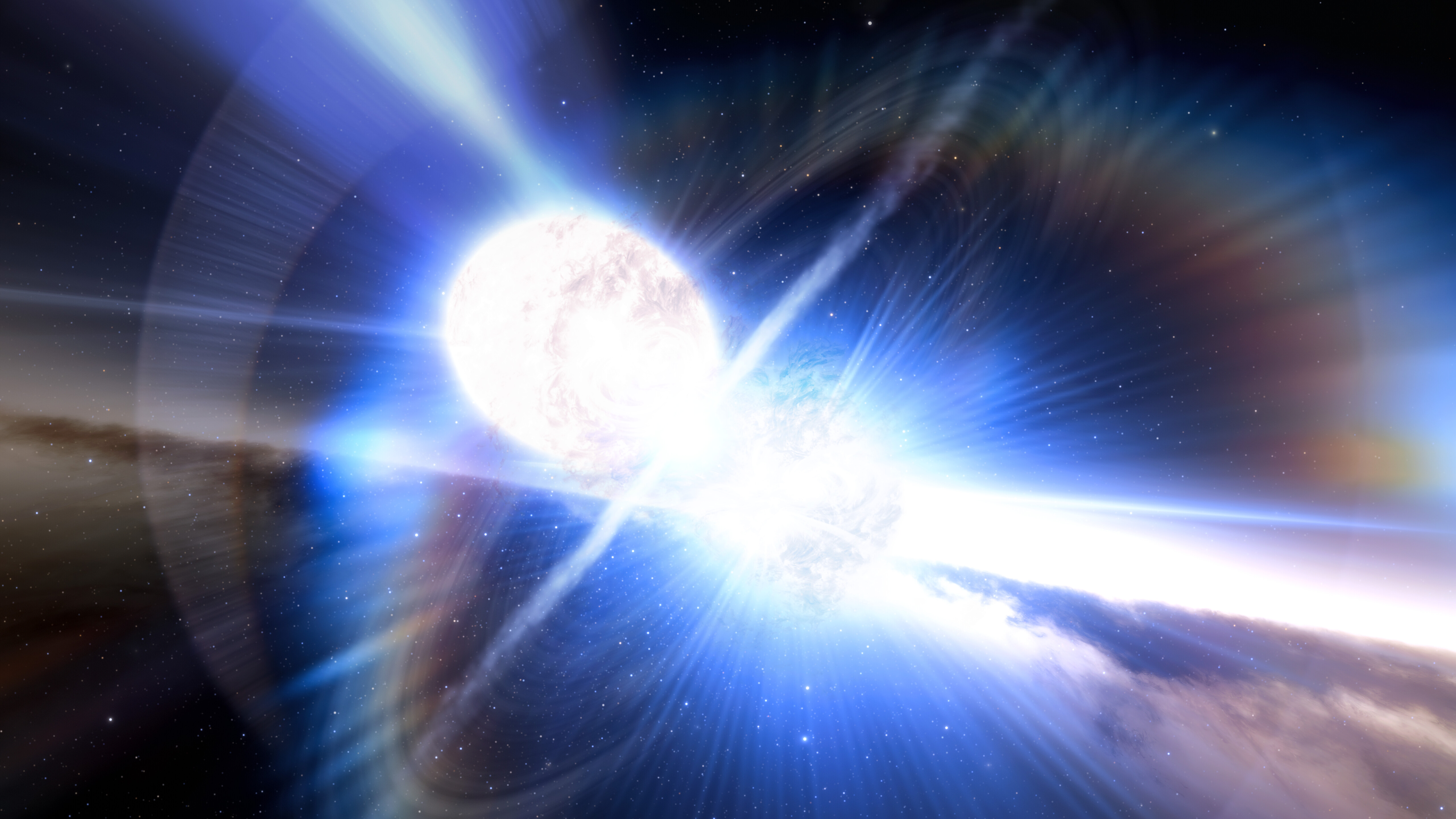
This artist's impression shows a kilonova produced by two colliding neutron stars. While studying the aftermath of a long gamma-ray burst (GRB), two independent teams of astronomers using a host of telescopes in space and on Earth, including the Gemini North telescope on Hawai‘i and the Gemini South telescope in Chile, have uncovered the unexpected hallmarks of a kilonova, the colossal explosion triggered by colliding neutron stars. Credit: NOIRLab/NSF/AURA/J. da Silva/Spaceengine. download Large JPEG


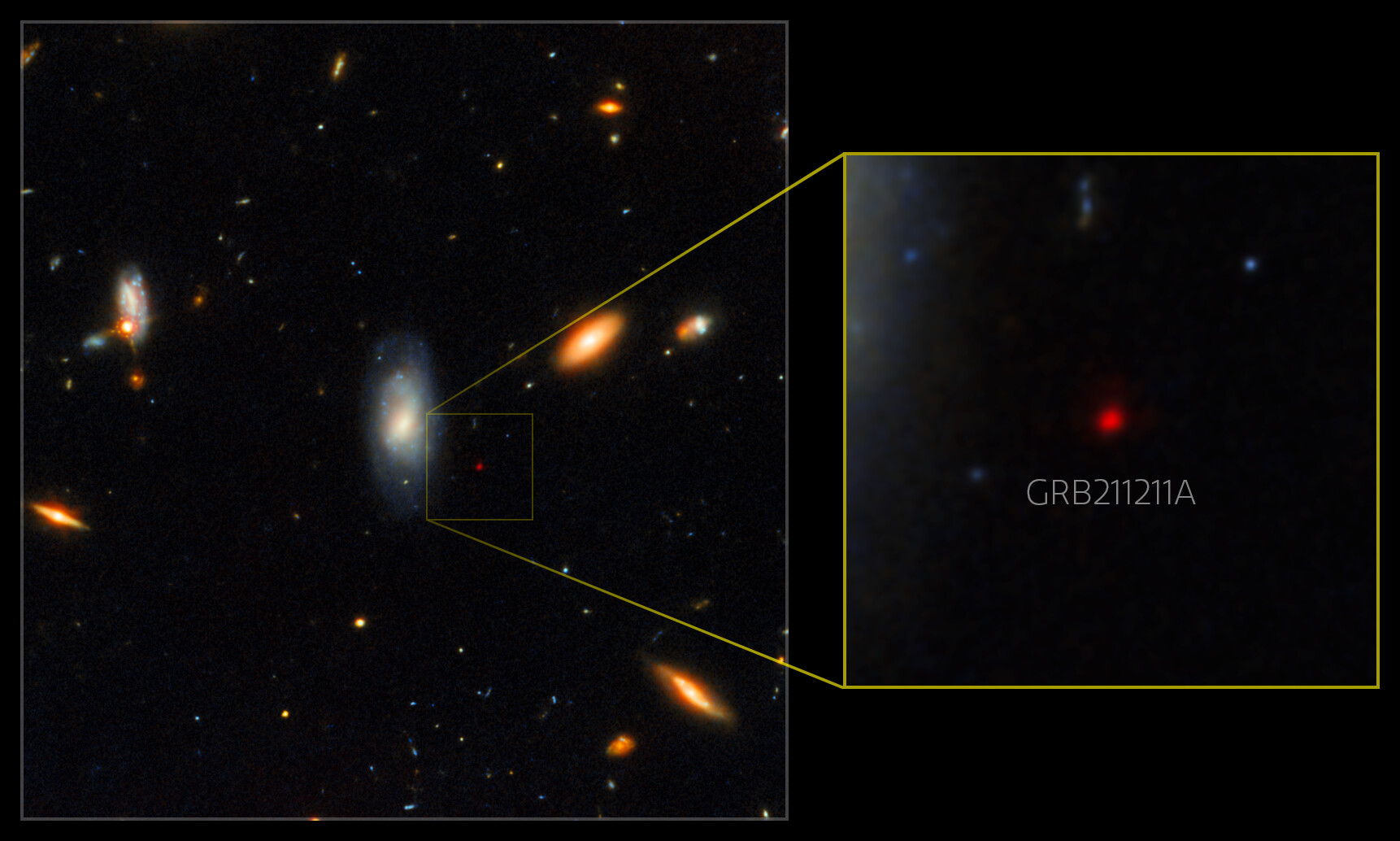
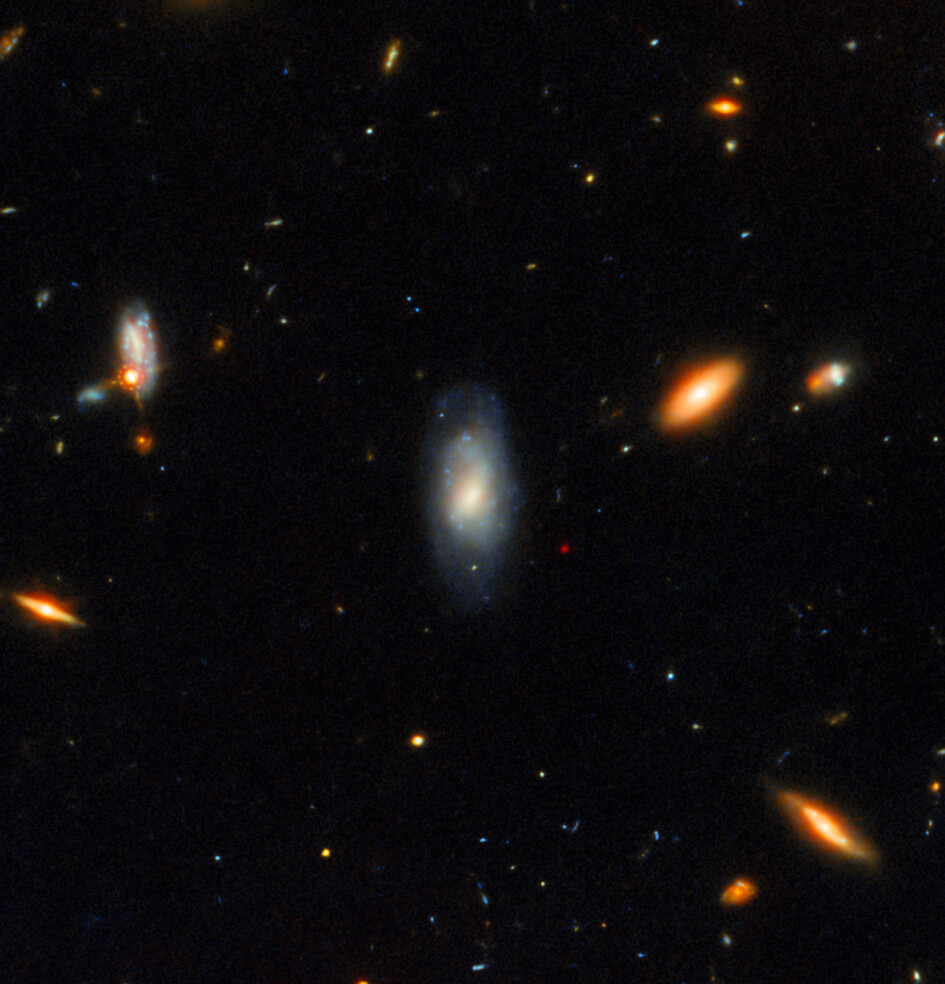
This Gemini North image, superimposed on an image taken with the Hubble Space Telescope, shows the telltale near-infrared afterglow of a kilonova produced by a long GRB (GRB 211211A). This discovery challenges the prevailing theory that long GRBs exclusively come from supernovae, the end-of-life explosions of massive stars. Credit: International Gemini Observatory/NOIRLab/NSF/AURA/M. Zamani; NASA/ESA.  download
Large JPEG


This Gemini North image, superimposed on an image taken with the Hubble Space Telescope, shows the telltale near-infrared afterglow of a kilonova produced by a long GRB (GRB 211211A). This discovery challenges the prevailing theory that long GRBs exclusively come from supernovae, the end-of-life explosions of massive stars. Credit: International Gemini Observatory/NOIRLab/NSF/AURA/M. Zamani; NASA/ESA. download Large JPEG


Cosmoview Episode 58: Kilonova Discovery Challenges our Understanding of Gamma-Ray Bursts. While studying the aftermath of a long gamma-ray burst (GRB), two independent teams of astronomers using a host of telescopes in space and on Earth, including the Gemini North telescope on Hawai‘i and the Gemini South telescope in Chile, have uncovered the unexpected hallmarks of a kilonova, the colossal explosion triggered by colliding neutron stars. This discovery challenges the prevailing theory that long GRBs exclusively come from supernovae, the end-of-life explosions of massive stars. Credit: Images and Videos: International Gemini Observatory/NOIRLab/NSF/AURA, Fermilab, M. Zamani, NASA/ESA, J. da Silva/Spaceengine, CI Lab, N. Bartmann Music: Written and performed by STAN DART Video

Kilonova Discovery Challenges our Understanding of Gamma-Ray Bursts.
Interview with Eleonora Troja, astronomer at the University of Rome Tor Vergata.
Video
 
Kilonova Discovery Challenges our Understanding of Gamma-Ray Bursts. Interview with Jillian Rastinejad, PhD student at Northwestern University.
Video


International Gemini Observatory probes aftermath of gamma-ray burst and uncovers surprising evidence of colliding neutron stars

While studying the aftermath of a long gamma-ray burst (GRB), two independent teams of astronomers using a host of telescopes in space and on Earth, including the Gemini North telescope on Hawai‘i and the Gemini South telescope in Chile, have uncovered the unexpected hallmarks of a kilonova, the colossal explosion triggered by colliding neutron stars. This discovery challenges the prevailing theory that long GRBs exclusively come from supernovae, the end-of-life explosions of massive stars.

Gamma-ray bursts (GRBs) — the most energetic explosions in the Universe — come in two varieties, long and short. Long GRBs, which last a couple of seconds to one minute, form when a star at least 10 times the mass of our Sun explodes as a supernova. Short GRBs, which last less than two seconds, occur when two compact objects, like two neutron stars or a neutron star and a black hole, collide to form a kilonova

While observing the aftermath of a long GRB detected in 2021, two independent teams of astronomers found the surprising signs of a neutron-star merger rather than the expected signal of a supernova. This surprising result marks the first time that a kilonova has been associated with a long GRB and challenges our understanding of these phenomenally powerful explosions.

The first team to announce this discovery was led by Jillian Rastinejad, a PhD student at Northwestern University. Rastinejad and her colleagues made this startling discovery with the help of Gemini North, part of the International Gemini Observatory, which is operated by NSF’s NOIRLab. The Gemini North observations revealed a telltale near-infrared afterglow at the precise location of the GRB, providing the first compelling evidence of a kilonova associated with this event [1]. Rastinejad’s team promptly reported their Gemini detection in a Gamma-ray Coordinates Network (GCN) Circular.

Astronomers around the world were first alerted to this burst, named GRB 211211A, when a powerful flash of gamma rays was picked up by NASA's Neil Gehrels Swift Observatory and Fermi Gamma-ray Space Telescope. Initial observations revealed that the GRB was uncommonly nearby, a mere one billion light-years from Earth.

Most GRBs originate in the distant, early Universe. Typically, these objects are so ancient and far flung that their light would have had to travel for more than six billion years to reach Earth. Light from the most-distant GRB ever recorded traveled for nearly 13 billion years before being detected here on Earth [2]. The relative proximity of this newly discovered GRB enabled astronomers to make remarkably detailed follow-up studies with a variety of ground- and space-based telescopes.

Astronomers usually investigate short GRBs when hunting for kilonovae,” said Rastinejad. “We were drawn to this longer-duration burst because it was so close that we could study it in detail. Its gamma rays also resembled those of a previous, mysterious supernova-less long GRB.”

A unique observational signature of kilonovae is their brightness at near-infrared wavelengths compared to their brightness in visible light. This difference in brightness is due to the heavy elements ejected by the kilonova, which effectively block visible light but allow the longer-wavelength infrared light to pass unimpeded. Observing in the near-infrared, however, is technically challenging and only a handful of telescopes on Earth, like the twin Gemini telescopes, are sensitive enough to detect this kilonova at these wavelengths.

Thanks to its sensitivity and our rapid-response, Gemini was the first to detect this kilonova in the near-infrared, convincing us that we were observing a neutron-star merger,” said Rastinejad. “Gemini’s nimble capabilities and variety of instruments let us tailor each night’s observing plan based on the previous night’s results, allowing us to make the most of every minute that our target was observable.”

Another team, led by Eleonora Troja, an astronomer at the University of Rome Tor Vergata, independently studied the afterglow using a different and a different series of observations, including the Gemini South telescope in Chile, [3] and independently concluded that the long GRB came from a kilonova.

We were able to observe this event only because it was so close to us,” said Troja. “It is very rare that we observe such powerful explosions in our cosmic backyard, and every time we do we learn about the most extreme objects in the Universe.”

The fact that two different teams of scientists working with independent datasets both arrived at the same conclusion about the kilonova nature of this GRB provides confidence in this interpretation.

The kilonova interpretation was so far off from everything we knew about long GRBs that we could not believe our own eyes and spent months testing all the other possibilities,” said Troja. “It is only after ruling out everything else that we realized our decade-long paradigm had to be revised.”

As well as contributing to our understanding of kilonovae and GRBs, this discovery provides astronomers with a new way to study the formation of gold and other heavy elements in the Universe. The extreme physical conditions in kilonovae produce heavy elements such as gold, platinum, and thorium. Astronomers can now identify the sites that are creating heavy elements by searching for the signature of a kilonova following a long-duration gamma-ray burst.

This discovery is a clear reminder that the Universe is never fully figured out,” said Rastinejad. “Astronomers often take it for granted that the origins of GRBs can be identified by how long the GRBs are, but this discovery shows us there’s still much more to understand about these amazing events.

NSF congratulates the science teams for this new and exciting discovery, opening a new window onto cosmic evolution,” said National Science Foundation Director Sethuraman Panchanathan. “The International Gemini Observatory continues to deliver powerful and nimble resources open to the whole scientific community through innovation and partnership.”

The International Gemini Observatory is operated by a partnership of six countries, including the United States through the National Science Foundation, Canada through the National Research Council of Canada, Chile through the Agencia Nacional de Investigación y Desarrollo, Brazil through the Ministério da Ciência, Tecnologia e Inovações, Argentina through the Ministerio de Ciencia, Tecnología e Innovación, and Korea through the Korea Astronomy and Space Science Institute. These Participants and the University of Hawaii, which has regular access to Gemini, each maintain a National Gemini Office to support their local users.


Note

[1] Rastinejad and her colleagues made initial follow-up observations of the burst using the Nordic Optical Telescope. Following the critical Gemini North observations, they continued their observations of the fading kilonova with the Karl G. Jansky Very Large Array, the Calar Alto Observatory, and the MMT Observatory, and obtained later observations with the Large Binocular Telescope, the W. M. Keck Observatory, the Gran Telescopio Canarias, and the NASA/ESA Hubble Space Telescope.

[2] Light that has traveled nearly 13 billion years to reach Earth would have a redshift (z) of about 7. Due to the accelerating expansion of the Universe, that would roughly equate to a distance of 24.5 billion light-years today. When talking about large redshifts, those greater than 1, and cosmically distant objects, it is more accurate to state how many billions of years the light has traveled rather than a distance in light-years.

[3] Troja and her colleagues initially observed the afterglow of this event with the Devasthal Optical Telescope, the Multicolor Imaging Telescopes for Survey and Monstrous Explosions, and the Calar Alto Observatory. They obtained observations of the host galaxy with the NASA/ESA Hubble Space Telescope.


Links


Contacts:

Jillian Rastinejad
Northwestern University
Email:
jillianrastinejad2024@u.northwestern.edu

Eleonora Troja
Astronomer
University of Rome Tor Vergata
Email:
eleonora.troja@uniroma2.it

Charles Blue
Public Information Officer
NSF’s NOIRLab
Tel: +1 202 236 6324
Email:
charles.blue@noirlab.edu


Saturday, October 28, 2017

Optical/Infrared Telescopes Follow Gravitational Waves to Treasure

Figure 1: Three-color false-color composite images showing the time evolution of the optical and near-infrared counterpart of GW170817 made using data from the Subaru Telescope (z-band, blue) and IRSF (H-band, green; Ks-band, red). Figure without the labels is linked here. Credit: NAOJ/Nagoya University

Figure 2: Artist's impression of the GW170817 kilonova
Credit: NAOJ

Astronomers have tracked down the source of a gravitational wave and discovered the first observed kilonova: a nuclear furnace 100 million times brighter than the Sun producing thousands of times the entire mass of the Earth in heavy elements such as precious metals.

On August 17, 2017 the LIGO-Virgo collaboration alerted more than 90 astronomy teams around the world, that they had detected a signal (GW170817) consistent with the inspiral and merger of two neutron stars. Dr. Raffaele Flaminio (NAOJ and CNRS/LAPP), a scientist from the Virgo and KAGRA collaborations, explains that "Thanks to the combination of the data from the LIGO detectors in the US and the Virgo detector in Europe, this was the best ever localized gravitational wave source."

J-GEM (Japanese collaboration of Gravitational wave Electro-Magnetic follow-up) is a research project to search for optical counterparts of gravitational wave sources because optical observations give us different information than gravitational wave observations. Indeed multi-messenger astronomy, observing the same phenomenon with both gravitational waves and normal light, is needed to paint the full picture of the phenomenon. 

Neutron star mergers are expected to have strong optical and infrared light emissions, so J-GEM sprang in to action. Using a network of telescopes around the world, including the Subaru Telescope in Hawai'i and the 1.4-m IRSF telescope in South Africa (run by Nagoya University and Kagoshima University), they observed the source located 130 million light-years away in the constellation Hydra, trying to discern its true nature. As they watched the object change day by day, they realized that they were observing the first ever confirmed kilonova. 

Astronomers have long searched for sites in the Universe where the heavy elements were produced by rapid neutron capture (r-process) reactions. One possible candidate was kilonova explosions which are predicted to produce 10,000 times the mass of the Earth in rare earth elements and precious metals.

The time evolution of the color and brightness of the object at the origin of the gravitational waves were too rapid to be a supernova, but matched the simulations of a kilonova made by the ATERUI supercomputer at the National Astronomical Observatory of Japan.

"We were so excited to see the rapid brightness evolution revealed day by day through observations at facilities operated by Japanese institutes distributed all over the world." said Dr. Yousuke Utsumi (Hiroshima University), a scientist in the J-GEM collaboration.

Movie: The optical and near-infrared counterpart of GW170817 capture by HSC mounted on the Subaru Telescope. (Credit: NAOJ)

Two papers on this research will be published in Publications of the Astronomical Society of Japan (PASJ) on October 16, 2017 (Utsumi et al., "J-GEM observations of an electromagnetic counterpart to the neutron star merger GW170817", and Tanaka et al., "Kilonova from post-merger ejecta as an optical and near-infrared counterpart of GW170817"). Another paper is also submitted to PASJ (Tominaga et al., "Subaru Hyper Suprime-Cam survey for an optical counterpart of GW170817").


Links


Tuesday, October 17, 2017

NASA Missions Catch First Light From a Gravitational-Wave Event

Gravitational Wave Source in NGC 4993
Credits: NASA and ESA
Acknowledgment: A. Levan (U. Warwick), N. Tanvir (U. Leicester), and A. Fruchter and O. Fox (STScI)

Neutron Star Collision Creates Kilonova
Credits: NASA, ESA, and A. Feild (STScI)
 Release images


For the first time, NASA scientists have detected light tied to a gravitational-wave event, thanks to two merging neutron stars in the galaxy NGC 4993, located about 130 million light-years from Earth in the constellation Hydra. 

Shortly after 8:41 a.m. EDT on Aug. 17, NASA's Fermi Gamma-ray Space Telescope picked up a pulse of high-energy light from a powerful explosion, which was immediately reported to astronomers around the globe as a short gamma-ray burst. The scientists at the National Science Foundation’s Laser Interferometer Gravitational-Wave Observatory (LIGO) detected gravitational waves dubbed GW170817 from a pair of smashing stars tied to the gamma-ray burst, encouraging astronomers to look for the aftermath of the explosion. Shortly thereafter, the burst was detected as part of a follow-up analysis by ESA’s (European Space Agency’s) INTEGRAL satellite.

NASA's Swift, Hubble, Chandra, and Spitzer missions, along with dozens of ground-based observatories, including the NASA-funded PanSTARRS survey, later captured the fading glow of the blast's expanding debris. 

"This is extremely exciting science," said Paul Hertz, director of NASA’s Astrophysics Division at the agency’s headquarters in Washington. "Now, for the first time, we've seen light and gravitational waves produced by the same event. The detection of a gravitational-wave source’s light has revealed details of the event that cannot be determined from gravitational waves alone. The multiplier effect of study with many observatories is incredible."

Neutron stars are the crushed, leftover cores of massive stars that previously exploded as supernovas long ago. The merging stars likely had masses between 10 and 60 percent greater than that of our Sun, but they were no wider than Washington, D.C. The pair whirled around each other hundreds of times a second, producing gravitational waves at the same frequency. As they drew closer and orbited faster, the stars eventually broke apart and merged, producing both a gamma-ray burst and a rarely seen flare-up called a "kilonova."

"This is the one we've all been waiting for," said David Reitze, executive director of the LIGO Laboratory at Caltech in Pasadena, California. "Neutron star mergers produce a wide variety of light because the objects form a maelstrom of hot debris when they collide. Merging black holes — the types of events LIGO and its European counterpart, Virgo, have previously seen — very likely consume any matter around them long before they crash, so we don't expect the same kind of light show."

"The favored explanation for short gamma-ray bursts is that they're caused by a jet of debris moving near the speed of light produced in the merger of neutron stars or a neutron star and a black hole," said Eric Burns, a member of Fermi's Gamma-ray Burst Monitor team at NASA's Goddard Space Flight Center in Greenbelt, Maryland. "LIGO tells us there was a merger of compact objects, and Fermi tells us there was a short gamma-ray burst. Together, we know that what we observed was the merging of two neutron stars, dramatically confirming the relationship."

Within hours of the initial Fermi detection, LIGO and the Virgo detector at the European Gravitational Observatory near Pisa, Italy, greatly refined the event's position in the sky with additional analysis of gravitational wave data. Ground-based observatories then quickly located a new optical and infrared source — the kilonova — in NGC 4993. 

To Fermi, this appeared to be a typical short gamma-ray burst, but it occurred less than one-tenth as far away as any other short burst with a known distance, making it among the faintest known. Astronomers are still trying to figure out why this burst is so odd, and how this event relates to the more luminous gamma-ray bursts seen at much greater distances. 

NASA’s Swift, Hubble and Spitzer missions followed the evolution of the kilonova to better understand the composition of this slower-moving material, while Chandra searched for X-rays associated with the remains of the ultra-fast jet.

When Swift turned to the galaxy shortly after Fermi’s gamma-ray burst detection, it found a bright and quickly fading ultraviolet (UV) source. 

"We did not expect a kilonova to produce bright UV emission," said Goddard’s S. Bradley Cenko, principal investigator for Swift. "We think this was produced by the short-lived disk of debris that powered the gamma-ray burst."

Over time, material hurled out by the jet slows and widens as it sweeps up and heats interstellar material, producing so-called afterglow emission that includes X-rays. But the spacecraft saw no X-rays — a surprise for an event that produced higher-energy gamma rays. 

NASA’s Chandra X-ray Observatory clearly detected X-rays nine days after the source was discovered. Scientists think the delay was a result of our viewing angle, and it took time for the jet directed toward Earth to expand into our line of sight.

"The detection of X-rays demonstrates that neutron star mergers can form powerful jets streaming out at near light speed," said Goddard's Eleonora Troja, who led one of the Chandra teams and found the X-ray emission. "We had to wait for nine days to detect it because we viewed it from the side, unlike anything we had seen before."

On Aug. 22, NASA’s Hubble Space Telescope began imaging the kilonova and capturing its near-infrared spectrum, which revealed the motion and chemical composition of the expanding debris.

"The spectrum looked exactly like how theoretical physicists had predicted the outcome of the merger of two neutron stars would appear," said Andrew Levan at the University of Warwick in Coventry, England, who led one of the proposals for Hubble spectral observations. "It tied this object to the gravitational wave source beyond all reasonable doubt." 

Astronomers think a kilonova's visible and infrared light primarily arises through heating from the decay of radioactive elements formed in the neutron-rich debris. Crashing neutron stars may be the universe's dominant source for many of the heaviest elements, including platinum and gold.
Because of its Earth-trailing orbit, Spitzer was uniquely situated to observe the kilonova long after the Sun moved too close to the galaxy on the sky for other telescopes to see it. Spitzer's Sept. 30 observation captured the longest-wavelength infrared light from the kilonova, which unveils the quantity of heavy elements forged. 

"Spitzer was the last to join the party, but it will have the final word on how much gold was forged," says Mansi Kasliwal, Caltech assistant professor and principal investigator of the Spitzer observing program. 

Numerous scientific papers describing and interpreting these observations have been published in Science, Nature, Physical Review Letters and The Astrophysical Journal.

Gravitational waves were directly detected for the first time in 2015 by LIGO, whose architects were awarded the 2017 Nobel Prize in physics for the discovery.


NASA's Hubble Studies Source of Gravitational Waves

On August 17, 2017, weak ripples in the fabric of space-time known as gravitational waves washed over Earth. Unlike previously detected gravitational waves, these were accompanied by light, allowing astronomers to pinpoint the source. NASA’s Hubble Space Telescope turned its powerful gaze onto the new beacon, obtaining both images and spectra. The resulting data will help reveal details of the titanic collision that created the gravitational waves, and its aftermath.

The Laser Interferometer Gravitational-Wave Observatory (LIGO) detected gravitational waves at 8:41 a.m. EDT on August 17. Two seconds later, NASA’s Fermi Gamma-ray Space Telescope measured a short pulse of gamma rays known as a gamma-ray burst. Many observatories, including space telescopes, probed the suspected location of the source, and within about 12 hours several spotted their quarry.

In a distant galaxy called NGC 4993, about 130 million light-years from Earth, a point of light shone where nothing had been before. It was about a thousand times brighter than a variety of stellar flare called a nova, putting it in a class of objects astronomers call “kilonovae.” It also faded noticeably over 6 days of Hubble observations.

“This appears to be the trifecta for which the astronomical community has been waiting: Gravitational waves, a gamma-ray burst, and a kilonova all happening together,” said Ori Fox of the Space Telescope Science Institute, Baltimore, Maryland.

The source of all three was the collision of two neutron stars, the aged remains of a binary star system. A neutron star forms when the core of a dying massive star collapses, a process so violent that it crushes protons and electrons together to form subatomic particles called neutrons. The result is like a giant atomic nucleus, cramming several Suns’ worth of material into a ball just a few miles across.

In NGC 4993, two neutron stars once spiraled around each other at blinding speed. As they drew closer together, they whirled even faster, spinning as fast as a blender near the end. Powerful tidal forces ripped off huge chunks while the remainder collided and merged, forming a larger neutron star or perhaps a black hole. Leftovers spewed out into space. Freed from the crushing pressure, neutrons turned back into protons and electrons, forming a variety of chemical elements heavier than iron.

“We think neutron star collisions are a source of all kinds of heavy elements, from the gold in our jewelry to the plutonium that powers spacecraft, power plants, and bombs,” said Andy Fruchter of the Space Telescope Science Institute.

Several teams of scientists are using Hubble’s suite of cameras and spectrographs to study the gravitational wave source. Fruchter, Fox, and their colleagues used Hubble to obtain a spectrum of the object in infrared light. By splitting the light of the source into a rainbow spectrum, astronomers can probe the chemical elements that are present. The spectrum showed several broad bumps and wiggles that signal the formation of some of the heaviest elements in nature. 

“The spectrum looked exactly like how theoretical physicists had predicted the outcome of the merger of two neutron stars would appear. It tied this object to the gravitational wave source beyond all reasonable doubt,” said Andrew Levan at the University of Warwick in Coventry, England, who led one of the proposals for Hubble spectral observations. Additional spectral observations were led by Nial Tanvir of the University of Leicester, England.

Spectral lines can be used as fingerprints to identify individual elements. However, this spectrum is proving a challenge to interpret.

“Beyond the fact that two neutron stars flung a lot of matter out into space, we’re not yet sure what else the spectrum is telling us,” explained Fruchter. “Because the material is moving so fast, the spectral lines are smeared out. Also, there are all kinds of unusual isotopes, many of which are short-lived and undergo radioactive decay. The good news is that it’s an exquisite spectrum, so we have a lot of data to work with and analyze.”

Hubble also picked up visible light from the event that gradually faded over the course of several days. Astronomers believe that this light came from a powerful “wind” of material speeding outward. These observations hint that astronomers viewed the collision from above the orbital plane of the neutron stars. If seen from the side (along the orbital plane), matter ejected during the merger would have obscured the visible light and only infrared light would be visible.

“What we see from a kilonova might depend on our viewing angle. The same type of event would appear different depending on whether we’re looking at it face-on or edge-on, which came as a total surprise to us,” said Eleonora Troja of the University of Maryland, College Park, Maryland, and NASA’s Goddard Space Flight Center, Greenbelt, Maryland. Troja is also a principal investigator of a team using Hubble observations to study the object.

The gravitational wave source now is too close to the Sun on the sky for Hubble and other observatories to study. It will come back into view in November. Until then, astronomers will be working diligently to learn all they can about this unique event.

The launch of NASA’s James Webb Space Telescope also will offer an opportunity to examine the infrared light from the source, should that glow remain detectable in the months and years to come.


Contact

Christine Pulliam / Ray Villard
Space Telescope Science Institute, Baltimore, Maryland
410-338-4366 / 410-338-4514

cpulliam@stsci.edu / villard@stsci.edu

Felicia Chou
NASA Headquarters, Washington, D.C.
202-358-0257

felicia.chou@nasa.gov

Dewayne Washington
Goddard Space Flight Center, Greenbelt, Maryland
301-286-0040

dewayne.a.washington@nasa.gov


Links

This site is not responsible for content found on external links