Friday, March 21, 2025

ALMA Unveils New Details of the Flares of Proxima Centauri Press Releases ALMA Unveils New Details of the Flares of Proxima Centauri

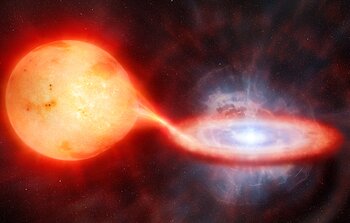
Artist's concept of a stellar flare from Proxima Centauri
Credit: NSF/AUI/NSF NRAO/S. Dagnello


At just over four light years, Proxima Centauri is our nearest stellar neighbor known to be a very active M dwarf star. Its flare activity has been well known to astronomers using visible wavelengths of light. Still, a new study using observations with the Atacama Large Millimeter/submillimeter Array (ALMA) highlights this star's extreme activity in radio and millimeter wavelengths, offering exciting insights about the nature of these flares as well as potential impacts on the livability of its terrestrial, habitable-zone planets.

Known to host a potentially habitable planet, the star exhibits very active flare activity in optical wavelengths. Like flares on our Sun, these outbursts release light energy across the electromagnetic spectrum and bursts of particles known as stellar energetic particles. Depending on the energy and frequency of these flares, nearby planets in the habitable zone might be rendered uninhabitable as the flares strip planetary atmospheres of necessary ingredients such as ozone and water.

A scientific team led by Kiana Burton of the University of Colorado and Meredith MacGregor of Johns Hopkins University utilized archival data and new ALMA observations to study the millimeter-wavelength flare activity of Proxima Centauri. Proxima Centauri's small size and strong magnetic field indicate that its entire internal structure is convective (unlike the Sun, which has both convective and non-convective layers), making the star much more active. Its magnetic fields become twisted, develop tension, and eventually snap, sending streams of energy and particles outward in what is observed as flares.

"Our Sun's activity doesn't remove Earth's atmosphere and instead causes beautiful auroras because we have a thick atmosphere and a strong magnetic field to protect our planet. But Proxima Centauri's flares are much more powerful, and we know it has rocky planets in the habitable zone. What are these flares doing to their atmospheres? Is there such a large flux of radiation and particles that the atmosphere is getting chemically modified, or perhaps completely eroded?" said MacGregor.

ALMA (Atacama Large Millimeter/submillimeter Array) This research represents the first multi-wavelength study using millimeter observations to uncover a new look at the physics of flares. Combining 50 hours of ALMA observations using both the full 12-meter array as well as the 7-meter Atacama Compact Array (ACA), a total of 463 flare events were reported at energies ranging from 1024 to 1027 erg, and with a brief duration ranging from 3 to 16 seconds.

"When we see the flares with ALMA, we see the electromagnetic radiation–the light in various wavelengths. But looking deeper, this radio wavelength flaring is also giving us a way to trace the properties of those particles and get a handle on what is being released from the star," says MacGregor. To do so, the team characterized the star's (so-called flare frequency distribution) to map out the number of flares as a function of their energy. Typically, the slope of this distribution tends to follow a power law function: smaller (less energetic) flares occur more frequently, while larger, more energetic flares occur less regularly. Proxima Centauri experiences so many flares that the team detected many flares within each energy range. Furthermore, the team was able to quantify the asymmetry of the star's highest energy flares, describing how the flares' decay phase was much longer than the initial burst phase.

Radio and millimeter-wavelength observations help constrain the energies associated with these flares and their associated particles. MacGregor highlighted ALMA's key role: "The millimeter flaring seems much more frequent. It's a different power law than we see at the optical wavelengths. If we only look at optical wavelengths, we're missing critical information. ALMA is the only millimeter interferometer sensitive enough for these measurements."


Additional information

results of the study are published in the following scientific paper: MacGregor et al. "The Proxima Centauri Campaign. First constraints on millimeter flare rates from ALMA".

The original press release was published by the National Radioastronomy Observatory of United States (NRAO), an ALMA partner in behalf of North America.

The Atacama Large Millimeter/submillimeter Array (ALMA), an international astronomy facility, is a partnership of the European Southern Observatory (ESO), the U.S. National Science Foundation (NSF), and the National Institutes of Natural Sciences (NINS) of Japan in cooperation with the Republic of Chile. ALMA is funded by ESO on behalf of its Member States, by NSF in cooperation with the National Research Council of Canada (NRC) and the National Science and Technology Council (NSTC) in Taiwan, and by NINS in cooperation with the Academia Sinica (AS) in Taiwan and the Korea Astronomy and Space Science Institute (KASI).

ALMA construction and operations are led by ESO on behalf of its Member States; by the National Radio Astronomy Observatory (NRAO), managed by Associated Universities, Inc. (AUI), on behalf of North America; and by the National Astronomical Observatory of Japan (NAOJ) on behalf of East Asia. The Joint ALMA Observatory (JAO) provides the unified leadership and management of ALMA's construction, commissioning, and operation.


Thursday, March 20, 2025

Hidden Cosmic Fuel Tank Found in Infant Galaxy Cluster

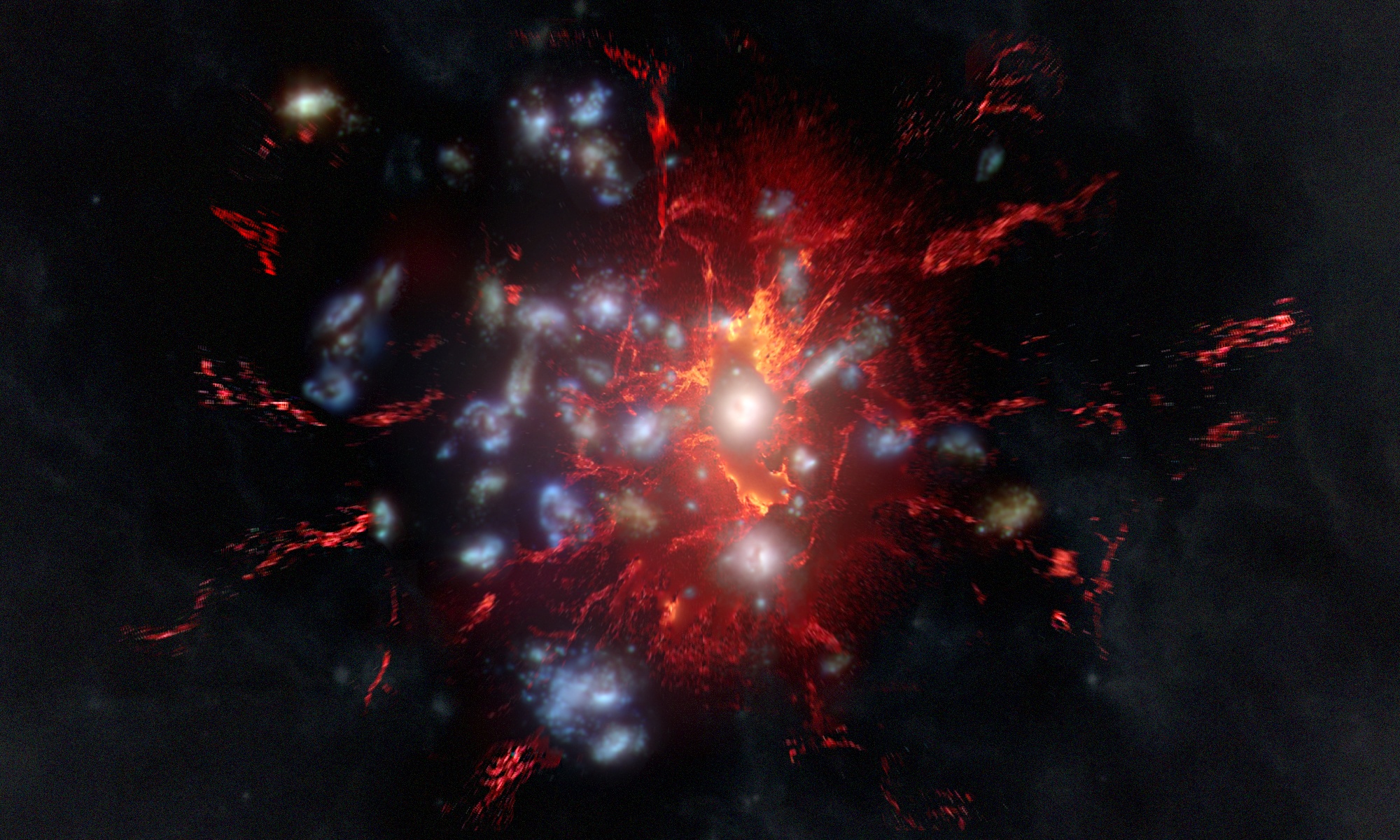
Illustration of the extended molecular gas (red) surrounding the galaxies in the protocluster core SPT2349-56
Credit: MPIfR/N.Sulzenauer.
Hi-Res File


Surprise ALMA-APEX discovery reveals diffuse molecular gas in galaxy protocluster SPT2349-56 – 75% more than previously detected – extending star formation timeline to 400 million years

Astronomers using the Atacama Large Millimeter/submillimeter Array (ALMA), along with complementary data from the Atacama Pathfinder Experiment (APEX), have discovered a surprisingly large reservoir of molecular gas in a protocluster of galaxies known as SPT2349-56. This protocluster, located approximately 12 billion light-years away, is a region of the early universe where a cluster of galaxies is just beginning to form.

Galaxy clusters are the largest structures in the universe, and understanding their formation is a major goal of scientists. Protoclusters like SPT2349-56 offer a unique window into this process, allowing astronomers to observe galaxies as they come together in a dense environment.

This new research, led by Dazhi Zhou of the University of British Columbia, focuses on the molecular gas within SPT2349-56. Molecular gas, primarily hydrogen, is the raw material for star formation, which plays a critical role in galaxy evolution.

Key Findings:

Missing Gas

  • By comparing observations from ALMA’s high-resolution configuration with lower-resolution data from ALMA’s Atacama Compact Array (ACA) and APEX, the team found a significant amount of molecular gas that was “invisible” in the higher-resolution ALMA images. The ACA detected 75% more CO than the sum of individual sources detected in higher-resolution ALMA data.

Extended Reservoir

  • This missing gas isn’t just a few faint, undetected galaxies. Instead, it appears to be a diffuse reservoir of gas spread throughout the protocluster.

Fuel for Starbursts
  • This hidden gas reservoir could be the key to understanding the intense star formation activity observed in SPT2349-56. The presence of so much extra gas extends the star formation fuel, meaning the overall depletion timescale will exceed 400 million years.

Proto-Intracluster Medium
  • The team speculates that this extended gas might be the precursor to the hot, diffuse gas known as the intracluster medium (ICM) that fills mature galaxy cluster

“This discovery highlights the power of ALMA, especially when used in multiple configurations,” says Zhou. “The high-resolution observations allowed us to pinpoint individual galaxies, while the lower-resolution data revealed the bigger picture – the extended gas that connects these galaxies and fuels their star formation.”

SPT2349-56 is an extreme system, producing stars ~ten thousand times faster than our milky way but in a comparable size, and these observations have pushed scientists’ understanding of galaxy formation and evolution. No simulation or galaxy formation model had previously predicted this overdensity of gas.These findings also suggest that high-resolution ALMA observations, while excellent for studying individual galaxies, may miss a significant component of the gas in these early clusters. The missing gas may reside in the circum-galactic medium (CGM) or the pre-heated proto-intracluster medium (proto-ICM). Future studies using ALMA’s full capabilities, including its compact array configurations, will be crucial for fully characterizing this hidden gas reservoir and understanding its role in the formation of galaxy clusters. (DZ: acknowledgement of SPT: The South Pole Telescope is supported by the National Science Foundation, the Department of Energy, and the United States Antarctic Program. DOI: 10.1038/s41586-023-05998-6.)


About ALMA

The Atacama Large Millimeter/submillimeter Array (ALMA), an international astronomy facility, is a partnership of the European Southern Observatory (ESO), the U.S. National Science Foundation (NSF) and the National Institutes of Natural Sciences (NINS) of Japan in cooperation with the Republic of Chile. ALMA is funded by ESO on behalf of its Member States, by NSF in cooperation with the National Research Council of Canada (NRC) and the National Science and Technology Council (NSTC) in Taiwan and by NINS in cooperation with the Academia Sinica (AS) in Taiwan and the Korea Astronomy and Space Science Institute (KASI).

ALMA construction and operations are led by ESO on behalf of its Member States; by the National Radio Astronomy Observatory (NRAO), managed by Associated Universities, Inc. (AUI), on behalf of North America; and by the National Astronomical Observatory of Japan (NAOJ) on behalf of East Asia. The Joint ALMA Observatory (JAO) provides the unified leadership and management of the construction, commissioning and operation of ALMA.


Wednesday, March 19, 2025

NASA's Webb Images Young, Giant Exoplanets, Detects Carbon Dioxide

HR 8799 (NIRCam Image)
Credits/Image: NASA, ESA, CSA, STScI, Laurent Pueyo (STScI), William Balmer (JHU), Marshall Perrin (STScI)

51 Eridani (NIRCam Image)
Credits/Image: NASA, ESA, CSA, STScI, Laurent Pueyo (STScI), William Balmer (JHU), Marshall Perrin (STScI)

Young Gas Giant HR 8799 e (NIRCam Spectrum)
Credits/Illustration: NASA, ESA, CSA, STScI, Joseph Olmsted (STScI)


NASA’s James Webb Space Telescope has captured direct images of multiple gas giant planets within an iconic planetary system. HR 8799, a young system 130 light-years away, has long been a key target for planet formation studies.

The observations indicate that the well-studied planets of HR 8799 are rich in carbon dioxide gas. This provides strong evidence that the system’s four giant planets formed much like Jupiter and Saturn, by slowly building solid cores that attract gas from within a protoplanetary disk, a process known as core accretion.

The results also confirm that Webb can infer the chemistry of exoplanet atmospheres through imaging. This technique complements Webb’s powerful spectroscopic instruments, which can resolve the atmospheric composition.

“By spotting these strong carbon dioxide features, we have shown there is a sizable fraction of heavier elements, like carbon, oxygen, and iron, in these planets’ atmospheres,” said William Balmer, of Johns Hopkins University in Baltimore. “Given what we know about the star they orbit, that likely indicates they formed via core accretion, which is an exciting conclusion for planets that we can directly see.”

Balmer is the lead author of the study announcing the results published today in The Astrophysical Journal. Balmer and their team’s analysis also includes Webb’s observation of a system 97 light-years away called 51 Eridani.

HR 8799 is a young system about 30 million years old, a fraction of our solar system’s 4.6 billion years. Still hot from their tumultuous formation, the planets within HR 8799 emit large amounts of infrared light that give scientists valuable data on how they formed.

Giant planets can take shape in two ways: by slowly building solid cores with heavier elements that attract gas, just like the giants in our solar system, or when particles of gas rapidly coalesce into massive objects from a young star’s cooling disk, which is made mostly of the same kind of material as the star. The first process is called core accretion, and the second is called disk instability. Knowing which formation model is more common can give scientists clues to distinguish between the types of planets they find in other systems.

“Our hope with this kind of research is to understand our own solar system, life, and ourselves in the comparison to other exoplanetary systems, so we can contextualize our existence,” Balmer said. “We want to take pictures of other solar systems and see how they’re similar or different when compared to ours. From there, we can try to get a sense of how weird our solar system really is—or how normal.”

Of the nearly 6,000 exoplanets discovered, few have been directly imaged, as even giant planets are many thousands of times fainter than their stars. The images of HR 8799 and 51 Eridani were made possible by Webb’s NIRCam (Near-Infrared Camera) coronagraph, which blocks light from bright stars to reveal otherwise hidden worlds.

This technology allowed the team to look for infrared light emitted by the planets in wavelengths that are absorbed by specific gases. The team found that the four HR 8799 planets contain more heavy elements than previously thought.

The team is paving the way for more detailed observations to determine whether objects they see orbiting other stars are truly giant planets or objects such as brown dwarfs, which form like stars but don’t accumulate enough mass to ignite nuclear fusion.

“We have other lines of evidence that hint at these four HR 8799 planets forming using this bottom-up approach” said Laurent Pueyo, an astronomer at the Space Telescope Science Institute in Baltimore, who co-led the work. “How common is this for planets we can directly image? We don't know yet, but we're proposing more Webb observations to answer that question.”

“We knew Webb could measure colors of the outer planets in directly imaged systems,” added Rémi Soummer, director of STScI’s Russell B. Makidon Optics Lab and former lead for Webb coronagraph operations. “We have been waiting for 10 years to confirm that our finely tuned operations of the telescope would also allow us to access the inner planets. Now the results are in and we can do interesting science with it.”

The NIRCam observations of HR 8799 and 51 Eridani were conducted as part of Guaranteed Time Observations programs 1194 and 1412 respectively.

The James Webb Space Telescope is the world’s premier space science observatory. Webb will solve mysteries in our solar system, look beyond to distant worlds around other stars, and probe the mysterious structures and origins of our universe and our place in it. Webb is an international program led by NASA with its partners, ESA (European Space Agency) and the Canadian Space Agency.


About This Release

Credits:

Media Contact:

Hannah Braun
Space Telescope Science Institute, Baltimore, Maryland

Roberto Molar Candanosa
Johns Hopkins University, Baltimore, Maryland

Permissions: Content Use Policy

Contact Us: Direct inquiries to the News Team.


Tuesday, March 18, 2025

Colourful clouds of a nearby neighbour

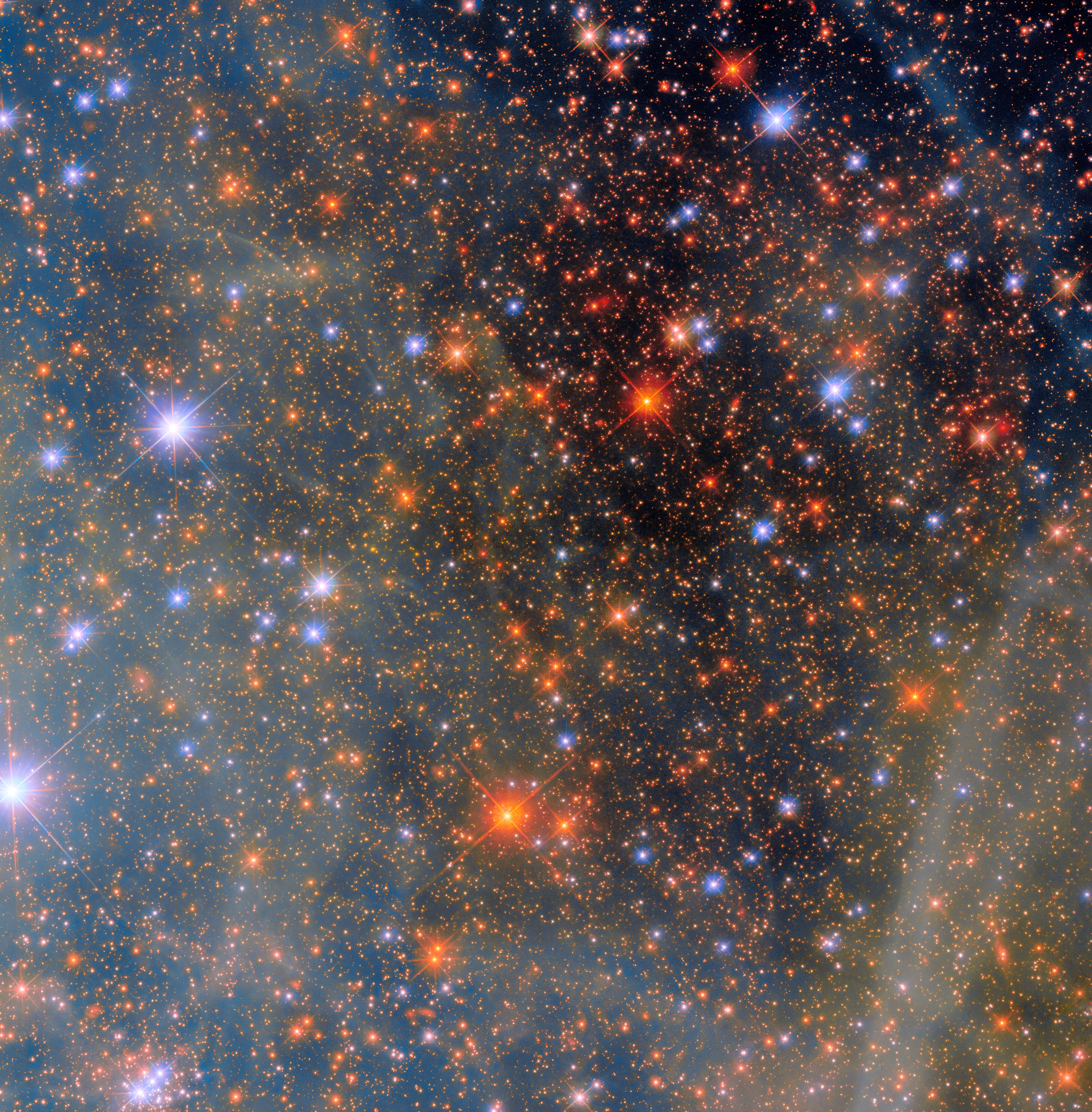
An area of space that is filled with stars. Most of the stars are small, distant dots in orange colours; closer stars shine with a bright glow and four thin spikes around them. These closer stars appear in both bluish and reddish colours. Clouds from a nebula cover the left half of the scene, giving it a blue-greenish cast. More pieces of cloud drift over the black background of space on the right. Credit: ESA/Hubble & NASA, C. Murray

Say hello to one of the Milky Way’s neighbours! Today’s NASA/ESA Hubble Space Telescope Picture of the Week features a scene from one of the closest galaxies to the Milky Way, the Small Magellanic Cloud (SMC). The SMC is a dwarf galaxy located about 200 000 light-years away. Most of the galaxy resides in the constellation Tucana, but a small section crosses over into the neighbouring constellation Hydrus.

Thanks to its proximity, the SMC is one of only a few galaxies that can be seen from Earth without the help of a telescope or binoculars. For viewers in the southern hemisphere and some latitudes in the northern hemisphere, the SMC resembles a piece of the Milky Way that has broken off, though in reality it’s much farther away than any part of our own galaxy.

With its 2.4-metre ‘eye’ and sensitive instruments, Hubble’s view of the SMC is far more detailed and vivid than what humans can see. Researchers used Hubble’s Wide Field Camera 3 instrument to observe this scene through four different filters. Each filter admits different wavelengths of light, creating a multicoloured view of dust clouds drifting across a field of stars. Hubble’s view, however, is much more zoomed-in than our eyes, the better for it to observe very distant objects. This image captures a small region of the SMC near the centre of NGC 346, a star cluster that is home to dozens of massive young stars.


Monday, March 17, 2025

Planetary System Found Around Nearest Single Star

PR Image noirlab2510a
Artist’s Illustration of Exoplanets Orbiting Barnard’s Star

PR Image noirlab2510b
MAROON-X at Gemini North

PR Image noirlab2510c
MAROON-X at Gemini North

PR Image noirlab2510d
Andreas Seifahrt and Jacob Bean Unpack MAROON-X


Videos

Exoplanets Orbiting Barnard’s Star Animation
PR Video noirlab2510a
Exoplanets Orbiting Barnard’s Star Animation


Using in part the Gemini North telescope, one half of the International Gemini Observatory, partly funded by the U.S. National Science Foundation and operated by NSF NOIRLab, astronomers have discovered four sub-Earth exoplanets orbiting Barnard’s Star, the nearest single star system to Earth. One of the planets is the least massive exoplanet ever discovered using the radial velocity technique, indicating a new benchmark for discovering smaller planets around nearby stars.

For a century, astronomers have been studying Barnard’s Star in the hope of finding planets around it. First discovered by E. E. Barnard at Yerkes Observatory in 1916, it is the nearest single star system to Earth [1]. Barnard’s Star is classified as a red dwarf — low-mass stars that often host closely-packed planetary systems, often with multiple rocky planets. Red dwarfs are extremely numerous in the Universe, so scientists are interested in understanding the environments of the planets they host.

One such effort was led by Jacob Bean from the University of Chicago, whose team created an instrument called MAROON-X, which is designed specifically to search for distant planets around red dwarf stars. MAROON-X is mounted on the Gemini North telescope, one half of the International Gemini Observatory, funded in part by the U.S. National Science Foundation and operated by NSF NOIRLab.

MAROON-X hunts for exoplanets using the radial velocity technique, meaning it detects the subtle back and forth wobble of a star as its exoplanets gravitationally tug on it, which causes the light emitted by the star to shift ever so slightly in wavelength. The powerful instrument measures these small shifts in light so precisely that it can even tease apart the number and masses of the planets that must be circling the star to have the observed effect.

After rigorously calibrating and analyzing data taken during 112 nights over a period of three years, the team found solid evidence for three exoplanets around Barnard’s Star, two of which were previously classified as candidates. The team also combined data from MAROON-X with data from a 2024 study done with the ESPRESSO instrument at the European Southern Observatory’s Very Large Telescope in Chile to confirm the existence of a fourth planet, elevating it as well from candidate to bona fide exoplanet.

“It’s a really exciting find — Barnard’s Star is our cosmic neighbor, and yet we know so little about it,” says Ritvik Basant, PhD student at the University of Chicago and first author of the paper appearing in The Astrophysical Journal Letters. “It’s signaling a breakthrough with the precision of these new instruments from previous generations.”

The newly discovered planets are most likely rocky planets, rather than gas planets like Jupiter. However, this will be difficult to pin down with certainty since, because of the angle we observe them from Earth, the planets do not cross in front of their star, which is the usual method for determining a planet’s composition. But with information from similar planets around other stars, the team will be able to make better estimates of their makeup.

They were, however, able to rule out with a fair degree of certainty the existence of other exoplanets with masses comparable to Earth in Barnard Star’s habitable zone — the region of space around a star that is just right to allow liquid water on an orbiting planet’s surface.

Barnard’s Star has been called the “great white whale” for planet hunters; several times over the past century, groups have announced evidence that suggested planets around Barnard’s Star, only for them to be subsequently disproved. But these latest findings give a much larger degree of confidence than any previous result.

“We observed at different times of night on different days. They’re in Chile; we’re in Hawai‘i. Our teams didn’t coordinate with each other at all,” says Basant. “That gives us a lot of assurance that these aren’t phantoms in the data.”

The four planets, each only about 20 to 30% the mass of Earth, are so close to their home star that they zip all the way around it in a matter of days. The fourth planet is the least massive planet discovered to date using the radial velocity technique. The team hopes this will spark a new era of finding more and more sub-Earth exoplanets in the Universe.

Most rocky planets found so far are much larger than Earth, and they appear to be fairly similar throughout the Milky Way Galaxy. But there are reasons to think that smaller exoplanets have more widely varied compositions. As scientists find more of them, they can begin to tease out more information about how these planets form and what makes them likely to have habitable conditions.

“The U.S. National Science Foundation is collaborating with the astronomy community on an adventure to look deeper into the Universe to detect planets with environments that might resemble Earth's,” says Martin Still, NSF program director for the International Gemini Observatory. “The planet discoveries provided by MAROON-X mounted on Gemini North provide a significant step along that journey.”

MAROON-X is still a visiting instrument at Gemini North. Given its outstanding performance and popularity with the user community, it is in the process of being converted to a permanent facility instrument..

“This result demonstrates the competitive, state-of-the-art capabilities that Gemini offers its user community. The observatory is in the middle of rejuvenating its instrumentation portfolio and MAROON-X is part of the first wave of new instruments, alongside GHOST on Gemini South and IGRINS-2 on Gemini North,” says Andreas Seifahrt, Associate Director of Development for the International Gemini Observatory, co-author of the paper, and member of the team who designed and built MAROON-X.


Notes

[1] The nearest star system to us, Proxima Centauri, has three stars circling each other, which changes the dynamics of planet formation and orbits.


More information

This research was presented in a paper titled “Four sub-Earth planets orbiting Barnard’s Star from MAROON-X and ESPRESSO” to appear in The Astrophysical Journal Letters. DOI: 10.3847/2041-8213/adb8d5

The team is composed of Ritvik Basant (University of Chicago), Rafael Luque (University of Chicago, NHFP Sagan Fellow), Jacob L. Bean (University of Chicago), Andreas Seifahrt (International Gemini Observatory/NSF NOIRLab), Madison Brady (University of Chicago), Lily L. Zhao (University of Chicago, NHFP Sagan Fellow), Nina Brown (University of Chicago), Tanya Das (University of Chicago), Julian Stürmer (Heidelberg University), David Kasper (University of Chicago), Rohan Gupta (University of Chicago), and Guðmundur Stefánsson (University of Amsterdam).

NSF NOIRLab, the U.S. National Science Foundation center for ground-based optical-infrared astronomy, operates the International Gemini Observatory (a facility of NSF, NRC–Canada, ANID–Chile, MCTIC–Brazil, MINCyT–Argentina, and KASI–Republic of Korea), NSF Kitt Peak National Observatory (KPNO), NSF Cerro Tololo Inter-American Observatory (CTIO), the Community Science and Data Center (CSDC), and NSF–DOE Vera C. Rubin Observatory (in cooperation with DOE’s SLAC National Accelerator Laboratory). It is managed by the Association of Universities for Research in Astronomy (AURA) under a cooperative agreement with NSF and is headquartered in Tucson, Arizona.

The scientific community is honored to have the opportunity to conduct astronomical research on I’oligam Du’ag (Kitt Peak) in Arizona, on Maunakea in Hawai‘i, and on Cerro Tololo and Cerro Pachón in Chile. We recognize and acknowledge the very significant cultural role and reverence of I’oligam Du’ag to the Tohono O’odham Nation, and Maunakea to the Kanaka Maoli (Native Hawaiians) community.


Links


Contacts:

Ritvik Basant
Graduate Student, Department of Astronomy and Astrophysics
University of Chicago
Email:
rbasant@uchicago.edu

Jacob Bean
Professor, Department of Astronomy and Astrophysics
University of Chicago
Email:
jacobbean@uchicago.edu

Andreas Seifahrt
Associate Director of Development
International Gemini Observatory/NSF NOIRLab
Email:
andreas.seifahrt@noirlab.edu

Josie Fenske
Jr. Public Information Officer
NSF NOIRLab
Email:
josie.fenske@noirlab.edu

Louise Lerner
Physical Sciences News Officer
University of Chicago
Email:
  louise@uchicago.edu


Sunday, March 16, 2025

Featured Image: A Ribbon Around the Heliosphere

A Ribbon Around the Heliosphere


Maps of energetic neutral atom flux from 2009 to 2022 and from 0.71 keV to 4.29 keV
Credit: Noh et al. 2025


In 2009, a small octagonal spacecraft called the Interstellar Boundary Explorer (IBEX) began mapping the edge of our solar system. IBEX measures the flux of energetic neutral atoms: fast-moving, electrically neutral atoms that form when high-energy positively charged ions from the solar wind steal an electron from neutral atoms of the interstellar medium. In addition to the expected ebb and flow of energetic neutral atoms, IBEX found something completely unexpected: a narrow, curved region where these atoms are especially prevalent, shown in the images above and to the right. This feature, known as the IBEX ribbon, is still something of a mystery, though many researchers have converged on the idea that the ribbon is generated just past the heliopause — the boundary of our solar system — up to a few hundred astronomical units beyond that boundary. To enable detailed studies of the IBEX ribbon, Sung Jun Noh (Los Alamos National Laboratory) and collaborators applied a new statistical technique to the IBEX measurements, allowing them to sharpen images of the ribbon and extract its properties in regions where the signal was previously thought too weak. This results of this new analysis support the idea that the ribbon arises beyond the boundary of our solar system. To learn more about efforts to understand the IBEX ribbon, be sure to check out the original research article linked below.

By Kerry Hensley

Citation

“Characteristics of the IBEX Ribbon and Their Implications for a Source Region Outside the Heliopause,” Sung Jun Noh et al 2025 ApJ 980 8.
doi:10.3847/1538-4357/ada36a


Saturday, March 15, 2025

Astronomy’s dirty window to space

Visualization of the wavelength-dependence of extinction (the “extinction curve”) caused by dust, for the plane of our galaxy’s disk, out to a distance of 8,000 light-years from the Sun. Red indicates regions where extinction falls off more rapidly at long wavelengths (the red end of the spectrum), while blue indicates that extinction is less dependent on wavelength. Regions with insufficient data are shown in white. The gray contours enclose regions of high dust density. © X. Zhang/G. Green, MPIA


Astronomers from the Max Planck Institute for Astronomy have constructed the first detailed 3D map of the properties of cosmic dust in our home galaxy. For their map, the astronomers used 130 million spectra from ESA’s Gaia mission, results from the LAMOST spectral survey, and machine learning. Dust makes distant astronomical objects appear more reddish and dimmer than they really are, so the new map will be an important tool for astronomers to make sense of their observations. The study has also revealed unusual properties of cosmic dust that will lead to further research.

When we observe distant celestial objects, there is a possible catch: Is that star I am observing really as reddish as it appears? Or does the star merely look reddish, since its light has had to travel through a cloud of cosmic dust to reach our telescope? For accurate observations, astronomers need to know the amount of dust between them and their distant targets. Not only does dust make objects appear reddish (“reddening”), it also makes them appear fainter than they really are (“extinction”). It’s like we are looking out into space through a dirty window. Now, two astronomers have published a 3D map that documents the properties of dust all around us in unprecedented detail, helping us make sense of what we observe.

Behind this is the fact that, fortunately, when looking at stars, there is a way of reconstructing the effect of dust. Cosmic dust particles do not absorb and scatter light evenly across all wavelengths. Instead, they absorb light more strongly at shorter wavelengths (towards the blue end of the spectrum), and less strongly at longer wavelengths (towards the red end). The wavelength-dependence can be plotted as an “extinction curve,” and its shape provides information not only about the composition of the dust, but also about its local environment, such as the amount and properties of radiation in the various regions of interstellar space.

Retrieving dust information from 130 million spectra

This is the kind of information used by Xiangyu Zhang, a PhD student at the Max Planck Institute for Astronomy (MPIA), and Gregory Green, an independent research group leader (Sofia Kovalevskaja Group) at MPIA and Zhang’s PhD advisor, to construct the most detailed 3D map yet of the properties of dust in the Milky Way galaxy. Zhang and Green turned to data from ESA’s Gaia mission, which was a 10.5-year-effort to obtain extremely accurate measurements of positions, motions and additional properties for more than a billion stars in our Milky Way and in our nearest galactic neighbours, the Magellanic Clouds. The third data release (DR3) of the Gaia mission, published in June 2022, provides 220 million spectra, and a quality check told Zhang and Green that about 130 million of those would be suitable for their search for dust.

The Gaia spectra are low-resolution, that is, the way that they separate light into different wavelength regions is comparatively coarse. The two astronomers found a way around that limitation: For 1% of their chosen stars, there is high-resolution spectroscopy from the LAMOST survey operated by the National Astronomical Observatories of China. This provides reliable information about the basic properties of the stars in question, such as their surface temperatures, which determines what astronomers call a star’s “spectral type.” Reconstructing a 3D map

Zhang and Green trained a neural network to generate model spectra based on a star’s properties and the properties of the intervening dust. They compared the results to 130 million suitable spectra from Gaia, and used statistical (“Bayesian”) techniques to deduce the properties of the dust between us and those 130 million stars.

The results allowed the astronomers to reconstruct the first detailed, three-dimensional map of the extinction curve of dust in the Milky Way. This map was made possible by Zhang and Green’s measurement of the extinction curve towards an unprecedented number of stars – 130 million, compared to previous works, which contained approximately 1 million measurements.

But dust is not just a nuisance for astronomers. It is important for star formation, which occurs in giant gas clouds shielded by their dust from the surrounding radiation. When stars form, they are surrounded by disks of gas and dust, which are the birthplaces of planets. The dust grains themselves are the building blocks for what will eventually become the solid bodies of planets like our Earth. In fact, within the interstellar medium of our galaxy, most of the elements heavier than hydrogen and helium are locked up in interstellar dust grains.

Unexpected properties of cosmic dust

The new results not only produce an accurate 3D map. They have also turned up a surprising property of interstellar dust clouds. Previously, it had been expected that the extinction curve should become flatter (less dependent on wavelength) for regions with a higher dust density. “Higher density,” of course, is in this case still very little: approximately ten billionth billionth grams of dust per cubic meter, equivalent to just 10 kg of dust in a sphere with Earth’s radius. In such regions, dust grains tend to grow in size, which changes the overall absorption properties.

Instead, the astronomers found that in areas of intermediate density, the extinction curve actually becomes steeper, with smaller wavelengths absorbed much more effectively than longer ones. Zhang and Green surmise that the steepening might be caused by the growth not of dust, but of a class of molecules called polycyclic aromatic hydrocarbons (PAHs), the most abundant hydrocarbons in the interstellar medium, which may even have played a role in the origin of life. They have already set out to test their hypothesis with future observations.

Background information

The results reported here have been published as Xiangyu Zhang and Gregory M. Green, “Three-dimensional maps of the interstellar dust extinction curve within the Milky Way galaxy,” in the journal Science. Both authors work at the Max Planck Institute for Astronomy.


Contacts: 

Dr. Markus Pössel

tel: +49 6221 528-261
pr@mpia.de
MPIA press department
Max Planck Institute for Astronomy, Heidelberg

Dr. Gregory Green
Sofia Kovalevskaja Group Leader

tel: +49 6221 528-460
green@mpia.de
Gregory Green / MPIA
Max-Planck-Institut für Astronomie, Heidelberg, Deutschland


Original publication

Xiangyu Zhang, Gregory M. Green
Three-dimensional maps of the interstellar dust extinction curve within the Milky Way galaxy
Science (2025). DOI: 10.1126/science.ado9787
Preprint available at:
https://www.eurekalert.org/press/scipak/

Download


Friday, March 14, 2025

ALMAGAL survey seeks to uncover the origin of stars

Collage of many of the young star clusters observed with ALMA as part of the ALMAGAL survey.
Credit: ALMA (ESO/NAOJ/NRAO)/S. Molinari et al.


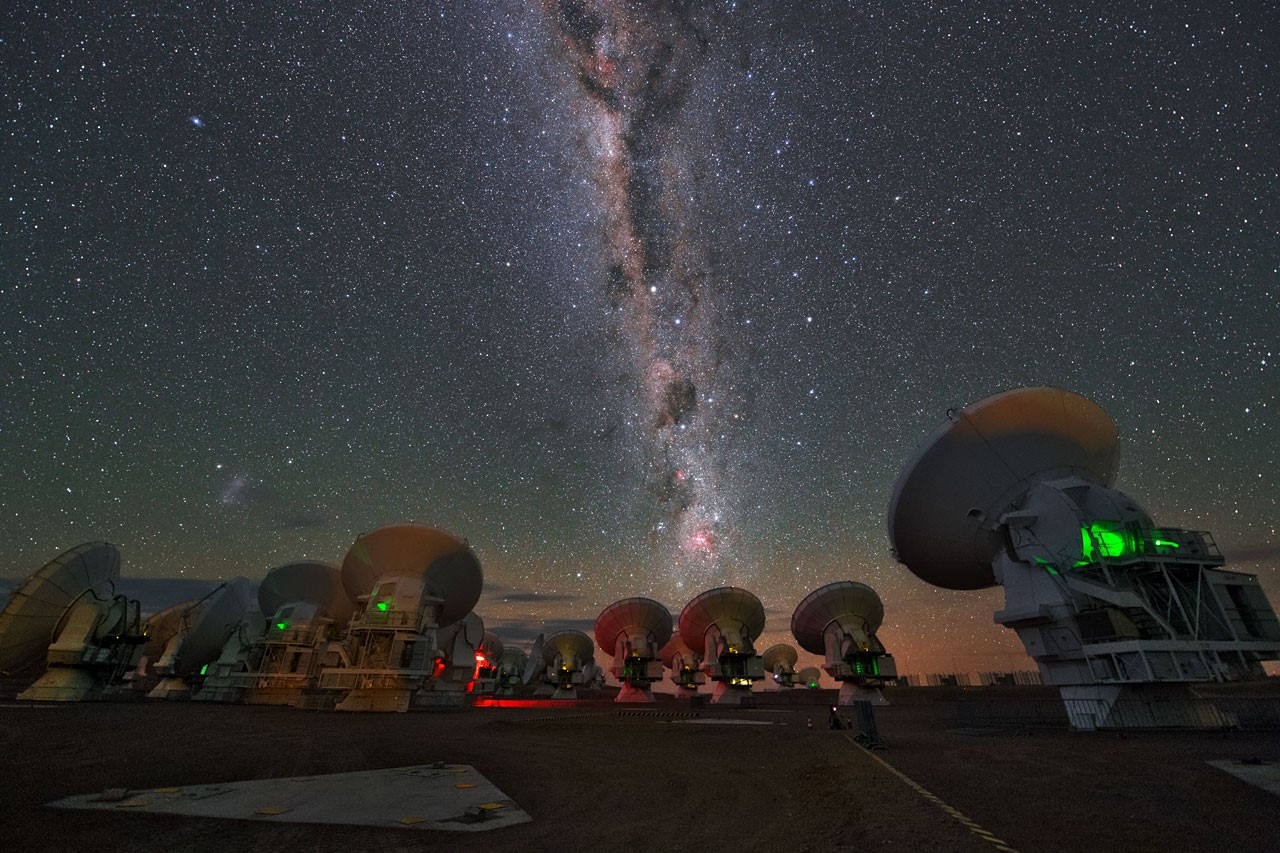
The ALMA antennas observe the Milky Way high up in the Chajnantor Plateau in Chile’s Atacama Desert.
Credit: ESO/Y. Beletsky


Stars are massive spheres of plasma, nuclear reactors that illuminate the universe. But where do they come from? We know they form in vast clouds of gas and dust, which collapse into smaller fragments. However, the details of how this happens remain unclear. A groundbreaking survey of 1,000 stellar nurseries is helping to answer this question.

Look up at the night sky and observe our galaxy, the Milky Way. Among the countless stars are clouds of gas and dust that work tirelessly like true factories to create new stars.

Much like some of the factories on Earth, these clouds use simple building blocks (hydrogen, helium, and small amounts of heavier elements) to make more complex pieces like stars. However, not all factories operate the same way. Some produce stars at different rates, with varying masses and compositions. What is happening behind the scenes?

Astronomers have long studied individual stellar nurseries, but how do their findings apply on a larger scale? We need a broader view to develop a universal model of star formation. That is where ALMAGAL comes in.

A Thousand Star-Forming Regions Under the Lens

The ALMAGAL survey, using the Atacama Large Millimeter/submillimeter Array (ALMA), examines more star-forming regions than ever before: three to four times more than all previous surveys combined, with remarkable detail.

The survey has observed 6,000 cores and 800 clumps, revealing key insights:
  • Not all star-forming regions are the same.
  • More material leads to higher star production. Massive clumps produce more and larger cores, fueling star growth.
  • Clumps evolve over time. Initially circular, they become more intricate as they fragment into cores. Some massive clumps remain unbroken, likely because they are still young.
What’s Next?

While ALMAGAL has already deepened our understanding of star birth, many questions remain. Researchers now aim to explore how the gas flows from clumps into cores and how newborn stars influence this process. Thanks to ALMAGAL’s extensive dataset, we are closer than ever to unraveling the secrets of star formation and even the origins of planetary systems.

Additional information

The description of the ALMAGAL survey and the first results are described in the following papers published in Astronomy & Astrophysics:

This post is based on the original published by the European Southern Observatory (ESO), an ALMA partner on behalf of Europe.

The Atacama Large Millimeter/submillimeter Array (ALMA), an international astronomy facility, is a partnership of the European Southern Observatory (ESO), the U.S. National Science Foundation (NSF), and the National Institutes of Natural Sciences (NINS) of Japan in cooperation with the Republic of Chile. ALMA is funded by ESO on behalf of its Member States, by NSF in cooperation with the National Research Council of Canada (NRC) and the National Science and Technology Council (NSTC) in Taiwan, and by NINS in cooperation with the Academia Sinica (AS) in Taiwan and the Korea Astronomy and Space Science Institute (KASI).

ALMA construction and operations are led by ESO on behalf of its Member States; by the National Radio Astronomy Observatory (NRAO), managed by Associated Universities, Inc. (AUI), on behalf of North America; and by the National Astronomical Observatory of Japan (NAOJ) on behalf of East Asia. The Joint ALMA Observatory (JAO) provides the unified leadership and management of ALMA's construction, commissioning, and operation.


Contacts:

Nicolás Lira
Education and Public Outreach Coordinator
Joint ALMA Observatory, Santiago - Chile
Phone:
+56 2 2467 6519
Cel: +56 9 9445 7726
Email: nicolas.lira@alma.cl

Bárbara Ferreira
ESO Media Manager
Garching bei München, Germany
Phone:
+49 89 3200 6670
Email: press@eso.org

Jill Malusky
Public Information Officer
NRAO
Phone:
+1 304-456-2236
Email: jmalusky@nrao.edu

Yuichi Matsuda
ALMA EA-ARC Staff Member
NAOJ
Email:
yuichi.matsuda@nao.ac.jp


Thursday, March 13, 2025

NuSTAR Observes Merging Clusters

An optical image of the Abell 399 (right) and Abell 401 (left) galaxy clusters, with microwave data from the Planck satellite overlaid in orange showing the location of hot gas in the clusters and linking them together. NuSTAR will help to measure the temperature of this gas. Image credit: ESA/Planck Collaboration/STScI.
Download Image

NuSTAR has recently spent more than two days observing one of the most significant galaxy cluster interactions in the local Universe – the early stage merger of the massive systems Abell 401 and Abell 399. This merger is one of the most energetic events in the Universe, and has profound effects on the Intra-Cluster Medium (ICM); the hot, diffuse, gas that fills the volume between cluster member galaxies, which emits strongly in soft X-rays, and is responsible for a significant percentage of the thermal pressure support that balances a cluster’s gravitational collapse. The ICM of each cluster is undergoing shocks caused by the interaction, becoming even hotter (increasing its thermal pressure), and producing hard X-ray photons that NuSTAR is sensitive to. Without NuSTAR observations, temperature measurements will be biased toward lower temperatures. This shock heating will preferentially occur at the interface between the galaxy clusters, and the high-energy spatial resolution of NuSTAR images is indispensable to being able to make multiple temperature measurements in different spatial regions around the clusters. These NuSTAR observations are also being used to searching for another, more elusive, source of hard X-ray emission from galaxy clusters – Cosmic Microwave Background photons (the leftover microwave radiation from the Big Bang) that have been inverse-compton scattered to X-ray energies by populations of cosmic rays in the ICM. It is extremely hard to identify this emission, but in combination with radio observations, they can both provide information about the cluster magnetic field strength, and the contributions of the magnetic field and the cosmic ray population to the pressure support of a galaxy cluster. In an era where it is now possible to constrain the other known source of ICM pressure (turbulence, using observations from the recently launched JAXA/NASA/ESA mission XRISM), NuSTAR will help build a full picture of the ongoing astrophysical processes in galaxy clusters.

Authors: David Turner (Research Associate, Michigan State University Astronomy Group), Karl Forster (NuSTAR Science Operations Manager)


Expecting the Unexpected

An artist's impression of the black hole and its surrounding accretion disk in the system IGR J17091-3624, mid-pulse. In the top right, a plot shows the "heartbeat"—the regular increase and decrease in brightness measured as the system pulses. Image credit: NASA/Goddard Space Flight Center/CI Lab.
Download Image

During the past week, a Target of Opportunity large observing program with NuSTAR was triggered to monitor the outburst of the black hole binary IGR J17091-3624. This X-ray transient black hole binary candidate was first detected in 2003 and has since exhibited fascinating behavior, including radio jets, X-ray quasi-periodic oscillations, and state transitions characteristic of microquasars. Most peculiar are its X-ray flarings, which resemble a “heartbeat” pattern over time—a phenomenon observed in only one other source, GRS 1915+105. This large observing program, consisting of a total of 500 ks of NuSTAR exposure time coordinated NASA’s NICER mission, was designed to track the full evolution of a transient black hole outburst, capturing rapid changes in X-ray spectra and variability as the system transitions through different accretion states. However, after the initial observations, the outburst appeared to fade rather than fully develop, leading to a pause in the program. This unexpected behavior exemplifies one of the key challenges—and excitements—of time-domain astrophysics: black hole outbursts are not always predictable, and what appears to be the beginning of a dramatic event can sometimes fizzle out. We continue to monitor the source with other observatories to determine whether the NuSTAR program should be resumed. The three observations taken so far remain highly valuable, revealing clear signatures of X-ray reflection off an accretion disk, with spectra showing atomic fluorescence lines distorted by the black hole’s gravity. As new data is acquired, we continue to refine our understanding of the factors that drive complete versus failed outbursts in black hole systems.

Last Wednesday was the due date for NuSTAR General Observer (GO) cycle-11, an annual call soliciting proposals for basic research relevant to the NuSTAR mission. This is the primary opportunity for the scientific community to request observing time with NuSTAR, and includes the possibility of proposing for multi-mission investigations by coordinating with NASA’s NICER and Swift and ESA’s XMM-Newton observatories. This year, the project has received a record number of proposals, 15% higher than previous years. The proposal oversubscription rate of available NuSTAR observing time is the highest for many years, and the interest in proposing for Target of Opportunity investigations continues an increasing trend seen in the last five years. Target of Opportunity investigations are the most oversubscribed and competitive aspect of the NuSTAR GO program, mirroring the community's focus on time-domain astrophysics. These proposals will be peer-reviewed by independent panels of experts in April, with recommendations for selection submitted by the end of that month, in time for cycle-11 observations to begin on June 1st this year.

Authors: Javier Garcia (Senior Scientist, GSFC), Karl Forster (NuSTAR Science Operations Lead, Caltech)


Wednesday, March 12, 2025

NASA's Webb Peers Deeper into Mysterious Flame Nebula

Credits/Image: NASA, ESA, CSA, STScI, Michael Meyer (University of Michigan), Matthew De Furio (UT Austin), Massimo Robberto (STScI), Alyssa Pagan (STScI)

Low Mass Objects within the Flame Nebula (NIRCam Image)
Credits/Image: NASA, ESA, CSA, STScI, Michael Meyer (University of Michigan)

Credits/Image/; NASA, ESA, CSA, STScI, Michael Meyer (University of Michigan), Matthew De Furio (UT Austin), Massimo Robberto (STScI), Alyssa Pagan (STScI)

Flame Nebula (Hubble and Webb Comparison) - Videos
Credits/Video: NASA, ESA, CSA, Alyssa Pagan (STScI)


The Flame Nebula, located about 1,400 light-years away from Earth, is a hotbed of star formation less than 1 million years old. Within the Flame Nebula, there are objects so small that their cores will never be able to fuse hydrogen like full-fledged stars — brown dwarfs.

Brown dwarfs, often called “failed stars,” over time become very dim and much cooler than stars. These factors make observing brown dwarfs with most telescopes difficult, if not impossible, even at cosmically short distances from the Sun. When they are very young, however, they are still relatively warmer and brighter and therefore easier to observe despite the obscuring, dense dust and gas that comprises the Flame Nebula in this case.

NASA’s James Webb Space Telescope can pierce this dense, dusty region and see the faint infrared glow from young brown dwarfs. A team of astronomers used this capability to explore the lowest mass limit of brown dwarfs within the Flame Nebula. The result, they found, were free-floating objects roughly two to three times the mass of Jupiter, although they were sensitive down to 0.5 times the mass of Jupiter.

“The goal of this project was to explore the fundamental low-mass limit of the star and brown dwarf formation process. With Webb, we're able to probe the faintest and lowest mass objects,” said lead study author Matthew De Furio of the University of Texas at Austin.

Smaller Fragments

The low-mass limit the team sought is set by a process called fragmentation. In this process large molecular clouds, from which both stars and brown dwarfs are born, break apart into smaller and smaller units, or fragments.

Fragmentation is highly dependent on several factors with the balance between temperature, thermal pressure, and gravity being among the most important. More specifically, as fragments contract under the force of gravity, their cores heat up. If a core is massive enough, it will begin to fuse hydrogen. The outward pressure created by that fusion counteracts gravity, stopping collapse and stabilizing the object (then known as a star). However, fragments whose cores are not compact and hot enough to burn hydrogen continue to contract as long as they radiate away their internal heat.

“The cooling of these clouds is important because if you have enough internal energy, it will fight that gravity,” says Michael Meyer of the University of Michigan. “If the clouds cool efficiently, they collapse and break apart.”

Fragmentation stops when a fragment becomes opaque enough to reabsorb its own radiation, thereby stopping the cooling and preventing further collapse. Theories placed the lower limit of these fragments anywhere between one and ten Jupiter masses. This study significantly shrinks that range as Webb’s census counted up fragments of different masses within the nebula.

“As found in many previous studies, as you go to lower masses, you actually get more objects up to about ten times the mass of Jupiter. In our study with the James Webb Space Telescope, we are sensitive down to 0.5 times the mass of Jupiter, and we are finding significantly fewer and fewer things as you go below ten times the mass of Jupiter,” De Furio explained. “We find fewer five-Jupiter-mass objects than ten-Jupiter-mass objects, and we find way fewer three-Jupiter-mass objects than five-Jupiter-mass objects. We don’t really find any objects below two or three Jupiter masses, and we expect to see them if they are there, so we are hypothesizing that this could be the limit itself.”

Meyer added, “Webb, for the first time, has been able to probe up to and beyond that limit. If that limit is real, there really shouldn’t be any one-Jupiter-mass objects free-floating out in our Milky Way galaxy, unless they were formed as planets and then ejected out of a planetary system.”

Building on Hubble’s Legacy

Brown dwarfs, given the difficulty of finding them, have a wealth of information to provide, particularly in star formation and planetary research given their similarities to both stars and planets. NASA’s Hubble Space Telescope has been on the hunt for these brown dwarfs for decades.

Even though Hubble can’t observe the brown dwarfs in the Flame Nebula to as low a mass as Webb can, it was crucial in identifying candidates for further study. This study is an example of how Webb took the baton—decades of Hubble data from the Orion Molecular Cloud Complex—and enabled in-depth research.

“It's really difficult to do this work, looking at brown dwarfs down to even ten Jupiter masses, from the ground, especially in regions like this. And having existing Hubble data over the last 30 years or so allowed us to know that this is a really useful star-forming region to target. We needed to have Webb to be able to study this particular science topic,” said De Furio.

“It’s a quantum leap in our capabilities between understanding what was going on from Hubble. Webb is really opening an entirely new realm of possibilities, understanding these objects,” explained astronomer Massimo Robberto of the Space Telescope Science Institute.

This team is continuing to study the Flame Nebula, using Webb’s spectroscopic tools to further characterize the different objects within its dusty cocoon.

“There's a big overlap between the things that could be planets and the things that are very, very low mass brown dwarfs,” Meyer stated. “And that's our job in the next five years: to figure out which is which and why.”

These results have been published in The Astrophysical Journal Letters.

The James Webb Space Telescope is the world's premier space science observatory. Webb is solving mysteries in our solar system, looking beyond to distant worlds around other stars, and probing the mysterious structures and origins of our universe and our place in it. Webb is an international program led by NASA with its partners, ESA (European Space Agency) and CSA (Canadian Space Agency).


About This Release

Credits:

Media Contact:

Matthew Brown
Space Telescope Science Institute, Baltimore, Maryland

Christine Pulliam
Space Telescope Science Institute, Baltimore, Maryland

Permissions: Content Use Policy

Contact Us: Direct inquiries to the News Team.

Related Links and Documents


Tuesday, March 11, 2025

A spiral and a star

A spiral galaxy seen face-on. Broken spiral arms made of blue patches of stars and thin strands of dark dust swirl around the galaxy’s centre, forming a broad, circular disc. An extended circular halo surrounds the disc. The centre is a brightly-glowing, stubby bar-shaped area in a pale yellow colour. A bright star in our own galaxy, with long cross-shaped diffraction spikes, is visible atop the distant galaxy. Credit: ESA/Hubble & NASA, S. J. Smartt, C. Kilpatrick

This NASA/ESA Hubble Space Telescope Picture of the Week features a sparkling spiral galaxy paired with a prominent star, both in the constellation Virgo. While the galaxy and the star appear to be close to one another, even overlapping, they’re actually a great distance apart. The star, which is marked with four long diffraction spikes, is in our own galaxy. It’s just 7109 light-years away from Earth. The galaxy, which is named NGC 4900, lies about 45 million light-years from Earth.

This image combines data from two of Hubble’s instruments: the Advanced Camera for Surveys, which was installed in 2002 and is still in operation today, and the older Wide Field and Planetary Camera 2, which was in use from 1993 to 2009. The data used here were taken more than 20 years apart for two different observing programmes — a real testament to Hubble’s long scientific lifetime!

Both programmes aimed to understand the demise of massive stars. In one, researchers studied the sites of past supernovae, aiming to estimate the masses of the stars that exploded and investigate how supernovae interact with their surroundings. NGC 4900 was selected for study because it hosted a supernova named SN 1999br.

In the other programme, researchers laid the groundwork for studying future supernovae by collecting images of more than 150 nearby galaxies. After a supernova is detected in one of these galaxies, researchers can examine these images, searching for a star at the location of the supernova. Identifying a supernova progenitor star in pre-explosion images gives valuable information about how, when and why supernovae occur.


Monday, March 10, 2025

Gemini South Observes Ultra-Hot Nova Erupting With Surprising Chemical Signature

Artist’s Illustration of Extragalactic Recurrent Nova
Credit: International Gemini Observatory/NOIRLab/NSF/AURA/M. Garlick, M. Zamani

LMC68 Near-Infrared Spectra
Credit: International Gemini Observatory/NOIRLab/NSF/AURA/T. Geballe/J. Pollard


Astronomers uncover extremely hot and violent eruption from first ever near-infrared analysis of a recurrent nova outside of the Milky Way Galaxy

Using the Gemini South telescope, one half of the International Gemini Observatory, partly funded by the U.S. National Science Foundation and operated by NSF NOIRLab, and the Magellan Baade Telescope, astronomers have for the first time observed a recurring nova outside of the Milky Way in near-infrared light. The data revealed highly unusual chemical emissions as well as one of the hottest temperatures ever reported for a nova, both indicative of an extremely violent eruption.

Nova explosions occur in binary star systems in which a white dwarf — the dense remnant of a dead star — continually siphons stellar material from a nearby companion star. As the outer atmosphere of the companion gathers onto the surface of the white dwarf it reaches temperatures hot enough to spark an eruption.

Almost all novae discovered to-date have been observed to erupt only once. But a few have been observed to erupt more than once, and are classified as recurrent novae. The span between eruptions for these novae can vary from as little as one year to many decades [1].

Less than a dozen recurrent novae have been observed within our Milky Way Galaxy, while far more are extragalactic, meaning located outside of the Milky Way. Studying extragalactic novae helps build astronomers’ understanding of how different environments affect nova eruptions.

The first recurrent extragalactic nova to be observed was LMC 1968-12a (LMC68), located in the Large Magellanic Cloud — a satellite galaxy of the Milky Way. This nova has a recurrent timescale of about four years — the third-shortest of any nova — and consists of a white dwarf and a companion red subgiant (a star much larger than the Sun). It was discovered in 1968 and its eruptions have been observed fairly regularly since 1990.

Its most recent eruption, in August 2024, was first captured by the Neil Gehrels Swift Observatory, which has been closely monitoring the nova every month since its 2020 eruption. Given its known recurrent timescale, astronomers were anticipating this eruption, and LMC68 delivered right on cue.

Follow-up observations were conducted nine days after the initial outburst with the Carnegie Institution’s Magellan Baade Telescope, and 22 days after the initial outburst with the Gemini South telescope, one half of the International Gemini Observatory, funded in part by the U.S. National Science Foundation and operated by NSF NOIRLab.

Using the technique of spectroscopy [2], the team observed LMC68’s near-infrared light, which allowed them to study the nova’s ultra-hot phase during which many elements have been highly energized. By studying this phase astronomers can learn about the most extreme processes at play in the eruption. This study is the first ever near-infrared spectroscopic observation of an extragalactic recurrent nova.

After its initial eruption LMC68’s light faded rapidly, but Gemini South’s FLAMINGOS-2 instrument still captured a strong signal from ionized silicon atoms, specifically silicon atoms that have been stripped of nine of their 14 electrons, which requires incredible amounts of energy in the form of radiation or violent collisions.

In the earlier spectrum from Magellan, the near-infrared light from just the ionized silicon alone shined 95 times brighter than the light emitted by the Sun added up across all its wavelengths (X-ray, ultraviolet, visible, infrared, and radio). When Gemini observed the line several days later the signal had faded, but the silicon emission still dominated the spectrum.

“The ionized silicon shining at almost 100 times brighter than the Sun is unprecedented,”
says Tom Geballe, NOIRLab emeritus astronomer and co-author of the paper appearing in the Monthly Notices of the Royal Astronomical Society. “And while this signal is shocking, it’s also shocking what’s not there.”

Novae found in the Milky Way typically emit numerous near-infrared signatures from highly-excited elements, but LMC68’s spectra contained only the ionized silicon feature. “We would’ve expected to also see signatures of highly energized sulfur, phosphorus, calcium and aluminum,” says Geballe.

“This surprising absence, combined with the presence and great strength of the silicon signature, implied an unusually high gas temperature, which our modeling confirmed,” adds co-author Sumner Starrfield, Regents Professor of Astrophysics at Arizona State University.

The team estimates that, during the nova’s early post-explosion phase, the temperature of the expelled gas reached 3 million degrees Celsius (5.4 million degrees Fahrenheit), making it one of the hottest novae ever recorded. This extreme temperature suggests a highly violent eruption, which the team theorizes is due to the conditions of the nova’s environment.

The Large Magellanic Cloud and its stars have a lower metallicity than the Milky Way, meaning it contains a lower abundance of elements heavier than hydrogen and helium, referred to as metals by astronomers. In high-metallicity systems, heavy elements trap heat on the white dwarf’s surface such that eruptions occur early in the accretion process. But without these heavy elements, more matter builds up on the white dwarf’s surface before it gets hot enough to ignite, causing the explosion to erupt with far greater violence. Additionally, the expelled gas collides with the atmosphere of the companion red subgiant, causing a huge shock that elevates the temperatures in the collision.

Prior to collecting their data, Starrfield predicted that the accretion of low-metallicity material onto a white dwarf would result in a more violent nova explosion. The observations and analysis presented here are broadly in agreement with that prediction.

“With only a small number of recurrent novae detected within our own galaxy, understanding of these objects has progressed episodically,” says Martin Still, NSF program director for the International Gemini Observatory. “By broadening our range to other galaxies using the largest astronomical telescopes available, like Gemini South, astronomers will increase the rate of progress and critically measure the behavior of these objects in different chemical environments.”


More Information

This research was presented in a paper titled “Near-infrared spectroscopy of the LMC recurrent nova LMCN 1968-12a” appearing in the Monthly Notices of the Royal Astronomical Society. DOI: 10.1093/mnras/stae2711

The team is composed of A. Evans (Keele University), D. P. K. Banerjee (Physical Research Laboratory, Ahmedabad), T. R. Geballe (International Gemini Observatory/NSF NOIRLab), A. Polin (Purdue University), E. Y. Hsiao (Florida State University), K. L. Page (University of Leicester), C. E. Woodward (University of Minnesota), S. Starrfield (Arizona State University).

NSF NOIRLab, the U.S. National Science Foundation center for ground-based optical-infrared astronomy, operates the International Gemini Observatory (a facility of NSF, NRC–Canada, ANID–Chile, MCTIC–Brazil, MINCyT–Argentina, and KASI–Republic of Korea), NSF Kitt Peak National Observatory (KPNO), NSF Cerro Tololo Inter-American Observatory (CTIO), the Community Science and Data Center (CSDC), and NSF–DOE Vera C. Rubin Observatory (in cooperation with DOE’s SLAC National Accelerator Laboratory). It is managed by the Association of Universities for Research in Astronomy (AURA) under a cooperative agreement with NSF and is headquartered in Tucson, Arizona.

The scientific community is honored to have the opportunity to conduct astronomical research on I’oligam Du’ag (Kitt Peak) in Arizona, on Maunakea in Hawai‘i, and on Cerro Tololo and Cerro Pachón in Chile. We recognize and acknowledge the very significant cultural role and reverence of I’oligam Du’ag to the Tohono O’odham Nation, and Maunakea to the Kanaka Maoli (Native Hawaiians) community.


Links


Contacts:

Tom Geballe

tom.geballe@noirlab.edu
Emeritus Astronomer
NSF NOIRLab


Sumner Starrfield
sumner.starrfield@gmail.com
Regents Professor of Astrophysics
Arizona State University


Josie Fenske
josie.fenske@noirlab.edu
Jr. Public Information Officer
NSF NOIRLab