Showing posts with label red dwarf star. Show all posts

Wednesday, July 15, 2026

First Completed Rocky Worlds Program Observations Open New Era in Exoplanet Studies

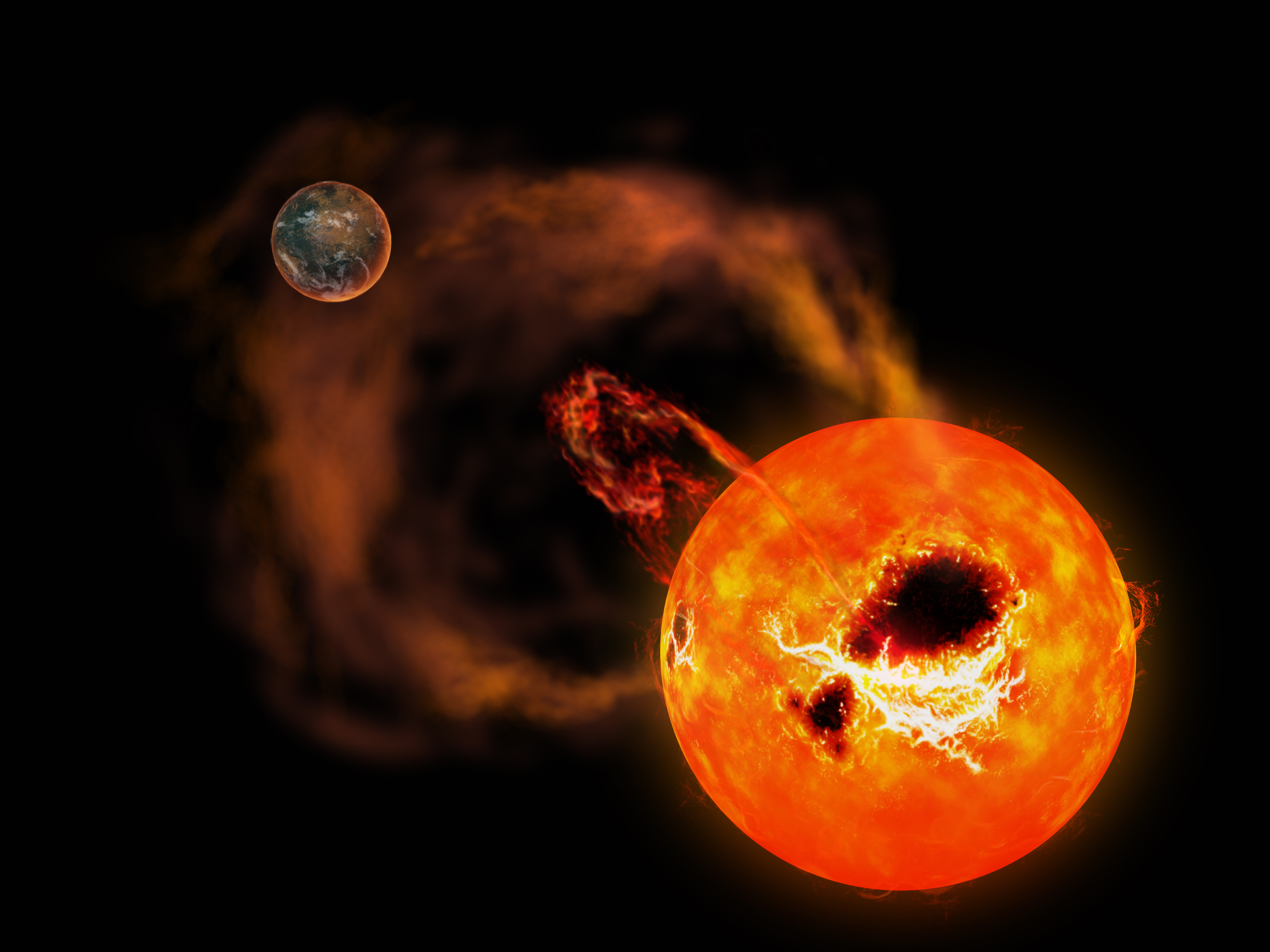
This artist’s concept shows an M dwarf star, also called a red dwarf star, and a planet. Most rocky planets in the Milky Way galaxy orbit red dwarf stars, which are smaller and cooler than the Sun, but can be much more active, bombarding nearby planets with high-energy X-rays and ultraviolet light.

The Rocky Worlds Director’s Discretionary program, a combined effort by NASA’s Webb and Hubble Space Telescopes, is underway to explore whether rocky planets can maintain atmospheres in this environment.

The team recently completed observations of the first target, Earth-sized rocky planet GJ 3929 b and its star GJ 3929. Credits Illustration: STScI, Ralf Crawford (STScI)


Scientists leading the astronomy community’s most ambitious effort to study rocky planets outside of our solar system have reached a major milestone.

The team has completed the coordinated observations of the first target, an Earth-sized rocky planet GJ 3929 b and GJ 3929, the red dwarf star it orbits, using NASA’s James Webb and Hubble Space Telescopes.

While the planet itself is scientifically compelling, researchers say the importance of this milestone extends far beyond a single target.

“This was our proving ground,” said Néstor Espinoza, Rocky Worlds Director’s Discretionary Time (DDT) program lead and mission scientist for exoplanet science at the Space Telescope Science Institute (STScI) in Baltimore. “Finishing these first observations shows that the program works technically, scientifically, and collaboratively.”

The Rocky Worlds DDT program was designed to create a foundational, community-driven dataset for studying rocky exoplanets with Webb and Hubble . While Webb measures mid-infrared light coming from each planet to determine whether it has an atmosphere, Hubble is analyzing ultraviolet light from each host star to assess the planet’s radiation environment.

STScI leads the effort to design the observing strategy, manage the program’s technical implementation, and build the collaborative framework connecting scientists across the broader exoplanet community.

“This team’s efforts reflect the best of the institute’s unique ability to bring together expertise in science operations, engineering, scheduling, software development, and large-scale program management to execute some of astronomy’s most technically challenging observations and answer some of the universe’s biggest questions,” said STScI Director Jennifer Lotz.

The GJ 3929 system became the program’s first completed target after emerging early as one of the strongest candidates for initial observations. Scientists selected the star and its planet through a multi-stage community process involving Science Advisory Council discussions, mini-surveys, and feedback from researchers across the exoplanet community.

The team emphasizes that the target was not chosen because it was expected to produce the most dramatic discovery. Instead, it represents an important balance: scientifically valuable, observationally feasible, and ideal for helping the team learn how to execute a complex program involving complementary observations, some of which are captured simultaneously, from multiple flagship observatories.

The observations required researchers to precisely predict when the planet would pass behind its star, an event known as a secondary eclipse. Even for a comparatively favorable target like GJ 3929 b, uncertainties in the planet’s orbit created significant technical challenges.

Completing the observations demonstrated that the team could overcome those challenges and establish a framework for future targets, many of which are expected to be even more difficult.

“This is exactly why the Rocky Worlds program exists,” added Hannah Diamond-Lowe, deputy lead of the program and assistant astronomer at STScI. “These are high-risk, high-reward observations. Completing this first target shows we know how to do it.”

The milestone also highlights the remarkably collaborative nature of the program. Scientists from around the world shared unpublished supporting observations, including radial velocity measurements used to refine the planet’s orbit and improve scheduling predictions, to help develop and refine the observation plans.

At the same time, the Rocky Worlds team is building new systems intended to encourage open collaboration while reducing duplicated effort across the field and grow the scope, impact and scientific return of the program, including the recently launched Rocky Worlds DDT Data Challenge. The new Community Involvement Initiative also provides an open forum for researchers and research to facilitate share information on analysis techniques, complementary and follow-up observations, project ideas, and plans for publications.

The program’s leaders say this collaborative structure was part of the vision from the beginning.

“We wanted to create something that belonged to the community,” Espinoza said. “The goal is not only to produce groundbreaking science, but also to build a framework where many researchers can contribute, collaborate, and learn together.”

The data, which are immediately available as soon as they’re downloaded from the telescope, have swiftly sparked scientific interest in the community. Some researchers have already started analyzing the data and publishing their conclusions.

For the Rocky Worlds team, that response reinforces the significance of the milestone.

The Space Telescope Science Institute is expanding the frontiers of space astronomy by hosting the science operations center of the Hubble Space Telescope, the science and mission operations centers for the James Webb Space Telescope, and the science operations center for the Nancy Grace Roman Space Telescope. STScI also houses the Barbara A. Mikulski Archive for Space Telescopes (MAST) which is a NASA-funded project to support and provide to the astronomical community a variety of astronomical data archives, and is the data repository for the Hubble, Webb, Roman, Kepler, K2, TESS missions and more. STScI is operated by the Association of Universities for Research in Astronomy in Washington, D.C.


About This Release

Credits:

Media Contacts:

Hannah Braun
Space Telescope Science Institute, Baltimore

Christine Pulliam
Space Telescope Science Institute, Baltimore

Permissions:
Content Use Policy


Monday, March 16, 2026

Nearby red dwarf star hosts at least four planets—with one in the habitable zone

sBGLS periodograms of all planet candidates and the rotation period of the star. The apparent fringe pattern in all panels is caused by the sampling of the data in two chunks separated by approximately 13 y. Credit: Astronomy & Astrophysics (2026). DOI: 10.1051/0004-6361/202554984


In 2020, a study confirmed that two planets orbited the nearby red dwarf, GJ 887. Now, astronomers have confirmed the existence of two additional planets orbiting GJ 887 in a new study published in Astronomy and Astrophysics. The new study suggests that one of these newly confirmed planets is in the habitable zone.

The GJ 887 red dwarf system

GJ 887 is a bright red dwarf star about 10.7 light years away from our solar system—a relatively short distance compared to other star systems. The previous study showed two non-transiting exoplanets with short orbital periods of 9 and 21 days and a potential third planet with a period of 50 days. At the time, available data could not differentiate whether the signal that was interpreted as potentially being from the third planet was coming from a planet or magnetic activity from the star.

Red dwarf stars are prime targets for finding low-mass planets in the habitable zone (HZ)—a region within a particular distance from a star where a planet's surface temperature allows for the existence of liquid water. The team involved in the new study aimed to determine whether this potential third planet could be confirmed and whether there might be any additional planets.

"The combination of the quiet, nearby star, confirmed planets close to the inner edge of the HZ, and the possibility of a third planet within the HZ means GJ 887 is particularly interesting for further characterization. If the 50 d signal is due to a planet, the system would be a prime candidate for atmospheric characterization, with such proposed imaging missions such as the Habitable Worlds Observatory (HWO) or interferometry missions such as Large Interferometer For Exoplanets (LIFE) due to its brightness and proximity to the sun," the study authors write.

New data confirms additional planets

The researchers combined new radial velocity (RV) measurements from the new High Accuracy Radial velocity Planet Searcher (HARPS) and Echelle SPectrograph for Rocky Exoplanets and Stable Spectroscopic Observations (ESPRESSO) spectral data and archival data. They also used photometric data from the Transiting Exoplanet Survey Satellite (TESS) and All-Sky Automated Survey (ASAS) to determine transits and stellar rotation.

The results confirmed that four planets orbit GJ 887 with periods of 4.4, 9.2, 21.8, and 50.8 days. They also confirmed that the 50.8-day planet (GJ 887 d) is in the HZ, making it the second closest HZ planet after Proxima Centauri b. The team says that the planet appears to be a "super-Earth" with a minimum mass of over six Earth masses.

"Without an independent radius estimate, the density and hence the composition of the planet cannot be determined. According to Luque and Pallé, planets in this mass range have either a rocky, a water-world or a puffy sub-Neptune composition," the study authors explain.

A fifth signal at 2.2 days was detected in the study, but could not be confirmed. The team says that, if confirmed, this may be a sub-Earth-mass planet. Future studies may confirm the existence of this potential planet with additional high-precision radial velocity data.

An ideal target for future study

The GJ 887 system is likely to remain in the crosshairs of astronomical instruments for years to come. GJ 887 d is a prime target for future direct imaging missions studying atmospheres and searching for biosignatures, such as the HWO and LIFE missions. There will likely be continued interest in determining the composition of GJ 887 d to see if it can support life.

"GJ 887 is a compelling system for further study. It is a nearby and, hence, bright, M dwarf, hosting a minimum of four planets, including a super-Earth-mass, Earth-mass, and potentially sub-Earth-mass planets. At least one of the planets is in the habitable zone," the study authors write.


Written for you by our author Krystal Kasal, edited by Gaby Clark, and fact-checked and reviewed by Robert Egan—this article is the result of careful human work. We rely on readers like you to keep independent science journalism alive. If this reporting matters to you, please consider a donation (especially monthly). You'll get an ad-free account as a thank-you.


Publication details

C. Hartogh et al, RedDots: Multiplanet system around M dwarf GJ 887 in the solar neighborhood, Astronomy & Astrophysics (2026). DOI: 10.1051/0004-6361/202554984

Journal information:

Astronomy & Astrophysics


Monday, March 17, 2025

Planetary System Found Around Nearest Single Star

PR Image noirlab2510a
Artist’s Illustration of Exoplanets Orbiting Barnard’s Star

PR Image noirlab2510b
MAROON-X at Gemini North

PR Image noirlab2510c
MAROON-X at Gemini North

PR Image noirlab2510d
Andreas Seifahrt and Jacob Bean Unpack MAROON-X


Videos

Exoplanets Orbiting Barnard’s Star Animation
PR Video noirlab2510a
Exoplanets Orbiting Barnard’s Star Animation


Using in part the Gemini North telescope, one half of the International Gemini Observatory, partly funded by the U.S. National Science Foundation and operated by NSF NOIRLab, astronomers have discovered four sub-Earth exoplanets orbiting Barnard’s Star, the nearest single star system to Earth. One of the planets is the least massive exoplanet ever discovered using the radial velocity technique, indicating a new benchmark for discovering smaller planets around nearby stars.

For a century, astronomers have been studying Barnard’s Star in the hope of finding planets around it. First discovered by E. E. Barnard at Yerkes Observatory in 1916, it is the nearest single star system to Earth [1]. Barnard’s Star is classified as a red dwarf — low-mass stars that often host closely-packed planetary systems, often with multiple rocky planets. Red dwarfs are extremely numerous in the Universe, so scientists are interested in understanding the environments of the planets they host.

One such effort was led by Jacob Bean from the University of Chicago, whose team created an instrument called MAROON-X, which is designed specifically to search for distant planets around red dwarf stars. MAROON-X is mounted on the Gemini North telescope, one half of the International Gemini Observatory, funded in part by the U.S. National Science Foundation and operated by NSF NOIRLab.

MAROON-X hunts for exoplanets using the radial velocity technique, meaning it detects the subtle back and forth wobble of a star as its exoplanets gravitationally tug on it, which causes the light emitted by the star to shift ever so slightly in wavelength. The powerful instrument measures these small shifts in light so precisely that it can even tease apart the number and masses of the planets that must be circling the star to have the observed effect.

After rigorously calibrating and analyzing data taken during 112 nights over a period of three years, the team found solid evidence for three exoplanets around Barnard’s Star, two of which were previously classified as candidates. The team also combined data from MAROON-X with data from a 2024 study done with the ESPRESSO instrument at the European Southern Observatory’s Very Large Telescope in Chile to confirm the existence of a fourth planet, elevating it as well from candidate to bona fide exoplanet.

“It’s a really exciting find — Barnard’s Star is our cosmic neighbor, and yet we know so little about it,” says Ritvik Basant, PhD student at the University of Chicago and first author of the paper appearing in The Astrophysical Journal Letters. “It’s signaling a breakthrough with the precision of these new instruments from previous generations.”

The newly discovered planets are most likely rocky planets, rather than gas planets like Jupiter. However, this will be difficult to pin down with certainty since, because of the angle we observe them from Earth, the planets do not cross in front of their star, which is the usual method for determining a planet’s composition. But with information from similar planets around other stars, the team will be able to make better estimates of their makeup.

They were, however, able to rule out with a fair degree of certainty the existence of other exoplanets with masses comparable to Earth in Barnard Star’s habitable zone — the region of space around a star that is just right to allow liquid water on an orbiting planet’s surface.

Barnard’s Star has been called the “great white whale” for planet hunters; several times over the past century, groups have announced evidence that suggested planets around Barnard’s Star, only for them to be subsequently disproved. But these latest findings give a much larger degree of confidence than any previous result.

“We observed at different times of night on different days. They’re in Chile; we’re in Hawai‘i. Our teams didn’t coordinate with each other at all,” says Basant. “That gives us a lot of assurance that these aren’t phantoms in the data.”

The four planets, each only about 20 to 30% the mass of Earth, are so close to their home star that they zip all the way around it in a matter of days. The fourth planet is the least massive planet discovered to date using the radial velocity technique. The team hopes this will spark a new era of finding more and more sub-Earth exoplanets in the Universe.

Most rocky planets found so far are much larger than Earth, and they appear to be fairly similar throughout the Milky Way Galaxy. But there are reasons to think that smaller exoplanets have more widely varied compositions. As scientists find more of them, they can begin to tease out more information about how these planets form and what makes them likely to have habitable conditions.

“The U.S. National Science Foundation is collaborating with the astronomy community on an adventure to look deeper into the Universe to detect planets with environments that might resemble Earth's,” says Martin Still, NSF program director for the International Gemini Observatory. “The planet discoveries provided by MAROON-X mounted on Gemini North provide a significant step along that journey.”

MAROON-X is still a visiting instrument at Gemini North. Given its outstanding performance and popularity with the user community, it is in the process of being converted to a permanent facility instrument..

“This result demonstrates the competitive, state-of-the-art capabilities that Gemini offers its user community. The observatory is in the middle of rejuvenating its instrumentation portfolio and MAROON-X is part of the first wave of new instruments, alongside GHOST on Gemini South and IGRINS-2 on Gemini North,” says Andreas Seifahrt, Associate Director of Development for the International Gemini Observatory, co-author of the paper, and member of the team who designed and built MAROON-X.


Notes

[1] The nearest star system to us, Proxima Centauri, has three stars circling each other, which changes the dynamics of planet formation and orbits.


More information

This research was presented in a paper titled “Four sub-Earth planets orbiting Barnard’s Star from MAROON-X and ESPRESSO” to appear in The Astrophysical Journal Letters. DOI: 10.3847/2041-8213/adb8d5

The team is composed of Ritvik Basant (University of Chicago), Rafael Luque (University of Chicago, NHFP Sagan Fellow), Jacob L. Bean (University of Chicago), Andreas Seifahrt (International Gemini Observatory/NSF NOIRLab), Madison Brady (University of Chicago), Lily L. Zhao (University of Chicago, NHFP Sagan Fellow), Nina Brown (University of Chicago), Tanya Das (University of Chicago), Julian Stürmer (Heidelberg University), David Kasper (University of Chicago), Rohan Gupta (University of Chicago), and Guðmundur Stefánsson (University of Amsterdam).

NSF NOIRLab, the U.S. National Science Foundation center for ground-based optical-infrared astronomy, operates the International Gemini Observatory (a facility of NSF, NRC–Canada, ANID–Chile, MCTIC–Brazil, MINCyT–Argentina, and KASI–Republic of Korea), NSF Kitt Peak National Observatory (KPNO), NSF Cerro Tololo Inter-American Observatory (CTIO), the Community Science and Data Center (CSDC), and NSF–DOE Vera C. Rubin Observatory (in cooperation with DOE’s SLAC National Accelerator Laboratory). It is managed by the Association of Universities for Research in Astronomy (AURA) under a cooperative agreement with NSF and is headquartered in Tucson, Arizona.

The scientific community is honored to have the opportunity to conduct astronomical research on I’oligam Du’ag (Kitt Peak) in Arizona, on Maunakea in Hawai‘i, and on Cerro Tololo and Cerro Pachón in Chile. We recognize and acknowledge the very significant cultural role and reverence of I’oligam Du’ag to the Tohono O’odham Nation, and Maunakea to the Kanaka Maoli (Native Hawaiians) community.


Links


Contacts:

Ritvik Basant
Graduate Student, Department of Astronomy and Astrophysics
University of Chicago
Email:
rbasant@uchicago.edu

Jacob Bean
Professor, Department of Astronomy and Astrophysics
University of Chicago
Email:
jacobbean@uchicago.edu

Andreas Seifahrt
Associate Director of Development
International Gemini Observatory/NSF NOIRLab
Email:
andreas.seifahrt@noirlab.edu

Josie Fenske
Jr. Public Information Officer
NSF NOIRLab
Email:
josie.fenske@noirlab.edu

Louise Lerner
Physical Sciences News Officer
University of Chicago
Email:
  louise@uchicago.edu


Saturday, January 14, 2023

NASA’s Webb Confirms Its First Exoplanet

Exoplanet LHS 475 b and Its Star (Illustration)
Credits: Illustration: NASA, ESA, CSA, Leah Hustak (STScI)

Exoplanet LHS 475 b (NIRSpec Transit Light Curve)
Credits: Illustration: NASA, ESA, CSA, Leah Hustak (STScI)

Science: Kevin B. Stevenson (APL), Jacob A. Lustig-Yaeger (APL), Erin M. May (APL), Guangwei Fu (JHU), Sarah E. Moran (University of Arizona)

Exoplanet LHS 475 b (Transmission Spectrum)
Credits: Illustration: NASA, ESA, CSA, Leah Hustak (STScI)
Science: Kevin B. Stevenson (APL), Jacob A. Lustig-Yaeger (APL), Erin M. May (APL), Guangwei Fu (JHU), Sarah E. Moran (University of Arizona)


Researchers confirmed an exoplanet, a planet that orbits another star, using NASA’s James Webb Space Telescope for the first time. Formally classified as LHS 475 b, the planet is almost exactly the same size as our own, clocking in at 99% of Earth’s diameter. The research team is led by Kevin Stevenson and Jacob Lustig-Yaeger, both of the Johns Hopkins University Applied Physics Laboratory in Laurel, Maryland.

The team chose to observe this target with Webb after carefully reviewing targets of interest from NASA’s Transiting Exoplanet Survey Satellite (TESS), which hinted at the planet’s existence. Webb’s Near-Infrared Spectrograph (NIRSpec) captured the planet easily and clearly with only two transit observations. “There is no question that the planet is there. Webb’s pristine data validate it,” said Lustig-Yaeger. “The fact that it is also a small, rocky planet is impressive for the observatory,” Stevenson added.

“These first observational results from an Earth-size, rocky planet open the door to many future possibilities for studying rocky planet atmospheres with Webb,” agreed Mark Clampin, Astrophysics Division director at NASA Headquarters in Washington. “Webb is bringing us closer and closer to a new understanding of Earth-like worlds outside our solar system, and the mission is only just getting started.”

Among all operating telescopes, only Webb is capable of characterizing the atmospheres of Earth-sized exoplanets. The team attempted to assess what is in the planet’s atmosphere by analyzing its transmission spectrum. Although the data show that this is an Earth-sized terrestrial planet, they do not yet know if it has an atmosphere. “The observatory’s data are beautiful,” said Erin May, also of the Johns Hopkins University Applied Physics Laboratory. “The telescope is so sensitive that it can easily detect a range of molecules, but we can’t yet make any definitive conclusions about the planet’s atmosphere.”

Although the team can’t conclude what is present, they can definitely say what is not present. “There are some terrestrial-type atmospheres that we can rule out,” explained Lustig-Yaeger. “It can’t have a thick methane-dominated atmosphere, similar to that of Saturn’s moon Titan.”

The team also notes that while it’s possible the planet has no atmosphere, there are some atmospheric compositions that have not been ruled out, such as a pure carbon dioxide atmosphere. “Counterintuitively, a 100% carbon dioxide atmosphere is so much more compact that it becomes very challenging to detect,” said Lustig-Yaeger. Even more precise measurements are required for the team to distinguish a pure carbon dioxide atmosphere from no atmosphere at all. The researchers are scheduled to obtain additional spectra with upcoming observations this summer.

Webb also revealed that the planet is a few hundred degrees warmer than Earth, so if clouds are detected, it may lead the researchers to conclude that the planet is more like Venus, which has a carbon dioxide atmosphere and is perpetually shrouded in thick clouds. “We’re at the forefront of studying small, rocky exoplanets,” Lustig-Yaeger said. “We have barely begun scratching the surface of what their atmospheres might be like.”

The researchers also confirmed that the planet completes an orbit in just two days, information that was almost instantaneously revealed by Webb’s precise light curve. Although LHS 475 b is closer to its star than any planet in our solar system, its red dwarf star is less than half the temperature of the Sun, so the researchers project it still could have an atmosphere.

The researchers’ findings have opened the possibilities of pinpointing Earth-sized planets orbiting smaller red dwarf stars. “This rocky planet confirmation highlights the precision of the mission’s instruments,” Stevenson said. “And it is only the first of many discoveries that it will make.” Lustig-Yaeger agreed. “With this telescope, rocky exoplanets are the new frontier.”

LHS 475 b is relatively close, at only 41 light-years away, in the constellation Octans.

The team’s results were presented at a press conference of the American Astronomical Society (AAS) on Wednesday, Jan. 11, 2023.

The James Webb Space Telescope is the world’s premier space science observatory. Webb will solve mysteries in our solar system, look beyond to distant worlds around other stars, and probe the mysterious structures and origins of our universe and our place in it. Webb is an international program led by NASA with its partners, ESA (European Space Agency) and CSA (Canadian Space Agency).


About This Release

Credits:

Media Contact:

Claire Blome
Space Telescope Science Institute, Baltimore, Maryland

Christine Pulliam
Space Telescope Science Institute, Baltimore, Maryland

Permissions:
Content Use Policy

Contact Us: Direct inquiries to the News Team.

Related Links and Documents


Thursday, April 08, 2021

Ultra-sensitive radio images reveal thousands of star-forming galaxies in early Universe

The deepest LOFAR image ever made, in the region of sky known as ‘Elais-N1’, which is one of the three fields studied as part of this deep radio survey. This image arises from a single LOFAR pointing observed repeatedly for a total of 164 hours. Over 80,000 radio sources are detected; this includes some spectacular large-scale emission arising from massive black holes, but most sources are distant galaxies like the Milky Way, forming their stars. Credit: Philip Best & Jose Sabater, University of Edinburgh.

An international team of astronomers has published the most sensitive images of the Universe ever taken at low radio frequencies, using the International Low Frequency Array (LOFAR). By observing the same regions of sky over and over again and combining the data to make a single very-long exposure image, the team has detected the faint radio glow of stars exploding as supernovae, in tens of thousands of galaxies out to the most distant parts of the Universe. A special issue of the scientific journal Astronomy & Astrophysics is dedicated to fourteen research papers describing these images and the first scientific results.

Cosmic star formation

Philip Best, University of Edinburgh (UK), who led the deep survey, explained: “When we look at the sky with a radio telescope, the brightest objects we see are produced by massive black holes at the centre of galaxies. However, our images are so deep that most of the objects in it are galaxies like our own Milky Way, which emit faint radio waves that trace their on-going star-formation.”

“The combination of the high sensitivity of LOFAR and the wide area of sky covered by our survey – about 300 times the size of the full moon – has enabled us to detect tens of thousands of galaxies like the Milky Way, far out into the distant Universe. The light from these galaxies has been travelling for billions of years to reach the Earth; this means that we see the galaxies as they were billions of years ago, back when they were forming most of their stars.”

Isabella Prandoni, INAF Bologna (Italy), added: “Star formation is usually enshrouded in dust, which obscures our view when we look with optical telescopes. But radio waves penetrate the dust, so with LOFAR we obtain a complete picture of their star-formation.” The deep LOFAR images have led to a new relation between a galaxy’s radio emission and the rate at which it is forming stars, and a more accurate measurement of the number of new stars being formed in the young Universe.

Exotic objects


The remarkable dataset has enabled a wide range of additional scientific studies, ranging from the nature of the spectacular jets of radio emission produced by massive black holes, to that arising from collisions of huge clusters of galaxies. It has also thrown up unexpected results. For example, by comparing the repeated observations, the researchers searched for objects that change in radio brightness. This resulted in the detection of the red dwarf star CR Draconis. Joe Callingham, Leiden University and ASTRON (NL), noted that “CR Draconis shows bursts of radio emission that strongly resemble those from Jupiter, and may be driven by the interaction of the star with a previously unknown planet, or because the star is rotating extremely quickly.”

Huge computational challenge

LOFAR does not directly produce maps of the sky; instead the signals from more than 70,000 antennas must be combined. To produce these deep pictures, more than 4 petabytes of raw data - equivalent to about a million DVDs – were taken and processed. “The deep radio images of our Universe are diffusely hidden, deep inside the vast amount of data that LOFAR has observed.” said Cyril Tasse from Paris Observatory, University PSL (France). “Recent mathematical advances made it possible to extract these, using large clusters of computers.”

Multi-wavelength data

Just as important in extracting the science has been a comparison of these radio images with data obtained at other wavelengths. “The parts of the sky we chose are the best-studied in the Northern sky” explained Philip Best. This has allowed the team to assemble optical, near-infrared, far-infrared and sub-millimetre data for the LOFAR-detected galaxies, which has been crucial in interpreting the LOFAR results.

LOFAR

LOFAR is the world’s leading telescope of its type. It is operated by ASTRON, the Netherlands Institute for Radio Astronomy, and coordinated by a partnership of 9 European countries: France, Germany, Ireland, Italy, Latvia, the Netherlands, Poland, Sweden and the UK. In its ‘high-band’ configuration, LOFAR observes at frequencies of around 150 MHz – between the FM and DAB radio bands. “LOFAR is unique in its ability to make high-quality images of the sky at metre-wavelengths”, said Huub Röttgering, Leiden University, who is leading the overall suite of LOFAR surveys. “These deep field images are a testament to its capabilities and a treasure trove for future discoveries”.

Additional images and videos are available at https://www.lofar-surveys.org/deepfields.html, which also hosts the papers, deep images and catalogues released today. A direct link to the special issue can be found here. 
 

Saturday, October 31, 2020

Stars and Skulls: new ESO image reveals eerie nebula

New ESO’s VLT image of the Skull Nebula
 
The Skull Nebula in the constellation of Cetus (The Whale) 
 
The sky around the Skull Nebula 


Videos

ESOcast 232 Light: Stars and Skulls

Zooming in on the Skull Nebula


This ethereal remnant of a long dead star, nestled in the belly of The Whale, bears an uneasy resemblance to a skull floating through space. Captured in astounding detail by ESO’s Very Large Telescope (VLT), the eerie Skull Nebula is showcased in this new image in beautiful bloodshot colours. This planetary nebula is the first known to be associated with a pair of closely bound stars orbited by a third outer star.

Also known as NGC 246, the Skull Nebula lies about 1600 light-years away from Earth in the southern constellation of Cetus (The Whale). It formed when a Sun-like star expelled its outer layers in its old age, leaving behind its naked core — a white dwarf — one of two stars that can be seen at the very centre of NGC 246. 

Even though this nebula has been known for centuries, only in 2014 did astronomers discover, using ESO’s VLT, that the white dwarf and its companion are concealing a third star situated at the heart of the Skull Nebula. This star, which is not visible in this image, is a dim red dwarf that sits close to the white dwarf at about 500 times the distance between Earth and the Sun. The red and white dwarf stars orbit each other as a pair, and the outer star orbits the two dwarfs at a distance of around 1900 times the Earth-Sun separation. Collectively, these three stars establish NGC 246 as the first known planetary nebula with a hierarchical triple stellar system at its centre.

Taken by the FORS 2 instrument on ESO's VLT in the Chilean Atacama Desert, this new image of the Skull Nebula intentionally captures light emitted in some narrow ranges of wavelengths — those associated with hydrogen and oxygen gas. Observations of light emitted by particular elements help reveal a wealth of information about an object’s chemical and structural compositions. This new image of the Skull Nebula highlights where NGC 246 is rich or poor in hydrogen (shown in red) and oxygen (depicted in light blue).

This image was selected as part of the ESO Cosmic Gems programme, an outreach initiative to produce images of interesting, intriguing or visually attractive objects using ESO telescopes, for the purposes of education and public outreach. The programme makes use of telescope time that cannot be used for science observations. All data collected may also be suitable for scientific purposes, and are made available to astronomers through ESO’s science archive.


More Infomation
 
ESO is the foremost intergovernmental astronomy organisation in Europe and the world’s most productive ground-based astronomical observatory by far. It has 16 Member States: Austria, Belgium, the Czech Republic, Denmark, France, Finland, Germany, Ireland, Italy, the Netherlands, Poland, Portugal, Spain, Sweden, Switzerland and the United Kingdom, along with the host state of Chile and with Australia as a Strategic Partner. ESO carries out an ambitious programme focused on the design, construction and operation of powerful ground-based observing facilities enabling astronomers to make important scientific discoveries. ESO also plays a leading role in promoting and organising cooperation in astronomical research. ESO operates three unique world-class observing sites in Chile: La Silla, Paranal and Chajnantor. At Paranal, ESO operates the Very Large Telescope and its world-leading Very Large Telescope Interferometer as well as two survey telescopes, VISTA working in the infrared and the visible-light VLT Survey Telescope. Also at Paranal ESO will host and operate the Cherenkov Telescope Array South, the world’s largest and most sensitive gamma-ray observatory. ESO is also a major partner in two facilities on Chajnantor, APEX and ALMA, the largest astronomical project in existence. And on Cerro Armazones, close to Paranal, ESO is building the 39-metre Extremely Large Telescope, the ELT, which will become “the world’s biggest eye on the sky”.
 
Bárbara Ferreira
ESO Public Information Officer
Garching bei München, Germany
Tel: +49 89 3200 6670
Email:
pio@eso.org

Source: ESO/News


Tuesday, July 14, 2020

The Lion’s Roar: New Telescope Spots Superflare in Leo

Artist’s impression of the dramatic effect a superflare on a red dwarf star could have on an Earth-like exoplanet orbiting it. Credit: NAOJ).  Original size (1.3MB

A new telescope in Okayama, Japan observed a superflare on a star in the constellation Leo to better understand how superflares on the Sun can affect technology and life on Earth.

The cold, dark chaos of space is filled with mystery.

Fortunately, the ways in which we can peer into the mists of the void are increasing, and now include Kyoto University’s 3.8 meter Seimei Telescope.

Using this new instrument—located on a hilltop in Okayama to the west of Kyoto—astronomers from Kyoto University's Graduate School of Science and the National Astronomical Observatory of Japan have succeeded in detecting 12 stellar flare phenomena on AD Leonis, a red dwarf star 16 light-years away in the constellation Leo, the Lion. In particular, one of these flares was 20 times larger than those emitted by our own Sun.

“Solar flares are sudden explosions that emanate from the surfaces of stars, including our own Sun,” explains Kosuke Namekata, first author of the paper which appeared in Publications of the Astronomical Society of Japan. “On rare occasions, an extremely large superflare will occur. These result in massive magnetic storms, which when emitted from our Sun can affect the Earth's technological infrastructure.”

Hence understanding the properties of superflares can be vital, but their rareness means that it is difficult to gather data from observing our Sun alone. This has led researchers to look for exoplanets similar to Earth, and to examine the stars they orbit.

In their paper in Publications of the Astronomical Society of Japan, the team reports on a long week of setting the sights of Seimei—along with other observational facilities—to AD Leonis. This M-type red dwarf is cooler than our Sun, resulting in a higher incidence of flares. The team expected a number of these flares to be large, but were still astounded to detect a superflare on their very first night of observations.

“Our analyses of the superflare resulted in some very intriguing data,” Namekata explains.

Light from excited hydrogen atoms in the superflare indicated that there were roughly 10 times more high-energy electrons than seen in typical flares from our Sun.

“This is the first time this phenomenon has been reported, and it’s thanks to the high precision of the Seimei Telescope,” says Namekata.

The team also observed flares where light from excited hydrogen atoms increased, but did not correspond with an increase in brightness across the rest of the visible spectrum.

“This was new for us as well, because typical flare studies have observed the continuum of the light spectrum—the broad range of wavelengths—rather than energy coming from specific atoms,” continues Namekata.

The high-quality of these data was thanks to the new telescope, which the team hopes will open doors to new revelations regarding extreme space events.

Kazunari Shibata, leader of the study, concludes, “More information on these fundamental stellar phenomena will help us predict superflares, and possibly mitigate magnetic storm damage here on Earth. We may even be able to begin understanding how these emissions can affect the existence—or emergence—of life on other planets.”

These results appeared as Namekata, et al. “Optical and X-ray observations of stellar flares on an active M dwarf AD Leonis with Seimei Telescope, SCAT, NICER and OISTER” in Publications of the Astronomical Society of Japan on July 10, 2020.


Related Links


Friday, December 14, 2018

In Search of Missing Worlds, Hubble Finds a Fast Evaporating Exoplanet

This artist's illustration shows a giant cloud of hydrogen streaming off a warm, Neptune-sized planet just 97 light-years from Earth. The exoplanet is tiny compared to its star, a red dwarf named GJ 3470. The star's intense radiation is heating the hydrogen in the planet's upper atmosphere to a point where it escapes into space. The alien world is losing hydrogen at a rate 100 times faster than a previously observed warm Neptune whose atmosphere is also evaporating away. Credits: NASA, ESA, and D. Player (STScI)

This graphic plots exoplanets based on their size and distance from their star. Each dot represents an exoplanet. Planets the size of Jupiter (located at the top of the graphic) and planets the size of Earth and so-called super-Earths (at the bottom) are found both close to and far from their star. But planets the size of Neptune (in the middle of the plot) are scarce close to their star. This so-called desert of hot Neptunes shows that such alien worlds are rare, or, they were plentiful at one time, but have since disappeared. The detection that GJ 3470b, a warm Neptune at the border of the desert, is fast losing its atmosphere suggests that hotter Neptunes may have eroded down to smaller, rocky super-Earths. Credits: NASA, ESA, and A. Feild (STScI).  Science: NASA, ESA, and V. Bourrier (University of Geneva, Switzerland)


Fishermen would be puzzled if they netted only big and little fish, but few medium-sized fish. Astronomers likewise have been perplexed in conducting a census of star-hugging extrasolar planets. They have found hot Jupiter-sized planets and hot super-Earths (planets no more than 1.5 times Earth's diameter). These planets are scorching hot because they orbit very close to their star. But so-called "hot Neptunes," whose atmospheres are heated to more than 1,700 degrees Fahrenheit, have been much harder to find. In fact, only about a handful of hot Neptunes have been found so far.

In fact, most of the known Neptune-sized exoplanets are merely "warm," because they orbit farther away from their star than those in the region where astronomers would expect to find hot Neptunes. The mysterious hot-Neptune deficit suggests that such alien worlds are rare, or, they were plentiful at one time, but have since disappeared.

A few years ago astronomers using NASA's Hubble Space Telescope found that one of the warmest known Neptunes (GJ 436b) is losing its atmosphere. The planet isn't expected to evaporate away, but hotter Neptunes might not have been so lucky.

Now, astronomers have used Hubble to nab a second "very warm" Neptune (GJ 3470b) that is losing its atmosphere at a rate 100 times faster than that of GJ 436b. Both planets reside about 3.7 million miles from their star. That's one-tenth the distance between our solar system's innermost planet, Mercury, and the Sun.

"I think this is the first case where this is so dramatic in terms of planetary evolution," said lead researcher Vincent Bourrier of the University of Geneva in Sauverny, Switzerland. "It's one of the most extreme examples of a planet undergoing a major mass-loss over its lifetime. This sizable mass loss has major consequences for its evolution, and it impacts our understanding of the origin and fate of the population of exoplanets close to their stars."

As with the previously discovered evaporating planets, the star's intense radiation heats the atmosphere to a point where it escapes the planet's gravitational pull like an untethered hot air balloon. The escaping gas forms a giant cloud around the planet that dissipates into space. One reason why GJ 3470b may be evaporating faster than GJ 436b is that it is not as dense, so it is less able to gravitationally hang on to the heated atmosphere.

What's more, the star hosting GJ 3470b is only 2 billion years old, compared to the 4-billion- to 8-billion-year-old star that planet GJ 436b orbits. The younger star is more energetic, so it bombards the planet with more blistering radiation than GJ 436b receives. Both are red dwarf stars, which are smaller and longer-lived than our Sun.

Uncovering two evaporating warm Neptunes reinforces the idea that the hotter version of these distant worlds may be a class of transitory planet whose ultimate fate is to shrink down to the most common type of known exoplanet, mini-Neptunes — planets with heavy, hydrogen-dominated atmospheres that are larger than Earth but smaller than Neptune. Eventually, these planets may downsize even further to become super-Earths, more massive, rocky versions of Earth.

"The question has been, where have the hot Neptunes gone?" said Bourrier. "If we plot planetary size and distance from the star, there's a desert, a hole, in that distribution. That's been a puzzle. We don't really know how much the evaporation of the atmospheres played in forming this desert. But our Hubble observations, which show a large amount of mass loss from a warm Neptune at the edge of the desert, is a direct confirmation that atmospheric escape plays a major role in forming this desert."

The researchers used Hubble's Space Telescope Imaging Spectrograph to detect the ultraviolet-light signature of hydrogen in a huge cocoon surrounding the planet as it passed in front of its star. The intervening cocoon of hydrogen filters out some of the starlight. These results are interpreted as evidence of the planet's atmosphere bleeding off into space.

The team estimates that the planet has lost as much as 35 percent of its material over its lifetime, because it was probably losing mass at a faster rate when its red-dwarf star was younger and emitting even more radiation. If the planet continues to rapidly lose material, it will shrink down to a mini-Neptune in a few billion years.

Hydrogen probably isn't the only element evaporating away: it may be a tracer for other material streaming off into space. The researchers plan to use Hubble to hunt for elements heavier than hydrogen and helium that have hitched a ride with the hydrogen gas to escape the planet. "We think that the hydrogen gas could be dragging heavy elements such as carbon, which reside deeper in the atmosphere, upward and out into space," Bourrier said.

The observations are part of the Panchromatic Comparative Exoplanet Treasury (PanCET) survey, a Hubble program to look at 20 exoplanets, mostly hot Jupiters, in the first large-scale ultraviolet, visible, and infrared comparative study of distant worlds.

Observing the evaporation of these two warm Neptunes is encouraging, but team members know they need to study more of them to confirm predictions. Unfortunately, there may be no other planets of this class residing close enough to Earth to observe. The problem is that hydrogen gas cannot be detected in warm Neptunes farther away than 150 light-years from Earth because it is obscured by interstellar gas. GJ 3470b resides 97 light-years away.

However, helium is another tracer for material escaping a warm Neptune's atmosphere. Astronomers could use Hubble and the upcoming NASA James Webb Space Telescope to search in infrared light for helium, because it is not blocked by interstellar material in space.

"Looking for helium could expand our survey range," Bourrier said. "Webb will have incredible sensitivity, so we would be able to detect helium escaping from smaller planets, such as mini-Neptunes."

The researcher's paper will appear in the Dec. 13 issue of Astronomy and Astrophysics.

The Hubble Space Telescope is a project of international cooperation between NASA and ESA (European Space Agency). NASA's Goddard Space Flight Center in Greenbelt, Maryland, manages the telescope. The Space Telescope Science Institute (STScI) in Baltimore, Maryland, conducts Hubble science operations. STScI is operated for NASA by the Association of Universities for Research in Astronomy in Washington, D.C.


Related  Links

This site is not responsible for content found on external links


Contact

Donna Weaver / Ray Villard
Space Telescope Science Institute, Baltimore, Maryland
410-338-4493 / 410-338-4514

dweaver@stsci.edu / villard@stsci.edu

Vincent Bourrier
University of Geneva, Sauverny, Switzerland
011-41-22-379-2449

vincent.bourrier@unige.ch


Sunday, October 21, 2018

Superflares From Young Red Dwarf Stars Imperil Planets

Violent outbursts of seething gas from young red dwarf stars may make conditions uninhabitable on fledgling planets. In this artist's rendering, an active, young red dwarf (right) is stripping the atmosphere from an orbiting planet (left). Scientists found that flares from the youngest red dwarfs they surveyed — approximately 40 million years old — are 100 to 1,000 times more energetic than when the stars are older. They also detected one of the most intense stellar flares ever observed in ultraviolet light — more energetic than the most powerful flare ever recorded from our Sun. Credits: NASA, ESA and D. Player (STScI)


The word "HAZMAT" describes substances that pose a risk to the environment, or even to life itself. Imagine the term being applied to entire planets, where violent flares from the host star may make worlds uninhabitable by affecting their atmospheres.

NASA's Hubble Space Telescope is observing such stars through a large program called HAZMAT — Habitable Zones and M dwarf Activity across Time.

"M dwarf" is the astronomical term for a red dwarf star — the smallest, most abundant and longest-lived type of star in our galaxy. The HAZMAT program is an ultraviolet survey of red dwarfs at three different ages: young, intermediate, and old.

Stellar flares from red dwarfs are particularly bright in ultraviolet wavelengths, compared with Sun-like stars. Hubble's ultraviolet sensitivity makes the telescope very valuable for observing these flares. The flares are believed to be powered by intense magnetic fields that get tangled by the roiling motions of the stellar atmosphere. When the tangling gets too intense, the fields break and reconnect, unleashing tremendous amounts of energy.

The team has found that the flares from the youngest red dwarfs they surveyed — just about 40 million years old — are 100 to 1,000 times more energetic than when the stars are older. This younger age is when terrestrial planets are forming around their stars.

Approximately three-quarters of the stars in our galaxy are red dwarfs. Most of the galaxy's "habitable-zone" planets — planets orbiting their stars at a distance where temperatures are moderate enough for liquid water to exist on their surface — likely orbit red dwarfs. In fact, the nearest star to our Sun, a red dwarf named Proxima Centauri, has an Earth-size planet in its habitable zone.

However, young red dwarfs are active stars, producing ultraviolet flares that blast out so much energy that they could influence atmospheric chemistry and possibly strip off the atmospheres of these fledgling planets.

"The goal of the HAZMAT program is to help understand the habitability of planets around low-mass stars," explained Arizona State University's Evgenya Shkolnik, the program's principal investigator. "These low-mass stars are critically important in understanding planetary atmospheres."

The results of the first part of this Hubble program are being published in The Astrophysical Journal. This study examines the flare frequency of 12 young red dwarfs. "Getting these data on the young stars has been especially important, because the difference in their flare activity is quite large as compared to older stars," said Arizona State University's Parke Loyd, the first author on this paper.

The observing program detected one of the most intense stellar flares ever observed in ultraviolet light. Dubbed the "Hazflare," this event was more energetic than the most powerful flare from our Sun ever recorded.

"With the Sun, we have a hundred years of good observations," Loyd said. "And in that time, we've seen one, maybe two, flares that have an energy approaching that of the Hazflare. In a little less than a day's worth of Hubble observations of these young stars, we caught the Hazflare, which means that we're looking at superflares happening every day or even a few times a day."

Could super-flares of such frequency and intensity bathe young planets in so much ultraviolet radiation that they forever doom chances of habitability? According to Loyd, "Flares like we observed have the capacity to strip away the atmosphere from a planet. But that doesn't necessarily mean doom and gloom for life on the planet. It just might be different life than we imagine. Or there might be other processes that could replenish the atmosphere of the planet. It's certainly a harsh environment, but I would hesitate to say that it is a sterile environment."

The next part of the HAZMAT study will be to study intermediate-aged red dwarfs that are 650 million years old. Then the oldest red dwarfs will be analyzed and compared with the young and intermediate stars to understand the evolution of the ultraviolet radiation environment of low-mass planets around these low-mass stars. The Hubble Space Telescope is a project of international cooperation between NASA and ESA (European Space Agency). NASA's Goddard Space Flight Center in Greenbelt, Maryland, manages the telescope. The Space Telescope Science Institute (STScI) in Baltimore, Maryland, conducts Hubble science operations. STScI is operated for NASA by the Association of Universities for Research in Astronomy, in Washington, D.C.


Ann Jenkins / Ray Villard
Space Telescope Science Institute, Baltimore, Maryland
410-338-4488 / 410-338-4514
jenkins@stsci.edu / villard@stsci.edu

Evgenya Shkolnik
Arizona State University, Tempe, Arizona 808-292-9088
shkolnik@asu.edu

Parke Loyd
Arizona State University, Tempe, Arizona
parke@asu.edu

Editor: Karl Hille


Source: NASA/Hubble

Thursday, March 01, 2018

Powerful Flare from Star Proxima Centauri Detected with ALMA

Artist impression of a red dwarf star like Proxima Centauri, the nearest star to our sun. New analysis of ALMA observations reveal that Proxima Centauri emitted a powerful flare that would have created inhospitable conditions for planets in that system. Credit: NRAO/AUI/NSF; D. Berry 

The brightness of Proxima Centauri as observed by ALMA over the two minutes of the event on March 24, 2017. The massive stellar flare is shown in red, with the smaller earlier flare in orange, and the enhanced emission surrounding the flare that could mimic a disk in blue. At its peak, the flare increased Proxima Centauri’s brightness by 1,000 times. The shaded area represents uncertainty. Credit: Meredith MacGregor, Carnegie


Artist animation of a red dwarf star similar to Proxima Centauri, the nearest star to our sun. New analysis of ALMA observations reveal that Proxima Centauri emitted a powerful flare that would have created inhospitable conditions for planets in that system. Credit: NRAO/AUI/NSF; D. Berry. Vimeo

An artist’s impression of a flare from Proxima Centauri, modeled after the loops of glowing hot gas seen in the largest solar flares. An artist’s impression of the exoplanet Proxima b is shown in the foreground. Proxima b orbits its star 20 times closer than the Earth orbits the Sun. A flare 10 times larger than a major solar flare would blast Proxima b with 4,000 times more radiation than the Earth gets from our Sun’s flares.  Credit: Roberto Molar Candanosa / Carnegie Institution for Science, NASA/SDO, NASA/JPL


Powerful Flare from Star Proxima Centauri Detected with ALMA
Puts habitability of nearby system into question

Space weather emitted by Proxima Centauri, the star closest to our sun, may make that system rather inhospitable to life after all.

Using data from the Atacama Large Millimeter/submillimeter Array (ALMA), a team of astronomers discovered that a powerful stellar flare erupted from Proxima Centauri last March. This finding, published in the Astrophysical Journal Letters, raises questions about the habitability of our solar system’s nearest exoplanetary neighbor, Proxima b, which orbits Proxima Centauri.

At its peak, the newly recognized flare was 10 times brighter than our sun’s largest flares, when observed at similar wavelengths. Stellar flares have not been well studied at the millimeter and submillimeter wavelengths detected by ALMA, especially around stars of Proxima Centauri’s type, called M dwarfs, which are the most common in our galaxy.

“March 24, 2017, was no ordinary day for Proxima Cen,” said Meredith MacGregor, an astronomer at the Carnegie Institution for Science, Department of Terrestrial Magnetism in Washington, D.C., who led the research with fellow Carnegie astronomer Alycia Weinberger. Along with colleagues from the Harvard-Smithsonian Center for Astrophysics, David Wilner and Adam Kowalski, and Steven Cranmer of the University of Colorado Boulder — they discovered the enormous flare when they reanalyzed ALMA observations taken last year.

The flare increased Proxima Centauri’s brightness by 1,000 times over 10 seconds. This was preceded by a smaller flare; taken together, the whole event lasted fewer than two minutes of the 10 hours that ALMA observed the star between January and March of last year.

Stellar flares happen when a shift in the star’s magnetic field accelerates electrons to speeds approaching that of light. The accelerated electrons interact with the highly charged plasma that makes up most of the star, causing an eruption that produces emission across the entire electromagnetic spectrum.

“It’s likely that Proxima b was blasted by high energy radiation during this flare,” MacGregor explained, adding that it was already known that Proxima Centauri experienced regular, although smaller, X-ray flares. “Over the billions of years since Proxima b formed, flares like this one could have evaporated any atmosphere or ocean and sterilized the surface, suggesting that habitability may involve more than just being the right distance from the host star to have liquid water.”

An earlier paper that also used the same ALMA data interpreted its average brightness, which included the light output of both the star and the flare together, as being caused by multiple disks of dust encircling Proxima Centauri, not unlike our own solar system’s asteroid and Kuiper belts.

But when MacGregor, Weinberger, and their team looked at the ALMA data as a function of observing time, instead of averaging it all together, they were able to see the transient explosion of radiation emitted from Proxima Centauri for what it truly was.

“There is now no reason to think that there is a substantial amount of dust around Proxima Cen,” Weinberger said. “Nor is there any information yet that indicates the star has a rich planetary system like ours.”

The National Radio Astronomy Observatory is a facility of the National Science Foundation operated under cooperative agreement by Associated Universities, Inc.

# # #

This research is presented in a paper titled “Detection of a millimeter flare from Proxima Centauri,” by M. MacGregor, et al., published in the Astrophysical Journal Letters. [https://doi.org/10.3847/2041-8213/aaad6b; preprint: http://arxiv.org/abs/1802.08257]

The Atacama Large Millimeter/submillimeter Array (ALMA), an international astronomy facility, is a partnership of the European Organisation for Astronomical Research in the Southern Hemisphere (ESO), the U.S. National Science Foundation (NSF) and the National Institutes of Natural Sciences (NINS) of Japan in cooperation with the Republic of Chile. ALMA is funded by ESO on behalf of its Member States, by NSF in cooperation with the National Research Council of Canada (NRC) and the Ministry of Science and Technology (MOST) in Taiwan and by NINS in cooperation with the Academia Sinica (AS) in Taiwan and the Korea Astronomy and Space Science Institute (KASI).

ALMA construction and operations are led by ESO on behalf of its Member States; by the National Radio Astronomy Observatory (NRAO), managed by Associated Universities, Inc. (AUI), on behalf of North America; and by the National Astronomical Observatory of Japan (NAOJ) on behalf of East Asia. The Joint ALMA Observatory (JAO) provides the unified leadership and management of the construction, commissioning and operation of ALMA.

This research was supported in part by a National Science Foundation Astronomy and Astrophysics Postdoctoral Fellowship under Award No. 1701406.

The Carnegie Institution for Science (carnegiescience.edu) is a private, nonprofit organization headquartered in Washington, D.C., with six research departments throughout the U.S. Since its founding in 1902, the Carnegie Institution has been a pioneering force in basic scientific research. Carnegie scientists are leaders in plant biology, developmental biology, astronomy, materials science, global ecology, and Earth and planetary science.


Contacts:

Charles Blue, 
NRAO Public Information Officer
(434) 296-0314; 

cblue@nrao.edu

Meredith MacGregor, 
Carnegie Institution for Science
(202) 478-8846;

mmacgregor@carnegiescience.edu

Alycia Weinberger, 
Carnegie Institution for Science
(202) 478-8852
aweinberger@carnegiescience.edu