Showing posts with label protocluster. Show all posts

Thursday, May 28, 2026

Just 1.2 Billion Years After the Big Bang, Galaxies Were Already Shaped by Where They Lived

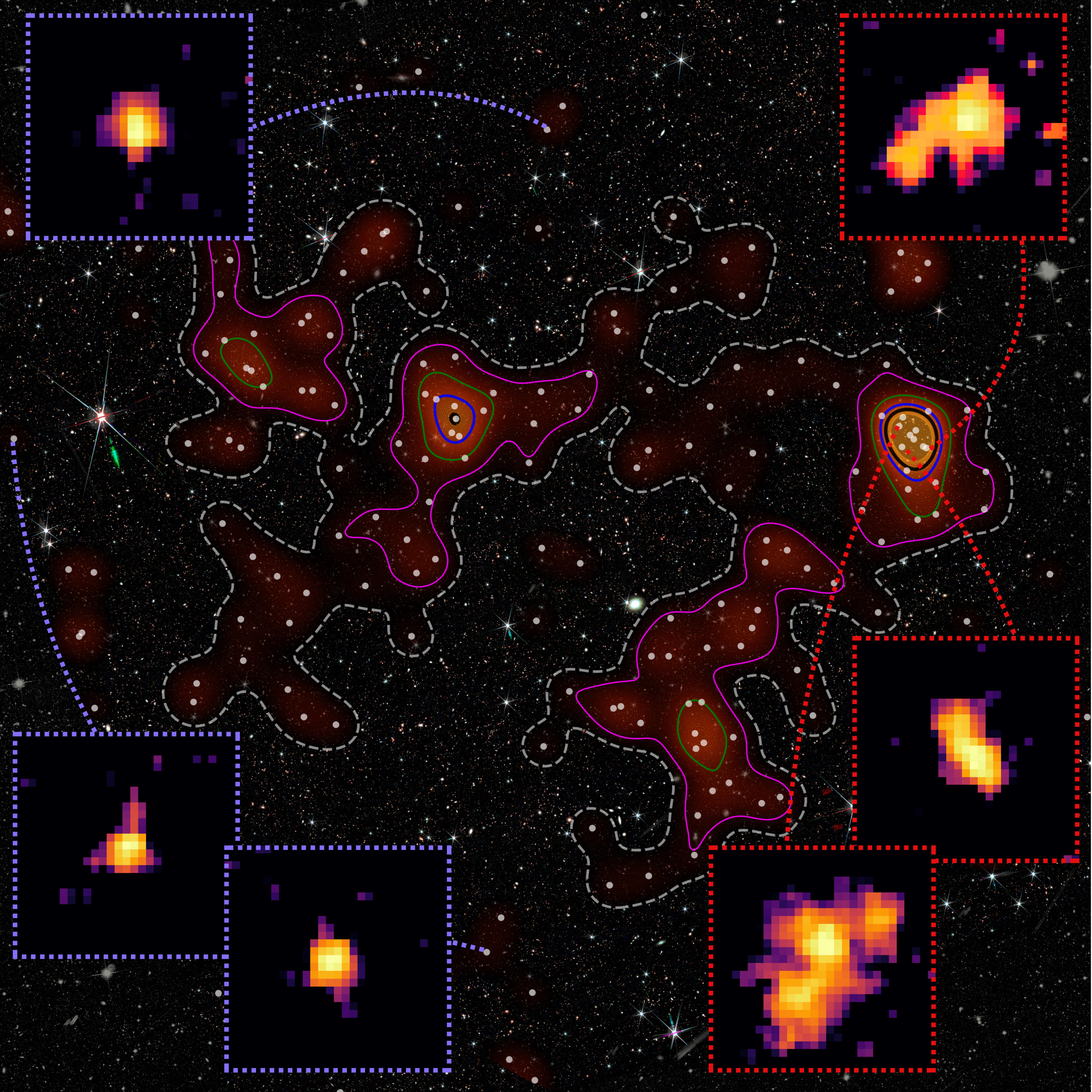
Figure 1: The Loktak Protocluster Region. A false-color composite image combining visible-light observations from the Hubble Space Telescope with infrared observations from JWST. White dots mark galaxies identified by the Subaru Telescope, while orange shading indicates regions where galaxies are densely concentrated. Colored contours show galaxy number density relative to the cosmic average at that time: 2 times (pink), 5 times (green), 8 times (blue), and 10 times (black). The white dashed line outlines the full extent of the Loktak Protocluster. The close-up images in the red and blue boxes show examples of galaxies in dense environments and in typical environments, respectively. A high resolution image is available here (5.2 MB). (Credit: Laishram et al./NAOJ/NASA/ESA/CSA)

Figure 2: Distribution of galaxy sizes for galaxies in the central region of the Loktak Protocluster (red) and galaxies in average environments at the same epoch (blue). Left: ultraviolet measurements. Right: optical measurements. In optical light, galaxies in the dense environment are larger. A value of 1 on the horizontal axis corresponds to the typical galaxy size in average environments. (Credit: Laishram et al./NAOJ)


A large protocluster of galaxies that existed 12.6 billion years ago, first discovered with the Subaru Telescope, has been examined in detail using the James Webb Space Telescope (JWST). The study found that galaxies in crowded regions are more extended than similar galaxies in less dense environments. The result shows that even when the Universe was only 1.2 billion years old, environment was already influencing how galaxies grew.

How Did the Universe’s Largest Structures Form?

In today’s Universe, galaxies are not spread evenly through space. They have gathered into groups, and those groups form enormous galaxy clusters containing hundreds or even thousands of galaxies. But these giant structures did not exist at the beginning of the Universe.

In the early Universe, slightly denser regions of matter gradually grew under gravity and eventually developed into galaxy clusters. These "seeds" of galaxy clusters are known as protoclusters.

One of the key questions for astronomers is when did dense environments begin to influence how galaxies evolve.

In the modern Universe, galaxies in clusters often look very different from isolated galaxies. They tend to be more massive, have difficulty forming new stars, and have rounder shapes. This phenomenon—where galaxy growth depends on its surroundings —is known as an environmental effect.

However, it has remained unclear whether such effects were already present in the very early Universe, or whether they appeared only after galaxy clusters had fully matured.

The Loktak Protocluster Discovered by the Subaru Telescope

An international research team including astronomers at the National Astronomical Observatory of Japan (NAOJ) used the Subaru Telescope’s wide-field camera, Hyper Suprime-Cam (HSC), to conduct a large sky survey and discovered a massive protocluster that existed 12.6 billion years ago.

Young galaxies with active star-formation often emit a special type of light called Lyman-alpha emission. This emission is produced when radiation from hot young stars excites surrounding hydrogen gas. Galaxies found through this signal are called Lyman-alpha emitters, and they are useful markers for tracing structure in the early Universe.

Using a special filter tuned to detect this light, the team mapped a vast area of sky and identified a region where galaxies were strongly concentrated.

The newly discovered structure was named the Loktak Protocluster, after Loktak Lake in Manipur, India. The name reflects the way four separate galaxy concentrations are linked together into one larger structure, resembling the floating islands of the lake (Figure 1). "Protoclusters are the construction sites of the most massive structures in the present-day Universe," says lead author Ronaldo Laishram of NAOJ. "Finding such a clearly organized system at this early epoch gives us a rare chance to study how environment affects galaxy growth in the young Universe."

JWST Reveals Differences in How Galaxies Grew

The team then used JWST infrared images to compare galaxies inside the protocluster with galaxies in more typical environments at the same cosmic epoch.

When observed in ultraviolet light—which traces regions where stars are forming—the two galaxy populations showed little difference in size. However, in optical light (Note 1), which traces the overall distribution of previously formed stars, galaxies in the protocluster were on average about 1.4 times larger than galaxies in normal environments (Figure 2, Note 2).

In other words, although the star-forming cores looked similar, the overall galaxies had grown differently. This suggests that star formation in galaxy centers proceeded similarly, but galaxies in dense environments built up their outer stellar structures earlier and more rapidly.

A Galaxy’s Fate Depends on Where It Lives

The importance of this result is that it clearly shows environmental effects were already shaping galaxies long before galaxy clusters were fully formed.

Out of the Universe’s current age of 13.8 billion years, the galaxies observed here are seen only 1.2 billion years after the Big Bang. Even at that very early time, how a galaxy grew depended on where it lived. This means galaxy evolution is determined not only by a galaxy’s own mass and internal properties, but also by its surroundings from an early stage.

The study suggests that the appearance of galaxies is shaped not only by what they are born with, but also by where they grow up—and that this process began in the earliest chapters of cosmic history.

Future observations using Subaru Telescope’s ʻŌnohiʻula PFS as well as the next-generation wide-field adaptive optics system (ULTIMATE), combined with continued JWST follow-up will help determine whether this kind of environmental effect was common in the early Universe or unique to the Loktak Protocluster.

These results appeared in The Astrophysical Journal Letters on April 27, 2026 (Laishram et al. "Discovery of a z ≃ 4.9 Lyα Emitter Protocluster: Wavelength-dependent Environmental Effects on Galaxy Structure").

This work was supported by JSPS KAKENHI grants (23H01219, 24H00002, 22K21349) and the JSPS Core-to-Core Program (JPJSCCA20210003).


Notes:

(Note 1) Because light from distant galaxies is stretched to longer wavelengths by the expansion of the Universe, light emitted as visible light reaches Earth as infrared light. JWST’s highly sensitive infrared instruments make it possible to study the visible-light structure of distant galaxies.

(Note 2) In general, more massive galaxies tend to be larger. However, the size difference found in this study cannot be explained by mass differences alone.


About the Subaru Telescope

The Subaru Telescope is a large optical-infrared telescope operated by the National Astronomical Observatory of Japan, National Institutes of Natural Sciences with the support of the MEXT Project to Promote Large Scientific Frontiers. We are honored and grateful for the opportunity of observing the Universe from Maunakea, which has cultural, historical, and natural significance in Hawai`i.


Wednesday, April 08, 2026

JWST Spies Once-hidden Treasures in the W51 Starbirth Crèche

A mid-infrared view of M51 provided by the James Webb Space Telescope's MIRI instrument. Swirls of interstellar gas are being illuminated by massive young newborn stars.Credit: NASA, ESA, CSA, Yoo & Ginsburg (UF). Image processing: A Pagan (STScI)

Star formation is a dramatic and complex process that erupts throughout the Universe. Yet, a lot of that action gets hidden by clouds of gas and dust. That's where observatories such as the James Webb Telescope JWST and the Atacama Large Millimeter Array (ALMA) come in handy. They use infrared light and radio waves respectively, to pierce the veil surrounding the process of starbirth.

A team led by University of Florida doctoral candidate Taehwa Yoo recently used to JWST to make observations of the giant Milky Way starbirth region Westerhout 51 (W51). It lies about 17,000 light-years away from Earth in the direction of the constellation Sagittarius. The images and data they collected revealed many fine details of the star-formation activity going on there. “With optical and ground-based infrared telescopes, we can’t see through the dust to see the young stars,” said Adam Ginsburg, Ph.D., a professor of astronomy at UF. “Now we can.”

An overview of W51A region. The composite image is produced by combining NIRCam F360M (blue), F410M (green), and MIRI F560W (red) on JWST. The north and east directions in ICRS coordinates are marked as arrows at the upper left corner. Courtesy Yoo, et al.

Despite the impressive images and data, some aspects of star birth remain hidden away behind clouds too dense even for JWST to pierce. The team compared their JWST images to observations of the same region made by the ALMA, and found that only a fraction of stars are detectable by both telescopes. The observations that JWST did make, however, showed a lot of detail in the structures it could see. And that provides astronomers with new insights into the starbirth process. "Because of James Webb, we can see those hidden, young massive stars forming in this star-forming region," Yoo said. "By looking at them, we can study their formation mechanisms."

Cutout images of specific regions in W51. (a) A dust filament around W51-E. (b) W51-IRS2 protocluster. (c) Cometary objects around W51-IRS2 (these are globules of dust that look like comets, sculpted by radiation from nearby stars). (d) W51-E protocluster. (e) A bar at the edge of IRS1 H II region. (An HII region is a cloud of mostly hydrogen gas from which stars can form.) (f) W51 IRS1 H II region shell structure. (g) W51b1 H II region. (h) W51b2 H II region and YSOs. (i) W51e7 H II region. (j) W51c1 H II region. (k) and (l) Newly discovered H II regions. Courtesy Yoo, et al.

Digging Into W51's Starbirth Activity

W51 is divided into several regions of enhanced star formation. As part of the observations, JWST zeroed in on the W51A region, the youngest starbirth crèche in the area. Multiple clouds of ionized gas and warm dust exist there, with some of the dust arranged in filaments. The science team also spotted a good example of a cavity around one of the newborn stars, which indicates that the star is "eating away" at its birthplace. They also studied giant gas bubbles of gas, dark dust filaments (which are likely still-hidden crèches), cometary objects, and protostellar jets streaming away from protostellar objects. Each of these are part of the starbirth process.

The team focused on the massive protoclusters called W51-E and W51-IRS2, using the Near Infrared Camera (NIRCAM) and the Mid-infrared Instrument (MIRI). Most of the stars they were able to observe are still accreting material and hadn't yet reached their full masses. Some have only formed in the past million years or so.

Yoo's group estimates there are about 10,000 solar masses of stars in W51A. Many are very young, massive stars, and not a lot is known about their earliest infancy, which is what fascinates astronomers today. In some areas, those remain hidden by too-thick clouds of gas and dust. Luckily, W51A has a lot to offer based on previous studies made by the Atacama Large Millimeter/submillimeter Array (ALMA). That radio array in Chile detected over 200 compact sources referred to as “PPOs (Pre/Protostellar Objects)” in the region. These are places where stars are actively forming or will start to form in the relatively near future. Astronomers want to know what kickstarts the process of star formation in regions like these, and what stages occur as massive young stars begin to form.

Combined observations from JWST and ALMA show the location of protocluster regions where multiple stars are forming. The locations of the matching sources are marked in the upper panel with the background image of F162M, F210M, and F480M filters on JWST. In the lower panels, W51-E and W51-IRS2 protocluster regions are zoomed in with the background image of the JWST NIRCam filters and ALMA 1.3 mm image combined. Courtesy Yoo, et al.

Starbirth Stages

In a general sense, astronomers know the overall process of starbirth: clouds of gas and dust condense and form hot cores called "young stellar objects." These are where the future star will be born. After a period of accretion, the star reaches a point where it begins fusing hydrogen to helium in its core. That's the point where the star is born. Before that, the star begins as that hot core, and also blows material away from itself via a superheated jet. High-mass stars born like this obviously affect their environment, especially in their birth crèches. They interact with neighboring clouds of gas, which affects the formation of sibling stars in the same region. The radiation from those high-mass stars can even go so far as to rip apart the clouds of gas. That chokes off the available material for new stars to form. From the JWST images and data, it's clear that each of those steps is in process in the W51A cloud.

In a recent paper in the Astrophysical Journal (noted below), Yoo and the team point out that several hot cores with rich chemistry associated with massive protostars exist in W51A. These are very likely sites of maser emissions from several varieties of molecules in the gas clouds crèches, including OH (hydroxide), CH3OH (methanol), SiO (silicon monoxide), NH3 (ammonia), and CS (carbon monosulfide). The presence of these masers acts as a tracer for dense molecular clouds where stars are expected to form (if they aren't doing so already).

In addition to the hot cores that indicate the very early stellar birth process, the team also observed at least one "knot" of emission from a protostellar object. It indicates ionized iron and hydrogen within the cloud. They think it's from a jet streaming from a hot young star that's heating up and affecting the nearby interstellar medium.

This latest look at W51 with JWST gives astronomers a much better idea of what different stages of starbirth look like, stages that are normally hidden from optical observations. The quality of the JWST data revealed more information and showed new structures in the area that astronomers can now use to more fully explain the process of starbirth. “They are not the first photos of this region, but they are the best,” said Ginsburg. “They’re so much better that they essentially are brand new photos. Every time we look at these images, we learn something new and unexpected."

By Carolyn Collins Petersen - April 06, 2026 01:04 AM UTC | Stars


For More Information

Researchers Use JWST to Reveal Hidden Details of W51 Star Formation

A JWST NIRCam/MIRI view of the W51A high-mass star-forming region


Carolyn Collins Petersen

Carolyn Collins Petersen is a long-time science writer and former astronomy researcher. She writes about astronomy and space exploration and has written 8 books, countless articles, more than 60 documentaries for planetarium star theaters, and exhibits for Griffith Observatory, NASA/JPL, the California Academy of Sciences, the Shanghai Astronomical Museum, and the Lowell Observatory Dark Sky Planetarium. She is CEO of Loch Ness Productions. You can email Carolyn here.


Wednesday, March 04, 2026

How giant galaxies could form just 1.4 billion years after the Big Bang

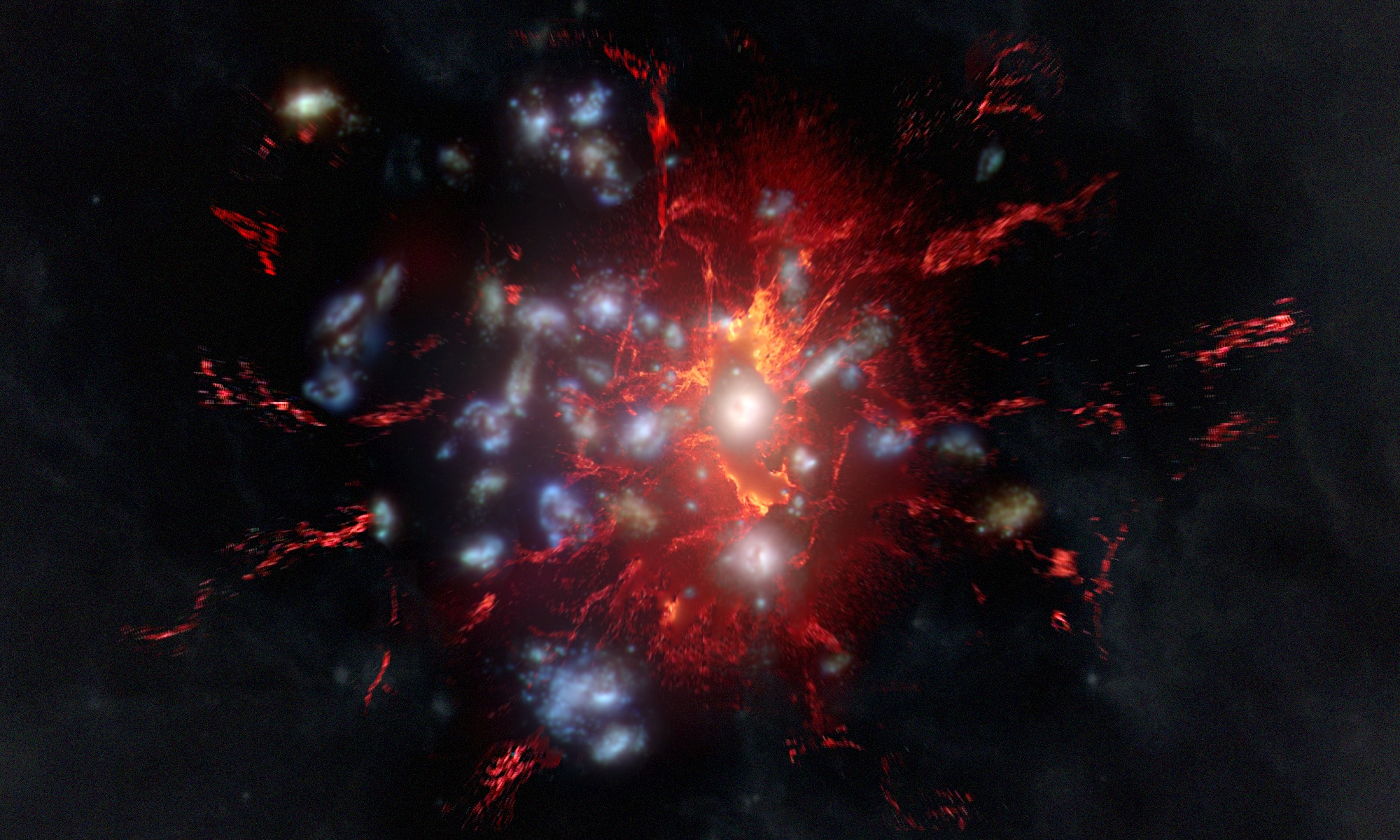
Clusters of young galaxies in the early Universe that later grow into large clusters are called protoclusters. This artist’s impression of the protocluster SPT2349-56 shows interacting galaxies of different shapes and sizes, and gas (orange) that is torn apart and heated by tidal forces. Due to its great distance from Earth, we see SPT2349-56 as it looked only 1.4 billion years after the Big Bang, when the Universe was 10% of its current age. © N.Sulzenauer, MPIfR


To the point

  • An international team led by MPIfR researchers used data from the Atacama Large Millimeter/submillimeter Array (ALMA) to shed light on a central question of galaxy formation.

  • They discovered shock-heated gas in one of the most spectacular aggregations of galaxies in the distant Universe.

  • They found evidence that a giant elliptical galaxy may form through the rapid collapse of this infant galaxy cluster.


New radio observations of molecular gas reveal how dozens of galaxies rapidly merge together in the early Universe.

Solving a Cosmic Mystery

A surprising observation has puzzled astronomers for two decades: Massive and evolved galaxies already existed just a few billion years after the Big Bang. Researchers expected to only find galaxies with young stars and ongoing star formation so early in the history of our Universe. Instead, there are many elliptical galaxies with older stellar populations and very little cold gas to form new stars. These observations pose a challenge to models of cosmological structure formation.

The group led by MPIfR astronomers now made a big leap in understanding these systems. “In a Universe where larger galaxies grow hierarchically through gravitational interactions and mergers of smaller building-blocks, some giant ellipticals must have formed completely differently than previously thought. Instead of slowly assembling mass throughout 14 billion years, a massive elliptical galaxy might swiftly emerge in just a few hundred million years. It can form through the collapse and coalescence of a major primordial structure, in the time it takes the Sun to orbit around the Milky Way’s center once”, explains Nikolaus Sulzenauer, PhD researcher at the MPIfR and University of Bonn, and first author leading the analysis. “We find that the structures with the very highest densities must have decoupled first from the Universe’s expansion at only 10% of the current cosmic age, and then rapidly assembled entire protoclusters.” The compression of gas sparks a cosmic firework, prodigiously bright as it is heated by star-birth activity. It is a beacon at far-infrared to millimeter wavelengths and thus accessible by observatories like ALMA and the Atacama Pathfinder Experiment (APEX).

Observing a Transformation

The team observed the cold gas and dust in the center of SPT2349-56, a protocluster seen just 1.4 billion years after the Big Bang and located in the southern constellation Phoenix. SPT2349-56 enables a rare glimpse of the first clusters, the main hubs of massive elliptical galaxies. “SPT2349-56 holds the record for the most vigorous stellar factory”, remarks Axel Weiß, who was also involved in the original discovery of SPT2349-56 with APEX. “In the center, we found four tightly-interacting galaxies forging one star every 40 minutes,” adds Ryley Hill from the University of British Columbia (UBC) in Canada. For comparison, it currently takes a whole year for three or four stars to form in the Milky Way.

“Importantly,” notes Sulzenauer “this galaxy quartet launches coherent giant tidal arms at 300 kilometers per second, stretching over an area much larger than the Milky Way. They glow intensely at submillimeter wavelength, their brightness boosted ten-fold by shock-waves exciting ionized carbon atoms. This bright emission allowed us to precisely measure the motion of gas in this gravitationally ejected spiral, resembling beads on a string encircling the protocluster core. To our surprise, clumps of tidal debris link to a chain of 20 additional colliding galaxies in the outer parts of the collapsing structure. This hints at a common origin. For the first time, we are witnessing the onset of a cascading merging transformation. Most of the 40 gas-rich galaxies in this core will be destroyed and will eventually transform into a giant elliptical galaxy within less than 300 million years – a mere blink of an eye.”

This radio image of the protocluster SPT2349-56 shows the intensity of ionized carbon (CⅡ) emitted at a wavelength of 158 micrometers. Star symbols mark the centers of galaxies, while orange contours highlight the tidal arms around the inner region. These tidally ejected, galaxy-scale gas clumps are found to be ten times brighter than expected. The size of the Milky Way disk is shown at the same scale. © N.Sulzenauer, MPIfR

Understanding How Galaxy Clusters Form

Duncan MacIntyre and Joel Tsuchitori, two UBC undergraduate students and part of the team, ran detailed numerical simulations. These were essential to bridge observations of this protocluster collapse with previous studies of mature galaxy clusters. The striking match between the different types of objects, found at different cosmic times, might not just demonstrate the importance of simultaneous major mergers during massive galaxy formation. It may also help to explain how heavy elements (such as carbon) are heated and transported throughout the first galaxy clusters.

“While our findings offer exciting new insights into rapid elliptical galaxy assembly, the various interactions between the merger shocks, gas heating from the growth of supermassive black holes, and their effect on the fuel for star-formation, remain big mysteries,” remarks Scott Chapman of Dalhousie University. “It might be too early to claim a full understanding of the ‘early childhood’ of giant ellipticals, but we have come a long way in linking tidal debris in protoclusters to the formation process of massive galaxies located in today’s galaxy clusters.”


Additional Information

The following scientists affiliated to the MPIfR are coauthors of this publication:
Nikolaus Sulzenauer, Axel Weiß, Amélie Saintonge.


Contacts:

Nikolaus Sulzenauer
Tel:
+49 228 525-105
Email: nsulzenauer@mpifr-bonn.mpg.de
Max Planck Institute for Radio Astronomy, Bonn

Dr. Axel Weiß
Tel:
+49 228 525-273
Email: aweiss@mpifr-bonn.mpg.de
Max Planck Institute for Radio Astronomy, Bonn

Dr. Nina Brinkmann
Press and Public Relations
Tel:
+49 228 525-399
Email: brinkmann@mpifr-bonn.mpg.de
Max Planck Institute for Radio Astronomy, Bonn


Original publication

Sulzenauer et al.
Bright [CⅡ]158µm Streamers as a Beacon for Giant Galaxy Formation in SPT2349−56 at z = 4.3>
The Astrophyiscal Journal 998 (2026)


DOI


Video


Graphics

  • spt2349_intensity_de 336.87 kB
  • spt2349_intensity_eng 332.3 kB
  • spt2349_tidal_streamers_full_nsulzenauer_2026 326.5 kB


  • Links

    Early Universe
    Research area at the MPIfR

    Paper on the discovery of the protocluster
    Nature 556 (2018)


    Tuesday, February 10, 2026

    NASA Telescopes Spot Surprisingly Mature Cluster in Early Universe

    JADES-ID1
    Credit X-ray: NASA/CXC/CfA/Á Bogdán; Infrared (JWST): NASA/ESA/CSA/STScI;
    Image Processing: NASA/CXC/SAO/P. Edmonds and L. Frattare


  • A galaxy cluster pulling itself together has been spotted at a much earlier time in the universe than expected.

  • This “protocluster” is located about 12.7 billion light-years from Earth, or only about 1 billion years after the big bang.

  • Astronomers needed to combine data from NASA’s Chandra and James Webb Space telescopes to find and identify this protocluster.

  • Galaxy clusters are some of the largest structures in the universe and understanding how and when they form is crucial.


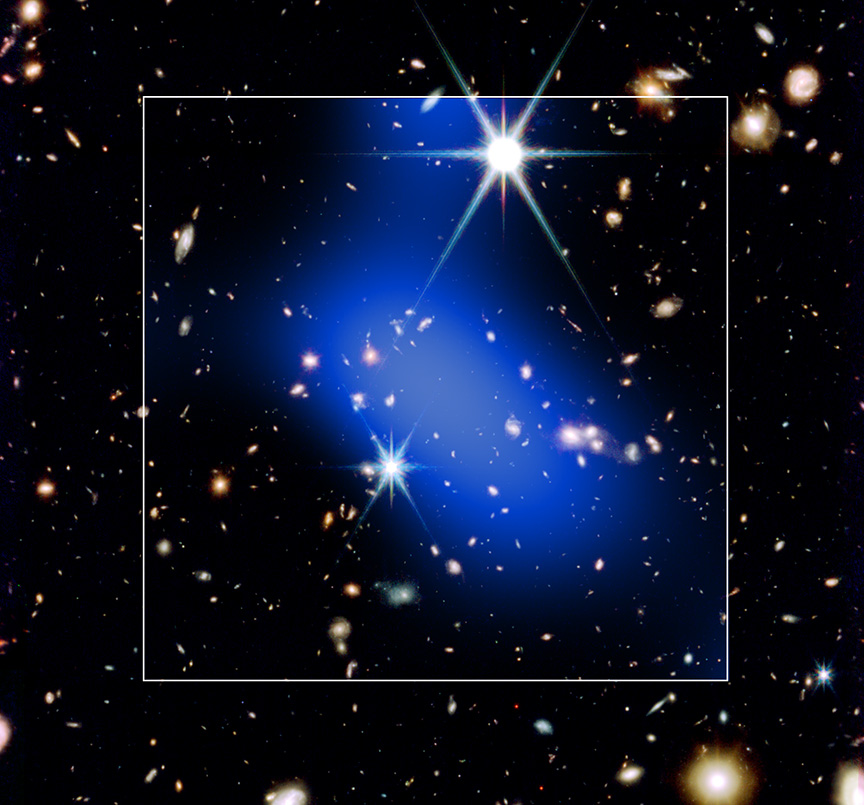
  • This graphic represents the discovery of what may be the most distant protocluster ever found, as described in our latest press release. By using NASA’s Chandra X-ray Observatory together with the James Webb Space Telescope (JWST), astronomers have netted an important piece in the history of the universe: when galaxy clusters, the largest structures held together by gravity, begin to form.

    The main panel contains an infrared image from the JWST Advanced Deep Extragalactic Survey (JADES), a deep infrared imaging project that used more than a month of the telescope’s observing time. The white box outlines X-rays (blue) seen with Chandra.

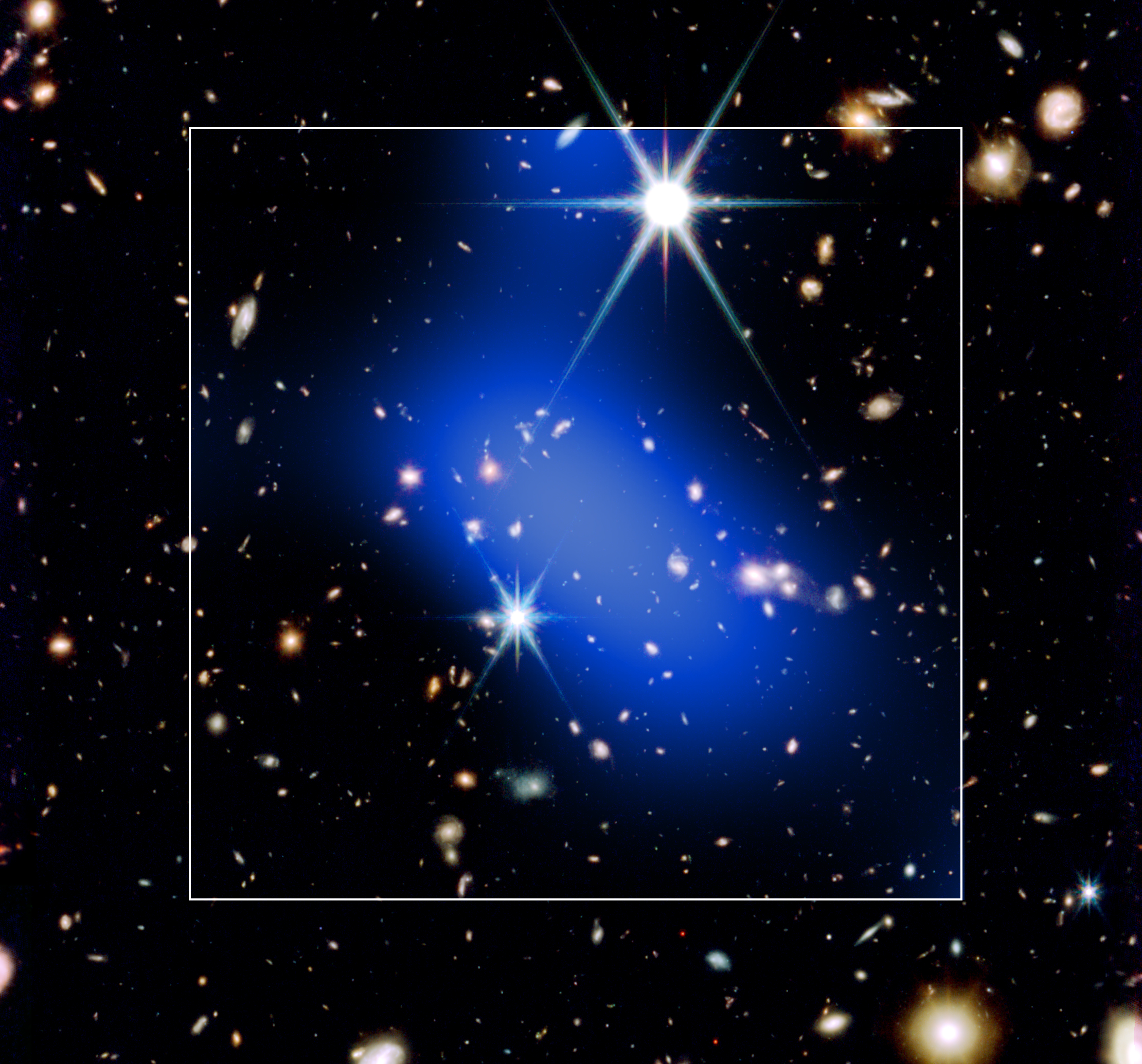
    The newly-discovered protocluster, dubbed JADES-ID1, is located about 12.7 billion light-years from Earth, or just about a billion years after the big bang. It has a mass of about 20 trillion suns and two important characteristics of a protocluster: a large number of galaxies held together by gravity (Webb sees at least 66 potential members) and a huge cloud of hot gas (detected by Chandra). So that only X-rays from the protocluster are included, only X-rays inside the white box are shown. The annotated version of the image shows circles where astronomers find some of the individual galaxies in JADES-ID1.

    Most models of the universe predict that there likely would not be enough time and a large enough density of galaxies for a protocluster of this size to form at this epoch in the early universe. The previous record holder for a protocluster with X-ray emission is seen much later, about three billion years after the big bang. Therefore, the discovery of JADES-ID1 will force scientists to re-examine their ideas for how galaxy clusters — gigantic collections of galaxies, hot gas, and dark matter — first appeared in the universe.

    To find JADES-ID1, astronomers combined deep observations from both Chandra and Webb. By design, the JADES field overlaps with the Chandra Deep Field South, the site of the deepest X-ray observation ever conducted. This field is thus one of the few in the entire sky where a discovery such as this could be made. The researchers found five other proto-cluster candidates in the JADES field, but only in JADES-ID1 are the galaxies seen to be embedded in hot gas. Only JADES-ID1 possesses enough mass for an X-ray signal from hot gas to be expected.

    A paper describing these results appears in the latest issue of the journal Nature and is available here. The authors of the study are Akos Bogdan and Gerritt Schellenberger (Center for Astrophysics | Harvard & Smithsonian) and Qiong Li and Christopher Conselice (University of Manchester in the United Kingdom).

    The earlier study led by Li was published in the Monthly Notices of the Royal Astronomical Society.

    NASA's Marshall Space Flight Center in Huntsville, Alabama, manages the Chandra program. The Smithsonian Astrophysical Observatory's Chandra X-ray Center controls science operations from Cambridge, Massachusetts, and flight operations from Burlington, Massachusetts.


    Visual Description:

    This composite image features what may be the most distant protocluster ever found; a region of space where a large number of young galaxies are being held together by gravity and hot gas. The image is presented twice, once with, and once without, annotations.

    The image includes scores of glowing dots and specks of light, in white and golden hues, set against the blackness of space. This layer of the composite visual is from a deep infrared imaging project undertaken by the James Webb Space Telescope. The specks range from relatively large oval galaxies with discernible spiral arms, and glowing balls with gleaming diffraction spikes, to minuscule pinpoints of distant light. Several of those pinpoints have been circled in the annotated image, as they are part of the distant protocluster.

    Layered onto the center of this image is a neon blue cloud. This cloud represents hot X-ray gas discovered by Chandra in the deepest X-ray observation ever conducted. In the annotated image, a thin white square surrounds the blue cloud. This represents Chandra’s field of observation. The X-rays from the distant protocluster located within this box are included in the composite image.

    The protocluster, dubbed JADES-1, has a mass of about 20 trillionsuns. It is located some 12.7 billion light-years from Earth, or just a billion years after the big bang. The discovery of a protocluster of this size, at this epoch in the early universe, will lead scientists to re-examine their ideas for how galaxy clusters first appeared in the niverse.


    Fast Facts for JADES-ID1:

    Credit: X-ray: NASA/CXC/CfA/Á Bogdán; Infrared (JWST): NASA/ESA/CSA/STScI; Image Processing: NASA/CXC/SAO/P. Edmonds and L. Frattare
    Release Date: January 28, 2026
    Scale: Image is about 54 arcsec (1.1 million light-years) across.
    Category: Groups & Clusters of Galaxies
    Coordinates (J2000): RA 3h 32m 31.75s | Dec -27° 46´ 51.5"
    Constellation: Fornax
    Observation Dates: 99 observations from May 2000 to Feb 2016
    Observation Time: 1743 hours 36 minutes (72 days, 15 hours, 36 minutes)
    Obs. ID: 441, 582, 1672, 2239, 2312, 1213, 2405, 2406, 2409, 8591-8597, 9575, 9578, 9593, 9596, 9718, 12044-12055, 12123, 12128, 12129, 12135, 12137, 12138, 12213, 12218-12223, 12227, 12230-12234, 16175-16191, 16450-16463, 16620, 16641, 16644, 17416, 17417, 17535, 17546, 17552, 17556, 17573, 17633, 17634, 17677, 18709, 18719, 18730
    Instrument: ACIS
    References: Bogdán, Á; et al. 2026, Nature, in press. Available here.
    Color Code: X-ray: blue; Infrared: red, green, blue
    Distance Estimate: About 12.7 billion light-years from Earth (z~5.7)


    Tuesday, January 20, 2026

    ALMA and the NSF VLA Use a Cosmic Lens to Reveal a Hyperactive Cradle of a Future Galaxy Cluster

    The galaxy cluster lens J0846 in optical light (bottom right), the ALMA view of dust-enshrouded, star-forming galaxies strongly lensed into bright arcs (top right), and a composite view (left) revealing at least 11 dusty galaxies in a compact protocluster core more than 11 billion light-years away, magnified by the foreground cluster’s gravity. Credit: NSF/AUI/NSF NRAO/B. Saxton; NSF/NOIRLab


    ALMA observations, together with NSF VLA, uncover the first strongly lensed protocluster core, revealing an intense burst of galaxy growth in the early universe

    Astronomers using the Atacama Large Millimeter/submillimeter Array (ALMA), together with the U.S. National Science Foundation Very Large Array (NSF VLA), have uncovered a rare, extraordinarily active region of the early universe where a future galaxy cluster is rapidly forming. By exploiting a powerful natural phenomenon known as gravitational lensing, ALMA revealed a compact, dust-enshrouded swarm of young galaxies forming stars at an exceptional rate more than 11 billion years ago.

    The discovery marks the first strongly lensed protocluster core ever identified, providing an unprecedented, magnified view of one of the universe’s earliest large-scale structures in formation. Complementary observations with the NSF VLA helped characterize both the distant galaxies and the massive foreground cluster responsible for the lensing effect.

    Galaxy clusters are the largest gravitationally bound structures in the universe. Their ancestors, known as protoclusters, are regions where galaxies are still assembling, rapidly converting gas into stars and growing in mass. Studying these systems allows astronomers to trace how today’s massive clusters emerged from much smaller, denser environments in the early cosmos.

    ALMA’s high-resolution observations revealed that what initially appeared as a single bright source in all-sky survey data is actually a tightly packed group of at least 11 dusty, star-forming galaxies. These galaxies are confined to a region only a few hundred thousand light-years across — remarkably compact on cosmic scales — and are experiencing intense bursts of star formation.

    Because these galaxies are heavily shrouded in dust, most of their visible light is absorbed and re-emitted at millimeter and submillimeter wavelengths. ALMA’s sensitivity to this cold dust and molecular gas allowed astronomers to detect the raw material fueling star formation and to measure the dynamics of the system with exceptional clarity.

    The protocluster lies behind a massive foreground galaxy cluster whose gravity acts as a cosmic magnifying glass, bending and amplifying the light from the more distant system. This gravitational lensing effect dramatically boosts ALMA and the NSF VLA’s ability to resolve individual galaxies and study their properties in detail, effectively turning the universe itself into a telescope.

    ALMA detected carbon monoxide (CO) emission, a key tracer of molecular gas, helping confirm that the galaxies share a common distance and form a physically connected structure. These observations show that the protocluster core contains enormous gas reservoirs capable of sustaining vigorous star formation and driving the rapid buildup of stellar mass.

    Complementary observations with the NSF VLA provided radio-frequency data that helped map the foreground cluster and identify radio emission associated with both star formation and energetic processes within the system, strengthening the interpretation of the lensing configuration and the nature of the galaxies involved.

    “Galaxy clusters are akin to a sprawling modern metropolis that was built upon an ancient civilization from the past. For example, if an archaeologist digs deeper into the ground, then they uncover an earlier civilization. Similarly, when astronomers observe objects farther away, they can look further back in time. In this way, the study of this distant protocluster gives us a glimpse into how one of the earliest ‘settlements’ of galaxies grew and evolved into the mature structures such as that foreground galaxy cluster that we observe today,” said Nicholas Foo, a graduate student at Arizona State University.

    Protoclusters like this one represent the earliest construction phases of galaxy clusters seen in the present-day universe. By combining ALMA’s detailed view of cold gas and dust with complementary radio observations from the NSF VLA, astronomers can investigate how galaxies grow, interact, and evolve in the densest environments of the early cosmos.

    This rare alignment of a young protocluster and a massive foreground lens provides an exceptional opportunity to test theories of galaxy and cluster formation. Future ALMA observations will further explore how these compact, dust-rich systems evolve and how their extreme environments shape the galaxies that will eventually populate massive clusters billions of years later.


    Additional Information

    The results of this research appear as "PASSAGES: The Discovery of a Strongly Lensed Protocluster Core Candidate at Cosmic Noon" in the Astrophysical Journal by N. foo et al.

    The original press release was published by the National Radio Astronomy Observatory of the United States, an ALMA partner, on behalf of North America.

    The Atacama Large Millimeter/submillimeter Array (ALMA), an international astronomy facility, is a partnership of the European Southern Observatory (ESO), the U.S. National Science Foundation (NSF), and the National Institutes of Natural Sciences (NINS) of Japan in cooperation with the Republic of Chile. ALMA is funded by ESO on behalf of its Member States, by NSF in cooperation with the National Research Council of Canada (NRC) and the National Science and Technology Council (NSTC) in Taiwan, and by NINS in cooperation with the Academia Sinica (AS) in Taiwan and the Korea Astronomy and Space Science Institute (KASI).

    >ALMA construction and operations are led by ESO on behalf of its Member States; by the National Radio Astronomy Observatory (NRAO), managed by Associated Universities, Inc. (AUI), on behalf of North America; and by the National Astronomical Observatory of Japan (NAOJ) on behalf of East Asia. The Joint ALMA Observatory (JAO) provides the unified leadership and management of ALMA's construction, commissioning, and operation.


    Contacts:

    Nicolás Lira
    Education and Public Outreach Officer
    Joint ALMA Observatory, Santiago - Chile
    Phone:
    +56 2 2467 6519
    Email: nicolas.lira@alma.cl

    Jill Malusky
    Public Information Officer
    NRAO
    Phone:
    +1 304-456-2236
    Email:jmalusky@nrao.edu

    Bárbara Ferreira
    ESO Media Manager
    Garching bei München, Germany
    Phone:
    +49 89 3200 6670
    Email: press@eso.org

    Yuichi Matsuda
    Education and Public Outreach Officer
    NAOJ
    Email:
    yuichi.matsuda@nao.ac.jp


    Friday, January 09, 2026

    Cosmic Lens Reveals Hyperactive Cradle of Future Galaxy Cluster

    The galaxy cluster lens J0846 in optical light (bottom right), the ALMA view of dust-enshrouded, star-forming galaxies strongly lensed into bright arcs (top right), and a composite view (left) revealing at least 11 dusty galaxies in a compact protocluster core more than 11 billion light-years away, magnified by the foreground cluster’s gravity. Credit: NSF/AUI/NSF NRAO/B. Saxton; NSF/NOIRLabTT. Hi-Res File


    The NSF VLA and ALMA uncover first strongly lensed protocluster core, a compact swarm of dusty, star‐bursting galaxies in the early Universe

    the Universe. Their progenitors, protoclusters, show these galaxies in their infancy, offering a window to study how they all formed. This early “settlement” of galaxies will eventually evolve into a sprawling metropolis by the present day. Astronomers using the U.S. National Science Foundation Very Large Array (NSF VLA) and the Atacama Large Millimeter/submillimeter Array (ALMA) have discovered a rare protocluster that was exceptionally bright, all when the Universe was 11 billion years younger. The system, called PJ0846+15 (J0846), is the first strongly lensed protocluster core discovered, revealing how some of the most massive galaxy clusters in the present-day Universe began their lives.

    High-resolution ALMA observations show that what once looked like a single bright submillimeter source in data sourced from the Planck telescope is actually a tight concentration of at least 11 dusty, star-forming galaxies, all packed into a region smaller than the distance between the Milky Way and Andromeda. These galaxies were undergoing a powerful starburst episode when the Universe was only a few billion years old, making J0846 one of the fastest-growing protocluster cores yet identified. Dust in these galaxies absorbs most of their visible light, hiding them from optical telescopes while they build stars at extraordinary rates. ALMA’s sensitivity to submillimeter emission from cold dust and molecular gas pierces this “dust blanket,” revealing the gas reservoirs and star‐forming activity that will eventually assemble into a massive galaxy cluster.

    J0846 lies behind a massive foreground galaxy cluster that sits roughly halfway along our line of sight, creating a rare double‐cluster alignment. The foreground cluster acts as a gravitational lens, magnifying, distorting, and in some cases duplicating the images of the distant galaxies like a cosmic funhouse mirror, boosting their apparent brightness and angular size. This natural magnification turns the system into a powerful zoom lens, allowing astronomers to study the background protocluster in far greater detail than would otherwise be possible. The younger, more distant protocluster is more than twice as far away as the foreground cluster, effectively letting astronomers glimpse different stages of cluster evolution along nearly the same line of sight—like looking through a forest from mature trees in the foreground to tiny saplings farther away.

    ALMA maps the CO(3–2) emission and dust continuum from the background galaxies, confirming that at least 11 systems share a common redshift and occupy a compact volume, and enabling precise measurements of their star formation rates, gas masses, and dynamics. These data show that the protocluster core hosts enormous reservoirs of cold gas feeding intense, dust‐enshrouded star formation that will rapidly build up the stellar mass of future cluster galaxies. Complementary NSF VLA observations at 6 GHz trace the radio continuum from star formation and possible active galactic nuclei in both the foreground and background structures. The NSF VLA imaging helps characterize the morphology of the foreground cluster galaxies and identify radio counterparts to the lensed background members, tying together the lensing mass distribution and the activity within the protocluster.

    “Galaxy clusters are akin to a sprawling modern metropolis that was built upon an ancient civilization from the past. For example, if an archaeologist digs deeper into the ground then they uncover that earlier civilization. Similarly, when astronomers observe objects that are further away we are able to look further back in time. In this way, the study of this distant protocluster gives us a glimpse into how one of the more early ‘settlements’ of galaxies grew and evolved into the matured structures such as that foreground galaxy cluster that we observe today,” said lead author Nicholas Foo, a graduate student at Arizona State University.

    Protoclusters like J0846 are the precursors of today’s massive galaxy clusters, representing early “construction sites” where gravity is rapidly assembling gas, galaxies, and dark matter into the largest structures in the cosmos. By combining ALMA’s view of dust and molecular gas with the NSF VLA’s maps of radio emission, astronomers obtain a multi‐wavelength picture of how galaxies in this dense environment grow, interact, and transform over time. The rare double‐cluster alignment and strong lensing make J0846 an exceptional laboratory for testing models of cluster formation and the co‐evolution of galaxies and their environments. As the NSF VLA and ALMA continue to target this field, the system will serve as a benchmark for connecting today’s mature clusters to their compact, dust‐rich, star‐bursting ancestors in the early Universe.


    About NRAO

    The National Radio Astronomy Observatory is a facility of the U.S. National Science Foundation, operated under cooperative agreement by Associated Universities, Inc.


    Media Contact:

    Corrina C. Jaramillo Feldman
    Sr. Public Information Officer
    VLA, VLBA, ngVLA

    cfeldman@nrao.edu
    (505) 366-7267


    Thursday, March 20, 2025

    Hidden Cosmic Fuel Tank Found in Infant Galaxy Cluster

    Illustration of the extended molecular gas (red) surrounding the galaxies in the protocluster core SPT2349-56
    Credit: MPIfR/N.Sulzenauer.
    Hi-Res File


    Surprise ALMA-APEX discovery reveals diffuse molecular gas in galaxy protocluster SPT2349-56 – 75% more than previously detected – extending star formation timeline to 400 million years

    Astronomers using the Atacama Large Millimeter/submillimeter Array (ALMA), along with complementary data from the Atacama Pathfinder Experiment (APEX), have discovered a surprisingly large reservoir of molecular gas in a protocluster of galaxies known as SPT2349-56. This protocluster, located approximately 12 billion light-years away, is a region of the early universe where a cluster of galaxies is just beginning to form.

    Galaxy clusters are the largest structures in the universe, and understanding their formation is a major goal of scientists. Protoclusters like SPT2349-56 offer a unique window into this process, allowing astronomers to observe galaxies as they come together in a dense environment.

    This new research, led by Dazhi Zhou of the University of British Columbia, focuses on the molecular gas within SPT2349-56. Molecular gas, primarily hydrogen, is the raw material for star formation, which plays a critical role in galaxy evolution.

    Key Findings:

    Missing Gas

    • By comparing observations from ALMA’s high-resolution configuration with lower-resolution data from ALMA’s Atacama Compact Array (ACA) and APEX, the team found a significant amount of molecular gas that was “invisible” in the higher-resolution ALMA images. The ACA detected 75% more CO than the sum of individual sources detected in higher-resolution ALMA data.

    Extended Reservoir

    • This missing gas isn’t just a few faint, undetected galaxies. Instead, it appears to be a diffuse reservoir of gas spread throughout the protocluster.

    Fuel for Starbursts
    • This hidden gas reservoir could be the key to understanding the intense star formation activity observed in SPT2349-56. The presence of so much extra gas extends the star formation fuel, meaning the overall depletion timescale will exceed 400 million years.

    Proto-Intracluster Medium
    • The team speculates that this extended gas might be the precursor to the hot, diffuse gas known as the intracluster medium (ICM) that fills mature galaxy cluster

    “This discovery highlights the power of ALMA, especially when used in multiple configurations,” says Zhou. “The high-resolution observations allowed us to pinpoint individual galaxies, while the lower-resolution data revealed the bigger picture – the extended gas that connects these galaxies and fuels their star formation.”

    SPT2349-56 is an extreme system, producing stars ~ten thousand times faster than our milky way but in a comparable size, and these observations have pushed scientists’ understanding of galaxy formation and evolution. No simulation or galaxy formation model had previously predicted this overdensity of gas.These findings also suggest that high-resolution ALMA observations, while excellent for studying individual galaxies, may miss a significant component of the gas in these early clusters. The missing gas may reside in the circum-galactic medium (CGM) or the pre-heated proto-intracluster medium (proto-ICM). Future studies using ALMA’s full capabilities, including its compact array configurations, will be crucial for fully characterizing this hidden gas reservoir and understanding its role in the formation of galaxy clusters. (DZ: acknowledgement of SPT: The South Pole Telescope is supported by the National Science Foundation, the Department of Energy, and the United States Antarctic Program. DOI: 10.1038/s41586-023-05998-6.)


    About ALMA

    The Atacama Large Millimeter/submillimeter Array (ALMA), an international astronomy facility, is a partnership of the European Southern Observatory (ESO), the U.S. National Science Foundation (NSF) and the National Institutes of Natural Sciences (NINS) of Japan in cooperation with the Republic of Chile. ALMA is funded by ESO on behalf of its Member States, by NSF in cooperation with the National Research Council of Canada (NRC) and the National Science and Technology Council (NSTC) in Taiwan and by NINS in cooperation with the Academia Sinica (AS) in Taiwan and the Korea Astronomy and Space Science Institute (KASI).

    ALMA construction and operations are led by ESO on behalf of its Member States; by the National Radio Astronomy Observatory (NRAO), managed by Associated Universities, Inc. (AUI), on behalf of North America; and by the National Astronomical Observatory of Japan (NAOJ) on behalf of East Asia. The Joint ALMA Observatory (JAO) provides the unified leadership and management of the construction, commissioning and operation of ALMA.


    Monday, September 25, 2023

    ALMA and James Webb Observe the Most Distant Galaxy Protocluster

    Artist's impression of the "metropolitan area" of the protocluster A2744ODz7p9 revealed by the James Webb Space Telescope and ALMA
    Credit: NAOJ

    Artist's impression of what the "metropolitan area" will become tens of millions of years after the observed time
    Credit: NAOJ


    The background color image shows a map of the light intensity (redder color shows stronger Emission) in the core region of the protogalactic cluster A2744ODz7p9, acquired with the NIRCam onboard JWST. The size of the image corresponds to about half of the radius of the Milky Way Galaxy. (Left) Contours show the distribution of light emitted by ionized oxygen, obtained with the NIRSpec instrument onboard JWST. 4 galaxies were identified at 13.14 billion light-years away. (Right) Contours show the distribution of dust emission from three of the four galaxies. The white circle in the lower left of the figure indicates the beam size of the ALMA data. Credit: JWST (NASA, ESA, CSA), ALMA (ESO/NOAJ/NRAO), T. Hashimoto et al.


    Galaxy formation simulations of the future of the core of A2744z7p9OD. (a) Gas density in a region similar to the proto-cluster A2744z7p9OD at a cosmological age of 689 million years. (b) A zoomed-in view of the core region in (a) corresponding to the region observed by JWST. The color map indicates the light distribution of oxygen ions. (b) to (d) show the evolution of the simulated object: the four galaxies gradually merge and evolve into a larger entity. Credit: T. Hashimoto et al.


    An international collaboration led by Assistant Professor Takuya Hashimoto (University of Tsukuba, Japan) and Researcher Javier Álvarez-Márquez (Spanish Center for Astrobiology) has used the James Webb Space Telescope (JWST) and the Atacama Large Millimeter/submillimeter Array (ALMA) to observe the most distant galaxy protocluster to date, 13.14 billion light-years away1. This profound observation has revealed this protocluster's dense 'metropolitan' core, indicating accelerated galaxy growth. Simulations suggest this region will merge into a singular, massive galaxy in the forthcoming tens of millions of years, offering insights into early galactic birth and evolution.

    Studying how individual stars are born and die in galaxies, how new stars are born from remnants of old stars, and how galaxies grow are important themes in astronomy, as they provide insight into our roots in the Universe. Galaxy clusters, one of the most significant structures in the Universe, assemble more than 100 galaxies bound together through mutual gravitational force. Observations of nearby galaxies have shown that the growth of a galaxy depends on its environment in the sense that mature stellar populations are commonly seen in regions where galaxies are densely collected. This is referred to as the "environment effect."

    Although the environment effect has been considered an essential piece to understanding galaxy formation and evolution, it is not well known when it was initiated in the history of the Universe. One of the keys to understanding this is to observe the ancestors of galaxy clusters shortly after the birth of the Universe, known as galaxy protoclusters (hereafter protoclusters); these are assemblies of about ten distant galaxies. Fortunately, astronomy allows us to observe the distant Universe as it was in the past. For example, light from a galaxy 13 billion light-years away takes 13 billion years to reach Earth, so what we observe now is what that galaxy looked like 13 billion years ago. However, light that travels 13 billion light-years becomes fainter, so the telescopes that observe it must have high sensitivity and spatial resolution.

    The research team first observed the core region of this protocluster using JWST. Using NIRSpec, an instrument that observes spectra at wavelengths ranging from visible to near-infrared, the team made integral field spectroscopy observations that can simultaneously acquire spectra from all locations within the field of view. The team has successfully detected ionized oxygen-ion light ([OIII] 5008 Å) from four galaxies in a quadrangle region measuring 36,000 light-years along a side, which is equivalent to half the radius of the Milky Way galaxy. Based on the redshift of this light (the elongation of the wavelength due to the cosmic expansion), the distance of the four galaxies from the Earth was identified as 13.14 billion light years. "I was surprised when we identified four galaxies by detecting oxygen-ion emission at almost the same distance. The 'candidate galaxies' in the core region were indeed members of the most distant protocluster," says Yuma Sugahara (Waseda/NAOJ), who led the JWST data analysis.

    In addition, the research team paid attention to the archival ALMA data, which had already been acquired for this region. The data captures radio emission from cosmic dust in these distant galaxies. As a result of analyses, they detected dust emissions from three of the four galaxies. This is the first detection of dust emission in member galaxies of a protocluster this far back in time. Cosmic dust in galaxies is thought to be supplied by supernova explosions at the end of the evolution of massive stars in the galaxies, which provide the material for new stars. Therefore, large amounts of dust in a galaxy indicate that many of the first-generation stars in the galaxy have already completed their lives and that the galaxy is growing. Professor Luis Colina (Centro de Astrobiología (CAB, CSIC-INTA)) describes the significance of the results: "Emission from cosmic dust was not detected in member galaxies of the protocluster outside the core region. The results indicate that many galaxies are clustered in a small region and that galaxy growth is accelerated, suggesting that environmental effects existed only ~700 million years after the Big Bang."

    Furthermore, the research team conducted a galaxy formation simulation to theoretically test how the four galaxies in the core region formed and evolved. The results showed that a region of dense gas particles existed around 680 million years after the Big Bang, and that four galaxies are formed, similar to the observed core region. To follow the evolution of these four galaxies, the simulation calculated physical processes such as the kinematics of stars and gas, chemical reactions, star formation, and supernovae. The simulations showed that the four galaxies merge and evolve into a single larger galaxy within a few tens of millions of years, which is a short time scale in the evolution of the Universe. "We successfully reproduced the properties of the galaxies in the core region owing to the high spatial resolution of our simulations and the large number of galaxy samples we have. In the future, we would like to explore the formation mechanism of the core region and its dynamical properties in more detail," says Yurina Nakazato, a graduate student at the University of Tokyo, who analyzed the simulation data.

    Javier Álvarez-Márquez (Spanish Center for Astrobiology) says, "We will conduct more sensitive observations of the protocluster A2744z7p9OD with ALMA to see if there are any galaxies that were not visible with the previous sensitivity. We will also apply the JWST and ALMA observations, which have proven to be very powerful, to more protoclusters to elucidate the growth mechanism of galaxies, and to explore our roots in the Universe."


    Additional Information

    These results have been accepted for publication in The Astrophysical Journal Letters as "Reionization and the ISM/Stellar Origins with JWST and ALMA (RIOJA): The core of the highest redshift galaxy overdensity confirmed by NIRSpec/JWST" on August 30, 2023, and will be published in the journal.

    The research team members are Takuya Hashimoto (University of Tsukuba), Javier Álvarez-Márquez (Centro de Astrobiología (CAB), CSIC-INTA), Yoshinobu Fudamoto (Chiba University), Luis Colina (Centro de Astrobiología (CAB), CSIC-INTA), Akio K. Inoue (Waseda University), Yurina Nakazato (University of Tokyo), Daniel Ceverino (Universidad Autonoma de Madrid/CIAFF), Naoki Yoshida (University of Tokyo, Kavli IPMU), Luca Costantin (Centro de Astrobiología (CAB), CSIC-INTA), Yuma Sugahara (Waseda University/NAOJ), Alejandro Crespo Gómez (Centro de Astrobiología (CAB), CSIC-INTA), Carmen Blanco-Prieto (Centro de Astrobiología (CAB), CSIC-INTA), Ken Mawatari (University of Tsukuba), Santiago Arribas (Centro de Astrobiología (CAB), CSIC-INTA), Rui Marques-Chaves (University of Geneva), Miguel Pereira-Santaella (Instituto de Física Fundamental (IFF), CSIC), Tom J.L.C. Bakx (Chalmers University of Technology), Masato Hagimoto (Nagoya University), Takeshi Hashigaya (Kyoto University), Hiroshi Matsuo (NAOJ/SOKENDAI), Yoichi Tamura (Nagoya University), Mitsutaka Usui (University of Tsukuba), Yi W. Ren (Waseda University)

    This text is based on the original
    Press Release by the National Astronomical Observatory of Japan (NAOJ), an ALMA partner on behalf of East Asia.

    The Atacama Large Millimeter/submillimeter Array (ALMA), an international astronomy facility, is a partnership of the European Organisation for Astronomical Research in the Southern Hemisphere (ESO), the U.S. National Science Foundation (NSF) and the National Institutes of Natural Sciences (NINS) of Japan in cooperation with the Republic of Chile. ALMA is funded by ESO on behalf of its Member States, by NSF in cooperation with the National Research Council of Canada (NRC) and the National Science and Technology Council (NSTC) in Taiwan and by NINS in cooperation with the Academia Sinica (AS) in Taiwan and the Korea Astronomy and Space Science Institute (KASI).

    ALMA construction and operations are led by ESO on behalf of its Member States; by the National Radio Astronomy Observatory (NRAO), managed by Associated Universities, Inc. (AUI), on behalf of North America; and by the National Astronomical Observatory of Japan (NAOJ) on behalf of East Asia. The Joint ALMA Observatory (JAO) provides the unified leadership and management of the construction, commissioning and operation of ALMA.

    Scientific Paper


    Notes:

    The redshift of this object was z = 7.88. Based on this, calculating the distance using the latest cosmological parameters (H0 = 67.7 km/s/Mpc, Ωm = 0.3111, ΩΛ = 0.6899) yields 13.14 billion light years. The distance for A2744z7p9OD was first determined by the team of Takahiro Morishita (California Institute of Technology).


    Contacts:

    Nicolás Lira
    Education and Public Outreach Coordinator
    Joint ALMA Observatory, Santiago - Chile
    Phone: +56 2 2467 6519
    Cel: +56 9 9445 7726
    Email:
    nicolas.lira@alma.cl

    Naoko Inoue
    EPO officer, ALMA Project
    National Astronomical Observatory of Japan (NAOJ)
    Email:
    naoko.inoue@nao.ac.jp

    Bárbara Ferreira
    ESO Public Information Officer
    Garching bei München, Germany
    Phone: +49 89 3200 6670
    Email:
    pio@eso.org

    Jill Malusky
    Public Information Officer
    NRAO
    Phone: +1 304-456-2236
    Email:
    jmalusky@nrao.edu


    Friday, April 01, 2022

    Spiderweb Galaxy Field: Feasting Black Holes Caught in Galactic Spiderweb

    J1140-2629
    Credit: X-ray: NASA/CXC/INAF/P. Tozzi et al; Optical (Subaru): NAOJ/NINS;
    Optical (HST): NASA/STScI


    A Tour of the Spiderweb  Galaxy Field - More Animations


    Often, a spiderweb conjures the idea of captured prey soon to be consumed by a waiting predator. In the case of the "Spiderweb" protocluster, however, objects that lie within a giant cosmic web are feasting and growing, according to data from NASA's Chandra X-ray Observatory.

    The Spiderweb galaxy, officially known as J1140-2629, gets its nickname from its web-like appearance in some optical light images. This likeness can be seen in the inset box where data from NASA's Hubble Space Telescope shows galaxies in orange, white, and blue, and data from Chandra is in purple. Located about 10.6 billion light years from Earth, the Spiderweb galaxy is at the center of a protocluster, a growing collection of galaxies and gas that will eventually evolve into a galaxy cluster.

    To look for growing black holes in the Spiderweb protocluster a team of researchers observed it for over eight days with Chandra. In the main panel of this graphic, a composite image of the Spiderweb protocluster shows X-rays detected by Chandra (also in purple) that have been combined with optical data from the Subaru telescope on Mauna Kea in Hawaii (red, green, and white). The large image is 11.3 million light years across.

    Most of the "blobs" in the optical image are galaxies in the protocluster, including 14 that have been detected in the new, deep Chandra image. These X-ray sources reveal the presence of material falling towards supermassive black holes containing hundreds of millions of times more mass than the Sun. The Spiderweb protocluster exists at an epoch in the Universe that astronomers refer to as "cosmic noon". Scientists have found that during this time — about 3 billion years after the big bang — black holes and galaxies were undergoing extreme growth.

    14 sources detected by Chandra
    Credit: X-ray: NASA/CXC/INAF/P. Tozzi et al; Optical (Subaru): NAOJ/NINS; Optical (HST): NASA/STScI)

    The Spiderweb appears to be exceeding the lofty standards of even this active period in the Universe. The 14 sources detected by Chandra (circled in a labeled image) imply that about 25% of the most massive galaxies contain actively growing black holes. This is between five and twenty times higher than the fraction found for other galaxies of a similar age and with about the same range of masses.

    These results suggest that some environmental factors are responsible for the large number of rapidly growing black holes in the Spiderweb protocluster. One cause may be that a high rate of collisions and interactions between galaxies is sweeping gas towards the black holes at the center of each galaxy, providing large amounts of material to consume. Another explanation is that the protocluster still contains large quantities of cold gas that is more easily consumed by a black hole than hot gas (this cold gas would be heated as the protocluster evolves into a galaxy cluster).

    A detailed study of Hubble data may provide important clues about the reasons for the large number of rapidly growing black holes in the Spiderweb protocluster. Extending this work to other protoclusters would also require the sharp X-ray vision of Chandra.

    A paper describing these results has been accepted for publication in the journal Astronomy and Astrophysics and a preprint is available online. The first author is Paolo Tozzi from the National Institute for Astrophysics in Arcetri, Italy.

    NASA's Marshall Space Flight Center manages the Chandra program. The Smithsonian Astrophysical Observatory's Chandra X-ray Center controls science operations from Cambridge, Massachusetts, and flight operations from Burlington, Massachusetts.


    Fast Facts for Spiderweb Galaxy Field:

    Scale: Main image is about 6.8 arcmin (11.3 million light years) across; Inset image is about 36 arcsec (1 million light years) across.
    Category:
    Black Holes, Groups & Clusters of Galaxies
    Coordinates (J2000): RA 11h 40m 48.3s | Dec -26° 29´ 09"
    Constellation:
    Hydra
    Observation Date: 22 total observations: 1 observation: June 6, 2000 and 21 observations between November 18, 2019 and August 4, 2020.
    Observation Time: 198 hours
    Obs. ID: 898, 21481-21484, 22905, 22921-22929, 23069, 23175, 23186, 23190, 23201, 23205, 23215
    Instrument:
    ACIS
    References: Tozzi, P., et al., 2022, A&A, Accepted; arXiv:2203.02208.
    Color Code: X-ray: purple; HST: red, green, blue; Subaru: red, green, blue
    Distance Estimate: About 10.6 billion light years (z=2.156)

    Monday, February 14, 2022

    Surprisingly High Fraction of Dead Galaxies Found in Ancient Galactic City


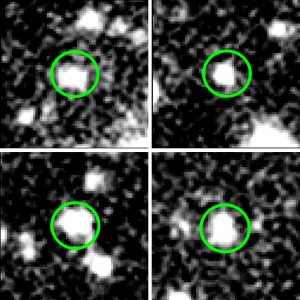
    Four of the 38 galaxies in the protocluster MAGAZ3N3 J095924+022537 that were imaged using keck observatoryʻs mosfire instrument.Credit: I. McConachie, G. Wilson/UC Riverside

    Why Cluster’s Galaxies are Unlike Those in All the Other Known Protoclusters is a Mystery, says UC Riverside-led Team

    Maunakea, Hawaiʻi – An international team of astronomers led by researchers at the University of California, Riverside (UCR), has discovered a massive cluster of young galaxies forming in the early universe.

    With the help of W. M. Keck Observatory on Maunakea, Hawaiʻi Island, the team found that the newly discovered growing galactic metropolis, named MAGAZ3NE J095924+022537, is a newborn galaxy cluster, or protocluster, consisting of at least 38 member galaxies, and is about 11.8 billion light-years away from Earth.

    Galaxy clusters grow over time under gravity and, in the present-day universe, can contain hundreds or even thousands of galaxies, as well as hot gas and dark matter. As time goes by, their galaxies burn through the fuel available and evolve from vigorously star-forming galaxies into red and dead galaxies.

    “In the early universe, all protoclusters discovered until now are full of vigorously star-forming galaxies,” said Ian McConachie, a graduate student in the UCR Department of Physics and Astronomy and the lead author of the research paper published in The Astrophysical Journal. “But incredibly, unlike all of the other protoclusters that have been found at this epoch, many galaxies in MAGAZ3NE J0959 appear to have already stopped forming stars.”

    “We were surprised to find a galaxy graveyard in such a young cluster,” said co-author Percy Gomez, a staff astronomer at Keck Observatory who worked with and mentored McConachie during his time as a Keck Visiting Scholar. “Now the question is, what did these galaxies look like before? A new search is on.”

    Co-author Gillian Wilson, a professor of physics and astronomy at UCR in whose lab McConachie works, said J0959 was discovered from the “Massive Ancient Galaxies At Z > 3 NEar-infrared,” or MAGAZ3NE, survey, designed to discover and study ultramassive galaxies and their neighbors.

    “We are seeing this protocluster as it appeared when the universe was less than 2 billion years old,” she said. “It is as if you took a cluster like Coma, the nearest rich cluster of galaxies to Earth, and plopped it into the early universe.”


    In the early universe, all previously discovered distant protoclusters like, for example, “The Spiderweb” (left: artist’s impression) are full of vigorously star-forming galaxies. In contrast, the newly-discovered protocluster “MAGAZ3NE J095924+022537” contains a high fraction of red and dead galaxies like the nearby “Coma” cluster (right). The discovery of an ancient cluster containing galaxies which resemble those found in modern clusters was a huge surprise. Credits: Spiderweb: M. Kornmesser/ESO; Coma: Russ Carroll, Robert Gendler, & Bob Franke/Dan Zowada Memorial ObservaItory. 

    Co-author Benjamin Forrest, a former postdoctoral researcher in Wilson’s lab who is now based at UC Davis, explained that at the heart of MAGAZ3NE J0959 is an ultramassive galaxy that has already formed a mass of more than 200 billion suns.

    “Why this ultramassive galaxy and so many of its neighbors formed most of their stars and then became inactive when the universe was still so young, in contrast to other known protoclusters from the same time, is a big mystery,” he said. “Why its galaxies are so unlike those in all the other known protoclusters, and so similar to those in Coma, is a complete mystery.”

    Forrest added that MAGAZ3NE J0959 was discovered from the ground, but the advent of powerful new capabilities, like the recently-launched James Webb Space Telescope, should soon reveal whether there are other protoclusters like MAGAZ3NE J0959 packed with dead galaxies waiting to be found in the early universe.

    “Should such protoclusters be found in large numbers, it would mean that the current paradigm of protocluster formation would require a major revision,” Forrest said. “A new scenario of protoclusters existing in a diversity of states in the early universe would have to be adopted. With many member galaxies quenching in the first two billion years, this would almost certainly pose significant challenges for current models of galaxy simulation.”

    The team used spectroscopic observations from Keck Observatory’s Multi-Object Spectrograph for Infrared Exploration, or MOSFIRE, to make detailed measurements of MAGAZ3NE J0959 and precisely quantify its distances.

    Closely associated to the question of how ultramassive galaxies form is the question of the environment in which they form, for example, are they always found in overdense environments like protoclusters, or can they also form in isolation? Next, the team plans to study the neighborhood of all other ultramassive galaxies in the MAGAZ3NE survey to answer this question.

    The study was supported by grants from the National Science Foundation and NASA.

    Source: W.M.Keck Observatory


    About MOSFIRE

    The Multi-Object Spectrograph for Infrared Exploration (MOSFIRE), gathers thousands of spectra from objects spanning a variety of distances, environments and physical conditions. What makes this large, vacuum-cryogenic instrument unique is its ability to select up to 46 individual objects in the field of view and then record the infrared spectrum of all 46 objects simultaneously. When a new field is selected, a robotic mechanism inside the vacuum chamber reconfigures the distribution of tiny slits in the focal plane in under six minutes. Eight years in the making with First Light in 2012, MOSFIRE’s early performance results range from the discovery of ultra-cool, nearby substellar mass objects, to the detection of oxygen in young galaxies only two billion years after the Big Bang. MOSFIRE was made possible by funding provided by the National Science Foundation.

    About W. M. Keck Observatory

    The W. M. Keck Observatory telescopes are among the most scientifically productive on Earth. The two 10-meter optical/infrared telescopes atop Maunakea on the Island of Hawaii feature a suite of advanced instruments including imagers, multi-object spectrographs, high-resolution spectrographs, integral-field spectrometers, and world-leading laser guide star adaptive optics systems. Some of the data presented herein were obtained at Keck Observatory, which is a private 501(c) 3 non-profit organization operated as a scientific partnership among the California Institute of Technology, the University of California, and the National Aeronautics and Space Administration. The Observatory was made possible by the generous financial support of the W. M. Keck Foundation. The authors wish to recognize and acknowledge the very significant cultural role and reverence that the summit of Maunakea has always had within the Native Hawaiian community. We are most fortunate to have the opportunity to conduct observations from this mountain.