Showing posts with label Small Magellanic Cloud (SMC). Show all posts

Wednesday, October 22, 2025

Distant galaxy A1689-zD1 found to have unusually low dust-to-gas ratio

False-color JWST/NIRCam RGB image cutout (blue: F150W; green: F277W; red: F444W), overlaid with [C ii]-158µm emission contours showing 3, 5, 7, 10σ (white solid lines). A scalebar is shown in the image plane. Credit: arXiv (2025). DOI: 10.48550/arxiv.2510.07936


Using the James Webb Space Telescope (JWST) and the Atacama Large Millimeter/sub-millimeter Array (ALMA), an international team of astronomers has carried out comprehensive multiwavelength observations of a distant massive galaxy known as A1689-zD1.

The new observations, detailed in a paper published October 9 on the pre-print server arXiv, yield important insights into the properties of the galaxy, especially regarding dust production in this system.

A1689-zD1 is a bright highly-lensed massive galaxy at a redshift of approximately 7.13. It has a diameter of about 3,000 light years and its stellar mass is estimated to be some 2.6 billion solar masses.

Previous observations of A1689-zD1 have found that it has a metallicity close to the solar value and that it contains a substantial amount of dust—with an estimated mass of 15 million solar masses. Due to this, A1689-zD1 is an excellent place to study the existence of interstellar dust at early cosmic epochs.

That is why a group of astronomers led by Kasper E. Heintz of the University of Copenhagen, Denmark, decided to explore the dust content with JWST and ALMA.

"We revisited this galaxy to gauge the baryonic matter components in the ISM [interstellar medium], with particular focus on constraining the build up of cosmic dust," the researchers explained.

Hintz's team performed the rest-frame ultraviolet to far-infrared modeling of the spectral energy distribution (SED) of A1689-zD1 to determine its stellar mass, dust mass, visual attenuation, and star-formation rate. The ALMA observations were also used to constrain the total dynamical mass of the source, and infer the gas mass using common gas tracers but bounded by the overall dynamics of the system.

The study found that although A1689-zD1 has a substantial dust mass, its dust-to-gas (DTG) and dust-to-metal (DTM) mass ratios are remarkably low—at a level of 0.00051 and 0.061, respectively. The astronomers note that this is due to the high metallicity of A1689-zD1 and its substantial gas mass, which was calculated to be 28 billion solar masses.

Therefore, the DTG and DTM mass ratios for A1689-zD1 are an order of magnitude lower than that found in the Milky Way and the Large Magellanic Cloud (LMC) or the Small Magellanic Cloud (SMC). These ratios also suggest that the bulk neutral atomic hydrogen (HI) gas in the line-of-sight to A1689-zD1 is relatively dust-poor compared to its chemical enrichment.

The authors of the paper conclude that the obtained results point to a potential change in the relative dust abundance or composition of early galaxies.

"We find that this deviation in the DTG and DTM mass ratios appears to be ubiquitous in other metal-rich galaxies at similar redshifts, z ≳ 6. This suggests that the processes that form and destroy dust at later times, or the dust emissivity itself, are drastically different for galaxies in the early universe," the scientists conclude.

by Tomasz Nowakowski, Phys.org
edited by Sadie Harley, reviewed by Robert Egan


Written for you by our author Tomasz Nowakowski, edited by Sadie Harley, and fact-checked and reviewed by Robert Egan—this article is the result of careful human work. We rely on readers like you to keep independent science journalism alive. If this reporting matters to you, please consider a donation (especially monthly). You'll get an ad-free account as a thank-you.


More information: Kasper E. Heintz et al, Inefficient dust production in a massive, metal-rich galaxy at z=7.13 uncovered by JWST and ALMA, arXiv (2025). DOI: 10.48550/arxiv.2510.07936

Journal information: arXiv


Explore further


Tuesday, March 18, 2025

Colourful clouds of a nearby neighbour

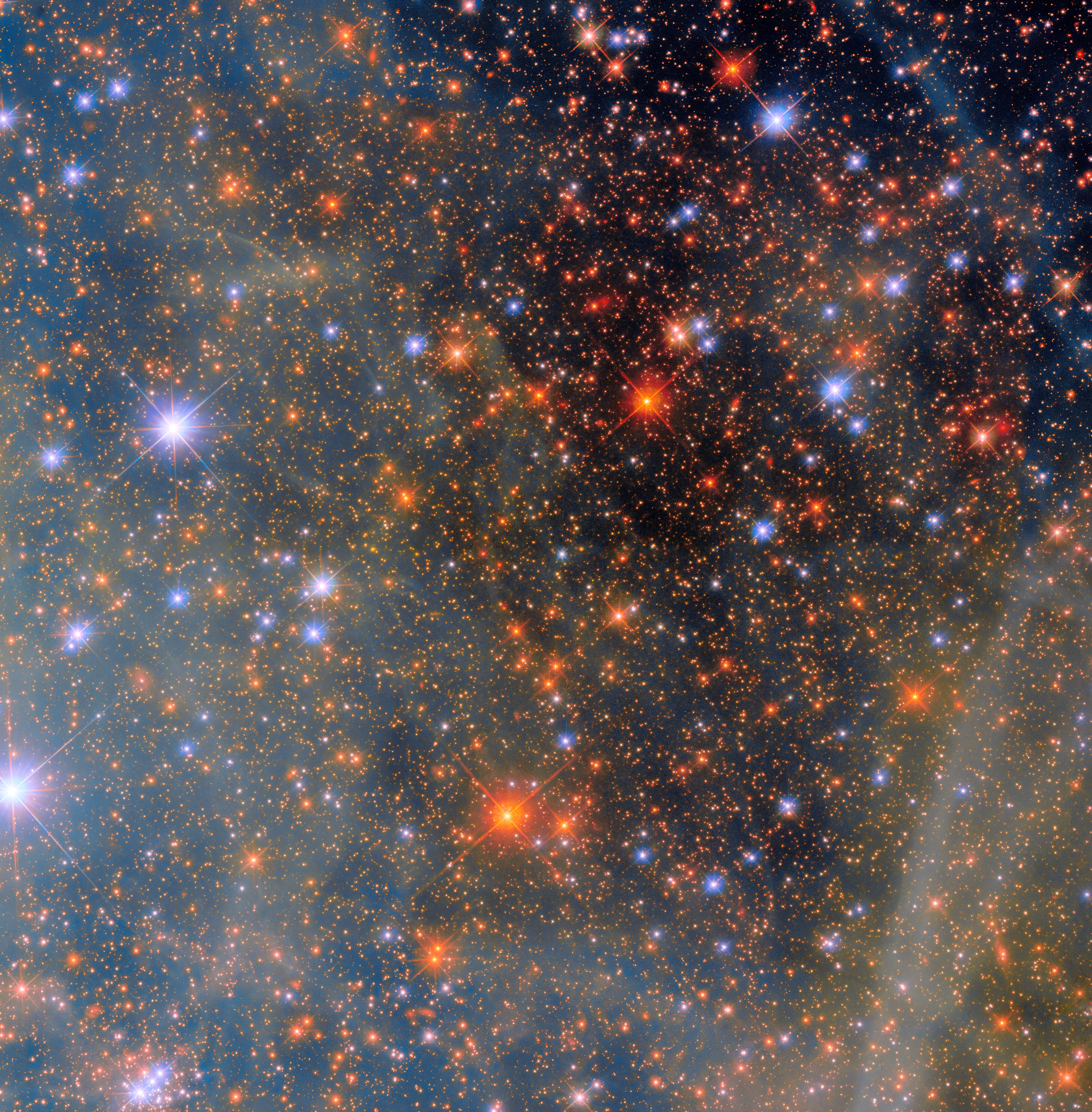
An area of space that is filled with stars. Most of the stars are small, distant dots in orange colours; closer stars shine with a bright glow and four thin spikes around them. These closer stars appear in both bluish and reddish colours. Clouds from a nebula cover the left half of the scene, giving it a blue-greenish cast. More pieces of cloud drift over the black background of space on the right. Credit: ESA/Hubble & NASA, C. Murray

Say hello to one of the Milky Way’s neighbours! Today’s NASA/ESA Hubble Space Telescope Picture of the Week features a scene from one of the closest galaxies to the Milky Way, the Small Magellanic Cloud (SMC). The SMC is a dwarf galaxy located about 200 000 light-years away. Most of the galaxy resides in the constellation Tucana, but a small section crosses over into the neighbouring constellation Hydrus.

Thanks to its proximity, the SMC is one of only a few galaxies that can be seen from Earth without the help of a telescope or binoculars. For viewers in the southern hemisphere and some latitudes in the northern hemisphere, the SMC resembles a piece of the Milky Way that has broken off, though in reality it’s much farther away than any part of our own galaxy.

With its 2.4-metre ‘eye’ and sensitive instruments, Hubble’s view of the SMC is far more detailed and vivid than what humans can see. Researchers used Hubble’s Wide Field Camera 3 instrument to observe this scene through four different filters. Each filter admits different wavelengths of light, creating a multicoloured view of dust clouds drifting across a field of stars. Hubble’s view, however, is much more zoomed-in than our eyes, the better for it to observe very distant objects. This image captures a small region of the SMC near the centre of NGC 346, a star cluster that is home to dozens of massive young stars.


Saturday, March 01, 2025

Einstein Probe Uncovers Rare X-ray Binary System

The figure shows the Nova Outburst which was monitored by Einstein Probe WXT
© C. Maitra, Haonan Yang / MPE


Einstein Probe satellite, a collaboration of, among others, the Max Planck Institute for Extraterrestrial Physics (MPE) and the Chinese Academy of Sciences (CAS), has captured an extraordinary celestial event: an X-ray outburst from a rare binary system. This discovery sheds new light on the evolution of massive stars and demonstrates the unique capabilities of Einstein Probe in detecting transient X-ray sources.

On 27 May 2024, the satellite’s Wide-field X-ray Telescope (WXT) detected an unusual X-ray source in the Small Magellanic Cloud (SMC). Follow-up observations, including those from NASA’s Swift and NICER telescopes and ESA’s XMM-Newton, confirmed the discovery: a rare pairing of a massive Be-type star and a dense white dwarf. This dynamic duo defies conventional expectations—while the Be star is still burning brightly, its companion has already collapsed into a white dwarf.

"This discovery uncovers an elusive class of object called Be white dwarf binaries (BeWDs). Binary evolution models predict that BeWDs should be about seven times more common than Be-neutron star (BeNS) systems. However, its detection is difficult due to the supersoft nature of the X-ray emission, which can be absorbed by the circumstellar disc of the Be star”, explains MPE scientist Chandreyee Maitra, who contributed to the interpretation of the results.

Haonan Yang, a PhD student at MPE and CAS who led the Einstein Probe data analysis of this object, adds: "The large Field of View of Einstein Probe’s Follow-up X-ray Telescope (EP FXT) allows efficient monitoring of the Magellanic Clouds, where such objects are expected to be detected in plentiful. Moreover, in collaboration with WXT, FXT can turn to a transient source within as little as 3 minutes after a new discovery, with a positioning accuracy better than 10 arcsec. FXT’s large effective area also ensures high sensitivity to low-energy photons, which is critical for probing supersoft sources."

His work highlights FXT’s capabilities in monitoring the nearby galaxies like the Magellanic Clouds, where such objects are expected to be abundant.

“The discovery of this source highlights the importance of soft X-ray surveys with EP FXT and WXT to uncover supersoft X-ray sources and novae. Moreover, the nova outburst from this system indicates the presence of a massive white dwarf close its maximum possible value, i.e., the Chandrasekhar limit. This can be instrumental in solving the debate on the progenitors of Supernova 1a”, says Chandreyee Maitra.


About Einstein Probe

MPE played a key role in the development of Einstein Probe’s Follow-up X-ray Telescope (FXT), contributing advanced optics and detector technology. The institute provided one of the FXT’s mirror modules, repurposing a spare from its eROSITA X-ray telescope, and collaborated with ESA and industry partners to supply the second. MPE also developed the state-of-the-art pnCCD detector modules, leveraging its expertise in high-precision X-ray spectroscopy.


Contact:

Dr. Chandreyee Maitra
Researcher in High-Energy Astrophysics Group

cmaitra@mpe.mpg.de
Max Planck Institute for Extraterrestrial Physics

Haonan Yang
PhD-student Highenergy group

tel: 
+49 89 30000-3347
hnyang@mpe.mpg.de
Max-Planck-Institut für extraterrestrische Physik, Garching


A. Marino, H. N. Yang, F. Coti Zelati, N. Rea, S. Guillot, G. K. Jaisawal, C. Maitra, et al.
Einstein Probe Discovery of EP J005245.1−722843: A Rare Be–White Dwarf Binary in the Small Magellanic Cloud?

ApJL 980 L36


Source | DOI


Einstein Probe detects puzzling cosmic explosion

January 23, 2025

Einstein Probe has opened a new window onto the distant X-ray Universe, promising new views of the most faraway explosions in the cosmos. Less than three months after launch, the spacecraft already discovered a puzzling blast of X-rays that could require a change the way we explain the extraordinary explosions known as gamma-ray bursts.


Friday, December 15, 2023

Distant Stars Spotted for the First Time in the Vast Magellanic Stream


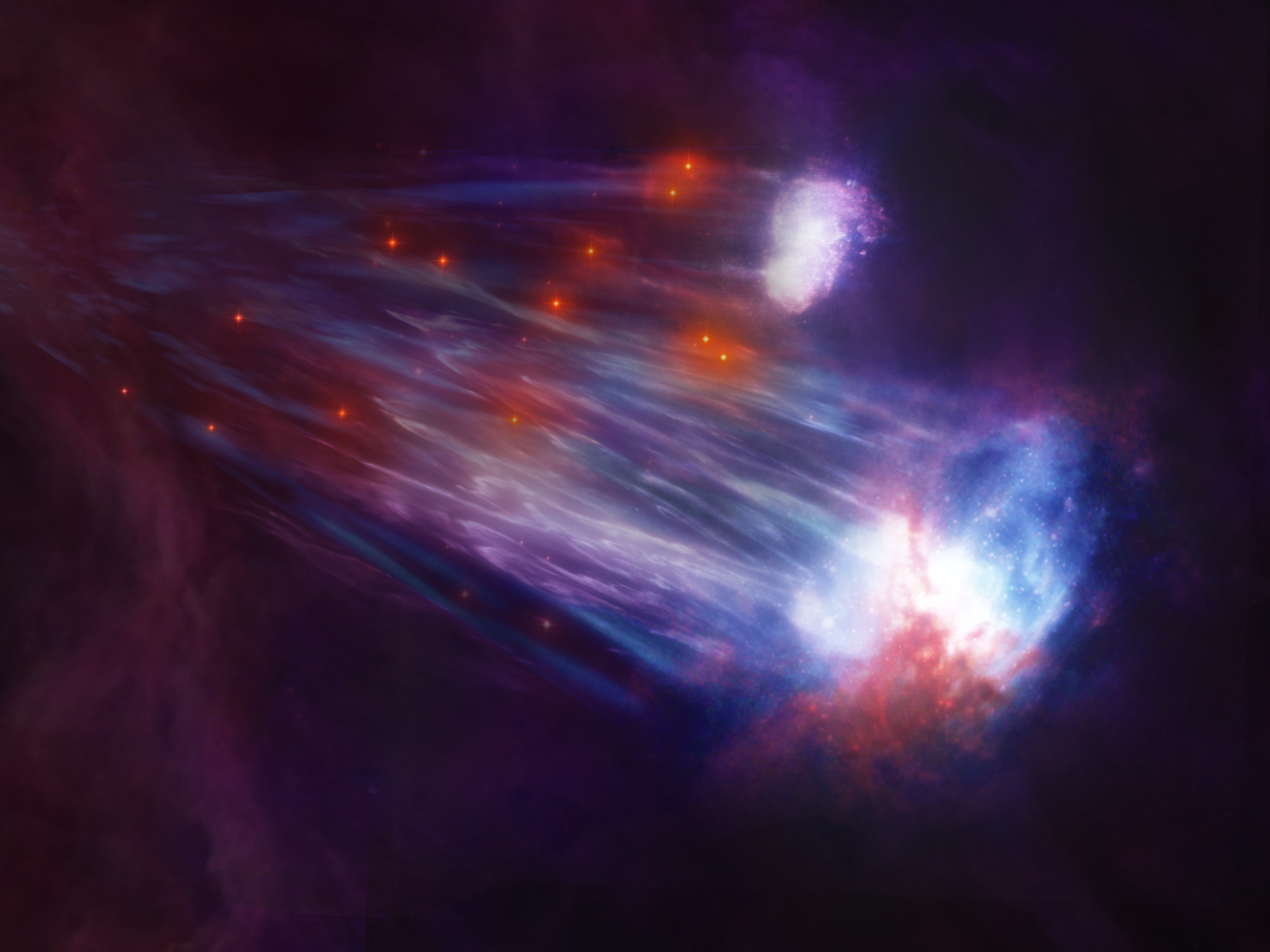
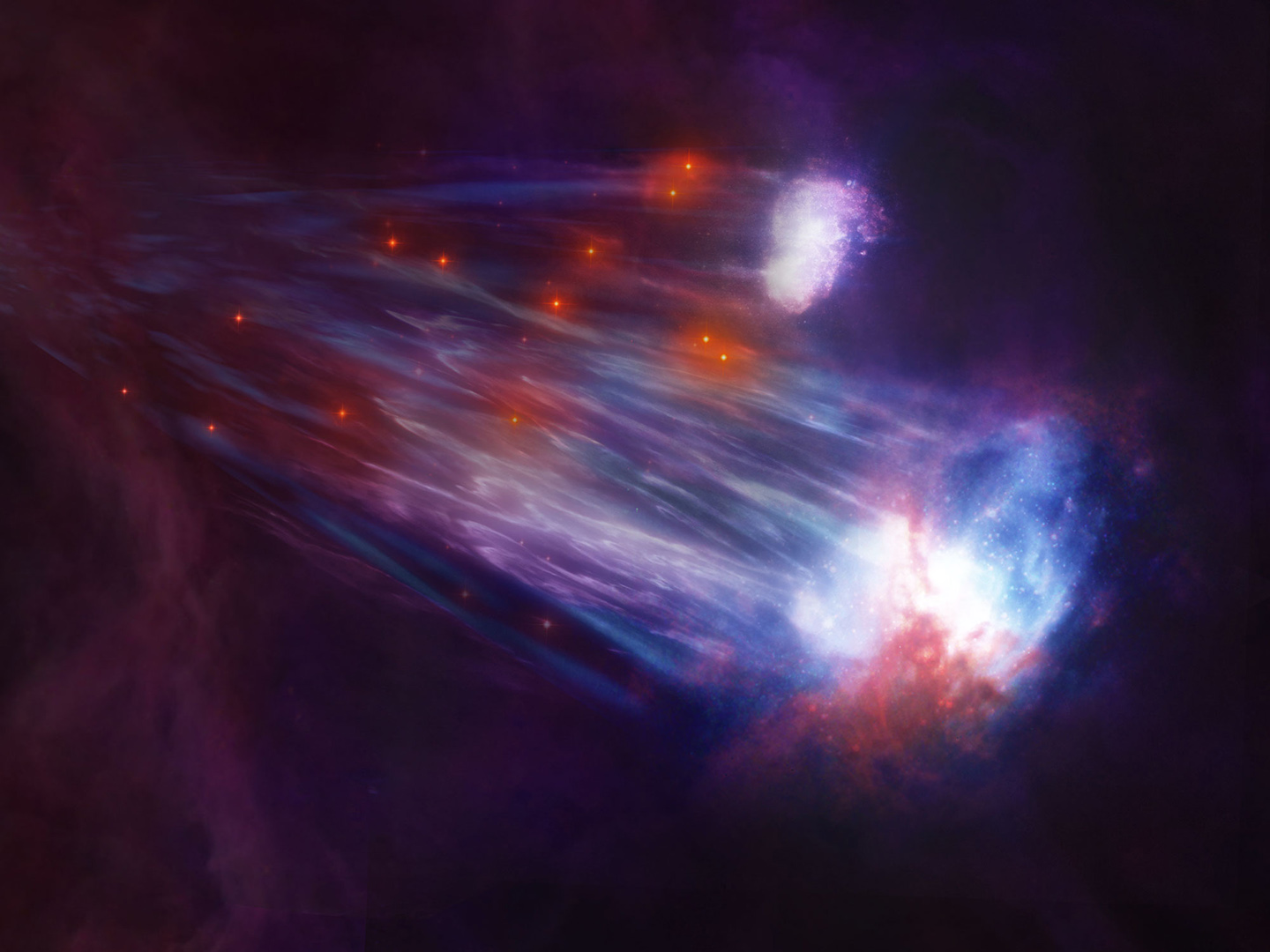
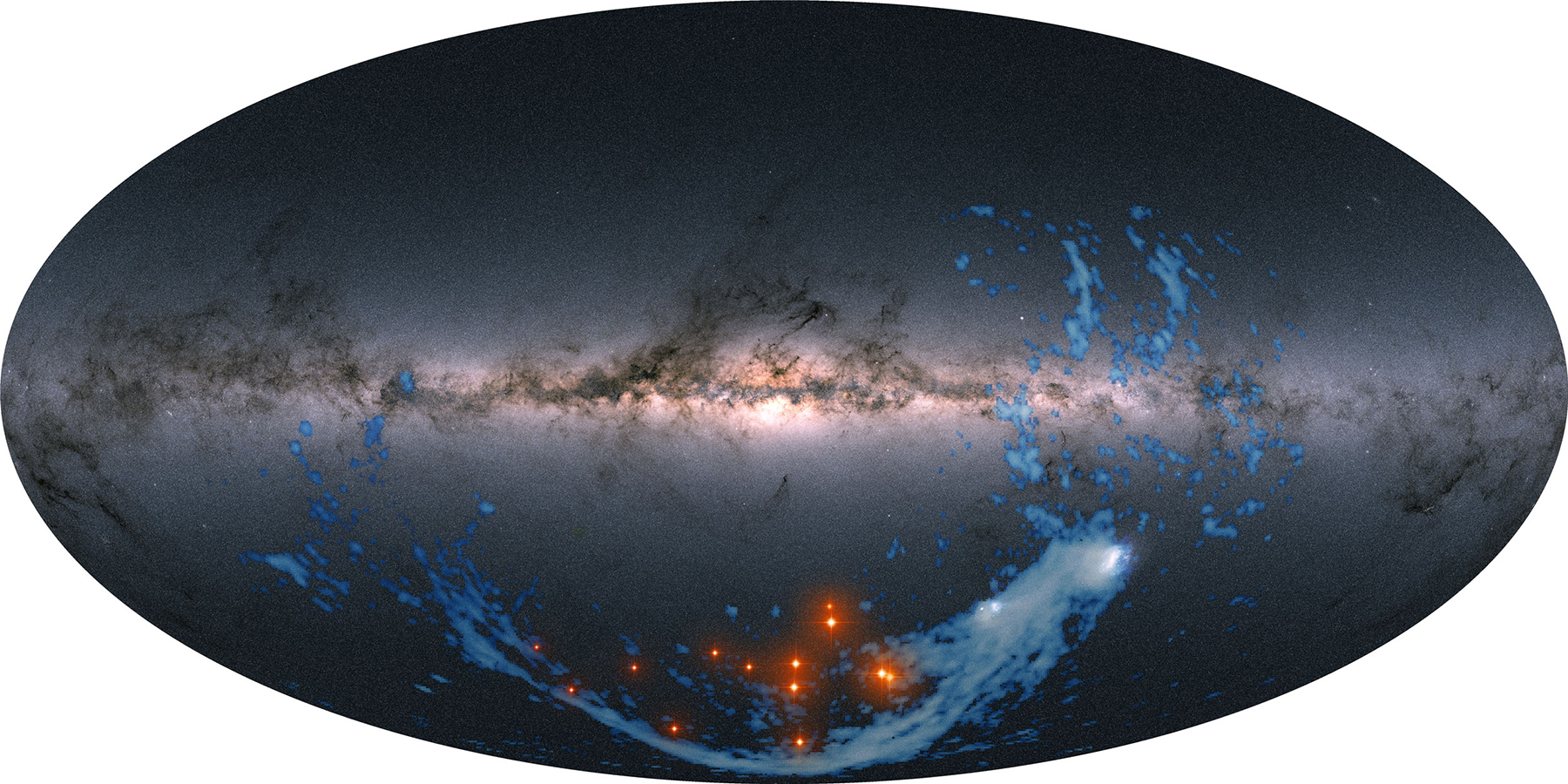
Artist's rendition of the Magellanic Stellar Stream. The Milky Way's nearest neighboring galaxies - the Small and Large Magellanic Clouds - are shown on the right side of the illustration. As these galaxies move to the right, the gaseous Magellanic Stream billows behind them, intertwining and stretching across the southern sky. The illustration also shows the 13 red giant stars discovered in the Magellanic Stellar Stream. Image Credits: CfA / Melissa Weiss. High Resolution Image / Low Resolution Image


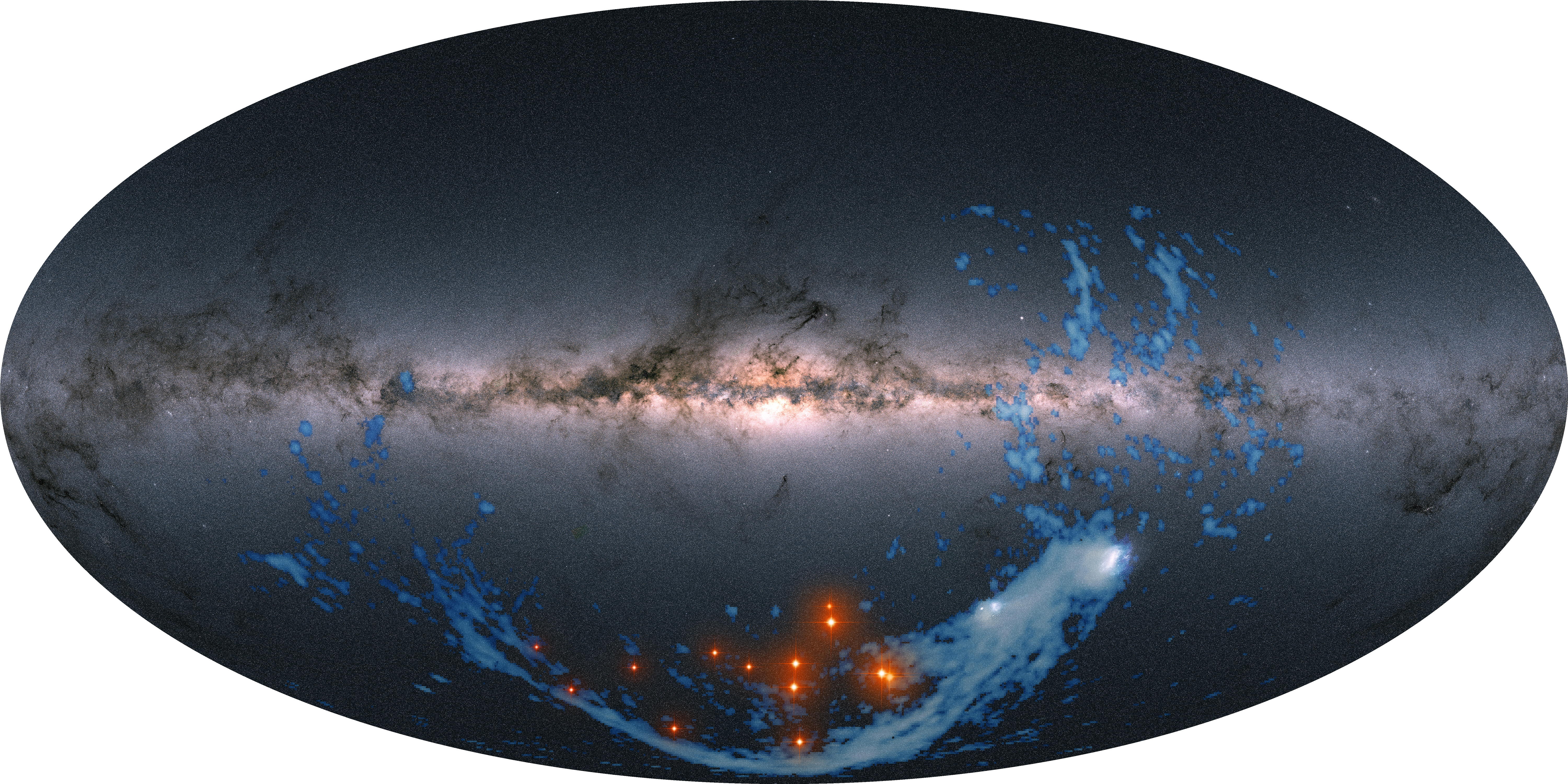
All-sky map of stars observed by the Gaia space observatory in 'galactic' coordinates, looking towards the center of the Milky Way. The neutral hydrogen gas of the Magellanic Stream is displayed in blue, spanning almost the entire southern sky. Red stars indicate the thirteen red giant stars identified by Chandra et al. to be members of the Magellanic Stellar Stream.  Credit: Red giants: CfA/Vedant Chandra/Melissa Weiss. All-sky view: Gaia Data Processing and Analysis Consortium (DPAC); A. Moitinho/A. F. Silva/M. Barros/C. Barata, University of Lisbon, Portugal; H. Savietto, Fork Research, Portugal. Magellanic Stream data: D. Nidever et al., NRAO/AUI/NSF, Leiden-Argentine-Bonn Survey; Parkes, Westerbork, and Arecibo Observatories. High Resolution Image / Low Resolution Image


Astronomers have solved a half-century-old scientific mystery by identifying stars associated with the cosmic gas stream emanating from a pair of nearby galaxies.

Cambridge, Mass. – For nearly fifty years, astronomers have come up empty-handed in their search for stars within the sprawling structure known as the Magellanic Stream. A colossal ribbon of gas, the Magellanic Stream spans nearly 300 Moon diameters across the Southern Hemisphere’s sky, trailing behind the Magellanic Cloud galaxies, two of our Milky Way Galaxy’s closest cosmic neighbors.

Now the star search is finally over. Researchers at the Center for Astrophysics | Harvard & Smithsonian (CfA) and colleagues have identified 13 stars whose distances, motion, and chemical makeup place the stars squarely within the enigmatic stream.

Locating these stars has now pinned down the true distance to the Magellanic Stream, revealing that it extends from 150,000 light-years to more than 400,000 light-years away. The findings pave the way to map and model the Magellanic Stream in unprecedented detail, offering new insights into the history and characteristics of our Galaxy and its neighbors.

"The Magellanic Stream dominates the Southern Hemisphere's sky and our work has at last found a stellar structure that people have sought for decades," says Vedant Chandra, a PhD student in Astronomy & Astrophysics at the CfA and lead author of a new study published in The Astrophysical Journal reporting the findings.

"With these results and more like them, we hope to gain a far greater understanding of the formation of the Magellanic Stream and the Magellanic Clouds, as well as their past and future interactions with our Galaxy," said co-author Charlie Conroy, a Professor of Astronomy at the CfA and Chandra’s advisor.

The Large and Small Magellanic Clouds are dwarf satellite galaxies of the Milky Way. Visible to the naked eye as gauzy luminances, the Clouds have been known since antiquity. With the advent of increasingly powerful telescopes able to perceive phenomena too faint for our eyes to see, astronomers discovered a gigantic plume of hydrogen gas apparently cast out of the Clouds in the early 1970s.

Studies of the gas within this Magellanic Stream further showed the Stream to have two interwoven filaments, with one originating from each Cloud. These features suggest the gravity of the Milky Way might have pulled the Magellanic Stream out of the Clouds. Yet how exactly the Stream formed has remained difficult to nail down, in no small part because of its presumed stellar component remaining irksomely indiscernible.

Chandra came at this problem through an ambitious project started in 2021 for his PhD at the CfA. Chandra consulted with Conroy about interesting topic areas to study, and Conroy pointed Chandra to the uncharted frontier of the Milky Way. The scant stars dotting the Galaxy’s outskirts have been little studied because our Solar System is smack dab in the starry disk of the Milky Way itself—akin to a concertgoer near the stage attempting to see somebody all the way out at the crowd’s periphery.

Over the last decade though, deep observational catalogs compiled by new instruments—especially the European Space Agency's Gaia spacecraft—have started to spy stellar objects that just might be these elusive frontier stars. With access granted to the 6.5m Magellan Baade Telescope at Las Campanas Observatory in Chile through the CfA and MIT, Chandra undertook a project to perform spectroscopy on 200 far-flung Milky Way stars, which when completed will be the largest such sample set to date.

Spectroscopy involves collecting enough light from an object to detect certain signatures imprinted within the light’s color bands that, like fingerprints, uniquely identify individual chemical elements. These signatures thus disclose the chemical makeup of an object, speaking to its origins. In addition, the signatures shift based on the distance to an object, enabling astronomers to tell where an object, such as a star, is going, and correspondingly where it came from.

In the case of Chandra's study, the spectroscopic analysis revealed a set of 13 stars with distances and velocities that fall right within the range expected for the Magellanic Stream. What’s more, the stars’ chemical abundances matched those of the Magellanic Clouds, for instance by being distinctively deficient in the heavier elements astronomers call metals. “These 13 stars just fell right out of our dataset,” says Rohan Naidu, co-author on the study and former CfA graduate student, currently a Hubble postdoctoral fellow at MIT.

By obtaining solid distance and extent measurements of the Magellanic Stream via these stars, the researchers buttressed its origin story as a gravitational grab by the Milky Way. The researchers were additionally able to calculate the Stream's overall gas distribution with higher confidence compared to prior estimates. The distribution indicates that the Stream is actually about twice as massive as generally reckoned.

That result, in turn, presages a future full of new star formation in the Milky Way, because the Stream is actively falling into our Galaxy, according to previous observations. In this way, the Stream serves as a primary provider of the cold, neutral gas needed for making fresh Milky Way stars.

"The Magellanic Stream is the dominant source of stellar calories for the Milky Way—it's our breakfast, lunch, and dinner," says Ana Bonaca, co-author on the study and former ITC postdoctoral fellow at the CfA, now staff scientist at Carnegie Observatories. "Based on the new, higher mass estimates for Magellanic Stream, the Milky Way may end up packing on more pounds than initially thought."

Further studies of the Magellanic Stream should also help astronomers learn more about the composition of our Galaxy. Because the Stream is thought to trace the past paths of the Magellanic Clouds, modeling the evolution of the relatively massive Large Magellanic Cloud via the Stream will improve measurements of the Milky Way’s mass distribution. Much of that mass is in the form of dark matter—a poorly understood, gravity-exerting substance. Better gauging the mass of our Galaxy out in its distant hinterlands will aid in accounting for ordinary matter versus dark matter contents, constraining the possible properties of the latter.

"The beauty of having a vast stellar stream like the Magellanic Stream is that we can now perform so many astrophysical investigations with it," says Chandra. "As our spectroscopic survey continues and we find more stars, we're excited to see what other surprises the Galactic outskirts have in store for us."


About the Center for Astrophysics | Harvard & Smithsonian

The Center for Astrophysics | Harvard & Smithsonian is a collaboration between Harvard and the Smithsonian designed to ask—and ultimately answer—humanity's greatest unresolved questions about the nature of the universe. The Center for Astrophysics is headquartered in Cambridge, MA, with research facilities across the U.S. and around the world.


Media Contact:

Peter Edmonds
Interim CfA Public Affairs Officer
Center for Astrophysics | Harvard & Smithsonian
+1 617-571-7279

pedmonds@cfa.harvard.edu


Thursday, October 12, 2023

NASA’s Webb Captures an Ethereal View of NGC 346

NGC 346 (MIRI Image)
Credits: Image: NASA, ESA, CSA, STScI, Nolan Habel (NASA-JPL)
Image Processing: Patrick Kavanagh (Maynooth University)


One of the greatest strengths of NASA’s James Webb Space Telescope is its ability to give astronomers detailed views of areas where new stars are being born. The latest example, showcased here in a new image from Webb’s Mid-Infrared Instrument (MIRI), is NGC 346 – the brightest and largest star-forming region in the Small Magellanic Cloud.

The Small Magellanic Cloud (SMC) is a satellite galaxy of the Milky Way, visible to the unaided eye in the southern constellation Tucana. This small companion galaxy is more primeval than the Milky Way in that it possesses fewer heavy elements, which are forged in stars through nuclear fusion and supernova explosions, compared to our own galaxy.

Since cosmic dust is formed from heavy elements like silicon and oxygen, scientists expected the SMC to lack significant amounts of dust. However the new MIRI image, as well as a previous image of NGC 346 from Webb’s Near-Infrared Camera released in January, show ample dust within this region.

In this representative-color image, blue tendrils trace emission from material that includes dusty silicates and sooty chemical molecules known as polycyclic aromatic hydrocarbons, or PAHs. More diffuse red emission shines from warm dust heated by the brightest and most massive stars in the heart of the region. An arc at the center left may be a reflection of light from the star near the arc’s center. (Similar, fainter arcs appear associated with stars at lower left and upper right.) Lastly, bright patches and filaments mark areas with abundant numbers of protostars. The research team looked for the reddest stars, and found 1,001 pinpoint sources of light, most of them young stars still embedded in their dusty cocoons.

By combining Webb data in both the near-infrared and mid-infrared, astronomers are able to take a fuller census of the stars and protostars within this dynamic region. The results have implications for our understanding of galaxies that existed billions of years ago, during an era in the universe known as “cosmic noon,” when star formation was at its peak and heavy element concentrations were lower, as seen in the SMC.

The James Webb Space Telescope is the world's premier space science observatory. Webb is solving mysteries in our solar system, looking beyond to distant worlds around other stars, and probing the mysterious structures and origins of our universe and our place in it. Webb is an international program led by NASA with its partners, ESA (European Space Agency) and the Canadian Space Agency.


About This Release

Credits:

Media Contact:

Christine Pulliam
Space Telescope Science Institute, Baltimore, Maryland

Permissions: Content Use Policy

Contact Us: Direct inquiries to the News Team.

Related Links and Documents


Monday, January 16, 2023

NASA’s Webb Uncovers Star Formation in Cluster’s Dusty Ribbons

NGC 346 (NIRCam Image)
Credits: Science: NASA, ESA, CSA, Olivia C. Jones (UK ATC), Guido De Marchi (ESTEC), Margaret Meixner (USRA)
Image Processing: Alyssa Pagan (STScI), Nolan Habel (USRA), Laura Lenkić (USRA), Laurie E. U. Chu (NASA Ames)


NGC 346, one of the most dynamic star-forming regions in nearby galaxies, is full of mystery. Now, it is less mysterious with new findings from NASA’s James Webb Space Telescope. 

NCG 346 is located in the Small Magellanic Cloud (SMC), a dwarf galaxy close to our Milky Way. The SMC contains lower concentrations of elements heavier than hydrogen or helium, which astronomers call metals, compared to the Milky Way. Since dust grains in space are composed mostly of metals, scientists expected there would be low amounts of dust, and that it would be hard to detect. New data from Webb reveals the opposite.

Astronomers probed this region because the conditions and amount of metals within the SMC resemble those seen in galaxies billions of years ago, during an era in the universe known as “cosmic noon,” when star formation was at its peak. Some 2 to 3 billion years after the big bang, galaxies were forming stars at a furious rate. The fireworks of star formation happening then still shape the galaxies we see around us today.

“A galaxy during cosmic noon wouldn’t have one NGC 346 like the Small Magellanic Cloud does; it would have thousands” of star-forming regions like this one, said Margaret Meixner, an astronomer at the Universities Space Research Association and principal investigator of the research team. “But even if NGC 346 is now the one and only massive cluster furiously forming stars in its galaxy, it offers us a great opportunity to probe conditions that were in place at cosmic noon.” 

By observing protostars still in the process of forming, researchers can learn if the star formation process in the SMC is different from what we observe in our own Milky Way. Previous infrared studies of NGC 346 have focused on protostars heavier than about 5 to 8 times the mass of our Sun. “With Webb, we can probe down to lighter-weight protostars, as small as one tenth of our Sun, to see if their formation process is affected by the lower metal content,” said Olivia Jones of the United Kingdom Astronomy Technology Centre, Royal Observatory Edinburgh, a co-investigator on the program.

As stars form, they gather gas and dust, which can look like ribbons in Webb imagery, from the surrounding molecular cloud. The material collects into an accretion disk that feeds the central protostar. Astronomers have detected gas around protostars within NGC 346, but Webb’s near-infrared observations mark the first time they have also detected dust in these disks.

“We’re seeing the building blocks, not only of stars, but also potentially of planets,” said Guido De Marchi of the European Space Agency, a co-investigator on the research team. “And since the Small Magellanic Cloud has a similar environment to galaxies during cosmic noon, it’s possible that rocky planets could have formed earlier in the universe than we might have thought.”

The team also has spectroscopic observations from Webb’s NIRSpec instrument that they are continuing to analyze. These data are expected to provide new insights into the material accreting onto individual protostars, as well as the environment immediately surrounding the protostar.

These results are being presented Jan. 11 in a press conference at the 241st meeting of the American Astronomical Society. The observations were obtained as part of program 1227.

  The James Webb Space Telescope is the world's premier space science observatory. Webb will solve mysteries in our solar system, look beyond to distant worlds around other stars, and probe the mysterious structures and origins of our universe and our place in it. Webb is an international program led by NASA with its partners, ESA (European Space Agency) and the Canadian Space Agency.


About This Release

Credits:

Media Contact:

Matthew Brown
Space Telescope Science Institute, Baltimore, Maryland

Christine Pulliam
Space Telescope Science Institute, Baltimore, Maryland

Permissions:
Content Use Policy

Contact Us: Direct inquiries to the News Team.


Friday, December 09, 2022

Head in the Clouds

A large number of bright stars, each with a cross-shape extending from its centre. In the centre there is a dense collection of foreground stars. Five are orange and the rest are blue. The black background is filled with small stars — most of them, however, larger than a single point. Credit: ESA/Hubble & NASA, A. Nota, G. De Marchi

A small portion of the Small Magellanic Cloud (SMC) is pictured in this image from the NASA/ESA Hubble Space Telescope. The SMC is a dwarf galaxy and one of the Milky Way’s nearest neighbours, lying only about 200 000 light-years from Earth. It makes a pair with the Large Magellanic Cloud, and both objects can be seen from the southern hemisphere, as well as from some northern latitudes.

The Small Magellanic Cloud contains hundreds of millions of stars, but this image focuses on just a small fraction of them. These stars comprise the open cluster NGC 376, which has a total mass only about 3400 times that of the Sun. Open clusters, as the name suggests, are loosely bound and sparsely populated. This distinguishes open clusters from globular clusters, which are often so thronged with stars that they have a continuous blur of starlight at their centres. In the case of NGC 376, individual stars can be picked out clearly even in the most densely populated parts of this image.

The data in this image come from two different astronomical investigations which relied on two of Hubble’s instruments: the Wide Field Camera 3 (WFC3) and the Advanced Camera for Surveys (ACS). The first investigation used the ACS to explore a handful of star clusters in the Small Magellanic Cloud and help astronomers explore topics including the abundance of low- and high-mass stars in different environments. The second investigation used both the WFC3 and ACS, and aimed to answer fundamental questions about the lives of stars and help astronomers understand precisely where, when, why and how stars form.


Wednesday, September 28, 2022

Hubble Detects Protective Shield Defending a Pair of Dwarf Galaxies

Using Quasars to Map the Magellanic Corona
Credits: Illustration: NASA, ESA, Leah Hustak (STScI)

Release Images

For billions of years, the Milky Way’s largest satellite galaxies – the Large and Small Magellanic Clouds – have followed a perilous journey. Orbiting one another as they are pulled in toward our home galaxy, they have begun to unravel, leaving behind trails of gaseous debris. And yet – to the puzzlement of astronomers – these dwarf galaxies remain intact, with ongoing vigorous star formation.

“A lot of people were struggling to explain how these streams of material could be there,” said Dhanesh Krishnarao, assistant professor at Colorado College. “If this gas was removed from these galaxies, how are they still forming stars?”

With the help of data from NASA’s Hubble Space Telescope and a retired satellite called the Far Ultraviolet Spectroscopic Explorer (FUSE), a team of astronomers led by Krishnarao has finally found the answer: the Magellanic system is surrounded by a corona, a protective shield of hot supercharged gas. This cocoons the two galaxies, preventing their gas supplies from being siphoned off by the Milky Way, and therefore allowing them to continue forming new stars.

This discovery, which was just published in Nature, addresses a novel aspect of galaxy evolution. “Galaxies envelope themselves in gaseous cocoons, which act as defensive shields against other galaxies,” said co-investigator Andrew Fox of the Space Telescope Science Institute in Baltimore, Maryland.

Astronomers predicted the corona’s existence several years ago. “We discovered that if we included a corona in the simulations of the Magellanic Clouds falling onto the Milky Way, we could explain the mass of extracted gas for the first time," explained Elena D'Onghia, a co-investigator at the University of Wisconsin–Madison. “We knew that the Large Magellanic Cloud should be massive enough to have a corona.”

But although the corona stretches more than 100,000 light-years from the Magellanic clouds and covers a huge portion of the southern sky, it is effectively invisible. Mapping it required scouring through 30 years of archived data for suitable measurements.

Researchers think that a galaxy’s corona is a remnant of the primordial cloud of gas that collapsed to form the galaxy billions of years ago. Although coronas have been seen around more distant dwarf galaxies, astronomers had never before been able to probe one in as much detail as this.

“There’re lots of predictions from computer simulations about what they should look like, how they should interact over billions of years, but observationally we can't really test most of them because dwarf galaxies are typically just too hard to detect,” said Krishnarao. Because they are right on our doorstep, the Magellanic Clouds provide an ideal opportunity to study how dwarf galaxies interact and evolve.

In search of direct evidence of the Magellanic Corona, the team combed through the Hubble and FUSE archives for ultraviolet observations of quasars located billions of light-years behind it. Quasars are the extremely bright cores of galaxies harboring massive active black holes. The team reasoned that although the corona would be too dim to see on its own, it should be visible as a sort of fog obscuring and absorbing distinct patterns of bright light from quasars in the background. Hubble observations of quasars were used in the past to map the corona surrounding the Andromeda galaxy.

By analyzing patterns in ultraviolet light from 28 quasars, the team was able to detect and characterize the material surrounding the Large Magellanic Cloud and confirm that the corona exists. As predicted, the quasar spectra are imprinted with the distinct signatures of carbon, oxygen, and silicon that make up the halo of hot plasma that surrounds the galaxy.

The ability to detect the corona required extremely detailed ultraviolet spectra. “The resolution of Hubble and FUSE were crucial for this study,” explained Krishnarao. “The corona gas is so diffuse, it’s barely even there.” In addition, it is mixed with other gases, including the streams pulled from the Magellanic Clouds and material originating in the Milky Way.

By mapping the results, the team also discovered that the amount of gas decreases with distance from the center of the Large Magellanic Cloud. “It’s a perfect telltale signature that this corona is really there,” said Krishnarao. “It really is cocooning the galaxy and protecting it.”

How can such a thin shroud of gas protect a galaxy from destruction?

“Anything that tries to pass into the galaxy has to pass through this material first, so it can absorb some of that impact,” explained Krishnarao. “In addition, the corona is the first material that can be extracted. While giving up a little bit of the corona, you're protecting the gas that's inside the galaxy itself and able to form new stars.”

The Hubble Space Telescope is a project of international cooperation between NASA and ESA (European Space Agency). NASA's Goddard Space Flight Center in Greenbelt, Maryland, manages the telescope. The Space Telescope Science Institute (STScI) in Baltimore, Maryland, conducts Hubble science operations. STScI is operated for NASA by the Association of Universities for Research in Astronomy in Washington, D.C.

The Far Ultraviolet Spectroscopic Explorer (FUSE) was a project of international cooperation between NASA, CSA (Canadian Space Agency), and CNES (French Space Agency), and was in operation between 1999 and 2007.


Credits:


Media Contact:

Margaret W. Carruthers
Space Telescope Science Institute, Baltimore, Maryland

Ray Villard
Space Telescope Science Institute, Baltimore, Maryland

Science Contact:

Dhanesh Krishnarao
Colorado College, Colorado Springs, Colorado

Andrew Fox
Space Telescope Science Institute, Baltimore, Maryland


Permissions: Content Use Policy

Contact Us:

Direct inquiries to the
News Team.

Related Links and Documents:


Monday, September 12, 2022

NASA's Hubble Finds Spiraling Stars, Providing Window into Early Universe

Spatial Distribution of NGC 346 Stars

The massive star cluster NGC 346, located in the Small Magellanic Cloud, has long intrigued astronomers with its unusual shape. Now researchers using two separate methods have determined that this shape is partly due to stars and gas spiraling into the center of this cluster in a river-like motion. The red spiral superimposed on NGC 346 traces the movement of stars and gas toward the center. Scientists say this spiraling motion is the most efficient way to feed star formation from the outside toward the center of the cluster. Credits: Illustration: NASA, ESA, Andi James (STScI). Release images

Nature likes spirals — from the whirlpool of a hurricane, to pinwheel-shaped protoplanetary disks around newborn stars, to the vast realms of spiral galaxies across our universe.

Now astronomers are bemused to find young stars that are spiraling into the center of a massive cluster of stars in the Small Magellanic Cloud, a satellite galaxy of the Milky Way.

The outer arm of the spiral in this huge, oddly shaped stellar nursery called NGC 346 may be feeding star formation in a river-like motion of gas and stars. This is an efficient way to fuel star birth, researchers say.

The Small Magellanic Cloud has a simpler chemical composition than the Milky Way, making it similar to the galaxies found in the younger universe, when heavier elements were more scarce. Because of this, the stars in the Small Magellanic Cloud burn hotter and so run out of their fuel faster than in our Milky Way.

Though a proxy for the early universe, at 200,000 light-years away the Small Magellanic Cloud is also one of our closest galactic neighbors.

Learning how stars form in the Small Magellanic Cloud offers a new twist on how a firestorm of star birth may have occurred early in the universe's history, when it was undergoing a "baby boom" about 2 to 3 billion years after the big bang (the universe is now 13.8 billion years old).

The new results find that the process of star formation there is similar to that in our own Milky Way.

Only 150 light-years in diameter, NGC 346 boasts the mass of 50,000 Suns. Its intriguing shape and rapid star-formation rate has puzzled astronomers. It took the combined power of NASA's Hubble Space Telescope and the European Southern Observatory's Very Large Telescope (VLT) to unravel the behavior of this mysterious-looking stellar nesting ground.

"Stars are the machines that sculpt the universe. We would not have life without stars, and yet we don't fully understand how they form," explained study leader Elena Sabbi of the Space Telescope Science Institute in Baltimore. "We have several models that make predictions, and some of these predictions are contradictory. We want to determine what is regulating the process of star formation, because these are the laws that we need to also understand what we see in the early universe."

Researchers determined the motion of the stars in NGC 346 in two different ways. Using Hubble, Sabbi and her team measured the changes of the stars' positions over 11 years. The stars in this region are moving at an average velocity of 2,000 miles per hour, which means that in 11 years they move 200 million miles. This is about 2 times the distance between the Sun and the Earth.

But this cluster is relatively far away, inside a neighboring galaxy. This means the amount of observed motion is very small and therefore difficult to measure. These extraordinarily precise observations were possible only because of Hubble's exquisite resolution and high sensitivity. Also, Hubble's three-decade-long history of observations provides a baseline for astronomers to follow minute celestial motions over time.

The second team, led by Peter Zeidler of AURA/STScI for the European Space Agency, used the ground-based VLT's Multi Unit Spectroscopic Explorer (MUSE) instrument to measure radial velocity, which determines whether an object is approaching or receding from an observer.

"What was really amazing is that we used two completely different methods with different facilities and basically came to the same conclusion, independent of each other," said Zeidler. "With Hubble, you can see the stars, but with MUSE we can also see the gas motion in the third dimension, and it confirms the theory that everything is spiraling inwards."

But why a spiral?

"A spiral is really the good, natural way to feed star formation from the outside toward the center of the cluster," explained Zeidler. "It's the most efficient way that stars and gas fueling more star formation can move towards the center."

Half of the Hubble data for this study of NGC 346 is archival. The first observations were taken 11 years ago. They were recently repeated to trace the motion of the stars over time. Given the telescope's longevity, the Hubble data archive now contains more than 32 years of astronomical data powering unprecedented, long-term studies.

"The Hubble archive is really a gold mine," said Sabbi. "There are so many interesting star-forming regions that Hubble has observed over the years. Given that Hubble is performing so well, we can actually repeat these observations. This can really advance our understanding of star formation."

The teams'findings appear Sept. 8 in The Astrophysical Journal.

Observations with NASA's James Webb Space Telescope should be able to resolve lower-mass stars in the cluster, giving a more holistic view of the region. Over Webb's lifespan, astronomers will be able to repeat this experiment and measure the motion of the low-mass stars. They could then compare the high-mass stars and the low-mass stars to finally learn the full extent of the dynamics of this nursery.

The Hubble Space Telescope is a project of international cooperation between NASA and ESA. NASA's Goddard Space Flight Center in Greenbelt, Maryland, manages the telescope. The Space Telescope Science Institute (STScI) in Baltimore, Maryland conducts Hubble science operations. STScI is operated for NASA by the Association of Universities for Research in Astronomy, in Washington, D.C.

Source: HubbleSite/News


Credits:

Release: NASA, ESA, STScI

Media Contact:

Ann Jenkins
Space Telescope Science Institute, Baltimore, Maryland

Ray Villard
Space Telescope Science Institute, Baltimore, Maryland

Science Contact:

Elena Sabbi
Space Telescope Science Institute, Baltimore, Maryland

Peter Zeidler
AURA/STScI for the European Space Agency


Permissions: Content Use Policy

Contact Us: Direct inquiries to the News Team.

Related Links and Documents:


Thursday, August 26, 2021

Red Giants and Neutron Stars and Gravitational Waves, Oh My!

An artist's depiction of a Thorne-Żytkow Object with a neutron star core and a red giant envelope
Credit: Astronomy magazine

Artist’s illustration of a red giant star expelling mass at the end of its life
Credit:JAXA

Title: Prospects for Multimessenger Observations of Thorne-Żytkow Objects
Authors: Lindsay DeMarchi, J. R. Sanders, and Emily M. Levesque
First Author’s Institution: Northwestern University

Status: Published in ApJ

The universe is full of different types of stars, including big ones called red giants. But what if some of those red giants are hiding another star inside them?

Two Stars for the Price of One?

A Thorne-Żytkow object (TZO) is a very special type of hybrid object that consists of two stars: a red giant (or supergiant) and a neutron star that lies at the core of the red giant. One way a TZO could be created is from the evolution of a close binary of two massive stars (> 8 solar masses) orbiting each other. Once the more massive star from the pair reaches the end of its lifetime, it will go supernova and leave behind a small, dense neutron star. This process could cause the neutron star and the remaining massive star to inspiral, allowing the red giant to swallow the tiny, but dense, neutron star — perhaps the most epic fit of celestial sibling jealousy!

The Challenges of Detecting a TZO

Though TZOs were first proposed in 1977, they remain extremely hard to detect and have never been observationally confirmed to exist. One of the issues is that a TZO doesn’t look that different from a red giant. Due to the presence of the neutron star core, however, TZOs should have different chemical abundances than red giants. Using this clue, one of the authors of today’s paper, Dr. Emily Levesque, identified a strong TZO candidate in the Small Magellanic Cloud in 2014 (read a bite about it here!). This star (known as HV 2112) has the chemical composition expected for TZOs — though it still may simply be a weird red giant without a neutron star core.

Besides TZOs being difficult to “visually” distinguish from red giants, they can also be difficult to gravitationally distinguish from standalone neutron stars. While it’s forming, a TZO will emit gravitational waves (GWs) at ~10 Hz frequencies that ground-based detectors like LIGO can’t see due to seismic noise coming from the Earth. After formation, a TZO will emit gravitational waves from its neutron core “spinning down” (spinning slower and slower). But spinning down is what neutron stars living outside of TZOs are also doing (we can see this happen with pulsars, for example), making it hard to tell TZOs and standalone neutron stars apart using just gravitational waves.

Where Does One Find a TZO?

The good news is that gravitational waves and visual identification of red giants can be used in unison to better identify TZOs! To that end, the authors of today’s paper identified a few nearby red (super)giant-rich regions that could be good candidates for hosting TZOs. They settled on one group of red supergiants in a region of the sky called the Scutum–Crux arm. The region is named RSGC1 and is about 6.6 kpc away from Earth. It is also very compact, about 10 million years old, and has around 210 massive stars. Its distance and small size make it ideal to scan for gravitational signatures, while its age and massive star population mean TZOs would have had time and the opportunity to form.

The authors carefully modeled what the gravitational signature of a TZO located in RSGC1 would look like (see the figure below). They took into account the properties of the red giant cluster, such as its distance and size. They also considered how fast neutron stars tend to spin down, which depends on their spin frequency to some power n, where 2 < n < 7. The authors consider a range of options for n that correspond to three different models for how the neutron star at the center of the TZO would spin down. Finally, they use what is known as the spindown limit, meaning that they assume all the energy from the slowing of the neutron star’s rotation is released as GWs. In reality, some of this energy could be used elsewhere — meaning that their calculation below is an upper limit for GW signals of TZOs in RSGC1.


Plot of strain — the strength of gravitational waves that LIGO is sensitive to — vs. frequency range of the LIGO detector. The curved black line shows the noise curve of the LIGO detector: LIGO can detect everything above the curve. The authors also show their calculations for GW signatures of TZOs in RSGC1 given three different models for neutron star spin as horizontal lines, shown in red (n=2), blue (n=5), and gray (n=7). All three lines are well above the LIGO sensitivity curve at frequencies greater than about 20 Hz, meaning that LIGO could indeed help detect potential TZOs in RSGC1! Credit: DeMarchi et al. 2021.

A New Tool for Finding TZOs

The authors have shown that the expected gravitational signatures for TZOs in RSGC1 are well above the noise threshold of LIGO, meaning that any neutron star cores would likely be detectable! The next step is to look for such signatures in archival LIGO data and compare them with observational data. If astronomers can find both a gravitational wave signature of a neutron star and a visual signature of a red giant emanating from the same source, it will be the strongest evidence yet of a TZO: a star within a star!

Original astrobite edited by James Negus.

About the author, Luna Zagorac:

I am a PhD candidate in the Physics Department at Yale University. My research focus is ultra light (or fuzzy) dark matter in simulations and observations. I’m also a Franke Fellow in the Natural Sciences & Humanities at Yale working on a project on Egyptian archaeoastronomy, another passion of mine. When I’m not writing code or deciphering glyphs, I can usually be found reading, doodling, or drinking coffee.

By Astrobites


Sunday, July 04, 2021

Hubble Sees a Cluster of Red, White, and Blue

NGC 330
Image credit: ESA/Hubble & NASA, J. Kalirai, A. Milone
Text credit: European Space Agency (ESA). Hi-res image

This image taken with the NASA/ESA Hubble Space Telescope depicts the open star cluster NGC 330, which lies around 180,000 light-years away inside the Small Magellanic Cloud. The cluster – which is in the constellation Tucana (the Toucan) – contains a multitude of stars, many of which are scattered across this striking image.

Because star clusters form from a single primordial cloud of gas and dust, all the stars they contain are roughly the same age. This makes them useful natural laboratories for astronomers to learn how stars form and evolve. This image uses observations from Hubble’s Wide Field Camera 3 and incorporates data from two very different astronomical investigations. The first aimed to understand why stars in star clusters appear to evolve differently from stars elsewhere, a peculiarity first observed with Hubble. The second aimed to determine how large stars can be before they become doomed to end their lives in cataclysmic supernova explosions.

Hubble images show us something new about the universe. This image, however, also contains clues about the inner workings of Hubble itself. The crisscross patterns surrounding the stars in this image, known as diffraction spikes, were created when starlight interacted with the four thin vanes supporting Hubble’s secondary mirror.

Media Contact:

Claire Andreoli
NASA's Goddard Space Flight Center
301-286-1940

Editor: Lynn Jenner


Friday, November 20, 2020

Astronomers Discover New “Fossil Galaxy” Buried Deep Within the Milky Way

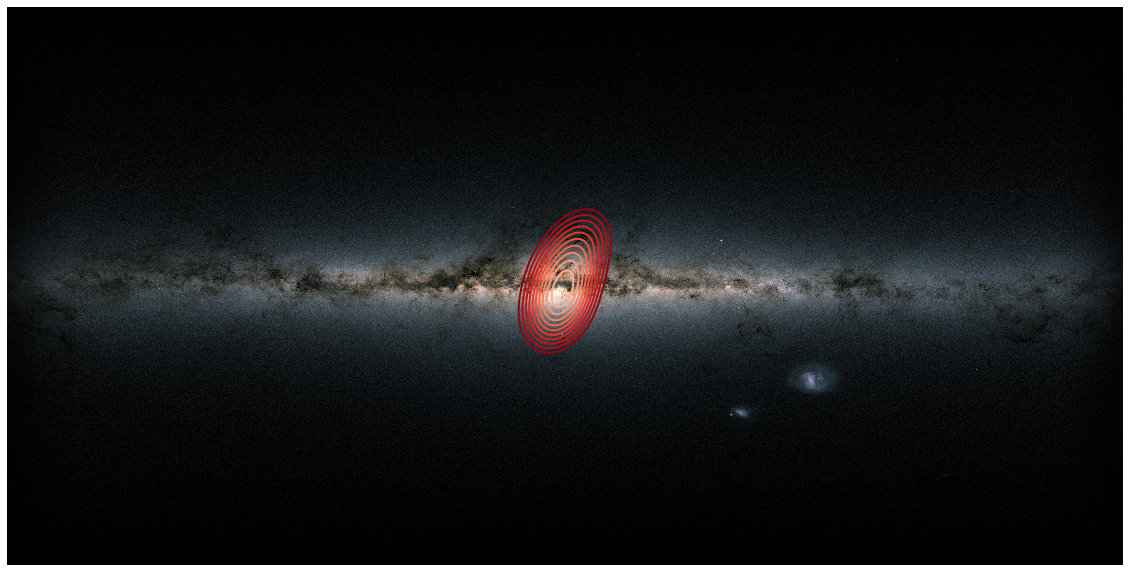
An artist’s impression of what the Milky Way might look like seen from above. The colored rings show the rough extent of the fossil galaxy known as Heracles. The yellow dot shows the position of the Sun. Image credit: Danny Horta-Darrington (Liverpool John Moores University), NASA/JPL-Caltech, and the SDSS 

An all-sky imageof the stars in the Milky Way as seen from Earth. The colored rings show the approximate extent of the stars that came from the fossil galaxy known as Heracles. The small objects to the lower right of the image are the Large and Small Magellanic Clouds, two small satellite galaxies of the Milky Way. Image credit: Danny Horta-Darrington (Liverpool John Moores University), ESA/Gaia, and the SDSS 
 

This movie shows a computer simulation of a galaxy like the Milky Way. The movie fast-forwards through simulated time from 13 billion years ago to today. The main galaxy grows as many small galaxies merge with it. Heracles resembles one of the smaller galaxies that merged with the Milky Way early in the process.  Credits: Video built by Ted Mackereth based on the EAGLE simulations. Download video (0:40, 25 MB)


Scientists working with data from the Sloan Digital Sky Surveys’ Apache Point Observatory Galactic Evolution Experiment (APOGEE) have discovered a “fossil galaxy” hidden in the depths of our own Milky Way.

This result, published today in Monthly Notices of the Royal Astronomical Society, may shake up our understanding of how the Milky Way grew into the galaxy we see today.

The proposed fossil galaxy may have collided with the Milky Way ten billion years ago, when our galaxy was still in its infancy. Astronomers named it Heracles, after the ancient Greek hero who received the gift of immortality when the Milky Way was created.

The remnants of Heracles account for about one third of the Milky Way’s spherical halo. But if stars and gas from Heracles make up such a large percentage of the galactic halo, why didn’t we see it before? The answer lies in its location deep inside the Milky Way.

“To find a fossil galaxy like this one, we had to look at the detailed chemical makeup and motions of tens of thousands of stars,” says Ricardo Schiavon from Liverpool John Moores University (LJMU) in the UK, a key member of the research team. “That is especially hard to do for stars in the center of the Milky Way, because they are hidden from view by clouds of interstellar dust. APOGEE lets us pierce through that dust and see deeper into the heart of the Milky Way than ever before.”

APOGEE does this by taking spectra of stars in near-infrared light, instead of visible light, which gets obscured by dust. Over its ten-year observational life, APOGEE has measured spectra for more than half a million stars all across the Milky Way, including its previously dust-obscured core.

Graduate student Danny Horta from LJMU, the lead author of the paper announcing the result, explains, “examining such a large number of stars is necessary to find unusual stars in the densely-populated heart of the Milky Way, which is like finding needles in a haystack.”

To separate stars belonging to Heracles from those of the original Milky Way, the team made use of both chemical compositions and velocities of stars measured by the APOGEE instrument.

“Of the tens of thousands of stars we looked at, a few hundred had strikingly different chemical compositions and velocities,” Horta said. “These stars are so different that they could only have come from another galaxy. By studying them in detail, we could trace out the precise location and history of this fossil galaxy.”

Because galaxies are built through mergers of smaller galaxies across time, the remnants of older galaxies are often spotted in the outer halo of the Milky Way, a huge but very sparse cloud of stars enveloping the main galaxy. But since our Galaxy built up from the inside out, finding the earliest mergers requires looking at the most central parts of the Milky Way’s halo, which are buried deep within the disc and bulge.

Stars originally belonging to Heracles account for roughly one third of the mass of the entire Milky Way halo today – meaning that this newly-discovered ancient collision must have been a major event in the history of our Galaxy. That suggests that our Galaxy may be unusual, since most similar massive spiral galaxies had much calmer early lives.

“As our cosmic home, the Milky Way is already special to us, but this ancient galaxy buried within makes it even more special,” Schiavon says.

Karen Masters, the Spokesperson for SDSS-IV comments, “APOGEE is one of the flagship surveys of the fourth phase of SDSS, and this result is an example of the amazing science that anyone can do, now that we have almost completed our ten-year mission.”

And this new age of discovery will not end with the completion of APOGEE observations. The fifth phase of the SDSS has already begun taking data, and its “Milky Way Mapper” will build on the success of APOGEE to measure spectra for ten times as many stars in all parts of the Milky Way, using near-infrared light, visible light, and sometimes both.


About the Sloan Digital Sky Survey

Funding for the Sloan Digital Sky Survey IV has been provided by the Alfred P. Sloan Foundation, the U.S. Department of Energy Office of Science, and the Participating Institutions. SDSS acknowledges support and resources from the Center for High-Performance Computing at the University of Utah. The SDSS web site is www.sdss.org.

SDSS is managed by the Astrophysical Research Consortium for the Participating Institutions of the SDSS Collaboration including the Brazilian Participation Group, the Carnegie Institution for Science, Carnegie Mellon University, Center for Astrophysics | Harvard & Smithsonian (CfA), the Chilean Participation Group, the French Participation Group, Instituto de Astrofísica de Canarias, The Johns Hopkins University, Kavli Institute for the Physics and Mathematics of the Universe (IPMU) / University of Tokyo, the Korean Participation Group, Lawrence Berkeley National Laboratory, Leibniz Institut für Astrophysik Potsdam (AIP), Max-Planck-Institut für Astronomie (MPIA Heidelberg), Max-Planck-Institut für Astrophysik (MPA Garching), Max-Planck-Institut für Extraterrestrische Physik (MPE), National Astronomical Observatories of China, New Mexico State University, New York University, University of Notre Dame, Observatório Nacional / MCTI, The Ohio State University, Pennsylvania State University, Shanghai Astronomical Observatory, United Kingdom Participation Group, Universidad Nacional Autónoma de México, University of Arizona, University of Colorado Boulder, University of Oxford, University of Portsmouth, University of Utah, University of Virginia, University of Washington, University of Wisconsin, Vanderbilt University, and Yale University.

Contacts:

Ricardo Schiavon
Liverpool John Moores University
R.P.Schiavon@ljmu.ac.uk
+44 (0)151 231 2945
 
Daniel Horta-Darrington
Liverpool John Moores University
D.HortaDarrington@2018.ljmu.ac.uk
+44 (0)151 231 2923
 
Karen Masters
SDSS Scientific Spokesperson, Haverford College
klmasters@haverford.edu
+1-610-795-6066
Twitter: @KarenLMasters / @SDSSurveys
 
Jordan Raddick
SDSS Public Information Officer
Johns Hopkins University
+1-443-570-7105
Twitter: @raddick
 

Wednesday, June 03, 2020

Intense Flash From Milky Way's Black Hole Illuminated Gas Far Outside of Our Galaxy

(Illustration) An enormous outburst from the vicinity of the Milky Way’s central black hole sent cones of blistering ultraviolet radiation above and below the plane of the galaxy and deep into space. The radiation cone that blasted out of the Milky Way’s south pole lit up a massive ribbon-like gas structure called the Magellanic Stream. This vast train of gas trails the Milky Way’s two prominent satellite galaxies: the Large Magellanic Cloud (LMC) and its companion, the Small Magellanic Cloud (SMC). The astronomers studied sightlines to quasars far behind the Magellanic Stream and behind another feature called the Leading Arm, a tattered and shredded gaseous “arm” that precedes the LMC and SMC in their orbit around the Milky Way. Unlike the Magellanic Stream, the Leading Arm did not show evidence of being lit up by the flare. The same event that caused the radiation flare also “burped” hot plasma that is now towering in ballooning lobes about 30,000 light-years above and below the plane of our galaxy. These bubbles, visible only in gamma rays and weighing the equivalent of millions of Suns, are called the Fermi Bubbles. The Fermi Bubbles and the Magellanic Stream were thought to be separate and unrelated to each other, but now it appears that the same powerful flash from our galaxy’s central black hole has played a major role in both. Credits: NASA, ESA and L. Hustak (STScI). 
Hi-res image

(Illustration) About 3.5 million years ago — just a blink of an eye in cosmic time — a tremendous explosion rocked the center of our galaxy. Our distant hominid ancestors, already afoot on the African plains, likely would have seen the resulting flare as a ghostly glow high overhead in the night sky. Now, astronomers using NASA's Hubble Space Telescope's unique capabilities have uncovered even more clues to this cataclysmic explosion. Credits: NASA, ESA, G. Cecil (UNC, Chapel Hill) and J. DePasquale (STScI).
Hi-res image

About 3.5 million years ago, the supermassive black hole at the center of our Milky Way galaxy unleashed an enormous burst of energy. Our primitive ancestors, already afoot on the African plains, likely would have witnessed this flare as a ghostly glow high overhead in the constellation Sagittarius. It might have persisted for 1 million years.

Now, eons later, astronomers are using NASA's Hubble Space Telescope's unique capabilities to uncover even more clues about this cataclysmic explosion. Looking to the far outskirts of our galaxy, they found that the black hole's floodlight reached so far into space it illuminated a vast train of gas trailing the Milky Way's two prominent satellite galaxies: the Large Magellanic Cloud (LMC) and its companion, the Small Magellanic Cloud (SMC). Hi-res image

The black hole outburst was probably caused by a large hydrogen cloud up to 100,000 times the Sun's mass falling onto the disk of material swirling near the central black hole. The resulting outburst sent cones of blistering ultraviolet radiation above and below the plane of the galaxy and deep into space.

The radiation cone that blasted out of the Milky Way’s south pole lit up a massive ribbon-like gas structure called the Magellanic Stream. The flash lit up a portion of the stream, ionizing its hydrogen (enough to make 100 million Suns) by stripping atoms of their electrons.

"The flash was so powerful that it lit up the stream like a Christmas tree — it was a cataclysmic event!" said Principal Investigator Andrew Fox of the Space Telescope Science Institute (STScI) in Baltimore. "This shows us that different regions of the galaxy are linked — what happens in the galactic center makes a difference to what happens out in the Magellanic Stream. We're learning about how the black hole impacts the galaxy and its environment."

Fox's team used Hubble's ultraviolet capabilities to probe the stream by using background quasars — the bright cores of distant, active galaxies — as light sources. Hubble's Cosmic Origins Spectrograph can see the fingerprints of ionized atoms in the ultraviolet light from the quasars. The astronomers studied sightlines to 21 quasars far behind the Magellanic Stream and 10 behind another feature called the Leading Arm, a tattered and shredded gaseous "arm" that precedes the LMC and SMC in their orbit around the Milky Way.

"When the light from the quasar passes through the gas we're interested in, some of the light at specific wavelengths gets absorbed by the atoms in the cloud," said STScI's Elaine Frazer, who analyzed the sightlines and discovered new trends in the data. "When we look at the quasar light spectrum at specific wavelengths, we see evidence of light absorption that we wouldn't see if the light hadn’t passed through the cloud. From this, we can draw conclusions about the gas itself."

The team found evidence that the ions had been created in the Magellanic Stream by an energetic flash. The burst was so powerful that it lit up the stream, even though this structure is about 200,000 light-years from the galactic center.

Unlike the Magellanic Stream, the Leading Arm did not show evidence of being lit up by the flare. That makes sense, because the Leading Arm is not sitting right below the south galactic pole, so it was not showered with the burst's radiation.

The same event that caused the radiation flare also "burped" hot plasma that is now towering about 30,000 light-years above and below the plane of our galaxy. These invisible bubbles, weighing the equivalent of millions of Suns, are called the Fermi Bubbles. Their energetic gamma-ray glow was discovered in 2010 by NASA's Fermi Gamma-ray Space Telescope. In 2015, Fox used Hubble's ultraviolet spectroscopy to measure the expansion velocity and composition of the ballooning lobes.

Now his team managed to stretch Hubble's reach beyond the bubbles. "We always thought that the Fermi Bubbles and the Magellanic Stream were separate and unrelated to each other and doing their own things in different parts of the galaxy’s halo," said Fox. "Now we see that the same powerful flash from our galaxy's central black hole has played a major role in both."

This research was possible only because of Hubble's unique ultraviolet capability. Because of the filtering effects of Earth's atmosphere, ultraviolet light cannot be studied from the ground. "It's a very rich region of the electromagnetic spectrum — there's a lot of features that can be measured in the ultraviolet," explained Fox. "If you work in the optical and infrared, you can't see them. That's why we have to go to space to do this. For this type of work, Hubble is the only game in town."

The findings, to be published in the Astrophysical Journal, will be presented during a press conference on June 2 at the 236th meeting of the American Astronomical Society, which will be conducted virtually this year.

The Hubble Space Telescope is a project of international cooperation between NASA and ESA (European Space Agency). NASA's Goddard Space Flight Center in Greenbelt, Maryland, manages the telescope. The Space Telescope Science Institute (STScI) in Baltimore conducts Hubble science operations. STScI is operated for NASA by the Association of Universities for Research in Astronomy in Washington, D.C.


Contacts

Claire Andreoli
NASA's Goddard Space Flight Center, Greenbelt, Md.
301-286-1940

claire.andreoli@nasa.gov

Ann Jenkins / Ray Villard
Space Telescope Science Institute, Baltimore
410-338-4488 / 410-338-4514

jenkins@stsci.edu / villard@stsci.edu

Elaine Frazer / Andrew Fox
Space Telescope Science Institute, Baltimore

efrazer@stsci.edu / afox@stsci.edu

Editor: Rob Garner

Source: NASA/Hubble