Showing posts with label Abell 401. Show all posts

Thursday, March 13, 2025

NuSTAR Observes Merging Clusters

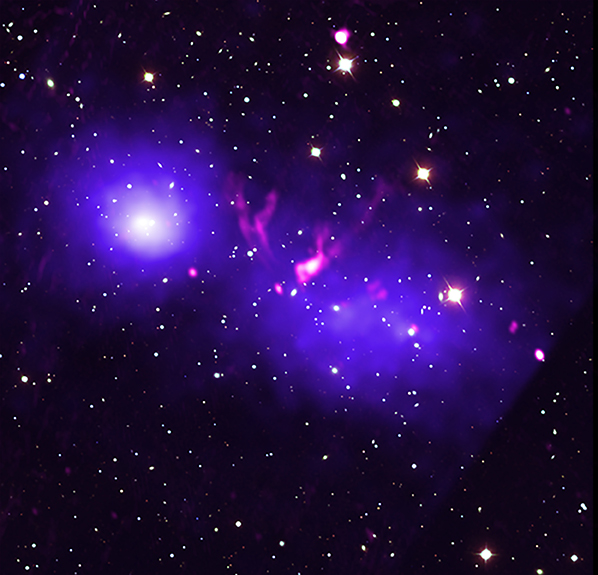
An optical image of the Abell 399 (right) and Abell 401 (left) galaxy clusters, with microwave data from the Planck satellite overlaid in orange showing the location of hot gas in the clusters and linking them together. NuSTAR will help to measure the temperature of this gas. Image credit: ESA/Planck Collaboration/STScI.
Download Image

NuSTAR has recently spent more than two days observing one of the most significant galaxy cluster interactions in the local Universe – the early stage merger of the massive systems Abell 401 and Abell 399. This merger is one of the most energetic events in the Universe, and has profound effects on the Intra-Cluster Medium (ICM); the hot, diffuse, gas that fills the volume between cluster member galaxies, which emits strongly in soft X-rays, and is responsible for a significant percentage of the thermal pressure support that balances a cluster’s gravitational collapse. The ICM of each cluster is undergoing shocks caused by the interaction, becoming even hotter (increasing its thermal pressure), and producing hard X-ray photons that NuSTAR is sensitive to. Without NuSTAR observations, temperature measurements will be biased toward lower temperatures. This shock heating will preferentially occur at the interface between the galaxy clusters, and the high-energy spatial resolution of NuSTAR images is indispensable to being able to make multiple temperature measurements in different spatial regions around the clusters. These NuSTAR observations are also being used to searching for another, more elusive, source of hard X-ray emission from galaxy clusters – Cosmic Microwave Background photons (the leftover microwave radiation from the Big Bang) that have been inverse-compton scattered to X-ray energies by populations of cosmic rays in the ICM. It is extremely hard to identify this emission, but in combination with radio observations, they can both provide information about the cluster magnetic field strength, and the contributions of the magnetic field and the cosmic ray population to the pressure support of a galaxy cluster. In an era where it is now possible to constrain the other known source of ICM pressure (turbulence, using observations from the recently launched JAXA/NASA/ESA mission XRISM), NuSTAR will help build a full picture of the ongoing astrophysical processes in galaxy clusters.

Authors: David Turner (Research Associate, Michigan State University Astronomy Group), Karl Forster (NuSTAR Science Operations Manager)


Wednesday, June 26, 2019

Cluster Merger: Galaxy Clusters Caught in a First Kiss

This image show the separate galaxy clusters 1E2215 and 1E2216, located about 1.2 billion light years from Earth, captured as they enter a critical phase of merging. Chandra’s X-ray data were combined with a radio image from the Giant Metrewave Radio Telescope in India and an optical image from the Sloan Digital Sky Survey that shows galaxies and stars in the field of view.  Credit: X-ray: NASA/CXC/RIKEN/L. Gu et al; Radio: NCRA/TIFR/GMRT; Optical: SDSS 


For the first time, astronomers have found two giant clusters of galaxies that are just about to collide, as reported in a new press release by RIKEN. This observation is important in understanding the formation of structure in the Universe, sincelarge-scale structures—such as galaxies and clusters of galaxies—are thought to grow by collisions and mergers.

The composite image shows the separate galaxy clusters 1E2215 and 1E2216, located about 1.2 billion light years from Earth, captured as they enter a critical phase of merging. Chandra’s X-ray data (blue) have been combined with a radio image from the Giant Metrewave Radio Telescope in India (red). These images were then overlaid on an optical image from the Sloan Digital Sky Survey that shows galaxies and stars in the field of view.

The discovery of 1E2215 and 1E2216 at this stage of merging has enabled astronomers to test their computer simulations of these important collisions. This new result provides evidence of a shock wave that is generated early in the merging process and travels out away from the collision in a perpendicular direction.

Because the merging process takes much longer than a human lifetime, astronomers only see snapshots of the various stages of these collisions. A separate graphic shows 1E2215 and 1E2216, plus two systems at earlier stages before collision (Abell 399/Abell 401, and Abell 1758), and one where the collision has already occurred (CIZA J2242.8). This series of images represents the sequential steps a galaxy cluster would undergo. A labeled version shows the separation between the two clusters and the amount of time, measured in billions of years, before or after impact.

In this cluster sequence graphic, only X-ray and radio data are shown. For Abell 399 and Abell 401, the X-ray data are from ROSAT and the radio data are from GMRT. In the Abell 1758 image and the 1E2215 and 1E2216 image, the X-ray are from Chandra and the radio data come from GMRT. Finally, the X-ray data in CIZA J2242.8 are from ESA’s XMM-Newton, while the radio data are from the Westerbork Synthesis Radio Telescope in the Netherlands. Credit: X-ray: NASA/CXC/RIKEN/L. Gu et al; Radio: NCRA/TIFR/GMRT; Optical: SDSS

Clusters of galaxies are the largest known objects held together by gravity and consist of hundreds of galaxies that each contain hundreds of billions of stars. Ever since the Big Bang, these objects have been growing by colliding and merging with each other. Due to their large size, with diameters of a few million light years, these collisions can take about a billion years to complete. After the dust has settled, the two colliding clusters will have merged into one bigger cluster.

The result was published in Nature Astronomy on June 24, 2019, by first author Liyi Gu of the RIKEN national science institute in Japan and the SRON Netherlands Institute for Space Research and collaborators. NASA's Marshall Space Flight Center in Huntsville, Alabama, manages the Chandra program for NASA's Science Mission Directorate in Washington. The Smithsonian Astrophysical Observatory in Cambridge, Massachusetts, controls Chandra's science and flight operations.


Fast Facts for Cluster Merger:

Scale: About 30 arcmin across (10 million light years)
Category: Groups & Clusters of Galaxies
Coordinates (J2000): RA 22h 18m 20.3s | Dec -03° 49' 41"
Constellation: Aquarius
Observation Date: 5 pointings from July 23 to July 29, 2018
Observation Time: 40 hours (1 day 16 hours)
Obs. ID: 21131-21134, 20778
Instrument: ACIS
References: Gu, L. et al., 2019, Nature Astronomy, in press
Color Code: X-ray: Blue; Radio: Pink; Optical: Red, Green, Blue
Distance Estimate: About 1.2 billion light years (z=0.09)


Wednesday, November 21, 2012

Planck spots hot gas bridging galaxy cluster pair

 
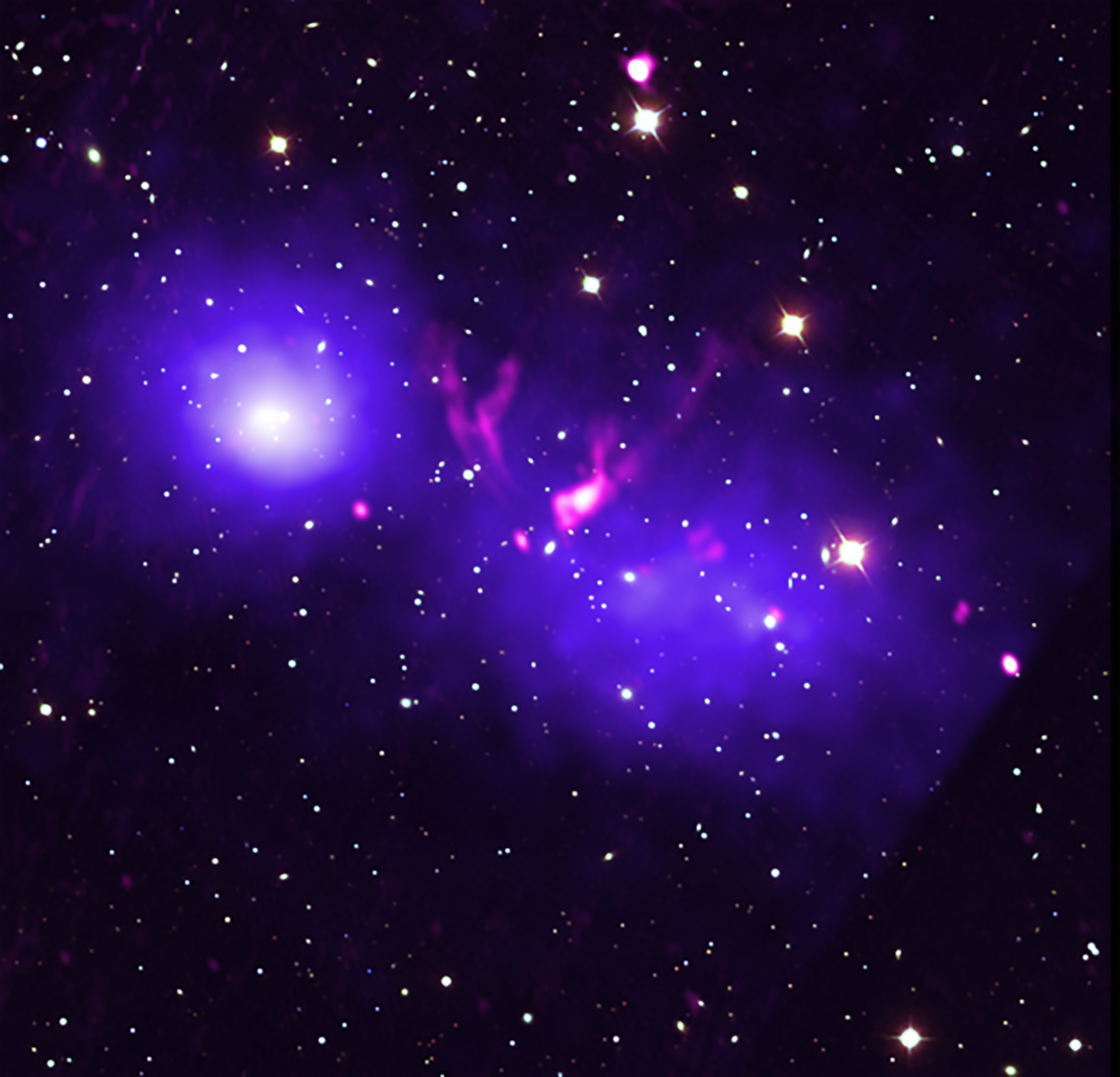
Planck has discovered a bridge of hot gas that connects galaxy clusters Abell 399 (lower centre) and Abell 401 (top left). The galaxy pair is located about a billion light-years from Earth, and the gas bridge extends approximately 10 million light-years between them.
 
The image shows the two galaxy clusters as seen at optical wavelengths with ground-based telescopes and through the Sunyaev-Zel'dovich effect (in orange) with ESA's Planck satellite.

Credits: Sunyaev–Zel’dovich effect: ESA Planck Collaboration; optical image: STScI Digitized Sky Survey .  HI-RES JPEG (Size:
7531 kb) 


ESA’s Planck space telescope has made the first conclusive detection of a bridge of hot gas connecting a pair of galaxy clusters across 10 million light-years of intergalactic space.
 
Planck’s primary task is to capture the most ancient light of the cosmos, the Cosmic Microwave Background, or CMB. As this faint light traverses the Universe, it encounters different types of structure including galaxies and galaxy clusters – assemblies of hundreds to thousands of galaxies bound together by gravity.

If the CMB light interacts with the hot gas permeating these huge cosmic structures, its energy distribution is modified in a characteristic way, a phenomenon known as the Sunyaev–Zel’dovich (SZ) effect, after the scientists who discovered it.

This effect has already been used by Planck to detect galaxy clusters themselves, but it also provides a way to detect faint filaments of gas that might connect one cluster to another.

In the early Universe, filaments of gaseous matter pervaded the cosmos in a giant web, with clusters eventually forming in the densest nodes.

Much of this tenuous, filamentary gas remains undetected, but astronomers expect that it could most likely be found between interacting galaxy clusters, where the filaments are compressed and heated up, making them easier to spot.

Planck’s discovery of a bridge of hot gas connecting the clusters Abell 399 and Abell 401, each containing hundreds of galaxies, represents one such opportunity.

The presence of hot gas between the billion-light-year-distant clusters was first hinted at in X-ray data from ESA’s XMM-Newton, and the new Planck data confirm the observation.

It also marks Planck’s first detection of inter-cluster gas using the SZ effect technique.

By combining the Planck data with archival X-ray observations from the German satellite Rosat, the temperature of the gas in the bridge is found to be similar to the temperature of the gas in the two clusters – on the order of 80 million degrees Celsius.

Early analysis suggests the gas could be mixture of the elusive filaments of the cosmic web mixed with gas originating from the clusters.

A more detailed analysis and the possible detection of gas bridges connecting other clusters will help to provide a more conclusive answer.

The new finding highlights the ability of Planck to probe galaxy clusters to their outskirts and beyond, examining their connection with the gas that permeates the entire Universe and from which all groups of galaxies formed. 


Notes for Editors

“Planck Intermediate Results. VIII. Filaments between interacting clusters”, is accepted for publication in Astronomy & Astrophysics.
 
For further information, please contact:
 
Markus Bauer
ESA Science and Robotic Exploration Communication Officer
Tel: +31 71 565 6799
Mob: +31 61 594 3 954
Email: markus.bauer@esa.int

Jan Tauber
ESA Planck Project Scientist
Tel: +31 71 565 5342
Email: Jan.Tauber@esa.int