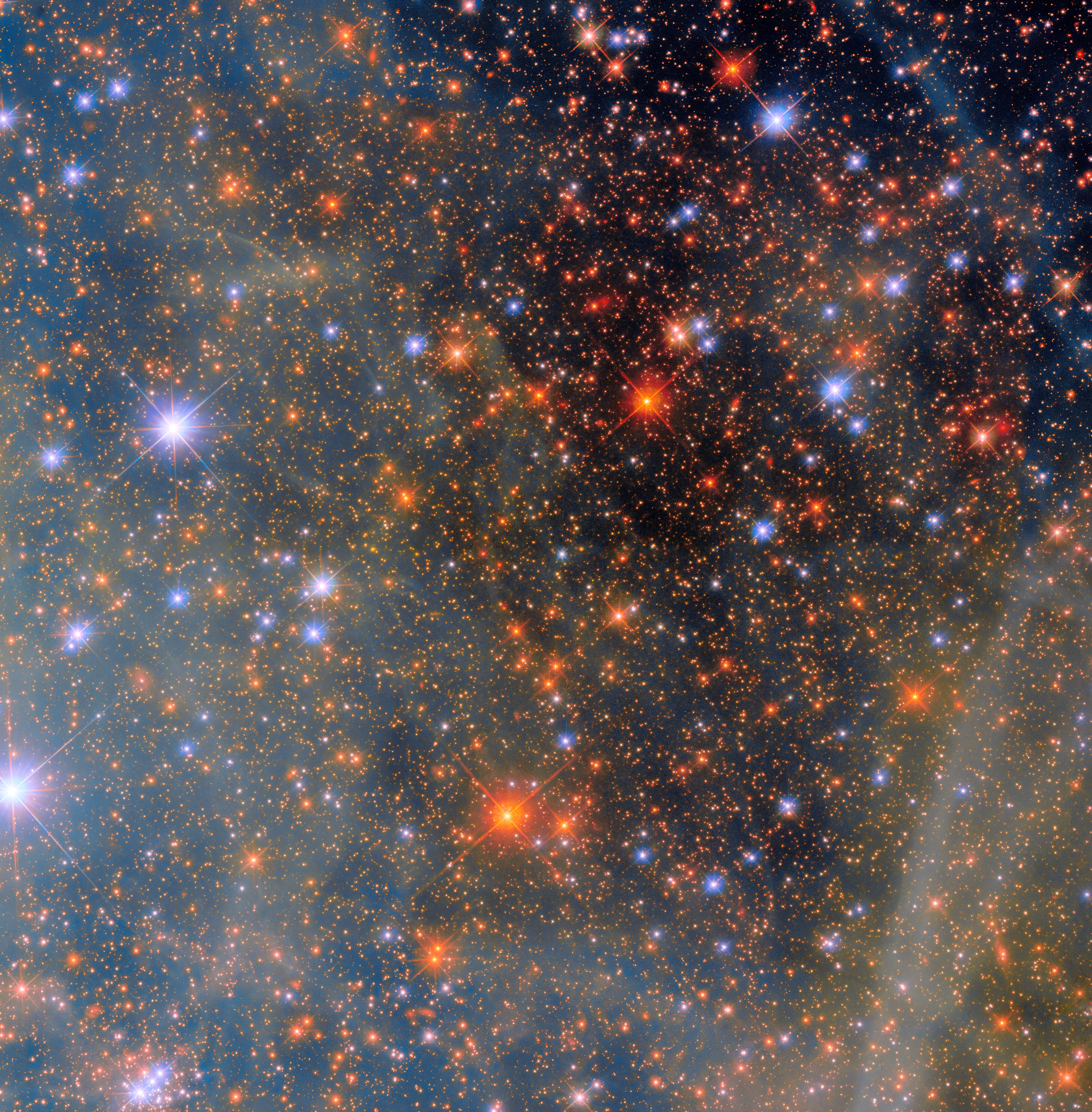
In the centre is an elliptical galaxy, seen as an oval-shaped glow around a small bright core. Around this is wrapped a broad band of light, appearing like a spiral galaxy stretched and warped into a ring, with bright blue lines drawn through it where the spiral arms have been stretched into circles. A few distant objects are visible around the ring on a black background. Credit: ESA/Webb, NASA & CSA, G. Mahler. Acknowledgement: M. A. McDonald
This new NASA/ESA/CSA James Webb Space Telescope Picture of the Month
features a rare cosmic phenomenon called an Einstein ring. What at
first appears to be a single, strangely shaped galaxy is actually two
galaxies that are separated by a large distance. The closer foreground
galaxy sits at the center of the image, while the more distant
background galaxy appears to be wrapped around the closer galaxy,
forming a ring.
Einstein rings occur when light from a very distant object is bent (or ‘lensed’) about a massive intermediate (or ‘lensing’) object. This is possible because spacetime, the fabric of the Universe itself, is bent by mass, and therefore light travelling through space and time is bent as well. This effect is much too subtle to be observed on a local level, but it sometimes becomes clearly observable when dealing with curvatures of light on enormous, astronomical scales, such as when the light from one galaxy is bent around another galaxy or galaxy cluster.
When the lensed object and the lensing object line up just so, the result is the distinctive Einstein ring shape, which appears as a full circle (as seen here) or a partial circle of light around the lensing object, depending on the precision of the alignment. Objects like these are the ideal laboratory in which to research galaxies too faint and distant to otherwise see.
The lensing galaxy at the center of this Einstein ring is an elliptical galaxy, as can be seen from the galaxy’s bright core and smooth, featureless body. This galaxy belongs to a galaxy cluster named SMACSJ0028.2-7537. The lensed galaxy wrapped around the elliptical galaxy is a spiral galaxy. Even though its image has been warped as its light travelled around the galaxy in its path, individual star clusters and gas structures are clearly visible.
The Webb data used in this image were taken as part of the Strong Lensing and Cluster Evolution (SLICE) survey (programme 5594), which is led by Guillaume Mahler at University of Liège in Belgium, and consists of a team of international astronomers. This survey aims to trace 8 billion years of galaxy cluster evolution by targeting 182 galaxy clusters with Webb’s Near-InfraRed Camera instrument. This image also incorporates data from two of the NASA/ESA Hubble Space Telescope’s instruments, the Wide Field Camera 3 and the Advanced Camera for Surveys.
Einstein rings occur when light from a very distant object is bent (or ‘lensed’) about a massive intermediate (or ‘lensing’) object. This is possible because spacetime, the fabric of the Universe itself, is bent by mass, and therefore light travelling through space and time is bent as well. This effect is much too subtle to be observed on a local level, but it sometimes becomes clearly observable when dealing with curvatures of light on enormous, astronomical scales, such as when the light from one galaxy is bent around another galaxy or galaxy cluster.
When the lensed object and the lensing object line up just so, the result is the distinctive Einstein ring shape, which appears as a full circle (as seen here) or a partial circle of light around the lensing object, depending on the precision of the alignment. Objects like these are the ideal laboratory in which to research galaxies too faint and distant to otherwise see.
The lensing galaxy at the center of this Einstein ring is an elliptical galaxy, as can be seen from the galaxy’s bright core and smooth, featureless body. This galaxy belongs to a galaxy cluster named SMACSJ0028.2-7537. The lensed galaxy wrapped around the elliptical galaxy is a spiral galaxy. Even though its image has been warped as its light travelled around the galaxy in its path, individual star clusters and gas structures are clearly visible.
The Webb data used in this image were taken as part of the Strong Lensing and Cluster Evolution (SLICE) survey (programme 5594), which is led by Guillaume Mahler at University of Liège in Belgium, and consists of a team of international astronomers. This survey aims to trace 8 billion years of galaxy cluster evolution by targeting 182 galaxy clusters with Webb’s Near-InfraRed Camera instrument. This image also incorporates data from two of the NASA/ESA Hubble Space Telescope’s instruments, the Wide Field Camera 3 and the Advanced Camera for Surveys.
Links
Source: ESA/Webb/potm