Showing posts with label IGR J17091-3624. Show all posts

Thursday, March 13, 2025

Expecting the Unexpected

An artist's impression of the black hole and its surrounding accretion disk in the system IGR J17091-3624, mid-pulse. In the top right, a plot shows the "heartbeat"—the regular increase and decrease in brightness measured as the system pulses. Image credit: NASA/Goddard Space Flight Center/CI Lab.
Download Image

During the past week, a Target of Opportunity large observing program with NuSTAR was triggered to monitor the outburst of the black hole binary IGR J17091-3624. This X-ray transient black hole binary candidate was first detected in 2003 and has since exhibited fascinating behavior, including radio jets, X-ray quasi-periodic oscillations, and state transitions characteristic of microquasars. Most peculiar are its X-ray flarings, which resemble a “heartbeat” pattern over time—a phenomenon observed in only one other source, GRS 1915+105. This large observing program, consisting of a total of 500 ks of NuSTAR exposure time coordinated NASA’s NICER mission, was designed to track the full evolution of a transient black hole outburst, capturing rapid changes in X-ray spectra and variability as the system transitions through different accretion states. However, after the initial observations, the outburst appeared to fade rather than fully develop, leading to a pause in the program. This unexpected behavior exemplifies one of the key challenges—and excitements—of time-domain astrophysics: black hole outbursts are not always predictable, and what appears to be the beginning of a dramatic event can sometimes fizzle out. We continue to monitor the source with other observatories to determine whether the NuSTAR program should be resumed. The three observations taken so far remain highly valuable, revealing clear signatures of X-ray reflection off an accretion disk, with spectra showing atomic fluorescence lines distorted by the black hole’s gravity. As new data is acquired, we continue to refine our understanding of the factors that drive complete versus failed outbursts in black hole systems.

Last Wednesday was the due date for NuSTAR General Observer (GO) cycle-11, an annual call soliciting proposals for basic research relevant to the NuSTAR mission. This is the primary opportunity for the scientific community to request observing time with NuSTAR, and includes the possibility of proposing for multi-mission investigations by coordinating with NASA’s NICER and Swift and ESA’s XMM-Newton observatories. This year, the project has received a record number of proposals, 15% higher than previous years. The proposal oversubscription rate of available NuSTAR observing time is the highest for many years, and the interest in proposing for Target of Opportunity investigations continues an increasing trend seen in the last five years. Target of Opportunity investigations are the most oversubscribed and competitive aspect of the NuSTAR GO program, mirroring the community's focus on time-domain astrophysics. These proposals will be peer-reviewed by independent panels of experts in April, with recommendations for selection submitted by the end of that month, in time for cycle-11 observations to begin on June 1st this year.

Authors: Javier Garcia (Senior Scientist, GSFC), Karl Forster (NuSTAR Science Operations Lead, Caltech)


Tuesday, February 21, 2012

IGR J17091-3624: NASA'S Chandra Finds Fastest Wind From Stellar-Mass Black Hole

IGR J17091-3624
Credit Illustration: NASA/CXC/M.Weiss


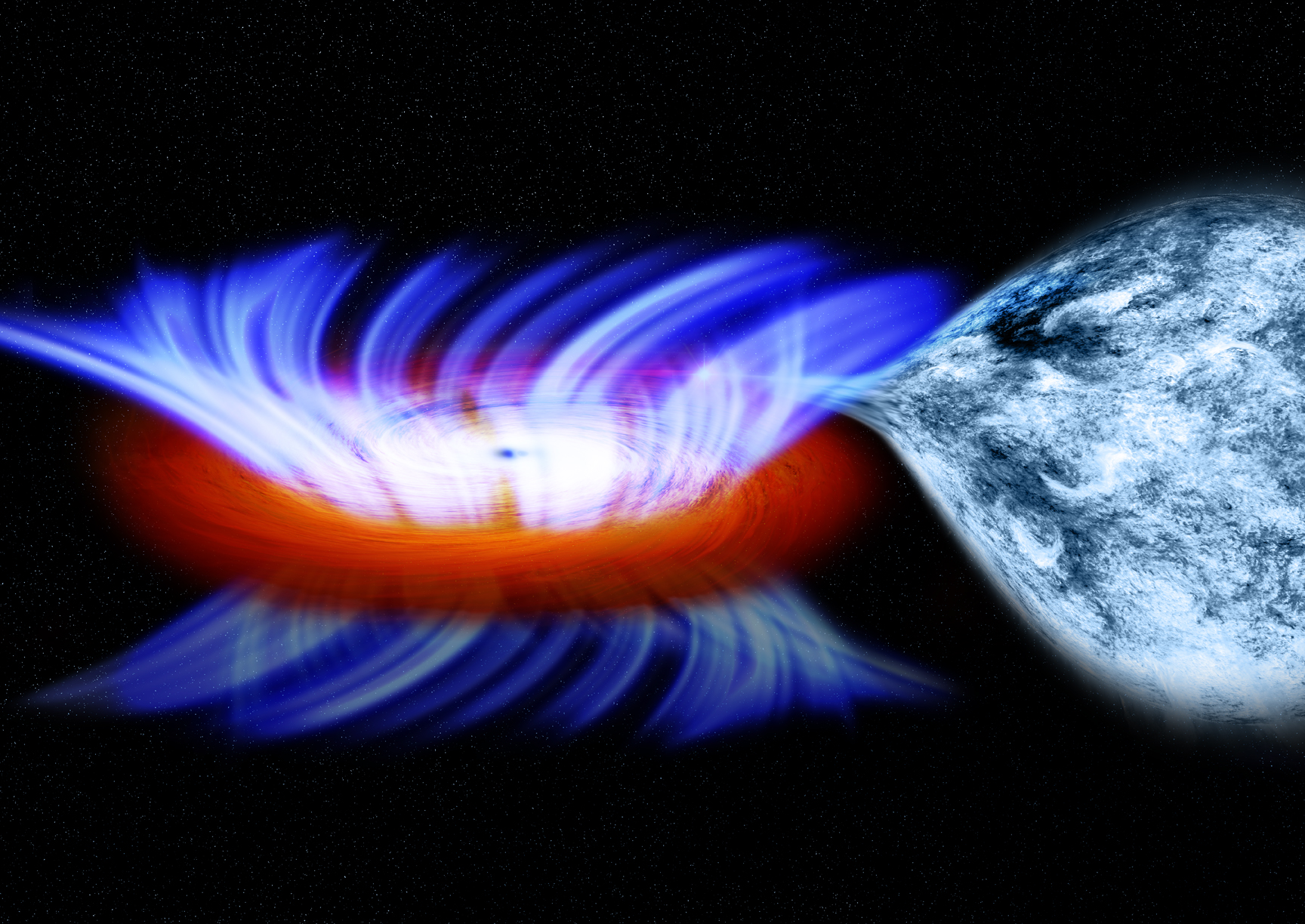
This artist's impression shows a binary system containing a stellar-mass black hole called IGR J17091-3624, or IGR J17091 for short. The strong gravity of the black hole, on the left, is pulling gas away from a companion star on the right. This gas forms a disk of hot gas around the black hole, and the wind is driven off this disk.

New observations with NASA's Chandra X-ray Observatory have clocked the fastest wind ever seen blowing off a disk around this stellar-mass black hole. Stellar-mass black holes are born when extremely massive stars collapse and typically weigh between five and 10 times the mass of the Sun.

The record-breaking wind is moving about twenty million miles per hour, or about three percent the speed of light. This is nearly ten times faster than had ever been seen from a stellar-mass black hole, and matches some of the fastest winds generated by supermassive black holes, objects millions or billions of times more massive.

Another unanticipated finding is that the wind, which comes from a disk of gas surrounding the black hole, may be carrying away much more material than the black hole is capturing.

The high speed for the wind was estimated from a spectrum made by Chandra in 2011. A spectrum shows how intense the X-rays are at different energies. Ions emit and absorb distinct features in spectra, which allow scientists to monitor them and their behavior. A Chandra spectrum of iron ions made two months earlier showed no evidence of the high-speed wind, meaning the wind likely turns on and off over
time.

Fast Facts for IGR J17091-3624:

Category: Black Holes
Coordinates: (J2000) RA 17h 09m 07.92s | Dec -36° 24' 25.20"
Constellation: Scorpius
Observation Dates: 2 pointings on Aug 1 and Oct 6, 2011
Observation Time: 16 hours 40 min
Obs. IDs: 12405, 12406
Instrument: ACIS
References: King, A. et al, 2012, ApJ, 746, L20; arXiv:1112.3648
Distance Estimate: About 28,000 light years

Thursday, December 15, 2011

NASA's RXTE Detects 'Heartbeat' of Smallest Black Hole Candidate

This animation compares the X-ray 'heartbeats' of GRS 1915 and IGR J17091, two black holes that ingest gas from companion stars. GRS 1915 has nearly five times the mass of IGR J17091, which at three solar masses may be the smallest black hole known. A fly-through relates the heartbeats to hypothesized changes in the black hole's jet and disk. Credit: NASA/Goddard Space Flight Center/CI Lab. Download this video and related content from NASA Goddard's Scientific Visualization Studio

An international team of astronomers has identified a candidate for the smallest-known black hole using data from NASA's Rossi X-ray Timing Explorer (RXTE). The evidence comes from a specific type of X-ray pattern, nicknamed a "heartbeat" because of its resemblance to an electrocardiogram. The pattern until now has been recorded in only one other black hole system.

Named IGR J17091-3624 after the astronomical coordinates of its sky position, the binary system combines a normal star with a black hole that may weigh less than three times the sun's mass. That is near the theoretical mass boundary where black holes become possible.

Gas from the normal star streams toward the black hole and forms a disk around it. Friction within the disk heats the gas to millions of degrees, which is hot enough to emit X-rays. Cyclical variations in the intensity of the X-rays observed reflect processes taking place within the gas disk. Scientists think that the most rapid changes occur near the black hole's event horizon, the point beyond which nothing, not even light, can escape.

Astronomers first became aware of the binary system during an outburst in 2003. Archival data from various space missions show it becomes active every few years. Its most recent outburst started in February and is ongoing. The system is located in the direction of the constellation Scorpius, but its distance is not well established. It could be as close as 16,000 light-years or more than 65,000 light-years away.

The record-holder for wide-ranging X-ray variability is another black hole binary system named GRS 1915+105. This system is unique in displaying more than a dozen highly structured patterns, typically lasting between seconds and hours.

"We think that most of these patterns represent cycles of accumulation and ejection in an unstable disk, and we now see seven of them in IGR J17091," said Tomaso Belloni at Brera Observatory in Merate, Italy. "Identifying these signatures in a second black hole system is very exciting."

In GRS 1915, strong magnetic fields near the black hole's event horizon eject some of the gas into dual, oppositely directed jets that blast outward at about 98 percent the speed of light. The peak of its heartbeat emission corresponds to the emergence of the jet.

Changes in the X-ray spectrum observed by RXTE during each beat reveal that the innermost region of the disk emits enough radiation to push back the gas, creating a strong outward wind that stops the inward flow, briefly starving the black hole and shutting down the jet. This corresponds to the faintest emission. Eventually, the inner disk gets so bright and hot it essentially disintegrates and plunges toward the black hole, re-establishing the jet and beginning the cycle anew. This entire process happens in as little as 40 seconds.

While there is no direct evidence IGR J17091 possesses a particle jet, its heartbeat signature suggests that similar processes are at work. Researchers say that this system's heartbeat emission can be 20 times fainter than GRS 1915 and can cycle some eight times faster, in as little as five seconds.

Astronomers estimate that GRS 1915 is about 14 times the sun's mass, placing it among the most-massive-known black holes that have formed because of the collapse of a single star. The research team analyzed six months of RXTE observations to compare the two systems, concluding that IGR J17091 must possess a minuscule black hole.

"Just as the heart rate of a mouse is faster than an elephant's, the heartbeat signals from these black holes scale according to their masses," said Diego Altamirano, an astrophysicist at the University of Amsterdam in The Netherlands and lead author of a paper describing the findings in the Nov. 4 issue of The Astrophysical Journal Letters.

The researchers say this analysis is just the start of a larger program to compare both of these black holes in detail using data from RXTE, NASA's Swift satellite and the European XMM-Newton observatory.

"Until this study, GRS 1915 was essentially a one-off, and there's only so much we can understand from a single example," said Tod Strohmayer, the project scientist for RXTE at NASA's Goddard Space Flight Center in Greenbelt, Md. "Now, with a second system exhibiting similar types of variability, we really can begin to test how well we understand what happens at the brink of a black hole."

Launched in late 1995, RXTE is second only to Hubble as the longest serving of NASA's operating astrophysics missions. RXTE provides a unique observing window into the extreme environments of neutron stars and black holes.

Francis Reddy

Source: NASA


Related links

Dutch press release
http://www.astronomie.nl/nieuws\2362/astronomen_observeren_de_hartslag_van_een_piepklein_zwart_gat.html

Italian press release
http://www.media.inaf.it/2011/12/12/batticuore-buco-nero/

GRS 1915+105: Taking the Pulse of a Black Hole System
http://chandra.harvard.edu/photo/2011/g1915/

RXTE Homes in on a Black Hole's Jets
http://www.nasa.gov/topics/universe/features/black-hole-jets.html

Francis Reddy
NASA's Goddard Space Flight Center, Greenbelt, Md.