Showing posts with label intracluster medium (ICM). Show all posts

Friday, December 19, 2025

Massive non-cool-core galaxy cluster explored with Chandra

Exposure-corrected 0.5–7 keV Chandra ACIS-I0–3 image of SPT-CL J0217-5014. The source extraction region, centered on the X-ray centroid, is shown by a white circle. The regions used for local background extraction are also indicated. All point sources were excluded from both the source and background regions during imaging and spectral analysis. Credit: arXiv (2025). DOI: 10.48550/arxiv.2512.04689


Astronomers have employed NASA's Chandra spacecraft to perform X-ray observations of a massive galaxy cluster known as SPT-CL J0217-5014. Results of the observational campaign, published December 4 on the arXiv preprint server, yield important insights into the properties and nature of this cluster.

Enormous gravitationally-bound structures

Galaxy clusters contain up to thousands of galaxies bound together by gravity. They form through accretion of mass and infall of smaller sub-structures and are the largest known gravitationally-bound structures in the universe. Astronomers perceive galaxy clusters as excellent laboratories for studying galaxy evolution and cosmology.

SPT-CL J0217-5014 is a galaxy cluster at a redshift of 0.53, with a stellar mass of about 300 trillion solar masses, and super-solar iron abundance. Given that very little is known regarding the properties of this cluster, a team of astronomers led by Dan Hu of Masaryk University in Brno, Czech Republic, decided to investigate it with Chandra's Advanced CCD Imaging Spectrometer (ACIS)-I array.

"This study aims to evaluate its chemical and thermodynamic properties with a dedicated Chandra observation," the researchers write.

Disturbed non-cool-core cluster

Chandra imaging revealed that SPT-CL J0217-5014 has a disturbed morphology, characterized by a surface brightness edge at about 330,000 light years to the west and a tail-like feature extending to the east. Such morphology suggests a disturbed, non-relaxed intracluster medium (ICM).

Furthermore, the collected data indicate that SPT-CL J0217-5014 is a non-cool-core cluster. It turned out that the cluster has a sub-solar abundance, which is consistent with the typical metallicities observed in non-cool-core clusters. The astronomers explained that in such clusters, the dynamical processes could disrupt the cool core and tend to mix the central metal-rich gas with the outer ICM.

The study found that the power ratio and morphology index of SPT-CL J0217-5014 clearly place it in the dynamically disturbed regime. This suggests that the cluster may have experienced a merger event.

Potential companions of SPT-CL J0217-5014

The observation also resulted in the identification of three potential galaxy clusters near SPT-CL J0217-5014, which received the designations CIG 2, CIG 3, and CIG 4. They have lower mass and are less enriched than SPT-CL J0217-5014. This finding indicates that SPT-CL J0217-5014 is the primary, most massive cluster in this complex and likely sits at a node of the surrounding large-scale structure. "SPT-CL J0217–5014 likely underwent a relatively energetic, nearly head-on merger that disrupted a pre-existing cool core; ClG 2 and ClG 3 may be lower-mass companions that have merged with or fallen onto the main cluster, while ClG 4 aligns with the extension of the filamentary galaxy distribution, suggesting its association with a broader cosmic web," the authors conclude.


Written for you by our author: Tomasz Nowakowski, edited by Stephanie Baum, and fact-checked and reviewed by Robert Egan—this article is the result of careful human work. We rely on readers like you to keep independent science journalism alive. If this reporting matters to you, please consider a donation (especially monthly). You'll get an ad-free account as a thank-you.


More information: Dan Hu et al, A Chandra view of SPT-CL J0217-5014: a massive galaxy cluster at a cosmic intersection at z=0.53, arXiv (2025). DOI: 10.48550/arxiv.2512.04689

Journal information: arXiv

© 2025 Science X Network


Explore further

X-ray observations reveal dynamic features of galaxy cluster PLCKG287


Thursday, March 20, 2025

Hidden Cosmic Fuel Tank Found in Infant Galaxy Cluster

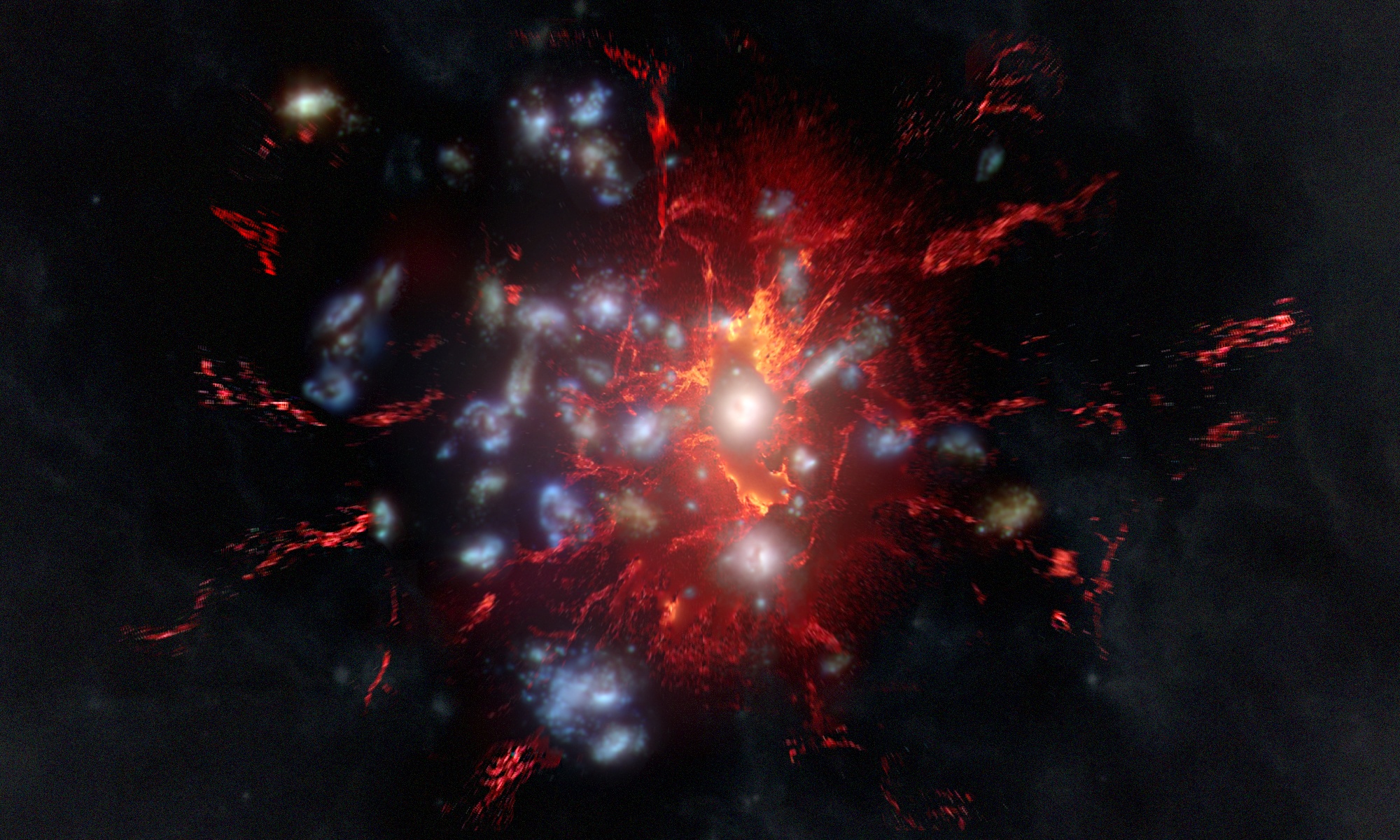
Illustration of the extended molecular gas (red) surrounding the galaxies in the protocluster core SPT2349-56
Credit: MPIfR/N.Sulzenauer.
Hi-Res File


Surprise ALMA-APEX discovery reveals diffuse molecular gas in galaxy protocluster SPT2349-56 – 75% more than previously detected – extending star formation timeline to 400 million years

Astronomers using the Atacama Large Millimeter/submillimeter Array (ALMA), along with complementary data from the Atacama Pathfinder Experiment (APEX), have discovered a surprisingly large reservoir of molecular gas in a protocluster of galaxies known as SPT2349-56. This protocluster, located approximately 12 billion light-years away, is a region of the early universe where a cluster of galaxies is just beginning to form.

Galaxy clusters are the largest structures in the universe, and understanding their formation is a major goal of scientists. Protoclusters like SPT2349-56 offer a unique window into this process, allowing astronomers to observe galaxies as they come together in a dense environment.

This new research, led by Dazhi Zhou of the University of British Columbia, focuses on the molecular gas within SPT2349-56. Molecular gas, primarily hydrogen, is the raw material for star formation, which plays a critical role in galaxy evolution.

Key Findings:

Missing Gas

  • By comparing observations from ALMA’s high-resolution configuration with lower-resolution data from ALMA’s Atacama Compact Array (ACA) and APEX, the team found a significant amount of molecular gas that was “invisible” in the higher-resolution ALMA images. The ACA detected 75% more CO than the sum of individual sources detected in higher-resolution ALMA data.

Extended Reservoir

  • This missing gas isn’t just a few faint, undetected galaxies. Instead, it appears to be a diffuse reservoir of gas spread throughout the protocluster.

Fuel for Starbursts
  • This hidden gas reservoir could be the key to understanding the intense star formation activity observed in SPT2349-56. The presence of so much extra gas extends the star formation fuel, meaning the overall depletion timescale will exceed 400 million years.

Proto-Intracluster Medium
  • The team speculates that this extended gas might be the precursor to the hot, diffuse gas known as the intracluster medium (ICM) that fills mature galaxy cluster

“This discovery highlights the power of ALMA, especially when used in multiple configurations,” says Zhou. “The high-resolution observations allowed us to pinpoint individual galaxies, while the lower-resolution data revealed the bigger picture – the extended gas that connects these galaxies and fuels their star formation.”

SPT2349-56 is an extreme system, producing stars ~ten thousand times faster than our milky way but in a comparable size, and these observations have pushed scientists’ understanding of galaxy formation and evolution. No simulation or galaxy formation model had previously predicted this overdensity of gas.These findings also suggest that high-resolution ALMA observations, while excellent for studying individual galaxies, may miss a significant component of the gas in these early clusters. The missing gas may reside in the circum-galactic medium (CGM) or the pre-heated proto-intracluster medium (proto-ICM). Future studies using ALMA’s full capabilities, including its compact array configurations, will be crucial for fully characterizing this hidden gas reservoir and understanding its role in the formation of galaxy clusters. (DZ: acknowledgement of SPT: The South Pole Telescope is supported by the National Science Foundation, the Department of Energy, and the United States Antarctic Program. DOI: 10.1038/s41586-023-05998-6.)


About ALMA

The Atacama Large Millimeter/submillimeter Array (ALMA), an international astronomy facility, is a partnership of the European Southern Observatory (ESO), the U.S. National Science Foundation (NSF) and the National Institutes of Natural Sciences (NINS) of Japan in cooperation with the Republic of Chile. ALMA is funded by ESO on behalf of its Member States, by NSF in cooperation with the National Research Council of Canada (NRC) and the National Science and Technology Council (NSTC) in Taiwan and by NINS in cooperation with the Academia Sinica (AS) in Taiwan and the Korea Astronomy and Space Science Institute (KASI).

ALMA construction and operations are led by ESO on behalf of its Member States; by the National Radio Astronomy Observatory (NRAO), managed by Associated Universities, Inc. (AUI), on behalf of North America; and by the National Astronomical Observatory of Japan (NAOJ) on behalf of East Asia. The Joint ALMA Observatory (JAO) provides the unified leadership and management of the construction, commissioning and operation of ALMA.


Thursday, March 13, 2025

NuSTAR Observes Merging Clusters

An optical image of the Abell 399 (right) and Abell 401 (left) galaxy clusters, with microwave data from the Planck satellite overlaid in orange showing the location of hot gas in the clusters and linking them together. NuSTAR will help to measure the temperature of this gas. Image credit: ESA/Planck Collaboration/STScI.
Download Image

NuSTAR has recently spent more than two days observing one of the most significant galaxy cluster interactions in the local Universe – the early stage merger of the massive systems Abell 401 and Abell 399. This merger is one of the most energetic events in the Universe, and has profound effects on the Intra-Cluster Medium (ICM); the hot, diffuse, gas that fills the volume between cluster member galaxies, which emits strongly in soft X-rays, and is responsible for a significant percentage of the thermal pressure support that balances a cluster’s gravitational collapse. The ICM of each cluster is undergoing shocks caused by the interaction, becoming even hotter (increasing its thermal pressure), and producing hard X-ray photons that NuSTAR is sensitive to. Without NuSTAR observations, temperature measurements will be biased toward lower temperatures. This shock heating will preferentially occur at the interface between the galaxy clusters, and the high-energy spatial resolution of NuSTAR images is indispensable to being able to make multiple temperature measurements in different spatial regions around the clusters. These NuSTAR observations are also being used to searching for another, more elusive, source of hard X-ray emission from galaxy clusters – Cosmic Microwave Background photons (the leftover microwave radiation from the Big Bang) that have been inverse-compton scattered to X-ray energies by populations of cosmic rays in the ICM. It is extremely hard to identify this emission, but in combination with radio observations, they can both provide information about the cluster magnetic field strength, and the contributions of the magnetic field and the cosmic ray population to the pressure support of a galaxy cluster. In an era where it is now possible to constrain the other known source of ICM pressure (turbulence, using observations from the recently launched JAXA/NASA/ESA mission XRISM), NuSTAR will help build a full picture of the ongoing astrophysical processes in galaxy clusters.

Authors: David Turner (Research Associate, Michigan State University Astronomy Group), Karl Forster (NuSTAR Science Operations Manager)


Friday, February 14, 2025

Teaming Up To Observe the Perseus Cluster

An X-ray image of the Perseus cluster taken by Hitomi, the precursor mission to XRISM. Image credit: NASA/CXC/SAO/E.Bulbul, et al. Download Image

During the past week, NuSTAR observed the Perseus Cluster, the brightest galaxy cluster in the sky in the X-rays, in coordination with the JAXA-NASA-ESA mission XRISM. Perseus is a calibration source for the wide-field Xtend imager on XRISM, but it also provides extremely valuable science for the primary XRISM instrument, Resolve. Resolve is the first high-spectral-resolution X-ray imaging spectrometer to fly an extended mission, replacing the similar instrument lost on the Hitomi mission. The XRISM science team has studied earlier observations of Perseus to try to resolve Doppler motions of the super-heated intra-cluster medium (ICM) gas, groundbreaking studies that will help us understand how these enormous galaxy clusters formed and evolved. However, the supermassive black hole at the center of the Perseus cluster also emits copious X-rays, which need to be disentangled from the ICM X-ray signal to properly isolate and measure the cluster gas motions. Simultaneous observations by NuSTAR are in a higher energy band than XRISM where the data is dominated by X-rays from the black hole. This will allow the XRISM calibration team to account for the contribution from the black hole in the XRISM observations, and precisely measure not only the gas motion but also the abundances of key elements and the temperature structure of the ICM. Since this is a calibration target observed twice a year by XRISM, a very deep total exposure will be obtained, and the vital collaboration with NuSTAR will enable a transformative view into the astrophysics of galaxy clusters.

Authors: Eric D. Miller (XRISM In-Flight Calibration Lead, MIT Kavli Institute for Astrophysics and Space Research)


Monday, December 02, 2024

An improved quantification of the intergalactic medium and cosmic filaments

Smoothed 0.3–1.2 keV eROSITA count rate map of the analysis footprint. The missing pixels show source-masked regions. Credit: Astronomy & Astrophysics (2024). DOI: 10.1051/0004-6361/202450933

Much of the mass in the universe lies not in stars or galaxies, but in the space between them, known as the intergalactic medium. It is warm and even hot, and is called the "warm-hot intergalactic medium," or WHIM. It holds about 50% of the normal mass (viz. baryonic, not including dark matter) of the universe but with a density of hydrogen ions less than 100 per cubic meter.

At temperatures between 100,000 and 10 million Kelvin, it is a web of "cosmic filaments" that are regions of hot, diffuse gas stretching between galaxies. These cosmic filaments, also called "galactic filaments," are the largest structures known in the universe, commonly 150 to 250 megaparsecs long (500 to 800 million light-years), the latter 8,000 times the width of the Milky Way galaxy.

Together they form the cosmic web, and they form the boundaries between cosmic voids, enormous regions of empty space containing almost no galaxies.

"The properties of the warm-hot intergalactic medium in cosmic filaments are among the least quantified units in modern astrophysics," writes a team of scientists from Europe, mostly Germany.

Using an instrument on a satellite that started surveying the universe in late 2019, they examined the X-ray emissions from almost 8,000 cosmic filaments and used a model to determine the temperature and baryon density contrast of the detected WHIM. Their work was published in the journal Astronomy & Astrophysics.

Cosmic filaments span almost the entire universe. Between them are voids with atom densities around one per cubic meter. (That is an extremely intense vacuum—by comparison, the density in interstellar space inside our own galaxy is a million to a trillion atoms per cubic meter, and the best vacuums that can be created on Earth is on the order of 1016 atoms per cubic meter.)

The void closest to us is the "Local Void." The cosmic filaments connect galaxies in a vast web; they are mostly full of gas, dust, stars, and a lot of dark matter. They are very hot, in a plasma state, but not as hot or as dense as the sun, consisting of ionized hydrogen atoms (a proton), and are detected by the absorption of light given off by quasars.

To study these structures, the group used data from eROSITA, an X-ray instrument that was part of the Russian-German Spectrum Roentgen Gamma space observatory. (Launched in July 2019, eROSITA was to image the entire sky for seven years, but the instrument stopped collecting data in February 2022, two days after Russia invaded Ukraine and institutional relations broke down.)

Distribution of the selected filaments in the redshift and physical length space. Credit: Astronomy & Astrophysics (2024); DOI: 10.1051/0004-6361/202450933

"Stacked" scans—the same images taken multiple times, a common way to deal with weak single scan intensities—were collected between December 12 to 19, 2021 in the X-ray spectrum of about 1 kilo-electronvolt (wavelengths of about 1 nm), utilizing four stacks. They then used a catalog of optical filaments, compiled in 2011 from the Sloan Digital Sky Survey, which contains over 63,000 filaments.

Assuming the standard cosmological parameters for the canonical ΛCDM model—the Hubble constant, the matter density, the baryon density and dark matter energy density, they calculated the physical length of the filaments.

Lengthy data analysis followed. First, they obtained the surface brightness profile of all filaments at discrete distances along each, carefully accounting for a host of effects such as projection effects, overlapped filaments and subtracting out the local background near each filament.

Next, they estimated the fraction of each signal due to unmasked galactic sources such as X-ray detected point sources, galaxy clusters and groups and other complicating factors. Finally, detailed astrophysical models (some from established libraries), corrections for instrument bias and statistical reasoning gave the best-fit temperature and density profiles of the gas in the weak hot intergalactic medium (WHIM).

Their best-fit temperature was 106.84 Kelvin, which is about 7 million K. For the baryon density contrast—the difference between the density of baryons and the average density of baryons—they found 101.88, which is 76. The density of ordinary matter, which is mostly baryons, in the WHIM was 76 times greater than the background baryon density of space.

Their average density contrast agrees with numerical simulations, but the relatively simple temperature they calculated was near the upper boundary of the X-ray emitting WHIM. This was not unexpected, they write, as the simple temperature was expected to be "biased to the high end of the temperature distribution when fitting a spectrum with a multi-temperature nature."

Understanding the X-ray emitting cosmic filaments and WHIM through studies such as this is expected to significantly improve in the coming decade, as improved filament finders are completed and a better understanding develops of the X-ray properties of galaxy groups, active galaxy nuclei and fast radio bursts allows better subtraction from the total WHIM signal.

X-ray missions such as the Hot Universe Baryon Surveyor and Line Emission Mapper "will be able to explore a wider parameter space of the WHIM properties," throwing more metaphorical light on the mysterious intergalactic medium.

by David Appell , Phys.org


More information: X. Zhang et al, The SRG/eROSITA all-sky survey, Astronomy & Astrophysics (2024). DOI: 10.1051/0004-6361/202450933

Journal information: Astronomy & Astrophysics

© 2024 Science X Network


Explore further


Sunday, December 01, 2024

Clusters

The images above show the galaxy cluster Abell 2034 in the optical, X-ray and radio. These show that the cluster contains 328 individual galaxies (including two massive brightest cluster galaxies) a disturbed ICM and several distinct sites of particle acceleration.

As the Universe evolves, gravity brings together hundreds, sometimes thousands of galaxies together to form galaxy clusters. The galaxies within these clusters usually account for about 1% of the total mass. They are encompassed by a hot low density gas (a million to 10 million Kelvin) known as the intra-cluster medium (ICM) which contains about 9% of the cluster mass. The other, approximately 90% of the mass is in the surrounding dark matter halo.

Observations at different frequencies

Observations at different frequencies help us to form a comprehensive picture of the structure and evolution of galaxy clusters. Optical telescopes, for example, can detect individual galaxies allowing us to determine the dynamics of the galaxies and infer the distribution of dark matter. X-rays observatories are used to measure thermal emission from the ICM. Radio telescopes offer a completely different view. They detect non-thermal emission, which reveals the cluster’s magnetic field and the sites of extreme particle acceleration in the ICM.

ASTRON interests

Our group at ASTRON is interested in studying the particle acceleration processes and magnetic fields within the tenuous ICM. We wish to understand the formation of radio halos which are characterised by cluster-wide radio emission and are thought to be caused by turbulence throughout the cluster. We also aim to understand the conditions that lead to the formation of radio relics. These objects are characterised by their peripheral location and are thought to be generated by large shock waves. Finally, we are studying other unusual structures showing intense particle acceleration in the ICM and the interaction between the ICM and discrete radio sources such as tailed radio galaxies.

Research staff: Tim Shimwell


Wednesday, May 29, 2024

Sloshing cold front detected in a massive galaxy cluster

RGB (tricolor) image of Abell 2566 obtained by proper combination of emission measured at 1.4 GHz with VLA

By analyzing the data from NASA's Chandra X-ray observatory, astronomers from India and South Africa have investigated a massive galaxy cluster known as Abell 2566. They detected sloshing cold fronts in the intracluster medium (ICM) of this cluster. The finding was reported in a research paper published May 17 on the preprint server arXiv.

Galaxy clusters contain up to thousands of galaxies bound together by gravity. They are the largest known gravitationally bound structures in the universe, and could serve as excellent laboratories for studying galaxy evolution and cosmology.

In general, the so-called cold fronts are sharp surface brightness discontinuities observed in X-ray images, where the drop of the surface brightness and is accompanied by a jump in the gas temperature, with the denser region colder than the more rarefied region.

Now, a team of astronomers led by Sonali K. Kadam of the Swami Ramanand Teerth Marathwada University in India has identified such features in Abell 2566—a cool core galaxy cluster at a redshift of 0.08, with an estimated mass of about 217 trillion solar masses.

By analyzing Chandra images and archival radio data, Kadam's team found evidence of gas sloshing in the core of Abell 2566 along with a pair of cold fronts in its environment.

First of all, the collected images unveiled an unusual morphology of ICM distribution—in the form of spiral-shaped gas sloshing along with edges in the surface brightness distribution. Spectral analysis conducted by the astronomers then confirmed an association of these morphological discontinuities with the cold fronts.

"A detailed analysis of the sectorial brightness profiles along these edges confirm their origin due to sloshing of gas, referred to as the sloshing cold fronts," the researchers explained.

Furthermore, the observations identified an offset of about 22,200 between the brightest cluster galaxy (BCG) and the X-ray emission peak, as well as close association of the BCG with a neighboring system. The authors of the paper suppose that this offset might have yielded the sloshing structure in Abell 2566.

Based on the collected data, the astronomers assume that the observed features and complex morphology of plasma distribution in Abell 2566 share a common origin—as they may be due to a minor merger. The team noted that a sub-cluster may have disturbed the main cluster by displacing its gravitational potential well.

"Such a displacement further results in the formation of cold fronts, the concentrically shaped borders in the surface brightness produced by the core's gas as it moves around the potential well. These further develop spiral patterns in the plasma distribution provided the sloshing direction is close to the plane of sky," the scientists concluded.

by Tomasz Nowakowski, Phys.org


More information: S. K. Kadam et al, Sloshing Cold Fronts in Galaxy Cluster Abell 2566, arXiv (2024). DOI: 10.48550/arxiv.2405.10475


Journal information: arXiv


© 2024 Science X Network

Explore further

Two large cold fronts detected in the galaxy cluster Abell 3558


Saturday, July 01, 2023

Cool, Relaxed, but Way Out of Its Lane: The Most Distant Cooling-Flow Galaxy Cluster Yet Observed


Title: SPT-CL J2215-3537: A Massive Starburst at the Center of the Most Distant Relaxed Galaxy Cluster
Authors: Michael S. Calzadilla et al.
First Author’s Institution: Massachusetts Institute of Technology
Status: Published in ApJ

The largest gravitationally bound structures in the universe are galaxy clusters — hundreds to thousands of individual galaxies bound together by gravity and surrounded by dark matter and gas. Lurking at the center of these galaxy clusters are the brightest galaxies in the universe: the aptly named brightest cluster galaxies (BCGs).

Because BCGs are right at the center of their galaxy cluster’s gravitational field, the clusters themselves act like a well, funneling new material onto the BCGs. This means that BCGs grow very large, and the evolution of the BCG is intimately linked to the evolution of the full galaxy cluster. Traditionally, it has been thought that the clusters feed the BCG with other galaxies full of pre-made stars (this mechanism is referred to as, no joke, galactic cannibalism — here’s a video on the topic). However, many BCGs have been observed to actively grow new stars. In these cases, it seems like the cluster is feeding free-floating gas known as the intracluster medium (ICM) to the BCG. This ICM contains the ingredients for star formation (mostly hydrogen gas), and the BCG can process these ingredients into new stars itself.

Going with the Flow

In order for this second type of BCG growth to be happening, the galaxy cluster needs to obey some fairly specific criteria. There needs to be one specific BCG in the cluster, and it needs to be sitting at the center of the cluster’s gravitational field, in order to direct the ICM onto the BCG. The cluster itself also needs to be large enough to have a lot of concentrated ICM, and old enough that a lot of the initial heat (kinetic energy) in the ICM has had time to escape (if not, it will be moving around too fast to get caught by the BCG’s gravity). These types of clusters are known as “cool-core” clusters, and the flow of ICM onto the BCG is known as a “cooling flow.” All of these things typically happen naturally in clusters, but they all require time, so they’re far more common in much older clusters at times much closer to the present day. These clusters are called “relaxed.” That’s what makes today’s article so exciting — the authors of this article have found a relaxed cluster funneling material onto its BCG at redshift 1.16 (only about 5.3 billion years after the Big Bang). This is the earliest example of such a cluster found to date — so this cluster must have relaxed faster than previously thought possible.


Figure 1: Some of the wide variety of observations required to study this galaxy cluster. Clockwise from the top left, they are: the ASKAP radio observations showing the active galactic nucleus, the Chandra X-ray observations showing the ICM, a Hubble composite image showing the cluster, and zoom-ins on the BCG in optical and ultraviolet wavelengths (respectively), also from Hubble. Credit: Calzadilla et al. 2023


The Picture(s) of Relaxation

This cluster, known as SPT-CL J2215-3537, or SPT2215, was originally found using the Sunyaev–Zeldovich effect in a South Pole Telescope survey. Optical and ultraviolet imaging (Figure 1) from the Hubble Space Telescope and the Magellan Telescopes were used to find the galaxies associated with the cluster, and optical spectroscopy from Magellan was used to make sure that the galaxies were all associated with the cluster in all three dimensions. This optical spectroscopy also measured the distance to the cluster, using redshifting of spectral lines, and therefore confirmed that we’re observing this cluster earlier in the universe’s history than any other cluster of its kind. A faint radio-wavelength source (probably an active galactic nucleus) was also found to be associated with the cluster using the Australian Square Kilometre Array Pathfinder (ASKAP) (Figure 1).


Figure 2: The temperature profile of the ICM of the galaxy cluster, measured from the X-ray observations shown in Figure 1. The temperature is shown in energy units, because in this case it’s essentially a measure of the kinetic energy of the gas. The grey line shows the actual data points, and the green region is a fit to a known model of the temperature profile in cool-core clusters.
Adapted from Calzadilla et al. 2023

A Cool Customer

The ICM is very diffuse, and it isn’t typically visible in optical or ultraviolet measurements. In order to measure this cluster’s ICM properties, the authors had to take observations using the Chandra X-ray Observatory. From this, they noticed that the ICM is distributed extremely regularly in the cluster, and that the ICM’s luminosity peaks very strongly in the center. As mentioned above, both of these characteristics are good indicators that the cluster is relaxed. The authors also measured the spectrum of the X-rays in order to determine the temperature of the ICM. By measuring different X-ray spectra at different distances from the center of the cluster, the authors developed a temperature profile (Figure 2). This showed that the ICM in the middle of the cluster in particular had a very low temperature, making it a cool-core cluster. Filaments of gas are also visible surrounding the BCG in the ultraviolet imaging from Hubble, suggesting that ICM is indeed falling onto the BCG.

Relaxed, but Working Hard

Finally, the authors measured the spectral energy distribution of the BCG itself (Figure 3). This is a technique where the amount of light emitted from a galaxy is measured at as many different wavelengths as possible, and then the luminosity at these different wavelengths is compared. Different components of a galaxy (such as new stars, old stars, or gas) emit light at different wavelengths, so scientists can estimate how fast a galaxy forms stars by fitting measurements to models of these different components. In this case, the authors used the Hubble and Magellan measurements mentioned above (at optical and ultraviolet wavelengths), additional near-infrared Magellan measurements, and far-infrared (very long-wavelength) Spitzer Space Telescope observations to construct their spectral energy distribution. From the spectral energy distribution, they determined that the BCG in this cluster was forming 320 solar masses of new stars every year (about 300 times the Milky Way’s rate)!


Figure 3: The spectral energy distribution of the BCG inside SPT2215. The blue points show the observed values for this galaxy, and the red points show the model that was fit to these values. Using this technique, the authors determined that the BCG is forming stars at a much higher rate than expected. Credit: Calzadilla et al. 2023


All of this evidence seems to point to a BCG forming stars out of fuel from the cluster itself. If this is the case, this will be the earliest ever example of such a cluster, and it has some pretty exciting implications. The authors suggest that clusters relaxing this quickly may have a totally separate mechanism for BCG formation, independent from the cannibalism-driven growth we expect. It also implies that active galactic nuclei (such as the one seen in the ASKAP imaging of this cluster in Figure 1) could start powering on earlier than expected, feeding energy back into the BCG and the cluster and disrupting star formation. The authors are working with more X-ray observations to characterize the physics of this cluster more precisely, and hopefully figure out some of the specifics of these implications.

Original astrobite edited by William Lamb.


About the author, Delaney Dunne:

I’m a PhD student at Caltech, where I study how galaxies form and evolve by mapping their molecular gas! I do this using COMAP, a radio-frequency Line Intensity Mapping experiment based in California’s Owens Valley.


Thursday, March 30, 2023

Astronomers witness the birth of a very distant cluster of galaxies from the early Universe

PR Image eso2304a
The Sunyaev-Zeldovich effect in the Spiderweb protocluster

PR Image eso2304b
The Spiderweb protocluster

Wide-field image of the Spiderweb galaxy (ground-based image)
 

Videos


Witnessing the Birth of a Distant Cluster of Galaxies (ESOcast Light 259)
Witnessing the Birth of a Distant Cluster of Galaxies (ESOcast Light 259) 
 
The Sunyaev-Zeldovich effect in the Spiderweb protocluster
The Sunyaev-Zeldovich effect in the Spiderweb protocluster 
 
Artist’s impression of a protocluster forming in the early Universe


Using the Atacama Large Millimeter/submillimeter Array (ALMA), of which ESO is a partner, astronomers have discovered a large reservoir of hot gas in the still-forming galaxy cluster around the Spiderweb galaxy — the most distant detection of such hot gas yet. Galaxy clusters are some of the largest objects known in the Universe and this result, published today in Nature, further reveals just how early these structures begin to form.

Galaxy clusters, as the name suggests, host a large number of galaxies — sometimes even thousands. They also contain a vast “intracluster medium” (ICM) of gas that permeates the space between the galaxies in the cluster. This gas in fact considerably outweighs the galaxies themselves. Much of the physics of galaxy clusters is well understood; however, observations of the earliest phases of formation of the ICM remain scarce.

Previously, the ICM had only been studied in fully-formed nearby galaxy clusters. Detecting the ICM in distant protoclusters — that is, still-forming galaxy clusters – would allow astronomers to catch these clusters in the early stages of formation. A team led by Luca Di Mascolo, first author of the study and researcher at the University of Trieste, Italy, were keen to detect the ICM in a protocluster from the early stages of the Universe.

Galaxy clusters are so massive that they can bring together gas that heats up as it falls towards the cluster. “Cosmological simulations have predicted the presence of hot gas in protoclusters for over a decade, but observational confirmations has been missing,” explains Elena Rasia, researcher at the Italian National Institute for Astrophysics (INAF) in Trieste, Italy, and co-author of the study. “Pursuing such key observational confirmation led us to carefully select one of the most promising candidate protoclusters.

That was the Spiderweb protocluster, located at an epoch when the Universe was only 3 billion years old. Despite being the most intensively studied protocluster, the presence of the ICM has remained elusive. Finding a large reservoir of hot gas in the Spiderweb protocluster would indicate that the system is on its way to becoming a proper, long-lasting galaxy cluster rather than dispersing.

Di Mascolo’s team detected the ICM of the Spiderweb protocluster through what’s known as the thermal Sunyaev-Zeldovich (SZ) effect. This effect happens when light from the cosmic microwave background — the relic radiation from the Big Bang — passes through the ICM. When this light interacts with the fast-moving electrons in the hot gas it gains a bit of energy and its colour, or wavelength, changes slightly. “At the right wavelengths, the SZ effect thus appears as a shadowing effect of a galaxy cluster on the cosmic microwave background,” explains Di Mascolo.

By measuring these shadows on the cosmic microwave background, astronomers can therefore infer the existence of the hot gas, estimate its mass and map its shape. “Thanks to its unparalleled resolution and sensitivity, ALMA is the only facility currently capable of performing such a measurement for the distant progenitors of massive clusters,” says Di Mascolo.

They determined that the Spiderweb protocluster contains a vast reservoir of hot gas at a temperature of a few tens of millions of degrees Celsius. Previously, cold gas had been detected in this protocluster, but the mass of the hot gas found in this new study outweighs it by thousands of times. This finding shows that the Spiderweb protocluster is indeed expected to turn into a massive galaxy cluster in around 10 billion years, growing its mass by at least a factor of ten.

Tony Mroczkowski, co-author of the paper and researcher at ESO, explains that “this system exhibits huge contrasts. The hot thermal component will destroy much of the cold component as the system evolves, and we are witnessing a delicate transition." He concludes that "it provides observational confirmation of long-standing theoretical predictions about the formation of the largest gravitationally bound objects in the Universe.

These results help to set the groundwork for synergies between ALMA and ESO’s upcoming Extremely Large Telescope (ELT), which “will revolutionise the study of structures like the Spiderweb,” says Mario Nonino, a co-author of the study and researcher at the Astronomical Observatory of Trieste. The ELT and its state-of-the-art instruments, such as HARMONI and MICADO, will be able to peer into protoclusters and tell us about the galaxies in them in great detail. Together with ALMA’s capabilities to trace the forming ICM, this will provide a crucial glimpse into the assembly of some of the largest structures in the early Universe.


More Information

This research was presented in the paper “Forming intracluster gas in a galaxy protocluster at a redshift of 2.16” to appear in Nature (doi: 10.1038/s41586-023-05761-x)

The team is composed of Luca Di Mascolo (Astronomy Unit, University of Trieste, Italy [UT]; INAF – Osservatorio Astrofisico di Trieste, Italy [INAF Trieste]; IFPU – Institute for Fundamental Physics of the Universe, Italy [IFPU]), Alexandro Saro (UT; INAF Trieste; IFPU; INFN – Sezione di Trieste, Italy [INFN]), Tony Mroczkowski (European Southern Observatory, Germany [ESO]), Stefano Borgani (UT; INAF Trieste; IFPU; INFN), Eugene Churazov (Max-Planck-Institute für Astrophysik, Germany; Space Research Institute, Russia), Elena Rasia (INAF Trieste; IFPU), Paolo Tozzi (INAF – Osservatorio Astrofisico di Arcetri, Italy), Helmut Dannerbauer (Instituto de Astrofísica de Canarias, Spain; Universidad de La Laguna, Spain), Kaustuv Basu (Argel ander Institute for Astronomy, University of Bonn, Germany), Christopher L. Carilli (National Radio Astronomy Observatory, USA), Michele Ginolfi (ESO; Dipartimento di Fisica e Astronomia, University of Florence, Italy), George Miley (Leiden Observatory, Leiden University, Netherlands), Mario Nonino (UT), Maurilio Pannella (UT; INAF Trieste; IFPU), Laura Pentericci (INAF – Osservatorio Astronomico di Roma, Italy), Francesca Rizzo (Cosmic Dawn Center, Denmark; Niels Bohr Institute, Denmark)

The Atacama Large Millimeter/submillimeter Array (ALMA), an international astronomy facility, is a partnership of ESO, the U.S. National Science Foundation (NSF) and the National Institutes of Natural Sciences (NINS) of Japan in cooperation with the Republic of Chile. ALMA is funded by ESO on behalf of its Member States, by NSF in cooperation with the National Research Council of Canada (NRC) and the National Science and Technology Council (NSTC) in Taiwan and by NINS in cooperation with the Academia Sinica (AS) in Taiwan and the Korea Astronomy and Space Science Institute (KASI). ALMA construction and operations are led by ESO on behalf of its Member States; by the National Radio Astronomy Observatory (NRAO), managed by Associated Universities, Inc. (AUI), on behalf of North America; and by the National Astronomical Observatory of Japan (NAOJ) on behalf of East Asia. The Joint ALMA Observatory (JAO) provides the unified leadership and management of the construction, commissioning and operation of ALMA.


Links


Contacts:

Luca Di Mascolo
University of Trieste
Trieste, Italy
Email:
luca.dimascolo@units.it

Tony Mroczkowski
European Southern Observatory
Garching bei München, Germany
Tel: +49 89 3200 6174
Email:
tony.mroczkowski@eso.org

Alexandro Saro
University of Trieste
Trieste, Italy
Email:
asaro@units.it

Juan Carlos Muñoz Mateos
ESO Media Officer
Garching bei München, Germany
Tel: +49 89 3200 6176
Email:
press@eso.org

Source: ESA/News


Monday, April 13, 2020

The Core Rocks!

Fig. 1. A simulated X-ray image and its residual image
One of the X-ray surface brightness profiles produced by their numerical simulation (left) and its X-ray residual image after removing its global profile calculated by their novel algorithm (right). Left: Brighter colors (e.g., red and white) and darker colors (e.g., blue) correspond to the bright and faint regions of the X-ray surface brightness, respectively. The cluster center is the center of this image. The white contours show the shape of the dark matter halo. Right: Brighter colors (e.g., red and white) and darker colors (e.g., blue) correspond to the larger positive and negative excess in the X-ray residual image. The white and black areas show the positive and negative excess regions detected by their novel algorithm. The shape of both regions look like spiral, which is a well-known feature of sloshing gas. Credit: Ueda Shutaro/ASIA

Fig. 2. One of the observed X-ray images in our cluster sample and its residual image.
One of the X-ray surface brightness profiles produced by their numerical simulation (left) and its X-ray residual image after removing its global profile calculated by their novel algorithm (right). Left: Brighter colors (e.g., red and white) and darker colors (e.g., blue) correspond to the bright and faint regions of the X-ray surface brightness, respectively. The cluster center is the center of this image. The white contours show the shape of the dark matter halo. Right: Brighter colors (e.g., red and white) and darker colors (e.g., blue) correspond to the larger positive and negative excess in the X-ray residual image. The white and black areas show the positive and negative excess regions detected by their novel algorithm. The shape of both regions look like spiral, which is a well-known feature of sloshing gas. Credit: Ueda Shutaro/ASIAA

Hunting the sloshing gas in the center of massive galaxy clusters

Galaxy clusters are the largest gravitationally bound objects in the universe. While it is well known that all galaxy clusters all galaxy clusters have experienced mergers and collisions through gravitational interactions, how mergers affect the evolution of galaxy clusters is still a mystery. Previous studies conducted by ASIAA astronomers including Dr. Shutaro Ueda have pointed out that “sloshing gas” holds the key to the answers. Now, the team led by Dr. Ueda has systematically evidenced that sloshing gas does exist in all of their clusters sample. The result strongly supports that mergers can always affect the evolution of galaxy clusters and their impacts brought to the entire galaxy clusters can last for a long time.

Dr. Ueda says: "We have analyzed 12 clusters and discovered sloshing gas in all of them. This progress may critically help our understanding towards the cool cores in cluster centers."

"The presence of cool cores is one of is one of the long-standing, well-known problems in astrophysics. They are found in the center of most of the galaxy clusters, the reason we call it "cool core" is because the temperature of the ICM in the center is cooler than that in the surroundings" Dr. Ueda continues: “Indeed, it is very difficult to keep the ICM “relatively-cool” for a long time. If gas temperature becomes low, gas pressure also decreases. Eventually, cool cores must be collapsed quickly. But galaxy clusters have no such collapsing cores, which means that they must have some hidden processes to prevent the collapses. Sloshing gas is one of the clues to trace down this problem.

Explaining how to spot sloshing gas, Dr. Ueda says, "Sloshing gas creates gas density perturbations in the center of galaxy clusters which also attributes a specific pattern of temperature profile. Therefore, spotting these differences is a well-known tool for identifying sloshing gas." The team selected 12 clusters out of CLASH, a world-famous pool for high-mass galaxy clusters images, taken by the Hubble Space Telescope. By analyzing their X-ray images taken by the Chandra X-ray Observatory, the team detected gas density perturbations in all of the selected clusters. They also measured the gas temperature difference. The results are in good agreement with what sloshing gas should look like.

In addition, to test how well their algorithm performs in detecting gas density perturbations and in identifying where those regions locate, the team used synthetic X-ray observations made by a hydrodynamic simulation.

Dr. Sandor M. Molnar from ASIAA performed a hydrodynamical simulation of a cluster merger to compare with observations. Dr. Molnar said “Numerical simulations are very powerful tools to understand astrophysics. They can be used to visualize and follow all of physical phenomena that human beings cannot see in their lifetime, namely, for example those, which are happening in colliding galaxy clusters during cosmological time-scale, billions of years. In addition, computer simulations enable us to identify the most important physical mechanisms which can reproduce the observational data and to check for biases in our analysis methods of real data. Thanks to the powerful computing resources at the National Center for High-Performance Computing in Taiwan, we succeeded in calculating physical parameters with very high angular resolution.” 

The team is planning a larger number of numerical simulations that may reproduce many types of galaxy clusters. Dr. Ueda explains: “Expanding the number of our cluster samples can reveal how many galaxy clusters host sloshing gas. This information allows us to estimate a lifetime of sloshing gas, which is a key parameter not only to improve our simulations but also to study the property of the ICM.”

Article author: Dr. Shutaro Ueda

Edited by: Lauren Huang

Reviewed by: Dr. Keiichi Umetsu


Glossary:

Sloshing Gas: Almost all galaxy clusters experience mergers. When a merger takes place, a specific pattern of "spiral" often can be observed in X-ray images. Such a spiral feature is due to the motion of the gas, the so-called "sloshing gas" - induced by a merger. At the beginning of the sloshing gas study, spiral features had been the only recognizable evidence. Later on, in studies like this one, astronomers started using numerical simulations to investigate identifiable evidence of sloshing gas. By now there have been two evidence features that people can look for sloshing gas with.

ICM: the acronym for Intracluster medium, ICM is the superheated plasma that permeates a galaxy cluster. The gas consists mainly of ionized hydrogen and helium and accounts for most of the baryonic material in galaxy clusters. The ICM is heated to temperatures on the order of 10 to 100 mega kelvins, emitting strong X-ray radiation.

CLASH: Acronym for Cluster Lensing And Supernova survey with Hubble, CLASH is one of three first class Hubble multi-cycle treasury programs designed to tackle large questions unanswerable through normal observations. Observations for CLASH were conducted on the Hubble Space Telescope with images taken in 16 filters, selected to maximize the ability to detect distant galaxies behind each cluster.


Notes:

Paper and Research Team

The paper was published as “Gas Density Perturbations in the Cool Cores of CLASH Galaxy Clusters” in Astrophysical Journal, Volume 892, Number 2

The team members are: Shutaro Ueda, Yuto Ichinohe, Sandor M. Molnar, Keiichi Umetsu, and Tetsu Kitayama


Background Information


Friday, October 18, 2019

Stormy cluster weather could unleash black hole power and explain lack of cosmic cooling

Figure 1. The left hand panel shows an actual observation of the galaxy cluster MS 0735.6+7421, while on the right the background Hubble image has instead been overlaid with a mock observation of the jet (pink) and X-ray emission (blue) made from the simulation. Both images show cavities excavated by the lobe inflation surround by X-ray bright rims of dense gas (blue), which are filled by distorted jet material (pink). Image credit: Hubble and Chandra Image: NASA, ESA, CXC, STScI, and B. McNamara (University of Waterloo); Very Large Array Telescope Image: NRAO, and L. Birzan and team (Ohio University); Simulated Data: M. A. Bourne (University of Cambridge).

Figure 2. An artist’s impression of the jet launched by a supermassive black hole, which inflates lobes of very hot gas that are distorted by the cluster weather. Image credit: Institute of Astronomy, University of Cambridge.


“Weather” in clusters of galaxies may explain a longstanding puzzle, according to a team of researchers at the University of Cambridge. The scientists used sophisticated simulations to show how powerful jets from supermassive black holes are disrupted by the motion of hot gas and galaxies, preventing gas from cooling, which could otherwise form stars. The team publish their work in the journal Monthly Notices of the Royal Astronomical Society.

 Typical clusters of galaxies have several thousand member galaxies, which can be very different to our own Milky Way and vary in size and shape. These systems are embedded in very hot gas known as the intracluster medium (ICM), all of which live in an unseen halo of so-called ‘dark matter’.

A large number of galaxies have supermassive black holes in their centres, and these often have high speed jets of material stretching over thousands of light years that can inflate very hot lobes in the ICM.

 The researchers, based at the Kavli Institute for Cosmology and Institute of Astronomy performed state-of-the-art simulations looking at the jet lobes in fine detail and the X-rays emitted as a result. The model captures the birth and cosmological evolution of the galaxy cluster, and allowed the scientists to investigate with unprecedented realism how the jets and lobes they inflate interact with a dynamic ICM.

They found that the mock X-ray observations of the simulated cluster revealed the so-called “X-ray cavities” and “X-ray bright rims” generated by supermassive black hole-driven jets, which itself is distorted by motions in the cluster remarkably resemble those found in observations of real galaxy clusters.

 Dr Martin Bourne of the Institute of Astronomy in Cambridge led the team. He commented: “We have developed new computational techniques, which harness the latest high-performance computing technology, to model for the first time the jet lobes with more than a million elements in fully realistic clusters. This allows us to place the physical processes that drive the liberation of the jet energy under the microscope.”

 As galaxies move around in the cluster, the simulation shows they create a kind of ‘weather’, moving, deforming and destroying the hot lobes of gas found at the end of the black hole jets. The jet lobes are enormously powerful and if disrupted, deliver vast amounts of energy to the ICM.

The Cambridge team believe that this cluster weather disruption mechanism may solve an enduring problem: understanding why ICM gas does not cool and form stars in the cluster centre. This so-called “cooling flow” puzzle has plagued astrophysicists for more than 25 years.

 The simulations performed provide a tantalizing new solution that could solve this problem. Dr Bourne commented: “The combination of the huge energies pumped into the jet lobes by the supermassive black hole and the ability of cluster weather to disrupt the lobes and redistribute this energy to the ICM provides a simple and yet elegant mechanism to solve the cooling flow problem.”

A series of next generation X-ray space telescopes will launch into orbit over the next decade. These advanced instruments should help settle the debate – and if intergalactic weather really does stop the birth of stars.


Notes

The simulations have been performed on the STFC DiRAC HPC facilities which are part of the National e-Infrastructure. The research was funded by European Research Council, STFC and the Kavli Foundation. This work has been accepted by Monthly Notices of the Royal Astronomical Society: “AGN jet feedback on a moving mesh: lobe energetics and X-ray properties in a realistic cluster environment” by Martin A. Bourne, Debora Sijacki and Ewald Puchwein.


Science Contact

Dr Martin Bourne
Kavli Institute for Cosmology, Cambridge
Institute of Astronomy
Cambridge

Mob: +44 (0)7557380858
mabourne@ast.cam.ac.uk


Friday, April 13, 2018

A colossal cluster

Credit: ESA/Hubble & NASA, RELICS


This NASA/ESA Hubble Space Telescope image shows a massive galaxy cluster glowing brightly in the darkness. Despite its beauty, this cluster bears the distinctly unpoetic name of PLCK_G308.3-20.2. 

Galaxy clusters can contain thousands of galaxies all held together by the glue of gravity. At one point in time they were believed to be the largest structures in the Universe — until they were usurped in the 1980s by the discovery of superclusters, which typically contain dozens of galaxy clusters and groups and span hundreds of millions of light-years. However, clusters do have one thing to cling on to; superclusters are not held together by gravity, so galaxy clusters still retain the title of the biggest structures in the Universe bound by gravity.

One of the most interesting features of galaxy clusters is the stuff that permeates the space between the constituent galaxies: the intracluster medium (ICM). High temperatures are created in these spaces by smaller structures forming within the cluster. This results in the ICM being made up of plasma — ordinary matter in a superheated state. Most luminous matter in the cluster resides in the ICM, which is very luminous X-rays. However, the majority of the mass in a galaxy cluster exists in the form of non-luminous dark matter. Unlike plasma, dark matter is not made from ordinary matter such as protons, neutrons and electrons. It is a hypothesised substance thought to make up 80 % of the Universe’s mass, yet it has never been directly observed.

This image was taken by Hubble’s Advanced Camera for Surveys and Wide-Field Camera 3 as part of an observing programme called RELICS (Reionization Lensing Cluster Survey). RELICS imaged 41 massive galaxy clusters with the aim of finding the brightest distant galaxies for the forthcoming NASA/ESA/CSA James Webb Space Telescope (JWST) to study.


Friday, December 15, 2017

Cosmic fireflies

Credit: ESA/Hubble & NASA


Galaxies glow like fireflies in this spectacular NASA/ESA Hubble Space Telescope image! This flickering swarm of cosmic fireflies is a rich cluster of galaxies called Abell 2163. Abell 2163 is a member of the Abell catalogue, an all-sky catalogue of over 4000 galaxy clusters. It is particularly well-studied because the material sitting at its core (its intracluster medium) exhibits exceptional properties, including a large and bright radio halo and extraordinarily high temperatures and X-ray luminosities. It is the hottest cluster in the catalogue! Observing massive clusters like Abell 2163 can contribute to the study of dark matter, and provide a new perspective on the distant Universe via phenomena such as gravitational lensing

This image was taken by Hubble’s Advanced Camera for Surveys and Wide-Field Camera 3, partially for an extensive observing programme called RELICS. The programme is imaging 41 massive galaxy clusters to find the brightest distant galaxies, which will be studied in more detail using both current telescopes and the future NASA/ESA/CSA James Webb Space Telescope (JWST).


Tuesday, August 02, 2016

Thermal conduction in galaxy clusters

Spatial structure of the mirror instability after one shear time in the PIC simulations by Matt Kunz (Princeton). The magnetic-field strength is indicated by colour, where the colour scale is in the units of the initial value of the magnetic field. Field lines are shown by contours. The mirror fluctuations are elongated along the field lines. © MPA/Princeton


From X-ray and SZ observations we know all major characteristics of the hot intracluster medium (ICM) filling the entire volume of galaxy clusters - the largest virialized objects in our Universe. However, several important properties are still poorly known, including thermal conduction in the ICM, mediated by electrons. 

To explain the sharp temperature gradients in galaxy clusters, it is often proposed that thermal conduction is suppressed both by the topology of magnetic-field lines, which tangle electron trajectories, and by variations of the field strength that can trap electrons. The latter mechanism can be crucially important when the so-called mirror instability generates fluctuations of the magnetic field strength: this kinetic instability is triggered by pressure anisotropies in turbulent plasma. Even if such fluctuations are present on truly microscopic scales, they have the potential to completely shut down heat conduction. Scientists at MPA have investigated such a possibility by analysing the results of recent simulations and found that the suppression of thermal conductivity is in fact rather modest, a factor of ~5 compared to unmagnetized plasma. The effect operates in addition to other suppression mechanisms and independently of them, and depends only weakly on the macroscopic parameters of the intracluster medium.

The dominant baryonic component of a galaxy cluster is hot tenuous plasma that has accreted into the deep gravitational well formed by the dominant dark matter component. This makes galaxy clusters unique laboratories for a variety of plasma phenomena on an extremely wide range of scales. Intricate plasma processes on microscales, more than ten orders of magnitude smaller than the size of the cluster, affect the large-scale properties of the cluster; for example modifying particle transport influences the temperature profile. Many puzzling features of galaxy clusters, such as the stability of cool cores, sharp local gradients or the substructure seen in temperature maps, are closely tied to the problem of thermal conduction in the intracluster medium (ICM).

From X-ray observations it is now clear that the ICM demonstrates a variety of violent physical processes, such as cluster mergers, infalling galaxies, shock waves, and active galactic nuclei. These naturally render the plasma turbulent. In addition, radio observations show evidence that the ICM is pervaded by magnetic fields. 
The field magnitude is sufficient to confine the motion of charged particles to spiralling around field lines with a tiny Larmor radius, much smaller than the mean free paths of the particles. This effectively shuts down particle transport perpendicular to field lines. Moreover, such a plasma turns out to be unstable to pressure anisotropies that are easily generated by turbulent motions. These instabilities then grow rapidly on Larmor scales.

When studying thermal conduction, the mirror instability is of particular interest. In this case, the magnetic field strength is perturbed with a significant amplitude on the order of the local mean magnetic field. The correlation length of mirror perturbations is only two orders of magnitude longer than the electron Larmor radius, but about ten orders of magnitude smaller that the collisional mean free path. This means that such perturbations are capable of magnetically mirroring the electrons: a charged particle spiralling along a field line is reflected from a region with a strong magnetic field. If perturbations of the magnetic field are generated by turbulence on scales above the collisional mean free path, magnetic trapping is ineffective. The mirror fluctuations, in contrast, are at the scales comparable to the ion Larmor radius, where magnetic mirrors can suppress electron transport considerably.

The scale of mirror fluctuations is far smaller than the current observational limits. Instead, one has to turn to numerical simulations. Only recently have particle-in-cell codes become capable of studying micro-instabilities driven by pressure anisotropies. In these simulations, a region of plasma (with a linear size of the order of a few hundreds of the ion Larmor radius) is subjected to a shear, stretching the magnetic field lines, producing pressure anisotropy, and triggering the instability.

Suppression factor of the electron diffusivity in mirror fluctuations (solid line) as a function of the ratio of the mean free path to the correlation length of the fluctuations. At large mean free paths, the suppression stays above a certain lower limit. For comparison, the dashed line shows suppression for a lognormal distribution of magnetic fluctuations with a similar width of the probability density. © MPA


Scientists at MPA have used the results of these simulations to investigate the motion of electrons in mirror fluctuations (shown in Fig. 1). By applying a Monte Carlo approach, the diffusion and thermal conduction coefficients have been estimated for a representative field line extracted from the simulation domain. The probability distribution function of the magnetic field strength along the field line turns out to have a cut-off at a field strength of several times the initial value. This leads to only a moderate amount of particle transport suppression. In the limit where the collisional mean free path is much larger than the correlation length of the mirror fluctuations, diffusion is suppressed by a factor of ~10 (Fig. 2). This value then has to be converted into the suppression of thermal conduction.

Due to the additional presence of diffusion in energy space the thermal conductivity is suppressed by approximately a factor of two less effectively than the particle transport. The resulting suppression by a factor of ~5 appears to depend only very weakly on macroscopic parameters of the ICM as long as the ion Larmor radius remains much smaller than the correlation scale of the mirror perturbations, which is indeed well satisfied in the ICM. The effect operates on top of other suppression mechanisms and independently of them.


Author:  Sergey Komarov

Original Publication: 

1. Komarov S. V., Churazov E. M., Kunz M. W., Schekochihin A. A.  
Title: 2016, MNRAS, 460, 467