Wednesday, February 19, 2025

A Fiery Rose Captured by Gemini

International Gemini Observatory/NOIRLab/NSF/AURA. Image Processing: J. Miller & M. Rodriguez (International Gemini Observatory/NSF NOIRLab), T.A. Rector (University of Alaska Anchorage/NSF NOIRLab), M. Zamani (NSF NOIRLab)


Videos


The NGC 2040 star cluster fuels the growth of this cosmic flower as the stellar life cycle unfolds within

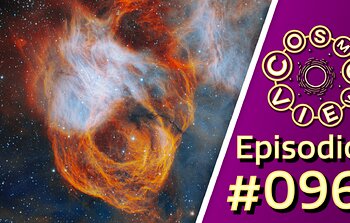
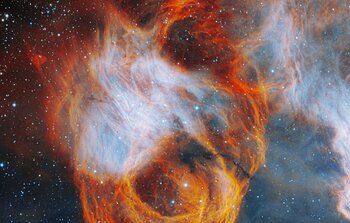
Displaying wispy layers of red, orange and yellow, the nebula encasing NGC 2040 resembles a vibrant rose in this image captured by the Gemini South telescope, one half of the International Gemini Observatory, which is supported in part by the U.S. National Science Foundation and operated by NSF NOIRLab. This nebulous flower showcases the dramatic story of stellar life, death and rebirth.

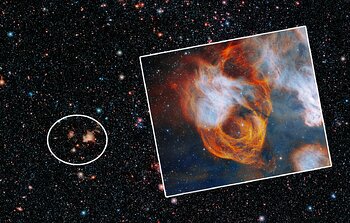
NGC 2040 is a young open cluster of stars within the Large Magellanic Cloud, a satellite galaxy of the Milky Way, located about 160,000 light-years from Earth. It is a type of star cluster known as an OB association because it contains more than a dozen stars of the O and B spectral types. These stars lead short lives of only a few million years, during which they burn very hot before exploding as supernovae. The energy released by the explosions of these massive stars feeds the formation of NGC 2040’s structure, while the expelled material seeds the growth of the next generation of stars.

The veiled nebula’s delicate structure, resembling a Valentine’s Day rose, is revealed in this image captured with the Gemini South telescope, one half of the International Gemini Observatory, funded in part by the U.S. National Science Foundation and operated by NSF NOIRLab. The 8-meter optical/infrared telescope is perfectly suited to capturing both the bright stars and the diffuse glow of the cluster.

NGC 2040 contains mostly hydrogen and oxygen atoms. As these atoms are excited by the ultraviolet radiation from nearby massive stars, they emit light. This emitted light spans a range of wavelengths from the ultraviolet, through the visible, and into the infrared. Special filters on Gemini South then allow specific wavelengths, or colors, of this emitted light to pass through, like the deep red and orange of glowing hydrogen and the light blue of glowing oxygen. The bright white represents areas where there is an abundance of both.

NGC 2040 is so named because it is part of the New General Catalogue of deep sky objects, first compiled by John Dryer in 1888. More recent observations have revealed that it is part of a massive structure of interstellar gas known as LH 88, which is one of the largest active star-forming regions in the Large Magellanic Cloud. Over the next million years thousands of new stars will be born in the region.

Most of the stars in the Milky Way, including the Sun, likely formed within open clusters similar to NGC 2040. When the O and B stars end their lives as supernovae they will enrich the cluster with elements such as carbon, oxygen, and iron. Together with the bountiful hydrogen of the cluster, these elements provide the necessary ingredients for the formation of new stars, planets, and perhaps even life.

The bright stars seen in the image are widely separated, but their motions through space are similar, indicating that they have a common origin. The layered nebulous structures in LH 88 are the remnants of stars that have already died. The delicate leaves of the rose were formed by both the shockwaves from supernovae and the stellar winds of the O and B stars.

Taken as a whole, the rose of LH 88 tells a story of death and rebirth, where the dust of dead stars becomes the seeds of new stars and planetary systems. And like a rose the beauty of LH 88 is fleeting. Within a few million years — a brief moment of cosmic time — the gas and dust will be either gathered into young stars or cast off into interstellar space. The stars formed within the cluster will have moved on to their own journeys through their galaxy.


More Information

NSF NOIRLab, the U.S. National Science Foundation center for ground-based optical-infrared astronomy, operates the International Gemini Observatory (a facility of NSF, NRC–Canada, ANID–Chile, MCTIC–Brazil, MINCyT–Argentina, and KASI–Republic of Korea), NSF Kitt Peak National Observatory (KPNO), NSF Cerro Tololo Inter-American Observatory (CTIO), the Community Science and Data Center (CSDC), and NSF–DOE Vera C. Rubin Observatory (in cooperation with DOE’s SLAC National Accelerator Laboratory). It is managed by the Association of Universities for Research in Astronomy (AURA) under a cooperative agreement with NSF and is headquartered in Tucson, Arizona.

The scientific community is honored to have the opportunity to conduct astronomical research on I’oligam Du’ag (Kitt Peak) in Arizona, on Maunakea in Hawai‘i, and on Cerro Tololo and Cerro Pachón in Chile. We recognize and acknowledge the very significant cultural role and reverence of I’oligam Du’ag to the Tohono O’odham Nation, and Maunakea to the Kanaka Maoli (Native Hawaiians) community.


Links


Contacts:

Josie Fenske

josie.fenske@noirlab.edu
Jr. Public Information Officer NSF NOIRLab


Tuesday, February 18, 2025

Researchers find dark matter dominating in early universe galaxies

Figure 1. Left: Gas distribution of ionized carbon (C+) on the halo scale of P009-10 as shown by the color image and black contours. Nuclear gas distribution, centered on the quasar (large black cross), is shown by the magenta contours. Right: Velocity field of the C+ emission from -200 (in blue; moving towards us) to +200 (in red; moving away from us) km/s indicating coherent rotation in a massive dark matter halo. Credit: Fei et al.

Figure 2. Rotation curves of distant galaxies. Fei et al. data, in red and blue, remains relatively flat (i.e., high), similar to local massive disk galaxies at z~0 (dashed grey line) that need extended dark matter to explain their high velocities. The results from other galaxies at redshift~2-3 (in gray data points) show a rotation curve that decreases at the outskirts. This leads to a low dark matter fraction. Credit: Fei et al.


An international team of researchers has found dark matter dominating the halos of two supermassive black holes in galaxies roughly 13 billion light years away, reports a new study published in The Astrophysical Journal on February 5.

Their study gives new insight into the relationship between dark matter and supermassive black holes when the universe was still very young, and how galaxies have evolved until today.

The first person to discover that dark matter played an important role in galaxies was astronomer Vera Rubin, who in the 1970s, noticed that the outer parts of local galaxies were rotating at higher speeds than expected, forming what was later named a flat rotation curve. If galaxies were only made up of stars and gas, and obeyed Newton's laws, the outskirts of a galaxy would move slower than the peak velocity closer to the galaxy’s center. Rubin’s observations could only make sense if there were a large amount of invisible mass, later called dark matter, that surrounded the galaxy like a halo, allowing stars and gas anywhere far from the galaxy center to move at higher velocity. Furthermore, dark matter assembly so far back in the universe has never been observationally constrained and remains unknown, despite its fundamental importance to our understanding of the Universe.

A research team led by The University of Tokyo Kavli Institute for the Physics and Mathematics of the Universe (Kavli IPMU, WPI) visiting researcher and Peking University graduate student Qinyue Fei, and including Kavli IPMU Professor John Silverman, the University of Texas Austin’s Dr. Seiji Fujimoto, and Peking University Kavli Institute for Astronomy and Astrophysics Associate Professor Ran Wang, have studied the dark matter content of supermassive black holes about 13 billion light years away.

“Vera Rubin provided the first evidence for dark matter using the rotation curves of nearby local galaxies. We’re using the same technique but now in the early universe,” said Silverman.

Made possible using data from the Atacama Large Millimeter/submillimeter Array (ALMA) and the ionized carbon (C+) emission line, the researchers were able to uncover the gas dynamics of two quasar host galaxies at redshift 6. By studying the rotation curves of each galaxy (Figure 2), they found dark matter made up about 60 per cent of its total mass. Velocity changes with radius in the galaxy are captured by blue-shifted gas (moving towards the researchers), and the red-shifted gas (moving away) (Figure 1).

Interestingly, the rotation curves in the distant universe from past studies reveal a decrease in the galaxy outskirts, meaning a low fraction of dark matter. But the data taken by Fei and Silverman’s team shows a flat rotation curve, similar to the massive disk galaxies close to Earth, which indicates more dark matter is required to explain the high velocities (Figure 2).

The team's findings shed light on the intricate relationship between dark matter and supermassive black holes. They offer a crucial piece of the puzzle in understanding how galaxies evolved from the early universe to the structures we observe today.
.


Paper details

Journal: The Astrophysical Journal
Paper title: Assessing the dark matter content of two quasar host galaxies at z∼6 through gas kinematics
Authors: Qinyue Fei (1, 2, 3), John Silverman (1, 4, 5, 6), Seiji Fujimoto (7, 20), Ran Wang (2, 3), Luis C. Ho (2, 3), Manuela Bischetti (8, 9), Stefano Carniani (10), Michele Ginolfi (11, 12), Gareth Jones (13, 14, 15), Roberto Maiolino (14, 15, 16), Wiphu Rujopakarn (17, 18), N. M. Förster Schreiber (19), Juan M. Espejo Salcedo (19), L. L. Lee (19)


Author affiliations:
 
1 Kavli Institute for the Physics and Mathematics of the Universe (Kavli IPMU, WPI), UTIAS, Tokyo Institutes for Advanced Study,University of Tokyo, Chiba, 277-8583, Japan
2 Department of Astronomy, School of Physics, Peking University, Beijing 100871, P. R. China
3 Kavli Institute for Astronomy and Astrophysics, Peking University, Beijing 100871, P. R. China
4 Department of Astronomy, School of Science, The University of Tokyo, 7-3-1 Hongo, Bunkyo, Tokyo 113-0033, Japan
5 Center for Data-Driven Discovery, Kavli IPMU (WPI), UTIAS, The University of Tokyo, Kashiwa, Chiba 277-8583, Japan
6 Center for Astrophysical Sciences, Department of Physics & Astronomy, Johns Hopkins University, Baltimore, MD 21218, USA
7 Department of Astronomy, The University of Texas at Austin, Austin, TX, USA
8 Dipartimento di Fisica, Universitá di Trieste, Sezione di Astronomia, Via G.B. Tiepolo 11, I-34131 Trieste, Italy
9 INAF - Osservatorio Astronomico di Trieste, Via G. B. Tiepolo 11, I–34131 Trieste, Italy
10 Scuola Normale Superiore, Piazza dei Cavalieri 7, I-56126 Pisa, Italy
11 Dipartimento di Fisica e Astronomia, Università di Firenze, Via G. Sansone 1, I-50019, Sesto F.no (Firenze), Italy
12 INAF — Osservatorio Astrofisico di Arcetri, Largo E. Fermi 5, I-50125, Florence, Italy
13 Department of Physics, University of Oxford, Denys Wilkinson Building, Keble Road, Oxford OX1 3RH, UK
14 Cavendish Laboratory, University of Cambridge, 19 J. J. Thomson Ave., Cambridge CB3 0HE, UK
15 Kavli Institute for Cosmology, University of Cambridge, Madingley Road, Cambridge CB3 0HA, UK
16 Department of Physics & Astronomy, University College London, Gower Street, London WC1E 6BT, UK
17 National Astronomical Research Institute of Thailand, Don Kaeo, Mae Rim, Chiang Mai 50180, Thailand
18 Department of Physics, Faculty of Science, Chulalongkorn University, 254 Phayathai Road, Pathumwan, Bangkok 10330, Thailand
19 Max-Planck-Institut für extraterrestrische Physik (MPE), Giessenbachstr. 1, D-85748 Garching, Germany

DOI: 10.3847/1538-4357/ada145 (Published February 5, 2025)
Paper abstract
(The Astrophysical Journal)>
Pre-print
(arXiv.org)


Research contact

John Silverman
Professor
Kavli Institute for the Physics and Mathematics of the Universe
E-mail:
john.silverman@pmu.jp

Media contact:

Motoko Kakubayashi
Press officer
Kavli Institute for the Physics and Mathematics of the Universe
The University of Tokyo
TEL: 04-7136-5980
E-mail:
press@ipmu.jp


Related links

Researchers find dark matter dominating in early universe galaxies (The Kavli Institute for Astronomy and Astrophysics at Peking University)


Monday, February 17, 2025

Webb Maps Full Picture of How Phoenix Galaxy Cluster Forms Stars

Phoenix Cluster (Hubble, Chandra, VLA Annotated)
Credits/Image: NASA, CXC, NRAO, ESA, Michael McDonald (MIT), Michael Reefe (MIT)
Illustration: Joseph Olmsted (STScI)

Phoenix Cluster (Hubble, Chandra, VLA)
Credits/Image: NASA, CXC, NRAO, ESA, Michael McDonald (MIT)
Image Processing: Joseph DePasquale (STScI)


Researchers using NASA’s James Webb Space Telescope have finally solved the mystery of how a massive galaxy cluster is forming stars at such a high rate. The confirmation from Webb builds on more than a decade of studies using NASA’s Chandra X-ray Observatory and Hubble Space Telescope, as well as several ground-based observatories.

The Phoenix cluster, a grouping of galaxies bound together by gravity 5.8 billion light-years from Earth, has been a target of interest for astronomers due to a few unique properties. In particular, ones that are surprising: a suspected extreme cooling of gas and a furious star formation rate despite a roughly 10 billion solar mass supermassive black hole at its core. In other observed galaxy clusters, the central supermassive black hole sends out energetic particles and radiation that prevents gas from cooling enough to form stars. Researchers have been studying gas flows within this cluster to try to understand how it is driving such extreme star formation.

“We can compare our previous studies of the Phoenix cluster, which found differing cooling rates at different temperatures, to a ski slope,” said Michael McDonald of the Massachusetts Institute of Technology in Cambridge, principal investigator of the program. “The Phoenix cluster has the largest reservoir of hot, cooling gas of any galaxy cluster — analogous to having the busiest chair lift, bringing the most skiers to the top of the mountain. However, not all of those skiers were making it down the mountain, meaning not all the gas was cooling to low temperatures. If you had a ski slope where there were significantly more people getting off the ski lift at the top than were arriving at the bottom, that would be a problem!”

To date, in the Phoenix cluster, the numbers weren’t adding up, and researchers were missing a piece of the process. Webb has now found those proverbial skiers at the middle of the mountain, in that it has tracked and mapped the missing cooling gas that will ultimately feed star formation. Most importantly, this intermediary warm gas was found within cavities tracing the very hot gas, a searing 18 million degrees Fahrenheit, and the already cooled gas around 18,000 degrees Fahrenheit.

The team studied the cluster’s core in more detail than ever before with the Medium-Resolution Spectrometer on Webb’s Mid-Infrared Instrument (MIRI). This tool allows researchers to take two-dimenstional spectroscopic data from a region of the sky, during one set of observations.

“Previous studies only measured gas at the extreme cold and hot ends of the temperature distribution throughout the center of the cluster,” added McDonald. “We were limited — it was not possible to detect the ‘warm’ gas that we were looking for. With Webb, we could do this for the first time.”

A Quirk of Nature

Webb’s capability to detect this specific temperature of cooling gas, around 540,000 degrees Fahrenheit, is in part due to its instrumental capabilities. However, the researchers are getting a little help from nature, as well

This oddity involves two very different ionized atoms, neon and oxygen, created in similar environments. At these temperatures, the emission from oxygen is 100 times brighter but is only visible in ultraviolet. Even though the neon is much fainter, it glows in the infrared, which allowed the researchers to take advantage of Webb’s advanced instruments.

“In the mid-infrared wavelengths detected by Webb, the neon VI signature was absolutely booming,” explained Michael Reefe, also of the Massachusetts Institute of Technology, lead author on the paper published in Nature. “Even though this emission is usually more difficult to detect, Webb’s sensitivity in the mid-infrared cuts through all of the noise.”

The team now hopes to employ this technique to study more typical galaxy clusters. While the Phoenix cluster is unique in many ways, this proof of concept is an important step towards learning about how other galaxy clusters form stars.

The James Webb Space Telescope is the world’s premier space science observatory. Webb is solving mysteries in our solar system, looking beyond to distant worlds around other stars, and probing the mysterious structures and origins of our universe and our place in it. Webb is an international program led by NASA with its partners, ESA (European Space Agency) and CSA (Canadian Space Agency).


About This Release

Credits:

Media Contact:

Hannah Braun
Space Telescope Science Institute, Baltimore, Maryland

Christine Pulliam
Space Telescope Science Institute, Baltimore, Maryland

Permissions: Content Use Policy

Contact Us: Direct inquiries to the News Team.


Sunday, February 16, 2025

Dusting for Stars’ Magnetic Fingerprints

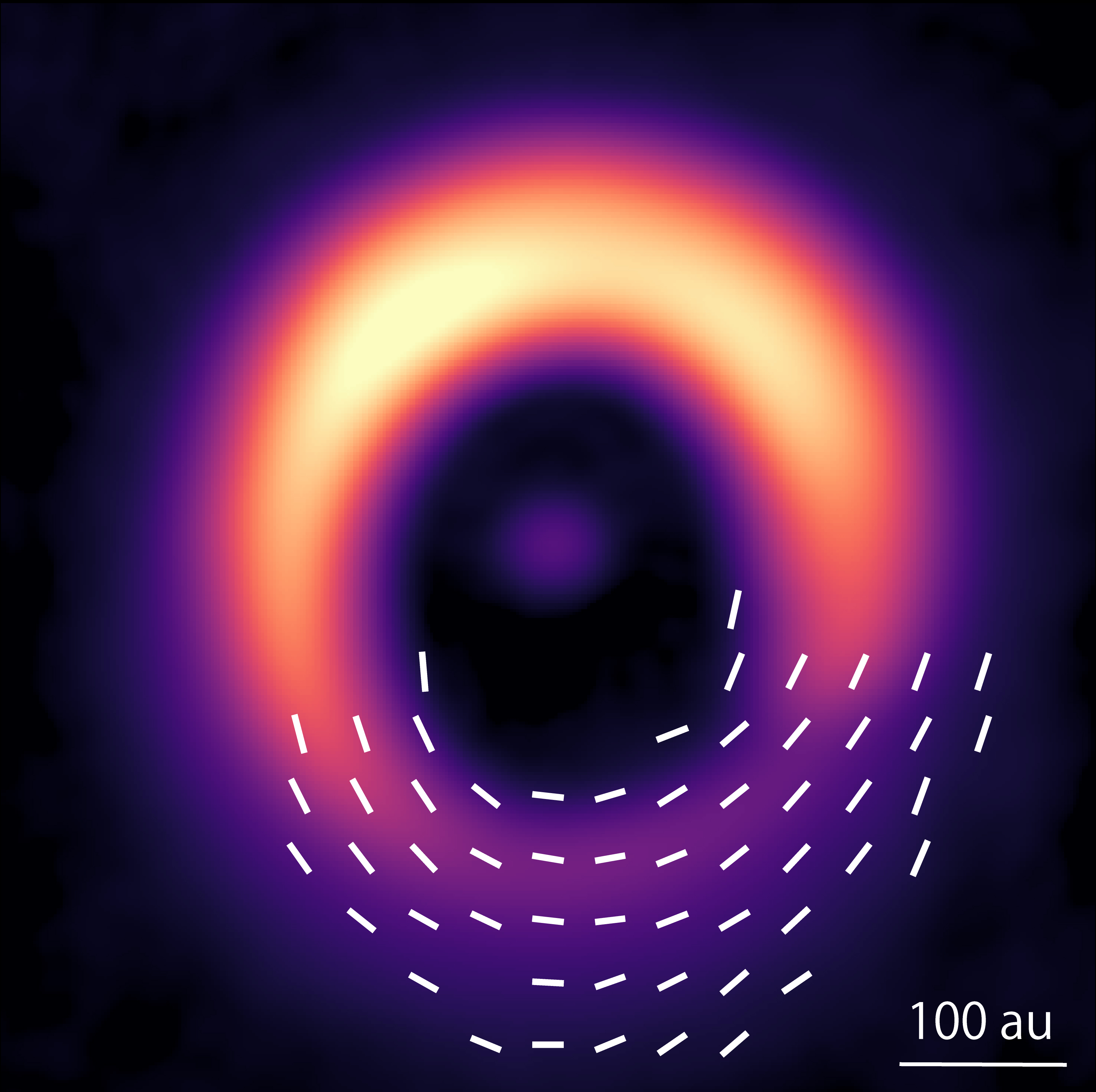
ALMA observations of the protoplanetary disk around HD 142527. The white bars show the directions of the magnetic field revealed by the orientation of the dust grains. The strength of the magnetic field is 0.3 milligauss. For comparison, a typical refrigerator magnet has a magnetic field of about 1,000,000 milligauss. Credit: ALMA (ESO/NAOJ/NRAO), S. Ohashi et al.
Download image (1.8MB)


For the first time astronomers have succeeded in observing the magnetic field around a young star where planets are thought to be forming. The team was able to use dust to measure the three-dimensional structure “fingerprint” of the magnetic field. This will help improve our understanding of planet formation. Planets form in turbulent disks of gas and dust called protoplanetary disks around young stars. It is thought that the first step in planet formation is dust grains colliding and sticking together. The movement of the dust grains is influenced by many forces, including magnetism. Thus, understanding the magnetic fields is important for understanding planet formation, but so far it has not been possible to measure the magnetic fields in a protoplanetary disk.

In this research, an international team of astronomers led by Satoshi Ohashi at the National Astronomical Observatory of Japan used the Atacama Large Millimeter/submillimeter Array (ALMA) to observe the protoplanetary disk around a young star known as HD 142527. This star is located 512 light-years away in the direction of the constellation Lupus. The team found that the dust grains aligned with the magnetic field lines. This allowed the team to detect and measure the unseen magnetic field lines, much the same way iron filings can reveal the magnetic field around a magnet. The team thinks that the measured three-dimensional structure might create strong turbulence withing the protoplanetary disk.

Now that this method of dusting for a young star’s magnetic fingerprint has been proven to work, the team wants to apply it to more stars, and measure the magnetic field closer to the star to better understand the magnetic conditions where planets are forming.


Detailed Article(s)

Magnetic Field in Planet Formation has been Successfully Observed
ALMA


Release Information

Researcher(s) Involved in this Release

Satoshi Ohashi (National Astronomical Observatory of Japan)

Coordinated Release Organization(s)

National Astronomical Observatory of Japan
RIKEN
Kogakuin University
Ibaraki University
Ashikaga University

Paper(s)
Satoshi Ohashi et al. “Observationally derived magnetic field strength and 3D components in the HD 142527 disk”, in Nature Astronomy, DOI:10.1038/s41550-024-02454-x


Related Link(s)

ALMA measures size of seeds of planets (December 5, 2016)

Saturday, February 15, 2025

Star cluster reveals its colours in stunning 80-million-pixel ESO image

PR Image eso2503a
The RCW 38 cluster in infrared light

PR Image eso2503b
The RCW 38 cluster in visible light

PR Image eso2503
RCW 38 in the Constellation of Vela


Videos

Look into the stunning RCW 38 star cluster
PR Video eso2503a
Look into the stunning RCW 38 star cluster

Zooming-in into RCW 38 in infrared light
PR Video eso2503b
Zooming-in into RCW 38 in infrared light


Image Comparisons

The RCW 38 cluster in visible and infrared light


The European Southern Observatory (ESO) has released a stunning 80 million-pixel image of the star cluster RCW 38, as captured by ESO’s Visible and Infrared Survey Telescope for Astronomy (VISTA), operating in Chile’s Atacama Desert.

Meet the colourful extravaganza of the RCW 38 stellar nursery, located some 5500 light-years away from us, in the constellation Vela. With its bright streaks and swirls, this birthplace of stars is not afraid to flaunt its colours. From the vivid pink of gas clouds to the multi-coloured dots, which are young stars, this image has it all.

Compared to our Sun, which at about 4.6 billion years old is in a stable phase of its life, the stars in RCW 38 are still very young. At less than a million years old, RCW 38 contains some 2000 stars, creating this psychedelic landscape. This young star cluster is bustling with activity, which makes it an interesting target for astronomers to observe.

Star clusters are like giant pressure cookers, containing all the ingredients for star formation: dense gas clouds and opaque clumps of cosmic dust. When this mixture of gas and dust collapses under its own gravity, a star is born.

The strong radiation coming from these newborn stars makes the gas that encompasses the star cluster glow brightly, creating the pink hues we see here in RCW 38. It’s truly a spectacular sight! Yet in visible light many stars in the RCW 38 cluster remain hidden from us, because dust blocks our view of them.

That is where the VISTA telescope, at ESO’s Paranal Observatory, comes in: its VIRCAM camera observes infrared light which, unlike visible light, can go through dust almost unimpeded, revealing the true riches of RCW 38. Suddenly, we also see young stars within dusty cocoons, or cold ‘failed’ stars known as brown dwarfs.

This infrared image was taken during the VISTA Variables in the Vía Láctea (VVV) survey, which has produced the most detailed infrared map of our home galaxy ever made. Surveys like this reveal as yet unknown astronomical objects, or give us a new view of known ones.

Since this image was taken, VISTA’s faithful VIRCAM camera, which has conducted numerous imaging surveys since 2008, has retired after an impressive run. Later this year, the telescope will receive a brand new instrument called 4MOST, which will gather the spectra of 2400 objects at once over a large area of the sky. As VISTA is born again, the future looks bright.

Source: ESO/News


More information

The European Southern Observatory (ESO) enables scientists worldwide to discover the secrets of the Universe for the benefit of all. We design, build and operate world-class observatories on the ground — which astronomers use to tackle exciting questions and spread the fascination of astronomy — and promote international collaboration for astronomy. Established as an intergovernmental organisation in 1962, today ESO is supported by 16 Member States (Austria, Belgium, Czechia, Denmark, France, Finland, Germany, Ireland, Italy, the Netherlands, Poland, Portugal, Spain, Sweden, Switzerland and the United Kingdom), along with the host state of Chile and with Australia as a Strategic Partner. ESO’s headquarters and its visitor centre and planetarium, the ESO Supernova, are located close to Munich in Germany, while the Chilean Atacama Desert, a marvellous place with unique conditions to observe the sky, hosts our telescopes. ESO operates three observing sites: La Silla, Paranal and Chajnantor. At Paranal, ESO operates the Very Large Telescope and its Very Large Telescope Interferometer, as well as survey telescopes such as VISTA. Also at Paranal ESO will host and operate the Cherenkov Telescope Array South, the world’s largest and most sensitive gamma-ray observatory. Together with international partners, ESO operates ALMA on Chajnantor, a facility that observes the skies in the millimetre and submillimetre range. At Cerro Armazones, near Paranal, we are building “the world’s biggest eye on the sky” — ESO’s Extremely Large Telescope. From our offices in Santiago, Chile we support our operations in the country and engage with Chilean partners and society.


Links


Contacts

Juan Carlos Muñoz Mateos
ESO Media Officer
Garching bei München, Germany
Tel: +49 89 3200 6176
Email:
press@eso.org


Friday, February 14, 2025

Teaming Up To Observe the Perseus Cluster

An X-ray image of the Perseus cluster taken by Hitomi, the precursor mission to XRISM. Image credit: NASA/CXC/SAO/E.Bulbul, et al. Download Image

During the past week, NuSTAR observed the Perseus Cluster, the brightest galaxy cluster in the sky in the X-rays, in coordination with the JAXA-NASA-ESA mission XRISM. Perseus is a calibration source for the wide-field Xtend imager on XRISM, but it also provides extremely valuable science for the primary XRISM instrument, Resolve. Resolve is the first high-spectral-resolution X-ray imaging spectrometer to fly an extended mission, replacing the similar instrument lost on the Hitomi mission. The XRISM science team has studied earlier observations of Perseus to try to resolve Doppler motions of the super-heated intra-cluster medium (ICM) gas, groundbreaking studies that will help us understand how these enormous galaxy clusters formed and evolved. However, the supermassive black hole at the center of the Perseus cluster also emits copious X-rays, which need to be disentangled from the ICM X-ray signal to properly isolate and measure the cluster gas motions. Simultaneous observations by NuSTAR are in a higher energy band than XRISM where the data is dominated by X-rays from the black hole. This will allow the XRISM calibration team to account for the contribution from the black hole in the XRISM observations, and precisely measure not only the gas motion but also the abundances of key elements and the temperature structure of the ICM. Since this is a calibration target observed twice a year by XRISM, a very deep total exposure will be obtained, and the vital collaboration with NuSTAR will enable a transformative view into the astrophysics of galaxy clusters.

Authors: Eric D. Miller (XRISM In-Flight Calibration Lead, MIT Kavli Institute for Astrophysics and Space Research)


Gemini North Teams Up With LOFAR to Reveal Largest Radio Jet Ever Seen in the Early Universe

PR Image noirlab2506a
Artistic representation of the largest radio jet in the early Universe

PR Image noirlab2506b
Quasar J1601+3102

PR Image noirlab2506c
Quasar J1601+3102


Videos

Cosmoview Episode 95: Gemini North Teams Up with LOFAR to Reveal the Largest Radio Jet Ever Seen in the Early Universe
PR Video noirlab2506a
Cosmoview Episode 95: Gemini North Teams Up with LOFAR to Reveal the Largest Radio Jet Ever Seen in the Early Universe

Cosmoview Episode 95: Gemini North Teams Up with LOFAR to Reveal the Largest Radio Jet Ever Seen in the Early Universe
PR Video noirlab2506b
Cosmoview Episodio 95: Gemini Norte colabora con LOFAR para descubrir el Jet más grande del Universo temprano


The monster jet spans at least 200,000 light-years and formed when the Universe was less than 10% of its current age

Making use of the Gemini North telescope, one half of the International Gemini Observatory, funded in part by the U.S. National Science Foundation and operated by NSF NOIRLab, astronomers have characterized the largest-ever early-Universe radio jet. Historically, such large radio jets have remained elusive in the distant Universe. With these observations, astronomers have valuable new insights into when the first jets formed in the Universe and how they impacted the evolution of galaxies.

From decades of astronomical observations scientists know that most galaxies contain massive black holes at their centers. The gas and dust falling into these black holes liberates an enormous amount of energy as a result of friction, forming luminous galactic cores, called quasars, that expel jets of energetic matter. These jets can be detected with radio telescopes up to large distances. In our local Universe these radio jets are not uncommon, with a small fraction being found in nearby galaxies, but they have remained elusive in the distant, early Universe until now.

Using a combination of telescopes, astronomers have discovered a distant, two-lobed radio jet that spans an astonishing 200,000 light-years at least — twice the width of the Milky Way. This is the largest radio jet ever found this early in the history of the Universe [1]. The jet was first identified using the international Low Frequency Array (LOFAR) Telescope, a network of radio telescopes throughout Europe.

Follow-up observations in the near-infrared with the Gemini Near-Infrared Spectrograph (GNIRS), and in the optical with the Hobby Eberly Telescope, were obtained to paint a complete picture of the radio jet and the quasar producing it. These findings are crucial to gaining more insight into the timing and mechanisms behind the formation of the first large-scale jets in our Universe.

GNIRS is mounted on the Gemini North telescope, one half of the International Gemini Observatory, funded in part by the U.S. National Science Foundation (NSF) and operated by NSF NOIRlab.

“We were searching for quasars with strong radio jets in the early Universe, which helps us understand how and when the first jets are formed and how they impact the evolution of galaxies,” says Anniek Gloudemans, postdoctoral research fellow at NOIRLab and lead author of the paper presenting these results in The Astrophysical Journal Letters.

Determining the properties of the quasar, such as its mass and the rate at which it is consuming matter, is necessary for understanding its formation history. To measure these parameters the team looked for a specific wavelength of light emitted by quasars known as the MgII (magnesium) broad emission line. Normally, this signal appears in the ultraviolet wavelength range. However, owing to the expansion of the Universe, which causes the light emitted by the quasar to be ‘stretched’ to longer wavelengths, the magnesium signal arrives at Earth in the near-infrared wavelength range, where it is detectable with GNIRS.

The quasar, named J1601+3102, formed when the Universe was less than 1.2 billion years old — just 9% of its current age. While quasars can have masses billions of times greater than that of our Sun, this one is on the small side, weighing in at 450 million times the mass of the Sun. The double-sided jets are asymmetrical both in brightness and the distance they stretch from the quasar, indicating an extreme environment may be affecting them.

“Interestingly, the quasar powering this massive radio jet does not have an extreme black hole mass compared to other quasars,” says Gloudemans. “This seems to indicate that you don’t necessarily need an exceptionally massive black hole or accretion rate to generate such powerful jets in the early Universe.”

The previous dearth of large radio jets in the early Universe has been attributed to noise from the cosmic microwave background — the ever-present fog of microwave radiation left over from the Big Bang. This persistent background radiation normally diminishes the radio light of such distant objects.

“It’s only because this object is so extreme that we can observe it from Earth, even though it’s really far away,” says Gloudemans. “This object shows what we can discover by combining the power of multiple telescopes that operate at different wavelengths.”

“When we started looking at this object we were expecting the southern jet to just be an unrelated nearby source, and for most of it to be small. That made it quite surprising when the LOFAR image revealed large, detailed radio structures,” says Frits Sweijen, postdoctoral research associate at Durham University and co-author of the paper. “The nature of this distant source makes it difficult to detect at higher radio frequencies, demonstrating the power of LOFAR on its own and its synergies with other instruments.”

Scientists still have a multitude of questions about how radio-bright quasars like J1601+3102 differ from other quasars. It remains unclear what circumstances are necessary to create such powerful radio jets, or when the first radio jets in the Universe formed. Thanks to the collaborative power of Gemini North, LOFAR and the Hobby Eberly Telescope, we are one step closer to understanding the enigmatic early Universe.


Notes

[1] An example of a monster radio jet found in the nearby Universe is the 23 million-light-year-long jet, named Porphyrion, which was observed 6.3 billion years after the Big Bang.


More information

This research was presented in a paper titled “Monster radio jet (>66 kpc) observed in quasar at z ∼ 5” to appear in The Astrophysical Journal Letters. DOI: 10.3847/2041-8213/ad9609

The team is composed of Anniek J. Gloudemans (NSF NOIRLab, International Gemini Observatory), Frits Sweijen (Durham University), Leah K. Morabito (Durham University), Emanuele Paolo Farina (NSF NOIRLab, International Gemini Observatory), Kenneth J. Duncan (Royal Observatory, Edinburgh), Yuichi Harikane (University of Tokyo), Huub J. A. Röttgering (Leiden University), Aayush Saxena (University of Oxford, Durham University), and Jan-Torge Schindler (University of Hamburg).

NSF NOIRLab, the U.S. National Science Foundation center for ground-based optical-infrared astronomy, operates the International Gemini Observatory (a facility of NSF, NRC–Canada, ANID–Chile, MCTIC–Brazil, MINCyT–Argentina, and KASI–Republic of Korea), NSF Kitt Peak National Observatory (KPNO), NSF Cerro Tololo Inter-American Observatory (CTIO), the Community Science and Data Center (CSDC), and NSF–DOE Vera C. Rubin Observatory (in cooperation with DOE’s SLAC National Accelerator Laboratory). It is managed by the Association of Universities for Research in Astronomy (AURA) under a cooperative agreement with NSF and is headquartered in Tucson, Arizona.

The scientific community is honored to have the opportunity to conduct astronomical research on I’oligam Du’ag (Kitt Peak) in Arizona, on Maunakea in Hawai‘i, and on Cerro Tololo and Cerro Pachón in Chile. We recognize and acknowledge the very significant cultural role and reverence of I’oligam Du’ag to the Tohono O’odham Nation, and Maunakea to the Kanaka Maoli (Native Hawaiians) community.


Links


Contacts:

Anniek Gloudemans
Postdoctoral research fellow
NSF NOIRLab / International Gemini Observatory
Email: anniek.gloudemans@noirlab.edu

Frits Sweijen
Postdoctoral research associate
Durham University
Email: frits.sweijen@durham.ac.uk

Josie Fenske
Jr. Public Information Officer
NSF NOIRLab
Email: josie.fenske@noirlab.edu


Thursday, February 13, 2025

NASA Telescopes Deliver Stellar Bouquet in Time for Valentine's Day

30 Doradus
Credit X-ray: NASA/CXC/Penn State Univ./L. Townsley et al.; Infrared: NASA/JPL-CalTech/SST; Optical: NASA/STScI/HST; Radio: ESO/NAOJ/NRAO/ALMA; Image Processing: NASA/CXC/SAO/J. Schmidt, N. Wolk, K. Arcand


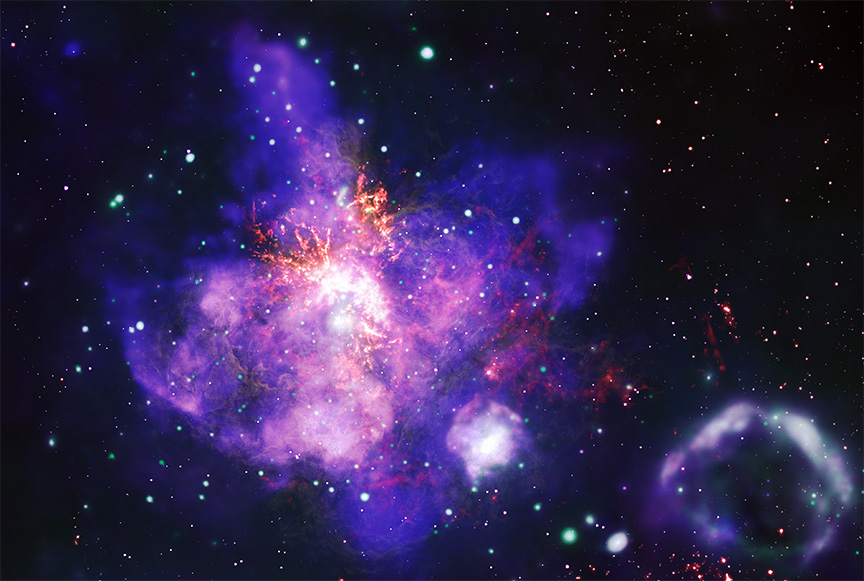
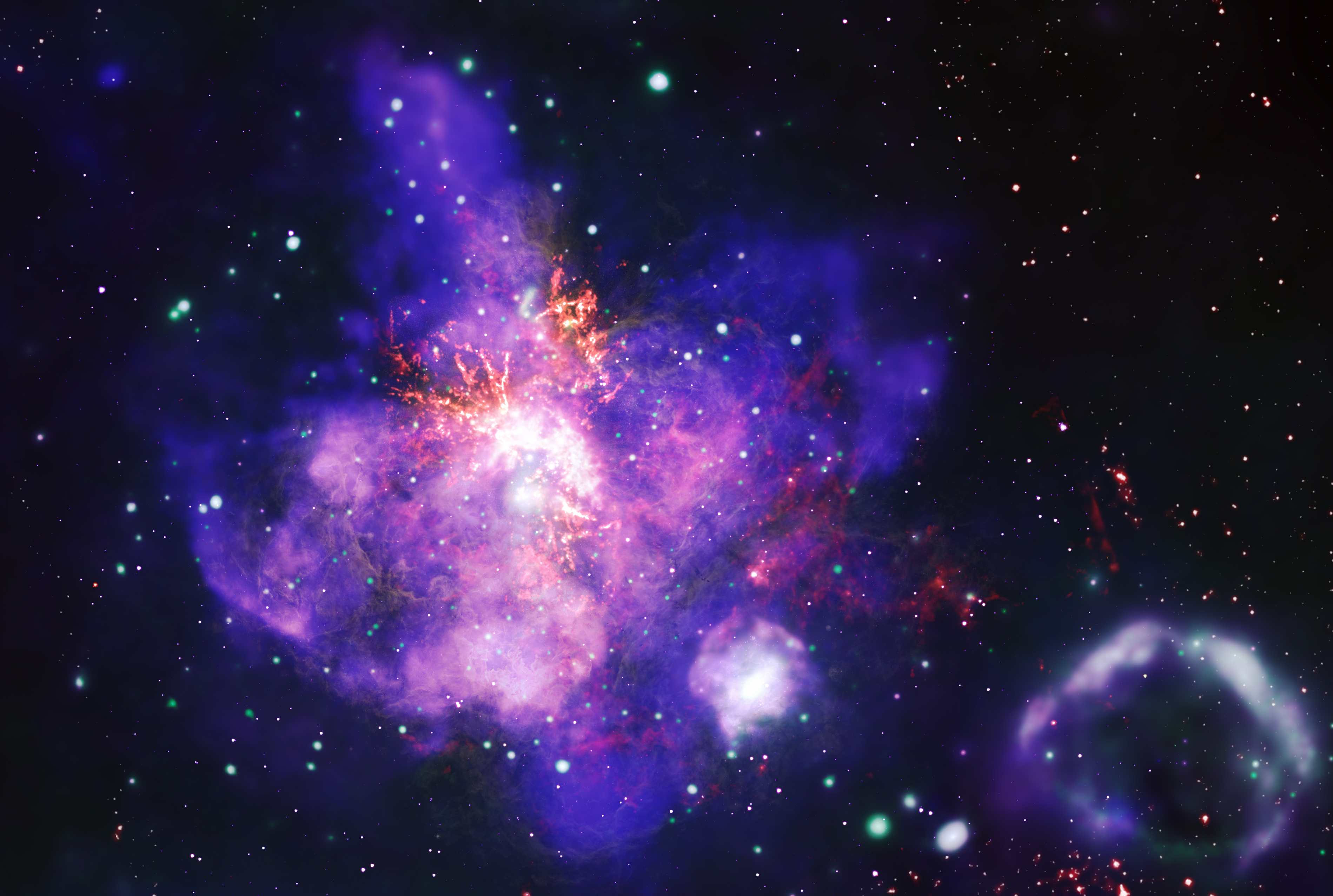
A bouquet of thousands of stars in bloom has arrived. This composite image contains the deepest X-ray image ever made of the spectacular star forming region called 30 Doradus.

By combining X-ray data from NASA’s Chandra X-ray Observatory (blue and green) with optical data from NASA’s Hubble Space Telescope (yellow) and radio data from the Atacama Large Millimeter/submillimeter Array (orange), this stellar arrangement comes alive.

30 Doradus Region (Labeled). Credit: X-ray: NASA/CXC/Penn State Univ./L. Townsley et al.; Infrared: NASA/JPL-CalTech/SST; Optical: NASA/STScI/HST; Radio: ESO/NAOJ/NRAO/ALMA; Image Processing: NASA/CXC/SAO/J. Schmidt, N. Wolk, K. Arcand)

Otherwise known as the Tarantula Nebula, 30 Dor is located about 160,000 light-years away in a small neighboring galaxy to the Milky Way known as the Large Magellanic Cloud (LMC). Because it one of the brightest and populated star-forming regions to Earth, 30 Dor is a frequent target for scientists trying to learn more about how stars are born.

With enough fuel to have powered the manufacturing of stars for at least 25 million years, 30 Dor is the most powerful stellar nursery in the local group of galaxies that includes the Milky Way, the LMC, and the Andromeda galaxy.

The massive young stars in 30 Dor send cosmically strong winds out into space. Along with the matter and energy ejected by stars that have previously exploded, these winds have carved out an eye-catching display of arcs, pillars, and bubbles.

A dense cluster in the center of 30 Dor contains the most massive stars astronomers have ever found, each only about one to two million years old. (Our Sun is over a thousand times older with an age of about 5 billion years.)

This new image includes the data from a large Chandra program that involved about 23 days of observing time, greatly exceeding the 1.3 days of observing that Chandra previously conducted on 30 Dor. The 3,615 X-ray sources detected by Chandra include a mixture of massive stars, double-star systems, bright stars that are still in the process of forming, and much smaller clusters of young stars.

There is a large quantity of diffuse, hot gas seen in X-rays, arising from different sources including the winds of massive stars and from the gas expelled by supernova explosions. This data set will be the best available for the foreseeable future for studying diffuse X-ray emission in star-forming regions.

The long observing time devoted to this cluster allows astronomers the ability to search for changes in the 30 Dor’s massive stars. Several of these stars are members of double star systems and their movements can be traced by the changes in X-ray brightness.

A paper describing these results appears in the July 2024 issue of The Astrophysical Journal Supplement Series. NASA's Marshall Space Flight Center manages the Chandra program. The Smithsonian Astrophysical Observatory's Chandra X-ray Center controls science operations from Cambridge, Massachusetts, and flight operations from Burlington, Massachusetts.


Visual Description:

This release features a highly detailed composite image of a star-forming region of space known as 30 Doradus, shaped like a bouquet, or a maple leaf.

30 Doradus is a powerful stellar nursery. In 23 days of observation, the Chandra X-ray telescope revealed thousands of distinct star systems. Chandra data also revealed a diffuse X-ray glow from winds blowing off giant stars, and X-ray gas expelled by exploding stars, or supernovas.

In this image, the X-ray wind and gas takes the shape of a massive purple and pink bouquet with an extended central flower, or perhaps a leaf from a maple tree. The hazy, mottled shape occupies much of the image, positioned just to our left of center, tilted slightly to our left. Inside the purple and pink gas and wind cloud are red and orange veins, and pockets of bright white light. The pockets of white light represent clusters of young stars. One cluster at the heart of 30 Doradus houses the most massive stars astronomers have ever found.

The hazy purple and pink bouquet is surrounded by glowing dots of green, white, orange, and red. A second mottled purple cloud shape, which resembles a ring of smoke, sits in our lower righthand corner.


Fast Facts for 30 Doradus:

Scale: Image is about 30 arcmin (1,400 light-years) across.
Category: Normal Stars & Star Clusters
Coordinates (J2000): RA 5h 38m 38s | Dec -69° 05´ 42"
Constellation: Dorado
Observation Dates: 54 observations from Sep 9, 1999 to Jan 22 2016
Observation Time: 541 hours (22 days 13 hours)
Obs. ID: 22, 5906, 7263, 7264, 2783, 16192-16203, 16442-16449, 16612, 16615-16617, 16621, 16640, 17321, 17414, 17486, 17544, 17545, 17555, 17561, 17562, 17602, 117603, 17640-17642, 17660, 18670-18672, 18706, 18720-18722, 18729, 18749, 18750
Instrument: ACIS
Also Known As: 30 Doradus
References: Townsley, L. et al, 2024, ApJS, 273, 5; arXiv:2403.16944
Color Code: X-ray: green, magenta, blue; Optical: dark yellow; Radio: orange; Infrared: red
Distance Estimate: About 160,000 light-years


Wednesday, February 12, 2025

Euclid discovers a stunning Einstein ring

Euclid image of a bright Einstein ring around galaxy NGC 6505
Credit: ESA/Euclid/Euclid Consortium/NASA, image processing by J.-C. Cuillandre, G. Anselmi, T. Li
Licence:
CC BY-SA 3.0 IGO or ESA Standard Licence
(content can be used under either licence)

Close-up of the Einstein ring around galaxy NGC 6505
Credit: ESA/Euclid/Euclid Consortium/NASA, image processing by J.-C. Cuillandre, G. Anselmi, T. Li
Licence:
CC BY-SA 3.0 IGO or ESA Standard Licence
(content can be used under either licence)

Infographic explaining how an Einstein Ring is formed
Credit: ESA

Licence: CC BY-SA 3.0 IGO
(content can be used under either licence)


Euclid, the European Space Agency’s dark Universe detective, has made an astonishing discovery – right in our cosmic backyard.

Euclid blasted off on its six-year mission to explore the dark Universe on 1 July 2023. Before the spacecraft could begin its survey, the team of scientists and engineers on Earth had to make sure everything was working properly. During this early testing phase, in September 2023, Euclid sent some images back to Earth. They were deliberately out of focus, but in one fuzzy image Euclid Archive Scientist Bruno Altieri saw a hint of a very special phenomenon and decided to take a closer look.

“I look at the data from Euclid as it comes in,” explains Bruno. “Even from that first observation, I could see it, but after Euclid made more observations of the area, we could see a perfect Einstein ring. For me, with a lifelong interest in gravitational lensing, that was amazing.”

The Einstein Ring, an extremely rare phenomenon, turned out to be hiding in plain sight in a galaxy not far away. The galaxy, called NGC 6505, is around 590 million light-years from Earth, a stone’s throw away in cosmic terms. But this is the first time that the ring of light surrounding its centre is detected, thanks to Euclid’s high-resolution instruments.

The ring around the foreground galaxy is made up of light from a farther out bright galaxy. This background galaxy is 4.42 billion light-years away, and its light has been distorted by gravity on its way to us. The far-away galaxy hasn’t been observed before and doesn’t yet have a name.

“An Einstein ring is an example of strong gravitational lensing,” explains Conor O’Riordan, of the Max Planck Institute for Astrophysics, Germany, and lead author of the first scientific paper analysing the ring. “All strong lenses are special, because they're so rare, and they're incredibly useful scientifically. This one is particularly special, because it’s so close to Earth and the alignment makes it very beautiful.”

Albert Einstein’s general theory of relativity predicts that light will bend around objects in space, so that they focus the light like a giant lens. This gravitational lensing effect is bigger for more massive objects – galaxies and clusters of galaxies. It means we can sometimes see the light from distant galaxies that would otherwise be hidden.

If the alignment is just right, the light from the distant source galaxy bends to form a spectacular ring around the foreground object. These Einstein rings are a rich laboratory for scientists. Studying their gravitational effects can help us learn about the expansion of the Universe, detect the effects of invisible dark matter and dark energy, and investigate the background source whose light is bent by dark matter in between us and the source.

“I find it very intriguing that this ring was observed within a well-known galaxy, which was first discovered in 1884,” says Valeria Pettorino, ESA Euclid Project Scientist. “The galaxy has been known to astronomers for a very long time. And yet this ring was never observed before. This demonstrates how powerful Euclid is, finding new things even in places we thought we knew well. This discovery is very encouraging for the future of the Euclid mission and demonstrates its fantastic capabilities.

By exploring how the Universe has expanded and formed over its cosmic history, Euclid will reveal more about the role of gravity and the nature of dark energy and dark matter. The space telescope will map more than a third of the sky, observing billions of galaxies out to 10 billion light-years. It is expected to find around 100 000 strong lenses, but to find one that’s so spectacular – and so close to home – is astonishing. Until now, less than 1000 strong lenses were known, and even fewer were imaged at high resolution.

“Euclid is going to revolutionise the field, with all this data we've never had before,” adds Conor.

Although this Einstein ring is stunning, Euclid’s main job is searching for the more subtle effects of weak gravitational lensing, where background galaxies appear only mildly stretched or displaced. To detect this effect, scientists will need to analyse billions of galaxies. Euclid began its detailed survey of the sky on 14 February 2024 and is gradually creating the most extensive 3D map of the Universe yet. Such an amazing find, so early in its mission, means Euclid is on course to uncover many more hidden secrets.


Notes for editors

  • Euclid: A complete Einstein ring in NGC 6505 by C. M. O’Riordan et al is published today in Astronomy & Astrophysics. DOI: 10.1051/0004-6361/202453014 
  • For more information, please contact ESA media relations: media@esa.int


Tuesday, February 11, 2025

Cosmic cloudscape

A portion of a nebula, made of variously-coloured layers of dust clouds. One upper layer is dark reddish dust which is dense and obscures light, in places so dense that it appears black. A middle layer is pale clouds that are thick like curling wisps of smoke. They form a broad bow across the centre of the image. Many small, bright stars lie throughout the nebula, coloured blue, purple or red depending on depth. Credit: ESA/Hubble & NASA, C. Murray

The Universe is a dusty place, as this NASA/ESA Hubble Space Telescope Picture of the Week shows. Featured in this image are swirling clouds of gas and dust near the Tarantula Nebula in the Large Magellanic Cloud. About 160 000 light-years away in the constellations Dorado and Mensa, the Large Magellanic Cloud is one of the nearest galaxies to the Milky Way. The Tarantula Nebula is the most productive star-forming region in the nearby Universe, home to the most massive stars known.

The colourful gas clouds of this nebula are crossed by wispy tendrils and dark clumps of dust. This dust is different from ordinary household dust, which can be made of bits of soil, skin cells, hair and even plastic. Cosmic dust tends to be made of carbon or of molecules called silicates, which contain silicon and oxygen. The data used to create this image were collected as part of an observing programme that aims to characterise the properties of cosmic dust in the Large Magellanic Cloud and other nearby galaxies.

Dust plays several important roles in the Universe. Even though individual dust grains are incredibly tiny, far smaller than the width of a single human hair, dust grains in discs around young stars clump together to form larger grains and eventually planets. Dust also helps cool clouds of gas so that they can condense into new stars. Dust even plays a role in making new molecules in interstellar space, providing a venue for individual atoms to find each other and bond together in the vastness of space.


Monday, February 10, 2025

Straight Shot: Hubble Investigates Galaxy with Nine Rings

LEDA 1313424, aptly nicknamed the Bullseye, is two and a half times the size of our Milky Way and has nine rings — six more than any other known galaxy. High-resolution imagery from NASA’s Hubble Space Telescope confirmed eight rings, and data from the W. M. Keck Observatory in Hawaii confirmed a ninth. Hubble and Keck also confirmed which galaxy dove through the Bullseye, creating these rings: the blue dwarf galaxy that sits to its immediate center-left. Credits/Science: NASA, ESA, Imad Pasha (Yale), Pieter van Dokkum (Yale)

This illustration compares the size of our own Milky Way galaxy to gargantuan galaxy LEDA 1313424, nicknamed the Bullseye. The Milky Way is about 100,000 light-years in diameter, and the Bullseye is almost two-and-a-half times larger, at 250,000 light-years across. Credits/Artwork: NASA, ESA, Ralf Crawford (STScI)

This illustration shows the massive galaxy nicknamed the Bullseye face-on. Dotted circles indicate where each of its rings are, which formed like ripples in a pond after a blue dwarf galaxy (not shown) shot through its core about 50 million years ago. NASA’s Hubble Space Telescope helped researchers carefully pinpoint the location of most of its rings, many of which are piled up at the center. Data from the W. M. Keck Observatory in Hawaii helped the team confirm another ring. Credits/Artwork: NASA, ESA, Ralf Crawford (STScI)


This image of collisional ring galaxy LEDA 1313424, nicknamed the Bullseye, was captured by the Hubble Space Telescope’s Advanced Camera for Surveys (ACS). The image shows a scale bar, compass arrows, and color key for reference. The scale bar is labeled in light-years along the top, which is the distance that light travels in one Earth-year. (It takes three years for light to travel a distance equal to the length of the scale bar.) One light-year is equal to about 5.88 trillion miles or 9.46 trillion kilometers. The scale bar is also labeled in arcminutes, which is a measure of angular distance on the sky. One arcsecond is equal an angular measurement of 1/3600 of one degree. There are 60 arcminutes in a degree and 60 arcseconds in an arcminute. (The full Moon has an angular diameter of about 30 arcminutes.) The actual size of an object that covers one arcsecond on the sky depends on its distance from the telescope.The north and east compass arrows show the orientation of the image on the sky. Note that the relationship between north and east on the sky (as seen from below) is flipped relative to direction arrows on a map of the ground (as seen from above). This image shows visible wavelengths of light that have been translated into visible-light colors. The color key shows which WFPC2 and MIRI filters were used when collecting the light. The color of each filter name is the visible-light color used to represent the infrared light that passes through that filter. Credits/Science: NASA, ESA, Imad Pasha (Yale), Pieter van Dokkum (Yale)


NASA's Hubble Space Telescope has captured a cosmic bullseye! The gargantuan galaxy LEDA 1313424 is rippling with nine star-filled rings after an "arrow" — a far smaller blue dwarf galaxy — shot through its heart. Astronomers using Hubble identified eight visible rings, more than previously detected by any telescope in any galaxy, and confirmed a ninth using data from the W. M. Keck Observatory in Hawaii. Previous observations of other galaxies show a maximum of two or three rings.

"This was a serendipitous discovery," said Imad Pasha, the lead researcher and a doctoral student at Yale University in New Haven, Connecticut. "I was looking at a ground-based imaging survey and when I saw a galaxy with several clear rings, I was immediately drawn to it. I had to stop to investigate it." The team later nicknamed the galaxy the "Bullseye."

Hubble and Keck Observatory’s follow-up observations also helped the researchers prove which galaxy plunged through the center of the Bullseye — a blue dwarf galaxy to its center-left. This relatively tiny interloper traveled like a dart through the core of the Bullseye about 50 million years ago, leaving rings in its wake like ripples in a pond. A thin trail of gas now links the pair, though they are currently separated by 130,000 light-years.

"We’re catching the Bullseye at a very special moment in time," said Pieter G. van Dokkum, a co-author of the new study and a professor at Yale. "There's a very narrow window after the impact when a galaxy like this would have so many rings."

Galaxies collide or barely miss one another quite frequently on cosmic timescales, but it is extremely rare for one galaxy to dive through the center of another. The blue dwarf galaxy's straight trajectory through the Bullseye later caused material to move both inward and outward in waves, setting off new regions of star formation.

How big is the Bullseye? Our Milky Way galaxy is about 100,000 light-years in diameter, and the Bullseye is almost two-and-a-half times larger, at 250,000 light-years across.

The researchers used Hubble's crisp vision to carefully to pinpoint the location of most of its rings, since many are piled up at the center. "This would have been impossible without Hubble," Pasha said.

They used Keck Observatory to confirm one more ring. The team suspects a 10th ring also existed, but has faded and is no longer detectable. They estimate it might lie three times farther out than the widest ring in Hubble's image.

A One-to-One Match with Predictions

Pasha also found a stunning connection between the Bullseye and a long-established theory: The galaxy's rings appear to have moved outward almost exactly as predicted by models.

"That theory was developed for the day that someone saw so many rings," van Dokkum said. "It is immensely gratifying to confirm this long-standing prediction with the Bullseye galaxy."

If viewed from above, it would be more obvious that the galaxy's rings aren't evenly spaced like those on a dart board. Hubble's image shows the galaxy from a slight angle. "If we were to look down at the galaxy directly, the rings would look circular, with rings bunched up at the center and gradually becoming more spaced out the farther out they are," Pasha explained.

To visualize how these rings may have formed, think about dropping a pebble into a pond. The first ring ripples out, becoming the widest over time, while others continue to form after it.

The researchers suspect that the first two rings in the Bullseye formed quickly and spread out in wider circles. The formation of additional rings may have been slightly staggered, since the blue dwarf galaxy's flythrough affected the first rings more significantly.

Individual stars' orbits were largely undisturbed, though groups of stars did "pile up" to form distinguishable rings over millions of years. The gas, however, was carried outward, and mixed with dust to form new stars, further brightening the Bullseye's rings.

There's a lot more research to be done to figure out which stars existed before and after the blue dwarf's "fly through." Astronomers will now also be able to improve models showing how the galaxy may continue to evolve over billions of years, including the disappearance of additional rings.

Although this discovery was a chance finding, astronomers can look forward to finding more galaxies like this one soon. " Once NASA's Nancy Grace Roman Space Telescope begins science operations, interesting objects will pop out much more easily," van Dokkum explained. "We will learn how rare these spectacular events really are."

The team's paper was published on the February 4, 2025 in The Astrophysical Journal Letters.

The Hubble Space Telescope has been operating for over three decades and continues to make ground-breaking discoveries that shape our fundamental understanding of the universe. Hubble is a project of international cooperation between NASA and ESA (European Space Agency). NASA’s Goddard Space Flight Center in Greenbelt, Maryland, manages the telescope and mission operations. Lockheed Martin Space, based in Denver, also supports mission operations at Goddard. The Space Telescope Science Institute in Baltimore, which is operated by the Association of Universities for Research in Astronomy, conducts Hubble science operations for NASA.


About This Release

Credits:

Media Contact:

Claire Blome
Space Telescope Science Institute, Baltimore, Maryland

Ray Villard
Space Telescope Science Institute, Baltimore, Maryland

Permissions: Content Use Policy

Related Links and Documents