Showing posts with label RCW 38. Show all posts

Tuesday, July 28, 2026

Could Colliding Stellar Winds Power Cosmic Rays?

This composite image shows in the RCW 38 stellar cluster in different wavelengths. In red are the X-rays from
young, hot stars and extended hot gas as imaged by Chandra, embedded in a molecular cloud (green) imaged in infrared by the ISAAC camera, and a ring of radio emission (blue) detected by ATCA from a region of gas heated by the radiation from the hot stars in the cluster. Image credit: NASA/CXC/CfA/S.Wolk et al./ISAAC/VLT/ATCA -
Download Image

During the past week, NuSTAR observed RCW 38, a gigantic star-forming region full of young massive stars, each dozens of times heavier than the Sun. These stars blast out powerful winds—streams of hot, ionized gas—at speeds of up to 2000 km/s, releasing energy over their lifetimes comparable to a supernova explosion. Where many such stars are packed together, their winds collide with each other and create powerful shocks, which can accelerate atomic particles to extremely high energies—a possible source of cosmic rays. RCW 38 is especially interesting: it is compact, young (less than a million years old), and apparently free of any supernova explosions. This makes it a rare place to study the effects of stellar winds alone, without other contaminants. Past observations detected X-rays from RCW 38, but were not able to distinguish whether they came from hot gas or accelerated particles. NuSTAR's unique ability to focus high-energy X-rays will help tell the two apart, and the first NuSTAR observation of  RCW 38 may be a step toward that answer.

Author: Haruki Kuramoto (PhD Student, University of Osaka, Japan)


Saturday, February 15, 2025

Star cluster reveals its colours in stunning 80-million-pixel ESO image

PR Image eso2503a
The RCW 38 cluster in infrared light

PR Image eso2503b
The RCW 38 cluster in visible light

PR Image eso2503
RCW 38 in the Constellation of Vela


Videos

Look into the stunning RCW 38 star cluster
PR Video eso2503a
Look into the stunning RCW 38 star cluster

Zooming-in into RCW 38 in infrared light
PR Video eso2503b
Zooming-in into RCW 38 in infrared light


Image Comparisons

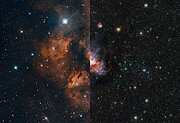
The RCW 38 cluster in visible and infrared light


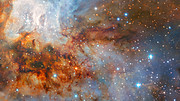
The European Southern Observatory (ESO) has released a stunning 80 million-pixel image of the star cluster RCW 38, as captured by ESO’s Visible and Infrared Survey Telescope for Astronomy (VISTA), operating in Chile’s Atacama Desert.

Meet the colourful extravaganza of the RCW 38 stellar nursery, located some 5500 light-years away from us, in the constellation Vela. With its bright streaks and swirls, this birthplace of stars is not afraid to flaunt its colours. From the vivid pink of gas clouds to the multi-coloured dots, which are young stars, this image has it all.

Compared to our Sun, which at about 4.6 billion years old is in a stable phase of its life, the stars in RCW 38 are still very young. At less than a million years old, RCW 38 contains some 2000 stars, creating this psychedelic landscape. This young star cluster is bustling with activity, which makes it an interesting target for astronomers to observe.

Star clusters are like giant pressure cookers, containing all the ingredients for star formation: dense gas clouds and opaque clumps of cosmic dust. When this mixture of gas and dust collapses under its own gravity, a star is born.

The strong radiation coming from these newborn stars makes the gas that encompasses the star cluster glow brightly, creating the pink hues we see here in RCW 38. It’s truly a spectacular sight! Yet in visible light many stars in the RCW 38 cluster remain hidden from us, because dust blocks our view of them.

That is where the VISTA telescope, at ESO’s Paranal Observatory, comes in: its VIRCAM camera observes infrared light which, unlike visible light, can go through dust almost unimpeded, revealing the true riches of RCW 38. Suddenly, we also see young stars within dusty cocoons, or cold ‘failed’ stars known as brown dwarfs.

This infrared image was taken during the VISTA Variables in the Vía Láctea (VVV) survey, which has produced the most detailed infrared map of our home galaxy ever made. Surveys like this reveal as yet unknown astronomical objects, or give us a new view of known ones.

Since this image was taken, VISTA’s faithful VIRCAM camera, which has conducted numerous imaging surveys since 2008, has retired after an impressive run. Later this year, the telescope will receive a brand new instrument called 4MOST, which will gather the spectra of 2400 objects at once over a large area of the sky. As VISTA is born again, the future looks bright.

Source: ESO/News


More information

The European Southern Observatory (ESO) enables scientists worldwide to discover the secrets of the Universe for the benefit of all. We design, build and operate world-class observatories on the ground — which astronomers use to tackle exciting questions and spread the fascination of astronomy — and promote international collaboration for astronomy. Established as an intergovernmental organisation in 1962, today ESO is supported by 16 Member States (Austria, Belgium, Czechia, Denmark, France, Finland, Germany, Ireland, Italy, the Netherlands, Poland, Portugal, Spain, Sweden, Switzerland and the United Kingdom), along with the host state of Chile and with Australia as a Strategic Partner. ESO’s headquarters and its visitor centre and planetarium, the ESO Supernova, are located close to Munich in Germany, while the Chilean Atacama Desert, a marvellous place with unique conditions to observe the sky, hosts our telescopes. ESO operates three observing sites: La Silla, Paranal and Chajnantor. At Paranal, ESO operates the Very Large Telescope and its Very Large Telescope Interferometer, as well as survey telescopes such as VISTA. Also at Paranal ESO will host and operate the Cherenkov Telescope Array South, the world’s largest and most sensitive gamma-ray observatory. Together with international partners, ESO operates ALMA on Chajnantor, a facility that observes the skies in the millimetre and submillimetre range. At Cerro Armazones, near Paranal, we are building “the world’s biggest eye on the sky” — ESO’s Extremely Large Telescope. From our offices in Santiago, Chile we support our operations in the country and engage with Chilean partners and society.


Links


Contacts

Juan Carlos Muñoz Mateos
ESO Media Officer
Garching bei München, Germany
Tel: +49 89 3200 6176
Email:
press@eso.org


Sunday, December 15, 2024

Featured Image: Gamma Rays from Massive Stars

Gamma Rays from Massive Stars

This image shows the star-forming region RCW 38, which is located 5,500 light-years from Earth. At less than a million years old — and possibly as young as 100,000 years — RCW 38 is the youngest super star cluster in the Milky Way. In the image above, infrared light from the Spitzer Space Telescope is shown in red, X-rays from the Chandra X-ray Observatory are in green, and gamma rays from the Fermi Gamma-ray Space Telescope are in blue. Paarmita Pandey (The Ohio State University) and coauthors recently observed this cluster in order to test the hypothesis that the outflowing winds of massive stars are a source of cosmic rays: charged particles traveling near the speed of light. Cosmic rays might be generated when winds from several stars crash into one another or into the gas of the interstellar medium. Pandey’s team hoped to find evidence for this process in the form of gamma rays, which are produced when cosmic rays collide with other particles. Using data from Fermi, the team found clear evidence of gamma rays coming from the region, adding to the small but growing number of young star clusters that are known to be associated with gamma-ray production. To learn more about this work, be sure to check out the full study linked below.


Citation

“Constraining the Diffusion Coefficient and Cosmic-Ray Acceleration Efficiency Using Gamma-Ray Emission from the Star-Forming Region RCW 38,” Paarmita Pandey et al 2024 ApJ 976 98. doi:10.3847/1538-4357/ad83bc


Thursday, July 12, 2018

Colourful Celestial Landscape

Celestial Art 

PR Image eso1823b
RCW 38 in the Constellation of Vela

PR Image eso1823c
Digitized Sky Survey image around the stellar cluster RCW 38


Videos

ESOcast 171 Light: Colourful Celestial Landscape (4K UHD)

ESOcast 171 Light: Colourful Celestial Landscape (4K UHD)

Zooming into RCW 38

Panning across RCW 38


New observations with ESO’s Very Large Telescope show the star cluster RCW 38 in all its glory. This image was taken during testing of the HAWK-I camera with the GRAAL adaptive optics system. It shows RCW 38 and its surrounding clouds of brightly glowing gas in exquisite detail, with dark tendrils of dust threading through the bright core of this young gathering of stars.

This image shows the star cluster RCW 38, as captured by the HAWK-I infrared imager mounted on ESO’s Very Large Telescope (VLT) in Chile. By gazing into infrared wavelengths, HAWK-I can examine dust-shrouded star clusters like RCW 38, providing an unparalleled view of the stars forming within. This cluster contains hundreds of young, hot, massive stars, and lies some 5500 light-years away in the constellation of Vela (The Sails).

The central area of RCW 38 is visible here as a bright, blue-tinted region, an area inhabited by numerous very young stars and protostars that are still in the process of forming. The intense radiation pouring out from these newly born stars causes the surrounding gas to glow brightly. This is in stark contrast to the streams of cooler cosmic dust winding through the region, which glow gently in dark shades of red and orange. The contrast creates this spectacular scene — a piece of celestial artwork.

Previous images of this region taken in optical wavelengths are strikingly different — optical images appear emptier of stars due to dust and gas blocking our view of the cluster. Observations in the infrared, however, allow us to peer through the dust that obscures the view in the optical and delve into the heart of this star cluster.

HAWK-I is installed on Unit Telescope 4 (Yepun) of the VLT, and operates at near-infrared wavelengths. It has many scientific roles, including obtaining images of nearby galaxies or large nebulae as well as individual stars and exoplanets. GRAAL is an adaptive optics module which helps HAWK-I to produce these spectacular images. It makes use of four laser beams projected into the night sky, which act as artificial reference stars, used to correct for the effects of atmospheric turbulence — providing a sharper image.

This image was captured as part of a series of test observations — a process known as science verification — for HAWK-I and GRAAL. These tests are an integral part of the commissioning of a new instrument on the VLT, and include a set of typical scientific observations that verify and demonstrate the capabilities of the new instrument.


More Information

The Principal Investigator of the observing proposal which led this spectacular image was Koraljka Muzic (CENTRA, University of Lisbon, Portugal). Her collaborators were Joana Ascenso (CENTRA, University of Porto, Portugal), Amelia Bayo (University of Valparaiso, Chile), Arjan Bik (Stockholm University, Sweden), Hervé Bouy (Laboratoire d’astrophysique de Bordeaux, France), Lucas Cieza (University Diego Portales, Chile), Vincent Geers (UKATC, UK), Ray Jayawardhana (York University, Canada), Karla Peña Ramírez (University of Antofagasta, Chile), Rainer Schoedel (Instituto de Astrofísica de Andalucía, Spain), and Aleks Scholz (University of St Andrews, UK).

The Science Verification of HAWK-I with the GRAAL adaptive optics module was presented in an article in ESO’s quarterly journal The Messenger entitled HAWK-I GRAAL Science Verification.

The science verification team was composed of Bruno Leibundgut, Pascale Hibon, Harald Kuntschner, Cyrielle Opitom, Jerome Paufique, Monika Petr-Gotzens, Ralf Siebenmorgen, Elena Valenti and Anita Zanella, all from ESO.

ESO is the foremost intergovernmental astronomy organisation in Europe and the world’s most productive ground-based astronomical observatory by far. It has 15 Member States: Austria, Belgium, the Czech Republic, Denmark, France, Finland, Germany, Italy, the Netherlands, Poland, Portugal, Spain, Sweden, Switzerland and the United Kingdom, along with the host state of Chile and with Australia as a strategic partner. ESO carries out an ambitious programme focused on the design, construction and operation of powerful ground-based observing facilities enabling astronomers to make important scientific discoveries. ESO also plays a leading role in promoting and organising cooperation in astronomical research. ESO operates three unique world-class observing sites in Chile: La Silla, Paranal and Chajnantor. At Paranal, ESO operates the Very Large Telescope and its world-leading Very Large Telescope Interferometer as well as two survey telescopes, VISTA working in the infrared and the visible-light VLT Survey Telescope. ESO is also a major partner in two facilities on Chajnantor, APEX and ALMA, the largest astronomical project in existence. And on Cerro Armazones, close to Paranal, ESO is building the 39-metre Extremely Large Telescope, the ELT, which will become “the world’s biggest eye on the sky”.


Links


Contacts 

Calum Turner
ESO Assistant Public Information Officer
Garching bei München, Germany
Tel: +49 89 3200 6670
Email: pio@eso.org

Source: ESO/News  


Thursday, July 20, 2017

Billions of new neighbours?

Credit: ESO/Koraljka Muzic (University of Lisbon), Aleks Scholz (University of St Andrews), Rainer Schoedel (Institituto de Astrofísica de Andalucía), Vincent Geers (UKATC), Ray Jayawardhana (York University), Joana Ascenso (Univeristy of Porto & University of Lisbon) & Lucas Cieza (University Diego Portales)


The objects that astronomers call brown dwarfs sit somewhere between the definition of a planet and a star. They are balls of gas with more mass than a planet, but not enough mass to sustain stable hydrogen fusion like a star. Because they hardly emit any visible light, they were only first discovered in 1995 and up until today the majority of known brown dwarfs are within 1500 light-years of us.

Now, astronomers using the NACO adaptive optics infrared camera on ESO’s Very Large Telescope have observed the star cluster RCW 38 in the constellation Vela (the Sail), about 5500 light-years away. This Picture of the Week shows the central part of RCW 38; the inserts on the sides show a subset of the brown dwarf candidates detected within the cluster.

The scientists found half as many brown dwarfs as stars in the cluster. From these results and from studying other star clusters, the astronomers estimate that the Milky Way contains at least between 25 to 100 billion brown dwarfs. RCW 38 probably contains even more less massive, fainter brown dwarfs, which are beyond the detection limits of this image — so this new estimate could actually be a significant underestimation. Further surveys will reveal the true number of brown dwarfs lurking in the Milky Way.


Links 

Source:  ESO/Potw

Wednesday, October 22, 2014

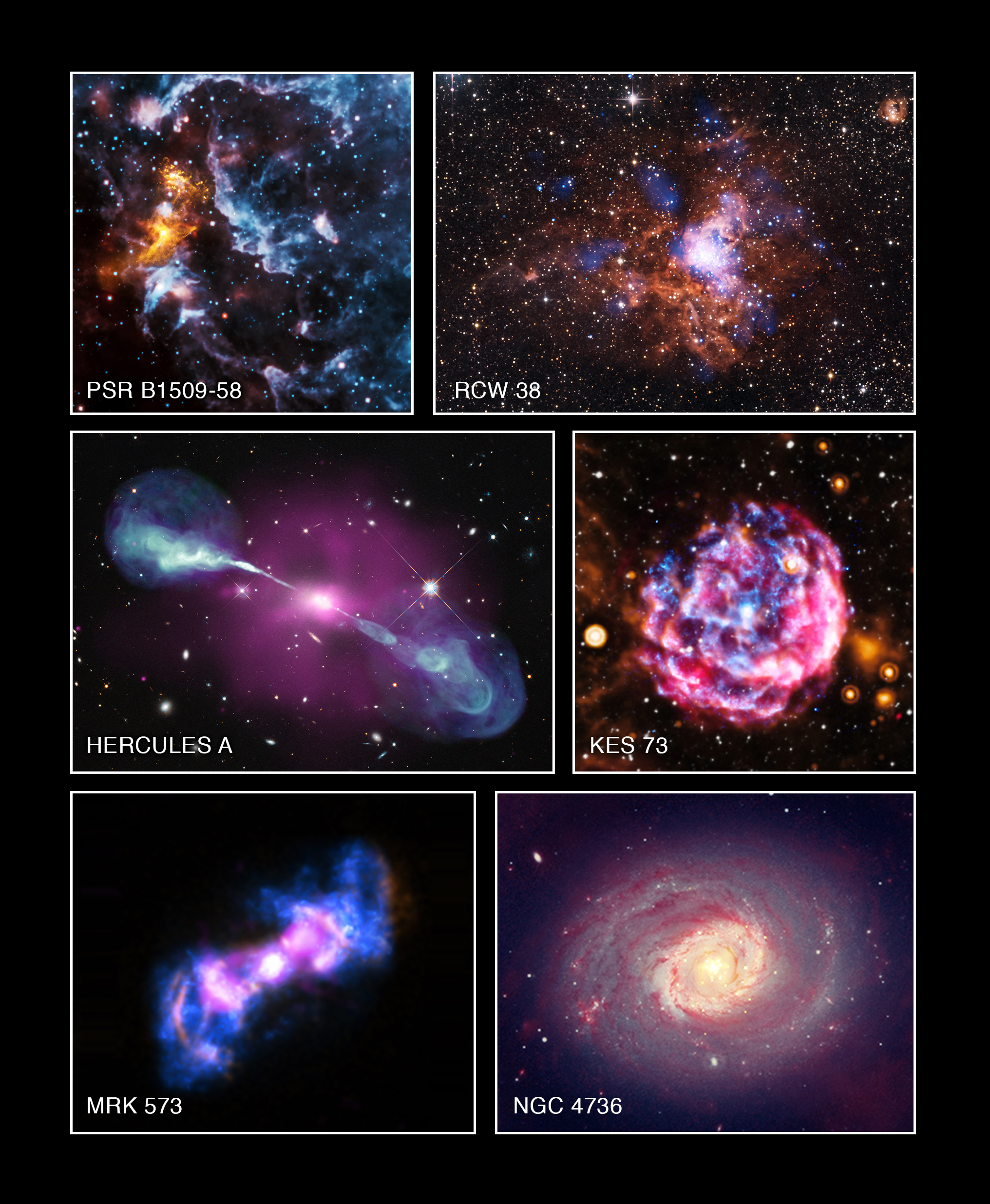
Chandra Archive Collection: Chandra's Archives Come to Life

Chandra Archive Collection
Credit NASA/CXC/SAO 
Instrument: ACIS 


JPEG (293.8 kb) - Large JPEG (2.2 MB) - More Images
(23 Out 13)


Every year, NASA's Chandra X-ray Observatory looks at hundreds of objects throughout space to help expand our understanding of the Universe. Ultimately, these data are stored in the Chandra Data Archive, an electronic repository that provides access to these unique X-ray findings for anyone who would like to explore them. With the passing of Chandra's 15th anniversary in operation on August 26, 1999, the archive continues to grow as each successive year adds to the enormous and invaluable dataset.

To celebrate Chandra's decade and a half in space, and to honor October as American Archives Month, a variety of objects have been selected from Chandra's archive. Each of the new images we have produced combines Chandra data with those from other telescopes. This technique of creating "multiwavelength" images allows scientists and the public to see how X-rays fit with data of other types of light, such as optical, radio, and infrared. As scientists continue to make new discoveries with the telescope, the burgeoning archive will allow us to see the high-energy Universe as only Chandra can. 

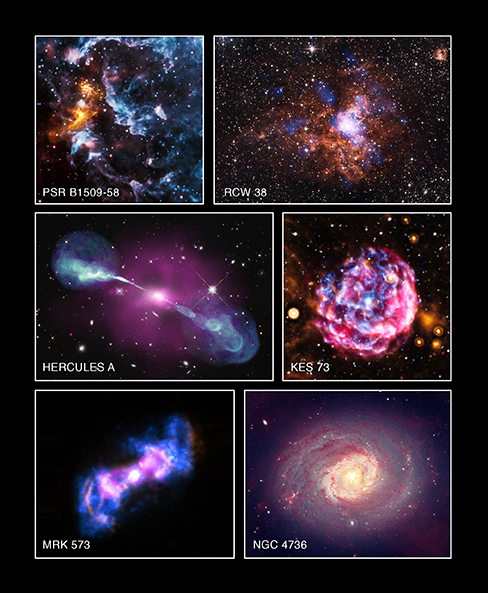
PSR B1509-58
PSR B1509-58 (upper left)
Pareidolia is the psychological phenomenon where people see recognizable shapes in clouds, rock formations, or otherwise unrelated objects or data. When Chandra's image of PSR B1509-58, a spinning neutron star surrounded by a cloud of energetic particles, was released in 2009, it quickly gained attention because many saw a hand-like structure in the X-ray emission. In this new image of the system, X-rays from Chandra in gold are seen along with infrared data from NASA's Wide-field Infrared Survey Explorer (WISE) telescope in red, green, and blue. Pareidolia may strike again in this image as some people report seeing a shape of a face in WISE's infrared data.

RCW 38
RCW 38 (upper right)
A young star cluster about 5,500 light years from Earth, RCW 38 provides astronomers a chance to closely examine many young, rapidly evolving stars at once. In this composite image, X-rays from Chandra are blue, while infrared data from NASA's Spitzer Space Telescope are orange and additional infrared data from the 2MASS survey appears white. There are many massive stars in RCW 38 that will likely explode as supernovas. Astronomers studying RCW 38 are hoping to better understand this environment as our Sun was likely born into a similar stellar nursery.

Hercules A
Hercules A (middle left):
Some galaxies have extremely bright cores, suggesting that they contain a supermassive black hole that is pulling in matter at a prodigious rate. Astronomers call these "active galaxies," and Hercules A is one of them. In visible light (colored red, green and blue, with most objects appearing white), Hercules A looks like a typical elliptical galaxy. In X-ray light, however, Chandra detects a giant cloud of multimillion-degree gas (purple). This gas has been heated by energy generated by the infall of matter into a black hole at the center of Hercules A that is over 1,000 times as massive as the one in the middle of the Milky Way. Radio data (blue) show jets of particles streaming away from the black hole. The jets span a length of almost one million light years.

Kes 73
Kes 73 (middle right):
The supernova remnant Kes 73, located about 28,000 light years away, contains a so-called anomalous X-ray pulsar, or AXP, at its center. Astronomers think that most AXPs are magnetars, which are neutron stars with ultra-high magnetic fields. Surrounding the point-like AXP in the middle, Kes 73 has an expanding shell of debris from the supernova explosion that occurred between about 750 and 2100 years ago, as seen from Earth. The Chandra data (blue) reveal clumpy structures along one side of the remnant, and appear to overlap with infrared data (orange). The X-rays partially fill the shell seen in radio emission (red) by the Very Large Array. Data from the Digitized Sky Survey optical telescope (white) show stars in the field-of-view.

Mrk 573
Mrk 573 (lower left):
Markarian 573 is an active galaxy that has two cones of emission streaming away from the supermassive black hole at its center. Several lines of evidence suggest that a torus, or doughnut of cool gas and dust may block some of the radiation produced by matter falling into supermassive black holes, depending on how the torus is oriented toward Earth. Chandra data of Markarian 573 suggest that its torus may not be completely solid, but rather may be clumpy. This composite image shows overlap between X-rays from Chandra (blue), radio emission from the VLA (purple), and optical data from Hubble (gold).

NGC 4736
NGC 4736 (lower right):
NGC 4736 (also known as Messier 94) is a spiral galaxy that is unusual because it has two ring structures. This galaxy is classified as containing a "low ionization nuclear emission region," or LINER, in its center, which produces radiation from specific elements such as oxygen and nitrogen. Chandra observations (gold) of NGC 4736, seen in this composite image with infrared data from Spitzer (red) and optical data from Hubble and the Sloan Digital Sky Survey (blue), suggest that the X-ray emission comes from a recent burst of star formation. Part of the evidence comes from the large number of point sources near the center of the galaxy, showing that strong star formation has occurred. In other galaxies, evidence points to supermassive black holes being responsible for LINER properties. Chandra's result on NGC 4736 shows LINERs may represent more than one physical phenomenon.

NASA's Marshall Space Flight Center in Huntsville, Alabama, manages the Chandra program for NASA's Science Mission Directorate in Washington, DC. The Smithsonian Astrophysical Observatory in Cambridge, Massachusetts, controls Chandra's science and flight operations.