Showing posts with label Phoenix Cluster. Show all posts

Monday, February 17, 2025

Webb Maps Full Picture of How Phoenix Galaxy Cluster Forms Stars

Phoenix Cluster (Hubble, Chandra, VLA Annotated)
Credits/Image: NASA, CXC, NRAO, ESA, Michael McDonald (MIT), Michael Reefe (MIT)
Illustration: Joseph Olmsted (STScI)

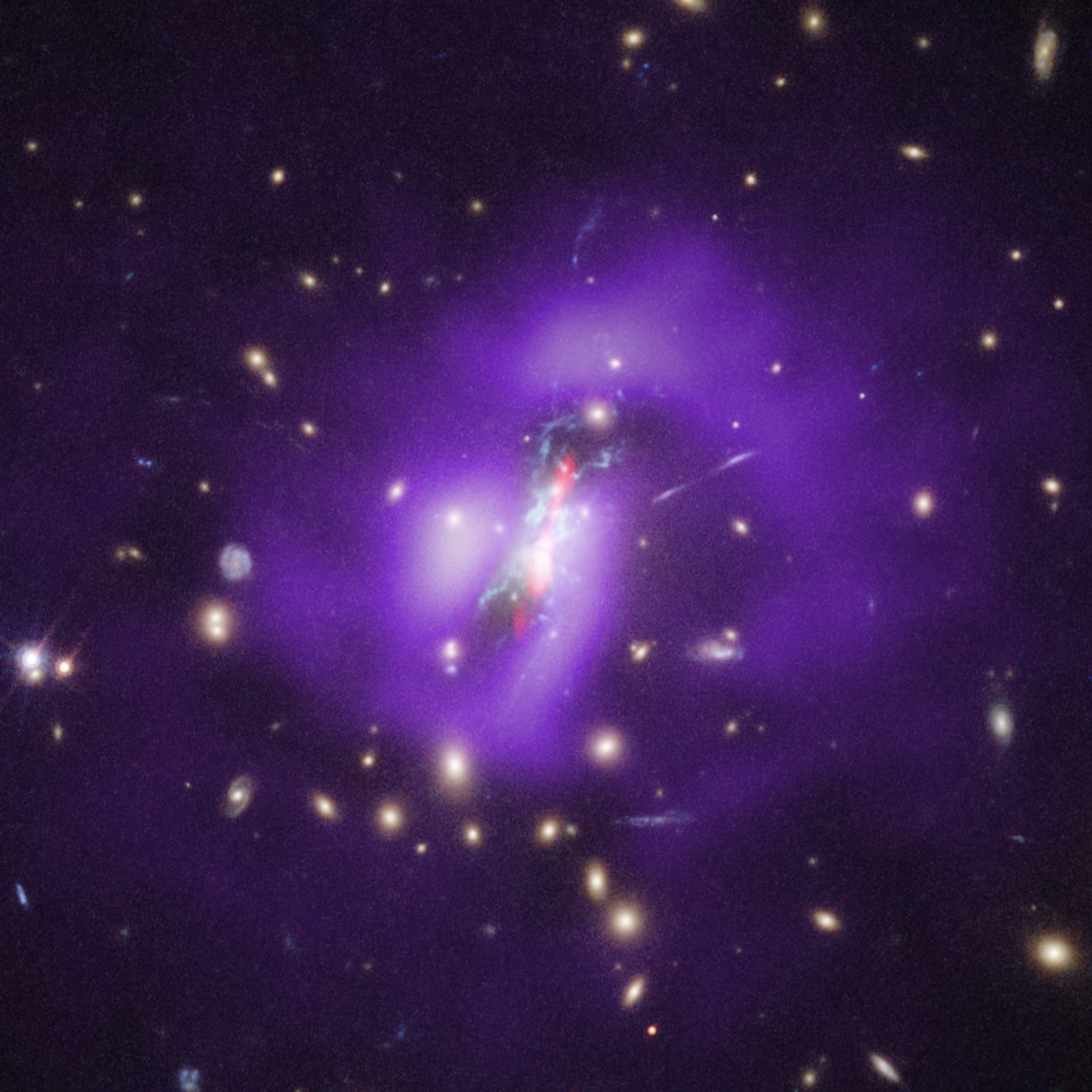
Phoenix Cluster (Hubble, Chandra, VLA)
Credits/Image: NASA, CXC, NRAO, ESA, Michael McDonald (MIT)
Image Processing: Joseph DePasquale (STScI)


Researchers using NASA’s James Webb Space Telescope have finally solved the mystery of how a massive galaxy cluster is forming stars at such a high rate. The confirmation from Webb builds on more than a decade of studies using NASA’s Chandra X-ray Observatory and Hubble Space Telescope, as well as several ground-based observatories.

The Phoenix cluster, a grouping of galaxies bound together by gravity 5.8 billion light-years from Earth, has been a target of interest for astronomers due to a few unique properties. In particular, ones that are surprising: a suspected extreme cooling of gas and a furious star formation rate despite a roughly 10 billion solar mass supermassive black hole at its core. In other observed galaxy clusters, the central supermassive black hole sends out energetic particles and radiation that prevents gas from cooling enough to form stars. Researchers have been studying gas flows within this cluster to try to understand how it is driving such extreme star formation.

“We can compare our previous studies of the Phoenix cluster, which found differing cooling rates at different temperatures, to a ski slope,” said Michael McDonald of the Massachusetts Institute of Technology in Cambridge, principal investigator of the program. “The Phoenix cluster has the largest reservoir of hot, cooling gas of any galaxy cluster — analogous to having the busiest chair lift, bringing the most skiers to the top of the mountain. However, not all of those skiers were making it down the mountain, meaning not all the gas was cooling to low temperatures. If you had a ski slope where there were significantly more people getting off the ski lift at the top than were arriving at the bottom, that would be a problem!”

To date, in the Phoenix cluster, the numbers weren’t adding up, and researchers were missing a piece of the process. Webb has now found those proverbial skiers at the middle of the mountain, in that it has tracked and mapped the missing cooling gas that will ultimately feed star formation. Most importantly, this intermediary warm gas was found within cavities tracing the very hot gas, a searing 18 million degrees Fahrenheit, and the already cooled gas around 18,000 degrees Fahrenheit.

The team studied the cluster’s core in more detail than ever before with the Medium-Resolution Spectrometer on Webb’s Mid-Infrared Instrument (MIRI). This tool allows researchers to take two-dimenstional spectroscopic data from a region of the sky, during one set of observations.

“Previous studies only measured gas at the extreme cold and hot ends of the temperature distribution throughout the center of the cluster,” added McDonald. “We were limited — it was not possible to detect the ‘warm’ gas that we were looking for. With Webb, we could do this for the first time.”

A Quirk of Nature

Webb’s capability to detect this specific temperature of cooling gas, around 540,000 degrees Fahrenheit, is in part due to its instrumental capabilities. However, the researchers are getting a little help from nature, as well

This oddity involves two very different ionized atoms, neon and oxygen, created in similar environments. At these temperatures, the emission from oxygen is 100 times brighter but is only visible in ultraviolet. Even though the neon is much fainter, it glows in the infrared, which allowed the researchers to take advantage of Webb’s advanced instruments.

“In the mid-infrared wavelengths detected by Webb, the neon VI signature was absolutely booming,” explained Michael Reefe, also of the Massachusetts Institute of Technology, lead author on the paper published in Nature. “Even though this emission is usually more difficult to detect, Webb’s sensitivity in the mid-infrared cuts through all of the noise.”

The team now hopes to employ this technique to study more typical galaxy clusters. While the Phoenix cluster is unique in many ways, this proof of concept is an important step towards learning about how other galaxy clusters form stars.

The James Webb Space Telescope is the world’s premier space science observatory. Webb is solving mysteries in our solar system, looking beyond to distant worlds around other stars, and probing the mysterious structures and origins of our universe and our place in it. Webb is an international program led by NASA with its partners, ESA (European Space Agency) and CSA (Canadian Space Agency).


About This Release

Credits:

Media Contact:

Hannah Braun
Space Telescope Science Institute, Baltimore, Maryland

Christine Pulliam
Space Telescope Science Institute, Baltimore, Maryland

Permissions: Content Use Policy

Contact Us: Direct inquiries to the News Team.


Monday, August 31, 2020

Can Black Hole Fire Up Cold Heart of the Phoenix?


Artist’s illustration of the structures seen in the observations.
Credit: NAOJ

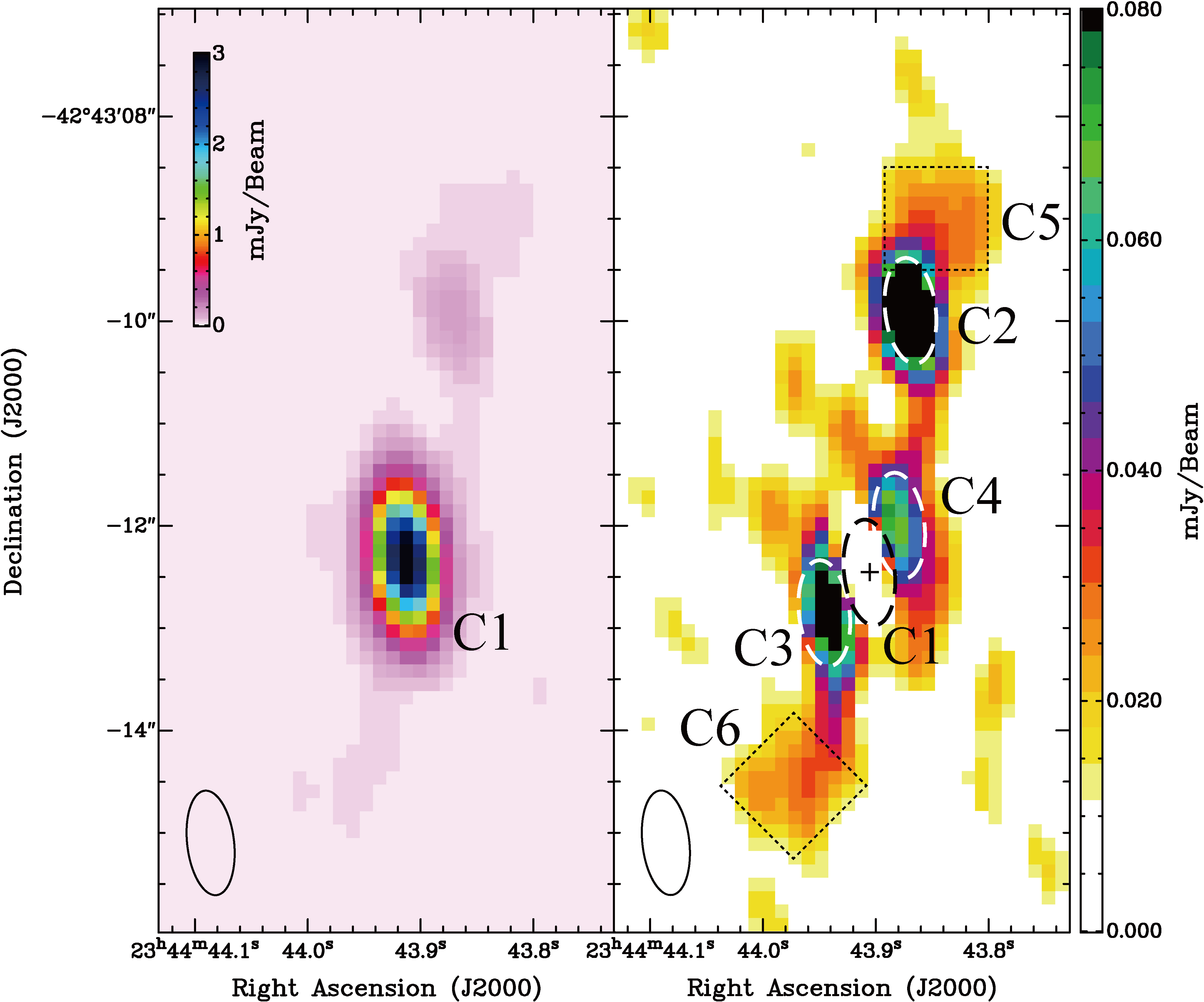
Radio astronomers have detected jets of hot gas blasted out by a black hole in the galaxy at the heart of the Phoenix Galaxy Cluster, located 5.9 billion light-years away in the constellation Phoenix. This is an important result for understanding the coevolution of galaxies, gas, and black holes in galaxy clusters.

Galaxies are not distributed randomly in space. Through mutual gravitational attraction, galaxies gather together to form collections known as clusters. The space between galaxies is not entirely empty. There is very dilute gas throughout a cluster which can be detected by X-ray observations.

If this intra-cluster gas cooled, it would condense under its own gravity to form stars at the center of the cluster. However, cooled gas and stars are not usually observed in the hearts of nearby clusters, indicating that some mechanism must be heating the intra-cluster gas and preventing star formation. One potential candidate for the heat source is jets of high-speed gas accelerated by a super-massive black hole in the central galaxy.

The Phoenix Cluster is unusual in that it does show signs of dense cooled gas and massive star formation around the central galaxy. This raises the question, “does the central galaxy have black hole jets as well?”

A team led by Takaya Akahori at the National Astronomical Observatory of Japan used the Australia Telescope Compact Array (ATCA) to search for black hole jets in the Phoenix Galaxy Cluster with the highest resolution to date. They detected matching structures extending out from opposite sides of the central galaxy. Comparing with observations of the region taken from the Chandra X-ray Observatory archive data shows that the structures detected by ATCA correspond to cavities of less dense gas, indicating that they are a pair of bipolar jets emitted by a black hole in the galaxy. Therefore, the team discovered the first example, in which intra-cluster gas cooling and black hole jets coexist, in the distant Universe.

Further details of the galaxy and jets could be elucidated through higher-resolution observations with next generation observational facilities, such as the Square Kilometre Array scheduled to start observations in the late 2020s.

These results appeared as T. Akahori et al. “Discovery of radio jets in the Phoenix galaxy cluster center” in the August 2020 issue of Publications of the Astronomical Society of Japan.

Radio observations of the center of the Phoenix Galaxy Cluster showing jet structures extending out from the central galaxy. Credit: Akahori et al.  Original Size (1.4MB)

Related Links

Can Black Hole Fire Up Cold Heart of the Phoenix? (NAOJ Mizusaw

Can Black Hole Fire Up Cold Heart of the Phoenix? (The University of Tokyo) 

Tuesday, November 19, 2019

Phoenix Cluster: A Weakened Black Hole Allows Its Galaxy to Awaken

Phoenix Cluster
Credit: X-ray: NASA/CXC/MIT/M.McDonald et al; Radio: NRAO/VLA; Optical: NASA/STScI


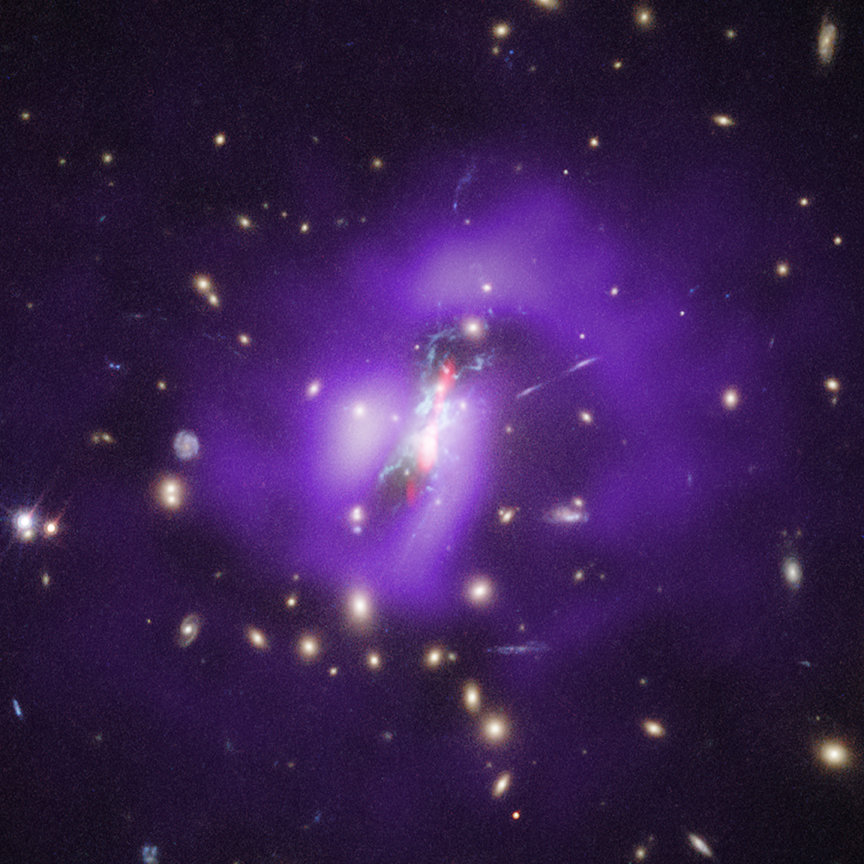
The Phoenix galaxy cluster contains the first confirmed supermassive black hole that is unable to prevent large numbers of stars from forming in the core of the galaxy cluster where it resides. This result, reported in our latest press release, was made by combining data from NASA's Chandra X-ray Observatory and Hubble Space Telescope, and the NSF's Karl Jansky Very Large Array (VLA). A new composite image shows data from each telescope. X-rays from Chandra depict hot gas in purple and radio emission from the VLA features jets in red. Optical light data from Hubble show galaxies (in yellow), and filaments of cooler gas where stars are forming (in light blue).

Composite - Phoenix Cluster
Credit: X-ray: NASA/CXC/MIT/M.McDonald et al; Radio: NRAO/VLA; Optical: NASA/STScI

Galaxy clusters are the largest structures in the cosmos that are held together by gravity, and they consist of hundreds or even thousands of galaxies embedded in hot gas and invisible dark matter. The galaxies in their centers of clusters contain the largest supermassive black holes known. In the case of the Phoenix Cluster, the black hole in its core has a mass equivalent to 5.8 billion suns.

For decades, astronomers have found such giant black holes pumping out energy into their environment, which keeps the gas that surrounds them too warm to form many stars. Previous work has shown that the largest galaxies in the universe lack cool gas in their centers and have many fewer stars than expected. The Phoenix Cluster is an example that bucks this trend. Instead, astronomers discovered a relatively cool current of gas along which many stars are being born.

The Phoenix Cluster system has several distinct elements that help tell the story of its unusually high star formation. Data from Chandra show that the coolest gas it can detect is located near the center of the cluster. In the absence of significant sources of heat, astronomers expect cooling to occur at the highest rates in a cluster's center, where the densest gas is located.

Optical observations with Hubble provide evidence for further cooling of gas near the center of the Phoenix Cluster. Ten billion solar masses of cooler gas are located along filaments to the north and south of the black hole, which likely originate from outbursts by the supermassive black hole located in the center of the image. The outbursts generated jets seen in radio waves by the VLA, in two opposite directions. As the jets push outward, they inflated cavities, or bubbles, in the hot gas that pervades the cluster. Chandra's sharp X-ray vision detected these cavities.

Phoenix Cluster
Credit: X-ray: NASA/CXC/MIT/M.McDonald et al; Radio: NRAO/VLA; Optical: NASA/STScI

The filaments of cool gas are located around the borders of the cavities, leading the authors to conclude that the black hole's outburst carries the gas away from the black hole. The farther away from the black hole, the faster the gas can cool to form stars. In the central part of the Phoenix cluster, stars are forming at a rate of about 500 solar masses per year. By comparison stars are forming in the Milky Way galaxy at a rate of about one sun's mass per year.

Eventually the black hole's outburst that is responsible for these jets will generate turbulence, sound waves and shock waves (similar to the sonic booms produced by supersonic aircraft). This will in turn provide a source of heat and prevent further cooling, until the outburst ceases and the build-up of cool gas recommences. The whole cycle can then repeat.

A paper describing these results was published in a recent issue of The Astrophysical Journal, and a preprint is available online. NASA's Marshall Space Flight Center manages the Chandra program. The Smithsonian Astrophysical Observatory's Chandra X-ray Center controls science and flight operations from Cambridge and Burlington, Massachusetts.


Fast Facts for Phoenix Cluster:

Scale: Image is about 45 arcsec (990,000 light years) across.
Category: Groups & Clusters of Galaxies, Quasars & Active Galaxies
Coordinates (J2000): RA 23h 44m 42.00s | Dec -42° 42´ 52.6"v Constellation Phoenix
Observation Date: 12 pointings from Sept 20, 2011 to Jan 25, 2018
Observation Time: 153 hours 7 min (6 days 9 hours 7 minutes)
Obs. ID: 13401, 16135, 16545, 19581-19583, 20630-20631, 20634-20636, 20797
Instrument: ACIS
Also Known As: SPT-CLJ2344-4243
References: McDonald, M. et al., 2019, ApJ, 885, 63; arXiv:1904.08942
Color Code: X-ray: Purple; Radio: Red; Optical: Orange (WFC/F850LP), Green (WFC/F755W), Blue (WFC/F475W)
Distance Estimate: About 5.8 billion light years (z=0.597)


Wednesday, October 16, 2019

Astronomers use giant galaxy cluster to magnify X-ray emissions of an early-forming galaxy

False color and X-ray images of the giant arc in SPT-CLJ2344-4243. The X-ray emitting giant arc is shown relative to the center of the foreground lensing galaxy cluster in a false color image at optical wavelengths. The inset shows Chandra X-ray 0.5–7 keV (left) and Hubble optical (right) images of the giant arc at a scale 1.5 times larger.

A team of astronomers, including Professor Keren Sharon from the University of Michigan, have utilized a massive cluster of galaxies in order to look back in time to the first generation of galaxies. The work of Sharon and her coauthors, led by Matthew Bayliss, a research scientist in MIT’s Kavli Institute for Astrophysics and Space Research, was published recently in Nature Astronomy.

An experiment of gravitational lensing

In previous studies, strong gravitational lensing by galaxy clusters was leveraged to observe faint galaxies at optical and infrared wavelengths. However, this is the first time gravitational lensing has been used to peer into distant star formation in the X-ray.

While conducting their research, the astronomers detected an infant galaxy, about 1/10,000 the size of the Milky Way, in its first high-energy stage of star formation. According to Sharon and her colleagues, the detection of this distant galaxy supports the idea that scientists can use galaxy clusters to observe phenomena dating back to the universe’s early history – in this case, nearly 9.4 billion years ago.

Galaxy clusters are the most massive objects in the universe. Because they are so large and composed of many galaxies all bound together by gravity, their gravitational pull is often so strong that it can bend space-time. When this happens, light may no longer move in straight lines as its path is warped by the gravitational pull of the cluster. As a result, the light from background objects is magnified. When this phenomena is used to astronomers’ advantage, it is called gravitational lensing.

Galaxy clusters are the most massive gravitationally bound objects in the Universe, composed of dark matter, hot gas, hundreds of galaxies. Because they are so massive, their gravity bends space-time, an effect predicted by Einstein’s general relativity. When this happens, light may no longer move in straight lines as its path follows the warped space-time. As a result, the image of background objects appears distorted and magnified. When this phenomena is used to astronomers’ advantage, it is called gravitational lensing.

“We have observed that the Phoenix cluster is causing lensing of several background sources, magnifying them and creating multiple images,” said Sharon. “I can take those observations and use them to solve for how much mass there is in this intervening object and determine the degree of magnification.”

Gravitational lensing essentially allows astronomers to use galaxy clusters as enormous magnifying glasses. If they are able to approximate the mass of a cluster, they can estimate the gravitational effects it may have on background light sources. For instance, the light from an object positioned behind the cluster would travel directly towards the cluster before bending around it and continuing towards the observer, appearing as distorted, magnified images of the object. This helps astronomers study galaxies that would otherwise be too faint for present-day telescopes.

Sourcing the X-rays

While studying gravitationally-lensed faint galaxies is now routine, faint X-ray sources behind galaxy clusters pose an additional challenge. The cores of galaxy clusters are filled with hot gas, which emits brightly in the X-ray. The X-ray light of the background source, although magnified, can be lost in the X-ray light of the foreground cluster.

While examining X-ray data of the Phoenix cluster, Dr. Bayliss realized that there was X-ray emission originating from one of the gravitationally-lensed background galaxies that appeared as a point source.

“This radiation is likely coming not from something that is very X-ray luminous, but from a stellar object or X-ray binary,” said Sharon. “This is very hard to see at such large distances and is only visible in this case because it is being magnified by the Phoenix cluster at a factor of 60. This is the farthest away it’s ever been seen.”

Isolating the background object

In order to achieve a better understanding of the identified X-ray emissions, the team tested whether they could isolate the fainter X-rays coming from the background object. Using data taken by NASA’s Chandra X-ray Observatory, the Hubble Space Telescope and the Magellan telescope in Chile, the team developed a model to precisely measure the X-ray emissions from the Phoenix cluster and subtract it from the data. What was left were the lensed emissions that they were able to trace back to a tiny dwarf galaxy, originating approximately 9.4 billion years ago.

The researchers further examined the the X-ray, optical, and infra-red emission coming from this galaxy and were able to measure its physical conditions, such as age, metallicity (the fraction of heavy elements), star formation rate, and mass. The gravitational lensing analysis, led by Sharon, enabled the team to convert the observed measurements to the intrinsic ones one would have measured without lensing magnification. Because this galaxy has low mass and low metallicity, and because X-rays are typically produced during extreme events, the researchers conclude that this galaxy may by similar to the first generation of galaxies formed in the very early universe, and responsible for ionizing it.

“The universe’s first stars and galaxies had enough energetic photons to create larger and larger spheres for ionized materials. After that epoch, light was free to travel through the universe,” said Sharon. “It’s interesting to find galaxies that are analogs of those first galaxies in an epoch where we can see them.”

by Nicholle Cardinal


More Information:


Tuesday, February 14, 2017

Self-made stars

This composite image shows powerful radio jets from the supermassive black hole at the center of a galaxy in the Phoenix Cluster inflating huge "bubbles" in the hot, ionized gas surrounding the galaxy. The cavities inside the blue region were imaged by NASA's Chandra X-ray observatory. Hugging the outside of these bubbles, ALMA discovered an unexpected trove of cold gas, the fuel for star formation (red). The background image is from the Hubble Space Telescope.  Image: ALMA (ESO/NAOJ/NRAO) H.Russell, et al.; NASA/ESA Hubble; NASA/CXC/MIT/M.McDonald et al.; B. Saxton (NRAO/AUI/NSF)


Astronomers observe black hole producing cold, star-making fuel from hot plasma jets and bubbles.

The Phoenix cluster is an enormous accumulation of about 1,000 galaxies, located 5.7 billion light years from Earth. At its center lies a massive galaxy, which appears to be spitting out stars at a rate of about 1,000 per year. Most other galaxies in the universe are far less productive, squeaking out just a few stars each year, and scientists have wondered what has fueled the Phoenix cluster’s extreme stellar output.

Now scientists from MIT, the University of Cambridge, and elsewhere may have an answer. In a paper published today in the Astrophysical Journal, the team reports observing jets of hot, 10-million-degree gas blasting out from the central galaxy’s black hole and blowing large bubbles out into the surrounding plasma.

These jets normally act to quench star formation by blowing away cold gas — the main fuel that a galaxy consumes to generate stars. However, the researchers found that the hot jets and bubbles emanating from the center of the Phoenix cluster may also have the opposite effect of producing cold gas, that in turn rains back onto the galaxy, fueling further starbursts. This suggests that the black hole has found a way to recycle some of its hot gas as cold, star-making fuel.

“We have thought the role of black hole jets and bubbles was to regulate star formation and to keep cooling from happening,” says Michael McDonald, assistant professor of physics in MIT’s Kavli Institute for Astrophysics and Space Research. “We kind of thought they were one-trick ponies, but now we see they can actually help cooling, and it’s not such a cut-and-dried picture.”

The new findings help to explain the Phoenix cluster’s exceptional star-producing power. They may also provide new insight into how supermassive black holes and their host galaxies mutually grow and evolve.

McDonald’s co-authors include lead author Helen Russell, an astronomer at Cambridge University; and others from the University of Waterloo, the Harvard-Smithsonian Center for Astrophysics, the University of Illinois, and elsewhere.

Hot jets, cold filaments

The team analyzed observations of the Phoenix cluster gathered by the Atacama Large Millimeter Array (ALMA), a collection of 66 large radio telescopes spread over the desert of northern Chile. In 2015, the group obtained permission to direct the telescopes at the Phoenix cluster to measure its radio emissions and to detect and map signs of cold gas.

The researchers looked through the data for signals of carbon monoxide, a gas that is present wherever there is cold hydrogen gas. They then converted the carbon monoxide emissions to hydrogen gas, to generate a map of cold gas near the center of the Phoenix cluster. The resulting picture was a puzzling surprise.

“You would expect to see a knot of cold gas at the center, where star formation happens,” McDonald says. “But we saw these giant filaments of cold gas that extend 20,000 light years from the central black hole, beyond the central galaxy itself. It’s kind of beautiful to see.”

The team had previously used NASA’s Chandra X-Ray Observatory to map the cluster’s hot gas. These observations produced a picture in which powerful jets flew out from the black hole at close to the speed of light. Further out, the researchers saw that the jets inflated giant bubbles in the hot gas.
When the team superimposed its picture of the Phoenix cluster’s cold gas onto the map of hot gas, they found a “perfect spatial correspondence”: The long filaments of frigid, 10-kelvins gas appeared to be draped over the bubbles of hot gas.

“This may be the best picture we have of black holes influencing the cold gas,” McDonald says.

Feeding the black hole

What the researchers believe to be happening is that, as jet inflate bubbles of hot, 10-million-degree gas near the black hole, they drag behind them a wake of slightly cooler, 1-million-degree gas. The bubbles eventually detach from the jets and float further out into the galaxy cluster, where each bubble’s trail of gas cools, forming long filaments of extremely cold gas that condense and rain back onto the black hole as fuel for star formation.

“It’s a very new idea that the bubbles and jets can actually influence the distribution of cold gas in any way,” McDonald says.

Scientists have estimated that there is enough cold gas near the center of the Phoenix cluster to keep producing stars at a high rate for another 30 to 40 million years. Now that the researchers have identified a new feedback mechanism that may supply the black hole with even more cold gas, the cluster’s stellar output may continue for much longer.

“As long as there’s cold gas feeding it, the black hole will keep burping out these jets,” McDonald says. “But now we’ve found that these jets are making more food, or cold gas. So you’re in this cycle that, in theory, could go on for a very long time.”

He suspects the reason the black hole is able to generate fuel for itself might have something to do with its size. If the black hole is relatively small, it may produce jets that are too weak to completely blast cold gas away from the cluster.

“Right now [the black hole] may be pretty small, and it’d be like putting a civilian in the ring with Mike Tyson,” McDonald says. “It’s just not up to the task of blowing this cold gas far enough away that it would never come back.”

The team is hoping to determine the mass of the black hole, as well as identify other, similarly extreme starmakers in the universe.


Thursday, October 01, 2015

Phoenix Cluster: A Fresh Perspective on an Extraordinary Cluster of Galaxies

SPT-CLJ2344-4243 - Phoenix Cluster
Credit:  X-ray: NASA/CXC/MIT/M.McDonald et al; 
Optical: NASA/STScI; Radio: TIFR/GMRT


animation


Galaxy clusters are often described by superlatives. After all, they are huge conglomerations of galaxies, hot gas, and dark matter and represent the largest structures in the Universe held together by gravity.

Galaxy clusters tend to be poor at producing new stars in their centers. They generally have one giant galaxy in their middle that forms stars at a rate significantly slower than most galaxies - including our Milky Way. The central galaxy contains a supermassive black holeroughly a thousand times more massive than the one at the center of our galaxy. Without heating by outbursts from this black hole, the copious amounts of hot gas found in the central galaxy should cool, allowing stars to form at a high clip. It is thought that the central black hole acts as a thermostat, preventing rapid cooling of surrounding hot gas and impeding star formation.

New data provide more details on how the galaxy cluster SPT-CLJ2344-4243, nicknamed the Phoenix Cluster for the constellation in which it is found, challenges this trend. The cluster has shattered multiple records in the past: In 2012, scientists announced that the Phoenix cluster featured the highest rate of cooling hot gas and star formation ever seen in the center of a galaxy cluster, and is the most powerful producer of X-rays of all known clusters. The rate at which hot gas is cooling in the center of the cluster is also the largest ever observed.

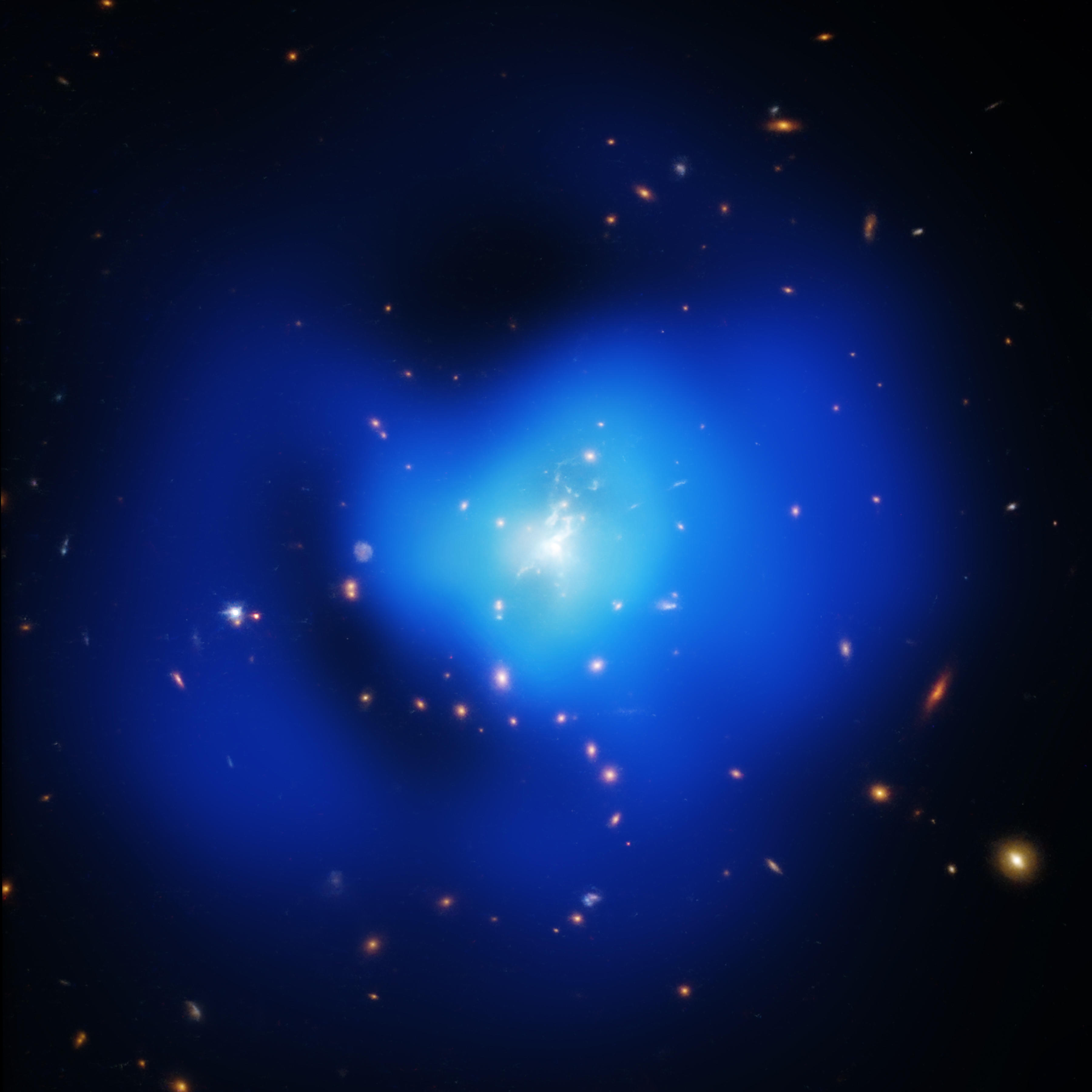
New observations of this galaxy cluster at X-ray, ultraviolet, and optical wavelengths by NASA's Chandra X-ray Observatory, the Hubble Space Telescope, and the Clay-Magellan telescope located in Chile, are helping astronomers better understand this remarkable object. Clay-Magellan's optical data reveal narrow filaments from the center of the cluster where stars are forming. These massive cosmic threads of gas and dust, most of which had never been detected before, extend for 160,000 to 330,000 lights years. This is longer than the entire breadth of the Milky Way galaxy, making them the most extensive filaments ever seen in a galaxy cluster.

These filaments surround large cavities - regions with greatly reduced X-ray emission - in the hot gas. The X-ray cavities can be seen in this composite image that shows the Chandra X-ray data in blue and optical data from the Hubble Space Telescope (red, green, and blue). For the location of these "inner cavities", mouse over the image. Astronomers think that the X-ray cavities were carved out of the surrounding gas by powerful jets of high-energy particles emanating from near a supermassive black hole in the central galaxy of the cluster. As matter swirls toward a black hole, an enormous amount of gravitational energy is released. 

Combined radio and X-ray observations of supermassive black holes in other galaxy clusters have shown that a significant fraction of this energy is released as jets of outbursts that can last millions of years. The observed size of the X-ray cavities indicates that the outburst that produced the cavities in SPT- CLJ2344-4243 was one of the most energetic such events ever recorded.

 Radio & Optical Image of Phoenix Cluster
Credit  X-ray: NASA/CXC/MIT/M.McDonald et al; 
Optical: NASA/STScI; Radio: TIFR/GMRT

However, the central black hole in the Phoenix cluster is suffering from somewhat of an identity crisis, sharing properties with both "quasars", very bright objects powered by material falling onto a supermassive black hole, and "radio galaxies" containing jets of energetic particles that glow in radio waves, and are also powered by giant black holes. Half of the energy output from this black hole comes via jets mechanically pushing on the surrounding gas (radio-mode), and the other half from optical, UV and X-radiation originating in an accretion disk (quasar-mode). Astronomers suggest that the black hole may be in the process of flipping between these two states.

X-ray cavities located farther away from the center of the cluster, labeled as "outer cavities", provide evidence for strong outbursts from the central black hole about a hundred million years ago (neglecting the light travel time to the cluster). This implies that the black hole may have been in a radio mode, with outbursts, about a hundred million years ago, then changed into a quasar mode, and then changed back into a radio mode.

It is thought that rapid cooling may have occurred in between these outbursts, triggering star formation in clumps and filaments throughout the central galaxy at a rate of about 610 solar masses per year. By comparison, only a couple new stars form every year in our Milky Way galaxy. The extreme properties of the Phoenix cluster system are providing new insights into various astrophysical problems, including the formation of stars, the growth of galaxies and black holes, and the co-evolution of black holes and their environment.

A paper describing these results, led by Michael McDonald (Massachusetts Institute of Technology), has been accepted for publication in The Astrophysical Journal and is available online. NASA's Marshall Space Flight Center in Huntsville, Alabama, manages the Chandra program for NASA's Science Mission Directorate in Washington. The Smithsonian Astrophysical Observatory in Cambridge, Massachusetts, controls Chandra's science and flight operations.


Fast Facts for Phoenix Cluster:

Scale: Image is about 1.2 arcmin across (about 1.5 million light years)
Category: Groups & Clusters of Galaxies
Coordinates (J2000): RA 23h 44m 42.00s | Dec -42 42 52.60
Constellation: Phoenix
Observation Date: 3 pointings between Sep 2011 and Aug 2014
Observation Time: 36 hours 23 min (1 days 12 hours 23 min).
Obs. ID: 13401, 16135, 16545
Instrument: ACIS
Also Known As: SPT-CLJ2344-4243
References: arXiv:1508.05941
Color Code: X-ray (Blue); Optical (Red, Green, Blue)
Distance Estimate: About 5.7 billion light years; z=0.596