Showing posts with label R136. Show all posts

Wednesday, August 06, 2025

A sea monster and a Tarantula

A nebula. The top-left is dense with layers of fluffy pink and greenish clouds. Long strands of green clouds stretch out from here; a faint layer of translucent blue dust combines with them to create a three-dimensional scene. A sparse network of dark dust clouds in the foreground adds reddish-black patches atop the nebula. Blue-white and orange stars, from our galaxy and beyond, are spread amongst the clouds. Credit: ESA/Hubble & NASA, C. Murray


A scene from a star-forming factory shines in this NASA/ESA Hubble Space Telescope Picture of the Week. This Hubble picture captures incredible details in the dusty clouds in a star-forming region called the Tarantula Nebula. What’s possibly the most amazing aspect of this detailed image is that this nebula isn’t even in our galaxy. Instead, it’s in the Large Magellanic Cloud, a dwarf galaxy that is located about 160 000 light-years away in the constellations Dorado and Mensa.

The Large Magellanic Cloud is the largest of the dozens of small satellite galaxies that orbit the Milky Way. The Tarantula Nebula is the largest and brightest star-forming region not just in the Large Magellanic Cloud, but in the entire group of nearby galaxies to which the Milky Way belongs.

The Tarantula Nebula is home to the most massive stars known, some of which are roughly 200 times as massive as our Sun. The scene pictured here is located away from the centre of the nebula, where there is a super star cluster called R136, but very close to a rare type of star called a Wolf–Rayet star. Wolf–Rayet stars are massive stars that have lost their outer shell of hydrogen and are extremely hot and luminous, powering dense and furious stellar winds.

This nebula is a frequent target for Hubble, whose multiwavelength capabilities are critical for capturing sculptural details in the nebula’s dusty clouds. The data used to create this image come from an observing programme called Scylla, named for a multi-headed sea monster from the Greek myth of Ulysses. The Scylla programme was designed to complement another Hubble observing programme called ULYSSES (Ultraviolet Legacy library of Young Stars as Essential Standards). ULYSSES targets massive young stars in the Small and Large Magellanic Clouds, while Scylla investigates the structures of gas and dust that surround these stars.


Thursday, February 13, 2025

NASA Telescopes Deliver Stellar Bouquet in Time for Valentine's Day

30 Doradus
Credit X-ray: NASA/CXC/Penn State Univ./L. Townsley et al.; Infrared: NASA/JPL-CalTech/SST; Optical: NASA/STScI/HST; Radio: ESO/NAOJ/NRAO/ALMA; Image Processing: NASA/CXC/SAO/J. Schmidt, N. Wolk, K. Arcand


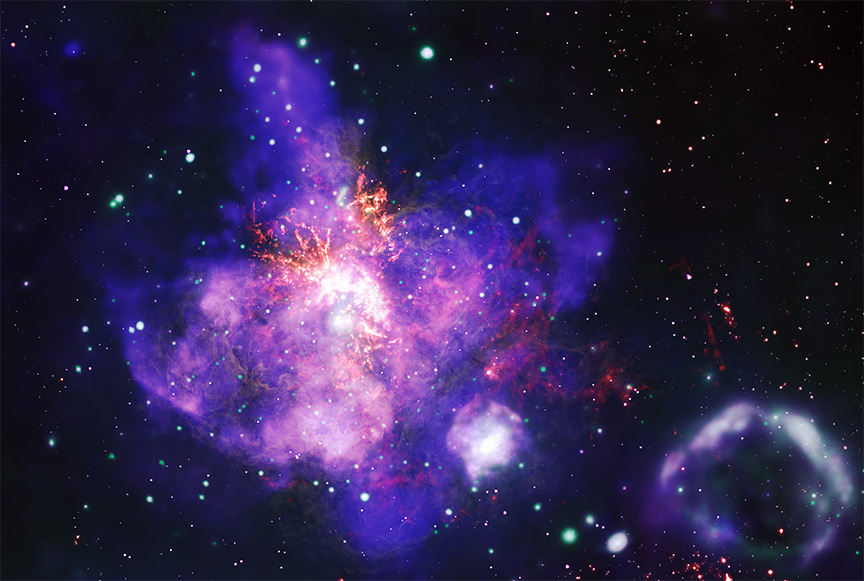
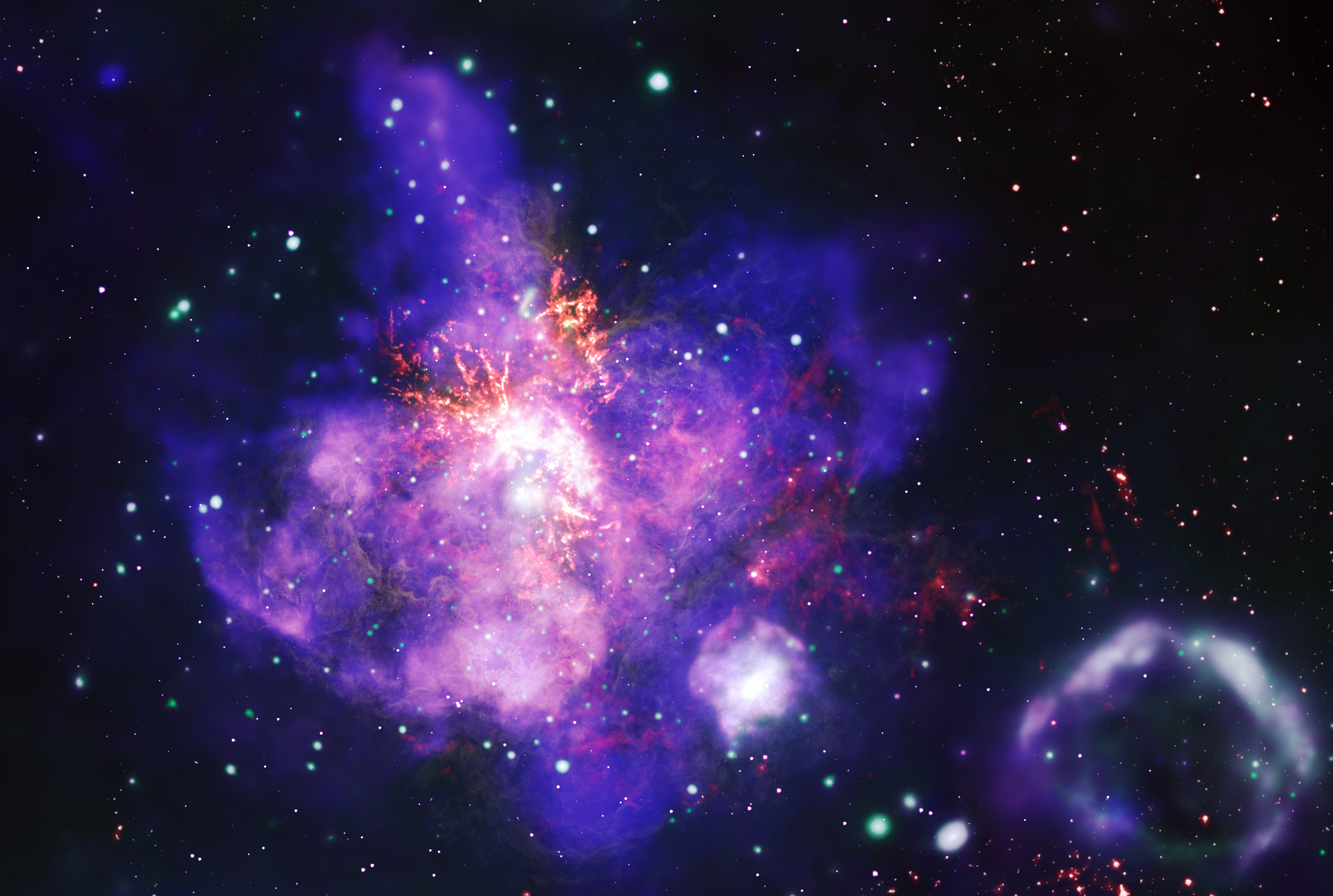
A bouquet of thousands of stars in bloom has arrived. This composite image contains the deepest X-ray image ever made of the spectacular star forming region called 30 Doradus.

By combining X-ray data from NASA’s Chandra X-ray Observatory (blue and green) with optical data from NASA’s Hubble Space Telescope (yellow) and radio data from the Atacama Large Millimeter/submillimeter Array (orange), this stellar arrangement comes alive.

30 Doradus Region (Labeled). Credit: X-ray: NASA/CXC/Penn State Univ./L. Townsley et al.; Infrared: NASA/JPL-CalTech/SST; Optical: NASA/STScI/HST; Radio: ESO/NAOJ/NRAO/ALMA; Image Processing: NASA/CXC/SAO/J. Schmidt, N. Wolk, K. Arcand)

Otherwise known as the Tarantula Nebula, 30 Dor is located about 160,000 light-years away in a small neighboring galaxy to the Milky Way known as the Large Magellanic Cloud (LMC). Because it one of the brightest and populated star-forming regions to Earth, 30 Dor is a frequent target for scientists trying to learn more about how stars are born.

With enough fuel to have powered the manufacturing of stars for at least 25 million years, 30 Dor is the most powerful stellar nursery in the local group of galaxies that includes the Milky Way, the LMC, and the Andromeda galaxy.

The massive young stars in 30 Dor send cosmically strong winds out into space. Along with the matter and energy ejected by stars that have previously exploded, these winds have carved out an eye-catching display of arcs, pillars, and bubbles.

A dense cluster in the center of 30 Dor contains the most massive stars astronomers have ever found, each only about one to two million years old. (Our Sun is over a thousand times older with an age of about 5 billion years.)

This new image includes the data from a large Chandra program that involved about 23 days of observing time, greatly exceeding the 1.3 days of observing that Chandra previously conducted on 30 Dor. The 3,615 X-ray sources detected by Chandra include a mixture of massive stars, double-star systems, bright stars that are still in the process of forming, and much smaller clusters of young stars.

There is a large quantity of diffuse, hot gas seen in X-rays, arising from different sources including the winds of massive stars and from the gas expelled by supernova explosions. This data set will be the best available for the foreseeable future for studying diffuse X-ray emission in star-forming regions.

The long observing time devoted to this cluster allows astronomers the ability to search for changes in the 30 Dor’s massive stars. Several of these stars are members of double star systems and their movements can be traced by the changes in X-ray brightness.

A paper describing these results appears in the July 2024 issue of The Astrophysical Journal Supplement Series. NASA's Marshall Space Flight Center manages the Chandra program. The Smithsonian Astrophysical Observatory's Chandra X-ray Center controls science operations from Cambridge, Massachusetts, and flight operations from Burlington, Massachusetts.


Visual Description:

This release features a highly detailed composite image of a star-forming region of space known as 30 Doradus, shaped like a bouquet, or a maple leaf.

30 Doradus is a powerful stellar nursery. In 23 days of observation, the Chandra X-ray telescope revealed thousands of distinct star systems. Chandra data also revealed a diffuse X-ray glow from winds blowing off giant stars, and X-ray gas expelled by exploding stars, or supernovas.

In this image, the X-ray wind and gas takes the shape of a massive purple and pink bouquet with an extended central flower, or perhaps a leaf from a maple tree. The hazy, mottled shape occupies much of the image, positioned just to our left of center, tilted slightly to our left. Inside the purple and pink gas and wind cloud are red and orange veins, and pockets of bright white light. The pockets of white light represent clusters of young stars. One cluster at the heart of 30 Doradus houses the most massive stars astronomers have ever found.

The hazy purple and pink bouquet is surrounded by glowing dots of green, white, orange, and red. A second mottled purple cloud shape, which resembles a ring of smoke, sits in our lower righthand corner.


Fast Facts for 30 Doradus:

Scale: Image is about 30 arcmin (1,400 light-years) across.
Category: Normal Stars & Star Clusters
Coordinates (J2000): RA 5h 38m 38s | Dec -69° 05´ 42"
Constellation: Dorado
Observation Dates: 54 observations from Sep 9, 1999 to Jan 22 2016
Observation Time: 541 hours (22 days 13 hours)
Obs. ID: 22, 5906, 7263, 7264, 2783, 16192-16203, 16442-16449, 16612, 16615-16617, 16621, 16640, 17321, 17414, 17486, 17544, 17545, 17555, 17561, 17562, 17602, 117603, 17640-17642, 17660, 18670-18672, 18706, 18720-18722, 18729, 18749, 18750
Instrument: ACIS
Also Known As: 30 Doradus
References: Townsley, L. et al, 2024, ApJS, 273, 5; arXiv:2403.16944
Color Code: X-ray: green, magenta, blue; Optical: dark yellow; Radio: orange; Infrared: red
Distance Estimate: About 160,000 light-years


Wednesday, January 29, 2020

This image from NASA's Spitzer Space Telescope shows the Tarantula Nebula in two wavelengths of infrared light. The red regions indicate the presence of particularly hot gas, while the blue regions are interstellar dust that is similar in composition to ash from coal or wood-burning fires on Earth. Credit: NASA/JPL-Caltech. › Full image and caption

The Tarantula Nebula, seen in this image by the Spitzer Space Telescope, was one of the first targets studied by the infrared observatory after its launch in 2003, and the telescope has revisited it many times since. Now that Spitzer is set to be retired on Jan. 30, 2020, scientists have generated a new view of the nebula from Spitzer data.

This high-resolution image combines data from multiple Spitzer observations, most recently in February and September 2019.

"I think we chose the Tarantula Nebula as one of our first targets because we knew it would demonstrate the breadth of Spitzer's capabilities," said Michael Werner, who has been Spitzer's project scientist since the mission's inception and is based at NASA's Jet Propulsion Laboratory in Pasadena, California. "That region has a lot of interesting dust structures and a lot of star formation happening, and those are both areas where infrared observatories can see a lot of things that you can't see in other wavelengths."

This annotated image from NASA's Spitzer Space Telescope shows the Tarantula Nebula in infrared light. The supernova 1987A and the starburst region R136 are noted. The magenta-colored regions are primarily interstellar dust that is similar in composition to ash from coal or wood fires on Earth. Credit: NASA/JPL-Caltech.  › Full image and caption

Infrared light is invisible to the human eye, but some wavelengths of infrared can pass through clouds of gas and dust where visible light cannot. So scientists use infrared observations to view newborn stars and still-forming "protostars," swaddled in the clouds of gas and dust from which they formed.

Located in the Large Magellanic Cloud - a dwarf galaxy gravitationally bound to our Milky Way galaxy - the Tarantula Nebula is a hotbed of star formation. In the case of the Large Magellanic Cloud, such studies have helped scientists learn about rates of star formation in galaxies other than the Milky Way.

The nebula also hosts R136, a "starburst" region, where massive stars form in extremely close proximity and at a rate far higher than in the rest of the galaxy. Within R136, in an area less than 1 light-year across (about 6 trillion miles, or 9 trillion kilometers), there are more than 40 massive stars, each containing at least 50 times the mass of our Sun. By contrast, there are no stars at all within 1 light-year of our Sun. Similar starburst regions have been found in other galaxies, containing dozens of massive stars - a higher number of massive stars than what is typically found in the rest of their host galaxies. How these starburst regions arise remains a mystery.

On the outskirts of the Tarantula Nebula, you can also find one of astronomy's most-studied stars that has exploded in a supernova. Dubbed 1987A because it was the first supernova spotted in 1987, the exploded star burned with the power of 100 million Suns for months. The shockwave from that event continues to move outward into space, encountering material ejected from the star during its dramatic death.

When the shockwave collides with dust, the dust heats up and begins to radiate in infrared light. In 2006, Spitzer observations saw that light and determined that the dust is largely composed of silicates, a key ingredient in the formation of rocky planets in our solar system. In 2019, scientists used Spitzer to study 1987A to monitor the changing brightness of the expanding shockwave and debris to learn more about how these explosions change their surrounding environment.

More From Spitzer

To see more amazing images from Spitzer, check out the NASA Selfies App, which has a bundle of new Spitzer images. Available for iOS and Android, the app lets you create a snapshot of yourself in a virtual spacesuit, posing in front of gorgeous cosmic locations, including the Tarantula Nebula. Its simple interface lets you snap a photo of yourself, pick your background and share on social media while also providing you some of the science behind the images.

For an even more immersive Spitzer experience, check out the new Spitzer Final Voyage VR experience, which places you in a 360-degree starscape that replicates Spitzer's current location orbiting the Sun, about 160 million miles (260 million kilometers) behind Earth. The narrated video shows you how the infrared telescope operates and what the universe looks like in infrared light. The VR experience is viewable on the Spitzer YouTube channel using mobile-based VR headsets, and in the Exoplanets Excursion VR app via Oculus Rift and HTC Vive headsets.

More information about Spitzer is available at the following site: https://www.nasa.gov/mission_pages/spitzer/main

News Media Contact

Calla Cofield
Jet Propulsion Laboratory, Pasadena, Calif.
626-808-2469
calla.e.cofield@jpl.nasa.gov


Wednesday, May 30, 2018

A Crowded Neighbourhood

The rich region around the Tarantula Nebula in the Large Magellanic Cloud

Tarantula Nebula region in the constellation of Doradus

The rich region around the Tarantula Nebula in the Large Magellanic Cloud (annotated)


Videos

ESOcast 162 Light: A Crowded Neighbourhood (4K UHD)

Zooming in on the Tarantula Nebula


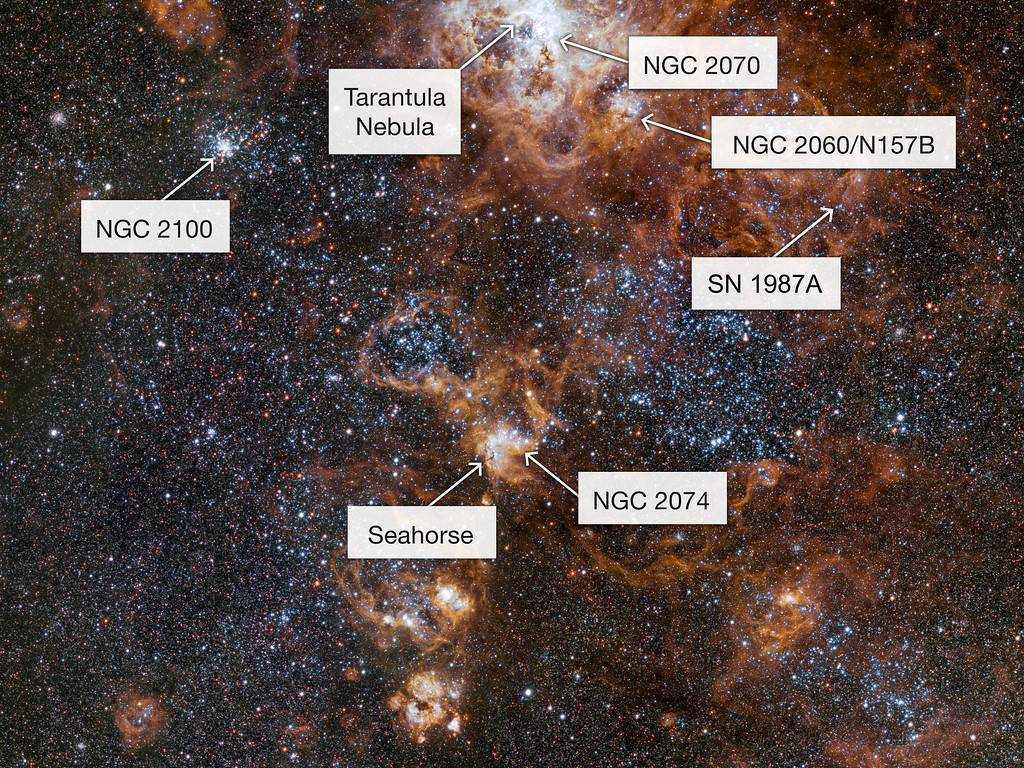
Glowing brightly about 160 000 light-years away, the Tarantula Nebula is the most spectacular feature of the Large Magellanic Cloud, a satellite galaxy to our Milky Way. The VLT Survey Telescope at ESO’s Paranal Observatory in Chile has imaged this region and its rich surroundings in exquisite detail. It reveals a cosmic landscape of star clusters, glowing gas clouds and the scattered remains of supernova explosions. This is the sharpest image ever of this entire field.

Taking advantage of the capacities of the VLT Survey Telescope (VST) at ESO’s Paranal Observatory in Chile, astronomers captured this very detailed new image of the Tarantula Nebula and its numerous neighbouring nebulae and star clusters. The Tarantula, which is also known as 30 Doradus, is the brightest and most energetic star-forming region in the Local Group of galaxies.

The Tarantula Nebula, at the top of this image, spans more than 1000 light-years and is located in the constellation of Dorado (The Dolphinfish) in the far southern sky. This stunning nebula is part of the Large Magellanic Cloud, a dwarf galaxy that measures about 14 000 light-years across. The Large Magellanic Cloud is one of the closest galaxies to the Milky Way.

At the core of the Tarantula Nebula lies a young, giant star cluster called NGC 2070, a starburst region whose dense core, R136, contains some of the most massive and luminous stars known. The bright glow of the Tarantula Nebula itself was first recorded by French astronomer Nicolas-Louis de Lacaille in 1751.

Another star cluster in the Tarantula Nebula is the much older Hodge 301, in which at least 40 stars are estimated to have exploded as supernovae, spreading gas throughout the region. One example of a supernova remnant is the superbubble SNR N157B, which encloses the open star cluster NGC 2060. This cluster was first observed by British astronomer John Herschel in 1836, using an 18.6-inch reflector telescope at the Cape of Good Hope in South Africa. On the outskirts of the Tarantula Nebula, on the lower right-hand side, it is possible to identify the location of the famous supernova SN 1987A [1].

Moving to the left-hand side of the Tarantula Nebula, one can see a bright open star cluster called NGC 2100, which displays a brilliant concentration of blue stars surrounded by red stars. This cluster was discovered by Scottish astronomer James Dunlop in 1826 while working in Australia, using his self-built 9-inch (23-cm) reflecting telescope.

At the centre of the image is the star cluster and emission nebula NGC 2074, another massive star-forming region discovered by John Herschel. Taking a closer look one can spot a dark seahorse-shaped dust structure — the “Seahorse of the Large Magellanic Cloud”. This is a gigantic pillar structure roughly 20 light-years long — almost five times the distance between the Sun and the nearest star, Alpha Centauri. The structure is condemned to disappear over the next million years; as more stars in the cluster form, their light and winds will slowly blow away the dust pillars.

Obtaining this image was only possible thanks to the VST’s specially designed 256-megapixel camera called OmegaCAM. The image was created from OmegaCAM images through four different coloured filters, including one designed to isolate the red glow of ionised hydrogen [2].


Notes

[1] SN 1987A was the first supernova to be observed with modern telescopes and the brightest since Kepler’s Star in 1604. SN 1987A was so intense that it blazed with the power of 100 million suns for several months following its discovery on 23 February 1987.

[2] The H-alpha emission line is a red spectral line created when the electron inside a hydrogen atom loses energy. This happens in hydrogen around hot young stars when the gas becomes ionised by the intense ultraviolet radiation and electrons subsequently recombine with protons to form atoms again. The ability of OmegaCAM to detect this line allows astronomers to characterise the physics of giant molecular clouds where new stars and planets form.


More Information

ESO is the foremost intergovernmental astronomy organisation in Europe and the world’s most productive ground-based astronomical observatory by far. It has 15 Member States: Austria, Belgium, the Czech Republic, Denmark, France, Finland, Germany, Italy, the Netherlands, Poland, Portugal, Spain, Sweden, Switzerland and the United Kingdom, along with the host state of Chile and with Australia as a strategic partner. ESO carries out an ambitious programme focused on the design, construction and operation of powerful ground-based observing facilities enabling astronomers to make important scientific discoveries. ESO also plays a leading role in promoting and organising cooperation in astronomical research. ESO operates three unique world-class observing sites in Chile: La Silla, Paranal and Chajnantor. At Paranal, ESO operates the Very Large Telescope and its world-leading Very Large Telescope Interferometer as well as two survey telescopes, VISTA working in the infrared and the visible-light VLT Survey Telescope. ESO is also a major partner in two facilities on Chajnantor, APEX and ALMA, the largest astronomical project in existence. And on Cerro Armazones, close to Paranal, ESO is building the 39-metre Extremely Large Telescope, the ELT, which will become “the world’s biggest eye on the sky”.


Links


Contacts


Richard Hook
ESO Public Information Officer
Garching bei München, Germany
Tel: +49 89 3200 6655
Cell: +49 151 1537 3591
Email:
rhook@eso.org


Source: ESO/News

Friday, March 18, 2016

Hubble unveils monster stars

R136 observed with WFC3

Pseudo image of R136


Astronomers using the unique ultraviolet capabilities of the NASA/ESA Hubble Space Telescope have identified nine monster stars with masses over 100 times the mass of the Sun in the star cluster R136. This makes it the largest sample of very massive stars identified to date. The results, which will be published in the Monthly Notices of the Royal Astronomical Society, raise many new questions about the formation of massive stars.

An international team of scientists using the NASA/ESA Hubble Space Telescope has combined images taken with the Wide Field Camera 3 (WFC3) with the unprecedented ultraviolet spatial resolution of the Space Telescope Imaging Spectrograph (STIS) to successfully dissect the young star cluster R136 in the ultraviolet for the first time [1].

R136 is only a few light-years across and is located in the Tarantula Nebula within the Large Magellanic Cloud, about 170 000 light-years away. The young cluster hosts many extremely massive, hot and luminous stars whose energy is mostly radiated in the ultraviolet [2]. This is why the scientists probed the ultraviolet emission of the cluster.

As well as finding dozens of stars exceeding 50 solar masses, this new study was able to reveal a total number of nine very massive stars in the cluster, all more than 100 times more massive as the Sun. However, the current record holder R136a1 does keep its place as the most massive star known in the Universe, at over 250 solar masses. The detected stars are not only extremely massive, but also extremely bright. Together these nine stars outshine the Sun by a factor of 30 million.

The scientists were also able to investigate outflows from these behemoths, which are most readily studied in the ultraviolet. They eject up to an Earth mass of material per month at a speed approaching one percent of the speed of light, resulting in extreme weight loss throughout their brief lives.

The ability to distinguish ultraviolet light from such an exceptionally crowded region into its component parts, resolving the signatures of individual stars, was only made possible with the instruments aboard Hubble,” explains Paul Crowther from the University of Sheffield, UK, and lead author of the study. “Together with my colleagues, I would like to acknowledge the invaluable work done by astronauts during Hubble’s last servicing mission: they restored STIS and put their own lives at risk for the sake of future science!” [3]

In 2010 Crowther and his collaborators showed the existence of four stars within R136, each with over 150 times the mass of the Sun. At that time the extreme properties of these stars came as a surprise as they exceeded the upper-mass limit for stars that was generally accepted at that time. Now, this new census has shown that there are five more stars with more than 100 solar masses in R136. The results gathered from R136 and from other clusters also raise many new questions about the formation of massive stars as the origin of these behemoths remains unclear [4].

Saida Caballero-Nieves, a co-author of the study, explains: “There have been suggestions that these monsters result from the merger of less extreme stars in close binary systems. From what we know about the frequency of massive mergers, this scenario can’t account for all the really massive stars that we see in R136, so it would appear that such stars can originate from the star formation process.

In order to find answers about the origin of these stars the team will continue to analyse the gathered datasets. An analysis of new optical STIS observations will also allow them to search for close binary systems in R136, which could produce massive black hole binaries which would ultimately merge, producing gravitational waves.

Once again, our work demonstrates that, despite being in orbit for over 25 years, there are some areas of science for which Hubble is still uniquely capable,” concludes Crowther.


Notes

[1] R136 was originally listed in a catalogue of the brightest stars in the Magellanic Clouds compiled at the Radcliffe Observatory in South Africa. It was separated into three components a, b, c at the European Southern Observatory, with R136a subsequently resolved into a group of eight stars (a1-a8) at ESO, and confirmed as a dense star cluster with the NASA/ESA Hubble Space Telescope after the first servicing mission in 1993.

[2] Very massive stars are exclusive to the youngest star clusters because their lifetimes are only 2-3 million years. Only a handful of such stars are known in the entire Milky Way galaxy.

[3] STIS’s capabilities were restored in 2009 by astronauts who successfully comp
leted Serving Mission 4 (SM4), one of the Hubble’s most challenging and intense servicing missions, involving five spacewalks.

[4] The ultraviolet signatures of even more very massive stars have also been revealed in other clusters — examples include star clusters in the dwarf galaxies NGC 3125 and NGC 5253. However, these clusters are too distant for individual stars to be distinguished even with Hubble.


More Information

The Hubble Space Telescope is a project of international cooperation between ESA and NASA.

The results were published in the paper “The R136 star cluster dissected with Hubble Space Telescope/STIS. I. Far-ultraviolet spectroscopic census and the origin of Heii λ1640 in young star clusters” in the Monthly Notices of the Royal Astronomical Society.

The international team of astronomers in this study consists of Paul A. Crowther (Department of Physics and Astronomy, University of Sheffield, Sheffield, UK), S.M. Caballero-Nieves(Department of Physics and Astronomy, University of Sheffield, Sheffield, UK), K.A. Bostroem (Space Telescope Science Institute, Baltimore MD, USA; Department of Physics, University of California, Davis CA, USA), J. Maíz Apellániz (Centro de Astrobiología, CSIC/INTA, Madrid, Spain), F.R.N. Schneider (Department of Physics, University of Oxford, Oxford, UK; Argelanger-Institut fur Astronomie der Universität Bonn, Bonn, Germany), N.R. Walborn(Space Telescope Science Institute, Baltimore MD, USA), C.R. Angus (Department of Physics and Astronomy, University of Sheffield, Sheffield, UK; Department of Physics, University of Warwick, Coventry, UK), I. Brott (Institute for Astrophysics, Vienna, Austria), A. Bonanos (Institute of Astronomy & Astrophysics, National Observatory of Athens, P. Penteli, Greece), A. de Koter (Astronomical Institute Anton Pannekoek, University of Amsterdam, Amsterdam, Netherlands; Institute of Astronomy, Leuven, Belgium), S.E. de Mink (Astronomical Institute Anton Pannekoek, University of Amsterdam, Amsterdam, Netherlands), C.J. Evans (UK Astronomy Technology Centre, Royal Observatory Edinburgh, Edinburgh, UK), G. Gräfener (Armagh Observatory, Armagh, UK), A. Herrero (Instituto de Astrofísica de Canarias, La Laguna, Tenerife, Spain; Departamento de Astrofísica, Universidad de La Laguna, La Laguna, Tenerife, Spain), I.D. Howarth (Department of Physics & Astronomy, University College London, London, UK), N. Langer (Argelanger-Institut fur Astronomie der Universität Bonn, Bonn, Germany), D.J. Lennon (European Space Astronomy Centre, ESA, Villanueva de la Cañada, Madrid, Spain), J. Puls (Universitäts-Sternwarte, Munchen, Germany), H. Sana (Space Telescope Science Institute, Baltimore MD, USA; Institute of Astronomy, Leuven, Belgium), J.S. Vink (Armagh Observatory, Armagh, UK).


Links


Contacts

Paul Crowther
University of Sheffield
United Kingdom
Tel: +44-(0)114 222 4291
Email:
paul.crowther@sheffield.ac.uk

Saida Caballero-Nieves
University of Sheffield
United Kingdom
Tel: +1 813 400 3765
Email:
s.caballero@shef.ac.uk

Mathias Jäger
ESA/Hubble, Public Information Officer
Garching, Germany
Tel: +49 176 62397500
Email:
mjaeger@partner.eso.org