Showing posts with label Einstein ring. Show all posts

Thursday, April 23, 2026

Euclid Space Warps: help spot galaxies bending spacetime

A collage of fourteen by eight squares containing examples of gravitational lenses. Each example typically comprises a bright centre with smears of stacredirs in an arc or multiple arcs around it as a result of light travelling towards Euclid from distant galaxies being bent and distorted by normal and dark matter in the foreground. In some rare cases the smearing is in a complete ring, crea,brting a so-called Einstein Ring. Credit: ESA/Euclid/Euclid Consortium/NASA, image processing by M. Walmsley, M. Huertas-Company, J.-C. Cuillandre.Hi-res JPG
Licence: CC BY-SA 3.0 IGO or ESA Standard Licence (content can be used under either licence)

Against a dark blue background, this infographic contains a paragraph of text in the top left corner, the logo of ESA in the top right corner and a succession of graphics in the bottom half of the image. The text paragraph explains the principle behind Einstein rings, and it can be read in the image caption. The graphics below it illustrate this astrophysical phenomenon, and by looking at them from left to right we can understand the process of how Einstein rings are formed.

The left-most element in the bottom half of the image is a graphic representation of a galaxy, labelled ‘distant galaxy’. To the right of it, another galaxy is shown, labelled ‘Foreground galaxy acting as a magnifying lens’. The third illustration, to the right of the previous one, shows ESA’s Euclid space telescope and is labelled ‘Telescope’. The ‘distant galaxy’ and the ‘Telescope’ are connected by two lines that form an elongated diamond-shape around the ‘Foreground galaxy’. This line is labelled ‘Gravity bends the light rays of the distant galaxy’. The fourth and last illustration in the line shows a ring of light around a central disk and is labelled ‘What the telescope sees’. Credit: ESA.
Hi-res JPG
Licence: CC BY-SA 3.0 IGO or ESA Standard Licence (content can be used under either licence)


In brief

With the launch of Space Warps, a new citizen science project on the Zooniverse platform, you can now join in the search to find rare and elusive strong gravitational lenses in never-before-seen images captured by the European Space Agency’s Euclid space telescope. The project aims at shining a light on dark matter in galaxies and providing clues about mysterious dark energy.

In-depth

Warps in spacetime do not only show up in science fiction movies like Interstellar. In real life, we can see the warping effect that gravity has on spacetime in the form of gravitational lensing.

The enormous gravity of a massive object – such as a galaxy or cluster of galaxies – distorts the shape of spacetime and can bend the light rays coming from a distant galaxy behind. By warping spacetime, the foreground galaxy acts like a magnifying glass.

Light from the background object that would be obscured doesn’t travel in a straight line anymore. Instead, it curves around the intervening mass, often producing multiple images, stretched arcs, or even a complete ring known as ‘Einstein ring’, like the one recently discovered by Euclid.

Strong gravitational lenses offer a striking demonstration of Einstein’s theory of general relativity, showing that matter in the Universe can act as a natural telescope, bringing distant objects into sight.

ESA’s Euclid telescope is revolutionising the studies of strong gravitational lensing by providing very sensitive imaging over large swaths of the sky in unprecedented detail. This is exactly what is needed to identify rare gravitational lenses.

In March 2025, 500 galaxy-galaxy strong lenses were found nestled in just the first 0.04% of Euclid data, most of them previously unknown. This pioneering catalogue was created thanks to the combined effort from citizen scientists, artificial intelligence (AI) and researchers.

Early glimpse of new Euclid images

As Euclid continues its survey, sending around 100 GB of data back to Earth every day, ESA and the Euclid Consortium once again need help from citizen scientists to identify strong gravitational lenses in a large data set.

For this, the Space Warps team has launched a citizen science project based on new Euclid images, which will be part of the future Euclid Data Release 1. While this data is not public yet, by participating in this new citizen science project you can get an early glimpse of these new images of galaxies captured by the telescope.

For this project, you will be inspecting new high quality imaging data from Euclid in which many previously unknown strong lenses are hiding. About 300 000 images pre-selected by AI algorithms will be shown, which are fine-tuned with the results from the initial citizen-science Euclid strong lens search. These are the highest ranked candidates from a whopping 72 million galaxies from DR1 that were classified by the AI algorithms. Scientists expect that this exquisite high-quality data will reveal more than 10 000 new lenses.

What can we learn from strong lenses.

The Euclid mission explores how the Universe has expanded and how its structure has changed through cosmic history using mainly two methods: weak lensing and baryonic acoustic oscillations. From this, scientists can learn more about the role of gravity and the nature of dark matter and dark energy.

Strong gravitational lenses can also provide insights into these central questions. For example, strong lensing features can ‘weigh’ individual galaxies and clusters of galaxies. This reveals the total matter (whether dark or light) and traces the distribution of dark matter. By studying strong lenses across cosmic time, scientists can trace the expansion of the Universe and its apparent acceleration. This will provide additional insight into the role of dark energy..

“We’ve already seen the success of combining AI with visual inspection by citizen volunteers and scientists on Space Warps, efficiently finding hundreds of high‑probability lens candidates in an initial small Euclid search in 2024”, explains Aprajita Verma, Space Warps’ co-founder and project lead at the University of Oxford, UK..

“In this brand new DR1 data, 30 times larger than the initial search and together with our improved AI algorithms, we are expecting to find more than 10 000 high quality lens candidates. This is more than four times the number of lenses than we have been able to find since the first gravitational lens was discovered nearly 50 years ago.”.

This step-change is possible thanks to Euclid. The mission can map large areas of the sky with unique sharpness, an ideal combination for finding rare objects like strong gravitational lenses..

“We can’t wait to see what we will find within this unprecedented dataset. Join us on Space Warps to take part in this exciting search!” concludes Aprajita.

Euclid: ESA’s mission into the unknown
Access the video


About Euclid

Euclid was launched in July 2023 and started its routine science observations on 14 February 2024. The goal of the mission is to reveal the hidden influence of dark matter and dark energy on the visible Universe. Over a period of six years, Euclid will observe the shapes, distances and motions of billions of galaxies out to 10 billion light-years. Euclid is a European mission, built and operated by ESA, with contributions from NASA. The Euclid Consortium – consisting of more than 2000 scientist from 300 institutes in 15 European countries, the USA, Canada, and Japan – is responsible for providing the scientific instruments and scientific data analysis. ESA selected Thales Alenia Space as prime contractor for the construction of the satellite and its service module, with Airbus Defence and Space chosen to develop the payload module, including the telescope. NASA provided the detectors of the Near-Infrared Spectrometer and Photometer, NISP. Euclid is a medium-class mission in ESA’s Cosmic Vision Programme.


Wednesday, February 12, 2025

Euclid discovers a stunning Einstein ring

Euclid image of a bright Einstein ring around galaxy NGC 6505
Credit: ESA/Euclid/Euclid Consortium/NASA, image processing by J.-C. Cuillandre, G. Anselmi, T. Li
Licence:
CC BY-SA 3.0 IGO or ESA Standard Licence
(content can be used under either licence)

Close-up of the Einstein ring around galaxy NGC 6505
Credit: ESA/Euclid/Euclid Consortium/NASA, image processing by J.-C. Cuillandre, G. Anselmi, T. Li
Licence:
CC BY-SA 3.0 IGO or ESA Standard Licence
(content can be used under either licence)

Infographic explaining how an Einstein Ring is formed
Credit: ESA

Licence: CC BY-SA 3.0 IGO
(content can be used under either licence)


Euclid, the European Space Agency’s dark Universe detective, has made an astonishing discovery – right in our cosmic backyard.

Euclid blasted off on its six-year mission to explore the dark Universe on 1 July 2023. Before the spacecraft could begin its survey, the team of scientists and engineers on Earth had to make sure everything was working properly. During this early testing phase, in September 2023, Euclid sent some images back to Earth. They were deliberately out of focus, but in one fuzzy image Euclid Archive Scientist Bruno Altieri saw a hint of a very special phenomenon and decided to take a closer look.

“I look at the data from Euclid as it comes in,” explains Bruno. “Even from that first observation, I could see it, but after Euclid made more observations of the area, we could see a perfect Einstein ring. For me, with a lifelong interest in gravitational lensing, that was amazing.”

The Einstein Ring, an extremely rare phenomenon, turned out to be hiding in plain sight in a galaxy not far away. The galaxy, called NGC 6505, is around 590 million light-years from Earth, a stone’s throw away in cosmic terms. But this is the first time that the ring of light surrounding its centre is detected, thanks to Euclid’s high-resolution instruments.

The ring around the foreground galaxy is made up of light from a farther out bright galaxy. This background galaxy is 4.42 billion light-years away, and its light has been distorted by gravity on its way to us. The far-away galaxy hasn’t been observed before and doesn’t yet have a name.

“An Einstein ring is an example of strong gravitational lensing,” explains Conor O’Riordan, of the Max Planck Institute for Astrophysics, Germany, and lead author of the first scientific paper analysing the ring. “All strong lenses are special, because they're so rare, and they're incredibly useful scientifically. This one is particularly special, because it’s so close to Earth and the alignment makes it very beautiful.”

Albert Einstein’s general theory of relativity predicts that light will bend around objects in space, so that they focus the light like a giant lens. This gravitational lensing effect is bigger for more massive objects – galaxies and clusters of galaxies. It means we can sometimes see the light from distant galaxies that would otherwise be hidden.

If the alignment is just right, the light from the distant source galaxy bends to form a spectacular ring around the foreground object. These Einstein rings are a rich laboratory for scientists. Studying their gravitational effects can help us learn about the expansion of the Universe, detect the effects of invisible dark matter and dark energy, and investigate the background source whose light is bent by dark matter in between us and the source.

“I find it very intriguing that this ring was observed within a well-known galaxy, which was first discovered in 1884,” says Valeria Pettorino, ESA Euclid Project Scientist. “The galaxy has been known to astronomers for a very long time. And yet this ring was never observed before. This demonstrates how powerful Euclid is, finding new things even in places we thought we knew well. This discovery is very encouraging for the future of the Euclid mission and demonstrates its fantastic capabilities.

By exploring how the Universe has expanded and formed over its cosmic history, Euclid will reveal more about the role of gravity and the nature of dark energy and dark matter. The space telescope will map more than a third of the sky, observing billions of galaxies out to 10 billion light-years. It is expected to find around 100 000 strong lenses, but to find one that’s so spectacular – and so close to home – is astonishing. Until now, less than 1000 strong lenses were known, and even fewer were imaged at high resolution.

“Euclid is going to revolutionise the field, with all this data we've never had before,” adds Conor.

Although this Einstein ring is stunning, Euclid’s main job is searching for the more subtle effects of weak gravitational lensing, where background galaxies appear only mildly stretched or displaced. To detect this effect, scientists will need to analyse billions of galaxies. Euclid began its detailed survey of the sky on 14 February 2024 and is gradually creating the most extensive 3D map of the Universe yet. Such an amazing find, so early in its mission, means Euclid is on course to uncover many more hidden secrets.


Notes for editors

  • Euclid: A complete Einstein ring in NGC 6505 by C. M. O’Riordan et al is published today in Astronomy & Astrophysics. DOI: 10.1051/0004-6361/202453014 
  • For more information, please contact ESA media relations: media@esa.int


Tuesday, September 20, 2022

Put a Ring On It: How Gravity Gives Astronomers a Powerful Lens On the Universe

The first image of an Einstein Ring
It was captured by the VLA in 1987. Credit: NRAO/AUI/NSF


ALMA’s highest resolution image ever reveals the dust glowing inside the distant galaxy SDP.81. The ring structure was created by a gravitational lens that distorted the view of the distant galaxy into a ring-like structure. Credit: ALMA (NRAO/ESO/NAOJ)

In 1919 astronomers Arthur Eddington and Andrew Crommelin captured photographic images of a total solar eclipse. The Sun was in the constellation Taurus at the time, and a handful of its stars could be seen in the photographs. But the stars weren’t quite in their expected place. The tremendous gravity of the Sun had deflected the light of these stars, making them appear slightly out of place. It was the first demonstration that gravity could change the path of light, just as predicted by Albert Einstein in 1915.

The bending of light by the mass of a star or galaxy is one of the central predictions of general relativity. Although Einstein first predicted the deflection of light from a single star, others such as Oliver Lodge argued that a large mass could act as a gravitational lens, warping the path of light similar to the way a glass lens focuses light. By 1935, Einstein demonstrated how light from a distant galaxy could be warped by a galaxy in front of it to create a ring of light. Such an Einstein Ring, as it came to be known, would make the distant galaxy appear as a ring or arc of light around the closer galaxy. But Einstein thought this effect would never be observed. These arcs of light would be too faint for optical telescopes to capture. Einstein was right until 1998 when the Hubble Space Telescope captured a ring around the galaxy B1938+666. This was the first optical ring to be observed, but it wasn’t the first Einstein Ring. The first ring was seen in radio light, and it was captured by the Very Large Array (VLA).

In 1987, a team of students at the MIT Research Lab in Electronics under Prof. Bernard Burke, and led by PhD student Jackie Hewitt, used the VLA to make detailed images of known radio-emitting objects. One of them, known as MG1131+0456, showed a distinct oval shape with two bright lobes. Hewitt and her team considered several models to explain the unusual shape, but only an Einstein Ring matched the data. Einstein’s galactic prediction was finally observed.

Radio astronomy is particularly good at capturing lensed galaxies. They have become a powerful tool for radio astronomers. Just as a glass lens focuses light to make an object appear brighter and larger, so does a gravitational lens. By observing lensed galaxies radio astronomers can study galaxies that would be too distant and faint to see on their own. Einstein rings can be used to measure the mass of the closer galaxy or galactic cluster since the amount of gravitational lensing depends on the mass of the foreground galaxy.

One of the more interesting aspects of gravitational lensing is that it can be used to measure the rate at which the universe expands. Light from a distant galaxy can take many different paths as it passes the foreground galaxy. Each of these paths can have different distances, which means the light can reach us at different times. We might see a burst of light from the galaxy multiple times, each from a different path. Astronomers can use this to calculate galactic distance, and thus the scale of the cosmos.

Since the first detection of an Einstein ring by the VLA, radio astronomers have found more of them, and have captured them in more detail. In 2015, for example, the Atacama Large Millimeter/submillimeter Array (ALMA) made a detailed image of the lensed arcs from a distant galaxy named SDP.81. The image was sharp enough that astronomers could trace the arcs back to their source to study how stars formed within the galaxy.

Einstein rings are now commonly seen in astronomical images, particularly in deep field images, such as those of the James Webb Space Telescope and others. As radio astronomy has shown, they are more than just beautiful. They give us a new lens on the cosmos.

About the Author:

Brian Koberlein is a science writer for NRAO. He has a Ph.D. in Physics from the University of Connecticut, and has published research in physics and astrophysics. Together with David Meisel, he is the author of Astrophysics Through Computation, published by Cambridge University Press.


Friday, June 22, 2018

VLT Makes Most Precise Test of Einstein’s General Relativity Outside Milky Way

Image of ESO 325-G004

Gravitational lensing of distant star-forming galaxies (schematic)

Two methods of measuring the mass of a galaxy

Galaxy cluster Abell S0740


 Video

ESOcast 166 Light: New test of Einstein’s general relativity (4K UHD)

Artist’s impression of massive object distorting spacetime

Pan across ESO 325-G004

Interview with Thomas Collett about the research


Astronomers using the MUSE instrument on ESO’s Very Large Telescope in Chile, and the NASA/ESA Hubble Space Telescope, have made the most precise test yet of Einstein’s general theory of relativity outside the Milky Way. The nearby galaxy ESO 325-G004 acts as a strong gravitational lens, distorting light from a distant galaxy behind it to create an Einstein ring around its centre. By comparing the mass of ESO 325-G004 with the curvature of space around it, the astronomers found that gravity on these astronomical length-scales behaves as predicted by general relativity. This rules out some alternative theories of gravity.

Using the MUSE instrument on ESO’s VLT, a team led by Thomas Collett from the University of Portsmouth in the UK first calculated the mass of ESO 325-G004 by measuring the movement of stars within this nearby elliptical galaxy.

Collett explains “We used data from the Very Large Telescope in Chile to measure how fast the stars were moving in ESO 325-G004 — this allowed us to infer how much mass there must be in the galaxy to hold these stars in orbit.

But the team was also able to measure another aspect of gravity. Using the NASA/ESA Hubble Space Telescope, they observed an Einstein ring resulting from light from a distant galaxy being distorted by the intervening ESO 325-G004. Observing the ring allowed the astronomers to measure how light, and therefore spacetime, is being distorted by the huge mass of ESO 325-G004.

Einstein’s general theory of relativity predicts that objects deform spacetime around them, causing any light that passes by to be deflected. This results in a phenomenon known as gravitational lensing. This effect is only noticeable for very massive objects. A few hundred strong gravitational lenses are known, but most are too distant to precisely measure their mass. However, the galaxy ESO 325-G004 is one of the closest lenses, at just 450 million light-years from Earth.

Collett continues “We know the mass of the foreground galaxy from MUSE and we measured the amount of gravitational lensing we see from Hubble. We then compared these two ways to measure the strength of gravity — and the result was just what general relativity predicts, with an uncertainty of only 9 percent. This is the most precise test of general relativity outside the Milky Way to date. And this using just one galaxy!

General relativity has been tested with exquisite accuracy on Solar System scales, and the motions of stars around the black hole at the centre of the Milky Way are under detailed study, but previously there had been no precise tests on larger astronomical scales. Testing the long range properties of gravity is vital to validate our current cosmological model.

These findings may have important implications for models of gravity alternative to general relativity. These alternative theories predict that the effects of gravity on the curvature of spacetime are “scale dependent”. This means that gravity should behave differently across astronomical length-scales from the way it behaves on the smaller scales of the Solar System. Collett and his team found that this is unlikely to be true unless these differences only occur on length scales larger than 6000 light-years.

The Universe is an amazing place providing such lenses which we can use as our laboratories,” adds team member Bob Nichol, from the University of Portsmouth. “It is so satisfying to use the best telescopes in the world to challenge Einstein, only to find out how right he was.


More Information

This research was presented in a paper entitled “A precise extragalactic test of General Relativity” by Collett et al., to appear in the journal Science.

The team is composed of T. E. Collett (Institute of Cosmology and Gravitation, University of Portsmouth, Portsmouth, UK), L. J. Oldham (Institute of Astronomy, University of Cambridge, Cambridge, UK), R. Smith (Centre for Extragalactic Astronomy, Durham University, Durham, UK), M. W. Auger (Institute of Astronomy, University of Cambridge, Cambridge, UK), K. B. Westfall (Institute of Cosmology and Gravitation, University of Portsmouth, Portsmouth, UK; University of California Observatories – Lick Observatory, Santa Cruz, USA), D. Bacon (Institute of Cosmology and Gravitation, University of Portsmouth, Portsmouth, UK), R. C. Nichol (Institute of Cosmology and Gravitation, University of Portsmouth, Portsmouth, UK), K. L. Masters (Institute of Cosmology and Gravitation, University of Portsmouth, Portsmouth, UK), K. Koyama (Institute of Cosmology and Gravitation, University of Portsmouth, Portsmouth, UK), R. van den Bosch (Max Planck Institute for Astronomy, Königstuhl, Heidelberg, Germany).

ESO is the foremost intergovernmental astronomy organisation in Europe and the world’s most productive ground-based astronomical observatory by far. It has 15 Member States: Austria, Belgium, the Czech Republic, Denmark, France, Finland, Germany, Italy, the Netherlands, Poland, Portugal, Spain, Sweden, Switzerland and the United Kingdom, along with the host state of Chile and with Australia as a strategic partner. ESO carries out an ambitious programme focused on the design, construction and operation of powerful ground-based observing facilities enabling astronomers to make important scientific discoveries. ESO also plays a leading role in promoting and organising cooperation in astronomical research. ESO operates three unique world-class observing sites in Chile: La Silla, Paranal and Chajnantor. At Paranal, ESO operates the Very Large Telescope and its world-leading Very Large Telescope Interferometer as well as two survey telescopes, VISTA working in the infrared and the visible-light VLT Survey Telescope. ESO is also a major partner in two facilities on Chajnantor, APEX and ALMA, the largest astronomical project in existence. And on Cerro Armazones, close to Paranal, ESO is building the 39-metre Extremely Large Telescope, the ELT, which will become “the world’s biggest eye on the sky”.


Links


Contacts

Thomas Collett
Institute of Cosmology and Gravitation — University of Portsmouth
Portsmouth, UK
Tel: +44 239 284 5146
Email: thomas.collett@port.ac.uk

Richard Hook
ESO Public Information Officer
Garching bei München, Germany
Tel: +49 89 3200 6655
Cell: +49 151 1537 3591
Email: pio@eso.org

Source: ESO/News


Sunday, April 08, 2018

Cosmic cloning

Credit: ESA/Hubble & NASA
Acknowledgement: Judy Schmidt


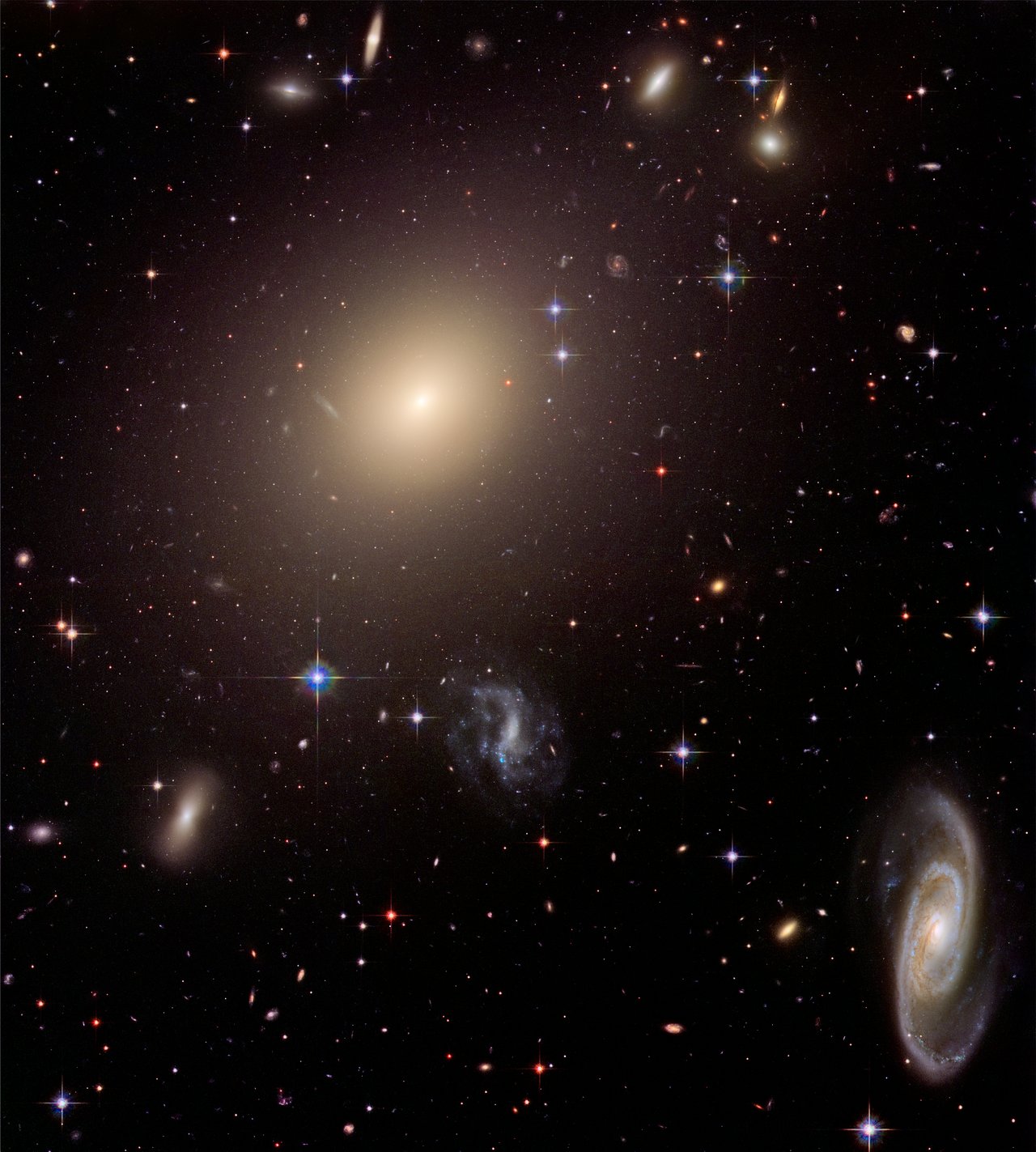
This image is packed full of galaxies! A keen eye can spot exquisite ellipticals and spectacular spirals, seen at various orientations: edge-on with the plane of the galaxy visible, face-on to show off magnificent spiral arms, and everything in between. The vast majority of these specks are galaxies, but to spot a foreground star from our own galaxy, you can look for a point of light with tell-tale diffraction spikes.

The most alluring subject sits at the centre of the frame. With the charming name of SDSSJ0146-0929, the glowing central bulge is a galaxy cluster — a monstrous collection of hundreds of galaxies all shackled together in the unyielding grip of gravity. The mass of this galaxy cluster is large enough to severely distort the spacetime around it, creating the odd, looping curves that almost encircle the cluster.

These graceful arcs are examples of a cosmic phenomenon known as an Einstein ring. The ring is created as the light from a distant objects, like galaxies, pass by an extremely large mass, like this galaxy cluster. In this image, the light from a background galaxy is diverted and distorted around the massive intervening cluster and forced to travel along many different light paths towards Earth, making it seem as though the galaxy is in several places at once.

Source: ESA/Hubble/Potw

Tuesday, June 07, 2016

A new Einstein Ring

In this colour composite image, the central lensing galaxy is shown in red and the blue Einstein ring, the distorted image of a distant galaxy, is visible all around it. Credit: Bettinelli et al., DECam (Blanco 4-m telescope at CTIO)


A multinational team of astronomers have found a new Einstein Ring, a rare image of a distant galaxy lensed by gravity. The scientists, from Spain, Italy and the USA, report their discovery in Monthly Notices of the Royal Astronomical Society.

In his seminal general theory of relativity published a century ago, Albert Einstein predicted that gravity would distort the fabric of spacetime, and that light would follow curved paths as a result. Astronomers first observed this effect in 1919, by measuring the position of stars near the Sun during the 1919 total solar eclipse, and noting a slight shift resulting from the gravitational field of our nearest star. On a larger scale, light from distant galaxies is bent by black holes and massive galaxies that lie between them and the Earth. The intervening objects act as lenses, creating arcs and ‘Einstein rings’ of light.

These rings are still comparatively rare and usually appear as small features in the sky. This makes them hard to see clearly, and most are observed with radio telescopes, or with the Hubble Space Telescope. Their rarity derives from the huge distances involved, and the low probability of our Galaxy, the lens galaxy and the distant galaxy all being almost exactly in line.

The newly discovered ring lies in the direction of the constellation of Sculptor in the southern sky. Margherita Bettinelli, a PhD student at the Instituto de Astrofisica de Canarias, found it while looking at archive images from the Dark Energy Camera (DECam) mounted on the Victor Blanco 4-m telescope at the Cerro Tololo Inter-American Observatory in Chile. Margherita and her team named the ring 'Canarias', in homage to the work carried out by astronomers on La Palma and Tenerife.

Light arriving at the Earth today left the Einstein ring 8 billion years ago, so we see the ring as it was 5 billion years after the Big Bang. Despite its relatively small apparent size (it stretches across an angle on the sky of 4.5 arcseconds or about 1/800th of a degree), it is larger than most of the other rings found to date. Follow up work with the 10.4-m Gran Telescopio Canarias (GTC) confirms its distance and shows that the intervening lens galaxy has a mass equivalent to around a trillion (million million) Suns.


Media Contact

Dr Robert Massey
Royal Astronomical Society
Tel: +44 (0)20 7292 3979
Mob: +44 (0)7802 877 699
rm@ras.org.uk


Science contact

Margherita Bettinelli
Instituto de Astrofisica de Canarias
mbettine@iac.es


Further information


The new work appears in "The Canarias Einstein Ring: a Newly Discovered Optical Einstein Ring", M. Bettinelli, M. Simioni, A. Aparicio, S. L. Hidalgo, S. Cassisi, A. R. Walker, G. Piotto and F. Valdes, Monthly Notices of the Royal Astronomical Society, in press.  


Notes for editors 

The scientific research following the discovery has been conducted and coordinated by the Stellar Populations group at the Instituto de Astrofisica de Canarias (IAC), led by Dr Antonio Aparicio Juan and Dr Sebastian Hidalgo. The Einstein ring was found in plates of the Sculptor dwarf galaxy, a companion to our own Milky Way, but is a far more distant object.

Ms Bettinelli is supervised by Dr Santi Cassisi and Dr Hidalgo. Another PhD student, Matteo Simioni, carried out further analysis, under the supervision of Dr Aparicio and Giampaolo Piotto of the University of Padua.

The Royal Astronomical Society (RAS), founded in 1820, encourages and promotes the study of astronomy, solar-system science, geophysics and closely related branches of science. The RAS organizes scientific meetings, publishes international research and review journals, recognizes outstanding achievements by the award of medals and prizes, maintains an extensive library, supports education through grants and outreach activities and represents UK astronomy nationally and internationally. Its more than 4000 members (Fellows), a third based overseas, include scientific researchers in universities, observatories and laboratories as well as historians of astronomy and others.

The RAS accepts papers for its journals based on the principle of peer review, in which fellow experts on the editorial boards accept the paper as worth considering.  The Society issues press releases based on a similar principle, but the organisations and scientists concerned have overall responsibility for their content.

Follow the RAS on Twitter


Monday, June 08, 2015

Sharpest View Ever of Star Formation in the Distant Universe

Montage of the SDP.81 Einstein Ring and the lensed galaxy

The lensed galaxy

The Einstein Ring SDP.81 seen with ALMA

Hubble image of the region around SDP.81

Montage of the SDP.81 Einstein Ring and the lensed galaxy (no annotations)


Videos 

Gravitational lensing of distant star-forming galaxies (schematic)


Gravitational lensing of distant star-forming galaxies (schematic)


ALMA’s observation of Einstein Ring reveals extraordinary detail

ALMA’s Long Baseline Campaign has produced a spectacular image of a distant galaxy being gravitationally lensed. The image shows a magnified view of the galaxy’s star-forming regions, the likes of which have never been seen before at this level of detail in a galaxy so remote. The new observations are far sharper than those made using the NASA/ESA Hubble Space Telescope, and reveal star-forming clumps in the galaxy equivalent to giant versions of the Orion Nebula in the Milky Way. 

ALMA’s Long Baseline Campaign has produced some amazing observations, and gathered unprecedentedly detailed information about the inhabitants of the near and distant Universe. Observations made at the end of 2014 as part of the campaign targeted a distant galaxy called HATLAS J090311.6+003906, otherwise known as SDP.81. This light from this galaxy is a victim of a cosmic effect known as gravitational lensing. A large galaxy sitting between SDP.81 and ALMA [1] is acting as a lens, warping and magnifying the view of a more distant galaxy and creating a near-perfect example of a phenomenon known as an Einstein Ring [2].

At least seven groups of scientists [3] have independently analysed the ALMA data on SDP.81. This flurry of research papers has revealed unprecedented information about the galaxy, including details about its structure, contents, motion, and other physical characteristics.

ALMA acts as an interferometer. Simply speaking, the array’s multiple antennas work in perfect synchrony to collect light as an enormous virtual telescope [4]. As a result, these new images of SDP.81 have a resolution up to six times higher [5] than those taken in the infrared with the NASA/ESA Hubble Space Telescope.

The astronomers’ sophisticated models reveal fine, never-before-seen structure within SDP.81, in the form of dusty clouds thought to be giant repositories of cold molecular gas — the birthplaces of stars and planets. These models were able to correct for the distortion produced by the magnifying gravitational lens.

As a result, the ALMA observations are so sharp that researchers can see clumps of star formation in the galaxy down to a size of about 200 light-years, equivalent to observing giant versions of the Orion Nebula producing thousands of times more new stars at the far side of the Universe. This is the first time this phenomenon has been seen at such an enormous distance.

“The reconstructed ALMA image of the galaxy is spectacular,” says Rob Ivison, co-author of two of the papers and ESO’s Director for Science. “ALMA’s huge collecting area, the large separation of its antennas, and the stable atmosphere above the Atacama desert all lead to exquisite detail in both images and spectra. That means that we get very sensitive observations, as well as information about how the different parts of the galaxy are moving. We can study galaxies at the other end of the Universe as they merge and create huge numbers of stars. This is the kind of stuff that gets me up in the morning!”

Using the spectral information gathered by ALMA, astronomers also measured how the distant galaxy rotates, and estimated its mass. The data showed that the gas in this galaxy is unstable; clumps of it are collapsing inwards, and will likely turn into new giant star-forming regions in the future.

Notably, the modeling of the lensing effect also indicates the existence of a supermassive black hole at the centre of the foreground galaxy lens [6]. The central part of SDP.81 is too faint to be detected, leading to the conclusion that the foreground galaxy holds a supermassive black hole with more than 200–300 million times the mass of the Sun.

The number of papers published using this single ALMA dataset demonstrates the excitement generated by the potential of the array’s high resolution and light-gathering power. It also shows how ALMA will enable astronomers to make more discoveries in the years to come, also uncovering yet more questions about the nature of distant galaxies.


Notes

[1] The lensed galaxy is seen at a time when the Universe was only 15 percent of its current age, just 2.4 billion years after Big Bang. The light has taken over twice the age of the Earth to reach us (11.4 billion years), detouring along the way around a massive foreground galaxy that is comparatively close at four billion light-years away from us.

[2] Gravitational lenses were predicted by Albert Einstein as part of his theory of general relativity. His theory tells us that objects bend space and time. Any light approaching this curved space-time will itself follow the curvatures created by the object. This enables particularly massive objects — huge galaxies and galaxy clusters — to act as cosmic magnifying glasses. An Einstein ring is a special type of gravitational lens, in which the Earth, the foreground lensing galaxy, and the background lensed galaxy are in perfect alignment, creating a harmonious distortion in the form of a ring of light. This phenomenon is illustrated in Video A.

[3] The science teams are listed below.

[4] ALMA’s ability to see the finest detail is achieved when the antennas are at their greatest separation, up to 15 kilometres apart. For comparison, earlier observations of gravitational lenses made with ALMA in a more compact configuration, with a separation of only around 500 metres, can be seen here.

[5] Details down to 0.023 arc-seconds, or 23 milli-arcseconds, can be measured in these data. Hubble observed this galaxy in the near-infrared, with a resolution of about 0.16 arc-seconds. Note, however, that when observing at shorter wavelengths, Hubble can reach finer resolutions, down to 0.022 arcseconds in the near-ultraviolet. ALMA’s resolution can be adjusted depending on the type of observations by moving the antennas further apart or closer together. For these observations, the widest separation was used, resulting in the finest resolution possible.

[6] The high-resolution ALMA image enables researchers to look for the central part of the background galaxy, which is expected to appear at the centre of the Einstein ring. If the foreground galaxy has a supermassive black hole at the centre, the central image becomes fainter. The faintness of the central image indicates how massive the black hole in the foreground galaxy is.


More Information

This research was presented in eight papers to appear in the near future. The science teams are listed below.

http://arxiv.org/abs/1503.07605
Yoichi Tamura (The University of Tokyo), Masamune Oguri (The University of Tokyo), Daisuke Iono (National Astronomical Observatory of Japan/SOKENDAI), Bunyo Hatsukade (National Astronomical Observatory of Japan), Yuichi Matsuda (National Astronomical Observatory of Japan/SOKENDAI), and Masao Hayashi (National Astronomical Observatory of Japan).

http://arxiv.org/abs/1503.08720
Simon Dye (University of Nottingham), Christina Furlanetto (University of Nottingham; CAPES Foundation, Ministry of Education of Brazil, Brazil), Mark Swinbank (Durham University), Catherine Vlahakis (Joint ALMA Observatory, Chile; ESO, Chile), James Nightingale (University of Nottingham), Loretta Dunne (University of Canterbury, New Zealand; Institute for Astronomy [IfA], Royal Observatory Edinburgh), Steve Eales (Cardiff University), Ian Smail (Durham), Ivan Oteo-Gomez (IfA, Edinburgh; ESO, Germany), Todd Hunter (National Radio Astronomy Observatory, Charlottesville, Virginia, USA), Mattia Negrello (INAF, Osservatorio Astronomico di Padova, Vicolo Osservatorio, Padova, Italy), Helmut Dannerbauer (Universitat Wien, Vienna, Austria), Rob Ivison (IfA, Edinburgh; ESO, Germany), Raphael Gavazzi (Universite Pierre et Marie Curie, Paris), Asantha Cooray (California Institute of Technology, USA) and Paul van der Werf (Leiden University, The Netherlands).

http://arxiv.org/abs/1505.05148
Mark Swinbank (Durham University), Simon Dye (University of Nottingham), James Nightingale (University of Nottingham), Christina Furlanetto (University of Nottingham; CAPES Foundation, Ministry of Education of Brazil, Brazil), Ian Smail (Durham), Asantha Cooray (California Institute of Technology, USA), Helmut Dannerbauer (Universitat Wien, Vienna, Austria), Loretta Dunne (University of Canterbury, New Zealand; Institute for Astronomy [IfA], Royal Observatory Edinburgh), Steve Eales (Cardiff University), Raphael Gavazzi (Universite Pierre et Marie Curie, Paris), Todd Hunter (National Radio Astronomy Observatory, Charlottesville, Virginia, USA), Rob Ivison (IfA, Edinburgh; ESO, Germany), Mattia Negrello (INAF, Osservatorio Astronomico di Padova, Vicolo Osservatorio, Padova, Italy), Ivan Oteo-Gomez (IfA, Edinburgh; ESO, Germany), Renske Smit (Durham), Paul van der Werf (Leiden University, The Netherlands), and Catherine Vlahakis (Joint ALMA Observatory, Chile; ESO, Chile).

http://arxiv.org/abs/1503.05558
Kenneth C. Wong (Institute of Astronomy and Astrophysics, Academia Sinica (ASIAA), Taipei, Taiwan), Sherry H. Suyu (ASIAA, Taiwan), and Satoki Matsushita (ASIAA, Taiwan)

http://arxiv.org/abs/1503.07997
Bunyo Hatsukade (National Astronomical Observatory of Japan, Tokyo, Japan) Yoichi Tamura (Institute of Astronomy, University of Tokyo, Tokyo, Japan), Daisuke Iono (National Astronomical Observatory of Japan; The Graduate University for Advanced Studies [SOKENDAI], Tokyo, Japan), Yuichi Matsuda (National Astronomical Observatory of Japan), Masao Hayashi (National Astronomical Observatory of Japan), Masamune Oguri (Research Center for the Early Universe, University of Tokyo, Tokyo, Japan; Department of Physics, University of Tokyo, Tokyo, Japan; Kavli Institute for the Physics and Mathematics of the Universe [Kavli IPMU, WPI], University of Tokyo, Chiba, Japan)

http://arxiv.org/abs/1503.02652
The ALMA Partnership, C. Vlahakis (Joint ALMA Observatory [JAO]; ESO) , T. R. Hunter (National Radio Astronomy Observatory [NRAO]), J. A. Hodge (NRAO) , L. M. Pérez (NRAO) , P. Andreani (ESO), C. L. Brogan (NRAO) , P. Cox (JAO, ESO) , S. Martin (Institut de Radioastronomie Millimétrique [IRAM]) , M. Zwaan (ESO) , S. Matsushita (Institute of Astronomy and Astrophysic, Taiwan) , W. R. F. Dent (JAO, ESO), C. M. V. Impellizzeri (JAO, NRAO), E. B. Fomalont (JAO, NRAO), Y. Asaki (National Astronomical Observatory of Japan; Institute of Space and Astronautical Science (ISAS), Japan Aerospace Exploration Agency [JAXA]) , D. Barkats (JAO, ESO) , R. E. Hills (Astrophysics Group, Cavendish Laboratory), A. Hirota (JAO; National Astronomical Observatory of Japan), R. Kneissl (JAO, ESO), E. Liuzzo (INAF, Istituto di Radioastronomia), R. Lucas (Institut de Planétologie et d’Astrophysique de Grenoble) , N. Marcelino (INAF), K. Nakanishi (JAO, National Astronomical Observatory of Japan), N. Phillips (JAO, ESO), A. M. S. Richards (University of Manchester), I. Toledo (JAO), R. Aladro (ESO), D. Broguiere (IRAM), J. R. Cortes (JAO, NRAO), P. C. Cortes (JAO, NRAO), D. Espada (ESO, National Astronomical Observatory of Japan), F. Galarza (JAO), D. Garcia-Appadoo (JAO, ESO), L. Guzman-Ramirez (ESO), A. S. Hales (JAO, NRAO) , E. M. Humphreys (ESO) , T. Jung (Korea Astronomy and Space Science Institute) , S. Kameno (JAO, National Astronomical Observatory of Japan) , R. A. Laing (ESO), S. Leon (JAO,ESO) , G. Marconi (JAO, ESO) , A. Mignano (INAF) , B. Nikolic (Astrophysics Group, Cavendish Laboratory), L. A. Nyman (JAO, ESO), M. Radiszcz (JAO), A. Remijan (JAO, NRAO), J. A. Rodón (ESO), T. Sawada (JAO, National Astronomical Observatory of Japan), S. Takahashi (JAO, National Astronomical Observatory of Japan), R. P. J. Tilanus (Leiden University), B. Vila Vilaro (JAO, ESO), L. C. Watson (ESO), T. Wiklind (JAO, ESO), Y. Ao (National Astronomical Observatory of Japan) , J. Di Francesco (National Research Council Herzberg Astronomy & Astrophysics), B. Hatsukade (National Astronomical Observatory of Japan), E. Hatziminaoglou (ESO), J. Mangum (NRAO), Y. Matsuda (National Astronomical Observatory of Japan), E. Van Kampen (ESO), A. Wootten (NRAO), I. De Gregorio-Monsalvo (JAO, ESO), G. Dumas (IRAM), H. Francke (JAO), J. Gallardo (JAO), J. Garcia (JAO), S. Gonzalez (JAO), T. Hill (ESO), D. Iono (National Astronomical Observatory of Japan), T. Kaminski (ESO), A. Karim (Argelander-Institute for Astronomy), M. Krips (IRAM), Y. Kurono (JAO, National Astronomical Observatory of Japan) , C. Lonsdale (NRAO), C. Lopez (JAO), F. Morales (JAO), K. Plarre (JAO), L. Videla (JAO), E. Villard (JAO, ESO), J. E. Hibbard (NRAO), K. Tatematsu (National Astronomical Observatory of Japan)

http://arxiv.org/abs/1503.02025
M. Rybak (Max Planck Institute for Astrophysics), J. P. McKean (Netherlands Institute for Radio Astronomy; University of Groningen) S. Vegetti (Max Planck Institute for Astrophysics), P. Andreani (ESO) and S. D. M. White (Max Planck Institute for Astrophysics)

http://arxiv.org/abs/1506.01425
M. Rybak (Max Planck Institute for Astrophysics), S. Vegetti (Max Planck Institute for Astrophysics), J. P. McKean (Netherlands Institute for Radio Astronomy; University of Groningen), P. Andreani (ESO) and S. D. M. White (Max Planck Institute for Astrophysics)


The Atacama Large Millimeter/submillimeter Array (ALMA), an international astronomy facility, is a partnership of ESO, the US National Science Foundation (NSF) and the National Institutes of Natural Sciences (NINS) of Japan in cooperation with the Republic of Chile. ALMA is funded by ESO on behalf of its Member States, by NSF in cooperation with the National Research Council of Canada (NRC) and the National Science Council of Taiwan (NSC) and by NINS in cooperation with the Academia Sinica (AS) in Taiwan and the Korea Astronomy and Space Science Institute (KASI).

ALMA construction and operations are led by ESO on behalf of its Member States; by the National Radio Astronomy Observatory (NRAO), managed by Associated Universities, Inc. (AUI), on behalf of North America; and by the National Astronomical Observatory of Japan (NAOJ) on behalf of East Asia. The Joint ALMA Observatory (JAO) provides the unified leadership and management of the construction, commissioning and operation of ALMA.


ESO is the foremost intergovernmental astronomy organisation in Europe and the world’s most productive ground-based astronomical observatory by far. It is supported by 16 countries: Austria, Belgium, Brazil, the Czech Republic, Denmark, France, Finland, Germany, Italy, the Netherlands, Poland, Portugal, Spain, Sweden, Switzerland and the United Kingdom, along with the host state of Chile. ESO carries out an ambitious programme focused on the design, construction and operation of powerful ground-based observing facilities enabling astronomers to make important scientific discoveries. ESO also plays a leading role in promoting and organising cooperation in astronomical research. ESO operates three unique world-class observing sites in Chile: La Silla, Paranal and Chajnantor. At Paranal, ESO operates the Very Large Telescope, the world’s most advanced visible-light astronomical observatory and two survey telescopes. VISTA works in the infrared and is the world’s largest survey telescope and the VLT Survey Telescope is the largest telescope designed to exclusively survey the skies in visible light. ESO is a major partner in ALMA, the largest astronomical project in existence. And on Cerro Armazones, close to Paranal, ESO is building the 39-metre European Extremely Large Telescope, the E-ELT, which will become “the world’s biggest eye on the sky”. ESO is a major partner in ALMA, the largest astronomical project in existence. And on Cerro Armazones, close to Paranal, ESO is building the 39-metre European Extremely Large Telescope, the E-ELT, which will become “the world’s biggest eye on the sky”.


Links

Research papers;


Contacts

Lars Lindberg Christensen
Head of ESO ePOD
Garching bei München, Germany
Tel: +49 89 3200 6761
Cell: +49 173 3872 621
Email:
lars@eso.org

Source: ESO

Wednesday, April 08, 2015

ALMA Sees Einstein Ring in Stunning Image of Lensed Galaxy

ALMA image of the gravitationally lensed galaxy SDP.81. The bright orange central region of the ring (ALMA's highest resolution observation ever) reveals the glowing dust in this distant galaxy. The surrounding lower-resolution portions of the ring trace the millimeter wavelength light emitted by carbon monoxide. Credit: ALMA (NRAO/ESO/NAOJ); B. Saxton NRAO/AUI/NSF

ALMA/Hubble composite image of the gravitationally lensed galaxy SDP.81. The bright orange central region of the ring (ALMA's highest resolution observation ever) reveals the glowing dust in this distant galaxy. The surrounding lower-resolution portions of the ring trace the millimeter wavelength light emitted by carbon monoxide. The diffuse blue element at the center of the ring is from the intervening lensing galaxy, as seen with the Hubble Space Telescope. Credit: ALMA (NRAO/ESO/NAOJ); B. Saxton NRAO/AUI/NSF; NASA/ESA Hubble, T. Hunter (NRAO)

ALMA's highest resolution image ever reveals the dust glowing inside the distant galaxy SDP.81. The ring structure was created by a gravitational lens that distorted the view of the distant galaxy into a ring-like structure. Credit: ALMA (NRAO/ESO/NAOJ)

 
Animation demonstrating how the gravity from a massive foreground galaxy can bend the light of a more distant galaxy. If the two galaxies line up just right, the result is a highly distorted image of the distant galaxy known as an Einstein ring. The radio image portion of the video is of galaxy SDP.81, which was imaged by ALMA as part of the telescope's Long Baseline Campaign. Credit: NRAO/AUI/NSF; ALMA (NRAO/ESO/NAOJ); Dana Berry / SkyWorks


Astronomers have discovered that a distant galaxy -- seen from Earth with the aid of a gravitational lens -- appears like a cosmic ring, thanks to the highest resolution images ever taken with the Atacama Large Millimeter/submillimeter Array (ALMA).

Forged by the chance alignment of two distant galaxies, this striking ring-like structure is a rare and peculiar manifestation of gravitational lensing as predicted by Albert Einstein in his theory of general relativity.

Gravitational lensing occurs when a massive galaxy or cluster of galaxies bends the light emitted from a more distant galaxy, forming a highly magnified, though much distorted image. In this particular case, the galaxy known as SDP.81 and an intervening galaxy line up so perfectly that the light from the more distant one forms a nearly complete circle as seen from Earth.

Discovered by the Herschel Space Observatory, SDP.81 is an active star-forming galaxy nearly 12 billion light-years away, seen at a time when the Universe was only 15 percent of its current age. It is being lensed by a massive foreground galaxy that is a comparatively nearby 4 billion light-years away.

"Gravitational lensing is used in astronomy to study the very distant, very early Universe because it gives even our best telescopes an impressive boost in power," said ALMA Deputy Program Scientist Catherine Vlahakis. "With the astounding level of detail in these new ALMA images, astronomers will now be able to reassemble the information contained in the distorted image we see as a ring and produce a reconstruction of the true image of the distant galaxy."

The new SDP.81 images were taken in October 2014 as part of ALMA’s Long Baseline Campaign, an essential program to test and verify the telescope’s highest resolving power, achieved when the antennas are at their greatest separation: up to 15 kilometers apart.

The highest resolution image of SDP.81 was made by observing the relatively bright light emitted by cosmic dust in the distant galaxy. This striking image reveals well-defined arcs in a pattern that hints at a more complete, nearly contiguous ring structure. Other slightly lower-resolution images, made by observing the faint molecular signatures of carbon monoxide and water, help complete the picture and provide important details about this distant galaxy.

Though this intriguing interplay of gravity and light in SDP.81 has been studied previously by other observatories, including radio observations with the Submillimeter Array and the Plateau de Bure Interferometer, and visible light observations with the Hubble Space Telescope, none has captured the remarkable details of the ring structure revealed by ALMA.

"The exquisite amount of information contained in the ALMA images is incredibly important for our understanding of galaxies in the early Universe," said astronomer Jacqueline Hodge with the National Radio Astronomy Observatory in Charlottesville, Va. "Astronomers use sophisticated computer programs to reconstruct lensed galaxies' true appearance. This unraveling of the bending of light done by the gravitational lens will allow us to study the actual shape and internal motion of this distant galaxy much more clearly than has been possible until now."

For these observations, ALMA achieved an astounding maximum resolution of 23 milliarcseconds, which is about the same as seeing the rim of a basketball hoop atop the Eiffel Tower from the observing deck of the Empire State Building.

"It takes a combination of ALMA’s high resolution and high sensitivity to unlock these otherwise hidden details of the early Universe," said ALMA Director Pierre Cox. "These results open a new frontier in astronomy and prove that ALMA can indeed deliver on its promise of transformational science."

SDP.81 is one of five targets selected for study during the ALMA Long Baseline Campaign. The others include the protoplanetary disk HL Tau, the asteroid Juno, the star Mira, and the quasar 3C138. Papers describing these publicly available data and the overall outcome of the ALMA Long Baseline Campaign are to be published in the Astrophysical Journal, Letters.

#  #  # 

The National Radio Astronomy Observatory is a facility of the National Science Foundation, operated under cooperative agreement by Associated Universities, Inc.

The Atacama Large Millimeter/submillimeter Array (ALMA), an international astronomy facility, is a partnership of the European Organisation for Astronomical Research in the Southern Hemisphere (ESO), the U.S. National Science Foundation (NSF) and the National Institutes of Natural Sciences (NINS) of Japan in cooperation with the Republic of Chile. ALMA is funded by ESO on behalf of its Member States, by NSF in cooperation with the National Research Council of Canada (NRC) and the National Science Council of Taiwan (NSC) and by NINS in cooperation with the Academia Sinica (AS) in Taiwan and the Korea Astronomy and Space Science Institute (KASI). ALMA construction and operations are led by ESO on behalf of its Member States; by the National Radio Astronomy Observatory (NRAO), managed by Associated Universities, Inc. (AUI), on behalf of North America; and by the National Astronomical Observatory of Japan (NAOJ) on behalf of East Asia. The Joint ALMA Observatory (JAO) provides the unified leadership and management of the construction, commissioning and operation of ALMA.

The paper, "ALMA Long Baseline Observations of the Strongly Lensed Submillimeter Galaxy HATLAS J090311.6+003906 at z=3.042," is located here: http://arxiv.org/abs/1503.02652


Contact: 

Charles Blue, Public Information Officer
(434) 296-0314; cblue@nrao.edu


Wednesday, April 01, 2015

Dusty substructure in a galaxy far far away

Fig. 1 The ALMA image of the continuum emission at 236 GHz of the lensed galaxy SDP.81 at two angular resolutions. The lensed system consists of four images with an extended, low-surface brightness Einstein ring. 


Fig. 2 The modelled sky-brightness distribution for the image in Fig. 1 (left) and the reconstructed surface brightness distribution (right) of the background galaxy. There are three areas with enhanced emission, which could indicate a disk galaxy seen edge-on. 

Fig. 3 This map shows the reconstructed star formation rate of the distant galaxy, which is actually quite small (as indicated by the length scale in light-years). The colour coding shows the amount of dust heated by radiation from the young stars.


Scientists at the Max Planck Institute for Astrophysics (MPA) have combined high-resolution images from the ALMA telescopes with a new scheme for undoing the distorting effects of a powerful gravitational lens in order to provide the first detailed picture of a young and distant galaxy, over 11 billion light-years from Earth. The reconstructed images show that star formation is heating interstellar dust and making it glow strongly in three distinct clumps embedded in a broader distribution, suggesting that object may be a rotating disk galaxy seen nearly edge-on.

Galaxies are constantly forming new stars within dense clouds of interstellar material. The star formation rate in today's galaxies is, however, much lower than it used to be. When the universe was about a quarter its current age, star formation was at its peak, and so astronomers are keen to learn about this period.

Looking back in time is possible because of the finite speed of light, but only by looking out to great distances, which in turn means that young galaxies appear very small and very faint. In addition, most of their new-born stars cannot be seen directly, because their radiation is absorbed by dust in the surrounding gas cloud and is re-emitted at far-infrared wavelengths.

As a result, star-forming regions in distant galaxies are one of the prime targets for the Atacama Large Millimetre/submillimetre Array. ALMA will consist of 66 high precision antennas, located on the Chajnantor plateau at 5000 meters altitude in northern Chile. The data from the individual antennas can be combined interferometrically, and the 15 kilometre span of the telescope provides resolution of better than a tenth of an arc-second. On its own, however, even this capability is not sufficient to make detailed pictures of young galaxies at the peak of their star formation.

"At a recent conference, ALMA scientists presented data they had used to verify the scientific capabilities of their array, among them an image of a strongly gravitationally lensed system, which immediately raised our interest", remembers Simona Vegetti, postdoctoral scientist at MPA. "Because of the lensing, the background galaxy is strongly magnified, by 17 times actually, which is why we can see it at all. Together with ALMA's unique angular resolution, this gave us the chance to try and see details in the distribution of dust in such a far-away galaxy for the first time."

Strong gravitational lensing happens when a background galaxy is closely aligned with a foreground mass concentration such as a cluster of galaxies, which bends light-rays from the source on their way to the observer. The foreground lens is, however, an imperfect optical system, leading to very large distortions (see Fig. 1). Nevertheless, from the properties of the lensed images, the mass distribution of the lensing system can be determined and a "true" (i.e. undistorted) image of the distant galaxy can be reconstructed. "Previous attempts to do this had assumed the background galaxies to be smooth and regular", explains Matus Rybak, who carried out the computer modelling at MPA. "This seems likely to be a very poor approximation to the structure of a strongly star-forming galaxy, and the raw ALMA images gave clear hints that this background source is complex. The new, more general approach we have developed is much better suited to irregular systems."

This intuition is borne out by the reconstructed image of the galaxy SDP.81 which shows star formation to be concentrated in three distinct regions (see Fig. 2). "This is the first time, that we can see structure in the dust emission of a z=3 galaxy on scales smaller than 150 light-years", points out Simona Vegetti. At this cosmic time, typical galaxies were forming stars at their peak rate, and indeed SDP.81 is forming about 300 solar masses of stars every year. (In our Milky Way, the star formation rate is about 3 solar masses per year.) The complex structure of the galaxy may indicate that it is a rotating disk with a central bulge that is seen (and lensed) edge-on; alternatively it may be a system which is undergoing a merger in which the separate components are still visible. To distinguish between these possibilities, data on the motions of gas within the galaxy are needed, so the next step for the MPA team together with their colleagues Paola Andreani at ESO and John McKean at the University of Groningen and the Netherlands Institute for Radio Astronomy (ASTRON) will be to analyse the molecular line observations of this system which ALMA has also obtained. 


Links:

Original publication
ALMA imaging of SDP.81 I. A pixelated reconstruction of the far-infrared continuum emission, M. Rybak, J. P. McKean, S. Vegetti, P. Andreani and S. D. M. White, submitted to MNRAS - ALMA

Contact:

Simona Vegetti
Max-Planck-Institut für Astrophysik
Phone: 089 30000-2285
Email: svegetti@mpa-garching.mpg.de

Hannelore Hämmerle
Press Officer
Max-Planck-Institut für Astrophysik
Tel. +49 89 30000-3980
E-mail: pr@mpa-garching.mpg.de