Showing posts with label Protoplanetary Disk. Show all posts

Tuesday, May 05, 2026

ALMA Reveals How Planet-Forming Disks Take Shape Press Releases ALMA Reveals How Planet-Forming Disks Take Shape

A conceptual visualization of ENDTRANZ, the transition zone at the envelope–disk boundary, which is shown as a red colored, belt-like annulus where the gas motion gradually transitions from the infalling envelope to the Keplerian rotation within the protoplanetary disk surrounding a young star. This is an AI-generated illustration based on a two-dimensional spatial map of the specific angular momentum in the equatorial plane, as obtained from the numerical simulations. The specific angular momentum map offers an intuitive lens to ‘see’ ENDTRANZ, making its dynamics more apparent than in the rotational velocity map. (Image Credit: Indrani Das/ASIAA)

The figure shows the radial variation of rotational velocity and specific angular momentum with distance from the star, in astronomical units (au), on the left- and right-hand axes, respectively, as obtained from the global collapse simulations. The orange-colored region represents the ENDTRANZ of a young stellar system. The vertical dashed and dotted lines represent the outer and inner boundaries of ENDTRANZ. (Image Credit: Indrani Das/ASIAA.)


New study identifies a long-sought transition zone where infalling gas becomes a rotating disk.

Every planet — including everyone in the Solar System — was born inside a rotating disk of gas and dust swirling around a young star. Astronomers have long understood that these disks exist and that planets take shape within them. What they couldn't explain was how the raw material gets there in the first place. Now, a new study led by Indrani Das of the Academia Sinica Institute of Astronomy and Astrophysics (ASIAA) has found the missing piece: a distinct transition zone where chaotic, infalling gas gradually settles into the orderly rotation of a planet-forming disk. The team named it ENDTRANZ — the Envelope Disk Transition Zone — and detected it for the first time in an actual young stellar system using the Atacama Large Millimeter/submillimeter Array (ALMA).

From chaos to order

Young stars are surrounded by a vast shroud of gas and dust called an envelope. Gravity pulls this material inward, feeding both the growing star and the disk around it. But the infalling gas moves differently than the disk — more slowly and chaotically — and the point at which one becomes the other had never been clearly observed.

Earlier theoretical models assumed the switch was sharp, almost instantaneous. The new study shows it isn't. Using numerical simulations with the FEOSAD code, the team tracked how a collapsing cloud core evolves into a star-disk system — and found that the transition unfolds gradually across a finite region, leaving a tell-tale signature: a characteristic "jump" in the distribution of specific angular momentum, a measure of how gas rotates as a function of its distance from the star.

"The existence of ENDTRANZ naturally results from the redistribution of mass and angular momentum during the formation of disks around young stars. This process ultimately governs how infalling material from the envelope, which rotates more slowly than the Keplerian speed, spreads out to form the disk and gradually settles into ordered Keplerian rotation," explained Das.

ALMA finds the fingerprint

To test whether ENDTRANZ exists in nature, the team turned to L1527 IRS, a young protostar about 450 light-years away in the Taurus molecular cloud. Using data from the ALMA Large Program eDisk (Embedded Disks in Planet Formation), they found exactly the same angular momentum signature that the simulations had predicted — spanning a zone roughly 16 astronomical units wide, or about 16 times the distance from Earth to the Sun.

"This ENDTRANZ tracer essentially manifests from the gradual transition in the rotational velocity, which offers a diagnostic framework for understanding the physical processes at play that drive the disk evolution," said Shantanu Basu, Interim Director of the Canadian Institute for Theoretical Astrophysics and co-author of the study.

ALMA's extraordinary resolution was essential to making this detection possible, resolving the structure at the precise interface between the envelope and the disk — a regime that had previously been beyond reach.

"A careful inspection and comparison of the radial dependence of specific angular momentum between the observational data and the simulations helped identify the evidence of ENDTRANZ in L1527 IRS," said Nagayoshi Ohashi, principal investigator of the ALMA eDisk Large Program and co-author of the study.

A new window on planet formation

The discovery establishes ENDTRANZ as a fundamental feature of how stars and planetary systems assemble — and opens the door to searching for the same signature in other young systems across the galaxy.

"In many ways, we believe this is just the beginning!" Das said.


Additional Information

The study appears as “Modeling the Break in the Specific Angular Momentum within the Envelope-Disk Transition Zone” by I. Das et al. in the Astrophysical Journal.

This article is based on the original press release by the National Astronomical Observatory of Japan (NAOJ), an ALMA partner on behalf of East Asia.

The Atacama Large Millimeter/submillimeter Array (ALMA), an international astronomy facility, is a partnership of the European Southern Observatory (ESO), the U.S. National Science Foundation (NSF), and the National Institutes of Natural Sciences (NINS) of Japan in cooperation with the Republic of Chile. ALMA is funded by ESO on behalf of its Member States, by NSF in cooperation with the National Research Council of Canada (NRC) and the National Science and Technology Council (NSTC) in Taiwan, and by NINS in cooperation with the Academia Sinica (AS) in Taiwan and the Korea Astronomy and Space Science Institute (KASI).

ALMA construction and operations are led by ESO on behalf of its Member States; by the National Radio Astronomy Observatory (NRAO), managed by Associated Universities, Inc. (AUI), on behalf of North America; and by the National Astronomical Observatory of Japan (NAOJ) on behalf of East Asia. The Joint ALMA Observatory (JAO) provides the unified leadership and management of ALMA's construction, commissioning, and operation.


Contacts:

Nicolás Lira
Education and Public Outreach Officer
Joint ALMA Observatory, Santiago - Chile
Phone:
+56 2 2467 6519
Cel: +56 9 9445 7726
Email: nicolas.lira@alma.cl

Seiichiro Naito
NAOJ EPO Lead
Email:
naito.seiichiro@nao.ac.jp

Jill Maluskyiv
NRAO
Phone:
+1 304-456-2236
Email: jmalusky@nrao.edu

Bárbara Ferreira
ESO Media Manager
Garching bei München, Germany
Phone:
+49 89 3200 6670
Email: press@eso.org


Friday, April 17, 2026

NASA’s Webb Redefines Dividing Line Between Planets, Stars

Astronomers used NASA’s James Webb Space Telescope to directly image 29 Cygni b, which weighs 15 times Jupiter. They found evidence for heavy chemical elements like carbon and oxygen, which strongly suggests it formed like a planet by accretion within a protoplanetary disk. Credit Image: NASA, ESA, CSA, William Balmer (JHU, STScI), Laurent Pueyo (STScI); Image Processing: Alyssa Pagan (STScI)
>
Exoplanet 29 Cygni b, seen in this artist’s concept, is a gas giant weighing about 15 times the mass of Jupiter. Astronomers studied 29 Cygni b with NASA’s James Webb Space Telescope. They determined that it likely formed from accretion rather than disk fragmentation. Credit Illustration: NASA, ESA, CSA, Joseph Olmsted (STScI)


Planets, like those in our solar system, form in a bottom-up process where small bits of rock and ice clump together and grow larger over time. But the heftier the planet, the harder it is to explain its formation that way.

Astronomers used NASA’s James Webb Space Telescope to examine 29 Cygni b, an object about 15 times as massive as Jupiter orbiting a nearby star. They found multiple lines of evidence that 29 Cygni b indeed formed from this bottom-up process, bringing new insights into how the heftiest planets come to be. A paper describing these findings published Tuesday in The Astrophysical Journal Letters.

The planet formation process is broadly understood to occur within gigantic disks of gas and dust around stars through a process called accretion. Dust gloms together into pebbles, which collide and grow larger and larger, forming protoplanets and eventually planets. The largest then collect gas to become giants like Jupiter. Since it takes more time for gas giants to form, and the disk of planet-forming material eventually evaporates and disappears, planetary systems end up with many more small planets than large planets.

In contrast, stars form when a vast cloud of gas fragments and each piece collapses under its own gravity, growing smaller and denser. A similar fragmentation process could theoretically occur within protoplanetary disks as well. That could explain why some very massive objects are found billions of miles from their host stars, in regions where the protoplanetary disk should have been too tenuous for accretion to occur.

29 Cygni b sits on the dividing line between what can be explained by these two different mechanisms. It weighs 15 times Jupiter and orbits its star at an average distance of 1.5 billion miles (2.4 billion kilometers), about the same as Uranus in our solar system. The research team targeted it because it could potentially result from either process.

“In computer models, it’s very easy for fragmentation in a disk to run away to much higher masses than 29 Cygni b. This is the lowest mass you could plausibly get. But at the same time, it’s about the highest mass you could get from accretion,” said lead author William Balmer of the Johns Hopkins University and the Space Telescope Science Institute, both in Baltimore.

Balmer’s observing program used Webb’s NIRCam (Near-Infrared Camera) in its coronagraphic mode to directly image 29 Cygni b. This planet was the first of four objects targeted by the program, all of which are known to weigh between 1 and 15 times as much as Jupiter. The team also required their targets to orbit within about 9 billion miles (15 billion kilometers) of their stars.

The planets were all young and still hot from their formation, ranging in temperature from about 1,000 to 1,900 degrees Fahrenheit (530 to 1,000 degrees Celsius). This would ensure their atmospheric chemistry was similar to the planets of HR 8799, whose system Balmer studied previously.

By choosing appropriate filters, the team was able to look for signs of light being absorbed by carbon dioxide (CO2) and carbon monoxide (CO), which allowed them to determine the amount of those heavier chemical elements, which astronomers collectively call metals.

They found strong evidence that 29 Cygni b is enriched in metals relative to its host star, which is similar to our Sun in its composition. Given the planet’s mass, the amount of heavy elements it contains is equivalent to about 150 Earths. This suggests that it accreted large amounts of metal-enriched solids from a protoplanetary disk.

The team also used a ground-based optical telescope array called CHARA (Center for High Angular Resolution Astronomy) to determine if the planet’s orbit is aligned with the spin of the star. They confirmed that alignment, which would be expected for an object that formed from a protoplanetary disk.

“We were able to update the planet’s orbit, and also observed the host star to determine its orientation with respect to that orbit,” said Ash Messier, co-author and a graduate student at Johns Hopkins University. “We showed that the inclination of the planet is well-aligned with the spin axis of the star, which is similar to what we see for the planets of our solar system.”

“Put together, this evidence strongly suggests that 29 Cygni b formed within a protoplanetary disk through rapid accretion of metal-rich material, rather than through gas fragmentation,” said Balmer. “In other words, it formed like a planet and not like a star.”

As the team gathers data on the other three targets within their program, they plan to look for evidence of compositional differences between the lower-mass and higher-mass planets. This should provide additional insights into their formation mechanisms.

The James Webb Space Telescope is the world’s premier space science observatory. Webb is solving mysteries in our solar system, looking beyond to distant worlds around other stars, and probing the mysterious structures and origins of our universe and our place in it. Webb is an international program led by NASA with its partners, ESA (European Space Agency) and CSA (Canadian Space Agency).


Details:

Last Updated: Apr 14, 2026
Location:
NASA Goddard Space Flight Center

Contact Media:

Laura Betz
NASA’s Goddard Space Flight Center
Greenbelt, Maryland

laura.e.betz@nasa.gov

Christine Pulliam
Space Telescope Science Institute
Baltimore, Maryland


Friday, January 23, 2026

NASA Webb Finds Young Sun-Like Star Forging, Spewing Common Crystals

NASA’s James Webb Space Telescope’s 2024 NIRCam image shows protostar EC 53 circled. Researchers using new data from Webb’s MIRI proved that crystalline silicates form in the hottest part of the disk of gas and dust surrounding the star — and may be shot to the system’s edges. Credit Image: NASA, ESA, CSA, STScI, Klaus Pontoppidan (NASA-JPL), Joel Green (STScI); Image Processing: Alyssa Pagan (STScI)

This illustration represents half the disk of gas and dust surrounding the protostar EC 53. Stellar outbursts periodically form crystalline silicates, which are launched up and out to the edges of the system, where comets and other icy rocky bodies may eventually form. Credit Illustration: NASA, ESA, CSA, Elizabeth Wheatley (STScI)

This image of protostar EC 53 in the Serpens Nebula, captured by the James Webb Space Telescope’s Near Infrared Camera (NIRCam), shows compass arrows, scale bar, and color key for reference. Credit Image: NASA, ESA, CSA, STScI, Klaus Pontoppidan (NASA-JPL), Joel Green (STScI); Image Processing: Alyssa Pagan (STScI)


Astronomers have long sought evidence to explain why comets at the outskirts of our own solar system contain crystalline silicates, since crystals require intense heat to form and these “dirty snowballs” spend most of their time in the ultracold Kuiper Belt and Oort Cloud. Now, looking outside our solar system, NASA’s James Webb Space Telescope has returned the first conclusive evidence that links how those conditions are possible. The telescope clearly showed for the first time that the hot, inner part of the disk of gas and dust surrounding a very young, actively forming star is where crystalline silicates are forged. Webb also revealed a strong outflow that is capable of carrying the crystals to the outer edges of this disk. Compared to our own fully formed, mostly dust-cleared solar system, the crystals would be forming approximately between the Sun and Earth.

Webb’s sensitive mid-infrared observations of the protostar, cataloged EC 53, also show that the powerful winds from the star’s disk are likely catapulting these crystals into distant locales, like the incredibly cold edge of its protoplanetary disk where comets may eventually form.

“EC 53’s layered outflows may lift up these newly formed crystalline silicates and transfer them outward, like they’re on a cosmic highway,” said Jeong-Eun Lee, the lead author of a new paper in Nature and a professor at Seoul National University in South Korea. “Webb not only showed us exactly which types of silicates are in the dust near the star, but also where they are both before and during a burst.”

The team used Webb’s MIRI (Mid-Infrared Instrument) to collect two sets of highly detailed spectra to identify specific elements and molecules, and determine their structures. Next, they precisely mapped where everything is, both when EC 53 is “quiet” (but still gradually “nibbling” at its disk) and when it’s more active (what’s known as an outburst phase).

This star, which has been studied by this team and others for decades, is highly predictable. (Other young stars have erratic outbursts, or their outbursts last for hundreds of years.) About every 18 months, EC 53 begins a 100-day, bombastic burst phase, kicking up the pace and absolutely devouring nearby gas and dust, while ejecting some of its intake as powerful jets and outflows. These expulsions may fling some of the newly formed crystals into the outskirts of the star’s protoplanetary disk.

“Even as a scientist, it is amazing to me that we can find specific silicates in space, including forsterite and enstatite near EC 53,” said Doug Johnstone, a co-author and a principal research officer at the National Research Council of Canada. “These are common minerals on Earth. The main ingredient of our planet is silicate.” For decades, research has also identified crystalline silicates not only on comets in our solar system, but also in distant protoplanetary disks around other, slightly older stars — but couldn’t pinpoint how they got there. With Webb’s new data, researchers now better understand how these conditions might be possible.

“It’s incredibly impressive that Webb can not only show us so much, but also where everything is,” said Joel Green, a co-author and an instrument scientist at the Space Telescope Science Institute in Baltimore, Maryland. “Our research team mapped how the crystals move throughout the system. We’ve effectively shown how the star creates and distributes these superfine particles, which are each significantly smaller than a grain of sand.”

Webb’s MIRI data also clearly shows the star’s narrow, high-velocity jets of hot gas near its poles, and the slightly cooler and slower outflows that stem from the innermost and hottest area of the disk that feeds the star. The image above, which was taken by another Webb instrument, NIRCam (Near-Infrared Camera), shows one set of winds and scattered light from EC 53’s disk as a white semi-circle angled toward the right. Its winds also flow in the opposite direction, roughly behind the star, but in near-infrared light, this region appears dark. Its jets are too tiny to pick out.

Look ahead

EC 53 is still “wrapped” in dust and may be for another 100,000 years. Over millions of years, while a young star’s disk is heavily populated with teeny grains of dust and pebbles, an untold number of collisions will occur that may slowly build up a range of larger rocks, eventually leading to the formation of terrestrial and gas giant planets. As the disk settles, both the star itself and any rocky planets will finish forming, the dust will largely clear (no longer obscuring the view), and a Sun-like star will remain at the center of a cleared planetary system, with crystalline silicates “littered” throughout.

EC 53 is part of the Serpens Nebula, which lies 1,300 light-years from Earth and is brimming with actively forming stars.

The James Webb Space Telescope is the world’s premier space science observatory. Webb is solving mysteries in our solar system, looking beyond to distant worlds around other stars, and probing the mysterious structures and origins of our universe and our place in it. Webb is an international program led by NASA with its partners, ESA (European Space Agency) and CSA (Canadian Space Agency).


Related Links

Read more: Webb’s Star Formation Discoveries

Explore more: Image Tour: Herbig-Haro 46/47

Read more: First-of-Its-Kind Detection Made in Striking New Webb Image

Read more: Infographic: Recipe for planet formation

Explore more: Star formation in the Eagle Nebula

Video: Exploring Star and Planet Formation

More Webb News

More Webb Images

Webb Science Themes

Webb Mission Page


Location: NASA Goddard Space Flight Center

Contact Media:

Laura Betz
NASA’s Goddard Space Flight Center
Greenbelt, Maryland

laura.e.betz@nasa.gov

Claire Blome
Space Telescope Science Institute
Baltimore, Maryland

Christine Pulliam
Space Telescope Science Institute
Baltimore, Maryland


Friday, August 08, 2025

Discovery of Protoplanetary Disk Caught in Explosion Driven by Stellar Jet

The left image shows 12CO (carbon monoxide) emission lines of WSB 52 at various wavelengths. The dashed line represents the expanding bubble model, and the red dot indicates the location of WSB 52. Panel 0 shows the zoomed-in continuum image of the protoplanetary disk. Panels 7 and 8 show the strong influence of a foreground molecular cloud. The right image is a cross-sectional diagram of the newly found phenomenon, showing the heights of the expansion bubbles that correspond to the number of each 12CO emission line image on the left. Credit: ALMA (ESO/NAOJ/NRAO), M. Aizawa et al.

Masataka Aizawa (Ibaraki University), who led this research, said, “We came upon this phenomenon by chance while reanalyzing ALMA archival data. In science fiction, there are scenes where a beam is fired at something to destroy it, causing an explosion with debris flying back at the shooter. Similar things occur in real astronomical phenomena, but with greater intensity. Through this discovery, I once again realized that nature is far more complex than humans think. In future research, I hope to explore further the effects of the explosions on the formation of stars and planetary systems.”

A Short animation conceptually showing the chain of events found through this research: A jet emitted by a baby star collides with a cloud of cold molecular gas, setting off the explosive expansion of a bubble.  The shock front created by the expanding bubble collides with the star’s disk and distorts it. Credit: ALMA (ESO/NAOJ/NRAO), M. Aizawa et al.


Using ALMA archival data, Masataka Aizawa of Ibaraki University and his team discovered an evenly expanding bubble structure engulfing and distorting the protoplanetary disk around the young star WSB 52. Astronomers think that the bubble structure formed several hundred years ago by a stellar jet in the vicinity of the star, as its center aligns with the axis of the disk. This finding suggests that the disk, which serves as a seedbed for planets, is exposed to a harsher environment than previously thought.

Stars are formed through the aggregation of gas in molecular clouds driven by gravity. As gas falls toward the star, it retains its angular momentum, creating a rotating disk known as a protoplanetary disk. The gas and dust in this rotating disk coagulate, eventually forming planets. According to this theory, not all of the gas that falls into the star is absorbed for star formation; instead, much of it is ejected as jets or outflows before returning to the surrounding star-forming environment.

By reanalyzing ALMA archival data of the young star WSB 52, which had previously been identified as having a protoplanetary disk, the research team unexpectedly discovered an explosively expanding bubble structure near the disk. Co-author Ryuta Orihara (the University of Tokyo, formerly a doctoral student at Ibaraki University) said, “ALMA’s high spectroscopic capabilities have unveiled the cross-section of an expanding bubble structure, as if it was examined with a CT scan.”

Further detailed analysis revealed a shock front created by the expanding bubble near the star, with the disk being distorted by the collision, and a fragment of gas in the disk being blown away. Similar expanding bubble structures have been detected around other young stars through visible and near-infrared observations; however, none of them have indicated signs of collision between the bubble and the disk as observed this time. This phenomenon was also unpredicted by the theories.

In addition, the research team found that the bubble’s center is aligned with the disk’s rotation axis through the analysis of the spatial relationship between the disk and the bubble. Based on this configuration, as well as the shape and energy of the bubble, the team concluded that a high-speed jet, emitted from WSB 52 hundreds of years ago, collided with cold material, causing the gas to compress. Then the increased pressure from the compression caused the gas to explode, which resulted in the formation of the expanding bubble. The team also discovered that the explosion may have occurred closer to the central star since the bubble’s center exhibits motion away from the star. This suggests that the impact of the bubble collision immediately after its formation could have been far more intense than observed, indicating that the disk we see today is the result of having undergone such an impact.

Previously, stellar jets were thought to serve primarily as indirect suppliers of matter and energy for the surrounding environment. However, this research proved that star jets have a direct impact on the protoplanetary disk via the formation of bubble structures. Co-author Munetake Momose (Ibaraki University, with a cross-appointment at NAOJ from July 2025) said, “Stellar jets are a universal phenomenon observed in young stars, but this research has revealed a previously unknown role that they play.” If explosive bubble expansion like this one occurs universally around young stars, it may have had a significant impact on the formation of various planetary systems, including our Solar System. A future in-depth study is expected to investigate the frequency of these explosions and their effects on disks.

Masataka Aizawa (Ibaraki University), who led this research, said, “We came upon this phenomenon by chance while reanalyzing ALMA archival data. In science fiction, there are scenes where a beam is fired at something to destroy it, causing an explosion with debris flying back at the shooter. Similar things occur in real astronomical phenomena, but with greater intensity. Through this discovery, I once again realized that nature is far more complex than humans think. In future research, I hope to explore further the effects of the explosions on the formation of stars and planetary systems.”


Additional Information

This research has been published in The Astrophysical Journal on 4th August 2025, as Masataka Aizawa et al. “Discovery of Jet-Bubble-Disk Interaction: Jet Feedback on a Protoplanetary Disk via an Expanding Bubble in WSB 52”.

The National Astronomical Observatory of Japan (NAOJ), an ALMA partner on behalf of East Asia, published
the original press release.

The Atacama Large Millimeter/submillimeter Array (ALMA), an international astronomy facility, is a partnership of the European Southern Observatory (ESO), the U.S. National Science Foundation (NSF), and the National Institutes of Natural Sciences (NINS) of Japan in cooperation with the Republic of Chile. ALMA is funded by ESO on behalf of its Member States, by NSF in cooperation with the National Research Council of Canada (NRC) and the National Science and Technology Council (NSTC) in Taiwan, and by NINS in cooperation with the Academia Sinica (AS) in Taiwan and the Korea Astronomy and Space Science Institute (KASI).

ALMA construction and operations are led by ESO on behalf of its Member States; by the National Radio Astronomy Observatory (NRAO), managed by Associated Universities, Inc. (AUI), on behalf of North America; and by the National Astronomical Observatory of Japan (NAOJ) on behalf of East Asia. The Joint ALMA Observatory (JAO) provides the unified leadership and management of ALMA's construction, commissioning, and operation.


Contacts:

Nicolás Lira
Education and Public Outreach Officer
Joint ALMA Observatory, Santiago - Chile
Phone:
+56 2 2467 6519
Cel: +56 9 9445 7726
Email: nicolas.lira@alma.cl

Yuichi Matsuda
ALMA EA-ARC Staff Member
NAOJ
Email:
yuichi.matsuda@nao.ac.jp

Bárbara Ferreira
ESO Media Manager
Garching bei München, Germany
Phone:
+49 89 3200 6670
Email: press@eso.org

Jill Malusky
Public Information Officer
NRAO
Phone:
+1 304-456-2236
Email: jmalusky@nrao.edu


Friday, August 01, 2025

Semi-heavy water ice detected around young Sun-like star

JWST image of the protostellar system L1527 IRS. The protostar is, embedded within a cloud of dust, gas and ice (including semi-heavy water ice), which feeds its growth. © NASA/ESA/CSA/STScI


For the first time, a team at Leiden University led by Ewine van Dishoek, an external scientific member of MPE, has robustly detected semi-heavy water ice around a young, sun-like star. These results support the theory that some of the water in our solar system originated before the Sun and its planets formed. The researchers used the James Webb Space Telescope to make their discovery, which they have published in The Astrophysical Journal Letters.

One way astronomers trace the origin of water is by measuring its deuteration ratio. Deuterium is a stable isotope of hydrogen whose nucleus contains a neutron as well as the proton. Water composed of one deuterium atom and one hydrogen atom – HDO rather than H₂O – is also known as semi-heavy water. A high fraction of semi-heavy water indicates that the water formed in a very cold place, such as the primitive dark clouds of dust, ice, and gas from which stars are born.

In our oceans, comets, and icy moons, up to one in a couple of thousand water molecules consists of semi-heavy water. This is about ten times higher than expected based on the composition of the Sun. Therefore, astronomers hypothesise that some of the water pin our solar system originated as ice in dark clouds hundreds of thousands of years before the birth of the Sun. To confirm this, they must measure the deuteration ratio of water ice in star-forming regions.

An international team of astronomers has now detected a high ratio of semi-heavy water ice in a protostellar envelope. This is the cloud of material surrounding a star in its embryonic stages.

The astronomers used the James Webb Space Telescope. Prior to its launch, the water deuteration ratio in star-forming regions could only be reliably measured in the gas phase, where chemical alteration occurs."Now, with the unprecedented sensitivity of Webb, we observe a beautifully clear semi-heavy water ice signature toward a protostar," says Katie Slavicinska, the Leiden University (Netherlands) PhD student who led the study.

The L1527 water deuteration ratio is very similar to that of some comets, as well as to the protoplanetary disk of a more evolved young star. This suggests that the water found in all of these objects has similar cold and ancient chemical origins.

"This finding adds to the mounting evidence that the bulk of water ice makes its journey largely unchanged from the earliest to the latest stages of star formation," says co-author Ewine van Dishoeck, a professor of astronomy at Leiden University who has spent much of her career tracing the journey of water through space.


Contact:

Ewine van Dishoeck
external scientific member
tel:
+49 89 30000-3592
fax: +49 89 30000-3569
ewine@mpe.mpg.de


Original publication

K. Slavicinska, Ł. Tychoniec, M. G. Navarro, E. F. van Dishoeck, et al.
HDO ice detected toward an isolated low-mass protostar with JWST 2025 ApJL L19


Source | DOI


More Information

Detection of semi-heavy water ice around young sunlike star


Sunday, February 16, 2025

Dusting for Stars’ Magnetic Fingerprints

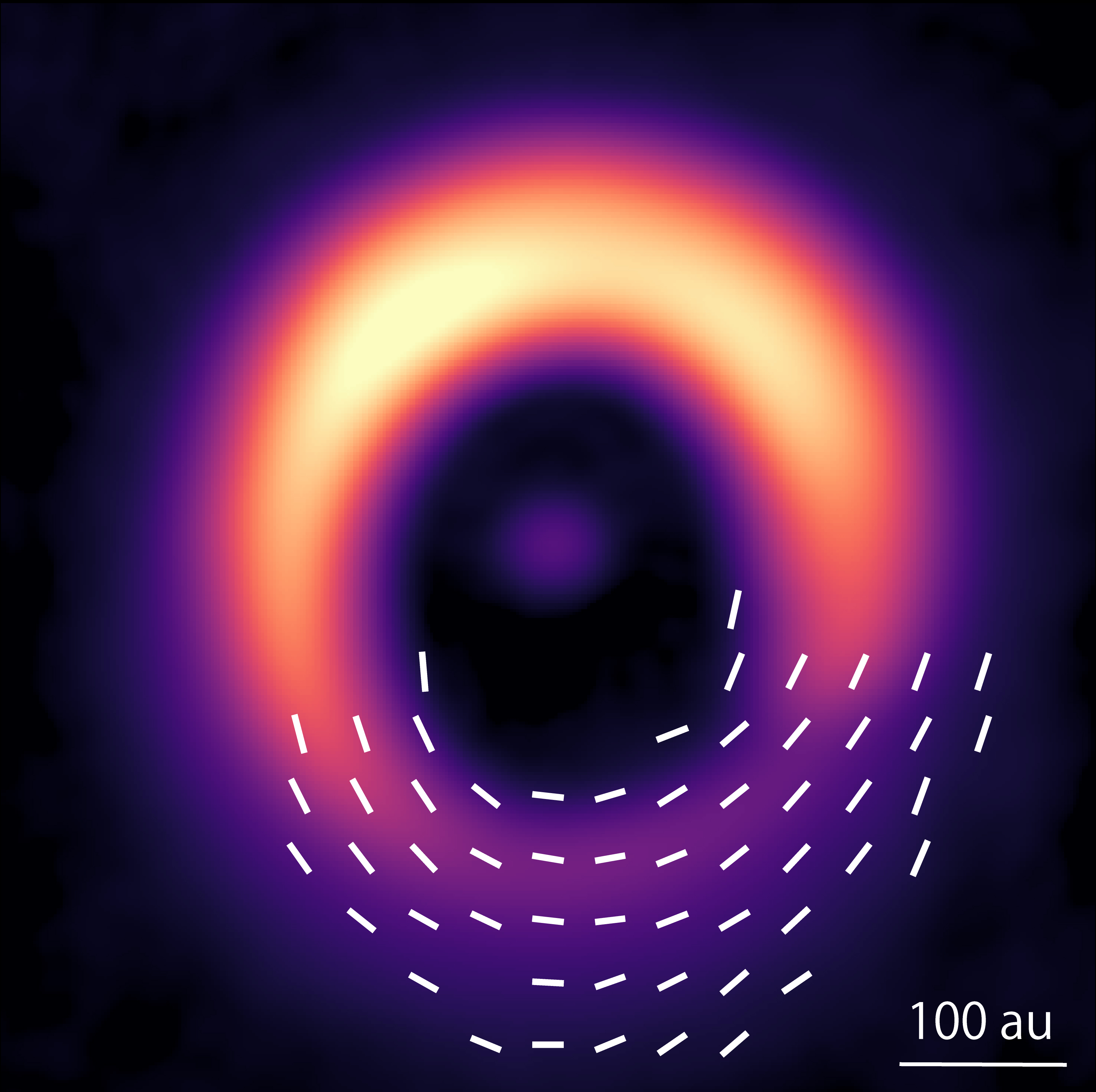
ALMA observations of the protoplanetary disk around HD 142527. The white bars show the directions of the magnetic field revealed by the orientation of the dust grains. The strength of the magnetic field is 0.3 milligauss. For comparison, a typical refrigerator magnet has a magnetic field of about 1,000,000 milligauss. Credit: ALMA (ESO/NAOJ/NRAO), S. Ohashi et al.
Download image (1.8MB)


For the first time astronomers have succeeded in observing the magnetic field around a young star where planets are thought to be forming. The team was able to use dust to measure the three-dimensional structure “fingerprint” of the magnetic field. This will help improve our understanding of planet formation. Planets form in turbulent disks of gas and dust called protoplanetary disks around young stars. It is thought that the first step in planet formation is dust grains colliding and sticking together. The movement of the dust grains is influenced by many forces, including magnetism. Thus, understanding the magnetic fields is important for understanding planet formation, but so far it has not been possible to measure the magnetic fields in a protoplanetary disk.

In this research, an international team of astronomers led by Satoshi Ohashi at the National Astronomical Observatory of Japan used the Atacama Large Millimeter/submillimeter Array (ALMA) to observe the protoplanetary disk around a young star known as HD 142527. This star is located 512 light-years away in the direction of the constellation Lupus. The team found that the dust grains aligned with the magnetic field lines. This allowed the team to detect and measure the unseen magnetic field lines, much the same way iron filings can reveal the magnetic field around a magnet. The team thinks that the measured three-dimensional structure might create strong turbulence withing the protoplanetary disk.

Now that this method of dusting for a young star’s magnetic fingerprint has been proven to work, the team wants to apply it to more stars, and measure the magnetic field closer to the star to better understand the magnetic conditions where planets are forming.


Detailed Article(s)

Magnetic Field in Planet Formation has been Successfully Observed
ALMA


Release Information

Researcher(s) Involved in this Release

Satoshi Ohashi (National Astronomical Observatory of Japan)

Coordinated Release Organization(s)

National Astronomical Observatory of Japan
RIKEN
Kogakuin University
Ibaraki University
Ashikaga University

Paper(s)
Satoshi Ohashi et al. “Observationally derived magnetic field strength and 3D components in the HD 142527 disk”, in Nature Astronomy, DOI:10.1038/s41550-024-02454-x


Related Link(s)

ALMA measures size of seeds of planets (December 5, 2016)

Wednesday, December 25, 2024

ALMA Reveals the Birthplace of a Planetary System

Fig.1: Composite images of PDS 70 in pseudo color. The left panel shows previous ALMA observations at 0.87 mm, and the right panel shows new ALMA observations at 3 mm. The composite image combines millimeter/submillimeter continuum images with ALMA (red), an infrared continuum image from W. M. Keck Observatory (green), and an optical image of a hydrogen emission line taken with the VLT (blue). The images show that the dust emissions observed with ALMA form a ring-like structure outside the planets detected by Keck and the VLT. At a wavelength of 3 mm, the dust emission can be seen prominently concentrated in the northwest direction (upper right of the image). Credit: ALMA (ESO/NAOJ/NRAO), W. M. Keck Observatory, VLT (ESO), K. Doi (MPIA)


Dust Accumulation to Form a New Planet Outside Just-Formed Planets

The Atacama Large Millimeter/submillimeter Array (ALMA) has successfully observed a site of planet formation by detecting a high concentration of dust grains, a planet-forming material, outside the orbits of just-formed planets. An international research team led by Kiyoaki Doi, then a Ph.D. student at the National Astronomical Observatory of Japan (NAOJ)/the Graduate University for Advanced Studies, SOKENDAI, and currently a postdoctoral fellow at the Max Planck Institute for Astronomy, performed high-resolution observations of a protoplanetary disk around a young star called PDS 70 at a wavelength of 3 mm with ALMA. The object hosts two known planets, and the new ALMA observations revealed a localized accumulation of dust grains outside the planetary orbits. This finding suggests that already-formed planets accumulate the material for a planet and facilitate the potential formation of the next planet. This work contributes to revealing the formation process of planetary systems consisting of multiple planets, like the Solar System.

To date, more than 5,000 planets have been identified both within and outside the Solar System. In some cases, they compose planetary systems consisting of multiple planets. These planets are believed to originate from micron-sized dust grains in the protoplanetary disks that surround young stars. However, how these dust grains accumulate locally and lead to the formation of planetary systems remains unknown.

PDS 70 is the only known celestial object with already–formed planets, confirmed by optical and infrared observations, within a protoplanetary disk. Unveiling the distribution of dust grains in this object will provide insight into how the already-formed planets interact with the surrounding protoplanetary disk and potentially influence subsequent planet formation.

Previous observations with ALMA at 0.87 mm revealed ring-shaped emissions from the dust grains outside the planetary orbits. However, the emission source might be optically thick (opaque, with dust grains on the near side obscuring those behind them), and the observed emissions distribution might not accurately reflect the distribution of the dust grains.

The researchers, led by Kiyoaki Doi, performed high-resolution observations of the protoplanetary disk around PDS 70 at a wavelength of 3 mm with ALMA. The observations at 3 mm are optically thinner (more transparent), providing the distribution of the dust grains more reliably. The new observations at 3 mm showed a different distribution from the previous 0.87 mm observations. They revealed that the dust emission is concentrated in a specific direction within the dust ring outside the planets. This suggests that dust grains, the building blocks of planets, accumulate in a narrow region and form a localized clump.

The dust clump outside the planets suggests that the already-formed planets interact with the surrounding disk, concentrating dust grains into a narrow region at the outer edge of their orbit. These clumped dust grains are thought to grow into a new planet. The formation of planetary systems, like the Solar System, can be explained by the sequential formation of the planets from inside to outside by repeating this process. This observational work captured how already-formed planets interact with their surroundings and trigger the formation of the next planet, contributing to our understanding of planetary system formation.

Kiyoaki Doi, who led this work, says, “A celestial object is made up of multiple components, each emitting radiation at different wavelengths. Thus, observing the same object at multiple wavelengths offers a unique perspective on the target. In PDS 70, the planets were discovered at optical and infrared wavelengths, while the protoplanetary disk was observed at millimeter wavelengths. This work shows that the disk exhibits different morphologies, even within the observation wavelength range of ALMA. This highlights the importance of observations across various wavelengths, including multi-wavelength observations with ALMA. Observing multiple components of a target with various observational settings with different telescopes is necessary for a comprehensive understanding of the entire system.”

Scientific Paper


Additional Information

The results of this work were published in Astrophysical Journal Letters by Doi et al., “Asymmetric Dust Accumulation of the PDS 70 Disk Revealed by ALMA Band 3 Observations.”

The Atacama Large Millimeter/submillimeter Array (ALMA), an international astronomy facility, is a partnership of the European Organisation for Astronomical Research in the Southern Hemisphere (ESO), the U.S. National Science Foundation (NSF) and the National Institutes of Natural Sciences (NINS) of Japan in cooperation with the Republic of Chile. ALMA is funded by ESO on behalf of its Member States, by NSF in cooperation with the National Research Council of Canada (NRC) and the National Science and Technology Council (NSTC) in Taiwan, and by NINS in cooperation with the Academia Sinica(AS) in Taiwan and the Korea Astronomy and Space Science Institute (KASI).

ALMA construction and operations are led by ESO on behalf of its Member States; by the National Radio Astronomy Observatory (NRAO), managed by Associated Universities, Inc. (AUI), on behalf of North America; and by the National Astronomical Observatory of Japan (NAOJ) on behalf of East Asia. The Joint ALMA Observatory (JAO) provides the unified leadership and management of the construction, commissioning and operation of ALMA.


Contacts

Nicolás Lira
Education and Public Outreach Coordinator
Joint ALMA Observatory, Santiago - Chile
Phone:
+56 2 2467 6519
Cel: +56 9 9445 7726
Email: nicolas.lira@alma.cl

Yuichi Matsuda
ALMA EA-ARC Staff Member
NAOJ
Email:
yuichi.matsuda@nao.ac.jp


Bárbara Ferreira
ESO Media Manager
Garching bei München, Germany
Phone:
+49 89 3200 6670
Email: press@eso.org

Jill Malusky
Public Information Officer
NRAO
Phone:
+1 304-456-2236
Email: jmalusky@nrao.edu


Tuesday, December 17, 2024

Dusty Crescents Around a Baby Star

The MWC 758 protoplanetary disk, as seen by the Very Large Telescope (yellow areas) and the Atacama Large Millimeter/submillimeter Array (blue areas). Credit: ESO/A. Garufi et al.; R. Dong et al.; ALMA (ESO/NAOJ/NRAO); CC BY 4.0


Complicated Disks

Did vortices sculpt the crescent-shaped clumps of dust around the young star MWC 758? Using data from the Atacama Large Millimeter/submillimeter Array (ALMA), researchers have mapped the motions of the dust clumps and weighed in on the vortex hypothesis.

How planets form is one of the most pressing questions in astronomy. Observations increasingly show that protoplanetary disks, the sites of planet formation, are complex objects. These disks feature rings, gaps, spirals, and vortices, any of which might signal the presence of baby planets.

Among the intriguing features seen in protoplanetary disks are crescents: asymmetric regions where the density of dust is enhanced. These regions are readily visible in observations by ALMA and have been found in several protoplanetary disks.

Researchers suspect that crescents are caused by swirling regions called vortices. Like debris caught in an eddy in a stream, dust could theoretically become trapped in a vortex, forming the clumps seen in images — and potentially creating a perfect dusty ecosystem for planets to form.

Images of the MWC 758 disk taken at a wavelength of 1.3 mm in 2017 (left) and 2021 (right).
Credit: Kuo et al. 2024

The Causes of Crescents

Recently, a team led by I-Hsuan Genevieve Kuo (Academia Sinica Institute of Astronomy and Astrophysics, Taiwan; University of Arizona) investigated the causes of crescents in the protoplanetary disk around the star MWC 758, also called HD 36112. MWC 758 is a 1.5–2-solar-mass star that is about 3.5 million years old and less than 500 light-years away. Its disk sports several intriguing features, including two crescents and a spiral. Previous research has attributed these features to the presence of one or more planets.

Vortex theory predicts that vortices in a protoplanetary disk will revolve around the central star at the Keplerian velocity (i.e., following the predictions of Kepler’s laws of motion). To test this theory, Kuo’s team used ALMA data from 2017 and 2021 to measure the motion of the two crescents. They found that the crescents moved in the direction of the disk’s rotation, with the inner crescent moving 50% slower than expected for the vortex hypothesis and the outer crescent moving 33% faster than expected.

Observed azimuthal (i.e., around the disk) velocity of the dust clumps (green and dark blue triangles) and expected velocity for Keplerian rotation (aqua circles).Credit: Kuo et al. 2024

Spiral vs. Vortex

Does this finding necessarily rule out the vortex hypothesis? Kuo and coauthors first investigated and eliminated the possibility that imperfections in the disk, like warps or eccentricity, were the cause of the mismatch with theory. They then noted that the motion of the crescents matches the Keplerian velocity at a radius of about 0.46 arcsecond. If a planet were present at that radius, there’s a chance it could throw the system off-kilter and produce the observed behavior — but MWC 758’s putative planets are located well inside and outside this radius.

Instead, the non-Keplerian rotation of the dust clumps might be caused by the interaction of vortices and spirals. In this case, the vortices themselves, which are invisible to us, are moving in the way predicted by theory, but the spiral knocks the (visible) dust off course.

Luckily, this prediction is testable. If vortices and spirals are vying for control of the dust crescents in MWC 758’s disk, their power struggle would be less effective on large dust grains than on small dust grains. In other words, large dust grains should adhere more closely to the expected Keplerian velocity than small dust grains do. Future high-resolution observations at different wavelengths, which probe grains of different sizes, may provide an answer.

By Kerry Hensley

Citation

“ALMA Observations of Proper Motions of the Dust Clumps in the Protoplanetary Disk MWC 758,” I-Hsuan Genevieve Kuo et al 2024 ApJL 975 L33. doi:10.3847/2041-8213/ad86c1


Tuesday, September 24, 2024

Fireworks at Closest Approach: Repeated X-ray Flares from a Young Binary System

Two young protostars in a cosmic tango that brings them within 10 stellar radii every two weeks. This artist’s illustration of the DQ Tau system shows the intense fireworks that occur every fortnight as these two swiftly moving stars are ever, ever getting back together. Image credit: NASA/JPL-Caltech/R. Hurt (IPAC).

DQ Tau is a unique binary system. Approximately 650 light-years away in the Taurus constellation, DQ Tau consists of two young stars still in the process of forming. The protostars have not yet ignited hydrogen burning in their cores (the fusion process that heats mature stars). Instead, they are glowing as they evolve from their natal form (diffuse clouds of gas) and are heated by this gravitational collapse. Each is half the mass of the Sun and currently twice its radius, dancing in a highly elongated orbit which has them plunging in towards each other every 15.8 days. At closest approach in this violent cosmic tango, the separation between the two stars is exceptionally small, only 8-10 stellar radii. Characteristic of this early phase, the protostars in DQ Tau harbor strong magnetic fields on their surfaces. Also, like most protostars, the DQ Tau system is surrounded by a disk in which planets are also forming. Understanding planet formation, including how the intense flares characteristic of protostars affect disk heating and chemistry, are areas of active research.

DQ Tau provides an exceptional laboratory for such studies. Like clockwork, the DQ Tau system brightens at closest approach. While large X-ray flares in young stars are generally rare and unpredictable (as on our own star, the Sun), the presence of the predictable X-ray super-flares and outbursts in DQ Tau enables synchronized studies of these cosmic fireworks. Like tourists at Yellowstone National Park timing their visit to Old Faithful Geyser, astronomers can plan ahead, coordinating telescopes to jointly investigate these intense flares and understand how they affect the protoplanetary disk. X-ray flares come as the protostar magnetospheres collide, while the lower energy optical and ultraviolet flares also come from accretion of material onto the young stars. Infrared and radio studies probe the changing temperature and chemistry of the protoplanetary disk.

In a recent paper published in the Astrophysical Journal, scientists led by Konstantin Getman at Pennsylvania State University report on new observations of a single orbit of DQ Tau in July and August 2022 using the NuSTAR, Swift, and Chandra X-ray telescopes. NuSTAR accesses higher energy X-rays, while Swift and Chandra access lower energy X-rays. The observations indicate that most of the X-ray emission is from interactions of the magnetospheres of these young stars at closest approach. In a process similar to what is seen on our own Sun, magnetic field collisions and reconnections produce strong high-energy X-ray emission. This heats the surrounding region to high temperature, detectable as thermal emission in the lower energy X-rays. Notably, however, flares on our Sun occur among coronal magnetic loops much smaller than the star, with sizes of 1000 to 10,000 km. In contrast, the DQ Tau super-flares occur on spatial scales a thousand times larger, corresponding to approximately 10 million km or tens of stellar radii. The current study is part of a broader campaign using additional ground-based telescopes to investigate the influence of DQ Tau’s stellar radiation on the chemistry within its surrounding disk.


Friday, July 05, 2024

NASA's Webb Captures Celestial Fireworks Around Forming Star

L1527 and Protostar (MIRI Image)
Credits: Image: NASA, ESA, CSA, STScI

L1527 and Protostar (MIRI Compass Image)
Credits: Image: NASA, ESA, CSA, STScI


The cosmos seems to come alive with a crackling explosion of pyrotechnics in this new image from NASA’s James Webb Space Telescope. Taken with Webb’s MIRI (Mid-Infrared Instrument), this fiery hourglass marks the scene of a very young object in the process of becoming a star. A central protostar grows in the neck of the hourglass, accumulating material from a thin protoplanetary disk, seen edge-on as a dark line. )

The protostar, a relatively young object of about 100,000 years, is still surrounded by its parent molecular cloud, or large region of gas and dust. Webb’s previous observation of L1527, with NIRCam (Near-Infrared Camera), allowed us to peer into this region and revealed this molecular cloud and protostar in opaque, vibrant colors.

Both NIRCam and MIRI show the effects of outflows, which are emitted in opposite directions along the protostar’s rotation axis as the object consumes gas and dust from the surrounding cloud. These outflows take the form of bow shocks to the surrounding molecular cloud, which appear as filamentary structures throughout. They are also responsible for carving the bright hourglass structure within the molecular cloud as they energize, or excite, the surrounding matter and cause the regions above and below it to glow. This creates an effect reminiscent of fireworks brightening a cloudy night sky. Unlike NIRCam, however, which mostly shows the light that is reflected off dust, MIRI provides a look into how these outflows affect the region’s thickest dust and gases.

The areas colored here in blue, which encompass most of the hourglass, show mostly carbonaceous molecules known as polycyclic aromatic hydrocarbons. The protostar itself and the dense blanket of dust and a mixture of gases that surround it are represented in red. (The sparkler-like red extensions are an artifact of the telescope’s optics). In between, MIRI reveals a white region directly above and below the protostar, which doesn’t show as strongly in the NIRCam view. This region is a mixture of hydrocarbons, ionized neon, and thick dust, which shows that the protostar propels this matter quite far away from it as it messily consumes material from its disk.

As the protostar continues to age and release energetic jets, it’ll consume, destroy, and push away much of this molecular cloud, and many of the structures we see here will begin to fade. Eventually, once it finishes gathering mass, this impressive display will end, and the star itself will become more apparent, even to our visible-light telescopes.

The combination of analyses from both the near-infrared and mid-infrared views reveal the overall behavior of this system, including how the central protostar is affecting the surrounding region. Other stars in Taurus, the star-forming region where L1527 resides, are forming just like this, which could lead to other molecular clouds being disrupted and either preventing new stars from forming or catalyzing their development.

The James Webb Space Telescope is the world’s premier space science observatory. Webb is solving mysteries in our solar system, looking beyond to distant worlds around other stars, and probing the mysterious structures and origins of our universe and our place in it. Webb is an international program led by NASA with its partners, ESA (European Space Agency) and CSA (Canadian Space Agency).


About This Release

Credits:

Media Contact:

Matthew Brown
Space Telescope Science Institute, Baltimore, Maryland

Christine Pulliam
Space Telescope Science Institute, Baltimore, Maryland

Permissions: Content Use Policy

Contact Us: Direct inquiries to the News Team.


Friday, June 07, 2024

Webb Finds Plethora of Carbon Molecules Around Young Star

Protoplanetary Disk (Artist's Concept)
Credits: Illustration: NASA-JPL

Hydrocarbons in Protoplanetary Disk Spectrum (MIRI)
Credits: Illustration: NASA, ESA, CSA, Ralf Crawford (STScI)


An international team of astronomers has used NASA’s James Webb Space Telescope to study the disk of gas and dust around a young, very low-mass star. The results reveal the largest number of carbon-containing molecules seen to date in such a disk. These findings have implications for the potential composition of any planets that might form around this star.

Rocky planets are more likely than gas giants to form around low-mass stars, making them the most common planets around the most common stars in our galaxy. Little is known about the chemistry of such worlds, which may be similar to or very different from Earth. By studying the disks from which such planets form, astronomers hope to better understand the planet formation process and the compositions of the resulting planets.

Planet-forming disks around very low-mass stars are difficult to study because they are smaller and fainter than disks around high-mass stars. A program called the MIRI (Mid-Infrared Instrument) Mid-INfrared Disk Survey (MINDS) aims to use Webb’s unique capabilities to build a bridge between the chemical inventory of disks and the properties of exoplanets.

“Webb has better sensitivity and spectral resolution than previous infrared space telescopes,” explained lead author Aditya Arabhavi of the University of Groningen in the Netherlands. “These observations are not possible from Earth, because the emissions from the disk are blocked by our atmosphere.”

In a new study, this team explored the region around a very low-mass star known as ISO-ChaI 147, a 1 to 2 million-year-old star that weighs just 0.11 times as much as the Sun. The spectrum revealed by Webb’s MIRI shows the richest hydrocarbon chemistry seen to date in a protoplanetary disk – a total of 13 different carbon-bearing molecules. The team’s findings include the first detection of ethane (C2H6) outside of our solar system, as well as ethylene (C2H4), propyne (C3H4), and the methyl radical CH3.

“These molecules have already been detected in our solar system, like in comets such as 67P/Churyumov–Gerasimenko and C/2014 Q2 (Lovejoy),” added Arabhavi. “Webb allowed us to understand that these hydrocarbon molecules are not just diverse but also abundant. It is amazing that we can now see the dance of these molecules in the planetary cradles. It is a very different planet-forming environment than we usually think of.”

The team indicates that these results have large implications for the chemistry of the inner disk and the planets that might form there. Since Webb revealed the gas in the disk is so rich in carbon, there is likely little carbon left in the solid materials that planets would form from. As a result, the planets that might form there may ultimately be carbon-poor. (Earth itself is considered carbon-poor.)

“This is profoundly different from the composition we see in disks around solar-type stars, where oxygen bearing molecules like water and carbon dioxide dominate,” added team member Inga Kamp, also of the University of Groningen. “This object establishes that these are a unique class of objects.”

“It’s incredible that we can detect and quantify the amount of molecules that we know well on Earth, such as benzene, in an object that is more than 600 light-years away,” added team member Agnés Perrin of Centre National de la Recherche Scientifique in France.

Next, the science team intends to expand their study to a larger sample of such disks around very low-mass stars to develop their understanding of how common or exotic such carbon-rich terrestrial planet-forming regions are. “The expansion of our study will also allow us to better understand how these molecules can form,” explained team member and principal investigator of the MINDS program, Thomas Henning, of the Max-Planck-Institute for Astronomy in Germany. “Several features in the Webb data are also still unidentified, so more spectroscopy is required to fully interpret our observations.”

This work also highlights the crucial need for scientists to collaborate across disciplines. The team notes that these results and the accompanying data can contribute towards other fields including theoretical physics, chemistry, and astrochemistry, to interpret the spectra and to investigate new features in this wavelength range.

These results have been published in the journal Science.

The James Webb Space Telescope is the world’s premier space science observatory. Webb is solving mysteries in our solar system, looking beyond to distant worlds around other stars, and probing the mysterious structures and origins of our universe and our place in it. Webb is an international program led by NASA with its partners, ESA (European Space Agency) and CSA (Canadian Space Agency).


About This Release

Credits:

Media Contact:

Bethany Downer
ESA/Webb, Baltimore, Maryland

Christine Pulliam
Space Telescope Science Institute, Baltimore, Maryland

Permissions: Content Use Policy

Contact Us: Direct inquiries to the News Team.

Related Links and Documents


Thursday, May 30, 2024

Planet and Star Formation


We study the formation of stars on all scales and the birth of planetary systems and their evolution. The Department established observational programs to search for extrasolar planets and to characterize their properties. We investigate the chemical and physical state of the interstellar medium and protoplanetary disks in dedicated laboratory experiments where we study the formation of complex organic molecules and cosmic dust analogues.

Star formation is a key process in the universe, shaping the structure of entire galaxies and driving their chemical evolution and, at the same time, providing the conditions for the formation of planets. Our goal is to understand the different modes of star formation, from massive star clusters to more isolated groups of low-mass stars.

We want to unravel the mysteries of planet formation from tiny dust grains to the formation of giant planets and their migration in gas disks. At the same time, we establish new search strategies for brown dwarfs and exoplanets and are beginning to characterize their atmospheres.

To this end, we combine multi-wavelength observations from large ground-based telescopes and space-born infrared observatories with large-scale numerical simulations on supercomputers, theoretical models, and dedicated laboratory experiments. Our research places extreme demands on observational techniques, pushing available angular resolution, dynamic range, and spectral resolving power to their limits. We help develop and construct astronomical instruments to meet these demanding requirements. Our particular fields of expertise are adaptive optics and interferometry for ground-based observations, and sensitive space-based infrared instruments.


Heidelberg Initiative for the Origins of Life – HIFOL

The Heidelberg Initiative for the Origins of Life (HIFOL) seeks to understand one of the most fundamental questions of humanity: how did life emerge on Earth and does life exist elsewhere in the Universe. HIFOL facilitates a wide range of interdisciplinary theoretical, experimental, and observational research covering the fields of astronomy, physics, geosciences, chemistry, biology and life sciences from a range of research institutes based in Heidelberg. HIFOL brings together researchers from the Max Planck Institute for Astronomy, the Max Planck Institute for Nuclear Physics, the University of Heidelberg, Heidelberg Institute of Theoretical Studies, and Kirchhoff Institute for Physics, each tackling different aspects of the same problem.

Astrophysicists aim to understand how planets form around stars and search for habitable Earth analogues, characterizing their atmospheres, using both space- and ground-based telescopes. Using both meteoritic and earth samples, geoscientists strive to unravel the past evolutionary history of the solar system and earth itself, including its interior, crust and hydrosphere. Chemists focus on studying the conditions at which amino acids, nucleotides and their first chains could be abiogenically synthesized and started the self-catalytic replication cycle, while biologists seek to figure out how transition from a non-living to a living world has occurred and where on early Earth it has happened, and how first cells, their membranes, metabolic and reproduction systems have emerged.


Contact:

Dr. Myriam Benisty
Director

benisty@mpia.de

Office:

Christelle Hiemstra
Assistant to the Managing Director
tel:06221/528-436

hiemstra@mpia.de

Director Emeritus:

Prof. Dr. Dr. h.c. Thomas K. Henning
tel:+49 6221 528-200

henning@mpia.de


Thursday, March 07, 2024

Groundbreaking survey reveals secrets of planet birth around dozens of stars

PR Image eso2405a
Planet-forming discs in three clouds of the Milky Way

PR Image eso2405b
Planet-forming discs in the Orion cloud

PR Image eso2405c
Planet-forming discs in the Taurus cloud

PR Image eso2405d
Planet-forming discs in the Chamaeleon cloud

PR Image eso2405e
The MWC 758 planet-forming disc as seen by SPHERE and ALMA


Videos

Survey reveals secrets of planet birth around dozens of stars | ESOcast Light


In a series of studies, a team of astronomers has shed new light on the fascinating and complex process of planet formation. The stunning images, captured using the European Southern Observatory's Very Large Telescope (ESO’s VLT) in Chile, represent one of the largest ever surveys of planet-forming discs. The research brings together observations of more than 80 young stars that might have planets forming around them, providing astronomers with a wealth of data and unique insights into how planets arise in different regions of our galaxy.

“This is really a shift in our field of study,” says Christian Ginski, a lecturer at the University of Galway, Ireland, and lead author of one of three new papers published today in Astronomy & Astrophysics. “We’ve gone from the intense study of individual star systems to this huge overview of entire star-forming regions.”

To date more than 5000 planets have been discovered orbiting stars other than the Sun, often within systems markedly different from our own Solar System. To understand where and how this diversity arises, astronomers must observe the dust- and gas-rich discs that envelop young stars — the very cradles of planet formation. These are best found in huge gas clouds where the stars themselves are forming.

Much like mature planetary systems, the new images showcase the extraordinary diversity of planet-forming discs. “Some of these discs show huge spiral arms, presumably driven by the intricate ballet of orbiting planets,” says Ginski. “Others show rings and large cavities carved out by forming planets, while yet others seem smooth and almost dormant among all this bustle of activity,” adds Antonio Garufi, an astronomer at the Arcetri Astrophysical Observatory, Italian National Institute for Astrophysics (INAF), and lead author of one of the papers.

The team studied a total of 86 stars across three different star-forming regions of our galaxy: Taurus and Chamaeleon I, both around 600 light-years from Earth, and Orion, a gas-rich cloud about 1600 light-years from us that is known to be the birthplace of several stars more massive than the Sun. The observations were gathered by a large international team, comprising scientists from more than 10 countries.

The team was able to glean several key insights from the dataset. For example, in Orion they found that stars in groups of two or more were less likely to have large planet-forming discs. This is a significant result given that, unlike our Sun, most stars in our galaxy have companions. As well as this, the uneven appearance of the discs in this region suggests the possibility of massive planets embedded within them, which could be causing the discs to warp and become misaligned.

While planet-forming discs can extend for distances hundreds of times greater than the distance between Earth and the Sun, their location several hundreds of light-years from us makes them appear as tiny pinpricks in the night sky. To observe the discs, the team employed the sophisticated Spectro-Polarimetric High-contrast Exoplanet REsearch instrument (SPHERE) mounted on ESO’s VLT. SPHERE’s state-of-the-art extreme adaptive optics system corrects for the turbulent effects of Earth’s atmosphere, yielding crisp images of the discs. This meant the team were able to image discs around stars with masses as low as half the mass of the Sun, which are typically too faint for most other instruments available today. Additional data for the survey were obtained using the VLT’s X-shooter instrument, which allowed astronomers to determine how young and how massive the stars are. The Atacama Large Millimeter/submillimeter Array (ALMA), in which ESO is a partner, on the other hand, helped the team understand more about the amount of dust surrounding some of the stars.

As technology advances, the team hopes to delve even deeper into the heart of planet-forming systems. The large 39-metre mirror of ESO’s forthcoming Extremely Large Telescope (ELT), for example, will enable the team to study the innermost regions around young stars, where rocky planets like our own might be forming.

For now, these spectacular images provide researchers with a treasure trove of data to help unpick the mysteries of planet formation. “It is almost poetic that the processes that mark the start of the journey towards forming planets and ultimately life in our own Solar System should be so beautiful,” concludes Per-Gunnar Valegård, a doctoral student at the University of Amsterdam, the Netherlands, who led the Orion study. Valegård, who is also a part-time teacher at the International School Hilversum in the Netherlands, hopes the images will inspire his pupils to become scientists in the future.

Source: ESO/News


More information

This research was presented in three papers to appear in Astronomy & Astrophysics. The data presented were gathered as part of the SPHERE consortium guaranteed time programme, as well as the DESTINYS (Disk Evolution Study Through Imaging of Nearby Young Stars) ESO Large Programme.
  1. “The SPHERE view of the Chamaeleon I star-forming region: The full census of planet-forming disks with GTO and DESTINYS programs” (https://www.aanda.org/10.1051/0004-6361/202244005)

The team is composed of C. Ginski (University of Galway, Ireland; Leiden Observatory, Leiden University, the Netherlands [Leiden]; Anton Pannekoek Institute for Astronomy, University of Amsterdam, the Netherlands [API]), R. Tazaki (API), M. Benisty (Univ. Grenoble Alpes, CNRS, IPAG, France [Grenoble]), A. Garufi (INAF, Osservatorio Astrofisico di Arcetri, Italy), C. Dominik (API), Á. Ribas (European Southern Observatory, Chile [ESO Chile]), N. Engler (ETH Zurich, Institute for Particle Physics and Astrophysics, Switzerland), J. Hagelberg (Geneva Observatory, University of Geneva, Switzerland), R. G. van Holstein (ESO Chile), T. Muto (Division of Liberal Arts, Kogakuin University, Japan), P. Pinilla (Max-Planck-Institut für Astronomie, Germany [MPIA]; Mullard Space Science Laboratory, University College London, UK), K. Kanagawa (Department of Earth and Planetary Sciences, Tokyo Institute of Technology, Japan), S. Kim (Department of Astronomy, Tsinghua University, China), N. Kurtovic (MPIA), M. Langlois (Centre de Recherche Astrophysique de Lyon, CNRS, UCBL, France), J. Milli (Grenoble), M. Momose (College of Science, Ibaraki University, Japan [Ibaraki]), R. Orihara (Ibaraki), N. Pawellek (Department of Astrophysics, University of Vienna, Austria), T. O. B. Schmidt (Hamburger Sternwarte, Germany), F. Snik (Leiden), and Z. Wahhaj (ESO Chile).
  1. “The SPHERE view of the Taurus star-forming region: The full census of planet-forming disks with GTO and DESTINYS programs” (https://www.aanda.org/10.1051/0004-6361/202347586)

The team is composed of A. Garufi (INAF, Osservatorio Astrofisico di Arcetri, Italy [INAF Arcetri]), C. Ginski (University of Galway, Ireland), R. G. van Holstein (European Southern Observatory, Chile [ESO Chile]), M. Benisty (Laboratoire Lagrange, Université Côte d’Azur, Observatoire de la Côte d’Azur, CNRS, France; Univ. Grenoble Alpes, CNRS, IPAG, France [Grenoble]), C. F. Manara (European Southern Observatory, Germany), S. Pérez (Millennium Nucleus on Young Exoplanets and their Moons [YEMS]; Departamento de Física, Universidad de Santiago de Chile, Chile [Santiago]), P. Pinilla (Mullard Space Science Laboratory, University College London, UK), A. Ribas (Institute of Astronomy, University of Cambridge, UK), P. Weber (YEMS, Santiago), J. Williams (Institute for Astronomy, University of Hawai‘i, USA), L. Cieza (Instituto de Estudios Astrofísicos, Facultad de Ingeniería y Ciencias, Universidad Diego Portales, Chile [Diego Portales]; YEMS), C. Dominik (Anton Pannekoek Institute for Astronomy, University of Amsterdam, the Netherlands [API]), S. Facchini (Dipartimento di Fisica, Università degli Studi di Milano, Italy), J. Huang (Department of Astronomy, Columbia University, USA), A. Zurlo (Diego Portales; YEMS), J. Bae (Department of Astronomy, University of Florida, USA), J. Hagelberg (Observatoire de Genève, Université de Genève, Switzerland), Th. Henning (Max Planck Institute for Astronomy, Germany [MPIA]), M. R. Hogerheijde (Leiden Observatory, Leiden University, the Netherlands; API), M. Janson (Department of Astronomy, Stockholm University, Sweden), F. Ménard (Grenoble), S. Messina (INAF - Osservatorio Astrofisico di Catania, Italy), M. R. Meyer (Department of Astronomy, The University of Michigan, USA), C. Pinte (School of Physics and Astronomy, Monash University, Australia; Grenoble), S. Quanz (ETH Zürich, Department of Physics, Switzerland [Zürich]), E. Rigliaco (Osservatorio Astronomico di Padova, Italy [Padova]), V. Roccatagliata (INAF Arcetri), H. M. Schmid (Zürich), J. Szulágyi (Zürich), R. van Boekel (MPIA), Z. Wahhaj (ESO Chile), J. Antichi (INAF Arcetri), A. Baruffolo (Padova), and T. Moulin (Grenoble).
  1. “Disk Evolution Study Through Imaging of Nearby Young Stars (DESTINYS): The SPHERE view of the Orion star-forming region” (https://www.aanda.org/10.1051/0004-6361/202347452)

The team is composed of P.-G. Valegård (Anton Pannekoek Institute for Astronomy, University of Amsterdam, the Netherlands [API]), C. Ginski (University of Galway, Ireland), A. Derkink (API), A. Garufi (INAF, Osservatorio Astrofisico di Arcetri, Italy), C. Dominik (API), Á. Ribas (Institute of Astronomy, University of Cambridge, UK), J. P. Williams (Institute for Astronomy, University of Hawai‘i, USA), M. Benisty (University of Grenoble Alps, CNRS, IPAG, France), T. Birnstiel (University Observatory, Faculty of Physics, Ludwig-Maximilians-Universität München, Germany [LMU]; Exzellenzcluster ORIGINS, Germany), S. Facchini (Dipartimento di Fisica, Università degli Studi di Milano, Italy), G. Columba (Department of Physics and Astronomy "Galileo Galilei" - University of Padova, Italy; INAF – Osservatorio Astronomico di Padova, Italy), M. Hogerheijde (API; Leiden Observatory, Leiden University, the Netherlands [Leiden]), R. G. van Holstein (European Southern Observatory, Chile), J. Huang (Department of Astronomy, Columbia University, USA), M. Kenworthy (Leiden), C. F. Manara (European Southern Observatory, Germany), P. Pinilla (Mullard Space Science Laboratory, University College London, UK), Ch. Rab (LMU; Max-Planck-Institut für extraterrestrische Physik, Germany), R. Sulaiman (Department of Physics, American University of Beirut, Lebanon), A. Zurlo (Instituto de Estudios Astrofísicos, Facultad de Ingeniería y Ciencias, Universidad Diego Portales, Chile; Escuela de Ingeniería Industrial, Facultad de Ingeniería y Ciencias, Universidad Diego Portales, Chile; Millennium Nucleus on Young Exoplanets and their Moons).

The European Southern Observatory (ESO) enables scientists worldwide to discover the secrets of the Universe for the benefit of all. We design, build and operate world-class observatories on the ground — which astronomers use to tackle exciting questions and spread the fascination of astronomy — and promote international collaboration for astronomy. Established as an intergovernmental organisation in 1962, today ESO is supported by 16 Member States (Austria, Belgium, Czechia, Denmark, France, Finland, Germany, Ireland, Italy, the Netherlands, Poland, Portugal, Spain, Sweden, Switzerland and the United Kingdom), along with the host state of Chile and with Australia as a Strategic Partner. ESO’s headquarters and its visitor centre and planetarium, the ESO Supernova, are located close to Munich in Germany, while the Chilean Atacama Desert, a marvellous place with unique conditions to observe the sky, hosts our telescopes. ESO operates three observing sites: La Silla, Paranal and Chajnantor. At Paranal, ESO operates the Very Large Telescope and its Very Large Telescope Interferometer, as well as survey telescopes such as VISTA. Also at Paranal ESO will host and operate the Cherenkov Telescope Array South, the world’s largest and most sensitive gamma-ray observatory. Together with international partners, ESO operates ALMA on Chajnantor, a facility that observes the skies in the millimetre and submillimetre range. At Cerro Armazones, near Paranal, we are building “the world’s biggest eye on the sky” — ESO’s Extremely Large Telescope. From our offices in Santiago, Chile we support our operations in the country and engage with Chilean partners and society.

The Atacama Large Millimeter/submillimeter Array (ALMA), an international astronomy facility, is a partnership of ESO, the U.S. National Science Foundation (NSF) and the National Institutes of Natural Sciences (NINS) of Japan in cooperation with the Republic of Chile. ALMA is funded by ESO on behalf of its Member States, by NSF in cooperation with the National Research Council of Canada (NRC) and the National Science and Technology Council (NSTC) in Taiwan and by NINS in cooperation with the Academia Sinica (AS) in Taiwan and the Korea Astronomy and Space Science Institute (KASI). ALMA construction and operations are led by ESO on behalf of its Member States; by the National Radio Astronomy Observatory (NRAO), managed by Associated Universities, Inc. (AUI), on behalf of North America; and by the National Astronomical Observatory of Japan (NAOJ) on behalf of East Asia. The Joint ALMA Observatory (JAO) provides the unified leadership and management of the construction, commissioning and operation of ALMA.


Links


Contacts

Christian Ginski
University of Galway
Galway, Ireland
Email:
christian.ginski@universityofgalway.ie

Antonio Garufi
INAF’s Arcetri Astrophysical Observatory
Florence, Italy
Email:
antonio.garufi@inaf.it

Per-Gunnar Valegård
University of Amsterdam
Email:
p.g.valegard@uva.nl

Bárbara Ferreira
ESO Media Manager
Garching bei München, Germany
Tel: +49 89 3200 6670
Cell: +49 151 241 664 00
Email:
press@eso.org