Showing posts with label Vela constellation. Show all posts

Saturday, February 15, 2025

Star cluster reveals its colours in stunning 80-million-pixel ESO image

PR Image eso2503a
The RCW 38 cluster in infrared light

PR Image eso2503b
The RCW 38 cluster in visible light

PR Image eso2503
RCW 38 in the Constellation of Vela


Videos

Look into the stunning RCW 38 star cluster
PR Video eso2503a
Look into the stunning RCW 38 star cluster

Zooming-in into RCW 38 in infrared light
PR Video eso2503b
Zooming-in into RCW 38 in infrared light


Image Comparisons

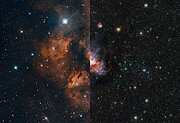
The RCW 38 cluster in visible and infrared light


The European Southern Observatory (ESO) has released a stunning 80 million-pixel image of the star cluster RCW 38, as captured by ESO’s Visible and Infrared Survey Telescope for Astronomy (VISTA), operating in Chile’s Atacama Desert.

Meet the colourful extravaganza of the RCW 38 stellar nursery, located some 5500 light-years away from us, in the constellation Vela. With its bright streaks and swirls, this birthplace of stars is not afraid to flaunt its colours. From the vivid pink of gas clouds to the multi-coloured dots, which are young stars, this image has it all.

Compared to our Sun, which at about 4.6 billion years old is in a stable phase of its life, the stars in RCW 38 are still very young. At less than a million years old, RCW 38 contains some 2000 stars, creating this psychedelic landscape. This young star cluster is bustling with activity, which makes it an interesting target for astronomers to observe.

Star clusters are like giant pressure cookers, containing all the ingredients for star formation: dense gas clouds and opaque clumps of cosmic dust. When this mixture of gas and dust collapses under its own gravity, a star is born.

The strong radiation coming from these newborn stars makes the gas that encompasses the star cluster glow brightly, creating the pink hues we see here in RCW 38. It’s truly a spectacular sight! Yet in visible light many stars in the RCW 38 cluster remain hidden from us, because dust blocks our view of them.

That is where the VISTA telescope, at ESO’s Paranal Observatory, comes in: its VIRCAM camera observes infrared light which, unlike visible light, can go through dust almost unimpeded, revealing the true riches of RCW 38. Suddenly, we also see young stars within dusty cocoons, or cold ‘failed’ stars known as brown dwarfs.

This infrared image was taken during the VISTA Variables in the Vía Láctea (VVV) survey, which has produced the most detailed infrared map of our home galaxy ever made. Surveys like this reveal as yet unknown astronomical objects, or give us a new view of known ones.

Since this image was taken, VISTA’s faithful VIRCAM camera, which has conducted numerous imaging surveys since 2008, has retired after an impressive run. Later this year, the telescope will receive a brand new instrument called 4MOST, which will gather the spectra of 2400 objects at once over a large area of the sky. As VISTA is born again, the future looks bright.

Source: ESO/News


More information

The European Southern Observatory (ESO) enables scientists worldwide to discover the secrets of the Universe for the benefit of all. We design, build and operate world-class observatories on the ground — which astronomers use to tackle exciting questions and spread the fascination of astronomy — and promote international collaboration for astronomy. Established as an intergovernmental organisation in 1962, today ESO is supported by 16 Member States (Austria, Belgium, Czechia, Denmark, France, Finland, Germany, Ireland, Italy, the Netherlands, Poland, Portugal, Spain, Sweden, Switzerland and the United Kingdom), along with the host state of Chile and with Australia as a Strategic Partner. ESO’s headquarters and its visitor centre and planetarium, the ESO Supernova, are located close to Munich in Germany, while the Chilean Atacama Desert, a marvellous place with unique conditions to observe the sky, hosts our telescopes. ESO operates three observing sites: La Silla, Paranal and Chajnantor. At Paranal, ESO operates the Very Large Telescope and its Very Large Telescope Interferometer, as well as survey telescopes such as VISTA. Also at Paranal ESO will host and operate the Cherenkov Telescope Array South, the world’s largest and most sensitive gamma-ray observatory. Together with international partners, ESO operates ALMA on Chajnantor, a facility that observes the skies in the millimetre and submillimetre range. At Cerro Armazones, near Paranal, we are building “the world’s biggest eye on the sky” — ESO’s Extremely Large Telescope. From our offices in Santiago, Chile we support our operations in the country and engage with Chilean partners and society.


Links


Contacts

Juan Carlos Muñoz Mateos
ESO Media Officer
Garching bei München, Germany
Tel: +49 89 3200 6176
Email:
press@eso.org


Monday, July 31, 2023

Webb Snaps Highly Detailed Infrared Image of Actively Forming Stars

Herbig-Haro 46/47 (NIRCam Image)
Credits: Image: NASA, ESA, CSA
Image Processing: Joseph DePasquale (STScI)


Young stars are rambunctious!

NASA’s James Webb Space Telescope has captured the “antics” of a pair of actively forming young stars, known as Herbig-Haro 46/47, in high-resolution near-infrared light. To find them, trace the bright pink and red diffraction spikes until you hit the center: The stars are within the orange-white splotch. They are buried deeply in a disk of gas and dust that feeds their growth as they continue to gain mass. The disk is not visible, but its shadow can be seen in the two dark, conical regions surrounding the central stars.

The most striking details are the two-sided lobes that fan out from the actively forming central stars, represented in fiery orange. Much of this material was shot out from those stars as they repeatedly ingest and eject the gas and dust that immediately surround them over thousands of years.

When material from more recent ejections runs into older material, it changes the shape of these lobes. This activity is like a large fountain being turned on and off in rapid, but random succession, leading to billowing patterns in the pool below it. Some jets send out more material and others launch at faster speeds. Why? It’s likely related to how much material fell onto the stars at a particular point in time.

The stars’ more recent ejections appear in a thread-like blue. They run just below the red horizontal diffraction spike at 2 o’clock. Along the right side, these ejections make clearer wavy patterns. They are disconnected at points, and end in a remarkable uneven light purple circle in the thickest orange area. Lighter blue, curly lines also emerge on the left, near the central stars, but are sometimes overshadowed by the bright red diffraction spike.

All of these jets are crucial to star formation itself. Ejections regulate how much mass the stars ultimately gather. (The disk of gas and dust feeding the stars is small. Imagine a band tightly tied around the stars.)

Now, turn your eye to the second most prominent feature: the effervescent blue cloud. This is a region of dense dust and gas, known both as a nebula and more formally as a Bok globule. When viewed mainly in visible light, it appears almost completely black – only a few background stars peek through. In Webb’s crisp near-infrared image, we can see into and through the gauzy layers of this cloud, bringing a lot more of Herbig-Haro 46/47 into focus, while also revealing a deep range of stars and galaxies that lie well beyond it. The nebula’s edges appear in a soft orange outline, like a backward L along the right and bottom.

This nebula is significant – its presence influences the shapes of the jets shot out by the central stars. As ejected material rams into the nebula on the lower left, there is more opportunity for the jets to interact with molecules within the nebula, causing them both to light up.

There are two other areas to look at to compare the asymmetry of the two lobes. Glance toward the upper right to pick out a blobby, almost sponge-shaped ejecta that appears separate from the larger lobe. Only a few threads of semi-transparent wisps of material point toward the larger lobe. Almost transparent, tentacle-like shapes also appear to be drifting behind it, like streamers in a cosmic wind. In contrast, at lower left, look beyond the hefty lobe to find an arc. Both are made up of material that was pushed the farthest and possibly by earlier ejections. The arcs appear to be pointed in different directions, and may have originated from different outflows.

Take another long look at this image. Although it appears Webb has snapped Herbig-Haro 46/47 edge-on, one side is angled slightly closer to Earth. Counterintuitively, it’s the smaller right half. Though the left side is larger and brighter, it is pointing away from us.

Over millions of years, the stars in Herbig-Haro 46/47 will fully form – clearing the scene of these fantastic, multihued ejections, allowing the binary stars to take center stage against a galaxy-filled background.

Webb can reveal so much detail in Herbig-Haro 46/47 for two reasons. The object is relatively close to Earth, and Webb’s image is made up of several exposures, which adds to its depth.

Herbig-Haro 46/47 lies only 1,470 light-years away in the Vela Constellation.

The James Webb Space Telescope is the world's premier space science observatory. Webb is solving mysteries in our solar system, looking beyond to distant worlds around other stars, and probing the mysterious structures and origins of our universe and our place in it. Webb is an international program led by NASA with its partners, ESA (European Space Agency) and the Canadian Space Agency.


About This Release

Credits:

Media Contact:

Claire Blome
Space Telescope Science Institute, Baltimore, Maryland

Christine Pulliam
Space Telescope Science Institute, Baltimore, Maryland

Permissions: Content Use Policy

 Contact Us: Direct inquiries to the News Team.

Related Links and Documents


Thursday, July 30, 2020

Stunning Space Butterfly Captured by ESO Telescope

New ESO’s VLT image of the NGC 2899 planetary nebula

NGC 2899 in the constellation of Vela

The sky around NGC 2899


Videos

ESOcast 227 Light: Stunning Space Butterfly Captured by ESO Telescope

Zooming in on the planetary nebula NGC 2899


Resembling a butterfly with its symmetrical structure, beautiful colours, and intricate patterns, this striking bubble of gas — known as NGC 2899 — appears to float and flutter across the sky in this new picture from ESO’s Very Large Telescope (VLT). This object has never before been imaged in such striking detail, with even the faint outer edges of the planetary nebula glowing over the background stars.

NGC 2899’s vast swathes of gas extend up to a maximum of two light-years from its centre, glowing brightly in front of the stars of the Milky Way as the gas reaches temperatures upwards of ten thousand degrees. The high temperatures are due to the large amount of radiation from the nebula’s parent star, which causes the hydrogen gas in the nebula to glow in a reddish halo around the oxygen gas, in blue. 

This object, located between 3000 and 6500 light-years away in the Southern constellation of Vela (The Sails), has two central stars, which are believed to give it its nearly symmetric appearance. After one star reached the end of its life and cast off its outer layers, the other star now interferes with the flow of gas, forming the two-lobed shape seen here. Only about 10–20% of planetary nebulae [1] display this type of bipolar shape.

Astronomers were able to capture this highly detailed image of NGC 2899 using the FORS instrument installed on UT1 (Antu), one of the four 8.2-metre telescopes that make up ESO’s VLT in Chile. Standing for FOcal Reducer and low dispersion Spectrograph, this high-resolution instrument was one of the first to be installed on ESO’s VLT and is behind numerous beautiful images and discoveries from ESO. FORS has contributed to observations of light from a gravitational wave source, has researched the first known interstellar asteroid, and has been used to study in depth the physics behind the formation of complex planetary nebulae.

This image was created under the ESO Cosmic Gems programme, an outreach initiative to produce images of interesting, intriguing or visually attractive objects using ESO telescopes, for the purposes of education and public outreach. The programme makes use of telescope time that cannot be used for science observations. All data collected may also be suitable for scientific purposes, and are made available to astronomers through ESO’s science archive.


Notes

[1] Unlike what their common name suggests, planetary nebulae have nothing to do with planets. The first astronomers to observe them merely described them as planet-like in appearance. They are instead formed when ancient ultraviolet radiation energises and lights up these moving shells, causing them to shine brightly for thousands of years until they ultimately disperse slowly through space, making planetary nebulae relatively short-lived phenomena on astronomical timescales.


More information
ESO is the foremost intergovernmental astronomy organisation in Europe and the world’s most productive ground-based astronomical observatory by far. It has 16 Member States: Austria, Belgium, the Czech Republic, Denmark, France, Finland, Germany, Ireland, Italy, the Netherlands, Poland, Portugal, Spain, Sweden, Switzerland and the United Kingdom, along with the host state of Chile and with Australia as a Strategic Partner. ESO carries out an ambitious programme focused on the design, construction and operation of powerful ground-based observing facilities enabling astronomers to make important scientific discoveries. ESO also plays a leading role in promoting and organising cooperation in astronomical research. ESO operates three unique world-class observing sites in Chile: La Silla, Paranal and Chajnantor. At Paranal, ESO operates the Very Large Telescope and its world-leading Very Large Telescope Interferometer as well as two survey telescopes, VISTA working in the infrared and the visible-light VLT Survey Telescope. Also at Paranal ESO will host and operate the Cherenkov Telescope Array South, the world’s largest and most sensitive gamma-ray observatory. ESO is also a major partner in two facilities on Chajnantor, APEX and ALMA, the largest astronomical project in existence. And on Cerro Armazones, close to Paranal, ESO is building the 39-metre Extremely Large Telescope, the ELT, which will become “the world’s biggest eye on the sky”.


Links


Contacts

Bárbara Ferreira pio@eso.org

Source: ESO/News


Monday, December 09, 2019

Cloudy with a Chance of Dust

Credit: ESO

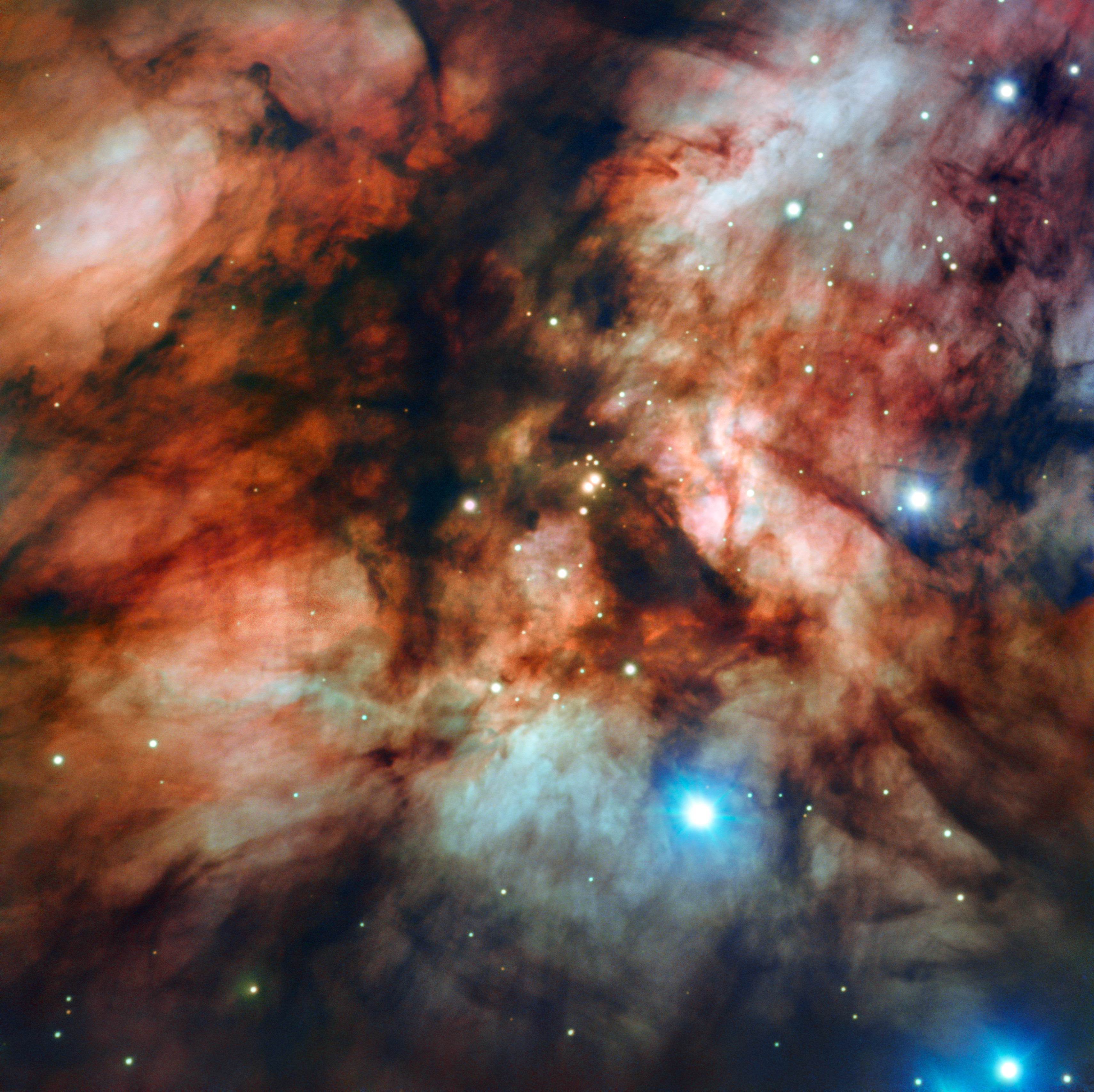
This cloud-strewn new image of RCW 36 (or Gum 20) was captured by ESO’s Focal Reducer and low dispersion Spectrograph (FORS). It shows one of the sites of massive-star formation closest to our Solar System, about 2300 light-years away. Located in the constellation of Vela (The Sails), the RCW 36 emission nebula is only part of an even larger star formation complex, known as the Vela Molecular Ridge.

Some areas in the clouds of RCW 36 are dense enough to block out background light, creating patches and wisps of inky black. Despite the dark appearance of these clouds, they are the only places in the Universe in which star formation occurs; clumps of molecular hydrogen and cosmic dust  collapse and come together to form stars encircled by small families of planets, as in our own Solar System.

FORS is mounted on ESO’s Very Large Telescope, one of the world's most advanced astronomical observatories. This image was selected as part of the ESO Cosmic Gems programme, an initiative that produces images of scientifically interesting and visually attractive objects using ESO telescopes for the purposes of education and public outreach. The programme makes use of telescope time that cannot be used for science observations. All data collected may also be suitable for scientific purposes, and are made available to astronomers through ESO’s science archive.

Source: ESO/potw