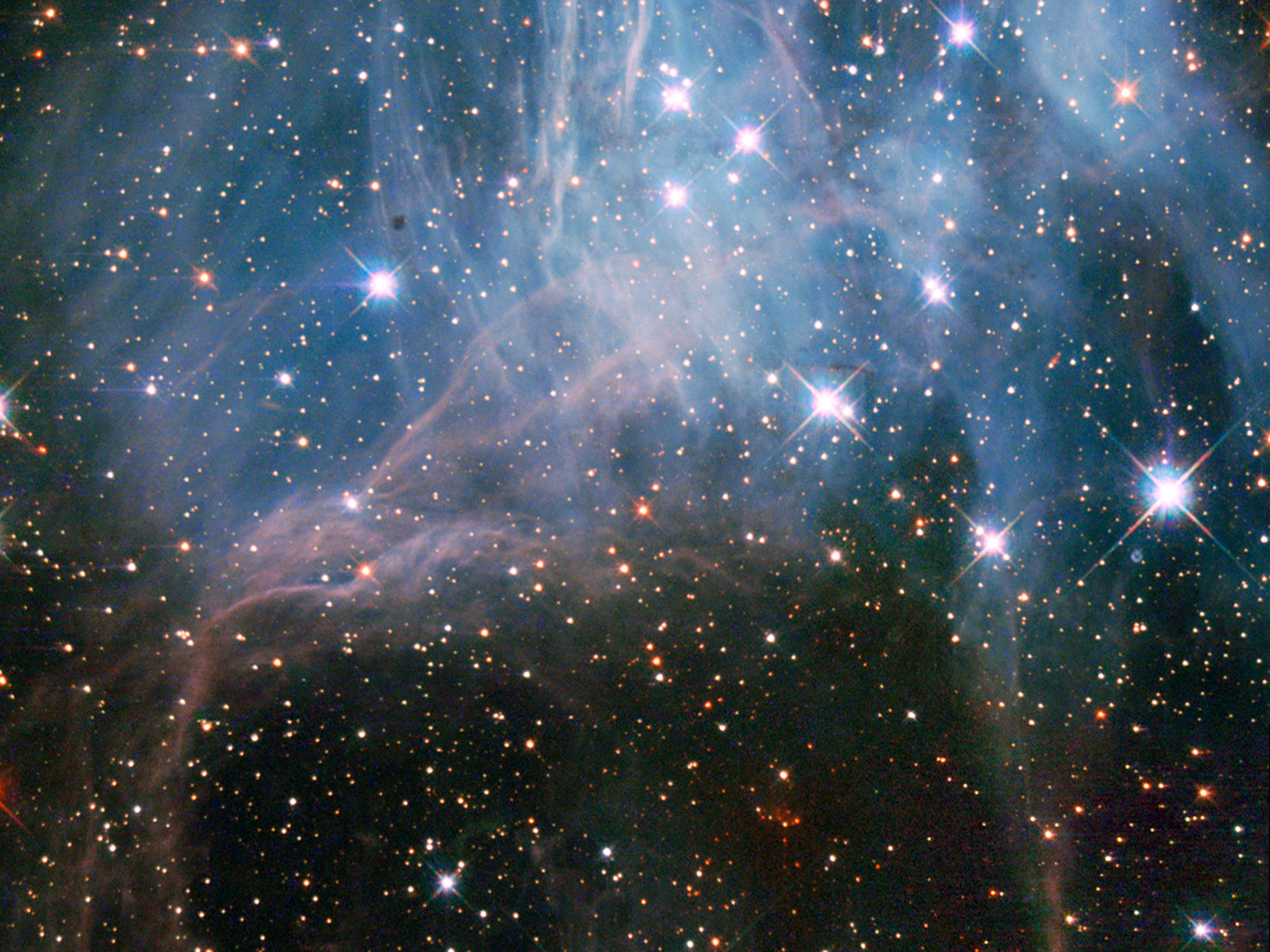
International Gemini Observatory/NOIRLab/NSF/AURA. Image Processing: J. Miller & M. Rodriguez (International Gemini Observatory/NSF NOIRLab), T.A. Rector (University of Alaska Anchorage/NSF NOIRLab), M. Zamani (NSF NOIRLab)
Videos
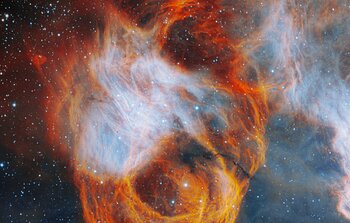
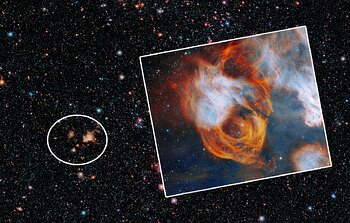
The NGC 2040 star cluster fuels the growth of this cosmic flower as the stellar life cycle unfolds within
Displaying wispy layers of red, orange and
yellow, the nebula encasing NGC 2040 resembles a vibrant rose in this
image captured by the Gemini South telescope, one half of the
International Gemini Observatory, which is supported in part by the U.S.
National Science Foundation and operated by NSF NOIRLab. This nebulous
flower showcases the dramatic story of stellar life, death and rebirth.
NGC 2040 is a young open cluster of stars within the Large Magellanic Cloud, a satellite galaxy of the Milky Way, located about 160,000 light-years from Earth. It is a type of star cluster known as an OB association because it contains more than a dozen stars of the O and B spectral types. These stars lead short lives of only a few million years, during which they burn very hot before exploding as supernovae. The energy released by the explosions of these massive stars feeds the formation of NGC 2040’s structure, while the expelled material seeds the growth of the next generation of stars.
The veiled nebula’s delicate structure, resembling a Valentine’s Day rose, is revealed in this image captured with the Gemini South telescope, one half of the International Gemini Observatory, funded in part by the U.S. National Science Foundation and operated by NSF NOIRLab. The 8-meter optical/infrared telescope is perfectly suited to capturing both the bright stars and the diffuse glow of the cluster.
NGC 2040 contains mostly hydrogen and oxygen atoms. As these atoms are excited by the ultraviolet radiation from nearby massive stars, they emit light. This emitted light spans a range of wavelengths from the ultraviolet, through the visible, and into the infrared. Special filters on Gemini South then allow specific wavelengths, or colors, of this emitted light to pass through, like the deep red and orange of glowing hydrogen and the light blue of glowing oxygen. The bright white represents areas where there is an abundance of both.
NGC 2040 is so named because it is part of the New General Catalogue of deep sky objects, first compiled by John Dryer in 1888. More recent observations have revealed that it is part of a massive structure of interstellar gas known as LH 88, which is one of the largest active star-forming regions in the Large Magellanic Cloud. Over the next million years thousands of new stars will be born in the region.
Most of the stars in the Milky Way, including the Sun, likely formed within open clusters similar to NGC 2040. When the O and B stars end their lives as supernovae they will enrich the cluster with elements such as carbon, oxygen, and iron. Together with the bountiful hydrogen of the cluster, these elements provide the necessary ingredients for the formation of new stars, planets, and perhaps even life.
The bright stars seen in the image are widely separated, but their motions through space are similar, indicating that they have a common origin. The layered nebulous structures in LH 88 are the remnants of stars that have already died. The delicate leaves of the rose were formed by both the shockwaves from supernovae and the stellar winds of the O and B stars.
Taken as a whole, the rose of LH 88 tells a story of death and rebirth, where the dust of dead stars becomes the seeds of new stars and planetary systems. And like a rose the beauty of LH 88 is fleeting. Within a few million years — a brief moment of cosmic time — the gas and dust will be either gathered into young stars or cast off into interstellar space. The stars formed within the cluster will have moved on to their own journeys through their galaxy.
NGC 2040 is a young open cluster of stars within the Large Magellanic Cloud, a satellite galaxy of the Milky Way, located about 160,000 light-years from Earth. It is a type of star cluster known as an OB association because it contains more than a dozen stars of the O and B spectral types. These stars lead short lives of only a few million years, during which they burn very hot before exploding as supernovae. The energy released by the explosions of these massive stars feeds the formation of NGC 2040’s structure, while the expelled material seeds the growth of the next generation of stars.
The veiled nebula’s delicate structure, resembling a Valentine’s Day rose, is revealed in this image captured with the Gemini South telescope, one half of the International Gemini Observatory, funded in part by the U.S. National Science Foundation and operated by NSF NOIRLab. The 8-meter optical/infrared telescope is perfectly suited to capturing both the bright stars and the diffuse glow of the cluster.
NGC 2040 contains mostly hydrogen and oxygen atoms. As these atoms are excited by the ultraviolet radiation from nearby massive stars, they emit light. This emitted light spans a range of wavelengths from the ultraviolet, through the visible, and into the infrared. Special filters on Gemini South then allow specific wavelengths, or colors, of this emitted light to pass through, like the deep red and orange of glowing hydrogen and the light blue of glowing oxygen. The bright white represents areas where there is an abundance of both.
NGC 2040 is so named because it is part of the New General Catalogue of deep sky objects, first compiled by John Dryer in 1888. More recent observations have revealed that it is part of a massive structure of interstellar gas known as LH 88, which is one of the largest active star-forming regions in the Large Magellanic Cloud. Over the next million years thousands of new stars will be born in the region.
Most of the stars in the Milky Way, including the Sun, likely formed within open clusters similar to NGC 2040. When the O and B stars end their lives as supernovae they will enrich the cluster with elements such as carbon, oxygen, and iron. Together with the bountiful hydrogen of the cluster, these elements provide the necessary ingredients for the formation of new stars, planets, and perhaps even life.
The bright stars seen in the image are widely separated, but their motions through space are similar, indicating that they have a common origin. The layered nebulous structures in LH 88 are the remnants of stars that have already died. The delicate leaves of the rose were formed by both the shockwaves from supernovae and the stellar winds of the O and B stars.
Taken as a whole, the rose of LH 88 tells a story of death and rebirth, where the dust of dead stars becomes the seeds of new stars and planetary systems. And like a rose the beauty of LH 88 is fleeting. Within a few million years — a brief moment of cosmic time — the gas and dust will be either gathered into young stars or cast off into interstellar space. The stars formed within the cluster will have moved on to their own journeys through their galaxy.
More Information
NSF NOIRLab, the U.S. National Science Foundation center for ground-based optical-infrared astronomy, operates the International Gemini Observatory (a facility of NSF, NRC–Canada, ANID–Chile, MCTIC–Brazil, MINCyT–Argentina, and KASI–Republic of Korea), NSF Kitt Peak National Observatory (KPNO), NSF Cerro Tololo Inter-American Observatory (CTIO), the Community Science and Data Center (CSDC), and NSF–DOE Vera C. Rubin Observatory (in cooperation with DOE’s SLAC National Accelerator Laboratory). It is managed by the Association of Universities for Research in Astronomy (AURA) under a cooperative agreement with NSF and is headquartered in Tucson, Arizona.
The scientific community is honored to have the opportunity to conduct astronomical research on I’oligam Du’ag (Kitt Peak) in Arizona, on Maunakea in Hawai‘i, and on Cerro Tololo and Cerro Pachón in Chile. We recognize and acknowledge the very significant cultural role and reverence of I’oligam Du’ag to the Tohono O’odham Nation, and Maunakea to the Kanaka Maoli (Native Hawaiians) community.
The scientific community is honored to have the opportunity to conduct astronomical research on I’oligam Du’ag (Kitt Peak) in Arizona, on Maunakea in Hawai‘i, and on Cerro Tololo and Cerro Pachón in Chile. We recognize and acknowledge the very significant cultural role and reverence of I’oligam Du’ag to the Tohono O’odham Nation, and Maunakea to the Kanaka Maoli (Native Hawaiians) community.
Links
- Explore LH 88 in more detail
- Photos of the Gemini South telescope
- Videos of the Gemini South telescope
- Images taken with GMOS-S
- Images of GMOS-S
- Check out other NOIRLab Photo Releases
Contacts:
Josie Fenske
josie.fenske@noirlab.edu
Jr. Public Information Officer NSF NOIRLab