Showing posts with label Kavli IPMU. Show all posts

Tuesday, February 18, 2025

Researchers find dark matter dominating in early universe galaxies

Figure 1. Left: Gas distribution of ionized carbon (C+) on the halo scale of P009-10 as shown by the color image and black contours. Nuclear gas distribution, centered on the quasar (large black cross), is shown by the magenta contours. Right: Velocity field of the C+ emission from -200 (in blue; moving towards us) to +200 (in red; moving away from us) km/s indicating coherent rotation in a massive dark matter halo. Credit: Fei et al.

Figure 2. Rotation curves of distant galaxies. Fei et al. data, in red and blue, remains relatively flat (i.e., high), similar to local massive disk galaxies at z~0 (dashed grey line) that need extended dark matter to explain their high velocities. The results from other galaxies at redshift~2-3 (in gray data points) show a rotation curve that decreases at the outskirts. This leads to a low dark matter fraction. Credit: Fei et al.


An international team of researchers has found dark matter dominating the halos of two supermassive black holes in galaxies roughly 13 billion light years away, reports a new study published in The Astrophysical Journal on February 5.

Their study gives new insight into the relationship between dark matter and supermassive black holes when the universe was still very young, and how galaxies have evolved until today.

The first person to discover that dark matter played an important role in galaxies was astronomer Vera Rubin, who in the 1970s, noticed that the outer parts of local galaxies were rotating at higher speeds than expected, forming what was later named a flat rotation curve. If galaxies were only made up of stars and gas, and obeyed Newton's laws, the outskirts of a galaxy would move slower than the peak velocity closer to the galaxy’s center. Rubin’s observations could only make sense if there were a large amount of invisible mass, later called dark matter, that surrounded the galaxy like a halo, allowing stars and gas anywhere far from the galaxy center to move at higher velocity. Furthermore, dark matter assembly so far back in the universe has never been observationally constrained and remains unknown, despite its fundamental importance to our understanding of the Universe.

A research team led by The University of Tokyo Kavli Institute for the Physics and Mathematics of the Universe (Kavli IPMU, WPI) visiting researcher and Peking University graduate student Qinyue Fei, and including Kavli IPMU Professor John Silverman, the University of Texas Austin’s Dr. Seiji Fujimoto, and Peking University Kavli Institute for Astronomy and Astrophysics Associate Professor Ran Wang, have studied the dark matter content of supermassive black holes about 13 billion light years away.

“Vera Rubin provided the first evidence for dark matter using the rotation curves of nearby local galaxies. We’re using the same technique but now in the early universe,” said Silverman.

Made possible using data from the Atacama Large Millimeter/submillimeter Array (ALMA) and the ionized carbon (C+) emission line, the researchers were able to uncover the gas dynamics of two quasar host galaxies at redshift 6. By studying the rotation curves of each galaxy (Figure 2), they found dark matter made up about 60 per cent of its total mass. Velocity changes with radius in the galaxy are captured by blue-shifted gas (moving towards the researchers), and the red-shifted gas (moving away) (Figure 1).

Interestingly, the rotation curves in the distant universe from past studies reveal a decrease in the galaxy outskirts, meaning a low fraction of dark matter. But the data taken by Fei and Silverman’s team shows a flat rotation curve, similar to the massive disk galaxies close to Earth, which indicates more dark matter is required to explain the high velocities (Figure 2).

The team's findings shed light on the intricate relationship between dark matter and supermassive black holes. They offer a crucial piece of the puzzle in understanding how galaxies evolved from the early universe to the structures we observe today.
.


Paper details

Journal: The Astrophysical Journal
Paper title: Assessing the dark matter content of two quasar host galaxies at z∼6 through gas kinematics
Authors: Qinyue Fei (1, 2, 3), John Silverman (1, 4, 5, 6), Seiji Fujimoto (7, 20), Ran Wang (2, 3), Luis C. Ho (2, 3), Manuela Bischetti (8, 9), Stefano Carniani (10), Michele Ginolfi (11, 12), Gareth Jones (13, 14, 15), Roberto Maiolino (14, 15, 16), Wiphu Rujopakarn (17, 18), N. M. Förster Schreiber (19), Juan M. Espejo Salcedo (19), L. L. Lee (19)


Author affiliations:
 
1 Kavli Institute for the Physics and Mathematics of the Universe (Kavli IPMU, WPI), UTIAS, Tokyo Institutes for Advanced Study,University of Tokyo, Chiba, 277-8583, Japan
2 Department of Astronomy, School of Physics, Peking University, Beijing 100871, P. R. China
3 Kavli Institute for Astronomy and Astrophysics, Peking University, Beijing 100871, P. R. China
4 Department of Astronomy, School of Science, The University of Tokyo, 7-3-1 Hongo, Bunkyo, Tokyo 113-0033, Japan
5 Center for Data-Driven Discovery, Kavli IPMU (WPI), UTIAS, The University of Tokyo, Kashiwa, Chiba 277-8583, Japan
6 Center for Astrophysical Sciences, Department of Physics & Astronomy, Johns Hopkins University, Baltimore, MD 21218, USA
7 Department of Astronomy, The University of Texas at Austin, Austin, TX, USA
8 Dipartimento di Fisica, Universitá di Trieste, Sezione di Astronomia, Via G.B. Tiepolo 11, I-34131 Trieste, Italy
9 INAF - Osservatorio Astronomico di Trieste, Via G. B. Tiepolo 11, I–34131 Trieste, Italy
10 Scuola Normale Superiore, Piazza dei Cavalieri 7, I-56126 Pisa, Italy
11 Dipartimento di Fisica e Astronomia, Università di Firenze, Via G. Sansone 1, I-50019, Sesto F.no (Firenze), Italy
12 INAF — Osservatorio Astrofisico di Arcetri, Largo E. Fermi 5, I-50125, Florence, Italy
13 Department of Physics, University of Oxford, Denys Wilkinson Building, Keble Road, Oxford OX1 3RH, UK
14 Cavendish Laboratory, University of Cambridge, 19 J. J. Thomson Ave., Cambridge CB3 0HE, UK
15 Kavli Institute for Cosmology, University of Cambridge, Madingley Road, Cambridge CB3 0HA, UK
16 Department of Physics & Astronomy, University College London, Gower Street, London WC1E 6BT, UK
17 National Astronomical Research Institute of Thailand, Don Kaeo, Mae Rim, Chiang Mai 50180, Thailand
18 Department of Physics, Faculty of Science, Chulalongkorn University, 254 Phayathai Road, Pathumwan, Bangkok 10330, Thailand
19 Max-Planck-Institut für extraterrestrische Physik (MPE), Giessenbachstr. 1, D-85748 Garching, Germany

DOI: 10.3847/1538-4357/ada145 (Published February 5, 2025)
Paper abstract
(The Astrophysical Journal)>
Pre-print
(arXiv.org)


Research contact

John Silverman
Professor
Kavli Institute for the Physics and Mathematics of the Universe
E-mail:
john.silverman@pmu.jp

Media contact:

Motoko Kakubayashi
Press officer
Kavli Institute for the Physics and Mathematics of the Universe
The University of Tokyo
TEL: 04-7136-5980
E-mail:
press@ipmu.jp


Related links

Researchers find dark matter dominating in early universe galaxies (The Kavli Institute for Astronomy and Astrophysics at Peking University)


Sunday, January 12, 2025

Astronomers witness the in situ spheroid formation in distant submillimetre-bright galaxies

Figure 1: Schematic diagram shows how spheroid formation occurs in distant submillimetre-bright galaxies, and how this process connects to the evolution of giant elliptical galaxies in today's Universe. On the far left, we have RGB images from JWST (using F444W for red, F227W for green, and F150W for blue) showcasing examples from our sample of galaxies. The cyan dashed ellipse marks the concentrated region of submm emission, with zoomed-in views highlighting the ALMA submm images. Also shown is a classification of the galaxies' intrinsic shapes. The average shape parameters for our full sample (green ellipse), a subsample of submm-compact galaxies (orange ellipse), and a subsample of submm-extended galaxies (blue ellipse) are compared to local early-type galaxies (red ellipse) and late-type galaxies (represented by purple and cyan spiral shapes). (Credit: Qing-Hua Tan)


An international team of researchers including The University of Tokyo Kavli Institute for the Physics and Mathematics of the Universe (Kavli IPMU, WPI) has found evidence showing that old elliptical galaxies in the universe can form from intense star formation within early galaxy cores. This discovery that will deepen our understanding of how galaxies evolved from the early Universe, reports a new study in Nature.

Galaxies in today’s Universe are diverse in morphologies and can be roughly divided into two categories: younger, disk-like spiral galaxies, like our own Milky Way, that are still forming new stars; and older, elliptical galaxies, which are dominated by a central bulge, no longer forming stars and mostly lacking gas. These spheroidal galaxies contain very old stars, yet how they formed has remained a mystery—until now.

The discovery of the birth sites of giant, elliptical galaxies – announced in a paper published today in the Nature – come from analyzing data from the Atacama Large Millimeter/submillimeter Array (ALMA) on over 100 Submillimeter Bright Galaxies (SMGs) with redshifts dating to the “Cosmic noon” era, when the universe was between around 1.6 and 5.9 billion years old and many galaxies were actively forming stars. This study provides the first solid observational evidence that spheroids can form directly through intense star formation within the cores of highly luminous starburst galaxies in the early Universe, based on a new perspective from the submillimeter band. This breakthrough will significantly impact models of galaxy evolution and deepen our understanding of how galaxies form and evolve across the Universe.

In this study, researchers led by Chinese Academy of Sciences Purple Mountain Observatory Associate Researcher Qinghua Tan, and including Kavli IPMU Professor John Silverman, Project Researcher Boris Kalita, and graduate student Zhaoxuan Liu, used statistical analysis of the surface brightness distribution of dust emission in the submillimeter band, combined with a novel analysis technique. They found that the submillimeter emission in most of sample galaxies are very compact, with surface brightness profiles deviating significantly from those of exponential disks. This suggests that the submillimeter emission typically comes from structures that are already spheroid-like. Further evidence for this spheroidal shape comes from a detailed analysis of galaxies’ 3D geometry. Modeling based on the skewed-high axis-ratio distribution shows that the ratio of the shortest to the longest of their three axes is, on average, half and increases with spatial compactness. This indicates that most of these highly star-forming galaxies are intrinsically spherical rather than disk-shaped. Supported by numerical simulations, this discovery has shown us that the main mechanism behind the formation of these tri-dimensional galaxies (spheroids) is the simultaneous action of cold gas accretion and galaxy interactions. This process is thought to have been quite common in the early Universe, during the period when most spheroids were forming. It could redefine how we understand galaxy formation.

This research was made possible thanks to the A3COSMOS and A3GOODSS archival projects, which enabled researchers to gather a large number of galaxies observed with a high enough signal-to-noise ratio for detailed analysis. Future exploration of the wealth of ALMA observations accumulated over the years, along with new submillimeter and millimeter observations with higher resolution and sensitivity, will allow us to systematically study the cold gas in galaxies. This will offer unprecedented insight into the distribution and kinematics of the raw materials fueling star formation. With the powerful capabilities of Euclid, the James Webb Space Telescope (JWST), and the China Space Station Telescope (CSST) to map the stellar components of galaxies, we will gain a more complete picture of early galaxy formation. Together, these insights will deepen our understanding of how the Universe as a whole has evolved over time.


Paper details

Journal: Nature
Paper title: In-Situ Spheroid Formation in Distant Submillimeter-Bright Galaxies
Authors: Qing-Hua Tan (1,2), Emanuele Daddi (2), Benjamin Magnelli (2), Camila A. Correa (2), Frédéric Bournaud (2), Sylvia Adscheid (3), Shao-Bo Zhang (1), David Elbaz (2), Carlos Gómez-Guijarro (2), Boris S. Kalita (4,5,6), Daizhong Liu (1), Zhaoxuan Liu (4,5,7), Jérôme Pety (8,9), Annagrazia Puglisi (10,11), Eva Schinnerer (12), John D. Silverman (4,5,7,13), Francesco Valentino (14,15)

Author affiliations:

1. Purple Mountain Observatory, Chinese Academy of Sciences, 10 Yuanhua Road, Nanjing 210023, People's Republic of China
2. Université Paris-Saclay, Université Paris Cité, CEA, CNRS, AIM, Gif-sur-Yvette 91191, France
3. Argelander-Institut für Astronomie, Universität Bonn, Auf dem Hügel 71, 53121 Bonn, Germany
4. Kavli Institute for the Physics and Mathematics of the Universe, The University of Tokyo, Kashiwa, 277-8583, Japan
5. Center for Data-Driven Discovery, Kavli IPMU (WPI), UTIAS, The University of Tokyo, Kashiwa, Chiba 277-8583, Japan
6. Kavli Institute for Astronomy and Astrophysics, Peking University, Beijing 100871, People's Republic of China
7. Department of Astronomy, School of Science, The University of Tokyo, 7-3-1 Hongo, Bunkyo, Tokyo 113-0033, Japan
8. Institut de Radioastronomie Millimétrique, 300 Rue de la Piscine, 38406 Saint-Martin d’Hères, France
9. LERMA, Observatoire de Paris, PSL Research University, CNRS, Sorbonne Universités, 75014 Paris, France
10. School of Physics and Astronomy, University of Southampton, Highfield SO17 1BJ, UK
11. Center for Extragalactic Astronomy, Department of Physics, Durham University, South Road, Durham DH1 3LE, UK
12. Max-Planck-Institut für Astronomie, Königstuhl 17, 69117 Heidelberg, Germany
13. Center for Astrophysical Sciences, Department of Physics & Astronomy, Johns Hopkins University, Baltimore, MD 21218, USA
14. European Southern Observatory, Karl-Schwarzschild-Str. 2, D-85748 Garching bei Munchen, Germany
15. Cosmic Dawn Center (DAWN), Denmark


DOI: 10.1038/s41586-024-08201-6 (Published December 4, 2024)
Paper abstract (Nature)
Pre-print (arXiv.org)


Research contact:

John Silverman
Professor
Kavli Institute for the Physics and Mathematics of the Universe
E-mail:
john.silverman@ipmu.jp

Media contact:

Motoko Kakubayashi
Press officer
Kavli Institute for the Physics and Mathematics of the Universe
The University of Tokyo
Tel: 04-7136-5980
E-mail
:press@ipmu.jp


Thursday, January 20, 2022

Researchers uncover model for extremely luminous and fast rising supernova


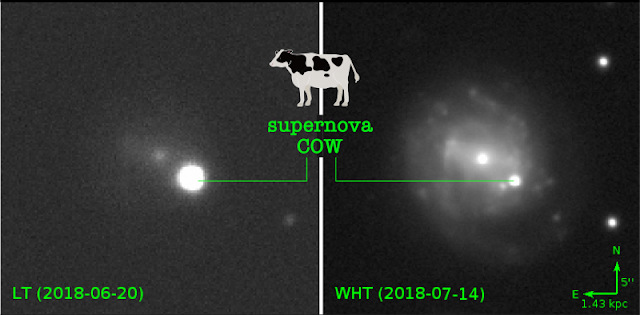
Figure 1: Supernova AT 2018cow, nicknamed the COW. (Left) Following its explosion, COW reached peak luminosity on June 20, 2018, being much brighter than the galaxy’s center at upper left. (Right) By July 14, 2018, COW had become dimmer, becoming just as bright as the galaxy's center. Credit: Daniel Perley (Liverpool J. M. University), Kavli IPMU


Figure 2: Light curve of supernova SN 2018gep (GEP) shows it reaches a higher peak luminosity rapidly compared to ordinary Ic supernovae (solid lines). Credit: Anna Ho (Caltech), Kavli IPMU


Figure 3: Cartoon illustration of the shock-interaction picture. (Upper left) A massive star undergoes large pulsations due to electron-positron pair-creation and ejects some material to form dense circumstellar matter. (Upper right) The star explodes to form a shock wave, which propagates through the circumstellar matter. (Lower left) When the shock wave reaches the surface of the circumstellar matter, the kinetic energy is converted to the thermal and radiation energy. Then the surface of the circumstellar matter shines very brightly. Material ejected by supernova explosion expands at moderate speeds. (Lower right) Circumstellar matter rapidly expands and fades. Supernova ejecta also expands and fades. Credit: Shing-Chi Leung, Kavli IPMU


Figure 4: Theoretical shock-interaction models for the light curves and comparisons with observational data from the COW and the GEP. Solid lines are the models including the self-consistent CSM. Dashed line are the models assuming the CSM is artificially removed. Credit: Shing-Chi Leung, Kavli IPMU

Appearing ten to a hundred times brighter at its peak, and with a much faster rise toward the peak, stellar explosions AT 2018cow (nicknamed the COW) and SN 2018gep (nicknamed the GEP) represent a new type of supernova called Fast Blue Optical Transient (FBOT), reports two recent studies.

Thanks to recent extensive supernova observations by several telescopes worldwide, COW and GEP appeared in the night sky in 2018 and were well-observed from the early phase of their explosions (figure 1). But their origin was a mystery.

To find a theoretical model, Shing-Chi Leung, a former Kavli Institute for the Physics and Mathematics of the Universe (Kavli IPMU) Project Researcher (currently a postdoctoral scholar at the California Institute of Technology), and Kavli IPMU Senior Scientist Ken’ichi Nomoto, organized two international teams of researchers to study each explosion, and have now succeeded in explaining COW and GEP features.

Observational data showed the COW had the brightest peak and the shortest rising time (about 1 day) among FBOTs. The GEP had a slightly lower brightness and a longer rising time (about 3 days), compared to the COW (figure 2).

Both research groups then successfully modeled the light curve, uncovering a clear picture of a possible sequence of events in both explosions (figure 3).

First, the star would have ejected its surface materials just before the explosion. These ejected materials would have formed a dense and opaque circumstellar matter (CSM) around the star, making the radius of the star much larger than ordinary presupernova stars. Such a presupernova mass ejection mechanism might have been caused by the pulsational pair-instability of very massive stars, which Leung and Nomoto had previously seen while studying the origin of massive black holes (see the related article).

When the supernova explosion occurred in the star, a strong shock wave would have formed and propagated through the CSM. When it reached the CSM surface, its kinetic energy would have converted into thermal and radiation energy, causing a sudden and a very bright event to occur, which is consistent with the very fast rise of the observed brightness of the supernova.

The CSM surface became as bright as observed peak of COW because of the large "radius", but once CSM quickly lost most of its energy and faded, it became transparent, giving way to an ordinary supernova light.

The theoretical supernova light curves powered by the shock-heating of the CSM the researchers created were found to be in good agreement with the observational data of the COW and the GEP, respectively (figure 4).

The researchers also found that without CSM, the rising of the light curve was much slower and the maximum luminosity was much lower, indicating FBOTs can be linked to CSM-heating.

The research teams are now proposing that the variation the CSM mass formed from the pulsational pair-instability of very massive stars would cause variation among FBOTs. If the CSM mass is large enough, the resulting supernova would be observed as a so-called Superluminous Supernova which is bright but shows much slower rising.

The next step is to confirm this hypothesis with more observations.

The results of both studies were published online in The Astrophysical Journal on 3 November 2020 [1] and 8 July 2021 [2].


Paper details

Paper [1]

Journal: The Astrophysical Journal
Paper title: A Model for the Fast Blue Optical Transient AT2018cow: Circumstellar Interaction of a Pulsational Pair-instability Supernova
Authors: Shing-Chi Leung (2,1), Sergei Blinnikov (1,3,4), Ken'ichi Nomoto (1), Petr Blakanov (3,5,6), Elena Sorokina (3,7) and Alexey Tolstov (8,1)

Author affiliations

1 Kavli Institute for the Physics and Mathematics of the Universe (WPI), The University of Tokyo Institutes for Advanced Study, The University of Tokyo, Kashiwa, Chiba 277-8583, Japan;
2 TAPIR, Walter Burke Institute for Theoretical Physics, Mailcode 350-17, Caltech, Pasadena, CA 91125, USA
3 National Research Center “Kurchatov institute,” Institute for Theoretical and Experimental Physics (ITEP), 117218 Moscow, Russia
4 Dukhov Automatics Research Institute (VNIIA), Suschevskaya 22, 127055 Moscow, Russia
5 National Research Nuclear University MEPhI, Kashirskoe sh. 31, Moscow 115409, Russia
6 Space Research Institute (IKI), Russian Academy of Sciences, Profsoyuznaya 84/32, 117997 Moscow, Russia
7 Sternberg Astronomical Institute, M.V. Lomonosov Moscow State University, Universitetski pr. 13, 119234 Moscow, Russia
8 The Open University of Japan, 2-11, Wakaba, Mihama-ku, Chiba, Chiba 261-8586, Japan

DOI: 10.3847/1538-4357/abba33 (published 3 November, 2020)
Paper abstract (The Astrophysical Journal)
Preprint (arXiv.org)


Paper [2]

Journal: The Astrophysical Journal
Paper title: Fast Blue Optical Transients Due to Circumstellar Interaction and the Mysterious
Supernova SN 2018gep
Authors: Shing-Chi Leung (1), Jim Fuller (1), Ken’ichi Nomoto (2)
Author affiliations:
1 TAPIR, Walter Burke Institute for Theoretical Physics, Mailcode 350-17,
Caltech, Pasadena, CA 91125, USA
2 Kavli Institute for the Physics and Mathematics of the Universe (WPI),
The University of Tokyo Institutes for Advanced Study, The University of Tokyo, Kashiwa, Chiba 277-8583, Japan


DOI: 10.3847/1538-4357/abfcbe (published 8 July, 2021)
Paper abstract (The Astrophysical Journal)
Preprint (arXiv.org)


Research contact

Ken'ichi Nomoto
Senior Scientist
Kavli Institute for the Physics and Mathematics of the Universe (Kavli IPMU), The University of Tokyo
E-mail:
nomoto@astron.s.u-tokyo.ac.jp
Preprint (arXiv.org)


Media contact:

Motoko Kakubayashi
Press officer
Kavli Institute for the Physics and Mathematics of the Universe (Kavli IPMU), The University of Tokyo
E-mail:
press@ipmu.jp

Related article:


Researchers find the origin and the maximum mass of massive black holes observed by gravitational wave detectors.


Thursday, July 01, 2021

A new type of supernova illuminates an old mystery


Figure 1: Las Cumbres Observatory and the Hubble Space Telescope color composite of the electron-capture supernova 2018zd (the large white dot on the right) and the host starburst galaxy NGC 2146 (towards the left). (Credit: NASA/STScI/J. DePasquale; Las Cumbres Observatory)


Figure 2: Artist impressions of a super-asymptotic giant branch star (left) and its core (right) made up of oxygen (O), neon (Ne), and magnesium (Mg). A super-asymptotic giant branch star is the end state of stars in a mass range of around 8-10 solar masses, whose core is pressure supported by electrons (e-). When the core becomes dense enough, neon and magnesium start to eat up electrons (so called electron-capture reactions), reducing the core pressure and inducing a core-collapse supernova explosion. (Credit: S. Wilkinson; Las Cumbres Observatory)

A worldwide team of researchers has discovered the first convincing evidence for a new type of stellar explosion, theorized 40 years ago by Kavli Institute for the Physics and Mathematics Senior Scientist Ken’ichi Nomoto; the new study was published in Nature Astronomy on June 28.

Electron-capture supernovae Nomoto theorized in the early 1980s are thought to arise from the explosions of massive super-asymptotic giant branch (SAGB) stars, for which there has also been scant evidence. The new discovery sheds light on the thousand-year mystery of the supernova from 1054AD that was seen all over the world in the daytime, before eventually becoming the Crab Nebula.

"I am very pleased that the electron-capture supernova has finally been discovered, which my colleagues and I predicted to exist, and connected to the Crab Nebula, 40 years ago. I very much appreciate the great efforts of observations that confirmed the old theoretical predictions, which is a wonderful example of the combination between observation and theory," said Nomoto.

Historically, there have been two main supernova types. One is the thermonuclear supernova - the explosion of a white dwarf star that gains matter in a binary system. These white dwarfs are the dense cores of ash that remain after a low-mass star (one up to about 8 times the mass of the Sun) reaches the end of its life. Another main supernova type is a core-collapse supernova where a massive star, one more than about 10 times the mass of the Sun, runs out of nuclear fuel and has its iron core collapse, creating a black hole or neutron star. The electron-capture supernovae are in between these two types of supernovae. They push the boundary of core-collapse supernovae down to about 8 solar masses and explode by a different mechanism.

While gravity is always trying to crush a star, what keeps most stars from collapsing is that you can’t pack the atoms in their cores any tighter. But in an electron-capture supernova, the star is so massive that some of the electrons in atoms in the core get smashed into their atomic nuclei, called an electron capture. This causes the core of the star to buckle under its own weight and collapse, resulting in an electron-capture supernova.

Using recently updated electron-capture rates, Nomoto and collaborators had been able to reconfirm their theoretical predictions.

Over the decades, theorists including Nomoto have formulated predictions of what to look for in an electron-capture supernova and their SAGB star progenitors. The stars should have a lot of mass, lose much of it before exploding, and this mass near the dying star should be on an unusual chemical composition. Then the electron-capture supernova should be weak, have little radioactive fallout, and have neutron-rich elements in the core.

The new study, led by Daichi Hiramatsu, a graduate student at the University of California, Santa Barbara, and Las Cumbres Observatory, and a core member of the Global Supernova Project, a worldwide team of researchers using dozens of telescopes around and above the globe. The team found that the supernova SN 2018zd had many unusual characteristics, some of which were seen for the first time in a supernova.

It helped that the supernova was relativity nearby, only 31 million light-years away, in the galaxy NGC 2146. This allowed the team to examine archival images taken prior to the explosion from the Hubble Space telescope and to detect the likely progenitor star before it exploded. The observations were consistent with another recently identified SAGB star in the Milky Way, but inconsistent with models of the progenitors of normal core-collapse supernovae, red supergiants.

The study looked through all published data on supernovae, and found that while some supernovae had a few of the indicators predicted for electron capture supernovae, only SN 2018zd had all six – an apparent SAGB progenitor, strong pre-supernova mass loss, an unusual stellar chemical composition, a weak explosion, little radioactivity, and a neutron-rich core.

The leader of the study, Daichi Hiramatsu said, “We started by asking ‘what’s this weirdo?’ Then we examined every aspect of SN 2018zd and realized that all of them can be explained in the electron-capture scenario.”

The new discoveries also illuminate some mysteries of the most famous supernova of the past. In 1054 AD a supernova happened in the Milky Way 

Galaxy, and according to Chinese and Japanese records was so bright that it could be seen in the daytime for 23 days, and at night nearly for two years. The resulting remnant, the Crab Nebula, has been studied in great detail. It was previously the best candidate for an electron-capture supernova, but this was uncertain partly because the explosion happened nearly a thousand years ago. The new result increases the confidence that SN 1054 was an electron-capture supernova. It also explains why that supernova was relatively bright compared to the models. Its luminosity was probably artificially enhanced by the supernova ejecta colliding with material cast off by the progenitor star as was seen in SN 2018zd.


Paper details
Journal: Nature Astronomy
Title: The electron-capture origin of supernova 2018zd

Authors: 

Daichi Hiramatsu (1,2), D. Andrew Howell (1,2), Schuyler D. Van Dyk (3), Jared A. Goldberg (2), Keiichi Maeda (4,5), Takashi J. Moriya (6,7), Nozomu Tominaga (8, 5, 6), Ken’ichi Nomoto (5), Griffin Hosseinzadeh (9), Iair Arcavi (10,11), Curtis McCully (1,2), Jamison Burke (1,2), K. Azalee Bostroem (12), Stefano Valenti (12), Yize Dong (12), Peter J. Brown (13), Jennifer E. Andrews (14), Christopher Bilinski (14), G. Grant Williams (14,15), Paul S. Smith (14), Nathan Smith (14), David J. Sand (14), Gagandeep S. Anand (16,17), Chengyuan Xu (18), Alexei V. Filippenko (19,20), Melina C. Bersten (21,22, 5), Gastón Folatelli (21,22, 5), Patrick L. Kelly (23), Toshihide Noguchi (24) and Koichi Itagaki (25)

Author affiliations:

1. Las Cumbres Observatory, Goleta, CA, USA.
2. Department of Physics, University of California, Santa Barbara, CA, USA.
3. Caltech/Spitzer Science Center, Caltech/IPAC, Pasadena, CA, USA.
4. Department of Astronomy, Kyoto University, Kyoto, Japan.
5. Kavli Institute for the Physics and Mathematics of the Universe (WPI), The University of Tokyo Institutes for Advanced Study, The University of Tokyo, Kashiwa, Japan.
6. National Astronomical Observatory of Japan, National Institutes of Natural Sciences, Mitaka, Japan.
7. School of Physics and Astronomy, Faculty of Science, Monash University, Clayton, Victoria, Australia.
8. Department of Physics, Faculty of Science and Engineering, Konan University, Hyogo, Japan.
9. Center for Astrophysics ∣ Harvard & Smithsonian, Cambridge, MA, USA.
10. The School of Physics and Astronomy, Tel Aviv University, Tel Aviv, Israel.
11. CIFAR Azrieli Global Scholars program, CIFAR, Toronto, Ontario, Canada.
12. Department of Physics, University of California, Davis, CA, USA.
13. Mitchell Institute for Fundamental Physics and Astronomy, Texas A&M University, College Station, TX, USA.
14. Steward Observatory, University of Arizona, Tucson, AZ, USA.
15. MMT Observatory, Tucson, AZ, USA.
16. Infrared Processing and Analysis Center, California Institute of Technology, Pasadena, CA, USA.
17. Institute for Astronomy, University of Hawai‘i, Honolulu, HI, USA.
18. Media Arts and Technology, University of California, Santa Barbara, CA, USA.
19. Department of Astronomy, University of California, Berkeley, CA, USA.
20. Miller Institute for Basic Research in Science, University of California, Berkeley, CA, USA.
21. Instituto de Astrofísica de La Plata (IALP), CONICET, Argentina.
22. Facultad de Ciencias Astronómicas y Geofísicas, Universidad Nacional de La Plata, La Plata, Argentina.
23. School of Physics and Astronomy, University of Minnesota, Minneapolis, MN, USA.
24. Noguchi Astronomical Observatory, Katori, Japan.
25. Itagaki Astronomical Observatory, Yamagata, Japan.

DOI: https://doi.org/10.1038/s41550-021-01384-2 (Posted on June 28, 2021)

Preprint (arXiv.org page)
Paper abstract (Nature Astronomy)

Research contact 

Ken’ichi Nomoto 
Senior Scientist
Kavli Institute for the Physics and Mathematics of the Universe, University of Tokyo
E-mail:
nomoto@astron.s.u-tokyo.ac.jp

Media contact

Motoko Kakubayashi
Press officer 
Kavli Institute for the Physics and Mathematics of the Universe, The University of Tokyo
E-mail:
press@ipmu.jp
TEL: 080-4056-2767

 Source:Kavli Institute for the Physics and Mathematics of the Universe (Kavli IPMU)


Wednesday, March 31, 2021

String theory solves mystery about how particles behave outside a black hole photon sphere

Figure 1. An artist’s impression of a “string” passing near a black hole. As the string approaches the black hole, it is gradually stretched. Then, as it moves past the black hole, it begins to vibrate. The image to the left, which was captured by the Event Horizon Telescope, represents the shadow of the supermassive black hole at the center of the galaxy M87, including the ring of light around it. (Credit: EHT Collaboration; Kavli IPMU (Kavli IPMU modified EHT’s original image)).

A paper by the Kavli Institute for the Physics and Mathematics of the Universe (Kavli IPMU) Director Ooguri Hirosi and Project Researcher Matthew Dodelson on the string theoretical effects outside the black hole photon sphere has been selected for the “Editors’ Suggestion” of the journal Physical Review D. Their paper was published on March 24, 2021.

In a quantum theory of point particles, a fundamental quantity is the correlation function, which measures the probability for a particle to propagate from one point to another. The correlation function develops singularities when the two points are connected by light-like trajectories. In a flat spacetime, there is such a unique trajectory, but when spacetime is curved, there can be many light-like trajectories connecting two points. This is a result of gravitational lensing, which describes the effect of curved geometry on the propagation of light.

In the case of a black hole spacetime, there are light-like trajectories winding around the black hole several times, resulting in a black hole photon sphere, as seen in the recent images by the Event Horizon Telescope (EHT) of the supermassive black hole at the center of the galaxy M87. 

Released on April 10, 2019, the EHT Collaboration’s images captured the shadow of a black hole and its photon sphere, the ring of light surrounding it. A photon sphere can occur in a region of a black hole where light entering in a horizontal direction can be forced by gravity to travel in various orbits. These orbits lead to singularities in the aforementioned correlation function.

However, there are cases when the singularities generated by trajectories winding around a black hole multiple times contradict with physical expectations. Dodelson and Ooguri have shown that such singularities are resolved in string theory. 

In string theory, every particle is considered as a particular excited state of a string. When the particle travels along a nearly light-like trajectory around a black hole, the spacetime curvature leads to tidal effects, which stretch the string. 

Dodelson and Ooguri showed that, if one takes these effects into account, the singularities disappear consistently with physical expectations. Their result provides evidence that a consistent quantum gravity must contain extended objects such as strings as its degrees of freedom. 

Ooguri says, “Our results show how string theoretical effects are enhanced near a black hole. Though the effects we found are not strong enough to have an observable consequence on ETH’s black hole image, further research may show us a way to test string theory using black holes.”

Paper details:

Journal: Physical Review D
Title: Singularities of thermal correlators at strong coupling

Authors: Matthew Dodelson (a), Hirosi Ooguri (a, b)
Author affiliation:
a. Kavli Institute for the Physics and Mathematics of the Universe (Kavli IPMU, WPI), The University of Tokyo, Kashiwa, Chiba 277-8583, Japan
b. Walter Burke Institute for Theoretical Physics, California Institute of Technology, Pasadena, CA 91125, USA 

DOI: 10.1103/PhysRevD.103.066018 (Posted on March 24, 2021)
Abstract of the treatise (Physical Review D)
Preprint (arXiv.org website) https://arxiv.org/abs/2010.09734

Research contact:

Hirosi Ooguri
Director, Principal Investigator
Kavli Institute for the Physics and Mathematics of the Universe, The University of Tokyo
E-mail:
hirosi.ooguri@ipmu.jp
 
Matthew Dodelson
Project Researcher
Kavli Institute for the Physics and Mathematics of the Universe, University of Tokyo
Email:
matthew.dodelson@ipmu.jp

Media contact

John Amari
Public Relations Officer
Kavli Institute for the Physics and Mathematics of the Universe, The University of Tokyo
E-mail:
press@ipmu.jp
TEL: 080-4056-2767


Thursday, February 04, 2021

Study of Supergiant Star Betelgeuse Unveils the Cause of its Pulsations; Recalibrated its Mass, Radius, and Distance

Fig 1: Recent brightness variations of Betelgeuse. Stellar pulsation causes the star’s brightness to vary, but the large dip in brightness in early 2020 is unprecedented. A comparison of direct images of the surface of Betelgeuse between January 2019 and December 2019 show that large portions of the star faded in December 2019, which could indicate a dust cloud appearing in front of it. The images were taken by the European Southern Observatory’s (ESO’s) Very Large Telescope. (Credit: ESO/M. Montargès et al.) For brightness data, see the caption of Fig 2.

Fig 2: Variation in brightness of Betelgeuse over the previous 15 years. Gaps in the data are periods when Betelgeuse is not visible in the night sky each year. The brightness data was collected by the observers of the American Association of Vari-able Star Observers (AAVSO) and the Solar Mass-Ejection Imager instrument in space. Data from the latter was processed by László Molnár from the Konkoly Observatory of CSFK in Budapest, Hungary. (Credit: L. Molnár, AAVSO, UCSD/SMEI, NA-SA/STEREO/HI)

Betelgeuse is normally one of the brightest, most recognizable stars of the winter sky, marking the left shoulder of the constellation Orion. But lately, it has been behaving strangely: an unprecedentedly large drop in its brightness has been observed in early 2020 (Figure 1), which has prompted speculation that Betelgeuse may be about to explode. 

To find out more, an international team of scientists, including Ken'ichi Nomoto at the Kavli Institute for the Physics and Mathematics of the Universe (Kavli IPMU), conducted a rigorous examination of Betelgeuse. They concluded that the star is in the early core helium-burning phase (which is more than 100,000 years before an explosion happens) and has smaller mass and radius—and is closer to Earth—than previously thought. They also showed that smaller brightness variations of Betelgeuse have been driven by stellar pulsations, and suggested that the recent large dimming event involved a dust cloud. 

The research team is led by Dr. Meridith Joyce from the Australian National University (ANU), who was an invited speaker at Kavli IPMU in January 2020, and includes Dr. Shing-Chi Leung, a former Kavli IPMU project researcher and a current postdoctoral scholar at the California Institute of Technology, and Dr. Chiaki Kobayashi, an associate professor at the University of Hertfordshire, who has been an affiliate member of Kavli IPMU. 

The team analyzed the brightness variation of Betelgeuse (Figure 2) by using evolutionary, hydrodynamic and seismic modelling. They achieved a clearer idea than before that Betelgeuse is currently burning helium in its core. They also showed that stellar pulsations driven by the so-called kappa-mechanism is causing the star to continuously brighten or fade with two periods of 185 (±13.5) days and approximately 400 days. But the large dip in brightness in early 2020 is unprecedented, and is likely due to a dust cloud in front of Betelgeuse, as seen in the image (Figure 1).

Their analysis reported a present-day mass of 16.5 to 19 solar mass—which is slightly lower than the most recent estimates. The study also revealed how big Betelgeuse is, as well as its distance from Earth. The star’s actual size has been a bit of a mystery: earlier studies, for instance, suggested it could be bigger than the orbit of Jupiter. However, the team’s results showed Betelgeuse only extends out to two-thirds of that, with a radius 750 times the radius of the sun. Once the physical size of the star is known, it will be possible to determine its distance from Earth. Thus far, the team's results show it is a mere 530 light years from us, or 25 percent closer than previously thought. 

Their results imply that Betelgeuse is not at all close to exploding, and that it is too far from Earth for the eventual explosion to have significant impact here, even though it is still a really big deal when a supernova goes off. And as Betelgeuse is the closest candidate for such an explosion, it gives us a rare opportunity to study what happens to stars like this before they explode.

 Source: Kavli Institute for the Physics and Mathematics of the Universe (Kavli IPMU)


Paper details 

Journal: The Astrophysical Journal
Title: Standing on the Shoulders of Giants: New Mass and Distance Estimates for Betelgeuse through Combined Evolutionary, Asteroseismic, and Hydrodynamic Simulations with MESA

Authors: Meridith Joyce (1,2), Shing-Chi Leung (3), László Molnár (4, 5, 6), Michael Ireland (1), Chiaki Kobayashi (2, 7, 8), Ken’ichi Nomoto (8)

Author affiliation:

1. Research School of Astronomy and Astrophysics, Australian National University (ANU), Canberra, ACT 2611, Australia
2. ARC Center of Excellence for All Sky Astrophysics in 3 Dimensions (ASTRO 3D), Australia
3. TAPIR, Walter Burke Institute for Theoretical Physics, Mailcode 350-17, Caltech, Pasadena, CA 91125, USA
4. Konkoly Observatory, Research Center for Astronomy and Earth Sciences (CSFK), Konkoly-Thege út 15-17, H-1121 Budapest, Hungary
5. MTA CSFK Lendulet Near-Field Cosmology Research Group, Konkoly-Thege út 15-17, H-1121 Budapest, Hungary
6. ELTE Eotvs Loránd University, Institute of Physics, Budapest, 1117, Páz mány Péter sétány 1 / A, Hungary
7. Center for Astrophysics Research, Department of Physics, Astronomy and Mathematics, University of Hertfordshire, College Lane, Hatfield AL10 9AB, UK
8. Kavli Institute for the Physics and Mathematics of the Universe (WPI), The University of Tokyo Institutes for Advanced Study, The University of Tokyo, Kashiwa, Chiba 277-8583, Japan

DOI: https://doi.org/10.3847/1538-4357/abb8db   (Posted on October 13, 2020)
Abstract of the paper: (The Astrophysical Journal)
Pre-print: (arXiv.org page)


Research contact :

Ken’ichi Nomoto
Senior Scientist
Kavli Institute for the Physics and Mathematics of the Universe, University of Tokyo
E-mail: nomoto@astron.s.u-tokyo.ac.jp
TEL: +81-4-7136-5940

Media contact:

John Amari
Press officer
Kavli Institute for the Physics and Mathematics of the Universe, The University of Tokyo
E-mail: press@ipmu.jp
TEL: 080-4056-2767


Related Links:

Click here to view the press release from ANU "Supergiant Betelgeuse smaller, closer than first thought" 

Click here to view the press release from Konkoly Observatory of the Research Centre for Astronomy and Earth Sciences (CSFK) / the web-page of Eötvös Loránd Research Network (ELKH)

"Supergiant star Betelgeuse smaller, closer than first thought"


Monday, November 30, 2020

Research suggests our Galaxy’s brightest gamma-ray binary system may be powered by a magnetar star

An impression of the gamma-ray binary system LS 5039. A neutron star (left) and its massive, companion star (right). The research team suggests that the neutron star at the heart of LS 5039 has an ultra-strong magnetic field, and is arguably a magnetar. The field accelerates high-energy particles inside the bow-shaped region, thereby emitting gamma-rays that characterize the gamma-ray binary system. (Credit: Kavli IPMU)

A team of researchers led by members of the Kavli Institute for the Physics and Mathematics of the Universe (Kavli IPMU) has analyzed previously collected data to infer the true nature of a compact object—found to be a rotating magnetar, a type of neutron star with an extremely strong magnetic field—orbiting within LS 5039, the brightest gamma-ray binary system in the Galaxy. 

Including former graduate student Hiroki Yoneda, Senior Scientist Kazuo Makishima and Principal Investigator Tadayuki Takahashi at the Kavli IMPU, the team also suggest that the particle acceleration process known to occur within LS 5039 is caused by interactions between the dense stellar winds of its primary massive star, and ultra-strong magnetic fields of the rotating magnetar.

Gamma-ray binaries are a system of massive, high-energy stars and compact stars. They were discovered only recently, in 2004, when observations of very-high-energy gamma-rays in the teraelectronvolt (TeV) band from large enough regions of the sky became possible. When viewed with visible light, gamma-ray binaries appear as bright bluish-white stars, and are indistinguishable from any other binary system hosting a massive star. However, when observed with X-rays and gamma-rays, their properties are dramatically different from those of other binaries. In these energy bands, ordinary binary systems are completely invisible, but gamma-ray binaries produce intense non-thermal emission, and their intensity appears to increase and decrease according to their orbital periods of several days to several years.

Once the gamma-ray binaries were established as a new astrophysical class, it was quickly recognized that an extremely efficient acceleration mechanism should operate in them. While the acceleration of TeV particles requires tens of years in supernova remnants, which are renowned cosmic accelerators, gamma-ray binaries boost electron energy beyond 1 TeV in just tens of seconds. Gamma-ray binaries can thus be considered one of the most efficient particle accelerators in the Universe.

In addition, some gamma-ray binaries are known to emit strong gamma-rays with energies of several megaelectron volts (MeV). Gamma-rays in this band are currently difficult to observe; they were detected from only around 30 celestial bodies in the whole sky. But the fact that such binaries emit strong radiation even in this energy band greatly adds to the mystery surrounding them, and indicates an extremely effective particle acceleration process going on within them.

Around 10 gamma-ray binaries have been found in the Galaxy thus far—compared to more than 300 X-ray binaries that are known to exist. Why gamma-ray binaries are so rare is unknown, and, indeed, what the true nature of their acceleration mechanism is, has been a mystery—until now.

Through previous studies, it was already clear that a gamma-ray binary is  generally made of a massive primary star that weighs 20-30 times the mass of the Sun, and a companion star that must be a compact star, but it was not clear, in many cases, whether the compact star is a black hole or a neutron star. The research team started their attempt by figuring out which is generally the case.

One of the most direct pieces of evidence for the presence of a neutron star is the detection of periodic fast pulsations, which are related to the neutron star rotation. Detection of such pulsation from a gamma-ray binary almost undoubtedly discards the black hole scenario. 

In this project, the team focused on LS 5039, which was discovered in 2005, and still keep its position as the brightest gamma-ray binary in the X-rays and gamma-ray range. Indeed, this gamma-ray binary was thought to contain a neutron star because of its stable X-ray and TeV gamma-ray radiation. However, until now, attempts to detect such pulses had been conducted with radio waves and soft X-rays—and because radio waves and soft X-rays are affected by the primary star’s stellar winds, detection of such periodical pulses had not been successful.

This time, for the first time, the team focused on the hard X-ray band (>10 keV) and observation data from LS 5039 gathered by the hard X-ray detector (HXD) on board the space-based telescopes Suzaku (between September 9 and 15, 2007) and NuSTAR (between September 1 and 5, 2016)—indeed, the six-day Suzaku observation period was the longest yet using hard X-rays. 

Both observations, while separated by nine years, provided evidence of a neutron star at the core of LS 5039: the periodic signal from Suzaku with a period of about 9 seconds. The probability that this signal arises from statistical fluctuations is only 0.1 percent. NuSTAR also showed a very similar pulse signal, though the pulse significance was lower—the NuSTAR data, for instance, was only tentative. By combining these results, it was also inferred that the spin period is increasing by 0.001 s every year. 

Based on the derived spin period and the rate of its increase, the team ruled out the rotation-powered and accretion-powered scenarios, and found that the magnetic energy of the neutron star is the sole energy source that can power LS 5039.  The required magnetic field reaches 1011 T, which is 3 orders of magnitude higher than those of typical neutron stars. This value is found among so-called magnetars, a subclass of neutron stars which have such an extremely strong magnetic field. The pulse period of 9 seconds is typical of magnetars, and this strong magnetic field prevents the stellar wind of the primary star from being captured by a neutron star, which can explain why LS 5039 does not exhibit properties similar to X-ray pulsars (X-ray pulsars usually occur in X-ray binary systems, where the stellar winds are captured by its companion star).

Interestingly, the 30 magnetars that have been found so far have all been found as isolated stars, so their existence in gamma-ray binaries was not considered a mainstream idea. Besides this new hypothesis, the team suggests a source that powers the non-thermal emission inside LS 5039—they propose that the emission is caused by an interaction between the magnetar’s magnetic fields and dense stellar winds. Indeed, their calculations suggest that gamma-rays with energies of several megaelectronvolts, which has been unclear, can be strongly emitted if they are produced in a region of an extremely strong magnetic field, close to a magnetar.

These results potentially settle the mystery as to the nature of the compact object within LS 5039, and the underlying mechanism powering the binary system. However, further observations and refining of their research is needed to shed new light on their findings. 


Paper details 

Journal: Physical Review Letter
Paper title: Sign of hard X-ray pulsation from the gamma-ray binary system LS 5039

Authors: Hiroki Yoneda (1,2,3), Kazuo Makishima (2,1), Teruaki Enoto (4), Dmitry Khangulyan (5), Takahiro Matsumoto (1), Tadayuki Takahashi (2,1)

Author affiliation:

1. Department of Physics, The University of Tokyo, 7-3-1 Hongo, Bunkyo, Tokyo 113-0033, Japan

2. Kavli Institute for the Physics and Mathematics of the Universe (WPI), The University of Tokyo Institutes for Advanced Study, The University of Tokyo, 5-1-5 Kashiwa-no-ha, Kashiwa, Chiba 277-8583, Japan

3. RIKEN Nishina Center, 2-1 Hirosawa, Wako, Saitama 351-0198, Japan
4. Extreme Natural Phenomena RIKEN Hakubi Research Team, Cluster for Pioneering Research, RIKEN, Hirosawa 2-1, Wako, Saitama 351-0198, Japan
5. Department of Physics, Rikkyo University, 3-34-1 Nishi Ikebukuro, Toshima, Tokyo 171-8501, Japan

DOI: https://doi.org/10.1103/PhysRevLett.125.111103 (Posted on September 8, 2020)
Abstract of the dissertation
Preprint (arXiv.org page)
 

Media contact: 

John Amari
Press officer 
Kavli Institute for the Physics and Mathematics of the Universe, The University of Tokyo
E-mail:
press@ipmu.jp
Tel: 080-4056-2767 

Source:  Kavli Institute for the Physics and Mathematics of the Universe


Thursday, November 26, 2020

A hint of new physics in polarized radiation from the early Universe

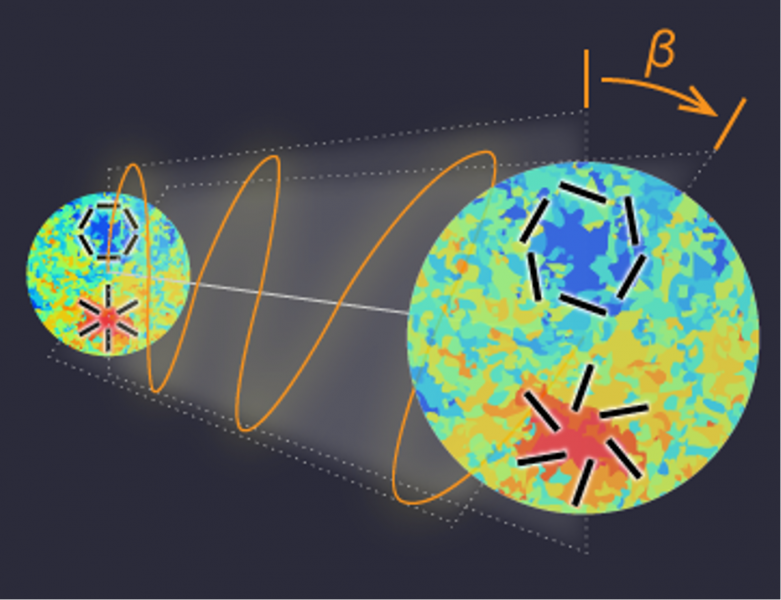
Figure: As the light of the cosmic microwave background emitted 13.8 billion years ago (left image) travels through the Universe until observed on Earth (right image), the direction in which the electromagnetic wave oscillates (orange line) is rotated by an angle β. The rotation could be caused by dark matter or dark energy interacting with the light of the cosmic microwave background, which changes the patterns of polarization (black lines inside the images). The red and blue regions in the images show hot and cold regions of the cosmic microwave background, respectively. (Credit: Y. Minami / KEK). Hi-res image

Using Planck data from the cosmic microwave background radiation, an international team of researchers has observed a hint of new physics. The team developed a new method to measure the polarization angle of the ancient light by calibrating it with dust emission from our own Milky Way. While the signal is not detected with enough precision to draw definite conclusions, it may suggest that dark matter or dark energy causes a violation of the so-called “parity symmetry.” 

The laws of physics governing the Universe are thought not to change when flipped around in a mirror. For example, electromagnetism works the same regardless of whether you are in the original system, or in a mirrored system in which all spatial coordinates have been flipped. If this symmetry, called “parity,” is violated, it may hold the key to understanding the elusive nature of dark matter and dark energy, which occupy 25 and 70 percent of the energy budget of the Universe today, respectively. While both dark, these two components have opposite effects on the evolution of the Universe: dark matter attracts, while dark energy causes the Universe to expand ever faster. 

A new study, including researchers from the Institute of Particle and Nuclear Studies (IPNS) at the High Energy Accelerator Research Organization (KEK), the Kavli Institute for the Physics and Mathematics of the Universe (Kavli IPMU) of the University of Tokyo, and the Max Planck Institute for Astrophysics (MPA), reports on a tantalizing hint of new physics—with 99.2 percent confidence level —which violates parity symmetry. Their findings were published in the journal Physical Review Letters on November 23, 2020; the paper was selected as the “Editors’ Suggestion,” judged by editors of the journal to be important, interesting, and well written.

The hint to a violation of parity symmetry was found in the cosmic microwave background radiation, the remnant light of the Big Bang. The key is the polarized light of the cosmic microwave background. Light is a propagating electromagnetic wave. When it consists of waves oscillating in a preferred direction, physicists call it “polarized.” The polarization arises when the light is scattered. Sunlight, for instance, consists of waves with all possible oscillating directions; thus, it is not polarized. The light of a rainbow, meanwhile, is polarized because the sunlight is scattered by water droplets in the atmosphere. Similarly, the light of the cosmic microwave background initially became polarized when scattered by electrons 400,000 years after the Big Bang. As this light traveled through the Universe for 13.8 billion years, the interaction of the cosmic microwave background with dark matter or dark energy could cause the plane of polarization to rotate by an angle β (Figure).

“If dark matter or dark energy interact with the light of the cosmic microwave background in a way that violates parity symmetry, we can find its signature in the polarization data,” points out Yuto Minami, a postdoctoral fellow at IPNS, KEK.

To measure the rotation angle β, the scientists needed polarization-sensitive detectors, such as those onboard the Planck satellite of the European Space Agency (ESA). And they needed to know how the polarization-sensitive detectors are oriented relative to the sky. If this information was not known with sufficient precision, the measured polarization plane would appear to be rotated artificially, creating a false signal. In the past, uncertainties over the artificial rotation introduced by the detectors themselves limited the measurement accuracy of the cosmic polarization angle β. 

“We developed a new method to determine the artificial rotation using the polarized light emitted by dust in our Milky Way,” said Minami. “With this method, we have achieved a precision that is twice that of the previous work, and are finally able to measure β.” The distance traveled by the light from dust within the Milky Way is much shorter than that of the cosmic microwave background. This means that the dust emission is not affected by dark matter or dark energy, i.e. β is present only in the light of the cosmic microwave background, while the artificial rotation affects both. The difference in the measured polarization angle between both sources of light can thus be used to measure β.

The research team applied the new method to measure β from the polarization data taken by the Planck satellite. They found a hint for violation of parity symmetry with 99.2 percent confidence level. To claim a discovery of new physics, much greater statistical significance, or a confidence level of 99.99995 percent, is required. Eiichiro Komatsu, director at the MPA and Principal Investigator at the Kavli IPMU, said: “It is clear that we have not found definitive evidence for new physics yet; higher statistical significance is needed to confirm this signal. But we are excited because our new method finally allowed us to make this ‘impossible’ measurement, which may point to new physics.”

To confirm this signal, the new method can be applied to any of the existing— and future—experiments measuring polarization of the cosmic microwave background, such as Simons Array and LiteBIRD, in which both KEK and the Kavli IPMU are involved.

Source: Kavli Institute for the Physics and Mathematics of the Universe (Kavli IPMU)

Paper details:

Journal: Physical Review Letters
Title: New extraction of the cosmic birefringence from the Planck 2018 polarization data

Authors: Yuto Minami (1), Eiichiro Komatsu (2,3)
Author affiliation:
1. High Energy Accelerator Research Organization, 1-1 Oho, Tsukuba, Ibaraki, 305-0801, Japan

2. Kavli Institute for the Physics and Mathematics of the Universe (Kavli IPMU, WPI), University of Tokyo, Chiba 277-8582, Japan

3. Max-Planck-Institut für Astrophysik, Karl-Schwarzschild Str. 1, 85741 Garching, Germany 

DOI: https://link.aps.org/doi/10.1103/PhysRevLett.125.221301 (November 23, 2020)
Abstract of the paper (Physical Review Letters page)


Research contact: 

Yuto Minami
Institute of Particle and Nuclear Studies, High Energy Accelerator Research Organization (KEK, Japan)
Postdoctoral Fellow
E-mail:
yminami@post.kek.jp

Eiichiro Komatsu 
Kavli Institute for the Physics and Mathematics of the Universe,The University of Tokyo
Principal Investigator
Max Planck Institute for Astrophysics
Director of the Department of Physical Cosmology
E-mail:
komatsu@mpa-garching.mpg.de
Tel: + 49-89-30000-2208

Media contact:

Hajime Hikino
PR office, High Energy Accelerator Research Organization (KEK, Japan)
E-mail:
press@kek.jp
TEL: +81-29-879-6047

Hiroko Tada
PR office, Institute of Particle and Nuclear Studies, High Energy Accelerator Research Organization (KEK, Japan)
E-mail:
htada@post.kek.jp
Tel: +81-29-864-5638

John Amari
Press officer 
Kavli Institute for the Physics and Mathematics of the Universe, The University of Tokyo
E-mail:
press@ipmu.jp
Tel: 080-4056-2767 

Hannelore Hämmerle 
Press Officer 
Max Planck Institute for Astrophysics
E-mail:
pr@mpa-garching.mpg.de 
Tel: +49-89-30000-3980


Thursday, November 12, 2020

History of temperature changes in the Universe revealed—First measurement using the Sunyaev-Zeldovich effect

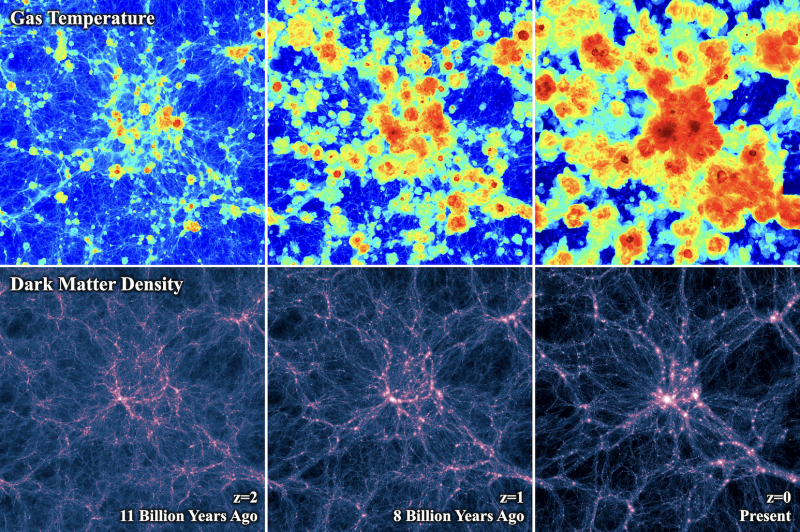
Image: Computer simulation of the evolution of the large-scale structure (bottom) and the temperature (top) of the Universe. The time flows from the left to the right panels, with the rightmost panel showing the present-day epoch. Credit: D. Nelson / Illustris Collaboration
. Hi-res image

Figure: Measured evolution of the temperature of the Universe. The time flows from left to right. The data points show the measurements, the red shaded area shows the physical model, and the blue box shows the estimate of the gravitational energy of the large-scale structure available for heating the gas, which can explain the measured temperature at the present time.   Reference: Chiang, Makiya, Ménard and Komatsu, Astrophysical Journal, 902, 56 (2020).


How hot is the Universe today? How hot was it before? A new study by an international team of researchers, including members of the Kavli Institute for the Physics and Mathematics of the Universe (Kavli IPMU), suggests that the mean temperature of gas in large structures of the Universe has increased about 3 times in the last 8 billion years, to reach about two million Kelvin today.

The large-scale structure of the Universe refers to the global pattern of how galaxies and galaxy clusters are distributed in space. This cosmic net formed from tiny irregularities in the matter distribution in the early Universe, which were amplified through gravitational attraction. “As the Universe evolves, gravity pulls dark matter and gas in space together into galaxies and clusters of galaxies,” said Yi-Kuan Chiang, the lead author of the study, and a research fellow at the Ohio State University Center for Cosmology and AstroParticle Physics. “The drag is violent—so violent that more and more gas is shocked and heated up.”

This heated gas can then be used to measure the mean temperature of the Universe over cosmic time. In particular, the researchers used the so-called “Sunyaev-Zeldovich” effect, named after Rashid Sunyaev, director emeritus at the Max Planck Institute for Astrophysics, and Soviet-era physicist Yakov Zeldovich, who first predicted this phenomenon theoretically. This effect arises when low-energy photons of the cosmic microwave background radiation are scattered by hot electrons in the large-scale structure of the Universe. The scattering transfers energy from electrons to photons, making the hot electron gas visible. The intensity of the Sunyaev-Zeldovich effect is proportional to the thermal pressure of the gas, which, in turn, is proportional to the temperature of electrons.

While this measurement is straightforward in principle, collecting the necessary data was a major undertaking. The study, which has been published in the Astrophysical Journal, was done in a collaboration of researchers at the Kavli IPMU, the Ohio State University, the Johns Hopkins University, and the Max Planck Institute for Astrophysics.

The researchers used data collected by two observatories, the Planck satellite and the Sloan Digital Sky Survey (SDSS). Planck is the European Space Agency mission which measured the cosmic microwave background radiation. SDSS collected detailed images and light spectra of galaxies. Combining the two data sets, the scientists were able to measure the amount of thermal pressure around the locations of galaxies and clusters of galaxies.

“It took astronomers more than 15 years to collect the necessary data using a telescope on the ground and one in space,” said Brice Ménard who led the analysis with Chiang. Ménard, who has been a visiting scientist at the Kavli IPMU since 2011, added: “On the analysis side, our team spent four years developing the algorithms necessary to extract the signal from these data.”

What’s more, interpretation of the data required a physical model, which was provided by Ryu Makiya, a research fellow at the Kavli IPMU. “Combining the latest data with a state-of-the-art theoretical model, we were able to reveal how the temperature of the Universe evolved, and how it was linked to formation of the large-scale structure of the Universe,” Makiya said. “The next goal is to understand details of the physics of thermal and non-thermal phenomena.”

Chiang, from the Ohio Stated University, added: “Our new measurement provides a direct confirmation of the seminal work by Jim Peebles—the 2019 Nobel Laureate in Physics—who laid out the theory of the emergence large-scale structure of the Universe.”

The study determined that about eight billion years ago (at a redshift z=1), the mean electron temperature was some 700,000 Kelvin, rising to about two million Kelvin today. Furthermore, the scientists determined that its evolution is almost entirely driven by the growth of structures, as gas is shock heated in collapsing large-scale structures.

Back in 2000, Eiichiro Komatsu, a Principal Investigator at the Kavli IPMU and Director at the Department of Physical Cosmology at the Max Planck Institute for Astrophysics, was also involved in a previous effort to calculate how the temperature of the Universe evolved. “For 20 years, we have been studying how to measure this using the Sunyaev-Zeldovich effect,” he remembered. “We now have finally measured the temperature of the Universe, not only thanks to the remarkable progress in observational data, but also due to the dedicated efforts of brilliant young scientists such as Yi-Kuan Chiang and Ryu Makiya. This is very satisfying,” Komatsu added.

Paper details:

Journal: The Astrophysical Journal
Title: The Cosmic Thermal History Probed by Sunyaev-Zeldovich Effect Tomography

Authors: Yi-Kuan Chiang (1), Ryu Makiya (2), Brice Ménard (2,3), and Eiichiro Komatsu (2,4)

Author affiliation:

1. Center for Cosmology and AstroParticle Physics (CCAPP), The Ohio State University, Columbus, OH 43210, USA
2. Kavli Institute for the Physics and Mathematics of the Universe (Kavli IPMU, WPI), University of Tokyo, Chiba 277-8582, Japan
3. Department of Physics & Astronomy, Johns Hopkins University, 3400 N. Charles Street, Baltimore, MD 21218, USA
4. Max-Planck-Institut für Astrophysik, Karl-Schwarzschild Str. 1, 85741 Garching, Germany

DOI: https://doi.org/10.3847/1538-4357/abb403 (October 12, 2020)
Abstract of the paper (Astrophysical Journal page)

Preprint (arXiv.org page)

Research contact:

Eiichiro Komatsu
Kavli Institute for the Physics and Mathematics of the Universe (Kavli IPMU)
Principal Investigator
Max Planck Institute for Astrophysics
Director of the Department of Physical Cosmology
E-mail:
komatsu@mpa-garching.mpg.de
TEL: + 49-89-30000-2208

Makiya Ryu
Kavli Institute for the Physics and Mathematics of the Universe (Kavli IPMU)
Visiting Associate Scientist
Institute of Astronomy and Astronomical Physics (ASIAA), Academia Sinica, Taiwan
Postdoctoral Fellow
E-mail:
rmakiya@siaa.sinica.edu.tw
TEL: +8862-2366-5420

Media contact:

John Amari
Press officer
Kavli Institute for the Physics and Mathematics of the Universe, The University of Tokyo
E-mail:
press@ipmu.jp
TEL: 080-4056-2767

Related links:

iNSPIRE
: https://inspirehep.net/literature/1803372

Tuesday, September 15, 2020

An international research team analysis rules out dark matter destruction as origin of extra radiation in galaxy center

Image caption 1: An artist’s interpretation of the Milky Way shows the “boxy” distribution of stars in the Ga-lactic Center. A research team of physicists said in a newly published study that this shape leaves very little room for excess radiation from the destruction of dark matter par-ticles. (Credit: Oscar Macias)


Image caption 2: This representation of data from the Fermi Gamma-ray Space Telescope after its launch in 2008 shows an excess of high-energy radiation in the Milky Way’s Galactic Center. Many physicists attributed this to the annihilation of weakly interacting dark matter parti-cles, but a research team study has excluded this possibility through a range of particle masses. (Credit: Oscar Macias)


The detection more than a decade ago by the Fermi Gamma-ray Space Telescope of an excess of high-energy radiation in the center of the Milky Way convinced some physicists that they were seeing evidence of the annihilation of dark matter particles, but a team led by a researcher at the Kavli Institute for the Physics and Mathematics of the Universe (Kavli IPMU) has ruled out that interpretation.

In a paper published recently in the journal Physical Review D, the Kavli IPMU Project Researcher Oscar Macias and colleagues at other institutions report that—through an analysis of the Fermi data and an exhaustive series of modelling exercises—they were able to determine that the observed gamma rays could not have been produced by what are called weakly interacting massive particles (WIMPS), most popularly theorized as the stuff of dark matter.

“The crucial point of our recent paper is that, our approach covers the wide range of astro-physical background models that have been used to infer the existence of the Galactic Center excess, and goes beyond them. So, using any of our state-of-the-art background models, we find no need for a dark matter component to be included in our model for this sky region. This allows us to impose very stringent constraints on particle dark matter models,” said Macias.

By eliminating these particles, the destruction of which could generate energies of up to 300 giga-electron volts, the paper’s authors say, they have put the strongest constraints yet on dark matter properties.

“For 40 years or so, the leading candidate for dark matter among particle physicists was a thermal, weakly interacting and weak-scale particle, and this result for the first time rules out that candidate up to very high-mass particles,” said co-author Kevork Abazajian, pro-fessor of physics and astronomy at the University of California, Irvine (UCI).

“In many models, this particle ranges from 10 to 1,000 times the mass of a proton, with more massive particles being less attractive theoretically as a dark matter particle,” add-ed co-author Manoj Kaplinghat, also a UCI professor of physics and astronomy. “In this paper, we’re eliminating dark matter candidates over the favored range, which is a huge improvement in the constraints we put on the possibilities that these are representative of dark matter.” Abazajian said that dark matter signals could be crowded out by other astrophysical phenomena in the Galactic Center—such as star formation, cosmic ray deflection off mo-lecular gas and, most notably, neutron stars and millisecond pulsars—as sources of ex-cess gamma rays detected by the Fermi space telescope.

“We looked at all of the different modelling that goes on in the Galactic Center, including molecular gas, stellar emissions and high-energy electrons that scatter low-energy pho-tons,” said Kavli IPMU’s Macias. “We took over three years to pull all of these new, better models together and examine the emissions, finding that there is little room left for dark matter.”

Macias, who is also a postdoctoral researcher with the GRAPPA Centre at the University of Amsterdam, added that this result would not have been possible without data and software provided by the Fermi Large Area Telescope collaboration.

The group tested all classes of models used in the Galactic Center region for excess emission analyses, and its conclusions remained unchanged. “One would have to craft a diffuse emission model that leaves a big ‘hole’ in them to relax our constraints, and sci-ence doesn’t work that way,” Macias said.

Kaplinghat noted that physicists have predicted that radiation from dark matter annihila-tion would be represented in a neat spherical or elliptical shape emanating from the Galactic Center, but the gamma ray excess detected by the Fermi space telescope after its June 2008 deployment shows up as a triaxial, bar-like structure.

“If you peer at the Galactic Center, you see that the stars are distributed in a boxy way,” he said. “There’s a disk of stars, and right in the center, there’s a bulge that’s about 10 degrees on the sky, and it’s actually a very specific shape—sort of an asymmetric box—and this shape leaves very little room for additional dark matter.”

Does this research rule out the existence of dark matter in the galaxy? “No,” Kaplinghat said. “Our study constrains the kind of particle that dark matter could be. The multiple lines of evidence for dark matter in the galaxy are robust and unaffected by our work.”

Far from considering the team’s findings to be discouraging, Abazajian said they should encourage physicists to focus on concepts other than the most popular ones.

“There are a lot of alternative dark matter candidates out there,” he said. “The search is going to be more like a fishing expedition where you don’t already know where the fish are.”

This project was made possible via funding from the World Premiere International Center Initiative (WPI), an initiative of the Ministry of Education, Culture, Sport, Science and Technology to create world-leading research centres in Japan; the National Science Foundation, and the U.S. Department of Energy Office of Science.

Paper details

Journal: Physical Review D
Title: Strong constraints on thermal relic dark matter from Fermi-LAT observations of the Galactic Center
Authors: Kevork N. Abazajian (1), Shunsaku Horiuchi (2), Manoj Kaplinghat (1), Ryan E. Keeley (1,3), and Oscar Macias (4,5)


Author affiliations:

1. Center for Cosmology, Department of Physics and Astronomy, University of California, Irvine, California 92697, USA
2. Center for Neutrino Physics, Department of Physics, Virginia Tech, Blacksburg, Virgin-ia 24061, USA
3. Korea Astronomy and Space Science Institute, Daejeon 34055, Korea
4. Kavli Institute for the Physics and Mathematics of the Universe (Kavli IPMU, WPI), Uni-versity of Tokyo, Kashiwa, Chiba, 277-8583, Japan 
5. GRAPPA Institute, University of Amsterdam, 1098 XH Amsterdam, Netherlands

DOI: https://doi.org/10.1103/PhysRevD.102.043012  (Published August 20, 2020)
Paper abstract (Physical Review D)
Preprint (arXiv.org) 

Research contact:

Oscar Macias
Project Researcher
Kavli Institute for the Physics and Mathematics of the Universe
The University of Tokyo
E-mail:
oscar.macias@ipmu.jp
TEL: +31 (0)20 525 6316

Media contact:

John Amari
Press officer 
Kavli Institute for the Physics and Mathematics of the Universe
The University of Tokyo
E-mail:
press@ipmu.jp
TEL: 080-4056-2767

Related links:
University of California, Irvine: press release
Femi LAT—Fermi Large Area Telescope collaboration: homepage

Source: Kavli Institute for the Physics and Mathematics of the Universe (Kavli IPMU)