Friday, January 19, 2024

SS 433: NASA's IXPE Helps Researchers Maximize 'Microquasar' Findings

SS433
Credit: X-ray: (IXPE): NASA/MSFC/IXPE; (Chandra): NASA/CXC/SAO; (XMM): ESA/XMM-Newton; IR: NASA/JPL/Caltech/WISE; Radio: NRAO/AUI/NSF/VLA/B. Saxton. (IR/Radio image created with data from M. Goss, et al.); Image Processing/compositing: NASA/CXC/SAO/N. Wolk & K. Arcand


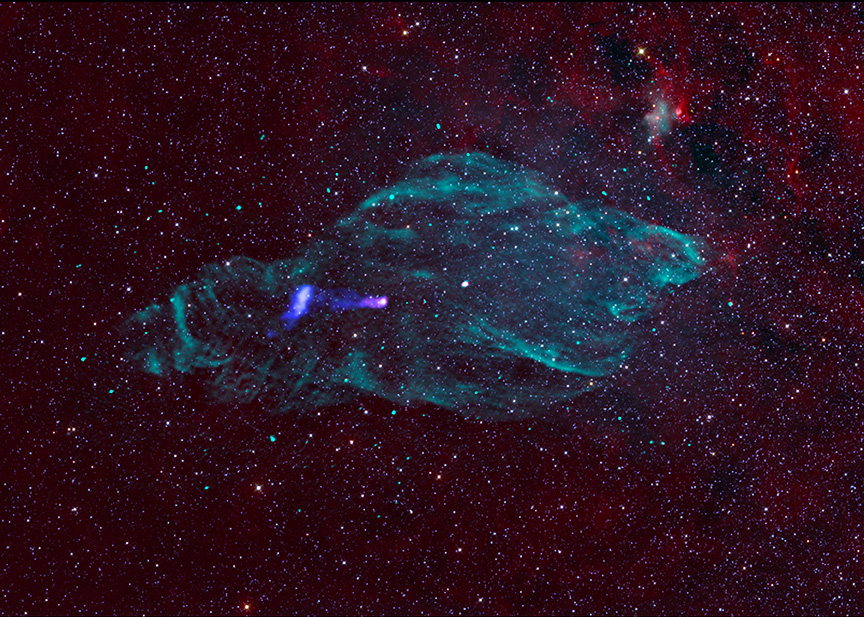
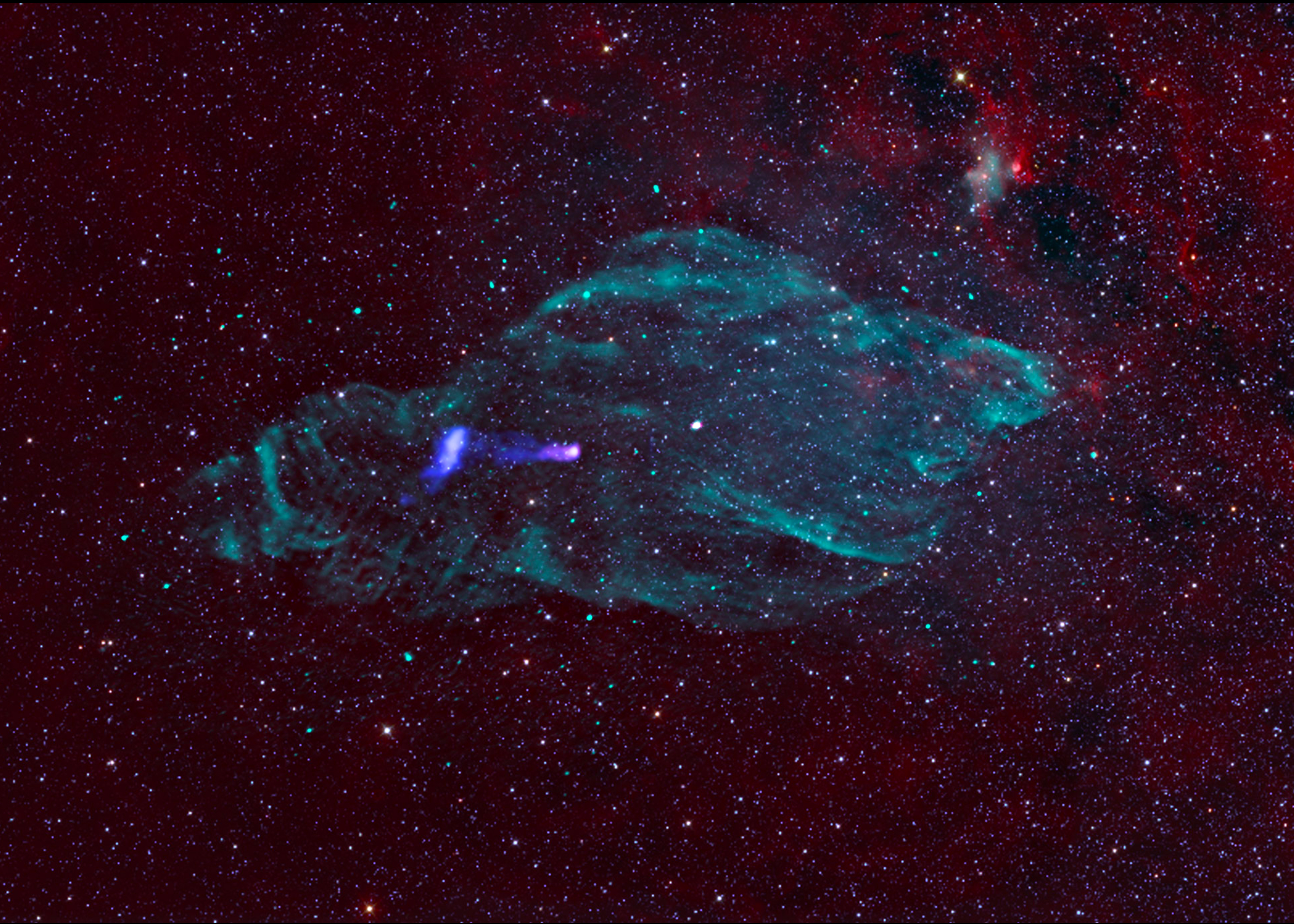
This composite image of the Manatee Nebula captures the jet emanating from SS 433, a black hole pulling material inwards that is embedded in the supernova remnant which spawned it. Radio emission from the supernova remnant are blue-green, whereas the X-ray from IXPE, XMM-Newton and Chandra are highlighted in bright blue-purple and pink-white set against a backdrop of infrared data in red. The black hole emits twin jets of matter traveling in opposite directions at nearly the speed of light.

These jets distort the remnant’s shape into one astronomers dubbed the Manatee. The jets become bright about 100 light-years away from the black hole, where particles are accelerated to very high energies by shocks within the jet. The IXPE data shows that the magnetic field, which plays a key role in how particles are accelerated, is aligned parallel to the jet — aiding our understanding of how astrophysical jets accelerate these particles to high energies.


Microquasar SS 433 sits in the center of the supernova remnant W50 in the constellation Aquila, some 18,000 light-years from Earth. SS 433’s powerful jets, which distort the remnant’s shape and earned it the nickname the “Manatee Nebula,” have been clocked at roughly 26% of the speed of light, or more than 48,000 miles per second. Credit: X-ray: (IXPE): NASA/MSFC/IXPE; (Chandra): NASA/CXC/SAO; (XMM): ESA/XMM-Newton; IR: NASA/JPL/Caltech/WISE; Radio: NRAO/AUI/NSF/VLA/B. Saxton. (IR/Radio image created with data from M. Goss, et al.); Image Processing/compositing: NASA/CXC/SAO/N. Wolk & K. Arcand)

A new paper, detailing IXPE’s observations at SS 433, is available in the latest edition of The Astrophysical Journal. IXPE is a collaboration between NASA and the Italian Space Agency with partners and science collaborators in 12 countries. IXPE is led by NASA’s Marshall Space Flight Center. Ball Aerospace, headquartered in Broomfield, Colorado, manages spacecraft operations together with the University of Colorado’s Laboratory for Atmospheric and Space Physics in Boulder.

NASA's Marshall Space Flight Center manages the Chandra program. The Smithsonian Astrophysical Observatory's Chandra X-ray Center controls science operations from Cambridge, Massachusetts, and flight operations from Burlington, Massachusetts.


Visual Description:

This composite image shows SS 433, a black hole embedded in a supernova remnant. The shape of the supernova remnant resembles the shape of a marine mammal known as the manatee, earning the remnant the nickname, the Manatee Nebula.

The manatee-like structure is oriented with its head toward the right side of the image, and its paddle-shaped tail toward the left side of the image, appearing as a somewhat transparent cloud of bluish-green. In the middle of the remnant is a bright white dot. This dot is black hole SS 433.

Farther toward our left, just above what would be the animal's tail, is an area mostly devoid of material. Here, jets of matter detected in X-ray light are purple-blue, with the black hole detected in X-ray light in pink. The jets are traveling in the opposite direction from the black hole at extreme speeds, causing distortion in the shape of the remnant.

The background of the image features a multitude of white flecks and wispy red streaks, stars and material glowing in infrared light.


Fast Facts for SS 433:

Scale: Image is about 110 arcmin (570 light-years) across.
Category: Black Holes
Coordinates (J2000): RA 19h 11m 50s | Dec +04° 58´ 42"
Constellation: Aquila
Observation Dates: June 27, 2000
Observation Time: 2 hours 41 minutes
Obs. ID: 659
Instrument: ACIS
References: Kaaret, P. et al, 2023, Published
Color Code: X-ray: pink, blue, purple; IR: red; Radio: green
Distance Estimate: About 18,000 light-years


Thursday, January 18, 2024

Webb Shows Many Early Galaxies Looked Like Pool Noodles, Surfboards

Sample Shapes of Distant Galaxies Identified in Webb’s CEERS Survey (NIRCam Image)
Credits: Image: NASA, ESA, CSA, STScI, Steve Finkelstein (UT Austin), Micaela Bagley (UT Austin), Rebecca Larson (UT Austin)

3D Classifications for Distant Galaxies in Webb’s CEERS Survey (NIRCam Image)
Credits: Image: NASA, ESA, CSA, STScI, Steve Finkelstein (UT Austin), Micaela Bagley (UT Austin), Rebecca Larson (UT Austin)

Early Galaxy Shapes Detected by Webb (Artist Concept)
Illustration: NASA, ESA, CSA, Joseph Olmsted (STScI)
Science: Viraj Pandya (Columbia), Haowen Zhang (University of Arizona), Lucy Reading-Ikkanda (Simons Foundation)


Researchers analyzing images from NASA’s James Webb Space Telescope have found that galaxies in the early universe are often flat and elongated, like surfboards and pool noodles – and are rarely round, like volleyballs or frisbees. “Roughly 50 to 80% of the galaxies we studied appear to be flattened in two dimensions,” explained lead author Viraj Pandya, a NASA Hubble Fellow at Columbia University in New York. “Galaxies that look like pool noodles or surfboards seem to be very common in the early universe, which is surprising, since they are uncommon nearby.”

The team focused on a vast field of near-infrared images delivered by Webb, known as the Cosmic Evolution Early Release Science (CEERS), plucking out galaxies that are estimated to exist when the universe was 600 million to 6 billion years old.

While most distant galaxies look like surfboards and pool noodles, others are shaped like frisbees and volleyballs. The “volleyballs,” or sphere-shaped galaxies, appear the most compact type on the cosmic “ocean” and were also the least frequently identified. The frisbees were found to be as large as the surfboard- and pool noodle-shaped galaxies along the “horizon,” but become more common closer to “shore” in the nearby universe. (Compare them in this illustration.)

Which category would our Milky Way galaxy fall into if we were able to wind the clock back by billions of years? “Our best guess is that it might have appeared more like a surfboard,” said co-author Haowen Zhang, a PhD candidate at the University of Arizona in Tucson. This hypothesis is based partly on new evidence from Webb – theorists have “wound back the clock” to estimate the Milky Way’s mass billions of years ago, which correlates with shape at that time.

These distant galaxies are also far less massive than nearby spirals and ellipticals – they are precursors to more massive galaxies like our own. “In the early universe, galaxies had had far less time to grow,” said Kartheik Iyer, a co-author and NASA Hubble Fellow also at Columbia University. “Identifying additional categories for early galaxies is exciting – there’s a lot more to analyze now. We can now study how galaxies’ shapes relate to how they look and better project how they formed in much more detail.”

Webb’s sensitivity, high-resolution images, and specialization in infrared light allowed the team to make quick work of characterizing many CEERS galaxies, and model their 3D geometries. Pandya also says their work wouldn’t be possible without the extensive research astronomers have done using NASA’s Hubble Space Telescope.

For decades, Hubble has wowed us with images of some of the earliest galaxies, beginning with its first “deep field” in 1995 and continuing with a seminal survey known as Cosmic Assembly Near-infrared Deep Extragalactic Legacy Survey. Deep sky surveys like these led to far greater statistics, leading astronomers to create robust 3D models of distant galaxies over all of cosmic time. Today, Webb is helping to enhance these efforts, adding a bounty of distant galaxies beyond Hubble’s reach and revealing the early universe in far greater detail than previously possible.

Webb’s images of the early universe have acted like an ocean swell – delivering new waves of evidence. “Hubble has long showed an excess of elongated galaxies,” explained co-author Marc Huertas-Company, a faculty research scientist at the Institute of Astrophysics on the Canary Islands. But researchers still wondered: Would additional detail show up better with sensitivity to infrared light? “Webb confirmed that Hubble didn’t miss any additional features in the galaxies they both observed. Plus, Webb showed us many more distant galaxies with similar shapes, all in great detail.”

There are still gaps in our knowledge – researchers not only need an even larger sample size from Webb to further refine the properties and precise locations of distant galaxies, they will also need to spend ample time tweaking and updating their models to better reflect the precise geometries of distant galaxies. “These are early results,” said co-author Elizabeth McGrath, an associate professor at Colby College in Waterville, Maine. “We need to delve more deeply into the data to figure out what’s going on, but we’re very excited about these early trends.”

The James Webb Space Telescope is the world's premier space science observatory. Webb is solving mysteries in our solar system, looking beyond to distant worlds around other stars, and probing the mysterious structures and origins of our universe and our place in it. Webb is an international program led by NASA with its partners, ESA (European Space Agency) and the Canadian Space Agency.


About This Release

Credits:

Media Contact:

Claire Blome
Space Telescope Science Institute, Baltimore, Maryland

Christine Pulliam
Space Telescope Science Institute, Baltimore, Maryland

Permissions: Content Use Policy

Contact Us: Direct inquiries to the News Team.

Related Links and Documents


Wednesday, January 17, 2024

NASA's Webb Discovers Dusty 'Cat's Tail' in Beta Pictoris System

Beta Pictoris (MIRI Image)
Credits: Image: NASA, ESA, CSA, STScI, Christopher Stark (NASA-GSFC), Kellen Lawson (NASA-GSFC), Jens Kammerer (ESO), Marshall Perrin (STScI)

Beta Pictoris (MIRI Annotated Image)
Credits: Image: NASA, ESA, CSA, STScI, Christopher Stark (NASA-GSFC), Kellen Lawson (NASA-GSFC), Jens Kammerer (ESO), Marshall Perrin (STScI)


Beta Pictoris, a young planetary system located just 63 light-years away, continues to intrigue scientists even after decades of in-depth study. It possesses the first dust disk imaged around another star — a disk of debris produced by collisions between asteroids, comets, and planetesimals. Observations from NASA’s Hubble Space Telescope revealed a second debris disk in this system, inclined with respect to the outer disk, which was seen first. Now, a team of astronomers using NASA’s James Webb Space Telescope to image the Beta Pictoris (Beta Pic) system has discovered a new, previously unseen structure.

The team, led by Isabel Rebollido of the Astrobiology Center in Spain, used Webb’s NIRCam (Near-Infrared Camera) and MIRI (Mid-Infrared Instrument) to investigate the composition of Beta Pic’s previously detected main and secondary debris disks. The results exceeded their expectations, revealing a sharply inclined branch of dust, shaped like a cat’s tail, that extends from the southwest portion of the secondary debris disk.

“Beta Pictoris is the debris disk that has it all: It has a really bright, close star that we can study very well, and a complex cirumstellar environment with a multi-component disk, exocomets, and two imaged exoplanets,” said Rebollido, lead author of the study. “While there have been previous observations from the ground in this wavelength range, they did not have the sensitivity and the spatial resolution that we now have with Webb, so they didn’t detect this feature.”

A Star’s Portrait Improved with Webb

Even with Webb, or JWST, peering at Beta Pic in the right wavelength range — in this case, the mid-infrared — was crucial to detect the cat’s tail, as it only appeared in the MIRI data. Webb’s mid-infrared data also revealed differences in temperature between Beta Pic’s two disks, which likely is due to differences in composition.

“We didn’t expect Webb to reveal that there are two different types of material around Beta Pic, but MIRI clearly showed us that the material of the secondary disk and cat’s tail is hotter than the main disk,” said Christopher Stark, a co-author of the study at NASA’s Goddard Space Flight Center in Greenbelt, Maryland. “The dust that forms that disk and tail must be very dark, so we don’t easily see it at visible wavelengths — but in the mid-infrared, it’s glowing.”

To explain the hotter temperature, the team deduced that the dust may be highly porous “organic refractory material,” similar to the matter found on the surfaces of comets and asteroids in our solar system. For example, a preliminary analysis of material sampled from asteroid Bennu by NASA’s OSIRIS-REx mission found it to be very dark and carbon-rich, much like what MIRI detected at Beta Pic.

The Tail’s Puzzling Beginning Warrants Future Research

However, a major lingering question remains: What could explain the shape of the cat’s tail, a uniquely curved feature unlike what is seen in disks around other stars?

Rebollido and the team modeled various scenarios in an attempt to emulate the cat’s tail and unravel its origins. Though further research and testing is required, the team presents a strong hypothesis that the cat’s tail is the result of a dust production event that occurred a mere one hundred years ago.

“Something happens — like a collision — and a lot of dust is produced,” shared Marshall Perrin, a co-author of the study at the Space Telescope Science Institute in Baltimore, Maryland. “At first, the dust goes in the same orbital direction as its source, but then it also starts to spread out. The light from the star pushes the smallest, fluffiest dust particles away from the star faster, while the bigger grains do not move as much, creating a long tendril of dust.”

“The cat’s tail feature is highly unusual, and reproducing the curvature with a dynamical model was difficult,” explained Stark. “Our model requires dust that can be pushed out of the system extremely rapidly, which again suggests it’s made of organic refractory material.”

The team’s preferred model explains the sharp angle of the tail away from the disk as a simple optical illusion. Our perspective combined with the curved shape of the tail creates the observed angle of the tail, while in fact, the arc of material is only departing from the disk at a five-degree incline. Taking into consideration the tail’s brightness, the team estimates the amount of dust within the cat’s tail to be equivalent to a large main belt asteroid spread out across 10 billion miles.

A recent dust production event within Beta Pic’s debris disks could also explain a newly-seen asymmetric extension of the inclined inner disk, as shown in the MIRI data and seen only on the side opposite of the tail. Recent collisional dust production could also account for a feature previously spotted by the Atacama Large Millimeter/submillimeter Array in 2014 : a clump of carbon monoxide (CO) located near the cat’s tail. Since the star’s radiation should break down CO within roughly one hundred years, this still-present concentration of gas could be lingering evidence of the same event.

“Our research suggests that Beta Pic may be even more active and chaotic than we had previously thought,” said Stark. “JWST continues to surprise us, even when looking at the most well-studied objects. We have a completely new window into these planetary systems.”

These results were presented in a press conference at the 243rd meeting of the American Astronomical Society in New Orleans, Louisiana.

The observations were taken as part of Guaranteed Time Observation program 1411 .

The James Webb Space Telescope is the world’s premier space science observatory. Webb is solving mysteries in our solar system, looking beyond to distant worlds around other stars, and probing the mysterious structures and origins of our universe and our place in it. Webb is an international program led by NASA with its partners, ESA (European Space Agency) and the Canadian Space Agency.


About This Release

Credits:

Media Contact:

Abigail Major
Space Telescope Science Institute, Baltimore, Maryland

Christine Pulliam
Space Telescope Science Institute, Baltimore, Maryland

Permissions:
Content Use Policy

Contact Us: Direct inquiries to the News Team.


Tuesday, January 16, 2024

Hubble Finds Weird Home of Farthest Fast Radio Burst

FRB 20220610A
This image from the Hubble Space Telescope shows a field of blue, red, orange, yellow and white distant galaxies against the black backdrop of space. At image center, a white inset box labeled “Host galaxy of FRB 20220610A” zooms in on a tight group of several galaxies of various elliptical shapes (to the far right). The white arrow inside the inset box points to the host galaxy of the exceptionally powerful fast radio burst 20220610A detected inside this galaxy group. Credits: Science: NASA, ESA, STScI, Alexa Gordon (Northwestern)


Astronomers using NASA's Hubble Space Telescope have found a rare event in an oddball place.

It's called a fast radio burst (FRB), a fleeting blast of energy that can – for a few milliseconds – outshine an entire galaxy. Hundreds of FRBs have been detected over the past few years. They pop off all over the sky like camera flashes at a stadium event, but the sources behind these intense bursts of radiation remain uncertain.

This new FRB is particularly weird because it erupted halfway across the universe, making it the farthest and most powerful example detected to date.

And if that's not strange enough, it just got weirder based on the follow-up Hubble observations made after its discovery. The FRB flashed in what seems like an unlikely place: a collection of galaxies that existed when the universe was only 5 billion years old. The large majority of previous FRBs have been found in isolated galaxies.

FRB 20220610A was first detected on June 10, 2022, by the Australian Square Kilometer Array Pathfinder (ASKAP ) radio telescope in Western Australia. The European Southern Observatory's Very Large Telescope in Chile confirmed that the FRB came from a distant place. The FRB was four times more energetic than closer FRBs.

"It required Hubble's keen sharpness and sensitivity to pinpoint exactly where the FRB came from," said lead author Alexa Gordon of Northwestern University in Evanston, Illinois. "Without Hubble's imaging, it would still remain a mystery as to whether this was originating from one monolithic galaxy or from some type of interacting system. It's these types of environments – these weird ones – that are driving us toward better understanding the mystery of FRBs."

Hubble's crisp images suggest this FRB originated in an environment where there may be as many as seven galaxies on a possible path to merging, which would also be very significant, researchers say.

"We are ultimately trying to answer the questions: What causes them? What are their progenitors and what are their origins? The Hubble observations provide a spectacular view of the surprising types of environments that give rise to these mysterious events," said co-investigator Wen-fai Fong, also of Northwestern University.

Though astronomers do not have a consensus on the possible mechanism behind this extraordinary phenomenon, it's generally thought that FRBs must involve some sort of compact object, like a black hole or neutron star. One extreme type of neutron star is called a magnetar – the most intensely magnetic type of neutron star in the universe. It has a magnetic field that is so strong that, if a magnetar were located halfway between Earth and the Moon, it would erase the magnetic strip on everyone's credit card in the world. Much worse yet, if an astronaut traveled within a few hundred miles of the magnetar, they would effectively be dissolved, because every atom in their body would be disrupted.

Possible mechanisms involve some kind of jarring starquake, or alternatively, an explosion caused when a magnetar's twisting magnetic field lines snap and reconnect. A similar phenomenon happens on the Sun, causing solar flares, but a magnetar's field is a trillion times stronger than the Sun's magnetosphere. The snapping would generate an FRB's flash, or might make a shock wave that incinerates surrounding dust and heats gas into a plasma.

There could be several flavors of magnetars. In one case, it could be an exploding object orbiting a black hole surrounded by a disk of material. Another alternative is a pair of orbiting neutron stars whose magnetospheres periodically interact, creating a cavity where eruptions can take place. It's estimated that magnetars are active for about 10,000 years before settling down, so they would be expected to be found where a firestorm of star birth is taking place. But this doesn't seem to be the case for all magnetars.

In the near future, FRB experiments will increase their sensitivity, leading to an unprecedented rate in the number of FRBs detected at these distances. Hubble will play a crucial role in characterizing the environments in which these FRBs occur. Astronomers will soon learn just how special the environment of this FRB was.

"We just need to keep finding more of these FRBs, both nearby and far away, and in all these different types of environments," said Gordon.

The results are being presented at the 243rd meeting of the American Astronomical Society in New Orleans, Louisiana.

The Hubble Space Telescope is a project of international cooperation between NASA and ESA. NASA's Goddard Space Flight Center in Greenbelt, Maryland, manages the telescope. The Space Telescope Science Institute (STScI) in Baltimore, Maryland, conducts Hubble and Webb science operations. STScI is operated for NASA by the Association of Universities for Research in Astronomy, in Washington, D.C.


About This Release

Credits:

Media Contact:

Ray Villard
Space Telescope Science Institute, Baltimore, Maryland

Science Contact:

Alexa Gordon
Northwestern University, Evanston, Illinois


Permissions: Content Use Policy

Contact Us: Direct inquiries to the News Team.

Related Links and Documents


Monday, January 15, 2024

Dark Energy Survey Publishes Definitive Results from Largest, Deepest, Most Uniform Supernova Sample

PR Image noirlab2401a
Dark Energy Camera Deep Image with Quasar (no annotations)

PR Image noirlab2401b
Dark Energy Camera Deep Image with Quasar (annotated)

PR Image noirlab2401c
Supernova Hubble Diagram

PR Image noirlab2401d
Cosmic Redshift

PR Image noirlab2401e
Dark Energy Camera Filters

PR Image noirlab2401f
Dark Energy Camera Deep Image


Videos

Dark Energy Camera Deep Image Animated 
Dark Energy Camera Deep Image Animated

A night with the Víctor M. Blanco 4-meter Telescope  
A night with the Víctor M. Blanco 4-meter Telescope

Cerro Tololo Aerial Flyover  
PR Video noirlab2401c
Cerro Tololo Aerial Flyover


Using the DOE-fabricated Dark Energy Camera, mounted on the Víctor M. Blanco 4-meter Telescope at Cerro Tololo Inter-American Observatory, the Dark Energy Survey has obtained the largest supernova sample ever using a single telescope. By analyzing over 1500 distant supernovae, the DES collaboration has placed the strongest constraints on the expansion of the Universe ever obtained using supernovae and found hints that the Universe’s dark energy density may vary with time.

In 1998 two separate teams of astrophysicists, using telescopes at the US National Science Foundation's Cerro Tololo Inter-American Observatory (CTIO) and Kitt Peak National Observatory, both Programs of NSF’s NOIRLab, discovered that the Universe is expanding at an accelerating rate. This phenomenon is attributed to a mysterious entity called dark energy that makes up about 70% of our Universe. The discovery came as a surprise to astrophysicists who, at the time, expected the Universe’s expansion to be slowing down.

This revolutionary discovery was achieved with observations of a particular class of exploding stars, called type Ia (read “type one-A”) supernovae [1], and was recognized with the Nobel Prize in Physics in 2011.

Now, 25 years after the initial discovery, the scientists working on the Dark Energy Survey (DES) have released the results of an unprecedented analysis using the same technique to further probe the mysteries of dark energy and place the strongest constraints on the expansion history of the Universe ever obtained. In a presentation at the 243rd meeting of the American Astronomical Society on 8 January 2024, and in a paper submitted to the Astrophysical Journal, astrophysicists report results that are consistent with the now-standard cosmological model of a Universe with an accelerating expansion. Yet, the findings are not definitive enough to rule out a possibly more complex model.

The DES is an international collaboration comprising more than 400 scientists from over 25 institutions, led by the US Department of Energy’s Fermi National Accelerator Laboratory. The DES employs the Dark Energy Camera (DECam), a 570-megapixel digital camera built by Fermilab and funded by the DOE Office of Science, with significant contributions by the NSF and the DES partners. It is mounted on the Víctor M. Blanco Telescope at CTIO in Chile. By taking data on 758 nights across six years, DES scientists mapped an area almost one-eighth of the entire sky.

Among the observations of about two million distant galaxies, the DES team found several thousand supernovae, making this the largest, deepest supernova sample ever obtained from a single telescope [2]. DES researchers then used advanced machine-learning techniques to aid in supernova classification and sift the sample into a uniform high-quality dataset with 1499 likely type Ia supernovae, thereby tripling the number of observed supernova Ia beyond a redshift of 0.2 and quintupling the number beyond a redshift of 0.5 [3]. “It’s a really massive scale-up from 25 years ago when only 52 supernovae were used to infer dark energy,” said Tamara Davis, a professor at the University of Queensland in Australia and co-convener of the DES Supernova Working Group. 

This large sample of supernovae, spanning a wide range of distances, can be used to trace out the history of cosmic expansion. For each supernova, DES scientists combine its distance with a measurement of its redshift — how quickly it is moving away from Earth as a result of the expansion of the Universe. Together, these two factors can lend insight into whether the Universe’s dark energy density has remained constant or changed over time.

“As the Universe expands, the matter density goes down,” said DES director and spokesperson Rich Kron, who is a Fermilab and University of Chicago scientist. “But if the dark energy density is a constant, that means the total proportion of dark energy must be increasing as the volume increases.”

The standard cosmological model is known as ΛCDM, or ‘Lambda cold dark matter’. This mathematical model describes how the Universe evolves using just a few features such as the density of matter, the type of matter and the behavior of dark energy. While ΛCDM assumes the density of dark energy in the Universe is constant over cosmic time and doesn’t dilute as the Universe expands, the DES Supernova Survey results hint that this may not be true.

Results were obtained by combining the DES data with complementary data from the European Space Agency’s Planck telescope. An intriguing outcome of this survey is that it is the first time that enough distant supernovae have been measured to make a highly detailed measurement of the decelerating phase of the Universe, and to see where the Universe transitions from decelerating to accelerating. And while the results are consistent with a constant density of dark energy in the Universe, they also hint that dark energy might possibly be varying. “There are tantalizing hints that dark energy changes with time,” said Davis, “We find that the simplest model of dark energy — ΛCDM — is not the best fit. It’s not so far off that we’ve ruled it out, but in the quest to understand what is accelerating the expansion of the Universe this is an intriguing new piece of the puzzle. A more complex explanation might be needed.”

The innovative techniques that the DES has pioneered will shape and further drive future astrophysical analyses. Projects like the upcoming Legacy Survey of Space and Time, to be conducted by Vera C. Rubin Observatory, which is operated jointly by NSF’s NOIRLab and DOE’s SLAC National Accelerator Laboratory, as well as NASA’s Nancy Grace Roman Space Telescope, will pick up where the DES left off. “We’re pioneering techniques that will be directly beneficial for the next generation of supernova surveys,” said Kron.

"This result clearly shows the value of astronomical survey projects that continue to yield excellent science well after data collection has ended," says Nigel Sharp, a program director in NSF's Astronomical Sciences Division. "We need as many diverse approaches as we can get in order to understand what dark energy is, and what it isn’t. This is an important route to that understanding."

Alistair Walker, DECam Instrument Scientist at NOIRLab, adds, “Multiple elements came together to permit this important advance in our understanding of dark energy — the pristine skies of Chile, the large Blanco Telescope equipped with the superbly-made DECam, intensive data calibration efforts that achieved unprecedented levels of measurement accuracy and a decade of analysis effort by a very talented group of scientists.”


Notes

[1] This technique requires data from type Ia supernovae, which occur when an extremely dense dead star, known as a white dwarf, reaches a critical mass and explodes. That critical mass is nearly the same for all white dwarfs, so all type Ia supernovae have approximately the same actual brightness. By comparing the apparent brightnesses of two type Ia supernovae as seen from Earth astronomers can determine their relative distances from us.

[2] The recently published Union3 dataset from Rubin et al. (2023) analyzes 2087 supernovae from different telescopes; the DES survey data were all captured using the same telescope, thereby making the sample more uniform and highly precise.

[3] An object’s redshift tells astronomers how quickly it is moving away from Earth as a result of the expansion of the Universe.


More information

This research was presented in a paper submitted to the Astrophysical Journal titled, "The Dark Energy Survey: Cosmology Results With ~1500 New High-redshift Type Ia Supernovae Using The Full 5-year Dataset”

These results are presented by the DES Supernova Working Group and the DES Collaboration.

NSF’s NOIRLab (National Optical-Infrared Astronomy Research Laboratory), the US center for ground-based optical-infrared astronomy, operates the International Gemini Observatory (a facility of NSF, NRC–Canada, ANID–Chile, MCTIC–Brazil, MINCyT–Argentina, and KASI–Republic of Korea), Kitt Peak National Observatory (KPNO), Cerro Tololo Inter-American Observatory (CTIO), the Community Science and Data Center (CSDC), and Vera C. Rubin Observatory (operated in cooperation with the Department of Energy’s SLAC National Accelerator Laboratory). It is managed by the Association of Universities for Research in Astronomy (AURA) under a cooperative agreement with NSF and is headquartered in Tucson, Arizona. The astronomical community is honored to have the opportunity to conduct astronomical research on Iolkam Du’ag (Kitt Peak) in Arizona, on Maunakea in Hawai‘i, and on Cerro Tololo and Cerro Pachón in Chile. We recognize and acknowledge the very significant cultural role and reverence that these sites have to the Tohono O’odham Nation, to the Native Hawaiian community, and to the local communities in Chile, respectively.

Funding for the DES Projects has been provided by the US Department of Energy, the US National Science Foundation, the Ministry of Science and Education of Spain, the Science and Technology Facilities Council of the United Kingdom, the Higher Education Funding Council for England, the National Center for Supercomputing Applications at the University of Illinois at Urbana-Champaign, the Kavli Institute of Cosmological Physics at the University of Chicago, Funding Authority for Funding and Projects in Brazil, Carlos Chagas Filho Foundation for Research Support of the State of Rio de Janeiro, Brazilian National Council for Scientific and Technological Development and the Ministry of Science and Technology, the German Research Foundation and the collaborating institutions in the Dark Energy Survey.

Based in part on data acquired at the Anglo-Australian Telescope for the Dark Energy Survey by OzDES. We acknowledge the traditional custodians of the land on which the AAT stands, the Gamilaraay people, and pay our respects to elders past and present.


Fermilab is America’s premier national laboratory for particle physics and accelerator research. A US Department of Energy Office of Science laboratory, Fermilab is located near Chicago, Illinois, and operated under contract by the Fermi Research Alliance LLC. Visit Fermilab’s website at www.fnal.gov and follow us on Twitter at @Fermilab.

The DOE Office of Science is the single largest supporter of basic research in the physical sciences in the United States and is working to address some of the most pressing challenges of our time. For more information, please visit
science.energy.gov.


Links


Contacts

Tamara Davis
University of Queensland in Australia
Email:
tamarad@physics.uq.edu.au

Yuanyuan Zhang
NSF’s NOIRLab
Email:
yuanyuan.zhang@noirlab.edu

Josie Fenske
NSF’s NOIRLab
Email:
josie.fenske@noirlab.edu


Sunday, January 14, 2024

WASP-69b: New Images Reveal Exoplanet’s Comet-Like Tail is Surprisingly Longer Than Previously Observed

An artist's impression of exoplanet wasp-69b orbiting its host star.
Credit: W. M. Keck Observatory/Adam Makarenko


Maunakea, Hawai‘i – New data from W. M. Keck Observatory on Maunakea, Hawaiʻi Island confirms exoplanet WASP-69b, known for its escaping atmosphere, is forming a comet-like tail that is even longer than previously observed.

Named WASP-69b, scientists have studied this Jupiter-sized planet in the past, focusing on its escaping atmosphere and observing only a small trail of helium gas. But during a press conference today at the January 2024 Meeting of the American Astronomical Society, a University of California, Los Angeles (UCLA)-led team of researchers announced that new Keck Observatory data reveal the tail is at least 350,000 miles long.

“Previous observations suggested that WASP-69b had a modest tail, or no tail at all,” says Dakotah Tyler, astrophysics doctoral candidate at UCLA and first author of the study. “However, we have been able to definitively show that this planet’s helium tail extends at least seven times the radius of the giant planet itself.”

The study is published in today’s edition of The Astrophysical Journal.

Located 160 light-years away from Earth, WASP-69b is so close to its sun that one year on this alien world lasts only 3.9 Earth days. Their proximity subjects the planet to extreme radiation from its host star, causing the gas giant’s atmosphere to burn off.

The team observed this using Keck Observatory’s Near-Infrared Spectrograph (NIRSPEC) to capture sharp images of WASP-69b, which revealed the sequence of events showing its tail stretching out as the planet shed its atmosphere.

“The WASP-69b system is a gem because we are able to study its atmospheric mass-loss in real-time,” says co-author, Erik Petigura, associate professor of astronomy and astrophysics at UCLA. “This makes for a rare opportunity to understand the critical physics that shapes thousands of other planets.”

“What truly set Keck apart in our observations was the large collecting area of its mirror, which enabled us to detect far more light from the star. This, combined with the high-resolution capabilities of the NIRSPEC instrument, gave us extremely high sensitivity to the velocity structure and total absorption of the escaped atmosphere, which strong stellar winds have sculpted into a long, wispy tail,” says Tyler.


ANIMATION: Artist’s rendition showing WASP-69b’s escaping atmosphere, which produces a planetary wind that interacts with the stellar wind from its host star. This interaction creates a long comet-like tail that extends over 350,000 miles long. Credit: W. M. Keck Observatory/Adam Makarenko


Although WASP-69b is only about 30 percent the mass of Jupiter, it is 10 percent larger due to the extreme heat from its host star, which causes its atmosphere to expand before breaking free. The escaping atmosphere then produces wind that violently interacts with the wind from the planet’s host star, forming WASP-69b’s helium tail.

“These comet-like tails are really valuable because they form when the escaping atmosphere of the planet rams into the stellar wind, which causes the gas to be swept back. Observing such an extended tail allows us to study these interactions in great detail,” says Petigura.

Studying atmospheric mass-loss directly is pivotal for understanding exactly how planets across our galaxy evolve over time with their stars.

WASP-69b is losing about 1 Earth mass every billion years, but with a total mass nearly 90 times that of the Earth, the planet is in no danger of losing all of its atmosphere during its lifetime.

“The resilience of this planet in such an extreme and hostile environment allows us to study the process of atmospheric mass-loss, which helps us understand how stars can cause their planets to evolve. But it also serves as a powerful reminder to us all,” says Tyler. “Perspective is everything. Despite the multitude of challenges we may face, like WASP-69b, we have what it takes to continue on.”


About NIRSPEC

The Near-Infrared Spectrograph (NIRSPEC) is a unique, cross-dispersed echelle spectrograph that captures spectra of objects over a large range of infrared wavelengths at high spectral resolution. Built at the UCLA Infrared Laboratory by a team led by Prof. Ian McLean, the instrument is used for radial velocity studies of cool stars, abundance measurements of stars and their environs, planetary science, and many other scientific programs. A second mode provides low spectral resolution but high sensitivity and is popular for studies of distant galaxies and very cool low-mass stars. NIRSPEC can also be used with Keck II’s adaptive optics (AO)system to combine the powers of the high spatial resolution of AO with the high spectral resolution of NIRSPEC. Support for this project was provided by the Heising-Simons Foundation.

About W. M. Keck Observatory

The W. M. Keck Observatory telescopes are among the most scientifically productive on Earth. The two 10-meter optical/infrared telescopes atop Maunakea on the Island of Hawaii feature a suite of advanced instruments including imagers, multi-object spectrographs, high-resolution spectrographs, integral-field spectrometers, and world-leading laser guide star adaptive optics systems. Some of the data presented herein were obtained at Keck Observatory, which is a private 501(c) 3 non-profit organization operated as a scientific partnership among the California Institute of Technology, the University of California, and the National Aeronautics and Space Administration. The Observatory was made possible by the generous financial support of the W. M. Keck Foundation. The authors wish to recognize and acknowledge the very significant cultural role and reverence that the summit of Maunakea has always had within the Native Hawaiian community. We are most fortunate to have the opportunity to conduct observations from this mountain.


Saturday, January 13, 2024

Cassiopeia A: NASA Telescopes Chase Down "Green Monster" in Star's Debris

Cassiopeia A
Credit: X-ray: NASA/CXC/SAO; Optical: NASA/ESA/STScI;
IR: NASA/ESA/CSA/STScI/Milisavljevic et al., NASA/JPL/CalTech;
Image Processing: NASA/CXC/SAO/J. Schmidt and K. Arcand


Tour: New Stellar Danger to Planets Identified by NASA's Chandra (Video YouTube)


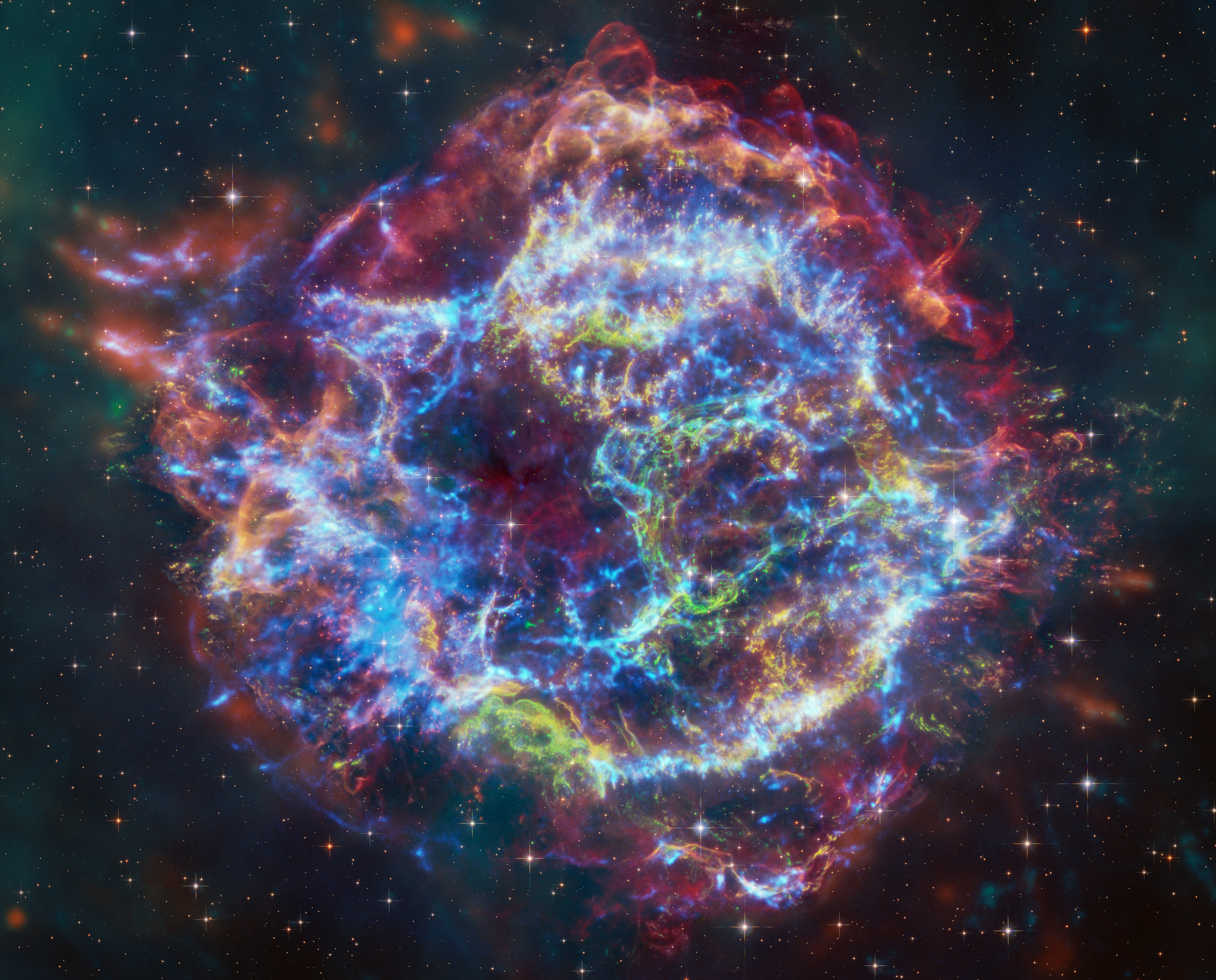
For the first time astronomers have combined data from NASA’s Chandra X-ray Observatory and James Webb Space Telescope to study the well-known supernova remnant Cassiopeia A (Cas A). As described in our latest press release, this work has helped explain an unusual structure in the debris from the destroyed star called the “Green Monster”, first discovered in Webb data in April 2023. The research has also uncovered new details about the explosion that created Cas A about 340 years ago, from Earth’s perspective.

A new composite image contains X-rays from Chandra (blue), infrared data from Webb (red, green, blue), and optical data from Hubble (red and white). The outer parts of the image also include infrared data from NASA’s Spitzer Space Telescope (red, green and blue). The outline of the Green Monster can be seen by mousing over the image.

The Chandra data reveals hot gas, mostly from supernova debris from the destroyed star, including elements like silicon and iron. In the outer parts of Cas A the expanding blast wave is striking surrounding gas that was ejected by the star before the explosion. The X-rays are produced by energetic electrons spiraling around magnetic field lines in the blast wave. These electrons light up as thin arcs in the outer regions of Cas A, and in parts of the interior. Webb highlights infrared emission from dust that is warmed up because it is embedded in the hot gas seen by Chandra, and from much cooler supernova debris. The Hubble data shows stars in the field.

A separate graphic shows a color Chandra image, where red shows iron and magnesium at low X-ray energies, green shows silicon at intermediate X-ray energies and blue shows the highest energy X-rays, from electrons spiraling around magnetic field lines. An outline of the Green Monster, plus the locations of the blast wave, and of debris rich in silicon and iron are labeled.

Chandra Image of Cassiopeia A, Labeled
Credit: X-ray: NASA/CXC/SAO

Detailed analysis by the researchers found that filaments in the outer part of Cas A, from the blast wave, closely matched the X-ray properties of the Green Monster, including less iron and silicon than in the supernova debris. This interpretation is apparent from the color Chandra image, which shows that the colors inside the Green Monster’s outline best match with the colors of the blast wave rather than the debris with iron and silicon. The authors conclude that the Green Monster was created by a blast wave from the exploded star slamming into material surrounding it, supporting earlier suggestions from the Webb data alone.

The debris from the explosion is seen by Chandra because it is heated to tens of millions of degrees by shock waves, akin to sonic booms from a supersonic plane. Webb can see some material that has not been affected by shock waves, what can be called “pristine” debris.

To learn more about the supernova explosion, the team compared the Webb view of the pristine debris with X-ray maps of radioactive elements that were created in the supernova. They used NASA’s Nuclear Spectroscopic Telescope Array (NuSTAR) data to map radioactive titanium — still visible today — and Chandra to map where radioactive nickel was by measuring the locations of iron. Radioactive nickel decays to form iron. An additional image shows the iron-rich debris (tracing where radioactive nickel was located) in green, the radioactive titanium in blue and the pristine debris seen in orange and yellow.

Iron/Titanium/Pristine Debris Cassiopeia A, Labeled
Credit: X-ray: NASA/CXC/SAO; Image Processing: NASA/CXC/SAO/J. Schmidt and J. Major

Some filaments of pristine debris near the center of Cas A, seen with Webb, are connected to the iron seen with Chandra farther out. Radioactive titanium is seen where pristine debris is relatively weak. These comparisons suggest that radioactive material seen in X-rays has helped shape the pristine debris near the center of the remnant seen with Webb, forming cavities. The fine structures in the pristine debris were most likely formed when the star’s inner layers were violently mixed with hot, radioactive matter produced during collapse of the star’s core under gravity.

These results were presented by Dan Milisavljevic from Purdue University at the 243rd meeting of the American Astronomical Society in New Orleans. They are described in more detail in two papers submitted to Astrophysical Journal Letters, one led by Milisavljevic focused on the Webb results (preprint here) and the other led by Jacco Vink of the University of Amsterdam focused on the Chandra results (preprint here). The co-authors of Vink’s paper are Manan Agarwal (University of Amsterdam, the Netherlands), Patrick Slane (Center for Astrophysics | Harvard & Smithsonian - CfA), Ilse De Looze (Ghent University, Belgium), Dan Milisavljevic, Daniel Patnaude (CfA), Paul Plucinsky (CfA), and Tea Temin (Princeton University). Related papers by other members of the research team are also in preparation.

The Smithsonian Astrophysical Observatory's Chandra X-ray Center controls science operations from Cambridge, Massachusetts, and flight operations from Burlington, Massachusetts.

The James Webb Space Telescope is the world's premier space science observatory. Webb is solving mysteries in our solar system, looking beyond to distant worlds around other stars, and probing the mysterious structures and origins of our universe and our place in it. Webb is an international program led by NASA with its partners, ESA (European Space Agency) and the Canadian Space Agency.

A Small Explorer mission led by Caltech and managed by JPL for NASA’s Science Mission Directorate in Washington, NuSTAR was developed in partnership with the Danish Technical University and the Italian Space Agency (ASI). The spacecraft was built by Orbital Sciences Corp. in Dulles, Virginia. NuSTAR’s mission operations center is at the University of California, Berkeley, and the official data archive is at NASA’s High Energy Astrophysics Science Archive Research Center at the agency’s Goddard Space Flight Center in Greenbelt, Maryland. ASI provides the mission’s ground station and a mirror data archive. Caltech manages JPL for NASA.


Visual Description:

This image of Cassiopeia A resembles a disk of electric light with red clouds, glowing white streaks, red and orange flames, and an area near the center of the remnant resembling a somewhat circular region of green lightning. X-rays from Chandra are blue and reveal hot gas, mostly from supernova debris from the destroyed star, and include elements like silicon and iron. X-rays are also present as thin arcs in the outer regions of the remnant.

Infrared data from Webb is red, green, and blue. Webb highlights infrared emission from dust that is warmed up because it is embedded in the hot gas seen by Chandra, and from much cooler supernova debris. Hubble data shows a multitude of stars that permeate the field of view.


Fast Facts for (Cassiopeia A):

Scale: Image is about 8 arcmin (25.5 light-years) across.
Category: Supernovas & Supernova Remnants
Coordinates (J2000): RA 23h 23m 26.7s | Dec +58° 49´ 03.00"
Constellation: Cassiopeia
Observation Dates: Nine observations in 2004: Feb 8, Apr 14, 18, 20, 22, 25 28, May 1, 5
Observation Time: 277 hours 58 minutes (11 days 13 hours 58 minutes)
Obs. ID: 4634-4639, 5196, 5319-5320
Instrument: ACIS
Also Known As: Cas A
References: Vink, J. et al. 2024, ApJ, submitted. Milisavljevic, D. et al. 2024, ApJ, submitted.
Color Code: X-ray: blue; Optical: red, white; Infrared: red, green, blue
Distance Estimate: About 11,000 light-years


Friday, January 12, 2024

Missing link found: supernovae give rise to black holes or neutron stars

PR Image eso2401a
A star goes supernova in a binary system

PR Image eso2401b
A supernova leaves behind a compact object in a binary system

PR Image eso2401c
A compact object and its companion star


Videos
 
Supernovae give rise to black holes or neutron stars (ESOcast 269 Light)
PR Video eso2401a
Supernovae give rise to black holes or neutron stars (ESOcast 269 Light)


Astronomers have found a direct link between the explosive deaths of massive stars and the formation of the most compact and enigmatic objects in the Universe — black holes and neutron stars. With the help of the European Southern Observatory’s Very Large Telescope (ESO’s VLT) and ESO’s New Technology Telescope (NTT), two teams were able to observe the aftermath of a supernova explosion in a nearby galaxy, finding evidence for the mysterious compact object it left behind.

When massive stars reach the end of their lives, they collapse under their own gravity so rapidly that a violent explosion known as a supernova ensues. Astronomers believe that, after all the excitement of the explosion, what is left is the ultra-dense core, or compact remnant, of the star. Depending on how massive the star is, the compact remnant will be either a neutron star — an object so dense that a teaspoon of its material would weigh around a trillion kilograms here on Earth — or a black hole — an object from which nothing, not even light, can escape.

Astronomers have found many clues hinting at this chain of events in the past, such as finding a neutron star within the Crab Nebula, the gas cloud left behind when a star exploded nearly a thousand years ago. But they had never before seen this process happen in real time, meaning that direct evidence of a supernova leaving behind a compact remnant has remained elusive. “In our work, we establish such a direct link,” says Ping Chen, a researcher at the Weizmann Institute of Science, Israel, and lead author of a study published today in Nature and presented at the 243rd American Astronomical Society meeting in New Orleans, USA.

The researchers’ lucky break came in May 2022, when South African amateur astronomer Berto Monard discovered the supernova SN 2022jli in the spiral arm of the nearby galaxy NGC 157, located 75 million light-years away. Two separate teams turned their attention to the aftermath of this explosion and found it to have a unique behaviour.
After the explosion, the brightness of most supernovae simply fades away with time; astronomers see a smooth, gradual decline in the explosion’s ‘light curve’. But SN 2022jli’s behaviour is very peculiar: as the overall brightness declines, it doesn’t do so smoothly, but instead oscillates up and down every 12 days or so. “In SN 2022jli’s data we see a repeating sequence of brightening and fading,” says Thomas Moore, a doctoral student at Queen’s University Belfast, Northern Ireland, who led a study of the supernova published late last year in the Astrophysical Journal. “This is the first time that repeated periodic oscillations, over many cycles, have been detected in a supernova light curve,” Moore noted in his paper. Both the Moore and Chen teams believe that the presence of more than one star in the SN 2022jli system could explain this behaviour. In fact, it’s not unusual for massive stars to be in orbit with a companion star in what is known as a binary system, and the star that caused SN 2022jli was no exception. What is remarkable about this system, however, is that the companion star appears to have survived the violent death of its partner and the two objects, the compact remnant and the companion, likely kept orbiting each other.

The data collected by the Moore team, which included observations with ESO’s NTT in Chile’s Atacama Desert, did not allow them to pin down exactly how the interaction between the two objects caused the highs and lows in the light curve. But the Chen team had additional observations. They found the same regular fluctuations in the system’s visible brightness that the Moore team had detected, and they also spotted periodic movements of hydrogen gas and bursts of gamma rays in the system. Their observations were made possible thanks to a fleet of instruments on the ground and in space, including X-shooter on ESO's VLT, also located in Chile.

Putting all the clues together, the two teams generally agree that when the companion star interacted with the material thrown out during the supernova explosion, its hydrogen-rich atmosphere became puffier than usual. Then, as the compact object left behind after the explosion zipped through the companion’s atmosphere on its orbit, it would steal hydrogen gas, forming a hot disc of matter around itself. This periodic stealing of matter, or accretion, released lots of energy that was picked up as regular changes of brightness in the observations.

Even though the teams could not observe light coming from the compact object itself, they concluded that this energetic stealing can only be due to an unseen neutron star, or possibly a black hole, attracting matter from the companion star’s puffy atmosphere. “Our research is like solving a puzzle by gathering all possible evidence,” Chen says. “All these pieces lining up lead to the truth.

With the presence of a black hole or neutron star confirmed, there is still plenty to unravel about this enigmatic system, including the exact nature of the compact object or what end could await this binary system. Next-generation telescopes such as ESO’s Extremely Large Telescope, scheduled to begin operation later this decade, will help with this, allowing astronomers to reveal unprecedented details of this unique system.

Source: ESO/News


More information

This research was presented in two papers. The team led by P. Chen published a paper titled “A 12.4 day periodicity in a close binary system after a supernova” in Nature (doi: 10.1038/s41586-023-06787-x).

The team is composed of P. Chen (Department of Particle Physics and Astrophysics, Weizmann Institute of Science, Israel [Weizmann Institute]), A. Gal-Yam (Weizmann Institute), J. Sollerman (The Oskar Klein Centre, Department of Astronomy, Stockholm University, Sweden [OKC DoA]), S. Schulze (The Oskar Klein Centre, Department of Physics, Stockholm University, Sweden [OKC DoP]), R. S. Post (Post Observatory, Lexington, USA), C. Liu (Department of Physics and Astronomy, Northwestern University, USA [Northwestern]; Center for Interdisciplinary Exploration and Research in Astrophysics, Northwestern University, USA [CIERA]), E. O. Ofek (Weizmann Institute), K. K. Das (Cahill Center for Astrophysics, California Institute of Technology, USA [Cahill Center]), C. Fremling (Caltech Optical Observatories, California Institute of Technology, USA [COO]; Division of Physics, Mathematics and Astronomy, California Institute of Technology, USA [PMA]), A. Horesh (Racah Institute of Physics, The Hebrew University of Jerusalem, Israel), B. Katz (Weizmann Institute), D. Kushnir (Weizmann Institute), M. M. Kasliwal (Cahill Center), S. R. Kulkarni (Cahill Center), D. Liu (South-Western Institute for Astronomy Research, Yunnan University, China [Yunnan]), X. Liu (Yunnan), A. A. Miller (Northwestern; CIERA), K. Rose (Sydney Institute for Astronomy, School of Physics, The University of Sydney, Australia), E. Waxman (Weizmann Institute), S. Yang (OKC DoA; Henan Academy of Sciences, China), Y. Yao (Cahill Center), B. Zackay (Weizmann Institute), E. C. Bellm (DIRAC Institute, Department of Astronomy, University of Washington, USA), R. Dekany (COO), A. J. Drake (PMA), Y. Fang (Yunnan), J. P. U. Fynbo (The Cosmic DAWN Center, Denmark; Niels Bohr Institute, University of Copenhagen, Denmark), S. L. Groom (IPAC, California Institute of Technology, USA [IPAC]), G. Helou (IPAC), I. Irani (Weizmann Institute), T. J. du Laz (PMA), X. Liu (Yunnan), P. A. Mazzali (Astrophysics Research Institute, Liverpool John Moores University, UK; Max Planck Institute for Astrophysics, Germany), J. D. Neill (PMA), Y.-J. Qin (PMA), R. L. Riddle (COO), A. Sharon (Weizmann Institute), N. L. Strotjohann (Weizmann Institute), A. Wold (IPAC), L. Yan (COO).

The team led by T. Moore published a paper titled “SN 2022jli: A Type 1c Supernova with Periodic Modulation of Its Light Curve and an Unusually Long Rise” in The Astrophysical Journal Letters (doi: 10.3847/2041-8213/acfc25).

T. Moore (Astrophysics Research Centre, Queenʼs University Belfast, UK [Queen’s]), S. J. Smartt (Queen’s; Department of Physics, University of Oxford, UK [Oxford]), M. Nicholl (Queen’s), S. Srivastav (Queen’s), H. F. Stevance (Oxford; Department of Physics, The University of Auckland, New Zealand), D. B. Jess (Queen’s; Department of Physics and Astronomy, California State University Northridge, USA), S. D. T. Grant (Queen’s), M. D. Fulton (Queen’s), L. Rhodes (Oxford), S. A. Sim (Queen’s), R. Hirai (OzGrav: The Australian Research Council Centre of Excellence for Gravitational Wave Discovery, Australia; School of Physics and Astronomy, Monash University, Australia), P. Podsiadlowski (University of Oxford, UK), J. P. Anderson (European Southern Observatory, Chile; Millennium Institute of Astrophysics MAS, Chile), C. Ashall (Department of Physics, Virginia Tech, USA), W. Bate (Queen’s), R. Fender (Oxford), C. P. Gutiérrez (Institut d’Estudis Espacials de Catalunya, Spain [IEEC]; Institute of Space Sciences, Campus UAB, Spain [ICE, CSIC]), D. A. Howell (Las Cumbres Observatory, USA [Las Cumbres]; Department of Physics, University of California, Santa Barbara, USA [UCSB]), M. E. Huber (Institute for Astronomy, University of Hawai’i, USA [Hawai’i]), C. Inserra (Cardiff Hub for Astrophysics Research and Technology, Cardiff University, UK), G. Leloudas (DTU Space, National Space Institute, Technical University of Denmark, Denmark), L. A. G. Monard (Kleinkaroo Observatory, South Africa), T. E. Müller-Bravo (IEEC; ICE, CSIC), B. J. Shappee (Hawai’i), K. W. Smith (Queen’s), G. Terreran (Las Cumbres), J. Tonry (Hawai’i), M. A. Tucker (Department of Astronomy, The Ohio State University, USA; Department of Physics, The Ohio State University, USA; Center for Cosmology and Astroparticle Physics, The Ohio State University, USA), D. R. Young (Queen’s), A. Aamer (Queen’s; Institute for Gravitational Wave Astronomy, University of Birmingham, UK [IGWA]; School of Physics and Astronomy, University of Birmingham, UK [Birmingham]), T.-W. Chen (Graduate Institute of Astronomy, National Central University, Taiwan), F. Ragosta (INAF, Osservatorio Astronomico di Roma, Italy; Space Science Data Center—ASI, Italy), L. Galbany (IEEC; ICE, CSIC), M. Gromadzki (Astronomical Observatory, University of Warsaw, Poland), L. Harvey (School of Physics, Trinity College Dublin, The University of Dublin, Ireland), P. Hoeflich (Department of Physics, Florida State University, USA), C. McCully (Las Cumbres), M. Newsome (Las Cumbres; UCSB), E. P. Gonzalez (Las Cumbres; UCSB), C. Pellegrino (Las Cumbres; UCSB), P. Ramsden (Birmingham; IGWA), M. Pérez-Torres (Instituto de Astrofísica de Andalucía (IAA-CSIC), Spain; School of Sciences, European University Cyprus, Cyprus), E. J. Ridley (IGWA; Birmingham), X. Sheng (Queen’s), and J. Weston (Queen’s)

The European Southern Observatory (ESO) enables scientists worldwide to discover the secrets of the Universe for the benefit of all. We design, build and operate world-class observatories on the ground — which astronomers use to tackle exciting questions and spread the fascination of astronomy — and promote international collaboration for astronomy. Established as an intergovernmental organisation in 1962, today ESO is supported by 16 Member States (Austria, Belgium, the Czech Republic, Denmark, France, Finland, Germany, Ireland, Italy, the Netherlands, Poland, Portugal, Spain, Sweden, Switzerland and the United Kingdom), along with the host state of Chile and with Australia as a Strategic Partner. ESO’s headquarters and its visitor centre and planetarium, the ESO Supernova, are located close to Munich in Germany, while the Chilean Atacama Desert, a marvellous place with unique conditions to observe the sky, hosts our telescopes. ESO operates three observing sites: La Silla, Paranal and Chajnantor. At Paranal, ESO operates the Very Large Telescope and its Very Large Telescope Interferometer, as well as survey telescopes such as VISTA. Also at Paranal ESO will host and operate the Cherenkov Telescope Array South, the world’s largest and most sensitive gamma-ray observatory. Together with international partners, ESO operates ALMA on Chajnantor, a facility that observes the skies in the millimetre and submillimetre range. At Cerro Armazones, near Paranal, we are building “the world’s biggest eye on the sky” — ESO’s Extremely Large Telescope. From our offices in Santiago, Chile we support our operations in the country and engage with Chilean partners and society,


Links


Contacts

Ping Chen
Weizmann Institute of Science
Rehovot, Israel
Tel: +972 8 934 6512
Email:
chen.ping@weizmann.ac.il

Thomas Moore
Queen’s University Belfast
Belfast, Northern Ireland, UK
Email:
tmoore11@qub.ac.uk

Jesper Sollerman
Department of Astronomy, Stockholm University
Stockholm, Sweden
Tel: +46 8 5537 8554
Email:
jesper@astro.su.se

Matt Nicholl
Queen’s University Belfast
Belfast, Northern Ireland, UK
Email:
matt.nicholl@qub.ac.uk

Bárbara Ferreira
ESO Media Manager
Garching bei München, Germany
Tel: +49 89 3200 6670
Cell: +49 151 241 664 00
Email:
press@eso.org