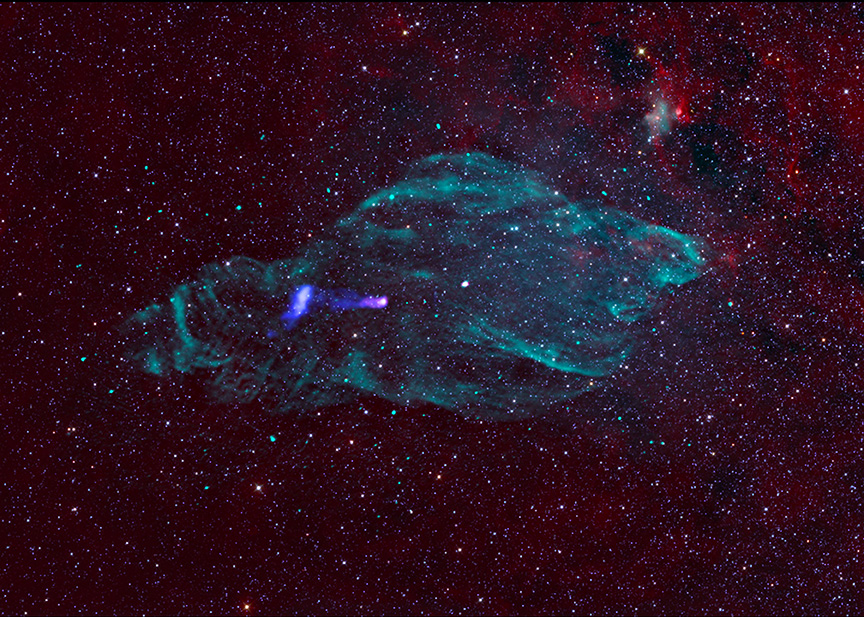
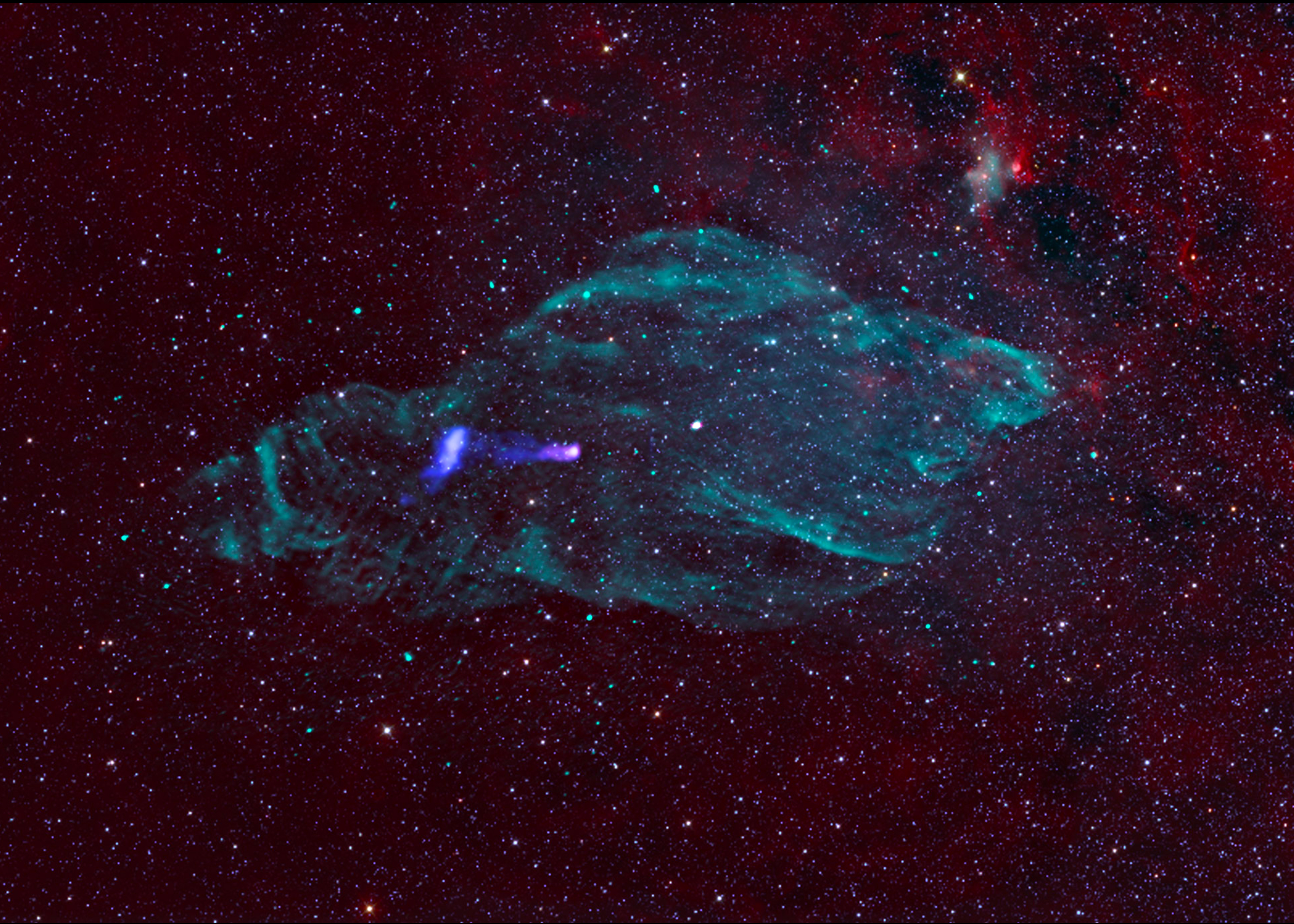
Figure 1 shows a composite X-ray image of the radio nebula W50 taken with the eROSITA telescope. The surface brightness of the X-ray emission is colour-coded in the 0.5–1 keV (red), 1–2 keV (green), and 2–4 keV (blue) energy bands. The white arrows depict the projection of the SS433 jets' precession cone extrapolated to distances of more than 100 pc. The hard and soft X-ray diffuse emission can be convincingly split into two components: softer filamentary emission (red-yellow) and harder (green-blue) emission from EXJs. Additionally, there are numerous nearby compact sources, such as active stars and accreting white dwarfs, as well as distant compact sources, mostly AGN. For distant sources, absorption by Milky Way gas suppresses emission below 1 or 2 keV, giving them a blue colour. © MPA; eROSITA/SRG

Figure 2 shows a schematic summary of the W50 nebula superimposed on a composite X-ray (red and green) and radio (VLA at 1.4 GHz, blue) image. Radio emission most likely arises at the outer, shell-like boundary of the nebula, while soft X-ray emission (0.3–0.9 keV) traces shock-heated interstellar medium (ISM) gas behind it, filling almost the entire interior of the nebula. The harder X-ray emission (0.9–2.7 keV in this case) is of a non-thermal (synchrotron) nature and may be produced by ultrarelativistic electrons that are accelerated at the shocks in the axial outflows from the system. The central part of the nebula, within 25 pc of SS433 (dashed circle), is likely to be of very low density and could be a wind-blown cavity created by an almost spherically symmetric outflow with a kinetic luminosity close to the Eddington limit. © MPA; eROSITA/SRG
Rare or unusual astrophysical objects are used to test the limits of theoretical models because of their extreme properties. The bright X-ray source SS433 in our galaxy undoubtedly belongs to this category. Initially identified as an Hα emitter, it was later recognised as a black hole in a binary system. Since then, SS433, which emits strongly in the radio and X-ray bands, has been targeted by almost every space- and ground-based observatory, leading to a flurry of discoveries. In contrast, the surrounding huge W50 nebula, spanning more than two degrees, is much fainter and difficult to study. The complete radio image earned W50 the nickname 'Manatee Nebula', while X-ray maps were mostly patches from different observatories or lacked spatial or energy resolution. This shortcoming has finally been overcome by the recently published SRG/eROSITA map of W50 in multiple X-ray colours, which reveals a beautiful blend of thermal and non-thermal processes within an elongated cocoon.
At the core of the W50 nebula lies a compact source (most likely a stellar-mass black hole) that accretes matter from a companion star at an astonishingly high rate — thousands of times greater than the amount the black hole can digest. This limiting rate (known as the Eddington accretion rate) arises due to the pressure exerted by the radiation produced by the infalling gas. This configuration has an immediate impact on the observational appearance of the compact source and its large-scale environment. The key prediction of the accretion theory is that most of the gas supplied to the black hole will be expelled from the system, depositing a large amount of energy into the ambient medium in the process (see Highlight September 2024).
The W50 nebula is well known in radio astronomy for its croissant-like shape. Mapping this large nebula in X-rays used to be problematic due to the limited field of view of space telescopes. Additionally, strong and inhomogeneous absorption by gas and dust occurs in the direction of W50, which is located just two degrees away from the Galactic Plane. These problems can be resolved by using a telescope with a large field of view and high sensitivity to diffuse emission — the very characteristics of the eROSITA telescope on board the SRG observatory.
The full-size X-ray map of the W50 nebula is shown in Fig. 1. The central bright spot is the black hole that powers the entire nebula. It appears extended because it is much brighter than the nebula emission, causing the central part of the image to become saturated.
The 'X-ray colours' in this figure serve the same role as red, green, and blue colours in visible light. Specifically, red corresponds to X-ray photons with a longer wavelength, while green and blue correspond to progressively shorter wavelengths. Remarkably, this simple approach immediately reveals the nature of the X-ray emission: red and yellow colours dominate where thermal plasma with a temperature of 2–10 million degrees is present. Conversely, in the bluer regions, non-thermal emission from relativistic particles dominates.
The nebula is clearly asymmetric, most likely due to a gradient in the ambient gas density surrounding it. The most remarkable feature is the so-called 'Extended X-ray Jets' (EXJs), which have sharp inner edges located around 25 parsecs from the central black hole SS433. Their spectra do not have the emission lines characteristic of thermal plasma. Rather, they must be due to the emission of relativistic particles accelerated by shocks powered by SS433’s outflows. These structures have recently been detected at TeV energies; each TeV photon carries a billion times more energy than a soft X-ray photon at keV energies.
These new X-ray data support the idea that the energy flow from SS433 evolves through three distinct stages:
1) an invisible 'dark' flow of energy between the black hole and the EXJs, presumably carried by a cold wind from the binary system;
2) a 'non-thermal' flow of energy over some 30 pc in the form of EXJs; and
3) a thermal flow (i.e., shock-heated interstellar medium (ISM)) that envelops the EXJs.
The thermal part of the W50 X-ray emission can be reasonably well described by a shock-heated plasma that has not yet reached temperature and ionisation equilibrium. Such emission is typical of middle-aged or old supernova remnants (SNRs). The outer radio boundary of the nebula also resembles SNR shocks (see Fig. 2).
In contrast, the 'extended X-ray jets' are the most remarkable features of this system on tens-of-pc scales. Their sharp inner edges plausibly correspond to extreme shocks that accelerate particles and power the X-ray (synchrotron) and TeV emission, which is 9–10 orders of magnitude more energetic. The W50/SS433 system clearly illustrates the important role that hyper-Eddington accretors might play in the energetics of the interstellar medium in galaxies at different redshifts, as well as in the production of ultra-high-energy particles.
In contrast, the 'extended X-ray jets' are the most remarkable features of this system on tens-of-pc scales. Their sharp inner edges plausibly correspond to extreme shocks that accelerate particles and power the X-ray (synchrotron) and TeV emission, which is 9–10 orders of magnitude more energetic. The W50/SS433 system clearly illustrates the important role that hyper-Eddington accretors might play in the energetics of the interstellar medium in galaxies at different redshifts, as well as in the production of ultra-high-energy particles.
Authors:
Rashid Sunyaev
Emeritus Director
Tel: 2244
Email: rsunyaev@mpa-garching.mpg.de
Eugene Churazov
Scientific Staff
Tel: 2219
Email: echurazov@mpa-garching.mpg.de
Original publication
Sunyaev R., Khabibullin I., Churazov E., Gilfanov M., Medvedev P., Sazonov S.
X-ray panorama of the SS433/W50 complex by SRG/eROSITA
A&A, in press
DOI