Showing posts with label debris disks. Show all posts

Thursday, January 22, 2026

ALMA Reveals Teenage Years of New Worlds

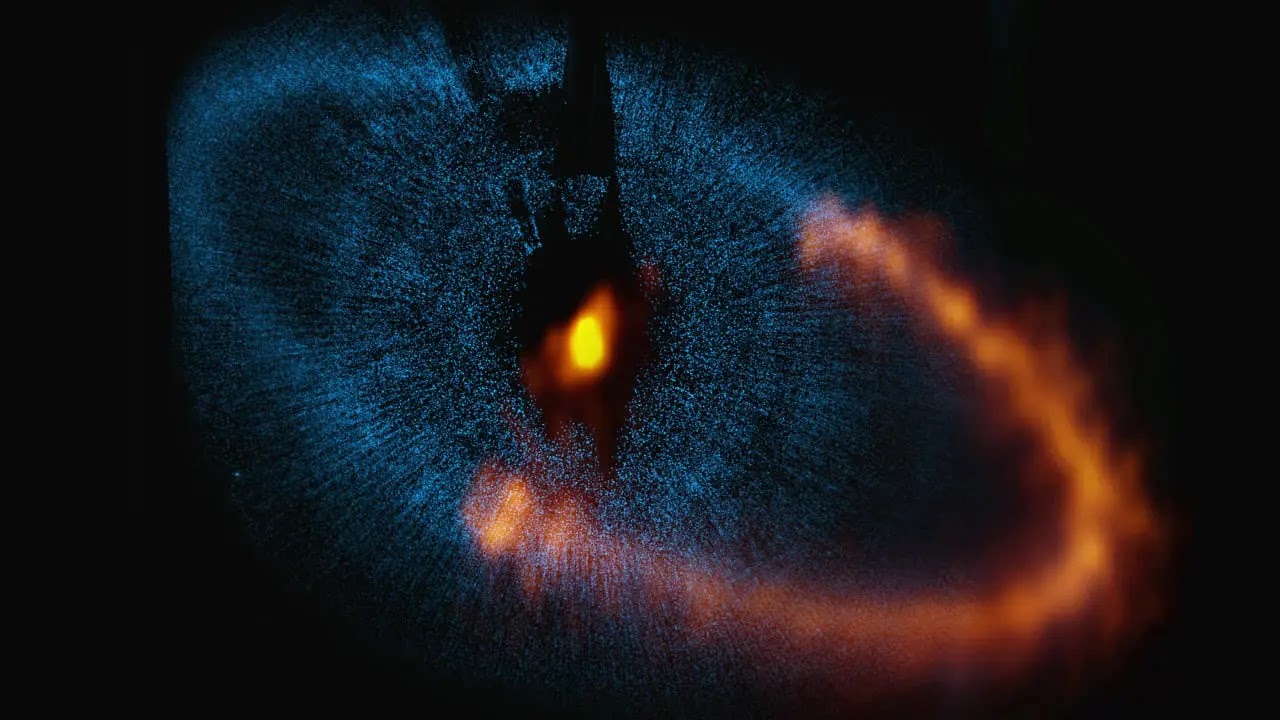
This ARKS gallery of faint debris disks reveals details about their shape: belts with multiple rings, wide smooth halos, sharp edges, and unexpected arcs and clumps, which hint at the presence of planets shaping these disks; and chemical make-up: the amber colors highlight the location and abundance of the dust in the 24 disks surveyed, while the blue their carbon monoxide gas location and abundance in the six gas-rich disks. Credit: Sebastian Marino, Sorcha Mac Manamon, and the ARKS collaboration. Hi-Res File


New astronomical survey captures previously unknown growing pains in the lives of planets

Astronomers have, for the first time, captured a detailed snapshot of planetary systems in an era long shrouded in mystery. The ALMA survey to Resolve exoKuiper belt Substructures (ARKS), using the Atacama Large Millimeter/submillimeter Array (ALMA), has produced the sharpest images ever of 24 debris disks, the dusty belts left after planets finish forming. These disks are the cosmic equivalent of the teenage years for planetary systems—somewhat more mature than newborn, planet-forming disks, but not yet settled into adulthood.

A Missing Link in Planetary Family Albums

“We’ve often seen the ‘baby pictures’ of planets forming, but until now, the ‘teenage years’ have been a missing link,” says Meredith Hughes, an Associate Professor of Astronomy at Wesleyan University and co-PI of this study.

Our own Solar System’s counterpart to this phase is the Kuiper Belt, a ring of icy debris beyond Neptune that preserves a record of massive collisions and planetary migrations from billions of years ago. By studying 24 exoplanetary debris belts, the ARKS team has opened a window into what our Solar System went through as the Moon was forming and as planets jostled for their final places, and sometimes trading orbits!

Teenage Disks: Hard to “Photograph,” Impossible to Ignore

Debris disks are faint, hundreds or even thousands of times dimmer than the bright, gas-rich disks where planets are born. The ARKS team overcame these challenges and produced images of these disks in unprecedented detail. Like teenagers dodging the camera, these faint disks have managed to hide from astronomers for years. But, thanks to ALMA, astronomers can now see their complex structures: belts with multiple rings, wide smooth halos, sharp edges, and even unexpected arcs and clumps.

“We’re seeing real diversity—not just simple rings, but multi-ringed belts, halos, and strong asymmetries, revealing a dynamic and violent chapter in planetary histories,” adds Sebastián Marino, program lead for ARKS, and an Associate Professor at the University of Exeter.

Highlights and Firsts from ARKS
  • A New Benchmark: ARKS is the largest, highest-resolution survey of debris disks, akin to a ‘DSHARP-for-debris-disks’, setting a new gold standard.

  • A Dynamic, Violent Youth: About one-third of observed disks show clear substructures (multiple rings or distinct gaps) suggesting legacy features left from earlier, planet-building stages or sculpted by planets over much longer timescales.

  • Unexpected Diversity: While some disks inherit intricate structures from their earlier years, others mellow out and spread into broad belts, similar to how we expect the Solar System to have developed.

  • Clues to Planetary ‘Stirring’: Many disks show evidence for zones of calm and chaos, with vertically “puffed-up” regions, akin to our Solar System’s own mix of serene classical Kuiper Belt objects and those scattered by Neptune’s long-ago migration.

  • Surprising Gas Survivors: Several disks retain gas much longer than expected. In some systems, lingering gas may shape the chemistry of growing planets, or even push dust into wide halos.

  • Asymmetries and Arcs: Many disks are lopsided, with bright arcs or eccentric shapes, hinting at gravitational shoves from unseen planets, leftover birth scars from planetary migration, or interactions between the gas and dust.

  • Public Data Release: All ARKS observations and processed data are being made freely available to astronomers worldwide, enabling further discoveries.

Implications: Your Solar System Was Once a Wild Ride

The ARKS results show this teenage phase is a time of transition and turmoil. “These disks record a period when planetary orbits were being scrambled and huge impacts, like the one that forged Earth’s Moon, were shaping young solar systems,” says Luca Matrà, a co-PI on the survey, and Associate Professor at Trinity College Dublin.

By looking at dozens of disks around stars of different ages and types, ARKS helped decode whether chaotic features are inherited, sculpted by planets, or arise from other cosmic forces. Answering these questions could reveal whether our Solar System’s history was unique, or the norm.

Looking Ahead: Hunting for Planetary Architects

The ARKS survey’s findings are a treasure trove for astronomers hunting for young planets and seeking to understand how planet families, like our own, are built and rearranged.

“This project gives us a new lens for interpreting the craters on the Moon, the dynamics of the Kuiper Belt, and the growth of planets big and small. It’s like adding the missing pages to the Solar System’s family album,” adds Hughes.

The ARKS survey is the work of an international team of approximately 60 scientists, led by the University of Exeter, Trinity College Dublin, and Wesleyan University. For more information, visit https://arkslp.org/.


About ALMA

The Atacama Large Millimeter/submillimeter Array (ALMA), an international astronomy facility, is a partnership of the European Southern Observatory (ESO), the U.S. National Science Foundation (NSF) and the National Institutes of Natural Sciences (NINS) of Japan in cooperation with the Republic of Chile. ALMA is funded by ESO on behalf of its Member States, by NSF in cooperation with the National Research Council of Canada (NRC) and the National Science and Technology Council (NSTC) in Taiwan and by NINS in cooperation with the Academia Sinica (AS) in Taiwan and the Korea Astronomy and Space Science Institute (KASI). ALMA construction and operations are led by ESO on behalf of its Member States; by the National Radio Astronomy Observatory (NRAO), managed by Associated Universities, Inc. (AUI), on behalf of North America; and by the National Astronomical Observatory of Japan (NAOJ) on behalf of East Asia. The Joint ALMA Observatory (JAO) provides the unified leadership and management of the construction, commissioning and operation of ALMA.


About NRAO

The National Radio Astronomy Observatory (NRAO) is a facility of the U.S. National Science Foundation, operated under cooperative agreement by Associated Universities, Inc.


Leadership Team

S. Marino (University of Exeter), A. M. Hughes (Wesleyan University), and L. Matrà (Trinity College Dublin)


Collaboration Members

Y. Han (Caltech), B. Zawadzki (Wesleyan University), S. Mac Manamon (Trinity College Dublin), J. Milli (IPAG), J. B. Lovell (Center for Astrophysics, Harvard & Smithsonian), A. Brennan (Trinity College Dublin), P. Weber (Usach, Núcleo Milenio YEMS), M. R. Jankovic (University of Belgrade), M. C. Wyatt (University of Cambridge), T. Löhne (Friedrich-Schiller-Universität Jena), P. Ábrahám (Konkoly Observatory), M. Bonduelle (IPAG), A. S. Hales (NRAO), M. Booth (UKATC), C. del Burgo (Universidad de La Laguna; Instituto de Astrofísica de Canarias), J. M. Carpenter (ALMA), G. Cataldi (NAOJ), E. Chiang (Berkeley), E. Choquet (LAM), S. Ertel (University of Arizona), A. Fehr (Center for Astrophysics, Harvard & Smithsonian), J. Olofsson (ESO), Th. Henning (MPIA), J. Jennings (Flatiron Institute), G. M. Kennedy (Victoria University), Á. Kóspál (Konkoly Observatory), A. V. Krivov (Friedrich-Schiller-Universität Jena), P. Luppe (Trinity College Dublin), M. A. MacGregor (Johns Hopkins University), E. Mansell (Wesleyan University), J. P. Marshall (ASIAA), B. C. Matthews (University of Victoria), A. Moór (Konkoly Observatory), K. Öberg (Center for Astrophysics, Harvard & Smithsonian), N. Pawellek (University of Vienna), T. D. Pearce (University of Warwick), S. Pérez (Usach, Núcleo Milenio YEMS), A. A. Sefilian (University of Arizona), A. G. Sepulveda (UT Law), D. J. Wilner (Center for Astrophysics, Harvard & Smithsonian), C. Baruteau (IRAP), R. Bendahan-West (University of Exeter), A. Bayo (ESO), R. Booth (University of Leeds), F. Castillo (Usach, Núcleo Milenio YEMS), A. Cheruiyot (Wesleyan University), J. Ehrhardt (ESO), Th. M. Esposito (Berkeley), V. Gupta (University of Exeter), J. Hom (University of Arizona), A. Higuchi (Musashino University), C. Hou (Wesleyan University), J. Kittling (KIPAC), Hiroshi Kobayashi (Nagoya University), J. Lee (Wesleyan University), Y. Mpofu (Wesleyan University), R. Nakatani (UNIMI), A. Nurmohamed (Wesleyan University), M. Pan (Center for Astrophysics, Harvard & Smithsonian), V. Squicciarini (University of Exeter), J. Zander (Friedrich-Schiller-Universität Jena).

Funding Acknowledgement

ARKS would not have been possible without the support of ALMA and its partners—the European Southern Observatory representing its member states, the United States National Science Foundation, and the National Institutes of Natural Sciences of Japan, together with the National Research Council of Canada, the Ministry of Science and Technology of Taiwan and the Academia Sinica Institute of Astronomy and Astrophysics, and the Korea Astronomy and Space Science Institute, in cooperation with the Republic of Chile; the Beatriz Galindo grant program; the Brinson Foundation; the Canadian Advanced Network for Astronomy Research supported by the National Research Council of Canada, the Canadian Space Agency, CANARIE, the Canadian Foundation for Innovation, and the Digital Research Alliance of Canada; the Chilean National Agency for Research and Development including the FONDECYT programme and the Millennium Science Initiative Program; the Consejería de Economía, Conocimiento y Empleo of the Government of the Canary Islands; the European Research Council (grants FEED and E-BEANS, numbers 101162711 and 100117693 ); the French National Planetology Program; the French National Research Agency; the Gates Cambridge Trust; the Heising–Simons Foundation; the Hungarian Ministry of Culture and Innovation through the National Research, Development and Innovation Fund; the Irish Research Council; the Institute of Physics Belgrade; Marie Skłodowska-Curie Actions; the NASA Connecticut Space Grant Consortium; the NASA Exoplanet Research Program; the North American ALMA Science Center; the Opticon–RadioNet Pilot funded by the European Union’s Horizon 2020 research and innovation programme; the Royal Society; the Smithsonian Institution; the Simons Foundation; the Space Telescope Science Institute; the Spanish Ministry of Science, Innovation and Universities and the European Regional Development Fund; the United Kingdom node of the European ALMA Regional Centre; United Kingdom Research and Innovation; the United States National Science Foundation; the University of La Laguna; the Warwick Prize Fellowship; the Ministry of Science, Technological Development and Innovations of the Republic of Serbia; and the National Science and Technology Council of Taiwan.


Monday, December 15, 2025

Michelangelo in Space: A Planet Carving the Fomalhaut Debris Disk?

This image combines observations from the Hubble Space Telescope and the Atacama Large Millimeter/submillimeter Array to show the dusty debris disk surrounding the star Fomalhaut. Credit:
ALMA (ESO/NAOJ/NRAO). Visible light image: the NASA/ESA Hubble Space Telescope A. Fujii/Digitized Sky Survey 2. Acknowledgment: Davide De Martin (ESA/Hubble); CC BY 4.0


Title:ALMA Reveals an Eccentricity Gradient in the Fomalhaut Debris Disk
Authors: Joshua B. Lovell et al.
First Author’s Institution: Center for Astrophysics | Harvard & Smithsonian
Status: Published in ApJ

Step 1: Understanding How to Carve Your Debris Disk

Let’s start with our solar system: the Kuiper belt, a large ring of icy asteroids, is believed to have been sculpted into its current shape by Neptune. Neptune may have previously scattered objects in the Kuiper Belt through gravitational interactions, but some of them (like Pluto) remain in an orbital resonance with Neptune. In the same way that Neptune shapes the Kuiper Belt, today’s authors believe a planet could be shaping an exo-Kuiper Belt around the star Fomalhaut.
.
What on Neptune is an orbital resonance, though? A planet orbiting a star has an orbital period, and the gravitational forces between nearby (astronomically speaking) objects can push these objects into a state where their orbital periods are multiples of each other. For example, Pluto and Neptune have a 2:3 orbital resonance, meaning Pluto completes two orbits for every three that Neptune does. The same can happen for the asteroids and planetesimals in the Kuiper Belt, so the same should happen in other star systems!
.
Step 2: Make Your Observations

If we understand how debris disks carved by exoplanets look — and we think we do — then we should be able to infer the existence of exoplanets! Today’s authors have used observations from the Atacama Large Millimeter/submillimeter Array (ALMA) of the debris disk around Fomalhaut and made some very clever calculations. We’ve known about this disk for a while, which is why today’s authors have studied it with a new analysis technique they developed.

Planeteismals — basically big rocks from a few to hundreds of kilometers across — that orbit in this disk do so with a certain eccentricity, and typically things in the same orbit would have the same eccentricity. But today’s authors were clever — they checked if there was an eccentricity gradient, meaning the planetesimals’ eccentricities depend on their semi-major axis (i.e., the mean orbit radius); we would typically not expect any eccentricity gradient for bodies orbiting a star unperturbed. The authors discovered that the gradient for planetesimals around Fomalhaut is negative, which implies the presence of a planet when you look at the maths behind gravitational interactions between planets and planetesimals.

A negative eccentricity gradient means the planetesimals gather up at the point on the orbit farthest from the star (the apocenter), and since there are more planetesimals in that region, they appear brighter in the ALMA data (see Fig. 1 left); the ring also appears slightly wider. If the eccentricity gradient were positive, the same thing would happen at the point on the orbit closest to the star (the pericenter). The authors term this phenomenon the “eccentric velocity divergence.”


Figure 1: Left: The observed intensity of the Fomalhaut debris disk with ALMA. Middle: the authors’ model that fits the ALMA data the best. Right: The residual (data – model) between model and data. White means there is a close match to the data (which is better). Credit: Lovell et al. 2025


When the authors ran their eccentric velocity divergence calculations for the Fomalhaut disk model, they compared it to observations using a Markov Chain Monte Carlo algorithm.

Figure 1 shows their best-fitting model, which fits remarkably well, based on the residual (i.e., the difference between model and data) you can see on the right — including the slightly wider ring at the apocenter!

The authors tested other scenarios with different gradients and allowed for the planetesimals to oscillate their eccentricity around their orbit, but they didn’t find a better-fitting scenario.

Step 3: Find a Carving Planet

Okay, so those were the details. The authors investigated a few scenarios to see what could be causing the observed debris disk and its negative eccentricity gradient, as well as an intermediate ring sitting between the main disk and the star that recently was seen with JWST. The authors tested two scenarios: one where a planet sits between the rings and evacuates the nearby region, and another where a planet is interior to the inner ring and clears the gap through orbital resonances (kind of like Neptune!). An illustration can be seen in Figure 2.

Figure 2: Illustration of possible planet-based scenarios that could create the observed debris disk around Fomalhaut. One features a planet between the observed debris disk rings, and another is where the planet is interior to both and carves the gap with orbital resonances. Credit: J. Williams


A planet was previously thought to exist around Fomalhaut, but it is now accepted there is not one we can currently observe. The authors point out that the possible planet sculpting this debris disk could be the same planet we thought existed previously, but at a lower mass (1–16 Earth masses; almost a Neptune mass). We can’t observe a planet with these parameters yet, but maybe with future observing facilities!

Finally, the authors stress, however, that it might not be a planet causing the observed structure — it could instead be the gravity of the planetesimals in the disk. Unfortunately, existing models are not equipped to explore this scenario, which is why the authors are planning to develop tools to investigate this next.

Original astrobite edited by Sandy Chiu.


About the author, Joe Williams:

I’m a third-year PhD student at the University of Exeter in the UK, and I study protoplanetary discs — mainly the tiny dust grains and their ices! In my spare time, I’m a climber, crocheter, and reader of sci-fi and fantasy books. My favourite sci-fi series is The Expanse!


Editor’s Note: Astrobites is a graduate-student-run organization that digests astrophysical literature for undergraduate students. As part of the partnership between the AAS and astrobites, we occasionally repost astrobites content here at AAS Nova. We hope you enjoy this post from astrobites; the original can be viewed at astrobites.org.


Thursday, December 04, 2025

SPHERE’s debris disk gallery: tell-tale signs of dust and small bodies in distant solar systems

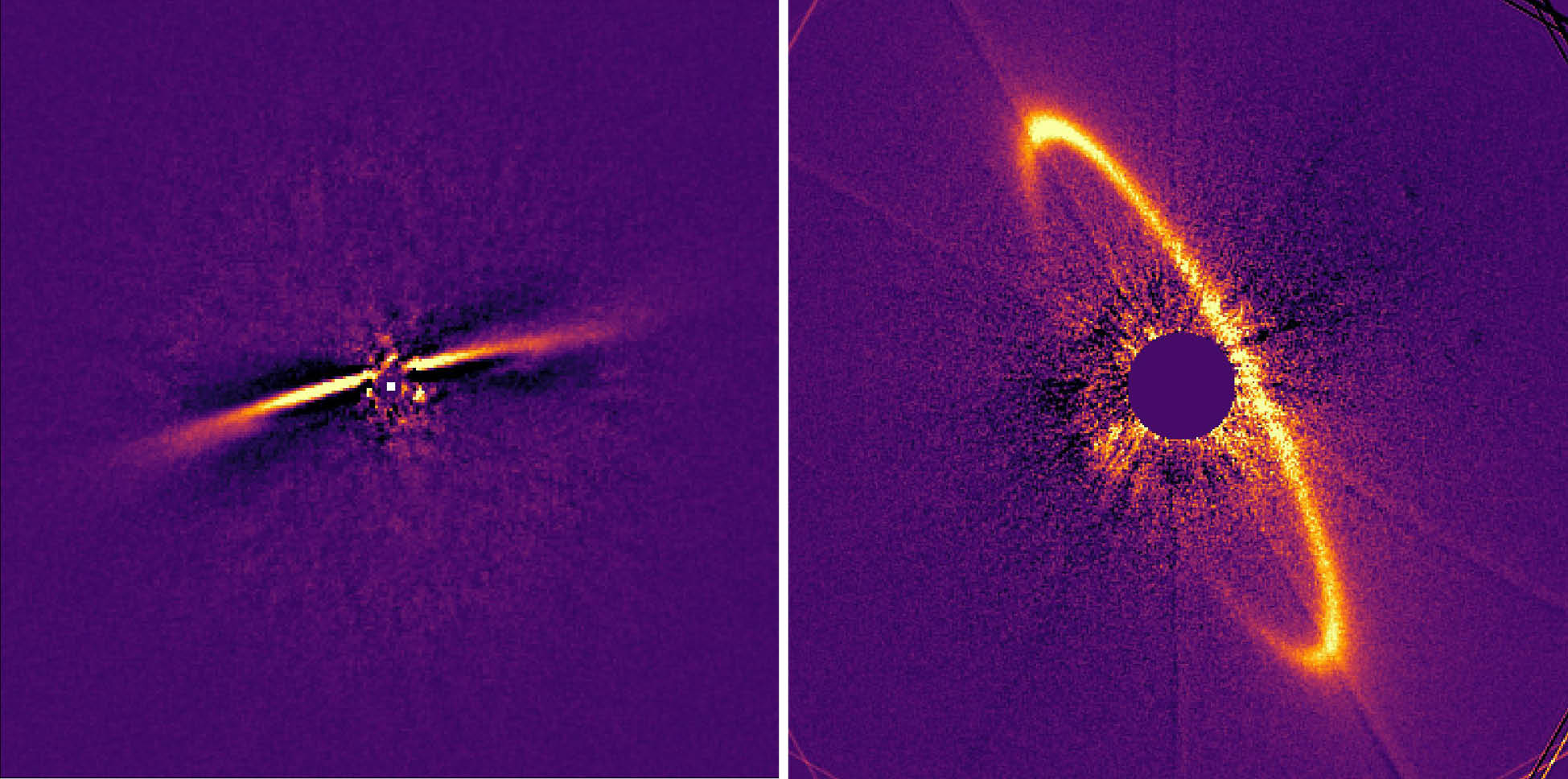
SPHERE gallery of debris disks, visible by the starlight they reflect, with the central star blocked out.
© N. Engler et al./SPHERE Consortium/ESO


Images of dust around distant exoplanets provide a glimpse of asteroids and comets in other solar systems

To the point:

  • Traces of comets and asteroids in distant solar systems: In young planetary systems, mutual collisions between asteroids or comets generate large amounts of dust, forming a "debris disk". The disk contains information about the system’s smaller bodies.

  • Observational challenge accepted: Producing debris disk images is difficult, in particular because of the glare of the bright star in the center. The SPHERE instrument was optimised for that kind of observation.

  • Familiar structures: Some of the disks imaged with SPHERE show structures reminiscent of the solar system, with asteroids concentrated in an asteroid belt inside the giant planet orbits, comets in a “Kuiper belt” outside.

Observations with the instrument SPHERE at ESO’s Very Large Telescope have produced an unprecedented gallery of “debris disks” in exoplanetary systems. Gaël Chauvin (Max Planck Institute for Astronomy), project scientist of SPHERE and co-author on the paper publishing the results, says: “This data set is an astronomical treasure. It provides exceptional insights into the properties of debris disks, and allows for deductions of smaller bodies like asteroids and comets in these systems, which are impossible to observe directly.”

In our own solar system, once you look beyond the Sun, the planets, and dwarf planets like Pluto, there is a bewildering array of smaller (“minor”) bodies. Of particular interest are the larger small bodies, with diameters between about a kilometer and several hundred kilometers. We call those objects comets if they put on (at least occasionally) a display of losing gas and dust to form distinctive visible structures like a tail, and asteroids when they don’t. Small bodies provide a glimpse of the earliest history of the solar system: In the evolution from dust grains to full-size planets, small bodies called planetesimals are a transitional stage, and the asteroids and comets are remnants from that stage – planetesimals that did not manage to evolve into larger planets. Small bodies are (somewhat) modified remnants of the building material for planets like our Earth!

Small bodies around stars other than the Sun?

So far, astronomers have detected more than 6000 exoplanets (that is, planets orbiting stars other than the Sun), giving us a much better idea of the diversity of planets out there, and of the place of our solar system within this teeming population. Taking actual images of such planets is a considerable challenge, though. At this time, there are less than 100 exoplanets that astronomers have been able to image, and even giant planets are no more than a structureless little blob on such images. “Finding any direct clues about the small bodies in a distant planetary system from images seems downright impossible. The other indirect methods used to detect exoplanets are no help, either” says Dr Julien Milli, astronomer at the University Grenoble Alpes and co-author of the study.

The solution, ironically, comes from stuff that is even smaller, by orders of magnitude. In particular in younger planetary systems, planetesimals will regularly collide – sometimes to stick together to form a larger body, sometimes to go their separate ways. These collisions create copious amounts of new dust, and the dust, it turns out, can be observed over large distances, given suitable instruments: Whenever you divide an object into smaller components, the total volume remains the same, but the total surface area increases. Divide an asteroid with a diameter of one kilometer into dust grains with diameters of one micrometer (= millionth of a meter), and you increase the overall surface by a factor of a billion! That is, in large part, why it is possible to observe debris disks around young stars by the starlight they reflect. Observe the dust, and you can glean information about the planetary system’s small bodies.

These images of the debris disks around the star HD 106906 (left) and that around HR 4796 (right) showcase the amount of detail that is possible with SPHERE. © N. Engler et al./SPHERE Consortium/ESO

Observing debris disks

Over time, such a debris disk will fade. Collisions will become less frequent. Dust will be blown out of the system by radiation pressure, caught by planetesimals or planets, or ends up in the central star. Our own solar system provides an example of what is left after billions of years: In this case, there are two remaining planetesimal belts, namely the asteroid belt between Mars and Jupiter, and a reservoir of comets outside the orbits of the giant planets in what is known as the Kuiper belt. There is also dust in our solar system’s main orbital light, known as zodiacal dust. Under a very dark sky, you will be able to see light reflected by that dust with the naked eye shortly after sunset or shortly before sunset, the so-called zodiacal light.

This configuration would be difficult to detect for alien astronomers studying our solar system from afar. But as the present study has shown, with the best current telescopes and instruments, for not-too-far-away systems, the dust should be observable for about the first 50 million years of the debris disk’s life. Which is not to say that such observations are not a considerable technical challenge! Imaging a debris disk is like taking a picture of a puff of cigarette smoke, but the smoke is hovering next to a bright stadium floodlight, and you are trying to take the picture from a distance of several kilometers. This is where suitable instrumentation makes all the difference, and it is where the SPHERE instrument, which began operating at one of ESO’s Very Large Telescopes (VLT) in the spring of 2014, excels.

Blocking out starlight

At the heart of SPHERE is a very simple concept. If in everyday life, we want to look at something and the Sun in the background is making this difficult, we put up a hand to block out the sunlight. When SPHERE observes an exoplanet or debris disk, it uses a coronagraph to block out the star’s light – in effect, a little disk inserted in the optical pathway that removes most of the starlight before the image is taken. The catch is that unless imaging is very precise and stable, this simple recipe cannot work in practice!

To meet the stringent requirements, SPHERE utilizes an extreme version of adaptive optics, where the unavoidable perturbations caused by the light passing through Earth’s atmosphere are analyzed and largely compensated for in real time through the use of a deformable mirror. Another, optional part of SPHERE filters out light with specific properties (“polarised light”) that are characteristic for light reflected by something like dust particles, as opposed to starlight, setting the stage for particularly sensitive debris disk images.

An unprecedented gallery of debris disk images

The new publication presents an unprecedented collection of debris disk images, produced with SPHERE from starlight reflected by small dust particles in these systems. "To obtain this collection, we processed data from observations of 161 nearby young stars whose infrared emission strongly indicates the presence of a debris disk," says Natalia Engler (ETH Zurich), the lead author of the study. "The resulting images show 51 debris disks with a variety of properties — some smaller, some larger, some seen from the side and some nearly face-on – and a considerable diversity of disk structures. Four of the disks had never been imaged before."

Comparisons within a larger sample are crucial for discovering the systematics behind object properties. In this case, an analysis of the 51 debris disks and their stars confirmed several systematic trends: When a young star is more massive, its debris disk tends to have more mass as well. The same is true for debris disks where the majority of the material is located at a greater distance from the central star.

Finding asteroid belts and Kuiper belts in other systems

Arguably the most interesting feature of the SPHERE debris disks are the structures within the disks themselves. In many of the images, disks have a concentric ring- or band-like structure, with disk material predominantly found at specific distances from the central star. The distribution of small bodies in our own solar system has a similar structure, with small bodies concentrated in the asteroid belt (asteroids) and the Kuiper belt (comets).

All of these belt structures appear to be associated with the presence of planets, specifically of giant planets, clearing their neighbourhoods of smaller bodies. Some of the giant planets had been observed already. In some of the SPHERE images, features like sharp inner edges or disk asymmetries give tantalizing hints of as-yet unobserved planets. In this way, the SPHERE disk collection sets interesting targets for future observations: the JWST, or the Extremely Large Telescope (ELT) currently under construction by ESO should allow astronomers to produce images of the planets that create these structures.

Background information

The results described here have been published as Natalia Engler et al., “Characterization of debris disks observed with SPHERE,” in the journal Astronomy and Astrophysics. DOI: 10.1051/0004-6361/202554953

The MPIA researchers involved are Gaël Chauvin, Thomas Henning, Samantha Brown, Matthias Samland, and Markus Feldt, in collaboration with Natalia Engler (ETH Zürich), Julien Milli (CNRS, IPAG, Université Grenoble Alpes), Nicole Pawellek (University of Vienna), Johan Olofsson (ESO), Anne-Lise Maire (CNRS, IPAG, Université Grenoble Alpes), and others


Contacts:

Dr. Markus Pössel
Head of press relations and outreach
Tel:
+49 6221 528-261
pr@mpia.de
Max Planck Institute for Astronomy, Heidelberg

Dr. Gaël Chauvin
Tel:
+49 6221 528-287
chauvin@mpia.de
Max Planck Institute for Astronomy, Heidelberg


Original publication

N. Engler, J. Milli, N. Pawellek, R. Gratton, P. Thébault, C. Lazzoni, J. Olofsson, H.M. Schmid, S. Ulmer-Moll, C. Perrot, J.-C. Augereau, S. Desidera, G. Chauvin, et al.
Characterization of debris disks observed with SPHERE
Astronomy and Astrophysics


DOI

Download

mpia-pm_chauvin_silicate_clouds_preprint_2025 12.18 MB
mpia-pm_sphere_disk_gallery_2025 8.94 MB
mpia-pm_sphere_disk_gallery_2025_fig1 199.32 kB


Friday, October 17, 2025

Webb sheds more light on composition of planetary debris around nearby white dwarf

The JWST/MIRI spectrum of GD 362. The three colored curves show the spectra in MIRI/MRS channels 1, 2, and 3.
Credit: arXiv (2025). DOI: 10.48550/arxiv.2510.07595


Using the James Webb Space Telescope (JWST), astronomers have performed infrared observations of a planetary debris disk around a nearby white dwarf known as GD 362. Results of the new observations, presented October 8 on the arXiv preprint server, yield important insights into the chemical composition of this disk.

White dwarfs (WDs) are stellar cores left behind after a star has exhausted its nuclear fuel. Due to their high gravity, they are known to have atmospheres of either pure hydrogen or pure helium.

However, there exists a small fraction of WDs that shows traces of heavier elements, and they are believed to be accreting planetary material. Studies of this material around WDs, which often forms dust disks, is essential to improving our knowledge of how planets form and evolve.

GD 362, also known as WD 1729+371, is a white dwarf located some 182.9 light years away. It has a radius of about 8,790 kilometers, a mass of approximately 0.57 solar masses, and its effective temperature is estimated to be 9,825 K.

Previous observations of GD 362 show that it is one of the most heavily polluted white dwarfs, and showcases an exceptionally strong infrared excess. It turned out that it possesses a helium-dominated atmosphere with a high metal abundance, and also an anomalously large mass of hydrogen. Moreover, a dust disk was identified, located within 140 to 1,400 stellar radii of GD 362.

Recently, a team of astronomers led by William T. Reach of the Space Science Institute in Boulder, Colorado, employed JWST's Near Infrared Spectrograph (NIRSpec) and Mid-Infrared Instrument (MIRI) to take a closer look at the disk around GD 362, hoping to shed more light on its chemical composition.

The spectral resolution and sensitivity of the two instruments allowed Reach's team to measure the composition of solid planetary material around GD 362. The mid-infrared spectrum was found to be dominated by an exceptionally strong 9–11 µm silicate feature, three times brighter than its underlying continuum, which extends to at least 2 µm, and requires hot debris (with a temperature of about 950 K) close to the white dwarf.

The results indicate that the disk around GD 362 contains a mix of amorphous and crystalline olivines and pyroxenes plus amorphous carbon. It was found that the elemental abundances of carbon, oxygen, magnesium, aluminum and iron are within a factor of two, relative to silicon.

It was noted that no evidence for water in the spectrum, nor were other hydrogen-bearing species found. This suggests the dust in the disk is drier and lower in hydrogen than in chondritic meteorites.

"Overall, the results indicate that GD 362 is surrounded by a disk with solids having elemental abundances approximately matching those seen in the atmosphere of the white dwarf, supporting the connection between disk and atmosphere arising from accretion of planetary material," the authors of the paper conclude.

by Tomasz Nowakowski, Phys.org
Stephanie Baum, reviewed by Robert Egan


Written for you by our author Tomasz Nowakowski, edited by Stephanie Baum, and fact-checked and reviewed by Robert Egan—this article is the result of careful human work. We rely on readers like you to keep independent science journalism alive. If this reporting matters to you, please consider a donation (especially monthly). You'll get an ad-free account as a thank-you.


More information: William T. Reach et al, Composition of planetary debris around the white dwarf GD 362, arXiv (2025). DOI: 10.48550/arxiv.2510.07595

Journal information: arXiv


Monday, September 22, 2025

NASA’s Hubble Sees White Dwarf Eating Piece of Pluto-Like Object

This artist’s concept shows a white dwarf surrounded by a large debris disk. Debris from pieces of a captured, Pluto-like object is falling onto the white dwarf. Credits: Artwork: NASA, Tim Pyle (NASA/JPL-Caltech)

In our nearby stellar neighborhood, a burned-out star is snacking on a fragment of a Pluto-like object. With its unique ultraviolet capability, only NASA’s Hubble Space Telescope could identify that this meal is taking place.

The stellar remnant is a white dwarf about half the mass of our Sun, but that is densely packed into a body about the size of Earth. Scientists think the dwarf’s immense gravity pulled in and tore apart an icy Pluto analog from the system’s own version of the Kuiper Belt, an icy ring of debris that encircles our solar system. The findings were reported on September 18 in the Monthly Notices of the Royal Astronomical Society.

The researchers were able to determine this carnage by analyzing the chemical composition of the doomed object as its pieces fell onto the white dwarf. In particular, they detected “volatiles” — substances with low boiling points — including carbon, sulphur, nitrogen, and a high oxygen content that suggests the strong presence of water.

“We were surprised,” said Snehalata Sahu of the University of Warwick in the United Kingdom. Sahu led the data analysis of a Hubble survey of white dwarfs. “We did not expect to find water or other icy content. This is because the comets and Kuiper Belt-like objects are thrown out of their planetary systems early, as their stars evolve into white dwarfs. But here, we are detecting this very volatile-rich material. This is surprising for astronomers studying white dwarfs as well as exoplanets, planets outside our solar system."

Only with Hubble

Using Hubble’s Cosmic Origins Spectrograph, the team found that the fragments were composed of 64 percent water ice. The fact that they detected so much ice meant that the pieces were part of a very massive object that formed far out in the star system’s icy Kuiper Belt analog. Using Hubble data, scientists calculated that the object was bigger than typical comets and may be a fragment of an exo-Pluto.

They also detected a large fraction of nitrogen – the highest ever detected in white dwarf debris systems. “We know that Pluto's surface is covered with nitrogen ices,” said Sahu. “We think that the white dwarf accreted fragments of the crust and mantle of a dwarf planet.”

Accretion of these volatile-rich objects by white dwarfs is very difficult to detect in visible light. These volatile elements can only be detected with Hubble’s unique ultraviolet light sensitivity. In optical light, the white dwarf would appear ordinary.

About 260 light-years away, the white dwarf is a relatively close cosmic neighbor. In the past, when it was a Sun-like star, it would have been expected to host planets and an analog to our Kuiper Belt.


Like seeing our Sun in future
Billions of years from now, when our Sun burns out and collapses to a white dwarf, Kuiper Belt objects will be pulled in by the stellar remnant’s immense gravity. “These planetesimals will then be disrupted and accreted,” said Sahu. “If an alien observer looks into our solar system in the far future, they might see the same kind of remains we see today around this white dwarf.”

The team hopes to use NASA’s James Webb Space Telescope to detect molecular features of volatiles such as water vapor and carbonates by observing this white dwarf in infrared light. By further studying white dwarfs, scientists can better understand the frequency and composition of these volatile-rich accretion events.

Sahu is also following the recent discovery of the interstellar comet 3I/ATLAS. She is eager to learn its chemical composition, especially its fraction of water. “These types of studies will help us learn more about planet formation. They can also help us understand how water is delivered to rocky planets,” said Sahu.

Boris Gänsicke, of the University of Warwick and a visitor at Spain’s Instituto de Astrofisica de Canarias, was the principal investigator of the Hubble program that led to this discovery. “We observed over 500 white dwarfs with Hubble. We’ve already learned so much about the building blocks and fragments of planets, but I’ve been absolutely thrilled that we now identified a system that resembles the objects in the frigid outer edges of our solar system,” said Gänsicke. “Measuring the composition of an exo-Pluto is an important contribution toward our understanding of the formation and evolution of these bodies.”

The Hubble Space Telescope has been operating for more than three decades and continues to make ground-breaking discoveries that shape our fundamental understanding of the universe. Hubble is a project of international cooperation between NASA and ESA (European Space Agency). NASA’s Goddard Space Flight Center in Greenbelt, Maryland, manages the telescope and mission operations. Lockheed Martin Space, based in Denver, also supports mission operations at Goddard. The Space Telescope Science Institute in Baltimore, which is operated by the Association of Universities for Research in Astronomy, conducts Hubble science operations for NASA.


Saturday, September 06, 2025

Neighboring Star’s Warped Ring Shaped by Evolving Planets

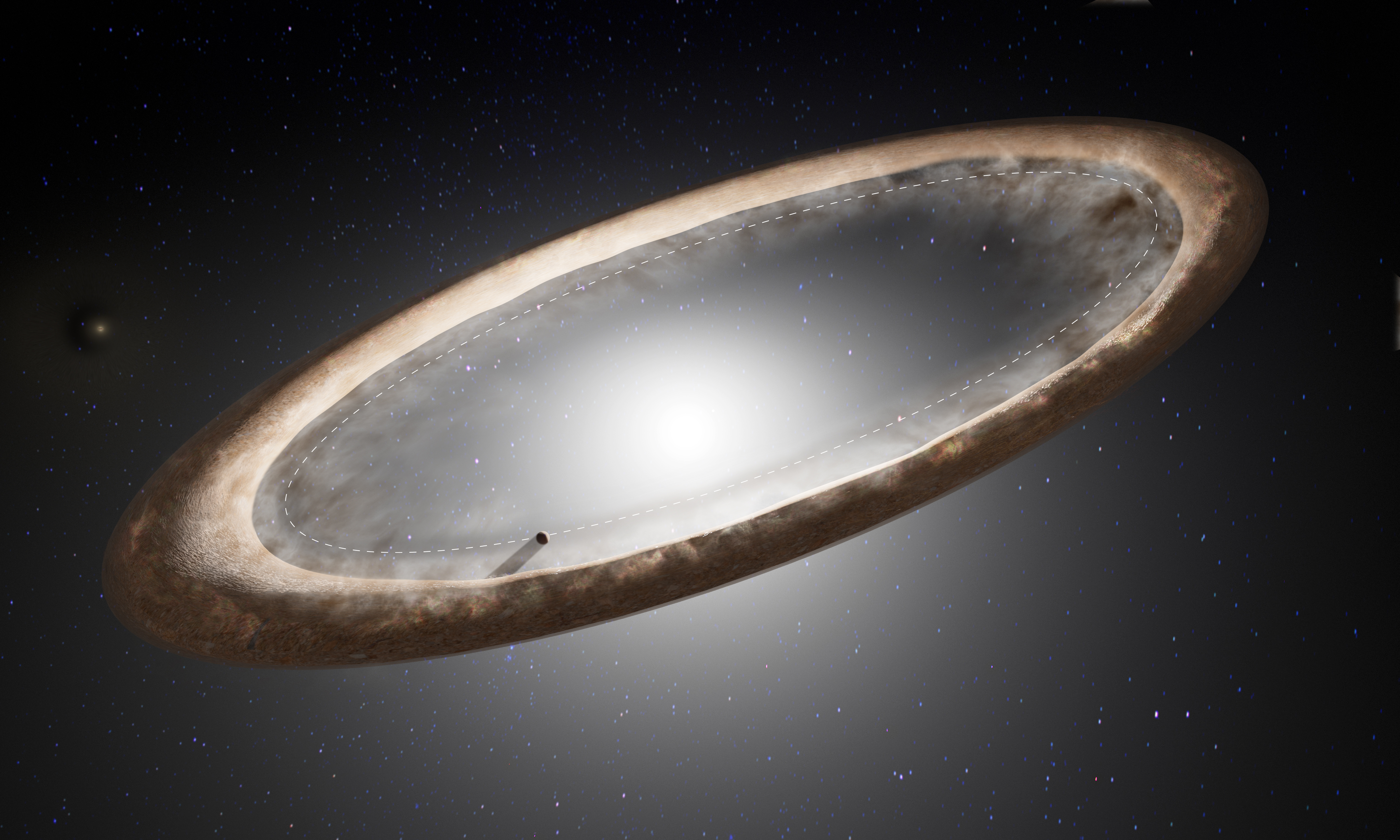
The bright star in the center, Fomalhaut, is surrounded by an ancient debris disk of uneven brightness. The disk is closer to the star in the south, where the disk is wider and fainter, and further from the star in the north, where the disk is narrower and brighter. The dotted ring shows the possible orbit of a planet implied by Lovell et al. Credit: NSF/AUI/NSF NRAO/B.Saxton.
Hi-Res File


Unusual shape of Fomalhaut’s debris ring shows evidence of sculpting by ancient planets, rewriting story of planetary system evolution

Astronomers using the Atacama Large Millimeter/submillimeter Array (ALMA) have made the highest resolution image to date, revealing new insights into the unusual and mysterious architecture of the debris disk encircling Fomalhaut, one of the brightest and most well-studied stars in our cosmic neighborhood. Debris disks are vast belts of dust and rocky bodies, similar to our Solar System’s asteroid belt—but much larger. The lopsidedness (or eccentricity) of Fomalhaut’s disk has fascinated astronomers for nearly two decades.

An international research team, led by astronomers at the Center for Astrophysics | Harvard & Smithsonian and Johns Hopkins University, published two papers analyzing these new observations in the Astrophysical Journal/Astrophysical Journal Letters. They have now found that Fomalhaut’s disk is not just eccentric—its eccentricity changes with distance from the star. Unlike previous models assuming a uniform or “fixed” eccentricity, their new data-driven model shows that the disk’s shape grows less stretched (or less eccentric) the farther a segment is from Fomalhaut. This morphology is known as a negative eccentricity gradient. You can imagine the offsets between the star and the ring’s center, much like Saturn’s rings, if Saturn wasn’t sitting neatly in the middle.

“Our observations show, for the first time, that the disk’s eccentricity isn’t constant,” said lead author of one of the papers, Joshua Bennett Lovell, a Submillimeter Array Fellow with the Harvard-Smithsonian Center for Astrophysics. “It steadily drops off with distance, a finding that has never before been conclusively demonstrated in any debris disk.” Lovell is also an ALMA Ambassador with the U.S. National Science Foundation National Radio Astronomy Observatory’s North American ALMA Science Center.

Using high-resolution ALMA images at 1.3mm wavelengths, the team fitted a new model setup to the data, one that accounts for the disk’s radius, width, and asymmetries, with an eccentric ring model that can alter its eccentricity with distance from the star. The best-fitting model pointed to a steep decline in eccentricity with distance, as predicted by dynamical theories of how planets can shape debris disks, but as-yet seen anywhere in the universe.

This negative gradient offers clues about hidden planets, currently unseen by astronomers, orbiting Fomalhaut. The new model suggests a massive planet orbiting inside of Fomalhaut’s disk may have sculpted its eccentricity profile early in the extrasolar system’s history. The unusual shape of the debris disk may have formed in the system’s youth, during the protoplanetary disk phase, and has remained this way for more than 400 million years, thanks to the continued push, and pull of this planet.

In the second paper, led by Graduate Student Jay Chittidi at Johns Hopkins University, the team exhausted the possibility that the ring’s eccentricity is fixed with the distance from the star. “Although the shift in brightness from the pericenter side of the disk, nearest to the star, to the apocenter side, furthest from the star, between the JWST and ALMA data was expected, the precise shifts that we measured in the disk brightness and the ring’s width could not be explained by the old models,” said Jay. “Simply put: we couldn’t find a model with a fixed eccentricity that could explain these peculiar features in Fomalhaut’s disk. Comparing the old and new models, we are now able to better interpret this disk, and reconstruct the history and present state of this dynamic system.”

Researchers hope this new model will be further tested with more ALMA observations, which were recently approved, “And hopefully we’ll find new clues that will help us uncover that planet!” adds Lovell. The team has shared the eccentricity model code developed for this newly published research to enable other astronomers to apply it to similar systems.


About NRAO

The National Radio Astronomy Observatory (NRAO) is a facility of the U.S. National Science Foundation, operated under cooperative agreement by Associated Universities, Inc.

About ALMA

The Atacama Large Millimeter/submillimeter Array (ALMA), an international astronomy facility, is a partnership of the European Southern Observatory (ESO), the U.S. National Science Foundation (NSF) and the National Institutes of Natural Sciences (NINS) of Japan in cooperation with the Republic of Chile. ALMA is funded by ESO on behalf of its Member States, by NSF in cooperation with the National Research Council of Canada (NRC) and the National Science and Technology Council (NSTC) in Taiwan and by NINS in cooperation with the Academia Sinica (AS) in Taiwan and the Korea Astronomy and Space Science Institute (KASI).

ALMA construction and operations are led by ESO on behalf of its Member States; by the National Radio Astronomy Observatory (NRAO), managed by Associated Universities, Inc. (AUI), on behalf of North America; and by the National Astronomical Observatory of Japan (NAOJ) on behalf of East Asia. The Joint ALMA Observatory (JAO) provides the unified leadership and management of the construction, commissioning and operation of ALMA.


Friday, June 27, 2025

Likely Saturn-Mass Planet Imaged by NASA Webb Is Lightest Ever Seen

Astronomers using NASA’s James Webb Space Telescope have captured compelling evidence of a planet with a mass similar to Saturn orbiting the young nearby star TWA 7. In this image combining ground-based data from ESO’s Very Large Telescope (VLT) and data from Webb’s MIRI (Mid-Infrared Instrument), light from the star TWA 7 has been subtracted. The location of the star is marked with a circle and a star symbol at the center of the image. The blue color represents data from the VLT’s SPHERE instrument, which showcases the location of the disk surrounding the host star. MIRI data is shown in orange. The bright orange spot to the upper right of the star is the source identified as TWA 7 b, within the debris disk. The more distant orange spot visible in the left of the image is an unrelated background star. Credits/Image: NASA, ESA, CSA, Anne-Marie Lagrange (CNRS, UGA), Mahdi Zamani (ESA/Webb)


Astronomers using NASA’s James Webb Space Telescope have captured compelling evidence of a planet with a mass similar to Saturn orbiting the young nearby star TWA 7. If confirmed, this would represent Webb’s first direct image discovery of a planet, and the lightest planet ever seen with this technique outside the solar system.

The international team detected a faint infrared source in the disk of debris surrounding TWA 7 using Webb’s MIRI (Mid-Infrared Instrument). The distance between the source and TWA 7 is estimated to be about 50 times the distance of the Earth from the Sun. This matches the expected position of a planet that would explain key features seen in the debris disk. The results published Wednesday, June 25 in the journal Nature.

Using MIRI’s coronagraph, the researchers carefully suppressed the bright glare of the host star to reveal faint nearby objects. This technique, called high-contrast imaging, enables astronomers to directly detect planets that would otherwise be lost in the overwhelming light from their host star. After subtracting residual starlight using advanced image processing, a faint infrared source was revealed near TWA 7. The team ruled out an object in our solar system that happened to be in the same part of the sky as the source. While there is a very small chance that it is a background galaxy, the evidence strongly points to the source being a previously undiscovered planet.

The source is located in a gap in one of three dust rings that were discovered around TWA 7 by previous ground-based observations. The object’s brightness, color, distance from the star, and position within the ring are consistent with theoretical predictions for a young, cold, Saturn-mass planet that is expected to be sculpting the surrounding debris disk.

“Our observations reveal a strong candidate for a planet shaping the structure of the TWA 7 debris disk, and its position is exactly where we expected to find a planet of this mass,” said Anne-Marie Lagrange, CNRS researcher at the Observatoire de Paris-PSL and Université Grenoble Alpes in France, lead author of the paper.

“This observatory enables us to capture images of planets with masses similar to those in the solar system, which represents an exciting step forward in our understanding of planetary systems, including our own,” added co-author Mathilde Malin of Johns Hopkins University and the Space Telescope Science Institute in Baltimore.

Initial analysis suggests that the object — referred to as TWA 7 b — could be a young, cold planet with a mass around 0.3 times that of Jupiter (about 100 Earth masses, or one Saturn mass) and a temperature near 120 degrees Fahrenheit (47 degrees Celsius). Its location aligns with a gap in the disk, hinting at a dynamic interaction between the planet and its surroundings.

Debris disks filled with dust and rocky material are found around both young and older stars, although they are more easily detected around younger stars as they are brighter. They often feature visible rings or gaps, thought to be created by planets that have formed around the star, but such a planet has yet to be directly detected within a debris disk. If verified, this discovery would mark the first time a planet has been directly associated with sculpting a debris disk, and could offer the first observational hint of a “trojan disk” — a collection of dust trapped in the planet’s orbit.

TWA 7, also known as CE Antilae, is a young (about 6.4 million years old) red dwarf star located about 34 light-years away in the TW Hydrae association. Its nearly face-on disk made it an ideal target for Webb’s high-sensitivity mid-infrared observations.

The findings highlight Webb’s ability to explore previously unseen, low-mass planets around nearby stars. Ongoing and future observations will aim to better constrain the properties of the candidate, verify its planetary status, and deepen our understanding of planet formation and disk evolution in young systems.

These observations were taken as part of the Webb observing program 3662.

The James Webb Space Telescope is the world’s premier space science observatory. Webb is solving mysteries in our solar system, looking beyond to distant worlds around other stars, and probing the mysterious structures and origins of our universe and our place in it. Webb is an international program led by NASA with its partners, ESA (European Space Agency) and CSA (Canadian Space Agency).


About This Release

Credits:

Media Contact:

Bethany Downer
ESA/Webb, Baltimore

Christine Pulliam
Space Telescope Science Institute, Baltimore

Permissions: Content Use Policy

Contact Us: Direct inquiries to the News Team.

Related Links and Documents


Monday, June 16, 2025

Another First: NASA Webb Identifies Frozen Water in Young Star System

For the first time, researchers confirmed the presence of crystalline water ice in a dusty debris disk that orbits a Sun-like star, using NASA’s James Webb Space Telescope. All the frozen water detected by Webb is paired with fine dust particles throughout the disk. The majority of the water ice observed is found where it’s coldest and farthest from the star. The closer to the star the researchers looked, the less water ice they found. Credits/Artwork: NASA, ESA, CSA, STScI, Ralf Crawford (STScI)


Is frozen water scattered in systems around other stars? Astronomers have long expected it is, partially based on previous detections of its gaseous form, water vapor, and its presence in our own solar system.

Now there is definitive evidence: Researchers confirmed the presence of crystalline water ice in a dusty debris disk that orbits a Sun-like star 155 light-years away using detailed data known as spectra from NASA’s James Webb Space Telescope. (The term water ice specifies its makeup, since many other frozen molecules are also observed in space, such as carbon dioxide ice, or “dry ice.”) In 2008, data from NASA’s retired Spitzer Space Telescope hinted at the possibility of frozen water in this system.

“Webb unambiguously detected not just water ice, but crystalline water ice, which is also found in locations like Saturn’s rings and icy bodies in our solar system’s Kuiper Belt,” said Chen Xie, the lead author of the new paper and an assistant research scientist at Johns Hopkins University in Baltimore, Maryland.

All the frozen water Webb detected is paired with fine dust particles throughout the disk — like itsy-bitsy “dirty snowballs.” The results published Wednesday in the journal Nature.

Astronomers have been waiting for this definitive data for decades. “When I was a graduate student 25 years ago, my advisor told me there should be ice in debris disks, but prior to Webb, we didn’t have instruments sensitive enough to make these observations,” said Christine Chen, a co-author and an astronomer at the Space Telescope Science Institute in Baltimore. “What’s most striking is that this data looks similar to the telescope’s other recent observations of Kuiper Belt objects in our own solar system.”

Water ice is a vital ingredient in disks around young stars — it heavily influences the formation of giant planets and may also be delivered by small bodies like comets and asteroids to fully formed rocky planets. Now that researchers have detected water ice with Webb, they have opened the door for all researchers to study how these processes play out in new ways in many other planetary systems.

Rocks, Dust, Ice Rushing Around

The star, cataloged HD 181327, is significantly younger than our Sun. It’s estimated to be 23 million years old, compared to the Sun’s more mature 4.6 billion years. The star is slightly more massive than the Sun, and it’s hotter, which led to the formation of a slightly larger system around it.

Webb’s observations confirm a significant gap between the star and its debris disk — a wide area that is free of dust. Farther out, its debris disk is similar to our solar system’s Kuiper Belt, where dwarf planets, comets, and other bits of ice and rock are found (and sometimes collide with one another). Billions of years ago, our Kuiper Belt was likely similar to this star’s debris disk.

“HD 181327 is a very active system,” Chen said. “There are regular, ongoing collisions in its debris disk. When those icy bodies collide, they release tiny particles of dusty water ice that are perfectly sized for Webb to detect.”

Frozen Water — Almost Everywhere

Water ice isn’t spread evenly throughout this system. The majority is found where it’s coldest and farthest from the star. “The outer area of the debris disk consists of over 20% water ice,” Xie said.

The closer in the researchers looked, the less water ice they found. Toward the middle of the debris disk, Webb detected about 8% water ice. Here, it’s likely that frozen water particles are produced slightly faster than they are destroyed. In the area of the debris disk closest to the star, Webb detected almost none. It’s likely that the star’s ultraviolet light vaporizes the closest specks of water ice. It’s also possible that rocks known as planetesimals have “locked up” frozen water in their interiors, which Webb can’t detect.

This team and many more researchers will continue to search for — and study — water ice in debris disks and actively forming planetary systems throughout our Milky Way galaxy. “The presence of water ice helps facilitate planet formation,” Xie said. “Icy materials may also ultimately be ‘delivered’ to terrestrial planets that may form over a couple hundred million years in systems like this.”

The researchers observed HD 181327 with Webb’s NIRSpec (Near-Infrared Spectrograph), which is super-sensitive to extremely faint dust particles that can only be detected from space.

The James Webb Space Telescope is the world’s premier space science observatory. Webb is solving mysteries in our solar system, looking beyond to distant worlds around other stars, and probing the mysterious structures and origins of our universe and our place in it. Webb is an international program led by NASA with its partners, ESA (European Space Agency) and CSA (Canadian Space Agency).

To learn more about Webb, visit: https://science.nasa.gov/webb


About This Release

Credits:

Media Contact:

Claire Blome
Space Telescope Science Institute, Baltimore

Christine Pulliam
Space Telescope Science Institute, Baltimore

Permissions: Content Use Policy

Contact Us: Direct inquiries to the News Team.

Related Links and Documents


Thursday, May 15, 2025

Another First: NASA Webb Identifies Frozen Water in Young Star System

For the first time, researchers confirmed the presence of crystalline water ice in a dusty debris disk that orbits a Sun-like star, using NASA’s James Webb Space Telescope. All the frozen water detected by Webb is paired with fine dust particles throughout the disk. The majority of the water ice observed is found where it’s coldest and farthest from the star. The closer to the star the researchers looked, the less water ice they found. Credits/Artwork: NASA, ESA, CSA, STScI, Ralf Crawford (STScI)


Is frozen water scattered in systems around other stars? Astronomers have long expected it is, partially based on previous detections of its gaseous form, water vapor, and its presence in our own solar system.

Now there is definitive evidence: Researchers confirmed the presence of crystalline water ice in a dusty debris disk that orbits a Sun-like star 155 light-years away using detailed data known as spectra from NASA’s James Webb Space Telescope. (The term water ice specifies its makeup, since many other frozen molecules are also observed in space, such as carbon dioxide ice, or “dry ice.”) In 2008, data from NASA’s retired Spitzer Space Telescope hinted at the possibility of frozen water in this system.

“Webb unambiguously detected not just water ice, but crystalline water ice, which is also found in locations like Saturn’s rings and icy bodies in our solar system’s Kuiper Belt,” said Chen Xie, the lead author of the new paper and an assistant research scientist at Johns Hopkins University in Baltimore, Maryland.

All the frozen water Webb detected is paired with fine dust particles throughout the disk — like itsy-bitsy “dirty snowballs.” The results published Wednesday in the journal Nature.

Astronomers have been waiting for this definitive data for decades. “When I was a graduate student 25 years ago, my advisor told me there should be ice in debris disks, but prior to Webb, we didn’t have instruments sensitive enough to make these observations,” said Christine Chen, a co-author and associate astronomer at the Space Telescope Science Institute in Baltimore. “What’s most striking is that this data looks similar to the telescope’s other recent observations of Kuiper Belt objects in our own solar system.”

Water ice is a vital ingredient in disks around young stars — it heavily influences the formation of giant planets and may also be delivered by small bodies like comets and asteroids to fully formed rocky planets. Now that researchers have detected water ice with Webb, they have opened the door for all researchers to study how these processes play out in new ways in many other planetary systems.

Rocks, Dust, Ice Rushing Around

The star, cataloged HD 181327, is significantly younger than our Sun. It’s estimated to be 23 million years old, compared to the Sun’s more mature 4.6 billion years. The star is slightly more massive than the Sun, and it’s hotter, which led to the formation of a slightly larger system around it.

Webb’s observations confirm a significant gap between the star and its debris disk — a wide area that is free of dust. Farther out, its debris disk is similar to our solar system’s Kuiper Belt, where dwarf planets, comets, and other bits of ice and rock are found (and sometimes collide with one another). Billions of years ago, our Kuiper Belt was likely similar to this star’s debris disk.

“HD 181327 is a very active system,” Chen said. “There are regular, ongoing collisions in its debris disk. When those icy bodies collide, they release tiny particles of dusty water ice that are perfectly sized for Webb to detect.”

Frozen Water — Almost Everywhere

Water ice isn’t spread evenly throughout this system. The majority is found where it’s coldest and farthest from the star. “The outer area of the debris disk consists of over 20% water ice,” Xie said.

The closer in the researchers looked, the less water ice they found. Toward the middle of the debris disk, Webb detected about 8% water ice. Here, it’s likely that frozen water particles are produced slightly faster than they are destroyed. In the area of the debris disk closest to the star, Webb detected almost none. It’s likely that the star’s ultraviolet light vaporizes the closest specks of water ice. It’s also possible that rocks known as planetesimals have “locked up” frozen water in their interiors, which Webb can’t detect.

This team and many more researchers will continue to search for — and study — water ice in debris disks and actively forming planetary systems throughout our Milky Way galaxy. “The presence of water ice helps facilitate planet formation,” Xie said. “Icy materials may also ultimately be ‘delivered’ to terrestrial planets that may form over a couple hundred million years in systems like this.”

The researchers observed HD 181327 with Webb’s NIRSpec (Near-Infrared Spectrograph), which is super-sensitive to extremely faint dust particles that can only be detected from space.

The James Webb Space Telescope is the world’s premier space science observatory. Webb is solving mysteries in our solar system, looking beyond to distant worlds around other stars, and probing the mysterious structures and origins of our universe and our place in it. Webb is an international program led by NASA with its partners, ESA (European Space Agency) and CSA (Canadian Space Agency).

To learn more about Webb, visit: https://science.nasa.gov/webb


About This Release

Credits:

Media Contact Claire Blome
Space Telescope Science Institute, Baltimore

Christine Pulliam
Space Telescope Science Institute, Baltimore

Permissions: Content Use Policy

Contact Us: Direct inquiries to the News Team.

Related Links and Documents


Sunday, October 27, 2024

Searching Five Million Stars for Disks, Debris, and Dyson Spheres

This image combines data from the Hubble Space Telescope and the Spitzer Space Telescope to show the center of the Milky Way at infrared wavelengths. Credit: Hubble: NASA, ESA, and Q.D. Wang (University of Massachusetts, Amherst); Spitzer: NASA, Jet Propulsion Laboratory, and S. Stolovy (Spitzer Science Center/Caltech)

Main-sequence stars with brighter than expected mid-infrared emission can signal the presence of a debris disk, rubble from planetary collisions, or even a theorized sign of a technologically advanced civilization. New research demonstrates a data-driven method to identify mid-infrared excesses in main-sequence stars.

This image combines observations from the Hubble Space Telescope and the Atacama Large Millimeter/submillimeter Array to show the dusty debris disk surrounding the star Fomalhaut.  Credit:
ALMA (ESO/NAOJ/NRAO). Visible light image: the NASA/ESA Hubble Space Telescope A. Fujii/Digitized Sky Survey 2. Acknowledgment: Davide De Martin (ESA/Hubble); CC BY 4.0

An Excess of Emission

Young stars swaddled in gas and dust are known to shine extra brightly in the mid-infrared, but as stars age, this mid-infrared exuberance is expected to fade. When it doesn’t, that signals something interesting. Extreme debris disks resulting from collisions between planets or planetesimals provide one explanation for excess infrared light from mature stars; as rubble and dust billow from the collision, the dust captures and reprocesses the star’s light, re-emitting it in the mid-infrared and causing a potentially detectable excess. Only a handful of extreme debris disk candidates have been identified.

Mid-infrared excesses are hypothesized to signal something even wilder: the presence of a Dyson sphere — a hypothetical artificial structure created by an advanced civilization to harness the power of their home star. Similar to dust and rubble, the components of a Dyson sphere would collect starlight and re-emit it at infrared wavelengths, potentially producing a mid-infrared bump.

Regardless of the cause, excess mid-infrared emission from mature Sun-like stars is something to investigate. But how do we find stars with this feature?

Difference between observed and predicted magnitude in the WISE W1 and W2 bands (3.4 and 4.6 microns, respectively)
Adapted from Contardo & Hogg 2024

Taking Cues from Data

Gabriella Contardo (International School for Advanced Studies, Italy) and David Hogg (New York University; Flatiron Institute; Max Planck Institute for Astronomy) began their search for mid-infrared excesses with an expansive set of observations from the Gaia spacecraft, the Two Micron All Sky Survey, and the Wide-field Infrared Survey Explorer (WISE). After trimming these data sets down to include only main-sequence Sun-like stars, and to exclude objects that might be contaminated by close neighbors or are too dusty, they reduced the number of stars in their sample from 18,751,187 to 4,898,812.

To identify mid-infrared excesses in this sample, the team needed an estimate of what the mid-infrared fluxes of these stars should be. Rather than using models, which can be computationally intensive and require making assumptions about the objects, Contardo and Hogg let the data lead the way.

Their data-driven method involves splitting the five million stars into eight sub-samples, each of which is used to train a separate random forest algorithm. Each algorithm “learns” what the mid-infrared emission “should” be from the stars in its sample, then predicts the mid-infrared emission of the stars in the other seven sub-samples. When a star’s actual mid-infrared emission is brighter than predicted, it gets flagged.

Locations of the 53 stars in the final mid-infrared excess sample
Credit: Contardo & Hogg 202

To Be Continued

This analysis yielded a preliminary sample of 127 objects with mid-infrared excess. Ultimately, after applying additional cuts to remove crowded objects, duplicate sources, and other complications, Contardo and Hogg landed on a sample of 53 objects with interesting infrared behavior. These objects’ mid-infrared emission ranged from 0.5% to 10% higher than expected, spanning the values predicted for extreme debris disks and rubble left over from planetary collisions. In fact, one of the 53 objects has already been highlighted by previous work as an extreme debris disk candidate.

What happens now? To identify the stars that are the most promising hosts of extreme debris disks, Contardo and Hogg listed ways to pin down the ages of the stars in their sample, which may rule out stars whose mid-infrared excess is due to their youth. They also proposed to compare the mid-infrared behavior of their stellar sample to Dyson sphere models, exploring whether the observed stellar behavior matches the predictions for these hypothetical structures.

By Kerry Hensley

Citation

“A Data-Driven Search for Mid-infrared Excesses Among Five Million Main-Sequence FGK Stars,” Gabriella Contardo and David W. Hogg 2024 AJ 168 157. doi:10.3847/1538-3881/ad6b90


Monday, June 03, 2024

JWST Spies a Debris Disk

The newly imaged debris disk surrounding the M-dwarf star Fomalhaut C. The right-hand panel shows the contours corresponding to the debris disk detected in thermal emission.Adapted from Lawson et al. 2024

JWST has achieved another first: the telescope has spotted light scattered by dust grains in the debris disk surrounding the star Fomalhaut C for the first time. These observations add to our knowledge of the planet formation process around the smallest and most common stars in our galaxy.

ALMA’s view of the debris disk around Fomalhaut A.
Credit: ALMA (ESO/NAOJ/NRAO); M. MacGregor;
CC BY 3.0

A Fleeting Phase

As stars and planets form out of collapsed clouds of gas and dust, nascent planetary systems pass through a short and poorly understood phase. Lasting just 10 million years, the fleeting debris disk stage is marked by collisions between protoplanets that create disks or rings of dust and rubble.

Studying debris disks is key to understanding how planetary systems form. Very few debris disks have been seen around the smallest, coolest, and most common type of star in the Milky Way — M dwarfs —and detailed observations of the few known M-dwarf debris disks have been scarce. Studies are split on whether low-mass stars are less likely to host debris disks or if these disks are simply more challenging to detect. Luckily, JWST is capable of spotting these elusive disks, and recent observations have given researchers a new perspective on a disk surrounding an M dwarf just 25 light-years away.

Disk Detected

Fomalhaut is a triple-star system most famous for the debris disk and highly debated planet candidate around the largest and brightest star in the system, Fomalhaut A. Astronomers previously spotted thermal emission from a debris disk surrounding an M dwarf in the system, Fomalhaut C, in observations by the Atacama Large Millimeter/submillimeter Array (ALMA), but follow-up observations failed to spot the disk in scattered light. Scattered-light observations give researchers valuable information about the size and makeup of dust grains in the disk.

Recently, a team led by Kellen Lawson (NASA’s Goddard Space Flight Center) turned JWST toward Fomalhaut C and eight other nearby M dwarfs to search for planets around these stars. In JWST’s 3.56 and 4.44 micron (1 micron = 10-6 meter) filters, the authors detected a faint disk extending beyond the star. In the shorter-wavelength filter, the outline of the disk matched the location of the debris disk seen previously by ALMA. In the longer-wavelength filter, the disk extended slightly beyond the emission seen by ALMA.

Fomalhaut C’s disk as seen in two different filters and with several different methods of removing diffracted starlight. Click to enlarge. Credit: Lawson et al. 2024

Challenging Observations

Fomalhaut C is the smallest and coolest star for which a disk has been detected in scattered light. The new observations highlight JWST’s ability to track down debris disks around small, cool stars, as well as the inherent difficulty of observing these structures: even under JWST’s watchful gaze, the star’s debris disk is seen only faintly, with background objects and noise interfering with the telescope’s view.

The difficult observing conditions complicated analysis of the disk’s properties — a challenging background-light subtraction might be responsible for the unaccountably red color of the disk — but the team was still able to search for planets. Lawson’s team ruled out the presence of a planet with a mass higher than Saturn’s mass orbiting within a distance of 10 au or a planet with a mass higher than Jupiter’s orbiting the star within 5 au. Follow-up observations of Fomalhaut C may refine our understanding of its debris disk, and future observations with JWST are sure to add to the small but critical sample of debris disks surrounding the smallest stars.

Citation

“JWST/NIRCam Detection of the Fomalhaut C Debris Disk in Scattered Light,” Kellen Lawson et al 2024 ApJL 967 L8. doi:10.3847/2041-8213/ad4496