Showing posts with label supenova. Show all posts

Monday, January 15, 2024

Dark Energy Survey Publishes Definitive Results from Largest, Deepest, Most Uniform Supernova Sample

PR Image noirlab2401a
Dark Energy Camera Deep Image with Quasar (no annotations)

PR Image noirlab2401b
Dark Energy Camera Deep Image with Quasar (annotated)

PR Image noirlab2401c
Supernova Hubble Diagram

PR Image noirlab2401d
Cosmic Redshift

PR Image noirlab2401e
Dark Energy Camera Filters

PR Image noirlab2401f
Dark Energy Camera Deep Image


Videos

Dark Energy Camera Deep Image Animated 
Dark Energy Camera Deep Image Animated

A night with the Víctor M. Blanco 4-meter Telescope  
A night with the Víctor M. Blanco 4-meter Telescope

Cerro Tololo Aerial Flyover  
PR Video noirlab2401c
Cerro Tololo Aerial Flyover


Using the DOE-fabricated Dark Energy Camera, mounted on the Víctor M. Blanco 4-meter Telescope at Cerro Tololo Inter-American Observatory, the Dark Energy Survey has obtained the largest supernova sample ever using a single telescope. By analyzing over 1500 distant supernovae, the DES collaboration has placed the strongest constraints on the expansion of the Universe ever obtained using supernovae and found hints that the Universe’s dark energy density may vary with time.

In 1998 two separate teams of astrophysicists, using telescopes at the US National Science Foundation's Cerro Tololo Inter-American Observatory (CTIO) and Kitt Peak National Observatory, both Programs of NSF’s NOIRLab, discovered that the Universe is expanding at an accelerating rate. This phenomenon is attributed to a mysterious entity called dark energy that makes up about 70% of our Universe. The discovery came as a surprise to astrophysicists who, at the time, expected the Universe’s expansion to be slowing down.

This revolutionary discovery was achieved with observations of a particular class of exploding stars, called type Ia (read “type one-A”) supernovae [1], and was recognized with the Nobel Prize in Physics in 2011.

Now, 25 years after the initial discovery, the scientists working on the Dark Energy Survey (DES) have released the results of an unprecedented analysis using the same technique to further probe the mysteries of dark energy and place the strongest constraints on the expansion history of the Universe ever obtained. In a presentation at the 243rd meeting of the American Astronomical Society on 8 January 2024, and in a paper submitted to the Astrophysical Journal, astrophysicists report results that are consistent with the now-standard cosmological model of a Universe with an accelerating expansion. Yet, the findings are not definitive enough to rule out a possibly more complex model.

The DES is an international collaboration comprising more than 400 scientists from over 25 institutions, led by the US Department of Energy’s Fermi National Accelerator Laboratory. The DES employs the Dark Energy Camera (DECam), a 570-megapixel digital camera built by Fermilab and funded by the DOE Office of Science, with significant contributions by the NSF and the DES partners. It is mounted on the Víctor M. Blanco Telescope at CTIO in Chile. By taking data on 758 nights across six years, DES scientists mapped an area almost one-eighth of the entire sky.

Among the observations of about two million distant galaxies, the DES team found several thousand supernovae, making this the largest, deepest supernova sample ever obtained from a single telescope [2]. DES researchers then used advanced machine-learning techniques to aid in supernova classification and sift the sample into a uniform high-quality dataset with 1499 likely type Ia supernovae, thereby tripling the number of observed supernova Ia beyond a redshift of 0.2 and quintupling the number beyond a redshift of 0.5 [3]. “It’s a really massive scale-up from 25 years ago when only 52 supernovae were used to infer dark energy,” said Tamara Davis, a professor at the University of Queensland in Australia and co-convener of the DES Supernova Working Group. 

This large sample of supernovae, spanning a wide range of distances, can be used to trace out the history of cosmic expansion. For each supernova, DES scientists combine its distance with a measurement of its redshift — how quickly it is moving away from Earth as a result of the expansion of the Universe. Together, these two factors can lend insight into whether the Universe’s dark energy density has remained constant or changed over time.

“As the Universe expands, the matter density goes down,” said DES director and spokesperson Rich Kron, who is a Fermilab and University of Chicago scientist. “But if the dark energy density is a constant, that means the total proportion of dark energy must be increasing as the volume increases.”

The standard cosmological model is known as ΛCDM, or ‘Lambda cold dark matter’. This mathematical model describes how the Universe evolves using just a few features such as the density of matter, the type of matter and the behavior of dark energy. While ΛCDM assumes the density of dark energy in the Universe is constant over cosmic time and doesn’t dilute as the Universe expands, the DES Supernova Survey results hint that this may not be true.

Results were obtained by combining the DES data with complementary data from the European Space Agency’s Planck telescope. An intriguing outcome of this survey is that it is the first time that enough distant supernovae have been measured to make a highly detailed measurement of the decelerating phase of the Universe, and to see where the Universe transitions from decelerating to accelerating. And while the results are consistent with a constant density of dark energy in the Universe, they also hint that dark energy might possibly be varying. “There are tantalizing hints that dark energy changes with time,” said Davis, “We find that the simplest model of dark energy — ΛCDM — is not the best fit. It’s not so far off that we’ve ruled it out, but in the quest to understand what is accelerating the expansion of the Universe this is an intriguing new piece of the puzzle. A more complex explanation might be needed.”

The innovative techniques that the DES has pioneered will shape and further drive future astrophysical analyses. Projects like the upcoming Legacy Survey of Space and Time, to be conducted by Vera C. Rubin Observatory, which is operated jointly by NSF’s NOIRLab and DOE’s SLAC National Accelerator Laboratory, as well as NASA’s Nancy Grace Roman Space Telescope, will pick up where the DES left off. “We’re pioneering techniques that will be directly beneficial for the next generation of supernova surveys,” said Kron.

"This result clearly shows the value of astronomical survey projects that continue to yield excellent science well after data collection has ended," says Nigel Sharp, a program director in NSF's Astronomical Sciences Division. "We need as many diverse approaches as we can get in order to understand what dark energy is, and what it isn’t. This is an important route to that understanding."

Alistair Walker, DECam Instrument Scientist at NOIRLab, adds, “Multiple elements came together to permit this important advance in our understanding of dark energy — the pristine skies of Chile, the large Blanco Telescope equipped with the superbly-made DECam, intensive data calibration efforts that achieved unprecedented levels of measurement accuracy and a decade of analysis effort by a very talented group of scientists.”


Notes

[1] This technique requires data from type Ia supernovae, which occur when an extremely dense dead star, known as a white dwarf, reaches a critical mass and explodes. That critical mass is nearly the same for all white dwarfs, so all type Ia supernovae have approximately the same actual brightness. By comparing the apparent brightnesses of two type Ia supernovae as seen from Earth astronomers can determine their relative distances from us.

[2] The recently published Union3 dataset from Rubin et al. (2023) analyzes 2087 supernovae from different telescopes; the DES survey data were all captured using the same telescope, thereby making the sample more uniform and highly precise.

[3] An object’s redshift tells astronomers how quickly it is moving away from Earth as a result of the expansion of the Universe.


More information

This research was presented in a paper submitted to the Astrophysical Journal titled, "The Dark Energy Survey: Cosmology Results With ~1500 New High-redshift Type Ia Supernovae Using The Full 5-year Dataset”

These results are presented by the DES Supernova Working Group and the DES Collaboration.

NSF’s NOIRLab (National Optical-Infrared Astronomy Research Laboratory), the US center for ground-based optical-infrared astronomy, operates the International Gemini Observatory (a facility of NSF, NRC–Canada, ANID–Chile, MCTIC–Brazil, MINCyT–Argentina, and KASI–Republic of Korea), Kitt Peak National Observatory (KPNO), Cerro Tololo Inter-American Observatory (CTIO), the Community Science and Data Center (CSDC), and Vera C. Rubin Observatory (operated in cooperation with the Department of Energy’s SLAC National Accelerator Laboratory). It is managed by the Association of Universities for Research in Astronomy (AURA) under a cooperative agreement with NSF and is headquartered in Tucson, Arizona. The astronomical community is honored to have the opportunity to conduct astronomical research on Iolkam Du’ag (Kitt Peak) in Arizona, on Maunakea in Hawai‘i, and on Cerro Tololo and Cerro Pachón in Chile. We recognize and acknowledge the very significant cultural role and reverence that these sites have to the Tohono O’odham Nation, to the Native Hawaiian community, and to the local communities in Chile, respectively.

Funding for the DES Projects has been provided by the US Department of Energy, the US National Science Foundation, the Ministry of Science and Education of Spain, the Science and Technology Facilities Council of the United Kingdom, the Higher Education Funding Council for England, the National Center for Supercomputing Applications at the University of Illinois at Urbana-Champaign, the Kavli Institute of Cosmological Physics at the University of Chicago, Funding Authority for Funding and Projects in Brazil, Carlos Chagas Filho Foundation for Research Support of the State of Rio de Janeiro, Brazilian National Council for Scientific and Technological Development and the Ministry of Science and Technology, the German Research Foundation and the collaborating institutions in the Dark Energy Survey.

Based in part on data acquired at the Anglo-Australian Telescope for the Dark Energy Survey by OzDES. We acknowledge the traditional custodians of the land on which the AAT stands, the Gamilaraay people, and pay our respects to elders past and present.


Fermilab is America’s premier national laboratory for particle physics and accelerator research. A US Department of Energy Office of Science laboratory, Fermilab is located near Chicago, Illinois, and operated under contract by the Fermi Research Alliance LLC. Visit Fermilab’s website at www.fnal.gov and follow us on Twitter at @Fermilab.

The DOE Office of Science is the single largest supporter of basic research in the physical sciences in the United States and is working to address some of the most pressing challenges of our time. For more information, please visit
science.energy.gov.


Links


Contacts

Tamara Davis
University of Queensland in Australia
Email:
tamarad@physics.uq.edu.au

Yuanyuan Zhang
NSF’s NOIRLab
Email:
yuanyuan.zhang@noirlab.edu

Josie Fenske
NSF’s NOIRLab
Email:
josie.fenske@noirlab.edu


Monday, March 30, 2020

Electron-eating neon causes star to collapse

Figure 1: An artist’s impression shows how an imaginary Neon footballfish (having Neon-Sign) eats away at the electrons inside a star core. (Credit: Kavli IPMU)

An international team of researchers has found that neon inside a certain massive star can eat so many electrons in the core, a process called electron capture, which causes the star to collapse into a neutron star and produce a supernova.

The researchers were interested in studying the final fate of stars within a mass range of 8 to 10 solar masses, or 8 to 10 times the mass of our Sun. This mass range is important because it includes the boundary between whether a star has a large enough mass to undergo a supernova explosion to form a neutron star, or has a smaller mass to form a white dwarf star without becoming a supernova.

An 8 to 10 solar mass star commonly forms a core composed of oxygen, magnesium, and neon (figure 1). The core is rich in degenerate-electrons, meaning there is an abundance of electrons in a dense space, whose energy is high enough to sustain the core against gravity. Once the core density is high enough, the electrons get eaten by magnesium and then neon, which also found inside the core. Past studies have confirmed that magnesium and neon can start eating away at the electrons once the mass of the core has grown close to a Chandrasekhar’s limiting mass, a process called electron capture, but there has been debate about whether electron capture can cause neutron star formation.

A team of researchers including Chinese University of Hong Kong PhD candidate Shuai Zha (frequent visitor to the Kavli Institute for the Physics and Mathematics of the Universe, Kavli IPMU, and currently a postdoctoral fellow at Stockholm University), Kavli IPMU WPI postdoctoral fellow Shing-Chi Leung (currently a postdoctoral fellow at Caltech), Nihon University Professor Toshio Suzuki, and Kavli IPMU Senior Scientist Ken'ichi Nomoto studied the evolution of an 8.4 solar mass star and ran computer simulations on it to find an answer.

Figure 2: (a) A star core contains oxygen, neon, and magnesium. Once the core density becomes high enough, (b) magnesium and neon begin eating electrons and inducing a collapse. (c) Then oxygen burning is ignited and produces iron-group-nuclei and free-protons, which eat more and more electrons to promote further collapse of the core. (d) Finally, the collapsing core becomes a neutron star in the center, and the outer layer explodes to produce a supernova. (Credit: Zha et al.)

Using newly updated data by Suzuki for density-dependent and temperature-dependent electron capture rates, they simulated the evolution of the star’s core, which is supported by the pressure of degenerate electrons against the star’s own gravity. As magnesium and mainly neon eat the electrons, the number of electrons decreased and the core rapidly shrunk (Figure 2).

Figure 3: The Crab Nebula, a remnant of the supernova in 1054 (SN 1054; observed by ancient astronomers in China, Japan and Arab). Nomoto et al. (1982) suggested that SN 1054 could be caused by Electron Capture Supernova of a star with the initial mass of about 9 times the Sun. (Credit: NASA, ESA, J. DePasquale (STScI), and R. Hurt (Caltech/IPAC)).

The electron capture also released heat. When the central density of the core exceeded 1010 g/cm3, oxygen in the core started to burn materials in the central region of the core, turning them into iron-group-nuclei such as iron and nickel. The temperature became so hot that protons became free and escaped. Now, the electrons became easier to be captured by free protons and iron-group-nuclei, and the density was so high that the core collapsed without producing a thermonuclear explosion.

With the new electron capture rates, oxygen burning was found to take place slightly off-center. Nevertheless, the collapse formed a neutron star and caused a supernova explosion, showing that an electron capture supernova takes place.

Note a certain mass range of stars with 8 to 10 solar masses would form white dwarfs composed of oxygen-magnesium-neon by losing envelope due to stellar wind mass loss. If the wind mass loss is small, on the other hand, the star undergoes the electron capture supernova as found in their simulation.

The team suggests that the electron capture supernova could explain the properties of the supernova recorded in 1054 that formed the Crab Nebula, as proposed Nomoto et al. (1982 Nature) (Figure 3).

These results were published in The Astrophysical Journal on November 15, 2019.


Paper details

Journal: The Astrophysical Journal Title: Evolution of ONeMg Core in Super-AGB Stars toward Electron-capture Supernovae: Effects of Updated Electron-capture Rate Authors: Shuai Zha (1), Shing-Chi Leung (2), Toshio Suzuki (3,4), and Ken'ichi Nomoto (2)


Author affiliations:

1 Department of Physics, The Chinese University of Hong Kong, Hong Kong S.A.R., Peoples Republic of China 

2 Kavli Institute for the Physics and Mathematics of the Universe (WPI), The University of Tokyo Institutes for Advanced Study, The University of Tokyo, Kashiwa, Chiba 277-8583, Japan

3 Department of Physics, College of Humanities and Sciences, Nihon University, Sakurajosui 3, Setagaya-ku, Tokyo 156-8550, Japan 4 Visiting Researcher, National Astronomical Observatory of Japan, Mitaka, Tokyo 181-8588, Japan.

DOI: https://doi.org/10.3847/1538-4357/ab4b4b (Published 15 November, 2019)

Research contact

Ken'ichi Nomoto
Senior Scientist
Kavli Institute for th
e Physics and Mathematics of the Universe
University of Tokyo
E-mail: nomoto@astron.s.u-tokyo.ac.jp

Media contact

Motoko Kakubayashi
Press officer
Kavli Institute for the Physics and Mathematics of the Universe
University of Tokyo
TEL:+81-4-7136-5980
E-mail: press@ipmu.jp


Sunday, September 16, 2018

Astronomers Witness Birth of New Star from Stellar Explosion

These image from NASA's Hubble Space Telescope show SN 2012au, a supernova explosion that was the subject of a recent study that included researchers from the CfA. Credit: NASA/STScI.  High Resolution (jpg) - Low Resolution (jpg)


Cambridge, MA - The explosions of stars, known as supernovae, can be so bright they outshine their host galaxies. They take months or years to fade away, and sometimes, the gaseous remains of the explosion slam into hydrogen-rich gas and temporarily get bright again – but could they remain luminous without any outside interference?

That's what Dan Milisavljevic, an assistant professor of physics and astronomy at Purdue University, believes he saw six years after "SN 2012au" exploded. Until recently, Milisavlievic was at the Harvard-Smithsonian Center for Astrophysics (CfA) in Cambridge, Mass.

"We haven't seen an explosion of this type, at such a late timescale, remain visible unless it had some kind of interaction with hydrogen gas left behind by the star prior to explosion," he said. "But there's no spectral spike of hydrogen in the data – something else was energizing this thing."

As large stars explode, their interiors collapse down to a point at which all of their particles become neutrons. If the newly born star has a magnetic field and rotates fast enough, it can accelerate nearby charged particles and become what astronomers call a pulsar wind nebula. This is most likely what happened to SN 2012au, according to findings published in The Astrophysical Journal Letters. Other co-authors include Dan Patnaude and John Raymond, also from the CfA.

"We know that supernova explosions produce these types of rapidly rotating neutron stars, but we never saw direct evidence of it at this unique time frame," Milisavljevic said. "This a key moment when the pulsar wind nebula is bright enough to act like a lightbulb illuminating the explosion's outer ejecta."

SN 2012au was already known to be extraordinary – and strange – in many ways. Although the explosion wasn't bright enough to be termed a "superluminous" supernova, it was extremely energetic and long-lasting, and dimmed in a similarly slow light curve.

Milisavljevic predicts that if researchers continue to monitor the sites of extremely bright supernovae, they might see similar transformations.

"If there truly is a pulsar or magnetar wind nebula at the center of the exploded star, it could push from the inside out and even accelerate the gas," he said. "If we return to some of these events a few years later and take careful measurements, we might observe the oxygen-rich gas racing away from the explosion even faster."

Superluminous supernovae are a hot topic in transient astronomy. They're potential sources of gravitational waves and black holes, and astronomers think they might be related to other kinds of explosions, like gamma ray bursts and fast radio bursts. Researchers want to understand the fundamental physics behind them, but they’re difficult to observe because they’re relatively rare and happen so far from Earth.

Only the next generation of telescopes including the Giant Magellan Telescope, which astronomers have dubbed "Extremely Large Telescopes," will have the ability to observe these events in such detail.

"This is a fundamental process in the universe. We wouldn't be here unless this was happening," Milisavljevic said. "Many of the elements essential to life come from supernova explosions – calcium in our bones, oxygen we breathe, iron in our blood – I think it's crucial for us, as citizens of the universe, to understand this process."

Headquartered in Cambridge, Mass., the Harvard-Smithsonian Center for Astrophysics (CfA) is a collaboration between the Smithsonian Astrophysical Observatory and the Harvard College Observatory. CfA scientists, organized into six research divisions, study the origin, evolution and ultimate fate of the universe.


For more information, contact:

Megan Watzke
Harvard-Smithsonian Center for Astrophysics
+1 617-496-7998
mwatzke@cfa.harvard.edu

Peter Edmonds
Harvard-Smithsonian Center for Astrophysics
+1 617-571-7279
pedmonds@cfa.harvard.edu


Friday, August 11, 2017

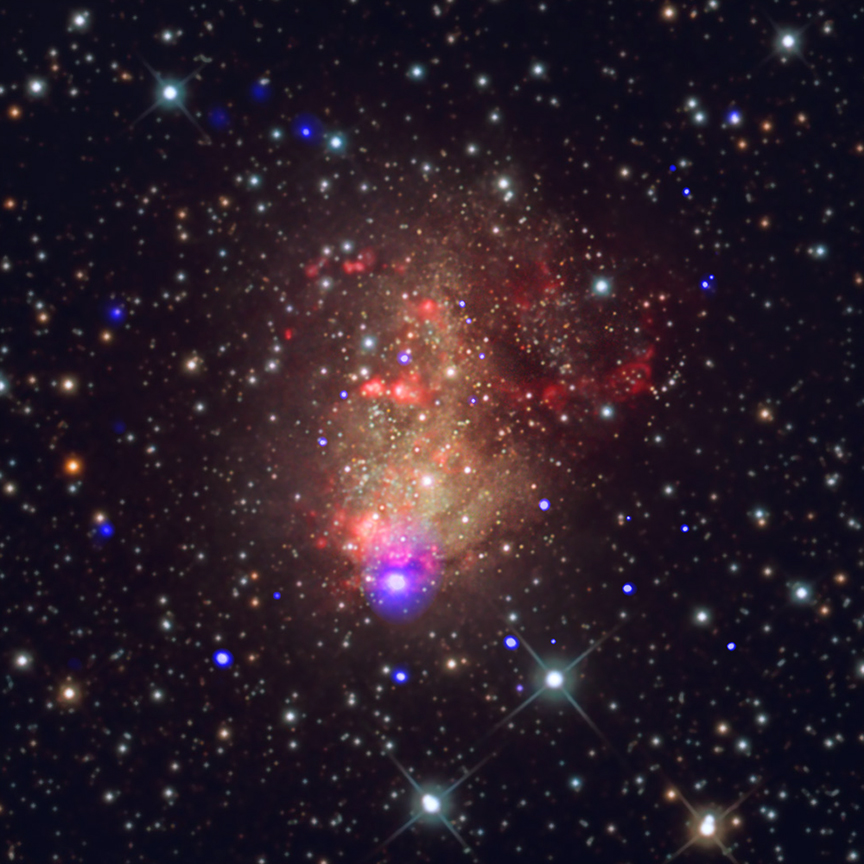
IC 10: A Starburst Galaxy with the Prospect of Gravitational WavesA Quick Look at IC 10

IC 10
Credit: X-ray: NASA/CXC/UMass Lowell/S.Laycock et al.
Optical: Bill Snyder Astrophotography


animation


In 1887, American astronomer Lewis Swift discovered a glowing cloud, or nebula, that turned out to be a small galaxy about 2.2 billion light years from Earth. Today, it is known as the "starburst" galaxy IC 10, referring to the intense star formation activity occurring there.

More than a hundred years after Swift's discovery, astronomers are studying IC 10 with the most powerful telescopes of the 21st century. New observations with NASA's Chandra X-ray Observatory reveal many pairs of stars that may one day become sources of perhaps the most exciting cosmic phenomenon observed in recent years: gravitational waves.

By analyzing Chandra observations of IC 10 spanning a decade, astronomers found over a dozen black holes and neutron stars feeding off gas from young, massive stellar companions. Such double star systems are known as "X-ray binaries" because they emit large amounts of X-ray light. As a massive star orbits around its compact companion, either a black hole or neutron star, material can be pulled away from the giant star to form a disk of material around the compact object. Frictional forces heat the infalling material to millions of degrees, producing a bright X-ray source.

When the massive companion star runs out of fuel, it will undergo a catastrophic collapse that will produce a supernova explosion, and leave behind a black hole or neutron star. The end result is two compact objects: either a pair of black holes, a pair of neutron stars, or a black hole and neutron star. If the separation between the compact objects becomes small enough as time passes, they will produce gravitational waves. Over time, the size of their orbit will shrink until they merge. LIGO has found three examples of black hole pairs merging in this way in the past two years.

Starburst galaxies like IC 10 are excellent places to search for X-ray binaries because they are churning out stars rapidly. Many of these newly born stars will be pairs of young and massive stars. The most massive of the pair will evolve more quickly and leave behind a black hole or a neutron star partnered with the remaining massive star. If the separation of the stars is small enough, an X-ray binary system will be produced.

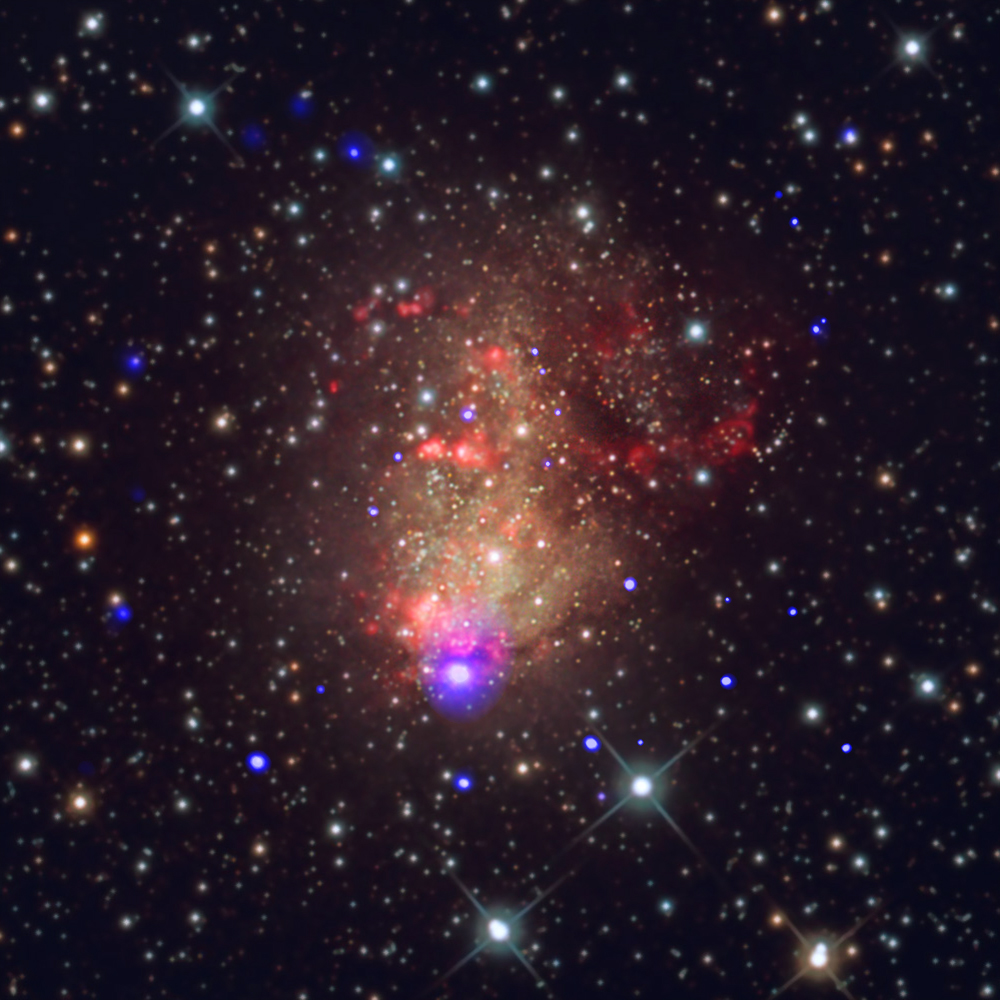
This new composite image of IC 10 combines X-ray data from Chandra (blue) with an optical image (red, green, blue) taken by amateur astronomer Bill Snyder from the Heavens Mirror Observatory in Sierra Nevada, California. The X-ray sources detected by Chandra appear as a darker blue than the stars detected in optical light.

The young stars in IC 10 appear to be just the right age to give a maximum amount of interaction between the massive stars and their compact companions, producing the most X-ray sources. If the systems were younger, then the massive stars would not have had time to go supernova and produce a neutron star or black hole, or the orbit of the massive star and the compact object would not have had time to shrink enough for mass transfer to begin. If the star system were much older, then both compact objects would probably have already formed. In this case transfer of matter between the compact objects is unlikely, preventing the formation of an X-ray emitting disk.

Chandra detected 110 X-ray sources in IC 10. Of these, over forty are also seen in optical light and 16 of these contain "blue supergiants", which are the type of young, massive, hot stars described earlier. Most of the other sources are X-ray binaries containing less massive stars. Several of the objects show strong variability in their X-ray output, indicative of violent interactions between the compact stars and their companions.

A pair of papers describing these results were published in the February 10th, 2017 issue of The Astrophysical Journal and is available online here and here. The authors of the study are Silas Laycock from the UMass Lowell's Center for Space Science and Technology (UML); Rigel Capallo, a graduate student at UML; Dimitris Christodoulou from UML; Benjamin Williams from the University of Washington in Seattle; Breanna Binder from the California State Polytechnic University in Pomona; and, Andrea Prestwich from the Harvard-Smithsonian Center for Astrophysics in Cambridge, Mass.

NASA's Marshall Space Flight Center in Huntsville, Alabama, manages the Chandra program for NASA's Science Mission Directorate in Washington. The Smithsonian Astrophysical Observatory in Cambridge, Massachusetts, controls Chandra's science and flight operations.


Fast Facts for IC 10:


Category: Neutron Stars/X-ray Binaries, Normal Galaxies & Starburst Galaxies
Coordinates (J2000): RA 00h 20m 23.2s | Dec 59° 17´ 34.7"
Constellation: Cassiopeia
Observation Date: 6 pointings between December 2009 and September 2010
Observation Time: 24 hours 19.5 min
Obs. ID: 11081-11086
Instrument: ACIS
References: Laycock S. et al., 2017, ApJ, 836, 50; arXiv:1611.08611. Laycock S. et al., 2017, ApJ [in press]; arXiv:1701.03803
Color Code: X-ray (Blue); Optical (Red, Green, Blue)
Distance Estimate: About 2.2 billion light years


Wednesday, July 09, 2014

VLT Clears Up Dusty Mystery

Artist’s impression of dust formation around a supernova explosion

The dwarf galaxy UGC 5189A, site of the supernova SN 2010jl

The dwarf galaxy UGC 5189A, site of the supernova SN 2010jl (annotated)


New observations reveal how stardust forms around a supernova

A group of astronomers has been able to follow stardust being made in real time — during the aftermath of a supernova explosion. For the first time they show that these cosmic dust factories make their grains in a two-stage process, starting soon after the explosion, but continuing for years afterwards. The team used ESO's Very Large Telescope (VLT) in northern Chile to analyse the light from the supernova SN2010jl as it slowly faded. The new results are published online in the journal Nature on 9 July 2014.

The origin of cosmic dust in galaxies is still a mystery [1]. Astronomers know that supernovae may be the primary source of dust, especially in the early Universe, but it is still unclear how and where dust grains condense and grow. It is also unclear how they avoid destruction in the harsh environment of a star-forming galaxy. But now, observations using ESO’s VLT at the Paranal Observatory in northern Chile are lifting the veil for the first time.

An international team used the X-shooter spectrograph to observe a supernova — known as SN2010jl — nine times in the months following the explosion, and for a tenth time 2.5 years after the explosion, at both visible and near-infrared wavelengths [2]. This unusually bright supernova, the result of the death of a massive star, exploded in the small galaxy UGC 5189A.

By combining the data from the nine early sets of observations we were able to make the first direct measurements of how the dust around a supernova absorbs the different colours of light,” said lead author Christa Gall from Aarhus University, Denmark. “This allowed us to find out more about the dust than had been possible before.

The team found that dust formation starts soon after the explosion and continues over a long time period. The new measurements also revealed how big the dust grains are and what they are made of. These discoveries are a step beyond recent results obtained using the Atacama Large Millimeter/submillimeter Array (ALMA), which first detected the remains of a recent supernova brimming with freshly formed dust from the famous supernova 1987A (SN 1987A; eso1401).

The team found that dust grains larger than one thousandth of a millimetre in diameter formed rapidly in the dense material surrounding the star. Although still tiny by human standards, this is large for a grain of cosmic dust and the surprisingly large size makes them resistant to destructive processes. How dust grains could survive the violent and destructive environment found in the remnants of supernovae was one of the main open questions of the ALMA paper, which this result has now answered — the grains are larger than expected.

Our detection of large grains soon after the supernova explosion means that there must be a fast and efficient way to create them,” said co-author Jens Hjorth from the Niels Bohr Institute of the University of Copenhagen, Denmark, and continued: “We really don’t know exactly how this happens.

But the astronomers think they know where the new dust must have formed: in material that the star shed out into space even before it exploded. As the supernova's shockwave expanded outwards, it created a cool, dense shell of gas — just the sort of environment where dust grains could seed and grow.

Results from the observations indicate that in a second stage — after several hundred days — an accelerated dust formation process occurs involving ejected material from the supernova. If the dust production in SN2010jl continues to follow the observed trend, by 25 years after the supernova, the total mass of dust will be about half the mass of the Sun; similar to the dust mass observed in other supernovae such as SN 1987A.

Previously astronomers have seen plenty of dust in supernova remnants left over after the explosions. But they also only found evidence for small amounts of dust actually being created in the supernova explosions. These remarkable new observations explain how this apparent contradiction can be resolved,” concludes Christa Gall.

Notes

[1] Cosmic dust consists of silicate and amorphous carbon grains — minerals also abundant on Earth. The soot from a candle is very similar to cosmic carbon dust, although the size of the grains in the soot are ten or more times bigger than typical grain sizes for cosmic grains.

[2] Light from this supernova was first seen in 2010, as is reflected in the name, SN 2010jl. It is classed as a Type IIn supernova. Supernovae classified as Type II result from the violent explosion of a massive star with at least eight times the mass of the Sun. The subtype of a Type IIn supernova — “n” denotes narrow — shows narrow hydrogen lines in its spectra. These lines result from the interaction between the material ejected by the supernova and the material already surrounding the star.

More information

This research was presented in a paper “Rapid formation of large dust grains in the luminous supernova SN 2010jl”, by C. Gall et al., to appear online in the journal Nature on 9 July 2014.

The team is composed of Christa Gall (Department of Physics and Astronomy, Aarhus University, Denmark; Dark Cosmology Centre, Niels Bohr Institute, University of Copenhagen, Denmark; Observational Cosmology Lab, NASA Goddard Space Flight Center, USA), Jens Hjorth (Dark Cosmology Centre, Niels Bohr Institute, University of Copenhagen, Denmark), Darach Watson (Dark Cosmology Centre, Niels Bohr Institute, University of Copenhagen, Denmark), Eli Dwek (Observational Cosmology Lab, NASA Goddard Space Flight Center, USA), Justyn R. Maund (Astrophysics Research Centre School of Mathematics and Physics Queen’s University Belfast, UK; Dark Cosmology Centre, Niels Bohr Institute, University of Copenhagen, Denmark; Department of Physics and Astronomy, University of Sheffield, UK), Ori Fox (Department of Astronomy, University of California, Berkeley, USA), Giorgos Leloudas (The Oskar Klein Centre, Department of Physics, Stockholm University, Sweden; Dark Cosmology Centre, Niels Bohr Institute, University of Copenhagen, Denmark), Daniele Malesani (Dark Cosmology Centre, Niels Bohr Institute, University of Copenhagen, Denmark) and Avril C. Day-Jones (Departamento de Astronomia, Universidad de Chile, Chile).

ESO is the foremost intergovernmental astronomy organisation in Europe and the world’s most productive ground-based astronomical observatory by far. It is supported by 15 countries: Austria, Belgium, Brazil, the Czech Republic, Denmark, France, Finland, Germany, Italy, the Netherlands, Portugal, Spain, Sweden, Switzerland and the United Kingdom. ESO carries out an ambitious programme focused on the design, construction and operation of powerful ground-based observing facilities enabling astronomers to make important scientific discoveries. ESO also plays a leading role in promoting and organising cooperation in astronomical research. ESO operates three unique world-class observing sites in Chile: La Silla, Paranal and Chajnantor. At Paranal, ESO operates the Very Large Telescope, the world’s most advanced visible-light astronomical observatory and two survey telescopes. VISTA works in the infrared and is the world’s largest survey telescope and the VLT Survey Telescope is the largest telescope designed to exclusively survey the skies in visible light. ESO is the European partner of a revolutionary astronomical telescope ALMA, the largest astronomical project in existence. ESO is currently planning the 39-metre European Extremely Large optical/near-infrared Telescope, the E-ELT, which will become “the world’s biggest eye on the sky”.

Links

Contacts

Christa Gall
Aarhus University
Denmark
Cell: +45 53 66 20 18
Email:
cgall@phys.au.dk

Jens Hjorth
Dark Cosmology Centre, Niels Bohr Institute, University of Copenhagen
Copenhagen, Denmark
Email:
jens@dark-cosmology.dk

Richard Hook
ESO education and Public Outreach Department
Garching bei München, Germany

Tel: +49 89 3200 6655
Email:
rhook@eso.org

Source: ESO