Friday, March 24, 2017

Defying cosmic convention

Credit: ESA/Hubble & NASA


Some galaxies are harder to classify than others. Here, Hubble’s trusty Wide Field Camera 3 (WFC3) has captured a striking view of two interacting galaxies located some 60 million light-years away in the constellation of  Leo (The Lion). The more diffuse and patchy blue glow covering the right side of the frame is known as NGC 3447 — sometimes NGC 3447B for clarity, as the name NGC 3447 can apply to the overall duo. The smaller clump to the upper left is known as NGC 3447A.

The trouble with space is that it is, to state the obvious, really, really big. Astronomers have for hundreds of years been discovering and naming galaxies, stars, cosmic clouds and more. Unifying and regulating the conventions and classifications for everything ever observed is very difficult, especially when you get an ambiguous object like NGC 3447, which stubbornly defies easy categorisation.

Overall, we know NGC 3447 comprises a couple of interacting galaxies, but we’re unsure what each looked like before they began to tear one another apart. The two sit so close that they are strongly influenced and distorted by the gravitational forces between them, causing the galaxies to twist themselves into the unusual and unique shapes seen here. NGC 3447A appears to display the remnants of a central bar structure and some disrupted spiral arms, both properties characteristic of certain spiral galaxies. Some identify NGC 3447B as a former spiral galaxy, while others categorise it as being an irregular galaxy.


Thursday, March 23, 2017

Saturn's Rings Viewed in the Mid-infrared Show Bright Cassini Division

Figure 1: A three-color composite of the mid-infrared images of Saturn on January 23, 2008 captured with COMICS on the Subaru Telescope. The Cassini Division and the C ring appear bright. Color differences reflect the temperatures; the warmer part is blue, the cooler part is red. (Credit: NAOJ)


A team of researchers has succeeded in measuring the brightnesses and temperatures of Saturn's rings using the mid-infrared images taken by the Subaru Telescope in 2008. The images are the highest resolution ground-based views ever made. They reveal that, at that time, the Cassini Division and the C ring were brighter than the other rings in the mid-infrared light and that the brightness contrast appeared to be the inverse of that seen in the visible light (Figure 1). The data give important insights into the nature of Saturn's rings.

Subaru Views Saturn

The Subaru Telescope also has observed Saturn several times over the years. Dr. Hideaki Fujiwara, Subaru Public Information Officer/Scientist, analyzed data taken in January 2008 using the Cooled Mid-Infrared Camera and Spectrometer (COMICS) on the telescope to produce a beautiful image of Saturn for public information purposes. During the analysis, he noticed that the appearance of Saturn's rings in the mid-infrared part of the spectrum was totally different from what is seen in the visible light

Saturn's main rings consist of the C, B, and A rings, each with different populations of particles. The Cassini Division separates the B and A rings. The 2008 image shows that the Cassini Division and the C ring are brighter in the mid-infrared wavelengths than the B and A rings appear to be (Figure 1). This brightness contrast is the inverse of how they appear in the visible light, where the B and A rings are always brighter than the Cassini Division and the C ring (Figure 2).

Figure 2: Comparison of the images of Saturn's rings in the 2008 view in the mid-infrared (left) and the visible light (right). The visible light image was taken on March 16, 2008 with the 105-cm Murikabushi telescope at Ishigakijima Astronomical Observatory. The radial brightness contrast of Saturn's rings is the inverse between the two wavelength ranges. (Credit: NAOJ)


"Thermal emission" from ring particles is observed in the mid-infrared, where warmer particles are brighter. The team measured the temperatures of the rings from the images, which revealed that the Cassini Division and the C ring are warmer than the B and A rings. The team concluded that this was because the particles in the Cassini Division and C ring are more easily heated by solar light due to their sparser populations and darker surfaces.

On the other hand, in the visible light, observers see sunlight being reflected by the ring particles. Therefore, the B and A rings, with their dense populations of particles, always seem bright in the visible wavelengths, while the Cassini Division and the C ring appear faint. The difference in the emission process explains the inverse brightnesses of Saturn's rings between the mid-infrared and the visible-light views.

Changing Angles Change the Brightnesses

It turns out that the Cassini Division and the C ring are not always brighter than the B and A rings, even in the mid-infrared. The team investigated images of Saturn's rings taken in April 2005 with COMICS, and found that the Cassini Division and the C ring were fainter than the B and A rings at that time, which is the same contrast to what was seen in the visible light (Figure 3).

Figure 3: Comparison of the mid-infrared images of Saturn's rings on April 30, 2005 (top) and January 23, 2008 (bottom). Although both of the images were taken in the mid-infrared, the radial contrast of Saturn's rings is the inverse of each other. (Credit: NAOJ)


The team concluded that the "inversion" of the brightness of Saturn's rings between 2005 and 2008 was caused by the seasonal change in the ring opening angle to the Sun and Earth. Since the rotation axis of Saturn inclines compared to its orbital plane around the Sun, the ring opening angle to the Sun changes over a 15-year cycle. This makes a seasonal variation in the solar heating of the ring particles. The change in the opening angle viewed from the Earth affects the apparent filling factor of the particles in the rings. These two variations – the temperature and the observed filling factor of the particles – led to the change in the mid-infrared appearance of Saturn's rings.

The data taken with the Subaru Telescope revealed that the Cassini Division and the C ring are sometimes bright in the mid-infrared though they are always faint in visible light. "I am so happy that the public information activities of the Subaru Telescope, of which I am in charge, led to this scientific finding," said Dr. Fujiwara. "We are going to observe Saturn again in May 2017 and hope to investigate the nature of Saturn's rings further by taking advantages of observations with space missions and ground-based telescopes."

This research is published in Astronomy & Astrophysics, Volume 599, A29 and posted on-line on February 23, 2017 (Fujiwara et al., 2017, "Seasonal variation of the radial brightness contrast of Saturn's rings viewed in mid-infrared by Subaru/COMICS"). This work is supported JSPS KAKENHI Grant Numbers JP23103002 and JP26800110.

The research team:

  • Hideaki Fujiwara: Subaru Telescope, National Astronomical Observatory of Japan, USA
  • Ryuji Morishima: University of California, Los Angeles/Jet Propulsion Laboratory, California Institute of Technology, USA
  • Takuya Fujiyoshi: Subaru Telescope, National Astronomical Observatory of Japan, USA
  • Takuya Yamashita: National Astronomical Observatory of Japan, Japan


Wednesday, March 22, 2017

NASA's Swift Mission Maps a Star's 'Death Spiral' into a Black Hole

This artist’s rendering shows the tidal disruption event named ASASSN-14li, where a star wandering too close to a 3-million-solar-mass black hole was torn apart. The debris gathered into an accretion disk around the black hole. New data from NASA's Swift satellite show that the initial formation of the disk was shaped by interactions among incoming and outgoing streams of tidal debris. Credit: NASA's Goddard Space Flight Center. Hi-res image


Some 290 million years ago, a star much like the sun wandered too close to the central black hole of its galaxy. Intense tides tore the star apart, which produced an eruption of optical, ultraviolet and X-ray light that first reached Earth in 2014. Now, a team of scientists using observations from NASA's Swift satellite have mapped out how and where these different wavelengths were produced in the event, named ASASSN-14li, as the shattered star's debris circled the black hole.

"We discovered brightness changes in X-rays that occurred about a month after similar changes were observed in visible and UV light," said Dheeraj Pasham, an astrophysicist at the Massachusetts Institute of Technology (MIT) in Cambridge, Massachusetts, and the lead researcher of the study. "We think this means the optical and UV emission arose far from the black hole, where elliptical streams of orbiting matter crashed into each other."

This animation illustrates how debris from a tidally disrupted star collides with itself, creating shock waves that emit ultraviolet and optical light far from the black hole. According to Swift observations of ASASSN-14li, these clumps took about a month to fall back to the black hole, where they produced changes in the X-ray emission that correlated with the earlier UV and optical changes. Credits: NASA's Goddard Space Flight Center. This video is public domain and can be downloaded from the Scientific Visualization Studio.


Astronomers think ASASSN-14li was produced when a sun-like star wandered too close to a 3-million-solar-mass black hole similar to the one at the center of our own galaxy. For comparison, the event horizon of a black hole like this is about 13 times bigger than the sun, and the accretion disk formed by the disrupted star could extend to more than twice Earth's distance from the sun.

When a star passes too close to a black hole with 10,000 or more times the sun's mass, tidal forces outstrip the star's own gravity, converting the star into a stream of debris. Astronomers call this a tidal disruption event. Matter falling toward a black hole collects into a spinning accretion disk, where it becomes compressed and heated before eventually spilling over the black hole's event horizon, the point beyond which nothing can escape and astronomers cannot observe. Tidal disruption flares carry important information about how this debris initially settles into an accretion disk.

Astronomers know the X-ray emission in these flares arises very close to the black hole. But the location of optical and UV light was unclear, even puzzling. In some of the best-studied events, this emission seems to be located much farther than where the black hole's tides could shatter the star. Additionally, the gas emitting the light seemed to remain at steady temperatures for much longer than expected.

ASASSN-14li was discovered Nov. 22, 2014, in images obtained by the All Sky Automated Survey for SuperNovae (ASASSN), which includes robotic telescopes in Hawaii and Chile. Follow-up observations with Swift's X-ray and Ultraviolet/Optical telescopes began eight days later and continued every few days for the next nine months. The researchers supplemented later Swift observations with optical data from the Las Cumbres Observatory headquartered in Goleta, California.   

In a paper describing the results published March 15 in The Astrophysical Journal Letters, Pasham, Cenko and their colleagues show how interactions among the infalling debris could create the observed optical and UV emission.

Tidal debris initially falls toward the black hole but overshoots, arcing back out along elliptical orbits and eventually colliding with the incoming stream.

"Returning clumps of debris strike the incoming stream, which results in shock waves that emit visible and ultraviolet light," said Goddard's Bradley Cenko, the acting Swift principal investigator and a member of the science team. "As these clumps fall down to the black hole, they also modulate the X-ray emission there."

Future observations of other tidal disruption events will be needed to further clarify the origin of optical and ultraviolet light.

Goddard manages the Swift mission in collaboration with Pennsylvania State University in University Park, the Los Alamos National Laboratory in New Mexico and Orbital Sciences Corp. in Dulles, Virginia. Other partners include the University of Leicester and Mullard Space Science Laboratory in the United Kingdom, Brera Observatory and the Italian Space Agency in Italy, with additional collaborators in Germany and Japan.

Related:


By Francis Reddy
NASA's Goddard Space Flight Center in Greenbelt, Md.
Editor: Karl Hille


Tuesday, March 21, 2017

Protostar Blazes Bright, Reshaping Its Stellar Nursery

Inside the Cats's Paw Nebula, as seen in an infrared image from NASA's Spitzer Space Telescope (left), ALMA discovered that an infant star is undergoing an intense growth spurt, shining nearly 100 brighter than before and reshaping its stellar nursery (right). Credit: ALMA (ESO/NAOJ/NRAO), T. Hunter; C. Brogan, B. Saxton (NRAO/AUI/NSF); GLIMPSE, NASA/JPL-Caltech

ALMA image of the glowing dust inside NGC 6334I, a protocluster containing an infant star that is undergoing an intense growth spurt, likely triggered by an avalanche of gas falling onto its surface. Credit: ALMA (ESO/NAOJ/NRAO); C. Brogan, B. Saxton (NRAO/AUI/NSF)

Comparing observations by two different millimeter-wavelength telescopes, ALMA and the SMA, astronomers noted a massive outburst in a star-forming cloud. Because the ALMA images are more sensitive and show finer detail, it was possible to use them to simulate what the SMA could have seen in 2015 and 2016. By subtracting the earlier SMA images from the simulated images, astronomers could see that a significant change had taken place in MM1 while the other three millimeter sources (MM2, MM3, and MM4) are unchanged. Credit: ALMA (ESO/NAOJ/NRAO); SMA, Harvard/Smithsonian CfA


A massive protostar, deeply nestled in its dust-filled stellar nursery, recently roared to life, shining nearly 100 times brighter than before. This outburst, apparently triggered by an avalanche of star-forming gas crashing onto the surface of the star, supports the theory that young stars can undergo intense growth spurts that reshape their surroundings.

Astronomers made this discovery by comparing new observations from the Atacama Large Millimeter/submillimeter Array (ALMA) in Chile with earlier observations from the Submillimeter Array (SMA) in Hawaii.

"We were amazingly fortunate to detect this spectacular transformation of a young, massive star,” said Todd Hunter, an astronomer at the National Radio Astronomy Observatory (NRAO) in Charlottesville, Va., and lead author on a paper published in the Astrophysical Journal Letters. "By studying a dense star-forming cloud with both ALMA and the SMA, we could see that something dramatic had taken place, completely changing a stellar nursery over a surprisingly short period of time."

In 2008, before the era of ALMA, Hunter and his colleagues used the SMA to observe a small but active portion of the Cat's Paw Nebula (also known as NGC 6334), a star-forming complex located about 5,500 light-years from Earth in the direction of the southern constellation Scorpius. This nebula is similar in many respects to its more northern cousin, the Orion Nebula, which is also brimming with young stars, star clusters, and dense cores of gas that are on the verge of becoming stars. The Cat's Paw Nebula, however, is forming stars at a faster rate.

The initial SMA observations of this portion of the nebula, dubbed NGC 6334I, revealed what appeared to be a typical protocluster: a dense cloud of dust and gas harboring several still-growing stars.

Young stars form in these tightly packed regions when pockets of gas become so dense that they begin to collapse under their own gravity. Over time, disks of dust and gas form around these nascent stars and funnel material onto their surfaces helping them grow.

This process, however, may not be entirely slow and steady. Astronomers now believe that young stars can also experience spectacular growth spurts, periods when they rapidly acquire mass by gorging on star-forming gas.

The new ALMA observations of this region, taken in 2015 and 2016, reveal that dramatic changes occurred toward a portion of the protocluster called NGC 6334I-MM1 after the original SMA observations. This region is now about four times brighter at millimeter wavelengths, meaning that the central protostar is nearly 100 times more luminous than before.

The astronomers speculate that leading up to this outburst, an uncommonly large clump of material was drawn into the star's accretion disk, creating a logjam of dust and gas. Once enough material accumulated, the logjam burst, releasing an avalanche of gas onto the growing star.

This extreme accretion event greatly increased the star’s luminosity, heating its surrounding dust. It’s this hot, glowing dust that the astronomers observed with ALMA. Though similar events have been observed in infrared light, this is the first time that such an event has been identified at millimeter wavelengths.

To ensure that the observed changes were not the result of differences in the telescopes or simply a data-processing error, Hunter and his colleagues used the ALMA data as a model to accurately simulate what the SMA -- with its more modest capabilities -- would have seen if it conducted similar observations in 2015 and 2016. By digitally subtracting the actual 2008 SMA images from the simulated images, the astronomers confirmed that there was indeed a significant and consistent change to one member of the protocluster.

"Once we made sure we were comparing the two sets of observations on an even playing field, we knew that we were witnessing a very special time in the growth of a star," said Crystal Brogan, also with the NRAO and co-author on the paper.

Further confirmation of this event came from complementary data taken by the Hartebeesthoek Radio Astronomy Observatory in South Africa. This single-dish observatory was monitoring the radio signals from masers in the same region. Masers are the naturally occurring cosmic radio equivalent of lasers. They are powered by a variety of energetic processes, including outbursts from rapidly growing stars.

The data from the Hartebeesthoek observatory reveal an abrupt and dramatic spike in maser emission from this region in early 2015, only a few months before the first ALMA observation. Such a spike is precisely what astronomers would expect to see if there were a protostar undergoing a major growth spurt.

"These observations add evidence to the theory that star formation is punctuated by a sequence of dynamic events that build up a star, rather than a smooth continuous growth," concluded Hunter. "It also tells us that it is important to monitor young stars at radio and millimeter wavelengths, because these wavelengths allow us to peer into the youngest, most deeply embedded star-forming regions. Catching such events at the earliest stage may reveal new phenomena of the star-formation process."

The National Radio Astronomy Observatory is a facility of the National Science Foundation, operated under cooperative agreement by Associated Universities, Inc.

# # #

The Atacama Large Millimeter/submillimeter Array (ALMA), an international astronomy facility, is a partnership of ESO, the U.S. National Science Foundation (NSF) and the National Institutes of Natural Sciences (NINS) of Japan in cooperation with the Republic of Chile. ALMA is funded by ESO on behalf of its Member States, by NSF in cooperation with the National Research Council of Canada (NRC) and the National Science Council of Taiwan (NSC) and by NINS in cooperation with the Academia Sinica (AS) in Taiwan and the Korea Astronomy and Space Science Institute (KASI).

ALMA construction and operations are led by ESO on behalf of its Member States; by the National Radio Astronomy Observatory (NRAO), managed by Associated Universities, Inc. (AUI), on behalf of North America; and by the National Astronomical Observatory of Japan (NAOJ) on behalf of East Asia. The Joint ALMA Observatory (JAO) provides the unified leadership and management of the construction, commissioning and operation of ALMA.

This research is presented in a paper titled "An extraordinary outburst in the massive protostellar system NGC6334I-MM1: Quadrupling of the millimeter continuum," by T.R. Hunter et al., published in the Astrophysical Journal Letters [https://doi.org/10.3847/2041-8213/aa5d0e].

Contact:

Charles Blue
434-296-0314;  
cblue@nrao.edu


Monday, March 20, 2017

Hubble Discovery of Runaway Star Yields Clues to Breakup of Multiple-Star System

Wayward Newborn Stars Fleeing from Their Birthplace
Credits: NASA, ESA, K. Luhman (Penn State University), and M. Robberto (STScI)


As British royal families fought the War of the Roses in the 1400s for control of England's throne, a grouping of stars was waging its own contentious skirmish — a star wars far away in the Orion Nebula.

The stars were battling each other in a gravitational tussle, which ended with the system breaking apart and at least three stars being ejected in different directions. The speedy, wayward stars went unnoticed for hundreds of years until, over the past few decades, two of them were spotted in infrared and radio observations, which could penetrate the thick dust in the Orion Nebula.

The observations showed that the two stars were traveling at high speeds in opposite directions from each other. The stars' origin, however, was a mystery. Astronomers traced both stars back 540 years to the same location and suggested they were part of a now-defunct multiple-star system. But the duo's combined energy, which is propelling them outward, didn't add up. The researchers reasoned there must be at least one other culprit that robbed energy from the stellar toss-up.

Now NASA's Hubble Space Telescope has helped astronomers find the final piece of the puzzle by nabbing a third runaway star. The astronomers followed the path of the newly found star back to the same location where the two previously known stars were located 540 years ago. The trio reside in a small region of young stars called the Kleinmann-Low Nebula, near the center of the vast Orion Nebula complex, located 1,300 light-years away.

"The new Hubble observations provide very strong evidence that the three stars were ejected from a multiple-star system," said lead researcher Kevin Luhman of Penn State University in University Park, Pennsylvania. "Astronomers had previously found a few other examples of fast-moving stars that trace back to multiple-star systems, and therefore were likely ejected. But these three stars are the youngest examples of such ejected stars. They're probably only a few hundred thousand years old. In fact, based on infrared images, the stars are still young enough to have disks of material leftover from their formation."
xtremely fast on their way out of the Kleinmann-Low Nebula, up to almost 30 times the speed of most of the nebula's stellar inhabitants. Based on computer simulations, astronomers predicted that these gravitational tugs-of-war should occur in young clusters, where newborn stars are crowded together. "But we haven't observed many examples, especially in very young clusters," Luhman said. "The Orion Nebula could be surrounded by additional fledging stars that were ejected from it in the past and are now streaming away into space."

The team's results will appear in the March 20, 2017 issue of The Astrophysical Journal Letters.

Luhman stumbled across the third speedy star, called "source x," while he was hunting for free-floating planets in the Orion Nebula as a member of an international team led by Massimo Robberto of the Space Telescope Science Institute in Baltimore, Maryland. The team used the near-infrared vision of Hubble's Wide Field Camera 3 to conduct the survey. During the analysis, Luhman was comparing the new infrared images taken in 2015 with infrared observations taken in 1998 by the Near Infrared Camera and Multi-Object Spectrometer (NICMOS). He noticed that source x had changed its position considerably, relative to nearby stars over the 17 years between Hubble images, indicating the star was moving fast, about 130,000 miles per hour.

The astronomer then looked at the star's previous locations, projecting its path back in time. He realized that in the 1470s source x had been near the same initial location in the Kleinmann-Low Nebula as two other runaway stars, Becklin-Neugebauer (BN) and "source I."

BN was discovered in infrared images in 1967, but its rapid motion wasn't detected until 1995, when radio observations measured the star's speed at 60,000 miles per hour. Source I is traveling roughly 22,000 miles per hour. The star had only been detected in radio observations; because it is so heavily enshrouded in dust, its visible and infrared light is largely blocked.

The three stars were most likely kicked out of their home when they engaged in a game of gravitational billiards, Luhman said. What often happens when a multiple system falls apart is that two of the member stars move close enough to each other that they merge or form a very tight binary. 
In either case, the event releases enough gravitational energy to propel all of the stars in the system outward. The energetic episode also produces a massive outflow of material, which is seen in the NICMOS images as fingers of matter streaming away from the location of the embedded source I star.

Future telescopes, such as the James Webb Space Telescope, will be able to observe a large swath of the Orion Nebula. By comparing images of the nebula taken by the Webb telescope with those made by Hubble years earlier, astronomers hope to identify more runaway stars from other multiple-star systems that broke apart.

The Hubble Space Telescope is a project of international cooperation between NASA and ESA (European Space Agency). NASA's Goddard Space Flight Center in Greenbelt, Maryland, manages the telescope. The Space Telescope Science Institute (STScI) in Baltimore conducts Hubble science operations. STScI is operated for NASA by the Association of Universities for Research in Astronomy, Inc., in Washington, D.C.


Related Links:


Contacts:

Donna Weaver / Ray Villard
Space Telescope Science Institute, Baltimore, Maryland
410-338-4493 / 410-338-4514

dweaver@stsci.edu / villard@stsci.edu

Kevin Luhman
Penn State University, University Park, Pennsylvania

kluhman@astro.psu.edu


Source: HubbleSite


Sunday, March 19, 2017

ALMA's ability to see a "Cosmic Hole" confirmed

The image shows the measurement of the SZ effect in the galaxy cluster RX J1347.5-1145 taken with ALMA (blue). The background image was taken by the Hubble Space Telescope. A "hole" caused by the SZ effect is seen in the ALMA observations.  Credit: ALMA (ESO/NAOJ/NRAO), Kitayama et al., NASA/ESA Hubble Space Telescope


Researchers using the Atacama Large Millimeter/submillimeter Array (ALMA) successfully imaged a radio "hole" around a galaxy cluster 4.8 billion light-years away from us. This is the highest resolution image ever taken of such a hole caused by the Sunyaev-Zel'dovich effect (SZ effect). The image proves ALMA's high capability to investigate the distribution and temperature of gas around galaxy clusters through the SZ effect.

A research team led by Tetsu Kitayama, a professor at Toho University, Japan, used ALMA to investigate the hot gas in a galaxy cluster. The hot gas is a key component to understand the nature and evolution of galaxy clusters. Even though the hot gas does not emit radio waves detectable with ALMA, the gas scatters the radio waves of the Cosmic Microwave Background and makes a "hole" around the galaxy cluster. This is the Sunyaev-Zel'dovich effect [1].

The team observed the galaxy cluster RX J1347.5-1145 located 4.8 billion light-years away. This galaxy cluster is well known among astronomers for its strong SZ effect and has been observed many times with radio telescopes. For example, the Nobeyama 45-m Radio Telescope, operated by the National Astronomical Observatory of Japan, has revealed an uneven distribution of the hot gas in this galaxy cluster, which was not seen in X-ray observations. To better understand the unevenness, astronomers need higher resolution observations. But relatively smooth and widely-distributed objects, such as the hot gas in galaxy clusters, are difficult to image with high-resolution radio interferometers.

To overcome this difficulty, ALMA utilized the Atacama Compact Array, also known as the Morita Array, the major Japanese contribution to the project. The Morita Array's smaller diameter antennas and the close-packed antenna configuration provide a wider field of view. By using the data from the Morita Array, astronomers can precisely measure the radio waves from objects subtending a large angle on the sky.
With ALMA, the team obtained an SZ effect image of RX J1347.5-1145, with twice the resolution and ten times better sensitivity than previous observations. This is the first image of the SZ effect with ALMA. The ALMA SZ image is consistent with the previous observations and better illustrates the pressure distribution of hot gas. This image proves that ALMA is highly capable of observing the SZ effect and clearly shows that a gigantic collision is ongoing in this galaxy cluster.

"It was nearly 50 years ago that the SZ effect was proposed for the first time," explains Kitayama. "The effect is pretty weak and it has been very difficult to image the effect with high resolution. Thanks to ALMA, this time we made a long-awaited breakthrough to pave a new path to probe the cosmic evolution."

Note

[1] "Cosmic Microwave Background (CMB)" radio waves come from every direction. When CMB radio waves pass through the hot gas in a galaxy cluster, the radio waves interact with high-energy electrons in the hot gas and gain energy. As a result, the CMB radio waves shift to higher energy. Observing from the Earth, the CMB in the original energy range has less intensity near the galaxy cluster. This is called the "Sunyaev-Zel'dovich effect," first proposed by Rashid Sunyaev and Yakov Zel'dovich in 1970.


These observation results were published as Kitayama et al. "The Sunyaev-Zel'dovich effect at 5″: RX J1347.5-1145 imaged by ALMA" in the Publications of the Astronomical Society of Japan in October 2016.

The research team members are:

Tetsu Kitayama (Toho University), Shutaro Ueda (Japan Aerospace Exploration Agency), Shigehisa Takakuwa (Kagoshima University / Academia Sinica Institute of Astronomy and Astrophysics), Takahiro Tsutsumi (U. S. National Radio Astronomy Observatory), Eiichiro Komatsu (Max-Planck Institute for Astrophysics / Kavli Institute for the Physics and Mathematics of the Universe, The University of Tokyo), Takuya Akahori (Kagoshima University), Daisuke Iono (National Astronomical Observatory of Japan / SOKENDAI), Takuma Izumi (The University of Tokyo), Ryohei Kawabe (National Astronomical Observatory of Japan / SOKENDAI / The University of Tokyo), Kotaro Kohno (The University of Tokyo), Hiroshi Matsuo (National Astronomical Observatory of Japan / SOKENDAI), Naomi Ota (Nara Women's University), Yasushi Suto (The University of Tokyo), Motokazu Takizawa (Yamagata University), and Kohji Yoshikawa (University of Tsukuba)


Saturday, March 18, 2017

ALMA peers into the hearts of stellar nurseries

NGC 6822
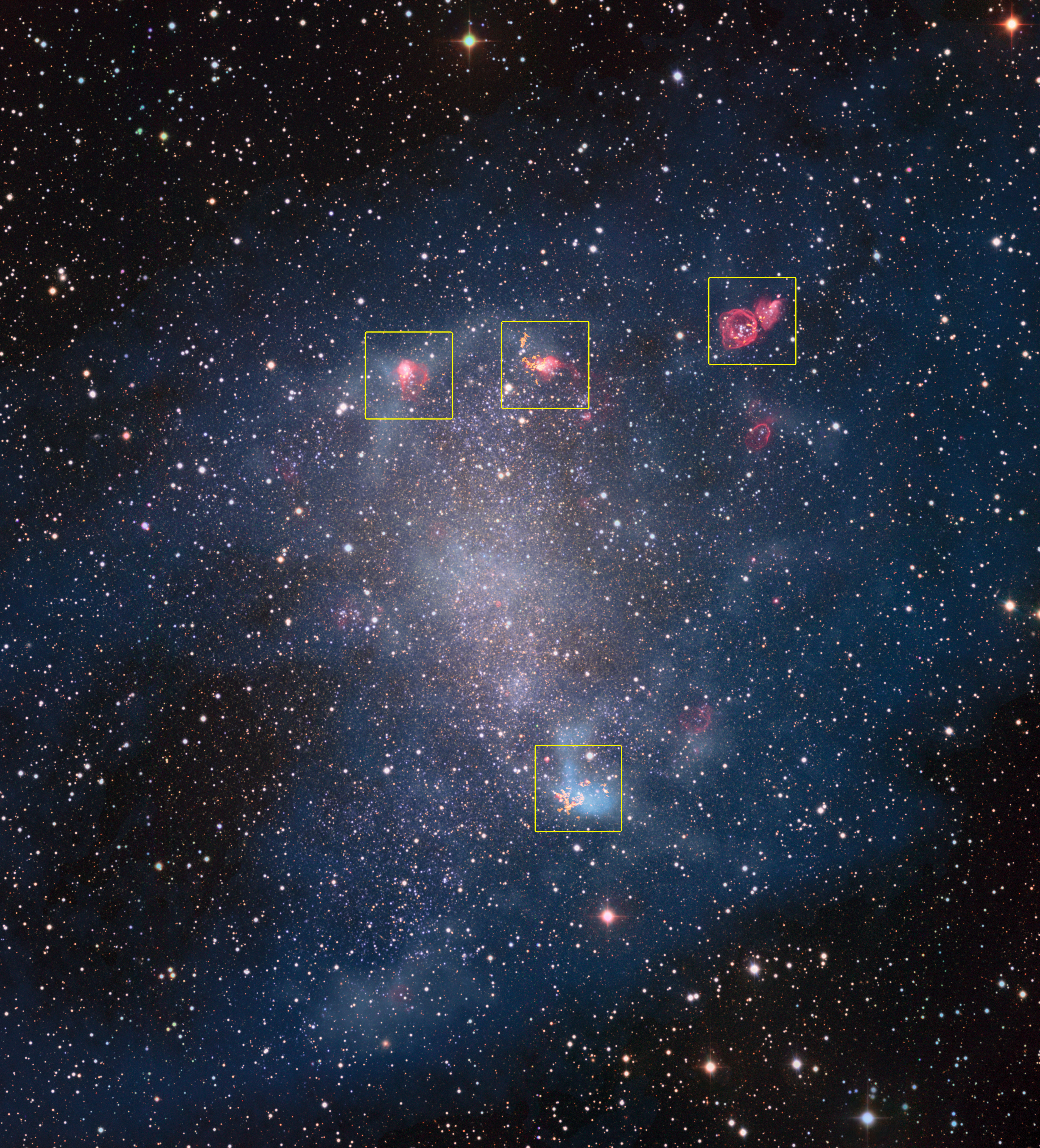
Credit: ESO, ALMA (ESO/NAOJ/NRAO)/A. Schruba, VLA (NRAO)/Y. Bagetakos/Little THINGS


With their spectacular glowing arms, grand spiral galaxies seem to get all the attention — but NGC 6822, a barred irregular dwarf galaxy, proves that regular spirals do not have a monopoly on galactic beauty. Also called Barnard’s galaxy, NGC 6822 is located in the constellation of Sagittarius just 1.6 million light-years away and is brimming with rich star formation regions.

This new image is a composite of older observations made with the Wide Field Imager attached to the 2.2-metre MPG/ESO telescope at ESO’s La Silla Observatory and new data collected by the Atacama Large Millimeter/submillimeter Array (ALMA). The areas observed with ALMA are highlighted in the image and can be seen here in detail.

The observations by ALMA reveal the structure of star-forming gas clouds in unprecedented resolution. Observations in our own galaxy have shown that stars form in the dense cores of giant clouds of molecular hydrogen gas, the only places where gas can become cold enough to collapse under its own gravity. These conditions also foster the formation of other molecules, such as carbon monoxide, which are an indispensable tool in helping astronomers to detect galactic molecular hydrogen gas.

Until recently, astronomers have only been able to resolve star formation regions within the Milky Way — but now ALMA’s sharp sight provides a window into star formation in other galaxies. The analysis of the data revealed that, unlike in our own galaxy, the observed molecules are concentrated into small, dense cores of gas. This explains why it has been so hard to observe extragalactic star formation regions so far, especially in low mass, low metallicity galaxies. ALMA also found that the cores in NGC 6822 behave remarkably similarly to stellar nurseries in the Milky Way, indicating that the physics of star formation in these low-mass galaxies resemble that which we see in our own galaxy.

Links
Source: ESO/Images

Friday, March 17, 2017

Seeing things sideways

Credit: ESA/Hubble & NASA


This image from Hubble’s Wide Field Camera 3 (WFC3) shows NGC 1448, a spiral galaxy located about 50 million light-years from Earth in the little-known constellation of Horologium (The Pendulum Clock). We tend to think of spiral galaxies as massive and roughly circular celestial bodies, so this glittering oval does not immediately appear to fit the visual bill. What’s going on?

Imagine a spiral galaxy as a circular frisbee spinning gently in space. When we see it face on, our observations reveal a spectacular amount of detail and structure — a great example from Hubble is the telescope’s view of Messier 51, otherwise known as the Whirlpool Galaxy. However, the NGC 1448 frisbee is very nearly edge-on with respect to Earth, giving it an appearance that is more oval than circular. The spiral arms, which curve out from NGC 1448’s dense core, can just about be seen.

Although spiral galaxies might appear static with their picturesque shapes frozen in space, this is very far from the truth. The stars in these dramatic spiral configurations are constantly moving and spinning around the galaxy’s core, with those on the inside whirling around faster than those sitting further out. This makes the formation and continued existence of a spiral galaxy’s arms something of a cosmic puzzle, because the arms wrapped around the spinning core should become wound tighter and tighter as time goes on — but this is not what we see. This is known as the winding problem.


Thursday, March 16, 2017

Dark Matter Less Influential in Galaxies in Early Universe

 PR Image eso1709a
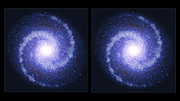
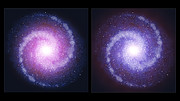
Comparison of rotating disc galaxies in the distant Universe and the present day

PR Image eso1709b
Comparison of rotating disc galaxies in the distant Universe and the present day


Videos

ESOcast 100 Light: Dark Matter Less Influential in Early Universe (4K UHD)
ESOcast 100 Light: Dark Matter Less Influential in Early Universe (4K UHD) 

Comparison of rotating disc galaxies in the distant Universe and the present day

Comparison of rotating disc galaxies in the distant Universe and the present day


VLT observations of distant galaxies suggest they were dominated by normal matter 

New observations indicate that massive, star-forming galaxies during the peak epoch of galaxy formation, 10 billion years ago, were dominated by baryonic or “normal” matter. This is in stark contrast to present-day galaxies, where the effects of mysterious dark matter seem to be much greater. This surprising result was obtained using ESO’s Very Large Telescope and suggests that dark matter was less influential in the early Universe than it is today. The research is presented in four papers, one of which will be published in the journal Nature this week.

We see normal matter as brightly shining stars, glowing gas and clouds of dust. But the more elusive dark matter does not emit, absorb or reflect light and can only be observed via its gravitational effects. The presence of dark matter can explain why the outer parts of nearby spiral galaxies rotate more quickly than would be expected if only the normal matter that we can see directly were present [1].

Now, an international team of astronomers led by Reinhard Genzel at the Max Planck Institute for Extraterrestrial Physics in Garching, Germany have used the KMOS and SINFONI instruments at ESO’s Very Large Telescope in Chile [2] to measure the rotation of six massive, star-forming galaxies in the distant Universe, at the peak of galaxy formation 10 billion years ago.

What they found was intriguing: unlike spiral galaxies in the modern Universe, the outer regions of these distant galaxies seem to be rotating more slowly than regions closer to the core — suggesting there is less dark matter present than expected [3].

“Surprisingly, the rotation velocities are not constant, but decrease further out in the galaxies,” comments Reinhard Genzel, lead author of the Nature paper. “There are probably two causes for this. Firstly, most of these early massive galaxies are strongly dominated by normal matter, with dark matter playing a much smaller role than in the Local Universe. Secondly, these early discs were much more turbulent than the spiral galaxies we see in our cosmic neighbourhood.”

Both effects seem to become more marked as astronomers look further and further back in time, into the early Universe. This suggests that 3 to 4 billion years after the Big Bang, the gas in galaxies had already efficiently condensed into flat, rotating discs, while the dark matter halos surrounding them were much larger and more spread out. Apparently it took billions of years longer for dark matter to condense as well, so its dominating effect is only seen on the rotation velocities of galaxy discs today
This explanation is consistent with observations showing that early galaxies were much more gas-rich and compact than today’s galaxies.

The six galaxies mapped in this study were among a larger sample of a hundred distant, star-forming discs imaged with the KMOS and SINFONI instruments at ESO’s Very Large Telescope at the Paranal Observatory in Chile. In addition to the individual galaxy measurements described above, an average rotation curve was created by combining the weaker signals from the other galaxies. This composite curve also showed the same decreasing velocity trend away from the centres of the galaxies. In addition, two further studies of 240 star forming discs also support these findings.

Detailed modelling shows that while normal matter typically accounts for about half of the total mass of all galaxies on average, it completely dominates the dynamics of galaxies at the highest redshifts.


Notes

[1] The disc of a spiral galaxy rotates over a timescale of hundreds of millions of years. Spiral galaxy cores have high concentrations of stars, but the density of bright matter decreases towards their outskirts. If a galaxy’s mass consisted entirely of normal matter, then the sparser outer regions should rotate more slowly than the dense regions at the centre. But observations of nearby spiral galaxies show that their inner and outer parts actually rotate at approximately the same speed. These “flat rotation curves ” indicate that spiral galaxies must contain large amounts of non-luminous matter in a dark matter halo surrounding the galactic disc.

[2] The data analysed were obtained with the integral field spectrometers KMOS and SINFONI at ESO’s Very Large Telescope in Chile in the framework of the KMOS3D and SINS/zC-SINF surveys. It is the first time that such a comprehensive study of the dynamics of a large number of galaxies spanning the redshift interval from z~0.6 to 2.6, or 5 billion years of cosmic time, has been carried out.

[3] This new result does not call into question the need for dark matter as a fundamental component of the Universe or the total amount. Rather it suggests that dark matter was differently distributed in and around disc galaxies at early times compared to the present day.


More Informations

This research was presented in a paper entitled “Strongly baryon dominated disk galaxies at the peak of galaxy formation ten billion years ago”, by R. Genzel et al., to appear in the journal Nature.

The team is composed of R. Genzel (Max-Planck-Institut für extraterrestrische Physik, Garching, Germany; University of California, Berkeley, USA), N.M. Förster Schreiber (Max-Planck-Institut für extraterrestrische Physik, Garching, Germany), H. Übler (Max-Planck-Institut für extraterrestrische Physik, Garching, Germany), P. Lang (Max-Planck-Institut für extraterrestrische Physik, Garching, Germany), T. Naab (Max-Planck-Institut für Astrophysik, Garching, Germany), R. Bender (Universitäts-Sternwarte Ludwig-Maximilians-Universität, München, Germany; Max-Planck-Institut für extraterrestrische Physik, Garching, Germany), L.J. Tacconi (Max-Planck-Institut für extraterrestrische Physik, Garching, Germany), E. Wisnioski (Max-Planck-Institut für extraterrestrische Physik, Garching, Germany), S.Wuyts (Max-Planck-Institut für extraterrestrische Physik, Garching, Germany; University of Bath, Bath, UK), T. Alexander (The Weizmann Institute of Science, Rehovot, Israel), A. Beifiori (Universitäts-Sternwarte Ludwig-Maximilians-Universität, München, Germany; Max-Planck-Institut für extraterrestrische Physik, Garching, Germany), S.Belli (Max-Planck-Institut für extraterrestrische Physik, Garching, Germany), G. Brammer (Space Telescope Science Institute, Baltimore, USA), A.Burkert (Max-Planck-Institut für Astrophysik, Garching, Germany; Max-Planck-Institut für extraterrestrische Physik, Garching, Germany) C.M. Carollo (Eidgenössische Technische Hochschule, Zürich, Switzerland), J. Chan (Max-Planck-Institut für extraterrestrische Physik, Garching, Germany), R. Davies (Max-Planck-Institut für extraterrestrische Physik, Garching, Germany), M. Fossati (Max-Planck-Institut für extraterrestrische Physik, Garching, Germany; Universitäts-Sternwarte Ludwig-Maximilians-Universität, München, Germany), A. Galametz (Max-Planck-Institut für extraterrestrische Physik, Garching, Germany; Universitäts-Sternwarte Ludwig-Maximilians-Universität, München, Germany), S. Genel (Center for Computational Astrophysics, New York, USA), O. Gerhard (Max-Planck-Institut für extraterrestrische Physik, Garching, Germany), D. Lutz (Max-Planck-Institut für extraterrestrische Physik, Garching, Germany), J.T. Mendel (Max-Planck-Institut für extraterrestrische Physik, Garching, Germany; Universitäts-Sternwarte Ludwig-Maximilians-Universität, München, Germany), I. Momcheva (Yale University, New Haven, USA), E.J. Nelson (Max-Planck-Institut für extraterrestrische Physik, Garching, Germany; Yale University, New Haven, USA), A. Renzini (Vicolo dell'Osservatorio 5, Padova, Italy), R.Saglia (Max-Planck-Institut für extraterrestrische Physik, Garching, Germany; Universitäts-Sternwarte Ludwig-Maximilians-Universität, München, Germany), A. Sternberg (Tel Aviv University, Tel Aviv, Israel), S. Tacchella (Eidgenössische Technische Hochschule, Zürich, Switzerland), K.Tadaki (Max-Planck-Institut für extraterrestrische Physik, Garching, Germany) and D. Wilman (Universitäts-Sternwarte Ludwig-Maximilians-Universität, München, Germany; Max-Planck-Institut für extraterrestrische Physik, Garching, Germany)

ESO is the foremost intergovernmental astronomy organisation in Europe and the world’s most productive ground-based astronomical observatory by far. It is supported by 16 countries: Austria, Belgium, Brazil, the Czech Republic, Denmark, France, Finland, Germany, Italy, the Netherlands, Poland, Portugal, Spain, Sweden, Switzerland and the United Kingdom, along with the host state of Chile. ESO carries out an ambitious programme focused on the design, construction and operation of powerful ground-based observing facilities enabling astronomers to make important scientific discoveries. ESO also plays a leading role in promoting and organising cooperation in astronomical research. ESO operates three unique world-class observing sites in Chile: La Silla, Paranal and Chajnantor. At Paranal, ESO operates the Very Large Telescope, the world’s most advanced visible-light astronomical observatory and two survey telescopes. VISTA works in the infrared and is the world’s largest survey telescope and the VLT Survey Telescope is the largest telescope designed to exclusively survey the skies in visible light. ESO is a major partner in ALMA, the largest astronomical project in existence. And on Cerro Armazones, close to Paranal, ESO is building the 39-metre European Extremely Large Telescope, the E-ELT, which will become “the world’s biggest eye on the sky”.


Links


Contacts

Reinhard Genzel
Director, Max-Planck-Institut für extraterrestrische Physik
Garching bei München, Germany
Tel: +49 89 30000 3280
Email: genzel@mpe.mpg.de

Natascha M. Forster Schreiber
Senior Scientist, Max-Planck-Institut für extraterrestrische Physik
Garching bei München, Germany
Tel: +49 89 30000 3524
Email: forster@mpe.mpg.de

Richard Hook
ESO Public Information Officer
Garching bei München, Germany
Tel: +49 89 3200 6655
Cell: +49 151 1537 3591
Email: rhook@eso.org

 Source: ESO

Wednesday, March 15, 2017

Scientists identify a black hole choking on stardust

In this artist's rendering, a thick accretion disk has formed around a supermassive black hole following the tidal disruption of a star that wandered too close. Stellar debris has fallen toward the black hole and collected into a thick chaotic disk of hot gas. Flashes of X-ray light near the center of the disk result in light echoes that allow astronomers to map the structure of the funnel-like flow, revealing for the first time strong gravity effects around a normally quiescent black hole. Image: NASA/Swift/Aurore Simonnet, Sonoma State University

Data suggest black holes swallow stellar debris in bursts.

In the center of a distant galaxy, almost 300 million light years from Earth, scientists have discovered a supermassive black hole that is “choking” on a sudden influx of stellar debris.

In a paper published today in Astrophysical Journal Letters, researchers from MIT, NASA’s Goddard Space Flight Center, and elsewhere report on a “tidal disruption flare” — a dramatic burst of electromagnetic activity that occurs when a black hole obliterates a nearby star. The flare was first discovered on Nov. 11, 2014, and scientists have since trained a variety of telescopes on the event to learn more about how black holes grow and evolve.

The MIT-led team looked through data collected by two different telescopes and identified a curious pattern in the energy emitted by the flare: As the obliterated star’s dust fell into the black hole, the researchers observed small fluctuations in the optical and ultraviolet (UV) bands of the electromagnetic spectrum. This very same pattern repeated itself 32 days later, this time in the X-ray band.

The researchers used simulations of the event performed by others to infer that such energy “echoes” were produced from the following scenario: As a star migrated close to the black hole, it was quickly ripped apart by the black hole’s gravitational energy. The resulting stellar debris, swirling ever closer to the black hole, collided with itself, giving off bursts of optical and UV light at the collision sites. As it was pulled further in, the colliding debris heated up, producing X-ray flares, in the same pattern as the optical bursts, just before the debris fell into the black hole.

“In essence, this black hole has not had much to feed on for a while, and suddenly along comes an unlucky star full of matter,” says Dheeraj Pasham, the paper’s first author and a postdoc in MIT’s Kavli Institute for Astrophysics and Space Research. “What we’re seeing is, this stellar material is not just continuously being fed onto the black hole, but it’s interacting with itself — stopping and going, stopping and going. This is telling us that the black hole is ‘choking’ on this sudden supply of stellar debris.”

Pasham’s co-authors include MIT Kavli postdoc Aleksander Sadowski and researchers from NASA’s Goddard Space Flight Center, the University of Maryland, the Harvard-Smithsonian Center for Astrophysics, Columbia University, and Johns Hopkins University. A “lucky” sighting

Pasham says tidal disruption flares are a potential window into the universe’s many “hidden” black holes, which are not actively accreting, or feeding on material.

“Almost every massive galaxy contains a supermassive black hole,” Pasham says. “But we won’t know about them if they’re sitting around doing nothing, unless there’s an event like a tidal disruption flare.”

Such flares occur when a star, migrating close to a black hole, gets pulled apart from the black hole’s immense gravitational energy. This stellar obliteration can give off incredible bursts of energy all along the electromagnetic spectrum, from the radio band, through the optical and UV wavelengths, and on through the X-ray and high-energy gamma ray bands. As extreme as they are, tidal disruption flares are difficult to observe, as they happen infrequently.

“You’d have to stare at one galaxy for roughly 10,000 to 100,000 years to see a star getting disrupted by the black hole at the center,” Pasham says.

Nevertheless, on Nov. 11, 2014, a global network of robotic telescopes named ASASSN (All Sky Automated Survey for SuperNovae) picked up signals of a possible tidal disruption flare from a galaxy 300 million light years away. Scientists quickly focused other telescopes on the event, including the X-ray telescope aboard NASA’s Swift satellite, an orbiting spacecraft that scans the sky for bursts of extremely high energy.

“Only recently have telescopes started ‘talking’ to each other, and for this particular event we were lucky because a lot of people were ready for it,” Pasham says. “It just resulted in a lot of data.”

A light-on collision

With access to these data, Pasham and his colleagues wanted to solve a longstanding mystery: Where did a flare’s bursts of light first arise? Using models of black hole dynamics, scientists have been able to estimate that as a black hole rips a star apart, the resulting tidal disruption flare can produce X-ray emissions very close to the black hole. But it’s been difficult to pinpoint the origin of optical and UV emissions. Doing so would be an added step toward understanding what happens when a star gets disrupted.

"Supermassive black holes and their host galaxies grow in-situ,” Pasham says. “Knowing exactly what happens in tidal disruption flares could help us understand this black hole and galaxy coevolution process."

The researchers studied the first 270 days following the detection of the tidal disruption flare, named ASASSN-14li. In particular, they analyzed X-ray and optical/UV data taken by the Swift satellite and the Las Cumbres Observatory Global Telescope. They identified fluctuations, or bursts, in the X-ray band — two broad peaks (one around day 50, and the other around day 110) followed by a short dip around day 80. They identified this very same pattern in the optical/UV data some 32 days earlier.

To explain these emission “echoes,” the team ran simulations of a tidal disruption flare produced from a black hole obliterating a star. The researchers modeled the resulting accretion disc — an elliptical disc of stellar debris swirling around the black hole — along with its probable speed, radius, and rate of infall, or speed at which material falls onto the black hole. From simulations run by others, the researchers conclude that the optical and UV bursts likely originated from the collision of stellar debris on the outer perimeter of the black hole. As this colliding material circles closer into the black hole, it heats up, eventually giving off X-ray emissions, which can lag behind the optical emissions, similar to what the scientists observed in the data.

“For supermassive black holes steadily accreting, you wouldn’t expect this choking to happen,” Pasham says. “The material around the black hole would be slowly rotating and losing some energy with each circular orbit. But that’s not what’s happening here. Because you have a lot of material falling onto the black hole, it’s interacting with itself, falling in again, and interacting again. If there are more events in the future, maybe we can see if this is what happens for other tidal disruption flares.” This research was supported, in part, by NASA.


Jennifer Chu | MIT News Office


Tuesday, March 14, 2017

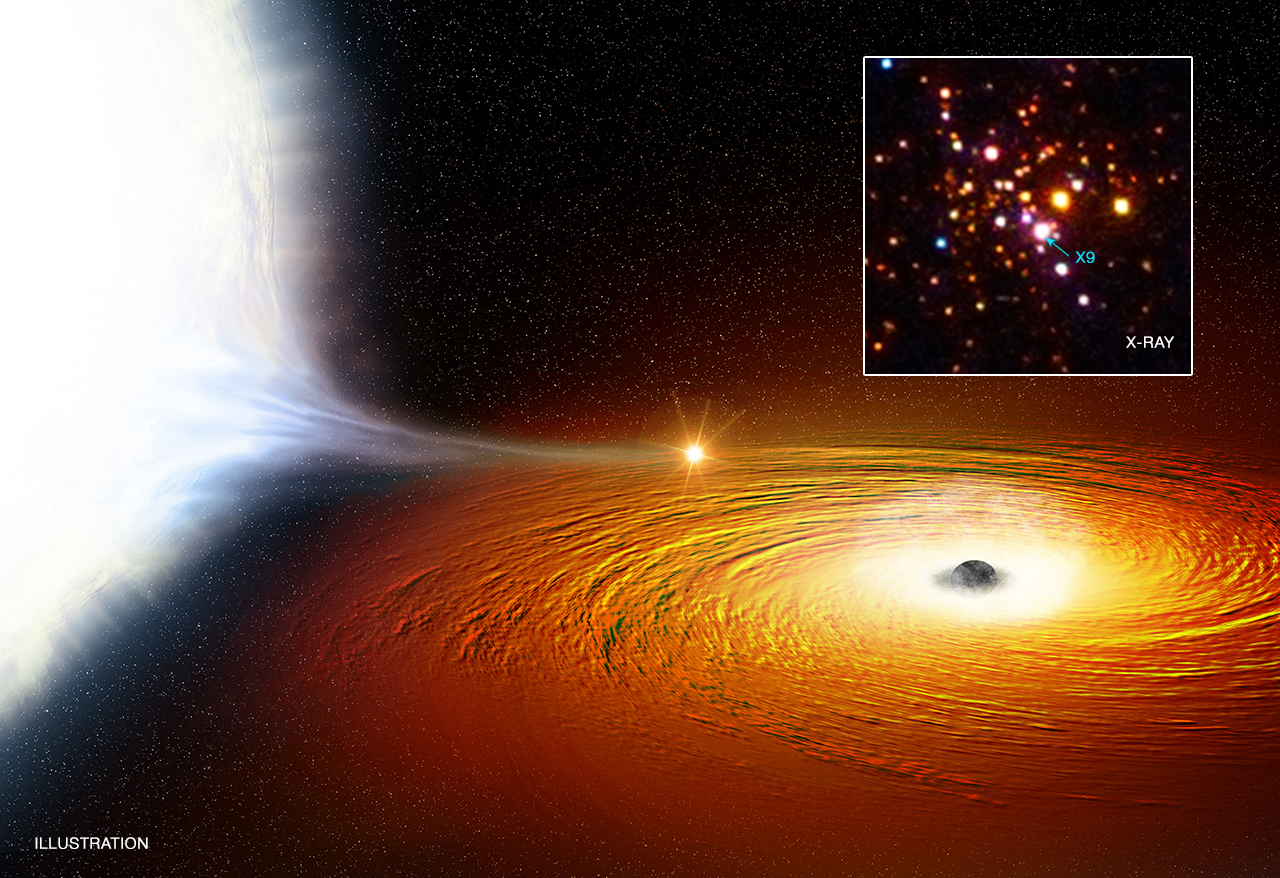
X9 in 47 Tucanae: Star Discovered in Closest Known Orbit Around Likely Black Hole A Quick Look at X9 in 47 Tucanae

 47 Tucanae
Credit  X-ray: NASA/CXC/University of Alberta/A.Bahramian et al.; 
Illustration: NASA/CXC/M.Weiss 


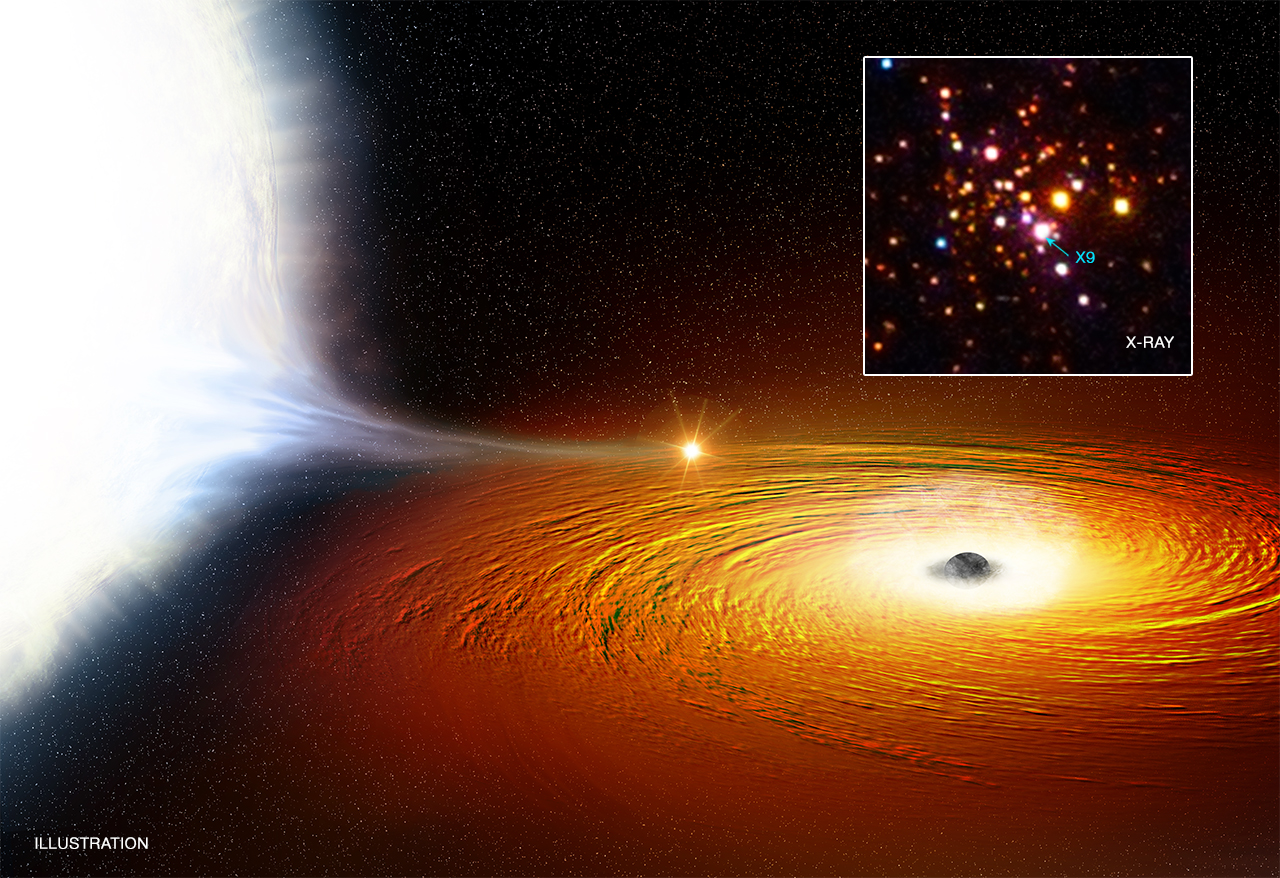
This graphic features an artist's impression of a star found in the closest orbit known around a black hole, as reported in our latest press release. This discovery was made using data from NASA's Chandra X-ray Observatory (shown in the inset where low, medium, and high-energy X-rays are colored red, green, and blue respectively), plus NASA's NuSTAR telescope and the Australia Telescope Compact Array.

Astronomers found this extraordinarily close stellar pairing in the globular cluster named 47 Tucanae, a dense collection of stars located on the outskirts of the Milky Way galaxy, about 14,800 light years from Earth.

This particular source, known as X9, has been of interest to scientists for many years. Until a couple of years ago, astronomers thought X9 contained a white dwarf pulling material from a companion star like the Sun. (Astronomers call a pair of objects orbiting one another a 'binary' system.) However, a team of scientists in 2015 used radio data to show that X9 likely consisted instead of a black hole pulling gas from a white dwarf companion. These researchers predicted that the white dwarf would take only about 25 minutes to orbit the black hole.

New Chandra data likely verify this hypothesis and reveal that the X-rays change periodically over about 28 minutes. Additionally, Chandra data show evidence for large amounts of oxygen in the system, a characteristic for the presence of a white dwarf. Therefore, a strong case can be made that that the companion star is a white dwarf, which would then be orbiting the black hole at only about 2.5 times the separation between the Earth and the Moon.

As seen in the artist's illustration, the white dwarf is so close to the black hole that much of its material is being pulled away. If it continues to lose mass, this white dwarf may evolve into some exotic sort of planet or completely evaporate.

In order to make such a close pairing, one possibility is that the black hole smashed into a red giant star, and then gas from the outer regions of the star was ejected from the binary. The remaining core of the red giant would form into a white dwarf, which becomes a binary companion to the black hole. The orbit of the binary would then have shrunk as gravitational waves were emitted, until the black hole started pulling material from the white dwarf. The gravitational waves currently being produced by X9 have a frequency that is too low to be detected with Laser Interferometer Gravitational-Wave Observatory (LIGO). It could potentially be detected with future gravitational wave observatories in space.

An alternative explanation for the observations is that the binary contains a neutron star, rather than a black hole, that is spinning faster as it pulls material from a white dwarf companion via a disk. This process can lead to the neutron star spinning around its axis thousands of times every second. A few such objects, called transitional millisecond pulsars, have been observed near the end of this spinning up phase. The authors do not favor this possibility as transitional millisecond pulsars have properties not seen in X9, such as extreme variability at X-ray and radio wavelengths. However, they cannot disprove this explanation.

In addition to Chandra, NASA's NuSTAR telescope, which observes higher-energy X-rays, and the radio telescope Australia Telescope Compact Array were used to make this discovery.

A paper describing these results was recently accepted for publication in the Monthly Notices of the Royal Astronomical Society and is available online. The authors on the paper are Arash Bahramian (University of Alberta), Craig Heinke (Alberta), Vlad Tudor (Curtin University and ICRAR), James Miller-Jones (ICRAR), Slavko Bogdanov (Columbia University), Thomas Maccarone (Texas Tech University), Christian Knigge (University of Southampton), Gregory Sivakoff (Alberta), Laura Chomiuk (Michigan State University), Jay Strader (Michigan State), Javier Garcia (Harvard-Smithsonian Center for Astrophysics), and Timothy Kallman (Goddard Space Flight Center).

NASA's Marshall Space Flight Center in Huntsville, Alabama, manages the Chandra program for NASA's Science Mission Directorate in Washington. The Smithsonian Astrophysical Observatory in Cambridge, Massachusetts, controls Chandra's science and flight operations.

A Quick Look at X9 in 47 Tucanae 


Fast Facts for 47 Tucanae:

Scale: Inset image is 1.5 arcmin across (about 6.5 light years)
Category: Neutron Stars/X-ray Binaries
Coordinates (J2000): RA 00h 24m 05s | Dec -72° 04´ 53"
Constellation: Tucana
Observation Date: 27 pointings between March 16, 2000 and January 8, 2006
Observation Time: 359 hours  
Obs. ID: 953, 955, 2735-2738, 16527, 15747, 16529, 17420, 15748, 16528, 5542-5546, 6230-6233, 6235-6240
Instrument: ACIS
References: Bahramian, A. et al. 2017, MNRAS [in press]; arXiv:1702.02167
Color Code: X-ray (Red, Green, Blue)
Distance Estimate: About 14,800 light years


Monday, March 13, 2017

Could Fast Radio Bursts Be Powering Alien Probes?

An artist's illustration of a light-sail powered by a radio beam (red) generated on the surface of a planet. The leakage from such beams as they sweep across the sky would appear as Fast Radio Bursts (FRBs), similar to the new population of sources that was discovered recently at cosmological distances. Credit: M. Weiss/CfA. Low Resolution (jpg)


Cambridge, MA - The search for extraterrestrial intelligence has looked for many different signs of alien life, from radio broadcasts to laser flashes, without success. However, newly published research suggests that mysterious phenomena called fast radio bursts could be evidence of advanced alien technology. Specifically, these bursts might be leakage from planet-sized transmitters powering interstellar probes in distant galaxies.

"Fast radio bursts are exceedingly bright given their short duration and origin at great distances, and we haven't identified a possible natural source with any confidence," said theorist Avi Loeb of the Harvard-Smithsonian Center for Astrophysics. "An artificial origin is worth contemplating and checking."

As the name implies, fast radio bursts are millisecond-long flashes of radio emission. First discovered in 2007, fewer than two dozen have been detected by gigantic radio telescopes like the Parkes Observatory in Australia or the Arecibo Observatory in Puerto Rico. They are inferred to originate from distant galaxies, billions of light-years away.

Loeb and his co-author Manasvi Lingam (Harvard University) examined the feasibility of creating a radio transmitter strong enough for it to be detectable across such immense distances. They found that, if the transmitter were solar powered, the sunlight falling on an area of a planet twice the size of the Earth would be enough to generate the needed energy. Such a vast construction project is well beyond our technology, but within the realm of possibility according to the laws of physics.

Lingam and Loeb also considered whether such a transmitter would be viable from an engineering perspective, or whether the tremendous energies involved would melt any underlying structure. 

Again, they found that a water-cooled device twice the size of Earth could withstand the heat.
They then asked, why build such an instrument in the first place? They argue that the most plausible use of such power is driving interstellar light sails. The amount of power involved would be sufficient to push a payload of a million tons, or about 20 times the largest cruise ships on Earth.

"That's big enough to carry living passengers across interstellar or even intergalactic distances," added Lingam.

To power a light sail, the transmitter would need to focus a beam on it continuously. Observers on Earth would see a brief flash because the sail and its host planet, star and galaxy are all moving relative to us. As a result, the beam sweeps across the sky and only points in our direction for a moment. Repeated appearances of the beam, which were observed but cannot be explained by cataclysmic astrophysical events, might provide important clues about its artificial origin.

Loeb admits that this work is speculative. When asked whether he really believes that any fast radio bursts are due to aliens, he replied, "Science isn't a matter of belief, it's a matter of evidence. Deciding what’s likely ahead of time limits the possibilities. It's worth putting ideas out there and letting the data be the judge.”

The paper reporting this work has been accepted for publication in the Astrophysical Journal Letters and is available online.

Headquartered in Cambridge, Mass., the Harvard-Smithsonian Center for Astrophysics (CfA) is a joint collaboration between the Smithsonian Astrophysical Observatory and the Harvard College Observatory. CfA scientists, organized into six research divisions, study the origin, evolution and ultimate fate of the universe.


For more information, contact:

Megan Watzke
Harvard-Smithsonian Center for Astrophysics
+1 617-496-7998

mwatzke@cfa.harvard.edu

Peter Edmonds
Harvard-Smithsonian Center for Astrophysics
+1 617-571-7279

pedmonds@cfa.harvard.edu