Showing posts with label "brightly lit" universe. Show all posts

Friday, August 14, 2020

Hubble Finds that Betelgeuse's Mysterious Dimming Is Due to a Traumatic Outburst


Illustration of Outburst from Betelgeuse  
Artwork: NASA , ESA, and E. Wheatley (STScI)
Science: A. Dupree (CfA)

Betelgeuse Magnesium II Spectrum Diagram 
Artwork: NASAESA, and E. Wheatley (STScI)

Release images

 Hubble Detects Dense, Heated Material Moving Through the Star's Atmosphere

Observations by NASA's Hubble Space Telescope are showing that the unexpected dimming of the supergiant star Betelgeuse was most likely caused by an immense amount of hot material ejected into space, forming a dust cloud that blocked starlight coming from Betelgeuse's surface.

Hubble researchers suggest that the dust cloud formed when superhot plasma unleashed from an welling of a large convection cell on the star's surface passed through the hot atmosphere to the colder outer layers, where it cooled and formed dust grains. The resulting dust cloud blocked light from about a quarter of the star's surface, beginning in late 2019. By April 2020, the star returned to normal brightness.

Betelgeuse is an aging, red supergiant star that has swelled in size due to complex, evolving changes in its nuclear fusion furnace at the core. The star is so huge now that if it replaced the Sun at the center of our solar system, its outer surface would extend past the orbit of Jupiter.

The unprecedented phenomenon for Betelgeuse's great dimming, eventually noticeable to even the naked eye, started in October 2019. By mid-February 2020, the monster star had lost more than two-thirds of its brilliance.

This sudden dimming has mystified astronomers, who scrambled to develop several theories for the abrupt change. One idea was that a huge, cool, dark "star spot" covered a wide patch of the visible surface. But the Hubble observations, led by Andrea Dupree, associate director of the Center for Astrophysics | Harvard & Smithsonian (CfA), Cambridge, Massachusetts, suggest a dust cloud covering a portion of the star.

Several months of Hubble's ultraviolet-light spectroscopic observations of Betelgeuse, beginning in January 2019, yield a timeline leading up to the darkening. These observations provide important new clues to the mechanism behind the dimming.

Hubble captured signs of dense, heated material moving through the star's atmosphere in September, October, and November 2019. Then, in December, several ground-based telescopes observed the star decreasing in brightness in its southern hemisphere.

“With Hubble, we see the material as it left the star’s visible surface and moved out through the atmosphere, before the dust formed that caused the star to appear to dim,” Dupree said. “We could see the effect of a dense, hot region in the southeast part of the star moving outward.

"This material was two to four times more luminous than the star's normal brightness," she continued. "And then, about a month later, the south part of Betelgeuse dimmed conspicuously as the star grew fainter. We think it is possible that a dark cloud resulted from the outflow that Hubble detected. Only Hubble gives us this evidence that led up to the dimming."

The team's paper will appear online Aug. 13 in The Astrophysical Journal.

Massive supergiant stars like Betelgeuse are important because they expel heavy elements such as carbon into space that become the building blocks of new generations of stars. Carbon is also a basic ingredient for life as we know it.

Tracing a Traumatic Outburst

Dupree's team began using Hubble early last year to analyze the behemoth star. Their observations are part of a three-year Hubble study to monitor variations in the star's outer atmosphere. Betelgeuse is a variable star that expands and contracts, brightening and dimming, on a 420-day cycle.

Hubble's ultraviolet-light sensitivity allowed researchers to probe the layers above the star's surface, which are so hot — more than 20,000 degrees Fahrenheit — they cannot be detected at visible wavelengths. These layers are heated partly by the star's turbulent convection cells bubbling up to the surface.

Hubble spectra, taken in early and late 2019, and in 2020, probed the star's outer atmosphere by measuring magnesium II (singly ionized magnesium) lines. In September through November 2019, the researchers measured material moving about 200,000 miles per hour passing from the star's surface into its outer atmosphere.

This hot, dense material continued to travel beyond Betelgeuse's visible surface, reaching millions of miles from the seething star. At that distance, the material cooled down enough to form dust, the researchers said.

This interpretation is consistent with Hubble ultraviolet-light observations in February 2020, which showed that the behavior of the star's outer atmosphere returned to normal, even though visible-light images showed that it was still dimming.

Although Dupree does not know the outburst's cause, she thinks it was aided by the star's pulsation cycle, which continued normally though the event, as recorded by visible-light observations. The paper's co-author, Klaus Strassmeier, of the Leibniz Institute for Astrophysics Potsdam, used the institute's automated telescope called STELLar Activity (STELLA), to measure changes in the velocity of the gas on the star's surface as it rose and fell during the pulsation cycle. The star was expanding in its cycle at the same time as the upwelling of the convective cell. The pulsation rippling outward from Betelgeuse may have helped propel the outflowing plasma through the atmosphere.

Dupree estimates that about two times the normal amount of material from the southern hemisphere was lost over the three months of the outburst. Betelgeuse, like all stars, is losing mass all the time, in this case at a rate 30 million times higher than the Sun.

Betelgeuse is so close to Earth, and so large, that Hubble has been able to resolve surface features – making it the only such star, except for our Sun, where surface detail can be seen.

Hubble images taken by Dupree in 1995 first revealed a mottled surface containing massive convection cells that shrink and swell, which cause them to darken and brighten. 

A supernova precursor?

The red supergiant is destined to end its life in a supernova blast. Some astronomers think the sudden dimming may be a pre-supernova event. The star is relatively nearby, about 725 light-years away, which means the dimming would have happened around the year 1300. But its light is just reaching Earth now.

"No one knows what a star does right before it goes supernova, because it's never been observed," Dupree explained. "Astronomers have sampled stars maybe a year ahead of them going supernova, but not within days or weeks before it happened. 

Dupree will get another chance to observe the star with Hubble in late August or early September. Right now, Betelgeuse is in the daytime sky, too close to the Sun for Hubble observations. But NASA's Solar TErrestrial RElations Observatory (STEREO)  has taken images of the monster star from its location in space. Those observations how that Betelgeuse dimmed again from mid-May to mid-July, although not as dramatically as earlier in the year.

Dupree hopes to use STEREO for more follow-up observations to monitor Betelgeuse's brightness. Her plan is to observe Betelgeuse again next year with STEREO when the star has expanded outward again in its cycle to see if it unleashes another petulant outburst.

Source: HubleSite/ News


Contacts

Donna Weaver / Ray Villard
Space Telescope Science Institute, Baltimore, Maryland
410-338-4493 / 410-338-4514

dweaver@stsci.edu / villard@stsci.edu

Andrea Dupree
CfA | Harvard & Smithsonian, Cambridge, Massachusetts
617-495-7489

adupree@cfa.harvard.edu


Related links


Thursday, March 16, 2017

Dark Matter Less Influential in Galaxies in Early Universe

 PR Image eso1709a
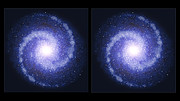
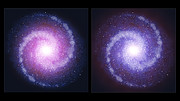
Comparison of rotating disc galaxies in the distant Universe and the present day

PR Image eso1709b
Comparison of rotating disc galaxies in the distant Universe and the present day


Videos

ESOcast 100 Light: Dark Matter Less Influential in Early Universe (4K UHD)
ESOcast 100 Light: Dark Matter Less Influential in Early Universe (4K UHD) 

Comparison of rotating disc galaxies in the distant Universe and the present day

Comparison of rotating disc galaxies in the distant Universe and the present day


VLT observations of distant galaxies suggest they were dominated by normal matter 

New observations indicate that massive, star-forming galaxies during the peak epoch of galaxy formation, 10 billion years ago, were dominated by baryonic or “normal” matter. This is in stark contrast to present-day galaxies, where the effects of mysterious dark matter seem to be much greater. This surprising result was obtained using ESO’s Very Large Telescope and suggests that dark matter was less influential in the early Universe than it is today. The research is presented in four papers, one of which will be published in the journal Nature this week.

We see normal matter as brightly shining stars, glowing gas and clouds of dust. But the more elusive dark matter does not emit, absorb or reflect light and can only be observed via its gravitational effects. The presence of dark matter can explain why the outer parts of nearby spiral galaxies rotate more quickly than would be expected if only the normal matter that we can see directly were present [1].

Now, an international team of astronomers led by Reinhard Genzel at the Max Planck Institute for Extraterrestrial Physics in Garching, Germany have used the KMOS and SINFONI instruments at ESO’s Very Large Telescope in Chile [2] to measure the rotation of six massive, star-forming galaxies in the distant Universe, at the peak of galaxy formation 10 billion years ago.

What they found was intriguing: unlike spiral galaxies in the modern Universe, the outer regions of these distant galaxies seem to be rotating more slowly than regions closer to the core — suggesting there is less dark matter present than expected [3].

“Surprisingly, the rotation velocities are not constant, but decrease further out in the galaxies,” comments Reinhard Genzel, lead author of the Nature paper. “There are probably two causes for this. Firstly, most of these early massive galaxies are strongly dominated by normal matter, with dark matter playing a much smaller role than in the Local Universe. Secondly, these early discs were much more turbulent than the spiral galaxies we see in our cosmic neighbourhood.”

Both effects seem to become more marked as astronomers look further and further back in time, into the early Universe. This suggests that 3 to 4 billion years after the Big Bang, the gas in galaxies had already efficiently condensed into flat, rotating discs, while the dark matter halos surrounding them were much larger and more spread out. Apparently it took billions of years longer for dark matter to condense as well, so its dominating effect is only seen on the rotation velocities of galaxy discs today
This explanation is consistent with observations showing that early galaxies were much more gas-rich and compact than today’s galaxies.

The six galaxies mapped in this study were among a larger sample of a hundred distant, star-forming discs imaged with the KMOS and SINFONI instruments at ESO’s Very Large Telescope at the Paranal Observatory in Chile. In addition to the individual galaxy measurements described above, an average rotation curve was created by combining the weaker signals from the other galaxies. This composite curve also showed the same decreasing velocity trend away from the centres of the galaxies. In addition, two further studies of 240 star forming discs also support these findings.

Detailed modelling shows that while normal matter typically accounts for about half of the total mass of all galaxies on average, it completely dominates the dynamics of galaxies at the highest redshifts.


Notes

[1] The disc of a spiral galaxy rotates over a timescale of hundreds of millions of years. Spiral galaxy cores have high concentrations of stars, but the density of bright matter decreases towards their outskirts. If a galaxy’s mass consisted entirely of normal matter, then the sparser outer regions should rotate more slowly than the dense regions at the centre. But observations of nearby spiral galaxies show that their inner and outer parts actually rotate at approximately the same speed. These “flat rotation curves ” indicate that spiral galaxies must contain large amounts of non-luminous matter in a dark matter halo surrounding the galactic disc.

[2] The data analysed were obtained with the integral field spectrometers KMOS and SINFONI at ESO’s Very Large Telescope in Chile in the framework of the KMOS3D and SINS/zC-SINF surveys. It is the first time that such a comprehensive study of the dynamics of a large number of galaxies spanning the redshift interval from z~0.6 to 2.6, or 5 billion years of cosmic time, has been carried out.

[3] This new result does not call into question the need for dark matter as a fundamental component of the Universe or the total amount. Rather it suggests that dark matter was differently distributed in and around disc galaxies at early times compared to the present day.


More Informations

This research was presented in a paper entitled “Strongly baryon dominated disk galaxies at the peak of galaxy formation ten billion years ago”, by R. Genzel et al., to appear in the journal Nature.

The team is composed of R. Genzel (Max-Planck-Institut für extraterrestrische Physik, Garching, Germany; University of California, Berkeley, USA), N.M. Förster Schreiber (Max-Planck-Institut für extraterrestrische Physik, Garching, Germany), H. Übler (Max-Planck-Institut für extraterrestrische Physik, Garching, Germany), P. Lang (Max-Planck-Institut für extraterrestrische Physik, Garching, Germany), T. Naab (Max-Planck-Institut für Astrophysik, Garching, Germany), R. Bender (Universitäts-Sternwarte Ludwig-Maximilians-Universität, München, Germany; Max-Planck-Institut für extraterrestrische Physik, Garching, Germany), L.J. Tacconi (Max-Planck-Institut für extraterrestrische Physik, Garching, Germany), E. Wisnioski (Max-Planck-Institut für extraterrestrische Physik, Garching, Germany), S.Wuyts (Max-Planck-Institut für extraterrestrische Physik, Garching, Germany; University of Bath, Bath, UK), T. Alexander (The Weizmann Institute of Science, Rehovot, Israel), A. Beifiori (Universitäts-Sternwarte Ludwig-Maximilians-Universität, München, Germany; Max-Planck-Institut für extraterrestrische Physik, Garching, Germany), S.Belli (Max-Planck-Institut für extraterrestrische Physik, Garching, Germany), G. Brammer (Space Telescope Science Institute, Baltimore, USA), A.Burkert (Max-Planck-Institut für Astrophysik, Garching, Germany; Max-Planck-Institut für extraterrestrische Physik, Garching, Germany) C.M. Carollo (Eidgenössische Technische Hochschule, Zürich, Switzerland), J. Chan (Max-Planck-Institut für extraterrestrische Physik, Garching, Germany), R. Davies (Max-Planck-Institut für extraterrestrische Physik, Garching, Germany), M. Fossati (Max-Planck-Institut für extraterrestrische Physik, Garching, Germany; Universitäts-Sternwarte Ludwig-Maximilians-Universität, München, Germany), A. Galametz (Max-Planck-Institut für extraterrestrische Physik, Garching, Germany; Universitäts-Sternwarte Ludwig-Maximilians-Universität, München, Germany), S. Genel (Center for Computational Astrophysics, New York, USA), O. Gerhard (Max-Planck-Institut für extraterrestrische Physik, Garching, Germany), D. Lutz (Max-Planck-Institut für extraterrestrische Physik, Garching, Germany), J.T. Mendel (Max-Planck-Institut für extraterrestrische Physik, Garching, Germany; Universitäts-Sternwarte Ludwig-Maximilians-Universität, München, Germany), I. Momcheva (Yale University, New Haven, USA), E.J. Nelson (Max-Planck-Institut für extraterrestrische Physik, Garching, Germany; Yale University, New Haven, USA), A. Renzini (Vicolo dell'Osservatorio 5, Padova, Italy), R.Saglia (Max-Planck-Institut für extraterrestrische Physik, Garching, Germany; Universitäts-Sternwarte Ludwig-Maximilians-Universität, München, Germany), A. Sternberg (Tel Aviv University, Tel Aviv, Israel), S. Tacchella (Eidgenössische Technische Hochschule, Zürich, Switzerland), K.Tadaki (Max-Planck-Institut für extraterrestrische Physik, Garching, Germany) and D. Wilman (Universitäts-Sternwarte Ludwig-Maximilians-Universität, München, Germany; Max-Planck-Institut für extraterrestrische Physik, Garching, Germany)

ESO is the foremost intergovernmental astronomy organisation in Europe and the world’s most productive ground-based astronomical observatory by far. It is supported by 16 countries: Austria, Belgium, Brazil, the Czech Republic, Denmark, France, Finland, Germany, Italy, the Netherlands, Poland, Portugal, Spain, Sweden, Switzerland and the United Kingdom, along with the host state of Chile. ESO carries out an ambitious programme focused on the design, construction and operation of powerful ground-based observing facilities enabling astronomers to make important scientific discoveries. ESO also plays a leading role in promoting and organising cooperation in astronomical research. ESO operates three unique world-class observing sites in Chile: La Silla, Paranal and Chajnantor. At Paranal, ESO operates the Very Large Telescope, the world’s most advanced visible-light astronomical observatory and two survey telescopes. VISTA works in the infrared and is the world’s largest survey telescope and the VLT Survey Telescope is the largest telescope designed to exclusively survey the skies in visible light. ESO is a major partner in ALMA, the largest astronomical project in existence. And on Cerro Armazones, close to Paranal, ESO is building the 39-metre European Extremely Large Telescope, the E-ELT, which will become “the world’s biggest eye on the sky”.


Links


Contacts

Reinhard Genzel
Director, Max-Planck-Institut für extraterrestrische Physik
Garching bei München, Germany
Tel: +49 89 30000 3280
Email: genzel@mpe.mpg.de

Natascha M. Forster Schreiber
Senior Scientist, Max-Planck-Institut für extraterrestrische Physik
Garching bei München, Germany
Tel: +49 89 30000 3524
Email: forster@mpe.mpg.de

Richard Hook
ESO Public Information Officer
Garching bei München, Germany
Tel: +49 89 3200 6655
Cell: +49 151 1537 3591
Email: rhook@eso.org

 Source: ESO

Wednesday, July 09, 2014

Cosmic Accounting Reveals Missing Light Crisis

Computer simulations of intergalactic hydrogen in a "dimly lit" universe (left) and a "brightly lit" universe (right) that has five times more of the energetic photons that destroy neutral hydrogen atoms. Hubble Space Telescope observations of hydrogen absorption match the picture on the right, but using only the known astronomical sources of ultraviolet light produces the much thicker structures on the left, and a severe mismatch with the observations. Image is credited to Ben Oppenheimer and Juna Kollmeier. A larger version is available here

Pasadena, CA—Something is amiss in the Universe. There appears to be an enormous deficit of ultraviolet light in the cosmic budget.

The vast reaches of empty space between galaxies are bridged by tendrils of hydrogen and helium, which can be used as a precise “light meter.” In a recent study published in The Astrophysical Journal Letters, a team of scientists finds that the light from known populations of galaxies and quasars is not nearly enough to explain observations of intergalactic hydrogen. The difference is a stunning 400 percent.

"It's as if you're in a big, brightly-lit room, but you look around and see only a few 40-watt lightbulbs," noted Carnegie’s Juna Kollmeier, lead author of the study. "Where is all that light coming from? It’s missing from our census."

Strangely, this mismatch only appears in the nearby, relatively well-studied cosmos. When telescopes focus on galaxies billions of light years away (and therefore are viewing the universe billions of years in its past), everything seems to add up. The fact that this accounting works in the early universe but falls apart locally has scientists puzzled.

The light in question consists of highly energetic ultraviolet photons that are able to convert electrically neutral hydrogen atoms into electrically charged ions. The two known sources for such ionizing photons are quasars—powered by hot gas falling onto supermassive black holes over a million times the mass of the sun—and the hottest young stars.

Observations indicate that the ionizing photons from young stars are almost always absorbed by gas in their host galaxy, so they never escape to affect intergalactic hydrogen. But the number of known quasars is far lower than needed to produce the required light.

“Either our accounting of the light from galaxies and quasars is very far off, or there’s some other major source of ionizing photons that we’ve never recognized,” Kollmeier said. “We are calling this missing light the photon underproduction crisis. But it’s the astronomers who are in crisis—somehow or other, the universe is getting along just fine.”

The mismatch emerged from comparing supercomputer simulations of intergalactic gas to the most recent analysis of observations from Hubble Space Telescope’s Cosmic Origins Spectrograph. “The simulations fit the data beautifully in the early universe, and they fit the local data beautifully if we’re allowed to assume that this extra light is really there,” explained Ben Oppenheimer a co-author from the University of Colorado. “It's possible the simulations do not reflect reality, which by itself would be a surprise, because intergalactic hydrogen is the component of the Universe that we think we understand the best.”

“The most exciting possibility is that the missing photons are coming from some exotic new source, not galaxies or quasars at all,” said Neal Katz a co-author from the University of Massachusetts at Amherst.

For example, the mysterious dark matter, which holds galaxies together but has never been seen directly, could itself decay and ultimately be responsible for this extra light.

"You know it's a crisis when you start seriously talking about decaying dark matter!" Katz remarked.

“The great thing about a 400% discrepancy is that you know something is really wrong,” commented co-author David Weinberg of The Ohio State University. “We still don't know for sure what it is, but at least one thing we thought we knew about the present day universe isn't true.”

Whether the explanation is exotic or not, astronomers will be working hard to shed light on the mystery.

Other co-authors on the study are Francesco Haardt of the Università dell’Insubria, Romeel Davé of the University of the Western Cape, Mark Fardal of University of Massachusetts Amherst, Piero Madau of University of California Santa Cruz, Charles Danforth of the University of Colorado, Amanda Ford of University of Arizona, Molly Peeples of the Space Telescope Science Institute, and Joseph McEwen of The Ohio State University.