Credit: NASA/CXC/Univ of Michigan/J. Miller et al.; Illustration: NASA/CXC/M.Weiss
Using NASA’s Chandra X-ray Observatory, ESA’s XMM-Newton and other telescopes, astronomers have determined that a giant black hole has destroyed a large star and strewn its contents into space, as described in our latest press release. By analyzing the details of the X-ray data,
the team were able to estimate the relative amount of nitrogen compared
to carbon in the aftermath of this gravitational assault. These
elements provide valuable clues to the researchers for what type of star
met its demise.
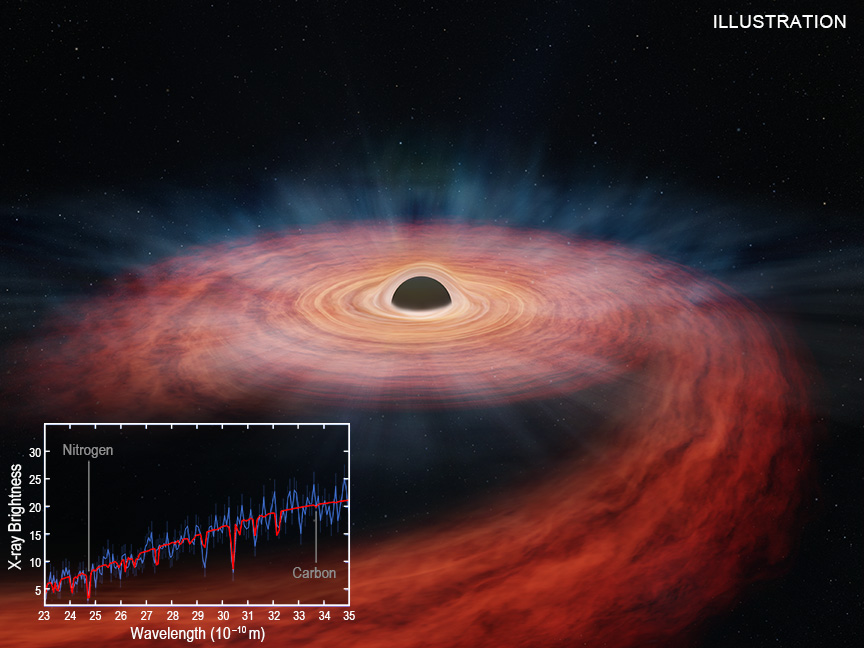
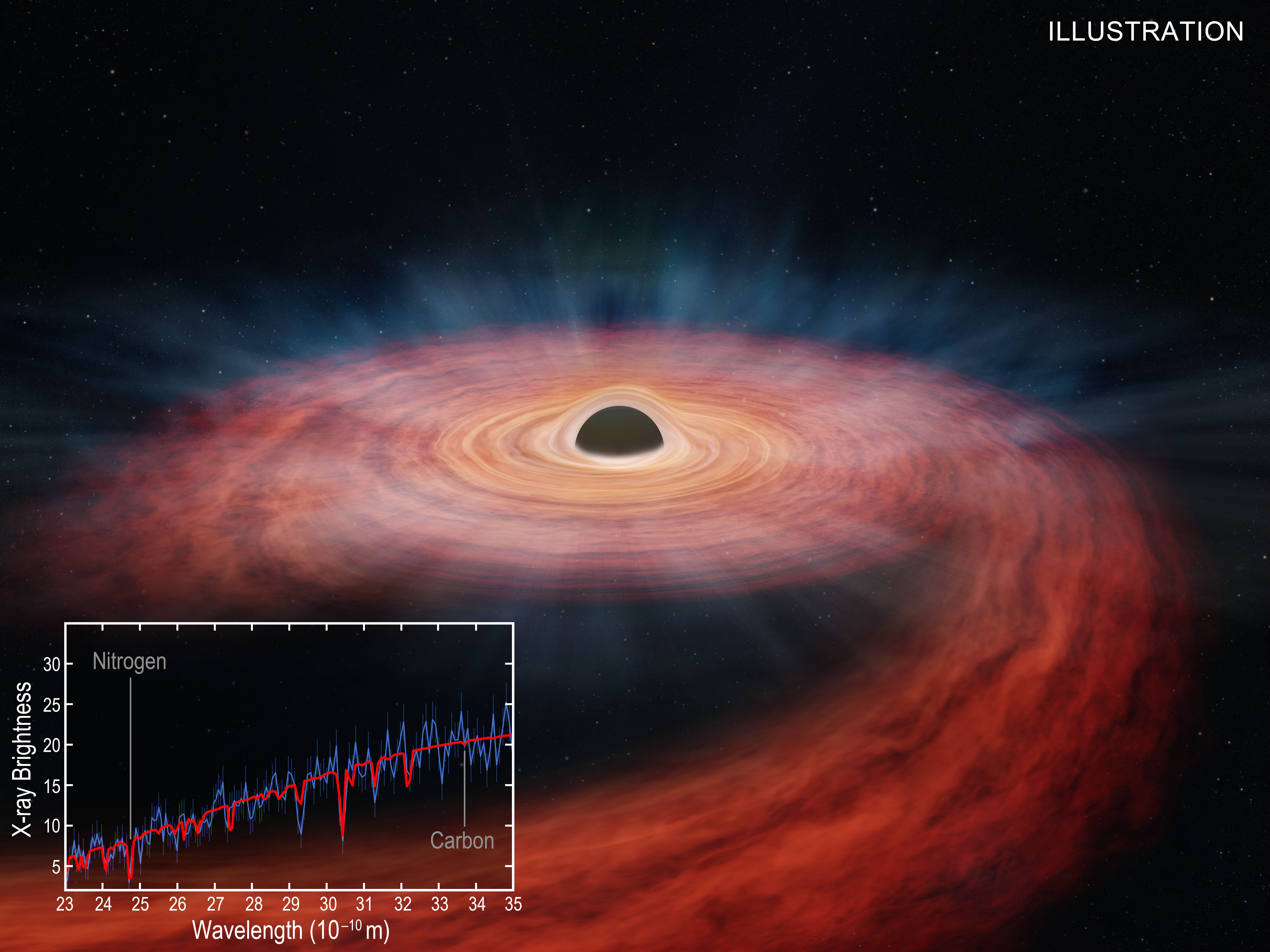
This artist’s illustration depicts the “tidal disruption event” (TDE) called ASASSN-14li, which is the focus of the latest study. As a star approached too closely to the supermassive black hole at the system, the strong gravity tore the star apart. This artist's impression depicts the aftermath of this destruction. After the star was ripped apart, some of its gas (red) was left orbiting around and falling into the black hole. A portion of the gas was driven away in a wind (blue). .
Scientists used an X-ray spectrum — that is, a plot of X-ray brightness compared to wavelength — from Chandra and XMM to probe the elements contained in this wind. The Chandra spectrum is shown in the inset, where the data is colored blue (jagged lines) and the uncertainties for each data point are blue vertical lines. A model of the spectrum is given in red, highlighting the detection of nitrogen from the dip in the spectrum, and the non-detection of carbon from the lack of a dip.
This artist’s illustration depicts the “tidal disruption event” (TDE) called ASASSN-14li, which is the focus of the latest study. As a star approached too closely to the supermassive black hole at the system, the strong gravity tore the star apart. This artist's impression depicts the aftermath of this destruction. After the star was ripped apart, some of its gas (red) was left orbiting around and falling into the black hole. A portion of the gas was driven away in a wind (blue). .
Scientists used an X-ray spectrum — that is, a plot of X-ray brightness compared to wavelength — from Chandra and XMM to probe the elements contained in this wind. The Chandra spectrum is shown in the inset, where the data is colored blue (jagged lines) and the uncertainties for each data point are blue vertical lines. A model of the spectrum is given in red, highlighting the detection of nitrogen from the dip in the spectrum, and the non-detection of carbon from the lack of a dip.

Credit: NASA/CXC/Univ of Michigan/J. Miller et al.
The amount of nitrogen and the maximum amount of carbon that could
escape detection gives a minimum value for the ratio of nitrogen to
carbon that agrees with the data. This value indicates that the shredded
star in ASASSN-14li was about three times the mass of the Sun. This would make it one of the largest stars ever known to be devastated in a TDE.
ASASSN-14li was first discovered in November 2014 by ground-based telescopes, when it was realized that this was the closest TDE to Earth in about a decade. In the years since, many telescopes, including Chandra, have observed this system.
In addition to the unusual size of the destroyed star and the ability to conduct the detailed forensics on it, ASASSN-14li is also exciting because of what it means for future studies. Astronomers have seen moderately massive stars like ASASSN-14li’s in the star cluster containing the supermassive black hole in the center of our galaxy. Therefore, the ability to estimate stellar masses of tidally disrupted stars potentially gives astronomers a way to identify the presence of star clusters around supermassive black holes in more distant galaxies.
Until this study there was a strong possibility that the elements observed in X-rays might have come from gas released in previous eruptions from the supermassive black hole. The pattern of elements analyzed here, however, appears to have come from a single star.
A paper describing these results has been published in The Astrophysical Journal Letters. The authors are Jon M. Miller (University of Michigan, Ann Arbor), Brenna Mockler (Carnegie Observatories), Enrico Ramirez-Ruiz (University of California, Santa Cruz), Paul Draghis (University of Michigan), Jeremy Drake (Center for Astrophysics | Harvard & Smithsonian), John Raymond (CfA), Mark Reynolds (University of Michigan), Xin Xiang (University of Michigan), Sol Bin Yun (University of Michigan), and Abderahmen Zoghbi (University of Maryland).
NASA's Marshall Space Flight Center manages the Chandra program. The Smithsonian Astrophysical Observatory's Chandra X-ray Center controls science operations from Cambridge, Massachusetts, and flight operations from Burlington, Massachusetts.
ASASSN-14li was first discovered in November 2014 by ground-based telescopes, when it was realized that this was the closest TDE to Earth in about a decade. In the years since, many telescopes, including Chandra, have observed this system.
In addition to the unusual size of the destroyed star and the ability to conduct the detailed forensics on it, ASASSN-14li is also exciting because of what it means for future studies. Astronomers have seen moderately massive stars like ASASSN-14li’s in the star cluster containing the supermassive black hole in the center of our galaxy. Therefore, the ability to estimate stellar masses of tidally disrupted stars potentially gives astronomers a way to identify the presence of star clusters around supermassive black holes in more distant galaxies.
Until this study there was a strong possibility that the elements observed in X-rays might have come from gas released in previous eruptions from the supermassive black hole. The pattern of elements analyzed here, however, appears to have come from a single star.
A paper describing these results has been published in The Astrophysical Journal Letters. The authors are Jon M. Miller (University of Michigan, Ann Arbor), Brenna Mockler (Carnegie Observatories), Enrico Ramirez-Ruiz (University of California, Santa Cruz), Paul Draghis (University of Michigan), Jeremy Drake (Center for Astrophysics | Harvard & Smithsonian), John Raymond (CfA), Mark Reynolds (University of Michigan), Xin Xiang (University of Michigan), Sol Bin Yun (University of Michigan), and Abderahmen Zoghbi (University of Maryland).
NASA's Marshall Space Flight Center manages the Chandra program. The Smithsonian Astrophysical Observatory's Chandra X-ray Center controls science operations from Cambridge, Massachusetts, and flight operations from Burlington, Massachusetts.
Visual Description:
This release features an artist's illustration of red stellar debris
swirling around a giant, spherical black hole. The debris field
represents the remains of a star with three times the mass of our Sun,
which was ripped apart by the black hole's immense gravity. This tidal
disruption event is known as ASASSN-14li. Its aftermath was studied by
NASA's Chandra X-ray Observatory, ESA's XMM-Newton, and other
telescopes.
At the center of the illustration is the spherical black hole, half-submerged in the debris field, which resembles the top half of a jet black ball. The ball sits at the core of the disk-shaped debris field, which is composed of distinct orange and red rings. A long, wide, ribbon of red cloud, representing part of the star's residual gas, enters the illustration at our lower left corner. This ribbon of red gas sweeps toward our center right across the black, starry sky. There, the gas curves back to the left, behind the black hole. Drawn in by gravity, the ribbon of gas encircles the ringed disk of brick red and golden orange stellar debris. This debris orbits, and eventually falls into, the black hole. Faint blue mist appears to radiate from the black hole and the orbiting stellar debris field. This mist represents the portion of stellar gas driven away from the ringed disk by a wind.
At the center of the illustration is the spherical black hole, half-submerged in the debris field, which resembles the top half of a jet black ball. The ball sits at the core of the disk-shaped debris field, which is composed of distinct orange and red rings. A long, wide, ribbon of red cloud, representing part of the star's residual gas, enters the illustration at our lower left corner. This ribbon of red gas sweeps toward our center right across the black, starry sky. There, the gas curves back to the left, behind the black hole. Drawn in by gravity, the ribbon of gas encircles the ringed disk of brick red and golden orange stellar debris. This debris orbits, and eventually falls into, the black hole. Faint blue mist appears to radiate from the black hole and the orbiting stellar debris field. This mist represents the portion of stellar gas driven away from the ringed disk by a wind.
Fast Facts for ASASSN-14li:
Category: Black Holes
Coordinates (J2000): RA 12h 48m 15.20s | Dec 17° 46´ 26.20"
Constellation: Coma Berenices
Observation Dates: 2 observations; Dec 8 & 11, 2014
Observation Time: 22 hours 1 minute
Obs. ID: 17566, 17567
Instrument: HRC
References: Miller, J.M., et al., 2023, ApJL, 53, 2 DOI 10.3847/2041-8213/ace03c
Distance Estimate: About 285 million light-years (z=0.0206)