Showing posts with label 47 Tucanae. Show all posts

Friday, February 02, 2024

Astronomers produce most detailed sensitive image ever of ancient star cluster

The team identified a new radio source (white square) in the centre of the cluster (red circle)
Credit: Paduano et al.

The discovery was made using CSIRO’s Australia Telescope Compact Array.
Credit: Alex Cherney/CSIRO

The dense ball of stars that makes up globular cluster 47 Tucanae.
Credits: NASA, ESA, and the Hubble Heritage (STScI/AURA)-ESA/Hubble Collaboration


A global team of astronomers have created the most sensitive radio image ever of a globular cluster, an ancient ball of tightly-packed stars.

The image is of the second brightest globular cluster in the night sky—known as 47 Tucanae—and was produced by a team led by the Curtin University node of the International Centre for Radio Astronomy Research (ICRAR) in Western Australia.

The scientists also detected a previously undiscovered radio signal from the centre of the cluster.

The research was published overnight in The Astrophysical Journal.

Astronomer Dr Arash Bahramian, from ICRAR’s Curtin University node, says star clusters are an ancient relic of the early Universe.

“Globular clusters are very old, giant balls of stars that we see around the Milky Way,” he said. “They’re incredibly dense, with tens of thousands to millions of stars packed together in a sphere.

“Our image is of 47 Tucanae, one of the most massive globular clusters in the galaxy. It has over a million stars and a very bright, very dense core.”

Dr Bahramian said the ultra-sensitive image was created from more than 450 hours of observations on CSIRO’s Australia Telescope Compact Array (ATCA), on Gomeroi Country.

It is the deepest, most sensitive radio image ever compiled by any Australian radio telescope.

Dr Bahramian said 47 Tucanae can be seen with the naked eye, and was first catalogued in the 1700s.

But he said imaging it in such great detail allowed astronomers to discover an incredibly faint radio signal at the centre of the cluster that had not been detected before.

Lead author Dr Alessandro Paduano, from ICRAR’s Curtin University node, said the detection of the signal was an exciting discovery and could be attributed to one of two possibilities.

“The first is that 47 Tucanae could contain a black hole with a mass somewhere between the supermassive black holes found in the centres of galaxies and the stellar black holes created by collapsed stars.” he said.

“While intermediate-mass black holes are thought to exist in globular clusters, there hasn’t been a clear detection of one yet.

“If this signal turns out to be a black hole, it would be a highly-significant discovery and the first ever radio detection of one inside a cluster.”

The second possible source of the signal is a pulsar—a rotating neutron star that emits radio waves.

“A pulsar this close to a cluster centre is also a scientifically interesting discovery, as it could be used to search for a central black hole that is yet to be detected.” Dr Paduano said.

Co-author Dr Tim Galvin, a research scientist with CSIRO, said the project once again demonstrated the ongoing importance of ATCA.

“This project has stretched our software to its limits, in terms of both data management and processing, and it has been really exciting to see the wealth of science that these techniques have enabled.”

“Alessandro’s research represents a culmination of years of research and technological advancements, and ATCA’s ultra-deep image of 47 Tucanae represents just the beginning of the discoveries that are yet to come.”

The ultra-sensitive image produced is what researchers can expect from the SKA radio telescopes, currently being built in Australia and South Africa by the SKA Observatory (SKAO).

Once complete, the SKA telescopes will be the two largest radio telescope arrays in the world, transforming our understanding of the Universe and tackling some of the most fundamental scientific questions of our time.

Dr Bahramian said researchers are continually finding new and innovative ways to get the best out of the radio telescopes they use.

“We managed to achieve close to SKA-quality science with the current generation of radio telescopes, combining hundreds of hours of observations to reveal the faintest details.” he said.

“It gives us a glimpse of the exciting capabilities the next generation of radio telescopes will achieve when they come online.”

The technique used for the ultra-sensitive image could help future radio telescopes, such as the SKA, to detect some of the faintest objects in the Universe.

Multimedia

A short, narrated animation is available from
vimeo.com/icrar/47tuc


Monday, June 06, 2022

Two Stellar Evolution Roads Diverged at a Certain Mass…


A Hubble image of the globular cluster NGC 6397, which hosts numerous white dwarfs. The white dwarfs are incredibly faint and can be seen in a zoomed-in version of the right quadrant of the image. Credit: NASA, ESA, and H. Richer (University of British Columbia)

Just by knowing the mass of a star, can we predict if it will end its life in fire (a supernova) or ice (a white dwarf that eventually fades into a cool black dwarf)? A team led by astronomers at the University of British Columbia tries to answer that question by observing white dwarfs in order to find exactly where that dividing line is between a death of fire and ice.


Hubble Space Telescope image of the Crab Nebula, the remnant of a supernova that took place in the year 1054 AD. Credit: NASA, ESA, J. Hester and A. Loll

…But Which Road Leads to a White Dwarf?

When a star runs out of fuel, it can either eject its outer layers in an explosion so violent that it outputs more energy than the Sun will in its 10 billion years of life, or the star may simply expand and settle down into a stable star called a white dwarf about the size of our moon. What determines which route the star takes is its mass: lower masses die a death of ice, higher masses of fire. Though we believe the dividing line is somewhere around 8 solar masses, this number doesn’t always agree with what we observe.

T

he color–magnitude diagram of the Milky Way globular cluster 47 Tucanae. The x-axis shows the color, the left y-axis shows the apparent magnitude at 47 Tucanae’s distance, and the right y-axis shifts the cluster to the distance of the Large Magellanic Cloud. This diagram shows that even at the distance of the Large Magellanic Cloud, these massive WDs are detectable. Credit: Richer et al. 2022

In Two Words I Can Sum Up Everything I’ve Learned About Stars: They Evolve

If all stars greater than 8 solar masses end their lives in the fire of a supernova, we would see a lot more supernova explosions (specifically, Type II supernovae) than we actually do. This dearth of Type II supernovae could indicate that the maximum mass of a star that can end its life as a white dwarf is actually closer to 12 solar masses rather than 8. Constraining this mass limit of stars that can become white dwarfs could inform the formation rate of compact objects as well as the metal content of galaxies. The more massive a star is, the more massive its white dwarf remnant is. Therefore, by hunting for massive white dwarfs, we can effectively hunt for massive progenitor stars that weren’t heavy enough to end in a supernova. A team led by Harvey Richer at the University of British Columbia has looked deep into young open star clusters outside our own galaxy to try to identify massive white dwarfs.

Previous searches for massive white dwarfs in young Milky Way open clusters only found white dwarfs up to 1.1 solar masses, which come from stars no larger than 6.2 solar masses. To probe whether even more massive stars can become white dwarfs, Richer and coauthors searched young clusters in the Large Magellanic Clouds. The team looked at four Magellanic Cloud clusters in which stars of 5.7 to 10.2 solar masses were just about to enter the asymptotic giant phase (a late evolutionary stage in an intermediate–mass star’s life at which point the star has exhausted its main fuel source), which would mean the white dwarfs in these clusters must have come from stars more massive than that. They also chose these specific clusters because of their distance; the Magellanic Clouds are far enough away that there would be new clusters to search, but not so distant that Gaia parallaxes are unreliable and there is confusion with field white dwarfs.


Distributions of the various populations of stars in two of the clusters. The white dwarfs in the leftmost panel are the five potential white dwarf candidates. Credit: Richer et al. 2022

The Universe Is Lovely, Dark, and Deep, But We Need More Data To Put This Mystery To Sleep

The team found five potential candidates in the oldest of the four clusters they studied by looking at the ages and populations of the clusters. These stars represent the first extragalactic single white dwarfs ever discovered. This study demonstrated that it is possible to detect white dwarfs in nearby galaxies with only moderate exposure times with Hubble. However, to study them spectroscopically and determine their masses and ages, the team needs more resolution, which will come with future 30+ meter telescopes. Confirmation of these heavy white dwarfs may finally lead us to the point where the roads of stellar evolution diverged.

Citation

“When Do Stars Go Boom?” Harvey B. Richer et al 2022 ApJL 931 L20. doi:10.3847/2041-8213/ac6585

By Haley Wahl


Tuesday, March 03, 2020

Globular cluster billowing in the Galactic wind

Globular cluster 47 Tuc (upper right) and the Small Magellanic Cloud in the same field-of-view. The inset is a close-up of the cluster showing the detected magnetic field in a colour scale. The lines indicate the effect of the Galactic wind on the magnetic field. © ESO/VISTA VMC (background image); F. Abbate et al., Nature Astronomy (inset)

Investigation of pulsars in 47 Tuc provides constraints on the magnetic field in the halo of the Milky Way

March 02, 2020. The Galactic magnetic field plays an important role in the evolution of our Galaxy, but its small-scale behaviour is still poorly known. It is also unknown whether it permeates the halo of the Galaxy or not. By using observations of pulsars in the halo globular cluster 47 Tuc, an international research team led by Federico Abbate from the Max Planck Institute for Radio Astronomy in Bonn, Germany who started this work at University of Milano Bicocca and INAF-Astronomical Observatory of Cagliari, could probe the Galactic magnetic field at scales of a few light years for the first time. They discovered an unexpected strong magnetic field in the direction of the cluster. This magnetic field points perpendicularly to the Galactic disk and could be explained by an interaction with the Galactic wind. This is a magnetized outflow that extends from the Galactic disk into the surrounding halo and its existence has never been proven before.

47 Tucanae, or 47 Tuc as it is usually called, is a spectacular globular cluster visible with the naked eye in the constellation “Tucana” in the southern sky close to the Small Magellanic Cloud. The first pulsar in this cluster was discovered in 1990 with the Parkes 64-m radio telescope in Australia, and soon more were found with the same telescope. Currently there are 25 pulsars known in 47 Tuc. For this reason, this very well-studied globular cluster became one of the most important for pulsar astronomers as well.

Pulsars are periodic sources that allow astronomers to measure the so-called dispersion measure which is a delay of the arrival time of the single pulses at different frequencies. This delay is proportional to the density of free electrons along the path from the pulsar to the Earth. “In 2001, we noticed that the pulsars in the far side of the cluster had a higher dispersion measure than those in the near side, which implied the presence of gas in the cluster”, says Paulo Freire from the Max Planck Institute for Radio Astronomy (MPIfR) who led a number of research projects on 47 Tuc.

What makes 47 Tuc even more interesting is that the cluster is at a distance of about 15,000 light years, located in a relatively undisturbed area in the Galactic halo. The halo surrounds the Galactic disk and hosts very few stars and very small quantities of gas. “The pulsars in this cluster can give us a unique and unprecedented insight into the large-scale geometry of the magnetic field in the Galactic halo.” says Federico Abbate, lead author of the paper and now working at MPIfR, who performed the analysis during his PhD at the University of Milano-Bicocca and at INAF - Cagliari Astronomical Observatory.

Understanding the geometry and strength of Galactic magnetic fields is essential to draw a complete picture of our Galaxy. The magnetic fields can affect star formation, regulate the propagation of high-energy particles and help establish the presence of a Galactic scale outflow of gas from the disk to the surrounding halo. Despite their importance, the large-scale geometry of the magnetic fields in the Galactic halo is not fully known.

Magnetic fields are not observable directly, but scientists make use of the effects they have on the low-density plasma that permeates the Galactic disk. In this plasma, the electrons are separated from the atomic nuclei and they behave like small magnets. The electrons are attracted by the magnetic field and are forced to orbit the magnetic field lines, emitting radiation known as synchrotron radiation. Other than emitting their own radiation, the free electrons also leave a peculiar signature on the polarized radiation that travels through the plasma. The electromagnetic field of the polarized radiation oscillates always in the same direction and the electrons in a magnetized medium will rotate this direction by different amounts at different frequencies. This effect is called Faraday rotation and is measurable only at radio frequencies.

Observations of polarized radio emission work well to constrain the magnetic field in the Galactic disk where the plasma is dense enough. In the Galactic halo, however, the plasma density is too low to directly observe the effects. For this reason, the geometry and strength of the magnetic field in the halo is unknown and models predict that it could either be parallel or perpendicular to the disk. The presence of a magnetized outflow from the disk to the halo has been suggested following observations in other galaxies. It can also explain the diffuse X-ray emission in the Galaxy.

Recent observations of the pulsars in 47 Tuc, also performed with the Parkes radio telescope in Australia, were able to measure their polarized radio emission and their Faraday rotation. These reveal the presence of a magnetic field in the globular cluster that is surprisingly strong - so strong, in fact, that it cannot be maintained by the globular cluster itself but requires an external source located in the Galactic halo. The direction of the magnetic field is compatible with that of the Galactic wind, perpendicular to the Galactic disk. The interaction of the Galactic wind and the cluster forms a shock that amplifies the magnetic field to the values observed.

This work reveals a new technique to study the magnetic field in the Galactic halo. This cluster is a perfect target for observations with the innovative MeerKAT radio telescope in South Africa. “In the near future, the MeerKAT telescope will greatly improve the polarization measurements and possibly not only confirm the presence of the Galactic wind but also constrain its properties,” says Andrea Possenti from the INAF – Cagliari Astronomical Observatory who is involved in the globular cluster pulsars efforts with MeerKAT together with the MPIfR. Moreover, this powerful telescope in particular with its further development towards the Square Kilometre Array (SKA) has the capabilities to observe other globular clusters in the halo and corroborate the results.

The results are published in this week’s issue of „Nature Astronomy“.


The research team consists of Federico Abbate, Andrea Possenti, Caterina Tiburzi, Ewan Barr, Willem van Straten, Alessandro Ridolfi and Paulo Freire. The first author, Federico Abbate, is now at the MPIfR. Co-authors Ewan Barr and Paulo Freire are both affiliated with the MPIfR.


Original Paper

Constraints on the magnetic field in the Galactic halo from globular cluster pulsars 

F. Abbate et al., Nature Astronomy, 02 March 2020. DOI: 10.1038/s41550-020-1030-6.

The URL will become valid after the embargo expires on Monday, March 02, 19:00 CET (13:00 US EST).


Links

Fundamental Physics in Radio Astronomy
Research Department "Fundamental Physics in Radio Astronomy" at MPIfR, Bonn, Germany

Parkes
CSIRO Parkes Observatory

Millisecond Pulsars in 47 Tuc 
Information on millisecond pulsars in globular cluster 47 Tuc (Website Paulo Freire)

MeerKAT
South African MeerKAT radio telescope

SKA Observatory 
Square Kilometre Array Observatory

Pulsar Dispersion Measure 
Website "Pulsar Dispersion Measure" at Swinburne University, Australia

Cosmic Magnetism
Website "Cosmic Magnetism" at Square Kilometre Array (SKA)

Galactic Magnetic Fields
Scholarpedia article "Galactic Magnetic Fields" by Rainer Beck/MPIfR

Pulsars in 47 Tuc (Movie)
Ensemble of pulsars in 47 Tuc: movie simulation with pulsar sounds (Jodrell Bank; Andrew Lyne & Michael Kramer; 40 MB)

Pulsars in 47 Tuc (Audio file)
Sounds of an ensemble of millisecond pulsars in 47 Tuc. Audio file (Jodrell Bank; Andrew Lyne & Michael Kramer)


Tuesday, March 14, 2017

X9 in 47 Tucanae: Star Discovered in Closest Known Orbit Around Likely Black Hole A Quick Look at X9 in 47 Tucanae

 47 Tucanae
Credit  X-ray: NASA/CXC/University of Alberta/A.Bahramian et al.; 
Illustration: NASA/CXC/M.Weiss 


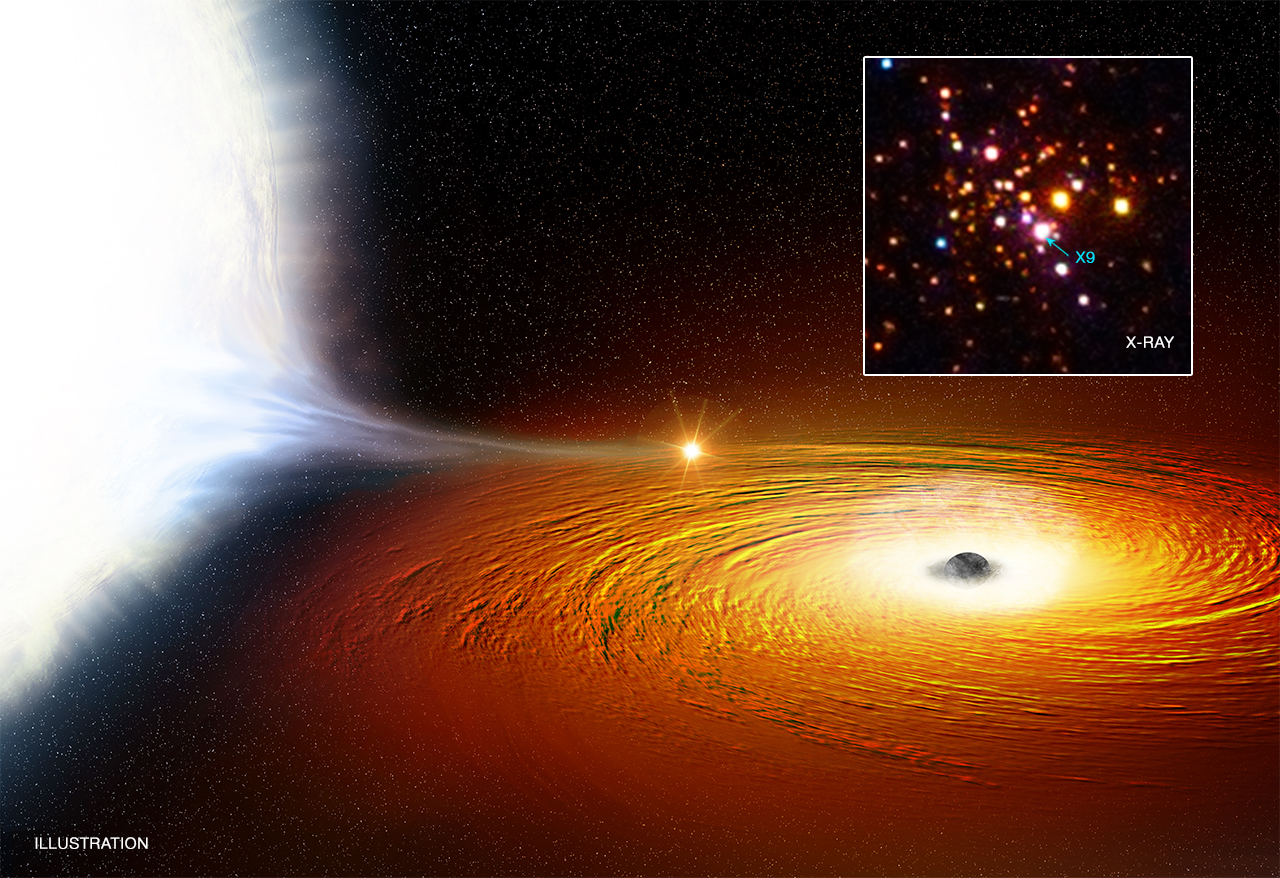
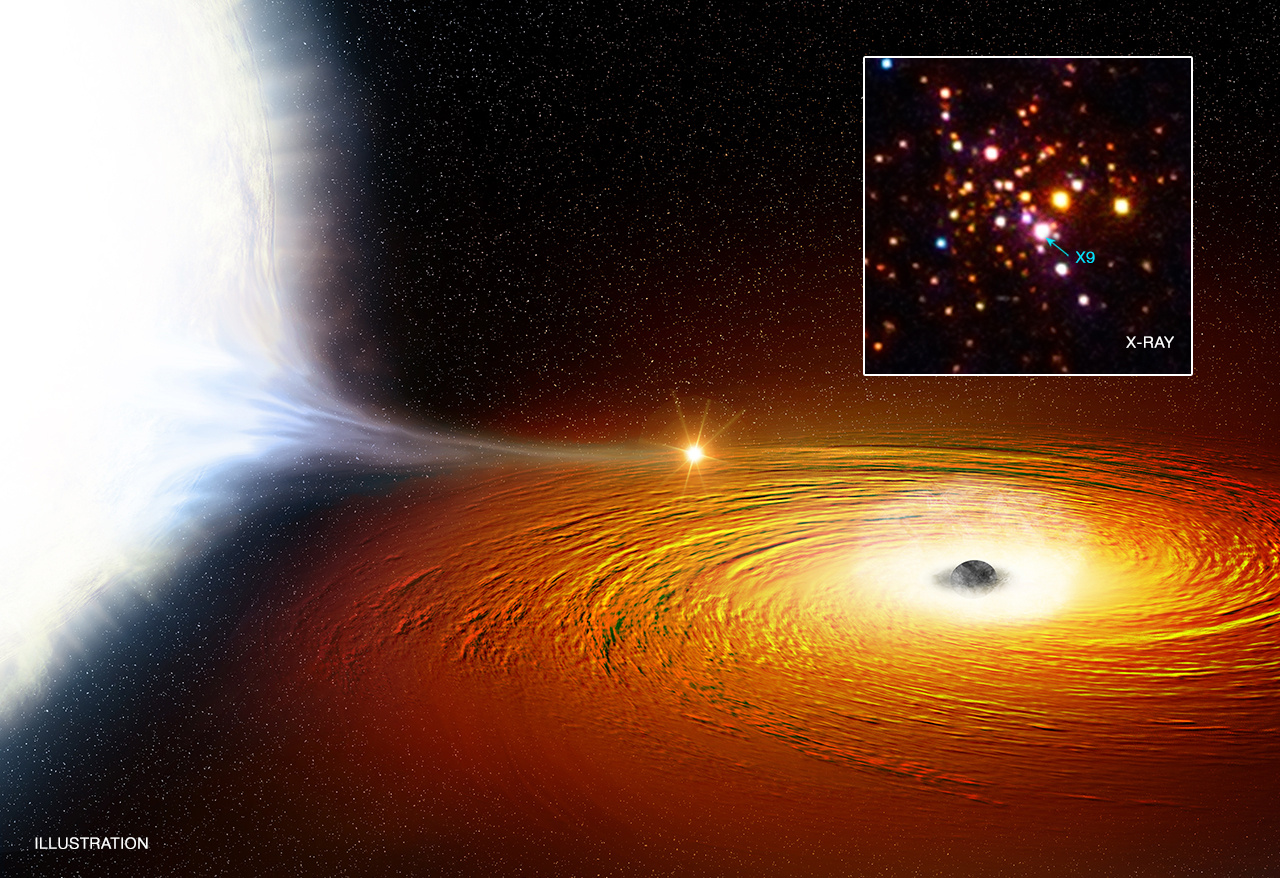
This graphic features an artist's impression of a star found in the closest orbit known around a black hole, as reported in our latest press release. This discovery was made using data from NASA's Chandra X-ray Observatory (shown in the inset where low, medium, and high-energy X-rays are colored red, green, and blue respectively), plus NASA's NuSTAR telescope and the Australia Telescope Compact Array.

Astronomers found this extraordinarily close stellar pairing in the globular cluster named 47 Tucanae, a dense collection of stars located on the outskirts of the Milky Way galaxy, about 14,800 light years from Earth.

This particular source, known as X9, has been of interest to scientists for many years. Until a couple of years ago, astronomers thought X9 contained a white dwarf pulling material from a companion star like the Sun. (Astronomers call a pair of objects orbiting one another a 'binary' system.) However, a team of scientists in 2015 used radio data to show that X9 likely consisted instead of a black hole pulling gas from a white dwarf companion. These researchers predicted that the white dwarf would take only about 25 minutes to orbit the black hole.

New Chandra data likely verify this hypothesis and reveal that the X-rays change periodically over about 28 minutes. Additionally, Chandra data show evidence for large amounts of oxygen in the system, a characteristic for the presence of a white dwarf. Therefore, a strong case can be made that that the companion star is a white dwarf, which would then be orbiting the black hole at only about 2.5 times the separation between the Earth and the Moon.

As seen in the artist's illustration, the white dwarf is so close to the black hole that much of its material is being pulled away. If it continues to lose mass, this white dwarf may evolve into some exotic sort of planet or completely evaporate.

In order to make such a close pairing, one possibility is that the black hole smashed into a red giant star, and then gas from the outer regions of the star was ejected from the binary. The remaining core of the red giant would form into a white dwarf, which becomes a binary companion to the black hole. The orbit of the binary would then have shrunk as gravitational waves were emitted, until the black hole started pulling material from the white dwarf. The gravitational waves currently being produced by X9 have a frequency that is too low to be detected with Laser Interferometer Gravitational-Wave Observatory (LIGO). It could potentially be detected with future gravitational wave observatories in space.

An alternative explanation for the observations is that the binary contains a neutron star, rather than a black hole, that is spinning faster as it pulls material from a white dwarf companion via a disk. This process can lead to the neutron star spinning around its axis thousands of times every second. A few such objects, called transitional millisecond pulsars, have been observed near the end of this spinning up phase. The authors do not favor this possibility as transitional millisecond pulsars have properties not seen in X9, such as extreme variability at X-ray and radio wavelengths. However, they cannot disprove this explanation.

In addition to Chandra, NASA's NuSTAR telescope, which observes higher-energy X-rays, and the radio telescope Australia Telescope Compact Array were used to make this discovery.

A paper describing these results was recently accepted for publication in the Monthly Notices of the Royal Astronomical Society and is available online. The authors on the paper are Arash Bahramian (University of Alberta), Craig Heinke (Alberta), Vlad Tudor (Curtin University and ICRAR), James Miller-Jones (ICRAR), Slavko Bogdanov (Columbia University), Thomas Maccarone (Texas Tech University), Christian Knigge (University of Southampton), Gregory Sivakoff (Alberta), Laura Chomiuk (Michigan State University), Jay Strader (Michigan State), Javier Garcia (Harvard-Smithsonian Center for Astrophysics), and Timothy Kallman (Goddard Space Flight Center).

NASA's Marshall Space Flight Center in Huntsville, Alabama, manages the Chandra program for NASA's Science Mission Directorate in Washington. The Smithsonian Astrophysical Observatory in Cambridge, Massachusetts, controls Chandra's science and flight operations.

A Quick Look at X9 in 47 Tucanae 


Fast Facts for 47 Tucanae:

Scale: Inset image is 1.5 arcmin across (about 6.5 light years)
Category: Neutron Stars/X-ray Binaries
Coordinates (J2000): RA 00h 24m 05s | Dec -72° 04´ 53"
Constellation: Tucana
Observation Date: 27 pointings between March 16, 2000 and January 8, 2006
Observation Time: 359 hours  
Obs. ID: 953, 955, 2735-2738, 16527, 15747, 16529, 17420, 15748, 16528, 5542-5546, 6230-6233, 6235-6240
Instrument: ACIS
References: Bahramian, A. et al. 2017, MNRAS [in press]; arXiv:1702.02167
Color Code: X-ray (Red, Green, Blue)
Distance Estimate: About 14,800 light years


Wednesday, December 21, 2016

Festive nebulae light up Milky Way Galaxy satellite

Festive nebulae

Wide-field image of Magellanic clouds (ground-based image)

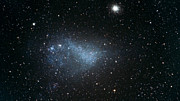
Globular cluster 47 Tucanae and the Small Magellanic Cloud (ground-based image)

Small Magellanic Cloud (ground-based image)

Small Magellanic Cloud and SMIDGE survey 


Videos 

Zoom in on NGC 248
Zoom in on NGC 248Videos


The sheer observing power of the NASA/ESA Hubble Space Telescope is rarely better illustrated than in an image such as this. This glowing pink nebula, named NGC 248, is located in the Small Magellanic Cloud, just under 200 000 light-years away and yet can still be seen in great detail.

Our home galaxy, the Milky Way, is part of a collection of galaxies known as the Local Group. Along with the Andromeda Galaxy, the Milky Way is one of the Group’s most massive members, around which many smaller satellite galaxies orbit. The Magellanic Clouds are famous examples, which can easily be seen with the naked eye from the southern hemisphere.

Within the smaller of these satellite galaxies, the Small Magellanic Cloud, the NASA/ESA Hubble Space Telescope captured two festive-looking emission nebulae, conjoined so they appear as one. Intense radiation from the brilliant central stars is causing hydrogen in the nebulae to glow pink.

Together the nebulae are called NGC 248. They were discovered in 1834 by the astronomer Sir John Herschel. NGC 248 is about 60 light-years long and 20 light-years wide. It is among a number of glowing hydrogen nebulae in the Small Magellanic Cloud, which lies in the southern constellation of Tucana (The Toucan), about 200 000 light-years away.

The nebula was observed as part of a Hubble survey, the Small Magellanic cloud Investigation of Dust and Gas Evolution (SMIDGE). In this survey astronomers are using Hubble to probe the Small Magellanic Cloud to understand how its dust — an important component of many galaxies and related to star formation — is different from the dust in the Milky Way.

Thanks to its relative proximity, the Small Magellanic Cloud is a valuable target. It also turns out to have only between a fifth and a tenth of the amount of heavy elements that the Milky Way has, making the dust similar to what we expect to see in galaxies in the earlier Universe.

This allows astronomers to use it as a cosmic laboratory to study the history of the Universe in our cosmic backyard. These observations also help us to understand the history of our own galaxy as most of the star formation happened earlier in the Universe, at a time when the percentage of heavy elements in the Milky Way was much lower than it is now.
.
The data used in this image were taken with Hubble’s Advanced Camera for Surveys in September 2015.


More information

The Hubble Space Telescope is a project of international cooperation between ESA and NASA.

Image credit: NASA, ESA, STScI, K. Sandstrom (University of California, San Diego), and the SMIDGE team.


Links


Contacts

Karin Sandstrom
University of California
San Diego, USA
Tel: +1 858-246-0552
Email: kmsandstrom@ucsd.edu

Mathias Jäger
ESA/Hubble, Public Information Officer
Garching bei München, Germany
Tel: +49 176 62397500
Email: mjaeger@partner.eso.org


Friday, October 21, 2016

The Toucan and the cluster

Credit: ESA/Hubble & NASA


It may be famous for hosting spectacular sights such as the Tucana Dwarf Galaxy and 47 Tucanae (heic1510), the second brightest globular cluster in the night sky, but the southern constellation of Tucana (The Toucan) also possesses a variety of unsung cosmic beauties.

One such beauty is NGC 299, an open star cluster located within the Small Magellanic Cloud just under 200 000 light-years away. Open clusters such as this are collections of stars weakly bound by the shackles of gravity, all of which formed from the same massive molecular cloud of gas and dust. Because of this, all the stars have the same age and composition, but vary in their mass because they formed at different positions within the cloud.

This unique property not only ensures a spectacular sight when viewed through a sophisticated instrument attached to a telescope such as Hubble’s Advanced Camera for Surveys, but gives astronomers a cosmic laboratory in which to study the formation and evolution of stars — a process that is thought to depend strongly on a star’s mass.


Friday, January 08, 2016

Globular Clusters Could Nurture Interstellar Civilizations

Globular star clusters like this one, 47 Tucanae, might be excellent places to search for interstellar civilizations. Their crowded nature means intelligent life at our stage of technological advancement could send probes to the nearest stars. Credit: NASA, ESA, and the Hubble Heritage Team.  High Resolution (jpg) - Low Resolution (jpg)


"A globular cluster might be the first place in which intelligent life is identified in our galaxy," says lead author Rosanne DiStefano of the Harvard-Smithsonian Center for Astrophysics (CfA).

DiStefano presented this research today in a press conference at a meeting of the American Astronomical Society.

Our Milky Way galaxy hosts about 150 globular clusters, most of them orbiting in the galactic outskirts. They formed about 10 billion years ago on average. As a result, their stars contain fewer of the heavy elements needed to construct planets, since those elements (like iron and silicon) must be created in earlier generations of stars. Some scientists have argued that this makes globular cluster stars less likely to host planets. In fact, only one planet has been found in a globular cluster to date.

However, DiStefano and her colleague Alak Ray (Tata Institute of Fundamental Research, Mumbai) argue that this view is too pessimistic. Exoplanets have been found around stars only one-tenth as metal-rich as our Sun. And while Jupiter-sized planets are found preferentially around stars containing higher levels of heavy elements, research finds that smaller, Earth-sized planets show no such preference.

"It's premature to say there are no planets in globular clusters," states Ray.

Another concern is that a globular cluster's crowded environment would threaten any planets that do form. A neighboring star could wander too close and gravitationally disrupt a planetary system, flinging worlds into icy interstellar space.

However, a star's habitable zone - the distance at which a planet would be warm enough for liquid water - varies depending on the star. While brighter stars have more distant habitable zones, planets orbiting dimmer stars would have to huddle much closer. Brighter stars also live shorter lives, and since globular clusters are old, those stars have died out. The predominant stars in globular clusters are faint, long-lived red dwarfs. 

Any potentially habitable planets they host would orbit nearby and be relatively safe from stellar interactions.
"Once planets form, they can survive for long periods of time, even longer than the current age of the universe," explains DiStefano.

So if habitable planets can form in globular clusters and survive for billions of years, what are the consequences for life should it evolve? Life would have ample time to become increasingly complex, and even potentially develop intelligence. 

Such a civilization would enjoy a very different environment than our own. The nearest star to our solar system is four light-years, or 24 trillion miles, away. In contrast, the nearest star within a globular cluster could be about 20 times closer - just one trillion miles away. This would make interstellar communication and exploration significantly easier.

"We call it the 'globular cluster opportunity,'" says DiStefano. "Sending a broadcast between the stars wouldn't take any longer than a letter from the U.S. to Europe in the 18th century."

"Interstellar travel would take less time too. The Voyager probes are 100 billion miles from Earth, or one-tenth as far as it would take to reach the closest star if we lived in a globular cluster. That means sending an interstellar probe is something a civilization at our technological level could do in a globular cluster," she adds.

The closest globular cluster to Earth is still several thousand light-years away, making it difficult to find planets, particularly in a cluster’s crowded core. But it could be possible to detect transiting planets on the outskirts of globular clusters. Astronomers might even spot free-floating planets through gravitational lensing, in which the planet’s gravity magnifies light from a background star.

A more intriguing idea might be to target globular clusters with SETI search methods, looking for radio or laser broadcasts. The concept has a long history: In 1974 astronomer Frank Drake used the Arecibo radio telescope to broadcast the first deliberate message from Earth to outer space. It was directed at the globular cluster Messier 13 (M13).

Headquartered in Cambridge, Mass., the Harvard-Smithsonian Center for Astrophysics (CfA) is a joint collaboration between the Smithsonian Astrophysical Observatory and the Harvard College Observatory. CfA scientists, organized into six research divisions, study the origin, evolution and ultimate fate of the universe.

For more information, contact:

Christine Pulliam
Media Relations Manager
Harvard-Smithsonian Center for Astrophysics
617-495-7463
cpulliam@cfa.harvard.edu


Wednesday, September 30, 2015

Discovery of the Companions of Millisecond Pulsars

An optical image of the globular cluster, 47 Tucanae. Astronomers have identified the orbiting companions to five millisecond pulsars in this cluster and found them all to be white dwarf stars.Credit: South African Astronomical Observatory


When a star with a mass of roughly ten solar masses finishes its life, it does so in a spectacular explosion known as a supernova, leaving behind as remnant "ash" a neutron star. Neutron stars have masses of one-to-several Suns, but they are tiny in size, only tens of kilometers. Neutron stars spin rapidly, and when they have associated rotating magnetic fields to constrain charged particles, these particles emit electromagnetic radiation in a lighthouse-like beam that can sweep past the Earth with great regularity every few seconds or less. Such neutron stars are known as pulsars. Pulsars are dramatic and powerful probes of supernovae, their progenitor stars, and the properties of nuclear matter under the extreme conditions that exist in these stars.

Some pulsars called millisecond pulsars spin much more quickly, and astronomers have concluded that in order to rotate so rapidly these objects must be regularly accreting material from a nearly companion star which in a binary orbit with it; the new material helps to spin-up the neutron star, which normally would gradually slow down. There are more than 200 known millisecond pulsars. An understanding of these pulsars has been hampered, however, by the fact that only about a dozen of them have had their companion stars directly detected and studied.

CfA astronomers Maureen van den Berg, Josh Grindlay, and Peter Edmonds and their colleagues used ultraviolet images from Hubble to identify the companion stars to two millisecond pulsars located in the globular cluster 47 Tucanae. They were also able to confirm a previous but tentative identification, and to confirm two more. They report that each is of these companions is a white dwarf star – an evolved star that can no longer sustain nuclear burning and which has shrunk to a fraction of its original radius. Each of these pulsars spins more than 120 times per second, and the companions orbit quite closely with periods ranging from only 0.43 days to 1.2 days, close enough to easily satisfy the requirements needed for this kind of cosmic cannibalism as the pulsars gradually feed on material from the white dwarfs. The new work significantly increases the number of identified and characterized millisecond pulsar companions.

Reference(s):

"Discovery of Near-Ultraviolet Counterparts to Millisecond Pulsars in the Globular Cluster 47 Tucanae," L. E. Rivera-Sandoval, M. van den Berg, C. O. Heinke, H. N. Cohn, P. M. Lugger, P. Freire, J. Anderson, A. M. Serenelli, L. G. Althaus, A. M. Cool, J. E. Grindlay, P. D. Edmonds, R. Wijnands and N. Ivanova, MNRAS 453, 2707, 2015.


Thursday, May 14, 2015

Hubble Catches a Stellar Exodus in Action

White Dwarfs Migrating from Globular Cluster 47 Tucanae's Core
Credit: NASA, ESA, and H. Richer and J. Heyl (University of British Columbia, Vancouver, Canada)
Acknowledgment: J. Mack (STScI) and G. Piotto (University of Padova, Italy)


Using NASA's Hubble Space Telescope, astronomers have captured for the first time snapshots of fledgling white dwarf stars beginning their slow-paced, 40-million-year migration from the crowded center of an ancient star cluster to the less populated suburbs.

White dwarfs are the burned-out relics of stars that rapidly lose mass, cool down, and shut off their nuclear furnaces. As these glowing carcasses age and shed weight, their orbits begin to expand outward from the star cluster's packed downtown. This migration is caused by a gravitational tussle among stars inside the cluster. Globular star clusters sort out stars according to their mass, governed by a gravitational billiard-ball game where lower mass stars rob momentum from more massive stars. The result is that heavier stars slow down and sink to the cluster’s core, while lighter stars pick up speed and move across the cluster to the edge. This process is known as "mass segregation." Until these Hubble observations, astronomers had never definitively seen the dynamical conveyor belt in action.

Astronomers used Hubble to watch the white-dwarf exodus in the globular star cluster 47 Tucanae, a dense swarm of hundreds of thousands of stars in our Milky Way galaxy. The cluster resides 16,700 light-years away in the southern constellation Tucana.

"We've seen the final picture before: white dwarfs that have already sorted themselves out and are orbiting in a location outside the core that is appropriate for their mass," explained Jeremy Heyl of the University of British Columbia (UBC), Vancouver, Canada, first author on the science paper. The team's results appeared in the May 1 issue of The Astrophysical Journal.

"But in this study, which comprises about a quarter of all the young white dwarfs in the cluster, we're actually catching the stars in the process of moving outward and segregating themselves according to mass," Heyl said. "The entire process doesn't take very long, only a few hundreds of millions of years, out of the 10-billion-year age of the cluster, for the white dwarfs to reach their new home in the outer suburbs."

"This result hasn't been seen before, and it challenges some ideas about some of the details of how and when a star loses its mass near the end of its life," added team member Harvey Richer of UBC.

Using the ultraviolet-light capabilities of Hubble's sharp-eyed Wide Field Camera 3, the astronomers examined 3,000 white dwarfs, tracing two populations with diverse ages and orbits. One grouping was 6 million years old and had just begun their journey. Another was around 100 million years old and had already arrived at its new homestead far away from the center, roughly 1.5 light-years, or nearly 9 trillion miles, away.

Only Hubble can detect these stars because ultraviolet light is blocked by Earth's atmosphere and therefore doesn't reach ground-based telescopes. The astronomers estimated the white dwarfs' ages by analyzing their colors, which gives them the stars' temperatures. The hottest dwarfs shine fiercely in ultraviolet light.

The dwarfs were tossed out of the rough-and-tumble cluster center due to gravitational interactions with heftier stars orbiting the region. Stars in globular clusters sort themselves out by weight, with the heavier stars sinking to the middle. Before flaming out as white dwarfs, the migrating stars were among the most massive in the cluster, weighing roughly as much as our Sun. The more massive stars burned out long ago.

The migrating white dwarfs, however, are not in a hurry to leave. Their orbits expand outward at about 30 miles an hour, roughly the average speed of a car traveling in the city. The dead stars will continue this pace for about 40 million years, until they reach a location that is more appropriate for their mass.

Although the astronomers were not surprised to see the migration, they were puzzled to find that the youngest white dwarfs were just embarking on their journey. This discovery may be evidence that the stars shed much of their mass at a later stage in their lives than once thought.

About 100 million years before stars evolve into white dwarfs, they swell up and become red giant stars. Many astronomers thought that stars lose most of their mass during this phase by blowing it off into space. But the Hubble observations reveal that the stars actually dump 40 percent to 50 percent of their bulk just 10 million years before completely burning out as white dwarfs.

"This late start is evidence that these white dwarfs are losing a large amount of mass just before they become white dwarfs and not during the earlier red giant phase, as most astronomers had thought," said Richer. 

"That's why we are seeing stars still in the process of moving slowly away from the center of the cluster. It's only after they lose their mass that they get gravitationally pushed out of the core. If the stars had shed most of their weight earlier in their lives, we wouldn't see such a dramatic effect between the youngest white dwarfs and the older ones that are 100 million years old."

Although the white dwarfs have exhausted the hydrogen fuel that makes them shine as stars, these stellar relics are among the brightest stars in this primordial cluster because their brilliant hot cores have been exposed, which are luminous largely in ultraviolet light. "When a white dwarf forms, they've got all this stored-up heat in their cores, and the reason we can see a white dwarf is because over time they radiate their stored thermal energy slowly into space," Richer explained. "They're getting cooler and less luminous as time goes on because they have no nuclear sources of energy."

After making it through the gauntlet of gravitational interactions within the crowded 1.5-light-year-wide core, the traveling white dwarfs encounter few interactions as they migrate outward, because the density of stars decreases. "A lot of action happens when they're 30 million to 40 million years old, and continues up to around 100 million years, and then as they get older the white dwarfs still evolve but less dramatically," Heyl said.

The 47 Tucanae cluster is an ideal place to study the mass segregation of white dwarfs because it is nearby and has a significant number of centrally concentrated stars that can be resolved by Hubble's crisp vision.

Contact

Donna Weaver / Ray Villard
Space Telescope Science Institute, Baltimore, Maryland
410-338-4493 / 410-338-4514

dweaver@stsci.edu / villard@stsci.edu

Felicia Chou
NASA Headquarters, Washington, DC
202-358-0257

felicia.chou@nasa.gov

Jeremy Heyl
University of British Columbia, Vancouver, BC, Canada
604-822-0995

heyl@phas.ubc.ca

Source: HubbleSite

Friday, July 19, 2013

Hubble Shows Link Between Stars' Ages and Their Orbits in Dense Cluster


Globular Cluster 47 Tucanae  
Credit: NASA, ESA, Digitized Sky Survey (DSS; STScI/AURA/UKSTU/AAO), H. Richer and J. Heyl (University of British Columbia), and J. Anderson and J. Kalirai (STScI). More Images

Astronomers using NASA's Hubble Space Telescope have for the first time linked two distinct populations of stars in an ancient globular star cluster to their unique orbital dynamics, offering proof that the stars do not share the same birth date.

The analysis of the globular cluster 47 Tucanae shows that the two populations differ in age by less than 100 million years. The cluster resides roughly 16,700 light-years away in the southern constellation Tucana.

Researchers, led by Harvey Richer of the University of British Columbia in Vancouver, combined recent Hubble observations with eight years' worth of data from the telescope's archive to determine the motions of the stars in this cluster.

Previous spectroscopic studies revealed that many globular clusters contain stars of varying chemical compositions, suggesting multiple episodes of star birth. This Hubble analysis, however, goes a step further, adding the stars' orbital motion to the analysis.

"When analyzing the motions of stars, the longer the time baseline for observations, the more accurately we can measure their motion," Richer explained. "These data are so good, we can actually see for the first time the individual motions of the stars in the cluster. The data offer detailed evidence to help us understand how various stellar populations formed in such clusters."

The Milky Way's globular clusters are the surviving relics from our galaxy's formation. They offer insights into the early history of our galaxy. 47 Tucanae is 10.5 billion years old and one of the brightest of our galaxy's more than 150 globular clusters. The cluster measures about 120 light-years wide.

Richer and his team used Hubble's Advanced Camera for Surveys in 2010 to observe the cluster. They combined those observations with 754 archival images to accurately measure the changes in positions of more than 30,000 stars. Using these data, they could discern how fast the stars are moving. The team also measured the stellar luminosities as well as temperatures.

This stellar archaeology identified the two distinct populations of stars. The first consists of redder stars, which are older, less chemically enriched, and in random, circularized orbits. The second population comprises bluer stars, which are younger, more chemically enhanced, and in more elliptical orbits.

"The redder generation, which is deficient in heavier elements, reflects the initial motion of the gas that formed the cluster," Richer said. "These stars have retained a memory of their original motion."

After the most massive of these stars completed their stellar evolution, they expelled gas enriched with heavier elements back into the cluster. This gas collided with other gas and formed a second, more chemically enriched generation of stars that was concentrated towards the cluster center. Slowly over time these stars have been moving outwards, putting them on more radial orbits.

This discovery is not the first for Hubble in revealing multiple generations of stars in globular clusters. In 2007 Hubble researchers found three generations of stars in the massive globular cluster NGC 2808. Richer's team, however, linked stellar dynamics to separate populations for the first time. Finding multiple stellar populations in globular clusters has deep cosmological implications. Astronomers need to solve future enigmas of these multiple generations to better understand how stars formed in distant galaxies in the early universe.

The team's results are published in the July 1 issue of The Astrophysical Journal Letters.

CONTACT

Donna Weaver / Ray Villard
Space Telescope Science Institute, Baltimore, Md.
410-338-4493 / 410-338-4514

dweaver@stsci.edu / villard@stsci.edu

Harvey Richer
University of British Columbia, Vancouver, BC, Canada
604-822-4134

richer@astro.ubc.ca


Thursday, March 07, 2013

47 Tucanae: Probing Extreme Matter Through Observations of Neutron Stars

Neutron stars, the ultra-dense cores left behind after massive stars collapse, contain the densest matter known in the Universe outside of a black hole. New results from Chandra and other X-ray telescopes have provided one of the most reliable determinations yet of the relation between the radius of a neutron star and its mass. These results constrain how nuclear matter - protons and neutrons, and their constituent quarks - interact under the extreme conditions found in neutron stars.

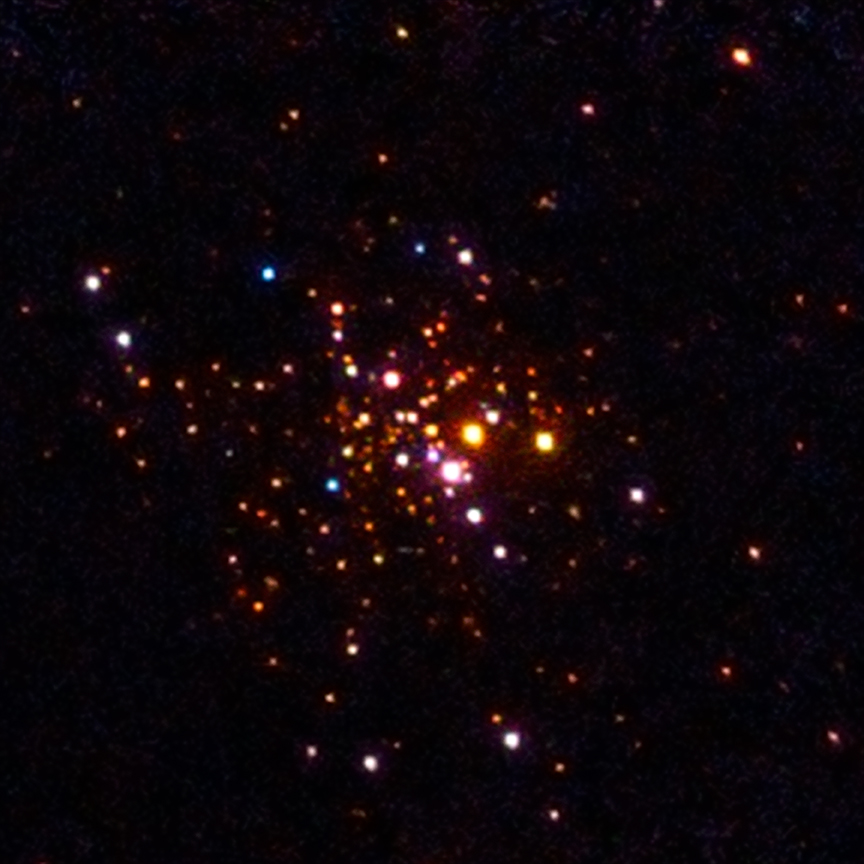
Three telescopes - Chandra, ESA's XMM-Newton, and NASA's Rossi X-ray Timing Explorer (RXTE) - were used to observe 8 neutron stars, including one in 47 Tucanae, a globular cluster located about 15,000 light years away in the outskirts of the Milky Way. The image shown here was constructed from a long Chandra observation of 47 Tucanae. Lower-energy X-rays are red, X-rays with intermediate energies are green, and the highest-energy X-rays are shown in blue.

In the image, the double, or binary, star system labeled as X7 contains a neutron star slowly pulling gas away from a companion star with a mass much lower than the Sun. In 2006, researchers used observations of the amount of X-rays from X7 at different energies together with theoretical models to determine a relationship between the mass and the radius of the neutron star. A similar procedure was used for Chandra observations of a neutron star in another globular cluster, NGC 6397, and for two other neutron stars in clusters observed by ESA's XMM-Newton.

Credit NASA/CXC/Michigan State/A.Steiner et al
JPEG (345.4 kb)   -  Large JPEG (6.9 MB)  -   Tiff (18.4 MB)
View on the Sky (WWT)

Four other neutron stars were observed with RXTE to undergo bursts of X-rays that cause the atmosphere of the neutron star to expand. By following the cooling of the star, its surface area can be calculated. Then, by folding in independent estimates of the distance to the neutron star, scientists were able to gather more information on the relationships between the masses and radii of these neutron stars.

Because the mass and radius of a neutron star is directly related to interactions between the particles in the interior of the star, the latest results give scientists new information about the inner workings of neutron stars.

The researchers used a wide range of different models for the structure of these collapsed objects and determined that the radius of a neutron star with a mass that is 1.4 times the mass of the Sun is between 10.4 and 12.9 km (6.5 to 8.0 miles). They also estimated the density at the center of a neutron star was about 8 times that of nuclear matter found in Earth-like conditions. This translates into a pressure that is over ten trillion trillion times the pressure required for diamonds to form inside the Earth.

Neutron stars, the ultra-dense cores left behind after massive stars collapse, contain the densest matter known in the Universe outside of a black hole. New results from Chandra and other X-ray telescopes have provided one of the most reliable determinations yet of the relation between the radius of a neutron star and its mass. These results constrain how nuclear matter - protons and neutrons, and their constituent quarks - interact under the extreme conditions found in neutron stars.

Three telescopes - Chandra, ESA's XMM-Newton, and NASA's Rossi X-ray Timing Explorer (RXTE) - were used to observe 8 neutron stars, including one in 47 Tucanae, a globular cluster located about 15,000 light years away in the outskirts of the Milky Way. The image shown here was constructed from a long Chandra observation of 47 Tucanae. Lower-energy X-rays are red, X-rays with intermediate energies are green, and the highest-energy X-rays are shown in blue.

In the image, the double, or binary, star system labeled as X7 contains a neutron star slowly pulling gas away from a companion star with a mass much lower than the Sun. In 2006, researchers used observations of the amount of X-rays from X7 at different energies together with theoretical models to determine a relationship between the mass and the radius of the neutron star. A similar procedure was used for Chandra observations of a neutron star in another globular cluster, NGC 6397, and for two other neutron stars in clusters observed by ESA's XMM-Newton.

The results apply whether the entire set of bursting sources, or the most extreme of the other sources, are removed from the sample. Previous studies have used smaller samples of neutron stars or have not accounted for as many uncertainties in using the models.

The new values for the neutron star's structure should hold true even if matter composed of free quarks exists in the core of the star. Quarks are fundamental particles that combine to form protons and neutrons and are not usually found in isolation. It has been postulated that free quarks may exist inside the centers of neutron stars, but no firm evidence for this has ever been found. 

The researchers also made an estimate of the distances between neutrons and protons in atomic nuclei here on earth. A larger neutron star radius naturally implies that, on average, neutrons and protons in a heavy nucleus are farther apart. Their estimate is being compared with values from terrestrial experiments.

The neutron star observations also provided new information about the so-called "symmetry energy" for nuclear matter, which is the energy cost required to create a system with a different number of protons than neutrons. The symmetry energy is important for neutron stars because they contain almost ten times as many neutrons as protons. It is also important for heavy atoms on Earth, like Uranium, because they often have more neutrons than protons. The results show that the symmetry energy does not change much with density.

These results will be published in a paper in the March 1st, 2013 issue of The Astrophysical Journal Letters. The authors are Andrew Steiner, from the Institute for Nuclear Theory at the University of Washington, James Lattimer from Stony Brook University in New York and Edward Brown from Michigan State University.

NASA's Marshall Space Flight Center in Huntsville, Ala., manages the Chandra program for NASA's Science Mission Directorate in Washington. The Smithsonian Astrophysical Observatory controls Chandra's science and flight operations from Cambridge, Mass.


Fast Facts for 47 Tucanae: 

Release Date: March 6, 2013 
Scale: Image is 2.3 arcmin across (about 10 light years) 
Category: Neutron Stars/X-ray Binaries
Coordinates: (J2000) RA 00h 24m 42.0s | Dec -72° 00' 00" 
Constellation: Tucana
Observation Date: 13 pointings between March 16, 2000 and Oct 11, 2002 
Observation Time: 100 (4 days, 4 hours). 
Obs. ID: 78, 953-956, 2735-2738, 3384-3387 
Instrument: ACIS
References: Steiner, A. et al 2013, ApJ 765, L5; arXiv:1205.6871
Color Code: X-ray (Red, Green, Blue)

Thursday, January 10, 2013

A Jumble of Exotic Stars

 PR Image eso1302a
The globular star cluster 47 Tucanae

 PR Image eso1302b
The globular star cluster 47 Tucanae in the constellation of Tucana (The Toucan

PR Image eso1302c
Wide-field view of the sky around the globular cluster 47 Tucanae

 Video

 PR Video eso1302a
A close look at the globular star cluster 47 Tucanae

 New VISTA snap of star cluster 47 Tucanae

This new infrared image from ESO’s VISTA telescope shows the globular cluster 47 Tucanae in striking detail. This cluster contains millions of stars, and there are many nestled at its core that are exotic and display unusual properties. Studying objects within clusters like 47 Tucanae may help us to understand how these oddballs form and interact. This image is very sharp and deep due to the size, sensitivity, and location of VISTA, which is sited at ESO's Paranal Observatory in Chile.

Globular clusters are vast, spherical clouds of old stars bound together by gravity. They are found circling the cores of galaxies, as satellites orbit the Earth. These star clumps contain very little dust and gas — it is thought that most of it has been either blown from the cluster by winds and explosions from the stars within, or stripped away by interstellar gas interacting with the cluster. Any remaining material coalesced to form stars billions of years ago.

These globular clusters spark a considerable amount of interest for astronomers — 47 Tucanae, otherwise known as NGC 104, is a huge, ancient globular cluster about 15 000 light-years away from us, and is known to contain many bizarre and interesting stars and systems.

Located in the southern constellation of Tucana (The Toucan), 47 Tucanae orbits our Milky Way. At about 120 light-years across it is so large that, despite its distance, it looks about as big as the full Moon. Hosting millions of stars, it is one of the brightest and most massive globular clusters known and is visible to the naked eye [1]. In amongst the swirling mass of stars at its heart lie many intriguing systems, including X-ray sources, variable stars, vampire stars, unexpectedly bright “normal” stars known as blue stragglers (eso1243), and tiny objects known as millisecond pulsars, small dead stars that rotate astonishingly quickly [2].

Red giants, stars that have exhausted the fuel in their cores and swollen in size, are scattered across this VISTA image and are easy to pick out, glowing a deep amber against the bright white-yellow background stars. The densely packed core is contrasted against the more sparse outer regions of the cluster, and in the background huge numbers of stars in the Small Magellanic Cloud are visible.

This image was taken using ESO’s VISTA (Visible and Infrared Survey Telescope for Astronomy) as part of a survey of the region of the Magellanic Clouds, two of the closest known galaxies to us. 47 Tucanae, although much closer than the Clouds, by chance lies in the the foreground of the Small Magellanic Cloud (eso1008), and was snapped during the survey.

VISTA is the world’s largest telescope dedicated to mapping the sky. Located at ESO’s Paranal Observatory in Chile, this infrared telescope, with its large mirror, wide field of view and sensitive detectors, is revealing a new view of the southern sky. Using a combination of sharp infrared images — such as the VISTA image above — and visible-light observations allows astronomers to probe the contents and history of objects like 47 Tucanae in great detail.

Notes

[1]
There are over 150 globular clusters orbiting our galaxy. 47 Tucanae is the second most massive after Omega Centauri (eso0844).

[2] Millisecond pulsars are incredibly quickly rotating versions of regular pulsars, highly magnetised, rotating stellar remnants that emit bursts of radiation as they spin. There are 23 known millisecond pulsars in 47 Tucanae — more than in all other globular clusters bar one, Terzan 5 (eso0945).

More information

ESO is the foremost intergovernmental astronomy organisation in Europe and the world’s most productive astronomical observatory. It is supported by 15 countries: Austria, Belgium, Brazil, the Czech Republic, Denmark, France, Finland, Germany, Italy, the Netherlands, Portugal, Spain, Sweden, Switzerland and the United Kingdom. ESO carries out an ambitious programme focused on the design, construction and operation of powerful ground-based observing facilities enabling astronomers to make important scientific discoveries. ESO also plays a leading role in promoting and organising cooperation in astronomical research. ESO operates three unique world-class observing sites in Chile: La Silla, Paranal and Chajnantor. At Paranal, ESO operates the Very Large Telescope, the world’s most advanced visible-light astronomical observatory and two survey telescopes. VISTA works in the infrared and is the world’s largest survey telescope and the VLT Survey Telescope is the largest telescope designed to exclusively survey the skies in visible light. ESO is the European partner of a revolutionary astronomical telescope ALMA, the largest astronomical project in existence. ESO is currently planning the 39-metre European Extremely Large optical/near-infrared Telescope, the E-ELT, which will become “the world’s biggest eye on the sky”.

Links


Contacts

 Richard Hook
 ESO, La Silla, Paranal, E-ELT & Survey Telescopes Press Officer
 Garching bei München, Germany
 Tel: +49 89 3200 6655
 Cell: +49 151 1537 3591
 Email:
rhook@eso.org