Showing posts with label X-ray binaries (XRBs). Show all posts

Sunday, March 08, 2026

NuSTAR Observes a Bursting Neutron Star

Artist's impression of the neutron star GS 1826–24, accreting material from its neighbor in a disk, and undergoing a bright thermonuclear burst that sends a flash through the system, illuminating its different components. Image credit: Futselaar (artsource) / Degenaar. Download Image

During the past week, NuSTAR targeted the X-ray binary GS 1826–24 in coordinated observations with the Karl G. Jansky Very Large Array (VLA) radio telescope, aiming to directly measure the speed of a jet launched by an accreting neutron star. This source recently entered an extraordinary state of rapid, clocklike thermonuclear bursts ignited on the neutron star surface. This produces a series of predictable, high-contrast, X-ray flashes that perturb the inner accretion flow and the associated jet of the neutron star binary system. NuSTAR precisely measures the burst onset and energetics, as well as the dynamical response of the inner accretion flow, while the VLA simultaneously tracks the compact radio jet. By measuring the lag between the X-ray burst and the jet’s radio response, the jet propagation speed can be directly determined — applying a novel burst-timing technique that was recently first demonstrated by the same team to measure the speed of the compact jet of the accreting neutron star 4U 1728−34 . At the same time, NuSTAR’s broadband X-ray coverage tracks how different components of the accretion flow — such as the boundary layer, corona, and inner disk — respond to each burst. This approach tests fundamental predictions for how relativistic jets are launched and powered in accreting compact objects.

Author: Nathalie Degenaar (Associate Professor, University of Amsterdam)


Wednesday, August 07, 2024

A Hard Look at a Soft-State X-ray Binary

At the center of this image, in between the glowing star-forming region at center left and the bright star at center right, is a bluish star with an unseen companion. This binary system is designated Cygnus X-1. Credit: DSS

Astronomers recently tracked a famous X-ray binary system through a change in its accretion state. What does this transition tell us about how black holes accrete gas?

An artist’s impression of an X-ray binary, in which a compact object accretes material from a companion star and emits X-rays during intermittent outbursts. Credit: ESO/L. Calçada; CC BY 4.0

Accretion Questions

X-ray binaries contain a star and a compact object — either a black hole or a neutron star. As the compact object ensnares gas from its stellar companion, a number of X-ray-bright features can emerge: the gas collects in a super-hot accretion disk and in a tenuous structure called the corona, and transient outflowing jets can appear.

Astronomers have discovered hundreds of X-ray binaries in the Milky Way, but there are still many open questions about the accretion process: What’s the origin of the corona, and how is it structured? Does it sit high above the compact object, or does it hover just above the surface of the disk? What’s the connection between the disk, the corona, and the jets?

One way to potentially answer these questions is to track an X-ray binary as it undergoes a state transition, shifting from producing more low-energy X-rays (“soft state”) to more high-energy X-rays (“hard state”). State transitions are thought to occur when a binary changes how it’s accreting gas, so observing a binary across state transitions can reveal whether the binary’s geometry changes in different accretion modes. Luckily, one of the best-studied X-ray binaries in our galaxy recently gave researchers a chance to study a state transition with a powerful observatory.

Side view of the favored coronal geometry; a wedge-shaped corona (blue) lies parallel to the accretion disk (yellow). The arrows show the direction of the black hole’s spin. Credit: AAS Nova/Kerry Hensley

From Hard to Soft

Cygnus X-1 is an X-ray binary containing a 41-solar-mass supergiant star and a 21-solar-mass black hole. Over decades of monitoring, scientists have witnessed Cygnus X-1 repeatedly transition between soft and hard states. Phase switches happen randomly, and a phase can last weeks or years.

Since the launch of the new Imaging X-ray Polarimetry Explorer (IXPE) spacecraft in 2021, Cygnus X-1 has held steady in a hard state. When researchers examined Cygnus X-1’s hard-state behavior with IXPE, they found that the X-ray emission was unexpectedly strongly polarized. In other words, the orientation of the X-rays as they traveled through space was more orderly than expected. Based on these observations, a “lamppost” model — in which the corona is situated above the black hole’s poles — is now disfavored. Instead, researchers favor a model in which the corona lies parallel to the accretion disk.

Left: Polarization degree and polarization angle for the hard (blue) and soft (red) states. Right: Polarization degree and angle as a function of energy for the soft state. Click to enlarge. Credit: Steiner et al. 2024

Soft-State Insights

In April 2023, Cygnus X-1 transitioned out of its long-lived hard state, giving researchers their first opportunity to study the system’s soft-state behavior with IXPE. James Steiner (Center for Astrophysics ∣ Harvard & Smithsonian) and collaborators analyzed five epochs of IXPE data spread over two months. They found that while Cygnus X-1’s X-ray emission in the soft state is less polarized — 2% polarization compared to 4% in the hard state — the two states were otherwise similar; the polarization angle is parallel to the outflowing jet, and the degree of polarization increases with the temperature of the gas.

Using a fully relativistic spectral model, Steiner’s team found that the corona likely lies parallel to the accretion disk, just as in the hard state. While there are many similarities between the hard and soft states of this system, the team suggested that the majority of the polarized light in each state comes from a different source.

In the hard state, X-ray photons become polarized when they scatter off the corona. In the soft state, a substantial fraction of the X-ray photons from the accretion disk are bent back toward the disk by the black hole’s immense gravity, and they become polarized when they are reflected off the surface of the disk. In other words, X-rays from the accretion disk undergo gravitational lensing — showing that the same process that bends the light from distant galaxies is at work in a system billions of times less massive!

Citation

“An IXPE-led X-Ray Spectropolarimetric Campaign on the Soft State of Cygnus X-1: X-Ray Polarimetric Evidence for Strong Gravitational Lensing,” James F. Steiner et al 2024 ApJL 969 L30. doi:10.3847/2041-8213/ad58e4


By Kerry Hensley

Thursday, May 10, 2018

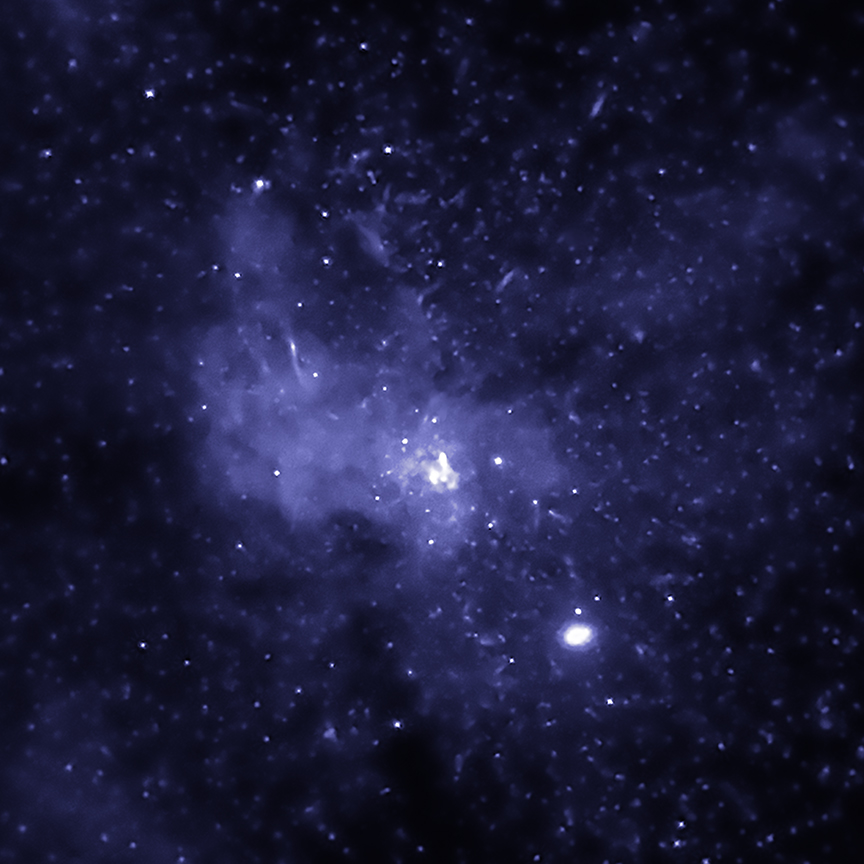
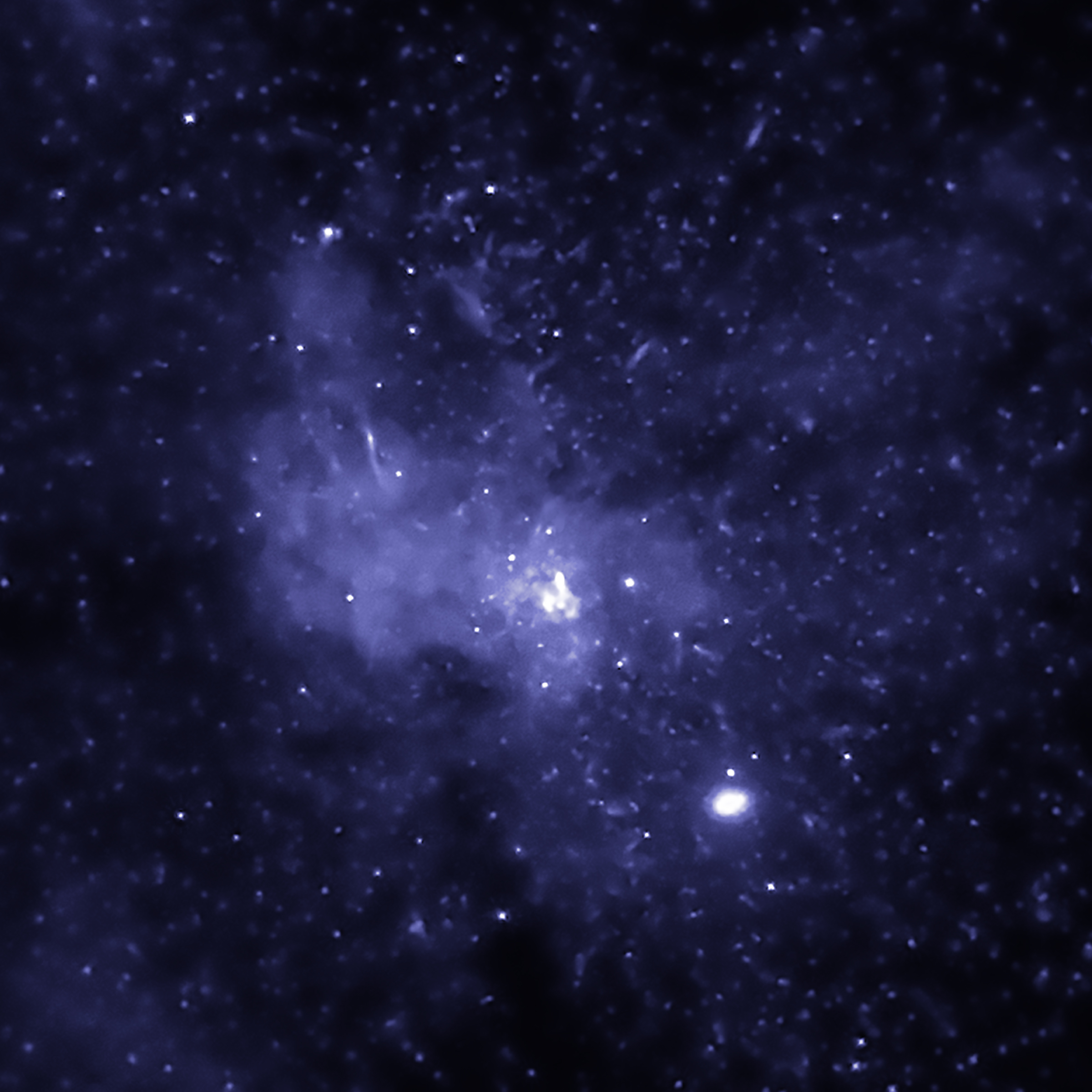
Sagittarius A* Swarm: Black Hole Bounty Captured in the Milky Way Center

 Sagittarius A* Swarm
NASA/CXC/Columbia Univ./C. Hailey et al.


Astronomers have discovered evidence for thousands of black holes located near the center of our Milky Way galaxy using data from NASA's Chandra X-ray Observatory.

This black hole bounty consists of stellar-mass black holes, which typically weigh between five to 30 times the mass of the Sun. These newly identified black holes were found within three light years — a relatively short distance on cosmic scales — of the supermassive black hole at our Galaxy's center known as Sagittarius A* (Sgr A*).

Theoretical studies of the dynamics of stars in galaxies have indicated that a large population of stellar mass black holes — as many as 20,000 — could drift inward over the eons and collect around Sgr A*. This recent analysis using Chandra data is the first observational evidence for such a black hole bounty.

A black hole by itself is invisible. However, a black hole — or neutron star — locked in close orbit with a star will pull gas from its companion (astronomers call these systems "X-ray binaries"). This material falls into a disk and heats up to millions of degrees and produces X-rays before disappearing into the black hole. Some of these X-ray binaries appear as point-like sources in the Chandra image.

A team of researchers, led by Chuck Hailey of Columbia University in New York, used Chandra data to search for X-ray binaries containing black holes that are located near Sgr A*. They studied the X-ray spectra — that is the amount of X-rays seen at different energies — of sources within about 12 light years of Sgr A*.

The team then selected sources with X-ray spectra similar to those of known X-ray binaries, which have relatively large amounts of low energy X-rays. Using this method they detected fourteen X-ray binaries within about three light years of Sgr A*. Two X-ray sources likely to contain neutron stars based on the detection of characteristic outbursts in previous studies were then eliminated from the analysis.

The dozen remaining X-ray binaries are identified in the labeled version of the image using red colored circles. Other sources with relatively large amounts of high energy X-rays are labeled in white, and are mostly binaries containing white dwarf stars.

Hailey and his collaborators concluded that a majority of these dozen X-ray binaries are likely to contain black holes. The amount of variability they have shown over timescales of years is different from that expected for X-ray binaries containing neutron stars.

Only the brightest X-ray binaries containing black holes are likely to be detectable at the distance of Sgr A*. Therefore, the detections in this study imply that a much larger population of fainter, undetected X-ray binaries — at least 300 and up to a thousand — containing stellar-mass black holes should be present around Sgr A*.

This population of black holes with companion stars near Sgr A* could provide insight into the formation of X-ray binaries from close encounters between stars and black holes. This discovery could also inform future gravitational wave research. Knowing the number of black holes in the center of a typical galaxy can help in better predicting how many gravitational wave events may be associated with them.

An even larger population of stellar-mass black holes without companion stars should be present near Sgr A*. According to theoretical follow-up work by Aleksey Generozov of Columbia and his colleagues, more than about 10,000 black holes and as many as 40,000 black holes should exist in the center of the Galaxy.

While the authors strongly favor the black hole explanation, they cannot rule out the possibility that up to about half of the observed dozen sources are from a population of millisecond pulsars, i.e., very rapidly rotating neutron stars with strong magnetic fields.

A paper describing these results appeared in the April 5th issue of the journal Nature. NASA's Marshall Space Flight Center in Huntsville, Alabama, manages the Chandra program for NASA's Science Mission Directorate in Washington. The Smithsonian Astrophysical Observatory in Cambridge, Massachusetts, controls Chandra's science and flight operations.


Fast Facts for Sagittarius A* Swarm:

Scale: Image is about 6 arcmin (45 light years) across
Category: Black Holes, Neutron Stars/X-ray Binaries
Coordinates (J2000): RA 17h 45m 40s | Dec -29° 00´ 28.00"
Constellation: Sagittarius
Observation Date: February 2002-April 2013
Observation Time: 389 hours 33 min (16 days 5 hours 33 min)
Obs. ID: 2943, 2951, 2952, 2953, 2954, 3392, 3393, 3663, 3665, 3549, 4683, 4684, 5950, 5951, 5952, 5953, 5954, 6363, 6113, 6639, 6640, 6641, 6642, 6643, 6644, 6645, 6646, 7554, 7555, 7556, 7557, 7558, 7559, 9169, 9170, 9171, 9172, 9173, 9174, 10556, 11843, 13016, 13017, 14941, 14942
Instrument: ACIS
References: Hailey, C et al, 2018, Nature, 556, 70
Color Code: X-ray Blue
Distance Estimate: About 26,000 light years


Friday, August 11, 2017

IC 10: A Starburst Galaxy with the Prospect of Gravitational WavesA Quick Look at IC 10

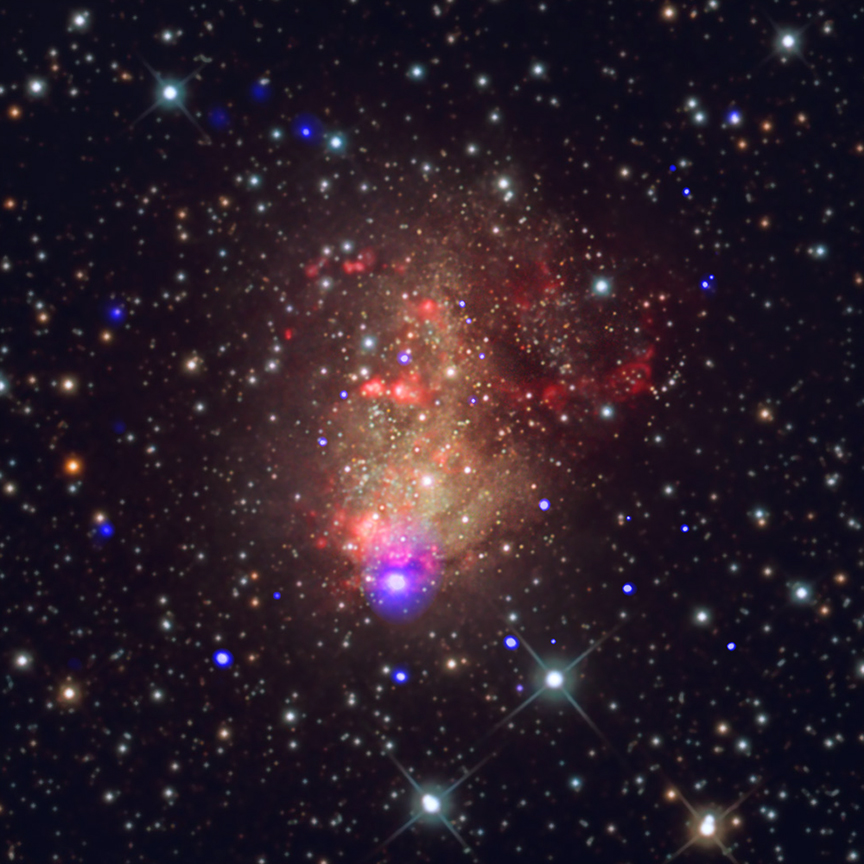
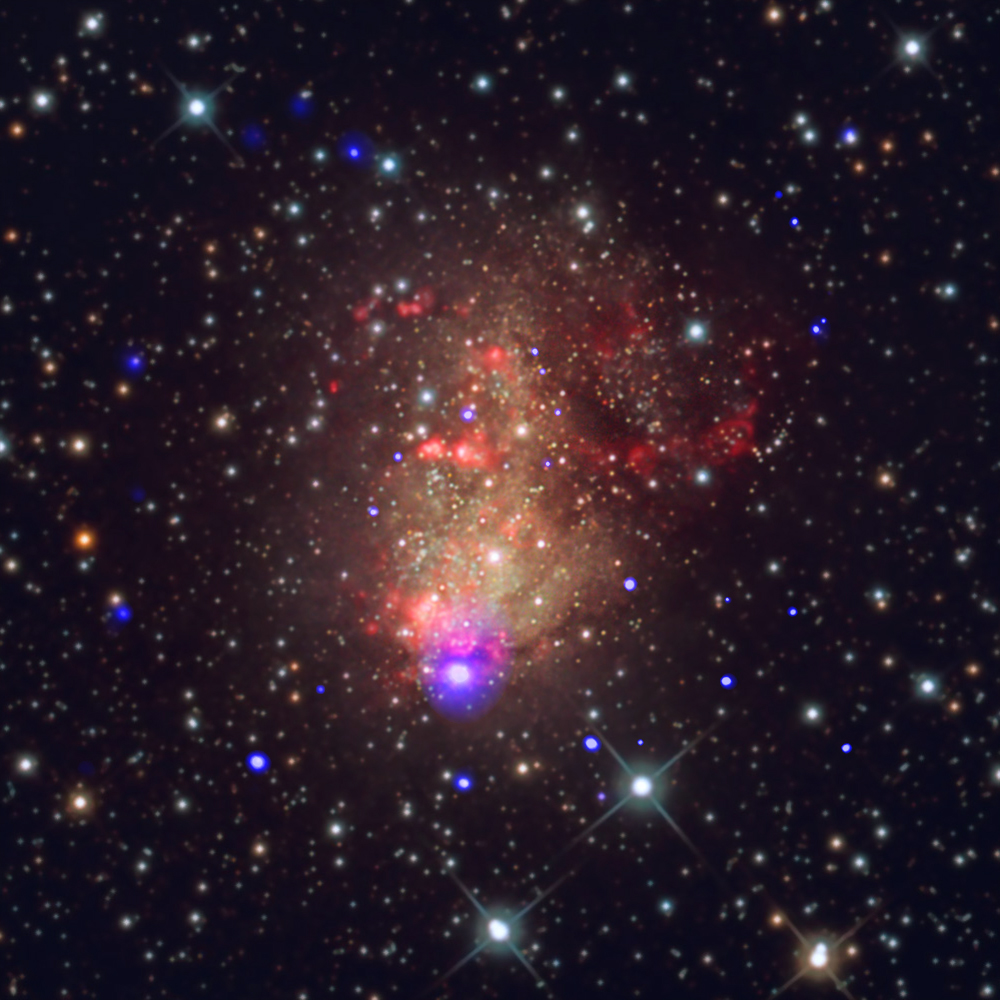
IC 10
Credit: X-ray: NASA/CXC/UMass Lowell/S.Laycock et al.
Optical: Bill Snyder Astrophotography


animation


In 1887, American astronomer Lewis Swift discovered a glowing cloud, or nebula, that turned out to be a small galaxy about 2.2 billion light years from Earth. Today, it is known as the "starburst" galaxy IC 10, referring to the intense star formation activity occurring there.

More than a hundred years after Swift's discovery, astronomers are studying IC 10 with the most powerful telescopes of the 21st century. New observations with NASA's Chandra X-ray Observatory reveal many pairs of stars that may one day become sources of perhaps the most exciting cosmic phenomenon observed in recent years: gravitational waves.

By analyzing Chandra observations of IC 10 spanning a decade, astronomers found over a dozen black holes and neutron stars feeding off gas from young, massive stellar companions. Such double star systems are known as "X-ray binaries" because they emit large amounts of X-ray light. As a massive star orbits around its compact companion, either a black hole or neutron star, material can be pulled away from the giant star to form a disk of material around the compact object. Frictional forces heat the infalling material to millions of degrees, producing a bright X-ray source.

When the massive companion star runs out of fuel, it will undergo a catastrophic collapse that will produce a supernova explosion, and leave behind a black hole or neutron star. The end result is two compact objects: either a pair of black holes, a pair of neutron stars, or a black hole and neutron star. If the separation between the compact objects becomes small enough as time passes, they will produce gravitational waves. Over time, the size of their orbit will shrink until they merge. LIGO has found three examples of black hole pairs merging in this way in the past two years.

Starburst galaxies like IC 10 are excellent places to search for X-ray binaries because they are churning out stars rapidly. Many of these newly born stars will be pairs of young and massive stars. The most massive of the pair will evolve more quickly and leave behind a black hole or a neutron star partnered with the remaining massive star. If the separation of the stars is small enough, an X-ray binary system will be produced.

This new composite image of IC 10 combines X-ray data from Chandra (blue) with an optical image (red, green, blue) taken by amateur astronomer Bill Snyder from the Heavens Mirror Observatory in Sierra Nevada, California. The X-ray sources detected by Chandra appear as a darker blue than the stars detected in optical light.

The young stars in IC 10 appear to be just the right age to give a maximum amount of interaction between the massive stars and their compact companions, producing the most X-ray sources. If the systems were younger, then the massive stars would not have had time to go supernova and produce a neutron star or black hole, or the orbit of the massive star and the compact object would not have had time to shrink enough for mass transfer to begin. If the star system were much older, then both compact objects would probably have already formed. In this case transfer of matter between the compact objects is unlikely, preventing the formation of an X-ray emitting disk.

Chandra detected 110 X-ray sources in IC 10. Of these, over forty are also seen in optical light and 16 of these contain "blue supergiants", which are the type of young, massive, hot stars described earlier. Most of the other sources are X-ray binaries containing less massive stars. Several of the objects show strong variability in their X-ray output, indicative of violent interactions between the compact stars and their companions.

A pair of papers describing these results were published in the February 10th, 2017 issue of The Astrophysical Journal and is available online here and here. The authors of the study are Silas Laycock from the UMass Lowell's Center for Space Science and Technology (UML); Rigel Capallo, a graduate student at UML; Dimitris Christodoulou from UML; Benjamin Williams from the University of Washington in Seattle; Breanna Binder from the California State Polytechnic University in Pomona; and, Andrea Prestwich from the Harvard-Smithsonian Center for Astrophysics in Cambridge, Mass.

NASA's Marshall Space Flight Center in Huntsville, Alabama, manages the Chandra program for NASA's Science Mission Directorate in Washington. The Smithsonian Astrophysical Observatory in Cambridge, Massachusetts, controls Chandra's science and flight operations.


Fast Facts for IC 10:


Category: Neutron Stars/X-ray Binaries, Normal Galaxies & Starburst Galaxies
Coordinates (J2000): RA 00h 20m 23.2s | Dec 59° 17´ 34.7"
Constellation: Cassiopeia
Observation Date: 6 pointings between December 2009 and September 2010
Observation Time: 24 hours 19.5 min
Obs. ID: 11081-11086
Instrument: ACIS
References: Laycock S. et al., 2017, ApJ, 836, 50; arXiv:1611.08611. Laycock S. et al., 2017, ApJ [in press]; arXiv:1701.03803
Color Code: X-ray (Blue); Optical (Red, Green, Blue)
Distance Estimate: About 2.2 billion light years


Tuesday, June 27, 2017

Arp 299: Galactic Goulash

Arp 299 (composite)
Credit: X-ray: NASA/CXC/Univ of Crete/K. Anastasopoulou et al, NASA/NuSTAR/GSFC/A. Ptak et al; 
Optical: NASA/STScI


animation


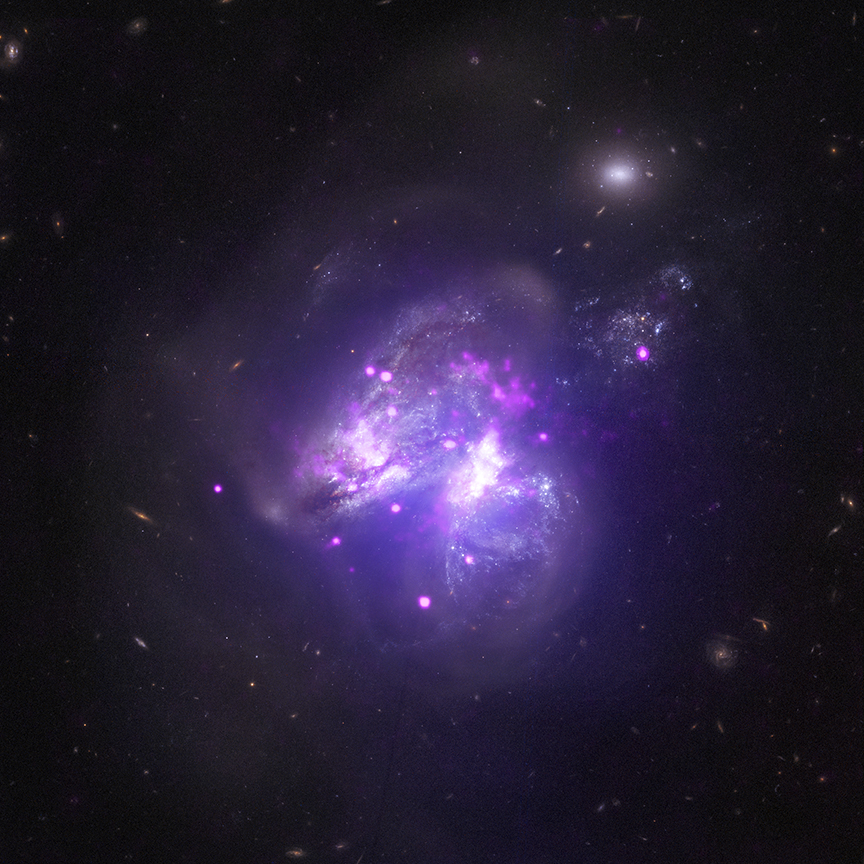
What would happen if you took two galaxies and mixed them together over millions of years? A new image including data from NASA's Chandra X-ray Observatory reveals the cosmic culinary outcome.

Arp 299 is a system located about 140 million light years from Earth. It contains two galaxies that are merging, creating a partially blended mix of stars from each galaxy in the process.

However, this stellar mix is not the only ingredient. New data from Chandra reveals 25 bright X-ray sources sprinkled throughout the Arp 299 concoction. Fourteen of these sources are such strong emitters of X-rays that astronomers categorize them as "ultra-luminous X-ray sources," or ULXs.

These ULXs are found embedded in regions where stars are currently forming at a rapid rate. Most likely, the ULXs are binary systems where a neutron star or black hole is pulling matter away from a companion star that is much more massive than the Sun. These double star systems are called high-mass X-ray binaries.

Such a loaded buffet of high-mass X-ray binaries is rare, but Arp 299 is one of the most powerful star-forming galaxies in the nearby Universe. This is due at least in part to the merger of the two galaxies, which has triggered waves of star formation. The formation of high-mass X-ray binaries is a natural consequence of such blossoming star birth as some of the young massive stars, which often form in pairs, evolve into these systems.


This new composite image of Arp 299 contains X-ray data from Chandra (pink), higher-energy X-ray data from NuSTAR (purple), and optical data from the Hubble Space Telescope (white and faint brown). Arp 299 also emits copious amounts of infrared light that has been detected by observatories such as NASA's Spitzer Space Telescope, but those data are not included in this composite.

The infrared and X-ray emission of the galaxy is remarkably similar to that of galaxies found in the very distant Universe, offering an opportunity to study a relatively nearby analog of these distant objects. A higher rate of galaxy collisions occurred when the universe was young, but these objects are difficult to study directly because they are located at colossal distances.

The Chandra data also reveal diffuse X-ray emission from hot gas distributed throughout Arp 299. Scientists think the high rate of supernovas, another common trait of star-forming galaxies, has expelled much of this hot gas out of the center of the system.

A paper describing these results appeared in the August 21st, 2016 issue of the Monthly Notices of the Royal Astronomical Society and is available online. The lead author of the paper is Konstantina Anastasopoulou from the University of Crete in Greece. NASA's Marshall Space Flight Center in Huntsville, Alabama, manages the Chandra program for NASA's Science Mission Directorate in Washington. The Smithsonian Astrophysical Observatory in Cambridge, Massachusetts, controls Chandra's science and flight operations.


Fast Facts for Arp 299:

Scale: Image is 2.8 arcmin across (about 117,000 light years).
Category: Quasars & Active Galaxies, Black Holes
Coordinates (J2000): RA 11h 28m 31.33s | Dec 58° 33´ 41.80"
Constellation: Ursa Major
Observation Date: 13 Jul 2001, 14 Feb 2005, 12-13 Mar 2013
Observation Time: 34 hours 41 minutes
Obs. ID: 1641, 6227, 15077, 15619
Instrument: ACIS
References: Anastasopoulou, K. et al, 2016, MNRAS, 460, 3570; arXiv:1605.07001; Ptak, A. et al, 2014, ApJ, 800, 104; arXiv:1412.3120
Color Code: X-ray (Chandra: Pink; NuSTAR: Blue), Optical (Red, Green, Blue)
Distance Estimate: About 140 million light years


Tuesday, March 14, 2017

X9 in 47 Tucanae: Star Discovered in Closest Known Orbit Around Likely Black Hole A Quick Look at X9 in 47 Tucanae

 47 Tucanae
Credit  X-ray: NASA/CXC/University of Alberta/A.Bahramian et al.; 
Illustration: NASA/CXC/M.Weiss 


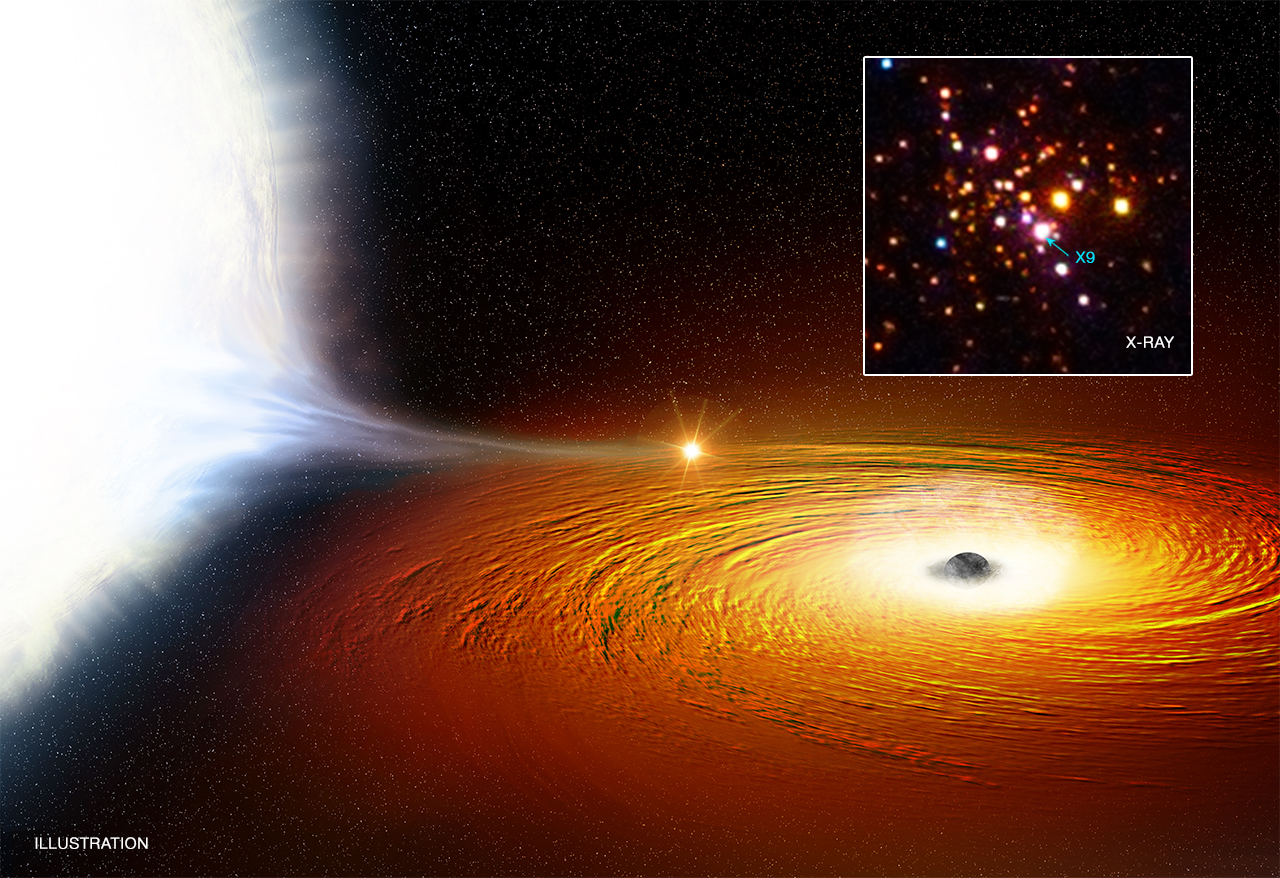
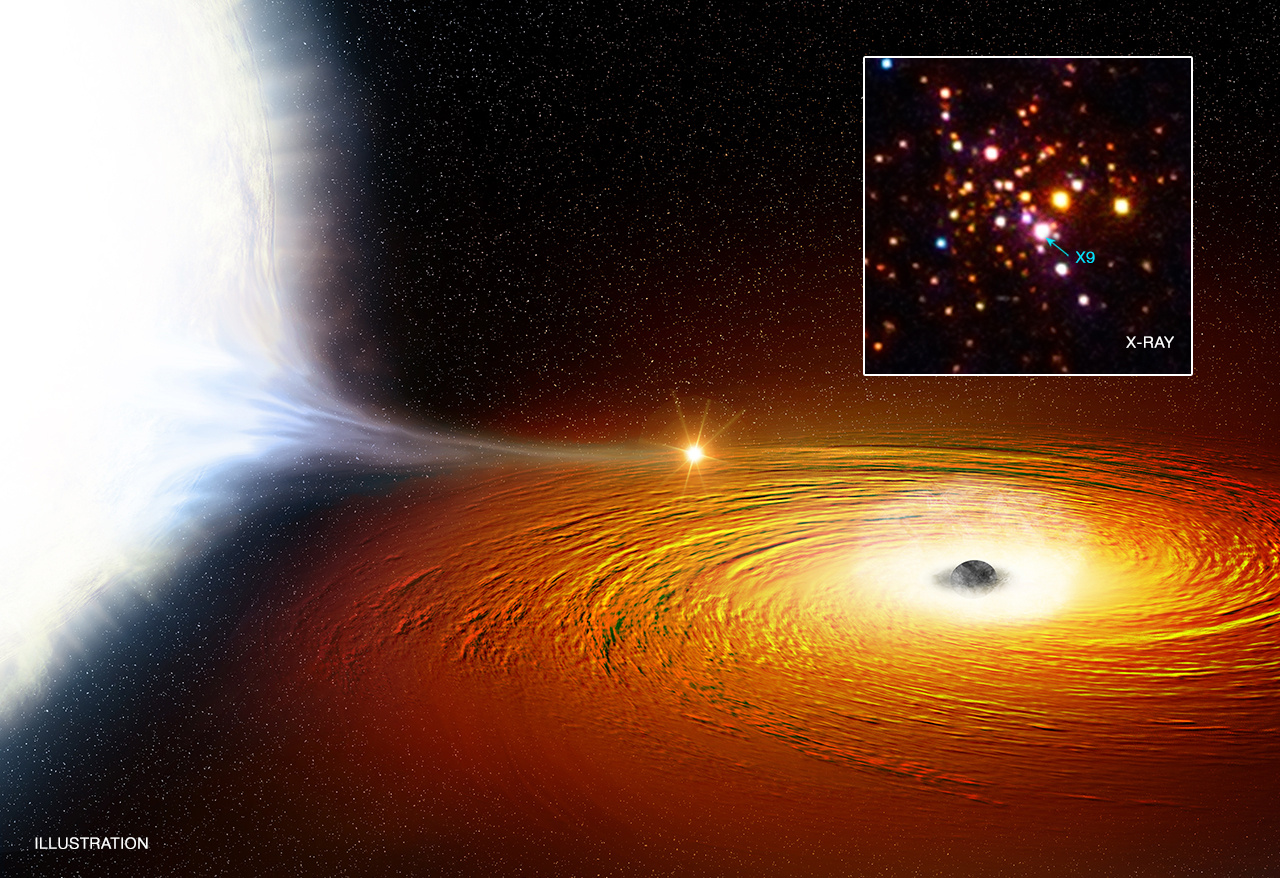
This graphic features an artist's impression of a star found in the closest orbit known around a black hole, as reported in our latest press release. This discovery was made using data from NASA's Chandra X-ray Observatory (shown in the inset where low, medium, and high-energy X-rays are colored red, green, and blue respectively), plus NASA's NuSTAR telescope and the Australia Telescope Compact Array.

Astronomers found this extraordinarily close stellar pairing in the globular cluster named 47 Tucanae, a dense collection of stars located on the outskirts of the Milky Way galaxy, about 14,800 light years from Earth.

This particular source, known as X9, has been of interest to scientists for many years. Until a couple of years ago, astronomers thought X9 contained a white dwarf pulling material from a companion star like the Sun. (Astronomers call a pair of objects orbiting one another a 'binary' system.) However, a team of scientists in 2015 used radio data to show that X9 likely consisted instead of a black hole pulling gas from a white dwarf companion. These researchers predicted that the white dwarf would take only about 25 minutes to orbit the black hole.

New Chandra data likely verify this hypothesis and reveal that the X-rays change periodically over about 28 minutes. Additionally, Chandra data show evidence for large amounts of oxygen in the system, a characteristic for the presence of a white dwarf. Therefore, a strong case can be made that that the companion star is a white dwarf, which would then be orbiting the black hole at only about 2.5 times the separation between the Earth and the Moon.

As seen in the artist's illustration, the white dwarf is so close to the black hole that much of its material is being pulled away. If it continues to lose mass, this white dwarf may evolve into some exotic sort of planet or completely evaporate.

In order to make such a close pairing, one possibility is that the black hole smashed into a red giant star, and then gas from the outer regions of the star was ejected from the binary. The remaining core of the red giant would form into a white dwarf, which becomes a binary companion to the black hole. The orbit of the binary would then have shrunk as gravitational waves were emitted, until the black hole started pulling material from the white dwarf. The gravitational waves currently being produced by X9 have a frequency that is too low to be detected with Laser Interferometer Gravitational-Wave Observatory (LIGO). It could potentially be detected with future gravitational wave observatories in space.

An alternative explanation for the observations is that the binary contains a neutron star, rather than a black hole, that is spinning faster as it pulls material from a white dwarf companion via a disk. This process can lead to the neutron star spinning around its axis thousands of times every second. A few such objects, called transitional millisecond pulsars, have been observed near the end of this spinning up phase. The authors do not favor this possibility as transitional millisecond pulsars have properties not seen in X9, such as extreme variability at X-ray and radio wavelengths. However, they cannot disprove this explanation.

In addition to Chandra, NASA's NuSTAR telescope, which observes higher-energy X-rays, and the radio telescope Australia Telescope Compact Array were used to make this discovery.

A paper describing these results was recently accepted for publication in the Monthly Notices of the Royal Astronomical Society and is available online. The authors on the paper are Arash Bahramian (University of Alberta), Craig Heinke (Alberta), Vlad Tudor (Curtin University and ICRAR), James Miller-Jones (ICRAR), Slavko Bogdanov (Columbia University), Thomas Maccarone (Texas Tech University), Christian Knigge (University of Southampton), Gregory Sivakoff (Alberta), Laura Chomiuk (Michigan State University), Jay Strader (Michigan State), Javier Garcia (Harvard-Smithsonian Center for Astrophysics), and Timothy Kallman (Goddard Space Flight Center).

NASA's Marshall Space Flight Center in Huntsville, Alabama, manages the Chandra program for NASA's Science Mission Directorate in Washington. The Smithsonian Astrophysical Observatory in Cambridge, Massachusetts, controls Chandra's science and flight operations.

A Quick Look at X9 in 47 Tucanae 


Fast Facts for 47 Tucanae:

Scale: Inset image is 1.5 arcmin across (about 6.5 light years)
Category: Neutron Stars/X-ray Binaries
Coordinates (J2000): RA 00h 24m 05s | Dec -72° 04´ 53"
Constellation: Tucana
Observation Date: 27 pointings between March 16, 2000 and January 8, 2006
Observation Time: 359 hours  
Obs. ID: 953, 955, 2735-2738, 16527, 15747, 16529, 17420, 15748, 16528, 5542-5546, 6230-6233, 6235-6240
Instrument: ACIS
References: Bahramian, A. et al. 2017, MNRAS [in press]; arXiv:1702.02167
Color Code: X-ray (Red, Green, Blue)
Distance Estimate: About 14,800 light years


Wednesday, November 23, 2016

Cyg X-3's Little Friend: A Stellar Circle of Life

Cygnus X-3
Credit: X-ray: NASA/CXC/SAO/M.McCollough et al, Radio: ASIAA/SAO/SMA  


A snapshot of the life cycle of stars has been captured where a stellar nursery is reflecting X-rays from a source powered by an object at the endpoint of its evolution. This discovery, described in our latest press release, provides a new way to study how stars form.

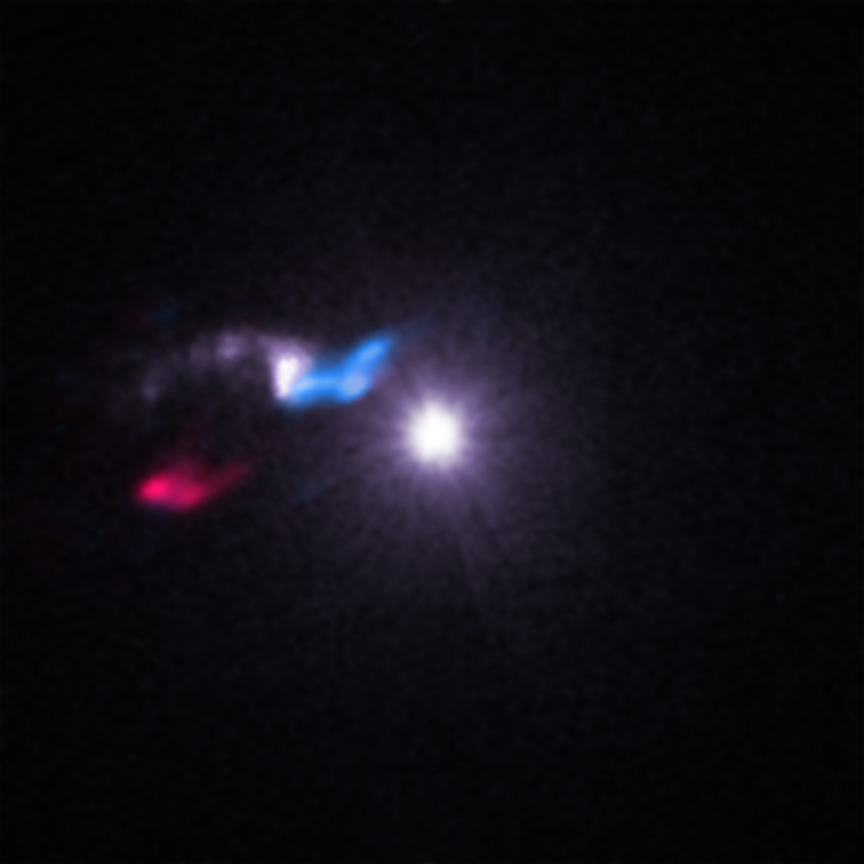
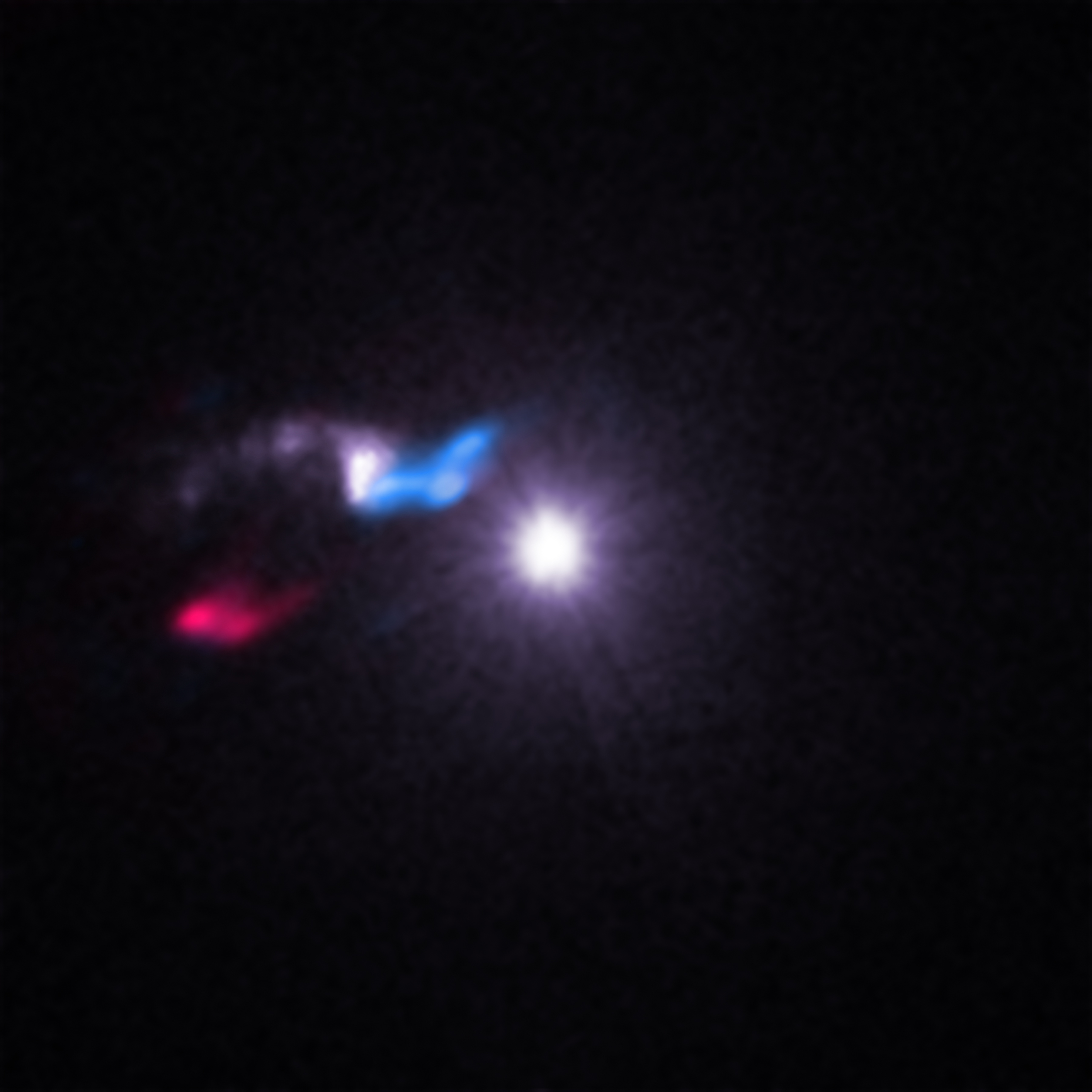
This composite image shows X-rays from NASA's Chandra X-ray Observatory (white) and radio data from the Smithsonian's Submillimeter Array (red and blue). The X-ray data reveal a bright X-ray source to the right known as Cygnus X-3, a system containing either a black hole or neutron star (a.k.a. a compact source) left behind after the death of a massive star. Within that bright source, the compact object is pulling material away from a massive companion star. Astronomers call such systems "X-ray binaries."

In 2003, astronomers presented results using Chandra's high-resolution vision in X-rays to identify a mysterious source of X-ray emission located very close to Cygnus X-3 on the sky (smaller white object to the upper left). The separation of these two sources is equivalent to the width of a penny about 800 feet away. A decade later, astronomers reported the new source is a cloud of gas and dust. 

In astronomical terms, this cloud is rather small - about 0.7 light years in diameter or under the distance between the Sun and Pluto's orbit.

Astronomers realized that this nearby cloud was acting as a mirror, reflecting some of the X-rays generated by Cygnus X-3 towards Earth. They nicknamed this object the "Little Friend" due to its close proximity to Cygnus X-3 on the sky and because it also demonstrated the same 4.8-hour variability in X-rays seen in the X-ray binary.

To determine the nature of the Little Friend, more information was needed. The researchers used the Submillimeter Array (SMA), a series of eight radio dishes atop Mauna Kea in Hawaii, to discover the presence of molecules of carbon monoxide. This is an important clue that helped confirm previous suggestions that the Little Friend is a Bok globule, small, dense, very cold clouds where stars can form. The SMA data also reveal the presence of a jet or outflow within the Little Friend, an indication that a star has started to form inside. The blue portion shows a jet moving towards us and the red portion shows a jet moving away from us.

These results were published in The Astrophysical Journal Letters, and the paper is also available online. NASA's Marshall Space Flight Center in Huntsville, Alabama, manages the Chandra program for NASA's Science Mission Directorate in Washington. The Smithsonian Astrophysical Observatory in Cambridge, Massachusetts, controls Chandra's science and flight operations.


Fast Facts for Cyg X-3's Little Friend:

Scale: Image is 1.4 arcmin across (about 8.15 light years)
Category: Normal Stars & Star Clusters, Neutron Stars/X-ray Binaries
Coordinates (J2000): RA 20h 32m 25.50s | Dec +40° 57' 27.70"
Constellation: Cygnus
Observation Date: 26 Jan 2006
Observation Time: 13 hours 46 min
Obs. ID: 6601
Instrument: ACIS
References: McCollough, M. et al, 2016, ApJL, 830, L36; arXiv:1610.01923
Color Code: X-ray (Purple); Radio (Blue, Red)
Distance Estimate: About 20,000 light years


Thursday, April 28, 2016

Powerful winds spotted from mysterious X-ray binaries

Credit: ESA–C. Carreau

Credit: NASA, ESA & A. Pellerin (STScI)

Credit: ESA/Hubble & NASA. Acknowledgement: J. Schmidt (Geckzilla)


At X-ray wavelengths, the celestial sky is dominated by two types of astronomical objects: supermassive black holes, sitting at the centres of large galaxies and ferociously devouring the material around them, and binary systems, consisting of a stellar remnant – a white dwarf, neutron star or black hole – feeding on gas from a companion star.

In both cases, the gas forms a swirling disc around the compact and very dense central object: friction in the disc causes the gas to heat up and emit light at many wavelengths, with a peak in X-rays.

Not all of the gas is swallowed by the central object though, and some of it might even be pushed away by powerful winds and jets.

But an intermediate class of objects was discovered in the 1980s and is still not well understood. Ten to a hundred times brighter than ordinary X-ray binaries, these sources are nevertheless too faint to be linked to accreting supermassive black holes, and in any case, are usually found far from the centre of their host galaxy.

"We think these 'ultra-luminous X-ray sources' are somewhat special binary systems, sucking up gas at a much higher rate than an ordinary X-ray binary," explains Ciro Pinto from the Institute of Astronomy in Cambridge, UK.

"Some host highly magnetised neutron stars, while others might conceal the long-sought-after intermediate-mass black holes, which have masses around 1000 times the mass of the Sun. But in the majority of cases, the reason for their extreme behaviour is still unclear."

Ciro is the lead author of a new study, based on observations from ESA's XMM-Newton, revealing for the first time strong winds gusting at very high speed from two of these exotic objects. The discovery, published in this week's issue of the journal Nature, confirms that these sources conceal a compact object accreting matter at extraordinarily high rates.


Ciro and his colleagues delved into the XMM-Newton archives and collected several days' worth of observations of three ultra-luminous X-ray sources, all hosted in nearby galaxies located less than 22 million light-years from our Milky Way.

The data were obtained over several years with the Reflection Grating Spectrometer, a highly sensitive instrument that allowed them to spot very subtle features in the spectrum of the X-rays from the sources.

In all three sources, the scientists were able to identify X-ray emission from gas in the outer portions of the disc surrounding the central compact object, slowly flowing towards it.

But two of the three sources – known as NGC 1313 X-1 and NGC 5408 X-1 – also show clear signs of X-rays being absorbed by gas that is streaming away from the central source at an extremely rapid 70 000 km/s – almost a quarter of the speed of light.

"This is the first time we've seen winds streaming away from ultra-luminous X-ray sources," says Ciro.

And there's more, since the very high speed of these outflows is telling us something about the nature of the compact objects in these sources, which are frantically devouring matter."

While the hot gas is pulled inwards by the central object's gravity, it also shines brightly, and the pressure exerted by the radiation pushes it outwards. This is a balancing act: the greater the mass, the faster it draws the surrounding gas. But this also causes the gas to heat up faster, emitting more light and increasing the pressure that blows the gas away.

There is a theoretical limit to how much matter can be accreted by an object of a given mass, called the 'Eddington luminosity'. It was first calculated for stars by astronomer Arthur Eddington, but it can also be applied to compact objects like black holes and neutron stars.
Eddington's calculation refers to an ideal case in which both the matter being accreted onto the central object and the radiation being emitted by it do so equally in all directions.

But the sources studied by Ciro and his collaborators are being fed through an accretion disc that is likely being puffed up by internal pressure of the gas flowing at a fast pace towards the central object.

In such a configuration, the material in the disc can shine 10 times or more above the Eddington limit and, as part of the gas eludes the gravitational grasp from the central object, very high-speed winds can arise like the ones observed by XMM-Newton.

"By observing X-ray sources that are radiating beyond the Eddington limit, it is possible to study their accretion process in great detail, investigating by how much the limit can be exceeded and what exactly triggers the outflow of such powerful winds," says Norbert Schartel, ESA XMM-Newton Project Scientist.

The nature of the compact objects hosted at the core of the sources observed in this study is, however, still uncertain, although the scientists suspect it might be stellar-mass black holes, with masses of several to a few dozen times that of the Sun.

To investigate further, the team is still scrutinising the data archive of XMM-Newton, searching for more sources of this type, and are also planning future observations, in X-rays as well as at optical and radio wavelengths.

"With a broader sample of sources and multi-wavelength observations, we hope to finally uncover the physical nature of these powerful, peculiar objects," concludes Ciro.


Notes for Editors

"Resolved atomic lines reveal outflows in two ultraluminous X-ray sources, by C. Pinto et al., is published in the journal Nature, doi: 10.1038/nature17417.


For further information, please contact:

Ciro Pinto
Institute of Astronomy, University of Cambridge United Kingdom 
Tel: +44 1223 339281 
Email: cpinto@ast.cam.ac.uk

Norbert Schartel
ESA XMM-Newton Project Scientist
Email: Norbert.Schartel@esa.int

Markus Bauer
ESA Science Communication Officer
Tel: +31 71 565 6799
Mob: +31 61 594 3 954
Email: markus.bauer@esa.int


Wednesday, January 06, 2016

Andromeda Galaxy Scanned with High-Energy X-ray Vision

NASA's Nuclear Spectroscope Telescope Array, or NuSTAR, has imaged a swath of the Andromeda galaxy -- the nearest large galaxy to our own Milky Way galaxy. Image credit: NASA/JPL-Caltech/GSFC.   › Full image and caption | Annotated Version | Inset


NASA's Nuclear Spectroscopic Telescope Array, or NuSTAR, has captured the best high-energy X-ray view yet of a portion of our nearest large, neighboring galaxy, Andromeda. The space mission has observed 40 "X-ray binaries" -- intense sources of X-rays comprised of a black hole or neutron star that feeds off a stellar companion.

The results will ultimately help researchers better understand the role of X-ray binaries in the evolution of our universe. According to astronomers, these energetic objects may play a critical role in heating the intergalactic bath of gas in which the very first galaxies formed.

"Andromeda is the only large spiral galaxy where we can see individual X-ray binaries and study them in detail in an environment like our own," said Daniel Wik of NASA Goddard Space Flight Center in Greenbelt, Maryland, who presented the results at the 227th meeting of American Astronomical Society in Kissimmee, Florida.¬¬¬¬ "We can then use this information to deduce what's going on in more distant galaxies, which are harder to see."

Andromeda, also known as M31, can be thought of as the big sister to our own Milky Way galaxy. Both galaxies are spiral in shape, but Andromeda is slightly larger than the Milky Way in size. Lying 2.5 million light-years away, Andromeda is relatively nearby in cosmic terms. It can even be seen by the naked eye in dark, clear skies.
Other space missions, such as NASA's Chandra X-ray Observatory, have obtained crisper images of Andromeda at lower X-ray energies than the high-energy X-rays detected by NuSTAR. The combination of Chandra and NuSTAR provides astronomers with a powerful tool for narrowing in on the nature of the X-ray binaries in spiral galaxies.

In X-ray binaries, one member is always a dead star or remnant formed from the explosion of what was once a star much more massive than the sun. Depending on the mass and other properties of the original giant star, the explosion may produce either a black hole or neutron star. Under the right circumstances, material from the companion star can "spill over" its outermost edges and then be caught by the gravity of the black hole or neutron star. As the material falls in, it is heated to blazingly high temperatures, releasing a huge amount of X-rays.

With NuSTAR's new view of a swath of Andromeda, Wik and colleagues are working on identifying the fraction of X-ray binaries harboring black holes versus neutron stars. That research will help them understand the population as a whole. 

"We have come to realize in the past few years that it is likely the lower-mass remnants of normal stellar evolution, the black holes and neutron stars, may play a crucial role in heating of the intergalactic gas at very early times in the universe, around the cosmic dawn," said Ann Hornschemeier of NASA Goddard, the principal investigator of the NuSTAR Andromeda studies.
"Observations of local populations of stellar-mass-sized black holes and neutron stars with NuSTAR allow us to figure out just how much power is coming out from these systems." 

The new research also reveals how Andromeda may differ from our Milky Way. Fiona Harrison, the principal investigator of the NuSTAR mission, added, "Studying the extreme stellar populations in Andromeda tells us about how its history of forming stars may be different than in our neighborhood."

Harrison will be presenting the 2015 Rossi Prize lecture at the AAS meeting. The prize, awarded by the AAS's High-Energy Astrophysics Division, honors physicist Bruno Rossi, an authority on cosmic-ray physics and a pioneer in the field of X-ray astronomy.

For more information about NuSTAR, visit:  http://www.nustar.caltech.edu/


Media Contact

Whitney Clavin
Jet Propulsion Laboratory, Pasadena, California
818-354-4673
whitney.clavin@jpl.nasa.gov

 Source: JPL-Caltech

Thursday, June 05, 2014

M51: Chandra Captures Galaxy Sparkling in X-rays

M51
Credit X-ray: NASA/CXC/Wesleyan Univ./R.Kilgard, et al; 
Optical: NASA/STScI
 

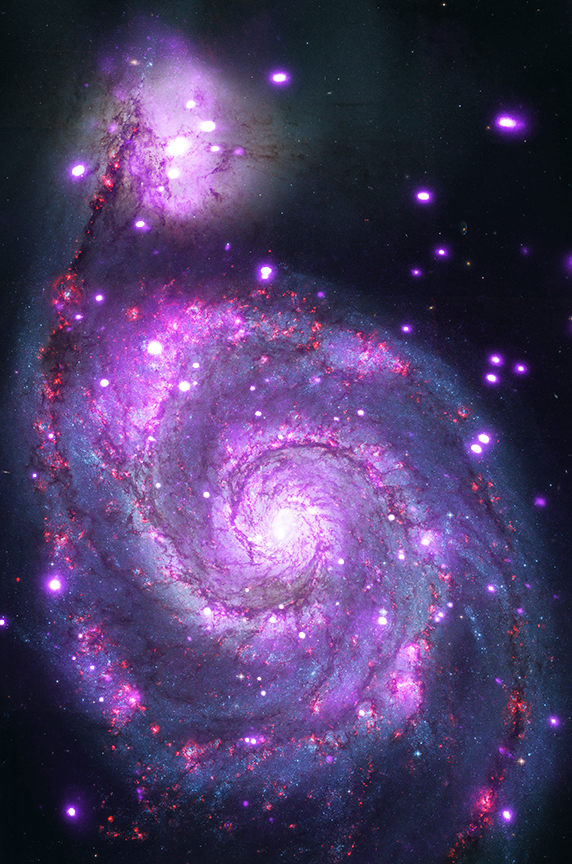
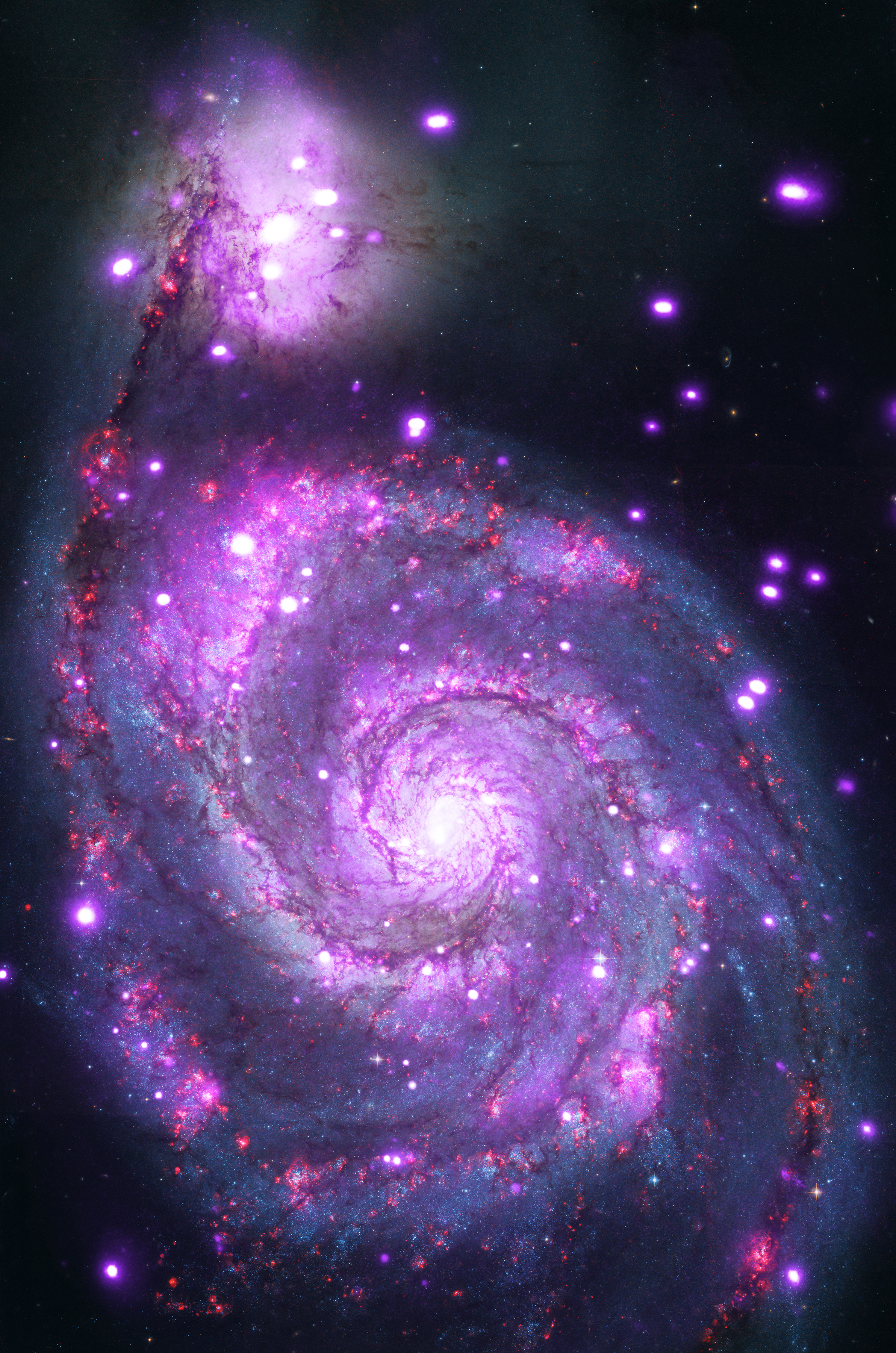
Nearly a million seconds of observing time with NASA's Chandra X-ray Observatory has revealed a spiral galaxy similar to the Milky Way glittering with hundreds of X-ray points of light.

The galaxy is officially named Messier 51 (M51) or NGC 5194, but often goes by its nickname of the "Whirlpool Galaxy." Like the Milky Way, the Whirlpool is a spiral galaxy with spectacular arms of stars and dust. M51 is located about 30 million light years from Earth, and its face-on orientation to Earth gives us a perspective that we can never get of our own spiral galactic home.

By using Chandra, astronomers can peer into the Whirlpool to uncover things that can only be detected in X-rays. In this new composite image, Chandra data are shown in purple. Optical data from the Hubble Space Telescope are red, green, and blue.

Most of the X-ray sources are X-ray binaries (XRBs). These systems consist of pairs of objects where a compact star, either a neutron star or, more rarely, a black hole, is capturing material from an orbiting companion star. The infalling material is accelerated by the intense gravitational field of the compact star and heated to millions of degrees, producing a luminous X-ray source. The Chandra observations reveal that at least ten of the XRBs in M51 are bright enough to contain black holes. In eight of these systems the black holes are likely capturing material from companion stars that are much more massive than the Sun.

Because astronomers have been observing M51 for about a decade with Chandra, they have critical information about how X-ray sources containing black holes behave over time. The black holes with massive stellar companions are consistently bright over the ten years of Chandra observations. These results suggest that the high-mass stars in these X-ray sources also have strong winds that allow for a steady stream of material to flow onto the black hole.

A difference between the Milky Way and the Whirlpool galaxy is that M51 is in the midst of merging with a smaller companion galaxy seen in the upper left of the image. Scientists think this galactic interaction is triggering waves of star formation. The most massive of the newly formed stars will race through their evolution in a few million years and collapse to form neutron stars or black holes. Most of the XRBs containing black holes in M51 are located close to regions where stars are forming, showing their connection to the oncoming galactic collision.

Previous studies of the Whirlpool Galaxy with Chandra revealed just over 100 X-ray sources. The new dataset, equivalent to about 900,000 seconds of Chandra observing time, reveals nearly 500 X-ray sources. About 400 of these sources are thought to be within M51, with the remaining either being in front of or behind the galaxy itself.

Much of the diffuse, or fuzzy, X-ray emission in M51 comes from gas that has been superheated by supernova explosions of massive stars.

The new Chandra observations were presented at the 224th meeting of the American Astronomical Society in Boston, Mass. by Roy Kilgard of Wesleyan University in Middletown, Conn. NASA's Marshall Space Flight Center in Huntsville, Ala., manages the Chandra program for NASA's Science Mission Directorate in Washington. The Smithsonian Astrophysical Observatory in Cambridge, Mass., controls Chandra's science and flight operations.


Fast Facts for Whirlpool Galaxy: 
 
Scale: Image is about 6 x 10 arcmin (About 52,000 x 87,000 light years) 
Category: Normal Galaxies & Starburst Galaxies
Coordinates (J2000): RA 13h 29m 55.7s | Dec +47° 13' 53" 
Constellation: Canes Venatici
Observation Date: 11 pointings between Mar 2000 and Oct 2012 
Observation Time: 232 hours 10 min (9 days 16 hours 10 min). 
Obs. ID: 353,354,1622,3932,13812-13816,15496,15553 
Instrument: ACIS
Also Known As: NGC 5194, NGC 5195 
References: Kilgard, R. et al, AAS 224, 1-5 June 2014 
Color Code: X-ray (Purple); Optical (Red, Green, Blue) 
Distance Estimate: About 30 million light years