Showing posts with label Saturn. Show all posts

Saturday, March 28, 2026

NASA Webb, Hubble Share Most Comprehensive View of Saturn to Date

Saturn (Webb NIRCam and Hubble WFC3/UVIS)
Complementary views of Saturn from NASA’s James Webb Space Telescope and Hubble Space Telescope show a dynamic planet with atmospheric features, orbiting moons, and bright rings. Credit Image: NASA, ESA, CSA, STScI, Amy Simon (NASA-GSFC), Michael Wong (UC Berkeley); Image Processing: Joseph DePasquale (STScI)

Captured Nov. 29, 2024 by NASA’s James Webb Space Telescope, this infrared view of Saturn shows its glowing icy rings and layered atmosphere. Several moons are visible, including Janus, Dione, and Enceladus. Credit Image: NASA, ESA, CSA, STScI, Amy Simon (NASA-GSFC), Michael Wong (UC Berkeley); Image Processing: Joseph DePasquale (STScI)

Captured Aug. 22, 2024 by NASA’s Hubble Space Telescope, this visible-light view of Saturn reveals the planet’s softly banded atmosphere and iconic rings. Several moons are also visible, labeled Janus, Mimas, and Epimetheus. Credit Image: NASA, ESA, CSA, STScI; Image Processing: Joseph DePasquale (STScI)

A wider view of Saturn from NASA’s James Webb Space Telescope shows six of Saturn’s larger moons, including the largest, Titan, at far left. Credit Image: NASA, ESA, STScI, Amy Simon (NASA-GSFC), Michael Wong (UC Berkeley); Image Processing: Joseph DePasquale (STScI)

These images of Saturn, captured by NASA’s James Webb and Hubble Spaces Telescopes, shows compass arrows, scale bar, and color key for reference. Credit Image: NASA, ESA, CSA, STScI; Image Processing: Joseph DePasquale (STScI)


NASA’s James Webb Space Telescope and Hubble Space Telescope have teamed up to capture new views of Saturn, revealing the planet in strikingly different ways. Observing in complementary wavelengths of light, the two space observatories provide scientists with a richer, more layered understanding of the gas giant’s atmosphere.

Both sense sunlight reflected from Saturn’s banded clouds and hazes, but where Hubble reveals subtle color variations across the planet, Webb’s infrared view senses clouds and chemicals at many different depths in the atmosphere, from the deep clouds to the tenuous upper atmosphere.

Together, scientists can effectively ‘slice’ through Saturn’s atmosphere at multiple altitudes, like peeling back the layers of an onion. Each telescope tells a different part of Saturn’s story, and the observations together help researchers understand how Saturn’s atmosphere works as a connected three-dimensional system. Both complement previous observations done by NASA’s Cassini orbiter during its time studying the Saturnian system from 1997 to 2017.

The Hubble image seen here was captured as part of a more than a decade long monitoring program called OPAL (Outer Planet Atmospheres Legacy) in August 2024, while the Webb image was captured a few months later using Director’s Discretionary Time.

The newly released images highlight features from Saturn’s busy atmosphere.

In the Webb image, a long-lived jet stream known as the “ribbon wave” meanders across the northern mid-latitudes, influenced by otherwise undetectable atmospheric waves. Just below that, a small spot represents a lingering remnant from the “Great Springtime Storm” of 2010 to 2012. Several other storms dotting the southern hemisphere of Saturn are visible in Webb’s image, as well.

All these features are shaped by powerful winds and waves beneath the visible cloud deck, making Saturn a natural laboratory for studying fluid dynamics under extreme conditions.

Several of the pointed edges of Saturn’s iconic hexagon-shaped jet stream at its north pole, discovered by NASA’s Voyager spacecraft in 1981, are also faintly visible in both images. It remains one of the solar system’s most intriguing weather patterns. Its persistence over decades highlights the stability of certain large-scale atmospheric processes on giant planets. These are likely the last high-resolution looks we’ll see of the famous hexagon until the 2040’s, as the northern pole enters winter and will shift into darkness for 15 years.

In Webb’s infrared observations, Saturn’s poles appear distinctly grey-green, indicating light emitting at wavelengths around 4.3 microns. This distinct feature could come from a layer of high-altitude aerosols in Saturn’s atmosphere that scatters light differently at those latitudes. Another possible explanation is auroral activity, as charged molecules interacting with the planet’s magnetic field can produce glowing emissions near the poles.

NASA’s Hubble and Webb have already explored Saturn’s auroras, provided insights into Jupiter’s spectacular auroras also seen with Hubble, confirmed the auroras of Uranus glimpsed in 2011 by Hubble, and detected Neptune’s auroras for the first time with Webb.

In Webb’s infrared image, the rings are extremely bright because they are made of highly reflective water ice. In both images, we’re seeing the sunlit face of the rings, a little less so in the Hubble image, hence the shadows visible underneath on the planet.

There are also subtle ring features such as spokes and structure in the B ring (the thick central region of the rings) that appear differently between the two observatories. The F ring, the outermost ring, looks thin and crisp in the Webb image, while it only slightly glows in the Hubble image..

Saturn’s orbit around the Sun, combined with the position of Earth in its annual orbit, determines our changing viewing angle of Saturn’s face and ring.

These 2024 observations, taken 14 weeks apart, show the planet moving from northern summer toward the 2025 equinox. As Saturn transitions into southern spring, and later southern summer in the 2030’s, Hubble and Webb will have progressively better views of that hemisphere.

Hubble’s observations of Saturn for decades have built a record of its evolving atmosphere. Programs like OPAL, with its annual monitoring, are allowing scientists to track storms, banding patterns, and seasonal shifts over time. Webb now adds powerful infrared capabilities to this ongoing record, extending what researchers can measure about Saturn’s atmospheric structure and dynamic processes.

The James Webb Space Telescope is the world’s premier space science observatory. Webb is solving mysteries in our solar system, looking beyond to distant worlds around other stars, and probing the mysterious structures and origins of our universe and our place in it. Webb is an international program led by NASA with its partners, ESA (European Space Agency) and CSA (Canadian Space Agency).


Details:

Last Updated: Mar 26, 2026
Location:
NASA Goddard Space Flight Center

Contact Media:

Laura Betz
NASA’s Goddard Space Flight Center
Greenbelt, Maryland

laura.e.betz@nasa.gov

Hannah Braun
Space Telescope Science Institute
Baltimore, Maryland


Christine Pulliam
Space Telescope Science Institute
Baltimore, Maryland


Monday, March 09, 2026

Listen to This Month's "Planetary Parade" with NASA's Chandra


  • Three new Chandra sonifications of data of Jupiter, Saturn, and Uranus have been released.

  • Planets and other Solar System bodies can reflect X-rays given off by the Sun, which Chandra can detect.

  • Sonification is a process that translates data captured by Chandra and other telescopes into sound.

  • In addition to X-rays from Chandra, these new sonifications contain data from Hubble, Cassini, and Keck telescopes.


In late February, people in the Northern Hemisphere can look up for a special sight: Six planets will all be visible from clear and dark night skies. New sonifications from NASA’s Chandra X-ray Observatory released Wednesday will help commemorate this latest “planetary parade.”

Because the planets in our solar system travel around the Sun in the same plane (known as the ecliptic), they will sometimes appear bunched together in the sky when their orbits find them on the same side of the Sun at the same time. When this happens, it looks like the planets have roughly formed a line from our vantage point on Earth.

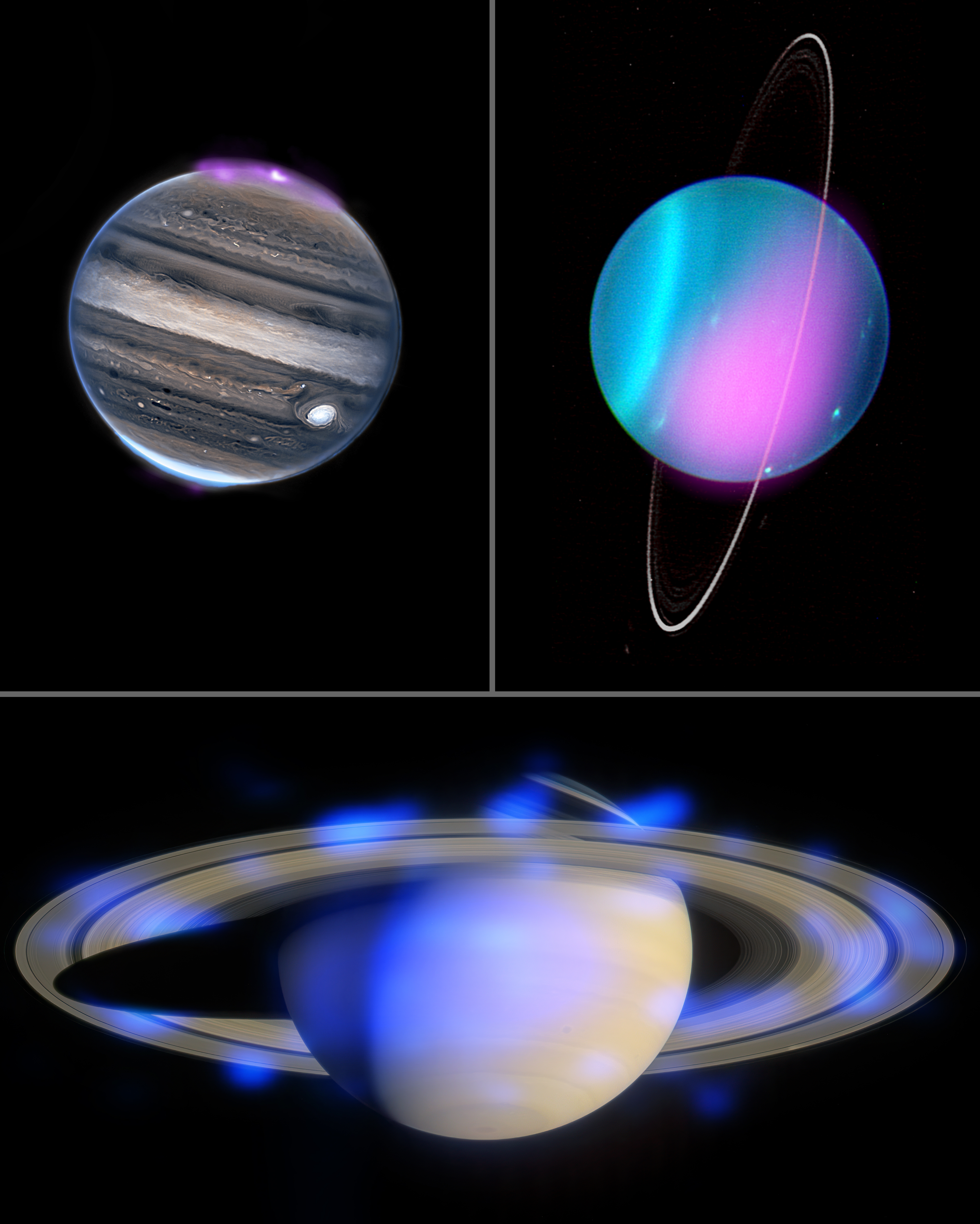
In Chandra’s sonifications, which translate astronomical data into sound, three of the planets that will be on display — Jupiter, Saturn, and Uranus — can be seen and heard in ways that they cannot from Earth.

While Chandra is best known for its X-ray insight into black holes and other extreme objects, the telescope has also played an important role in the exploration of our solar system. The Sun gives off X-rays that travel out into the solar system and can be reflected by planets, moons, and other bodies. This gives astronomers a unique window into certain physics that cannot be discovered through other kinds of telescopes.

The sonification of Jupiter combines X-ray data from Chandra with an infrared image from NASA’s Hubble Space Telescope. Woodwind sounds reveal Chandra’s X-ray data, including emission from the planet’s auroras. More instruments join in to represent the planet’s complex cloud layers. Next, through the combination of an optical image from NASA’s Cassini mission and X-rays from Chandra, listeners can experience Saturn like never before. A siren-like sound follows the arc of the rings, and different tones of synthesizers play as the scan passes the planet itself. Finally, listeners can hear the ice giant Uranus through the data collected by Chandra and the W.M. Keck Observatory. The data in this sonification reflects the amount of light detected from the planet and the orientation of its ring.

The process of creating a sonification preserves the integrity of the data, which arrives on Earth as a series of ones and zeroes (binary code), and shifts it into a form that can be processed through hearing. Sonifications expand options for people to explore what telescopes discover in space, an example of NASA’s ongoing commitment to share its data as widely as possible.


Jupiter:

In this image, the amount of diffuse X-rays from a donut-shaped ring of energetic particles around Jupiter, seen on the left and right side of the planet, has been enhanced compared to the amount of X-rays from the planet's auroras, seen at the poles. As the scan moves left to right, it encounters X-rays that bracket the planet on either side, and this plays as woodwind sounds. As we pass over the planet itself, seen in an infrared image from NASA’s Hubble Space Telescope, the sounds become fuller as the infrared data is represented by other instruments. Since Jupiter is tilted slightly, the pitch descends as the scan passes over the bright band near the equator and through the Great Red Spot. On the other side, more X-ray data from Chandra flanks the planet and can be heard as gusty wind sounds at the end.


Saturn:

The scan of Saturn begins on the right and moves to the left. As it encounters Saturn’s famous rings, seen in an optical image from the Cassini mission, listeners hear a siren effect whose frequency follows the arc of the rings. Once the scan reaches the planet itself, the sounds change, to lower tones with a dark synthetic bass sound. This distinguishes the rings from the planet. Chandra’s X-rays are heard as higher synthetic tones that mark where high-energy activity is found across the planet, rings, and poles.


Uranus:

Returning to the left to right scan, the sounds begin with a cello that traces the arcing ring — not as famous as Saturn’s but still prominent — around the ice giant Uranus. The notes change to represent the amount of reflected light and its location on Uranus as seen in an optical light image from the W.M. Keck Observatory. The X-rays detected by Chandra, which come from X-rays from the Sun that are reflected, are heard as higher frequencies as the scan passes over the pinkish region of the planet. The apparent asymmetry in the X-rays may not be a real effect because of the faint signal and the smoothing that was applied to the image.

NASA's Marshall Space Flight Center in Huntsville, Alabama, manages the Chandra program. The Smithsonian Astrophysical Observatory's Chandra X-ray Center controls science operations from Cambridge, Massachusetts, and flight operations from Burlington, Massachusetts

For more on the Chandra sonification program, visit: https://chandra.si.edu/sound/


Visual Description:

This release features three sonifications, each focusing on a different planet in our solar system. The sonifications are presented as soundtracks to short videos. Each video features a composite image and an activation line. As the activation line sweeps across the image, it encounters visual elements. These elements are translated into sound, or sonified, according to parameters established by Chandra's sonification team.

The first sonification focuses on the planet Jupiter. At the center of the associated composite image is the gas giant itself; a seemingly perfect sphere with an atmosphere of latitudinal bands. The bands are different shades of grey, brown, and black, each with its own texture and width. Flanking Jupiter are neon pink and white clouds, representing X-rays from energetic particles in a ring around the planet. In the video, the activation line moves from our left to right. It first encounters a pink cloud, triggering whooshing woodwinds. When the activation line encounters Jupiter, dramatic low notes are triggered. Listen for the dip as the line passes over the Great Red Spot in Jupiter's southern hemisphere. The activation line continues toward our right, passing more pink X-ray clouds. The largest cloud, the last one encountered, has a bright white core, which translates to loud gusty woodwinds.

The second sonification focuses on the ringed planet, Saturn. In the composite image, the large gas giant fills the frame, its spherical outer layer a pale sandy grey. In this image, the wide bands of rings surrounding the planet are in shades of pale grey and sandy yellow. Here, Saturn is tilted away from us, making the round rings appear oval in shape. Dotting the planet are small pockets of neon blue. These represent reflected X-ray light observed by Chandra. In this video, the activation line moves from our right to left. When the line passes over the rings, a whooshing sounds spreads, conveying the widening middle of the oval shapes. Pockets of neon blue X-ray light trigger synthesizer sounds, with the pitch mapped to each pocket's vertical position in the image. When the line sweeps across Saturn's large round body, a low rumbling synth tone is triggered. The volume is linked to brightness, such that the low tone fades when the line reaches the shady side of the planet, on our left.
The third sonification features the planet Uranus. In the composite image, the icy giant is a greenish-blue cyan color, with a blush of neon pink X-rays hovering over its core. Uranus has a collection of very narrow rings, much finer than the wide disk-like rings surrounding Saturn. In this image, the fine rings are near vertical and slightly tilted, creating an oval shape with rounded points at our lower left and upper right. In this sonification, the activation line moves from our left to right. Brightness is mapped to volume and height is mapped to pitch, such that brighter objects at the top of the image sound louder and higher. Here, the curved oval shape of the rings is conveyed as a swooping cello note, with the pitch sliding up as the activation line passes the oval tilted toward our upper right.


Fast Facts for: Jupiter:

Credit: X-ray: NASA/CXC/SAO; Infrared: NASA/ESA/CSA/STScI; Image Processing: NASA/CXC/SAO/J. Major, S. Wolk; Sonification: NASA/CXC/SAO/K.Arcand, SYSTEM Sounds (M. Russo, A. Santaguida)
Release Date: February 25, 2026
Scale: Image is about 37 arcseconds across (Jupiter's diameter is 86,900 miles) as viewed from Earth.
Category: Solar System
Observation Date(s): Dec 18, 2000
Observation Time: 9 hours 57 minutes
Obs. IDs: 18929, 20108-20110
Instrument: ACIS
References: Elsner, R.F., et al, 2002, ApJ, 572, 1077; DOI 10.1086/340434
Color Code: X-ray: purple; Infrared: red, green, and blue
Distance Estimate: About 383 million miles from Earth (at the start of Chandra observations)


Fast Facts for: Saturn:

Credit: X-ray: NASA/MSFC/CXC/A.Bhardwaj et al.; Optical: NASA/JPL-Caltech/SSI; Sonification: NASA/CXC/SAO/K.Arcand, SYSTEM Sounds (M. Russo, A. Santaguida)
Release Date: February 25, 2026
Scale: At the time of this observation, the angular diameter of the disk of Saturn was 20.5 arcsec.
Category: Solar System
Observation Date(s): April 14, 2003; January 20, 2004; January 26, 2004
Observation Time: 30 hours (1 day 6 hours)
Obs. IDs: 3725, 4466, 4467
Instrument: ACIS
References: A. Bhardwaj et al. The Astrophysical Journal, 627:L73, 2005 July 1 also astro-ph
Color Code: X-ray (Energy): blue; Optical: red, green, and blue
Distance Estimate: An average distance of 886 million miles (1.4 billion kilometers) from Earth.


Fast Facts for Uranus:

Credit: X-ray: NASA/CXO/University College London/W. Dunn et al; Optical: W.M. Keck Observatory; Sonification; NASA/CXC/SAO/K.Arcand, SYSTEM Sounds (M. Russo, A. Santaguida), Cello by Johnny Mok
Release Date: February 25, 2026
Scale: At the time of this observation, the angular diameter of the disk of Saturn was 20.5 arcsec.
Category: Solar System
Observation Date(s): August 7, 2002
Observation Time: 8 hours 13 minutes
Obs. IDs: 2518
Instrument: ACIS
References: Dunn, W. et al. 2021, JGR (accepted)
Color Code: X-ray (Energy): blue; Optical: red, green, and blue
Distance Estimate: An average distance of 1.8 billion miles (2.9 billion kilometers) from Earth.


Wednesday, December 11, 2024

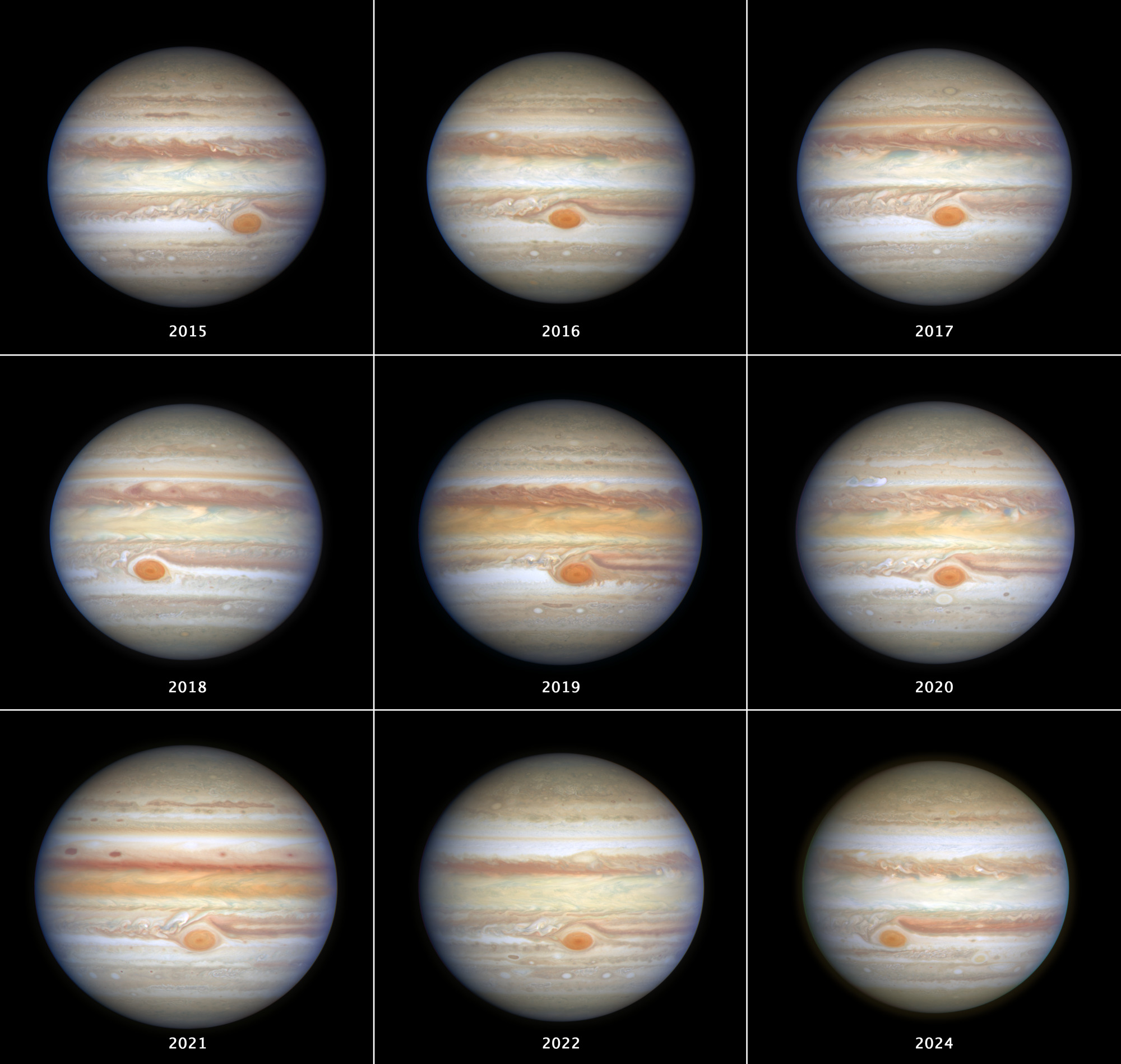
NASA's Hubble Celebrates Decade of Tracking Outer Planets

Hubble's Decade-Long Views of the Outer Solar System Planets
Credits/Science: NASA, ESA, Amy Simon (NASA-GSFC), Michael H. Wong (UC Berkeley)
Image Processing: Joseph DePasquale (STScI)

OPAL Jupiter Observations
Credits/Science: NASA, ESA, Amy Simon (NASA-GSFC), Michael H. Wong (UC Berkeley)
Image Processing: Joseph DePasquale (STScI)

Multiwavelength OPAL Jupiter
Credits/Science: NASA, ESA, Amy Simon (NASA-GSFC), Michael H. Wong (UC Berkeley)
Image Processing: Joseph DePasquale (STScI)

Multiwavelength OPAL Saturn
Credits/Science: NASA, ESA, Amy Simon (NASA-GSFC), Michael H. Wong (UC Berkeley)
Image Processing: Joseph DePasquale (STScI)

Videos

Credits/Science: NASA, ESA, Amy Simon (NASA-GSFC), Michael H. Wong (UC Berkeley)
Video: Joseph DePasquale (STScI)

OPAL Saturn Observations - August 2024
Credits/Science: NASA, ESA, Amy Simon (NASA-GSFC), Michael H. Wong (UC Berkeley)
Video: Joseph DePasquale (STScI)


Encountering Neptune in 1989, NASA's Voyager mission completed humankind's first close-up exploration of the four giant outer planets of our solar system. Collectively, since their launch in 1977, the twin Voyager 1 and Voyager 2 spacecraft discovered that Jupiter, Saturn, Uranus, and Neptune were far more complex than scientists had imagined. There was a lot more to be learned.

A NASA's Hubble Space Telescope observation program called OPAL (Outer Planet Atmospheres Legacy) obtains long-term baseline observations of Jupiter, Saturn, Uranus, and Neptune in order to understand their atmospheric dynamics and evolution.

"The Voyagers don't tell you the full story," said Amy Simon of NASA's Goddard Space Flight Center in Greenbelt, Maryland, who conducted giant planet observations with OPAL.

Hubble's image sharpness is comparable to the Voyager views as they approached the outer planets, and Hubble spans wavelengths from ultraviolet to near-infrared light. Hubble is the only telescope that can provide high spatial resolution and image stability for global studies of cloud coloration, activity, and atmospheric motion on a consistent time basis to help constrain the underlying mechanics of weather and climate systems.

All four of the outer planets have deep atmospheres and no solid surfaces. Their churning atmospheres have their own unique weather systems, some with colorful bands of multicolored clouds, and with mysterious, large storms that pop up or linger for many years. Each outer planet also has seasons lasting many years. (The James Webb Space Telescope's infrared capabilities will be used to probe deep into atmospheres of the outer planets to complement the OPAL observations.)

Following the complex behavior is akin to understanding Earth's dynamic weather as followed over many years, as well as the Sun's influence on the solar system's weather. The four distant worlds also serve as proxies for understanding the weather and climate on similar planets orbiting other stars.

Planetary scientists realized that any one year of data from Hubble, while interesting in its own right, doesn't tell the full story of the outer planets. Hubble's OPAL program has routinely observed the planets once a year when they are closest to the Earth.

"Because OPAL now spans 10 years and counting, our database of planetary observations is ever growing. That longevity allows for serendipitous discoveries, but also for tracking long-term atmospheric changes as the planets orbit the Sun. The scientific value of these data is underscored by the more than 60 publications to date that include OPAL data," said Simon.

This payoff continues to be a huge archive of data that has led to a string of remarkable discoveries to share with planetary astronomers around the world. "OPAL also interfaces with other ground- and space-based planetary programs. Many papers from other observatories and space missions pull in Hubble data from OPAL for context," said Simon.

The team's decade of discovery under Hubble's OPAL program is being presented at the December meeting of the American Geophysical Union in Washington, D.C.

Some Highlights:

Jupiter

Jupiter's bands of clouds present an ever-changing kaleidoscope of shapes and colors. There is always stormy weather on Jupiter: cyclones, anticyclones, wind shear, and the largest storm in the solar system, the Great Red Spot (GRS). Jupiter is covered with largely ammonia ice-crystal clouds on top of an atmosphere that's tens of thousands of miles deep.

Hubble's sharp images track clouds and measure the winds, storms, and vortices, in addition to monitoring the size, shape and behavior of the GRS. Hubble follows as the GRS continues shrinking in size and its winds are speeding up. OPAL data recently measured how often mysterious dark ovals — visible only at ultraviolet wavelengths — appeared in the "polar hoods" of stratospheric haze. Unlike Earth, Jupiter is only inclined three degrees on its axis (Earth is 23.5 degrees). Seasonal changes might not be expected, except that Jupiter's distance from the Sun varies by about 5% over its 12-year-long orbit, and so OPAL closely monitors the atmosphere for seasonal effects. Another Hubble advantage is that ground-based observatories can't continuously view Jupiter for two Jupiter rotations, because that adds up to 20 hours. During that time, an observatory on the ground would have gone into daytime and Jupiter would no longer be visible until the next evening

Saturn

Saturn takes more than 29 years to orbit the Sun, and so OPAL has followed it for approximately one quarter of a Saturnian year (picking up in 2018, after the end of the Cassini mission). Because Saturn is tilted 26.7 degrees, it goes through more profound seasonal changes than Jupiter. Saturnian seasons last approximately seven years. This also means Hubble can view the spectacular ring system from an oblique angle of almost 30 degrees to seeing the rings tilted edge-on. Edge-on, the rings nearly vanish because they are relatively paper-thin. This will happen again in 2025.

OPAL has followed changes in colors of Saturn's atmosphere. The varying color was first detected by the Cassini orbiter, but Hubble provides a longer baseline. Hubble revealed slight changes from year-to-year in color, possibly caused by cloud height and winds. The observed changes are subtle because OPAL has covered only a fraction of a Saturnian year. Major changes happen when Saturn progresses into the next season. Saturn's mysteriously dark ring spokes , which slice across the ring plane, are transient features that rotate along with the rings. Their ghostly appearance only persists for two or three rotations around Saturn. During active periods, freshly formed spokes continuously add to the pattern. They were first seen in 1981 by Voyager 2. Cassini also saw the spokes during its 13-year-long mission, which ended in 2017. Hubble shows that the frequency of spoke apparitions is seasonally driven, first appearing in OPAL data in 2021. Long-term monitoring shows that both the number and contrast of the spokes vary with Saturn's seasons.

Uranus

Uranus is tilted on its side so that its spin axis almost lies in the plane of the planet's orbit. This results in the planet going through radical seasonal changes along it 84-year-long trek around the Sun. The consequence of the planet's tilt means part of one hemisphere is completely without sunlight, for stretches of time lasting up to 42 years. OPAL has followed the northern pole now tipping toward the Sun.

With OPAL, Hubble first imaged Uranus after the spring equinox, when the Sun was last shining directly over the planet's equator. Hubble resolved multiple storms with methane ice-crystal clouds appearing at mid-northern latitudes as summer approaches the north pole. Uranus' north pole now has a thickened photochemical haze with several little storms near the edge of the boundary. Hubble has been tracking the size of the north polar cap and it continues to get brighter year after year. As northern summer solstice approaches in 2028, the cap may grow brighter still, and will be aimed directly toward Earth, allowing good views of the rings and north pole. The ring system will then appear face-on. Understanding how Uranus changes over time will help in mission planning for NASA's proposed Uranus Orbiter and Probe.

Neptune

When Voyager 2 flew by Neptune in 1989, astronomers were mystified by a great dark spot the size of the Atlantic Ocean looming in the atmosphere. Was it long-lived like Jupiter's Great Red Spot? The question remained unanswered until Hubble was able to show in 1994 that such dark storms were transitory, cropping up and then disappearing over a duration of two to six years each. During the OPAL program, Hubble saw the end of one dark spot and the full life cycle of a second one — both of them migrating toward the equator before dissipating. The OPAL program ensures that astronomers won't miss another one.

Hubble observations uncovered a link between Neptune's shifting cloud abundance and the 11-year solar cycle . The connection between Neptune and solar activity is surprising to planetary scientists because Neptune is our solar system's farthest major planet. It receives only about 1/1000th as much sunlight as Earth receives. Yet Neptune's global cloudy weather seems to be influenced by solar activity. Do the planet's seasons also play a role?
https://hubblesite.org/contents/news-releases/2024/news-2024-010
The Hubble Space Telescope has been operating for over three decades and continues to make ground-breaking discoveries that shape our fundamental understanding of the universe. Hubble is a project of international cooperation between NASA and ESA (European Space Agency). NASA's Goddard Space Flight Center in Greenbelt, Maryland, manages the telescope and mission operations. Lockheed Martin Space, based in Denver, also supports mission operations at Goddard. The Space Telescope Science Institute in Baltimore, which is operated by the Association of Universities for Research in Astronomy, conducts Hubble science operations for NASA.


About This Release

Credits:

Media Contact:

Ray Villard
Space Telescope Science Institute, Baltimore, Maryland

Science Contact:

Amy Simon
NASA Goddard Space Flight Center, Greenbelt, Maryland

Michael H. Wong
University of California, Berkeley, California

Permissions: Content Use Policy

Contact Us: Direct inquiries to the News Team.

Related Links and Documents


Saturday, December 23, 2023

NASA's Hubble Watches 'Spoke Season' on Saturn

Saturn
Credits: Science: NASA, ESA, STScI, Amy Simon (NASA-GSFC)


This photo of Saturn was taken by NASA's Hubble Space Telescope on October 22, 2023, when the ringed planet was approximately 850 million miles from Earth. Hubble's ultra-sharp vision reveals a phenomenon called ring spokes.

Saturn's spokes are transient features that rotate along with the rings. Their ghostly appearance only persists for two or three rotations around Saturn. During active periods, freshly-formed spokes continuously add to the pattern.

In 1981, NASA's Voyager 2 first photographed the ring spokes. NASA's Cassini orbiter also saw the spokes during its 13-year-long mission that ended in 2017.

Hubble continues observing Saturn annually as the spokes come and go. This cycle has been captured by Hubble's Outer Planets Atmospheres Legacy (OPAL) program that began nearly a decade ago to annually monitor weather changes on all four gas-giant outer planets.

Hubble's crisp images show that the frequency of spoke apparitions is seasonally driven, first appearing in OPAL data in 2021 but only on the morning (left) side of the rings. Long-term monitoring show that both the number and contrast of the spokes vary with Saturn's seasons. Saturn is tilted on its axis like Earth and has seasons lasting approximately seven years.

"We are heading towards Saturn equinox, when we'd expect maximum spoke activity, with higher frequency and darker spokes appearing over the next few years," said the OPAL program lead scientist, Amy Simon of NASA's Goddard Space Flight Center in Greenbelt, Maryland.

This year, these ephemeral structures appear on both sides of the planet simultaneously as they spin around the giant world. Although they look small compared with Saturn, their length and width can stretch longer than Earth's diameter!

"The leading theory is that spokes are tied to Saturn's powerful magnetic field, with some sort of solar interaction with the magnetic field that gives you the spokes," said Simon. When it's near the equinox on Saturn, the planet and its rings are less tilted away from the Sun. In this configuration, the solar wind may more strongly batter Saturn's immense magnetic field, enhancing spoke formation.

Planetary scientists think that electrostatic forces generated from this interaction levitate dust or ice above the ring to form the spokes, though after several decades no theory perfectly predicts the spokes. Continued Hubble observations may eventually help solve the mystery.

The Hubble Space Telescope is a project of international cooperation between NASA and ESA. NASA's Goddard Space Flight Center in Greenbelt, Maryland, manages the telescope. The Space Telescope Science Institute (STScI) in Baltimore, Maryland, conducts Hubble and Webb science operations. STScI is operated for NASA by the Association of Universities for Research in Astronomy, in Washington, D.C.


About This Release

Credits:

Media Contact:

Ray Villard
Space Telescope Science Institute, Baltimore, Maryland

Science: Amy Simon (NASA-GSFC)

Permissions: Content Use Policy

Contact Us: Direct inquiries to the News Team.

Related Links and Documents


Tuesday, April 04, 2023

Hubble Finds Saturn's Rings Heating Its Atmosphere

Saturn Lyman-alpha Image
Credits: Science: NASA, ESA, Lotfi Ben-Jaffel (IAP & LPL)

Release Images


The secret has been hiding in plain view for 40 years. But it took the insight of a veteran astronomer to pull it all together within a year, using observations of Saturn from NASA's Hubble Space Telescope and retired Cassini probe, in addition to the Voyager 1 and 2 spacecraft and the retired International Ultraviolet Explorer mission.

The discovery: Saturn's vast ring system is heating the giant planet's upper atmosphere. The phenomenon has never before been seen in the solar system. It's an unexpected interaction between Saturn and its rings that potentially could provide a tool for predicting if planets around other stars have glorious Saturn-like ring systems, too.

The telltale evidence is an excess of ultraviolet radiation, seen as a spectral line of hot hydrogen in Saturn's atmosphere. The bump in radiation means that something is contaminating and heating the upper atmosphere from the outside.

The most feasible explanation is that icy ring particles raining down onto Saturn's atmosphere cause this heating. This could be due to the impact of micrometeorites, solar wind particle bombardment, solar ultraviolet radiation, or electromagnetic forces picking up electrically charged dust. All this happens under the influence of Saturn's gravitational field pulling particles into the planet. When NASA's Cassini probe plunged into Saturn's atmosphere at the end of its mission in 2017, it measured the atmospheric constituents and confirmed that many particles are falling in from the rings.

"Though the slow disintegration of the rings is well known, its influence on the atomic hydrogen of the planet is a surprise. From the Cassini probe, we already knew about the rings' influence. However, we knew nothing about the atomic hydrogen content," said Lotfi Ben-Jaffel of the Institute of Astrophysics in Paris and the Lunar & Planetary Laboratory, University of Arizona, author of a paper published on March 30 in the Planetary Science Journal.

"Everything is driven by ring particles cascading into the atmosphere at specific latitudes. They modify the upper atmosphere, changing the composition," said Ben-Jaffel. "And then you also have collisional processes with atmospheric gasses that are probably heating the atmosphere at a specific altitude."

Ben-Jaffel's conclusion required pulling together archival ultraviolet-light (UV) observations from four space missions that studied Saturn. This includes observations from the two NASA Voyager probes that flew by Saturn in the 1980s and measured the UV excess. At the time, astronomers dismissed the measurements as noise in the detectors. The Cassini mission, which arrived at Saturn in 2004, also collected UV data on the atmosphere (over several years). Additional data came from Hubble and the International Ultraviolet Explorer, which launched in 1978, and was an international collaboration between NASA, ESA (European Space Agency), and the United Kingdom's Science and Engineering Research Council.

But the lingering question was whether all the data could be illusory, or instead reflected a true phenomenon on Saturn.

The key to assembling the jigsaw puzzle came in Ben-Jaffel's decision to use measurements from Hubble's Space Telescope Imaging Spectrograph (STIS). Its precision observations of Saturn were used to calibrate the archival UV data from all four other space missions that have observed Saturn. He compared the STIS UV observations of Saturn to the distribution of light from multiple space missions and instruments.

"When everything was calibrated, we saw clearly that the spectra are consistent across all the missions. This was possible because we have the same reference point, from Hubble, on the rate of transfer of energy from the atmosphere as measured over decades," Ben-Jaffel said. "It was really a surprise for me. I just plotted the different light distribution data together, and then I realized, wow— it's the same." Four decades of UV data cover multiple solar cycles and help astronomers study the Sun's seasonal effects on Saturn. By bringing all the diverse data together and calibrating it, Ben-Jaffel found that there is no difference to the level of UV radiation. "At any time, at any position on the planet, we can follow the UV level of radiation," he said. This points to the steady "ice rain" from Saturn's rings as the best explanation. "We are just at the beginning of this ring characterization effect on the upper atmosphere of a planet. We eventually want to have a global approach that would yield a real signature about the atmospheres on distant worlds. One of the goals of this study is to see how we can apply it to planets orbiting other stars. Call it the search for 'exo-rings.'" The Hubble Space Telescope is a project of international cooperation between NASA and ESA. NASA's Goddard Space Flight Center in Greenbelt, Maryland, manages the telescope. The Space Telescope Science Institute (STScI) in Baltimore conducts Hubble science operations. STScI is operated for NASA by the Association of Universities for Research in Astronomy, in Washington, D.C.


About This Release

Credits: Release: NASA, ESA, STScI

Media Contact:

Ray Villard
Space Telescope Science Institute, Baltimore, Maryland

Science Contact:

Lotfi Ben-Jaffel
Institut d'Astrophysique de Paris, Paris, France
Lunar and Planetary Laboratory–University of Arizona, Tucson, Arizona


Permissions: Content Use Policy

Contact Us: Direct inquiries to the News Team.

Related Links and Documents


Thursday, February 09, 2023

Hubble Captures the Start of a New Spoke Season at Saturn

Spokes Spotted in Saturn's Rings
Credits: Science: NASA, ESA, Amy Simon (NASA-GSFC)
Image Processing:: Alyssa Pagan (STScI)


New images of Saturn from NASA's Hubble Space Telescope herald the start of the planet's "spoke season" surrounding its equinox, when enigmatic features appear across its rings. The cause of the spokes, as well as their seasonal variability, has yet to be fully explained by planetary scientists.

Like Earth, Saturn is tilted on its axis and therefore has four seasons, though because of Saturn's much larger orbit, each season lasts approximately seven Earth years. Equinox occurs when the rings are tilted edge-on to the Sun. The spokes disappear when it is near summer or winter solstice on Saturn. (When the Sun appears to reach either its highest or lowest latitude in the northern or southern hemisphere of a planet.) As the autumnal equinox of Saturn's northern hemisphere on May 6, 2025, draws near, the spokes are expected to become increasingly prominent and observable.

The suspected culprit for the spokes is the planet's variable magnetic field. Planetary magnetic fields interact with the solar wind, creating an electrically charged environment (on Earth, when those charged particles hit the atmosphere this is visible in the northern hemisphere as the aurora borealis , or northern lights). Scientists think that the smallest, dust-sized icy ring particles can become charged as well, which temporarily levitates those particles above the rest of the larger icy particles and boulders in the rings.

The ring spokes were first observed by NASA's Voyager mission in the early 1980s. The transient, mysterious features can appear dark or light depending on the illumination and viewing angles.

"Thanks to Hubble's OPAL program, which is building an archive of data on the outer solar system planets, we will have longer dedicated time to study Saturn’s spokes this season than ever before," said NASA senior planetary scientist Amy Simon, head of the Hubble Outer Planet Atmospheres Legacy (OPAL ) program.

Saturn's last equinox occurred in 2009, while NASA's Cassini spacecraft was orbiting the gas giant planet for close-up reconnaissance. With Cassini's mission completed in 2017, and the Voyager spacecrafts long gone, Hubble is continuing the work of long-term monitoring of changes on Saturn and the other outer planets.

"Despite years of excellent observations by the Cassini mission, the precise beginning and duration of the spoke season is still unpredictable, rather like predicting the first storm during hurricane season," Simon said.

While our solar system's other three gas giant planets also have ring systems, nothing compares to Saturn's prominent rings, making them a laboratory for studying spoke phenomena. Whether spokes could or do occur at other ringed planets is currently unknown. "It's a fascinating magic trick of nature we only see on Saturn —for now at least," Simon said. Hubble's OPAL program will add both visual and spectroscopic data, in wavelengths of light from ultraviolet to near-infrared, to the archive of Cassini observations. Scientists are anticipating putting these pieces together to get a more complete picture of the spoke phenomenon, and what it reveals about ring physics in general.

The Hubble Space Telescope is a project of international cooperation between NASA and ESA. NASA's Goddard Space Flight Center in Greenbelt, Maryland, manages the telescope. The Space Telescope Science Institute (STScI) in Baltimore conducts Hubble science operations. STScI is operated for NASA by the Association of Universities for Research in Astronomy, in Washington, D.C.


About This Release:

Credits:

Releease: NASA, ESA, STScI

Media Contact:

Leah Ramsay
Space Telescope Science Institute, Baltimore, Maryland

Ray Villard
Space Telescope Science Institute, Baltimore, Maryland

Science Contact:
Amy Simon
NASA Goddard Space Flight Center, Greenbelt, Maryland

Permissions:
Content Use Policy

Contact Us: Direct inquiries to the News Team.

Related Links and Documents:


Monday, March 07, 2022

Hubble's Advanced Camera for Surveys Celebrates 20 Years of Discovery


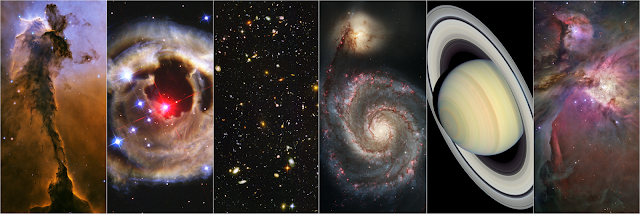
Hubble's Advanced Camera for Surveys (ACS) forever changed our view of the universe. Two decades into its epic mission, ACS continues to deliver ground-breaking science and stunning images. ACS has taken over 125,000 pictures and spawned numerous discoveries. Here is a portfolio of some of the ACS's most striking images. In this six-panel collage, the photos are (left to right): the Spire in the Eagle Nebula, V838 Monocerotis, the Hubble Ultra Deep Field (HUDF), the Whirlpool Galaxy (M51), Saturn, and the Orion Nebula (M42).Credits: Image: NASA, ESA, STScI 


For 20 years, the Advanced Camera for Surveys (ACS) has unveiled intriguing new secrets of the universe, looking deep into space with unprecedented clarity from onboard NASA's Hubble Space Telescope. Astronauts installed ACS during Hubble Servicing Mission 3B, also known as STS-109, on March 7, 2002. With its wide field of view, sharp image quality, and high sensitivity, ACS has delivered many of Hubble's most impressive images of deep space.

Former astronaut Mike Massimino, one of the two spacewalking astronauts who installed ACS, remembers, "We knew ACS would add so much discovery potential to the telescope, but I don't think anybody really understood everything it could do. It was going to unlock the secrets of the universe."

ACS has lived up to that promise. Following its installation, ACS became Hubble's most frequently used instrument. Among its many accomplishments, the camera has helped map the distribution of dark matter, detected the most distant objects in the universe, searched for massive planets and studied the evolution of clusters of galaxies.

"When ACS was installed on Hubble, the telescope was already famous for taking deep images of the distant universe, like the Hubble Deep Field," explained Tom Brown, Head of the Hubble Space Telescope Mission Office at the Space Telescope Science Institute (STScI) in Baltimore, Maryland. "However, because ACS was so powerful relative to the earlier cameras, it became routine to see very distant galaxies in the background of Hubble images, even when we were looking at nearby objects."

One example of this is a spectacular disrupted galaxy called the Tadpole (UGC 10214). Astronomers photographed the Tadpole shortly after ACS's installation to demonstrate the camera's capabilities. With its long tail of stars, the Tadpole looked like a runaway pinwheel firework. But what was really stunning was the backdrop — a rich tapestry of 6,000 galaxies captured by ACS.

"The Advanced Camera for Surveys represented a new paradigm for Hubble Space Telescope instruments when it was designed. It has lived up to expectations, proving to be one of Hubble's most scientifically productive instruments," said Mark Clampin, Director of the Sciences and Exploration Directorate at NASA's Goddard Space Flight Center in Greenbelt, Maryland. Prior to joining Goddard, Clampin was the ACS Group Lead at STScI, where he worked on three Hubble Servicing Missions. 

In January 2007, an electronics malfunction rendered the two most-used science channels on ACS inoperable. Thanks to engineering ingenuity, spacewalking astronauts on Hubble Servicing Mission 4 (STS-125) repaired the Wide Field Channel, the workhorse responsible for 70 percent of the pre-2007 ACS science. The High Resolution Channel, however, could not be repaired. Still, two decades into its mission, ACS continues to deliver ground-breaking science.

"The Advanced Camera for Surveys has opened our eyes to a deep and active universe for two decades," said Jennifer Wiseman, NASA's Hubble Senior Project Scientist. "We are anticipating still more discoveries with this camera, in conjunction with Hubble's other science instruments, for many years to come."

To date, ACS has taken over 125,000 pictures. These observations have spawned numerous discoveries, some of which are highlighted below.

The Hubble Ultra Deep Field 

In undoubtedly its most important observations, ACS revealed a series of the deepest portraits of the universe ever achieved by humankind. In the original Hubble Ultra Deep Field (HUDF), unveiled in 2004, ACS teamed up with Hubble's Near Infrared Camera and Multi-object Spectrometer (NICMOS) to capture light from galaxies that existed about 13 billion years ago, some 400 to 800 million years after the Big Bang. This million-second-long exposure revealed new insights into some of the first galaxies to emerge from the so-called "dark ages," the time shortly after the Big Bang when the first stars reheated the cold, dark universe. 

In later versions, ACS teamed with other Hubble instruments to refine the depth and reach of the original Hubble Ultra Deep Field. These portraits pushed humanity's view of the universe back to within 435 million years of the Big Bang, capturing images of the earliest objects in the cosmos. They forever changed our view of the universe and spawned innumerable collaborations.

 The Frontier Fields

Following in the spirit of the Hubble Ultra Deep Field, the Frontier Fields extended Hubble's reach even farther with the help of giant cosmic lenses in space. The immense gravity of massive clusters of galaxies warps the light from even-more-distant galaxies beyond, distorting and magnifying the light until those galaxies — too faint to be seen by Hubble directly — become visible. Frontier Fields combined the power of Hubble with the power of these "natural telescopes" to reveal galaxies 10 to 100 times fainter than could be seen by Hubble alone. Astronomers simultaneously used ACS for visible-light imaging and Hubble's Wide Field Camera 3 for its infrared vision.

Over the course of three years, Hubble devoted 840 orbits around the Earth — that's more than 1,330 hours — to six clusters of galaxies and six "parallel fields" — regions near the galaxy clusters. While these parallel fields could not be used for gravitational lensing, Hubble performed "deep field" observations on them — long looks far into the depths of space. Through the power of gravitational lensing, Hubble peered more deeply into space than ever before, while the parallel field observations expanded our knowledge of the early universe that began with the Hubble Deep Fields and Hubble Ultra Deep Field.

Helping the New Horizons Mission by Photographing Pluto

ACS captured the most detailed images ever taken of the dwarf planet Pluto years before the New Horizons flyby. The images reveal an icy, mottled, dark molasses-colored world undergoing seasonal surface and brightness changes. The ACS images were invaluable to planning the details of the New Horizons flyby in 2015 by showing which hemisphere looked more interesting for the spacecraft to take close-up snapshots during its brief encounter.

The Mysterious Fomalhaut b  

In 2008, ACS made the first visible-light snapshot of what was initially thought to be a planet, dubbed Fomalhaut b, orbiting the nearby, bright southern star Fomalhaut. The diminutive-looking object appeared as a dot next to a vast ring of icy debris that ACS observed to be encircling Fomalhaut. In following years, researchers tracked the object along its trajectory. But over time the dot expanded and became fainter as it moved out of sight. Instead of a planet, it is now thought to be an expanding cloud of very fine dust particles from two icy bodies that smashed into each other, according to some researchers. The nature of the object is still being debated, and follow-up studies may unravel this mystery.

The Light Echo of V838 Monocerotis  

The ACS captured an unusual phenomenon in space called a light echo, where light from an erupting star reflects or "echoes" off the dust and then travels to Earth. The echo came from the variable star V838 Monocerotis (V838 Mon). In early 2002, V838 Mon increased in brightness temporarily to become 600,000 times brighter than our Sun. The reason for the eruption is still unclear.

Light from V838 Mon propagated outward through a cloud of dust surrounding the star. Because of the extra distance the scattered light traveled, it reached the Earth years after the light from the stellar outburst itself. ACS monitored the light from the stellar outburst for several years as it continued to reflect off shells of dust surrounding the star. The phenomenon is an analog of a sound produced when an Alpine yodeler's voice echoes off the surrounding mountainsides. The spectacular light echo allowed astronomers to view continuously changing cross-sections of dust surrounding the star. This is a dramatic illustration of the power of ACS and Hubble to monitor phenomena over time. The longevity and consistency of ACS is critical for this type of research. 

Collision of the Milky Way and Andromeda Galaxies

By measuring the tiny, sideways motion of a group of stars in our neighboring Andromeda galaxy, ACS allowed astronomers to calculate that Andromeda and our Milky Way will collide head-on in about 4 billion years from now. Andromeda, also known as M31, is now 2.5 million light-years away, but it is falling toward the Milky Way under the mutual pull of gravity between the two galaxies. The prediction is that they will merge into a single elliptical galaxy similar to the kind commonly seen throughout the universe.

Galaxy Cluster Abell 1689's Gravitational Lens

In 2002, ACS delivered an unprecedented and dramatic new view of the cosmos when it demonstrated the power of gravitational lensing. The ACS peered straight through the center of one of the most massive galaxy clusters known, called Abell 1689. The gravity of the cluster's trillion stars – plus dark matter – acts as a 2-million-light-year-wide "lens" in space. This gravitational lens bends and magnifies the light of galaxies located far behind it, distorting their shapes and creating multiple images of individual galaxies.  

ACS's sharpness, combined with this behemoth natural lens, revealed remote galaxies previously beyond even Hubble's reach. The results shed light on galaxy evolution and dark matter in space.

Mature and "Toddler" Galaxies Far Back in Time

Using ACS to look back in time nearly 9 billion years, an international team of astronomers found mature galaxies in a young universe. The galaxies are members of a cluster of galaxies that existed when the universe was only 5 billion years old. This compelling evidence that galaxies must have started forming just after the Big Bang was bolstered by observations made by the same team of astronomers when they peered even farther back in time. The team found galaxies a mere 1.5 billion years after the birth of the cosmos. The early galaxies reside in a still-developing cluster, the most distant proto-cluster ever found. 

The ACS was built especially for studies of such distant objects. These findings further support observations and theories that galaxies formed relatively early in the history of the cosmos. The existence of such massive clusters in the early universe agrees with a cosmological model wherein clusters form from the merger of many sub-clusters in a universe dominated by cold dark matter. The precise nature of cold dark matter, however, is still not known.

Clues about the Accelerating Universe and Dark Energy

Astronomers using ACS found supernovas that exploded so long ago they provide new clues about the accelerating universe and its mysterious "dark energy." ACS can pick out the faint glow of these very distant supernovas. The ACS can then dissect their light to measure their distances, study how they fade, and confirm that they are a special type of exploding star, called a Type Ia supernova, that are reliable distance indicators. Type Ia supernovas glow at a predictable peak brightness, which makes them reliable objects for calibrating vast intergalactic distances.

In 1998, Hubble astronomers found such a far-off supernova that provided the unexpected revelation that galaxies appeared to be moving away from each other at an ever-increasing speed. They've attributed this accelerating expansion to a mysterious factor known as dark energy that is believed to permeate the universe. Since its installation, ACS has been hunting Type Ia supernovas in the early universe to provide supporting evidence.

The Hubble Space Telescope is a project of international cooperation between NASA and ESA (European Space Agency). NASA's Goddard Space Flight Center in Greenbelt, Maryland, manages the telescope. The Space Telescope Science Institute (STScI) in Baltimore, Maryland, conducts Hubble science operations. STScI is operated for NASA by the Association of Universities for Research in Astronomy, in Washington, D.C.


Credits: Release: NASA, ESA 

Media Contact: 

Ann Jenkins
Space Telescope Science Institute, Baltimore, Maryland

Ray Villard
Space Telescope Science Institute, Baltimore, Maryland


Contact Us: Direct inquiries to the News Team.

Related Links and Documents:  


Source: HubbleSite/News


Friday, September 13, 2019

Saturn's Rings Shine in New Hubble Portrait

Saturn's Rings
Credit: NASA, ESA, A. Simon (Goddard Space Flight Center), M.H. Wong (University of California, Berkeley), and the OPAL Team.  Release Images - Release Videos

Saturn is so beautiful that astronomers cannot resist using the Hubble Space Telescope to take yearly snapshots of the ringed world when it is at its closest distance to Earth.

These images, however, are more than just beauty shots. They reveal a planet with a turbulent, dynamic atmosphere. This year's Hubble offering, for example, shows that a large storm visible in the 2018 Hubble image in the north polar region has vanished. Smaller storms pop into view like popcorn kernels popping in a microwave oven before disappearing just as quickly. Even the planet's banded structure reveals subtle changes in color.

But the latest image shows plenty that hasn't changed. The mysterious six-sided pattern, called the "hexagon," still exists on the north pole. Caused by a high-speed jet stream, the hexagon was first discovered in 1981 by NASA's Voyager 1 spacecraft.

Saturn's signature rings are still as stunning as ever. The image reveals that the ring system is tilted toward Earth, giving viewers a magnificent look at the bright, icy structure. Hubble resolves numerous ringlets and the fainter inner rings.

This image reveals an unprecedented clarity only seen previously in snapshots taken by NASA spacecraft visiting the distant planet. Astronomers will continue their yearly monitoring of the planet to track shifting weather patterns and identify other changes. The second in the yearly series, this image is part of the Outer Planets Atmospheres Legacy (OPAL) project. OPAL is helping scientists understand the atmospheric dynamics and evolution of our solar system's gas giant planets.


Contact:

Donna Weaver / Ray Villard
Space Telescope Science Institute, Baltimore, Maryland
410-338-4493 / 410-338-4514
dweaver@stsci.edu / villard@stsci.edu

Amy Simon
Goddard Space Flight Center, Greenbelt, Maryland
amy.simon@nasa.gov

Mike Wong
University of California, Berkeley, California
mikewong@astro.berkeley.edu


Related Links:


Friday, August 31, 2018

Hubble observes energetic lightshow at Saturn’s north pole

PR Image heic1815a
Saturn’s northern auroras

PR Image heic1815b
Saturn’s northern auroras


Videos

Animation of Saturn’s northern auroras

Closeup of Saturn's auroras


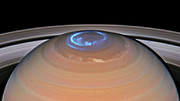
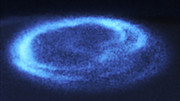
Astronomers using the NASA/ESA Hubble Space telescope have taken a series of spectacular images featuring the fluttering auroras at the north pole of Saturn. The observations were taken in ultraviolet light and the resulting images provide astronomers with the most comprehensive picture so far of Saturn’s northern aurora.

In 2017, over a period of seven months, the NASA/ESA Hubble Space Telescope took images of auroras above Saturn’s north pole region using the Space Telescope Imaging Spectrograph. The observations were taken before and after the Saturnian northern summer solstice. These conditions provided the best achievable viewing of the northern auroral region for Hubble.

On Earth, auroras are mainly created by particles originally emitted by the Sun in the form of solar wind. When this stream of electrically charged particles gets close to our planet, it interacts with the magnetic field, which acts as a gigantic shield. While it protects Earth’s environment from solar wind particles, it can also trap a small fraction of them. Particles trapped within the magnetosphere — the region of space surrounding Earth in which charged particles are affected by its magnetic field — can be energised and then follow the magnetic field lines down to the magnetic poles. There, they interact with oxygen and nitrogen atoms in the upper layers of the atmosphere, creating the flickering, colourful lights visible in the polar regions here on Earth [1].

However, these auroras are not unique to Earth. Other planets in our Solar System have been found to have similar auroras. Among them are the four gas giants Jupiter, Saturn, Uranus and Neptune.

Because the atmosphere of each of the four outer planets in the Solar System is — unlike the Earth — dominated by hydrogen, Saturn’s auroras can only be seen in ultraviolet wavelengths; a part of the electromagnetic spectrum which can only be studied from space.

Hubble allowed researchers to monitor the behaviour of the auroras at Saturn's north pole over an extended period of time. The Hubble observations were coordinated with the “Grand Finale” of the Cassini spacecraft, when the spacecraft simultaneously probed the auroral regions of Saturn [2]. The Hubble data allowed astronomers to learn more about Saturn’s magnetosphere, which is the largest of any planet in the Solar System other than Jupiter.

The images show a rich variety of emissions with highly variable localised features. The variability of the auroras is influenced by both the solar wind and the rapid rotation of Saturn, which lasts only about 11 hours. On top of this, the northern aurora displays two distinct peaks in brightness — at dawn and just before midnight. The latter peak, unreported before, seems specific to the interaction of the solar wind with the magnetosphere at Saturn’s solstice.

The main image presented here is a composite of observations made of Saturn in early 2018 in the optical and of the auroras on Saturn’s north pole region, made in 2017, demonstrating the size of the auroras along with the beautiful colours of Saturn.

Hubble has studied Saturn's auroras in the past. In 2004, it studied the southern auroras shortly after the southern solstice (heic0504) and in 2009 it took advantage of a rare opportunity to record Saturn when its rings were edge-on (heic1003). This allowed Hubble to observe both poles and their auroras simultaneously.


Notes

[1] The auroras here on Earth have different names depending on which pole they occur at. Aurora Borealis, or the northern lights, is the name given to auroras around the north pole and Aurora Australis, or the southern lights, is the name given for auroras around the south pole.


[2] Cassini was a collaboration between NASA, ESA and the Italian Space Agency. It spent 13 years orbiting Saturn, gathering information and giving astronomers a great insight into the inner workings of Saturn. Cassini took more risks at the end of its mission, travelling through the gap between Saturn and its rings. No spacecraft had previously done this, and Cassini gathered spectacular images of Saturn as well as new data for scientists to work with. On 15 September 2017 Cassini was sent on a controlled crash into Saturn.


More Information

The Hubble Space Telescope is a project of international cooperation between ESA and NASA.
Image credit: NASA, ESA & L. Lamy


Links


Contacts

Laurent Lamy
Observatoire de Paris
Paris, France
Tel: +33 145 077668
Email: laurent.lamy@obspm.fr

Mathias Jäger
ESA/Hubble, Public Information Officer
Garching, Germany
Tel: +49 176 62397500
Email: mjaeger@partner.eso.org