Thursday, May 11, 2023

Webb Looks for Fomalhaut's Asteroid Belt and Finds Much More

Fomalhaut Dusty Debris Disk (MIRI Image)
Credits: Image: NASA, ESA, CSA
Image Processing: András Gáspár (University of Arizona), Alyssa Pagan (STScI)
Science: András Gáspár (University of Arizona)

Fomalhaut Dusty Debris Disk (MIRI Compass Image)
Credits: Image: NASA, ESA, CSA
Image Processing: András Gáspár (University of Arizona), Alyssa Pagan (STScI)
Science: András Gáspár (University of Arizona)


Astronomers used NASA’s James Webb Space Telescope to image the warm dust around a nearby young star, Fomalhaut, in order to study the first asteroid belt ever seen outside of our solar system in infrared light. But to their surprise, the dusty structures are much more complex than the asteroid and Kuiper dust belts of our solar system. Overall, there are three nested belts extending out to 14 billion miles (23 billion kilometers) from the star; that’s 150 times the distance of Earth from the Sun. The scale of the outermost belt is roughly twice the scale of our solar system's Kuiper Belt of small bodies and cold dust beyond Neptune. The inner belts – which had never been seen before – were revealed by Webb for the first time.

The belts encircle the young hot star, which can be seen with the naked eye as the brightest star in the southern constellation Piscis Austrinus. The dusty belts are the debris from collisions of larger bodies, analogous to asteroids and comets, and are frequently described as 'debris disks.' “I would describe Fomalhaut as the archetype of debris disks found elsewhere in our galaxy, because it has components similar to those we have in our own planetary system,” said András Gáspár of the University of Arizona in Tucson and lead author of a new paper describing these results. “By looking at the patterns in these rings, we can actually start to make a little sketch of what a planetary system ought to look like — if we could actually take a deep enough picture to see the suspected planets.”

The Hubble Space Telescope and the Herschel Space Observatory, as well as the Atacama Large Millimeter/submillimeter Array (ALMA), have previously taken sharp images of the outermost belt. However, none of them found any structure interior to it. The inner belts have been resolved for the first time by Webb in infrared light. “Where Webb really excels is that we're able to physically resolve the thermal glow from dust in those inner regions. So you can see inner belts that we could never see before,” said Schuyler Wolff, another member of the team at the University of Arizona.

Hubble, ALMA, and Webb are tag-teaming to assemble a holistic view of the debris disks around a number of stars. “With Hubble and ALMA, we were able to image a bunch of Kuiper Belt analogs, and we've learned loads about how outer disks form and evolve,” said Wolff. “But we need Webb to allow us to image a dozen or so asteroid belts elsewhere. We can learn just as much about the inner warm regions of these disks as Hubble and ALMA taught us about the colder outer regions.”

These belts most likely are carved by the gravitational forces produced by unseen planets. Similarly, inside our solar system Jupiter corrals the asteroid belt, the inner edge of the Kuiper Belt is sculpted by Neptune, and the outer edge could be shepherded by as-yet-unseen bodies beyond it. As Webb images more systems, we will learn about the configurations of their planets.

Fomalhaut's dust ring was discovered in 1983 in observations made by NASA's Infrared Astronomical Satellite (IRAS). The existence of the ring has also been inferred from previous and longer-wavelength observations using submillimeter telescopes on Mauna Kea, Hawaii, NASA’s Spitzer Space Telescope, and Caltech's Submillimeter Observatory.

“The belts around Fomalhaut are kind of a mystery novel: Where are the planets?” said George Rieke, another team member and U.S. science lead for Webb's Mid-Infrared Instrument (MIRI), which made these observations. "I think it's not a very big leap to say there's probably a really interesting planetary system around the star.”

“We definitely didn't expect the more complex structure with the second intermediate belt and then the broader asteroid belt,” added Wolff. “That structure is very exciting because any time an astronomer sees a gap and rings in a disk, they say, ‘There could be an embedded planet shaping the rings!’”

Webb also imaged what Gáspár dubs "the great dust cloud" that may be evidence for a collision occurring in the outer ring between two protoplanetary bodies. This is a different feature from a suspected planet first seen inside the outer ring by Hubble in 2008. Subsequent Hubble observations showed that by 2014 the object had vanished. A plausible interpretation is that this newly discovered feature, like the earlier one, is an expanding cloud of very fine dust particles from two icy bodies that smashed into each other.

The idea of a protoplanetary disk around a star goes back to the late 1700s when astronomers Immanuel Kant and Pierre-Simon Laplace independently developed the theory that the Sun and planets formed from a rotating gas cloud that collapsed and flattened due to gravity. Debris disks develop later, following the formation of planets and dispersal of the primordial gas in the systems. They show that small bodies like asteroids are colliding catastrophically and pulverizing their surfaces into huge clouds of dust and other debris. Observations of their dust provide unique clues to the structure of an exoplanetary system, reaching down to earth-sized planets and even asteroids, which are much too small to see individually.


The team's results are being published in the journal Nature Astronomy.

The James Webb Space Telescope is the world's premier space science observatory. The Fomalhaut observations utilized the Mid-Infrared Instrument (MIRI), which was contributed by NASA and ESA (European Space Agency), with the instrument designed and built by a consortium of nationally funded European Institutes (the MIRI European Consortium) and NASA’s Jet Propulsion Laboratory, in partnership with the University of Arizona. Webb will solve mysteries in our solar system, look beyond to distant worlds around other stars, and probe the mysterious structures and origins of our universe and our place in it. Webb is an international program led by NASA with its partners, ESA, and the Canadian Space Agency.


About This Release

Credits:

Release: NASA, ESA, STScI

Media Contact:

Ray Villard
Space Telescope Science Institute, Baltimore, Maryland

Christine Pulliam
Space Telescope Science Institute, Baltimore, Maryland


Permissions: Content Use Policy

Contact Us: Direct inquiries to the  News Team.

Related Links and Documents:


Wednesday, May 10, 2023

Hubble Follows Shadow Play Around Planet-Forming Disk

Concentric Gas-and-Dust Disks Around Star TW Hydrae (Artist's Concept)
Credits: Artwork: NASA, AURA/STScI for ESA, Leah Hustak (STScI)

TW Hydrae Disk
Credits: Image: NASA, ESA, STScI, John Debes (AURA/STScI for ESA)
Image Processing: Joseph DePasquale (STScI)


The young star TW Hydrae is playing "shadow puppets" with scientists observing it with NASA's Hubble Space Telescope.

In 2017, astronomers reported discovering a shadow sweeping across the face of a vast pancake-shaped gas-and-dust disk surrounding the red dwarf star. The shadow isn't from a planet, but from an inner disk slightly inclined relative to the much larger outer disk – causing it to cast a shadow. One explanation is that an unseen planet's gravity is pulling dust and gas into the planet's inclined orbit.

Now, a second shadow – playing a game of peek-a-boo – has emerged in just a few years between observations stored in Hubble's MAST archive. This could be from yet another disk nestled inside the system. The two disks are likely evidence of a pair of planets under construction.

TW Hydrae is less than 10 million years old and resides about 200 light-years away. In its infancy, our solar system may have resembled the TW Hydrae system, some 4.6 billion years ago. Because the TW Hydrae system is tilted nearly face-on to our view from Earth, it is an optimum target for getting a bull's-eye-view of a planetary construction yard.

The second shadow was discovered in observations obtained on June 6, 2021, as part of a multi-year program designed to track the shadows in circumstellar disks. John Debes of AURA/STScI for the European Space Agency at the Space Telescope Science Institute in Baltimore, Maryland, compared the TW Hydrae disk to Hubble observations made several years ago.

"We found out that the shadow had done something completely different," said Debes, who is principal investigator and lead author of the study published in The Astrophysical Journal. "When I first looked at the data, I thought something had gone wrong with the observation because it wasn't what I was expecting. I was flummoxed at first, and all my collaborators were like: what is going on? We really had to scratch our heads and it took us a while to actually figure out an explanation."

The best solution the team came up with is that there are two misaligned disks casting shadows. They were so close to each other in the earlier observation they were missed. Over time they've now separated and split into two shadows. "We've never really seen this before on a protoplanetary disk. It makes the system much more complex than we originally thought," he said.

The simplest explanation is that the misaligned disks are likely caused by the gravitational pull of two planets in slightly different orbital planes. Hubble is piecing together a holistic view of the architecture of the system.

The disks may be proxies for planets that are lapping each other as they whirl around the star. It's sort of like spinning two vinyl phonograph records at slightly different speeds. Sometimes labels will match up but then one gets ahead of the other.

"It does suggest that the two planets have to be fairly close to each other. If one was moving much faster than the other, this would have been noticed in earlier observations. It's like two race cars that are close to each other, but one slowly overtakes and laps the other," said Debes.

The suspected planets are located in a region roughly the distance of Jupiter from our Sun. And, the shadows complete one rotation around the star about every 15 years – the orbital period that would be expected at that distance from the star.

Also, these two inner disks are inclined about five to seven degrees relative to the plane of the outer disk. This is comparable to the range of orbital inclinations inside our solar system. "This is right in line with typical solar system style architecture," said Debes.

The outer disk that the shadows are falling on may extend as far as several times the radius of our solar system's Kuiper belt. This larger disk has a curious gap at twice Pluto's average distance from the Sun. This might be evidence for a third planet in the system.

Any inner planets would be difficult to detect because their light would be lost in the glare of the star. Also, dust in the system would dim their reflected light. ESA's Gaia space observatory may be able to measure a wobble in the star if Jupiter-mass planets are tugging on it, but this would take years given the long orbital periods.

The TW Hydrae data are from Hubble's Space Telescope Imaging Spectrograph. The James Webb Space Telescope's infrared vision may also be able to show the shadows in more detail.

The Hubble Space Telescope is a project of international cooperation between NASA and ESA. NASA's Goddard Space Flight Center in Greenbelt, Maryland, manages the telescope. The Space Telescope Science Institute (STScI) in Baltimore conducts Hubble science operations. STScI is operated for NASA by the Association of Universities for Research in Astronomy, in Washington, D.C.


About This Release

Credits

Media Contact:

Ray Villard
Space Telescope Science Institute, Baltimore, Maryland

Science Contact:Contact: John Debes
AURA/STScI for the European Space Agency, Baltimore, Maryland


Permissions: Content Use Policy

Contact Us: Direct inquiries to the News Team.

Related Links and Documents:


Tuesday, May 09, 2023

M84: 'H' is for Hot and Huge in Chandra Image

M84
Credit: X-ray: NASA/CXC/Princeton Univ/C. Bambic et al.;
Optical: SDSS; Radio: NSF/NRAO/VLA/ESO;
Image processing: NASA/CXC/SAO/N.Wolk


With a single letter seemingly etched in the X-ray glow around it, a giant black hole at the center of a massive elliptical galaxy is making a mark on its surroundings.

This “H”-shaped structure is found in a detailed new X-ray map of the multimillion-degree gas around the galaxy Messier 84 (M84).

As gas is captured by the gravitational force of the black hole, some of it will fall into the abyss, never to be seen again. Some of the gas, however, avoids this fate and instead gets blasted away from the black hole in the form of jets of particles. These jets can push out cavities, in the hot gas surrounding the black hole. Given the orientation of the jets to Earth and the profile of the hot gas, the cavities in M84 form what appears to resemble the letter “H.” The H-shaped structure in the gas is an example of pareidolia, which is when people see familiar shapes or patterns in random data. Pareidolia can occur in all kinds of data from clouds to rocks and astronomical images.


M84 (labeled)
Credit: X-ray: NASA/CXC/Princeton Univ/C. Bambic et al.;
Optical: SDSS; Radio: NSF/NRAO/VLA/ESO;
Image processing: NASA/CXC/SAO/N.Wolk

Astronomers used NASA’s Chandra X-ray Observatory to make a map of the hot gas (pink) in and around M84, reaching to within only about 100 light-years away from the black hole in the center of the galaxy. This gas radiates at temperatures in the tens of millions of degrees, making it primarily observable in X-rays. The huge letter “H” is about 40,000 light-years tall — about half the width of the Milky Way. The radio image from the National Science Foundation’s Karl G. Jansky Very Large Array (VLA) (blue) reveals the jets streaking away from the black hole. Optical data from the Sloan Digital Sky Survey (white) shows M84 and neighboring galaxies. The letter H and the position of the black hole are labeled. An additional graphic shows a close-up of the region marked with a square, and separate labels for the galaxy and the jets in the optical and radio images respectively.
 

M84
Credit: X-ray: NASA/CXC/Princeton Univ/C. Bambic et al.;
Optical: SDSS; Radio: NSF/NRAO/VLA/ESO;
Image processing: NASA/CXC/SAO/N.Wolk

Researchers studying M84 with Chandra and the VLA found that the jets may influence the flow of the hot gas towards the black hole even more than the gravitational pull from the black hole. For example, the team estimates matter is falling towards the black hole from the north — along the direction of the jet seen in radio waves — at about 500 times the mass of the Earth every year, a rate that is only a quarter of that from directions where the jet is not pointing, to the east and west. One possibility is that gas is lifted along the direction of the jet by the cavities, slowing the rate at which gas falls onto the black hole.

The authors tested a model called Bondi accretion, where all of the matter within a certain distance from a black hole — effectively inside a sphere — is close enough to be affected by a black hole’s gravity and start falling inwards at the same rate from all directions. (The dashed circle in the close-up image is centered on the black hole and shows the approximate distance from the black hole where gas should start falling inwards.) This effect is named after the scientist Hermann Bondi, and “accretion” refers to matter falling toward the black hole. The new results show that Bondi accretion is not occurring in M84 because matter is not falling towards the black hole evenly from all directions.

M84 is a cousin of Messier 87 (M87), the galaxy containing the first black hole imaged with the global Event Horizon Telescope network, and, like M87, is also a member of the Virgo Cluster. The supermassive black hole in M84, along with those in our galaxy, M87, NGC 3115, and NGC 1600, are the only ones close enough to Earth, or massive enough, for astronomers to see details in Chandra images which are so near the black hole that gas should be falling inwards. Like the black hole in M87, the one in M84 is producing a jet of particles; however, the point source of X-rays from material even closer to the black hole is over ten times fainter for M84. This allows more detailed study of gas falling towards the black hole in M84 that is farther out, preventing the faint X-rays produced by this gas from being overwhelmed by the X-ray glare from the point source.

A paper describing these results appears in The Monthly Notices of the Royal Astronomical Society and a preprint is available here. The study was led by Christopher Bambic, a graduate student at Princeton University. Other authors include Helen Russell (University of Nottingham, United Kingdom), Christopher Reynolds (Institute of Astronomy, Cambridge, UK; University of Maryland, College Park), Andy Fabian (Institute of Astronomy), Brian McNamara (University of Waterloo, Canada; Waterloo Centre for Astrophysics, Canada), and Paul Nulsen (Center for Astrophysics | Harvard & Smithsonian).

NASA's Marshall Space Flight Center manages the Chandra program. The Smithsonian Astrophysical Observatory's Chandra X-ray Center controls science operations from Cambridge, Massachusetts, and flight operations from Burlington, Massachusetts.

Quick Look: 'H' is for Hot and Huge in Chandra Image


Fast Facts for M84:

Scale: Image is about 9 arcmin (140,000 light-years) across.
Category: Normal Galaxies & Starburst Galaxies, Black Holes
Coordinates (J2000): RA 12h 25m 03.74s | Dec +12° 53´ 13.14"
Constellation: Virgo
Observation Dates: 26 observations from May 2000 through May 2019
Observation Time: 234 hours 39 minutes (9 days 18 hours 39 minutes)
Obs. ID: 803, 5908, 6131, 20539-20543, 21845, 12867, 22126-22128, 22142-22144, 22153, 22163, 22164, 22166, 22174-22177, 22195, 22196
Instrument: ACIS
Also Known As: NGC 4374
References: Bambic, C. et al. 2023, MNRAS,(accepted); arXiv:2301.11937
Color Code: X-ray: pink; Optical: red, green, blue; Radio: blue;
Distance Estimate: About 55 million light-years


Monday, May 08, 2023

Star Eats Planet, Brightens Dramatically Planetary Death Spiral

This artist's impression shows a doomed planet skimming the surface of its star. Astronomers used a combination of telescopes to spot the first direct evidence of an aging, bloated sun-like star, like the one pictured here, engulfing its planet. These telescopes included the Zwicky Transient Facility (ZTF) at Caltech's Palomar Observatory, the W.M. Keck Observatory, and NASA's NEOWISE mission. The aging star depicted here, called ZTF SLRN-2020, is roughly 10 billion years old. It had begun to inflate over hundreds of thousands of years as it transformed into a red giant, and, as a result, inched closer to its inner planet. According to astronomers, when the planet was almost touching the surface of the star, the increasing frictional forces caused the planet to rapidly spiral inward. Eventually, on timescales that are not certain, the planet plunged into the core of the star. When that happened, the star inflated to four times its size and brightened by a factor of more than a hundred. ZTF SLRN-2020 lies about 15,000 light-years away in the constellation Aquila. Credit: K. Miller/R. Hurt (Caltech/IPAC)

Planetary Death Spiral

ZTF and NEOWISE spot evidence for the first known case of a star engulfing its planet

For the first time, astronomers have caught a star in the act of swallowing a planet whole. The sun-like star, called ZTF SLRN-2020, lies about 15,000 light-years away in our galaxy and is thought to have engulfed a hot gas giant about the size of Jupiter or smaller. Scientists already knew that older stars will, as they puff up with age, ultimately ingest their inner orbiting planets. Our own sun is predicted to do so in 5 billion years, consuming Mercury, Venus, and likely Earth. But nobody had seen direct evidence for such a remarkable scenario until now.

"The confirmation that sun-like stars engulf inner planets provides us with a missing link in our understanding of the fates of solar systems, including our own," says Kishalay De (MS '18, PhD '21), a postdoctoral scholar at MIT and lead author of a new study about the findings in the journal Nature.

The plump star was first spotted by Zwicky Transient Facility, or ZTF, a National Science Foundation–funded instrument that scans the skies every night from Caltech's Samuel Oschin Telescope at Palomar Observatory near San Diego. ZTF observations showed that the star had dramatically brightened and begun to fade in a period of about a week. At first, De thought this variable star might have resulted from a nova explosion, which occurs when a dead star called a white dwarf steals matter from its companion star. But follow-up observations with the W. M. Keck Observatory atop Maunakea in Hawaiʻi revealed something else was going on.

"I had been looking for erupting stars called novae," De says. "But the Keck data indicated that the star was not lighting up hot gas as is expected for novae. I couldn't make any sense of it."

De, who was then a graduate student at Caltech, put the object aside to finish his PhD thesis and came back to it about a year later after he had moved to MIT. He and his colleagues then obtained infrared data from a camera at Palomar's Hale Telescope called WIRC (Wide-field Infrared Camera), "and that's when things got really interesting," he says.

Those observations showed that the star was brightening over time in not only optical light as ZTF had observed but also in infrared light, which indicates the presence of dust. The researchers then turned to NASA's NEOWISE space telescope in search of more clues. NEOWISE, formerly known as WISE (Wide-field Infrared Survey Explorer), has been scanning the skies regularly since shortly after its launch in 2009. NEOWISE detected the star brightening in infrared light about nine months before ZTF caught the extreme rise in optical light. Even now, after the optical light has faded, NEOWISE continues to pick up infrared light from the star.

"The infrared observations were one of the main clues that we were looking at a star engulfing a planet," says Viraj Karambelkar (MS '21), a grad student at Caltech and co-author of the study.

Once the science team put all the evidence together, they realized that the dust they were seeing with NEOWISE was being generated as a planet spiraled into the star's puffy atmosphere. Like other older stars, the star had begun to expand in size as it aged, bringing it closer to the orbiting planet. As the planet skimmed the surface of the star, it pulled hot gas off the star that then drifted outward and cooled, forming dust. In addition, material from the disintegrating planet blew outward, also forming dust.

What happened next, according to the astronomers, triggered the flare of optical light seen by ZTF.

"The planet plunged into the core of the star and got swallowed whole. As it was doing this, energy was transferred to the star," De explains. "The star blew off its outer layers to get rid of the energy. It expanded and brightened, and the brightening is what ZTF registered."

Some of this expanding stellar material then escaped from the star and traveled outward. Like the boiled-off layers of the star and planet that previously drifted outward, this material also cooled to form dust.

NEOWISE is detecting the infrared glow of all the newly minted dust.

"NEOWISE data are a treasure trove," says co-author Mansi Kasliwal (MS '07, PhD '11), professor of astronomy at Caltech and a co-investigator on the ZTF project. "ZTF caught the event, which is what it excels at, while NEOWISE and other telescopes all helped us figure out what is going on."

The planetary engulfment is similar to what happens when two stars merge, events called red novae. Stars in our universe often form in pairs. Over time, as one star ages and expands faster than its companion, it can essentially ingest its partner. Twenty of these star mergers have been detected to date by ZTF and other instruments, mostly in galaxies beyond the Milky Way.

"Star mergers are thousands of times brighter than this event," says Karambelkar, who has observed eight of these eruptions using ZTF as part of his PhD thesis. "This was another clue that we were looking at a planet being eaten by its star. The level of brightening was much fainter due to the small size of the planet."

"This is just spectacular," Kasliwal adds. "We are still amazed that we caught a star in the act of ingesting its planet, something our own sun will do to its inner planets. That's a long time from now, in five billion years, so we don't have to worry just yet."

The Nature study titled "An infrared transient from a star engulfing a planet," was funded by NASA, the National Science Foundation (NSF), and the Heising-Simons Foundation.

Caltech's ZTF is funded by the NSF and an international collaboration of partners. Additional support comes from the Heising-Simons Foundation and from Caltech. ZTF data are processed and archived by Caltech's IPAC. NASA supports ZTF's search for near-Earth objects through the Near-Earth Object Observations program.

Launched in 2009, the WISE spacecraft was placed into hibernation in 2011 after completing its primary mission. In September 2013, NASA reactivated the spacecraft with the primary goal of scanning for near-Earth objects, or NEOs, and the mission and spacecraft were renamed NEOWISE. The mission was selected competitively under NASA's Explorers Program managed by the agency's Goddard Space Flight Center in Greenbelt, Maryland. NEOWISE is a project of JPL, which is managed by Caltech for NASA, and the University of Arizona and is supported by NASA's Planetary Defense Coordination Office.

Written by
Whitney Clavin


Contact:

Whitney Clavin
(626) 395‑1944

wclavin@caltech.edu

Source: Caltech/News


Kishaly De - Viraj Karambelkar and Mansi Kasliwal


Saturday, May 06, 2023

The Bizarre Behavior of Black Holes


Researchers at Caltech study all manner of odd black hole behaviors. In honor of Black Hole Week, here are a few of them, from gobbling up stars to dancing and chirping.

By Whitney Clavin

Black holes are strewn across the universe, from our own galaxy to the farthest reaches of the cosmos. Made of matter so dense that it twists the fabric of space and time, these dark beasts are called black because even light cannot escape the grasp of their gravity. Some contain just a few times the mass of our sun, though the behemoths at the centers of galaxies can hold up to tens of billions of times more mass than our star. Black holes can, at times, lie dormant and unmoving like sea urchins in a cosmic ocean, but they can also be ferocious eaters.


Ripped to Shreds


Black Hole Tidal Disruption Event

When stars wander too close, black holes can shred them to pieces. Called tidal disruption events, or TDEs, these cosmic cataclysms happen when the gravitational pull of a black hole rips apart the doomed star and creates a glow of light telescopes can detect.

In 2021 and 2022, several telescopes—including the Caltech-led Zwicky Transient Facility (ZTF) operating from Palomar Observatory and the Caltech-led NuSTAR (Nuclear Spectroscopic Telescope Array)— saw a TDE in a galaxy 250 million light-years from Earth, one of the closest TDE encounters seen to date.


Comparing "Chirps" from Black Holes

Many black holes are found in pairs that orbit each other like ice dancers. Eventually they collide, merge, and coalesce into one giant body. The National Science Foundation-funded LIGO (Laser Interferometer Gravitational-wave Observatory) detects ripples in space and time called gravitational waves that emanate from pairs of merging stellar-mass black holes. When researchers translate the gravitational waves into sound waves and shift up the frequency to better suit human ears, they hear a distinct “chirp.” Compare the chirps from different black hole mergers here.


Flash in the Dark


Some scientists think that colliding black holes might also emanate flashes of light waves, but only when the black holes in question are embedded in thick disks swirling around a more massive black hole. On May 21, 2019, LIGO and partner observatory Virgo detected gravitational waves from a pair of merging, jiggling black holes, while, around the same time, ZTF caught a flare of optical light from the same location. The scientists speculate that the two events could be correlated and have since found other similar scenarios. They think that two smaller merging black holes are plowing through gas surrounding a much more massive one, creating the brilliant flares.


When Titans Collide


Even the supermassive black holes that lie in the hearts of galaxies can spiral around each other and merge. In one Caltech-led study that analyzed 45 years of radio observations, astronomers found direct evidence of two supermassive black holes locked in a two-year dance at the heart of a galaxy 9 billion light-years away.


Camera Ready


A couple of black holes have reached celebrity status. With the help of radio telescopes across the globe and some clever image processing, the Event Horizon Telescope (EHT) project took the first photograph of the supermassive black hole at the center of a galaxy called Messier 87 in 2019. The photograph shows not the black hole itself, but the shadow it cast on a ring of glowing material that encircles it. In 2022, EHT took the first-ever picture of the black hole lying at the heart of our own galaxy, called Sagittarius *A (seen below). This black hole is much less massive than M87’s, and material is swirling around it at a faster rate, making it even harder to image.

Source: Caltech/News


Friday, May 05, 2023

A New Look at Gamma Rays from Our Galaxy’s Next-Door Neighbour

An ultraviolet image of the Andromeda Galaxy from NASA's Galaxy Evolution Explorer.
Credit:
NASA/JPL-Caltech


Title: On the Gamma-Ray Emission of the Andromeda Galaxy M31
Authors: Yi Xing et al.
First Author’s Institution: Shanghai Astronomical Observatory, Chinese Academy of Sciences
Status: Published in ApJL

Gamma rays are the highest-energy photons in our universe. Naturally, they come from some of the most extreme environments in the universe, such as pulsars, active galactic nuclei, supernovae, and potentially even dark matter. Though many gamma-ray sources have been detected both in the Milky Way and extragalactically, the nature of gamma-ray emission from our closest neighbouring galaxy, Andromeda (or Messier 31), remains somewhat of a mystery.

The Fermi Large Area Telescope (Fermi-LAT) is an instrument on the Fermi Gamma-ray Space Telescope that has been surveying the sky for high-energy gamma rays since 2008, with ample data taken on Andromeda throughout its flight. Many groups have analyzed these data, with more data giving more insight into what’s making these gamma rays.


Figure 1: Significance maps of Andromeda at energies from 0.1 to 500 gigaelectronvolts (left) and 2 to 500 gigaelectronvolts (right). The region of optical emission is represented by the white contour. The colorbar corresponds to test statistic, which is similar to significance. A test statistic of 25 corresponds to a detection. Green markers correspond to nearby sources found in the SIMBAD database. The left figure shows a hint of additional structure in the southeast region of Andromeda, but both point sources emerge out of the seemingly extended region only with the lowest energies cut out. Credit: Xing et al. 2023

To Extend or Not to Extend?

Up until today’s article, it looked like gamma rays from Andromeda were coming from a blob-like shape (i.e., extended emission) surrounding the centre of the galaxy (similar to Figure 1, left). This was particularly exciting, since extended structure in gamma-ray emission often suggests either a distribution of cosmic rays or the presence of a massive dark matter halo.

Cosmic rays are charged particles that travel at relativistic speeds through the universe but get easily diverted by magnetic fields, making it very difficult to trace their origin from Earth. Luckily, since there are processes that produce gamma rays from charged particles (hadronic processes), identifying regions of extended gamma rays can trace regions where populations of cosmic rays are interacting with their environments. On the other hand, clumps of massive dark matter located in the centre of Andromeda could decay or annihilate, producing gamma rays in the process.


Figure 2: A spectral energy distribution showing flux (quantity of gamma rays received) plotted against energy of Andromeda’s centre (black) and southeast (red) emission regions, along with the Milky Way’s galactic centre (blue). It is apparent that both sources are not only similar in brightness but are also producing significantly more gamma rays than our galactic centre. Click to enlarge. Credit: Xing et al. 2023
 
Where are the Gamma Rays Coming From?

A reanalysis of 14 years of Fermi-LAT data by the authors reveals that the emission of gamma rays isn’t extended after all. In fact, it seems that it’s constrained to two point sources: one located right at the centre of the galaxy and another ~20,000 light-years to the southeast (see Figure 1). This only became apparent when the authors cut out the lowest-energy gamma rays, which still make the data appear more or less extended when they’re included. Even more curiously, the authors found that both of these regions are significantly brighter than expected when compared to the gamma-ray emission of our own galactic centre (see Figure 2).

This new picture of Andromeda’s gamma rays changes a lot about our understanding of the galaxy. It’s no longer likely that Andromeda’s central gamma-ray hotspot is coming from a dark matter halo or cosmic ray distribution, so the authors looked to the Milky Way’s galactic centre to figure out what sorts of objects could be responsible for the gamma rays. One of the leading theories for our own galactic centre gamma rays is a population of old, unresolved objects, such as millisecond pulsars. However, in the case of Andromeda, at least 15,000 millisecond pulsars would be needed to account for the especially bright gamma-ray emission. While it’s still uncertain whether or not the centre of Andromeda can host this huge number of pulsars, we’ve only detected around 200 in the Milky Way’s centre, so this explanation seems unlikely.

The authors also investigate the southeast source that appeared in their new analysis. Since galaxies are pretty far apart from one another, the chance of finding two or more galaxies by coincidence in a circle drawn around both the central and southeast sources is only ~0.4%. This means that the emission is most likely coming from within Andromeda. As seen in Figure 2, the off-centre source is almost exactly the same brightness as Andromeda’s centre source (which is peculiar in its own right!), leading to the same problem of identifying sources capable of emitting such bright emission. After looking through X-ray and optical surveys, the authors determined that there weren’t any good counterparts for this region in other wavelengths either. Even considering the low probability of this being an extragalactic source behind Andromeda, there aren’t any known counterparts in the region of the sky where this hotspot is located.

The results are certainly unexpected and open up a whole new can of worms when it comes to figuring out the origin of the gamma rays in our neighbouring galaxy. Even though there are still a lot of unknowns, future observations and analyses of these newly constrained regions will help us understand how bright gamma rays are produced near the centres of galaxies and may even help us better understand our own galactic centre.

Original astrobite edited by Ivey Davis and Katya Gozman.


Editor’s Note: Astrobites is a graduate-student-run organization that digests astrophysical literature for undergraduate students. As part of the partnership between the AAS and astrobites, we occasionally repost astrobites content here at AAS Nova. We hope you enjoy this post from astrobites; the original can be viewed at astrobites.org.
 

About the author, Samantha Wong:

I’m a graduate student at McGill University, where I study high-energy astrophysics. This includes studying all sorts of extreme environments in the universe like active galactic nuclei, pulsars, and supernova remnants with the VERITAS gamma-ray telescope.


Thursday, May 04, 2023

Astronomers find distant gas clouds with leftovers of the first stars

PR Image eso2306a
Chemical elements in a distant gas cloud

PR Image eso2306b
Measuring the chemical composition of a gas cloud


Videos

Observing the ashes of the first stars (ESOcast 261 Light)


Using ESO’s Very Large Telescope (VLT), researchers have found for the first time the fingerprints left by the explosion of the first stars in the Universe. They detected three distant gas clouds whose chemical composition matches what we expect from the first stellar explosions. These findings bring us one step closer to understanding the nature of the first stars that formed after the Big Bang.

“For the first time ever, we were able to identify the chemical traces of the explosions of the first stars in very distant gas clouds,” says Andrea Saccardi, a PhD student at the Observatoire de Paris - PSL, who led this study during his master’s thesis at the University of Florence.

Researchers think that the first stars that formed in the Universe were very different from the ones we see today. When they appeared 13.5 billion years ago, they contained just hydrogen and helium, the simplest chemical elements in nature [1]. These stars, thought to be tens or hundreds of times more massive than our Sun, quickly died in powerful explosions known as supernovae, enriching the surrounding gas with heavier elements for the first time. Later generations of stars were born out of that enriched gas, and in turn ejected heavier elements as they too died. But the very first stars are now long gone, so how can researchers learn more about them? “Primordial stars can be studied indirectly by detecting the chemical elements they dispersed in their environment after their death,” says Stefania Salvadori, Associate Professor at the University of Florence and co-author of the study published today in the Astrophysical Journal.

Using data taken with ESO’s VLT in Chile, the team found three very distant gas clouds, seen when the Universe was just 10–15% of its current age, and with a chemical fingerprint matching what we expect from the explosions of the first stars. Depending on the mass of these early stars and the energy of their explosions, these first supernovae released different chemical elements such as carbon, oxygen and magnesium, which are present in the outer layers of stars. But some of these explosions were not energetic enough to expel heavier elements like iron, which is found only in the cores of stars. To search for the telltale sign of these very first stars that exploded as low energy supernovae, the team therefore looked for distant gas clouds poor in iron but rich in the other elements. And they found just that: three faraway clouds in the early Universe with very little iron but plenty of carbon and other elements — the fingerprint of the explosions of the very first stars.

This peculiar chemical composition has also been observed in many old stars in our own galaxy, which researchers consider to be second-generation stars that formed directly from the ‘ashes’ of the first ones. This new study has found such ashes in the early Universe, thus adding a missing piece to this puzzle. “Our discovery opens new avenues to indirectly study the nature of the first stars, fully complementing studies of stars in our galaxy,” explains Salvadori.

To detect and study these distant gas clouds, the team used light beacons known as quasars — very bright sources powered by supermassive black holes at the centres of faraway galaxies. As the light from a quasar travels through the Universe, it passes through gas clouds where different chemical elements leave an imprint on the light.

To find these chemical imprints, the team analysed data on several quasars observed with the X-shooter instrument on ESO’s VLT. X-shooter splits light into an extremely wide range of wavelengths, or colours, which makes it a unique instrument with which to identify many different chemical elements in these distant clouds.

This study opens new windows for next generation telescopes and instruments, like ESO’s upcoming Extremely Large Telescope (ELT) and its high-resolution ArmazoNes high Dispersion Echelle Spectrograph (ANDES). “With ANDES at the ELT we will be able to study many of these rare gas clouds in greater detail, and we will be able to finally uncover the mysterious nature of the first stars,” concludes Valentina D’Odorico, a researcher at the National Institute of Astrophysics in Italy and co-author of the study.


Notes

[1] Minutes after the Big Bang the only elements present in the Universe were the three lightest ones: hydrogen, helium and very small traces of lithium. Heavier elements were formed much later on in stars.


More Information

This research was presented in a paper to appear in the Astrophysical Journal (doi: 10.3847/1538-4357/acc39f)

The team is composed of Andrea Saccardi (GEPI, Observatoire de Paris, Université PSL, CNRS, France; Dipartimento di Fisica e Astronomia, University of Florence, Italy [UFlorence]), Stefania Salvadori (UFlorence; INAF – Osservatorio Astrofisico di Arcetri, Italy), Valentina D’Odorico (Scuola Normale Superiore, Italy; INAF – Osservatorio Astrofisico di Trieste, Italy [INAF Trieste]; IFPU – Institute for Fundamental Physics of the Universe, Italy [IFPU]), Guido Cupani (INAF Trieste; IFPU), Michele Fumagalli (Dipartimento di Fisica G. Occhialini, University of Milano Bicocca, Italy; INAF Trieste), Trystyn A. M. Berg (Dipartimento di Fisica G. Occhialini, University of Milano Bicocca, Italy), George D. Becker (Department of Physics & Astronomy, University of California, USA), Sara Ellison (Department of Physics & Astronomy, University of Victoria, Canada), Sebastian Lopez (Departamento de Astronomía, Universidad de Chile, Chile).

The European Southern Observatory (ESO) enables scientists worldwide to discover the secrets of the Universe for the benefit of all. We design, build and operate world-class observatories on the ground — which astronomers use to tackle exciting questions and spread the fascination of astronomy — and promote international collaboration in astronomy. Established as an intergovernmental organisation in 1962, today ESO is supported by 16 Member States (Austria, Belgium, the Czech Republic, Denmark, France, Finland, Germany, Ireland, Italy, the Netherlands, Poland, Portugal, Spain, Sweden, Switzerland and the United Kingdom), along with the host state of Chile and with Australia as a Strategic Partner. ESO’s headquarters and its visitor centre and planetarium, the ESO Supernova, are located close to Munich in Germany, while the Chilean Atacama Desert, a marvellous place with unique conditions to observe the sky, hosts our telescopes. ESO operates three observing sites: La Silla, Paranal and Chajnantor. At Paranal, ESO operates the Very Large Telescope and its Very Large Telescope Interferometer, as well as survey telescopes such as VISTA. Also at Paranal ESO will host and operate the Cherenkov Telescope Array South, the world’s largest and most sensitive gamma-ray observatory. Together with international partners, ESO operates ALMA on Chajnantor, a facility that observes the skies in the millimetre and submillimetre range. At Cerro Armazones, near Paranal, we are building “the world’s biggest eye on the sky” — ESO’s Extremely Large Telescope. From our offices in Santiago, Chile we support our operations in the country and engage with Chilean partners and society.


Links


Contacts:

Andrea Saccardi
GEPI, Observatoire de Paris, Université PSL, CNRS
Paris, France
Cell: +39 3408796870
Email:
andrea.saccardi@observatoiredeparis.psl.eu

Stefania Salvadori
University of Florence
Florence, Italy
Tel: +39 055 2755222
Email:
stefania.salvadori@unifi.it

Valentina D’Odorico
INAF Osservatorio Astronomico di Trieste
Trieste, Italy
Tel: +39 040 3199217
Email:
valentina.dodorico@inaf.it

Juan Carlos Muñoz Mateos
ESO Media Officer
Garching bei München, Germany
Tel: +49 89 3200 6176
Email:
press@eso.org

Source: ESO/News


Wednesday, May 03, 2023

Superflare with Massive, High-Velocity Prominence Eruption


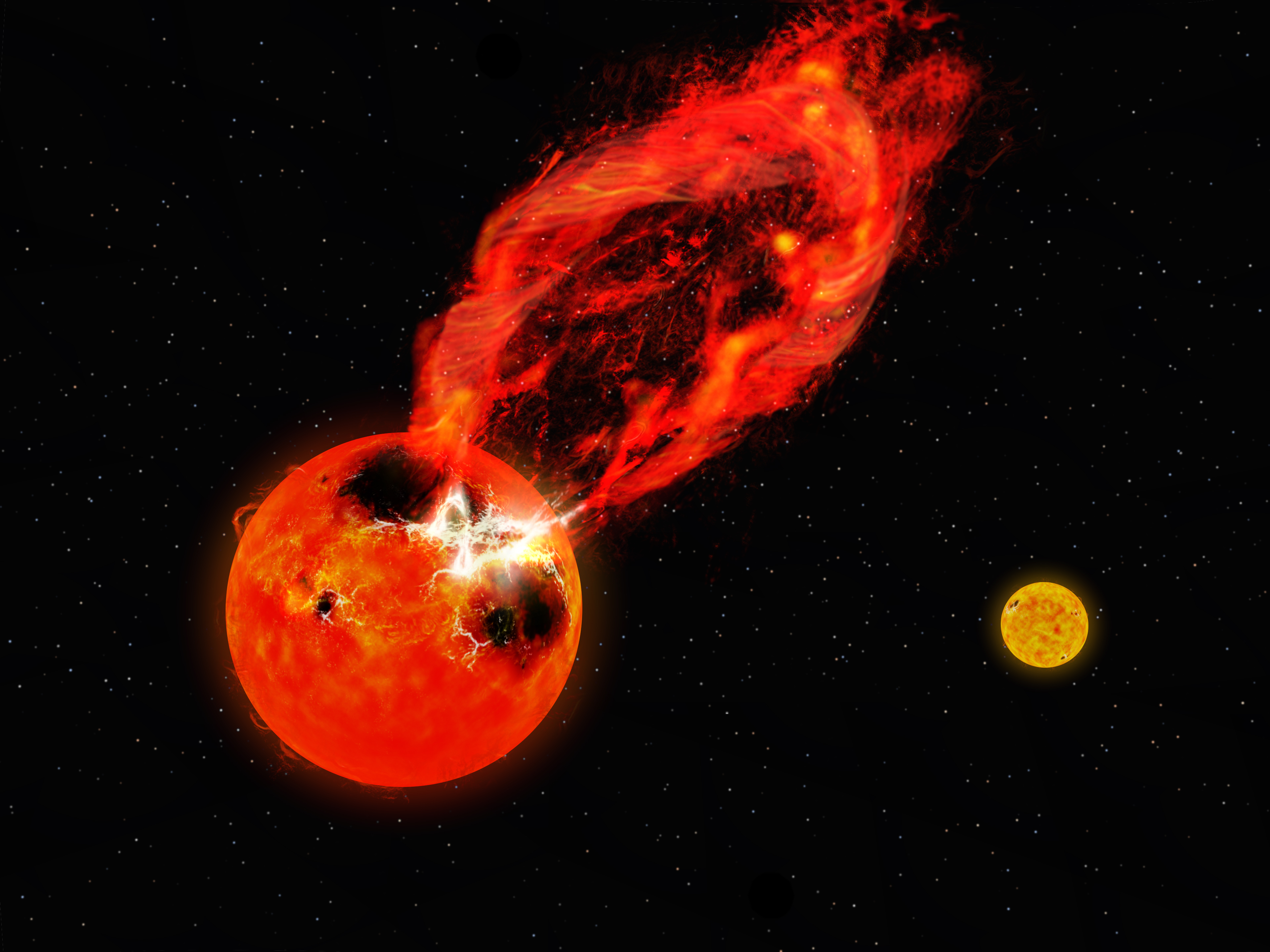
Artist’s impression of the superflare observed on one of the stars in the V1355 Orionis binary star system. The binary companion star is visible in the background on the right. (Credit: NAOJ). Original size (2.2MB)

A team of Japanese astronomers used simultaneous ground-based and space-based observations to capture a more complete picture of a superflare on a star. The observed flare started with a very massive, high-velocity prominence eruption. These results give us a better idea of how superflares and stellar prominence eruptions occur.

Some stars have been seen releasing superflares over 10 times larger than the largest solar flare ever seen on the Sun. The hot ionized gas released by solar flares can influence the environment around the Earth, referred to as space weather. More powerful superflares must have an even greater impact on the evolution of any planets forming around the star, or the evolution of any life forming on those planets. But the details of how superflares and prominence eruptions on stars occur have been unclear.

A team led by Shun Inoue at Kyoto University used the 3.8-m Seimei Telescope in Japan and the Transiting Exoplanet Survey Satellite (TESS) to monitor the binary star system V1355 Orionis which is known to frequently release large-scale superflares. V1355 Orionis is located 400 light years away in the constellation Orion.

The team succeeded in capturing a superflare with continuous, high temporal resolution observations. Data analysis shows that the superflare originated with a phenomenon known as a prominence eruption. Calculating the velocity of the eruption requires making some assumptions about aspects that aren’t directly observably, but even the most conservative estimates far exceed the escape velocity of the star (347 km/s), indicating that the prominence eruption was capable of breaking free of the star’s gravity and developing into Coronal Mass Ejections (CMEs). The prominence eruption was also one of the most massive ever observed, carrying trillions of tons of material.

These results appeared as Inoue et al. “Detection of a high-velocity prominence eruption leading to a CME associated with a superflare on the RS CVn-type star V1355 Orionis” in The Astrophysical Journal on April 27, 2023.


Tuesday, May 02, 2023

Ghostly galactic jellyfish


A spiral galaxy. Its spiral arms are studded with many pink spots, especially around the top of the galaxy. One arm is sticking out below the galaxy. From it and around the bottom of the galaxy, faint gas streams away, while little gas is visible above the galaxy. The galaxy is quite small in the centre of a dark background, where a few smaller galaxies of various shapes and sizes hang. Credit: ESA/Hubble & NASA, M. Gullieuszik and the GASP team.


The jellyfish galaxy JO175 appears to hang suspended in this image from the NASA/ESA Hubble Space Telescope. This galaxy lies over 650 million light-years from Earth in the appropriately-named constellation Telescopium, and was captured in crystal-clear detail by Hubble’s Wide Field Camera 3. A handful of more distant galaxies are lurking throughout the scene, and a bright four-pointed star lies to the lower right side.

Jellyfish galaxies get their unusual name from the tendrils of star-forming gas and dust that trail behind them, just like the tentacles of a jellyfish. These bright tendrils contain clumps of star formation and give jellyfish galaxies a particularly striking appearance. Unlike their ocean-dwelling namesakes, jellyfish galaxies make their homes in galaxy clusters, and the pressure of the tenuous superheated plasma that permeates these galaxy clusters is what draws out the jellyfish galaxies’ distinctive tendrils.

Hubble recently completed a deep dive into jellyfish clusters, specifically the star-forming clumps of gas and dust that stud their tendrils. By studying the origins and fate of the stars in these clumps, astronomers hoped to better understand the processes underpinning star formation elsewhere in the Universe. Interestingly, their research suggests that star formation in the discs of galaxies is similar to star formation in the extreme conditions found in the tendrils of jellyfish galaxies.


Monday, May 01, 2023

Webb Finds Water Vapor, But From a Rocky Planet or Its Star?

Exoplanet GJ 486 b (Artist Concept)
Credits: Illustration: NASA, ESA, CSA, Joseph Olmsted (STScI), Leah Hustak (STScI)

Exoplanet GJ 486 b (Transmission Spectrum)
Credits: Illustration: NASA, ESA, CSA, Joseph Olmsted (STScI)
Science: Sarah E. Moran (University of Arizona), Kevin B. Stevenson (APL), Ryan MacDonald (University of Michigan), Jacob A. Lustig-Yaeger (APL)


The most common stars in the universe are red dwarf stars, which means that rocky exoplanets are most likely to be found orbiting such a star. Red dwarf stars are cool, so a planet has to hug it in a tight orbit to stay warm enough to potentially host liquid water (meaning it lies in the habitable zone). Such stars are also active, particularly when they are young, releasing ultraviolet and X-ray radiation that could destroy planetary atmospheres. As a result, one important open question in astronomy is whether a rocky planet could maintain, or reestablish, an atmosphere in such a harsh environment.

To help answer that question, astronomers used NASA’s James Webb Space Telescope to study a rocky exoplanet known as GJ 486 b. It is too close to its star to be within the habitable zone, with a surface temperature of about 800 degrees Fahrenheit (430 degrees Celsius). And yet, their observations using Webb’s Near-Infrared Spectrograph (NIRSpec) show hints of water vapor. If the water vapor is associated with the planet, that would indicate that it has an atmosphere despite its scorching temperature and close proximity to its star. Water vapor has been seen on gaseous exoplanets before, but to date no atmosphere has been definitively detected around a rocky exoplanet. However, the team cautions that the water vapor could be on the star itself – specifically, in cool starspots – and not from the planet at all.

“We see a signal and it’s almost certainly due to water. But we can’t tell yet if that water is part of the planet’s atmosphere, meaning the planet has an atmosphere, or if we’re just seeing a water signature coming from the star,” said Sarah Moran of the University of Arizona in Tucson, lead author of the study.

“Water vapor in an atmosphere on a hot rocky planet would represent a major breakthrough for exoplanet science. But we must be careful and make sure that the star is not the culprit,” added Kevin Stevenson of the Johns Hopkins University Applied Physics Laboratory in Laurel, Maryland, principal investigator on the program.

GJ 486 b is about 30% larger than the Earth and three times as massive, which means it is a rocky world with stronger gravity than Earth. It orbits a red dwarf star in just under 1.5 Earth days. It is expected to be tidally locked, with a permanent day side and a permanent night side.

GJ 486 b transits its star, crossing in front of the star from our point of view. If it has an atmosphere, then when it transits starlight would filter through those gasses, imprinting fingerprints in the light that allow astronomers to decode its composition through a technique called transmission spectroscopy.

The team observed two transits, each lasting about an hour. They then used three different methods to analyze the resulting data. The results from all three are consistent in that they show a mostly flat spectrum with an intriguing rise at the shortest infrared wavelengths. The team ran computer models considering a number of different molecules, and concluded that the most likely source of the signal was water vapor.

While the water vapor could potentially indicate the presence of an atmosphere on GJ 486 b, an equally plausible explanation is water vapor from the star. Surprisingly, even in our own Sun, water vapor can sometimes exist in sunspots because these spots are very cool compared to the surrounding surface of the star. GJ 486 b’s host star is much cooler than the Sun, so even more water vapor would concentrate within its starspots. As a result, it could create a signal that mimics a planetary atmosphere.

“We didn’t observe evidence of the planet crossing any starspots during the transits. But that doesn’t mean that there aren’t spots elsewhere on the star. And that’s exactly the physical scenario that would imprint this water signal into the data and could wind up looking like a planetary atmosphere,” explained Ryan MacDonald of the University of Michigan in Ann Arbor, one of the study’s co-authors.

A water vapor atmosphere would be expected to gradually erode due to stellar heating and irradiation. As a result, if an atmosphere is present, it would likely have to be constantly replenished by volcanoes ejecting steam from the planet’s interior. If the water is indeed in the planet’s atmosphere, additional observations are needed to narrow down how much water is present.

Future Webb observations may shed more light on this system. An upcoming Webb program will use the Mid-Infrared Instrument (MIRI) to observe the planet’s day side. If the planet has no atmosphere, or only a thin atmosphere, then the hottest part of the day side is expected to be directly under the star. However, if the hottest point is shifted, that would indicate an atmosphere that can circulate heat.

Ultimately, observations at shorter infrared wavelengths by another Webb instrument, the Near-Infrared Imager and Slitless Spectrograph (NIRISS), will be needed to differentiate between the planetary atmosphere and starspot scenarios.

“It’s joining multiple instruments together that will really pin down whether or not this planet has an atmosphere,” said Stevenson.

The study is accepted for publication in The Astrophysical Journal Letters.

The James Webb Space Telescope is the world’s premier space science observatory. Webb will solve mysteries in our solar system, look beyond to distant worlds around other stars, and probe the mysterious structures and origins of our universe and our place in it. Webb is an international program led by NASA with its partners, ESA (European Space Agency) and the Canadian Space Agency.


About This Release:

Credits:

Media Contact:

Christine Pulliam
Space Telescope Science Institute, Baltimore, Maryland

Science: Sarah E. Moran (University of Arizona), Kevin B. Stevenson (APL), Ryan MacDonald (University of Michigan), Jacob A. Lustig-Yaeger (APL)


Saturday, April 29, 2023

The cluster that almost got away

A collection of oval-shaped, elliptical galaxies. The largest has two neighbouring bright spots in the core. It and two others look like galaxy clusters, with surrounding smaller galaxies. On the left edge of the image are two bright stars with four long spikes, and on the right edge is a small ring-shaped galaxy. Smaller stars and galaxies are spread evenly across the dark background. Credit: ESA/Hubble & NASA, H. Ebeling

A menagerie of interesting astronomical finds fill this image from the NASA/ESA Hubble Space Telescope. As well as several large elliptical galaxies, a ring-shaped galaxy is lurking on the right of this image. A pair of bright stars are also visible at the left of this image, notable for their colourful criss-crossing diffraction spikes. This collection of astronomical curiosities is the galaxy cluster ACO S520 in the constellation Pictor, which was captured by Hubble’s Advanced Camera for Surveys.

This is one of a series of Hubble observations searching for massive, luminous galaxy clusters that had not been captured by earlier surveys. Appropriately, the proposal for observing time was named "They almost got away"! Astronomers took advantage of occasional gaps in Hubble's busy schedule to capture images of these barely-explored galaxy clusters, revealing a wealth of interesting targets for further study with Hubble and the NASA/ESA/CSA James Webb Space Telescope.

Galaxy clusters are among the largest known objects in the Universe, and studying these objects can provide insights into the distribution of dark matter, which is responsible for most of the mass of a galaxy cluster. The vast masses of galaxy clusters is what causes many of them to act as gravitational lenses which distort and magnify light from even more distant objects. This can allow astronomers to use galaxy clusters as a kind of natural gravitational telescope to reveal distant objects that would usually be too faint to resolve — even for the crystal-clear vision of Hubble.

Source: ESA/Hubble/potw


Friday, April 28, 2023

Supernova Survey: New Stellar Danger to Planets Identified by NASA's Chandra

SN 2010jl
Credit: Science: NASA/CXC/Univ. of Illinois/I. Brunton et al.; Illustration: NASA/CXC/M. Weiss


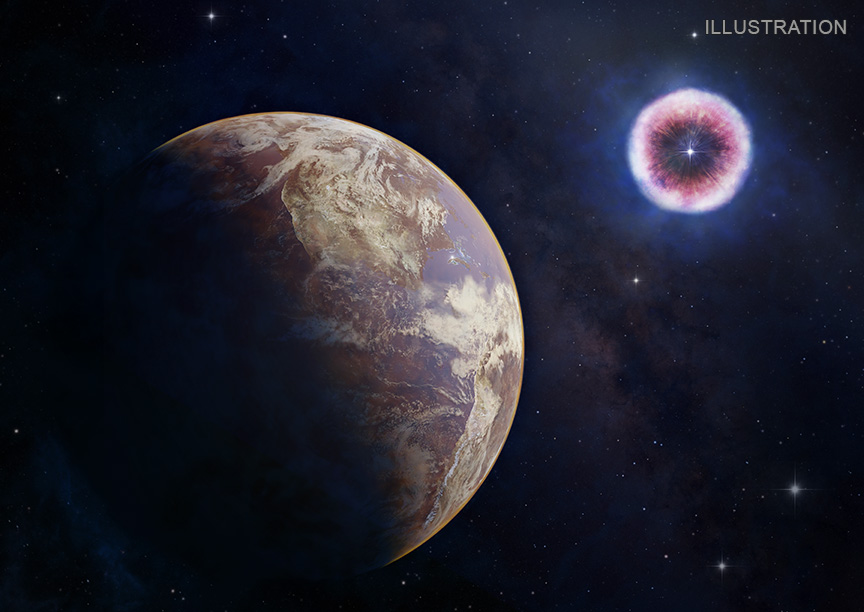
Astronomers using data from NASA’s Chandra X-ray Observatory and other telescopes have identified a new threat to life on planets like Earth: a phase during which intense X-rays from exploded stars can affect planets over 100 light-years away. This result, as outlined in our latest press release, has implications for the study of exoplanets and their habitability.

This newly found threat comes from a supernova’s blast wave striking dense gas surrounding the exploded star, as depicted in the upper right of our artist’s impression. When this impact occurs it can produce a large dose of X-rays that reaches an Earth-like planet (shown in the lower left, illuminated by its host star out of view to the right) months to years after the explosion and may last for decades. Such intense exposure may trigger an extinction event on the planet.

A new study reporting this threat is based on X-ray observations of 31 supernovae and their aftermath — mostly from NASA’s Chandra X-ray Observatory, Swift and NuSTAR missions, and ESA’s XMM-Newton — show that planets can be subjected to lethal doses of radiation located as much as about 160 light-years away. Four of the supernovae in the study (SN 1979C, SN 1987A, SN 2010jl, and SN 1994I) are shown in composite images containing Chandra data in the supplemental image.

4 of the 31 supernovae in the study
Credit: NASA/CXC/Univ. of Illinois/I. Brunton et al.


Prior to this, most research on the effects of supernova explosions had focused on the danger from two periods: the intense radiation produced by a supernova in the days and months after the explosion, and the energetic particles that arrive hundreds to thousands of years afterward.

If a torrent of X-rays sweeps over a nearby planet, the radiation could severely alter the planet's atmospheric chemistry. For an Earth-like planet, this process could wipe out a significant portion of ozone, which ultimately protects life from the dangerous ultraviolet radiation of its host star. It could also lead to the demise of a wide range of organisms, especially marine ones at the foundation of the food chain, leading to an extinction event.

After years of lethal X-ray exposure from the supernova’s interaction, and the impact of ultraviolet radiation from an Earth-like planet’s host star, a large amount of nitrogen dioxide may be produced, causing a brown haze in the atmosphere, as shown in the illustration. A “de-greening” of land masses could also occur because of damage to plants.

A separate artist’s impression (panel #1) depicts the same Earth-like planet as having been abundant with life at the time of the nearby supernova, years before most of the X-ray’s impacts are felt (panel #2).

Illustration of an Earth-like planet before and after radiation exposure.
Illustration Credit: NASA/CXC/M. Weiss

Among the four supernovae in the set of images, SN 2010jl has produced the most X-rays. The authors estimate it to have delivered a lethal dose of X-rays for Earth-like planets less than about 100 light-years away.

There is strong evidence — including the detection in different locations around the globe of a radioactive type of iron — that supernovae occurred close to Earth between about 2 million and 8 million years ago. Researchers estimate these supernovae were between about 65 and 500 light-years away from Earth.

Although the Earth and the Solar System are currently in a safe space in terms of potential supernova explosions, many other planets in the Milky Way are not. These high-energy events would effectively shrink the areas within the Milky Way galaxy, known as the Galactic Habitable Zone, where conditions would be conducive for life as we know it.

Because the X-ray observations of supernovae are sparse, particularly of the variety that strongly interact with their surroundings, the authors urge follow-up observations of interacting supernovae for months and years after the explosion.

The paper describing this result appears in the April 20, 2023 issue of The Astrophysical Journal, and is available here. The other authors of the paper are Ian Brunton, Connor O’Mahoney, and Brian Fields (University of Illinois at Urbana-Champaign), Adrian Melott (University of Kansas), and Brian Thomas (Washburn University in Kansas).

NASA's Marshall Space Flight Center manages the Chandra program. The Smithsonian Astrophysical Observatory's Chandra X-ray Center controls science operations from Cambridge, Massachusetts, and flight operations from Burlington, Massachusetts.

Quick Look: New Stellar Danger to Planets Identified by NASA's Chandra