Showing posts with label SN 2010jl. Show all posts

Saturday, January 20, 2024

Gone but not forgotten

A galaxy that is flat and misshapen. Above and on its right it is covered by plumes of shining gas and dust, while its centre and left side are more dim and patchy. A trail of dark, dim dust stretches from below the galaxy up and off to the left, where there are three more bright patches. The background around the galaxy is quite dark, with only a few small background galaxies and one star visible. Credit: ESA/Hubble & NASA, A. Filippenko

This image features a relatively small galaxy known as UGC 5189A, which is located about 150 million light-years away in the constellation Leo. This galaxy was observed by Hubble to study a supernova explosion in 2010 known as SN 2010jl. This particular supernova was notable for having been an exceptionally luminous supernova event. In fact, over a period of three years, SN 2010jl released at least 2.5 billion times more visible energy alone than our Sun emitted over the same timeframe across all wavelengths.

Even after supernovae have faded to non-observable levels, it can still be of interest to study the environments where they occurred. This can provide astronomers with valuable information: supernovae can take place for a variety of reasons, and understanding the environments in which they took place can help improve our understanding of the conditions necessary for them to be triggered. Furthermore, follow-up studies after supernovae can improve our understanding of the immediate aftermath of such events, from their potent effects on the gas and dust around them, to the stellar remnants they leave behind.

To this end, UGC 5189A has been observed many times by Hubble since 2010. This image is from data collected in three of the latest Hubble studies of UGC 5189A, which also examined several other relatively nearby galaxies that recently hosted supernovae — ‘relatively nearby’, in this context, meaning roughly 100 million light years away.


Friday, April 28, 2023

Supernova Survey: New Stellar Danger to Planets Identified by NASA's Chandra

SN 2010jl
Credit: Science: NASA/CXC/Univ. of Illinois/I. Brunton et al.; Illustration: NASA/CXC/M. Weiss


Astronomers using data from NASA’s Chandra X-ray Observatory and other telescopes have identified a new threat to life on planets like Earth: a phase during which intense X-rays from exploded stars can affect planets over 100 light-years away. This result, as outlined in our latest press release, has implications for the study of exoplanets and their habitability.

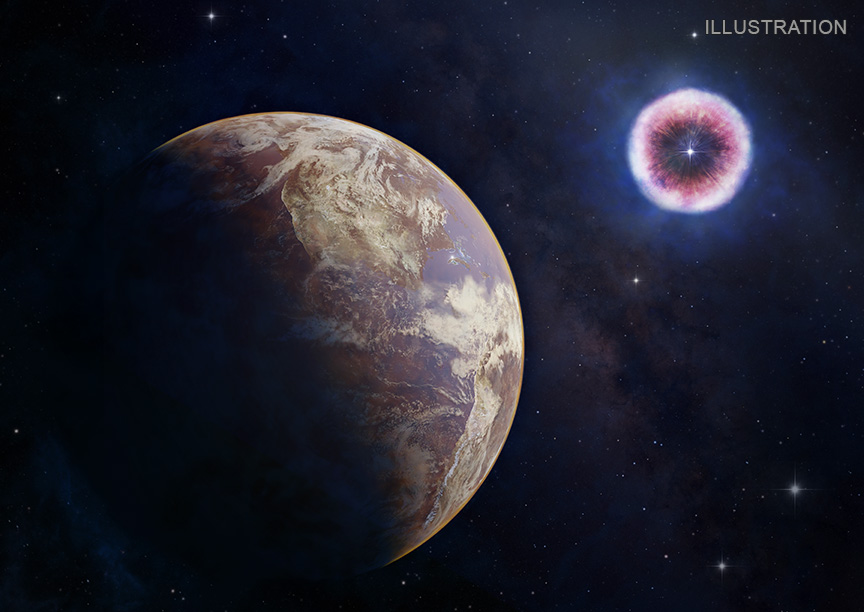
This newly found threat comes from a supernova’s blast wave striking dense gas surrounding the exploded star, as depicted in the upper right of our artist’s impression. When this impact occurs it can produce a large dose of X-rays that reaches an Earth-like planet (shown in the lower left, illuminated by its host star out of view to the right) months to years after the explosion and may last for decades. Such intense exposure may trigger an extinction event on the planet.

A new study reporting this threat is based on X-ray observations of 31 supernovae and their aftermath — mostly from NASA’s Chandra X-ray Observatory, Swift and NuSTAR missions, and ESA’s XMM-Newton — show that planets can be subjected to lethal doses of radiation located as much as about 160 light-years away. Four of the supernovae in the study (SN 1979C, SN 1987A, SN 2010jl, and SN 1994I) are shown in composite images containing Chandra data in the supplemental image.

4 of the 31 supernovae in the study
Credit: NASA/CXC/Univ. of Illinois/I. Brunton et al.


Prior to this, most research on the effects of supernova explosions had focused on the danger from two periods: the intense radiation produced by a supernova in the days and months after the explosion, and the energetic particles that arrive hundreds to thousands of years afterward.

If a torrent of X-rays sweeps over a nearby planet, the radiation could severely alter the planet's atmospheric chemistry. For an Earth-like planet, this process could wipe out a significant portion of ozone, which ultimately protects life from the dangerous ultraviolet radiation of its host star. It could also lead to the demise of a wide range of organisms, especially marine ones at the foundation of the food chain, leading to an extinction event.

After years of lethal X-ray exposure from the supernova’s interaction, and the impact of ultraviolet radiation from an Earth-like planet’s host star, a large amount of nitrogen dioxide may be produced, causing a brown haze in the atmosphere, as shown in the illustration. A “de-greening” of land masses could also occur because of damage to plants.

A separate artist’s impression (panel #1) depicts the same Earth-like planet as having been abundant with life at the time of the nearby supernova, years before most of the X-ray’s impacts are felt (panel #2).

Illustration of an Earth-like planet before and after radiation exposure.
Illustration Credit: NASA/CXC/M. Weiss

Among the four supernovae in the set of images, SN 2010jl has produced the most X-rays. The authors estimate it to have delivered a lethal dose of X-rays for Earth-like planets less than about 100 light-years away.

There is strong evidence — including the detection in different locations around the globe of a radioactive type of iron — that supernovae occurred close to Earth between about 2 million and 8 million years ago. Researchers estimate these supernovae were between about 65 and 500 light-years away from Earth.

Although the Earth and the Solar System are currently in a safe space in terms of potential supernova explosions, many other planets in the Milky Way are not. These high-energy events would effectively shrink the areas within the Milky Way galaxy, known as the Galactic Habitable Zone, where conditions would be conducive for life as we know it.

Because the X-ray observations of supernovae are sparse, particularly of the variety that strongly interact with their surroundings, the authors urge follow-up observations of interacting supernovae for months and years after the explosion.

The paper describing this result appears in the April 20, 2023 issue of The Astrophysical Journal, and is available here. The other authors of the paper are Ian Brunton, Connor O’Mahoney, and Brian Fields (University of Illinois at Urbana-Champaign), Adrian Melott (University of Kansas), and Brian Thomas (Washburn University in Kansas).

NASA's Marshall Space Flight Center manages the Chandra program. The Smithsonian Astrophysical Observatory's Chandra X-ray Center controls science operations from Cambridge, Massachusetts, and flight operations from Burlington, Massachusetts.

Quick Look: New Stellar Danger to Planets Identified by NASA's Chandra


Tuesday, May 15, 2012

SN 2010jl: A Supernova Cocoon Breakthrough

SN 2010jl
Credit X-ray: NASA/CXC/Royal Military College of Canada/P.Chandra et al); Optical: NASA/STScI
Observations with NASA's Chandra X-ray Observatory have provided the first X-ray evidence of a supernova shock wave breaking through a cocoon of gas surrounding the star that exploded. This discovery may help astronomers understand why some supernovas are much more powerful than others.

On November 3, 2010, a supernova was discovered in the galaxy UGC 5189A, located about 160 million light years away. Using data from the All Sky Automated Survey telescope in Hawaii taken earlier, astronomers determined this supernova exploded in early October 2010 (in Earth's time-frame).

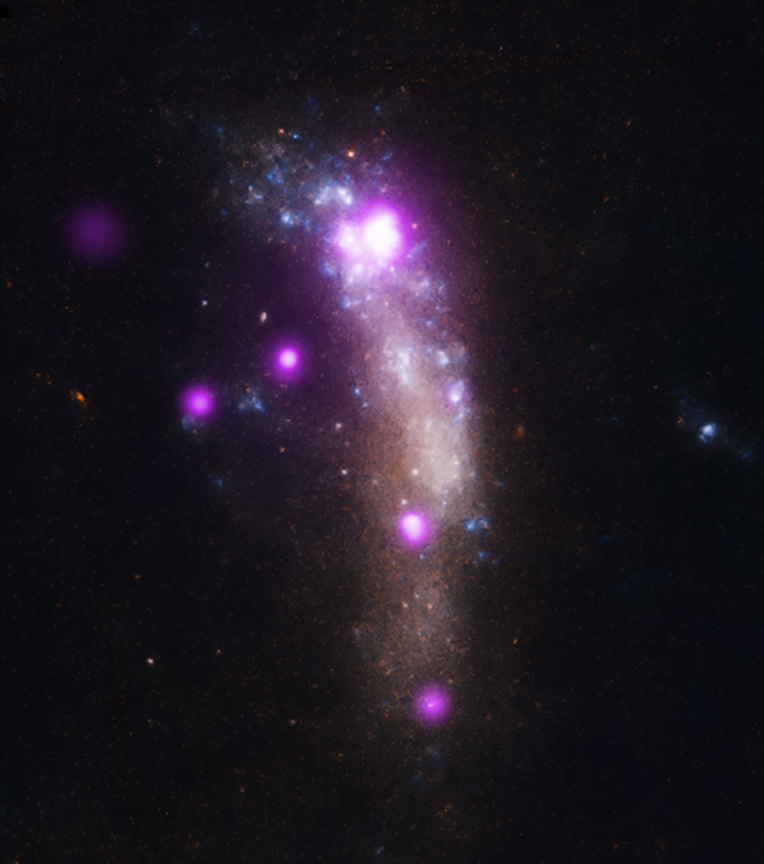
This composite image of UGC 5189A shows X-ray data from Chandra in purple and optical data from Hubble Space Telescope in red, green and blue. SN 2010jl is the very bright X-ray source near the top of the galaxy.

A team of researchers used Chandra to observe this supernova in December 2010 and again in October 2011. The supernova was one of the most luminous that has ever been detected in X-rays.

In optical light, SN 2010jl was about ten times more luminous than a typical supernova resulting from the collapse of a massive star, adding to the class of very luminous supernovas that have been discovered recently with optical surveys. Different explanations have been proposed to explain these energetic supernovas including (1) the interaction of the supernova's blast wave with a dense shell of matter around the pre-supernova star, (2) radioactivity resulting from a pair-instability supernova (triggered by the conversion of gamma rays into particle and anti-particle pairs), and (3) emission powered by a neutron star with an unusually powerful magnetic field.

In the first Chandra observation of SN 2010jl, the X-rays from the explosion's blast wave were strongly absorbed by a cocoon of dense gas around the supernova. This cocoon was formed by gas blown away from the massive star before it exploded.

In the second observation taken almost a year later, there is much less absorption of X-ray emission, indicating that the blast wave from the explosion has broken out of the surrounding cocoon. The Chandra data show that the gas emitting the X-rays has a very high temperature -- greater than 100 million degrees Kelvin - strong evidence that it has been heated by the supernova blast wave.

The energy distribution, or spectrum, of SN 2010jl in optical light reveals features that the researchers think are explained by the following scenario: matter around the supernova has been heated and ionized (electrons stripped from atoms) by X-rays generated when the blast wave plows through this material. While this type of interaction has been proposed before, the new observations directly show, for the first time, that this is happening.

This discovery therefore supports the idea that some of the unusually luminous supernovas are caused by the blast wave from their explosion ramming into the material around it.

In a rare example of a cosmic coincidence, analysis of the X-rays from the supernova shows that there is a second unrelated source at almost the same location as the supernova. These two sources strongly overlap one another as seen on the sky. This second source is likely to be an ultraluminous X-ray source, possibly containing an unusually heavy stellar-mass black hole, or an intermediate mass black hole.

These results were published in a paper appearing in the May 1st, 2012 issue of The Astrophysical Journal Letters. The authors were Poonam Chandra (Royal Military College of Canada, Kingston, Canada), Roger Chevalier and Christopher Irwin (University of Virginia, Charlottsville, VA), Nikolai Chugai (Institute of Astronomy of Russian Academy of Sciences, Moscow, Russia), Claes Fransson (Stockholm University, Sweden), and Alicia Soderberg (Harvard-Smithsonian Center for Astrophysics, Cambridge, MA).

Fast Facts for SN 2010jl:

Scale: 46 arcsec across (36,000 light years)
Category: Supernovas & Supernova Remnants
Coordinates: (J2000) RA 09h 42m 53.33s | Dec +09° 29' 41.80"
Constellation: Leo
Observation Date: 3 pointings between 7 Dec 2010 and 17 Oct 2011
Observation Time: 22 hours 13 min.
Obs. ID: 11122, 13199, 13781
Color Code: X-ray (Purple); Optical (Red, Green, Blue)
Instrument: ACIS
References: Chandra, P. et al, 2012 ApJ 750:L2; arXiv:1203.1614
Distance Estimate: 163 million light years