Releases from NASA, HubbleSite, Spitzer, ESO, ESA, NASA’s Chandra X-ray Observatory, Royal Astronomical Society, Harvard-Smithsonian Center For Astrophysics, Max Planck Institute, Gemini Observatory, Subaru Telescope, W. M. Keck Observatory, JPL-Caltech, ICRAR, Webb Space Telescope, etc
A series of plots showing the tentative detection of a candidate stellar overdensity (Pegasus VII) in the UNIONS photometric catalogs. Credit: arXiv (2025). DOI: 10.48550/arxiv.2502.09792
An international team of astronomers reports the discovery of a new dwarf galaxy, which they have named Pegasus VII. The newfound galaxy, which lies about 2.4 million light years away, was identified in the Ultraviolet Near-Infrared Optical Northern Survey (UNIONS). The discovery was detailed in a research paper published Feb. 13 on the arXiv preprint server.
Dwarf galaxies are low-luminosity and low-mass stellar systems, usually containing a few billion stars. Their formation and activity are thought to be heavily influenced by interactions with larger galaxies.
One of the great places to look for dwarf galaxies is the halo of the Andromeda galaxy (also known as Messier 31, or M31 for short), due to its relative proximity. UNIONS is so far the deepest available survey for exploring the far reaches of this galaxy's halo and now a team of astronomers led by Simon E. T. Smith of the University of Victoria in Canada, has found another such dwarf.
"We present the newly discovered dwarf galaxy Pegasus VII (Peg VII), a member of the M31 sub-group which has been uncovered in the ri photometric catalogs from the Ultraviolet Near-Infrared Optical Northern Survey and confirmed with follow-up imaging from both the Canada-France-Hawaii Telescope and the Gemini-North Telescope," the researchers wrote in the paper.
Pegasus VII was identified at a separation of about 1.08 million light years from the Andromeda galaxy. Therefore, Pegasus VII is just about to cross the virial radius of Andromeda and has likely been isolated up until this point.
According to the study, Pegasus VII has an absolute V-band magnitude of −5.7 mag, a central surface of 27.3 mag/arcsec2, and a physical half-light radius of approximately 577 light years. This means that Pegasus VII is the faintest known dwarf galaxy satellite of Andromeda and roughly five times larger than the most extended globular clusters in this galaxy.
The study found that Pegasus VII has an ellipticity at a level of 0.5 and this projected elongation is aligned within 18 degrees of the projected direction towards Andromeda. The astronomers suppose that the source of this elongation is a previous tidal interaction with the gravitational potential of the Andromeda galaxy.
Furthermore, the researchers calculated that Pegasus VII has a total stellar mass of 26,000 solar masses and its metallicity is at a level of -2.0 dex. The age of the dwarf galaxy was estimated to be around 10 billion years.
Summing up the results, the authors of the paper concluded that they hope to find many more dwarf galaxies in the halo of Andromeda.
"The discovery of Pegasus VII complements both the empirical and theoretical claim that a wealth of dwarf galaxy satellites remain undetected towards M31," the scientists wrote.
More information: Simon E. T. Smith et al, Deep in the Fields of the Andromeda Halo: Discovery of the Pegasus VII dwarf galaxy in UNIONS, arXiv (2025).DOI: 10.48550/arxiv.2502.09792
Hubble M31 PHAT+PHAST Mosaic Science: NASA, ESA, Benjamin F. Williams (UWashington), Zhuo Chen (UWashington), L. Clifton Johnson (Northwestern)
Image Processing: Joseph DePasquale (STScI)
Compass and Scale Image of M31 PHAT+PHAST Mosaic Science: NASA, ESA, Benjamin F. Williams (UWashington), Zhuo Chen (UWashington), L. Clifton Johnson (Northwestern)
Image Processing: Joseph DePasquale (STScI)
Andromeda M31 PHAST Mosaic Video Credits/Visualization: NASA, ESA, Greg Bacon (STScI)
Science: Benjamin F. Williams (UWashington)
In the years following the launch of NASA's Hubble Space Telescope, astronomers have tallied over 1 trillion galaxies in the universe. But only one galaxy stands out as the most important nearby stellar island to our Milky Way — the magnificent Andromeda galaxy (Messier 31). It can be seen with the naked eye on a very clear autumn night as a faint cigar-shaped object roughly the apparent angular diameter of our Moon.
A century ago, Edwin Hubble first established that this so-called "spiral nebula" was actually very far outside our own Milky Way galaxy —at a distance of approximately 2.5 million light-years or roughly 25 Milky Way diameters. Prior to that, astronomers had long thought that the Milky way encompassed the entire universe. Overnight, Hubble's discovery turned cosmology upside down by unveiling an infinitely grander universe.
Now, a century later, the space telescope named for Hubble has accomplished the most comprehensive survey of this enticing empire of stars. The Hubble telescope is yielding new clues to the evolutionary history of Andromeda, and it looks markedly different from the Milky Way's history.
Without Andromeda as a proxy for spiral galaxies in the universe at large, astronomers would know much less about the structure and evolution of our own Milky Way. That's because we are embedded inside the Milky Way. This is like trying to understand the layout of New York City by standing in the middle of Central Park.
"With Hubble we can get into enormous detail about what's happening on a holistic scale across the entire disk of the galaxy. You can't do that with any other large galaxy," said principal investigator Ben Williams of the University of Washington. Hubble's sharp imaging capabilities can resolve more than 200 million stars in the Andromeda galaxy, detecting only stars brighter than our Sun. They look like grains of sand across the beach. But that's just the tip of the iceberg. Andromeda's total population is estimated to be 1 trillion stars, with many less massive stars falling below Hubble's sensitivity limit.
Photographing Andromeda was a herculean task because the galaxy is a much bigger target on the sky than the galaxies Hubble routinely observes, which are often billions of light-years away. The full mosaic was carried out under two Hubble programs. In total it required over 1,000 Hubble orbits, spanning more than a decade.
This panorama started with the Panchromatic Hubble Andromeda Treasury (PHAT) program about a decade ago. Images were obtained at near-ultraviolet, visible, and near-infrared wavelengths using the Advanced Camera for Surveys and the Wide Field Camera 3 aboard Hubble to photograph the northern half of Andromeda.
This program was followed up by the Panchromatic Hubble Andromeda Southern Treasury (PHAST), recently published in The Astrophysical Journal and led by Zhuo Chen at the University of Washington, which added images of approximately 100 million stars in the southern half of Andromeda. This region is structurally unique and more sensitive to the galaxy's merger history than the northern disk mapped by the PHAT survey.
The combined programs collectively cover the entire disk of Andromeda, which is seen almost edge-on — tilted by 77 degrees relative to Earth's view. The galaxy is so large that the mosaic is assembled from approximately 600 separate fields of view. The mosaic image is made up of at least 2.5 billion pixels.
The complementary Hubble survey programs provide information about the age, heavy-element abundance and stellar masses inside Andromeda. This will allow astronomers to distinguish between competing scenarios where Andromeda merged with one or more galaxies. Hubble's detailed measurements constrain models of Andromeda's merger history and disk evolution.
A Galactic 'Train Wreck'
Though the Milky Way and Andromeda formed presumably around the same time many billions of years ago, observational evidence shows that they have very different evolutionary histories, despite growing up in the same cosmological neighborhood. Andromeda seems to be more highly populated with younger stars and unusual features like coherent streams of stars, say researchers. This implies it has a more active recent star-formation and interaction history than the Milky Way.
"Andromeda's a train wreck. It looks like it has been through some kind of event that caused it to form a lot of stars and then just shut down," said Daniel Weisz at the University of California, Berkeley. "This was probably due to a collision with another galaxy in the neighborhood."
A possible culprit is the compact satellite galaxy Messier 32, which resembles the stripped-down core of a once-spiral galaxy that may have interacted with Andromeda in the past. Computer simulations suggest that when a close encounter with another galaxy uses up all the available interstellar gas, star formation subsides.
"Andromeda looks like a transitional type of galaxy that's between a star-forming spiral and a sort of elliptical galaxy dominated by aging red stars," said Weisz. "We can tell it's got this big central bulge of older stars and a star-forming disk that's not as active as you might expect given the galaxy's mass."
"This detailed look at the resolved stars will help us to piece together the galaxy's past merger and interaction history," added Williams.
Hubble's new findings will support future observations by NASA's James Webb Space Telescope and the upcoming Nancy Grace Roman Space Telescope. Essentially a wide-angle version of Hubble (with the same sized mirror), Roman will capture the equivalent of at least 100 high-resolution Hubble images in a single exposure. These observations will complement and extend Hubble's huge dataset. ; The Hubble Space Telescope has been operating for over three decades and continues to make ground-breaking discoveries that shape our fundamental understanding of the universe. Hubble is a project of international cooperation between NASA and ESA (European Space Agency). NASA's Goddard Space Flight Center in Greenbelt, Maryland, manages the telescope and mission operations. Lockheed Martin Space, based in Denver, also supports mission operations at Goddard. The Space Telescope Science Institute in Baltimore, which is operated by the Association of Universities for Research in Astronomy, conducts Hubble science operations for NASA.
Gamma rays are the highest-energy photons in our universe. Naturally, they come from some of the most extreme environments in the universe, such as pulsars, active galactic nuclei, supernovae, and potentially even dark matter. Though many gamma-ray sources have been detected both in the Milky Way and extragalactically, the nature of gamma-ray emission from our closest neighbouring galaxy, Andromeda (or Messier 31), remains somewhat of a mystery.
The Fermi Large Area Telescope (Fermi-LAT) is an instrument on the Fermi Gamma-ray Space Telescope that has been surveying the sky for high-energy gamma rays since 2008, with ample data taken on Andromeda throughout its flight. Many groups have analyzed these data, with more data giving more insight into what’s making these gamma rays.
Figure 1: Significance maps of Andromeda at energies from 0.1 to 500
gigaelectronvolts (left) and 2 to 500 gigaelectronvolts (right). The
region of optical emission is represented by the white contour. The
colorbar corresponds to test statistic, which is similar to
significance. A test statistic of 25 corresponds to a detection. Green
markers correspond to nearby sources found in the SIMBAD database. The
left figure shows a hint of additional structure in the southeast region
of Andromeda, but both point sources emerge out of the seemingly
extended region only with the lowest energies cut out. Credit: Xing et
al. 2023
To Extend or Not to Extend?
Up until today’s article, it looked like gamma rays from Andromeda were coming from a blob-like shape (i.e., extended emission) surrounding the centre of the galaxy (similar to Figure 1, left). This was particularly exciting, since extended structure in gamma-ray emission often suggests either a distribution of cosmic rays or the presence of a massive dark matter halo.
Cosmic rays are charged particles that travel at relativistic speeds through the universe but get easily diverted by magnetic fields, making it very difficult to trace their origin from Earth. Luckily, since there are processes that produce gamma rays from charged particles (hadronic processes), identifying regions of extended gamma rays can trace regions where populations of cosmic rays are interacting with their environments. On the other hand, clumps of massive dark matter located in the centre of Andromeda could decay or annihilate, producing gamma rays in the process.
Figure 2: A spectral energy distribution showing flux (quantity of gamma rays received) plotted against energy of Andromeda’s centre (black) and southeast (red) emission regions, along with the Milky Way’s galactic centre (blue). It is apparent that both sources are not only similar in brightness but are also producing significantly more gamma rays than our galactic centre. Click to enlarge. Credit: Xing et al. 2023
Where are the Gamma Rays Coming From?
A reanalysis of 14 years of Fermi-LAT data by the authors reveals that the emission of gamma rays isn’t extended after all. In fact, it seems that it’s constrained to two point sources: one located right at the centre of the galaxy and another ~20,000 light-years to the southeast (see Figure 1). This only became apparent when the authors cut out the lowest-energy gamma rays, which still make the data appear more or less extended when they’re included. Even more curiously, the authors found that both of these regions are significantly brighter than expected when compared to the gamma-ray emission of our own galactic centre (see Figure 2).
This new picture of Andromeda’s gamma rays changes a lot about our understanding of the galaxy. It’s no longer likely that Andromeda’s central gamma-ray hotspot is coming from a dark matter halo or cosmic ray distribution, so the authors looked to the Milky Way’s galactic centre to figure out what sorts of objects could be responsible for the gamma rays. One of the leading theories for our own galactic centre gamma rays is a population of old, unresolved objects, such as millisecond pulsars. However, in the case of Andromeda, at least 15,000 millisecond pulsars would be needed to account for the especially bright gamma-ray emission. While it’s still uncertain whether or not the centre of Andromeda can host this huge number of pulsars, we’ve only detected around 200 in the Milky Way’s centre, so this explanation seems unlikely.
The authors also investigate the southeast source that appeared in their new analysis. Since galaxies are pretty far apart from one another, the chance of finding two or more galaxies by coincidence in a circle drawn around both the central and southeast sources is only ~0.4%. This means that the emission is most likely coming from within Andromeda. As seen in Figure 2, the off-centre source is almost exactly the same brightness as Andromeda’s centre source (which is peculiar in its own right!), leading to the same problem of identifying sources capable of emitting such bright emission. After looking through X-ray and optical surveys, the authors determined that there weren’t any good counterparts for this region in other wavelengths either. Even considering the low probability of this being an extragalactic source behind Andromeda, there aren’t any known counterparts in the region of the sky where this hotspot is located.
The results are certainly unexpected and open up a whole new can of worms when it comes to figuring out the origin of the gamma rays in our neighbouring galaxy. Even though there are still a lot of unknowns, future observations and analyses of these newly constrained regions will help us understand how bright gamma rays are produced near the centres of galaxies and may even help us better understand our own galactic centre.
Original astrobite edited by Ivey Davis and Katya Gozman.
Editor’s Note:Astrobitesis a graduate-student-run organization that digests astrophysical literature for undergraduate students. As part of thepartnershipbetween
the AAS and astrobites, we occasionally repost astrobites content here
at AAS Nova. We hope you enjoy this post from astrobites; the original
can be viewed atastrobites.org.
About the author, Samantha Wong:
I’m a graduate student at McGill University, where I study high-energy astrophysics. This includes studying all sorts of extreme environments in the universe like active galactic nuclei, pulsars, and supernova remnants with the VERITAS gamma-ray telescope.
The NASA/ESA Hubble Space Telescope has
captured the most detailed image yet of a close neighbour of the Milky
Way — the Triangulum Galaxy, a spiral galaxy located at a distance of
only three million light-years. This panoramic survey of the
third-largest galaxy in our Local Group of galaxies provides a
mesmerising view of the 40 billion stars that make up one of the most
distant objects visible to the naked eye.
This new image of the Triangulum Galaxy
— also known as Messier 33 or NGC 598 — has a staggering 665 million
pixels and showcases the central region of the galaxy and its inner
spiral arms. To stitch together this gigantic mosaic, Hubble’s Advanced Camera for Surveys needed to create 54 separate images.
Under excellent dark-sky conditions, the Triangulum Galaxy
can be seen with the naked eye as a faint, blurry object in the
constellation of Triangulum (the Triangle), where its ethereal glow is an exciting target for amateur astronomers.
At only three million light-years from Earth, the Triangulum Galaxy is a notable member of the Local Group — it is the group’s third-largest galaxy, but also the smallest spiral galaxy in the group [1].
It measures only about 60 000 light-years across, compared to the 200
000 light-years of the Andromeda Galaxy; the Milky Way lies between
these extremes at about 100 000 light-years in diameter [2].
The Triangulum Galaxy is not only surpassed in size by the
other two spirals, but by the multitude of stars they contain. The
Triangulum Galaxy has at least an order of magnitude less stars than the
Milky Way and two orders of magnitude less than Andromeda. These
numbers are hard to grasp when already in this image 10 to 15 million
individual stars are visible.
In contrast to the two larger spirals, the Triangulum
Galaxy doesn’t have a bright bulge at its centre and it also lacks a bar
connecting its spiral arms to the centre. It does, however, contain a
huge amount of gas and dust, giving rise to rapid star formation. New
stars form at a rate of approximately one solar mass every two years.
The abundance of gas clouds in the Triangulum Galaxy is precisely what drew astronomers to conduct this detailed survey. When stars are born,
they use up material in these clouds of gas and dust, leaving less fuel
for new stars to emerge. Hubble’s image shows two of the four brightest
of these regions in the galaxy: NGC 595 and NGC 604.
The latter is the second most luminous region of ionised hydrogen
within the Local Group and it is also among the largest known star
formation regions in the Local Group.
These detailed observations of the Triangulum Galaxy have tremendous
legacy value — combined with those of the Milky Way, the Andromeda
Galaxy and the irregular Magellanic Cloud galaxies, they will help astronomers to better understand star formation and stellar evolution.
Notes
[1] Our galaxy, theMilky Way, is part of theLocal Group, an assembly of more than 50 galaxies bound together by gravity. Its largest member is theAndromeda Galaxy— also known as Messier 31 — followed by the Milky Way and the
Triangulum Galaxy. The remaining members of the Local Group are dwarf
galaxies, each orbiting one of the three larger ones.
[2] The much bigger Andromeda Galaxy
was mapped by Hubble in 2015, creating the sharpest and largest image of
this galaxy and the largest Hubble image ever (heic1502).
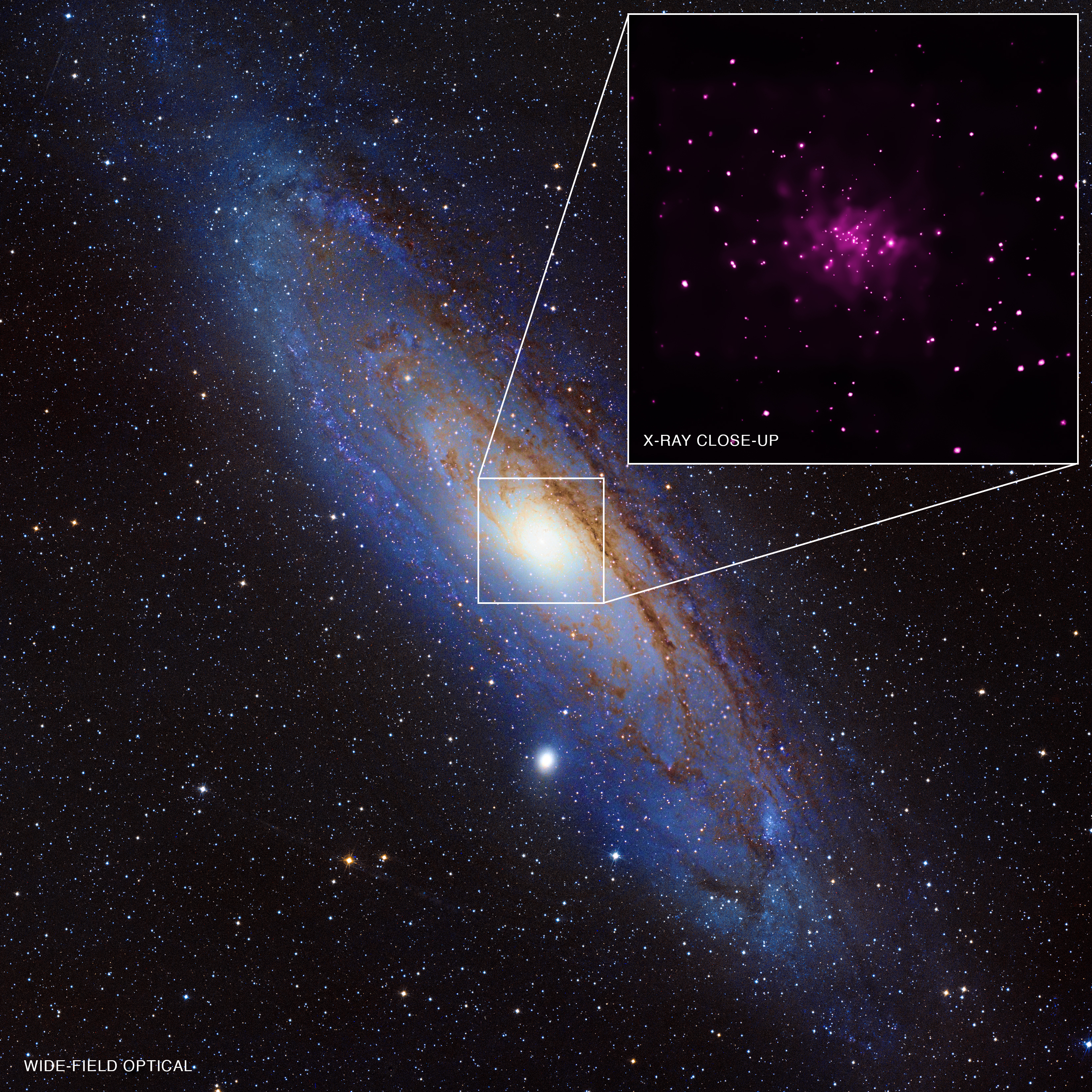
Data from NASA's Chandra X-ray Observatory have been used to discover 26 black hole candidates in the Milky Way's galactic neighbor, Andromeda, as described in our latest press release. This is the largest number of possible black holes found in a galaxy outside of our own.
A team of researchers, led by Robin Barnard of the
Harvard-Smithsonian Center for Astrophysics, used 152 observations of
Chandra spanning over 13 years to find the 26 new black hole candidates.
Nine were known from earlier work. These black holes belong to the stellar-mass black hole category, which means they were created when a massive star collapsed and are about 5 to 10 times the mass of the Sun.
This wide-field view of Andromeda contains optical data from the
Burrell Schmidt telescope of the Warner and Swansey Observatory on Kitt
Peak in Arizona. Additional detail of the core and dust in the spiral
arms comes from an image taken by astrophotographer Vicent Peris using
data from two of his personal telescopes. In this combined optical
image, red, green, and blue show different bands from the visible light
portion of the electromagnetic spectrum.
The inset contains X-ray data from multiple Chandra observations of
the central region of Andromeda. This Chandra image shows 28 of the 35
black hole candidates in this view, visible by mousing over the image.
The other seven candidates can be seen in this Chandra image with a larger field of view.
Chandra X-ray close-up of M31's core, with sources circled
Seven of the 35 black hole candidates are within only 1,000 light years
of the Andromeda Galaxy's center (mouse over the image for the dotted
circle enclosing these sources). This is more than the number of black
hole candidates with similar properties located near the center of our own Galaxy.
This, however, does not take astronomers by surprise, since the bulge
of stars in the middle of Andromeda is bigger, allowing more black holes
to form.
Eight of the nine black hole candidates that were previously identified are associated with globular clusters,
the ancient concentrations of stars distributed in a spherical pattern
about the center of the galaxy. This also differentiates Andromeda from
the Milky Way as astronomers have yet to find a similar black hole in
one of the Milky Way's globular clusters.
Andromeda, also known as Messier 31 (M31), is a spiral galaxy located
about 2.5 million light years away. It is thought that the Milky Way
and Andromeda will collide
several billion years from now. The black holes located in both
galaxies will then reside in the large, elliptical galaxy that results
from this merger.
These results are available online
and will be published in the June 20th issue of The Astrophysical
Journal. Many of the Andromeda observations were made within Chandra's
Guaranteed Time Observer program.
Fast Facts for M31:
Scale:Optical image is 2 degrees across (about 100,000 light years); inset image is 14 arcmin across (about 12,000 light years) Category:Normal Galaxies & Starburst Galaxies, Black Holes Coordinates (J2000):RA 00h 40m 27s | Dec +40° 40' 12 Constellation:Andromeda Observation Date:152 pointings between 1999 and 2012
Observation Time:55 hours 30 min (2 days 7 hours 30 min) Instrument:ACIS Also Known As:Andromeda References:Barnard, R. et al, 2013, ApJ 770, 148;arXiv:1304.7780 Color Code:X-ray (Purple); Optical (Red, Green, Blue) Distance Estimate:
About 2.5 million light years
The ring-like swirls of dust filling the Andromeda galaxy stand out colorfully in this new image from the Herschel Space Observatory, a European Space Agency mission with important NASA participation. Image credit: ESA/NASA/JPL-Caltech/NHSC .› Full image and caption
In this new view of the Andromeda galaxy from the Herschel space observatory, cool lanes of forming stars are revealed in the finest detail yet. Herschel is a European Space Agency mission with important NASA participation. Image credit: ESA/Herschel/PACS & SPIRE Consortium, O. Krause, HSC, H. Linz .› Full image and caption-enlarge image
Two new eye-catching views from the Herschel space observatory are fit for a princess. They show the elegant spiral galaxy Andromeda, named after the mythical Greek princess known for her beauty.
The Andromeda galaxy, also known as Messier 31, lies 2 million light-years away, and is the closest large galaxy to our own Milky Way. It is estimated to have up to one trillion stars, whereas the Milky Way contains hundreds of billions. Recent evidence suggests Andromeda's overall mass may in fact be less than the mass of the Milky Way, when dark matter is included.
Herschel, a European Space Agency mission with important NASA contributions, sees the longer-wavelength infrared light from the galaxy, revealing its rings of cool dust. Some of this dust is the very coldest in the galaxy -- only a few tens of degrees above absolute zero.
In both views, warmer dust is highlighted in the central regions by different colors. New stars are being born in this central, crowded hub, and throughout the galaxy's rings in dusty knots. Spokes of dust can also be seen between the rings.
Herschel is a European Space Agency cornerstone mission, with science instruments provided by consortia of European institutes and with important participation by NASA. NASA's Herschel Project Office is based at NASA's Jet Propulsion Laboratory, Pasadena, Calif. JPL contributed mission-enabling technology for two of Herschel's three science instruments. The NASA Herschel Science Center, part of the Infrared Processing and Analysis Center at the California Institute of Technology in Pasadena, supports the United States astronomical community. Caltech manages JPL for NASA.