Showing posts with label superflares. Show all posts

Friday, October 18, 2024

Astronomers observe a strong superflare from giant star

Evolution of NICER spectra during the flare; shown are four spectra from one orbit each. Spectra are binned to a minimum of 25 counts per bin. Colors correspond the time of the observation. Credit: arXiv (2024).DOI: 10.48550/arxiv.2410.03616

Using the Neutron Star Interior Composition Explorer (NICER) and various ground-based telescopes, an international team of astronomers have performed observations of a strong X-ray superflare which occurred in 2022 on a giant star known as HD 251108. Results of the observational campaign, published Oct. 4 on the pre-print server arXiv, provide more insights into the flaring activity of this star.Colors correspond the time of the observation.

Superflares are massive bursts of energy from a stellar surface. Detecting new flares of this type and studying them in detail is essential to better understand the origin of these events and the interaction between the magnetic fields and surfaces of stars.

Located some 1,646 light years away, HD 251108 is an evolved and magnetically active K-type —about seven times larger than the sun. The star is relatively cool, with an of 4,460 K, and its mass is comparable to that of the sun.

In late 2022, HD 251108 experienced a powerful X-ray superflare and a group of astronomers led by Hans Moritz Gunther of MIT Kavli Institute for Astrophysics and Space Research in Cambridge, Massachusetts, began to monitor this event in order to better understand flaring activity on single giant stars.

"We followed the phase of a superflare for 28 days with NICER and from the ground. We track the decay in unprecedented detail in several coronal temperature components," the researchers wrote in the paper.

The observations found that the 2022 superflare on HD 251108 had a peak flux of around 10 decillion erg/s in the 0.5–4.0 keV band and an exponential decay time of 2.2 days in the early decay phase. This makes it one of the strongest flares ever observed.

Based on the collected data, the length of the flare loop was estimated to be two to four times larger than the radius of HD 251108. Moreover, about 10 days after the flare peak, the flare was found to undergo a short phase of limited re-heating and the lightcurve began to deviate from the initial decay.

The study found that chemical abundances of HD 251108 are stable throughout the flare and consistent with typical active stars with the inverse first ionization potential (IFIP) effect. The astronomers noted that during the initial decay, the X-ray light curve is matched by a decay in the hydrogen-alpha flux, while the plasma shows some re-heating.

According to the paper, HD 251108 shows rotational modulation with a period of 21.3 days. Such behavior can be explained by large stellar spots, stable for several years, but rotating in and out of view.

The observations also found that the star exhibits photometric variability of order of approximately 0.5 mag, on time scales of one or more decades of order 0.5 mag. This is consistent with these large and very stable stellar spots.

by Tomasz Nowakowski , Phys.org


More information: Hans Moritz Günther et al, A long-duration superflare on the K giant HD 251108, arXiv (2024). DOI: 10.48550/arxiv.2410.03616

Journal information: arXiv


Explore further


Wednesday, May 03, 2023

Superflare with Massive, High-Velocity Prominence Eruption


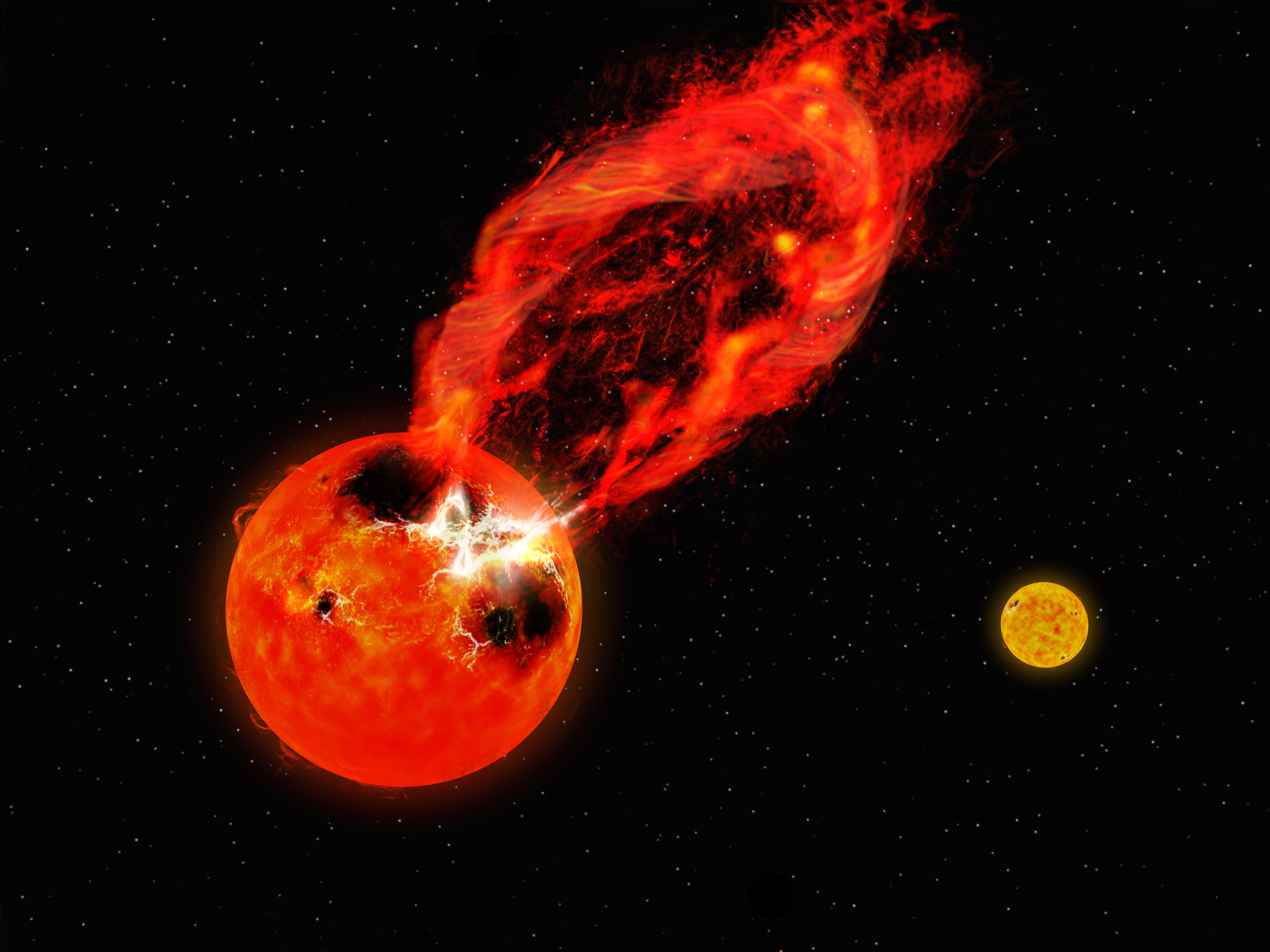
Artist’s impression of the superflare observed on one of the stars in the V1355 Orionis binary star system. The binary companion star is visible in the background on the right. (Credit: NAOJ). Original size (2.2MB)

A team of Japanese astronomers used simultaneous ground-based and space-based observations to capture a more complete picture of a superflare on a star. The observed flare started with a very massive, high-velocity prominence eruption. These results give us a better idea of how superflares and stellar prominence eruptions occur.

Some stars have been seen releasing superflares over 10 times larger than the largest solar flare ever seen on the Sun. The hot ionized gas released by solar flares can influence the environment around the Earth, referred to as space weather. More powerful superflares must have an even greater impact on the evolution of any planets forming around the star, or the evolution of any life forming on those planets. But the details of how superflares and prominence eruptions on stars occur have been unclear.

A team led by Shun Inoue at Kyoto University used the 3.8-m Seimei Telescope in Japan and the Transiting Exoplanet Survey Satellite (TESS) to monitor the binary star system V1355 Orionis which is known to frequently release large-scale superflares. V1355 Orionis is located 400 light years away in the constellation Orion.

The team succeeded in capturing a superflare with continuous, high temporal resolution observations. Data analysis shows that the superflare originated with a phenomenon known as a prominence eruption. Calculating the velocity of the eruption requires making some assumptions about aspects that aren’t directly observably, but even the most conservative estimates far exceed the escape velocity of the star (347 km/s), indicating that the prominence eruption was capable of breaking free of the star’s gravity and developing into Coronal Mass Ejections (CMEs). The prominence eruption was also one of the most massive ever observed, carrying trillions of tons of material.

These results appeared as Inoue et al. “Detection of a high-velocity prominence eruption leading to a CME associated with a superflare on the RS CVn-type star V1355 Orionis” in The Astrophysical Journal on April 27, 2023.


Tuesday, June 02, 2020

Hot stars are plagued by giant magnetic spots, ESO data shows

Artist’s impression of star plagued by giant magnetic spot

Spots on the Sun vs spots on extreme horizontal branch stars (artist's impression)


Videos

ESOcast Light 223: Hot Stars are Plagued by Giant Magnetic Spots

Animation of star plagued by giant magnetic spot

Spots on the Sun vs spots on extreme horizontal branch stars (animation)


Astronomers using European Southern Observatory (ESO) telescopes have discovered giant spots on the surface of extremely hot stars hidden in stellar clusters. Not only are these stars plagued by magnetic spots, some also experience superflare events, explosions of energy several million times more energetic than similar eruptions on the Sun. The findings, published today in Nature Astronomy, help astronomers better understand these puzzling stars and open doors to resolving other elusive mysteries of stellar astronomy.

The team, led by Yazan Momany from the INAF Astronomical Observatory of Padua in Italy, looked at a particular type of star known as extreme horizontal branch stars — objects with about half the mass of the Sun but four to five times hotter. “These hot and small stars are special because we know they will bypass one of the final phases in the life of a typical star and will die prematurely,” says Momany, who was previously a staff astronomer at ESO’s Paranal Observatory in Chile. “In our Galaxy, these peculiar hot objects are generally associated with the presence of a close companion star.”

Surprisingly, however, the vast majority of these extreme horizontal branch stars, when observed in tightly packed stellar groups called globular clusters, do not appear to have companions. The team’s long-term monitoring of these stars, made with ESO telescopes, also revealed that there was something more to these mysterious objects. When looking at three different globular clusters, Momany and his colleagues found that many of the extreme horizontal branch stars within them showed regular changes in their brightness over the course of just a few days to several weeks.

“After eliminating all other scenarios, there was only one remaining possibility to explain their observed brightness variations,” concludes Simone Zaggia, a study co-author from the INAF Astronomical Observatory of Padua in Italy and a former ESO Fellow: “these stars must be plagued by spots!” 

Spots on extreme horizontal branch stars appear to be quite different from the dark sunspots on our own Sun, but both are caused by magnetic fields. The spots on these hot, extreme stars are brighter and hotter than the surrounding stellar surface, unlike on the Sun where we see spots as dark stains on the solar surface that are cooler than their surroundings. The spots on extreme horizontal branch stars are also significantly larger than sunspots, covering up to a quarter of the star’s surface. These spots are incredibly persistent, lasting for decades, while individual sunspots are temporary, lasting only a few days to months. As the hot stars rotate, the spots on the surface come and go, causing the visible changes in brightness.

Beyond the variations in brightness due to spots, the team also discovered a couple of extreme horizontal branch stars that showed superflares — sudden explosions of energy and another signpost of the presence of a magnetic field. “They are similar to the flares we see on our own Sun, but ten million times more energetic,” says study co-author Henri Boffin, an astronomer at ESO’s headquarters in Germany. “Such behaviour was certainly not expected and highlights the importance of magnetic fields in explaining the properties of these stars.”

After six decades of trying to understand extreme horizontal branch stars, astronomers now have a more complete picture of them. Moreover, this finding could help explain the origin of strong magnetic fields in many white dwarfs, objects that represent the final stage in the life of Sun-like stars and show similarities to extreme horizontal branch stars. “The bigger picture though,” says team member, David Jones, a former ESO Fellow now at the Instituto de Astrofísica de Canarias, Spain, “is that changes in brightness of all hot stars — from young Sun-like stars to old extreme horizontal branch stars and long-dead white dwarfs — could all be connected. These objects can thus be understood as collectively suffering from magnetic spots on their surfaces.”

To arrive at this result, the astronomers used several instruments on ESO’s Very Large Telescope (VLT), including VIMOS, FLAMES and FORS2, as well as OmegaCAM attached to the VLT Survey Telescope at Paranal Observatory. They also employed ULTRACAM on the New Technology Telescope at ESO’s La Silla Observatory, also in Chile. The breakthrough came as the team observed the stars in the near-ultraviolet part of the spectrum, allowing them to reveal the hotter, extreme stars standing out bright amongst the cooler stars in globular clusters.


More Information

This research is presented in the paper “A plague of magnetic spots among the hot stars of globular clusters”, published today in Nature Astronomy (doi: 10.1038/s41550-020-1113-4).

The team is composed of Y. Momany (INAF Astronomical Observatory of Padua, Italy [INAF Padua]), S. Zaggia (INAF Padua), M. Montalto (Department of Physics and Astronomy, University of Padua, Italy [U. Padua]), D. Jones (Instituto de Astrofísica de Canarias and Department of Astrophysics, University of La Laguna, Tenerife, Spain), H.M.J. Boffin (European Southern Observatory, Garching, Germany, S. Cassisi (INAF Astronomical Observatory of Abruzzo and INFN Pisa, Italy), C. Moni Bidin (Instituto de Astronomia, Universidad Catolica del Norte, Antofagasta, Chile), M. Gullieuszik (INAF Padua), I. Saviane (European Southern Observatory, Santiago, Chile), L. Monaco (Departamento de Ciencias Fisicas, Universidad Andreas Bello, Santiago, Chile), E. Mason (INAF Astronomical Observatory of Trieste, Italy), L. Girardi (INAF Padua), V. D’Orazi (INAF Padua), G. Piotto (U. Padua), A.P. Milone (U. Padua), H. Lala (U. Padua), P.B. Stetson (Herzberg Astronomy and Astrophysics, National Research Council, Victoria, Canada), and Y. Beletsky (Las Campanas Observatory, Carnegie Institution of Washington, La Serena, Chile).

ESO is the foremost intergovernmental astronomy organisation in Europe and the world’s most productive ground-based astronomical observatory by far. It has 16 Member States: Austria, Belgium, the Czech Republic, Denmark, France, Finland, Germany, Ireland, Italy, the Netherlands, Poland, Portugal, Spain, Sweden, Switzerland and the United Kingdom, along with the host state of Chile and with Australia as a Strategic Partner. ESO carries out an ambitious programme focused on the design, construction and operation of powerful ground-based observing facilities enabling astronomers to make important scientific discoveries. ESO also plays a leading role in promoting and organising cooperation in astronomical research. ESO operates three unique world-class observing sites in Chile: La Silla, Paranal and Chajnantor. At Paranal, ESO operates the Very Large Telescope and its world-leading Very Large Telescope Interferometer as well as two survey telescopes, VISTA working in the infrared and the visible-light VLT Survey Telescope. Also at Paranal ESO will host and operate the Cherenkov Telescope Array South, the world’s largest and most sensitive gamma-ray observatory. ESO is also a major partner in two facilities on Chajnantor, APEX and ALMA, the largest astronomical project in existence. And on Cerro Armazones, close to Paranal, ESO is building the 39-metre Extremely Large Telescope, the ELT, which will become “the world’s biggest eye on the sky”.


Links


Contacts

Yazan Al Momany
INAF - Osservatorio Astronomico di Padova
Padua, Italy
Tel: +39 333 6297662
Email:
yazan.almomany@inaf.it

Henri Boffin
European Southern Observatory
Garching bei München, Germany
Email:
hboffin@eso.org

David Jones
Instituto de Astrofísia de Canarias (IAC)
Tenerife, Spain
Tel: +34 63 8982356
Email:
djones@iac.es

Simone Zaggia
INAF - Osservatorio Astronomico di Padova
Padua, Italy
Tel: +39 (0)49 8293533
Email:
simone.zaggia@inaf.it

Bárbara Ferreira
ESO Public Information Officer
Garching bei München, Germany
Tel: +49 89 3200 6670
Cell: +49 151 241 664 00
Email:
pio@eso.org


Source: ESO/News