Thursday, September 24, 2015

Rosetta reveals comet's water-ice cycle

Copyright Data: ESA/Rosetta/VIRTIS/INAF-IAPS/OBS DE PARIS-LESIA/DLR; M.C. De Sanctis et al (2015); 
Comet: ESA/Rosetta/NavCam – CC BY-SA IGO 3.0

Copyright ESA/Rosetta/NAVCAM – CC BY-SA IGO 3.0

Copyright: ESA/Rosetta/VIRTIS/INAF-IAPS/OBS DE PARIS-LESIA/DLR; M.C. De Sanctis et al (2015)

Copyright: ESA/Rosetta/VIRTIS/INAF-IAPS/OBS DE PARIS-LESIA/DLR; M.C. De Sanctis et al (2015)


ESA’s Rosetta spacecraft has provided evidence for a daily water-ice cycle on and near the surface of comets.

Comets are celestial bodies comprising a mixture of dust and ices, which they periodically shed as they swing towards their closest point to the Sun along their highly eccentric orbits.

As sunlight heats the frozen nucleus of a comet, the ice in it – mainly water but also other ‘volatiles’ such as carbon monoxide and carbon dioxide – turns directly into a gas.

This gas flows away from the comet, carrying dust particles along. Together, gas and dust build up the bright halo and tails that are characteristic of comets.

Rosetta arrived at Comet 67P/Churyumov–Gerasimenko in August 2014 and has been studying it up close for over a year. On 13 August 2015, the comet reached the closest point to the Sun along its 6.5-year orbit, and is now moving back towards the outer Solar System.

A key feature that Rosetta’s scientists are investigating is the way in which activity on the comet and the 
associated outgassing are driven, by monitoring the increasing activity on and around the comet since Rosetta’s arrival.

Scientists using Rosetta’s Visible, InfraRed and Thermal Imaging Spectrometer, VIRTIS, have identified a region on the comet’s surface where water ice appears and disappears in sync with its rotation period. Their findings are published today in the journal Nature.

“We found a mechanism that replenishes the surface of the comet with fresh ice at every rotation: this keeps the comet ‘alive’,” says Maria Cristina De Sanctis from INAF-IAPS in Rome, Italy, lead author of the study.
 
The team studied a set of data taken in September 2014, concentrating on a one square km region on the comet’s neck. At the time, the comet was about 500 million km from the Sun and the neck was one of the most active areas.

As the comet rotates, taking just over 12 hours to complete a full revolution, the various regions undergo different illumination.

“We saw the tell-tale signature of water ice in the spectra of the study region but only when certain portions were cast in shadow,” says Maria Cristina.

Conversely, when the Sun was shining on these regions, the ice was gone. This indicates a cyclical behaviour of water ice during each comet rotation.”

The data suggest that water ice on and a few centimetres below the surface ‘sublimates’ when illuminated by sunlight, turning it into gas that then flows away from the comet. Then, as the comet rotates and the same region falls into darkness, the surface rapidly cools again.

However, the underlying layers remain warm owing to the sunlight they received in the previous hours, and, as a result, subsurface water ice keeps sublimating and finding its way to the surface through the comet’s porous interior.

But as soon as this ‘underground’ water vapour reaches the cold surface, it freezes again, blanketing that patch of comet surface with a thin layer of fresh ice.

Eventually, as the Sun rises again over this part of the surface on the next comet day, the molecules in the newly formed ice layer are the first to sublimate and flow away from the comet, restarting the cycle.

“We suspected such a water ice cycle might be at play at comets, on the basis of theoretical models and previous observations of other comets but now, thanks to Rosetta's extensive monitoring at 67P/Churyumov–Gerasimenko, we finally have observational proof,” says Fabrizio Capaccioni, VIRTIS principal investigator at INAF-IAPS in Rome, Italy.

From these data, it is possible to estimate the relative abundance of water ice with respect to other material. 

Down to a few cm deep over the region of the portion of the comet nucleus that was surveyed, water ice accounts for 10–15% of the material and appears to be well-mixed with the other constituents.

The scientists also calculated how much water vapour was being emitted by the patch that they analysed with VIRTIS, and showed that this accounted for about 3% of the total amount of water vapour coming out from the whole comet at the same time, as measured by Rosetta’s MIRO microwave sensor.

“It is possible that many patches across the surface were undergoing the same diurnal cycle, thus providing additional contributions to the overall outgassing of the comet,” adds Dr Capaccioni.

The scientists are now busy analysing VIRTIS data collected in the following months, as the comet’s activity increased around the closest approach to the Sun.

“These initial results give us a glimpse of what is happening underneath the surface, in the comet’s interior,” concludes Matt Taylor, ESA Rosetta Project Scientist.

“Rosetta is capable of tracking changes on the comet over short as well as longer time scales, and we are looking forward to combining all of this information to understand the evolution of this and other comets.”


Notes for Editors

“The diurnal cycle of water ice on comet 67P/Churyumov-Gerasimenko,” by Maria Cristina De Sanctis et al. is published in the 24 September 2015 issue of Nature.

The results are based on images and spectra taken at visible and infrared wavelengths of light on 12–14 September 2014 with VIRTIS.

These results will be presented next week at the European Planetary Science Congress, taking place from 27 September to 2 October 2015 in Nantes, France.


About Rosetta


Rosetta is an ESA mission with contributions from its Member States and NASA. Rosetta’s Philae lander is contributed by a consortium led by DLR, MPS, CNES and ASI.


For further information, please contact:

Maria Cristina De Sanctis
INAF-IAPS, Rome, Italy
Email: mariacristina.desanctis@iaps.inaf.it

Fabrizio Capaccioni
VIRTIS principal investigator
INAF-IAPS, Rome, Italy
Email: fabrizio.capaccioni@iaps.inaf.it

Matt Taylor
ESA Rosetta Project Scientist
Email: matt.taylor@esa.int

Markus Bauer


ESA Science and Robotic Exploration Communication Officer


Tel: +31 71 565 6799


Mob: +31 61 594 3 954


Email: markus.bauer@esa.int


Source: ESA/ROSETTA

Sagittarius A*: Milky Way's Black Hole Shows Signs of Increased Chatter

Sagittarius A*
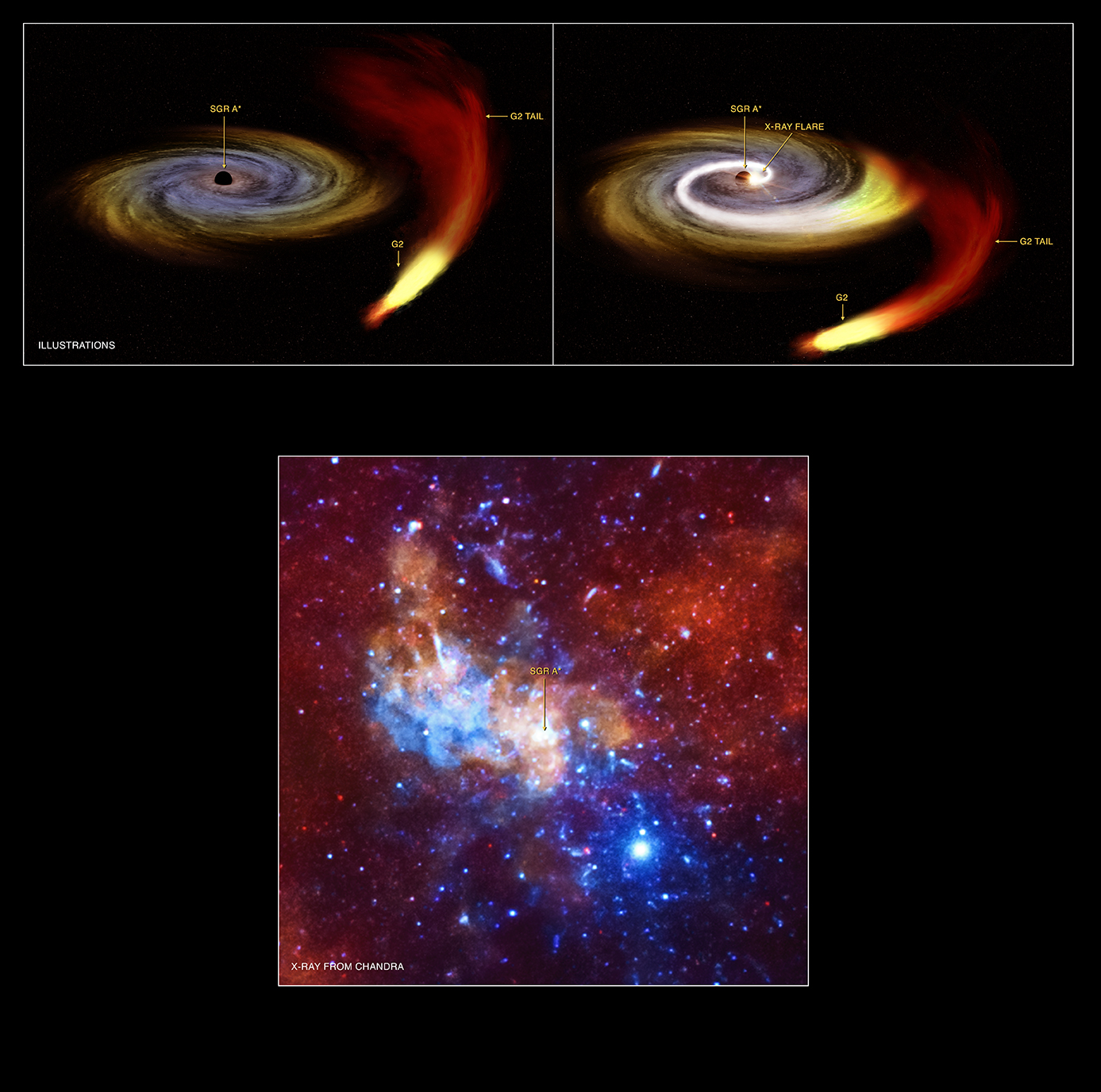
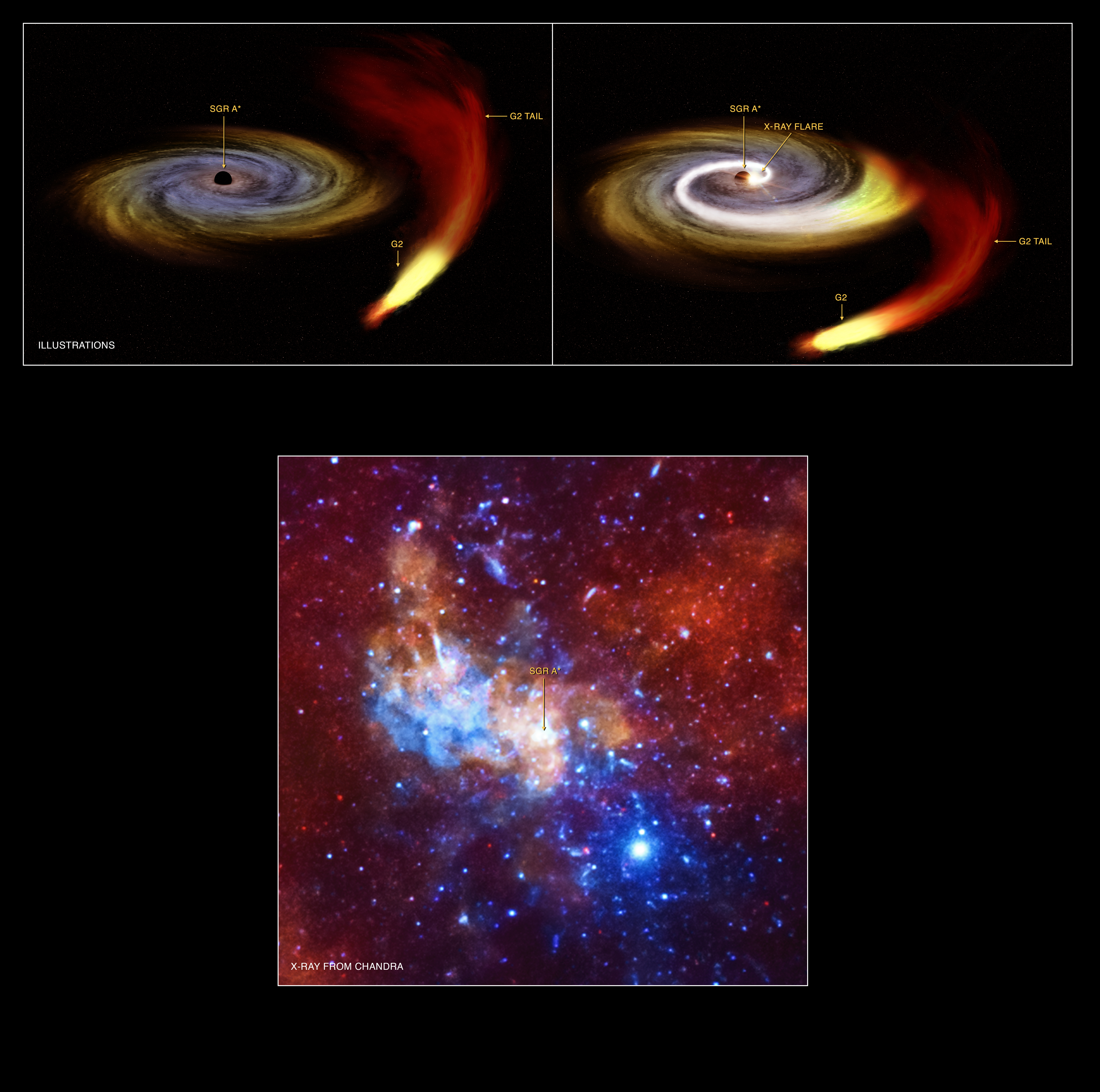
Credit NASA/CXC/MPE/G.Ponti et al; Illustration: NASA/CXC/M.Weiss


Three orbiting X-ray telescopes have been monitoring the supermassive black hole at the center of the Milky Way galaxy for the last decade and a half to observe its behavior, as explained in our latest press release. This long monitoring campaign has revealed some new changes in the patterns of this 4-million-solar-mass black hole known as Sagittarius A* (Sgr A*).

The bottom panel of this graphic is a view of the region around Sgr A* where red, green, and blue represent low, medium, and high-energy X-rays detected by NASA's Chandra X-ray Observatory. Sgr A* itself is not visible in this image, but is embedded in the white dot at the end of the arrow. The other two telescopes involved in the 15 years of X-ray observations were ESA's XMM-Newton and NASA's Swift Gamma Ray Burst Explorer, but their data are not included in this image.

Within the past year, the usually quiet black hole has shown an increased level of X-ray flares over its typical rate. This surge in X-ray flares coincides with the passage close to Sgr A* of a mysterious object called G2. Astronomers have been tracking G2 for years, originally thinking it was an extended cloud of gas and dust. However, after passing close to Sgr A* in late 2013 its appearance did not change much, apart from being slightly stretched by the gravity of the black hole. This led to new theories that G2 was not a gas cloud, but instead a star or pair of stars within an extended dusty cocoon.

If the G2 explanation does explain the recent rise in X-ray flares, it would be the first sign of excess material falling onto the black hole because of the cloud's close passage. Some gas would likely have been stripped off the cloud, and captured by the gravity of Sgr A*. It then could have started interacting with hot material flowing towards the black hole, resulting in an enhanced feeding rate and the production of X-ray flares. This scenario is depicted in the artist's illustrations found in the upper two panels of the graphic.

While the timing of G2's passage with the surge in X-rays from Sgr A* is intriguing, it is not yet an open-and-shut case. That is because astronomers see other black holes that appear to have behavior similar to the most recent increase of activity from Sgr A*. Therefore, it's possible this increased chatter from Sgr A* may be a common trait among supermassive black holes and unrelated to G2. Instead, it could represent, for example, a change in the strength of winds from nearby massive stars that are feeding the black hole.

The analysis included 150 Chandra and XMM-Newton observations pointed at the center of the Milky Way over the last 15 years, extending from September 1999 to November 2014. An increase in the rate and brightness of bright flares from Sgr A* occurred after mid-2014, several months after the closest approach of G2 to the huge black hole. The newest set of Chandra, XMM and Swift observations, obtained between August 30 and October 2014, revealed six bright flares within about three days, while an average of only 0.8 bright flares was expected.

A paper on these findings has been accepted by the Monthly Notices of the Royal Astronomical Society and a preprint is available online. The authors of this study were Gabriele Ponti (Max Planck Institute for Extraterrestrial Physics), Barbara De Marco (Max Planck), Mark Morris (University of California, Los Angeles), Andrea Merloni (Max Planck), Teo Muñoz-Darias (University of La Laguna, Spain), Maica Clavel (CEA Saclay, France), Darryl Haggard (Amherst College), Shuo Zhang (Columbia University), Kirpal Nandra (Max Planck), Stefan Gillassen (Max Planck), Kenji Mori (Columbia), Joseph Nielsen (Massachusetts Institute of Technology), Nanda Rea (University of Amsterdam), Natalie Degenaar (University of Cambridge), Regis Terrier (University of Paris), and Andrea Goldwurm (CEA Saclay).

NASA's Marshall Space Flight Center in Huntsville, Alabama, manages the Chandra program for NASA's Science Mission Directorate in Washington. The Smithsonian Astrophysical Observatory in Cambridge, Massachusetts, controls Chandra's science and flight operations.


Fast Facts for Sagittarius A*:

Scale: Image is 5 by 5 arcmin (about 38 light years)
Category: Black Holes, Milky Way Galaxy
Coordinates (J2000): RA 17h 45m 40s | Dec -29° 00' 28.00"
Constellation: Sagittarius
Observation Date: 43 pointings from September 21, 1999 to May 18, 2009
Observation Time: 278 hours (11 days 14 hours).
Obs. ID: 242, 1561, 2943, 2951-2954, 3392, 3393, 3549, 3663, 3665, 4683, 4684, 5360, 5950-5954, 6113, 6363, 6639, 6640-6646, 7554-7759, 9169-9174, 10556
Instrument: ACIS
Also Known As: Galactic Center
References: Ponti, G et al, 2015, MNRAS (accepted); arXiv:1407.2243
Color Code: Energy: Red (2-3.3 keV), Green (3.3-4.7 keV), Blue (4.7-8 keV)
Distance Estimate: About 26,000 light years


Wednesday, September 23, 2015

A Cosmic Rose With Many Names


The star formation region Messier 17

The star-forming region Messier 17 in the constellation of Sagittarius

Digitized Sky Survey Image of the Omega Nebula (M 17)


Videos

Zooming in on the star formation region Messier 17

A close looks at the star formation region Messier 17


This new image of the rose-coloured star forming region Messier 17 was captured by the Wide Field Imager on the MPG/ESO 2.2-metre telescope at ESO’s La Silla Observatory in Chile. It is one of the sharpest images showing the entire nebula and not only reveals its full size but also retains fine detail throughout the cosmic landscape of gas clouds, dust and newborn stars.

The nebula pictured here may have had more names bestowed upon it over the ages than any other object of its kind. Although officially known as Messier 17, its nicknames include: the Omega Nebula, the Swan Nebula, the Checkmark Nebula, the Horseshoe Nebula and — lest those with more of a more marine bent miss out — the Lobster Nebula.

Messier 17 is located about 5500 light-years from Earth near the plane of the Milky Way and in the constellation of Sagittarius (The Archer). The object spans a big section of the sky — its gas and dust clouds measure about 15 light-years across. This material is fueling the birth of new stars and the wide field of view of the new picture reveals many stars in front of, in, or behind Messier 17.

The nebula appears as a complex red structure with some graduation to pink. Its colouring is a signature of glowing hydrogen gas. The short-lived blue stars that recently formed in Messier 17 emit enough ultraviolet light to heat up surrounding gas to the extent that it begins to glow brightly. In the central region the colours are lighter, and some parts appear white. This white colour is real — it arises as a result of mixing the light from the hottest gas with the starlight reflected by dust.

The gas in the nebula is estimated to have more than 30 000 times the mass of the Sun. Messier 17 also contains an open star cluster of 35 stars, which is known as NGC 6618 [1]. The total number of stars in the nebula, however, is much higher — there are almost 800 stars in the centre with even more forming in its outer regions.

Throughout this rosy glow, the nebula shows a web of darker regions of dust that obscure the light. This obscuring material is also glowing and — although these areas are dark in this visible-light image — they look bright when observed using infrared cameras.

The nebula owes its official name to the French comet hunter Charles Messier who included the nebula as the seventeenth object in his famous astronomical catalogue in 1764 [2]. But even with a name as bland as Messier 17, this flowery nebula still looks dazzling.

This picture comes from the ESO Cosmic Gems programme [3].


Notes

[1] This designation is also sometimes used for the entire star formation region.

[2] The astronomer Jean Philippe de Chéseaux discovered the object in 1745, but his discovery did not receive widespread attention. Thus, Messier independently rediscovered and catalogued it almost 20 years later.

[3] The ESO Cosmic Gems programme is an outreach initiative to produce images of interesting, intriguing or visually attractive objects using ESO telescopes, for the purposes of education and public outreach. The programme makes use of telescope time that cannot be used for science observations. All data collected may also be suitable for scientific purposes, and are made available to astronomers through ESO’s science archive.

More Information

ESO is the foremost intergovernmental astronomy organisation in Europe and the world’s most productive ground-based astronomical observatory by far. It is supported by 16 countries: Austria, Belgium, Brazil, the Czech Republic, Denmark, France, Finland, Germany, Italy, the Netherlands, Poland, Portugal, Spain, Sweden, Switzerland and the United Kingdom, along with the host state of Chile. ESO carries out an ambitious programme focused on the design, construction and operation of powerful ground-based observing facilities enabling astronomers to make important scientific discoveries. ESO also plays a leading role in promoting and organising cooperation in astronomical research. ESO operates three unique world-class observing sites in Chile: La Silla, Paranal and Chajnantor. At Paranal, ESO operates the Very Large Telescope, the world’s most advanced visible-light astronomical observatory and two survey telescopes. VISTA works in the infrared and is the world’s largest survey telescope and the VLT Survey Telescope is the largest telescope designed to exclusively survey the skies in visible light. ESO is a major partner in ALMA, the largest astronomical project in existence. And on Cerro Armazones, close to Paranal, ESO is building the 39-metre European Extremely Large Telescope, the E-ELT, which will become “the world’s biggest eye on the sky”.

Links

Contacts

Richard Hook
ESO Public Information Officer
Garching bei München, Germany
Tel: +49 89 3200 6655
Cell: +49 151 1537 3591
Email:
rhook@eso.org


Source: ESO

Watching an Exoplanet in Motion Around a Distant Star


A series of images taken between November 2013 to April 2015 with the Gemini Planet Imager (GPI) on the Gemini South telescope in Chile shows the exoplanet β Pic b orbiting the star β Pictoris, which lies over 60 light-years from Earth. In the images, the star is at the centre of the left-hand edge of the frame; it is hidden by the Gemini Planet Imager’s coronagraph. We are looking at the planet’s orbit almost edge-on; the planet is closer to the Earth than the star. The images are based on observations described in a paper published in the Astrophysical Journal, 16 September 2015 and whose lead author is Maxwell Millar-Blanchaer. GPI is a groundbreaking instrument that was developed by an international team led by Stanford University’s Prof. Bruce Macintosh (a U of T alumnus) and the University of California Berkeley’s Prof. James Graham (former director of the Dunlap Institute for Astronomy & Astrophysics, U of T). Image credit: M. Millar-Blanchaer, University of Toronto; F. Marchis, SETI Institute. Vimeo

GIF version of animation.  
Image credit: M. Millar-Blanchaer, University of Toronto; R. Marchis (SETI Institute)


A team of astronomers has given us our best view yet of an exoplanet moving in its orbit around a distant star. A series of images captured between November 2013 to April 2015 shows the exoplanet β Pic b as it moves through 1 ½ years of its 22-year orbital period.

First discovered in 2008, β Pic b is a gas giant planet ten to twelve times the mass of Jupiter, with an orbit roughly the diameter of Saturn’s. It is part of a dynamic and complex system that includes comets, orbiting gas clouds, and an enormous debris disk that in our Solar System would extend from Neptune’s orbit to nearly two thousand times the Sun/Earth distance. Because the planet and debris disk interact gravitationally, the system provides astronomers with an ideal laboratory to test theories on the formation of planetary systems beyond ours.

Maxwell Millar-Blanchaer, a PhD-candidate in the Department of Astronomy & Astrophysics, University of Toronto, is lead author of a paper to be published September 16th in the Astrophysical Journal. The paper describes observations of the β Pictoris system made with the Gemini Planet Imager (GPI) instrument on the Gemini South telescope in Chile.

"The images in the series represent the most accurate measurements of the planet’s position ever made," says Millar-Blanchaer. "In addition, with GPI, we're able to see both the disk and the planet at the exact same time. With our combined knowledge of the disk and the planet we’re really able to get a sense of the planetary system’s architecture and how everything interacts."

The paper includes refinements to measurements of the exoplanet’s orbit and the ring of material circling the star which shed light on the dynamic relationship between the two. It also includes the most accurate measurement of the mass of β Pictoris to date and shows it is very unlikely that β Pic b will pass directly between us and its parent star.

"It’s remarkable that Gemini is not only able to directly image exoplanets but is also capable of effectively making movies of them orbiting their parent star," said Chris Davis, astronomy division program director at the National Science Foundation, which is one of five international partners that funds the Gemini twin telescopes’ operation and maintenance. "Beta Pic is a special target. The disk of gas and dust from which planets are currently forming was one of the first to be observed and is a fabulous laboratory for the study of young solar systems.”

Astronomers have discovered nearly two thousand exoplanets in the past two decades but most have been detected with instruments – like the Kepler space telescope – that use the transit method of detection: astronomers detect a faint drop in a star’s brightness as an exoplanet transits or passes between us and the star, but do not see the exoplanet itself.

With GPI, astronomers image the actual planet – a remarkable feat given that an orbiting world typically appears a million times fainter than its parent star. This is possible because GPI's adaptive optics sharpen the image of the target star by cancelling out the distortion caused by the Earth’s atmosphere; it then blocks the bright image of the star with a device called a coronagraph, revealing the exoplanet.

Laurent Pueyo is with the Space Telescope Science Institute and a co-author on the paper. "It’s fortunate that we caught β Pic b just as it was heading back – as seen from our vantage point – toward β Pictoris," says Pueyo. "This means we can make more observations before it gets too close to its parent star and that will allow us to measure its orbit even more precisely."

GPI is a groundbreaking instrument that was developed by an international team led by Stanford University’s Prof. Bruce Macintosh (a U of T alumnus) and the University of California Berkeley’s Prof. James Graham (former director of the Dunlap Institute for Astronomy & Astrophysics, University of Toronto). In August 2015, the team announced its first exoplanet discovery: a young Jupiter-like exoplanet designated 51 Eri b. It is the first exoplanet to be discovered as part of the GPI Exoplanet Survey (GPIES) which will target 600 stars over the next three years. 


Contact:


Media Contact:

Peter Michaud 
Public Information and Outreach ManagerGemini Observatory, Hilo, HI
Email: pmichaud@gemini.edu
Cell: (808) 936-6643
Desk: (808) 974-2510

Chris Sasaki
Communications Coordinator
Dunlap Institute for Astronomy & Astrophysics
University of Toronto
Email: media@dunlap.utoronto.ca
Phone: 416-978-6613


Science Contacts:

Max Millar-Blanchaer
Department of Astronomy and Astrophysics
University of Toronto
Email: maxmb@astro.utoronto.ca
Phone: (416) 978-3146

Fredrik Rantakyro
Gemini Observatory, La Serena, Chile
Email: frantaky@gemini.edu
Cell: 9 - 995097802
Desk: 56-51- 2205665

Joint University of Toronto and Gemini Observatory Press Release
See the Dunlop Observatory/University of Toronto version of this release here.


Tuesday, September 22, 2015

Dark Energy Spectrometer for Kitt Peak Receives Funding Green Light

The Dark Energy Spectroscopic Instrument (DESI) will be mounted on the 4-meter Mayall telescope at Kitt Peak National Observatory. It will measure the redshifts of 30 million galaxies and quasars in order to study how dark energy and gravity shape the structure of the universe. Image Credit: P. Marenfeld & NOAO/AURA/NSF


The Dark Energy Spectroscopic Instrument (DESI), destined for the 4-meter Mayall telescope at Kitt Peak National Observatory (KPNO), will chart out the role of dark energy in the expansion history of the universe. The US Department of Energy has announced its approval of Critical Decision 2 (CD-2) for the DESI project, authorizing its scientific scope, schedule, and funding profile. The Mayall telescope is operated by the National Optical Astronomy Observatory (NOAO).

To carry out its mission, DESI will measure the redshifts of more than 30 million galaxies and quasars and create a three-dimensional map of the universe that extends from the nearby universe out to a distance of 10 billion light years. Probing a larger volume of the universe than any map yet made, the map will reveal how dark energy and gravity have competed over time to shape the structure of the universe.

DESI’s unique map-making ability is made possible by the massively parallel nature of its optical spectrometer. Lori Allen, NOAO Associate Director for KPNO explains, “DESI will measure 5000 spectra at a time over a huge 8 square degree field-of-view, or approximately 40 times the area of the full moon. DESI on the Mayall telescope will be a world-leading spectroscopic capability.”

Large optical lenses and speedy robotic fiber positioners are critical to DESI’s highly multiplexed spectroscopy. To attach the spectrometer to the telescope, the top end of the Mayall will be replaced with DESI’s optical corrector and focal-plane system. The six glass lenses of the corrector, each a meter across, will focus the light from the 4-meter diameter primary mirror onto the 0.8-meter diameter focal plane, which will consist of 5,000 tiny robots, each holding an optical fiber. The closely packed robots will position the fibers so that each captures the spectrum of a single galaxy or quasar. The robots are designed to position the fibers precisely and quickly, in under a minute, in order to survey the 14,000 square degrees of sky that DESI will study over five years. The fibers will feed ten 3-arm spectrographs.

“DESI will be a heavyweight, both scientifically and literally,” says David Sprayberry, NOAO Project Manager for DESI. “The instrument will weigh 5 tons.”

DESI’s scientific reach stretches beyond cosmology. It will be a powerful engine of discovery in many areas of astrophysics, and unanticipated discoveries are expected. “The DESI survey will venture into hitherto uncharted territory”, says Arjun Dey, NOAO’s Project Scientist for DESI. “In astronomy, the most interesting discoveries are often the ones we least expect!”

The DESI project team, which is responsible for the design, fabrication, installation and commissioning of the instrument, is comprised of technical staff from Lawrence Berkeley National Laboratory, Fermilab, NOAO, and the SLAC National Accelerator Laboratory, as well as technical teams from six US universities and five foreign institutions in the United Kingdom, France, Spain, and Switzerland.

DESI is the latest chapter in NOAO’s history of studying dark energy. In the late 1980s, NOAO and its facilities were involved in the unexpected discovery that the expansion of the universe is accelerating (Reiss et al. 1998, Perlmutter et al. 1999). The acceleration has been attributed to dark energy, the nature of which remains a mystery. Dark energy is currently estimated to make up approximately 70% of the universe. NOAO and its facilities are currently involved in two other projects in partnership with DOE that are designed to study the nature of dark energy, the Dark Energy Survey (DES), currently ongoing at Cerro Tololo Inter-American Observatory, and the Large Synoptic Survey Telescope (LSST), also sited in Chile, which is scheduled to begin science operations at the beginning of the next decade.

“NOAO is partnering with world-leading teams in wide-field survey-based astronomy and astrophysics,” says Robert Blum, Deputy Director of NOAO. “At a time when every federal research dollar must count, NOAO is embarking on programs that efficiently deliver huge data sets to the US astronomical community for exploration and experimentation alike.


NOAO DESI Contact

Dr. Robert Blum
National Optical Astronomy Observatory
950 N Cherry Ave
Tucson AZ 85719 USA
+1 520-318-8233
E-mail: rblum@noao.edu


Media Contact:

Dr. Joan Najita
National Optical Astronomy Observatory
950 N Cherry Ave
Tucson AZ 85719 USA
+1 520-318-8416
E-mail: najita@noao.edu


Cosmic optical illusions in Ursa Major

Cosmic optical illusions in Ursa Major
Copyright: NASA, ESA and the Hubble Heritage Team (STScI/AURA)


Some of the stunning views we have of the cosmos owe their beauty to a trick of perspective, as captured in this NASA/ESA Hubble Space Telescope image.

The galaxies at the top and bottom of the frame are named PGC 37639 and PGC 101374 respectively. 

Although it may look as if the two are in the middle of a galactic tug-of-war, connected by the prominent stream of blue through the centre of the image, PGC 37639 lies somewhat closer to Earth than its companion, and the two are not physically connected.

In another optical trick, this image does not contain two galaxies, but at least four. The upper left patch actually hosts two galaxies in the early stages of merging. Their bright centres can still be seen separately, glowing amid a maelstrom of gas and dust.

A smaller and relatively intact spiral galaxy, known as SDSSCGB 19.4, can be seen to the right of the merging duo. This trio of galaxies comprises Arp 194, a galaxy group just under 600 million light-years away from Earth in the constellation of Cepheus.

The blue stream is thought to have formed through the turbulent gravitational interactions occurring at the top of the frame — the uppermost galaxy clump is a whirl of flailing once-spiral arms. The stream is some 100 000 light-years long, and made up of gas, dust and many millions of newborn stars. These stars, which are clumped together to form star clusters, which in turn later accumulate as superclusters, are responsible for the striking blue hue visible here. They are mostly young, hot and massive, a combination that causes them to emit blue light.

This image was released in 2009, to commemorate the Hubble’s 9th year in space. The telescope has gone on to hit a quarter of a century orbiting Earth, a milestone it reached this April.


Monday, September 21, 2015

Mysterious, Massive, Magnetic Stars

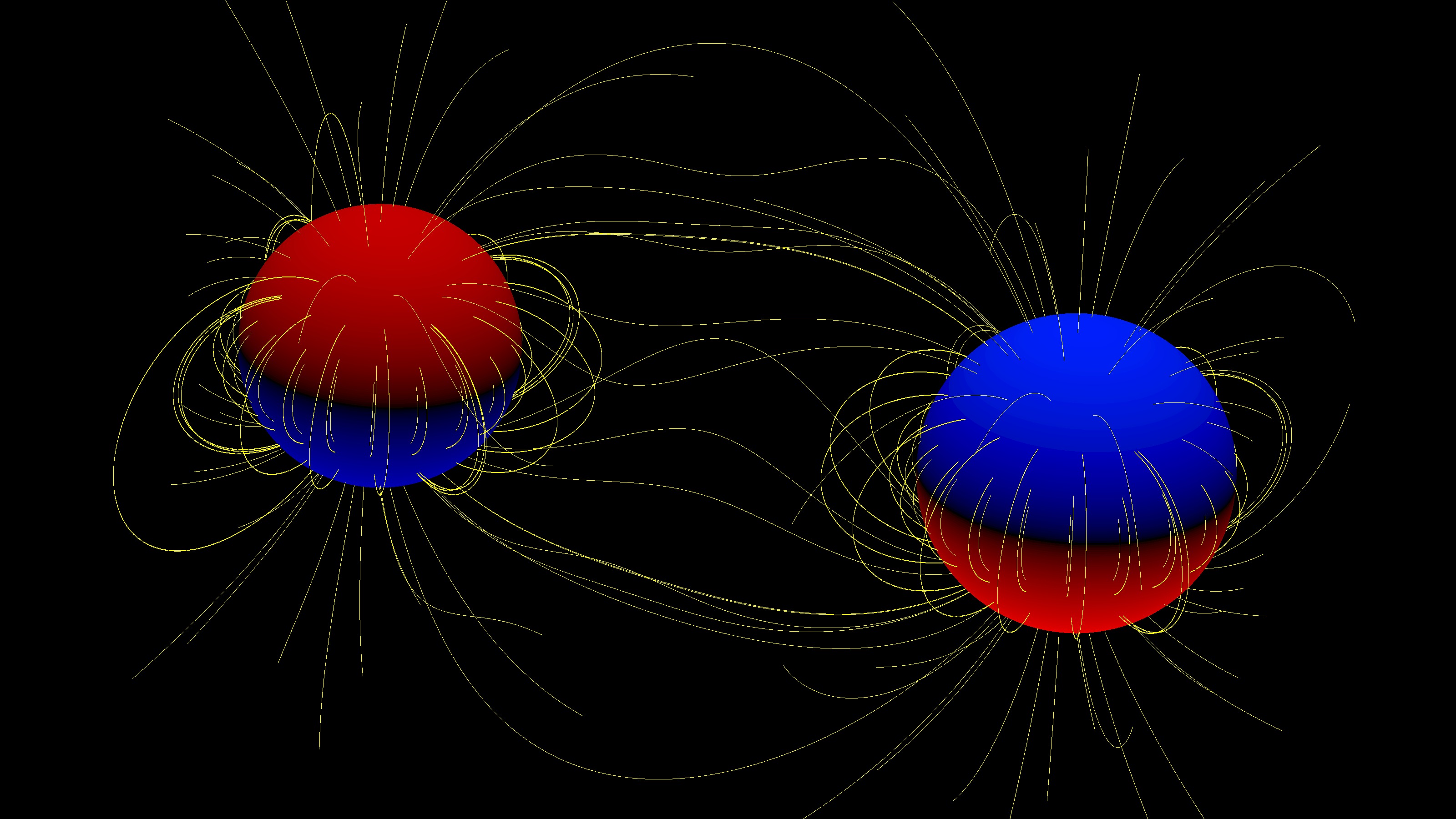
Caption: The polarity of the star's surface magnetic field, north or south, is indicated by red and blue respectively. Yellow lines indicate the magnetic field lines running from the stellar surfaces. Credit: Visualisation courtesy of Volkmar Holzwarth, KIS, Freiburg. Hi-res image


A Canadian PhD student has discovered a unique object – two massive stars with magnetic fields in a binary system. Matt Shultz of Queen’s University, Ontario, Canada found the system – Epsilon Lupi – and publishes the new result in Monthly Notices of the Royal Astronomical Society.

Around 1/3 of stars in our Galaxy are thought to be in binary systems, where two or more stars orbit around a common centre. They are invaluable for astronomers, as watching how they behave lets astronomers measure their mass and connect this with their brightness – a key way in which we understand how stars evolve.

Mr Shultz is a member of the Binarity and Magnetic Interactions in various classes of Stars - BinaMIcS - consortium led by Dr Evelyne Alecian of the University of Grenoble in France. The collaboration is studying the magnetic properties of close binary stars, and Mr Shultz made the discovery using CFHT.

Epsilon Lupi is the fourth brightest star system in the southern constellation of Lupus. The pair of stars is about 500 light years away, are both blue in colour, each have between 7 and 8 times the mass of the Sun, and combined together the pair is around 6000 times as luminous as the Sun. Astronomers have known for many years that Epsilon Lupi is a binary system, but had no idea that the two giant stars had magnetic fields.

Shultz comments: “The origin of magnetism amongst massive stars is something of a mystery and this discovery may help to shed some light on the question of why any of these stars have magnetic fields.”

In cool stars, such as the Sun, magnetic fields are generated by “dynamos” powered by strong convection in the outer layers of the star, where hot material rises, cools and falls back. But there is essentially no convection in the envelopes of massive stars, so there is no support for a magnetic dynamo. Nevertheless, approximately 10% of massive stars have strong magnetic fields.

Two explanations have been proposed for their origin, both variants on the idea of a so-called “fossil” magnetic field, a field generated at some point in the star's past and then locked into the star's surface.

The first hypothesis is that the magnetic field is generated while the star is being formed; a second is that the magnetic field originates in dynamos driven by the violent mixing of material when two already-formed stars in a close binary merge.

“This discovery allows us to rule out the binary merger scenario,” says Mr. Shultz, “However, it doesn't change the basic finding of the BinaMIcS collaboration: fewer than 2% of massive stars in close binaries have magnetic fields, and we still don't know why that is.”

The research shows the strengths of the magnetic fields are similar in the two stars, however their magnetic axes are anti-aligned, with the south magnetic pole of one star pointing in approximately the same direction as the north pole of the other. It may even be that the two stars share a single magnetic field.

“We're not sure why yet, but it probably points to something significant about how the stars are interacting with one another”, adds Shultz.

The stars are close enough that their magnetospheres are likely to be interacting during the whole of their orbit around each other. This means that their magnetic fields may act as a giant brake, slowing down the stars. As a result, in the long term, the two stars could even be spiralling in towards each other.


Additional information 


Media contacts:

Robert Massey
Royal Astronomical Society
Tel: +44 (0)20 7734 3307 x113
Mob: +44 (0)7802 877 699
Email: rm@ras.org.uk

Anne Craig
Queen's University
Tel: +1(1)613-533-2877
Email: anne.craig@queensu.ca


Science contact

Matt Shultz
Queen’s University
Tel: +1(1)613-387-3773
Email: matt.shultz@gmail.com


Friday, September 18, 2015

Evolution in slow motion

Credit: ESA/Hubble & NASA
Acknowledgement: Judy Schmidt (geckzilla.com)


It is known today that merging galaxies play a large role in the evolution of galaxies and the formation of elliptical galaxies in particular. However there are only a few merging systems close enough to be observed in depth. The pair of interacting galaxies picture seen here — known as NGC 3921 — is one of these systems.

NGC 3921 — found in the constellation of Ursa Major (The Great Bear) — is an interacting pair of disc galaxies in the late stages of its merger. Observations show that both of the galaxies involved were about the same mass and collided about 700 million years ago. You can see clearly in this image the disturbed morphology, tails and loops characteristic of a post-merger.

The clash of galaxies caused a rush of star formation and previous Hubble observations showed over 1000 bright, young star clusters bursting to life at the heart of the galaxy pair.

Thursday, September 17, 2015

Funky Light Signal From Colliding Black Holes Explained

Credit: Columbia University 

This simulation helps explain an odd light signal thought to be coming from a close-knit pair of merging black holes, PG 1302-102, located 3.5 billion light-years away. The close-up view at right shows that the smaller of the two black holes gives off more light (left side of picture). While the black holes themselves don't emit light, they accumulate and heat up surrounding gas, which then radiates light. The reason the smaller black hole gives off more light is that it is orbiting farther from the center of mass and closer to the surrounding gas disk, allowing it to gather up most of the gas as it orbits. The result is that the more massive central black hole is starved of gas and doesn't glow as brightly.

As these black holes orbit around each other, they are thought to send out a varying light signal. The signal was detected by astronomers using telescopes on the ground and in space.

The simulation comes from Brian Farris of Columbia University and New York University, both in New York City. Credit: Columbia University


Entangled by gravity and destined to merge, two candidate black holes in a distant galaxy appear to be locked in an intricate dance. Researchers using data from NASA's Galaxy Evolution Explorer (GALEX) and NASA's Hubble Space Telescope have come up with the most compelling confirmation yet for the existence of these merging black holes and have found new details about their odd, cyclical light signal.

The candidate black hole duo, called PG 1302-102, was first identified earlier this year using ground-based telescopes. The black holes are the tightest orbiting pair detected so far, with a separation not much bigger than the diameter of our solar system. They are expected to collide and merge in less than a million years, triggering a titanic blast with the power of 100 million supernovae.

Researchers are studying this pair to better understand how galaxies and the monstrous black holes at their cores merge -- a common occurrence in the early universe. But as common as these events were, they are hard to spot and confirm.

PG 1302-102 is one of only a handful of good binary black hole candidates. It was discovered and reported earlier this year by researchers at the California Institute of Technology in Pasadena, after they scrutinized an unusual light signal coming from the center of a galaxy. The researchers, who used telescopes in the Catalina Real-Time Transient Survey, demonstrated that the varying signal is likely generated by the motion of two black holes, which swing around each other every five years. 

While the black holes themselves don't give off light, the material surrounding them does.

In the new study, published in the Sept. 17 issue of Nature, researchers found more evidence to support and confirm the close-knit dance of these black holes. Using ultraviolet data from GALEX and Hubble, they were able to track the system's changing light patterns over the past 20 years.

"We were lucky to have GALEX data to look through," said co-author David Schiminovich of Columbia University in New York. "We went back into the GALEX archives and found that the object just happened to have been observed six times."
Hubble, which sees ultraviolet light in addition to visible and other wavelengths of light, had likewise observed the object in the past.

The ultraviolet light was important to test a prediction of how the black holes generate a cyclical light pattern. The idea is that one of the black holes in the pair is giving off more light -- it is gobbling up more matter than the other one, and this process heats up matter that emits energetic light. As this black hole orbits around its partner every five years, its light changes and appears to brighten as it heads toward us.

"It's as if a 60-Watt light bulb suddenly appears to be 100 Watts," explained Daniel D'Orazio, lead author of the study from Columbia University. "As the black hole light speeds away from us, it appears as a dimmer 20-Watt bulb."

What's causing the changes in light? One set of changes has to do with the "blue shifting" effect, in which light is squeezed to shorter wavelengths as it travels toward us in the same way that a police car's siren squeals at higher frequencies as it heads toward you. Another reason has to do with the enormous speed of the black hole.

The brighter black hole is, in fact, traveling at nearly seven percent the speed of light -- in other words, really fast. Though it takes the black hole five years to orbit its companion, it is traveling vast distances. It would be as if a black hole lapped our entire solar system from the outer fringes, where the Oort cloud of comets lies, in just five years. At speeds as high as this, which are known as relativistic, the light becomes boosted and brighter.

D'Orazio and colleagues modeled this effect based on a previous Caltech paper and predicted how it should look in ultraviolet light. They determined that, if the periodic brightening and dimming previously seen in the visible light is indeed due to the relativistic boosting effect, then the same periodic behavior should be present in ultraviolet wavelengths, but amplified 2.5 times. Sure enough, the ultraviolet light from GALEX and Hubble matched their predictions.

"We are strengthening our ideas of what's going on in this system and starting to understand it better," said Zoltan Haiman, a co-author from Columbia University who conceived the project.

The results will also help researchers understand how to find even closer-knit merging black holes in the future, what some consider the holy grail of physics and the search for gravitational waves. In the final moments before the ultimate union of two black holes, when they are tightly spinning around each other like ice skaters in a "death spiral," they are predicted to send out ripples in space and time. 

These so-called gravitational waves, whose existence follows from Albert Einstein's gravity theory published 100 years ago, hold clues about the fabric of our universe.

The findings are also a doorway to understanding other merging black holes across the universe, a widespread population that is only now beginning to yield its secrets.

The California Institute of Technology in Pasadena led the Galaxy Evolution Explorer mission, which ended in 2013 after more than a decade of scanning the skies in ultraviolet light. NASA's Jet Propulsion Laboratory, also in Pasadena, managed the mission and built the science instrument. JPL is managed by Caltech for NASA.

The Hubble Space Telescope is a project of international cooperation between NASA and ESA (European Space Agency). NASA's Goddard Space Flight Center in Greenbelt, Maryland, manages the telescope. The Space Telescope Science Institute (STScI) in Baltimore, Maryland, conducts Hubble science operations. STScI is operated for NASA by the Association of Universities for Research in Astronomy in Washington.


Wednesday, September 16, 2015

A Shy Galactic Neighbour

Sculptor Dwarf Galaxy

Location of the Sculptor Dwarf Galaxy 

Wide-field image of the sky around the Sculptor Dwarf Galaxy


Videos
 
A close-up look at the Sculptor Dwarf Galaxy


The Sculptor Dwarf Galaxy, pictured in this new image from the Wide Field Imager camera, installed on the 2.2-metre MPG/ESO telescope at ESO’s La Silla Observatory, is a close neighbour of our galaxy, the Milky Way. Despite their close proximity, both galaxies have very distinct histories and characters. This galaxy is much smaller and older than the Milky Way, making it a valuable subject for studying both star and galaxy formation in the early Universe. However, due to its faintness, studying this object is no easy task.

The Sculptor Dwarf Galaxy — also known as the Sculptor Dwarf Elliptical or the Sculptor Dwarf Spheroidal — is a dwarf spheroidal galaxy, and is one of the fourteen known satellite galaxies orbiting the Milky Way [1]. These galactic hitchhikers are located close by in the Milky Way’s extensive halo, a spherical region extending far beyond our galaxy’s spiral arms. As indicated by its name, this galaxy is located in the southern constellation of Sculptor and lies about 280 000 light-years away from Earth. Despite its proximity, the galaxy was only discovered in 1937, as its stars are faint and spread thinly across the sky.

Although difficult to pick out, the Sculptor Dwarf Galaxy was among the first faint dwarf galaxies found orbiting the Milky Way. The tiny galaxy’s shape intrigued astronomers at the time of its discovery, but nowadays dwarf spheroidal galaxies play a more important role in allowing astronomers to dig deeply into the Universe’s past.

The Milky Way, like all large galaxies, is thought to have formed from the build-up of smaller galaxies during the early days of the Universe. If some of these small galaxies still remain today, they should now contain many extremely old stars. The Sculptor Dwarf Galaxy fits the bill as a primordial galaxy, thanks to a large number of ancient stars, visible in this image.

Astronomers can determine the age of stars in the galaxy because their light carries the signatures of only a small quantity of heavy chemical elements. These heavy elements accumulate in galaxies with successive generations of stars. A low level of heavy elements thus indicates that the average age of the stars in the Sculptor Dwarf Galaxy is high.

This quantity of old stars makes the Sculptor Dwarf Galaxy a prime target for studying the earliest periods of star formation. In a recent study, astronomers combined all the data available for the galaxy to create the most accurate star formation history ever determined for a dwarf spheroidal galaxy. This analysis revealed two distinct groups of stars in the galaxy. The first, predominant group is the older population, which is lacking in heavier elements. The second, smaller population, in contrast, is rich with heavy elements. Like young people crowding into city centres, this youthful stellar population is concentrated toward the galaxy’s core.

The stars within dwarf galaxies like the Sculptor Dwarf Galaxy can exhibit complex star formation histories. But as most of these dwarf galaxies’ stars have been isolated from each other and have not interacted for billions of years, each collection of stars has charted its own evolutionary course. Studying the similarities in dwarf galaxies’ histories, and explaining the occasional outliers, will help to explain the development of all galaxies, from the most unassuming dwarf to the grandest spirals. There is indeed much for astronomers to learn from the Milky Way’s shy neighbours.


Notes 

[1] This faint galaxy should not be confused with the much brighter Sculptor Galaxy (NGC 253) in the same constellation.


More Information

ESO is the foremost intergovernmental astronomy organisation in Europe and the world’s most productive ground-based astronomical observatory by far. It is supported by 16 countries: Austria, Belgium, Brazil, the Czech Republic, Denmark, France, Finland, Germany, Italy, the Netherlands, Poland, Portugal, Spain, Sweden, Switzerland and the United Kingdom, along with the host state of Chile. ESO carries out an ambitious programme focused on the design, construction and operation of powerful ground-based observing facilities enabling astronomers to make important scientific discoveries. ESO also plays a leading role in promoting and organising cooperation in astronomical research. ESO operates three unique world-class observing sites in Chile: La Silla, Paranal and Chajnantor. At Paranal, ESO operates the Very Large Telescope, the world’s most advanced visible-light astronomical observatory and two survey telescopes. VISTA works in the infrared and is the world’s largest survey telescope and the VLT Survey Telescope is the largest telescope designed to exclusively survey the skies in visible light. ESO is a major partner in ALMA, the largest astronomical project in existence. And on Cerro Armazones, close to Paranal, ESO is building the 39-metre European Extremely Large Telescope, the E-ELT, which will become “the world’s biggest eye on the sky”.


Links

Contacts

Richard Hook
ESO education and Public Outreach Department
Garching bei München, Germany
Tel: +49 89 3200 6655
Cell: +49 151 1537 3591
Email:
rhook@eso.org

Source: ESO

ESA/NASA Solar Observatory Discovers Its 3,000th Comet


Before 1979, there were less than a dozen known sungrazing comets – comets that swing by incredibly close to the sun. But that was before the ESA/NASA Solar and Heliospheric Observatory launched in 2000. Since then, SOHO has become the greatest sungrazing comet hunter of all time with comet finds numbering in the thousands. Credits: NASA/Duberstein. Download video

A sun grazing comet as witnessed by the ESA/NASA Solar Heliospheric Observatory, or SOHO, as it dived toward the sun on July 5 and July 6, 2011. SOHO is the overwhelming leader in spotting sungrazers, with almost 3000 spotted to date. SOHO can see the faint light of a comet, because the much brighter light of the sun is blocked by what's known as a coronograph. Credits: ESA&NASA/SOHO

One of the more well-known comets observed by SOHO is Comet ISON, seen in the this time lapse photo from Nov. 28, 2013. Comet ISON comes in from the bottom right and moves out toward the upper right, getting fainter and fainter. The image of the sun at the center is from NASA's Solar Dynamics Observatory. Credits: ESA/NASA/SOHO/SDO/GSFC. Hi-res image


In 1995, a new solar observatory was launched. A joint project of ESA and NASA, the Solar and Heliospheric Observatory – SOHO – has been sending home images of our dynamic sun ever since. SOHO was planned to open up a new era of solar observations, dramatically extending our understanding of the star we live with. . . and it delivered.

But no one could have predicted SOHO's other observational triumph: In the last two decades, SOHO has become the greatest comet finder of all time. In August 2015, SOHO is expected to discover its 3000th comet. Prior to the SOHO launch, only a dozen or so comets had ever even been discovered from space, and some 900 had been discovered from the ground since 1761.

"SOHO has a view of about 12 and a half million miles beyond the sun," said Joe Gurman, the mission scientist for SOHO at NASA's Goddard Space Flight Center in Greenbelt, Maryland. "So we expected it might from time to time see a bright comet near the sun. But nobody dreamed we'd approach 200 a year."

More than just a celebrated bright vision in the night sky, comets can tell scientists a great deal about the place and time where they originated. Comets are essentially a clump of frozen gases mixed with dust. They are often pristine relics that can hold clues about the very formation of our solar system. On the other hand, if they have made previous trips around the sun, they can hold information about the distant reaches of the solar system through which they've traveled. We have a variety of tools to determine what comets are made of from afar. One is to watch how material evaporates off its surface when it comes close to the sun, and here's where SOHO can provide remarkable information.

SOHO is unique in that it is able to spot comets that skim extremely close to the sun, known as sungrazers. One of SOHO's instruments, called a coronagraph, specifically blocks out the bright light of the sun to examine its atmosphere – which is a billion times fainter than the star itself. To this day, SOHO is one of our best sources for views of the giant explosions regularly produced by the sun called coronal mass ejections, or CMEs, which can hurl a million tons of solar particles off into space. This field of view is large enough to see a sungrazing comet as it sling shots around the sun.

The overwhelming bulk – some 85% -- of SOHO's comet discoveries are what's called Kreutz comets. Scientists think a single extremely large sungrazing comet broke up thousands of years ago, leading to thousands of leftover fragments, which continue to follow the same Kreutz path. On average, a new member of the Kreutz family is discovered every three days. Unfortunately, the long journey for these fragments invariably ends as they pass the sun. If they're close enough to the sun to be seen by SOHO, they're too close to survive.

"They just disintegrate every time we observe one," said Karl Battams, a solar scientist at the Naval Research Labs in Washington, D.C., who has been in charge of running the SOHO comet-sighting website since 2003. "There's only one Kreutz comet that made it around the sun – Comet Lovejoy. And we are pretty confident it fell apart a couple of weeks afterwards."

Other, non-Kreutz comets have survived, however. One frequent visitor is comet 96P Machholz. Orbiting the sun approximately every 6 years, SOHO has now seen this comet four times. Such comets survive by virtue of the fact that they don't travel as close to the sun – so they experience less intense solar radiation and are not subject to gravitational stretching and pulling from the sun. Information about the composition of comets is something SOHO can help with. Depending on how a comet reacts to the sun gives clues about the very substance out of which these visitors from the outer solar system are made.

Watching these sungrazing comets also help us learn about the sun. Their tails of ionized gas illuminate magnetic fields around the sun, so they can act as a tracer that helps scientists observe these invisible fields. Such fields have even ripped off comet tails allowing astronomers to watch the lost tails blowing in the steady outpouring of solar particles streaming off the sun. The tails act as a giant windsock in this solar wind, showing researchers the details of the wind's movement.

SOHO's great success as a comet finder is, of course, dependent on the people who sift through SOHO's data – a task open to the world as the data is publicly available online in real time. A cadre of volunteer amateur astronomers dedicate themselves to searching the data via the NASA-funded Sungrazer Project. While scientists often search the imagery for very specific events, various members of the astronomy community choose to comb through all the imagery in fine detail. The result: 75% of SOHO comets have been found by these citizen scientists.

Whenever someone spots a comet, they report it to Battams. He goes over the imagery to confirm the sighting and then submits it to the Central Bureau for Astronomical Telegrams, which gives it an official name. While comets spotted from the ground are named after the person who first discovered them, comets first observed by a space-based telescope are named after the spacecraft.

"As I joined the team when we already had found 500 comets, I've been in charge of confirming 2,500 so far," said Battams. "I think it's safe to say I've looked at more images of comets than any other person in history. Each comet is visible in at least 15 images, so that's more than 40,000 images of comets."

SOHO has also helped provide images for comets discovered by others. In 2012, a sungrazer was found the old-fashioned way – from the ground. Known as Comet ISON, scientists quickly realized it would make a swing by the sun close enough to be spotted by a variety of solar telescopes including SOHO. A large campaign of observations was launched, as telescopes from around the world and across the solar system watched the comet -- a fossil from the original days of the solar system formation – sweep in. The final observatory to see Comet ISON was SOHO, which watched the comet curve in toward the sun. . . and disintegrate.

Observations from SOHO were key to helping describe ISON's last hours – something that no other observatory captured.

"When SOHO launched, its sensors were some 100 times more sensitive than previous imagers," said Gurman. "That was crucial to seeing the faint light from the solar particles in a CME. SOHO allowed us to see a range of brightness and details never before seen. It was great luck that the same exposures allowed us to see comets – not just extremely bright ones, but a whole range of fainter ones, too."

At almost 20 years old, the SOHO mission is a respected elder in NASA's Heliophysics System Observatory – the fleet of spacecraft that both watch the sun and measure its effects near Earth and throughout the solar system. SOHO is a cooperative effort between ESA and NASA. Mission control is based at NASA Goddard. The Large Angle and Spectrometric Coronagraph Experiment, or LASCO, which is the instrument that provides comet imagery, was built at the Naval Research Lab in Washington, D.C.

For more about SOHO: http://www.nasa.gov/soho

For more on the SOHO Sungrazer Project: http://sungrazer.nrl.navy.mil

Karen C. Fox
NASA's Goddard Space Flight Center, Greenbelt, Maryland

Editor: Holly Zell

Source: NASA/SOHO

Tuesday, September 15, 2015

Shocks in a Distant Gamma-Ray Burst

An optical image of the sky at the location of a faint galaxy (marked with the cross-hairs) where a gamma-ray burst (GRB) was seen last year. Followup studies of the burst and its afterglow find that it originated in a supernova - the death of a massive star - yet also shows signs of shocks more typically originating in GRBs from merging binary stars. Credit: Cano et al.


Gamma ray bursts (GRBs)--flashes of high-energy light occur about once a day, randomly, from around the sky--are the brightest events in the known universe. While a burst is underway, it is many millions of times brighter than an entire galaxy. Astronomers are anxious to decipher their nature not only because of their dramatic energetics, but also because their tremendous brightness enables them to be seen across cosmological distances and times, providing windows into the young universe.

There appear to be two general types of GRBs: those associated with the deaths of massive stars, and ones believed to originate from the coalescence of two extreme objects (neutron stars or black holes) that had been orbiting each other in a binary system. In general the two types can be distinguished by the lengths of their bursts, the former lasting longer than a few seconds, while the latter are briefer. Astronomers think that, despite the differences, both kinds of GRBs have hot discs accreting material leading to the production of bipolar jets of charged particles moving at relativistic speeds. In the standard model, shocks internal to the fireball produce the gamma-rays in the first (longer duration) case, while shocks from the jets' interactions with the external medium produce the initial burst of gamma-rays in the second case. Many details are similar in both scenarios, however, while some others vary according to the type, and astronomers have been trying to constrain these various parameters so that they can trace the origin of each GRB more precisely.

CfA astronomer Raffaella Margutti and her colleagues used several ground-based telescopes to follow-up a GRB event that went off in June of 2014, examining the afterglow from about three days after the detection to about one hundred and twenty days later. They conclude that the burst is associated with a massive star's death (a supernova), but find that some of its emission apparently results from shocks external to the fireball as are seen in the less luminous class of GRBs. The results are consistent with the predictions of supernova modeling, but the fact that this object spans both classes highlights the complexity of the sometimes-overlapping physical processes at work and the importance of observations at multiple wavelengths.

Reference(s):  

"c/iPTF14bfu: Detection of Shock-Breakout Emission from a Cosmological γ-Ray Burst," Zach Cano, A. de Ugarte Postigo, D. Perley, T. Kruhler, R. Margutti, M. Friis, D. Malesani, P. Jakobsson, J. P. U. Fynbo, J. Gorosabel, J. Hjorth, R. Sanchez-Ramırez, S. Schulze, N. R. Tanvir, C. C. Thone, and D. Xu, MNRAS 452, 1535, 2015.