Showing posts with label binary stars. Show all posts

Wednesday, April 29, 2026

Unraveling the Mass Mystery of Orion’s Young Stars

Artist’s impression of two young stars orbiting each other inside the dusty Orion star-forming complex. Because clouds of gas and dust hide these systems at visible and infrared wavelengths, astronomers used the NSF Very Long Baseline Array to observe them in radio light and measure their orbital motion and masses directly. Credit: NRAO/AUI/NSF. Hi-Res File

Artist’s impression of two young stars orbiting each other inside the dusty Orion star-forming complex. Because clouds of gas and dust hide these systems at visible and infrared wavelengths, astronomers used the NSF Very Long Baseline Array to observe them in radio light and measure their orbital motion and masses directly. Credit: NRAO/AUI/NSF - Youtube Vieeo


A star’s mass determines its entire life story, from how it shines to how it dies. For young stars…

A star’s mass determines its entire life story, from how it shines to how it dies. For young stars shrouded in dust, getting an accurate mass has long been difficult…but new radio measurements are beginning to change that. Astronomers are helping unravel the mass mystery of young stars in the Orion star-forming complex by measuring their masses with unprecedented precision.

Lightweight Sun-like stars burn steadily for 10 billion years, while massive ones blaze briefly before exploding as supernovae in mere millions of years. Mass also determines what heavy elements they forge, such as carbon, oxygen, and iron, which form the building blocks of planets and life. In addition, it influences what types of planets can form around them.

Using the U.S. National Science Foundation Very Long Baseline Array (NSF VLBA), a network of radio telescopes spread across the United States that work together as one giant instrument, the team tracked the orbital motions of a sample of young binary star systems in Orion. Binary stars are pairs that orbit a shared center of mass, like dance partners spinning each other around. By watching these “dances” with extraordinary precision at radio wavelengths, researchers were able to calculate the stars’ true masses without relying on theoretical models. As lead researcher Dr. Sergio Abraham Dzib Quijano, from the Max Planck Institute for Radio Astronomy explains, “Stellar mass is the most fundamental property of a star, yet it is notoriously difficult to measure for young, embedded systems.”​

Young stars in Orion are shrouded in dense clouds of gas and dust, blocking visible and even infrared light from reaching most telescopes. The NSF VLBA overcomes this by observing at radio wavelengths (5 GHz), where dust is transparent and the array’s extreme resolution (sub-milliarcsecond) resolves tight binaries that blur together at other wavelengths.

The NSF VLBA can also detect motions on the sky smaller than the width of a human hair seen from thousands of kilometers away, showcasing the remarkable technical achievement behind these mass measurements. In practice, this means measuring tiny shifts in a star’s apparent position on the sky over months and years, using repeated observations to trace out its path. Each NSF VLBA radio telescope in the array records the incoming radio waves with exquisite timing. By combining the signals from antennas spread across the country from Hawaii to the Virgin Islands, astronomers can pinpoint a star’s position with milliarcsecond accuracy, far finer than what is possible with a single dish. By comparing how that position changes from epoch to epoch, they can see the subtle orbital motion caused by the gravity of a companion star and use that motion to infer the mass of each star in the system.

In the systems where the measured masses could be compared with standard models of young-star evolution, the results were mixed: some were reproduced well, while at least one showed a clear mismatch, suggesting that the models may still need refinement. The observations also uncovered previously hidden close companions and evidence that strong magnetic activity can persist in relatively massive young stars.

Young stars in Orion are the building blocks of future planetary systems, much like our own Solar System. “These accurate mass measurements now turn Orion into a precision laboratory for testing how young stars form and evolve,” says Dr. Jazmin Ordonez-Toro, postdoctoral Orquídeas fellow at the Astronomical Observatory at the University of Nariño, who co-led the study, “These measurements vastly expand our understanding of how stellar neighborhoods like our own are built.”


Press Contacts:

Melissa Weiss
Public Information and Multimedia Officer

Email | Phone


About NRAO

The National Radio Astronomy Observatory is a major facility of the U.S. National Science Foundation, operated under cooperative agreement by Associated Universities, Inc.


Sunday, February 15, 2026

JWST Spies a Potential Microlensed Massive Binary Star System

The galaxy cluster MACS J0416.1-2403, as seen by the Hubble Space Telescope and JWST

JWST image of the gravitationally lensed Cosmic Gems arc, in which multiple individual star clusters are visible. Credit: ESA/Webb, NASA & CSA, L. Bradley (STScI), A. Adamo (Stockholm University) and the Cosmic Spring collaboration; CC BY 4.0

Glimpses of Single Stars

Galaxy clusters, the largest gravitationally bound structures in the universe, create the conditions necessary for astronomers to perform an extraordinary feat: examine individual massive stars and star clusters at far greater distances than our telescopes can typically achieve. This is possible thanks to gravitational lensing, the bending of spacetime by an immense mass, which warps and magnifies the light from more distant objects.

These glimpses of single stars and star clusters offer a rare chance to study massive stars in our universe’s distant past directly. In particular, these observations allow us to probe whether factors like the multiplicity fraction — how many massive stars are in binary or multiple systems — have changed over cosmic time.


Peering Through a Gravitational Lens

In a recent research article, a team led by Hayley Williams (University of Minnesota) reported on their examination of an intriguing source in a gravitationally lensed galaxy called the “Warhol arc.” This galaxy, located at a redshift of z = 0.94 (when the universe was roughly 6 billion years old), is gravitationally lensed by the massive galaxy cluster MACS J0416.1−2403. The cluster is located at a redshift of z = 0.396, corresponding to when the universe was about 9.4 billion years old.

Using data from the JWST Prime Extragalactic Areas for Reionization and Lensing Science (PEARLS) program and the Canadian NIRISS Unbiased Cluster Survey (CANUCS), Williams’s team analyzed a source in the Warhol arc called W2, which previous work suggests is either a binary star system or a small star cluster.

Top row: The Warhol arc during four epochs of JWST observations. Bottom row: On the left, a magnified image of W2 during the first epoch. The remaining images show the difference in brightness between subsequent epochs and the first epoch. Click to enlarge. Credit: Williams et al. 2026

Multiplicity and Microlensing

Across four epochs spanning 126 days, the JWST observations show the source W2 within the Warhol arc. Williams and collaborators performed spectral fitting of the JWST light curves to investigate the multiplicity of the source. They found that the data are best matched by a binary system containing stars with temperatures of 3500K and 12600K.

W2 varies between observations in both brightness and color, a fact that the authors suggested is due to microlensing by a star within the lensing galaxy cluster, rather than variability within the binary system itself. Under this hypothesis, the orbital motions of the binary bring the stars across the microlensing caustic — a region in which the magnification is exceptionally high — and the brightness and color of W2 vary as the components of the binary approach and recede from the caustic.

Williams and collaborators also performed stellar population modeling to explore the binary configurations that could match the observations. They found that the stars likely have masses of 21–24 solar masses, with one being a cool red supergiant and the other a hot, main-sequence companion. Depending on the precise evolutionary stage of the binary, it’s possible that one of the stars is nearing a supernova explosion. Lending more support to the binary system hypothesis, the microlensing measurements constrain W2 to be no larger than 90 au — too small for even a compact star cluster.

The team closed by proposing further observations of W2’s position to rule out the possibility that the microlensing rate there is unusually high, an outcome that may suggest that microlensing of two unrelated stars, rather than a binary system, is responsible for these observations.

By Kerry Hensley

Citation

“JWST’s PEARLS: A Candidate Massive Binary Star System in a Lensed Galaxy at Redshift 0.94,” Hayley Williams et al 2026 ApJ 997 292. doi:10.3847/1538-4357/ae2003


Wednesday, November 05, 2025

The Hidden Efficiency of Stellar Interactions

Artist’s impression of the evolution of a binary system with mass transfer. The left panel represents the initial state, where two regular, main-sequence stars orbit each other. The middle panel shows the mass transfer process, where the more massive star evolves faster and expands, thereby throwing mass onto the other. The right panel shows the present-day configuration consisting of a stripped star and a rapidly rotating star. Credit: Navid Marvi, courtesy of the Carnegie Institution for Science

The observational constraints on the mass transfer efficiency are in conflict with theoretical models. The main panel shows the available constraints for each of the 16 binary star systems, which shows a preference for stars to accrete 30-90% of the transferred mass. The top panel shows histograms of the predictions of theoretical models. The rotationally limited model (in red) predicts very little mass accretion, namely below 10% of the transferred mass. The thermally limited model (in orange) predicts a bimodal distribution with an accretion efficiency of either below 20% or 100%. Both of these models, which are the main ones used in a larg.e number of theoretical studies and predictions for stellar populations, are therefore in conflict with the observations. © MPA


When two stars orbit close together, one star can transfer material to its companion, dramatically changing both stars' evolution. However, how much of this transferred material actually stays with the receiving star has remained one of the biggest mysteries in binary star physics. Using a new sample of 16 carefully studied binary systems, MPA scientists have now discovered that binary stars are much more efficient at keeping transferred material than previously thought, with many systems retaining more than half of the mass that was donated. This finding challenges decades of theoretical assumptions and has profound implications for our understanding of stellar evolution, affecting everything from the types of supernovae we observe to the formation of gravitational wave sources, X-ray binaries, and exotic stellar objects like blue stragglers.

Most stars in the Universe are born in binary or multiple star systems, where two or more stars orbit around their common center of mass. When these stars orbit close enough together, over the course of their lifetimes, they can interact gravitationally and exchange material. This can dramatically alter the evolution of both stars, leading to exotic stellar objects, different types of supernovae, and the formation of compact objects like neutron stars and black holes. Therefore, binary interactions play a key role in shaping the stellar populations we observe.

The research team focused on a special type of binary system called Be+sdOB binaries, which consist of a "stripped" star that has lost its outer layers, and a rapidly rotating star that was spun up by accreting these outer layers (see Figure 1). These systems are particularly valuable for studying mass transfer because they represent clear examples of past binary interaction. The stripped star reveals how much mass was originally donated, while the other star shows how much was actually retained.

Previous studies have successfully measured the masses of both stars in 16 such systems using a combination of state-of-the-art observational techniques. Namely, high-resolution interferometry from the CHARA Array and VLTI/GRAVITY instruments creates a powerful virtual telescope by combining light from multiple telescopes, allowing them to measure the tiny separations and orbital motions of close binary stars. These interferometric measurements, combined with detailed spectroscopic observations, enabled precise mass determinations. By comparing these present-day masses with stellar evolution models, the team at MPA could determine how much mass must have been transferred and retained during the binary interaction.

The results are striking: half of the systems require that more than 50% of the transferred mass was retained by the receiving star. This is in stark contrast to theoretical models that assume only a few percent of transferred material can be kept, based on the idea that rapidly rotating stars cannot accept much additional mass due to centrifugal forces (see Figure 2).

The most likely explanation for this efficient mass transfer is that accretion disks around the receiving star can carry away angular momentum while allowing matter to fall onto the star. This process, well-known in other astrophysical contexts, appears to be much more important in binary star evolution than previously recognized.

These findings will force a major revision of binary evolution models and have wide-ranging implications. Many high-profile theoretical predictions about stellar evolution rely on the assumption that mass transfer is highly non-conservative, which these findings are in strong tension with. The results suggest that mass-gaining stars will be much more massive than currently predicted, leading to different populations of supernovae, white dwarfs, and gravitational wave sources. The orbital properties of post-interaction binaries will also be affected, which provides important constraints for understanding the formation of exotic stellar objects.


Contacts:

Thibault Lechien
PhD student
Tel:
2001
lechien@mpa-garching.mpg.de

Selma E. de Mink
Director
Tel:
2041
sedemink@mpa-garching.mpg.de

Original publication

Thibault Lechien, Selma E. de Mink, Ruggero Valli, Amanda C. Rubio, Lieke A. C. van Son, Robert Klement, Harim Jin, and Onno Pols
Binary Stars Take What They Get: Evidence for Efficient Mass Transfer from Stripped Stars with Rapidly Rotating Companions
ApJL 990 L51

Source | DOI


Friday, January 17, 2025

Webb Watches Carbon-Rich Dust Shells Form, Expand in Star System

Compare Observations of Wolf-Rayet 140 (MIRI Images)
Credits/Image: NASA, ESA, CSA, STScI
Science: Emma Lieb (University of Denver), Ryan Lau (NSF's NOIRLab), Jennifer Hoffman (University of Denver)


Wolf-Rayet 140 (MIRI Compass Image)
Credits/Image: NASA, ESA, CSA, STScI
Science: Emma Lieb (University of Denver), Ryan Lau (NSF's NOIRLab), Jennifer Hoffman (University of Denver)


Fade Between 2022 and 2023 Observations of Wolf-Rayet 140
Credits/Video: NASA, ESA, CSA, STScI, Joseph DePasquale (STScI)
Science: Emma Lieb (University of Denver), Ryan Lau (NSF's NOIRLab), Jennifer Hoffman (University of Denver)


Stars’ Orbits in Wolf-Rayet 140 (Visualization)
Credits/Animation: NASA, ESA, CSA, Joseph Olmsted (STScI)


Astronomers have long tried to track down how elements like carbon, which is essential for life, become widely distributed across the universe. Now, NASA’s James Webb Space Telescope has examined one ongoing source of carbon-rich dust in our own Milky Way galaxy in greater detail: Wolf-Rayet 140, a system of two massive stars that follow a tight, elongated orbit.
As they swing past one another (within the central white dot in the Webb images), the stellar winds from each star slam together, the material compresses, and carbon-rich dust forms. Webb’s latest observations show 17 dust shells shining in mid-infrared light that are expanding at regular intervals into the surrounding space.

“The telescope not only confirmed that these dust shells are real, its data also showed that the dust shells are moving outward at consistent velocities, revealing visible changes over incredibly short periods of time,” said Emma Lieb, the lead author of the new paper and a doctoral student at the University of Denver in Colorado.

Every shell is racing away from the stars at more than 1,600 miles per second (2,600 kilometers per second), almost 1% the speed of light. “We are used to thinking about events in space taking place slowly, over millions or billions of years,” added Jennifer Hoffman, a co-author and a professor at the University of Denver. “In this system, the observatory is showing that the dust shells are expanding from one year to the next.”

Like clockwork, the stars’ winds generate dust for several months every eight years, as the pair make their closest approach during a wide, elongated orbit. Webb also shows how dust formation varies — look for the darker region at top left in both images.

The telescope’s mid-infrared images detected shells that have persisted for more than 130 years. (Older shells have dissipated enough that they are now too dim to detect.) The researchers speculate that the stars will ultimately generate tens of thousands of dust shells over hundreds of thousands of years.

“Mid-infrared observations are absolutely crucial for this analysis, since the dust in this system is fairly cool. Near-infrared and visible light would only show the shells that are closest to the star,” explained Ryan Lau, a co-author and astronomer at NSF NOIRLab in Tuscon, Arizona, who led the initial research about this system. “With these incredible new details, the telescope is also allowing us to study exactly when the stars are forming dust — almost to the day.”

The dust’s distribution isn’t uniform. Though this isn’t obvious at first glance, zooming in on the shells in Webb’s images reveals that some of the dust has “piled up,” forming amorphous, delicate clouds that are as large as our entire solar system. Many other individual dust particles float freely. Every speck is as small as one-hundredth the width of a human hair. Clumpy or not, all of the dust moves at the same speed and is carbon rich.

The Future of This System

What will happen to these stars over millions or billions of years, after they are finished “spraying” their surroundings with dust? The Wolf-Rayet star in this system is 10 times more massive than the Sun and nearing the end of its life. In its final “act,” this star will either explode as a supernova — possibly blasting away some or all of the dust shells — or collapse into a black hole, which would leave the dust shells intact.

Though no one can predict with any certainty what will happen, researchers are rooting for the black hole scenario. “A major question in astronomy is, where does all the dust in the universe come from?” Lau said. “If carbon-rich dust like this survives, it could help us begin to answer that question.”

“We know carbon is necessary for the formation of rocky planets and solar systems like ours,” Hoffman added. “It’s exciting to get a glimpse into how binary star systems not only create carbon-rich dust, but also propel it into our galactic neighborhood.”

These results have been published in the Astrophysical Journal Letters and were presented in a press conference at the 245th meeting of the American Astronomical Society in National Harbor, Maryland.

The James Webb Space Telescope is the world’s premier space science observatory. Webb will solve mysteries in our solar system, look beyond to distant worlds around other stars, and probe the mysterious structures and origins of our universe and our place in it. Webb is an international program led by NASA with its partners, ESA (European Space Agency) and the Canadian Space Agency.


About This Release

Credits:

Media Contact:

Claire Blome
Space Telescope Science Institute, Baltimore, Maryland

Christine Pulliam
Space Telescope Science Institute, Baltimore, Maryland

Science: Emma Lieb (University of Denver)

Permissions: Content Use Policy

Contact Us: Direct inquiries to the News Team.

Related Links and Documents


Thursday, October 17, 2024

NASA's Hubble Sees a Stellar Volcano

Credits/Image: NASA, ESA, Matthias Stute , Margarita Karovska , Davide De Martin (ESA/Hubble), Mahdi Zamani (ESA/Hubble)

Credits/Visualization: NASA, ESA, Matthias Stute , Margarita Karovska , Davide De Martin , Mahdi Zamani , N. Bartmann (ESA/Hubble)

Credits/Visualization: NASA, ESA, Matthias Stute , Margarita Karovska , Davide De Martin , Mahdi Zamani , N. Bartmann (ESA/Hubble)


A bright binary star surrounded by a colorful nebula on the black background of space. The star in the center is a large white spot surrounded by a circular glow. It has a large, X-shaped set of diffraction spikes around it. The nebula extends far above, below, left and right of the star in long, arcing shapes made of thin, multicolored filaments — mostly red and greenish colors, but lit in a bright cyan near the star where its light illuminates the gas.

NASA's Hubble Space Telescope has provided a dramatic and colorful close-up look at one of the most rambunctious stars in our galaxy, weaving a huge spiral pattern among the stars.

Located approximately 700 light-years away, a binary star system called R Aquarii undergoes violent eruptions that blast out huge filaments of glowing gas. The twisted stellar outflows make the region look like a lawn sprinkler gone berserk. This dramatically demonstrates how the universe redistributes the products of nuclear energy that form deep inside stars and jet back into space.

R Aquarii belongs to a class of double stars called symbiotic stars. The primary star is an aging red giant and its companion is a compact burned-out star known as a white dwarf. The red giant primary star is classified as a Mira variable that is over 400 times larger than our Sun. The bloated monster star pulsates, changes temperature, and varies in brightness by a factor of 750 times over a roughly 390-day period. At its peak the star is blinding at nearly 5,000 times our Sun's brightness.

When the white dwarf star swings closest to the red giant along its 44-year orbital period, it gravitationally siphons off hydrogen gas. This material accumulates on the dwarf star's surface until it undergoes spontaneous nuclear fusion, making that surface explode like a gigantic hydrogen bomb. After the outburst, the fueling cycle begins again.

This outburst ejects geyser-like filaments shooting out from the core, forming weird loops and trails as the plasma emerges in streamers. The plasma is twisted by the force of the explosion and channeled upwards and outwards by strong magnetic fields. The outflow appears to bend back on itself into a spiral pattern. The plasma is shooting into space over 1 million miles per hour – fast enough to travel from Earth to the Moon in 15 minutes! The filaments are glowing in visible light because they are energized by blistering radiation from the stellar duo.

Hubble first observed the star in 1990. R Aquarii was resolved into two very bright stars separated by about 1.6 billion miles. The ESA/Hubble team now has made a unique timelapse of R Aquarii's dynamic behavior, from observations spanning from 2014 to 2023. Across the five images, the rapid and dramatic evolution of the binary star and its surrounding nebula can be seen. The binary star dims and brightens due to strong pulsations in the red giant star.

The scale of the event is extraordinary even in astronomical terms. Space-blasted material can be traced out to at least 248 billion miles from the stars, or 24 times our solar system's diameter. Images like these and more from Hubble are expected to revolutionize our ideas about such unique stellar "volcanoes" as R Aquarii.

The Hubble Space Telescope has been operating for over three decades and continues to make ground-breaking discoveries that shape our fundamental understanding of the universe. Hubble is a project of international cooperation between NASA and ESA (European Space Agency). NASA's Goddard Space Flight Center in Greenbelt, Maryland, manages the telescope and mission operations. Lockheed Martin Space, based in Denver, Colorado, also supports mission operations at Goddard. The Space Telescope Science Institute in Baltimore, Maryland, which is operated by the Association of Universities for Research in Astronomy, conducts Hubble science operations for NASA.


About This Release

Credits:

Media Contact:

Ray Villard
Space Telescope Science Institute, Baltimore, Maryland

Bethany Downer
ESA/Hubble

Permissions: Content Use Policy

Contact Us: Direct inquiries to the News Team.

Related Links and Documents


Monday, October 07, 2024

How galaxies make black holes collide

Schematic overview of a wide binary orbiting inside the Milky Way. While moving through the Galaxy its ellipticity gets modulated by the gravity of the Galaxy and fly-bys from ambient stars, leading to close encounters (inset). Credit: Jakob Stegmann et al 2024 ApJL 972 L19

Illustration of two equal-mass objects moving around each other on a circular orbit (left panel) and more and more elliptical orbits (towards the right). While all objects remain widely separated for most of the time, those moving on a very elliptical trajectory encounter each other very closely once per orbit. Credit: A. Price-Whelan/Creative Commons CC-BY-SA licence


The groundbreaking detections of gravitational waves from merging pairs of black holes have left us with an intriguing question: how do black holes get close enough to merge? Scientists at MPA show that some of them may have started out as massive stars orbiting one another at extremely large separations — 1,000 to 10,000 times the distance between Earth and Sun. Once these stars end their lives and form black holes, the gravity of the entire galaxy in which they reside could slowly deform the shape of their orbit leading to a close encounter and merger of the black holes.

A large fraction of stars are not alone. Observations show that, unlike our Sun, many of them are orbited by a stellar companion and form a so-called binary. The separation at which these binary stars orbit one another closely determines their evolution. On the one hand, stars on very tight orbits are prone to exchange mass leading to a complex interactive stellar evolution. For massive stars, these interactions may leave behind a close binary black hole which could eventually merge due to the energy-loss from gravitational-wave emission. On the other hand, binary stars at wider separations were previously thought to evolve rather unspectacularly, effectively as single stars, leaving behind binary black holes which are too far apart to merge.

In a recent study, published in the The Astrophysical Journal Letters, a group of researchers led by MPA research fellow Jakob Stegmann question this standard lore of binary physics and show that it is only true as long as the binaries are considered to be in isolation. In reality, they are embedded in a galactic environment in which wide binaries separated by more than 1,000 Earth-Sun distances are vulnerable to perturbations from the gravity of the host galaxy and from fly-bys of ambient stars. Taking into account this galactic influence, the study shows that the dynamics of wide binaries can give rise to extreme interactions between stars and compact remnants.

These interactions are a consequence of the extremely low binding energy that holds very wide binary black holes together. Thus, the gravitational pull of the entire host galaxy can slowly deform the shape of the orbit on which the two black holes move around each other and make it more and more elongated. On these highly elliptical orbits the two black holes remain widely separated for most of the time, but pass close to each other once per orbit (see animation). This leads to a counterintuitive result: In order to bring two black holes closer than a few kilometres so that they can merge, we could nevertheless start with a wide separation of more than 1,000 times the distance between Earth and Sun. The clue lies in the ellipticity of their orbit which slowly grows due to the disturbing effect of the galaxy’s gravity.

This mechanism of driving two black holes closer together could also be relevant for the evolution of wide low-mass binary stars. Recently, researchers at MPIA in Heidelberg have searched for wide binaries in the data from the ESA-led mission Gaia. Surprisingly, they found that about ten percent of all low-mass stars possess a distant stellar companion. While systems like those are not massive enough to develop black holes, in this case the MPA study shows that the gravity of the galaxy could drive the stars to a head-on collision. These collisions would not lead to detectable emission of gravitational waves, but could be visible as energetic flares, so-called Luminous Red Novae.

The results of this study represent progress in investigating the plethora of evolutionary pathways of binary stars and their compact remnants. While previous work on wide binaries has mostly focused on ruling out the existence of a distant companion to our Sun (referred to as the “Nemesis hypothesis”), on the one hand, and understanding the upper limit of their separation to remain bound, on the other hand, little attention has been paid to studying the interactions between wide binary stars. With future data releases of Gaia expanding the catalogue of wide binary stars at an unprecedented rate, the MPA study makes an important step towards understanding their co-evolution with the Milky Way. Investigating their dynamics in detail allows us to understand how systems previously thought uneventful could in fact lead to some of the most energetic transients in the Universe.


Author:

Jakob Stegmann
tel:2237

stegmaja@mpa-garching.mpg.de

Original Publication

Jakob Stegmann, Alejandro Vigna-Gómez, Antti Rantala, Tom Wagg, Lorenz Zwick, Mathieu Renzo, Lieke A. C. van Son, Selma E. de Mink, and Simon D. M. White

Close Encounters of Wide Binaries Induced by the Galactic Tide: Implications for Stellar Mergers and Gravitational-wave Sources

https://iopscience.iop.org/article/10.3847/2041-8213/ad70bb

Source | DOI


Tuesday, September 24, 2024

Fireworks at Closest Approach: Repeated X-ray Flares from a Young Binary System

Two young protostars in a cosmic tango that brings them within 10 stellar radii every two weeks. This artist’s illustration of the DQ Tau system shows the intense fireworks that occur every fortnight as these two swiftly moving stars are ever, ever getting back together. Image credit: NASA/JPL-Caltech/R. Hurt (IPAC).

DQ Tau is a unique binary system. Approximately 650 light-years away in the Taurus constellation, DQ Tau consists of two young stars still in the process of forming. The protostars have not yet ignited hydrogen burning in their cores (the fusion process that heats mature stars). Instead, they are glowing as they evolve from their natal form (diffuse clouds of gas) and are heated by this gravitational collapse. Each is half the mass of the Sun and currently twice its radius, dancing in a highly elongated orbit which has them plunging in towards each other every 15.8 days. At closest approach in this violent cosmic tango, the separation between the two stars is exceptionally small, only 8-10 stellar radii. Characteristic of this early phase, the protostars in DQ Tau harbor strong magnetic fields on their surfaces. Also, like most protostars, the DQ Tau system is surrounded by a disk in which planets are also forming. Understanding planet formation, including how the intense flares characteristic of protostars affect disk heating and chemistry, are areas of active research.

DQ Tau provides an exceptional laboratory for such studies. Like clockwork, the DQ Tau system brightens at closest approach. While large X-ray flares in young stars are generally rare and unpredictable (as on our own star, the Sun), the presence of the predictable X-ray super-flares and outbursts in DQ Tau enables synchronized studies of these cosmic fireworks. Like tourists at Yellowstone National Park timing their visit to Old Faithful Geyser, astronomers can plan ahead, coordinating telescopes to jointly investigate these intense flares and understand how they affect the protoplanetary disk. X-ray flares come as the protostar magnetospheres collide, while the lower energy optical and ultraviolet flares also come from accretion of material onto the young stars. Infrared and radio studies probe the changing temperature and chemistry of the protoplanetary disk.

In a recent paper published in the Astrophysical Journal, scientists led by Konstantin Getman at Pennsylvania State University report on new observations of a single orbit of DQ Tau in July and August 2022 using the NuSTAR, Swift, and Chandra X-ray telescopes. NuSTAR accesses higher energy X-rays, while Swift and Chandra access lower energy X-rays. The observations indicate that most of the X-ray emission is from interactions of the magnetospheres of these young stars at closest approach. In a process similar to what is seen on our own Sun, magnetic field collisions and reconnections produce strong high-energy X-ray emission. This heats the surrounding region to high temperature, detectable as thermal emission in the lower energy X-rays. Notably, however, flares on our Sun occur among coronal magnetic loops much smaller than the star, with sizes of 1000 to 10,000 km. In contrast, the DQ Tau super-flares occur on spatial scales a thousand times larger, corresponding to approximately 10 million km or tens of stellar radii. The current study is part of a broader campaign using additional ground-based telescopes to investigate the influence of DQ Tau’s stellar radiation on the chemistry within its surrounding disk.


Thursday, June 20, 2024

It’s Twins! Astronomers Discover Parallel Disks and Jets Erupting From a Pair of Young Stars

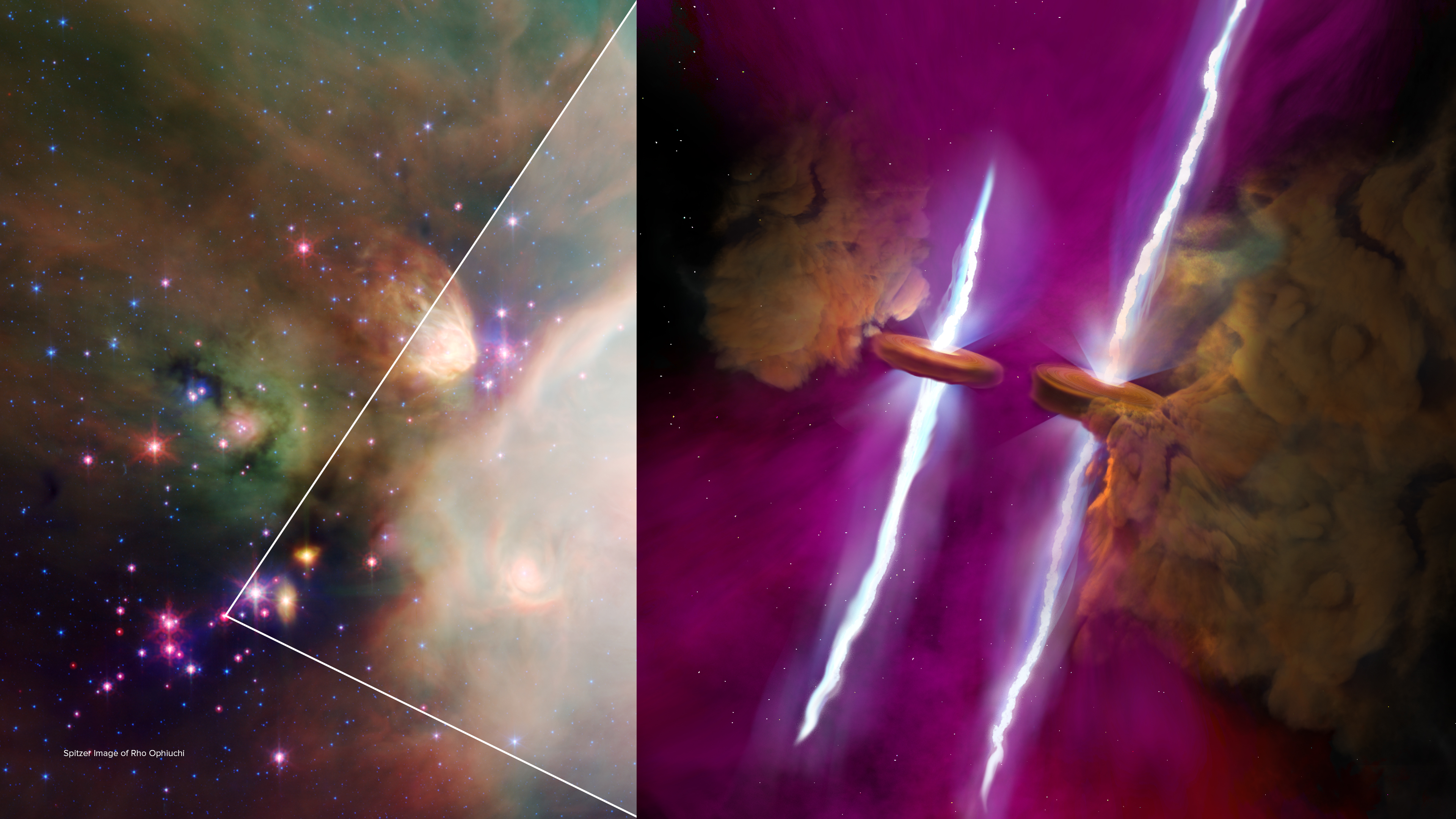
At left, a mid-infrared image of the rho Ophiuchi molecular cloud complex by NASA’s Spitzer Space Telescope, the focus pointing to star system WL20. At right, WL20 expands to reveal an artist’s impression of this new discovery. Astronomers couldn't believe their luck when observations across multiple radio and infrared wavelengths from ALMA and JWST revealed twin disks and jets erupting from a pair of young binary stars in WL20. Credit: U.S. NSF/ NSF NRAO/B. Saxton.; NASA/JPL-Caltech/Harvard-Smithsonian CfA. Hi-Res File

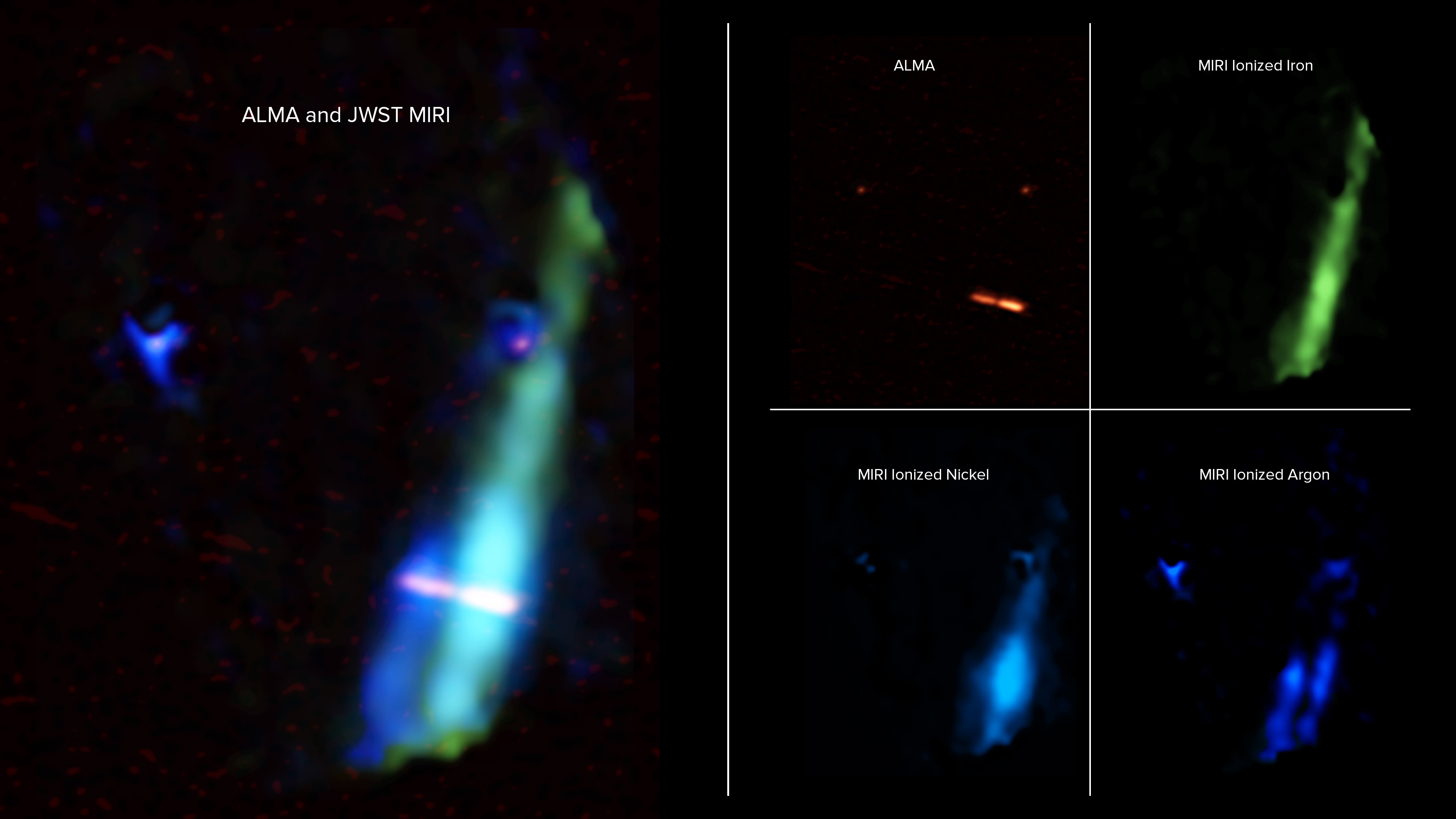
These brightly colored shapes represent astronomical data collected by NRAO's ALMA and NASA's JWST telescopes. At left, a composite image overlaps ALMA and JWST data revealing the discs and parallel jets emitting from the pair of binary stars in WL20. At right, the breakdown of the separate ALMA data, and JWST data representing various chemical compositions, is shown. Credit: U.S. NSF/ NSF NRAO/ ALMA(ESO/NAOJ/NRAO)/ NASA/ JPL-Caltech/ JWST/ B. Saxton. Hi-Res File


Telescopes from the U.S. National Science Foundation’s National Radio Astronomy Observatory and NASA’s Jet Propulsion Laboratory discover dynamic duo

Most of the Universe is invisible to the human eye. The building blocks of stars are only revealed in wavelengths that are outside of the visible spectrum. Astronomers recently used two very different, and very powerful, telescopes to discover twin disks—and twin parallel jets—erupting from young stars in a multiple star system. This discovery was unexpected, and unprecedented, given the age, size, and chemical makeup of the stars, disks, and jets. Their location in a known, well-studied part of the Universe adds to the thrill.

Observations from the U.S. National Science Foundation’s (NSF) National Radio Astronomy Observatory’s (NRAO) Atacama Large Millimeter/submillimeter Array (ALMA) and NASA’s James Webb Space Telescope’s (JWST) Mid-Infrared Instrument (MIRI) were combined for this research.

ALMA and JWST’s MIRI observe very different parts of the electromagnetic spectrum. Using them together allowed astronomers to discover these twins, hidden in radio and infrared wavelengths in star system WL20, located in the nearby rho Ophiuchi molecular cloud complex, over 400 light years away from the Earth’s Solar System.

“What we discovered was absolutely wild,” shares astronomer Mary Barsony, “We’ve known about star system WL20 for a long time. But what caught our attention is that one of the stars in the system appeared much younger than the rest. Using MIRI and ALMA together, we actually saw that this ONE star was TWO stars right next to each other. Each of these stars was surrounded by a disk, and each disc was emitting jets parallel to the other.”

ALMA spotted the discs, while MIRI found the jets. Co-author Valentin J.M. Le Gouellec of NASA-ARC retrieved and reduced ALMA archival data to reveal the discs’ composition, while Lukasz Tychoniec of Leiden Observatory provided high-resolution images, revealing the discs massive size, approximately 100 times the distance between the Earth and the Sun. Another co-author, Martijn L. van Gelder, provided resources to process the data collected by MIRI, revealing the chemical makeup of the jets.

Adds Barsony, “So if it weren’t for MIRI, we wouldn’t even know that these jets existed, which is amazing.” ALMA’s high resolution observations of the disks surrounding the two newly observed stars revealed the disks’ structure, as Barsony explains,“Someone looking at this ALMA data not knowing there were twin jets would think, oh, it’s a large edge on disk with a central hole, instead of two edge on disks and two jets. That’s pretty remarkable.”

Another remarkable thing about this discovery is that it may never have had the opportunity to happen. Explains JPL scientist Michael Ressler, “A lot of the research about binary protostars focuses on a few nearby star forming regions. I had been awarded some observing time of my own with JWST, and I chose to split it into a few small projects. For one project, I decided to study binaries in the Perseus star forming region. However, I had been studying WL20, which is in the rho Ophiuchus region in nearly the opposite part of the sky, for nearly 30 years, and I thought, ‘why not sneak it in? I’m never going to get another chance, even if it doesn’t quite fit with the others.’ We had a very fortunate accident with what we found, and the results are stunning.”

By combining multi-wavelength data from ALMA and JWST, these new findings shed light on the complex processes involved in the formation of multiple star systems. Astronomers plan to utilize ALMA’s future upgraded capabilities, like the Wideband Sensitivity Upgrade, to continue unraveling the mysteries surrounding the birth of stars and planetary systems.


About ALMA & NRAO

The Atacama Large Millimeter/submillimeter Array (ALMA), an international astronomy facility, is a partnership of the European Southern Observatory (ESO), the U.S. National Science Foundation (NSF) and the National Institutes of Natural Sciences (NINS) of Japan in cooperation with the Republic of Chile. ALMA is funded by ESO on behalf of its Member States, by NSF in cooperation with the National Research Council of Canada (NRC) and the National Science and Technology Council (NSTC) in Taiwan and by NINS in cooperation with the Academia Sinica (AS) in Taiwan and the Korea Astronomy and Space Science Institute (KASI).

ALMA construction and operations are led by ESO on behalf of its Member States; by the National Radio Astronomy Observatory (NRAO), managed by Associated Universities, Inc. (AUI), on behalf of North America; and by the National Astronomical Observatory of Japan (NAOJ) on behalf of East Asia. The Joint ALMA Observatory (JAO) provides the unified leadership and management of the construction, commissioning and operation of ALMA.

The NRAO is a facility of the U.S. National Science Foundation, operated under cooperative agreement by Associated Universities, Inc.

About JWST

The James Webb Space Telescope is the world’s premier space science observatory. Webb is solving mysteries in our solar system, looking beyond to distant worlds around other stars, and probing the mysterious structures and origins of our universe and our place in it. Webb is an international program led by NASA with its partners, ESA (European Space Agency) and CSA (Canadian Space Agency).


Friday, March 22, 2024

NASA's Hubble Finds that Aging Brown Dwarfs Grow Lonely

Hubble Brown Dwarf Survey Illustration
Credits: Artwork: NASA, ESA, Joseph Olmsted (STScI)


It takes two to tango, but in the case of brown dwarfs that were once paired as binary systems, that relationship doesn't last for very long, according to a recent survey from NASA's Hubble Space Telescope.

Brown dwarfs are interstellar objects larger than Jupiter but smaller than the lowest-mass stars. They are born like stars – out of a cloud of gas and dust that collapses – but do not have enough mass to sustain the fusion of hydrogen like a normal star.

Astronomers using Hubble confirm that companions are extremely rare around the lowest-mass and coldest brown dwarfs. Hubble can detect binaries as close to each other as a 300-million-mile separation – the approximate separation between our Sun and the asteroid belt. But they didn't find any binary pairs in a sample of brown dwarfs in the solar neighborhood. This implies that a binary pair of dwarfs is so weakly linked by gravity that they drift apart over a few hundred million years due to the pull of bypassing stars.

"Our survey confirms that widely separated companions are extremely rare among the lowest-mass and coldest isolated brown dwarfs, even though binary brown dwarfs are observed at younger ages. This suggests that such systems do not survive over time," said lead author Clémence Fontanive of the Trottier Institute for Research on Exoplanets, Université de Montréal, Canada.

In a similar survey Fontanive conducted a couple of years ago, Hubble looked at extremely young brown dwarfs and some had binary companions, confirming that star-forming mechanisms do produce binary pairs among low-mass brown dwarfs. The lack of binary companions for older brown dwarfs suggests that some may have started out as binaries, but parted ways over time.

The new Hubble findings published in The Monthly Notices of the Royal Astronomical Society further support the theory that brown dwarfs are born the same way as stars, through the gravitational collapse of a cloud of molecular hydrogen. The difference being that they do not have enough mass to sustain nuclear fusion of hydrogen for generating energy, whereas stars do. More than half of the stars in our galaxy have a companion star that resulted from these formation processes, with more massive stars more commonly found in binary systems. "The motivation for the study was really to see how low in mass the trends seen among multiple stars systems hold up," said Fontanive.

"Our Hubble survey offers direct evidence that these binaries that we observe when they're young are unlikely to survive to old ages, they're likely going to get disrupted. When they're young, they're part of a molecular cloud, and then as they age the cloud disperses. As that happens, things start moving around and stars pass by each other. Because brown dwarfs are so light, the gravitational hold tying wide binary pairs is very weak, and bypassing stars can easily tear these binaries apart," said Fontanive.

The team selected a sample of brown dwarfs previously identified by NASA's Wide-Field Infrared Survey Explorer. It sampled some of the coldest and lowest-mass old brown dwarfs in the solar neighborhood. These old brown dwarfs are so cool (a few hundred degrees warmer than Jupiter in most cases) that their atmospheres contain water vapor that condensed out.

To find the coolest companions, the team used two different near-infrared filters, one in which cold brown dwarfs are bright, and another covering specific wavelengths where they appear very faint due to water absorption in their atmospheres.

"This is the best observational evidence to date that brown dwarf pairs drift apart over time," said Fontanive. "We could not have done this kind of survey and confirmed earlier models without Hubble's sharp vision and sensitivity."

The Hubble Space Telescope has been operating for over three decades and continues to make ground-breaking discoveries that shape our fundamental understanding of the universe. Hubble is a project of international cooperation between NASA and ESA (European Space Agency). NASA's Goddard Space Flight Center in Greenbelt, Maryland, manages the telescope. Goddard also conducts mission operations with Lockheed Martin Space based in Denver, Colorado. The Space Telescope Science Institute in Baltimore, Maryland, which is operated by the Association of Universities for Research in Astronomy, conducts Hubble science operations for NASA.


About This Release:

Credits:

Media Contact:

Ray Villard
Space Telescope Science Institute, Baltimore, Maryland

Science Contact:

Clémence Fontanive
Trottier Institute for Research on Exoplanets at Université de Montréal

Permissions: Content Use Policy

Contact Us: Direct inquiries to the News Team.

Related Links and Documents


Monday, June 27, 2022

Insights from Binary Stars in the Milky Way

This collage shows dozens of binary star systems seen by the Gaia spacecraft
Credit:
ESA/Gaia/DPAC


Tidal forces are perhaps best known for generating tidal tails and streams in interacting galaxies, but a galaxy’s tidal pull can have subtle effects on binary star systems as well. Credit:
NASA, H. Ford (JHU), G. Illingworth (UCSC/LO), M. Clampin (STScI), G. Hartig (STScI), the ACS Science Team and ESA
 
Many stars travel through space with a binary companion, and large-scale surveys allow us to study enormous numbers of these stellar pairs. What do these surveys tell us about the characteristics of binary stars in the Milky Way?

Stars Awash in the Galactic Tide

The orbital parameters of a binary star system — namely, the distance between the stars and how eccentric (non-circular) their orbits are — can encode information about the formation and evolution of the binary system as well as the evolution of the stars themselves. The orbits of binary stars are susceptible to outside influence, too; gravitational nudges from passing stars, nearby gas clouds, and the overall tidal pull of the galaxy can change a binary system’s orbits over time.

When we examine the orbits of binary systems in the Milky Way with observations from the sky-mapping Gaia spacecraft, we find unexpected trends in the orbital parameters of binary systems near the Sun. Namely, among binary systems separated by large distances (>1,000 au), there are more systems with highly eccentric orbits than expected. What’s the origin of this trend?

Nature vs. Nurture

As Chris Hamilton (Institute for Advanced Study) explains in a recent research article, understanding the current orbits of binary stars in the Milky Way requires separating the effects of nature (the eccentricities that the binary systems are born with) and nurture (the outside gravitational effects of passing stars and the background galactic pull).

Hamilton approached this problem by modeling the effects of the Milky Way’s overall gravitational pull on populations of synthetic binary stars in the outer regions of the galaxy. In order to test the effects of nature as well as nurture, Hamilton modeled populations with different initial eccentricity distributions: uniform (all eccentricities are equally common), thermal (the binaries have reached statistical equilibrium through gravitational interactions; represented by the gray lines in the figure to the right), subthermal (fewer eccentric binaries than the thermal case), and superthermal (more eccentric binaries than the thermal case, as we see near the Sun).


The final distribution of eccentricities (black lines) and best-fitting power laws (green lines) acquired from various initial distributions (red lines). These results show that a superthermal eccentricity distribution, as is seen in binary systems near the Sun, can only arise from a distribution that is initially superthermal. Credit: Adapted from Hamilton 2022


Maybe They’re Born with It, Maybe It’s the Tidal Influence of the Milky Way

The model results show that the tidal pull of the Milky Way tends not to change the eccentricity distribution of a population of binary stars. Put another way, this means that the high number of wide, eccentric binary systems in the solar neighborhood can’t have been caused by the Milky Way’s gravitational influence — another factor, such as the combined effects of individual gravitational nudges from passing stars and gas clouds, must have caused this trend, or binary systems in the solar neighborhood must be born with a similar distribution of eccentricities.

As is so often the case, there’s plenty more work to be done to understand this issue fully. In particular, modeling the effects of gravitational tugs from passing stars and applying new techniques to study the time evolution of binary systems will be critical to reaching a conclusion.

Citation

“On the Phase-mixed Eccentricity and Inclination Distributions of Wide Binaries in the Galaxy,” Chris Hamilton 2022 ApJL 929 L29.doi:10.3847/2041-8213/ac6600

ByKerry Hensley

Tuesday, February 01, 2022

Even dying stars can still give birth to planets

Artistic impression
Credit: N. Stecki

Planets are usually not much older than the stars around which they revolve. Take the Sun: it was born 4.6 billion years ago, and not long after that, Earth came into the world. But KU Leuven astronomers have discovered that a completely different scenario is also possible. Even if they are near death, some types of stars can possibly still form planets. If this is confirmed, theories on planet formation will need to be adjusted.

Planets such as Earth, and all other planets in our solar system, were formed not long after the Sun. Our Sun started to burn 4.6 billion years ago, and in the next million years, the matter around it clumped into protoplanets. The birth of the planets in that protoplanetary disc, a gigantic pancake made of dust and gas, so to speak, with the Sun in the middle, explains why they all orbit in the same plane.

But such discs of dust and gas needn’t necessarily only surround newborn stars. They can also develop independently from star formation, for example around binary stars of which one is dying (binary stars are two stars that orbit each other, also called a binary system). When the end approaches for a medium-sized star (like the Sun), it catapults the outer part of its atmosphere into space, after which it slowly dies out as a so-called white dwarf. However, in the case of binary stars, the gravitational pull of the second star causes the matter ejected by the dying star to form a flat, rotating disc. Moreover, this disc strongly resembles the protoplanetary discs that astronomers observe around young stars elsewhere in the Milky Way.

This we already knew. However, what is new is that the discs surrounding so-called evolved binary stars not uncommonly show signs that could point to planet formation, as discovered by an international team of astronomers led by KU Leuven researchers. What’s more, their observations show that this is the case for one in ten of these binary stars. “In ten per cent of the evolved binary stars with discs we studied, we see a large cavity (a void/opening, ed.) in the disc”, says KU Leuven astronomer Jacques Kluska, first author of the article in the journal Astronomy & Astrophysics in which the discovery is described. “This is an indication that something is floating around there that has collected all matter in the area of the cavity.”

Second-generation planets

The clean-up of the matter could be the work of a planet. That planet might not have formed at the very beginning of one of the binary stars’ life, but at the very end. The astronomers moreover found further strong indications for the presence of such planets. “In the evolved binary stars with a large cavity in the disc, we saw that heavy elements such as iron were very scarce on the surface of the dying star”, says Kluska. “This observation leads one to suspect that dust particles rich in these elements were trapped by a planet.” By the way, the Leuven astronomer doesn’t rule out the possibility that in this way, several planets can be formed around these binary stars.

The discovery was made when the astronomers were drawing up an inventory of evolved binary stars in our Milky Way. They did that based on existing, publicly available observations. Kluska and his colleagues counted 85 of such binary star pairs. In ten pairs, the researchers came across a disc with a large cavity on the infrared images.

Current theories put to the test

If new observations confirm the existence of planets around evolved binary stars, and if it turns out the planets were only formed after one of the stars had reached the end of its life, the theories on planet formation will need to be adjusted. “The confirmation or refutation of this extraordinary way of planet formation will be an unprecedented test for the current theories”, according to Professor Hans Van Winckel, head of the KU Leuven Institute of Astronomy.

The KU Leuven astronomers soon want to verify their hypothesis themselves. To this end, they will use the big telescopes of the European Southern Observatory in Chile to take a closer look at the ten pairs of binary stars whose discs show a large cavity.

More information


translated by Miriel Vandeperre


Saturday, October 30, 2021

Amateur astronomers help discovery of a warped disc around a black hole in Milky Way

Black hole with warped disc
Credit John Paice

An international team of astrophysicists from South Africa, the UK, France and the US have found large variations in the brightness of light seen from around one of the closest black holes in our Galaxy, 9,600 light-years from Earth, which they conclude is caused by a huge warp in its accretion disc.
This object, MAXI J1820+070, erupted as a new X-ray transient in March 2018 and was discovered by a Japanese X-ray telescope onboard the International Space Station. These transients, systems that exhibit violent outbursts, are binary stars, consisting of a low-mass star, similar to our Sun and a much more compact object, which can be a white dwarf, neutron star or black hole. In this case, MAXI J1820+070 contains a black hole that is at least 8 times the mass of our Sun.

The first findings have now been accepted for publication in the international highly ranked journal, Monthly Notices of the Royal Astronomical Society, whose lead author is Dr Jessymol Thomas, a Postdoctoral Research Fellow at the South African Astronomical Observatory (SAAO).

The discovery presented in the paper was made from an extensive and detailed light-curve obtained over almost a year by dedicated amateurs around the globe who are part of the AAVSO (American Association of Variable Star Observers). MAXI J1820+070 is one of the three brightest X-ray transients ever observed, a consequence of both its proximity to Earth and being outside of the obscuring plane of our Milky Way Galaxy. Because it remained bright for many months, this made it possible to be followed by so many amateurs.

Professor Phil Charles, researcher at the University of Southampton and member of the research team explained, “material from the normal star is pulled by the compact object into its surrounding accretion disc of spiralling gas. Massive outbursts occur when the material in the disc becomes hot and unstable, accretes onto the black hole and releases copious amounts of energy before traversing the event horizon. This process is chaotic and highly variable, varying on timescales from milliseconds to months.”

The research team have produced a visualisation of the system, showing how a huge X-ray output emanates from very close to the black hole, and then irradiates the surrounding matter, especially the accretion disc, heating it up to a temperature of around 10,000K, which is seen as the visual light emitted. That is why, as the X-ray outburst declines, so does the optical light.

But something unexpected happened almost 3 months after the outburst began when the optical light curve started a huge modulation – a bit like turning a dimmer switch up and down and almost doubling in brightness at its peak - on a period of about 17 hours. Yet there was no change whatsoever in the X-ray output, which remained steady. While small, quasi-periodic visible modulations had been seen in the past during other X-ray transient outbursts, nothing on this scale had ever been seen before.

What was causing this extraordinary behaviour? “With the angle of view of the system as shown in the pictorial, we could quite quickly rule out the usual explanation that the X-rays were illuminating the inner face of the donor star because the brightening was occurring at the wrong time”, said Prof. Charles. Nor could it be due to varying light from where the mass transfer stream hits the disc as the modulation gradually moved relative to the orbit.

This left only one possible explanation, the huge X-ray flux was irradiating the disc and causing it to warp, as shown in the picture. The warp provides a huge increase in the area of the disc that could be illuminated, thereby making the visual light output increase dramatically when viewed at the right time. Such behaviour had been seen in X-ray binaries with more massive donors, but never in a black-hole transient with a low mass donor like this. It opens a completely new avenue for studying the structure and properties of warped accretion discs.

Prof Charles continued, “This object has remarkable properties amongst an already interesting group of objects that have much to teach us about the end-points of stellar evolution and the formation of compact objects. We already know of a couple of dozen black hole binary systems in our Galaxy, which all have masses in the 5 – 15 solar mass range. They all grow by the accretion of matter that we have witnessed so spectacularly here.”

Starting some 5 years ago, a major science programme on the Southern African Large Telescope (SALT) to study transient objects has made a number of important observations of compact binaries, including black hole systems like MAXI J1820+070. As the Principal Investigator for this programme, Prof. Buckley, states “SALT is a perfect tool to study the changing behaviour of these X-ray binaries during their outbursts, which it can monitor regularly over periods of weeks to months and can be coordinated with observations from other telescopes, including space-based ones.”


Wednesday, November 18, 2020

The Cosmic Dust in Your Bones

Evidence indicates that large amounts of cosmic dust are produced as the stellar winds of massive stars collide in Wolf-Rayet binary or multiple-star systems. As the stars orbit each other and dust is produced, a distinctive pinwheel pattern is formed, as shown in this image from the European Southern Observatory. Warm dust like this glows in the mid-infrared wavelengths of light detectable by NASA’s James Webb Space Telescope. Confirming the origin of dust will help account for the mysterious over-abundance of it found in galaxies, which is crucial to the later development of stars, planets, and life as we know it. Credit: ESOand Callingham et al. Release image/Release videos

Discovering too much money in your bank account may not be what you would call a "crisis," but it would still be unexpected and you should figure out how it got there. Astronomers find themselves in a similar position when calculating the amount of dust galaxies should have; there is more dust than expected, and they don’t know where it’s coming from. This matters because cosmic dust is essential to the function of the universe: it shelters forming stars, becomes part of planets, and can contain the organic compounds that lead to life as we know it. Dust led to us.

"What we refer to as the 'dust budget crisis' is the major problem in astronomy of not being able to account for all the dust that's observed in galaxies, both in the nearby and distant, early universe," says Ryan Lau of the Japan Aerospace Exploration Agency. Lau is leading an Director's Discretionary-Early Release Science Program with NASA's upcoming James Webb Space Telescope to study dust-producing Wolf-Rayet binary stars.

Wolf-Rayet stars are very hot and very bright. There is evidence that Wolf-Rayet stars, through interactions with a companion star, produce large amounts of dust in a distinctive pinwheel pattern as the two stars orbit each other and their stellar winds collide. It is possible that these binary-star systems account for a large percentage of a galaxy's "dust budget." However, the intense luminosity and heat coming from the Wolf-Rayet stars has made it difficult to study the faint, more diffuse dust of these systems. This is where Webb comes in.

"The mid-infrared light that Webb can detect is exactly the wavelength of light we want to look at to study the dust and its chemical composition," Lau explains. Infrared wavelengths are longer than the wavelengths of visible light, and so can slide between dust grains to reach the telescope, rather than getting caught up bouncing around in the dust cloud. Webb will detect this light and allow astronomers to read the information it carries, including the signature of chemicals in the dusty environment, some of which may be the same chemicals that form the building blocks of life on Earth.

"Webb has an unprecedented combination of spatial resolution and sensitivity in mid-infrared wavelengths that is really what enables us to conduct these interesting observations," Lau says. "We can achieve the spatial resolution from ground-based telescopes, but lack the sensitivity that Webb can achieve from its observing location in space, without the interference of Earth's atmosphere. Conversely, with previous infrared space-based telescopes like NASA’s Spitzer mission, we could achieve the sensitivity but lacked the spatial resolution."

Targeting Two Dust Factories

Lau and the Director's Discretionary-Early Release Science (DD-ERS) team will use Webb to study two Wolf-Rayet binary systems, using the telescope's Mid-Infrared Instrument (MIRI) and Near Infrared Imager and Slitless Spectrograph (NIRISS). The WR140 binary system has been studied extensively in many wavelengths of light and so will provide a good baseline for gauging Webb's best observing modes for this kind of cosmic subject. Another Wolf-Rayet binary, WR137, will experience its stars’ closest approach to each other—when the most dust is thought to be produced—early in Webb's mission when the DD-ERS program observations are scheduled.

Beyond new discoveries about the formation and chemical composition of dust, the DD-ERS program also will be among the first opportunities astronomers have to test out best practices for Webb’s instruments and processing the data it delivers.

"This DD-ERS program will look at the best ways to maximize Webb’s dynamic range—the difference between the brightest and faintest objects it observes—and that will be useful to the astronomy community in many ways in the future; for example, in studying the dusty disk surrounding the bright center of an active galaxy, or finding a planet orbiting a bright star,” says Mansi Kasliwal, another astronomer on the DD-ERS team. Kasliwal led the laboratory at the California Institute of Technology where Lau performed his post-doctoral research on Wolf-Rayet binaries and developed the proposal for the DD-ERS program.

Both Lau and Kasliwal agree that while the open question of how cosmic dust is created and disseminated throughout the universe is a fascinating one, it is really a stepping stone toward answering one of the biggest questions ever posed: How did we get here? As far as we know, Earth is an island of life in the universe, and in seeking to understand something as seemingly remote as cosmic dust, Lau says that we are ultimately seeking to understand ourselves. "Understanding the formation of dust is critical for us to trace our own cosmic origins," Lau says. "Webb is one of the most powerful scientific tools ever built in the quest to find answers to these fundamental questions."

The James Webb Space Telescope will be the world's premier space science observatory when it launches in 2021. Webb will solve mysteries in our solar system, look beyond to distant worlds around other stars, and probe the mysterious structures and origins of our universe and our place in it. Webb is an international program led by NASA with its partners, ESA (European Space Agency) and the Canadian Space Agency.

Contact:  

Leah Ramsay / Christine Pulliam
Space Telescope Science Institute, Baltimore, Maryland
667-218-6439 / 410-338-4366

lramsay@stsci.edu / cpulliam@stsci.edu 

Related Links:  NASA's Webb Portal


 Source: NASA's James Webb Space Telescope/News